EP4342013B1 - Traîtement des gazes residues des piles à combustible, comprenant de'l hydrogène et de l'oxygène - Google Patents
Traîtement des gazes residues des piles à combustible, comprenant de'l hydrogène et de l'oxygène Download PDFInfo
- Publication number
- EP4342013B1 EP4342013B1 EP22750781.1A EP22750781A EP4342013B1 EP 4342013 B1 EP4342013 B1 EP 4342013B1 EP 22750781 A EP22750781 A EP 22750781A EP 4342013 B1 EP4342013 B1 EP 4342013B1
- Authority
- EP
- European Patent Office
- Prior art keywords
- fuel cell
- recombination
- fuel
- fuel cells
- hydrogen
- Prior art date
- Legal status (The legal status is an assumption and is not a legal conclusion. Google has not performed a legal analysis and makes no representation as to the accuracy of the status listed.)
- Active
Links
Images



Classifications
-
- H—ELECTRICITY
- H01—ELECTRIC ELEMENTS
- H01M—PROCESSES OR MEANS, e.g. BATTERIES, FOR THE DIRECT CONVERSION OF CHEMICAL ENERGY INTO ELECTRICAL ENERGY
- H01M8/00—Fuel cells; Manufacture thereof
- H01M8/06—Combination of fuel cells with means for production of reactants or for treatment of residues
- H01M8/0662—Treatment of gaseous reactants or gaseous residues, e.g. cleaning
-
- H—ELECTRICITY
- H01—ELECTRIC ELEMENTS
- H01M—PROCESSES OR MEANS, e.g. BATTERIES, FOR THE DIRECT CONVERSION OF CHEMICAL ENERGY INTO ELECTRICAL ENERGY
- H01M8/00—Fuel cells; Manufacture thereof
- H01M8/02—Details
- H01M8/0202—Collectors; Separators, e.g. bipolar separators; Interconnectors
- H01M8/0204—Non-porous and characterised by the material
- H01M8/0206—Metals or alloys
-
- H—ELECTRICITY
- H01—ELECTRIC ELEMENTS
- H01M—PROCESSES OR MEANS, e.g. BATTERIES, FOR THE DIRECT CONVERSION OF CHEMICAL ENERGY INTO ELECTRICAL ENERGY
- H01M8/00—Fuel cells; Manufacture thereof
- H01M8/04—Auxiliary arrangements, e.g. for control of pressure or for circulation of fluids
- H01M8/04298—Processes for controlling fuel cells or fuel cell systems
- H01M8/04313—Processes for controlling fuel cells or fuel cell systems characterised by the detection or assessment of variables; characterised by the detection or assessment of failure or abnormal function
- H01M8/04537—Electric variables
- H01M8/04544—Voltage
- H01M8/04559—Voltage of fuel cell stacks
-
- H—ELECTRICITY
- H01—ELECTRIC ELEMENTS
- H01M—PROCESSES OR MEANS, e.g. BATTERIES, FOR THE DIRECT CONVERSION OF CHEMICAL ENERGY INTO ELECTRICAL ENERGY
- H01M8/00—Fuel cells; Manufacture thereof
- H01M8/04—Auxiliary arrangements, e.g. for control of pressure or for circulation of fluids
- H01M8/04298—Processes for controlling fuel cells or fuel cell systems
- H01M8/04313—Processes for controlling fuel cells or fuel cell systems characterised by the detection or assessment of variables; characterised by the detection or assessment of failure or abnormal function
- H01M8/04537—Electric variables
- H01M8/04544—Voltage
- H01M8/04567—Voltage of auxiliary devices, e.g. batteries, capacitors
-
- H—ELECTRICITY
- H01—ELECTRIC ELEMENTS
- H01M—PROCESSES OR MEANS, e.g. BATTERIES, FOR THE DIRECT CONVERSION OF CHEMICAL ENERGY INTO ELECTRICAL ENERGY
- H01M8/00—Fuel cells; Manufacture thereof
- H01M8/04—Auxiliary arrangements, e.g. for control of pressure or for circulation of fluids
- H01M8/04298—Processes for controlling fuel cells or fuel cell systems
- H01M8/04313—Processes for controlling fuel cells or fuel cell systems characterised by the detection or assessment of variables; characterised by the detection or assessment of failure or abnormal function
- H01M8/04537—Electric variables
- H01M8/04574—Current
- H01M8/04589—Current of fuel cell stacks
-
- H—ELECTRICITY
- H01—ELECTRIC ELEMENTS
- H01M—PROCESSES OR MEANS, e.g. BATTERIES, FOR THE DIRECT CONVERSION OF CHEMICAL ENERGY INTO ELECTRICAL ENERGY
- H01M8/00—Fuel cells; Manufacture thereof
- H01M8/04—Auxiliary arrangements, e.g. for control of pressure or for circulation of fluids
- H01M8/04298—Processes for controlling fuel cells or fuel cell systems
- H01M8/04313—Processes for controlling fuel cells or fuel cell systems characterised by the detection or assessment of variables; characterised by the detection or assessment of failure or abnormal function
- H01M8/04537—Electric variables
- H01M8/04574—Current
- H01M8/04597—Current of auxiliary devices, e.g. batteries, capacitors
-
- H—ELECTRICITY
- H01—ELECTRIC ELEMENTS
- H01M—PROCESSES OR MEANS, e.g. BATTERIES, FOR THE DIRECT CONVERSION OF CHEMICAL ENERGY INTO ELECTRICAL ENERGY
- H01M8/00—Fuel cells; Manufacture thereof
- H01M8/24—Grouping of fuel cells, e.g. stacking of fuel cells
- H01M8/249—Grouping of fuel cells, e.g. stacking of fuel cells comprising two or more groupings of fuel cells, e.g. modular assemblies
-
- H—ELECTRICITY
- H01—ELECTRIC ELEMENTS
- H01M—PROCESSES OR MEANS, e.g. BATTERIES, FOR THE DIRECT CONVERSION OF CHEMICAL ENERGY INTO ELECTRICAL ENERGY
- H01M8/00—Fuel cells; Manufacture thereof
- H01M8/24—Grouping of fuel cells, e.g. stacking of fuel cells
- H01M8/2457—Grouping of fuel cells, e.g. stacking of fuel cells with both reactants being gaseous or vaporised
-
- Y—GENERAL TAGGING OF NEW TECHNOLOGICAL DEVELOPMENTS; GENERAL TAGGING OF CROSS-SECTIONAL TECHNOLOGIES SPANNING OVER SEVERAL SECTIONS OF THE IPC; TECHNICAL SUBJECTS COVERED BY FORMER USPC CROSS-REFERENCE ART COLLECTIONS [XRACs] AND DIGESTS
- Y02—TECHNOLOGIES OR APPLICATIONS FOR MITIGATION OR ADAPTATION AGAINST CLIMATE CHANGE
- Y02E—REDUCTION OF GREENHOUSE GAS [GHG] EMISSIONS, RELATED TO ENERGY GENERATION, TRANSMISSION OR DISTRIBUTION
- Y02E60/00—Enabling technologies; Technologies with a potential or indirect contribution to GHG emissions mitigation
- Y02E60/30—Hydrogen technology
- Y02E60/50—Fuel cells
Definitions
- the invention relates to a fuel cell arrangement with fuel cells and a residual gas treatment device for hydrogen-containing and oxygen-containing residual gases from the fuel cells and to a method for treating hydrogen-containing and oxygen-containing residual gases from fuel cells.
- Fuel cells fuel cell assemblies comprising a plurality of fuel cells, and methods for their operation are extensively known in the prior art.
- Fuel cells are galvanic cells that provide the energy released during a chemical reaction, particularly an exergonic one, of at least two reaction gases, at least partially as electrical energy. Fuel cells thus serve, among other things, to supply electrical energy, but under certain circumstances also thermal energy.
- Fuel cells are used, among other things, in stationary applications to provide uninterruptible power supplies, island grids, and/or similar applications. Furthermore, fuel cells can also be used to provide thermal energy for heating purposes.
- fuel cells are also planned for vehicles, for example watercraft such as ferries or submarines, aircraft, but also for motor vehicles, in particular for electrically powered vehicles such as electric vehicles, hybrid vehicles or the like.
- fuel cells in which, in addition to or As an alternative to the use of a vehicle battery to supply electrical energy to an electric drive system of the vehicle, fuel cells can also be provided.
- a frequently used type of fuel cell is the hydrogen-oxygen fuel cell, in which electrical energy and heat are usually generated through an electrochemical reaction between hydrogen and oxygen.
- the oxygen supply can also be replaced or supplemented by air, depending on the design of the fuel cell.
- One of the reaction products is water.
- residual gases must be removed from the fuel cell in the area of each electrode, for example, a hydrogen-containing residual gas at the anode electrode and an oxygen-containing residual gas at the cathode electrode.
- hydrogen is supplied to the anode, while oxygen is supplied to the cathode.
- the electrodes interact electrochemically with each other via an electrolyte, which can be formed, for example, by a polymer electrolyte membrane or the like.
- the hydrogen can be supplied either by pure hydrogen gas or by a hydrogen-containing fuel gas.
- the oxygen can be supplied by pure oxygen gas or, for example, in the form of air.
- a direct voltage is typically provided between the electrodes, which may, for example, be approximately 1 V or less. Therefore, a plurality of fuel cells are typically operated electrically in series and can be combined to form a fuel cell stack of a fuel cell assembly.
- unconverted residual gases are produced at the outlet. These are normally released into the environment. In the case of a polymer electrolyte fuel cell, these are hydrogen-containing residual gases and oxygen-containing residual gases. If the fuel cell is required to operate in a closed system, the residual gases must be stored. To enable safe storage, the hydrogen content in the residual gases must be reduced below the explosion limit, ideally eliminated entirely.
- Non-operating modules may also have hydrogen on the oxygen side, for example if the gas spaces have been charged with hydrogen to prevent corrosion and oxidation.
- Such recombiners are, for example, in US 2008/248369 or EP 1750321 described.
- WO 2020/038907 A1 A method for treating hydrogen-containing and oxygen-containing residual gases from fuel cells and a residual gas treatment system is disclosed, for example, by WO 2020/038907 A1 .
- the doctrine of WO 2020/038907 A1 is particularly suitable for a substantially closed operation of a fuel cell arrangement, in which the residual gases should not be readily released into the environment, for example, an ambient atmosphere or the like. Even though this teaching has proven successful, disadvantages still arise. Especially when the operating state of the fuel cell changes, especially during a switch-on process or When the fuel cell is switched off, an undesirable gas composition of the residual gas mixture can arise in the residual gas circuit, which can impair the optimal use according to the theory of WO 2020/038907 A1 can influence.
- the invention is therefore based on the object of providing a fuel cell arrangement with fuel cells and a residual gas treatment device for hydrogen-containing and oxygen-containing residual gases of the fuel cells, as well as a method for treating hydrogen-containing and oxygen-containing residual gases from fuel cells in order to be able to realize a largely optimal residual gas treatment.
- the invention proposes a fuel cell arrangement with fuel cells and a residual gas treatment device for hydrogen-containing and oxygen-containing residual gases from the fuel cells, as well as a method for treating hydrogen-containing and oxygen-containing residual gases from fuel cells according to the independent claims.
- the invention solves the problem directed to a fuel cell arrangement by providing that in such a fuel cell arrangement, comprising a plurality of fuel cells electrically and mechanically combined in a fuel cell stack, further comprising a residual gas treatment device for hydrogen-containing and oxygen-containing residual gases of the fuel cells, the residual gas treatment device comprises a recombinant fuel cell with catalyst and membrane, which is conducted via an electrical circuit separate from the fuel cells.
- the structure of the fuel cell arrangement is extended by one or more so-called recombination cells.
- These fuel cells are normal cells with a catalyst and Membrane, as used in the fuel cell assembly.
- the resulting residual gases are fed into the recombinant fuel cell, where they are electrochemically converted into water.
- the recombinant fuel cell is fed via an electrical circuit separate from the rest of the fuel cell.
- the recombination fuel cell is arranged directly downstream of the fuel cells in the fuel cell stack, which enables a compact design.
- the recombinant fuel cell is located outside the fuel cell stack.
- the existing fuel cell stack can remain unchanged.
- a voltage and/or current measuring device is integrated into the recombinant fuel cell or connected to the recombinant fuel cell. This allows the conversion of hydrogen in the residual gas to be measured and, ideally, provides information about the amount of hydrogen at the outlet of the recombinant fuel cell.
- a sheet metal recombination cell is arranged between the fuel cells and the recombinant fuel cell, wherein in the sheet metal recombination cell, the membrane of the recombinant fuel cell is replaced by a sheet metal.
- the sheet metal in the center of the cell makes this sheet metal recombination cell more mechanically and thermally stable. Due to the direct reaction of reactant mixtures from the fuel cells in the fuel cell stack in the mechanically more stable sheet metal recombination cell, potential damage to the subsequent membrane recombinant fuel cell can be prevented.
- the invention relates to a process for the treatment of hydrogen-containing and oxygen-containing residual gases from fuel cells.
- the problem is solved by a method in which the residual gases from fuel cells electrically and mechanically combined in a fuel cell stack are fed to a recombination fuel cell, which is conducted via an electrical circuit separate from the fuel cells.
- the residual gases within the fuel cell stack are fed to the recombinant fuel cell.
- the residual gases are led out of the fuel cell stack and fed to a recombinant fuel cell arranged outside the stack.
- residual gases first flow through a sheet metal recombination cell in which a membrane of the recombination fuel cell is replaced by a sheet metal before being fed into the recombination fuel cell.
- the recombination of residual gases can be integrated directly into the structure of the fuel cell stack.
- the reactivity of the recombination cell can be measured using voltage and/or current measurements, eliminating the need for additional gas sensors. Integration into the fuel cell stack offers a significant geometric advantage. Due to its design, the recombination system can be optimally cooled. In certain cases, energy recovery from the reactants would also be possible.
- FIG 1 shows a simplified representation of a fuel cell arrangement 1 comprising a fuel cell stack 2 and an operating part 13.
- the fuel cell stack 2 consists of several individual fuel cells 3, here PEM fuel cells, stacked on top of one another and thus electrically connected in series.
- FIG. 1 a residual gas treatment device 4 according to the invention for hydrogen-containing and oxygen-containing residual gases from the fuel cells 3 of the fuel cell stack 2.
- This residual gas treatment device 4 comprises a recombinant fuel cell 5, the basic structure of which does not differ from that of a fuel cell 3 of the fuel cell stack 2.
- the recombinant fuel cell 5 is connected downstream of the fuel cells 3 with respect to a flow direction 9 of the reactants, but is not electrically connected in series with them, but is guided via an electrical circuit 8 separate from the fuel cells 3.
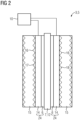
- FIG. 2 shows a simplified cross-sectional view of the fuel cell structure.
- Each of the fuel cells 3 or recombinant fuel cells 5 has a membrane 7 and, on both sides thereof, a catalyst layer 6 and a gas diffusion layer 14.
- the gas diffusion layer 14 and the catalyst layer 6 together form a gas diffusion electrode 24.
- a bipolar plate 15 which establishes the electrical connection to the next fuel cell 3 and in which gas distribution structures 16 are incorporated, through which gas spaces 17 and 18 for the reactants hydrogen and oxygen are formed.
- the electrode 24 adjacent to a gas space 17 for hydrogen is also called the anode
- the operating part 13 of the fuel cell assembly 1 comprises connection technology, sensors, valves, water separators, etc. Therefore, there are connections for the hydrogen supply 19 and discharge 20 and connections for the oxygen supply 21 and discharge 22. Furthermore, at the end of the fuel cell assembly 1 on the operating part side, electrical load connections 23 are led outwards, to which a load (not shown) to be supplied with current from the fuel cell assembly 1 can be connected.
- the recombination fuel cell 5 is arranged directly downstream of the fuel cells 3 in the fuel cell stack 2 in the flow direction 9 of the reactants, so that a compact structure is achieved.
- Figure 3 shows an alternative embodiment of a fuel cell arrangement 1 according to the invention, in which the recombination fuel cell 5 is arranged outside the fuel cell stack 2 downstream of the fuel cells 3 in the flow direction 9 of the reactants.
- a voltage and/or current measuring device 10 is integrated into the recombinant fuel cell 5 (see Figure 2 ).
- the corresponding connections to circuit 8 are located in the area of the other connections.
- Figure 3 Corresponding connections are found on the external recombination fuel cell 5.
- the fuel cell arrangement of the Figure 4 is compared to the embodiment of the Figure 1 by arranging a sheet metal recombination cell 11 between the fuel cells 3 and the recombination fuel cell 5.
- the structure of such a sheet metal recombination cell 11 differs from that of the recombinant fuel cell 5 in that the membrane 7 of the recombinant fuel cell 5 is replaced by a sheet 12, whereby the mechanical stability is increased compared to the recombinant fuel cell 5 and the mechanical or thermal stress due to the reaction of hydrogen with oxygen can already take place in this cell without damaging it, and thus possible damage to the subsequent recombinant fuel cell 5 can be prevented.
Landscapes
- Life Sciences & Earth Sciences (AREA)
- Engineering & Computer Science (AREA)
- Manufacturing & Machinery (AREA)
- Sustainable Development (AREA)
- Sustainable Energy (AREA)
- Chemical & Material Sciences (AREA)
- Chemical Kinetics & Catalysis (AREA)
- Electrochemistry (AREA)
- General Chemical & Material Sciences (AREA)
- Fuel Cell (AREA)
- Separation Using Semi-Permeable Membranes (AREA)
Claims (8)
- Agencement (1) de piles à combustible comprenant plusieurs piles (3) à combustible rassemblées électriquement et mécaniquement en un empilement (2) de piles à combustible, comprenant en outre un dispositif (4) de traitement de gaz résiduels, pour des gaz résiduels, contenant de l'hydrogène et contenant de l'oxygène, des piles (3) à combustible, dans lequel le dispositif (4) de traitement de gaz résiduels comprend une pile (5) de combustible de recombinaison ayant un catalyseur (6) et une membrane (7), qui est en conduction avec un circuit (8) de courant séparé des piles (3) à combustible, caractérisé en ce qu'un dispositif (10) de mesure de la tension ou du courant est intégré dans la pile (5) à combustible de recombinaison ou est raccordé à la pile (5) à combustible de recombinaison.
- Agencement (1) de piles à combustible suivant la revendication 1, dans lequel la pile (5) à combustible de recombinaison est, dans le sens (9) de passage des réactifs, montée directement en aval des piles (3) à combustible de l'empilement (2) de piles à combustible.
- Agencement (1) de piles à combustible suivant la revendication 1, dans lequel la pile (5) à combustible de recombinaison est montée à l'extérieur de l'empilement (2) de piles à combustible en aval des piles (3) à combustible dans le sens (9) de passage des réactifs.
- Agencement (1) de piles à combustible suivant l'une des revendications précédentes, une pile (11) de recombinaison à tôle est montée entre les piles (3) à combustible et la pile (5) à combustible de recombinaison, dans lequel, dans la pile (11) de recombinaison à tôle, la membrane (7) de la pile (5) à combustible de recombinaison est remplacée par une tôle (12).
- Procédé de traitement de gaz résiduels, contenant de l'hydrogène et contenant de l'oxygène, de piles (3) à combustible, dans lequel on envoie les gaz résiduels de piles (3) à combustible, rassemblées électriquement et mécaniquement en un empilement (2) de piles à combustible, à une pile (5) à combustible de recombinaison, qui est en conduction avec un circuit (8) de courant séparé des piles (3) à combustible, caractérisé en ce que l'on mesure la tension et/ou l'intensité du courant de la pile (5) à combustible de recombinaison.
- Procédé suivant la revendication 5, dans lequel on envoie, à la pile (5) à combustible de recombinaison, les gaz résiduels à l'intérieur de l'empilement (2) de piles à combustible.
- Procédé suivant la revendication 5, dans lequel on fait sortir les gaz résiduels de l'empilement (2) de piles à combustible et on les envoie à la pile (5) à combustible de recombinaison.
- Procédé suivant l'une des revendications 5 à 7, dans lequel des gaz résiduels passent d'abord dans une cellule (11) de recombinaison à tôle, dans laquelle au lieu d'une membrane (7), comme dans la pile (5) à combustible de recombinaison, est disposée une tôle (12), avant de les envoyer dans la pile (5) à combustible de recombinaison.
Applications Claiming Priority (2)
| Application Number | Priority Date | Filing Date | Title |
|---|---|---|---|
| DE102021208146.0A DE102021208146A1 (de) | 2021-07-28 | 2021-07-28 | Behandlung wasserstoffhaltiger und sauerstoffhaltiger Restgase von Brennstoffzellen |
| PCT/EP2022/069251 WO2023006396A1 (fr) | 2021-07-28 | 2022-07-11 | Traitement de gaz résiduels contenant de l'hydrogène et de l'oxygène de piles à combustible |
Publications (2)
| Publication Number | Publication Date |
|---|---|
| EP4342013A1 EP4342013A1 (fr) | 2024-03-27 |
| EP4342013B1 true EP4342013B1 (fr) | 2025-06-04 |
Family
ID=82786806
Family Applications (1)
| Application Number | Title | Priority Date | Filing Date |
|---|---|---|---|
| EP22750781.1A Active EP4342013B1 (fr) | 2021-07-28 | 2022-07-11 | Traîtement des gazes residues des piles à combustible, comprenant de'l hydrogène et de l'oxygène |
Country Status (8)
| Country | Link |
|---|---|
| US (1) | US20240258545A1 (fr) |
| EP (1) | EP4342013B1 (fr) |
| KR (1) | KR20240036092A (fr) |
| CA (1) | CA3227578A1 (fr) |
| DE (1) | DE102021208146A1 (fr) |
| ES (1) | ES3040367T3 (fr) |
| PT (1) | PT4342013T (fr) |
| WO (1) | WO2023006396A1 (fr) |
Citations (1)
| Publication number | Priority date | Publication date | Assignee | Title |
|---|---|---|---|---|
| EP1750321B1 (fr) * | 2005-07-29 | 2015-12-02 | Siemens Aktiengesellschaft | Procédé d'opération d'un ensemble de piles à combustible avec un mélange gazeux comprenant une proportion d'un gaz inerte et une proportion d'un gaz de réaction et batterie de piles à combustible pour celui-ci |
Family Cites Families (3)
| Publication number | Priority date | Publication date | Assignee | Title |
|---|---|---|---|---|
| US20050014037A1 (en) * | 2002-12-04 | 2005-01-20 | Chris Boyer | Fuel cell with recombination catalyst |
| US20080248369A1 (en) * | 2007-04-04 | 2008-10-09 | De Vaal Jacob W | Fuel cell system with flame arresting recombiner |
| EP3614475A1 (fr) * | 2018-08-20 | 2020-02-26 | Siemens Aktiengesellschaft | Procédé de traitement du gaz résiduel contenant de l'hydrogène et de l'oxygène des piles à combustible ainsi que système de traitement du gaz résiduel |
-
2021
- 2021-07-28 DE DE102021208146.0A patent/DE102021208146A1/de not_active Withdrawn
-
2022
- 2022-07-11 WO PCT/EP2022/069251 patent/WO2023006396A1/fr not_active Ceased
- 2022-07-11 KR KR1020247006287A patent/KR20240036092A/ko active Pending
- 2022-07-11 EP EP22750781.1A patent/EP4342013B1/fr active Active
- 2022-07-11 CA CA3227578A patent/CA3227578A1/fr active Pending
- 2022-07-11 US US18/292,363 patent/US20240258545A1/en active Pending
- 2022-07-11 ES ES22750781T patent/ES3040367T3/es active Active
- 2022-07-11 PT PT227507811T patent/PT4342013T/pt unknown
Patent Citations (1)
| Publication number | Priority date | Publication date | Assignee | Title |
|---|---|---|---|---|
| EP1750321B1 (fr) * | 2005-07-29 | 2015-12-02 | Siemens Aktiengesellschaft | Procédé d'opération d'un ensemble de piles à combustible avec un mélange gazeux comprenant une proportion d'un gaz inerte et une proportion d'un gaz de réaction et batterie de piles à combustible pour celui-ci |
Also Published As
| Publication number | Publication date |
|---|---|
| WO2023006396A1 (fr) | 2023-02-02 |
| CA3227578A1 (fr) | 2023-02-02 |
| DE102021208146A1 (de) | 2023-02-02 |
| PT4342013T (pt) | 2025-07-30 |
| US20240258545A1 (en) | 2024-08-01 |
| ES3040367T3 (en) | 2025-10-30 |
| KR20240036092A (ko) | 2024-03-19 |
| EP4342013A1 (fr) | 2024-03-27 |
Similar Documents
| Publication | Publication Date | Title |
|---|---|---|
| EP0596366B1 (fr) | Procédé et dispositif pour évacuation de l'eau et des gaz inertes dans une batterie de piles à combustible | |
| DE19857398B4 (de) | Brennstoffzellensystem, insbesondere für elektromotorisch angetriebene Fahrzeuge | |
| DE102014210511B4 (de) | Brennstoffzellenverwaltungsverfahren | |
| EP1333517A2 (fr) | Dispositif de piles à combustible et systeme pour ce dispositif de piles à combustible | |
| EP4182986B1 (fr) | Empilement de piles à combustible, appareil à pile à combustible et véhicule à pile à combustible | |
| EP1256142B1 (fr) | Pile a combustible alcaline a oxydation directe du methanol | |
| EP4342013B1 (fr) | Traîtement des gazes residues des piles à combustible, comprenant de'l hydrogène et de l'oxygène | |
| EP3676898B1 (fr) | Procédé de protection de piles individuelles, systeme de piles à combustible et véhicule automobile | |
| DE102010054305A1 (de) | Brennstoffzellenstapel mit mehreren Brennstoffzellen | |
| DE102008041225A1 (de) | Brennstoffzelle sowie Verfahren zum Betreiben derselben | |
| DE102017101515A1 (de) | Brennstoffzellenstapel und Brennstoffzellensystem mit einem solchen | |
| WO2006056319A1 (fr) | Procede permettant de faire fonctionner une pile de cellules a combustible | |
| EP1665443B1 (fr) | Pile a combustible, et module de pile a combustible correspondant | |
| EP2850687B1 (fr) | Dispositif de stockage d'énergie électrique | |
| DE102015215497B4 (de) | Brennstoffzellenstapel mit variabler Segmentierung sowie Brennstoffzellensystem und Fahrzeug mit einem solchen | |
| DE102011009958B4 (de) | Brennstoffzellensystem mit reduzierter Kohlenstoffkorrosion sowie Verfahren zum Betreiben eines Brennstoffzellensystems | |
| DE102012213037A1 (de) | Speichereinrichtung für elektrische Energie, insbesondere Batterie oder Batteriezelle | |
| DE102018210165A1 (de) | Spannsystem für Brennstoffzellenstapel und Brennstoffzellenstapel mit einem solchen | |
| DE112006002510T5 (de) | Brennstoffzelle | |
| WO2002027834A2 (fr) | Module a piles a combustible | |
| WO2004006370A2 (fr) | Empilement de piles a combustible basse temperature | |
| DE102016116117A1 (de) | Vorrichtung zur Kompression einer Brennstoffzellenanordnung, Brennstoffzellenanordnung und Kraftfahrzeug | |
| DE102022203070A1 (de) | Brennstoffzelle mit reduzierendem Strömungsquerschnitt | |
| DE102019208311A1 (de) | Segmentierte Einlageplatte für einen Brennstoffzellenstapel | |
| DE102017100738A1 (de) | Brennstoffzellenstapel mit erhöhter Beständigkeit gegenüber Spannungsumkehr sowie Brennstoffzellensystem und Fahrzeug mit einem solchen |
Legal Events
| Date | Code | Title | Description |
|---|---|---|---|
| STAA | Information on the status of an ep patent application or granted ep patent |
Free format text: STATUS: UNKNOWN |
|
| STAA | Information on the status of an ep patent application or granted ep patent |
Free format text: STATUS: THE INTERNATIONAL PUBLICATION HAS BEEN MADE |
|
| PUAI | Public reference made under article 153(3) epc to a published international application that has entered the european phase |
Free format text: ORIGINAL CODE: 0009012 |
|
| STAA | Information on the status of an ep patent application or granted ep patent |
Free format text: STATUS: REQUEST FOR EXAMINATION WAS MADE |
|
| 17P | Request for examination filed |
Effective date: 20231222 |
|
| AK | Designated contracting states |
Kind code of ref document: A1 Designated state(s): AL AT BE BG CH CY CZ DE DK EE ES FI FR GB GR HR HU IE IS IT LI LT LU LV MC MK MT NL NO PL PT RO RS SE SI SK SM TR |
|
| DAV | Request for validation of the european patent (deleted) | ||
| DAX | Request for extension of the european patent (deleted) | ||
| GRAP | Despatch of communication of intention to grant a patent |
Free format text: ORIGINAL CODE: EPIDOSNIGR1 |
|
| STAA | Information on the status of an ep patent application or granted ep patent |
Free format text: STATUS: GRANT OF PATENT IS INTENDED |
|
| INTG | Intention to grant announced |
Effective date: 20250124 |
|
| GRAS | Grant fee paid |
Free format text: ORIGINAL CODE: EPIDOSNIGR3 |
|
| GRAA | (expected) grant |
Free format text: ORIGINAL CODE: 0009210 |
|
| STAA | Information on the status of an ep patent application or granted ep patent |
Free format text: STATUS: THE PATENT HAS BEEN GRANTED |
|
| AK | Designated contracting states |
Kind code of ref document: B1 Designated state(s): AL AT BE BG CH CY CZ DE DK EE ES FI FR GB GR HR HU IE IS IT LI LT LU LV MC MK MT NL NO PL PT RO RS SE SI SK SM TR |
|
| REG | Reference to a national code |
Ref country code: GB Ref legal event code: FG4D Free format text: NOT ENGLISH |
|
| REG | Reference to a national code |
Ref country code: CH Ref legal event code: EP |
|
| REG | Reference to a national code |
Ref country code: DE Ref legal event code: R096 Ref document number: 502022004183 Country of ref document: DE |
|
| REG | Reference to a national code |
Ref country code: IE Ref legal event code: FG4D Free format text: LANGUAGE OF EP DOCUMENT: GERMAN |
|
| REG | Reference to a national code |
Ref country code: PT Ref legal event code: SC4A Ref document number: 4342013 Country of ref document: PT Date of ref document: 20250730 Kind code of ref document: T Free format text: AVAILABILITY OF NATIONAL TRANSLATION Effective date: 20250724 |
|
| REG | Reference to a national code |
Ref country code: SE Ref legal event code: TRGR |
|
| REG | Reference to a national code |
Ref country code: NL Ref legal event code: MP Effective date: 20250604 |
|
| PG25 | Lapsed in a contracting state [announced via postgrant information from national office to epo] |
Ref country code: FI Free format text: LAPSE BECAUSE OF FAILURE TO SUBMIT A TRANSLATION OF THE DESCRIPTION OR TO PAY THE FEE WITHIN THE PRESCRIBED TIME-LIMIT Effective date: 20250604 |
|
| PGFP | Annual fee paid to national office [announced via postgrant information from national office to epo] |
Ref country code: ES Payment date: 20250812 Year of fee payment: 4 Ref country code: PT Payment date: 20250725 Year of fee payment: 4 |
|
| PGFP | Annual fee paid to national office [announced via postgrant information from national office to epo] |
Ref country code: DE Payment date: 20250728 Year of fee payment: 4 |
|
| REG | Reference to a national code |
Ref country code: LT Ref legal event code: MG9D |
|
| PG25 | Lapsed in a contracting state [announced via postgrant information from national office to epo] |
Ref country code: GR Free format text: LAPSE BECAUSE OF FAILURE TO SUBMIT A TRANSLATION OF THE DESCRIPTION OR TO PAY THE FEE WITHIN THE PRESCRIBED TIME-LIMIT Effective date: 20250905 |
|
| PGFP | Annual fee paid to national office [announced via postgrant information from national office to epo] |
Ref country code: NO Payment date: 20250718 Year of fee payment: 4 |
|
| PG25 | Lapsed in a contracting state [announced via postgrant information from national office to epo] |
Ref country code: PL Free format text: LAPSE BECAUSE OF FAILURE TO SUBMIT A TRANSLATION OF THE DESCRIPTION OR TO PAY THE FEE WITHIN THE PRESCRIBED TIME-LIMIT Effective date: 20250604 |
|
| PGFP | Annual fee paid to national office [announced via postgrant information from national office to epo] |
Ref country code: IT Payment date: 20250731 Year of fee payment: 4 |
|
| PG25 | Lapsed in a contracting state [announced via postgrant information from national office to epo] |
Ref country code: BG Free format text: LAPSE BECAUSE OF FAILURE TO SUBMIT A TRANSLATION OF THE DESCRIPTION OR TO PAY THE FEE WITHIN THE PRESCRIBED TIME-LIMIT Effective date: 20250604 |
|
| PG25 | Lapsed in a contracting state [announced via postgrant information from national office to epo] |
Ref country code: HR Free format text: LAPSE BECAUSE OF FAILURE TO SUBMIT A TRANSLATION OF THE DESCRIPTION OR TO PAY THE FEE WITHIN THE PRESCRIBED TIME-LIMIT Effective date: 20250604 |
|
| PGFP | Annual fee paid to national office [announced via postgrant information from national office to epo] |
Ref country code: AT Payment date: 20251020 Year of fee payment: 4 Ref country code: FR Payment date: 20250725 Year of fee payment: 4 |
|
| PGFP | Annual fee paid to national office [announced via postgrant information from national office to epo] |
Ref country code: SE Payment date: 20250725 Year of fee payment: 4 |
|
| PG25 | Lapsed in a contracting state [announced via postgrant information from national office to epo] |
Ref country code: RS Free format text: LAPSE BECAUSE OF FAILURE TO SUBMIT A TRANSLATION OF THE DESCRIPTION OR TO PAY THE FEE WITHIN THE PRESCRIBED TIME-LIMIT Effective date: 20250904 |
|
| PG25 | Lapsed in a contracting state [announced via postgrant information from national office to epo] |
Ref country code: LV Free format text: LAPSE BECAUSE OF FAILURE TO SUBMIT A TRANSLATION OF THE DESCRIPTION OR TO PAY THE FEE WITHIN THE PRESCRIBED TIME-LIMIT Effective date: 20250604 |
|
| REG | Reference to a national code |
Ref country code: ES Ref legal event code: FG2A Ref document number: 3040367 Country of ref document: ES Kind code of ref document: T3 Effective date: 20251030 |
|
| PG25 | Lapsed in a contracting state [announced via postgrant information from national office to epo] |
Ref country code: NL Free format text: LAPSE BECAUSE OF FAILURE TO SUBMIT A TRANSLATION OF THE DESCRIPTION OR TO PAY THE FEE WITHIN THE PRESCRIBED TIME-LIMIT Effective date: 20250604 |
|
| PG25 | Lapsed in a contracting state [announced via postgrant information from national office to epo] |
Ref country code: IS Free format text: LAPSE BECAUSE OF FAILURE TO SUBMIT A TRANSLATION OF THE DESCRIPTION OR TO PAY THE FEE WITHIN THE PRESCRIBED TIME-LIMIT Effective date: 20251004 |
|
| PG25 | Lapsed in a contracting state [announced via postgrant information from national office to epo] |
Ref country code: SM Free format text: LAPSE BECAUSE OF FAILURE TO SUBMIT A TRANSLATION OF THE DESCRIPTION OR TO PAY THE FEE WITHIN THE PRESCRIBED TIME-LIMIT Effective date: 20250604 |
|
| PG25 | Lapsed in a contracting state [announced via postgrant information from national office to epo] |
Ref country code: CZ Free format text: LAPSE BECAUSE OF FAILURE TO SUBMIT A TRANSLATION OF THE DESCRIPTION OR TO PAY THE FEE WITHIN THE PRESCRIBED TIME-LIMIT Effective date: 20250604 |
|
| PG25 | Lapsed in a contracting state [announced via postgrant information from national office to epo] |
Ref country code: EE Free format text: LAPSE BECAUSE OF FAILURE TO SUBMIT A TRANSLATION OF THE DESCRIPTION OR TO PAY THE FEE WITHIN THE PRESCRIBED TIME-LIMIT Effective date: 20250604 |
|
| PG25 | Lapsed in a contracting state [announced via postgrant information from national office to epo] |
Ref country code: SK Free format text: LAPSE BECAUSE OF FAILURE TO SUBMIT A TRANSLATION OF THE DESCRIPTION OR TO PAY THE FEE WITHIN THE PRESCRIBED TIME-LIMIT Effective date: 20250604 |
|
| REG | Reference to a national code |
Ref country code: CH Ref legal event code: H13 Free format text: ST27 STATUS EVENT CODE: U-0-0-H10-H13 (AS PROVIDED BY THE NATIONAL OFFICE) Effective date: 20260224 |
|
| REG | Reference to a national code |
Ref country code: DE Ref legal event code: R097 Ref document number: 502022004183 Country of ref document: DE |
|
| PG25 | Lapsed in a contracting state [announced via postgrant information from national office to epo] |
Ref country code: RO Free format text: LAPSE BECAUSE OF FAILURE TO SUBMIT A TRANSLATION OF THE DESCRIPTION OR TO PAY THE FEE WITHIN THE PRESCRIBED TIME-LIMIT Effective date: 20250604 |
|
| PG25 | Lapsed in a contracting state [announced via postgrant information from national office to epo] |
Ref country code: LU Free format text: LAPSE BECAUSE OF NON-PAYMENT OF DUE FEES Effective date: 20250711 |
|
| REG | Reference to a national code |
Ref country code: BE Ref legal event code: MM Effective date: 20250731 |
|
| PG25 | Lapsed in a contracting state [announced via postgrant information from national office to epo] |
Ref country code: MC Free format text: LAPSE BECAUSE OF FAILURE TO SUBMIT A TRANSLATION OF THE DESCRIPTION OR TO PAY THE FEE WITHIN THE PRESCRIBED TIME-LIMIT Effective date: 20250604 |
|
| PLBE | No opposition filed within time limit |
Free format text: ORIGINAL CODE: 0009261 |
|
| STAA | Information on the status of an ep patent application or granted ep patent |
Free format text: STATUS: NO OPPOSITION FILED WITHIN TIME LIMIT |
|
| PG25 | Lapsed in a contracting state [announced via postgrant information from national office to epo] |
Ref country code: DK Free format text: LAPSE BECAUSE OF FAILURE TO SUBMIT A TRANSLATION OF THE DESCRIPTION OR TO PAY THE FEE WITHIN THE PRESCRIBED TIME-LIMIT Effective date: 20250604 |
|
| PG25 | Lapsed in a contracting state [announced via postgrant information from national office to epo] |
Ref country code: BE Free format text: LAPSE BECAUSE OF NON-PAYMENT OF DUE FEES Effective date: 20250731 |
|
| REG | Reference to a national code |
Ref country code: CH Ref legal event code: L10 Free format text: ST27 STATUS EVENT CODE: U-0-0-L10-L00 (AS PROVIDED BY THE NATIONAL OFFICE) Effective date: 20260416 |
|
| PG25 | Lapsed in a contracting state [announced via postgrant information from national office to epo] |
Ref country code: CH Free format text: LAPSE BECAUSE OF NON-PAYMENT OF DUE FEES Effective date: 20250731 |