EP4342811A1 - Container and container assembly - Google Patents
Container and container assembly Download PDFInfo
- Publication number
- EP4342811A1 EP4342811A1 EP22804443.4A EP22804443A EP4342811A1 EP 4342811 A1 EP4342811 A1 EP 4342811A1 EP 22804443 A EP22804443 A EP 22804443A EP 4342811 A1 EP4342811 A1 EP 4342811A1
- Authority
- EP
- European Patent Office
- Prior art keywords
- container
- main body
- liquid
- body portion
- concave portions
- Prior art date
- Legal status (The legal status is an assumption and is not a legal conclusion. Google has not performed a legal analysis and makes no representation as to the accuracy of the status listed.)
- Granted
Links
Images



Classifications
-
- B—PERFORMING OPERATIONS; TRANSPORTING
- B65—CONVEYING; PACKING; STORING; HANDLING THIN OR FILAMENTARY MATERIAL
- B65D—CONTAINERS FOR STORAGE OR TRANSPORT OF ARTICLES OR MATERIALS, e.g. BAGS, BARRELS, BOTTLES, BOXES, CANS, CARTONS, CRATES, DRUMS, JARS, TANKS, HOPPERS, FORWARDING CONTAINERS; ACCESSORIES, CLOSURES, OR FITTINGS THEREFOR; PACKAGING ELEMENTS; PACKAGES
- B65D23/00—Details of bottles or jars not otherwise provided for
- B65D23/001—Supporting means fixed to the container
-
- B—PERFORMING OPERATIONS; TRANSPORTING
- B65—CONVEYING; PACKING; STORING; HANDLING THIN OR FILAMENTARY MATERIAL
- B65D—CONTAINERS FOR STORAGE OR TRANSPORT OF ARTICLES OR MATERIALS, e.g. BAGS, BARRELS, BOTTLES, BOXES, CANS, CARTONS, CRATES, DRUMS, JARS, TANKS, HOPPERS, FORWARDING CONTAINERS; ACCESSORIES, CLOSURES, OR FITTINGS THEREFOR; PACKAGING ELEMENTS; PACKAGES
- B65D1/00—Rigid or semi-rigid containers having bodies formed in one piece, e.g. by casting metallic material, by moulding plastics, by blowing vitreous material, by throwing ceramic material, by moulding pulped fibrous material or by deep-drawing operations performed on sheet material
- B65D1/02—Bottles or similar containers with necks or like restricted apertures, designed for pouring contents
-
- B—PERFORMING OPERATIONS; TRANSPORTING
- B65—CONVEYING; PACKING; STORING; HANDLING THIN OR FILAMENTARY MATERIAL
- B65D—CONTAINERS FOR STORAGE OR TRANSPORT OF ARTICLES OR MATERIALS, e.g. BAGS, BARRELS, BOTTLES, BOXES, CANS, CARTONS, CRATES, DRUMS, JARS, TANKS, HOPPERS, FORWARDING CONTAINERS; ACCESSORIES, CLOSURES, OR FITTINGS THEREFOR; PACKAGING ELEMENTS; PACKAGES
- B65D23/00—Details of bottles or jars not otherwise provided for
- B65D23/10—Handles
-
- B—PERFORMING OPERATIONS; TRANSPORTING
- B65—CONVEYING; PACKING; STORING; HANDLING THIN OR FILAMENTARY MATERIAL
- B65D—CONTAINERS FOR STORAGE OR TRANSPORT OF ARTICLES OR MATERIALS, e.g. BAGS, BARRELS, BOTTLES, BOXES, CANS, CARTONS, CRATES, DRUMS, JARS, TANKS, HOPPERS, FORWARDING CONTAINERS; ACCESSORIES, CLOSURES, OR FITTINGS THEREFOR; PACKAGING ELEMENTS; PACKAGES
- B65D25/00—Details of other kinds or types of rigid or semi-rigid containers
- B65D25/20—External fittings
- B65D25/22—External fittings for facilitating lifting or suspending of containers
-
- B—PERFORMING OPERATIONS; TRANSPORTING
- B65—CONVEYING; PACKING; STORING; HANDLING THIN OR FILAMENTARY MATERIAL
- B65D—CONTAINERS FOR STORAGE OR TRANSPORT OF ARTICLES OR MATERIALS, e.g. BAGS, BARRELS, BOTTLES, BOXES, CANS, CARTONS, CRATES, DRUMS, JARS, TANKS, HOPPERS, FORWARDING CONTAINERS; ACCESSORIES, CLOSURES, OR FITTINGS THEREFOR; PACKAGING ELEMENTS; PACKAGES
- B65D25/00—Details of other kinds or types of rigid or semi-rigid containers
- B65D25/20—External fittings
- B65D25/24—External fittings for spacing bases of containers from supporting surfaces, e.g. legs
-
- Y—GENERAL TAGGING OF NEW TECHNOLOGICAL DEVELOPMENTS; GENERAL TAGGING OF CROSS-SECTIONAL TECHNOLOGIES SPANNING OVER SEVERAL SECTIONS OF THE IPC; TECHNICAL SUBJECTS COVERED BY FORMER USPC CROSS-REFERENCE ART COLLECTIONS [XRACs] AND DIGESTS
- Y02—TECHNOLOGIES OR APPLICATIONS FOR MITIGATION OR ADAPTATION AGAINST CLIMATE CHANGE
- Y02W—CLIMATE CHANGE MITIGATION TECHNOLOGIES RELATED TO WASTEWATER TREATMENT OR WASTE MANAGEMENT
- Y02W30/00—Technologies for solid waste management
- Y02W30/50—Reuse, recycling or recovery technologies
- Y02W30/80—Packaging reuse or recycling, e.g. of multilayer packaging
Definitions
- the present invention relates to a container for containing a liquid and to a container assembly including this container.
- Liquids such as material liquids for foods and high-purity chemical solutions for industrial use (for example, photoresist and cleaning agent used in manufacture of semiconductors and manufacture of liquid crystal displays) are contained in containers while their high purities are maintained so as to prevent contamination by foreign substances or deterioration of the liquids. These liquids are stored and transported while being contained in the containers. Also, a container containing a liquid is set into a liquid feeder, and the liquid is discharged from the container and is used.
- the bottom surface of such a container is formed to be flat so as to enable the container to stand by itself.
- a method for discharging a liquid by means of pressure feed is a known technique.
- a liquid feed pipe and a gas supply pipe are inserted into a container, and a gas is fed into the container through the gas supply pipe so as to increase the internal pressure of the container, thereby feeding the liquid into the liquid feed pipe, whereby the liquid is discharged from the container.
- a high-pressure gas for example, 100 to 200 kPa
- a high-pressure gas for example, 100 to 200 kPa
- Patent Document 1 describes a container having a hemispherical bottom surface and a support base (cradle) for enabling the container to stand by itself.
- a concave groove formed on the outer surface of a circumferential wall of the container and being continuous in the circumferential direction and convex portions provided on the inner surface of a circumferential wall of the support base the container and the support base are fitted together. Since the bottom surface of the container is hemispherical, the internal pressure of the container generated as a result of supply of the above-described high-pressure gas acts equally on the bottom surface.
- the concave groove Since the entire bottom surface extends downward due to the pressure of the high-pressure gas, the concave groove follows this extension and extends in the manner of a helical spring. Consequently, the concave groove pushes out the convex portions of the cradle and cannot maintain the engagement with the convex portions. As a result, the container comes off the support base and falls over, and it becomes unable to stably pressure-feed the liquid.
- Patent Document 2 describes a liquid container which includes a container main body having a round bottom and a support base which has a penetrating portion at its center and which supports the container main body, thereby enabling the container main body to stand by itself. A circumferential groove for engagement with the support base is formed on the container main body.
- a liquid feeder which includes a pedestal having a protrusion which is fitted into the penetrating portion of the support base and comes into contact with the round bottom, and a pressing member which presses an upper end of the container main body.
- the container main body is sandwiched between container supports provided in the liquid feeder, such as the protrusion of the pedestal and the pressing member, even when the internal pressure of the container main body increases, the circumferential groove does not extend and the container main body does not come off the support base.
- the liquid feeder having container supports such as the protrusion and the pressing member is indispensable to pressure-feed the liquid within the container by the high-pressure gas, limitations are imposed on liquid feeders into which the container can be set, and therefore, the liquid container described in Patent Document 2 is poor in versatility.
- the present invention has been accomplished so as to solve the above-described problems, and an object of the present invention is to provide a container and a container assembly which can remarkably suppress deformation of the container, without use of container supports of a liquid feeder, even when the internal pressure of the container becomes high at the time of pressure feed of a liquid by using a high-pressure gas, whereby stable liquid feed can be performed.
- the container and the container assembly have a high degree of versatility such that, for their use, they can be set into a liquid feeder having no container support.
- a container of the present invention which has been accomplished so as to achieve the above-described object is a container used to contain a liquid and to pressure-feed the liquid, comprising an approximately cylindrical main body portion, a cylindrical mouth opening at one end of the main body portion, a stepped portion continuously extending from the other end of the main body portion and having a reduced diameter, and a round bottom portion continuously extending from the stepped portion and bulging away from the stepped portion, wherein a plurality of concave portions for engagement with claw portions of a support base which enables the container to stand by itself are intermittently formed at the stepped portion, the concave portions being recessed at positions which do not overlap with a series of parting lines extending through the main body portion, the stepped portion, and the round bottom portion, and wherein each of the concave portions has an approximately elliptical shape elongated in a circumferential direction of the main body portion, and the total length of the plurality of concave portions in the circumferential direction accounts for 20 to 50% of the largest peripheral
- the concave portions may be provided, symmetrically with respect to the parting lines, at four locations each being an angle of 20 to 45° away from the corresponding parting line or at six locations separated from one another by an angle of 60°, the angles being those about a center axis of the main body portion.
- the main body portion of each of the above-described containers has a trunk portion and a neck portion which is located closer to the cylindrical mouth and whose diameter is smaller than that of the trunk portion, and a handle is fitted and/or screwed onto an outer surface of the neck portion.
- the container assembly includes any of the above-described containers and a support base which has an opening into which the round bottom portion is fitted and claw portions which extend from a circumferential edge of the opening and are engaged with the concave portions, whereby the support base enables the container to stand by itself.
- the container and the container assembly of the present invention even when the internal pressure of the container becomes high at the time of pressure-feed of the liquid, the container does not extend or deform due to pressure, because the concave portions for engagement with the claw portions of the support base are intermittently formed at particular positions. Therefore, the support base does not come off the container, and therefore, pressure-feed of the liquid can be performed stably.
- the container since the container itself does not extend in the direction of its center axis at the time of pressure feed of the liquid, container supports for suppressing deformation of the container are not required to be provided in liquid feeders. Therefore, the container and the container assembly can cope with various types of liquid feeders and have a high degree of versatility.
- Fig. 1 shows one embodiment of a container 10 of the present invention.
- Fig. 1(a) is a front view of the container 10, and
- Fig. 1(b) is an end view taken along line A-A and viewed in the arrow direction.
- the container 10 is a container for pressure feed which contains a liquid and which can endure an internal pressure of up to 200 kPa.
- the container 10 includes a tubular main body portion 12, a cylindrical mouth 11 which is open at one end (upper end) of the main body portion 12, a stepped portion 13 which is continuous from the other end (lower end) of the main body portion 12, and a round bottom portion 15 which continuously extends away from the stepped portion 13 and bulges downward to have an approximately hemispherical shape.
- the internal space of the container 10 communicates with the outside through the cylindrical mouth 11. This opening and a lower end of an inner wall of the round bottom portion 15 face each other.
- the main body portion 12 has an upper end portion 12a at which the cylindrical mouth 11 is open, a neck portion 12b which extends from its lower end, and a trunk portion 12c which extends further downward from a lower end of the neck portion 12b.
- the diameter of the trunk portion 12c decreases gradually toward the neck portion 12b.
- external threads 12a 1 and 12b 1 protrude respectively from outer circumferential surfaces of the upper end portion 12a and the neck portion 12b.
- the container 10 is made of a resin and is formed by direct blow molding.
- a tubular resin material which is formed by extruding a molten resin at high temperature and is called parison is sandwiched in split molds having engraved desired shapes to be produced.
- a lower end of the parison is pinched off by the molds, whereby a pinched-off portion is formed.
- a portion where the parison has been pinched off becomes a bottom portion of the container.
- compressed air is fed into the parison through a blow pin.
- Parting lines PL which are marks of the mating interface of the split molds, are formed continuously through the upper end portion 12a, the neck portion 12b, the trunk portion 12c, the stepped portion 13, and the round bottom portion 15.
- the stepped portion 13 which is continuous with and directly adjacent to the round bottom portion 15, has a slightly larger thickness in the vicinity of the parting lines PL, as compared with wall thicknesses at other locations on the same circumference. This thicker portion contributes to increasing rigidity, thereby suppressing deformation of the container.
- the concave portions 14 are recessed from an outer surface of the container 10 toward its center axis at four locations which are located on opposite sides of the parting lines PL and are symmetric with respect to the parting lines PL.
- the four concave portions 14 do not overlap with the parting lines PL and are formed at the stepped portion 13 to be arranged in a row in the circumferential direction of the container 10.
- Claw portions 21 of a support base 20, which will be described later, are engaged with the concave portions 14 (see Fig. 2 ).
- each concave portion 14 has an approximately elliptical shape; i.e., its length H along the circumferential direction of the main body portion 12 (circumferential direction length H) is greater than its length along the direction of the center axis of the main body portion 12 (namely, the direction of the center axis of the container 10) (center axis direction length V).
- each concave portion 14 is located an angle of ⁇ away from the position of the boundary between the main body portion 12 and the stepped portion 13 on a corresponding parting lines PL. Namely, in a cross sectional view of the container 10 at the boundary between the main body portion 12 and the stepped portion 13, each of the four concave portions 14 is separated and deviated, by the smallest angle ⁇ , from a reference line Y, which passes through the center axis C of the container 10 and connects the parting lines PL. In the example shown in Fig. 1(b) , the angle ⁇ is 30°.
- the plurality of concave portions 14 are not connected in series and provided intermittently as described above, even when the internal pressure of the container 10 increases due to the pressure of the high-pressure gas which is introduced at the time of pressure feed of the liquid contained in the container 10, extension of the concave portions 14 in the direction of the center axis direction length V can be suppressed, and the engagement between the concave portions 14 and the claw portions 21 is maintained, so the support base 20 does not come off the container 10. Also, since the concave portions 14 do not extend due to high pressure, the container 10 does not extend in the direction of the center axis (the vertical direction in Fig.
- the container 10 Since the container 10 can be applied to various types of liquid feeders which may or may not have container supports for suppressing deformation of containers, the container 10 has a high degree of versatility. As described above, according to the container 10 of the present invention, there do not arise a problem that, as in the case of a conventionally known container having a circumferential groove which is continuously concaved along the outer circumference of the container, the circumferential groove extends under high pressure and the support base comes off the container, and a problem that the overall height increases. In addition, the container 10 eliminates the necessity of container supports of the liquid feeder.
- the above-described angle ⁇ is preferably 20 to 45°, more preferably 20 to 40°, further preferably 20 to 30°, and most preferably 30°. Also, it is preferred that the plurality of angles ⁇ are the same. When the angle ⁇ falls within this range, the concave portions 14 can be disposed near the parting lines PL where the wall thickness is slightly larger and therefore deformation does not occur easily.
- the four concave portions 14 are disposed in point symmetry with respect to the center axis C serving as a point of symmetry, in line symmetry with respect to the reference line Y serving as an axis, and/or in line symmetry with respect to the reference line X serving as an axis where the reference line X perpendicularly intersecting the reference line Y at the center axis C, since the high pressure at the time of pressure feed equally acts on each concave portion 14, extension of the container 10 can be suppressed more effectively.
- the container 10 and the support base 20 can be coupled together by merely aligning a pair of the concave portion 14 and the claw portion 21 with each other.
- This occupancy ratio is preferably 10 to 90%, more preferably 15 to 70%, and further preferably 20 to 50%.
- the circumferential direction length H is an outer circumferential length of the main body portion 12 which is missing due to presence of each concave portion 14.
- the largest peripheral length of the main body portion 12 is determined based on the outer diameter of the main body portion 12, which is arbitrarily set in accordance with a required capacity of the container 10.
- the capacity of the container 10 is specifically 3 to 20 L, more specifically 3 to 10 L.
- the outer diameter of the main body portion 12 is set, for example, to 120 to 360 mm.
- no particular limitation is imposed on the center axis direction length V of the concave portions 14, and the center axis direction length V is set to 4 to 15 mm.
- a liquid feed pipe (not shown) is inserted from the cylindrical mouth 11 straight toward the round bottom portion 15, and its end is positioned such that a slight gap remains between the end and an inner wall surface of a top portion of the round bottom portion 15.
- the liquid remaining in the container 10 collects at the top portion of the round bottom portion 15 having an approximately hemispherical shape. Since the end of the liquid feed pipe is positioned in the vicinity of the top portion of the round bottom portion 15, the residual amount of the liquid can be reduced considerably.
- the radius of curvature of the inner wall surface of the round bottom portion 15 is preferably 1 to 5 times a value obtained by dividing the largest peripheral length D by 2 ⁇ (namely, the radius of the trunk portion 12c), more preferably 1 to 4 times the value, and further preferably 1 to 3 times the value.
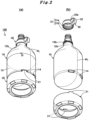
- Fig. 2(a) shows a perspective view of a container assembly 100 of the present invention
- Fig. 2(b) shows an exploded perspective view of the container assembly 100
- the container assembly 100 is composed of the container 10, a support base 20, and a handle 30. Like the container 10, the support base 20 and the handle 30 are also made of a resin.
- the support base 20 has a flat cylindrical shape as a whole and has an opening at its upper end.
- the support base 20 has an outer diameter equal to an outermost diameter of the main body portion 12 of the container 10.
- claw portions 21 are provided at positions corresponding to the concave portions 14.
- the claw portions 21 extend upward from a side wall portion of the support base 20.
- Each claw portion 21 is curved, in the shape of a hook, toward the center axis side of the support base 20. Since the support base 20 is made of a resin, the claw portions 21 have a slight degree of flexibility.
- the claw portions 21 come into contact with an upper end portion of the round bottom portion 15 and deflect so as to slightly expand outward from the side surface of the support base 20, and then are fitted into the recessed concave portions 14. Since the container 10 and the support base 20 are coupled together only by engagement between the claw portions 21 and the concave portions 14, they can be coupled and decoupled easily when necessary.
- the outer diameter of the support base 20 may be smaller than the outermost diameter of the main body portion 12.
- the handle 30 has an annular portion 31 and an ear portion 32.
- the annular portion 31 has a ring-like shape, thereby forming a circular opening.
- the annular portion 31 is attached to the neck portion 12b of the container 10 in such a manner that it surrounds the neck portion 12b.
- the ear portion 32 extends from a portion of an outer circumference of the annular portion 31 in a radial direction of the annular portion 31.
- the annular portion 31 has an attachment hole 31a through which the neck portion 12b passes and an internal thread 31b provided on an inner wall surface of the annular portion 31. Meanwhile, the ear portion 32 has a circular opening as a finger engagement hole 32a into which a finger is inserted.
- Planes defined by the opening circles of the attachment hole 31a and the finger engagement hole 32a are located to be orthogonal to each other.
- the handle 30 is detachably attached to the container 10 as a result of screw engagement between the external thread 12b 1 and the internal thread 31b.
- the handle 30 is attached to the container 10 when necessary. For example, when a worker carries the container assembly 100, the worker can insert his/her finger into the finger engagement hole 32a, and lift and carry the container assembly 100.
- the handle 30 is not molded integrally with the container 10 and is separate from the container 10.
- the container 10 has a shape of point symmetry with respect to its center axis (excluding the external threads 12a 1 and 12bi).
- Figs. 1 and 2 show the example in which the number of concave portions 14 is 4. However, no limitation is imposed on the number of the concave portions 14 so long as a plurality of concave portions 14 are formed. Specifically, the number of concave portions 14 may be 2 to 6.
- Fig. 3(a) shows an example in which the number of the concave portions 14 is 2.
- Fig. 3(b) shows an example in which the number of the concave portions 14 is 3.
- Fig. 3(c) shows an example in which the number of the concave portions 14 is 5.
- Fig. 3(d) shows an example in which the number of the concave portions 14 is 6.
- Each of these drawings is an end view which represents an end surface obtained in the same manner as in Fig. 1(b) . Specifically, the end surface is obtained by cutting the container 10 at a position between the main body portion 12 and the stepped portion 13, and the obtained end surface is viewed in the direction toward the stepped portion 13.
- the concave portions 14 are intermittently formed at equal intervals or at unequal intervals in the horizontal direction of the container 10 and do not overlap with the parting lines PL.
- the material of the container 10 is a thermoplastic resin.
- the member which constitutes the container 10 may have a single-layer structure or a multilayer structure.
- the thermoplastic resin which constitutes the container 10 preferably has a flexural modulus of at least 700 MPa.
- the container 10 has a multilayer structure, it is sufficient that resin layers which form the multilayer structure have the above-described flexural modulus as a whole.
- the container 10 formed of a thermoplastic resin having a flexural modulus of at least 700 MPa enables pressure-feed of the liquid by using a gas having a pressure of up to 200 kPa, without causing breakage of the container or large deformation of the container.
- the flexural modulus can be determined in accordance with JIS K7171(2016).
- the container 10 has a smaller wall thickness so long as the container 10 can be molded by using a thermoplastic resin having a flexural modulus of at least 700 MPa and a required strength can be secured.
- the wall thickness of the trunk portion 12c of the container 10 may be 0.8 to 4 mm.
- the material of the container 10 may be a high-purity thermoplastic resin.
- the container 10 formed of a high-purity thermoplastic resin is suitable for containing a liquid required to have a high degree of cleanness, such as semiconductor materials, chemical solutions for manufacture of semiconductors, and food materials.
- the high-purity thermoplastic resin refers to a resin which does not cause leaching of impurity particulates into the liquid contained in the container 10 in an amount in excess of a predetermined reference value. Cleanness is known as an index representing this reference value.
- the cleanness shows the degree to which the quality of the liquid deteriorates as a result of leaching of impurity particulates into the liquid contained in the container for a long period of time.
- the cleanness can be obtained by storing ultrapure water or a photoresist liquid in a test container for a certain period of time and then counting the number of particulates present in a portion (1 mL) of the liquid stored in the container. Particulates whose particle sizes are 0.3, 0.2, 0.1, and/or 0.06 ⁇ m or greater are counted in accordance with a standard to be applied.
- a represents the capacity of the test container
- b represents the amount of liquid sampled from the test container.
- a liquid sample for measuring the initial cleanness is collected as follows. Into the test container having a capacity a (mL), ultrapure water or a photoresist liquid is poured in an amount which is half of the capacity of the test container; i.e., a/2 (mL). After shaking the test container for 15 seconds and leaving it for 24 hours, the ultrapure water or photoresist liquid is sampled as the liquid sample. A plug is attached to the container after measurement of the initial cleanness, and the container is allowed to stand for a certain period of time. Then, the container is rotated three times without generating bubbles.
- the parameter "c" is a value representing the number of particulates contained in the entire sample liquid and counted by a particle counter.
- the initial cleanness and the cleanness after storage for the certain period of time are calculated from that numerical value in accordance with Expression (1).
- the smaller the numerical value of the cleanness the smaller the degree to which the quality of the photoresist liquid has deteriorated.
- the cleanness is smaller than 100 number/mL, it shows that the container has contained the photoresist liquid without deteriorating its quality.
- Such photoresist liquid does not lower the quality and yield of semiconductors or liquid crystal displays (LCD).
- a resin which is determined to satisfy the condition that a container 10 formed of that resin and used as a test container have a predetermined cleanness is chosen as a high-purity thermoplastic resin for forming the container 10.
- a resin whose cleanness is smaller than 100 number/mL one example of the predetermined reference value
- the high-purity thermoplastic resin is a resin which does not cause leaching of impurity particulates into the liquid in an amount in excess of the predetermined reference value.
- a resin whose cleanness is smaller than 200 number/mL may be used in accordance with a standard to be applied.
- a resin whose cleanness is smaller than 50 number/mL, smaller than 10 number/mL, smaller than 5 number/mL, or smaller than 3 number/mL may be used.
- the plug (not shown) of the container is preferably formed of the high-purity thermoplastic resin.
- the degree of lowering of transparency of liquid may be used to define the degree of leaching of impurity particulates.
- Examples of the resin used to from the container 10 include polyolefins such as polyethylene and polypropylene, polyamide, polyvinyl alcohol, poly (ethylene-co-vinyl alcohol), polyester, and polyphenylene oxide.
- polyolefins such as polyethylene and polypropylene, polyamide, polyvinyl alcohol, poly (ethylene-co-vinyl alcohol), polyester, and polyphenylene oxide.
- polyethylene is preferred.
- Specific examples include linear polyethylene (LLDPE) and high-density polyethylene (HDPE), which are copolymers of ethylene and ⁇ -olefin. From the viewpoint of rigidity and cleanness, it is preferable to form the container 10 with high-density polyethylene. From the viewpoint of environmental protection, it is preferable to use a resin that can be recycled as a material.
- the melt flow rate of high-density polyethylene is preferably 0.01 to 3.0 g/10 minutes, more preferably 0.05 to 2.0 g/10 minutes.
- the density of high-density polyethylene is preferably 0.940 to 0.970 g/cm 3 , more preferably 0.950 to 0.960 g/cm 3 .
- the melt flow rate can be determined in accordance with JIS K6760 (1995).
- At least the inner wall surface of the container 10 may be made of a polyethylene or ethylene ⁇ -olefin copolymer resin having a density of 0.940 to 0.970 g/cm 3 .
- This resin is preferred such that the weight average molecular weight measured by gel permeation chromatography is 10 ⁇ 10 4 to 30 ⁇ 10 4 , the amount of polymer having a molecular weight of 1 ⁇ 10 3 or less is less than 2.5% by mass, and the amounts of a neutralizer, an antioxidant, and a light stabilizer, which are quantified by liquid chromatography, are 0.01% by mass or less.
- the ⁇ -olefin may be at least one selected from the group consisting of propylene, butene-1, 4-methyl-pentene-1, hexene-1, and octene-1.
- Use of such a resin enables production of a container 10 which exhibits high mechanical strength and is excellent in handling and in which leaching of impurity particulates into the contained liquid is considerably suppressed.
- the material of the container 10 may be a resin composition which includes a polyethylene or ethylene / ⁇ -olefin copolymer resin having a density of 0.940 to 0.970 g/cm 3 ; a neutralizer, an antioxidant, and a light stabilizer; a light blocking pigment containing an inorganic pigment and/or an organic pigment; and a dispersant which is an olefin polymer having a number average molecular weight of 2 ⁇ 10 3 or more.
- This resin preferably has a weight average molecular weight of 10 ⁇ 10 4 to 30 ⁇ 10 4 measured by gel permeation chromatography, and the amount of polymer having a molecular weight of 1 ⁇ 10 3 or less is less than 5% by mass.
- the amounts of the neutralizer, antioxidant, and light stabilizer in the resin composition are preferably 0.01% by mass or less, respectively. At least one selected from titanium oxide, carbon black, and red iron oxide are used as the above-described inorganic pigment. At least one selected from phthalocyanine-type, quinacridone-type, and azo-type organic pigments are used as the above-described organic pigment.
- the amount of the light blocking pigment in the resin composition is preferably 0.01 to 5% by mass.
- the amount of the dispersant of the olefin-based polymer is preferably less than 5% by mass.
- Such a resin composition enables obtainment of a container 10 which exhibits high mechanical strength and is excellent in handling, in which leaching of impurity particulates into the contained liquid is considerably suppressed, and which can prevent deterioration of the liquid caused by light.
- Such container 10 is suitably used for storing a chemical solution for manufacture of semiconductors or the above-mentioned solvent for production of pharmaceuticals.
- the container 10 may have a layer structure having an inner layer, an intermediate layer, and an outer layer.
- the inner layer is preferably formed of a high-purity resin which includes at least one of an olefin polymer (e.g., ethylene, propylene, butene-1, 4-methyl-pentene-1, hexene-1, or octene-1) and a copolymer composed of ethylene and olefin other than ethylene; and a neutralizer, an antioxidant, and a light stabilizer.
- the amounts of the neutralizer, the antioxidant, and the light stabilizer are preferably 0.01% by mass at a maximum, respectively.
- the intermediate layer preferably contains a solvent barrier resin containing poly (ethylene-co-vinyl alcohol). Further, an adhesive resin layer formed of maleic acid modified polyethylene or the like may be provided between the inner layer and the intermediate layer and/or between the intermediate layer and the outer layer.
- the outer layer preferably includes a resin composition containing a light-blocking substance. This resin composition may contain a pigment dispersant in an amount of less than 5% by mass and a light-blocking pigment in an amount of 0.01 to 5% by weight.
- the pigment dispersant is made of an olefin-based polymer such as polyethylene and polypropylene having a number average molecular weight of 2 ⁇ 10 3 or more.
- the light-blocking pigment contains an inorganic pigment and/or an organic pigment.
- This resin composition may also contain an UV absorber in an amount of less than 2.5% by weight. According to such a layer structure, since particulates and metal ions do not leach from the container 10 during storage and transportation of the liquid, the quality of the high-purity liquid can be maintained, and the container 10 that is difficult to break and lightweight is obtained.
- the materials include a homopolymer and/or a copolymer and/or a polymer blend, each of which includes at least one of the group consisting of low-density polyethylene, medium-density polyethylene, high-density polyethylene, linear low-density polyethylene, polypropylene, polybutene, polystyrene, polyvinyl acetate, poly(methyl methacrylate), poly(ethyl methacrylate), poly(acrylic acid), cyclic polyolefin, polyacrylonitrile, polyamide (nylon), polyesters such as polyethylene terephthalate and polybutylene terephthalate, polyurethane, polycarbonate, polyimide, polyphenylene sulfide, and poly(vinyl chloride).
- blow molding As a method for manufacturing the container 10, direct blow molding (extrusion blow molding) is mentioned, but instead of this, known blow molding such as injection blow molding, multilayer extrusion blow molding, and stretch blow molding may be employed.
- known blow molding such as injection blow molding, multilayer extrusion blow molding, and stretch blow molding may be employed.
- the method for manufacturing the support base 20 and the handle 30 is preferably injection molding.
- liquid contained in the container 10 examples include liquid chemicals such as methanol, ethanol, isopropanol, isobutanol, ethylene glycol, acetone, ethyl acetate, toluene, dimethylformamide, ethylene glycol acetate, methoxypropyl acetate, and butyl cellosolve; chemical solutions for manufacture of semiconductors and liquid crystal devices such as photoresist liquids and cleaning agents; medical and pharmaceutical solutions such as disinfectants, infusions, dialysates, and formulation raw materials; and chemical solutions for food industry such as flavorings, concentrates, and food additives.
- liquid chemicals such as methanol, ethanol, isopropanol, isobutanol, ethylene glycol, acetone, ethyl acetate, toluene, dimethylformamide, ethylene glycol acetate, methoxypropyl acetate, and butyl cellosolve
- chemical solutions for manufacture of semiconductors and liquid crystal devices such as photore
- High-density polyethylene resin (melt flow rate: 0.3 g/10 min, density: 0.951 g/cm 3 , flexural modulus: 1370 MPa), serving as the material of the container 10, was hot-melted and extruded by an extruder to form a parison.
- the parison was sandwiched in a two-part mold and direct blow molding was performed, thereby fabricating a container 10 of Example 1.
- the container 10 had four concave portions 14. Each of the four concave portions 14 had a circumferential direction length H of 25 mm and a center axis direction length V of 6 mm and was 30° away from the position of the boundary between the main body portion 12 and the stepped portion 13 on the corresponding parting line PL.
- the largest peripheral length D of the main body portion 12 was is 160 ⁇ mm, and the proportion of the circumferential direction lengths H of the four concave portions 14 to the largest peripheral length D, i.e. the occupancy ratio (H ⁇ N/D ⁇ 100), was 20%.
- the support base 20 and the handle 30 were fabricated by injection molding using linear low-density polyethylene resin (melt flow rate: 4.0 g/10 min, density: 0.938 g/cm 3 ).
- the support base 20 was coupled to the container 10, and the handle 30 was attached to the container 10 by screwing, thereby fabricating the container assembly 100.
- the length of the container 10 from the upper end of the main body portion 12 to the lower end of the round bottom portion 15 was measured, as the overall height of the container 10 at normal pressure, by using a height gauge (manufactured by Mitutoyo Co., Ltd.).
- a pressurization device was attached to the cylindrical mouth 11 and the upper end portion 12a, and the internal pressure of the container 10 was increased to 200 kPa, which was kept constant for 1 hour. After 1 hour, the overall height of the container 10 was measured again and recorded as the overall height at high pressure.
- the ratio of the overall height at high pressure to the overall height of container 10 at normal pressure was obtained as an overall height change ratio.
- the obtained overall height change ratio was 0.61%.
- Tap water (2 L) was stored in the container 10, and a liquid feed pipe (not shown) was inserted straight from the cylindrical mouth 11 into the container 10 and was fixed such that its end was located near the inner wall surface of the round bottom portion 15. Tap water was discharged from the container 10 by applying a pressure of 0.05 MPa to the interior of the container 10. The application of the pressure was stopped when tap water no longer came out of the liquid feed pipe, and the amount of tap water remaining in the container 10 was measured. The measured amount was 0.3 mL.
- a container 10 of Example 2 was fabricated by performing the same process as in Example 1 except that the circumferential direction length H of each concave portion 14 was changed to 35 mm and the occupancy ratio of the four concave portions 14 was changed to 28%. Also, the support base 20 and the handle 30 were fabricated in the same manner as in Example 1. The support base 20 was coupled to the container 10, and the handle 30 was attached to the container 10 by screwing, thereby fabricating the container assembly 100. For the container 10, a shape change at high pressure was measured by preforming the same operation as in Example 1 and the overall height change ratio was obtained. The obtained overall height change ratio was 0.69%.
- a container 10 of Example 3 was fabricated by performing the same process as in Example 1 except that six concave portions 14 was formed at 60° intervals such that the concave portions 14 were separated from one another by 60° and their occupancy ratio was changed to 30%. Also, the support base 20 and the handle 30 were fabricated in the same manner as in Example 1. The support base 20 was coupled to the container 10, and the handle 30 was attached to the container 10 by screwing, thereby fabricating the container assembly 100. For the container 10, a shape change at high pressure was measured by preforming the same operation as in Example 1 and the overall height change ratio was obtained. The obtained overall height change ratio was 0.69%.
- a container 10 of Example 4 was fabricated by performing the same process as in Example 3 except that the circumferential direction length H of each concave portion 14 was changed to 35 mm and the occupancy ratio of the six concave portions 14 was changed to 42%. Also, the support base 20 and the handle 30 were fabricated in the same manner as in Example 1. The support base 20 was coupled to the container 10, and the handle 30 was attached to the container 10 by screwing, thereby fabricating the container assembly 100. For the container 10, a shape change at high pressure was measured by preforming the same operation as in Example 1 and the overall height change ratio was obtained. The obtained overall height change ratio was 0.86%.
- a container 10 of Example 5 was fabricated by performing the same process as in Example 3 except that the largest peripheral length D was change to 360 ⁇ mm, the circumferential direction length H of each concave portion 14 was changed to 50 mm , thereby changing the occupancy ratio of the six concave portions 14 to 27%, and the center axis direction length V was changed to 10 mm.
- the support base 20 and the handle 30 were fabricated in the same manner as in Example 1.
- the support base 20 was coupled to the container 10, and the handle 30 was attached to the container 10 by screwing, thereby fabricating the container assembly 100.
- a shape change at high pressure was measured by preforming the same operation as in Example 1 and the overall height change ratio was obtained.
- the obtained overall height change ratio was 1.03%.
- the amount of residual liquid measured by performing the same operation as Example 1 was 0.6 mL.
- the support base 20 and the handle 30 were fabricated in the same manner as in Example 1.
- the support base 20 was coupled to the container 10, and the handle 30 was attached to the container 10 by screwing, thereby fabricating the container assembly 100.
- the support base 20 came off the container 10. Therefore, the overall height change ratio was not measured.
- a container 40 of Comparative Example 2 was fabricated by performing the same process as in Example 1 except that, instead of the concave portions 14, a circumferential groove 44 is provided over the entire circumference of a lower end of the main body portion 42, thereby changing the occupancy ratio of the circumferential groove 44 to 100%, and the container 40 and a handle 40a were molded integrally.
- a support base 20 fabricated by performing the same process as in Example 1 was coupled to the container 40, thereby fabricating the container assembly 100.
- a shape change at high pressure was measured by preforming the same operation as in Example 1 and the overall height change ratio was obtained. The obtained overall height change ratio was 5.11%.
- the amount of residual liquid measured by performing the same operation as Example 1 was 2.2 mL.
- a container 40 of Comparative Example 3 was fabricated by performing the same process as in Comparative Example 2 except that the largest peripheral length D was change to 360 ⁇ mm.
- a support base 20 fabricated by performing the same process as in Comparative Example 2 was coupled to the container 40, thereby fabricating the container assembly 100.
- a shape change at high pressure was measured by preforming the same operation as in Example 1 and the overall height change ratio was obtained. The obtained overall height change ratio was 7.37%.
- a container 40 of Comparative Example 4 capable of standing by itself without use of a support base was fabricated by performing the same process as in Comparative Example 2 except that, as shown in Fig. 5(b) , the concave portions 14 were not provided and a flat bottom portion 45 was formed instead of the round bottom portion 15.
- the internal pressure of the container 40 was increased to 200 kPa by performing the same operation as in Example 1, the flat bottom portion 45 bulged and the container 40 fell over.
- the overall height change ratio of the fallen-over container 40 was obtained.
- the obtained overall height change ratio was 4.10%.
- Table 1 collectively shows the configurations of the containers 10 of Examples 1 to 5 and the containers of Comparative Examples 1 to 4 and also shows the results of measurement of their shape changes at high pressure and measurement of their residual liquid amounts.
- the container and the container assembly of the present invention are suitably used for pressure feed of liquids, for example, in the field of foods, in the field of pharmaceuticals, and in the field of manufacture of semiconductors and liquid crystal devices, in which clean liquids are demanded.
Landscapes
- Engineering & Computer Science (AREA)
- Mechanical Engineering (AREA)
- Ceramic Engineering (AREA)
- Containers Having Bodies Formed In One Piece (AREA)
- Details Of Rigid Or Semi-Rigid Containers (AREA)
- Filling Of Jars Or Cans And Processes For Cleaning And Sealing Jars (AREA)
- Catching Or Destruction (AREA)
Abstract
Description
- The present invention relates to a container for containing a liquid and to a container assembly including this container.
- Liquids such as material liquids for foods and high-purity chemical solutions for industrial use (for example, photoresist and cleaning agent used in manufacture of semiconductors and manufacture of liquid crystal displays) are contained in containers while their high purities are maintained so as to prevent contamination by foreign substances or deterioration of the liquids. These liquids are stored and transported while being contained in the containers. Also, a container containing a liquid is set into a liquid feeder, and the liquid is discharged from the container and is used.
- In general, the bottom surface of such a container is formed to be flat so as to enable the container to stand by itself. A method for discharging a liquid by means of pressure feed is a known technique. In this method, a liquid feed pipe and a gas supply pipe are inserted into a container, and a gas is fed into the container through the gas supply pipe so as to increase the internal pressure of the container, thereby feeding the liquid into the liquid feed pipe, whereby the liquid is discharged from the container. In this case, a high-pressure gas (for example, 100 to 200 kPa) is frequently used so as to pressure-feed a liquid which is high in viscosity and does not flow easily. In the case of a generally known container having a flat bottom surface, when the pressure inside the container increases due to supply of the high-pressure gas, the bottom surface may bulge and deform, and the container may tilt. When the amount of the liquid remaining in the container decreases, the end of the liquid feed pipe becomes unable to reach the liquid, because of the deformation of the bottom surface and the tilting of the container, possibly resulting in the inability to discharge from the container a portion of the liquid contained in the container.
- Patent Document 1 describes a container having a hemispherical bottom surface and a support base (cradle) for enabling the container to stand by itself. As a result of engagement between a concave groove formed on the outer surface of a circumferential wall of the container and being continuous in the circumferential direction and convex portions provided on the inner surface of a circumferential wall of the support base, the container and the support base are fitted together. Since the bottom surface of the container is hemispherical, the internal pressure of the container generated as a result of supply of the above-described high-pressure gas acts equally on the bottom surface. Since the entire bottom surface extends downward due to the pressure of the high-pressure gas, the concave groove follows this extension and extends in the manner of a helical spring. Consequently, the concave groove pushes out the convex portions of the cradle and cannot maintain the engagement with the convex portions. As a result, the container comes off the support base and falls over, and it becomes unable to stably pressure-feed the liquid.
- Patent Document 2 describes a liquid container which includes a container main body having a round bottom and a support base which has a penetrating portion at its center and which supports the container main body, thereby enabling the container main body to stand by itself. A circumferential groove for engagement with the support base is formed on the container main body. When this liquid container is used, it is set into a liquid feeder which includes a pedestal having a protrusion which is fitted into the penetrating portion of the support base and comes into contact with the round bottom, and a pressing member which presses an upper end of the container main body. Since the container main body is sandwiched between container supports provided in the liquid feeder, such as the protrusion of the pedestal and the pressing member, even when the internal pressure of the container main body increases, the circumferential groove does not extend and the container main body does not come off the support base. However, in the case of the liquid container described in Patent Document 2, since the liquid feeder having container supports such as the protrusion and the pressing member is indispensable to pressure-feed the liquid within the container by the high-pressure gas, limitations are imposed on liquid feeders into which the container can be set, and therefore, the liquid container described in Patent Document 2 is poor in versatility.
-
- [Patent Document 1]
JPS58-76899U - [Patent Document 2]
JP2011-098736A - The present invention has been accomplished so as to solve the above-described problems, and an object of the present invention is to provide a container and a container assembly which can remarkably suppress deformation of the container, without use of container supports of a liquid feeder, even when the internal pressure of the container becomes high at the time of pressure feed of a liquid by using a high-pressure gas, whereby stable liquid feed can be performed. The container and the container assembly have a high degree of versatility such that, for their use, they can be set into a liquid feeder having no container support.
- A container of the present invention which has been accomplished so as to achieve the above-described object is a container used to contain a liquid and to pressure-feed the liquid, comprising an approximately cylindrical main body portion, a cylindrical mouth opening at one end of the main body portion, a stepped portion continuously extending from the other end of the main body portion and having a reduced diameter, and a round bottom portion continuously extending from the stepped portion and bulging away from the stepped portion, wherein a plurality of concave portions for engagement with claw portions of a support base which enables the container to stand by itself are intermittently formed at the stepped portion, the concave portions being recessed at positions which do not overlap with a series of parting lines extending through the main body portion, the stepped portion, and the round bottom portion, and wherein each of the concave portions has an approximately elliptical shape elongated in a circumferential direction of the main body portion, and the total length of the plurality of concave portions in the circumferential direction accounts for 20 to 50% of the largest peripheral length of the main body portion.
- In the container, the concave portions may be provided, symmetrically with respect to the parting lines, at four locations each being an angle of 20 to 45° away from the corresponding parting line or at six locations separated from one another by an angle of 60°, the angles being those about a center axis of the main body portion.
- In a container assembly of the present invention, the main body portion of each of the above-described containers has a trunk portion and a neck portion which is located closer to the cylindrical mouth and whose diameter is smaller than that of the trunk portion, and a handle is fitted and/or screwed onto an outer surface of the neck portion.
- The container assembly includes any of the above-described containers and a support base which has an opening into which the round bottom portion is fitted and claw portions which extend from a circumferential edge of the opening and are engaged with the concave portions, whereby the support base enables the container to stand by itself.
- According to the container and the container assembly of the present invention, even when the internal pressure of the container becomes high at the time of pressure-feed of the liquid, the container does not extend or deform due to pressure, because the concave portions for engagement with the claw portions of the support base are intermittently formed at particular positions. Therefore, the support base does not come off the container, and therefore, pressure-feed of the liquid can be performed stably.
- Also, since the container itself does not extend in the direction of its center axis at the time of pressure feed of the liquid, container supports for suppressing deformation of the container are not required to be provided in liquid feeders. Therefore, the container and the container assembly can cope with various types of liquid feeders and have a high degree of versatility.
-
-
Fig. 1 shows a front view of a container to which the present invention is applied and an end view taken along line A-A and viewed in the arrow direction. -
Fig. 2 shows a perspective view and an exploded perspective view of a container assembly to which the present invention is applied. -
Fig. 3 is an end view showing a different example of the container to which the present invention is applied. -
Fig. 4 shows an end view of a container of Comparative Example 1 which falls outside the scope of the present invention. -
Fig. 5 shows perspective views of containers of Comparative Examples 2 and 4 which fall outside the scope of the present invention. - Hereunder, embodiments for practicing the present invention will be explained in detail, but the scope of the present invention is not limited to these embodiments.
-
Fig. 1 shows one embodiment of acontainer 10 of the present invention.Fig. 1(a) is a front view of thecontainer 10, andFig. 1(b) is an end view taken along line A-A and viewed in the arrow direction. Thecontainer 10 is a container for pressure feed which contains a liquid and which can endure an internal pressure of up to 200 kPa. Thecontainer 10 includes a tubularmain body portion 12, acylindrical mouth 11 which is open at one end (upper end) of themain body portion 12, astepped portion 13 which is continuous from the other end (lower end) of themain body portion 12, and around bottom portion 15 which continuously extends away from thestepped portion 13 and bulges downward to have an approximately hemispherical shape. The internal space of thecontainer 10 communicates with the outside through thecylindrical mouth 11. This opening and a lower end of an inner wall of theround bottom portion 15 face each other. - The
main body portion 12 has anupper end portion 12a at which thecylindrical mouth 11 is open, aneck portion 12b which extends from its lower end, and atrunk portion 12c which extends further downward from a lower end of theneck portion 12b. The diameter of thetrunk portion 12c decreases gradually toward theneck portion 12b. Also,external threads upper end portion 12a and theneck portion 12b. - The
container 10 is made of a resin and is formed by direct blow molding. In the direct blow molding, a tubular resin material which is formed by extruding a molten resin at high temperature and is called parison is sandwiched in split molds having engraved desired shapes to be produced. In this state, a lower end of the parison is pinched off by the molds, whereby a pinched-off portion is formed. A portion where the parison has been pinched off becomes a bottom portion of the container. Subsequently, compressed air is fed into the parison through a blow pin. As a result, the parison is bulged and pressed against the inner wall of the mold, whereby the container is formed. Parting lines PL, which are marks of the mating interface of the split molds, are formed continuously through theupper end portion 12a, theneck portion 12b, thetrunk portion 12c, thestepped portion 13, and theround bottom portion 15. - Since the
container 10 is a product formed by direct blow molding, thestepped portion 13, which is continuous with and directly adjacent to theround bottom portion 15, has a slightly larger thickness in the vicinity of the parting lines PL, as compared with wall thicknesses at other locations on the same circumference. This thicker portion contributes to increasing rigidity, thereby suppressing deformation of the container. - In the front view as shown in
Fig. 1(a) , in a region from a lower end of themain body portion 12 to the steppedportion 13, theconcave portions 14 are recessed from an outer surface of thecontainer 10 toward its center axis at four locations which are located on opposite sides of the parting lines PL and are symmetric with respect to the parting lines PL. The fourconcave portions 14 do not overlap with the parting lines PL and are formed at the steppedportion 13 to be arranged in a row in the circumferential direction of thecontainer 10.Claw portions 21 of asupport base 20, which will be described later, are engaged with the concave portions 14 (seeFig. 2 ). As a result, thecontainer 10 and thesupport base 20 are coupled together, whereby thecontainer 10 stands by itself. All of the fourconcave portions 14 have the same shape. Eachconcave portion 14 has an approximately elliptical shape; i.e., its length H along the circumferential direction of the main body portion 12 (circumferential direction length H) is greater than its length along the direction of the center axis of the main body portion 12 (namely, the direction of the center axis of the container 10) (center axis direction length V). - The center point h of the circumferential direction length H of each
concave portion 14 is located an angle of θ away from the position of the boundary between themain body portion 12 and the steppedportion 13 on a corresponding parting lines PL. Namely, in a cross sectional view of thecontainer 10 at the boundary between themain body portion 12 and the steppedportion 13, each of the fourconcave portions 14 is separated and deviated, by the smallest angle θ, from a reference line Y, which passes through the center axis C of thecontainer 10 and connects the parting lines PL. In the example shown inFig. 1(b) , the angle θ is 30°. - Since the plurality of
concave portions 14 are not connected in series and provided intermittently as described above, even when the internal pressure of thecontainer 10 increases due to the pressure of the high-pressure gas which is introduced at the time of pressure feed of the liquid contained in thecontainer 10, extension of theconcave portions 14 in the direction of the center axis direction length V can be suppressed, and the engagement between theconcave portions 14 and theclaw portions 21 is maintained, so thesupport base 20 does not come off thecontainer 10. Also, since theconcave portions 14 do not extend due to high pressure, thecontainer 10 does not extend in the direction of the center axis (the vertical direction inFig. 1(a) ), and the overall height of thecontainer 10 hardly changes between the case where the internal pressure of thecontainer 10 is normal pressure and the case where the internal pressure of thecontainer 10 is high pressure. Since thecontainer 10 can be applied to various types of liquid feeders which may or may not have container supports for suppressing deformation of containers, thecontainer 10 has a high degree of versatility. As described above, according to thecontainer 10 of the present invention, there do not arise a problem that, as in the case of a conventionally known container having a circumferential groove which is continuously concaved along the outer circumference of the container, the circumferential groove extends under high pressure and the support base comes off the container, and a problem that the overall height increases. In addition, thecontainer 10 eliminates the necessity of container supports of the liquid feeder. - In the case where the
container 10 has fourconcave portions 14, the above-described angle θ is preferably 20 to 45°, more preferably 20 to 40°, further preferably 20 to 30°, and most preferably 30°. Also, it is preferred that the plurality of angles θ are the same. When the angle θ falls within this range, theconcave portions 14 can be disposed near the parting lines PL where the wall thickness is slightly larger and therefore deformation does not occur easily. - In the case where, as shown in
Fig. 1(b) , the fourconcave portions 14 are disposed in point symmetry with respect to the center axis C serving as a point of symmetry, in line symmetry with respect to the reference line Y serving as an axis, and/or in line symmetry with respect to the reference line X serving as an axis where the reference line X perpendicularly intersecting the reference line Y at the center axis C, since the high pressure at the time of pressure feed equally acts on eachconcave portion 14, extension of thecontainer 10 can be suppressed more effectively. In addition, when theclaw portions 21 of thesupport base 20 provided at positions corresponding to theconcave portions 14 are engaged with theconcave portions 14, thecontainer 10 and thesupport base 20 can be coupled together by merely aligning a pair of theconcave portion 14 and theclaw portion 21 with each other. - The ratio of the sum total of the circumferential direction lengths H of the
concave portions 14 to a largest peripheral length D of the main body portion 12 (the longest circumferential length of the outer circumference of themain body portion 12; seeFig. 2(a) ); i.e., an occupancy ratio of the circumferential direction lengths H of theconcave portions 14 to the largest peripheral length D of themain body portion 12, is represented by an expression of occupancy ratio = (H×N/D)×100, where N represents the number of theconcave portions 14. This occupancy ratio is preferably 10 to 90%, more preferably 15 to 70%, and further preferably 20 to 50%. Wehn the occupancy ratio falls within this range, it is possible to engage theclaw portions 21 with theconcave portions 14 infallibly, and to suppress extension of theconcave portions 14 due to application of high pressure to the interior of thecontainer 10. The circumferential direction length H is an outer circumferential length of themain body portion 12 which is missing due to presence of eachconcave portion 14. - The largest peripheral length of the
main body portion 12 is determined based on the outer diameter of themain body portion 12, which is arbitrarily set in accordance with a required capacity of thecontainer 10. The capacity of thecontainer 10 is specifically 3 to 20 L, more specifically 3 to 10 L. The outer diameter of themain body portion 12 is set, for example, to 120 to 360 mm. Notably, no particular limitation is imposed on the center axis direction length V of theconcave portions 14, and the center axis direction length V is set to 4 to 15 mm. - When the liquid is to be fed by means of pressure feed, a liquid feed pipe (not shown) is inserted from the
cylindrical mouth 11 straight toward theround bottom portion 15, and its end is positioned such that a slight gap remains between the end and an inner wall surface of a top portion of theround bottom portion 15. As the liquid is discharged from thecontainer 10 as a result of the pressure feed, the liquid remaining in thecontainer 10 collects at the top portion of theround bottom portion 15 having an approximately hemispherical shape. Since the end of the liquid feed pipe is positioned in the vicinity of the top portion of theround bottom portion 15, the residual amount of the liquid can be reduced considerably. - Also, even when the internal pressure of the
container 10 becomes high due to the high-pressure gas which is introduced into thecontainer 10 at the time of pressure feed, since the bottom surface of thecontainer 10 has an approximately hemispherical shape and therefore the pressure acting on the inner wall surface of theround bottom portion 15 is dispersed, deformation of the bottom surface is suppressed. The radius of curvature of the inner wall surface of theround bottom portion 15 is preferably 1 to 5 times a value obtained by dividing the largest peripheral length D by 2π (namely, the radius of thetrunk portion 12c), more preferably 1 to 4 times the value, and further preferably 1 to 3 times the value. -
Fig. 2(a) shows a perspective view of acontainer assembly 100 of the present invention, andFig. 2(b) shows an exploded perspective view of thecontainer assembly 100. Thecontainer assembly 100 is composed of thecontainer 10, asupport base 20, and ahandle 30. Like thecontainer 10, thesupport base 20 and thehandle 30 are also made of a resin. - The
support base 20 has a flat cylindrical shape as a whole and has an opening at its upper end. Thesupport base 20 has an outer diameter equal to an outermost diameter of themain body portion 12 of thecontainer 10. Around the opening of thesupport base 20,claw portions 21 are provided at positions corresponding to theconcave portions 14. Theclaw portions 21 extend upward from a side wall portion of thesupport base 20. Eachclaw portion 21 is curved, in the shape of a hook, toward the center axis side of thesupport base 20. Since thesupport base 20 is made of a resin, theclaw portions 21 have a slight degree of flexibility. Therefore, when thecontainer 10 and thesupport base 20 are coupled together, theclaw portions 21 come into contact with an upper end portion of theround bottom portion 15 and deflect so as to slightly expand outward from the side surface of thesupport base 20, and then are fitted into the recessedconcave portions 14. Since thecontainer 10 and thesupport base 20 are coupled together only by engagement between theclaw portions 21 and theconcave portions 14, they can be coupled and decoupled easily when necessary. Notably, the outer diameter of thesupport base 20 may be smaller than the outermost diameter of themain body portion 12. - The
handle 30 has anannular portion 31 and anear portion 32. Theannular portion 31 has a ring-like shape, thereby forming a circular opening. Theannular portion 31 is attached to theneck portion 12b of thecontainer 10 in such a manner that it surrounds theneck portion 12b. Theear portion 32 extends from a portion of an outer circumference of theannular portion 31 in a radial direction of theannular portion 31. Theannular portion 31 has anattachment hole 31a through which theneck portion 12b passes and an internal thread 31b provided on an inner wall surface of theannular portion 31. Meanwhile, theear portion 32 has a circular opening as afinger engagement hole 32a into which a finger is inserted. Planes defined by the opening circles of theattachment hole 31a and thefinger engagement hole 32a are located to be orthogonal to each other. Thehandle 30 is detachably attached to thecontainer 10 as a result of screw engagement between theexternal thread 12b1 and the internal thread 31b. Thehandle 30 is attached to thecontainer 10 when necessary. For example, when a worker carries thecontainer assembly 100, the worker can insert his/her finger into thefinger engagement hole 32a, and lift and carry thecontainer assembly 100. - The
handle 30 is not molded integrally with thecontainer 10 and is separate from thecontainer 10. Thus, thecontainer 10 has a shape of point symmetry with respect to its center axis (excluding theexternal threads 12a1 and 12bi). As a result, when thecontainer 10 is produced by direct blow molding, it is possible to prevent thecontainer 10 from having uneven thickness (excluding thebottom portion 15 and a pinch-off portion formed in its vicinity) , thereby effectively suppressing deformation at the time of pressure feed. -
Figs. 1 and2 show the example in which the number ofconcave portions 14 is 4. However, no limitation is imposed on the number of theconcave portions 14 so long as a plurality ofconcave portions 14 are formed. Specifically, the number ofconcave portions 14 may be 2 to 6.Fig. 3(a) shows an example in which the number of theconcave portions 14 is 2.Fig. 3(b) shows an example in which the number of theconcave portions 14 is 3.Fig. 3(c) shows an example in which the number of theconcave portions 14 is 5.Fig. 3(d) shows an example in which the number of theconcave portions 14 is 6. Each of these drawings is an end view which represents an end surface obtained in the same manner as inFig. 1(b) . Specifically, the end surface is obtained by cutting thecontainer 10 at a position between themain body portion 12 and the steppedportion 13, and the obtained end surface is viewed in the direction toward the steppedportion 13. - The two
concave portions 14 inFig. 3(a) are provided at positions determined such that the positions are in point symmetry with respect to the center axis C of thecontainer 10 serving as a point of symmetry and each position is an angle θ (= 45°) away from a corresponding parting line PL at the boundary between themain body portion 12 and the steppedportion 13. The threeconcave portions 14 inFig. 3(b) are provided at positions which are separated from one another by an angle θ1 (= 120°) and which are symmetric with respect to the reference line X, which is perpendicular to the reference line Y. Theconcave portions 14 inFig. 3(c) are provided at positions which are separated from one another by an angle θ1 (= 72°) and which are symmetric with respect to the reference line X. Theconcave portions 14 inFig. 3(d) are provided at positions which are separated from one another by an angle θ1 (= 60°) and which are symmetric with respect to the reference lines X and Y. In each of the examples, theconcave portions 14 are intermittently formed at equal intervals or at unequal intervals in the horizontal direction of thecontainer 10 and do not overlap with the parting lines PL. - The material of the
container 10 is a thermoplastic resin. The member which constitutes thecontainer 10 may have a single-layer structure or a multilayer structure. In both the case where thecontainer 10 has a single-layer structure and the case where thecontainer 10 has a multilayer structure, the thermoplastic resin which constitutes thecontainer 10 preferably has a flexural modulus of at least 700 MPa. In the case where thecontainer 10 has a multilayer structure, it is sufficient that resin layers which form the multilayer structure have the above-described flexural modulus as a whole. Thecontainer 10 formed of a thermoplastic resin having a flexural modulus of at least 700 MPa enables pressure-feed of the liquid by using a gas having a pressure of up to 200 kPa, without causing breakage of the container or large deformation of the container. The flexural modulus can be determined in accordance with JIS K7171(2016). - The greater the wall thickness of the
container 10, the greater the degree to which the strength of the container can be enhanced. Meanwhile, when the wall thickness is excessively large, a large amount of a raw material is needed, and the container has an excessively large weight. In view of this, it is preferred that thecontainer 10 has a smaller wall thickness so long as thecontainer 10 can be molded by using a thermoplastic resin having a flexural modulus of at least 700 MPa and a required strength can be secured. For example, the wall thickness of thetrunk portion 12c of thecontainer 10 may be 0.8 to 4 mm. - The material of the
container 10 may be a high-purity thermoplastic resin. In the case where thecontainer 10 has a multilayer structure, it is sufficient that at least the material of its inner surface is a high-purity thermoplastic resin. Thecontainer 10 formed of a high-purity thermoplastic resin is suitable for containing a liquid required to have a high degree of cleanness, such as semiconductor materials, chemical solutions for manufacture of semiconductors, and food materials. The high-purity thermoplastic resin refers to a resin which does not cause leaching of impurity particulates into the liquid contained in thecontainer 10 in an amount in excess of a predetermined reference value. Cleanness is known as an index representing this reference value. The cleanness shows the degree to which the quality of the liquid deteriorates as a result of leaching of impurity particulates into the liquid contained in the container for a long period of time. The cleanness can be obtained by storing ultrapure water or a photoresist liquid in a test container for a certain period of time and then counting the number of particulates present in a portion (1 mL) of the liquid stored in the container. Particulates whose particle sizes are 0.3, 0.2, 0.1, and/or 0.06 µm or greater are counted in accordance with a standard to be applied. Specifically, the cleanness is defined by the following mathematical expression (1).
[Mathematical expression 1]
- In Mathematical expression (1), "a" represents the capacity of the test container, and "b" represents the amount of liquid sampled from the test container. First, a liquid sample for measuring the initial cleanness is collected as follows. Into the test container having a capacity a (mL), ultrapure water or a photoresist liquid is poured in an amount which is half of the capacity of the test container; i.e., a/2 (mL). After shaking the test container for 15 seconds and leaving it for 24 hours, the ultrapure water or photoresist liquid is sampled as the liquid sample. A plug is attached to the container after measurement of the initial cleanness, and the container is allowed to stand for a certain period of time. Then, the container is rotated three times without generating bubbles. Subsequently, another liquid sample for measuring the cleanness after the ultrapure water or photoresist liquid having been stored is collected. The parameter "c" is a value representing the number of particulates contained in the entire sample liquid and counted by a particle counter. The initial cleanness and the cleanness after storage for the certain period of time are calculated from that numerical value in accordance with Expression (1). The smaller the numerical value of the cleanness, the smaller the degree to which the quality of the photoresist liquid has deteriorated. When the cleanness is smaller than 100 number/mL, it shows that the container has contained the photoresist liquid without deteriorating its quality. Such photoresist liquid does not lower the quality and yield of semiconductors or liquid crystal displays (LCD).
- A resin which is determined to satisfy the condition that a
container 10 formed of that resin and used as a test container have a predetermined cleanness is chosen as a high-purity thermoplastic resin for forming thecontainer 10. In the case where thecontainer 10 contains a photoresist liquid, a resin whose cleanness is smaller than 100 number/mL (one example of the predetermined reference value) is used. In other words, the high-purity thermoplastic resin is a resin which does not cause leaching of impurity particulates into the liquid in an amount in excess of the predetermined reference value. Alternatively, a resin whose cleanness is smaller than 200 number/mL may be used in accordance with a standard to be applied. Also, a resin whose cleanness is smaller than 50 number/mL, smaller than 10 number/mL, smaller than 5 number/mL, or smaller than 3 number/mL may be used. Notably, the plug (not shown) of the container is preferably formed of the high-purity thermoplastic resin. - Also, instead of the cleanness, the degree of lowering of transparency of liquid (another example of the predetermined reference value) may be used to define the degree of leaching of impurity particulates.
- Examples of the resin used to from the
container 10 include polyolefins such as polyethylene and polypropylene, polyamide, polyvinyl alcohol, poly (ethylene-co-vinyl alcohol), polyester, and polyphenylene oxide. One or more of these resins may be used to form a single-layer container, and a plurality of these resins may be used to form a multilayer container. Among them, polyethylene is preferred. Specific examples include linear polyethylene (LLDPE) and high-density polyethylene (HDPE), which are copolymers of ethylene and α-olefin. From the viewpoint of rigidity and cleanness, it is preferable to form thecontainer 10 with high-density polyethylene. From the viewpoint of environmental protection, it is preferable to use a resin that can be recycled as a material. - The melt flow rate of high-density polyethylene is preferably 0.01 to 3.0 g/10 minutes, more preferably 0.05 to 2.0 g/10 minutes. The density of high-density polyethylene is preferably 0.940 to 0.970 g/cm3, more preferably 0.950 to 0.960 g/cm3. The melt flow rate can be determined in accordance with JIS K6760 (1995).
- At least the inner wall surface of the
container 10 may be made of a polyethylene or ethylene α-olefin copolymer resin having a density of 0.940 to 0.970 g/cm3. This resin is preferred such that the weight average molecular weight measured by gel permeation chromatography is 10×104 to 30×104, the amount of polymer having a molecular weight of 1×10³ or less is less than 2.5% by mass, and the amounts of a neutralizer, an antioxidant, and a light stabilizer, which are quantified by liquid chromatography, are 0.01% by mass or less. Here, the α-olefin may be at least one selected from the group consisting of propylene, butene-1, 4-methyl-pentene-1, hexene-1, and octene-1. Use of such a resin enables production of acontainer 10 which exhibits high mechanical strength and is excellent in handling and in which leaching of impurity particulates into the contained liquid is considerably suppressed. - The material of the
container 10 may be a resin composition which includes a polyethylene or ethylene / α-olefin copolymer resin having a density of 0.940 to 0.970 g/cm3; a neutralizer, an antioxidant, and a light stabilizer; a light blocking pigment containing an inorganic pigment and/or an organic pigment; and a dispersant which is an olefin polymer having a number average molecular weight of 2×10³ or more. This resin preferably has a weight average molecular weight of 10×104 to 30×104 measured by gel permeation chromatography, and the amount of polymer having a molecular weight of 1×10³ or less is less than 5% by mass. The amounts of the neutralizer, antioxidant, and light stabilizer in the resin composition are preferably 0.01% by mass or less, respectively. At least one selected from titanium oxide, carbon black, and red iron oxide are used as the above-described inorganic pigment. At least one selected from phthalocyanine-type, quinacridone-type, and azo-type organic pigments are used as the above-described organic pigment. The amount of the light blocking pigment in the resin composition is preferably 0.01 to 5% by mass. The amount of the dispersant of the olefin-based polymer is preferably less than 5% by mass. Use of such a resin composition enables obtainment of acontainer 10 which exhibits high mechanical strength and is excellent in handling, in which leaching of impurity particulates into the contained liquid is considerably suppressed, and which can prevent deterioration of the liquid caused by light.Such container 10 is suitably used for storing a chemical solution for manufacture of semiconductors or the above-mentioned solvent for production of pharmaceuticals. - The
container 10 may have a layer structure having an inner layer, an intermediate layer, and an outer layer. In this case, the inner layer is preferably formed of a high-purity resin which includes at least one of an olefin polymer (e.g., ethylene, propylene, butene-1, 4-methyl-pentene-1, hexene-1, or octene-1) and a copolymer composed of ethylene and olefin other than ethylene; and a neutralizer, an antioxidant, and a light stabilizer. In this case, the amounts of the neutralizer, the antioxidant, and the light stabilizer are preferably 0.01% by mass at a maximum, respectively. The intermediate layer preferably contains a solvent barrier resin containing poly (ethylene-co-vinyl alcohol). Further, an adhesive resin layer formed of maleic acid modified polyethylene or the like may be provided between the inner layer and the intermediate layer and/or between the intermediate layer and the outer layer. The outer layer preferably includes a resin composition containing a light-blocking substance. This resin composition may contain a pigment dispersant in an amount of less than 5% by mass and a light-blocking pigment in an amount of 0.01 to 5% by weight. The pigment dispersant is made of an olefin-based polymer such as polyethylene and polypropylene having a number average molecular weight of 2×10³ or more. The light-blocking pigment contains an inorganic pigment and/or an organic pigment. This resin composition may also contain an UV absorber in an amount of less than 2.5% by weight. According to such a layer structure, since particulates and metal ions do not leach from thecontainer 10 during storage and transportation of the liquid, the quality of the high-purity liquid can be maintained, and thecontainer 10 that is difficult to break and lightweight is obtained. - No particular limitation is imposed on the materials of the
support base 20 and thehandle 30, and the materials may be the same or different from the material of thecontainer 10. Examples of the materials include a homopolymer and/or a copolymer and/or a polymer blend, each of which includes at least one of the group consisting of low-density polyethylene, medium-density polyethylene, high-density polyethylene, linear low-density polyethylene, polypropylene, polybutene, polystyrene, polyvinyl acetate, poly(methyl methacrylate), poly(ethyl methacrylate), poly(acrylic acid), cyclic polyolefin, polyacrylonitrile, polyamide (nylon), polyesters such as polyethylene terephthalate and polybutylene terephthalate, polyurethane, polycarbonate, polyimide, polyphenylene sulfide, and poly(vinyl chloride). - As a method for manufacturing the
container 10, direct blow molding (extrusion blow molding) is mentioned, but instead of this, known blow molding such as injection blow molding, multilayer extrusion blow molding, and stretch blow molding may be employed. The method for manufacturing thesupport base 20 and thehandle 30 is preferably injection molding. - Examples of the liquid contained in the
container 10 include liquid chemicals such as methanol, ethanol, isopropanol, isobutanol, ethylene glycol, acetone, ethyl acetate, toluene, dimethylformamide, ethylene glycol acetate, methoxypropyl acetate, and butyl cellosolve; chemical solutions for manufacture of semiconductors and liquid crystal devices such as photoresist liquids and cleaning agents; medical and pharmaceutical solutions such as disinfectants, infusions, dialysates, and formulation raw materials; and chemical solutions for food industry such as flavorings, concentrates, and food additives. - The present invention will now be described specifically by referring to examples. However, the present invention is not limited to these examples.
- High-density polyethylene resin (melt flow rate: 0.3 g/10 min, density: 0.951 g/cm3, flexural modulus: 1370 MPa), serving as the material of the
container 10, was hot-melted and extruded by an extruder to form a parison. The parison was sandwiched in a two-part mold and direct blow molding was performed, thereby fabricating acontainer 10 of Example 1. Thecontainer 10 had fourconcave portions 14. Each of the fourconcave portions 14 had a circumferential direction length H of 25 mm and a center axis direction length V of 6 mm and was 30° away from the position of the boundary between themain body portion 12 and the steppedportion 13 on the corresponding parting line PL. The largest peripheral length D of themain body portion 12 was is 160π mm, and the proportion of the circumferential direction lengths H of the fourconcave portions 14 to the largest peripheral length D, i.e. the occupancy ratio (H×N/D×100), was 20%. - The
support base 20 and thehandle 30 were fabricated by injection molding using linear low-density polyethylene resin (melt flow rate: 4.0 g/10 min, density: 0.938 g/cm3). Thesupport base 20 was coupled to thecontainer 10, and thehandle 30 was attached to thecontainer 10 by screwing, thereby fabricating thecontainer assembly 100. - The length of the
container 10 from the upper end of themain body portion 12 to the lower end of theround bottom portion 15 was measured, as the overall height of thecontainer 10 at normal pressure, by using a height gauge (manufactured by Mitutoyo Co., Ltd.). A pressurization device was attached to thecylindrical mouth 11 and theupper end portion 12a, and the internal pressure of thecontainer 10 was increased to 200 kPa, which was kept constant for 1 hour. After 1 hour, the overall height of thecontainer 10 was measured again and recorded as the overall height at high pressure. The ratio of the overall height at high pressure to the overall height ofcontainer 10 at normal pressure was obtained as an overall height change ratio. The obtained overall height change ratio was 0.61%. - Tap water (2 L) was stored in the
container 10, and a liquid feed pipe (not shown) was inserted straight from thecylindrical mouth 11 into thecontainer 10 and was fixed such that its end was located near the inner wall surface of theround bottom portion 15. Tap water was discharged from thecontainer 10 by applying a pressure of 0.05 MPa to the interior of thecontainer 10. The application of the pressure was stopped when tap water no longer came out of the liquid feed pipe, and the amount of tap water remaining in thecontainer 10 was measured. The measured amount was 0.3 mL. - A
container 10 of Example 2 was fabricated by performing the same process as in Example 1 except that the circumferential direction length H of eachconcave portion 14 was changed to 35 mm and the occupancy ratio of the fourconcave portions 14 was changed to 28%. Also, thesupport base 20 and thehandle 30 were fabricated in the same manner as in Example 1. Thesupport base 20 was coupled to thecontainer 10, and thehandle 30 was attached to thecontainer 10 by screwing, thereby fabricating thecontainer assembly 100. For thecontainer 10, a shape change at high pressure was measured by preforming the same operation as in Example 1 and the overall height change ratio was obtained. The obtained overall height change ratio was 0.69%. - A
container 10 of Example 3 was fabricated by performing the same process as in Example 1 except that sixconcave portions 14 was formed at 60° intervals such that theconcave portions 14 were separated from one another by 60° and their occupancy ratio was changed to 30%. Also, thesupport base 20 and thehandle 30 were fabricated in the same manner as in Example 1. Thesupport base 20 was coupled to thecontainer 10, and thehandle 30 was attached to thecontainer 10 by screwing, thereby fabricating thecontainer assembly 100. For thecontainer 10, a shape change at high pressure was measured by preforming the same operation as in Example 1 and the overall height change ratio was obtained. The obtained overall height change ratio was 0.69%. - A
container 10 of Example 4 was fabricated by performing the same process as in Example 3 except that the circumferential direction length H of eachconcave portion 14 was changed to 35 mm and the occupancy ratio of the sixconcave portions 14 was changed to 42%. Also, thesupport base 20 and thehandle 30 were fabricated in the same manner as in Example 1. Thesupport base 20 was coupled to thecontainer 10, and thehandle 30 was attached to thecontainer 10 by screwing, thereby fabricating thecontainer assembly 100. For thecontainer 10, a shape change at high pressure was measured by preforming the same operation as in Example 1 and the overall height change ratio was obtained. The obtained overall height change ratio was 0.86%. - A
container 10 of Example 5 was fabricated by performing the same process as in Example 3 except that the largest peripheral length D was change to 360 πmm, the circumferential direction length H of eachconcave portion 14 was changed to 50 mm , thereby changing the occupancy ratio of the sixconcave portions 14 to 27%, and the center axis direction length V was changed to 10 mm. Also, thesupport base 20 and thehandle 30 were fabricated in the same manner as in Example 1. Thesupport base 20 was coupled to thecontainer 10, and thehandle 30 was attached to thecontainer 10 by screwing, thereby fabricating thecontainer assembly 100. For thecontainer 10, a shape change at high pressure was measured by preforming the same operation as in Example 1 and the overall height change ratio was obtained. The obtained overall height change ratio was 1.03%. Also, the amount of residual liquid measured by performing the same operation as Example 1 was 0.6 mL. - A
container 10 of Comparative Example 1 was fabricated by performing the same process as in Example 1 except that, as shown inFig. 4 , a singeconcave portion 14 was disposed to be located an angle θ (= 90°) away from the position of the boundary between themain body portion 12 and the steppedportion 13 on a parting line PL, and the occupancy ratio of the singleconcave portion 14 was changed to 5%. Also, thesupport base 20 and thehandle 30 were fabricated in the same manner as in Example 1. Thesupport base 20 was coupled to thecontainer 10, and thehandle 30 was attached to thecontainer 10 by screwing, thereby fabricating thecontainer assembly 100. When the internal pressure of thecontainer 10 was increased to 200 kPa by performing the same operation as in Example 1, thesupport base 20 came off thecontainer 10. Therefore, the overall height change ratio was not measured. - As shown in
Fig. 5(a) , acontainer 40 of Comparative Example 2 was fabricated by performing the same process as in Example 1 except that, instead of theconcave portions 14, acircumferential groove 44 is provided over the entire circumference of a lower end of themain body portion 42, thereby changing the occupancy ratio of thecircumferential groove 44 to 100%, and thecontainer 40 and ahandle 40a were molded integrally. Asupport base 20 fabricated by performing the same process as in Example 1 was coupled to thecontainer 40, thereby fabricating thecontainer assembly 100. For thecontainer 40, a shape change at high pressure was measured by preforming the same operation as in Example 1 and the overall height change ratio was obtained. The obtained overall height change ratio was 5.11%. Also, the amount of residual liquid measured by performing the same operation as Example 1 was 2.2 mL. - A
container 40 of Comparative Example 3 was fabricated by performing the same process as in Comparative Example 2 except that the largest peripheral length D was change to 360π mm. Asupport base 20 fabricated by performing the same process as in Comparative Example 2 was coupled to thecontainer 40, thereby fabricating thecontainer assembly 100. For thecontainer 40, a shape change at high pressure was measured by preforming the same operation as in Example 1 and the overall height change ratio was obtained. The obtained overall height change ratio was 7.37%. - A
container 40 of Comparative Example 4 capable of standing by itself without use of a support base was fabricated by performing the same process as in Comparative Example 2 except that, as shown inFig. 5(b) , theconcave portions 14 were not provided and aflat bottom portion 45 was formed instead of theround bottom portion 15. When the internal pressure of thecontainer 40 was increased to 200 kPa by performing the same operation as in Example 1, theflat bottom portion 45 bulged and thecontainer 40 fell over. The overall height change ratio of the fallen-overcontainer 40 was obtained. The obtained overall height change ratio was 4.10%. - Table 1 collectively shows the configurations of the
containers 10 of Examples 1 to 5 and the containers of Comparative Examples 1 to 4 and also shows the results of measurement of their shape changes at high pressure and measurement of their residual liquid amounts. -
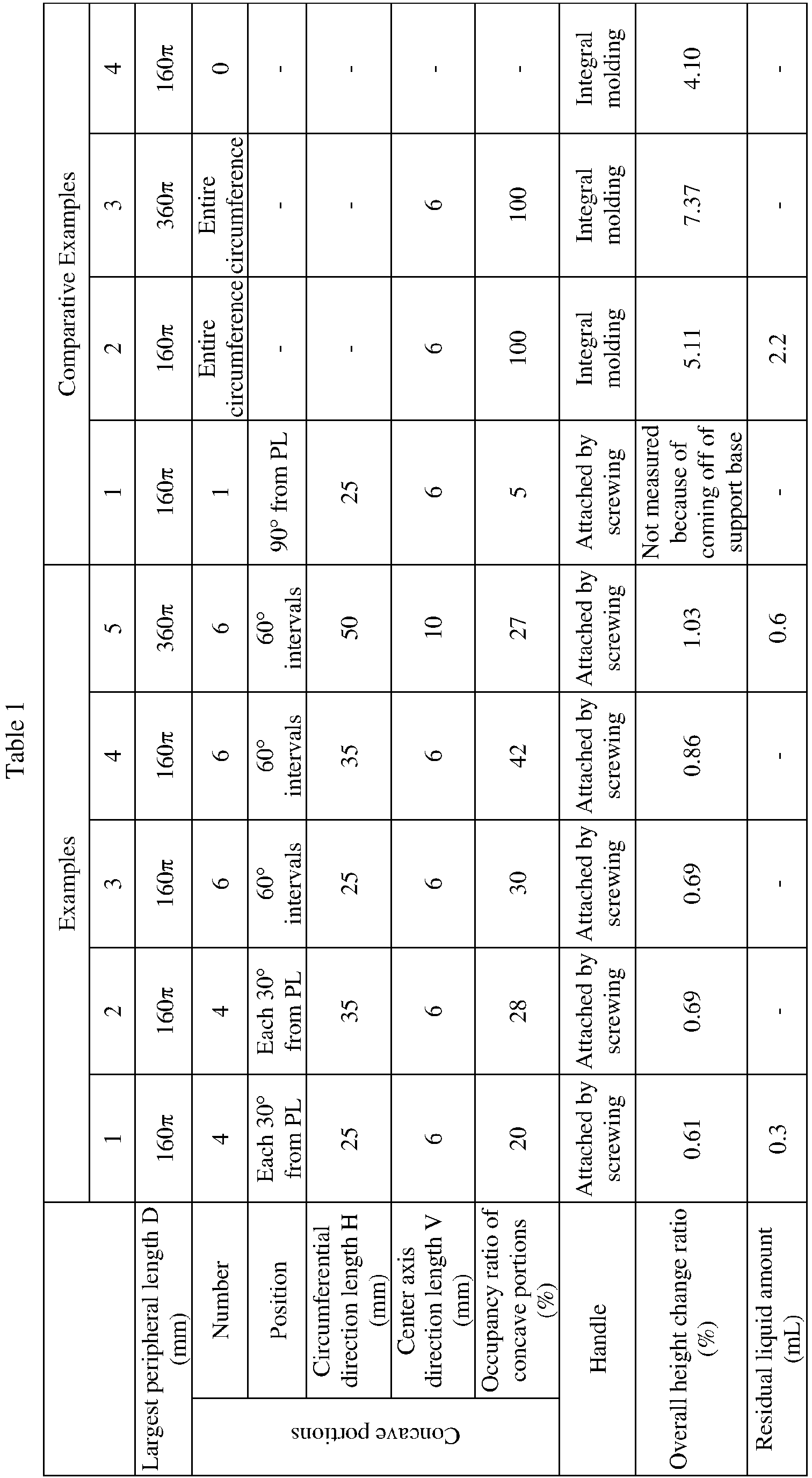
- As can be understood from Table 1, in each of of the
containers 10 of Examples 1 to 5, theconcave portions 14 did not extend. Therefore, even when the internal pressure of eachcontainer 10 was high, its overall height hardly changed although container supports for suppressing a change in the overall height of thecontainer 10 were not used. Meanwhile, in the case of Comparative Example 1, since thecontainer 10 had only oneconcave portion 14, the engagement between thecontainer 10 and thesupport base 20 was instable, and therefore, thecontainer 10 came off thesupport base 20. In the case of Comparative Examples 2 and 3 in which, instead of theconcave portions 14, thecircumferential groove 44 was continuously provided over the entire circumference of thecontainer 40, the overall height of the container increased considerably, because thecircumferential groove 44 extended in the manner of a helical spring as a result of an increase in the internal pressure of thecontainer 40. - The container and the container assembly of the present invention are suitably used for pressure feed of liquids, for example, in the field of foods, in the field of pharmaceuticals, and in the field of manufacture of semiconductors and liquid crystal devices, in which clean liquids are demanded.
- 10 : container, 11 : cylindrical mouth, 12 : main body portion, 12a : upper end portion, 12ai : external thread, 12b : neck portion, 12bi : external thread, 12c : trunk portion, 13 : stepped portion, 14 : concave portion, 15 : round bottom portion, 20 : support base, 21 : claw portion, 30 : handle, 31 : annular portion, 31a : attachment hole, 31b : internal thread, 32 : ear portion, 32a : finger engagement hole, 40 : container, 40a : handle, 42 : main body portion, 44 : circumferential groove, 45 : flat bottom portion, 100 : container assembly, C : center axis, D : largest peripheral length, H : circumferential direction length, h : center point, PL : parting line, V : center axis direction length, X and Y : reference lines, and θ and θ1 : angles
Claims (4)
- A container used to contain a liquid and to pressure-feed the liquid, comprising an approximately cylindrical main body portion, a cylindrical mouth opening at one end of the main body portion, a stepped portion continuously extending from the other end of the main body portion and having a reduced diameter, and a round bottom portion continuously extending from the stepped portion and bulging away from the stepped portion, the container being characterized in thata plurality of concave portions for engagement with claw portions of a support base which enables the container to stand by itself are intermittently formed at the stepped portion, the concave portions being recessed at positions which do not overlap with a series of parting lines extending through the main body portion, the stepped portion, and the round bottom portion; andeach of the concave portions has an approximately elliptical shape elongated in a circumferential direction of the main body portion, and the total length of the plurality of concave portions in the circumferential direction accounts for 20 to 50% of a largest peripheral length of the main body portion.
- The container according to claim 1, wherein the concave portions are provided, symmetrically with respect to the parting lines, at four locations each being an angle of 20 to 45° away from the corresponding parting line or at six locations separated from one another by an angle of 60°, the angles being those about a center axis of the main body portion.
- A container assembly characterized in that the main body portion of the container according to claim 1 or 2 has a trunk portion and a neck portion which is located closer to the cylindrical mouth and whose diameter is smaller than that of the trunk portion, and a handle is fitted and/or screwed onto an outer surface of the neck portion.
- A container assembly characterized by comprising the container according to claim 1 or 2 and a support base which has an opening into which the round bottom portion is fitted and claw portions which extend from a circumferential edge of the opening and are engaged with the concave portions, whereby the support base enables the container to stand by itself.
Applications Claiming Priority (2)
| Application Number | Priority Date | Filing Date | Title |
|---|---|---|---|
| JP2021083228A JP7013610B1 (en) | 2021-05-17 | 2021-05-17 | Containers and container assemblies |
| PCT/JP2022/016522 WO2022244527A1 (en) | 2021-05-17 | 2022-03-31 | Container and container assembly |
Publications (3)
| Publication Number | Publication Date |
|---|---|
| EP4342811A1 true EP4342811A1 (en) | 2024-03-27 |
| EP4342811A4 EP4342811A4 (en) | 2025-04-23 |
| EP4342811B1 EP4342811B1 (en) | 2026-02-11 |
Family
ID=80737852
Family Applications (1)
| Application Number | Title | Priority Date | Filing Date |
|---|---|---|---|
| EP22804443.4A Active EP4342811B1 (en) | 2021-05-17 | 2022-03-31 | Container and container assembly |
Country Status (7)
| Country | Link |
|---|---|
| US (1) | US12384596B2 (en) |
| EP (1) | EP4342811B1 (en) |
| JP (1) | JP7013610B1 (en) |
| KR (1) | KR102607395B1 (en) |
| CN (1) | CN117320970B (en) |
| TW (1) | TWI802412B (en) |
| WO (1) | WO2022244527A1 (en) |
Families Citing this family (4)
| Publication number | Priority date | Publication date | Assignee | Title |
|---|---|---|---|---|
| SE544653C2 (en) * | 2020-07-08 | 2022-10-04 | Aarke Ab | Beverage bottle and method for joining thereof |
| JP7013610B1 (en) * | 2021-05-17 | 2022-01-31 | 株式会社アイセロ | Containers and container assemblies |
| JP2024066898A (en) | 2022-11-02 | 2024-05-16 | 旭化成株式会社 | Solid electrolyte laminate, solid secondary battery, and method for manufacturing the same |
| JP2025068429A (en) * | 2023-10-16 | 2025-04-28 | 株式会社アイセロ | Dip nozzle, and liquid container using the same |
Family Cites Families (46)
| Publication number | Priority date | Publication date | Assignee | Title |
|---|---|---|---|---|
| US845777A (en) * | 1906-10-27 | 1907-03-05 | Joseph Grossman | Milk-bottle protector. |
| US860316A (en) * | 1907-03-18 | 1907-07-16 | Louis P Nash | Casing for siphon-bottles. |
| US2837245A (en) * | 1955-05-12 | 1958-06-03 | Injection Molding Company | Low pressure flexible wall container |
| US2905351A (en) * | 1956-02-27 | 1959-09-22 | Braun Co W | Snap-on base for a bottle, jar, glass, or the like |
| US3847494A (en) * | 1970-08-19 | 1974-11-12 | E Franklin | Coupling mechanism for tubular elements |
| US3722725A (en) * | 1970-09-24 | 1973-03-27 | Monsanto Co | Package for pressurized fluent materials a |
| US3927782A (en) * | 1974-07-02 | 1975-12-23 | Illinois Tool Works | Plastic container and base construction |
| US3948404A (en) * | 1974-11-14 | 1976-04-06 | E. I. Du Pont De Nemours And Company | Composite package for containing pressurized fluids |
| FR2357437A1 (en) * | 1976-07-07 | 1978-02-03 | Carnaud Total Interplastic | HOLLOW BODY IN PLASTIC MATERIAL SUBJECT TO INTERNAL PRESSURE |
| DE2731635C2 (en) * | 1976-07-16 | 1985-07-25 | Owens-Illinois, Inc., Toledo, Ohio | Bottle made of biaxially oriented polyester |
| US4241839A (en) * | 1979-08-14 | 1980-12-30 | Sewell Plastics, Inc. | Base-cup for assuring vertical alignment of semi-hemispherically bottomed bottles |
| US4463860A (en) * | 1980-03-03 | 1984-08-07 | Yoshino Kogyosho Co., Ltd. | Saturated polyester resin bottle and stand |
| US4326638A (en) * | 1980-05-16 | 1982-04-27 | Plastipak Packaging Division, Beatrice Food Co. | Combination base cup and bottle |
| JPS6323319Y2 (en) * | 1980-07-22 | 1988-06-27 | ||
| JPS5726337A (en) * | 1980-07-23 | 1982-02-12 | Mitsubishi Electric Corp | Controller for air conditioner |
| JPS5876899A (en) | 1981-10-31 | 1983-05-10 | 株式会社東芝 | Voice segment detector |
| JPS5876899U (en) | 1981-11-19 | 1983-05-24 | 大日本インキ化学工業株式会社 | Container with freestanding holder |
| JPH01147938A (en) * | 1987-12-03 | 1989-06-09 | Matsushita Electric Ind Co Ltd | Communication equipment |
| US4881666A (en) * | 1988-01-19 | 1989-11-21 | Robert Tullman | Variable volume container |
| JPH01147983U (en) * | 1988-03-31 | 1989-10-13 | ||
| JP3016052B2 (en) * | 1992-05-15 | 2000-03-06 | 東洋自動機株式会社 | Degassing device for automatic packaging machine |
| JPH072233U (en) * | 1993-06-15 | 1995-01-13 | 広幸 麻生 | Beer bottle and one shobo handle |
| US5662241A (en) * | 1995-07-03 | 1997-09-02 | Sorensen; Charles K. | Container and stand for liquids |
| TW442429B (en) * | 1998-05-08 | 2001-06-23 | Aicello Chemical Co | Container for high purity liquid chemicals |
| JP2000010390A (en) * | 1998-06-24 | 2000-01-14 | Sharp Corp | Developer container |
| US6405675B1 (en) * | 2000-08-11 | 2002-06-18 | Julie M. Mills | Water bottle assembly having a removable water bowl |
| DE20201737U1 (en) * | 2002-02-05 | 2003-04-30 | Münch, Hans, 82024 Taufkirchen | Repeatedly usable bottle for drinks containing carbon dioxide gas comprises a machine-washable bottle body provided with grooves serving for attachment of the bottle base |
| US20060177399A1 (en) * | 2004-11-16 | 2006-08-10 | Herve Jourdan | Pressurized device for hair fiber styling and use of the same for hair fiber styling and/or hair |
| BRMU8500295Y1 (en) * | 2005-02-23 | 2014-01-14 | CONSTRUCTIVE PROVISION ON PACKAGING OF MEDICINAL PRODUCTS AND COSMETICS | |
| CN200988621Y (en) * | 2006-11-01 | 2007-12-12 | 美的集团有限公司 | Connection device for electric heating capacitor |
| CN201056328Y (en) * | 2007-07-13 | 2008-05-07 | 广东奥飞动漫文化股份有限公司 | Packaging can for conveniently piling up remote control toy car |
| US8439223B2 (en) * | 2007-08-20 | 2013-05-14 | The Procter & Gamble Company | Base cup for a supportable pressurizable container |
| US9061795B2 (en) * | 2007-08-20 | 2015-06-23 | Procter & Gamble | Supportable pressurizable container and base cup therefor with alignment tabs |
| US20090050599A1 (en) * | 2007-08-20 | 2009-02-26 | Matthew John Martin | Supportable pressurizable container having a bottom for receiving a dip tube and base cup therefor |
| US20090184116A1 (en) * | 2008-01-23 | 2009-07-23 | Laske Lawrence L | Portable, nestable storage and carrying means for food and drink having integrated releasable serving means |
| CN201249910Y (en) * | 2008-04-30 | 2009-06-03 | 陈勇 | Storage type bottle base |
| CN201390477Y (en) * | 2009-03-20 | 2010-01-27 | 吴伟坚 | Wine bottle |
| JP5560019B2 (en) * | 2009-11-04 | 2014-07-23 | 株式会社アイセロ | Liquid feeding device and liquid container used for the liquid feeding device |
| US8453860B2 (en) * | 2011-09-12 | 2013-06-04 | Efrain Otero | Bottle with ratcheting base and inner bladder |
| MX2018000864A (en) | 2015-07-23 | 2018-05-15 | Colgate Palmolive Co | Container closure and preform. |
| US20180296013A1 (en) * | 2016-12-08 | 2018-10-18 | Matthew Richad Frei | Container Inverter |
| JP7264585B2 (en) * | 2017-06-15 | 2023-04-25 | 株式会社吉野工業所 | container with cap |
| WO2020111024A1 (en) * | 2018-11-30 | 2020-06-04 | キョーラク株式会社 | Capped container, leakage examination method for double container, lamination release container, and manufacturing method therefor |
| JP2020196537A (en) * | 2019-05-31 | 2020-12-10 | シャープ株式会社 | Container and container set |
| CN211495203U (en) * | 2019-09-02 | 2020-09-15 | 陕西西氢航天动力科技有限公司 | Sealing device capable of being rapidly disassembled and assembled under high-temperature environment |
| JP7013610B1 (en) * | 2021-05-17 | 2022-01-31 | 株式会社アイセロ | Containers and container assemblies |
-
2021
- 2021-05-17 JP JP2021083228A patent/JP7013610B1/en active Active
-
2022
- 2022-03-31 KR KR1020237004487A patent/KR102607395B1/en active Active
- 2022-03-31 US US18/561,003 patent/US12384596B2/en active Active
- 2022-03-31 CN CN202280036120.XA patent/CN117320970B/en active Active
- 2022-03-31 EP EP22804443.4A patent/EP4342811B1/en active Active
- 2022-03-31 WO PCT/JP2022/016522 patent/WO2022244527A1/en not_active Ceased
- 2022-05-16 TW TW111118161A patent/TWI802412B/en not_active IP Right Cessation
Also Published As
| Publication number | Publication date |
|---|---|
| JP7013610B1 (en) | 2022-01-31 |
| JP2022176682A (en) | 2022-11-30 |
| KR20230025526A (en) | 2023-02-21 |
| CN117320970B (en) | 2025-12-12 |
| WO2022244527A1 (en) | 2022-11-24 |
| TW202246135A (en) | 2022-12-01 |
| KR102607395B1 (en) | 2023-11-29 |
| US20240367857A1 (en) | 2024-11-07 |
| EP4342811A4 (en) | 2025-04-23 |
| TWI802412B (en) | 2023-05-11 |
| EP4342811B1 (en) | 2026-02-11 |
| US12384596B2 (en) | 2025-08-12 |
| CN117320970A (en) | 2023-12-29 |
Similar Documents
| Publication | Publication Date | Title |
|---|---|---|
| EP4342811B1 (en) | Container and container assembly | |
| EP3505462B1 (en) | Container | |
| US11858680B2 (en) | Container and method of manufacturing the same | |
| CA3117896C (en) | Container and method of manufacturing the same | |
| US6244454B1 (en) | Multilayer thin wall container | |
| JP6983827B2 (en) | Pipette tip | |
| DK2933201T3 (en) | LIGHTWEIGHT PLASTIC CONTAINER | |
| KR20110049684A (en) | Liquid container, liquid feeding apparatus and liquid feeding method using the liquid container | |
| US20110240673A1 (en) | Collapsible container and method of making | |
| US10988277B2 (en) | Synthetic resin container and preform | |
| HU213465B (en) | Plastic barrel | |
| EP2481680A1 (en) | Medical fluid nozzle | |
| US20140183153A1 (en) | Inverted bottle assembly | |
| JP2019209994A (en) | Inverted double container | |
| EP3215426B1 (en) | A thermoplastic preform for a wide-mouth container | |
| JP7295393B2 (en) | delaminating container | |
| JPH0995565A (en) | High-purity resin composition and its molding | |
| CN112770978B (en) | container with lid | |
| CN121263369A (en) | Immersion nozzle and liquid container using the same | |
| JP2019026292A (en) | Plastic container | |
| US20190055047A1 (en) | Bottle with base | |
| US20240246726A1 (en) | Liquid container and liquid container with content liquid | |
| JP7246946B2 (en) | delaminating container | |
| US20180186519A1 (en) | Caps and adapters for containers | |
| HK40002764A (en) | Container |
Legal Events
| Date | Code | Title | Description |
|---|---|---|---|
| STAA | Information on the status of an ep patent application or granted ep patent |
Free format text: STATUS: THE INTERNATIONAL PUBLICATION HAS BEEN MADE |
|
| PUAI | Public reference made under article 153(3) epc to a published international application that has entered the european phase |
Free format text: ORIGINAL CODE: 0009012 |
|
| STAA | Information on the status of an ep patent application or granted ep patent |
Free format text: STATUS: REQUEST FOR EXAMINATION WAS MADE |
|
| 17P | Request for examination filed |
Effective date: 20231110 |
|
| AK | Designated contracting states |
Kind code of ref document: A1 Designated state(s): AL AT BE BG CH CY CZ DE DK EE ES FI FR GB GR HR HU IE IS IT LI LT LU LV MC MK MT NL NO PL PT RO RS SE SI SK SM TR |
|
| DAV | Request for validation of the european patent (deleted) | ||
| DAX | Request for extension of the european patent (deleted) | ||
| REG | Reference to a national code |
Ref legal event code: R079 Ipc: B65D0023000000 Ref country code: DE Ref legal event code: R079 Ref document number: 602022030231 Country of ref document: DE Free format text: PREVIOUS MAIN CLASS: B65D0025200000 Ipc: B65D0023000000 |
|
| A4 | Supplementary search report drawn up and despatched |
Effective date: 20250326 |
|
| RIC1 | Information provided on ipc code assigned before grant |
Ipc: B65D 23/10 20060101ALN20250320BHEP Ipc: B65D 23/00 20060101AFI20250320BHEP |
|
| GRAP | Despatch of communication of intention to grant a patent |
Free format text: ORIGINAL CODE: EPIDOSNIGR1 |
|
| STAA | Information on the status of an ep patent application or granted ep patent |
Free format text: STATUS: GRANT OF PATENT IS INTENDED |
|
| RIC1 | Information provided on ipc code assigned before grant |
Ipc: B65D 23/10 20060101ALN20250516BHEP Ipc: B65D 23/00 20060101AFI20250516BHEP |
|
| INTG | Intention to grant announced |
Effective date: 20250611 |
|
| GRAJ | Information related to disapproval of communication of intention to grant by the applicant or resumption of examination proceedings by the epo deleted |
Free format text: ORIGINAL CODE: EPIDOSDIGR1 |
|
| STAA | Information on the status of an ep patent application or granted ep patent |
Free format text: STATUS: REQUEST FOR EXAMINATION WAS MADE |
|
| GRAP | Despatch of communication of intention to grant a patent |
Free format text: ORIGINAL CODE: EPIDOSNIGR1 |
|
| STAA | Information on the status of an ep patent application or granted ep patent |
Free format text: STATUS: GRANT OF PATENT IS INTENDED |
|
| INTC | Intention to grant announced (deleted) | ||
| P01 | Opt-out of the competence of the unified patent court (upc) registered |
Free format text: CASE NUMBER: UPC_APP_3846_4342811/2025 Effective date: 20250820 |
|
| RIC1 | Information provided on ipc code assigned before grant |
Ipc: B65D 23/00 20060101AFI20250821BHEP Ipc: B65D 23/10 20060101ALN20250821BHEP |
|
| INTG | Intention to grant announced |
Effective date: 20250924 |
|
| GRAS | Grant fee paid |
Free format text: ORIGINAL CODE: EPIDOSNIGR3 |
|
| GRAA | (expected) grant |
Free format text: ORIGINAL CODE: 0009210 |
|
| STAA | Information on the status of an ep patent application or granted ep patent |
Free format text: STATUS: THE PATENT HAS BEEN GRANTED |
|
| AK | Designated contracting states |
Kind code of ref document: B1 Designated state(s): AL AT BE BG CH CY CZ DE DK EE ES FI FR GB GR HR HU IE IS IT LI LT LU LV MC MK MT NL NO PL PT RO RS SE SI SK SM TR |
|
| REG | Reference to a national code |
Ref country code: CH Ref legal event code: F10 Free format text: ST27 STATUS EVENT CODE: U-0-0-F10-F00 (AS PROVIDED BY THE NATIONAL OFFICE) Effective date: 20260211 Ref country code: GB Ref legal event code: FG4D |
|
| REG | Reference to a national code |
Ref country code: DE Ref legal event code: R096 Ref document number: 602022030231 Country of ref document: DE |
|
| REG | Reference to a national code |
Ref country code: IE Ref legal event code: FG4D |
|
| PGFP | Annual fee paid to national office [announced via postgrant information from national office to epo] |
Ref country code: DE Payment date: 20260213 Year of fee payment: 5 |
|
| PGFP | Annual fee paid to national office [announced via postgrant information from national office to epo] |
Ref country code: BE Payment date: 20260330 Year of fee payment: 5 |