EP4342941B1 - Procédé de recyclage de polyéthylène téréphtalate à l'aide d'un gradient de concentration d'impuretés - Google Patents
Procédé de recyclage de polyéthylène téréphtalate à l'aide d'un gradient de concentration d'impuretés Download PDFInfo
- Publication number
- EP4342941B1 EP4342941B1 EP22196675.7A EP22196675A EP4342941B1 EP 4342941 B1 EP4342941 B1 EP 4342941B1 EP 22196675 A EP22196675 A EP 22196675A EP 4342941 B1 EP4342941 B1 EP 4342941B1
- Authority
- EP
- European Patent Office
- Prior art keywords
- preferred
- volume section
- range
- polyester
- organic compound
- Prior art date
- Legal status (The legal status is an assumption and is not a legal conclusion. Google has not performed a legal analysis and makes no representation as to the accuracy of the status listed.)
- Active
Links
Images




Classifications
-
- C—CHEMISTRY; METALLURGY
- C08—ORGANIC MACROMOLECULAR COMPOUNDS; THEIR PREPARATION OR CHEMICAL WORKING-UP; COMPOSITIONS BASED THEREON
- C08J—WORKING-UP; GENERAL PROCESSES OF COMPOUNDING; AFTER-TREATMENT NOT COVERED BY SUBCLASSES C08B, C08C, C08F, C08G or C08H
- C08J11/00—Recovery or working-up of waste materials
- C08J11/04—Recovery or working-up of waste materials of polymers
- C08J11/10—Recovery or working-up of waste materials of polymers by chemically breaking down the molecular chains of polymers or breaking of crosslinks, e.g. devulcanisation
-
- C—CHEMISTRY; METALLURGY
- C08—ORGANIC MACROMOLECULAR COMPOUNDS; THEIR PREPARATION OR CHEMICAL WORKING-UP; COMPOSITIONS BASED THEREON
- C08J—WORKING-UP; GENERAL PROCESSES OF COMPOUNDING; AFTER-TREATMENT NOT COVERED BY SUBCLASSES C08B, C08C, C08F, C08G or C08H
- C08J11/00—Recovery or working-up of waste materials
- C08J11/04—Recovery or working-up of waste materials of polymers
- C08J11/10—Recovery or working-up of waste materials of polymers by chemically breaking down the molecular chains of polymers or breaking of crosslinks, e.g. devulcanisation
- C08J11/18—Recovery or working-up of waste materials of polymers by chemically breaking down the molecular chains of polymers or breaking of crosslinks, e.g. devulcanisation by treatment with organic material
- C08J11/22—Recovery or working-up of waste materials of polymers by chemically breaking down the molecular chains of polymers or breaking of crosslinks, e.g. devulcanisation by treatment with organic material by treatment with organic oxygen-containing compounds
- C08J11/24—Recovery or working-up of waste materials of polymers by chemically breaking down the molecular chains of polymers or breaking of crosslinks, e.g. devulcanisation by treatment with organic material by treatment with organic oxygen-containing compounds containing hydroxyl groups
-
- C—CHEMISTRY; METALLURGY
- C08—ORGANIC MACROMOLECULAR COMPOUNDS; THEIR PREPARATION OR CHEMICAL WORKING-UP; COMPOSITIONS BASED THEREON
- C08G—MACROMOLECULAR COMPOUNDS OBTAINED OTHERWISE THAN BY REACTIONS ONLY INVOLVING UNSATURATED CARBON-TO-CARBON BONDS
- C08G63/00—Macromolecular compounds obtained by reactions forming a carboxylic ester link in the main chain of the macromolecule
- C08G63/78—Preparation processes
-
- C—CHEMISTRY; METALLURGY
- C08—ORGANIC MACROMOLECULAR COMPOUNDS; THEIR PREPARATION OR CHEMICAL WORKING-UP; COMPOSITIONS BASED THEREON
- C08J—WORKING-UP; GENERAL PROCESSES OF COMPOUNDING; AFTER-TREATMENT NOT COVERED BY SUBCLASSES C08B, C08C, C08F, C08G or C08H
- C08J11/00—Recovery or working-up of waste materials
- C08J11/04—Recovery or working-up of waste materials of polymers
- C08J11/10—Recovery or working-up of waste materials of polymers by chemically breaking down the molecular chains of polymers or breaking of crosslinks, e.g. devulcanisation
- C08J11/18—Recovery or working-up of waste materials of polymers by chemically breaking down the molecular chains of polymers or breaking of crosslinks, e.g. devulcanisation by treatment with organic material
-
- C—CHEMISTRY; METALLURGY
- C08—ORGANIC MACROMOLECULAR COMPOUNDS; THEIR PREPARATION OR CHEMICAL WORKING-UP; COMPOSITIONS BASED THEREON
- C08J—WORKING-UP; GENERAL PROCESSES OF COMPOUNDING; AFTER-TREATMENT NOT COVERED BY SUBCLASSES C08B, C08C, C08F, C08G or C08H
- C08J2367/00—Characterised by the use of polyesters obtained by reactions forming a carboxylic ester link in the main chain; Derivatives of such polymers
-
- C—CHEMISTRY; METALLURGY
- C08—ORGANIC MACROMOLECULAR COMPOUNDS; THEIR PREPARATION OR CHEMICAL WORKING-UP; COMPOSITIONS BASED THEREON
- C08J—WORKING-UP; GENERAL PROCESSES OF COMPOUNDING; AFTER-TREATMENT NOT COVERED BY SUBCLASSES C08B, C08C, C08F, C08G or C08H
- C08J2367/00—Characterised by the use of polyesters obtained by reactions forming a carboxylic ester link in the main chain; Derivatives of such polymers
- C08J2367/02—Polyesters derived from dicarboxylic acids and dihydroxy compounds
-
- C—CHEMISTRY; METALLURGY
- C08—ORGANIC MACROMOLECULAR COMPOUNDS; THEIR PREPARATION OR CHEMICAL WORKING-UP; COMPOSITIONS BASED THEREON
- C08J—WORKING-UP; GENERAL PROCESSES OF COMPOUNDING; AFTER-TREATMENT NOT COVERED BY SUBCLASSES C08B, C08C, C08F, C08G or C08H
- C08J2467/00—Characterised by the use of polyesters obtained by reactions forming a carboxylic ester link in the main chain; Derivatives of such polymers
-
- C—CHEMISTRY; METALLURGY
- C08—ORGANIC MACROMOLECULAR COMPOUNDS; THEIR PREPARATION OR CHEMICAL WORKING-UP; COMPOSITIONS BASED THEREON
- C08J—WORKING-UP; GENERAL PROCESSES OF COMPOUNDING; AFTER-TREATMENT NOT COVERED BY SUBCLASSES C08B, C08C, C08F, C08G or C08H
- C08J2467/00—Characterised by the use of polyesters obtained by reactions forming a carboxylic ester link in the main chain; Derivatives of such polymers
- C08J2467/02—Polyesters derived from dicarboxylic acids and dihydroxy compounds
-
- Y—GENERAL TAGGING OF NEW TECHNOLOGICAL DEVELOPMENTS; GENERAL TAGGING OF CROSS-SECTIONAL TECHNOLOGIES SPANNING OVER SEVERAL SECTIONS OF THE IPC; TECHNICAL SUBJECTS COVERED BY FORMER USPC CROSS-REFERENCE ART COLLECTIONS [XRACs] AND DIGESTS
- Y02—TECHNOLOGIES OR APPLICATIONS FOR MITIGATION OR ADAPTATION AGAINST CLIMATE CHANGE
- Y02P—CLIMATE CHANGE MITIGATION TECHNOLOGIES IN THE PRODUCTION OR PROCESSING OF GOODS
- Y02P20/00—Technologies relating to chemical industry
- Y02P20/141—Feedstock
- Y02P20/143—Feedstock the feedstock being recycled material, e.g. plastics
-
- Y—GENERAL TAGGING OF NEW TECHNOLOGICAL DEVELOPMENTS; GENERAL TAGGING OF CROSS-SECTIONAL TECHNOLOGIES SPANNING OVER SEVERAL SECTIONS OF THE IPC; TECHNICAL SUBJECTS COVERED BY FORMER USPC CROSS-REFERENCE ART COLLECTIONS [XRACs] AND DIGESTS
- Y02—TECHNOLOGIES OR APPLICATIONS FOR MITIGATION OR ADAPTATION AGAINST CLIMATE CHANGE
- Y02W—CLIMATE CHANGE MITIGATION TECHNOLOGIES RELATED TO WASTEWATER TREATMENT OR WASTE MANAGEMENT
- Y02W30/00—Technologies for solid waste management
- Y02W30/50—Reuse, recycling or recovery technologies
- Y02W30/62—Plastics recycling; Rubber recycling
Definitions
- PET Polyethylene terephthalate
- PET is one of the most widely used and economically important thermoplastic polymers. PET is used for, e.g., fibres for clothing, containers for food and beverages, such as bottles, and for films.
- PET-containing products have created serious ecological concerns.
- Methods for recycling PET are thus very important in order to reduce the amount of PET waste.
- One method of recycling is the reduction of PET into the chemical components that are used to produce PET, followed by the polymerisation of the chemical components to obtain recycled PET. This is known as chemical recycling.
- Disadvantages of the chemical recycling process include the following: the recycling process is generally very energy inefficient, is ecologically unfriendly, and has a low through-put.
- the PET is depolymerised to monomers, this requires long depolymerisation times, and leads to the production of large amounts of degradation products that can't be removed from the recycled PET. Very often it is also required to mix the PET that is chemically recycled with virgin PET in order to obtain a recycled PET product of sufficiently high quality.
- EP3778744 A1 discloses a method for recycling PET that includes mixing virgin PET liquid material with the recycled PET (virgin PET liquid material is defined as the chemical components required to produce virgin PET, i.e. , PET that is not obtained using a recycling method).
- CN109134244 A discloses a method for recycling PET that uses both glycol and methanol to depolymerise PET.
- CN108395373 A discloses a method for recycling PET that uses ethylene glycol and propylene glycol.
- An object of the present invention is to at least partially overcome at least one of the disadvantages encountered in the state of the art.
- the feedstock comprises a first polyester, and the first intermediate product is obtained from the first polyester.
- Sources of impurities include the feedstock (used for the method for producing the first intermediate product), which contain impurities such as sand and polyvinyl chloride.
- the fragments are in a form that is selected from the group consisting of flakes, threads, fibres, particles, splinters, sheets, films, and a combination of two or more thereof.
- This preferred embodiment is a 9 th embodiment of the invention.
- flakes are particularly preferred.
- a means that does not use a density of the first polyester to perform the at least partial sorting it is preferred to use a means that does not use a density of the first polyester to perform the at least partial sorting.
- a gravity separator is particularly preferred. In this aspect, a gravity separator that does not require a fluid to perform the at least partial sorting is more preferred.
- a suitably gravity separator can be obtained from, e.g ., Cimbria Heid GmbH (Austria).
- This preferred embodiment is a 14 th embodiment of the invention.
- a temperature of the first initial mixture is in the range of 50 °C to 90 °C, more preferably in the range of 55 °C to 85 °C, even more preferably in the range of 55 °C to 80 °C, further preferably in the range of 60 °C to 80 °C, and even further preferably in the range of 65 °C to 77 °C.
- This preferred embodiment is a 17 th embodiment of the invention.
- the first polyester in the volume section V 1 has an intrinsic viscosity in the range of 0.50 dL/g to 1.00 dL/g, more preferably in the range of 0.60 dL/g to 0.95 dL/g, even more preferably in the range of 0.70 dL/g to 0.90 dL/g, and further preferably in the range of 0.76 dL/g to 0.84 dL/g.
- This preferred embodiment is an 18 th embodiment of the invention.
- This preferred embodiment is a 20 th embodiment of the invention.
- the pressure in the volume section V 1 is atmospheric pressure.
- the method further comprises the step of agitating the first initial mixture, preferably in the volume section V 1 .
- This preferred embodiment is a 24 th embodiment of the invention.
- the first initial mixture is agitated using a mechanical means adapted and arranged for agitation., a non-mechanical means adapted and arranged for agitation, or a combination thereof.
- the mechanical means, the non-mechanical means, or both are adapted and arranged for suspending particles in a liquid, e.g. , suspending a plurality of fragments of the feedstock in the first organic compound. Suspension of particles can be achieved by, e.g ., using a mechanical agitation means that has a number of revolutions per minute above a minimum value.
- the first initial mixture is agitated such that impurities can float on the surface of the first initial mixture. This can be achieved, by, e.g ., using an agitation means that has a number of revolutions per minute below a maximum value.
- the method further comprises the step of at least partially removing the at least one impurity from the first initial mixture, preferably in the volume section V 1 .
- This preferred embodiment is a 25 th embodiment of the invention.
- the at least one impurity was present in the feedstock.
- a floatable separating means is used to at least partially remove the at least one impurity.
- the at least one impurity is at least partially remove using skimming, filtration, or a combination thereof.
- the method further comprises the step of transporting the first polyester, preferably from the volume section V 1 , to a volume section V 2 .
- This preferred embodiment is a 26 th embodiment of the invention.
- the first polyester it is preferred to transport the first polyester to the volume section V 2 after the feedstock has been contacted with the first amount of the first organic compound in the volume section V 1 .
- the volume section V 2 is at least partially filled with the first organic compound, and wherein
- This preferred embodiment is a 27 th embodiment of the invention.
- At least a fraction of the first organic compound in the volume section V 2 was transported from the volume section V 1 .
- at least a fraction of the first organic compound in the volume section V 2 was added via at least one inlet of the volume section V 2 , e.g., an inlet of a further kind, and an inlet of an even-further kind.
- at least 50 wt-%, more preferably at least 60 wt-%, and further preferably at least 70 wt-% of the first organic compound in the volume section V 2 is due to the addition of the first organic compound via at least one inlet of the volume section V 2 .
- the wt-% is based on the total weight of the first organic compound in the volume section V 2 .
- a further amount of the first organic compound " is an example of a fraction of the first organic compound added via at least one inlet.
- the difference H 2 - H 1 is less than 250 cm, more preferably less than 180 cm, even more preferably less than 160 cm, and further preferably less than 140 cm.
- the first polyester prior to entering the volume section V 2 , is transported along an even-further direction, wherein the even-further direction is at least partially against the direction of gravity.
- This preferred embodiment is a 29 th embodiment of the invention.
- the first organic compound is transported in a direction opposite the even-further direction.
- the first polyester and a fraction of the first organic compound are transported in opposite directions.
- an angle between the even-further direction and a horizontal plane is in the range of 12° to 45°, more preferably in the range of 17° to 40°, even more preferably is in the range of 20° to 35°, further preferably in the range of 24° to 32°.
- This preferred embodiment is a 30 th embodiment of the invention.
- an example of a horizontal plane is a floor, e.g., a floor of a recycling plant. In an aspect of the 30 th embodiment, it is preferred that the horizontal plane is perpendicular to the direction of gravity.
- the method further comprises the step of increasing the temperature of the first polyester, preferably in the volume section V 2 .
- This preferred embodiment is a 31 st embodiment of the invention.
- the temperature is increased by the contact of the first polyester with the further amount of the first organic compound. In an aspect of the 31 st embodiment, it is preferred to increase the temperature prior to contacting the first polyester with the further organic compound.
- the temperature in the volume section V 2 is in the range of 50 °C to 220 °C, more preferably in the range of 60 °C to 210 °C, more preferably in the range of 65 °C to 205 °C, and further preferably in the range of 68 °C to 200 °C.
- This preferred embodiment is a 32 nd embodiment of the invention.
- the temperature in the volume section V 2 is the temperature of a mixture comprising the first polyester and the first organic compound.
- This preferred embodiment is a 33 rd embodiment of the invention.
- This preferred embodiment is a 34 th embodiment of the invention.
- the temperature in the first zone increases from a first end of the first zone to a further end of the first zone.
- the temperature increases from 70 °C, measured at the first end of the first zone, to 145 °C, measured at the further end of the first zone.
- the first end of the first zone is located downstream of the further end of the first zone.
- the first end of the first zone is located near an inlet of the volume section V 2 through which the first polyester enters the volume section V 2 .
- the temperature in the further zone increases from a first end of the further zone to a further end of the further zone.
- the temperature increases from 140 °C, measured at the first end of the further zone, to 200 °C, measured at the further end of the further zone.
- the first end of the further zone is located downstream of the further end of the further zone.
- the further end of the further zone is located near an outlet of the volume section V 2 through which the first polyester exits the volume section V 2 .
- the ends of the zones are arranged in this order: the first end of the first zone, the further end of the first zone, the first end of the further zone, and the further end of the further zone.
- the further end of the first zone forms the first end of the further zone.
- This preferred embodiment is a 35 th embodiment of the invention.
- the temperature of the further fraction of the further amount of the first organic compound is below the boiling point of the first organic compound. In an aspect of the 36 th embodiment, feature b., it is preferred that the temperature of the further fraction of the further amount of the first organic compound is in the range of 180 °C to 196 °C, more preferably in the range of 190 °C to 196 °C.
- This preferred embodiment is a 39 th embodiment of the invention.
- the method further comprises the step of reducing the following in the volume section V 2 :
- This preferred embodiment is a 41 st embodiment of the invention.
- the step a. in the 41 st embodiment prior to contacting the first polyester with the further organic compound.
- This preferred embodiment is a 42 nd embodiment of the invention.
- the transport of the first polyester along the first direction comprises at least one or all of the following: transport from the volume section V 1 to the volume section V 2 , transport through the volume section V 2 , or both.
- the transport of the first polyester along the further direction comprises transport through the volume section V 3 .
- the first polyester is in the form of a plurality of fragments.
- This preferred embodiment is a 54 th embodiment of the invention.
- the wt-% are based on a total weight of the first intermediate product in the first intermediate mixture.
- all possible combination of the features a. and b. are preferred aspects of the embodiment. These combinations are e.g., a; b; a+b.
- the first intermediate product comprises 20 wt-% of a monomer, and 80 wt-% of an oligomer.
- an example of a monomer is BHET.
- an example of an oligomer is a PET oligomer.
- This preferred embodiment is a 64 th embodiment of the invention.
- the Hunter Lab colour coordinate(s) L, b, or both are adjusted by the addition of at least one colouring agent to the first intermediate mixture, preferably in the volume section V 5 .
- This preferred embodiment is a 79 th embodiment of the invention. Suitable colouring agents are well-known to the skilled person, and are commercially available from Asili Corporation (USA) and Clariant AG (Switzerland).
- the stabiliser is added prior to the first intermediate mixture entering the volume section V 6 ; the stabiliser is added to the first intermediate mixture in the volume section V 6 , preferably prior to increasing the weight average molar mass of the first intermediate product.
- the residence time of the first intermediate mixture in the volume section V 6 is less than 750 minutes, more preferably less than 500 even more preferably less than 350 minutes, and further preferably less than 200 minutes.
- This preferred embodiment is an 86 th embodiment of the disclosure.
- the at least one organic compound is at least one or all of the following: the first organic compound, the further organic compound. In another aspect of the 93 rd embodiment, it is preferred that the at least one organic compound is at least partially removed from at least one or all of the following: the first intermediate mixture, and the further intermediate mixture. In yet another aspect of the 93 rd embodiment, it is preferred that the first organic compound is at least partially removed by flash evaporation.
- the further intermediate product is a further polyester.
- This preferred embodiment is a 94 th embodiment of the disclosure.
- the further polyester is selected from the group consisting of a polyethylene terephthalate, a polybutylene terephthalate, a polylactide, a polytrimethylene terephthalate, a polyethylene naphthalate, a polycarbonate, a polyester carbonate, a polyarylate, a polyester resin, preferably an unsaturated polyester resin, and a combination of two or more thereof.
- This preferred embodiment is a 95 th embodiment of the disclosure.
- the further polyester is polyethylene terephthalate.
- the further intermediate product is in the form of a liquid (e.g ., a melt, or a molten polymer), granules, or a combination thereof.
- a liquid e.g ., a melt, or a molten polymer
- granules or a combination thereof.
- the granules are commonly referred to as chips. In an aspect of the 96 th embodiment, it is preferred that the granules are obtained by extruding and cooling the hot melt.
- the further intermediate product is subjected to at least one processing step in order to obtain a product.
- This preferred embodiment is a 97 th embodiment of the disclosure.
- the further intermediate product is subjected to the at least one processing step downstream of the volume section V 6 , and more preferably downstream of the volume section V 7 .
- a 100 th embodiment of the disclosure is a further intermediate product obtainable by the method, according to the disclosure, for producing a further intermediate product.
- the further intermediate product is preferably a further polyester.
- the further intermediate product has at least one or all of the following properties:
- This preferred embodiment is a 101 st embodiment of the disclosure.
- the further intermediate product has, in Hunter Lab colour coordinates, an L value in the range of 45 to 75, more preferably in the range of 50 to 70, and further preferably in the range of 55 to 65.
- the further intermediate product has, in Hunter Lab colour coordinates, a b value in the range of 0 to 6, more preferably in the range of 1 to 5, and further preferably in the range of 2 to 4.
- a 102 nd embodiment of the disclosure is a product comprising a further intermediate product according to the disclosure.
- the product is selected from the group consisting of a yarn, a textile, shaped articles (e.g ., bottles), moulding materials, films, sheets, granulates, composites, foams, fibres, lubricants, adhesives, thickening agents, suspending agents, flocculants, resins, plastics, coatings, construction materials, absorbent materials, pharmaceuticals, materials for controlled release of active substances, powders, and a combination of at least two or more thereof.
- This preferred embodiment is a 103 rd embodiment of the disclosure.
- the product is yarn, more preferably a yarn for a textile.
- yarn include fully drawn yarn, draw texture yarn, and partially orientated yarn.
- the product has at least one or all of the following properties:
- This preferred embodiment is a 104 th embodiment of the disclosure.
- a 105 th embodiment of the disclosure is a use of a first intermediate product according to the disclosure for producing a further intermediate product, preferably a further polyester.
- ranges should preferably be understood to include both end points of the range.
- each disclosure of a range in the document should preferably be understood as also disclosing preferred sub-ranges in which one end point is excluded or both end points are excluded.
- a disclosure of a range from 60 °C to 75 °C is to be understood as disclosing a range that includes both of the end points 60 °C and 75 °C.
- a wt-% of feature A, more preferably b wt-% of feature A, and further preferably c wt-% of feature A has a length of x , more preferably a length of y, and further preferably a length of z
- At least one, more preferably at least two, even more preferably at least three, and further preferably all volume sections are in fluid communication with at least one filtering means.
- a volume section V 2 has a first zone and a further zone.
- the further zone is downstream the first zone.
- a mass ratio of the first polyester to a first organic compound in the first zone differs from a mass ratio of the first polyester to a first organic compound in the further zone. It is further preferred that the mass ratio of the first polyester to a first organic compound in the first zone is smaller than the mass ratio of the first polyester to a first organic compound in the further zone.
- a volume section V 2 is adapted and arranged for all of the following: removing at least one impurity from a mixture comprising a first polyester and a first organic compound, at least partially depolymerising a first polyester (preferably by solvolysis), and embrittling a first polyester.
- embrittling should preferably be understood to mean a process of making a first polyester more brittle. For example, if the first polyester is in the form of PET flakes, less force is required to break the flakes into smaller pieces after embrittling, compared to the force required to break the PET flakes into smaller pieces prior to embrittling.
- a volume section V 3 is adapted and arranged for at least partially depolymerising a first polyester, preferably using solvolysis.
- a volume section V 6 is adapted and arranged for at least partially polymerising at least one or all of the following, more preferably by polycondensation: monomers and oligomers.
- a volume section V 7 is adapted and arranged for at least partially polymerising at least one or all of the following, more preferably by polycondensation: monomers and oligomers.
- A1.) a first polyester is contacted with a further amount of a first organic compound in a volume section V 2 , and A2.) a weight average molar mass of the first polyester is reduced in the volume section V 2 .
- steps A1.) and A2.) are performed at least partially simultaneously.
- a first polyester is contacted with a further organic compound in a volume section V 3 , and B2.) a weight average molar mass of the first polyester is reduced in the volume section V 3 .
- steps B1.) and B2.) are performed at least partially simultaneously.
- At least one or all of the following can be transported between two components that are in fluid communication with each other: a solid, a mixture of a solid and a fluid, a mixture of a solid and a gas, and a mixture of a solid, liquid and gas.
- a mixture comprising PET flakes and MEG can be transported between two volume sections, that are in fluid communication with each other, using an Archimedean screw, a siphon, or a combination thereof.
- a "feedstock" comprising the first polyester is provided.
- the feedstock may optionally comprise one or more other components, such as at least one impurity.
- the first polyester is contacted with an organic compound (e.g ., the first organic compound, the further organic compound).
- This contact of the first polyester with the organic compound should preferably be understood to include both of the following scenarios: a.) prior to the contact with the organic compound, at least one other component of the feedstock was at least partially separated from the first polyester ( i.e.
- a first polyester in a feedstock is in the form of a plurality of fragments.
- the plurality of fragments are obtained by processing product articles. Examples of processing the product articles include shredding, milling, or a combination thereof.
- PET bottles are provided, which are first shredded to obtain PET flakes, with the PET flakes subsequently milled.
- textiles comprising PET are provided, with the textiles shredded to obtain textile fragments.
- a “fragment” of a first polyester preferably has physical dimensions (e.g. , length, width, thickness) that are all below an upper value. It is preferred that this upper value is less than 5 cm, more preferably less than 4 cm, and further preferably less than 3 cm.
- An example of a plurality of "fragments" are PET flakes, which are well-known to the skilled person employed in the technical field of recycling.
- the plurality of fragments comprises a plurality of fragments of the first kind and the plurality of fragments of the further kind.
- a "fragment of the first kind” should preferably be understood to mean a fragment that has a maximum thickness of less than 1.0 mm.
- a “fragment of the further kind” should preferably be understood to mean a fragment that has a maximum thickness of 1.0 mm or more.
- An example of a “fragment of the first kind” is a fragment that is obtained by shredding a wall of a PET beverage container.
- An example of a “fragment of the further kind” is a fragment that is obtained by shredding a bottom of a PET beverage container.
- examples of the at least one impurity is one or all of the following: at least one impurity that adheres to the outer surfaces of the fragments (e.g ., a label that adheres to the outer surfaces of PET flakes), at least one impurity that is mixed with the plurality of fragments (e.g ., gravel that is mixed with PET flakes), or a combination thereof.
- the feedstock is washed, preferably using at least one or all of the following; water, a caustic wash.
- a preferred caustic wash comprises sodium hydroxide.
- a feedstock used in a method, according to the invention, for producing a first intermediate product is washed prior to contacting the feedstock with a first amount of a first organic compound.
- an "inlet of a first kind” should preferably be understood to mean an inlet that is adapted and arranged to allow a first polyester to enter a volume section.
- a volume section is a reactor
- an inlet of the first kind is an opening on a side of the reactor.
- An "inlet of a further kind” should preferably be understood to mean an inlet that is adapted and arranged to allow an organic compound (e.g ., a first organic compound) to enter a volume section.
- a preferred inlet of the further kind is adapted and arranged to allow the organic compound to enter the volume section in the form of a gas, e.g., a vapour.
- An example of an inlet of the further kind is a gas nozzle, such as a high-pressure gas nozzle.
- An "inlet of an even-further kind” should preferably be understood to mean an inlet that is adapted and arranged to allow an organic compound (e.g. , a first organic compound) to enter a volume section.
- a preferred inlet of the even-further kind is adapted and arranged to allow the organic compound to enter the volume section in the form of a liquid.
- An example of an inlet of the even-further kind is a nozzle, such as a nozzle that is adapted and arranged to spray the liquid.
- a number average molar mass of a first polyester, prior to being contacted with a first amount of a first organic compound is in the range of 12 000 Da to 18 500 Da, more preferably in the range of 12 700 Da to 17 700 Da, and further preferably in the range of 13 200 Da to 17 200 Da.
- a number average molar mass of a first polyester exiting a volume section V 1 is in the range of 10 100 Da to 21 800 Da, more preferably in the range of 10 900 Da to 21 100 Da, and further preferably in the range of 11 400 Da to 20 600 Da.
- a number average molar mass of a first polyester that exists a volume section V 2 is in the range of 500 Da to 2 500 Da, more preferably in the range of 700 Da to 2 000 Da, and further preferably in the range of 1000 Da to 1500 Da.
- First particulated material suitable for the invention is commercially available from e.g ., Merck KGaA (Germany) and Donau Carbon GmbH (Germany).
- the process step of "increasing a weight average molar mass of an intermediate product" preferably includes at least one or all of the following: at least partially polymerising the intermediate product; cross-linking the intermediate product; transesterification of the intermediate product; or a combination of at least two or more thereof.
- the weight average molar mass of an intermediate product is increased by at least partially polymerising the intermediate product. In this aspect, polycondensation is preferred.
- the mass ratio of PET to MEG in the volume section V 1 is determined as described below.
- the collective sample, used to determine the mass ratio, is obtained as illustrated in the description of Fig. 9 .
- the mass ratio is determined by first measuring the weight of the collective sample of the first initial mixture M SAMPLE, TOTAL, V1 .
- the MEG is then decanted from the collective sample, and the remaining PET flakes are placed in an oven for 1 hour at 250 °C. After 1 hour, the PET flakes are removed and weighed to obtain the weight of the PET flakes M SAMPLE, PET, V1 .
- the weighing of the specimen A and specimen B is performed using an analytical balance.
- the PVC content in the feedstock C PVC is the average of the C SAMPLE, PVC values determined for the samples.
- the content of solid impurities in the feedstock C S is determined by selecting 10 samples, comprising PET flakes, from the feedstock. The sample are selected at positions that are uniformly distributed through the volume of the feedstock.
- the content of solid impurities for a sample C SAMPLE, S is determined as follows:
- the temperature is measured using a resistive thermometer commercially available from WIKA Alexander Wiegand SE & Co. KG (Germany).
- Fig. 6A shows the calibration curve for PMMA, which corresponds to the below data: Vp/mL Mp/Da Designation of standard Increase Deviation in % 13.71 988000 PSS-ReadyCal-Kit mmkitr1-07, red -0.32 -2.14 14.31 608000 PSS-ReadyCal-Kit mmkitr1-07, white -0.31 3.37 15.15 340000 PSS-ReadyCal-Kit mmkitr1-07, green -0.29 3.34 16.05 202000 PSS-ReadyCal-Kit mmkitr1-07, red -0.29 -4.15 17.33 88500 PSS-ReadyCal-Kit mmkitr1-07, white -0.28 -5.10 18.42 41400 PSS-ReadyCal-Kit mmkitr1-07, green -0.29 -1.00 19.45 18700 PSS-ReadyCal-Kit mmkitr1-07, red -0.3 8.
- Fig. 6B shows the measured first polyester standards, where the first polyester is PET.
- Fig. 6C shows the calibration curve used to determine the molar masses of the first polyester.
- the curve in Fig. 6C corresponds to the following data: Vp/mL Mp/Da Designation of standard Increase Deviation in % 13.71 931380 Calibration Point 1 -0.33 -2.20 14.31 564864 Calibration Point 2 -0.32 3.47 15.15 310414 Calibration Point 3 -0.30 3.44 16.05 181563 Calibration Point 4 -0.29 -4.27 17.33 77600 Calibration Point 5 -0.29 -5.25 18.42 35482 Calibration Point 6 -0.30 -1.03 19.45 15649 Calibration Point 7 -0.31 9.11 20.41 7942 Calibration Point 8 -0.33 5.20 21.35 4063 Calibration Point 9 -0.36 -2.66 22.35 1872 Calibration Point 10 -0.39 -10.53 23
- the above method is also used to measure a molar mass (e.g., weight average molar mass, number average molar mass) of the first intermediate product (e.g., PET oligomers), the further intermediate product (e.g., recycled PET), and the product.
- a molar mass e.g., weight average molar mass, number average molar mass
- the first intermediate product e.g., PET oligomers
- the further intermediate product e.g., recycled PET
- the amount of free MEG in the first intermediate mixture (comprising e.g., PET oligomers and free MEG) is determined as follows: i.) Preparation of periodic acid solution: add 23 g periodic acid to a 1000 ml volumetric flask. Dissolve the periodic acid in distilled water. The flask must be filled with distilled water so that 1000 ml of the solution is obtained. ii.) Preparation of 10 % sulphuric acid: add 25 ml distilled water in a 100 ml volumetric flask. Add 10 g of 98% sulphuric acid to the flask. Cool the solution at 23 °C.
- step iii. 10 g solid sodium bicarbonate and 10 % potassium iodide (prepared in step iii.) to the flask. Shake vigorously and immediately titrate against the 0.1 N sodium arsenite solution (prepared in step iv.) until a faint yellow colour is obtained. Then, add 1 ml of the starch indicator solution (prepared in step v.) and continue titration until the blue colour completely disappears. The end point of titration is indicated by the extinction of the blue colouring. The colour extinction must persist for 3 minutes.
- % MEG content BW ⁇ V ⁇ F ⁇ 0 .31 / E
- BW is the spent 0.1 N sodium arsenite solution (ml) for the blank
- V is the spent 0.1 N sodium arsenite solution (ml) for the sample
- F is the factor of the 0.1 N sodium arsenite solution
- E is the initial weight of the sample in g.
- the intrinsic viscosity IV of the first polyester is measured according to the standard ASTM D4603:2018, with the following change: the flow time of the solution in a capillary viscometer is determined at 25 °C, instead of 30 °C (as given in the standard).
- the above method is also used to measure the intrinsic viscosity of the first intermediate product, the further intermediate product, and the product.
- 10 fragments of the first polyester e.g. , 10 PET flakes
- a scanning electron microscope (SEM) image is taken for each of the fragments, with an image having an area of 100 ⁇ m x 100 ⁇ m (see Fig. 7 ).
- the number of impurities are counted in each of the images to obtain the number of particles/cm 2 per image, N i .
- the subscript i refers to the number of particles/cm 2 determined for the i th fragment.
- number of impurities are counted on a surface of a fragment, and not an edge of the fragment.
- the fragments used for determining the particle count per area of the feedstock is selected prior to contacting the feedstock with the first amount of the first organic compound.
- the fragments used for determining the particle count per area in the first zone is selected at the inlet through which the fragments enters the volume section V 2 , i.e., an inlet of the first kind. 10 fragments are selected at intervals of 5 minutes until 10 fragments have been selected. The fragments used for determining the particle count per area in the further zone is selected at the outlet through which the fragments exits the volume section V 2 . Similar to selecting the fragments that enter the volume section V 2 , the 10 fragments are selected at intervals of 5 minutes until 10 fragments have been selected.
- the properties of the first particulated material are measured using mercury (Hg) porosimetry.
- the mercury porosimetry analysis was performed according to ISO15901-1 (2005).
- a Thermo Fisher Scientific PASCAL 140 (low pressure up to 4 bar) und a PASCAL 440 (high pressure up to 4000 bar) and SOLID Software version 3.0.2 (all available from Thermo Fisher Scientific, Inc.) were calibrated with a blank that has a filling volume of 460.82 mm 3 /g.
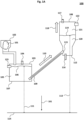
- Fig. 1 is a schematic illustration of an assembly and a method, according to the invention, for producing a first intermediate product. More specifically, Fig. 1 shows an assembly and method for recycling used PET.
- At least a fraction of the impurities e.g. , fragments of bottle caps which comprise polyolefins, float on a surface 106 of the first initial mixture 105.
- These floating impurities can be removed by using, e.g. , skimming or filtration.
- the impurities are removed from the volume section V 1 103 via the outlet 123.
- the PET flakes in the first initial mixture 105 sink to a bottom 107 of the volume section V 1 103.
- the PET flakes, as well as some of the MEG in the first initial mixture 105, are transported to a volume section V 2 108 that is partially filled with MEG.
- the transport is performed using conveying screw 109 (an Archimedean screw) and a siphon (not shown) that is in fluid communication with the conveying screw 109 and the volume section V 2 108. Further means of transportation, such as additional conveying screws or pumps, can also be used, and are not shown.
- the volume section V 2 108 is in fluid communication with the volume section V 1 103.
- the volume section V 2 108 can be e.g., a receptacle, a tank, or a reactor, such as a pre-glycolysis reactor.
- the conveying screw 109 is arranged such that the PET flakes that are transported to the volume section V 2 108 are transported along a direction 110 (an even-further direction) that is at least partially opposite the direction of gravity 161.
- a further fraction of the MEG is injected in the form of a liquid via an inlet of an even-further kind 117.
- the inlet of the even-further kind 117 is a nozzle that is adapted and arranged to spray the liquid MEG into the volume section V 2 108.
- the PET flakes in volume section V 2 108 are partially depolymerised (reducing a weight average molar mass) via glycolysis, thereby reducing the weight average molar mass of the PET flakes in the volume section V 2 .
- Part of the PET flakes may be depolymerised to oligomers in the volume section V2.
- the liquid MEG in the volume section V 2 108 comprises liquid MEG that was transported from the volume section V 1 103, liquid MEG that was injected via the inlet of the even-further kind 117, and any MEG vapour (injected via the inlet of the further kind 116) that has condensed.
- the liquid MEG does not completely fill the volume section V 2 108.
- the surface (or level) of the liquid MEG therefore forms a boundary 119 that divides the volume section V 2 108 into a first zone 120 and a further zone 121.
- the further zone 121 is downstream the first zone 120.
- Fig. 1B shows a cross-section of a further part of the assembly, viewed from the side.
- the PET flakes (and PET oligomers, if present) that exit via outlet 122 are transported to a volume section V 3 124, which is a reactor (e.g., a glycolysis reactor).
- the volume section V 3 124 is in fluid communication with the volume section V 2 108.
- the PET flakes (and PET oligomers, if present) enter the volume section V 3 124 via the inlet 125, and flow through the volume section V 3 124 as indicated by the arrow 136.
- the inlet 125 of the volume section V 3 124 is also below the outlet 122 of the volume section V 2 108.
- the volume section V 3 124 is fed with MEG (a further organic compound) via an inlet 143.
- MEG a further organic compound
- the mixing of the PET with MEG (fed to the volume section V 3 ) leads to the obtaining of a further initial mixture that comprises the PET flakes (and PET oligomers, if present) and MEG.
- the MEG in the further initial mixture causes the partly depolymerised PET flakes (and PET oligomers, if present) to undergo further glycolysis (reducing a weight average molar mass of the first polyester) as the further initial mixture flows through the volume section V 3 124.
- a first intermediate mixture is thereby obtained.
- a transport pipe 144, in fluid communication with an outlet 126, is located inside the volume section V 3 124.
- the first intermediate mixture is transported to a volume section V 4 127, which is in fluid communication with the volume section V 3 124.
- the volume section V 4 127 can be e.g., a receptacle, or a tank, such as a stirred tank.
- the first intermediate mixture enters the volume section V 4 127 via an inlet 128.
- the first intermediate mixture is mixed with diatomaceous earth (first particulated material).
- the first intermediate mixture in the volume section V 4 127 is agitated in order to improve the mixing of the first intermediate mixture and the diatomaceous earth.
- the first intermediate mixture which comprises the diatomaceous earth, exits the volume section V 4 127 via an outlet 129, and is transported to a vertical leaf filter 130 (filtering means), which is in fluid communication with the volume section V 4 127.
- the first intermediate mixture which comprises the diatomaceous earth, enters the vertical leaf filter 130 via an inlet 131.
- the first intermediate mixture flows through the leaf filter 130 and is re-circulated (not shown) between the leaf filter 130 and the volume section V 4 127, thereby allowing the individual filters of the leaf filter 130 to be coated with the diatomaceous earth. Initially the filtrate (the intermediate mixture) will be turbid.
- the intermediate mixture is allowed to exit the vertical leaf filter 130 via an outlet 132.
- the vertical leaf filter 130 filters out the diatomaceous earth and other particulated material (i.e. , impurities) in the first intermediate mixture, as well as any PET flakes that have not been depolymerised to oligomers or BHET.
- the first intermediate mixture which exits the vertical leaf filter 130 via outlet 132 has only trace amounts of impurities and diatomaceous earth.
- the first intermediate mixture that exits the vertical leaf filter 130, via the outlet 132, is transported to a volume section V 5 133, which is in fluid communication with the vertical leaf filter 130.
- the first intermediate mixture enters the volume section V 5 133 via an inlet 134.
- the volume section V 5 133 can be e.g., a receptacle, or a tank, such as a rectification tank.
- the volume section V 5 133 is used to determine and correct the colour of the first intermediate mixture. If necessary, at least one colouring agent is added to the first intermediate mixture in the volume section V 5 133.
- the first intermediate mixture is agitated in order to better mix the first intermediate mixture with the at least one colouring agent.
- the first intermediate mixture which possibly comprises the at least one colouring agent, exits the volume section V 5 133 via an outlet 135.
- the volume section V 6 137 is a pre-polymerisation reactor that polymerises the oligomers and BHET (increasing the weight average molar mass of the first intermediate product) in the first intermediate mixture to obtain polymers (the further intermediate product).
- a further intermediate mixture comprising polymers (i.e. , PET polymers) and MEG is thereby obtained.
- up to 95 % of excess MEG is evaporated under vacuum conditions.
- the excess MEG comprises both free MEG that was transported into the volume section V 6 , as well as bound MEG that was released by the polymerisation.
- the further intermediate mixture exits the volume section V 6 137 via an outlet 139.
- the further intermediate mixture that exits the volume section V 6 137, via the outlet 139, is transported to a volume section V 7 140, which is in fluid communication with the volume section V 6 137.
- the further intermediate mixture enters the volume section V 7 140 via an inlet 141.
- the volume section V 7 140 is a polymerisation reactor, such as a disc-cage reactor, that is used to further increase the weight average molar mass (via polymerisation) of the polymers, and any remaining oligomers, in the further intermediate mixture.
- any remaining MEG in the further intermediate mixture is also evaporated under vacuum conditions in the volume section V 7 140.
- the transport of the first intermediate mixture between volume sections V 3 , V 4 , V 5 , V 6 , and the vertical leaf filter is achieved by pumping the first intermediate mixture.
- Figs. 1A and 1B show that the PET flakes are transported in a first direction that is at least partially opposite the direction of gravity when the PET flakes have an intrinsic viscosity that is larger than or equal to a value Y IV,1 , and transported in further direction that is at least partially along the direction of gravity when the PET flakes have an intrinsic viscosity that is less than a value Y IV,2 (here Y IV,1 and Y IV,2 represents variables, with Y IV,1 > Y IV,2 ) .
- PET fragments e.g. , in the form of flakes
- Y IV,1 a value Y IV,1 .
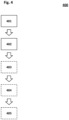
- 304 Contacting the first polyester with a further amount of the first organic compound, in the volume section V 2 , wherein at least one impurity is present in the volume section V 2 , and the volume section V 2 has a first zone and a further zone, and wherein a relative ratio of a particle count per area of the at least one impurity in the first zone to a particle count per area of the at least one impurity in the further zone is equal to or greater than 10, more preferably equal to or greater than 15, even more preferably equal to or greater than 20, further preferably equal to or greater than 25, and even further preferably equal to or greater than 30.
- 305 Optionally, reducing a weight average molar mass of the first polyester in the volume section V 2 .
- steps 304 and 305 are performed at least partially simultaneously.
- steps 307 and 308 are performed at least partially simultaneously.
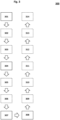
- Fig. 4 is flow diagram showing the steps of an embodiment of a method 400,of the disclosure, for producing a further intermediate product. Optional steps in Fig. 4 are indicated with a dashed box. The description of the method steps are given below.
- 402 Increasing the weight average molar mass of the first intermediate product in the first intermediate mixture, in the volume section V 6 , to obtain a further intermediate mixture that comprises a further intermediate product.
- Fig. 5 shows how an orientation of a direction with respect to gravity is defined.
- Fig. 5A shows a direction 570 that is at least partially opposite the direction of gravity 561.
- the direction 570 can be decomposed into three components.
- the direction 570 has a component 571 parallel to the direction of gravity 561, and a component 572 perpendicular to the direction of gravity (the other component perpendicular to the direction of gravity is not shown).
- the direction of the component 571 is opposite the direction of gravity.
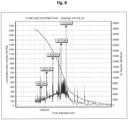
- Fig. 8 shows the distribution of the pore diameter of the first particulated material.
- the first particulated material has modes at approximately 17 100 nm, 15 100 nm, 12 300 nm, 10 600 nm, and 9 300 nm.
- a mode is where the quantity dV/dlogD has a maximum value (either a local maximum or a global maximum).
- dV is the differential volume
- dlogD is the differential of the logarithm of the pore diameter of the first particulated material.
- a primary mode refers to the global maximum of dV/dlogD.
- a secondary mode refers to the second largest maximum of dV/dlogD.
- Fig. 8 also shows the cumulative pore volume for the first particulated material.
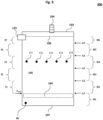
- Fig. 9 is an illustration of the test method for determining the mass ratio of the feedstock, more preferably the first polyester, to the first organic compound in the volume section V 1 .
- Fig. 9 shows an enlargement of the cross-section of the volume section V 1 103 of Fig. 1A (for illustration purposes the dimension of the volume section V 1 103 in Fig. 9 has been changed compared to the dimensions of the volume section V 1 in Fig. 1A ).
- the first initial mixture 105 in the volume section V 1 is divided into a number of height sections H as shown in Fig. 9 .
- the first height section H1 is bordered by the bottom 107 of the volume section V 1 103 and a height A1
- the second height section H2 is bordered by the heights A1 and A2, etc.
- the last height section H6 is bordered by the height A5 and the surface 106 of the first initial mixture 105.
- Fig. 9 shows 6 height sections H
- the number of height sections is determined by the fill height of the first initial mixture 105 in the volume section V 1 103.
- the height sections should each have a height of 20 cm, with the exception of the last height section bordered by the surface of the first initial mixture (height section H6 in Fig. 9 ).
- the fill height of the first initial mixture in the volume section V 1 is 150 cm, then the first initial mixture is divided into 8 height sections, with 7 height section have a height of 20 cm, and the last height section having a height of 10 cm.
- the height of the first height section H1, bordered by the bottom 107, is measured from the lowest point of the bottom 107.
- the samples should be taken while the volume section V 1 is being agitated.
- the 5 samples taken in a height section should be taken at the same position in the height section, with the taking of two subsequent samples being separated by a two-minute interval. This is illustrated in Fig. 9 , where the 5 samples in the height section H1 are taken at position B 1, with the samples taken at two-minute intervals.
- the position in a height section where the five samples are taken can be anywhere in the height section.
- the agitation means is a physical agitation means ( e.g. , 164 in Fig. 9 ) which does not allow for the taking of samples below a certain height, the lowest height A min where it is possible to take a sample without interfering with the agitation means replaces the bottom 107 in the procedure above, i.e., the first height section is bordered by A min .
- the new height sections I adjusted for the presence of the agitation means 164, are shown in Fig. 9 .
- the height sections I Similar to the height sections H, the height sections I also have a height of 20 cm, with the exception of the height section I5 bordered by the surface 106.
- the 5 samples taken in a height section should be taken at positions that are evenly spread out in a direction that is perpendicular to the height of the first initial mixture. This is shown as positions C1 to C5 in Fig. 9 .
- a feedstock comprising PET flakes is provided.
- the PET flakes were obtained by processing (e.g., shredding) used PET bottles.
- the PET flakes subjected to the method steps as described in Fig. 1A .
- the PET flakes are transported through the volume sections V 1 and V 2 .
- the PET flakes are contacted with MEG. It should be noted that the presence of the volume section V 1 is not essential for the examples below.
- the volume section V 2 has a first zone and a further zone.
- the following parameters are used for the volume section V 2 :
- An overpressure in the volume section V 2 was in the range of 4 kPa to 8 kPa, and a residence time in the range of 110 minutes to 150 minutes.
- the PET flakes are subsequently transported from the volume section V 2 to the volume section V 3 (a glycolysis reactor).
- the PET flakes in the volume section V 3 are also contacted with MEG.
- the following parameters are used for the glycolysis process in the volume section V 3 : a temperature in the range of 195 °C to 240 °C, an overpressure in the range of 0.7 kPa to 0.9 kPa, and a residence time in the range of 250 minutes to 420 minutes.
- a first intermediate mixture comprising BHET, PET oligomers and free MEG is obtained.
- the first intermediate mixture comprises in the range of 85 wt-% to 93 wt-% of a first intermediate product (BHET and PET oligomers), with the rest of the first intermediate mixture being made up of free MEG and residual impurities (to be filtered out).
- the wt-% values are based on a total mass of the first intermediate mixture.
- the first intermediate product is subjected to the steps described in Fig. 1B ( e.g. , filtering), as well as polymerisation as described in Fig. 1C .
- Recycled PET is thus obtained.
- the recycled PET is used to produce yarn.
- the relative ratio of the particle count per area of the impurities in the first zone to the particle count per area of the impurities in the further zone is varied, as shown in Table 1 below.
- Table 1 Example 1.1 1.2 1.3 1.4 1.5 1.6 Set-up Relative ratio of particle count per area 1 to 5 5 to 10 10 to 15 20 to 25 30 to 35 50 to 55
Landscapes
- Chemical & Material Sciences (AREA)
- Health & Medical Sciences (AREA)
- Chemical Kinetics & Catalysis (AREA)
- Medicinal Chemistry (AREA)
- Polymers & Plastics (AREA)
- Organic Chemistry (AREA)
- Life Sciences & Earth Sciences (AREA)
- Sustainable Development (AREA)
- Polyesters Or Polycarbonates (AREA)
- Separation, Recovery Or Treatment Of Waste Materials Containing Plastics (AREA)
- Organic Low-Molecular-Weight Compounds And Preparation Thereof (AREA)
Claims (8)
- Un procédé de production d'un premier produit intermédiaire, comprenant les étapes suivantesa. fournir une matière première (101) qui comprend un premier polyester ;b. mise en contact du premier polyester avec une quantité supplémentaire d'un premier composé organique dans une section de volume V2 (108), dans laquellei. au moins une impureté est présente dans la section de volume V2 (108), etii. la section de volume V2 (108) comporte une première zone (120) et une autre zone (121) ;c. réduire une masse molaire moyenne en poids du premier polyester dans la section de volume V2 (108), dans lequel, après l'achèvement de l'étape de réduction, le premier polyester a une viscosité intrinsèque comprise entre 0,10 dL/g et 0,45 dL/g ;d. transporter le premier polyester vers une section de volume V3 ;e. mise en contact du premier polyester avec un autre composé organique dans la section de volume V3 (124) pour obtenir un autre mélange initial ;f. réduire la masse molaire moyenne en poids du premier polyester dans la section de volume V3 (124) pour obtenir un premier mélange intermédiaire, dans lequel le premier mélange intermédiaire comprenddans lequeli. un premier produit intermédiaire dont la viscosité intrinsèque est comprise entre 0,010 dL/g et 0,090 dL/g,ii. l'autre composé organique ;
un rapport relatif entre le nombre de particules par surface de l'au moins une impureté dans la première zone (120) et le nombre de particules par surface de l'au moins une impureté dans l'autre zone (121) est égal ou supérieur à 10 et égal ou inférieur à 1 000,
avec la viscosité intrinsèque et le rapport relatif du nombre de particules par surface de l'au moins une impureté déterminée selon les méthodes décrites dans le présent document. - Le procédé selon la revendication 1, comprenant en outre l'étape de mise en contact de la matière première (101) avec une première quantité d'un premier composé organique dans une section de volume V1 (103) pour obtenir un premier mélange initial (105), dans lequel la première quantité se présente sous la forme d'un liquide.
- Le procédé selon l'une quelconque des revendications précédentes, dans lequel le premier polyester est choisi dans le groupe constitué d'un polyéthylène téréphtalate, d'un polybutylène téréphtalate, d'un polylactide, d'un polytriméthylène téréphtalate, d'un polyéthylène naphtalate, d'un polycarbonate, d'un polyester carbonate, d'un polyarylate, d'une résine polyester, et d'une combinaison de deux ou plusieurs d'entre eux.
- Le procédé selon l'une des revendications précédentes, dans laquelle la matière première (101) comprend en outre au moins une impureté.
- Le procédé selon la revendication 4, dans laquelle au moins une impureté dans la matière première (101) est comprise entre 10 ppm en poids et 10000 ppm en poids, le poids étant basé sur le poids total de la matière première, les ppm en poids étant déterminés selon la méthode décrite dans le présent document.
- Le procédé selon l'une quelconque des revendications précédentes, dans laquelle le premier composé organique présente au moins une ou toutes les propriétés suivantes :a. comprend au moins deux groupes hydroxyle ;b. une masse molaire d'au moins 60 g/mol ;c. un point d'ébullition d'au moins 192 °C.
- Le procédé selon l'une des revendications précédentes, dans laquelle l'autre composé organique possède au moins une ou toutes les propriétés suivantes :a. comprend au moins deux groupes hydroxyle ;b. une masse molaire d'au moins 60 g/mol ;c. un point d'ébullition d'au moins 192 °C.
- Le procédé selon l'une des revendications précédentes, dans laquelle au moins 40 % en poids du premier produit intermédiaire se présente sous la forme d'oligomères ayant entre 2 et 35 unités répétitives, le pourcentage en poids étant déterminé selon la méthode décrite ici.
Priority Applications (8)
| Application Number | Priority Date | Filing Date | Title |
|---|---|---|---|
| ES22196675T ES2987870T3 (es) | 2022-09-20 | 2022-09-20 | Proceso para reciclar tereftalato de polietileno utilizando un gradiente de concentración de impurezas |
| EP22196675.7A EP4342941B1 (fr) | 2022-09-20 | 2022-09-20 | Procédé de recyclage de polyéthylène téréphtalate à l'aide d'un gradient de concentration d'impuretés |
| KR1020257012921A KR20250070092A (ko) | 2022-09-20 | 2023-09-19 | 불순물 농도의 구배를 사용한 폴리에틸렌 테레프탈레이트의 재활용 공정 |
| US18/857,358 US12600836B2 (en) | 2022-09-20 | 2023-09-19 | Process for recycling polyethylene terephthalate using a gradient in impurity concentration |
| EP23773268.0A EP4590752A1 (fr) | 2022-09-20 | 2023-09-19 | Processus de recyclage de polyéthylène téréphtalate utilisant un gradient de concentration d'impuretés |
| PCT/EP2023/075810 WO2024061910A1 (fr) | 2022-09-20 | 2023-09-19 | Processus de recyclage de polyéthylène téréphtalate utilisant un gradient de concentration d'impuretés |
| JP2025515614A JP2025530365A (ja) | 2022-09-20 | 2023-09-19 | 不純物濃度の勾配を使用してポリエチレンテレフタレートをリサイクルするプロセス |
| CN202380067533.9A CN119998371A (zh) | 2022-09-20 | 2023-09-19 | 使用杂质浓度梯度回收聚对苯二甲酸乙二醇酯的方法 |
Applications Claiming Priority (1)
| Application Number | Priority Date | Filing Date | Title |
|---|---|---|---|
| EP22196675.7A EP4342941B1 (fr) | 2022-09-20 | 2022-09-20 | Procédé de recyclage de polyéthylène téréphtalate à l'aide d'un gradient de concentration d'impuretés |
Publications (3)
| Publication Number | Publication Date |
|---|---|
| EP4342941A1 EP4342941A1 (fr) | 2024-03-27 |
| EP4342941C0 EP4342941C0 (fr) | 2024-07-10 |
| EP4342941B1 true EP4342941B1 (fr) | 2024-07-10 |
Family
ID=83398417
Family Applications (2)
| Application Number | Title | Priority Date | Filing Date |
|---|---|---|---|
| EP22196675.7A Active EP4342941B1 (fr) | 2022-09-20 | 2022-09-20 | Procédé de recyclage de polyéthylène téréphtalate à l'aide d'un gradient de concentration d'impuretés |
| EP23773268.0A Withdrawn EP4590752A1 (fr) | 2022-09-20 | 2023-09-19 | Processus de recyclage de polyéthylène téréphtalate utilisant un gradient de concentration d'impuretés |
Family Applications After (1)
| Application Number | Title | Priority Date | Filing Date |
|---|---|---|---|
| EP23773268.0A Withdrawn EP4590752A1 (fr) | 2022-09-20 | 2023-09-19 | Processus de recyclage de polyéthylène téréphtalate utilisant un gradient de concentration d'impuretés |
Country Status (7)
| Country | Link |
|---|---|
| US (1) | US12600836B2 (fr) |
| EP (2) | EP4342941B1 (fr) |
| JP (1) | JP2025530365A (fr) |
| KR (1) | KR20250070092A (fr) |
| CN (1) | CN119998371A (fr) |
| ES (1) | ES2987870T3 (fr) |
| WO (1) | WO2024061910A1 (fr) |
Families Citing this family (7)
| Publication number | Priority date | Publication date | Assignee | Title |
|---|---|---|---|---|
| EP4342943B1 (fr) | 2022-09-20 | 2024-07-17 | revalyu Resources GmbH | Procédé de recyclage de polyéthylène téréphtalate à l'aide d'une charge d'alimentation sélectionnée |
| EP4342945B1 (fr) | 2022-09-20 | 2024-07-17 | revalyu Resources GmbH | Procédé de recyclage de polyéthylène téréphtalate à l'aide de différents niveaux de monoéthylène glycol |
| ES2987897T3 (es) | 2022-09-20 | 2024-11-18 | Revalyu Resources Gmbh | Proceso para reciclar tereftalato de polietileno utilizando un intervalo de temperatura seleccionado para elprocesamiento de oligómeros |
| ES2987868T3 (es) | 2022-09-20 | 2024-11-18 | Revalyu Resources Gmbh | Proceso para reciclar tereftalato de polietileno utilizando material filtrante de partículas porosas |
| EP4342946B1 (fr) | 2022-09-20 | 2024-07-17 | revalyu Resources GmbH | Procédé de recyclage de polytéréphtalate d'éthylène à l'aide d'un réacteur de lavage |
| ES2987865T3 (es) | 2022-09-20 | 2024-11-18 | Revalyu Resources Gmbh | Proceso para reciclar tereftalato de polietileno utilizando coordenadas de color específicas para el procesamiento de oligómeros |
| EP4342942B1 (fr) | 2022-09-20 | 2024-07-10 | revalyu Resources GmbH | Procédé de recyclage de polyéthylène téréphtalate déterminé par la viscosité intrinsèque du polyéthylène téréphtalate |
Citations (1)
| Publication number | Priority date | Publication date | Assignee | Title |
|---|---|---|---|---|
| EP2784110B1 (fr) * | 2013-03-26 | 2017-03-29 | Oxxynova GmbH | Procédé et appareil pour décolorer des copeaux de pet déchiquetés |
Family Cites Families (115)
| Publication number | Priority date | Publication date | Assignee | Title |
|---|---|---|---|---|
| US3884850A (en) | 1970-02-13 | 1975-05-20 | Fiber Industries Inc | Continuous atmospheric depolymerization of polyester |
| US3907868A (en) | 1974-02-15 | 1975-09-23 | Du Pont | Polyester waste recovery |
| JPS60248646A (ja) | 1984-05-25 | 1985-12-09 | Toray Ind Inc | ポリエステル屑の解重合方法 |
| US5223544A (en) | 1992-03-31 | 1993-06-29 | Shell Oil Company | Process for the removal of foreign materials from a post-consumer plyethylene terephthalate feed stream |
| JP3510885B2 (ja) | 1992-05-18 | 2004-03-29 | ペトレサイクル プロプライエタリー リミテッド | 使用ずみpetの資源からのポリエチレンテレフタレートの再生方法 |
| WO1995010499A1 (fr) | 1993-10-14 | 1995-04-20 | Shell Internationale Research Maatschappij B.V. | Procede de recuperation d'acide dicarboxylique a teneur reduite en impuretes, a partir d'un polymere de polyester |
| US5710315A (en) | 1994-05-27 | 1998-01-20 | E. I. Du Pont De Nemours And Company | Monomer recovery process for contaminated polymers |
| FI97726C (fi) | 1994-07-07 | 1997-02-10 | Alko Yhtioet Oy | Sulatyöstettävä polyesteriuretaani ja menetelmä sen valmistamiseksi |
| DE19531886A1 (de) | 1995-08-30 | 1997-03-06 | Basf Magnetics Gmbh | Kontinuierlich ablaufendes Verfahren zur Wiedergewinnung von Rohmaterialien aus beschichteten Folien |
| DE19534276A1 (de) | 1995-09-15 | 1997-03-20 | Degussa | Verfahren zur Aufarbeitung von Polyalkylenterephthalaten |
| US6369192B1 (en) | 1995-10-27 | 2002-04-09 | Praxair Technology, Inc. | Methods for removing contaminants from polymers |
| US6103774A (en) | 1997-04-02 | 2000-08-15 | The Coca-Cola Company | Process for removing contaminants from polyesters and controlling polymer molecular weight |
| US6136869A (en) | 1997-10-17 | 2000-10-24 | Eastman Chemical Company | Depolymerization process for recycling polyesters |
| ATE437847T1 (de) | 1999-10-22 | 2009-08-15 | Teijin Ltd | Verfahren zur abtrennung und rückgewinnung von dimethylterephthalat und ethylenglykol aus polyesterabfällen |
| CZ2000969A3 (cs) | 2000-03-17 | 2001-08-15 | Milan Ing. Šírek | Způsob chemické recyklace odpadního polyethylentereftalátu |
| JP4008214B2 (ja) | 2001-08-03 | 2007-11-14 | 三菱重工業株式会社 | ポリエステルのモノマー化反応容器 |
| DE10140370A1 (de) | 2001-08-23 | 2003-03-06 | Buehler Ag | Verfahren zur Verarbeitung eines Polykondensats in einem Mehrwellen-Extruder |
| KR100866819B1 (ko) | 2001-10-16 | 2008-11-04 | 데이진 가부시키가이샤 | Pet 보틀의 리사이클 방법 |
| US20030134915A1 (en) | 2001-12-17 | 2003-07-17 | Scantlebury Geoffrey Raymond | Production of transparent polyester using waste |
| JP2003191241A (ja) | 2001-12-28 | 2003-07-08 | Is:Kk | 使用済みポリエチレンテレフタレート製ボトルの粉砕物の洗浄方法 |
| JP2003300933A (ja) | 2002-02-06 | 2003-10-21 | Is:Kk | ポリエチレンテレフタレート解重合溶液からの微粒子の除去方法 |
| ATE458779T1 (de) | 2002-04-12 | 2010-03-15 | Mba Polymers Inc | Mehrstufige trennung von kunststoffen |
| EP1367080A1 (fr) | 2002-05-29 | 2003-12-03 | Hycail B.V. | Polymères d'acide hydroxycarboxylique hyperramifiés |
| JP2004083899A (ja) * | 2002-08-06 | 2004-03-18 | Is:Kk | ポリエチレンテレフタレート解重合溶液からの微粒子の除去方法及びこれに用いた濾材の再生方法 |
| US7297721B2 (en) | 2003-06-20 | 2007-11-20 | Futura Polyesters Limited | Process for controlled polymerization of a mixed polymer |
| DE10348144A1 (de) | 2003-10-13 | 2005-05-19 | Krones Ag | PET-Flaschen-Recycling |
| JP2005350509A (ja) | 2004-06-08 | 2005-12-22 | Daicel Polymer Ltd | Pet再生樹脂組成物、pet再生樹脂用改質材及びこれを用いたpet再生樹脂成形品 |
| BRPI0402330B1 (pt) | 2004-06-14 | 2020-11-03 | Fundação De Amparo À Pesquisa Do Estado de São Paulo | processo de descontaminação de poliéster reciclado e uso do mesmo |
| WO2006044154A1 (fr) | 2004-10-18 | 2006-04-27 | Phoenix Technologies International, Llc | Procede de traitement de polyethylene terephtalate recycle pour la decontamination et la solidification rapides |
| JP2006143622A (ja) | 2004-11-17 | 2006-06-08 | Is:Kk | グリコール溶液の精製方法 |
| DE102004059808A1 (de) | 2004-12-10 | 2006-06-14 | Krones Ag | Dekontamination von Flakes |
| EP1829914A1 (fr) | 2004-12-21 | 2007-09-05 | Asahi Kasei Chemicals Corporation | Procede pour recycler un polymere de polycondensation recupere |
| EP1964877A1 (fr) | 2005-12-09 | 2008-09-03 | Kumamoto Technology & Industry Foundation | Procede de depolymerisation de polyester et de polyester insature et procede de recuperation du monomere de polyester lie au procede de depolymerisation |
| GB0615765D0 (en) | 2006-08-09 | 2006-09-20 | Waste And Resources Action Pro | Recycling process for polyethylene terephthalate (PET) |
| ITVR20060034U1 (it) | 2006-11-15 | 2008-05-16 | Marco Bologna | Sistema di controllo e comando per l'attivazione di apparati in genere e trasporto di dati |
| ITTO20070084A1 (it) | 2007-02-06 | 2008-08-07 | K & E Srl | Dispositivi di miscelazione radiale per reattori inclinati rotanti. |
| KR100837781B1 (ko) | 2007-04-17 | 2008-06-13 | 충남대학교산학협력단 | 폴리에스터 폐기물의 재생방법 및 이에 사용되는 장치 |
| JP2009120766A (ja) | 2007-11-16 | 2009-06-04 | Teijin Fibers Ltd | テレフタル酸ジメチル及びエチレングリコールの回収方法 |
| MX2022000196A (es) | 2008-09-30 | 2022-03-02 | Shaw Ind Group Inc | Composiciones de tereftalato de polietileno reciclado, fibras y articulos producidos a partir de las mismas, y metodos para producirlas. |
| RU2012103457A (ru) | 2009-07-02 | 2013-08-10 | БЕПЕКС ИНТЕРНЭШНЛ, ЭлЭлСи | Устройство и способ для парофазной переработки бывших в употреблении полимеров |
| KR101099009B1 (ko) | 2009-10-09 | 2011-12-28 | 충남대학교산학협력단 | 폴리에스터 폐기물의 재생방법 및 그 재생장치 |
| KR101142328B1 (ko) | 2010-01-05 | 2012-05-17 | 주식회사 휴비스 | 폴리에스테르의 화학적 재생 방법 |
| US8877107B2 (en) | 2010-09-28 | 2014-11-04 | Uhde Inventa-Fischer Gmbh | Method for increasing the molecular weight of a polyester granulate by using its residual heat |
| CN103124591B (zh) | 2010-09-30 | 2015-06-03 | 伊奎聚合物有限公司 | 混合方法和可用于其的装置 |
| KR101302359B1 (ko) | 2011-04-07 | 2013-09-06 | 주식회사 휴비스 | 화학재생 공정을 이용한 생분해성 공중합 폴리에스테르수지 및 그 제조방법 |
| KR101306580B1 (ko) | 2011-05-30 | 2013-09-11 | 웅진케미칼 주식회사 | 폐 저융점 폴리에스테르를 이용한 재생 저융점 폴리에스테르의 제조방법 |
| CN103146151B (zh) | 2011-12-06 | 2015-04-08 | 上海聚友化工有限公司 | 一种废聚酯瓶回收再利用的方法 |
| CN103360260B (zh) | 2012-04-10 | 2015-04-01 | 李晓峰 | 一种对苯二甲酸乙二酯的制备工艺和聚酯的制备方法 |
| US9234074B2 (en) | 2012-04-20 | 2016-01-12 | Perpetual Global Technologies Limited | Flakes of ester mixtures and methods for their production |
| DE102012220498A1 (de) | 2012-11-09 | 2014-05-15 | Aquafil Engineering Gmbh | Verfahren und Vorrichtung zur Behandlung von Polymeren |
| US9353237B2 (en) | 2013-01-11 | 2016-05-31 | Plastipak Packaging, Inc. | System and method for recycling and recapture of bio-based plastics |
| CN103147163B (zh) | 2013-03-21 | 2015-03-18 | 宁波大发化纤有限公司 | 一种皮芯型再生聚酯短纤维及其制备方法 |
| CN203346318U (zh) | 2013-06-03 | 2013-12-18 | 扬州惠通化工技术有限公司 | 废瓶片聚酯熔体生产装置 |
| KR102162280B1 (ko) | 2013-06-17 | 2020-10-06 | 에스케이케미칼 주식회사 | 폴리에틸렌테레프탈레이트 수지와 공중합 폴리에스테르 수지를 포함하는 열수축 필름 형성용 조성물, 및 열수축 필름 |
| CN103357605B (zh) | 2013-07-13 | 2015-04-15 | 福建锦兴环保科技有限公司 | 废旧聚酯瓶片的清洗装置及清洗工艺 |
| CN103755933B (zh) | 2014-01-14 | 2016-01-13 | 北京服装学院 | 一种废旧pet织物半降解增粘制备长丝级切片的方法 |
| EP3140281B1 (fr) | 2014-05-05 | 2018-03-14 | Resinate Materials Group, Inc. | Polyols de polyester à teneur améliorée en produit recyclé |
| DE102014220330B4 (de) | 2014-10-07 | 2016-11-03 | Herbold Meckesheim Gmbh | Verfahren zur Aufbereitung von Kunststoffen und Vorrichtung |
| CN104357938B (zh) | 2014-11-03 | 2016-06-15 | 东华大学 | 一种再生聚酯纤维的制备方法 |
| CN104447341B (zh) | 2014-11-03 | 2016-02-10 | 东华大学 | 一种聚酯醇解方法 |
| CN104327259B (zh) | 2014-11-03 | 2016-02-10 | 东华大学 | 一种低熔点再生共聚酯的制备方法 |
| FR3030541B1 (fr) | 2014-12-19 | 2017-02-03 | Ifp Energies Now | Procede de glycolyse du poly(terephtalate d'ethylene) en deux etapes reactionnelles |
| CN107257823A (zh) | 2015-01-30 | 2017-10-17 | 瑞森内特材料集团有限公司 | 用于处理pet和ptt回收料流的综合方法 |
| CN105367415B (zh) | 2015-11-13 | 2018-02-13 | 航天资源循环科技有限公司 | 一种废旧pet材料化学法回收循环再利用系统 |
| WO2017092071A1 (fr) | 2015-11-30 | 2017-06-08 | 谭亦武 | Procédé et application pour le recyclage et la réutilisation de déchets de pet |
| CN106832397B (zh) | 2015-12-07 | 2019-09-20 | 中国石化仪征化纤有限责任公司 | 在线回用pet聚合废料的方法 |
| CH713339A1 (de) | 2017-01-03 | 2018-07-13 | Alpla Werke Alwin Lehner Gmbh & Co Kg | PET-Regranulat mit hoher intrinsischer Viskosität und Verfahren zu dessen Herstellung. |
| CN206883973U (zh) | 2017-06-21 | 2018-01-16 | 濠锦化纤(福州)有限公司 | 再生塑料粉碎装置 |
| CN107266664A (zh) | 2017-07-12 | 2017-10-20 | 宜兴市创新精细化工有限公司 | 一种聚酯废料回收工艺 |
| CN109423699A (zh) | 2017-08-24 | 2019-03-05 | 青岛吉盛纺织有限公司 | 一种利用回收的pet瓶制造纺织用长丝的方法 |
| DE102018202547A1 (de) | 2018-02-20 | 2019-10-02 | Thyssenkrupp Ag | Vorrichtung und Verfahren zum Einmischen von Recyclingmaterial in eine Polyesterschmelze |
| CN108395373A (zh) | 2018-04-10 | 2018-08-14 | 福建荔枝新材料有限公司 | 一种废旧聚酯回收方法 |
| BR102018068454B1 (pt) | 2018-09-12 | 2022-04-19 | Petróleo Brasileiro S.A. - Petrobras | Catalisadores e processo para obtenção de poliéster reciclado |
| GB2570019B (en) | 2018-09-17 | 2021-04-21 | Impact Laboratories Ltd | Plastic recycling process |
| US11396588B2 (en) | 2018-09-21 | 2022-07-26 | Premirr Plastics Inc. | Process and system for depolymerizing plastic |
| CN109134244B (zh) | 2018-09-26 | 2020-10-30 | 东华大学 | 一种废旧聚酯的降解方法 |
| CN111138641B (zh) | 2018-11-02 | 2021-12-21 | 中国石油化工股份有限公司 | 一种废聚酯瓶回用制备瓶级切片的方法 |
| WO2020149798A1 (fr) | 2019-01-15 | 2020-07-23 | Köksan Pet Ve Plasti̇k Ambalaj Sanayi̇ Ve Ti̇caret Anoni̇m Şi̇rketi̇ | Procédé de glycolyse chimique dans lequel des déchets de pet transparents sont recyclés pour être utilisés dans la production de résine pet de qualité bouteille |
| FR3092324B1 (fr) | 2019-02-01 | 2021-04-23 | Ifp Energies Now | Procédé de production d’un polyester téréphtalate intégrant un procédé de dépolymérisation |
| FR3092323B1 (fr) | 2019-02-01 | 2021-06-04 | Ifp Energies Now | Procédé de production d’un polyester téréphtalate à partir d’un mélange monomérique comprenant un diester |
| CN110273197A (zh) | 2019-05-20 | 2019-09-24 | 福建师范大学福清分校 | 一种废弃绦纶纺织物生产的再生彩纱及其制备方法 |
| US20210094205A1 (en) | 2019-05-20 | 2021-04-01 | Octal Saoc Fzc | Process for rotary die cutting of reclaimed polyester |
| CN110527138B (zh) | 2019-07-10 | 2020-07-03 | 艾凡佳德(上海)环保科技有限公司 | 一种废旧聚酯的连续醇解回收方法 |
| GB2586249B (en) | 2019-08-13 | 2021-09-22 | Poseidon Plastics Ltd | Polymer recycling |
| GB2598077B (en) | 2019-08-13 | 2026-03-18 | Poseidon Plastics Ltd | Polymer recycling |
| CN112759746B (zh) | 2019-10-21 | 2022-08-12 | 中国石油化工股份有限公司 | 一种高洁净食品级再生瓶片的制备方法 |
| CN110698658B (zh) | 2019-10-22 | 2021-11-26 | 宁波大发化纤有限公司 | 一种废聚酯链解制备有色聚酯的方法 |
| CN110616474B (zh) | 2019-10-22 | 2021-02-12 | 宁波大发化纤有限公司 | 废聚酯纺织品制备皮芯复合低熔点再生聚酯纤维的方法 |
| NL2024181B1 (en) | 2019-11-07 | 2021-07-20 | Ioniqa Tech B V | Reactor system and method of separating a first contaminant from a feed stream |
| NL2024194B1 (en) | 2019-11-08 | 2021-07-20 | Ioniqa Tech B V | Method for treatment of waste material and reactor system thereof |
| CN110734578B (zh) | 2019-11-13 | 2022-03-11 | 宁波大发化纤有限公司 | 一种废聚酯原料中分离获得再生聚酯的方法 |
| CN110818886B (zh) | 2019-12-13 | 2022-02-11 | 中国科学院过程工程研究所 | 一种废弃pet聚酯制备再生食品级pet聚酯的方法 |
| US11639431B2 (en) | 2020-01-23 | 2023-05-02 | Premirr Plastics Inc. | Process and system for depolymerizing plastic |
| CA3167415A1 (fr) | 2020-02-10 | 2021-08-19 | Bruce Roger Debruin | Appareil et procedes de manipulation de solides plastiques particulaires |
| WO2021163091A1 (fr) | 2020-02-10 | 2021-08-19 | Eastman Chemical Company | Séparation centrifuge par densité de déchets plastiques |
| MX2022009400A (es) | 2020-02-10 | 2022-10-07 | Eastman Chem Co | Materiales de plastico de desecho tratados. |
| EP4103378A4 (fr) | 2020-02-10 | 2024-10-30 | Eastman Chemical Company | Recyclage chimique de flux de déchets plastiques mélangés traités |
| EP3875523A1 (fr) * | 2020-03-03 | 2021-09-08 | UAB Neo Group | Procédés de recyclage de polyéthylène téréphtalate |
| CN115461430A (zh) | 2020-04-13 | 2022-12-09 | 伊士曼化工公司 | 用于化学回收的溶剂分解副产物流的增强分离 |
| CN115397904B (zh) | 2020-04-13 | 2025-12-05 | 伊士曼化工公司 | 化学回收塑料干细料 |
| CN111978686B (zh) | 2020-08-25 | 2022-12-20 | 广州大学 | 一种再生聚酯材料及其制备方法 |
| CN111849026A (zh) | 2020-08-27 | 2020-10-30 | 华润化学材料科技股份有限公司 | 一种生产rPET瓶级聚酯切片的方法和系统 |
| CN112646135B (zh) | 2020-12-10 | 2023-01-13 | 北京服装学院 | 有色废旧聚酯纺织品连续制备可纺级无色再生聚酯的方法 |
| CN112608514A (zh) | 2020-12-14 | 2021-04-06 | 浙江理工大学 | 一种废旧聚酯醇解法制备抗菌再生聚酯的方法 |
| IN202121037279A (fr) * | 2021-08-17 | 2022-09-16 | Jb Rpet Industries Pvt Ltd | |
| WO2023176649A1 (fr) | 2022-03-15 | 2023-09-21 | 東レ株式会社 | Résine de polyester recyclée obtenue à l'aide d'un tissu de pet coloré servant de matériau, et procédé d'obtention d'un ester monomère à partir du tissu de pet coloré |
| EP4342943B1 (fr) | 2022-09-20 | 2024-07-17 | revalyu Resources GmbH | Procédé de recyclage de polyéthylène téréphtalate à l'aide d'une charge d'alimentation sélectionnée |
| EP4342942B1 (fr) | 2022-09-20 | 2024-07-10 | revalyu Resources GmbH | Procédé de recyclage de polyéthylène téréphtalate déterminé par la viscosité intrinsèque du polyéthylène téréphtalate |
| EP4342944B1 (fr) | 2022-09-20 | 2024-08-14 | revalyu Resources GmbH | Procédé de recyclage de polyéthylène téréphtalate à l'aide de monoéthylène glycol gazeux et/ou liquide |
| ES2987863T3 (es) | 2022-09-20 | 2024-11-18 | Revalyu Resources Gmbh | Proceso para reciclar tereftalato de polietileno utilizando una materia prima separada |
| ES2987868T3 (es) | 2022-09-20 | 2024-11-18 | Revalyu Resources Gmbh | Proceso para reciclar tereftalato de polietileno utilizando material filtrante de partículas porosas |
| ES2987865T3 (es) | 2022-09-20 | 2024-11-18 | Revalyu Resources Gmbh | Proceso para reciclar tereftalato de polietileno utilizando coordenadas de color específicas para el procesamiento de oligómeros |
| EP4342946B1 (fr) | 2022-09-20 | 2024-07-17 | revalyu Resources GmbH | Procédé de recyclage de polytéréphtalate d'éthylène à l'aide d'un réacteur de lavage |
| EP4342945B1 (fr) | 2022-09-20 | 2024-07-17 | revalyu Resources GmbH | Procédé de recyclage de polyéthylène téréphtalate à l'aide de différents niveaux de monoéthylène glycol |
| ES2987897T3 (es) | 2022-09-20 | 2024-11-18 | Revalyu Resources Gmbh | Proceso para reciclar tereftalato de polietileno utilizando un intervalo de temperatura seleccionado para elprocesamiento de oligómeros |
-
2022
- 2022-09-20 ES ES22196675T patent/ES2987870T3/es active Active
- 2022-09-20 EP EP22196675.7A patent/EP4342941B1/fr active Active
-
2023
- 2023-09-19 KR KR1020257012921A patent/KR20250070092A/ko active Pending
- 2023-09-19 WO PCT/EP2023/075810 patent/WO2024061910A1/fr not_active Ceased
- 2023-09-19 CN CN202380067533.9A patent/CN119998371A/zh active Pending
- 2023-09-19 JP JP2025515614A patent/JP2025530365A/ja active Pending
- 2023-09-19 EP EP23773268.0A patent/EP4590752A1/fr not_active Withdrawn
- 2023-09-19 US US18/857,358 patent/US12600836B2/en active Active
Patent Citations (1)
| Publication number | Priority date | Publication date | Assignee | Title |
|---|---|---|---|---|
| EP2784110B1 (fr) * | 2013-03-26 | 2017-03-29 | Oxxynova GmbH | Procédé et appareil pour décolorer des copeaux de pet déchiquetés |
Also Published As
| Publication number | Publication date |
|---|---|
| ES2987870T3 (es) | 2024-11-18 |
| WO2024061910A1 (fr) | 2024-03-28 |
| US12600836B2 (en) | 2026-04-14 |
| EP4342941C0 (fr) | 2024-07-10 |
| JP2025530365A (ja) | 2025-09-11 |
| EP4590752A1 (fr) | 2025-07-30 |
| EP4342941A1 (fr) | 2024-03-27 |
| KR20250070092A (ko) | 2025-05-20 |
| CN119998371A (zh) | 2025-05-13 |
| US20250171609A1 (en) | 2025-05-29 |
Similar Documents
| Publication | Publication Date | Title |
|---|---|---|
| EP4342944B1 (fr) | Procédé de recyclage de polyéthylène téréphtalate à l'aide de monoéthylène glycol gazeux et/ou liquide | |
| EP4342937B1 (fr) | Procédé de recyclage de polyéthylène téréphtalate à l'aide d'une charge d'alimentation séparée | |
| EP4342941B1 (fr) | Procédé de recyclage de polyéthylène téréphtalate à l'aide d'un gradient de concentration d'impuretés | |
| EP4342943B1 (fr) | Procédé de recyclage de polyéthylène téréphtalate à l'aide d'une charge d'alimentation sélectionnée | |
| EP4342946B1 (fr) | Procédé de recyclage de polytéréphtalate d'éthylène à l'aide d'un réacteur de lavage | |
| EP4342938B1 (fr) | Procédé de recyclage de polytéréphtalate d'éthylène à l'aide de coordonnées de couleur spécifiques pour le traitement d'oligomères | |
| EP4342942B1 (fr) | Procédé de recyclage de polyéthylène téréphtalate déterminé par la viscosité intrinsèque du polyéthylène téréphtalate | |
| EP4342940B1 (fr) | Procédé de recyclage de polyéthylène téréphtalate à l'aide d'une plage de températures sélectionnée pour le traitement d'oligomères | |
| EP4342945B1 (fr) | Procédé de recyclage de polyéthylène téréphtalate à l'aide de différents niveaux de monoéthylène glycol | |
| EP4342939B1 (fr) | Procédé de recyclage de polyéthylène téréphtalate à l'aide d'un matériau filtrant poreux particulaire |
Legal Events
| Date | Code | Title | Description |
|---|---|---|---|
| STAA | Information on the status of an ep patent application or granted ep patent |
Free format text: STATUS: EXAMINATION IS IN PROGRESS |
|
| PUAI | Public reference made under article 153(3) epc to a published international application that has entered the european phase |
Free format text: ORIGINAL CODE: 0009012 |
|
| 17P | Request for examination filed |
Effective date: 20230704 |
|
| AK | Designated contracting states |
Kind code of ref document: A1 Designated state(s): AL AT BE BG CH CY CZ DE DK EE ES FI FR GB GR HR HU IE IS IT LI LT LU LV MC MK MT NL NO PL PT RO RS SE SI SK SM TR |
|
| GRAP | Despatch of communication of intention to grant a patent |
Free format text: ORIGINAL CODE: EPIDOSNIGR1 |
|
| STAA | Information on the status of an ep patent application or granted ep patent |
Free format text: STATUS: GRANT OF PATENT IS INTENDED |
|
| GRAS | Grant fee paid |
Free format text: ORIGINAL CODE: EPIDOSNIGR3 |
|
| RIC1 | Information provided on ipc code assigned before grant |
Ipc: C08J 11/24 20060101ALN20240415BHEP Ipc: C08J 11/18 20060101ALI20240415BHEP Ipc: C08J 11/10 20060101AFI20240415BHEP |
|
| RIC1 | Information provided on ipc code assigned before grant |
Ipc: C08J 11/24 20060101ALN20240426BHEP Ipc: C08J 11/18 20060101ALI20240426BHEP Ipc: C08J 11/10 20060101AFI20240426BHEP |
|
| INTG | Intention to grant announced |
Effective date: 20240508 |
|
| GRAA | (expected) grant |
Free format text: ORIGINAL CODE: 0009210 |
|
| STAA | Information on the status of an ep patent application or granted ep patent |
Free format text: STATUS: THE PATENT HAS BEEN GRANTED |
|
| AK | Designated contracting states |
Kind code of ref document: B1 Designated state(s): AL AT BE BG CH CY CZ DE DK EE ES FI FR GB GR HR HU IE IS IT LI LT LU LV MC MK MT NL NO PL PT RO RS SE SI SK SM TR |
|
| REG | Reference to a national code |
Ref country code: CH Ref legal event code: EP |
|
| REG | Reference to a national code |
Ref country code: DE Ref legal event code: R096 Ref document number: 602022004449 Country of ref document: DE |
|
| U01 | Request for unitary effect filed |
Effective date: 20240808 |
|
| U07 | Unitary effect registered |
Designated state(s): AT BE BG DE DK EE FI FR IT LT LU LV MT NL PT RO SE SI Effective date: 20240902 |
|
| U20 | Renewal fee for the european patent with unitary effect paid |
Year of fee payment: 3 Effective date: 20240924 |
|
| REG | Reference to a national code |
Ref country code: ES Ref legal event code: FG2A Ref document number: 2987870 Country of ref document: ES Kind code of ref document: T3 Effective date: 20241118 |
|
| PG25 | Lapsed in a contracting state [announced via postgrant information from national office to epo] |
Ref country code: NO Free format text: LAPSE BECAUSE OF FAILURE TO SUBMIT A TRANSLATION OF THE DESCRIPTION OR TO PAY THE FEE WITHIN THE PRESCRIBED TIME-LIMIT Effective date: 20241010 |
|
| PG25 | Lapsed in a contracting state [announced via postgrant information from national office to epo] |
Ref country code: GR Free format text: LAPSE BECAUSE OF FAILURE TO SUBMIT A TRANSLATION OF THE DESCRIPTION OR TO PAY THE FEE WITHIN THE PRESCRIBED TIME-LIMIT Effective date: 20241011 Ref country code: PL Free format text: LAPSE BECAUSE OF FAILURE TO SUBMIT A TRANSLATION OF THE DESCRIPTION OR TO PAY THE FEE WITHIN THE PRESCRIBED TIME-LIMIT Effective date: 20240710 |
|
| PG25 | Lapsed in a contracting state [announced via postgrant information from national office to epo] |
Ref country code: IS Free format text: LAPSE BECAUSE OF FAILURE TO SUBMIT A TRANSLATION OF THE DESCRIPTION OR TO PAY THE FEE WITHIN THE PRESCRIBED TIME-LIMIT Effective date: 20241110 |
|
| PG25 | Lapsed in a contracting state [announced via postgrant information from national office to epo] |
Ref country code: HR Free format text: LAPSE BECAUSE OF FAILURE TO SUBMIT A TRANSLATION OF THE DESCRIPTION OR TO PAY THE FEE WITHIN THE PRESCRIBED TIME-LIMIT Effective date: 20240710 |
|
| PG25 | Lapsed in a contracting state [announced via postgrant information from national office to epo] |
Ref country code: RS Free format text: LAPSE BECAUSE OF FAILURE TO SUBMIT A TRANSLATION OF THE DESCRIPTION OR TO PAY THE FEE WITHIN THE PRESCRIBED TIME-LIMIT Effective date: 20241010 |
|
| PG25 | Lapsed in a contracting state [announced via postgrant information from national office to epo] |
Ref country code: RS Free format text: LAPSE BECAUSE OF FAILURE TO SUBMIT A TRANSLATION OF THE DESCRIPTION OR TO PAY THE FEE WITHIN THE PRESCRIBED TIME-LIMIT Effective date: 20241010 Ref country code: PL Free format text: LAPSE BECAUSE OF FAILURE TO SUBMIT A TRANSLATION OF THE DESCRIPTION OR TO PAY THE FEE WITHIN THE PRESCRIBED TIME-LIMIT Effective date: 20240710 Ref country code: NO Free format text: LAPSE BECAUSE OF FAILURE TO SUBMIT A TRANSLATION OF THE DESCRIPTION OR TO PAY THE FEE WITHIN THE PRESCRIBED TIME-LIMIT Effective date: 20241010 Ref country code: IS Free format text: LAPSE BECAUSE OF FAILURE TO SUBMIT A TRANSLATION OF THE DESCRIPTION OR TO PAY THE FEE WITHIN THE PRESCRIBED TIME-LIMIT Effective date: 20241110 Ref country code: HR Free format text: LAPSE BECAUSE OF FAILURE TO SUBMIT A TRANSLATION OF THE DESCRIPTION OR TO PAY THE FEE WITHIN THE PRESCRIBED TIME-LIMIT Effective date: 20240710 Ref country code: GR Free format text: LAPSE BECAUSE OF FAILURE TO SUBMIT A TRANSLATION OF THE DESCRIPTION OR TO PAY THE FEE WITHIN THE PRESCRIBED TIME-LIMIT Effective date: 20241011 |
|
| PG25 | Lapsed in a contracting state [announced via postgrant information from national office to epo] |
Ref country code: SM Free format text: LAPSE BECAUSE OF FAILURE TO SUBMIT A TRANSLATION OF THE DESCRIPTION OR TO PAY THE FEE WITHIN THE PRESCRIBED TIME-LIMIT Effective date: 20240710 |
|
| PG25 | Lapsed in a contracting state [announced via postgrant information from national office to epo] |
Ref country code: MC Free format text: LAPSE BECAUSE OF FAILURE TO SUBMIT A TRANSLATION OF THE DESCRIPTION OR TO PAY THE FEE WITHIN THE PRESCRIBED TIME-LIMIT Effective date: 20240710 |
|
| PG25 | Lapsed in a contracting state [announced via postgrant information from national office to epo] |
Ref country code: CZ Free format text: LAPSE BECAUSE OF FAILURE TO SUBMIT A TRANSLATION OF THE DESCRIPTION OR TO PAY THE FEE WITHIN THE PRESCRIBED TIME-LIMIT Effective date: 20240710 |
|
| PG25 | Lapsed in a contracting state [announced via postgrant information from national office to epo] |
Ref country code: SK Free format text: LAPSE BECAUSE OF FAILURE TO SUBMIT A TRANSLATION OF THE DESCRIPTION OR TO PAY THE FEE WITHIN THE PRESCRIBED TIME-LIMIT Effective date: 20240710 |
|
| PLBE | No opposition filed within time limit |
Free format text: ORIGINAL CODE: 0009261 |
|
| STAA | Information on the status of an ep patent application or granted ep patent |
Free format text: STATUS: NO OPPOSITION FILED WITHIN TIME LIMIT |
|
| 26N | No opposition filed |
Effective date: 20250411 |
|
| PG25 | Lapsed in a contracting state [announced via postgrant information from national office to epo] |
Ref country code: IE Free format text: LAPSE BECAUSE OF NON-PAYMENT OF DUE FEES Effective date: 20240920 |
|
| U20 | Renewal fee for the european patent with unitary effect paid |
Year of fee payment: 4 Effective date: 20250926 |
|
| PG25 | Lapsed in a contracting state [announced via postgrant information from national office to epo] |
Ref country code: CY Free format text: LAPSE BECAUSE OF FAILURE TO SUBMIT A TRANSLATION OF THE DESCRIPTION OR TO PAY THE FEE WITHIN THE PRESCRIBED TIME-LIMIT; INVALID AB INITIO Effective date: 20220920 |
|
| PGFP | Annual fee paid to national office [announced via postgrant information from national office to epo] |
Ref country code: ES Payment date: 20251001 Year of fee payment: 4 |
|
| PG25 | Lapsed in a contracting state [announced via postgrant information from national office to epo] |
Ref country code: HU Free format text: LAPSE BECAUSE OF FAILURE TO SUBMIT A TRANSLATION OF THE DESCRIPTION OR TO PAY THE FEE WITHIN THE PRESCRIBED TIME-LIMIT; INVALID AB INITIO Effective date: 20220920 |