EP4345628A1 - Procédé d'optimisation de qualité de service (qos) dans des disques à semi-conducteurs (ssd) et son ssd - Google Patents
Procédé d'optimisation de qualité de service (qos) dans des disques à semi-conducteurs (ssd) et son ssd Download PDFInfo
- Publication number
- EP4345628A1 EP4345628A1 EP23153559.2A EP23153559A EP4345628A1 EP 4345628 A1 EP4345628 A1 EP 4345628A1 EP 23153559 A EP23153559 A EP 23153559A EP 4345628 A1 EP4345628 A1 EP 4345628A1
- Authority
- EP
- European Patent Office
- Prior art keywords
- free
- die
- super
- block
- ssd
- Prior art date
- Legal status (The legal status is an assumption and is not a legal conclusion. Google has not performed a legal analysis and makes no representation as to the accuracy of the status listed.)
- Pending
Links
Images




Classifications
-
- G—PHYSICS
- G06—COMPUTING OR CALCULATING; COUNTING
- G06F—ELECTRIC DIGITAL DATA PROCESSING
- G06F3/00—Input arrangements for transferring data to be processed into a form capable of being handled by the computer; Output arrangements for transferring data from processing unit to output unit, e.g. interface arrangements
- G06F3/06—Digital input from, or digital output to, record carriers, e.g. RAID, emulated record carriers or networked record carriers
- G06F3/0601—Interfaces specially adapted for storage systems
- G06F3/0602—Interfaces specially adapted for storage systems specifically adapted to achieve a particular effect
- G06F3/061—Improving I/O performance
- G06F3/0611—Improving I/O performance in relation to response time
-
- G—PHYSICS
- G06—COMPUTING OR CALCULATING; COUNTING
- G06F—ELECTRIC DIGITAL DATA PROCESSING
- G06F12/00—Accessing, addressing or allocating within memory systems or architectures
- G06F12/02—Addressing or allocation; Relocation
- G06F12/0223—User address space allocation, e.g. contiguous or non contiguous base addressing
- G06F12/023—Free address space management
- G06F12/0238—Memory management in non-volatile memory, e.g. resistive RAM or ferroelectric memory
- G06F12/0246—Memory management in non-volatile memory, e.g. resistive RAM or ferroelectric memory in block erasable memory, e.g. flash memory
-
- G—PHYSICS
- G06—COMPUTING OR CALCULATING; COUNTING
- G06F—ELECTRIC DIGITAL DATA PROCESSING
- G06F3/00—Input arrangements for transferring data to be processed into a form capable of being handled by the computer; Output arrangements for transferring data from processing unit to output unit, e.g. interface arrangements
- G06F3/06—Digital input from, or digital output to, record carriers, e.g. RAID, emulated record carriers or networked record carriers
- G06F3/0601—Interfaces specially adapted for storage systems
- G06F3/0628—Interfaces specially adapted for storage systems making use of a particular technique
- G06F3/0638—Organizing or formatting or addressing of data
- G06F3/064—Management of blocks
-
- G—PHYSICS
- G06—COMPUTING OR CALCULATING; COUNTING
- G06F—ELECTRIC DIGITAL DATA PROCESSING
- G06F3/00—Input arrangements for transferring data to be processed into a form capable of being handled by the computer; Output arrangements for transferring data from processing unit to output unit, e.g. interface arrangements
- G06F3/06—Digital input from, or digital output to, record carriers, e.g. RAID, emulated record carriers or networked record carriers
- G06F3/0601—Interfaces specially adapted for storage systems
- G06F3/0628—Interfaces specially adapted for storage systems making use of a particular technique
- G06F3/0646—Horizontal data movement in storage systems, i.e. moving data in between storage devices or systems
- G06F3/0652—Erasing, e.g. deleting, data cleaning, moving of data to a wastebasket
-
- G—PHYSICS
- G06—COMPUTING OR CALCULATING; COUNTING
- G06F—ELECTRIC DIGITAL DATA PROCESSING
- G06F3/00—Input arrangements for transferring data to be processed into a form capable of being handled by the computer; Output arrangements for transferring data from processing unit to output unit, e.g. interface arrangements
- G06F3/06—Digital input from, or digital output to, record carriers, e.g. RAID, emulated record carriers or networked record carriers
- G06F3/0601—Interfaces specially adapted for storage systems
- G06F3/0668—Interfaces specially adapted for storage systems adopting a particular infrastructure
- G06F3/0671—In-line storage system
- G06F3/0673—Single storage device
- G06F3/0679—Non-volatile semiconductor memory device, e.g. flash memory, one time programmable memory [OTP]
-
- G—PHYSICS
- G06—COMPUTING OR CALCULATING; COUNTING
- G06F—ELECTRIC DIGITAL DATA PROCESSING
- G06F2212/00—Indexing scheme relating to accessing, addressing or allocation within memory systems or architectures
- G06F2212/72—Details relating to flash memory management
- G06F2212/7202—Allocation control and policies
-
- G—PHYSICS
- G06—COMPUTING OR CALCULATING; COUNTING
- G06F—ELECTRIC DIGITAL DATA PROCESSING
- G06F2212/00—Indexing scheme relating to accessing, addressing or allocation within memory systems or architectures
- G06F2212/72—Details relating to flash memory management
- G06F2212/7204—Capacity control, e.g. partitioning, end-of-life degradation
-
- G—PHYSICS
- G06—COMPUTING OR CALCULATING; COUNTING
- G06F—ELECTRIC DIGITAL DATA PROCESSING
- G06F2212/00—Indexing scheme relating to accessing, addressing or allocation within memory systems or architectures
- G06F2212/72—Details relating to flash memory management
- G06F2212/7205—Cleaning, compaction, garbage collection, erase control
Definitions
- the present disclosure relates to Solid State Drives (SSDs), and more particularly to a method and a system for optimizing Quality of Service (QoS) in SSDs by streamlining host and background input/output (I/O) operations to different dies.
- SSDs Solid State Drives
- QoS Quality of Service
- SSDs have been widely adopted in various applications where high data access speed is needed. SSDs have reduced the traditional read latency from multiple milliseconds to less than 100 microseconds. Due to the increased speed of SSDs, traditional hard disk drive (HDD) interface is no longer suitable for SSD applications.
- HDD hard disk drive
- An SSD is a solid-state storage device that uses integrated circuit assemblies to store data persistently and may use flash memory. Compared to electromechanical drives, SSDs are typically more resistant to physical shock, are quieter, and have quicker access time and lower latency. Further, architecture of SSD includes various sections and subsections. For example, the architecture may include a plurality of channels, wherein each of the plurality of channels includes a plurality of banks or chips, each of the plurality of banks includes a plurality of planes, each of the plurality of planes includes a plurality of dies, each of the plurality of dies includes a plurality of blocks, and each of the plurality of blocks includes a plurality of pages.
- An SSD may include NAND flash memory. Flash memory do not have a property of overwrite, so data needs to be erased before new data can be written to the same block. Due to this property, when data stored in a flash block is changed, new data is written to a new flash block. In order to utilize the older blocks, a garbage collection (GC) operation may be performed.
- the garbage collection operation is a technique for securing usable capacity in the flash memory by copying valid data of a block to a new block and erasing the existing block. The garbage collection creates space in the SSD.
- the super block may be a block including all the blocks of a particular level across all the planes and all the banks of a particular level of die. For instance, if there are three dies (namely die 0, die 1 and die 2) including fifty blocks each (namely block 0, block 1, block 2ising block 149), then the free super blocks of die 0 will be allocated sequentially until all the blocks of the die 0 are exhausted. Upon exhaustion of all the free super blocks in die 0, then the allocation of free super blocks continues sequentially with free super blocks in remaining dies, for example die 1 and die 2.
- a method of operating a solid state drive includes a plurality of channels, each of the plurality of channels includes a plurality of banks, each of the plurality of banks includes a plurality of planes, each of the plurality of planes includes a plurality of dies, each of the plurality of dies includes a plurality of blocks, and each of the plurality of blocks includes a plurality of pages.
- the method includes: generating, by a controller provided in the SSD, a free block list indicating a plurality of free super blocks, wherein adjacent free super blocks of the plurality of free super blocks correspond to different dies of the plurality of dies; and allocating, by the controller, a free super block from among the plurality of free super blocks indicated by the free block list for each of a host write operation and a garbage collection write operation, according to a sequence of the plurality of free super blocks indicated by the free block list.
- an SSD includes: a non-volatile memory comprising a plurality of channels, wherein each of the plurality of channels comprises a plurality of banks, each of the plurality of banks comprises a plurality of planes, each of the plurality of planes comprises a plurality of dies, each of the plurality of dies comprises a plurality of blocks, and each of the plurality of blocks comprises a plurality of pages; a controller; and a memory communicatively coupled to the controller, wherein the memory stores instructions, which when executed, are configured to control the controller to: generate a free block list indicating a plurality of free super blocks, wherein adjacent free super blocks of the plurality of free super blocks correspond to different dies of the plurality of dies; and allocate a free super block from among the plurality of free super blocks indicated by the free block list for each of a host write operation and a garbage collection write operation, according to a sequence of the plurality of free super blocks indicated by the free block list.
- a non-transitory computer readable storage medium stores instructions that when executed by a processor of a solid state drive (SSD), cause the SSD to: generate a free block list indicating a plurality of free super blocks, wherein adjacent free super blocks of the plurality of free super blocks correspond to different dies of a plurality of dies provided in the SSD; and allocate a free super block from among the plurality of free super blocks indicated by the free block list for each of a host write operation and a garbage collection write operation, according to a sequence of the plurality of free super blocks indicated by the free block list.
- SSD solid state drive
- the expression, "at least one of a, b, and c,” should be understood as including only a, only b, only c, both a and b, both a and c, both b and c, or all of a, b, and c.
- a term “same” is used to compare a dimension of two or more elements, the term may cover a "substantially same” dimension.
- step or operation may be performed later than the other step or operation unless the other step or operation is specifically described as being performed after the step or operation.
- SSDs Solid-State Drives
- QoS Quality of Service
- the methods disclosed herein may address the technical problem associated with the latency issues encountered in the SSDs due to the clash that occurs due to simultaneous scheduling of a host write operation and a garbage collection operation within the same die of an SSD.
- the method may include generating, by a controller (i.e., control circuitry including, for example, transistors, capacitors, logic gates, and other circuit elements to implement certain functionality described in more detail below) configured in the SSD, a free block list indicating a plurality of free super blocks.
- the free block list generated in the present disclosure works in a manner which is different than the manner in which the free block lists are generated in related techniques.
- each of the plurality of free super blocks that are appended sequentially to the free block list are selected from a different die of a plurality of dies. Thereafter, the method includes allocating a free super block from the plurality of free super blocks in the free block list for each of a host write operation and a garbage collection operation, following sequence of the plurality of free super blocks in the free block list.
- the free block list is generated based on free super blocks that are appended sequentially from a different die of the plurality of dies in the SSD, rather than from the same die as in related techniques. This ensures that, each time a free super block is allocated by following the sequence of the generated free block list, for the host write operation or the garbage collection write operation, the free super block is allocated to a different die. For instance, if the free super block 1 is from die 0, then the next free super block in the sequence of the generated free block list would be from a different die. For instance, the next free super block i.e., free super block 2 could be from die 1. Therefore, when a host write operation is scheduled, the method includes allocating free super block 1 from die 0 for the host write operation.
- the SSD schedules a garbage collection write operation
- the next free super block in the free block list to be allocated i.e., free super block 2 from die 1
- the host write operation is performed in a block of die 0 while the garbage collection write operation is performed in a block of die 1.
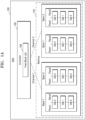
- the SSD 100 includes a controller 102, a memory 104 and a free block list 106.
- the SSD 100 may include a plurality of channels, each of which may direct towards (i.e., communicate with) a plurality of banks of the memory 104.
- Each of the plurality of banks may include a plurality of planes of the memory 104, each of the plurality of planes may include a plurality of dies of the memory 104, each of the plurality of dies may include a plurality of blocks of the memory 104, and each of the plurality of blocks may include a plurality of pages of the memory 104.
- each of the banks includes two planes i.e., plane 1 and plane 2 as shown in the FIG. 1A .
- each plane includes a plurality of dies such as die 0, die 1 and die 2 as shown in the FIG. 1A .
- Each die includes multiple blocks and each block includes multiple pages.
- the aforementioned architecture of the SSD 100 as shown in the FIG. 1A is only for illustrative and understanding purpose. However, the number of components and the specific architecture illustrated in the FIG. 1A should be not construed as limiting the present disclosure.
- the free block list 106 configured in the controller 102 may include one or more free super blocks arranged in a sequential manner. Each of these free super blocks is allocated for functionalities of the SSD 100 such as a host write operation, a garbage collection operation and the like.
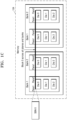
- FIGs. 1B and 1C show a super block within the Solid State Drive (SSD) in accordance with some example embodiments.
- the controller 102 may consider a super block for performing any operation related to the SSD 100 such as host write operation, garbage collection operation, host read operation and the like.
- the super block may be a block including all the blocks of a particular level across all the planes and all the banks of a particular level of die.
- SBN 0 represents a super block 0 which includes block 0 of each plane and each bank of a particular level of die i.e., in this instance die 0 of each plane and each bank.
- SBN 1 would represent a super block 1 which includes block 1 of each plane and each bank of die 0, and so on.
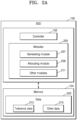
- FIG. 2A shows a detailed block diagram of a method for optimizing Quality of Service (QoS) in accordance with some example embodiments.
- QoS Quality of Service
- the SSD 100 may include data 203 and modules 205.
- the data 203 is stored in a memory 104 associated with the controller 102.
- the data 203 may include tolerance data 213 and other data 215.
- the modules 205 may be implemented by circuitry within or external to the controller 102, and the circuitry may include transistors, capacitors, logic gates, and other circuit elements to implement certain functionality described in more detail below.
- the data 203 may be stored in the memory 104 in the form of various data structures. Additionally, the data 203 can be organized using data models, such as relational or hierarchical data models.
- the other data 215 may be stored data of the SSD 100, including temporary data and temporary files, generated by the modules 205 for performing the various functions of the controller 102.
- the tolerance data 213 may indicate a tolerance level, and for example may indicate a predefined lowest valid page count, which is used in selecting the super blocks from dies of the SSD 100 for a garbage collection write operation.
- the modules 205 of the controller 102 may process the other data 215 stored in the memory 104.
- the modules 205 may be stored within the memory 104.
- the modules 205 communicatively coupled to the controller 102 may also be present outside the memory 104 as shown in FIG.2A and implemented as hardware.
- the term modules 205 may refer to an Application Specific Integrated Circuit (ASIC), an electronic circuit, a processor (shared, dedicated, or group) and memory that execute one or more software or firmware programs, a combinational logic circuit, and/or other suitable components that provide the described functionality.
- ASIC Application Specific Integrated Circuit
- the modules 205 may include, for example, a generating module 207, an allocating module 209, and other modules 211.
- the other modules 211 may be used to perform various functions of the controller 102. It will be appreciated that such aforementioned modules 205 may be represented as a single module or a combination of different modules.
- the generating module 207 may generate a free block list 106 indicating a plurality of free super blocks. In some example embodiments, the generating module 207 may generate the free block list 106 during at least one of an initialization mode and a power on recovery mode of the SSD. In some example embodiments, each of the plurality of free super blocks are appended sequentially to the free block list 106 upon removing unwanted content or relocating content from a particular super block. In some example embodiments, each of the plurality of free super blocks are appended to the free block list 106 by performing a garbage collection read operation. In some example embodiments, as part of the garbage collection read operation, the generating module 207 may select a super block among the plurality of super blocks, for performing a garbage collection write operation.
- the generating module 207 may select the super block among the plurality of super blocks, based on a tolerance level related to a valid page count and based on a die of the SSD to which the super block belongs. For instance, the generating module 207 may select the super block among the plurality of super block for performing the garbage collection write operation, from a die other than a die from which a super block was selected by the garbage collection read operation in a previous cycle. In some example embodiments, the generating module 207 may select the super block from a die which is successive (i.e., sequentially adjacent) to the die from which the super block was selected in the previous cycle. As an example, consider the super block selected by performing the garbage collection read operation in the previous cycle is super block 1 from die 0.
- the super block would be selected from the successive die i.e., from die 1.
- the super block may be selected by performing the garbage collection read operation, from any die of the SSD, other than the dies from which the super blocks were allocated for host write and garbage collection write operations.
- the super block selected for host write is from die 0,
- super block selected for garbage collection write is from die 2
- the super block would be selected from any die other than die 0, and die 2 i.e., from die 1 or die 3.
- the generating module 207 may select the super block by performing the garbage collection read operation on the basis of the tolerance level related to valid page count.
- the generating module 207 may determine valid page count of each super block within the identified die, and compare the determined valid page count of each super block within the identified die with a predefined lowest valid page count for a super block. As an example, consider the predefined lowest valid page count is 200 pages for a super block having 200000 pages. In such cases, the tolerance level related to the valid page count is said to be 200.
- the generating module 207 selects such super block for the garbage collection write operation.
- the generating module 207 may select any one of these super blocks randomly for performing the garbage collection write operation or may select the super block with the least valid pages among the other super blocks whose valid page count is less than the predefined lowest valid page count.
- the garbage collection write operation is performed on the selected super block to free the super block.
- the free super block thus obtained is then appended by the generating module 207 to the free block list.
- appending the free super block to the free block list may include appending a number representing the free super block belonging to the identified die to the existing free super block numbers in the free block list.
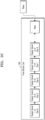
- FIG. 2B shows an arrangement of free super blocks in a comparative free block list 221 of a related technique. For instance, if there are three dies (namely die 0, die 1 and die 2) including fifty super blocks (namely super block 0, super block 1, super block 2ising super block 49), then the free super blocks that are appended sequentially to the free block list 221 are selected from the die 0 until all the super blocks of the die 0 are exhausted, as shown in the FIG.
- freeing and appending of the free super blocks continues with the free super blocks in die 1 and so on.
- the arrangement of free super blocks in the free block list 106 is as shown in the FIGs. 2C and 2D .
- free super blocks are appended in such a way that it reduces the probability of clashes between the host write operation and garbage collection write operation.
- the plurality of free super blocks appended sequentially to the free block list 106 are selected from different dies of the plurality of dies.
- free super blocks appended to the free block list are the super blocks selected from different dies, for instance, super block 1 of die 0, followed by super block 9 of die 2, super block 6 of die 0, super block 4 of die 1, super block 3 of die 2, and so on, as shown in the FIG. 2C .
- the plurality of free super blocks appended sequentially to the free block list 106 are selected from a different die but a successive die of the plurality of dies.
- free super blocks appended to the free block list are the super blocks selected from successive dies i.e., super block 1 of die 0 followed by super block 9 of die 1, super block 6 of die 2, super block 4 of die 0, super block 3 of die 1, and so on as shown in the FIG. 2D . Therefore, by selecting the super blocks for sequentially appending to the free block list 106, from different dies or successive dies and not the same die, clashes between the host write operation and garbage collection operation may be avoided.
- the allocating module 209 may allocate a free super block from the plurality of free super blocks in the free block list 106 for each of the host write operation and the garbage collection write operation. In some example embodiments, the allocating module 209 may allocate the free block for each of the host write operation and the garbage collection write operation by following the sequence in which the plurality of free blocks are listed or appended in the free block list 106. For instance, consider the free block list 106 as shown in the FIG. 2D . Consider, a host write operation and a garbage collection write operation are scheduled simultaneously.
- the allocating module 209 follows the sequence of the free block list 106 and allocates free super block 1 of die 0 for the host write operation and free super block 9 of die 1 for the garbage collection write operation. If another host write operation is scheduled, the allocating module 209 may then allocate the next free super block in the free block list 106 i.e., free super block 6 of die 2. This process continues in a similar manner based on the free super blocks appended in the free block list 106 after each garbage collection read operation.
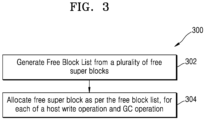
- FIG.3 is a flowchart illustrating a method of optimizing Quality of Service (QoS) in SSDs in accordance with some example embodiments.
- QoS Quality of Service
- the method 300 includes optimizing Quality of Service (QoS) in SSDs.
- QoS Quality of Service
- the method 300 may be described in the general context of computer-executable instructions.
- computer-executable instructions can include routines, programs, objects, components, data structures, procedures, modules, and functions, which perform functions or implement abstract data types.
- the order in which the method 300 is described is not intended to be construed as a limitation, and any number of the described method blocks can be combined in any order to implement the method 300. Additionally, individual blocks may be deleted from the method 300 without departing from the scope of the subject matter described herein. Furthermore, the method 300 can be implemented in any suitable hardware, software, firmware, or combination thereof.
- the method 300 may include generating, by a controller 102 configured in the SSD 100, a free block list 106 indicating a plurality of free super blocks.
- each of the plurality of free super blocks appended sequentially to the free block list 106 is selected from a different die of a plurality of dies.
- each of the plurality of free super blocks is appended to the free block list 106 by performing a garbage collection read operation.
- the controller 102 may select a super block among the plurality of super blocks, for a garbage collection operation, based on a tolerance level related to valid page count, from a die other than the dies from which the super blocks were allocated for the garbage collection write operation or the host write operation.
- the controller 102 may generate the free block list 106 during at least one of an initialization mode and a power on recovery mode of the SSD 100.
- the method 300 may include allocating, by the controller 102, a free super block from the plurality of free super blocks in the free block list 106 for each of a host write operation and a garbage collection operation.
- FIG. 4 is a general diagram of a system 400 to which a storage device is applied, according to some example embodiments.
- the system 400 of FIG. 4 may be a mobile system, such as a portable communication terminal (e.g., a mobile phone), a smartphone, a tablet personal computer (PC), a wearable device, a healthcare device, or an Internet of things (IOT) device.
- a portable communication terminal e.g., a mobile phone
- smartphone e.g., a smartphone
- PC tablet personal computer
- wearable device e.g., a wearable device
- healthcare device e.g., a healthcare device
- IOT Internet of things
- the system 400 of FIG. 4 is not necessarily limited to the mobile system and may be a PC, a laptop computer, a server, a media player, or an automotive device (e.g., a navigation device).
- an automotive device e.g., a navigation device
- the system 400 may include a main processor 410, memories (e.g., 420a and 420b), and storage devices (e.g., 430a and 430b).
- the system 400 may include at least one of an optical input device (i.e., an image capturing device) 441, a user input device 442, a sensor 443, a communication device 444, a display 445, a speaker 446, a power supplying device 447, and a connecting interface 448.
- the main processor 410 may control operation of the system 400, including operations of other components included in the system 400.
- the main processor 410 may be implemented as a hardware processor, such as a general-purpose processor, a dedicated processor, or an application processor.
- the main processor 410 may include at least one CPU core 411 and may further include a controller 412 configured to control the memories 420a and 420b and/or the storage devices 430a and 430b.
- the main processor 410 may further include an accelerator 413, which is a dedicated circuit for a high-speed data operation, such as an artificial intelligence (AI) data operation.
- the accelerator 413 may include hardware, such as a graphics processing unit (GPU), a neural processing unit (NPU) and/or a data processing unit (DPU), and be implemented as a chip that is physically separate from the other components of the main processor 410.
- the memories 420a and 420b may be used as main memory devices of the system 400. Although each of the memories 420a and 420b may include a volatile memory, such as static random access memory (SRAM) and/or dynamic RAM (DRAM), each of the memories 420a and 420b may include non-volatile memory, such as a flash memory, phase-change RAM (PRAM) and/or resistive RAM (RRAM).
- SRAM static random access memory
- DRAM dynamic RAM
- non-volatile memory such as a flash memory, phase-change RAM (PRAM) and/or resistive RAM (RRAM).
- PRAM phase-change RAM
- RRAM resistive RAM
- the memories 420a and 420b may be implemented in the same package as the main processor 410.
- the storage devices 430a and 430b may serve as non-volatile storage devices configured to store data regardless of whether power is supplied thereto, and have larger storage capacity than the memories 420a and 420b.
- the storage devices 430a and 430b may respectively include storage controllers 431a and 431b and non-volatile memories (NVMs) 432a and 432b configured to store data via the control of the storage controllers 431a and 431b.
- NVMs 432a and 432b may include flash memories having a two-dimensional (2D) structure or a three-dimensional (3D) V-NAND structure
- the NVMs 432a and 432b may include other types of NVMs, such as PRAM and/or RRAM.
- the storage devices 430a and 430b may be physically separated from the main processor 410 and included in the system 400 or implemented in the same package as the main processor 410.
- the storage devices 430a and 430b may have types of solid-state devices (SSDs) or memory cards and be removably combined with other components of the system 100 through an interface, such as the connecting interface 448 as described below.
- the storage devices 430a and 430b may be devices to which a standard protocol, such as a universal flash storage (UFS), an embedded multi-media card (eMMC), or a non-volatile memory express (NVMe), is applied, without being limited thereto.
- UFS universal flash storage
- eMMC embedded multi-media card
- NVMe non-volatile memory express
- the optical input device 441 may capture still images or moving images.
- the optical input device 441 may include a camera, a camcorder, and/or a webcam.
- the user input device 442 may receive various types of data input by a user of the system 400 and include a touch pad, a keypad, a keyboard, a mouse, and/or a microphone.
- the sensor 443 may detect various types of physical quantities, which may be obtained from the outside of the system 400, and convert the detected physical quantities into electric signals.
- the sensor 443 may include a temperature sensor, a pressure sensor, an illuminance sensor, a position sensor, an acceleration sensor, a biosensor, and/or a gyroscope sensor.
- the communication device 444 may transmit and receive signals between other devices outside the system 400 according to various communication protocols.
- the communication device 444 may include an antenna, a transceiver, and/or a modem.
- the display 445 and the speaker 446 may serve as output devices configured to respectively output visual information and auditory information to the user of the system 400.
- the power supplying device 447 may appropriately convert power supplied from a battery embedded in the system 400 and/or an external power source, and supply the converted power to each of components of the system 400.
- the connecting interface 448 may provide connection between the system 400 and an external device, which is connected to the system 400 and capable of transmitting and receiving data to and from the system 400.
- the connecting interface 448 may be implemented by using various interface schemes, such as advanced technology attachment (ATA), serial ATA (SATA), external SATA (e-SATA), small computer small interface (SCSI), serial attached SCSI (SAS), peripheral component interconnection (PCI), PCI express (PCIe), NVMe, IEEE 4394, a universal serial bus (USB) interface, a secure digital (SD) card interface, a multi-media card (MMC) interface, an eMMC interface, a UFS interface, an embedded UFS (eUFS) interface, and a compact flash (CF) card interface.
- ATA advanced technology attachment
- SATA serial ATA
- e-SATA external SATA
- SCSI small computer small interface
- SAS serial attached SCSI
- PCI peripheral component interconnection
- PCIe PCI express
- NVMe IEEE 4394
- USB universal
- a free block list may be generated based on free super blocks that are appended sequentially from sequential dies of the plurality of dies in the SSD.
- the free super block belongs to a different die. For instance, if the free super block 1 is from die 0, then the next free super block in the sequence of the generated free block list would be from a different die. Simultaneously or while the host write operation in ongoing, if the SSD schedules a garbage collection write operation, then the next free super block in the free block list may be allocated.
Landscapes
- Engineering & Computer Science (AREA)
- Theoretical Computer Science (AREA)
- Physics & Mathematics (AREA)
- General Engineering & Computer Science (AREA)
- General Physics & Mathematics (AREA)
- Human Computer Interaction (AREA)
- Memory System (AREA)
Applications Claiming Priority (1)
| Application Number | Priority Date | Filing Date | Title |
|---|---|---|---|
| IN202241056374 | 2022-09-30 |
Publications (1)
| Publication Number | Publication Date |
|---|---|
| EP4345628A1 true EP4345628A1 (fr) | 2024-04-03 |
Family
ID=85121960
Family Applications (1)
| Application Number | Title | Priority Date | Filing Date |
|---|---|---|---|
| EP23153559.2A Pending EP4345628A1 (fr) | 2022-09-30 | 2023-01-26 | Procédé d'optimisation de qualité de service (qos) dans des disques à semi-conducteurs (ssd) et son ssd |
Country Status (3)
| Country | Link |
|---|---|
| US (1) | US12277322B2 (fr) |
| EP (1) | EP4345628A1 (fr) |
| CN (1) | CN117806535A (fr) |
Families Citing this family (1)
| Publication number | Priority date | Publication date | Assignee | Title |
|---|---|---|---|---|
| CN120540575A (zh) * | 2024-02-26 | 2025-08-26 | 长江存储科技有限责任公司 | 存储系统的操作方法、控制器、存储系统及存储介质 |
Citations (3)
| Publication number | Priority date | Publication date | Assignee | Title |
|---|---|---|---|---|
| EP2939100A2 (fr) * | 2012-12-31 | 2015-11-04 | SanDisk Technologies Inc. | Procédé et système pour opérations asynchrones sur puce dans une mémoire non volatile |
| US20200125294A1 (en) * | 2018-10-18 | 2020-04-23 | Western Digital Technologies, Inc. | Using interleaved writes to separate die planes |
| US11175984B1 (en) * | 2019-12-09 | 2021-11-16 | Radian Memory Systems, Inc. | Erasure coding techniques for flash memory |
Family Cites Families (45)
| Publication number | Priority date | Publication date | Assignee | Title |
|---|---|---|---|---|
| JPH11110267A (ja) * | 1997-10-02 | 1999-04-23 | Oki Electric Ind Co Ltd | データ保存装置、データ保存方法及び記録媒体 |
| US7020739B2 (en) * | 2000-12-06 | 2006-03-28 | Tdk Corporation | Memory controller, flash memory system having memory controller and method for controlling flash memory device |
| JP4256600B2 (ja) * | 2001-06-19 | 2009-04-22 | Tdk株式会社 | メモリコントローラ、メモリコントローラを備えるフラッシュメモリシステム及びフラッシュメモリの制御方法 |
| US7978516B2 (en) * | 2007-12-27 | 2011-07-12 | Pliant Technology, Inc. | Flash memory controller having reduced pinout |
| WO2009098777A1 (fr) * | 2008-02-08 | 2009-08-13 | Fujitsu Limited | Procédé de sauvegarde, procédé de stockage et dispositif de matrice de disques |
| JP2010015197A (ja) * | 2008-06-30 | 2010-01-21 | Toshiba Corp | ストレージ制御装置、データ復元装置およびストレージシステム |
| US7856528B1 (en) * | 2009-08-11 | 2010-12-21 | Texas Memory Systems, Inc. | Method and apparatus for protecting data using variable size page stripes in a FLASH-based storage system |
| US8255620B2 (en) * | 2009-08-11 | 2012-08-28 | Texas Memory Systems, Inc. | Secure Flash-based memory system with fast wipe feature |
| US9612978B2 (en) * | 2010-12-31 | 2017-04-04 | International Business Machines Corporation | Encrypted flash-based data storage system with confidentiality mode |
| US8539142B2 (en) * | 2011-09-30 | 2013-09-17 | Hitachi, Ltd. | Storage system comprising nonvolatile semiconductor storage media |
| CN103999057B (zh) * | 2011-12-30 | 2016-10-26 | 英特尔公司 | 具有开关的相变存储器(pcms)的元数据管理和支持 |
| US11037625B2 (en) * | 2012-11-20 | 2021-06-15 | Thstyme Bermuda Limited | Solid state drive architectures |
| US9286002B1 (en) * | 2012-12-28 | 2016-03-15 | Virident Systems Inc. | Dynamic restriping in nonvolatile memory systems |
| US9734050B2 (en) * | 2012-12-31 | 2017-08-15 | Sandisk Technologies Llc | Method and system for managing background operations in a multi-layer memory |
| US9223693B2 (en) * | 2012-12-31 | 2015-12-29 | Sandisk Technologies Inc. | Memory system having an unequal number of memory die on different control channels |
| US9465731B2 (en) * | 2012-12-31 | 2016-10-11 | Sandisk Technologies Llc | Multi-layer non-volatile memory system having multiple partitions in a layer |
| US9734911B2 (en) * | 2012-12-31 | 2017-08-15 | Sandisk Technologies Llc | Method and system for asynchronous die operations in a non-volatile memory |
| US8873284B2 (en) * | 2012-12-31 | 2014-10-28 | Sandisk Technologies Inc. | Method and system for program scheduling in a multi-layer memory |
| US9336133B2 (en) * | 2012-12-31 | 2016-05-10 | Sandisk Technologies Inc. | Method and system for managing program cycles including maintenance programming operations in a multi-layer memory |
| US9348746B2 (en) * | 2012-12-31 | 2016-05-24 | Sandisk Technologies | Method and system for managing block reclaim operations in a multi-layer memory |
| US10445229B1 (en) * | 2013-01-28 | 2019-10-15 | Radian Memory Systems, Inc. | Memory controller with at least one address segment defined for which data is striped across flash memory dies, with a common address offset being used to obtain physical addresses for the data in each of the dies |
| US11249652B1 (en) * | 2013-01-28 | 2022-02-15 | Radian Memory Systems, Inc. | Maintenance of nonvolatile memory on host selected namespaces by a common memory controller |
| US9342443B2 (en) * | 2013-03-15 | 2016-05-17 | Micron Technology, Inc. | Systems and methods for memory system management based on thermal information of a memory system |
| US9135164B2 (en) * | 2013-03-15 | 2015-09-15 | Virident Systems Inc. | Synchronous mirroring in non-volatile memory systems |
| US20150378886A1 (en) * | 2013-04-08 | 2015-12-31 | Avalanche Technology, Inc. | Software-defined ssd and system using the same |
| US9542118B1 (en) * | 2014-09-09 | 2017-01-10 | Radian Memory Systems, Inc. | Expositive flash memory control |
| US10552085B1 (en) * | 2014-09-09 | 2020-02-04 | Radian Memory Systems, Inc. | Techniques for directed data migration |
| US10552058B1 (en) * | 2015-07-17 | 2020-02-04 | Radian Memory Systems, Inc. | Techniques for delegating data processing to a cooperative memory controller |
| US10133490B2 (en) * | 2015-10-30 | 2018-11-20 | Sandisk Technologies Llc | System and method for managing extended maintenance scheduling in a non-volatile memory |
| US20170123666A1 (en) * | 2015-10-30 | 2017-05-04 | Sandisk Technologies Inc. | System and method for managing maintenance scheduling in a non-volatile memory |
| US10120613B2 (en) * | 2015-10-30 | 2018-11-06 | Sandisk Technologies Llc | System and method for rescheduling host and maintenance operations in a non-volatile memory |
| US9778855B2 (en) * | 2015-10-30 | 2017-10-03 | Sandisk Technologies Llc | System and method for precision interleaving of data writes in a non-volatile memory |
| US10042553B2 (en) * | 2015-10-30 | 2018-08-07 | Sandisk Technologies Llc | Method and system for programming a multi-layer non-volatile memory having a single fold data path |
| US10346268B2 (en) * | 2016-07-21 | 2019-07-09 | SK Hynix Inc. | Efficient data recovery for write path errors |
| US10552254B2 (en) * | 2017-08-15 | 2020-02-04 | Micron Technology, Inc. | Partially written superblock treatment |
| JP2019057178A (ja) * | 2017-09-21 | 2019-04-11 | 東芝メモリ株式会社 | メモリシステムおよび制御方法 |
| JP2019057172A (ja) * | 2017-09-21 | 2019-04-11 | 東芝メモリ株式会社 | メモリシステムおよび制御方法 |
| US10642746B2 (en) * | 2018-03-22 | 2020-05-05 | Western Digital Technologies, Inc. | Controlling cached/non-cached memory access decisions based on memory access queue fill levels |
| US10915400B1 (en) * | 2019-11-08 | 2021-02-09 | Micron Technology, Inc. | Dynamic over provisioning allocation for purposed blocks |
| JP7353934B2 (ja) * | 2019-11-19 | 2023-10-02 | キオクシア株式会社 | メモリシステムおよび制御方法 |
| US20210149594A1 (en) * | 2019-11-19 | 2021-05-20 | Microsoft Technology Licensing, Llc | Solid-state devices to reduce latency by employing instruction time slicing to non-volatile memory (nvm) sets mapped to independently programmable nvm planes |
| US11409600B2 (en) * | 2019-12-30 | 2022-08-09 | Micron Technology, Inc. | Increased memory access parallelism using parity |
| US11513891B2 (en) * | 2020-07-24 | 2022-11-29 | Kioxia Corporation | Systems and methods for parity-based failure protection for storage devices |
| CN113227959A (zh) * | 2021-03-30 | 2021-08-06 | 长江存储科技有限责任公司 | 具有读取错误处理的存储器控制器 |
| JP2023136082A (ja) * | 2022-03-16 | 2023-09-29 | キオクシア株式会社 | メモリシステムおよび制御方法 |
-
2022
- 2022-12-07 US US18/076,686 patent/US12277322B2/en active Active
-
2023
- 2023-01-26 EP EP23153559.2A patent/EP4345628A1/fr active Pending
- 2023-02-24 CN CN202310166919.7A patent/CN117806535A/zh active Pending
Patent Citations (3)
| Publication number | Priority date | Publication date | Assignee | Title |
|---|---|---|---|---|
| EP2939100A2 (fr) * | 2012-12-31 | 2015-11-04 | SanDisk Technologies Inc. | Procédé et système pour opérations asynchrones sur puce dans une mémoire non volatile |
| US20200125294A1 (en) * | 2018-10-18 | 2020-04-23 | Western Digital Technologies, Inc. | Using interleaved writes to separate die planes |
| US11175984B1 (en) * | 2019-12-09 | 2021-11-16 | Radian Memory Systems, Inc. | Erasure coding techniques for flash memory |
Also Published As
| Publication number | Publication date |
|---|---|
| US12277322B2 (en) | 2025-04-15 |
| US20240111422A1 (en) | 2024-04-04 |
| CN117806535A (zh) | 2024-04-02 |
Similar Documents
| Publication | Publication Date | Title |
|---|---|---|
| KR102874828B1 (ko) | 저장 장치 및 그 동작 방법 | |
| KR102839223B1 (ko) | 데이터 저장 장치 및 그 동작 방법 | |
| TWI738442B (zh) | 資料儲存裝置與資料處理方法 | |
| US9223696B2 (en) | Data storage device for holding erasure of victim block having valid page copied to merge block and method of operating the same | |
| CN113778317B (zh) | 计算机可读取存储介质、调度主机命令的方法及装置 | |
| CN115113799B (zh) | 主机命令的执行方法及装置 | |
| CN114371812A (zh) | 控制器及其操作方法 | |
| EP4345628A1 (fr) | Procédé d'optimisation de qualité de service (qos) dans des disques à semi-conducteurs (ssd) et son ssd | |
| CN118672490A (zh) | 处理快闪存储器主机写入命令的方法以及相关存储器控制器与储存系统 | |
| KR20220076803A (ko) | 데이터 저장 장치 및 그것의 동작 방법 | |
| KR102815402B1 (ko) | 컨트롤러, 컨트롤러의 동작 방법 및 이를 포함하는 저장 장치 | |
| US20250181502A1 (en) | Memory system and a method for garbage collection of the memory system | |
| CN116149540B (zh) | 更新主机与闪存地址对照表的方法和计算机可读取存储介质和装置 | |
| CN113495850B (zh) | 管理垃圾回收程序的方法、装置及计算机可读取存储介质 | |
| CN118760394B (zh) | 数据存储装置、数据存储系统及所使用的数据整理方法 | |
| CN101996137A (zh) | 存储装置与其资料处理方法 | |
| CN118585141A (zh) | 一种存储器及其数据处理方法 | |
| CN112099731A (zh) | 数据储存装置与数据处理方法 | |
| CN115878024B (zh) | 写入数据到闪存存储器的方法及装置 | |
| CN118445225A (zh) | 存储设备及其操作方法以及包括存储设备的主机存储系统 | |
| CN118051170A (zh) | 存储器控制器及其操作方法、存储器系统、电子设备 | |
| KR102835936B1 (ko) | 데이터 저장 장치, 이를 포함하는 전자 장치 및 데이터 저장 장치의 동작 방법 | |
| US12189985B2 (en) | Memory controllers and operating methods thereof, memory systems, and electronic devices | |
| US12498874B2 (en) | Storage device and operating method of storage device | |
| CN119556846B (zh) | 存储器控制器及其操作方法、存储器系统 |
Legal Events
| Date | Code | Title | Description |
|---|---|---|---|
| PUAI | Public reference made under article 153(3) epc to a published international application that has entered the european phase |
Free format text: ORIGINAL CODE: 0009012 |
|
| STAA | Information on the status of an ep patent application or granted ep patent |
Free format text: STATUS: THE APPLICATION HAS BEEN PUBLISHED |
|
| STAA | Information on the status of an ep patent application or granted ep patent |
Free format text: STATUS: REQUEST FOR EXAMINATION WAS MADE |
|
| AK | Designated contracting states |
Kind code of ref document: A1 Designated state(s): AL AT BE BG CH CY CZ DE DK EE ES FI FR GB GR HR HU IE IS IT LI LT LU LV MC ME MK MT NL NO PL PT RO RS SE SI SK SM TR |
|
| 17P | Request for examination filed |
Effective date: 20240322 |
|
| RBV | Designated contracting states (corrected) |
Designated state(s): AL AT BE BG CH CY CZ DE DK EE ES FI FR GB GR HR HU IE IS IT LI LT LU LV MC ME MK MT NL NO PL PT RO RS SE SI SK SM TR |
|
| P01 | Opt-out of the competence of the unified patent court (upc) registered |
Free format text: CASE NUMBER: APP_34417/2024 Effective date: 20240607 |