EP4347879B1 - Procédés, compositions, kits et systèmes pour améliorer la capture d'analytes pour une analyse spatiale - Google Patents
Procédés, compositions, kits et systèmes pour améliorer la capture d'analytes pour une analyse spatiale Download PDFInfo
- Publication number
- EP4347879B1 EP4347879B1 EP22738116.7A EP22738116A EP4347879B1 EP 4347879 B1 EP4347879 B1 EP 4347879B1 EP 22738116 A EP22738116 A EP 22738116A EP 4347879 B1 EP4347879 B1 EP 4347879B1
- Authority
- EP
- European Patent Office
- Prior art keywords
- substrate
- capture
- biological sample
- analyte
- sample
- Prior art date
- Legal status (The legal status is an assumption and is not a legal conclusion. Google has not performed a legal analysis and makes no representation as to the accuracy of the status listed.)
- Active
Links
Images









Classifications
-
- C—CHEMISTRY; METALLURGY
- C12—BIOCHEMISTRY; BEER; SPIRITS; WINE; VINEGAR; MICROBIOLOGY; ENZYMOLOGY; MUTATION OR GENETIC ENGINEERING
- C12Q—MEASURING OR TESTING PROCESSES INVOLVING ENZYMES, NUCLEIC ACIDS OR MICROORGANISMS; COMPOSITIONS OR TEST PAPERS THEREFOR; PROCESSES OF PREPARING SUCH COMPOSITIONS; CONDITION-RESPONSIVE CONTROL IN MICROBIOLOGICAL OR ENZYMOLOGICAL PROCESSES
- C12Q1/00—Measuring or testing processes involving enzymes, nucleic acids or microorganisms; Compositions therefor; Processes of preparing such compositions
- C12Q1/68—Measuring or testing processes involving enzymes, nucleic acids or microorganisms; Compositions therefor; Processes of preparing such compositions involving nucleic acids
- C12Q1/6813—Hybridisation assays
- C12Q1/6841—In situ hybridisation
-
- C—CHEMISTRY; METALLURGY
- C12—BIOCHEMISTRY; BEER; SPIRITS; WINE; VINEGAR; MICROBIOLOGY; ENZYMOLOGY; MUTATION OR GENETIC ENGINEERING
- C12N—MICROORGANISMS OR ENZYMES; COMPOSITIONS THEREOF; PROPAGATING, PRESERVING, OR MAINTAINING MICROORGANISMS; MUTATION OR GENETIC ENGINEERING; CULTURE MEDIA
- C12N15/00—Mutation or genetic engineering; DNA or RNA concerning genetic engineering, vectors, e.g. plasmids, or their isolation, preparation or purification; Use of hosts therefor
- C12N15/09—Recombinant DNA-technology
- C12N15/10—Processes for the isolation, preparation or purification of DNA or RNA
- C12N15/1034—Isolating an individual clone by screening libraries
- C12N15/1065—Preparation or screening of tagged libraries, e.g. tagged microorganisms by STM-mutagenesis, tagged polynucleotides, gene tags
Definitions
- the present invention relates to methods for determining the abundance and location of multiple analytes in a biological sample using a sandwich maker system.
- the methods and systems used herein include a first substrate that includes a plurality of probes that include a capture domain and a spatial domain and a second substrate that includes a plurality of probes comprising a capture domain and a spatial domain
- Cells within a tissue of a subject have differences in cell morphology and/or function due to varied analyte levels (e.g., gene and/or protein expression) within the different cells.
- the specific position of a cell within a tissue e.g., the cell's position relative to neighboring cells or the cell's position relative to the tissue microenvironment
- Preserving the original spatial distribution of gene expression is critical for spatial transcriptomics gene expression assays.
- One option to analyze gene expression is by using multiple substrates.
- one substrate e.g., slide
- another includes a biological specimen such as a tissue section.
- This set up provides the ability to capture analytes on one substrate.
- capturing analytes on one substrate provides spatial information, there remains a need to increase resolution and/or sensitivity in spatial methods that incorporate a system that utilizes capture probes on multiple substrates.
- the methods and systems disclosed herein increase the resolution and/or sensitivity of analyte detection.
- the methods and systems here utilize multiple substrate arrays, which include at least two slides on either side of a biological sample.
- methods and systems that include a first slide that includes a plurality of probes comprising a first capture probe and a first spatial barcode.
- the methods here also feature a second slide which also includes an array of capture probes that include at least a capture domain sequence and spatial barcode.
- the biological sample is provided on the first slide; and after permeabilizing the biological sample, analytes are free to disperse from the biological sample. Because the analytes passively diffuse, they will be captured by the probes on both the first and second slides, thus increasing the total number of analytes captured at a particular spot (e.g., or i.e., compared to a system that utilizes one substrate).
- the method comprises: (a) providing a first substrate and a biological sample mounted thereon, wherein the first substrate comprises a plurality of first capture probes, wherein a first capture probe of the plurality of first capture probes comprises (i) a first spatial barcode and (ii) a first capture domain; (b) aligning a second substrate on the opposite side of the first substrate relative to the biological sample, thereby sandwiching the first substrate, the biological sample, and the second substrate, wherein the second substrate comprises a plurality of second capture probes, wherein a second capture probe of the plurality of second capture probes comprises (i) a second spatial barcode and (ii) a second capture domain; and (c) hybridizing a first analyte of the multiple analytes to the first capture domain and hybridizing a second analyte of the multiple analytes to the second capture domain.
- the method further comprises (d) (A) determining (i) all or a portion of the sequence of the first spatial barcode, or a complement thereof, and (ii) all or a portion of the sequence of the first analyte captured on the first capture domain, or a complement thereof, and using the sequences of (i) and (ii) to determine the abundance and the location of the first analyte in the biological sample, and/or (B) determining (i) all or a portion of the sequence of the second spatial barcode, or a complement thereof, and (ii) all or a portion of the sequence of the second analyte captured on the second capture domain, or a complement thereof, and using the sequences of (i) and (ii) to determine the abundance and the location of the second analyte in the biological sample.
- the methods further comprise, prior to (a) mounting the biological sample onto the plurality of first capture probes of the first substrate.
- total number of the multiple analytes determined is increased by about 10%, about 20%, about 30%, about 40%, about 50%, about 60%, about 70%, about 80%, about 90%, about 100%, or more compared to a method using one substrate.
- the methods further include adding a permeabilization buffer to the biological sample, thereby promoting migration of the first analyte and the second analyte from the biological sample.
- the permeabilization buffer comprises pepsin or proteinase K.
- step (b) of the above methods is performed with the aid of a sample holder comprising: (i) a first member comprising a first retaining mechanism configured to receive the first substrate, (ii) a second member configured to receive the second substrate, and (iii) an alignment mechanism that is connected to at least one of the first member and second member and configured to align the first substrate and the second substrate.
- step (b) of the above methods comprises (i) retaining the first substrate in the first retaining mechanism of the first substrate, (ii) retaining the second substrate in the second retaining mechanism of the second substrate, and (iii) using the alignment mechanism to align the second substrate on the opposite side of the first substrate relative to the biological sample, thereby sandwiching the first substrate, the biological sample, and the second substrate.
- the first capture domain comprises (i) a poly-thymine (poly(T)) sequence, (ii) a sequence complementary to a capture handle sequence present in an analyte capture agent, or (iii) a sequence complementary to a portion of a connected probe generated by templated ligation.
- the plurality of first capture probes is arranged on a plurality of first beads.
- the first capture probe further comprises one or more first functional domains, a first unique molecular identifier, a first cleavage domain, and combinations thereof.
- the methods further include generating a first extended capture probe using the first analyte as a template.
- the first capture probe is extended at its 3' end.
- the generating the first extended capture probe utilizes a reverse transcriptase.
- the generating the first extended capture probe utilizes fluorescently labeled nucleotides.
- the methods further include amplifying the extended capture probe to produce a plurality of extended capture probes.
- the amplifying utilizes a DNA polymerase, a plurality of primers, and a plurality of nucleotides.
- the determining step in step (d)(A) in the above methods comprises sequencing. In some instances, the determining step in step (d)(A) comprises sequencing (i) all or a portion of the sequence of the first spatial barcode or the complement thereof, and (ii) all or a portion of the sequence of the first analyte.
- the second capture domain comprises (i) a poly-thymine (poly(T)) sequence, (ii) a sequence complementary to a capture handle sequence present in an analyte capture agent, or (iii) a sequence complementary to a portion of a connected probe generated by templated ligation.
- the plurality of second capture probes is arranged on a plurality of second beads.
- the second capture probe further comprises one or more second functional domains, a second unique molecular identifier, a second cleavage domain, and combinations thereof.
- the methods disclosed herein further include generating a second extended capture probe using the second analyte as a template.
- the second capture probe is extended at its 3' end.
- the generating the second extended capture probe utilizes a reverse transcriptase.
- the generating the second extended capture probe utilizes fluorescently labeled nucleotides.
- the methods above further include amplifying the extended capture probe to produce a plurality of extended capture probes.
- the amplifying utilizes a DNA polymerase, a plurality of primers, and a plurality of nucleotides.
- the determining step in step (d)(B) in the methods above comprises sequencing. In some instances, the determining step in step (d)(B) comprises sequencing (i) all or a portion of the sequence of the second spatial barcode or the complement thereof, and (ii) all or a portion of the sequence of the second analyte.
- the first analyte and the second analyte are RNA molecules. In some instances, the RNA molecules are mRNA molecules. In some instances, the first analyte and the second analyte are different analytes.
- the first analyte and the second analyte can be a protein and a nucleic acid (e.g., RNA or DNA). Additionally, or in the alternative, the first analyte and the second analyte can be an intermediate agent or portion thereof and RNA.
- the intermediate agent can be a connected probe (e.g., RTL probe) or analyte capture agent (e.g., oligo-conjugated antibody).
- first analyte and the second analyte can be RNA and DNA. Additionally, or in the alternative, the first analyte and the second analyte can be an intermediate agent and DNA. Additionally, or in the alternative, the first analyte and the second analyte can be a targeted capture on one slide and whole transcriptome or DNA on other slide.
- the biological sample is a tissue section sample. In some instances, the biological sample is a tissue section. In some instances, the biological sample is a formalin-fixed, paraffin-embedded (FFPE) sample, a frozen sample, a fresh frozen sample, or a fresh sample. In some instances, the biological sample is an FFPE sample.
- FFPE formalin-fixed, paraffin-embedded
- kits include (a) a first substrate comprising a plurality of first capture probes, wherein a first capture probe of the plurality of first capture probes comprises (i) a first spatial barcode and (ii) a first capture domain; (b) a second substrate comprises a plurality of second capture probes, wherein a second capture probe of the plurality of second capture probes comprises (i) a second spatial barcode and (ii) a second capture domain; and (c) instructions for performing any of the above methods.
- the systems are used for determining the abundance and location of multiple analytes in a biological sample.
- the systems include (a) a first substrate comprising a plurality of first capture probes, wherein a first capture probe of the plurality of first capture probes comprises (i) a first spatial barcode and (ii) a first capture domain; (b) a second substrate comprises a plurality of second capture probes, wherein a second capture probe of the plurality of second capture probes comprises (i) a second spatial barcode and (ii) a second capture domain; (c) a biological sample holder comprising: (i) a first member comprising a first retaining mechanism configured to receive the first substrate, (ii) a second member configured to receive the second substrate, and (iii) an alignment mechanism that is connected to at least one of the first member and second member and configured to align the first substrate and the second substrate; and (d) the biological sample.
- each when used in reference to a collection of items, is intended to identify an individual item in the collection but does not necessarily refer to every item in the collection, unless expressly stated otherwise, or unless the context of the usage clearly indicates otherwise.
- a cell includes one or more cells, including mixtures thereof.
- a and/or B is used herein to include all of the following alternatives: “A”, “B”, “A or B”, and “A and B”.
- kits, systems, and apparatuses for detecting multiple analytes in a biological sample.
- methods, kits, systems, and apparatuses that utilize two spatially barcoded (e.g., gene expression) arrays.
- the spatially barcoded arrays are used to detect analytes in a biological sample using a sandwiching process described herein.
- both substrates comprise spatially barcoded capture probes and each capture probe comprises at least a capture domain and a spatial barcode.
- Use of the two substrates in a sandwiching process described herein increases the amount of spatially barcoded capture probes for capturing analytes from a single location in a biological sample.
- the disclosure provides methods, kits, systems, and apparatuses that lead to increased information gathered for spatial analysis.
- Spatial analysis methodologies and compositions described herein can provide a vast amount of analyte and/or expression data for a variety of analytes within a biological sample at high spatial resolution, while retaining native spatial context.
- Spatial analysis methods and compositions can include, e.g., the use of a capture probe including a spatial barcode (e.g., a nucleic acid sequence that provides information as to the location or position of an analyte within a cell or a tissue sample (e.g., mammalian cell or a mammalian tissue sample) and a capture domain that is capable of binding to an analyte (e.g., a protein and/or a nucleic acid) produced by and/or present in a cell.
- a spatial barcode e.g., a nucleic acid sequence that provides information as to the location or position of an analyte within a cell or a tissue sample
- a capture domain that is capable of binding to an analyte (
- Spatial analysis methods and compositions can also include the use of a capture probe having a capture domain that captures an intermediate agent for indirect detection of an analyte.
- the intermediate agent can include a nucleic acid sequence (e.g., a barcode) associated with the intermediate agent. Detection of the intermediate agent is therefore indicative of the analyte in the cell or tissue sample.
- Non-limiting aspects of spatial analysis methodologies and compositions are described in U.S. Patent Nos. 10,774,374 , 10,724,078 , 10,480,022 , 10,059,990 , 10,041,949 , 10,002,316 , 9,879,313 , 9,783,841 , 9,727,810 , 9,593,365 , 8,951,726 , 8,604,182 , 7,709,198 , U.S. Patent Application Publication Nos.
- US 2021/317524 A1 discloses methods for determining a location of a feature in a spatial array of features including providing a spatial array including a plurality of features on a substrate, where a feature of the plurality of features has a capture probe, and where the capture probe has a spatial barcode and a constant sequence; hybridizing a first sequencing probe to the spatial barcode, where the first sequencing probe has a first label and a first nucleotide sequence; obtaining a first image of the first label with the first sequencing probe hybridized to the spatial barcode; determining, based on the first image, a first portion of a sequence of the spatial barcode; and associating the feature with a location in the spatial array based on a location of the first label in the first image.
- US 2021/130881 A1 discloses a sample holder that includes a first member featuring a first retaining mechanism configured to retain a first substrate that includes a sample, a second member featuring a second retaining mechanism configured to retain a second substrate that includes a reagent medium, and an alignment mechanism connected to at least one of the first and second members, and configured to align the first and second members such that the sample contacts at least a portion of the reagent medium when the first and second members are aligned.
- WO 2004/067759 A2 discloses a method of producing arrays of nucleic acids corresponding to a first set of nucleic acids immobilised on a first solid support including furnishing on said first set of nucleic acids a second set of nucleic acids, each nucleic acid of the second set having at least a portion which is complementary to at least a portion of respective nucleic acid of the first set and being hybridised to it thereby. This may involve contact with a solution containing a mixture of nucleic acids, or synthesis using the first nucleic acids as primers and templates.
- the second set of nucleic acids are immobilised to a second solid support, either before or while they are hybridised to the first set of nucleic acids. Separation of the first and second solid supports provides said first support bearing the master array and said second support bearing a complementary array. Further non-limiting aspects of spatial analysis methodologies and compositions are described herein.
- a "barcode” is a label, or identifier, that conveys or is capable of conveying information (e.g., information about an analyte in a sample, a bead, and/or a capture probe).
- a barcode can be part of an analyte, or independent of an analyte.
- a barcode can be attached to an analyte.
- a particular barcode can be unique relative to other barcodes.
- an "analyte” can include any biological substance, structure, moiety, or component to be analyzed.
- target can similarly refer to an analyte of interest.
- Analytes can be broadly classified into one of two groups: nucleic acid analytes, and non-nucleic acid analytes.
- non-nucleic acid analytes include, but are not limited to, lipids, carbohydrates, peptides, proteins, glycoproteins (N-linked or O-linked), lipoproteins, phosphoproteins, specific phosphorylated or acetylated variants of proteins, amidation variants of proteins, hydroxylation variants of proteins, methylation variants of proteins, ubiquitylation variants of proteins, sulfation variants of proteins, viral proteins (e.g., viral capsid, viral envelope, viral coat, viral accessory, viral glycoproteins, viral spike, etc.), extracellular and intracellular proteins, antibodies, and antigen binding fragments.
- viral proteins e.g., viral capsid, viral envelope, viral coat, viral accessory, viral glycoproteins, viral spike, etc.
- the analyte(s) can be localized to subcellular location(s), including, for example, organelles, e.g., mitochondria, Golgi apparatus, endoplasmic reticulum, chloroplasts, endocytic vesicles, exocytic vesicles, vacuoles, lysosomes, etc.
- organelles e.g., mitochondria, Golgi apparatus, endoplasmic reticulum, chloroplasts, endocytic vesicles, exocytic vesicles, vacuoles, lysosomes, etc.
- analyte(s) can be peptides or proteins, including without limitation antibodies and enzymes. Additional examples of analytes can be found in Section (I)(c) of WO 2020/176788 and/or U.S. Patent Application Publication No. 2020/0277663 .
- an analyte can be detected indirectly, such as through detection of an intermediate agent, for example, a connected probe (e.g., a ligation product) or an analyte capture agent (e.g., an oligonucleotide-conjugated antibody), such as those described herein.
- an intermediate agent for example, a connected probe (e.g., a ligation product) or an analyte capture agent (e.g., an oligonucleotide-conjugated antibody), such as those described herein.
- a “biological sample” is typically obtained from the subject for analysis using any of a variety of techniques including, but not limited to, biopsy, surgery, and laser capture microscopy (LCM), and generally includes cells and/or other biological material from the subject.
- a biological sample can be a tissue section.
- a biological sample can be a fixed and/or stained biological sample (e.g., a fixed and/or stained tissue section).
- stains include histological stains (e.g., hematoxylin and/or eosin) and immunological stains (e.g., fluorescent stains).
- a biological sample e.g., a fixed and/or stained biological sample
- Biological samples are also described in Section (I)(d) of WO 2020/176788 and/or U.S. Patent Application Publication No. 2020/0277663 .
- a biological sample is permeabilized with one or more permeabilization reagents.
- permeabilization of a biological sample can facilitate analyte capture.
- Exemplary permeabilization agents and conditions are described in Section (I)(d)(ii)(13) or the Exemplary Embodiments Section of WO 2020/176788 and/or U.S. Patent Application Publication No. 2020/0277663 .
- Array-based spatial analysis methods involve the transfer of one or more analytes from a biological sample to an array of features on a substrate, where each feature is associated with a unique spatial location on the array. Subsequent analysis of the transferred analytes includes determining the identity of the analytes and the spatial location of the analytes within the biological sample. The spatial location of an analyte within the biological sample is determined based on the feature to which the analyte is bound (e.g., directly or indirectly) on the array, and the feature's relative spatial location within the array.
- a “capture probe” refers to any molecule capable of capturing (directly or indirectly) and/or labelling an analyte (e.g., an analyte of interest) in a biological sample.
- the capture probe is a nucleic acid or a polypeptide.
- the capture probe includes a barcode (e.g., a spatial barcode and/or a unique molecular identifier (UMI)) and a capture domain).
- UMI unique molecular identifier
- a capture probe can include a cleavage domain and/or a functional domain (e.g., a primer-binding site, such as for next-generation sequencing (NGS)).
- NGS next-generation sequencing
- FIG. 1 is a schematic diagram showing an exemplary capture probe, as described herein.
- the capture probe 102 is optionally coupled to a feature 101 by a cleavage domain 103, such as a disulfide linker.
- the capture probe can include a_functional sequence 104 that is useful for subsequent processing.
- the functional sequence 104 can include all or a part of sequencer specific flow cell attachment sequence (e.g., a P5 or P7 sequence), all or a part of a sequencing primer sequence, (e.g., a R1 primer binding site, a R2 primer binding site), or combinations thereof.
- the capture probe can also include a spatial barcode 105.
- the capture probe can also include a unique molecular identifier (UMI) sequence 106. While FIG.
- UMI unique molecular identifier
- the capture probe can also include a capture domain 107 to facilitate capture of a target analyte.
- the capture domain can have a sequence complementary to a sequence of a nucleic acid analyte.
- the capture domain can have a sequence complementary to a connected probe described herein.
- the capture domain can have a sequence complementary to a capture handle sequence present in an analyte capture agent.
- the capture domain can have a sequence complementary to a splint oligonucleotide.
- Such splint oligonucleotide in addition to having a sequence complementary to a capture domain of a capture probe, can have a sequence of a nucleic acid analyte, a sequence complementary to a portion of a connected probe described herein, and/or a capture handle sequence described herein.
- the functional sequences can generally be selected for compatibility with any of a variety of different sequencing systems, e.g., Ion Torrent Proton or PGM, Illumina sequencing instruments, PacBio, Oxford Nanopore, etc., and the requirements thereof.
- functional sequences can be selected for compatibility with non-commercialized sequencing systems. Examples of such sequencing systems and techniques, for which suitable functional sequences can be used, include (but are not limited to) Ion Torrent Proton or PGM sequencing, Illumina sequencing, PacBio SMRT sequencing, and Oxford Nanopore sequencing.
- functional sequences can be selected for compatibility with other sequencing systems, including non-commercialized sequencing systems.
- the spatial barcode 105 and functional sequences 104 are common to all of the probes attached to a given feature.
- the UMI sequence 106 of a capture probe attached to a given feature is different from the UMI sequence of a different capture probe attached to the given feature.
- FIG. 2 is a schematic illustrating a cleavable capture probe, wherein the cleaved capture probe can enter into a non-permeabilized cell and bind to analytes within the sample.
- the capture probe 201 contains a cleavage domain 202, a cell penetrating peptide 203, a reporter molecule 204, and a disulfide bond (-S-S-).
- 205 represents all other parts of a capture probe, for example a spatial barcode and a capture domain.
- FIG. 3 is a schematic diagram of an exemplary multiplexed spatially-barcoded feature.
- the feature 301 can be coupled to spatially-barcoded capture probes, wherein the spatially-barcoded probes of a particular feature can possess the same spatial barcode, but have different capture domains designed to associate the spatial barcode of the feature with more than one target analyte.
- a feature may be coupled to four different types of spatially-barcoded capture probes, each type of spatially-barcoded capture probe possessing the spatial barcode 302.
- One type of capture probe associated with the feature includes the spatial barcode 302 in combination with a poly(T) capture domain 303, designed to capture mRNA target analytes.
- a second type of capture probe associated with the feature includes the spatial barcode 302 in combination with a random N-mer capture domain 304 for gDNA analysis.
- a third type of capture probe associated with the feature includes the spatial barcode 302 in combination with a capture domain complementary to a capture handle sequence of an analyte capture agent of interest 305.
- a fourth type of capture probe associated with the feature includes the spatial barcode 302 in combination with a capture domain that can specifically bind a nucleic acid molecule 306 that can function in a CRISPR assay (e.g., CRISPR/Cas9). While only four different capture probe-barcoded constructs are shown in FIG.
- capture-probe barcoded constructs can be tailored for analyses of any given analyte associated with a nucleic acid and capable of binding with such a construct.
- the schemes shown in FIG. 3 can also be used for concurrent analysis of other analytes disclosed herein, including, but not limited to: (a) mRNA, a lineage tracing construct, cell surface or intracellular proteins and metabolites, and gDNA; (b) mRNA, accessible chromatin (e.g., ATAC-seq, DNase-seq, and/or MNase-seq) cell surface or intracellular proteins and metabolites, and a perturbation agent (e.g., a CRISPR crRNA/sgRNA, TALEN, zinc finger nuclease, and/or antisense oligonucleotide as described herein); (c) mRNA, cell surface or intracellular proteins and/or metabolites, a barcoded labelling agent (e.g., the MHC multimers
- a perturbation agent can be a small molecule, an antibody, a drug, an aptamer, a miRNA, a physical environmental (e.g., temperature change), or any other known perturbation agents. See, e.g., Section (II)(b) (e.g., subsections (i)-(vi)) of WO 2020/176788 and/or U.S. Patent Application Publication No. 2020/0277663 . Generation of capture probes can be achieved by any appropriate method, including those described in Section (II)(d)(ii) of WO 2020/176788 and/or U.S. Patent Application Publication No. 2020/0277663 .
- more than one analyte type e.g., nucleic acids and proteins
- a biological sample can be detected (e.g., simultaneously or sequentially) using any appropriate multiplexing technique, such as those described in Section (IV) of WO 2020/176788 and/or U.S. Patent Application Publication No. 2020/0277663 .
- an analyte capture agent refers to an agent that interacts with an analyte (e.g., an analyte in a biological sample) and with a capture probe (e.g., a capture probe attached to a substrate or a feature) to identify the analyte.
- the analyte capture agent includes: (i) an analyte binding moiety (e.g., that binds to an analyte), for example, an antibody or antigen-binding fragment thereof; (ii) analyte binding moiety barcode; and (iii) a capture handle sequence.
- an analyte binding moiety barcode refers to a barcode that is associated with or otherwise identifies the analyte binding moiety.
- the term “analyte capture sequence” or “capture handle sequence” refers to a region or moiety configured to hybridize to, bind to, couple to, or otherwise interact with a capture domain of a capture probe.
- a capture handle sequence is complementary to a capture domain of a capture probe.
- an analyte binding moiety barcode (or portion thereof) may be able to be removed (e.g., cleaved) from the analyte capture agent.
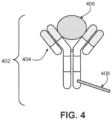
- FIG. 4 is a schematic diagram of an exemplary analyte capture agent 402 comprised of an analyte-binding moiety 404 and an analyte-binding moiety barcode domain 408.
- the exemplary analyte -binding moiety 404 is a molecule capable of binding to an analyte 406 and the analyte capture agent is capable of interacting with a spatially-barcoded capture probe.
- the analyte -binding moiety can bind to the analyte 406 with high affinity and/or with high specificity.
- the analyte capture agent can include an analyte -binding moiety barcode domain 408, a nucleotide sequence (e.g., an oligonucleotide), which can hybridize to at least a portion or an entirety of a capture domain of a capture probe.
- the analyte-binding moiety barcode domain 408 can comprise an analyte binding moiety barcode and a capture handle sequence described herein.
- the analyte-binding moiety 404 can include a polypeptide and/or an aptamer.
- the analyte-binding moiety 404 can include an antibody or antibody fragment (e.g., an antigen-binding fragment).
- FIG. 5 is a schematic diagram depicting an exemplary interaction between a feature-immobilized capture probe 524 and an analyte capture agent 526.
- the feature-immobilized capture probe 524 can include a spatial barcode 508 as well as functional sequences 506 and UMI 510, as described elsewhere herein.
- the capture probe can also include a capture domain 512 that is capable of binding to an analyte capture agent 526.
- the analyte capture agent 526 can include a functional sequence 518, analyte binding moiety barcode 516, and a capture handle sequence 514 that is capable of binding to the capture domain 512 of the capture probe 524.
- the analyte capture agent can also include a linker 520 that allows the capture agent barcode domain 516 to couple to the analyte binding moiety 522.
- FIGs. 6A , 6B , and 6C are schematics illustrating how streptavidin cell tags can be utilized in an array-based system to produce a spatially-barcoded cell or cellular contents.
- peptide-bound major histocompatibility complex MHC
- biotin ⁇ 2m
- streptavidin moiety comprises multiple pMHC moieties.
- Each of these moieties can bind to a TCR such that the streptavidin binds to a target T-cell via multiple MHC/TCR binding interactions. Multiple interactions synergize and can substantially improve binding affinity.
- a capture agent barcode domain 601 can be modified with streptavidin 602 and contacted with multiple molecules of biotinylated MHC 603 such that the biotinylated MHC 603 molecules are coupled with the streptavidin conjugated capture agent barcode domain 601. The result is a barcoded MHC multimer complex 605.
- the capture agent barcode domain sequence 601 can identify the MHC as its associated label and also includes optional functional sequences such as sequences for hybridization with other oligonucleotides. As shown in FIG.
- one example oligonucleotide is capture probe 606 that comprises a complementary sequence (e.g., rGrGrG corresponding to C C C), a barcode sequence and other functional sequences, such as, for example, a UMI, an adapter sequence (e.g., comprising a sequencing primer sequence (e.g., R1 or a partial R1 ("pR1"), R2), a flow cell attachment sequence (e.g., P5 or P7 or partial sequences thereof)), etc.
- capture probe 606 may at first be associated with a feature (e.g., a gel bead) and released from the feature.
- capture probe 606 can hybridize with a capture agent barcode domain 601 of the MHC-oligonucleotide complex 605.
- the hybridized oligonucleotides (Spacer C C C and Spacer rGrGrG) can then be extended in primer extension reactions such that constructs comprising sequences that correspond to each of the two spatial barcode sequences (the spatial barcode associated with the capture probe, and the barcode associated with the MHC-oligonucleotide complex) are generated.
- one or both of the corresponding sequences may be a complement of the original sequence in capture probe 606 or capture agent barcode domain 601.
- the capture probe and the capture agent barcode domain are ligated together.
- the resulting constructs can be optionally further processed (e.g., to add any additional sequences and/or for clean-up) and subjected to sequencing.
- a sequence derived from the capture probe 606 spatial barcode sequence may be used to identify a feature and the sequence derived from spatial barcode sequence on the capture agent barcode domain 601 may be used to identify the particular peptide MHC complex 604 bound on the surface of the cell (e.g., when using MHC-peptide libraries for screening immune cells or immune cell populations).
- a spatial barcode with one or more neighboring cells, such that the spatial barcode identifies the one or more cells, and/or contents of the one or more cells, as associated with a particular spatial location.
- One method is to promote analytes or analyte proxies (e.g., intermediate agents) out of a cell and towards a spatially-barcoded array (e.g., including spatially-barcoded capture probes).
- Another method is to cleave spatially-barcoded capture probes from an array and promote the spatially-barcoded capture probes towards and/or into or onto the biological sample.
- capture probes may be configured to prime, replicate, and consequently yield optionally barcoded extension products from a template (e.g., a DNA or RNA template, such as an analyte or an intermediate agent (e.g., a connected probe (e.g., a ligation product) or an analyte capture agent), or a portion thereof), or derivatives thereof (see, e.g., Section (II)(b)(vii) of WO 2020/176788 and/or U.S. Patent Application Publication No. 2020/0277663 regarding extended capture probes).
- a template e.g., a DNA or RNA template, such as an analyte or an intermediate agent (e.g., a connected probe (e.g., a ligation product) or an analyte capture agent), or a portion thereof
- a template e.g., a DNA or RNA template, such as an analyte or an intermediate agent (e.g.,
- capture probes may be configured to form a connected probe (e.g., a ligation product) with a template (e.g., a DNA or RNA template, such as an analyte or an intermediate agent, or portion thereof), thereby creating ligations products that serve as proxies for a template.
- a connected probe e.g., a ligation product
- a template e.g., a DNA or RNA template, such as an analyte or an intermediate agent, or portion thereof
- an "extended capture probe” refers to a capture probe having additional nucleotides added to the terminus (e.g., 3' or 5' end) of the capture probe thereby extending the overall length of the capture probe.
- an "extended 3' end” indicates additional nucleotides were added to the most 3' nucleotide of the capture probe to extend the length of the capture probe, for example, by polymerization reactions used to extend nucleic acid molecules including templated polymerization catalyzed by a polymerase (e.g., a DNA polymerase or a reverse transcriptase).
- a polymerase e.g., a DNA polymerase or a reverse transcriptase
- extending the capture probe includes adding to a 3' end of a capture probe a nucleic acid sequence that is complementary to a nucleic acid sequence of an analyte or intermediate agent specifically bound to the capture domain of the capture probe.
- the capture probe is extended using reverse transcription.
- the capture probe is extended using one or more DNA polymerases. The extended capture probes include the sequence of the capture probe and the sequence of the spatial barcode of the capture probe.
- extended capture probes are amplified (e.g., in bulk solution or on the array) to yield quantities that are sufficient for downstream analysis, e.g., via DNA sequencing.
- extended capture probes e.g., DNA molecules
- an amplification reaction e.g., a polymerase chain reaction. Additional variants of spatial analysis methods, including in some embodiments, an imaging step, are described in Section (II)(a) of WO 2020/176788 and/or U.S. Patent Application Publication No. 2020/0277663 .
- Spatial information can provide information of biological and/or medical importance.
- the methods and compositions described herein can allow for: identification of one or more biomarkers (e.g., diagnostic, prognostic, and/or for determination of efficacy of a treatment) of a disease or disorder; identification of a candidate drug target for treatment of a disease or disorder; identification (e.g., diagnosis) of a subject as having a disease or disorder; identification of stage and/or prognosis of a disease or disorder in a subject; identification of a subject as having an increased likelihood of developing a disease or disorder; monitoring of progression of a disease or disorder in a subject; determination of efficacy of a treatment of a disease or disorder in a subject; identification of a patient subpopulation for which a treatment is effective for a disease or disorder; modification of a treatment of a subject with a disease or disorder; selection of a subject for participation in a clinical trial; and/or selection of a treatment for a subject with a disease or disorder.
- Spatial information can provide information of biological importance.
- the methods and compositions described herein can allow for: identification of transcriptome and/or proteome expression profiles (e.g., in healthy and/or diseased tissue); identification of multiple analyte types in close proximity (e.g., nearest neighbor analysis); determination of up- and/or down-regulated genes and/or proteins in diseased tissue; characterization of tumor microenvironments; characterization of tumor immune responses; characterization of cells types and their co-localization in tissue; and identification of genetic variants within tissues (e.g., based on gene and/or protein expression profiles associated with specific disease or disorder biomarkers).
- a substrate functions as a support for direct or indirect attachment of capture probes to features of the array.
- a "feature” is an entity that acts as a support or repository for various molecular entities used in spatial analysis.
- some or all of the features in an array are functionalized for analyte capture.
- Exemplary substrates are described in Section (II)(c) of WO 2020/176788 and/or U.S. Patent Application Publication No. 2020/0277663 .
- Exemplary features and geometric attributes of an array can be found in Sections (II)(d)(i), (II)(d)(iii), and (II)(d)(iv) of WO 2020/176788 and/or U.S. Patent Application Publication No. 2020/0277663 .
- analytes and/or intermediate agents can be captured when contacting a biological sample with a substrate including capture probes (e.g., a substrate with capture probes embedded, spotted, printed, fabricated on the substrate, or a substrate with features (e.g., beads, wells) comprising capture probes).
- capture probes e.g., a substrate with capture probes embedded, spotted, printed, fabricated on the substrate, or a substrate with features (e.g., beads, wells) comprising capture probes.
- contact contacted
- contacting a biological sample with a substrate refers to any contact (e.g., direct or indirect) such that capture probes can interact (e.g., bind covalently or non-covalently (e.g., hybridize)) with analytes from the biological sample.
- Capture can be achieved actively (e.g., using electrophoresis) or passively (e.g., using diffusion). Analyte capture is further described in Section (II)(e) of WO 2020/176788 and/or U.S. Patent Application Publication No. 2020/0277663 .
- spatial analysis can be performed by attaching and/or introducing a molecule (e.g., a peptide, a lipid, or a nucleic acid molecule) having a barcode (e.g., a spatial barcode) to a biological sample (e.g., to a cell in a biological sample).
- a plurality of molecules e.g., a plurality of nucleic acid molecules
- a plurality of barcodes e.g., a plurality of spatial barcodes
- a biological sample e.g., to a plurality of cells in a biological sample for use in spatial analysis.
- the biological sample after attaching and/or introducing a molecule having a barcode to a biological sample, the biological sample can be physically separated (e.g., dissociated) into single cells or cell groups for analysis.
- Some such methods of spatial analysis are described in Section (III) of WO 2020/176788 and/or U.S. Patent Application Publication No. 2020/0277663 .
- spatial analysis can be performed by detecting multiple oligonucleotides that hybridize to an analyte.
- spatial analysis can be performed using RNA-templated ligation (RTL).
- RTL RNA-templated ligation
- Methods of RTL have been described previously. See, e.g., Credle et al., Nucleic Acids Res. 2017 Aug 21;45(14):e128 .
- RTL includes hybridization of two oligonucleotides to adjacent sequences on an analyte (e.g., an RNA molecule, such as an mRNA molecule).
- the oligonucleotides are DNA molecules.
- one of the oligonucleotides includes at least two ribonucleic acid bases at the 3' end and/or the other oligonucleotide includes a phosphorylated nucleotide at the 5' end.
- one of the two oligonucleotides includes a capture domain (e.g., a poly(A) sequence, a non-homopolymeric sequence).
- a ligase e.g., SplintR ligase
- the two oligonucleotides hybridize to sequences that are not adjacent to one another. For example, hybridization of the two oligonucleotides creates a gap between the hybridized oligonucleotides.
- a polymerase e.g., a DNA polymerase
- the connected probe e.g., a ligation product
- the connected probe is released using an endonuclease.
- the endonuclease is an RNAse.
- the endonuclease is one of RNase A, RNase C, RNase H, and RNase I.
- the endonuclease is RNAse H.
- the RNase H is RNase H1 or RNase H2.
- the released connected probe e.g., a ligation product
- capture probes e.g., instead of direct capture of an analyte
- sequence information for a spatial barcode associated with an analyte is obtained, and the sequence information can be used to provide information about the spatial distribution of the analyte in the biological sample.
- Various methods can be used to obtain the spatial information.
- specific capture probes and the analytes they capture are associated with specific locations in an array of features on a substrate.
- specific spatial barcodes can be associated with specific array locations prior to array fabrication, and the sequences of the spatial barcodes can be stored (e.g., in a database) along with specific array location information, so that each spatial barcode uniquely maps to a particular array location.
- specific spatial barcodes can be deposited at predetermined locations in an array of features during fabrication such that at each location, only one type of spatial barcode is present so that spatial barcodes are uniquely associated with a single feature of the array.
- the arrays can be decoded using any of the methods described herein so that spatial barcodes are uniquely associated with array feature locations, and this mapping can be stored as described above.
- each array feature location represents a position relative to a coordinate reference point (e.g., an array location, a fiducial marker) for the array. Accordingly, each feature location has an "address" or location in the coordinate space of the array.
- Some exemplary spatial analysis workflows are described in the Exemplary Embodiments section of WO 2020/176788 and/or U.S. Patent Application Publication No. 2020/0277663 . See, for example, the Exemplary embodiment starting with "In some non-limiting examples of the workflows described herein, the sample can be immersed" of WO 2020/176788 and/or U.S. Patent Application Publication No. 2020/0277663 . See also, e.g., the Visium Spatial Gene Expression Reagent Kits User Guide (e.g., Rev D, dated October 2020 ), and/or the Visium Spatial Tissue Optimization Reagent Kits User Guide (e.g., Rev D, dated October 2020 ).
- spatial analysis can be performed using dedicated hardware and/or software, such as any of the systems described in Sections (II)(e)(ii) and/or (V) of WO 2020/176788 and/or U.S. Patent Application Publication No. 2020/0277663 , or any of one or more of the devices or methods described in Sections Control Slide for Imaging, Methods of Using Control Slides and Substrates for, Systems of Using Control Slides and Substrates for Imaging, and/or Sample and Array Alignment Devices and Methods, Informational labels of WO 2020/123320 .
- Suitable systems for performing spatial analysis can include components such as a chamber (e.g., a flow cell or sealable, fluid-tight chamber) for containing a biological sample.
- the biological sample can be mounted for example, in a biological sample holder.
- One or more fluid chambers can be connected to the chamber and/or the sample holder via fluid conduits, and fluids can be delivered into the chamber and/or sample holder via fluidic pumps, vacuum sources, or other devices coupled to the fluid conduits that create a pressure gradient to drive fluid flow.
- One or more valves can also be connected to fluid conduits to regulate the flow of reagents from reservoirs to the chamber and/or sample holder.
- the systems can optionally include a control unit that includes one or more electronic processors, an input interface, an output interface (such as a display), and a storage unit (e.g., a solid state storage medium such as, but not limited to, a magnetic, optical, or other solid state, persistent, writeable and/or re-writeable storage medium).
- the control unit can optionally be connected to one or more remote devices via a network.
- the control unit (and components thereof) can generally perform any of the steps and functions described herein. Where the system is connected to a remote device, the remote device (or devices) can perform any of the steps or features described herein.
- the systems can optionally include one or more detectors (e.g., CCD, CMOS) used to capture images.
- the systems can also optionally include one or more light sources (e.g., LED-based, diode-based, lasers) for illuminating a sample, a substrate with features, analytes from a biological sample captured on a substrate, and various control and calibration media.
- one or more light sources e.g., LED-based, diode-based, lasers
- the systems can optionally include software instructions encoded and/or implemented in one or more of tangible storage media and hardware components such as application specific integrated circuits.
- the software instructions when executed by a control unit (and in particular, an electronic processor) or an integrated circuit, can cause the control unit, integrated circuit, or other component executing the software instructions to perform any of the method steps or functions described herein.
- the systems described herein can detect (e.g., register an image) the biological sample on the array.
- Exemplary methods to detect the biological sample on an array are described in WO 2021/102003 A1 and/or U.S. Patent Application Publication No. US 2021/0150707 A1 .
- the biological sample Prior to transferring analytes from the biological sample to the array of features on the substrate, the biological sample can be aligned with the array. Alignment of a biological sample and an array of features including capture probes can facilitate spatial analysis, which can be used to detect differences in analyte presence and/or level within different positions in the biological sample, for example, to generate a three-dimensional map of the analyte presence and/or level. Exemplary methods to generate a two- and/or three-dimensional map of the analyte presence and/or level are described in WO 2021/067514 A1 and spatial analysis methods are generally described in WO 2020/061108 and/or U.S. Patent Application Publication No. US 2021/0155982 A1 .
- a map of analyte presence and/or level can be aligned to an image of a biological sample using one or more fiducial markers, e.g., objects placed in the field of view of an imaging system which appear in the image produced, as described in the Substrate Attributes Section, Control Slide for Imaging Section of WO 2020/123320 , WO 2021/102005 A1 , and/or U.S. Patent Application Publication No. US 2021/0158522 A1 .
- fiducial markers e.g., objects placed in the field of view of an imaging system which appear in the image produced, as described in the Substrate Attributes Section, Control Slide for Imaging Section of WO 2020/123320 , WO 2021/102005 A1 , and/or U.S. Patent Application Publication No. US 2021/0158522 A1 .
- Fiducial markers can be used as a point of reference or measurement scale for alignment (e.g., to align a sample and an array, to align two substrates, to determine a location of a sample or array on a substrate relative to a fiducial marker) and/or for quantitative measurements of sizes and/or distances.
- the methods and systems disclosed herein increase the resolution and number of analytes detected of one or more analytes in a biological sample.
- the methods and systems here utilize spatial arrays, which include at least two substrates (e.g., gene expression slides) on opposite sides of a biological sample.
- the multiple analytes are different analytes.
- the different analytes can be protein and nucleic acid (e.g., RNA or DNA).
- the different analytes can be intermediate agent or portion thereof and RNA.
- the intermediate agent can be a connected probe (e.g., RTL probe) or analyte capture agent (e.g., oligo-conjugated antibody).
- the different analytes can be RNA and DNA. Additionally, or in the alternative, the different analytes can be intermediate agent and DNA. Additionally, or in the alternative, the different analytes can be targeted capture on one slide and whole transcriptome or DNA on other slide.
- the methods include (a) providing a first substrate and a biological sample mounted thereon, wherein the first substrate comprises a plurality of first capture probes, wherein a first capture probe of the plurality of first capture probes comprises (i) a first spatial barcode and (ii) a first capture domain; (b) aligning a second substrate on the opposite side of the first substrate relative to the biological sample, thereby sandwiching the first substrate, the biological sample, and the second substrate, wherein the second substrate comprises a plurality of second capture probes, wherein a second capture probe of the plurality of second capture probes comprises (i) a second spatial barcode and (ii) a second capture domain; and (c) hybridizing a first analyte of the multiple analytes to the first capture domain and hybridizing a second analyte of the multiple analytes to the second capture domain.
- the methods further include determining (i) all or a portion of the sequence of the spatial barcode, or a complement thereof, and (ii) all or a portion of the sequence of the one or more analytes captured on the second capture domain, or a complement thereof, and using the sequences of (i) and (ii) to determine the abundance and the location of the analyte in the biological sample.
- the capture probes on the first substrate are arranged as an array and include a capture domain described herein (e.g., a capture domain sequence such as a poly(T) (e.g., a poly-thymine sequence or an oligo d(T)) sequence) and a spatial barcode (thus allowing for spatial analysis).
- the second substrate also includes an array across the substrate or an area of the substrate of capture probes, and the capture probes on the second substrate also include at least a capture domain sequence and spatial barcode.
- the biological sample is provided on the first substrate; after permeabilizing the biological sample analytes are free to disperse from the biological sample. As the analytes passively diffuse, they can be captured by the probes both on the first substrate and the second substrate or on areas of substrates.
- this disclosure describes an approach to increase overall capture of analytes by using two gene expression arrays (each comprising capture probes having capture domains and spatial barcodes) in a sandwiching setup.
- this configuration can be applied to barcoded arrays made with printed spots, beads, or microspheres.
- the first substrate comprising a plurality of first capture probes, wherein a first capture probe of the plurality of first capture probes comprises (i) a first spatial barcode and (ii) a first capture domain) and the second substrate (comprising a plurality of second capture probes, wherein a second capture probe of the plurality of second capture probes comprises (i) a second spatial barcode and (ii) a second capture domain)
- first substrate comprising a plurality of first capture probes, wherein a first capture probe of the plurality of first capture probes comprises (i) a first spatial barcode and (ii) a first capture domain)
- the second substrate comprising a plurality of second capture probes, wherein a second capture probe of the plurality of second capture probes comprises (i) a second spatial barcode and (ii) a second capture domain
- the plurality of capture probes on a spatially barcoded substrate may be ordered as an array of capture probes.
- the capture probes of the array may be
- Capture probes of a feature of the array may comprise a particular spatial barcode (e.g., a feature-specific spatial barcode), whereas capture probes of a different feature of the array may comprise a different spatial barcode (e.g., a different feature-specific spatial barcode).
- a spatially barcoded substrate may be referred to herein as a spatially barcoded array or a substrate comprising an array of capture probes.
- Spatially barcoded substrates with capture domains configured to hybridize to mRNA analytes may be referred to herein as "gene expression substrates," “gene expression slides,” “GEx slides,” or “gene expression arrays”. Unless explicitly indicated, the terms are interchangeable.
- the biological sample is provided on a first substrate (e.g., a first spatially barcoded substrate (e.g., a first gene expression substrate)).
- a biological sample is placed on the first substrate.
- the first substrate is a substrate that allows the biological sample to adhere to the substrate.
- the first substrate is a glass substrate.
- the first substrate includes materials formed from various glasses, substrate s formed from various polymers, hydrogels, layers and/or films, membranes (e.g., porous membranes), flow cells, wafers, plates, or combinations thereof.
- capture probes on the first substrate includes a spatial barcode and a capture domain.
- a capture probe on the first substrate includes a capture domain (e.g., a poly(T) sequence), a unique molecular identifier, a functional sequence such as a primer, a spatial barcode, or combinations thereof.
- the capture domain on the first substrate includes a poly-thymine (e.g., also called poly(T), poly-d(T), or oligo d(T) throughout) sequence that is complementary to a polyadenylation sequence.
- the capture probes are distributed on the first substrate inferior to the biological sample.
- a capture probe in the plurality is about 20, about 25, about 30, about 35, about 40, about 45, about 50, about 55, about 60, about 65, about 70, about 75, about 80, about 85, about 90, about 95, about 100, or more single-stranded nucleotides in length.
- a capture probe includes one or more non-naturally occurring nucleotides.
- the capture probes are distributed equally on the array of the first substrate.
- the capture probes on the first substrate are adhered directly (e.g., as described herein).
- the capture probes are placed using printed spots (e.g., as described herein).
- a second substrate e.g., a second spatially barcoded substrate (e.g., a second gene expression substrate)
- a second substrate is placed superior to the biological sample opposite to the first substrate, creating a sandwich configuration wherein the biological sample and the permeabilization buffer are located in between the two substrates.
- the second substrate is placed below the biological sample, opposite to the first substrate creating a sandwich configuration wherein the biological sample and the permeabilization buffer are located in between the two substrates.
- the second substrate is a glass substrate.
- the second substrate includes various glasses, substrate s formed from various polymers, hydrogels, layers and/or films, membranes (e.g., porous membranes), flow cells, wafers, plates, or combinations thereof.
- the second substrate includes a plurality of probes (e.g., as described herein).
- one or more probes in the plurality includes a spatial barcode and a capture domain.
- a probe on the second substrate includes a capture domain (e.g., a poly(T) sequence), a unique molecular identifier, a functional sequence such as a primer, a spatial barcode, or combinations thereof.
- a probe on the second substrate can be a probe as described in FIG. 1 .
- the probes on the second substrate are adhered directly to the substrate (e.g., as described herein).
- the probes on the second substrate are placed using printed spots (e.g., as described herein).
- the system includes a biological sample sandwiched between two substrates.
- a biological sample 724 comprising one or more cells is placed on a first substrate 720.
- the bottom right image of FIG. 7A represents a situation in which the biological sample is placed on the inferior substrate (compared to the superior substrate in FIG. 7A , bottom left).
- the like terms for each can be carried over to each image.
- the first substrate 720 includes an array of probes 722 that include inter alia a capture domain (e.g., a poly-thymine sequence) and a spatial barcode.
- the array (e.g., plurality) of capture probes can be associated with a whole substrate, parts of a substrate, or defined regions on a substrate.
- the system includes a permeabilization buffer that is added to the biological sample 724, allowing analytes 726 to diffuse 728 from the biological sample 724. Analytes 726 diffuse from the cell passively in any direction, for example, vertically, horizontally, or laterally, (e.g., arrows represented as 728 ).
- analytes diffuse from the cell to the array of probes 726 on the first substrate 720.
- Analytes also migrate to a second substrate 730, which includes a second array (e.g., or i.e., plurality) of capture probes 732.
- a capture probe or bead (which comprises probes) in the second array includes a capture domain sequence (e.g., a poly-thymine sequence) and a spatial barcode.
- the analyte migrates to the second substrate in a vector, for example, as shown by 728. After migrating to the second substrate, the analyte can be extended, amplified, and sequence using methods disclosed herein.
- the first substrate 720 and the second substrate 730 are sandwiched together and form substantially parallel planes.
- the angle of migration of the analyte is measured as an angle from the first substrate 720. In some instances, the angle is 90 degrees relative to the first substrate 720. In some instances, the angle is about 85, about 80, about 75, about 70, about 65, about 60, about 55, about 50, or about 45 degrees relative to the first substrate 720.
- the first substrate 720 and the second substrate 730 are sandwiched together in a sandwiching process.
- the first substrate is aligned with the second substrate, such that at least a portion of the biological sample is aligned with at least a portion of the array (e.g., aligned in a sandwich configuration).
- the first substrate is aligned with the second substrate such that at least a portion of the biological sample is vertically aligned with at least a portion of the array.
- the second substrate is in a superior position to the first substrate.
- the first substrate may be positioned superior to the second substrate (as depicted in FIG. 7 , bottom left image).
- the first and second substrates are aligned to maintain a gap or separation distance between the two substrates.
- one or more analytes are released from the biological sample and actively or passively migrate to the array for capture.
- the migration occurs while the aligned portions of the biological sample and the array are contacted with a reagent medium (e.g., permeabilization buffer).
- the released one or more analytes may actively or passively migrate across the gap via the reagent medium toward the capture probes or beads on second substrate 730, and be captured by the capture probes 732.
- the separation distance between first and second substrates is maintained between 2 microns and 1 mm (e.g., between 2 microns and 800 microns, between 2 microns and 700 microns, between 2 microns and 600 microns, between 2 microns and 500 microns, between 2 microns and 400 microns, between 2 microns and 300 microns, between 2 microns and 200 microns, between 2 microns and 100 microns, between 2 microns and 25 microns, between 2 microns and 10 microns), measured in a direction orthogonal to the surface of first substrate that supports sample.
- the distance is 2 microns. In some instances, the distance is 2.5 microns.
- the distance is about 2, 3, 4, 5, 6, 7, 8, 9, 10, 11, 12, 13, 14, 15, 16, 17, 18, 19, 20, 21, 22, 23, 24, or 25 microns.
- second substrate is placed in direct contact with the sample on the first substrate ensuring no diffusive spatial resolution losses.
- the separation distance is measured in a direction orthogonal to a surface of the first substrate that supports the biological sample.
- the first and second substrates are placed in a substrate holder (e.g., an array alignment device) configured to align the biological sample and the array.
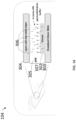
- the device comprises a sample holder.
- the sample holder includes first and second members that comprise first and second retaining mechanisms configured to retain the first and second substrates, respectively.
- the device can include an alignment mechanism that is connected to at least one of the members and aligns the first and second members.
- a sample holder is provided as part of the sandwiching mechanism (e.g., sandwiching apparatus) used in the methods disclosed herein.
- the sample holder includes a first member that includes a first retaining mechanism that retains substrate with sample.
- the sample holder also includes a second member that includes a second retaining mechanism that retains second substrate with a feature array.
- An alignment mechanism is connected to at least one of first and second members or to both first and second members. During an alignment and contacting procedure, an alignment mechanism functions to align the first and second members, thereby ensuring that sample and feature array are also aligned and brought into contact to facilitate analysis of sample.
- the alignment mechanism can be implemented as a rotating actuator connected to the first and second members.
- a rotating actuator is a hinge.
- rotation of one of the members about the hinge axis aligns members and, and also aligns sample and feature array.
- the members can be rotated about the hinge axis until the sample and feature array are aligned and in contact.
- the rotating actuator is implemented as a folding member Folding member can be formed from a variety of materials, including compliant materials such as rubber and vinyl, metals and metal alloys, and plastics.
- the rotating actuator can include at least one arm. In some instances, the rotating actuator can include multiple arms (e.g., 2 or more, 3 or more, 4 or more, or even more).
- sample holder is implemented as a unitary (e.g., i.e., one-piece) device. In some instances, Sample holder can also be implemented as a two-piece device, with first and second members being separate but reproducibly connectable via the alignment mechanism. When the first and second members are brought into proximity, connectors engage with receivers, aligning first and second members, and also aligning sample with the feature array. It should be noted that while connectors are positioned on second member and receivers are positioned on first member, the reverse could also be true. Moreover, first and second members could each have one or more connectors and one or more receivers.
- first retaining mechanism can be implemented in various ways.
- first retaining mechanism can correspond to a recess dimensioned to receive first substrate.
- a gasket can optionally be positioned within the recess to maintain an interference fit between the edges of the recess and first substrate.
- first retaining mechanism can correspond to one or more members positioned to apply a force to first substrate, in particular, to maintain contact between first substrate and first member. Examples of such members include, but are not limited to, clips, screws and other threaded retaining fasteners, and members that snap-fasten or otherwise engage with first member. The members can apply a force to the sample bearing surface of first substrate and/or to one or more lateral surfaces first substrate.
- second retaining mechanism can correspond to any of the different types of retaining mechanisms discussed above in connection with first retaining mechanism.
- First and second retaining mechanisms and can be different or the same.
- the first member includes a first aperture.
- the first aperture can be positioned, for example, so that when the first substrate is retained in first member, first aperture is aligned with a sample region (e.g., a region where sample is typically located, or which is designated for placement of sample) on first substrate.
- Aperture can be positioned so that sample can be viewed from the back surface of first member (e.g., or i.e., the surface opposite to the surface that supports first substrate) through first aperture, and one or more images of sample can be obtained through first aperture.
- a reagent medium can be positioned on a first or second substrate. More generally, however, the first or second substrate may further comprise a reagent medium placed thereon.
- the reagent medium includes a permeabilization reagent (e.g., a solid, liquid, gel, or dried permeabilization reagent).
- the reagent medium includes one or more additional components.
- the additional components can include a hydrogel compound or layer with an embedded permeabilization reagent.
- the second member includes at least one aperture. More generally, the second member can include one or more (e.g., 2 or more, 3 or more, 4 or more, 5 or more, 6 or more, 8 or more, 10 or more, 15 or more, 20 or more, 30 or more, 40 or more, 50 or more, or even more) second apertures.
- the second aperture is aligned with at least a portion of the sample region on substrate when the first and second members and are aligned.
- a second aperture can used for various purposes.
- the feature array and/or the sample can be viewed or imaged through second aperture. Viewing/imaging can be used to adjust the relative positions of the feature array and the sample to improve alignment, for example.
- one or more bounding surfaces of the second aperture and a back surface of the second substrate cooperate to form a reagent well.
- a reagent solution e.g., comprising a permeabilization reagent
- the reagent solution can permeate (e.g., by diffusion) through the back surface of the second substrate and contact the sample.
- the sample holder includes a first adjustment mechanism connected to the first member.
- the first adjustment mechanism translates the first substrate in at least one direction parallel to the surface of the first substrate that supports the sample. In some embodiments, the first adjustment mechanism translates the first substrate in two directions parallel to the surface of the first substrate.
- the first adjustment mechanism can be implemented in various ways.
- the first adjustment mechanism includes one or more thumbscrews or linear actuators that can be used to translate the first substrate.
- the alignment mechanism is also configured to maintain a separation between the first and second substrates (and the first and second members) when the substrates (and members) are aligned.
- the separation can be maintained such that at least a portion of the sample contacts the reagent medium (e.g., the feature array of the reagent medium).
- the alignment mechanism maintains the first and second substrates in an approximately parallel relationship when the substrates (and the first and second members) are aligned.
- An included angle between the first and second substrates in such circumstances can be 2 degrees or less (e.g., 1 degree or less, 0.5 degrees or less, 0.25 degrees or less).
- the sample holder can include one or more spacing members that assist in maintaining the spacing and/or approximately parallel arrangement of the first and second substrates. Spacing members can be connected to either or both of the first and second members.
- the sample holder includes a second adjustment mechanism.
- the second adjustment mechanism adjusts a distance of the separation between the first and second substrates (e.g., or i.e., in a direction orthogonal to the surface of the first substrate that supports the sample).
- the adjustment mechanism is connected to both members.
- the second adjustment mechanism can be implemented in various ways.
- the second adjustment mechanism includes one or more thumbscrews or adjustable pins or posts.
- the second adjustment mechanism includes one or more linear actuators.
- the second adjustment mechanism includes a swellable or expandable membrane, gasket, or layer positioned between the first and second members.
- the sample holder can be introduced into a thermocycler to promote capture of analytes from the sample by the feature array.
- the sample holder can be inserted directly into a suitable thermocycler for this purpose.
- the sample holder can be coupled to a thermocycler adapter and the coupled holder and adapter inserted into a thermocycler. Exemplary devices and exemplary sample holders are described in PCT Patent Application Publication No. WO 2020/123320 .
- the probes on the first and/or second substrate are adhered to beads (e.g., as described herein).
- the probes are placed on the first and/or second substrate using microspheres (e.g., as described herein).
- the beads or microspheres that include probes are associated with, or affixed to, the first and/or second substrate. For example, in some instances capture probe containing beads or microsphere are affixed directly or indirectly to a substrate via surface chemistries, hydrogel, and the like.
- the diameter of a bead the is adhered to the probe on the second substrate is about 1 ⁇ m, about 2 ⁇ m, about 3 ⁇ m, about 4 ⁇ m, about 5 ⁇ m, about 6 ⁇ m, about 7 ⁇ m, about 8 ⁇ m, about 9 ⁇ m, about 10 ⁇ m, about 15 ⁇ m, about 20 ⁇ m, or more.
- the substrate holder is compatible with a variety of different schemes for contacting the aligned portions of the biological sample and array with the reagent medium to promote analyte capture.
- the reagent medium is deposited directly on the second substrate (e.g., forming a reagent medium that includes the permeabilization reagent and the feature array), and/or directly on the first substrate.
- the reagent medium is deposited on the first and/or second substrate, and then the first and second substrates aligned in the sandwich configuration such that the reagent medium contacts the aligned portions of the biological sample and array.
- the reagent medium is introduced into the gap while the first and second substrates are aligned in the sandwich configuration.
- a dried permeabilization reagent is applied or formed as a layer on the first substrate or the second substrate or both prior to contacting the sample and the feature array.
- a reagent can be deposited in solution on the first substrate or the second substrate or both and then dried. Drying methods include, but are not limited to spin coating a thin solution of the reagent and then evaporating a solvent included in the reagent or the reagent itself.
- the reagent can be applied in dried form directly onto the first substrate or the second substrate or both.
- the coating process can be done in advance of the analytical workflow and the first substrate and the second substrate can be stored pre-coated. Alternatively, the coating process can be done as part of the analytical workflow.
- the reagent is a permeabilization reagent.
- the reagent is a permeabilization enzyme, a buffer, a detergent, or any combination thereof.
- the permeabilization enzyme is pepsin.
- the reagent is a dried reagent (e.g., a reagent free from moisture or liquid).
- the substrate that includes the sample e.g., a histological tissue section
- the sample can be hydrated by contacting the sample with a reagent medium, e.g., a buffer that does not include a permeabilization reagent.
- the hydration is performed while the first and second substrates are aligned in a sandwich configuration.
- the aligned portions of the biological sample and the array are in contact with the reagent medium for about 1 minute. In some instances, the aligned portions of the biological sample and the array are in contact with the reagent medium for about 5 minutes. In some instances, the aligned portions of the biological sample and the array are in contact with the reagent medium in the gap for about 1 minute, about 5 minutes, about 10 minutes, about 12 minutes, about 15 minutes, about 18 minutes, about 20 minutes, about 25 minutes, about 30 minutes, about 36 minutes, about 45 minutes, or about an hour. In some instances, the aligned portions of the biological sample and the array are in contact with the reagent medium for about 1-60 minutes. In some instances, the aligned portions of the biological sample and the array are in contact with the reagent medium for about 30 minutes.
- the permeabilization agent can be removed from contact with sample (e.g., by opening substrate holder).
- the substrate holder is opened before complete permeabilization of sample.
- only a portion of sample is permeabilized, and only a portion of the analytes in sample may be captured by feature array.
- the reduced amount of analyte captured and available for detection can be offset by the reduction in lateral diffusion that results from incomplete permeabilization of sample.
- the spatial resolution of the assay is determined by the extent of analyte diffusion in the transverse direction (e.g., or i.e., orthogonal to the normal direction to the surface of sample).
- the substrate holder is opened following complete or substantially complete permeabilization of the sample.
- the device is configured to control a temperature of the first and second substrates.
- the temperature of the first and second members is lowered to a first temperature that is below room temperature (e.g., 25 degrees Celsius) (e.g., 20 degrees Celsius or lower, 15 degrees Celsius or lower, 10 degrees Celsius or lower, 5 degrees Celsius or lower, 4 degrees Celsius or lower, 3 degrees Celsius or lower, 2 degrees Celsius or lower, 1 degree Celsius or lower, 0 degrees Celsius or lower, -1 degrees Celsius or lower, -5 degrees Celsius or lower).
- the device includes a temperature control system (e.g., heating and cooling conducting coils) to control the temperature of the sample holder.
- the temperature of the sample holder is controlled externally (e.g., via refrigeration or a hotplate).
- the second member, set to or at the first temperature contacts the first substrate, and the first member, set to or at the first temperature, contacts the second substrate, thereby lowering the temperature of the first substrate and the second substrate to a second temperature.
- the second temperature is equivalent to the first temperature.
- the first temperature is lower than room temperature (e.g., 25 degrees Celsius).
- the second temperature ranges from about -10 degrees Celsius to about 4 degrees Celsius.
- the second temperature is below room temperature (e.g., 25 degrees Celsius) (e.g., 20 degrees Celsius or lower, 15 degrees Celsius or lower, 10 degrees Celsius or lower, 5 degrees Celsius or lower, 4 degrees Celsius or lower, 3 degrees Celsius or lower, 2 degrees Celsius or lower, 1 degree Celsius or lower, 0 degrees Celsius or lower, -1 degrees Celsius or lower, -5 degrees Celsius or lower).
- room temperature e.g. 25 degrees Celsius
- 20 degrees Celsius or lower e.g., 15 degrees Celsius or lower, 10 degrees Celsius or lower, 5 degrees Celsius or lower, 4 degrees Celsius or lower, 3 degrees Celsius or lower, 2 degrees Celsius or lower, 1 degree Celsius or lower, 0 degrees Celsius or lower, -1 degrees Celsius or lower, -5 degrees Celsius or lower.
- the second substrate is contacted with the permeabilization reagent.
- the permeabilization reagent is dried.
- the permeabilization reagent is a gel or a liquid.
- the biological sample is contacted with buffer. Both the first and second substrates are placed at lower temperature to slow down diffusion and permeabilization efficiency.
- the sample can be contacted directly with a liquid permeabilization reagent without inducing an unwanted initiation of permeabilization due to the substrates being at the second temperature.
- the low temperature slows down or prevents the initiation of permeabilization.
- a second step keeping the sample holder and substrates at a cold temperature (e.g., at the first or second temperatures) continues to slow down or prevent the permeabilization of the sample.
- the sample holder (and consequently the first and second substrates) is heated up to initiate permeabilization.
- the sample holder is heated up to a third temperature.
- the third temperature is above room temperature (e.g., 25 degrees Celsius) (e.g., 30 degrees Celsius or higher, 35 degrees Celsius or higher, 40 degrees Celsius or higher, 50 degrees Celsius or higher, 60 degrees Celsius or higher).
- analytes that are released from the permeabilized tissue of the sample diffuse to the surface of the second substrate and are captured on the array (e.g., barcoded probes) of the second substrate.
- the first substrate and the second substrate are separated (e.g., pulled apart) and temperature control is stopped.
- a permeabilization solution can be introduced into some or all of the wells, and then the sample and the feature array can be contacted by closing the sample holder to permeabilize the sample.
- a permeabilization solution can be soaked into a hydrogel film that is applied directly to the sample, and/or soaked into features (e.g., beads) of the array. When the first and second substrates are aligned in the sandwich configuration, the permeabilization solution promotes migration of analytes from the sample to the array.
- different permeabilization agents or different concentrations of permeabilization agents can be infused into array features (e.g., beads) or into a hydrogel layer as described above.
- array features e.g., beads
- hydrogel layer e.g., a hydrogel layer
- first and second substrates can include a conductive epoxy. Electrical wires from a power supply can connect to the conductive epoxy, thereby allowing a user to apply a current and generate an electric field between the first and second substrates.
- electrophoretic migration results in higher analyte capture efficiency and better spatial fidelity of captured analytes (e.g., on a feature array) than random diffusion onto matched substrates without the application of an electric field (e.g., via manual alignment of the two substrates).
- electrophoretic migration results in higher analyte capture efficiency and better spatial fidelity of captured analytes (e.g., on a feature array) than random diffusion onto matched substrates without the application of an electric field (e.g., via manual alignment of the two substrates).
- Exemplary methods of electrophoretic migration are described in WO 2020/176788 .
- Loss of spatial resolution can occur when analytes migrate from the sample to the feature array and a component of diffusive migration occurs in the transverse (e.g., lateral) direction, approximately parallel to the surface of the first substrate on which the sample is mounted.
- a permeabilization agent deposited on or infused into a material with anisotropic diffusion can be applied to the sample or to the feature array.
- the first and second substrates are aligned by the sample holder and brought into contact.
- a permeabilization layer that includes a permeabilization solution infused into an anisotropic material is positioned on the second substrate.
- the feature array can be constructed atop a hydrogel layer infused with a permeabilization agent.
- the hydrogel layer can be mounted on the second substrate, or alternatively, the hydrogel layer itself may function as the second substrate.
- the permeabilization agent diffuses out of the hydrogel layer and through or around the feature array to reach the sample. Analytes from the sample migrate to the feature array. Direct contact between the feature array and the sample helps to reduce lateral diffusion of the analytes, mitigating spatial resolution loss that would occur if the diffusive path of the analytes was longer.
- the workflow includes provision of the first substrate comprising the biological sample. In some embodiments, the workflow includes, mounting the biological sample onto the first substrate. In some embodiments wherein the biological sample is a tissue sample, the workflow include sectioning of the tissue sample (e.g., cryostat sectioning). In some embodiments, the workflow includes a fixation step. In some instances, the fixation step can include fixation with methanol. In some instances, the fixation step includes formalin (e.g., 2% formalin).
- the biological sample on the first substrate is stained using any of the methods described herein.
- the biological sample is imaged, capturing the stain pattern created during the stain step.
- the biological sample then is destained prior to the sandwiching process.
- the first substrate and the second substrate are separated (e.g., such that they are no longer aligned in a sandwich configuration, also referred to herein as opening the sandwich).
- subsequent analysis e.g., reverse transcription, cDNA synthesis, library preparation, and sequences
- the process of transferring an analyte from the first substrate to the second substrate is referred to interchangeably herein as a "sandwich process,” “sandwiching process,” or “sandwiching”.
- the sandwich process is further described in PCT Patent Application Publication No. WO 2020/123320 .
- the permeabilization buffer includes proteinase K, pepsin, collagenase, a detergent, one or more ribonuclease inhibitor, or combinations thereof.
- the detergent is selected from sodium dodecyl sulfate (SDS), polyethylene glycol tert-octylphenyl ether, polysorbate 80, polysorbate 20, N-lauroylsarcosine (or a sodium salt thereof), or combinations thereof.
- the permeabilization buffer comprises a hydrogel.
- biological samples Prior to analyte capture, in some instances, biological samples can be stained using a wide variety of stains and staining techniques.
- the biological sample is a tissue section on a substrate (e.g., a slide; e.g., a 10 ⁇ m biological section section).
- the tissue section is about 5, 6, 7, 8, 9, 10, 11, 12, 13, 14, 15, 16, 17, 18, 19, 20, 21, 22, 23, 24, or 25 ⁇ m in thickness.
- the biological sample is dried after placement onto the first substrate. In some instances, the biological sample is dried at 42°C. In some instances, drying occurs for about 1 hour, about 2, hours, about 3 hours, or until the sections become transparent. In some instances, the biological sample can be dried overnight (e.g., in a desiccator at room temperature).
- a sample can be stained using any number of biological stains, including but not limited to, acridine orange, Bismarck brown, carmine, coomassie blue, cresyl violet, DAPI, eosin, ethidium bromide, acid fuchsine, hematoxylin, Hoechst stains, iodine, methyl green, methylene blue, neutral red, Nile blue, Nile red, osmium tetroxide, propidium iodide, rhodamine, or safranin.
- the methods disclosed herein include imaging the biological sample. In some instances, imaging the sample occurs prior to deaminating the biological sample.
- the sample can be stained using known staining techniques, including Can-Grunwald, Giemsa, hematoxylin and eosin (H&E), Jenner's, Leishman, Masson's trichrome, Papanicolaou, Romanowsky, silver, Sudan, Wright's, and/or Periodic Acid Schiff (PAS) staining techniques.
- PAS staining is typically performed after formalin or acetone fixation. In some instances, the stain is an H&E stain.
- the biological sample can be stained using a detectable label (e.g., radioisotopes, fluorophores, chemiluminescent compounds, bioluminescent compounds, and dyes) as described elsewhere herein.
- a biological sample is stained using only one type of stain or one technique.
- staining includes biological staining techniques such as H&E staining.
- staining includes identifying analytes using fluorescently-conjugated antibodies.
- a biological sample is stained using two or more different types of stains, or two or more different staining techniques.
- a biological sample can be prepared by staining and imaging using one technique (e.g., H&E staining and brightfield imaging), followed by staining and imaging using another technique (e.g., IHC/IF staining and fluorescence microscopy) for the same biological sample.
- one technique e.g., H&E staining and brightfield imaging
- another technique e.g., IHC/IF staining and fluorescence microscopy
- biological samples can be destained.
- Methods of destaining or discoloring a biological sample are known in the art, and generally depend on the nature of the stain(s) applied to the sample.
- H&E staining can be destained by washing the sample in HCl, or any other acid (e.g., selenic acid, sulfuric acid, hydroiodic acid, benzoic acid, carbonic acid, malic acid, phosphoric acid, oxalic acid, succinic acid, salicylic acid, tartaric acid, sulfurous acid, trichloroacetic acid, hydrobromic acid, hydrochloric acid, nitric acid, orthophosphoric acid, arsenic acid, selenous acid, chromic acid, citric acid, hydrofluoric acid, nitrous acid, isocyanic acid, formic acid, hydrogen selenide, molybdic acid, lactic acid, acetic acid, carbonic acid, hydrogen sulfide, or combinations thereof).
- destaining can include 1, 2, 3, 4, 5, or more washes in an acid (e.g., HCl).
- destaining can include adding HCl to a downstream solution (e.g., permeabilization solution).
- destaining can include dissolving an enzyme used in the disclosed methods (e.g., pepsin) in an acid (e.g., HCl) solution.
- other reagents can be added to the destaining solution to raise the pH for use in other applications. For example, SDS can be added to an acid destaining solution in order to raise the pH as compared to the acid destaining solution alone.
- one or more immunofluorescence stains are applied to the sample via antibody coupling.
- Such stains can be removed using techniques such as cleavage of disulfide linkages via treatment with a reducing agent and detergent washing, chaotropic salt treatment, treatment with antigen retrieval solution, and treatment with an acidic glycine buffer.
- Methods for multiplexed staining and destaining are described, for example, in Bolognesi et al., J. Histochem. Cytochem. 2017; 65(8): 431-444 , Lin et al., Nat Commun. 2015; 6:8390 , Pirici et al., J. Histochem. Cytochem. 2009; 57:567-75 , and Glass et al., J. Histochem. Cytochem. 2009; 57:899-905 .
- immunofluorescence or immunohistochemistry protocols can be performed as a part of, or in addition to, the exemplary spatial workflows presented herein.
- tissue sections can be fixed according to methods described herein.
- the biological sample can be transferred to an array (e.g., capture probe array), wherein analytes (e.g., proteins) are detected using immunofluorescence protocols.
- analytes e.g., proteins
- the sample can be rehydrated, blocked, and permeabilized (3X SSC, 2% BSA, 0.1% Triton X, 1 U/ ⁇ l RNAse inhibitor for 10 minutes at 4°C) before being stained with fluorescent primary antibodies (1:100 in 3XSSC, 2% BSA, 0.1% Triton X, 1 U/ ⁇ l RNAse inhibitor for 30 minutes at 4°C).
- the biological sample can be washed, coverslipped (in glycerol + 1 U/ ⁇ l RNAse inhibitor), imaged (e.g., using a confocal microscope or other apparatus capable of fluorescent detection), washed, and processed according to analyte capture or spatial workflows described herein.
- a glycerol solution and a cover slip can be added to the sample.
- the glycerol solution can include a counterstain (e.g., DAPI).
- an antigen retrieval buffer can improve antibody capture in IF/IHC protocols.
- An exemplary protocol for antigen retrieval can be preheating the antigen retrieval buffer (e.g., to 95°C), immersing the biological sample in the heated antigen retrieval buffer for a predetermined time, and then removing the biological sample from the antigen retrieval buffer and washing the biological sample.
- optimizing permeabilization can be useful for identifying intracellular analytes.
- Permeabilization optimization can include selection of permeabilization agents, concentration of permeabilization agents, and permeabilization duration. Tissue permeabilization is discussed elsewhere herein.
- blocking an array and/or a biological sample in preparation of labeling the biological sample decreases nonspecific binding of the antibodies to the array and/or biological sample (decreases background).
- Some embodiments provide for blocking buffers/blocking solutions that can be applied before and/or during application of the label, wherein the blocking buffer can include a blocking agent, and optionally a surfactant and/or a salt solution.
- a blocking agent can be bovine serum albumin (BSA), serum, gelatin (e.g., fish gelatin), milk (e.g., non-fat dry milk), casein, polyethylene glycol (PEG), polyvinyl alcohol (PVA), or polyvinylpyrrolidone (PVP), biotin blocking reagent, a peroxidase blocking reagent, levamisole, Carnoy's solution, glycine, lysine, sodium borohydride, pontamine sky blue, Sudan Black, trypan blue, FITC blocking agent, and/or acetic acid.
- the blocking buffer/blocking solution can be applied to the array and/or biological sample prior to and/or during labeling (e.g., application of fluorophore-conjugated antibodies) to the biological sample.
- one or more analytes from the biological sample are released from the biological sample and migrate to a substrate comprising an array of capture probes for attachment to the capture probes of the array.
- the release and migration of the analytes to the substrate comprising the array of capture probes occurs in a manner that preserves the original spatial context of the analytes in the biological sample.
- the biological sample is mounted on a first substrate and the substrate comprising the array of capture probes is a second substrate.
- the method is facilitated by a sandwiching process. Sandwiching processes are described in, e.g., US. Patent Application Pub. No.
- the sandwiching process may be facilitated by a device, sample holder, sample handling apparatus, or system described in, e.g., US. Patent Application Pub. No. 20210189475 , WO 2021/252747 A1 , or WO 2022/061152 A2 .
- FIG. 14 is a schematic diagram depicting an exemplary sandwiching process 104 between a first substrate comprising a biological sample (e.g., a tissue section 302 on a slide 303) and a second substrate comprising a spatially barcoded array, e.g., a slide 304 that is populated with spatially-barcoded capture probes 306.
- the first substrate is aligned with the second substrate, such that at least a portion of the biological sample is aligned with at least a portion of the array (e.g., aligned in a sandwich configuration).
- the second substrate e.g., slide 304 is in a superior position to the first substrate (e.g., slide 303).
- the first substrate may be positioned superior to the second substrate (e.g., slide 304).
- a reagent medium 305 e.g., permeabilization solution
- a reagent medium 305 e.g., permeabilization solution
- a permeabilization buffer which permeabilizes or digests the sample 302 and the analytes (e.g., the different analytes described herein, such as, protein, nucleic acid (e.g., RNA or DNA), intermediate agent (e.g., connected probe (e.g., RTL probe) or analyte capture agent (e.g., oligo-conjugated antibody)) or portion thereof, targeted capture, and/or whole transcriptome) 308 of the biological sample 302 may release, actively or passively migrate (e.g., diffuse) across the gap 307 toward the capture probes 306, and bind on the capture probes 306.
- analytes e.g., the different analytes described herein, such as, protein,
- an extension reaction may occur, thereby generating a spatially barcoded library.
- an extension reaction may occur, thereby generating a spatially barcoded library.
- reverse transcription may be used to generate a cDNA library associated with a particular spatial barcode.
- Barcoded cDNA libraries may be mapped back to a specific spot on a capture area of the capture probes 306. This data may be subsequently layered over a high-resolution microscope image of the biological sample, making it possible to visualize the data within the morphology of the tissue in a spatially-resolved manner.
- the extension reaction can be performed separately from the sample handling apparatus described herein that is configured to perform the exemplary sandwiching process 104.
- the sandwich configuration of the sample 302, the first substrate (e.g., slide 303) and the second substrate (e.g., slide 304) may provide advantages over other methods of spatial analysis and/or analyte capture.
- the sandwich configuration may reduce a burden of users to develop in house tissue sectioning and/or tissue mounting expertise.
- the sandwich configuration may decouple sample preparation/tissue imaging from the barcoded array (e.g., spatially-barcoded capture probes 306) and enable selection of a particular region of interest of analysis (e.g., for a tissue section larger than the barcoded array).
- the sandwich configuration also beneficially enables spatial analysis without having to place a biological sample (e.g., tissue section) 302 directly on the second substrate (e.g., slide 304).
- the sandwiching process comprises: mounting the first substrate on a first member of a support device, the first member configured to retain the first substrate; mounting the second substrate on a second member of the support device, the second member configured to retain the second substrate, applying a reagent medium to the first substrate and/or the second substrate, the reagent medium comprising a permeabilization agent, operating an alignment mechanism (also referred to herein as an adjustment mechanism) of the support device to move the first member and/or the second member such that a portion of the biological sample is aligned (e.g., vertically aligned) with a portion of the array of capture probes and within a threshold distance of the array of capture probes, and such that the portion of the biological sample and the capture probe contact the reagent medium, wherein the permeabilization agent releases the analyte from the biological sample.
- an alignment mechanism also referred to herein as an adjustment mechanism
- the sandwiching process methods described above can be implemented using a variety of hardware components.
- the sandwiching process methods can be implemented using a sample holder (also referred to herein as a support device, a sample handling apparatus, and an array alignment device).
- the sample holder can include a first member including a first retaining mechanism configured to retain a first substrate comprising a sample.
- the first retaining mechanism can be configured to retain the first substrate disposed in a first plane.
- the sample holder can further include a second member including a second retaining mechanism configured to retain a second substrate disposed in a second plane.
- the sample holder can further includes an alignment mechanism connected to one or both of the first member and the second member.
- the alignment mechanism can be configured to align the first and second members along the first plane and/or the second plane such that the sample contacts at least a portion of the reagent medium when the first and second members are aligned and within a threshold distance along an axis orthogonal to the second plane.
- the adjustment mechanism may be configured to move the second member along the axis orthogonal to the second plane and/or move the first member along an axis orthogonal to the first plane.
- the adjustment mechanism includes a linear actuator.
- the linear actuator is configured to move the second member along an axis orthogonal to the plane or the first member and/or the second member.
- the linear actuator is configured to move the first member along an axis orthogonal to the plane of the first member and/or the second member.
- the linear actuator is configured to move the first member, the second member, or both the first member and the second member at a velocity of at least 0.1 mm/sec.
- the linear actuator is configured to move the first member, the second member, or both the first member and the second member with an amount of force of at least 0.1 lbs.
- FIG. 15A is a perspective view of an example sample handling apparatus 1400 in a closed position in accordance with some example implementations.
- the sample handling apparatus 1400 includes a first member 1404, a second member 1410, optionally an image capture device 1420, a first substrate 1406, optionally a hinge 1415, and optionally a mirror 1416.
- the hinge 1415 may be configured to allow the first member 1404 to be positioned in an open or closed configuration by opening and/or closing the first member 1404 in a clamshell manner along the hinge 1415.
- FIG. 15B is a perspective view of the example sample handling apparatus 1400 in an open position in accordance with some example implementations.
- the sample handling apparatus 1400 includes one or more first retaining mechanisms 1408 configured to retain one or more first substrates 1406.
- the first member 1404 is configured to retain two first substrates 1406, however the first member 1404 may be configured to retain more or fewer first substrates 1406.
- the first substrate 1406 and/or the second substrate 1412 may be loaded and positioned within the sample handling apparatus 1400 such as within the first member 1404 and the second member 1410, respectively.
- the hinge 1415 may allow the first member 1404 to close over the second member 1410 and form a sandwich configuration (e.g., the sandwich configuration shown in FIG. 14 ) .
- an adjustment mechanism (not shown) of the sample handling apparatus 1400 may actuate the first member 1404 and/or the second member 1410 to form the sandwich configuration for the permeabilization step (e.g., bringing the first substrate 1406 and the second substrate 1412 closer to each other and within a threshold distance for the sandwich configuration).
- the adjustment mechanism may be configured to control a speed, an angle, a force, or the like of the sandwich configuration.
- the biological sample (e.g., sample 302) may be aligned within the first member 1404 (e.g., via the first retaining mechanism 1408) prior to closing the first member 1404 such that a desired region of interest of the sample 302 is aligned with the barcoded array of the second substrate (e.g., the slide 304), e.g., when the first and second substrates are aligned in the sandwich configuration.
- Such alignment may be accomplished manually (e.g., by a user) or automatically (e.g., via an automated alignment mechanism).
- spacers may be applied to the first substrate 1406 and/or the second substrate 1412 to maintain a minimum spacing between the first substrate 1406 and the second substrate 1412 during sandwiching.
- the permeabilization solution (e.g., permeabilization solution 305) may be applied to the first substrate 1406 and/or the second substrate 1412.
- the first member 1404 may then close over the second member 1410 and form the sandwich configuration.
- Analytes e.g., the different analytes described herein, such as, mRNA transcripts
- 308 may be captured by the capture probes 306 and may be processed for spatial analysis.
- the image capture device 1420 may capture images of the overlap area (e.g., overlap area 710) between the tissue 302 and the capture probes 306. If more than one first substrates 1406 and/or second substrates 1412 are present within the sample handling apparatus 1400, the image capture device 1420 may be configured to capture one or more images of one or more overlap areas 710. Further details on support devices, sample holders, sample handling apparatuses, or systems for implementing a sandwiching process are described in, e.g., US. Patent Application Pub. No. 20210189475 , and WO 2022/061152 A2 .
- Analytes within a biological sample may be released through disruption (e.g., permeabilization, digestion, etc.) of the biological sample or may be released without disruption.
- permeabilizing e.g., any of the permeabilization reagents and/or conditions described herein
- a biological sample including for example including the use of various detergents, buffers, proteases, and/or nucleases for different periods of time and at various temperatures.
- various methods of delivering fluids e.g., a buffer, a permeabilization solution
- a substrate holder e.g., for sandwich assembly, sandwich configuration, as described herein.
- the sandwich configuration described herein between a first substrate comprising a biological sample (e.g., slide 303) and a second substrate comprising a spatially barcoded array (e.g., slide 304 with barcoded capture probes 306) may include a reagent medium (e.g., a liquid reagent medium, e.g., a permeabilization solution 305 or other target molecule release and capture solution) to fill a gap (e.g., gap 307). It may be desirable that the reagent medium be free from air bubbles between the slides to facilitate transfer of target molecules with spatial information. Additionally, air bubbles present between the slides may obscure at least a portion of an image capture of a desired region of interest. Accordingly, it may be desirable to ensure or encourage suppression and/or elimination of air bubbles between the two substrates (e.g., slide 303 and slide 304) during a permeabilization step (e.g., step 104).
- a reagent medium e.g., a liquid reagent medium,
- Workflows described herein may include contacting a drop of the reagent medium (e.g., liquid reagent medium, e.g., a permeabilization solution 305) disposed on a first substrate or a second substrate with at least a portion of the second substrate or first substrate, respectively.
- the contacting comprises bringing the two substrates into proximity such that the sample on the first substrate is aligned with the barcode array of capture probes on the second substrate.
- the drop includes permeabilization reagents (e.g., any of the permeabilization reagents described herein).
- the rate of permeabilization of the biological sample is modulated by delivering the permeabilization reagents (e.g., a fluid containing permeabilization reagents) at various temperatures.
- the reagent medium e.g., liquid reagent medium, permeabilization solution 305 may fill a gap (e.g., the gap 307) between a first substrate (e.g., slide 303) and a second substrate (e.g., slide 304 with barcoded capture probes 306) to warrant or enable transfer of target molecules with spatial information.
- a first substrate e.g., slide 303
- a second substrate e.g., slide 304 with barcoded capture probes 306
- Described herein are examples of filling methods that may suppress bubble formation and suppress undesirable flow of transcripts and/or target molecules or analytes.
- Robust fluidics in the sandwich making described herein may preserve spatial information by reducing or preventing deflection of molecules as they move from the tissue slide to the capture slide.
- FIG. 16A shows an exemplary sandwiching process 3600 where a first substrate (e.g., slide 303), including a biological sample 302 (e.g., a tissue section), and a second substrate (e.g., slide 304 including spatially barcoded capture probes 306) are brought into proximity with one another.
- a liquid reagent drop e.g., permeabilization solution 305
- the permeabilization solution 305 may release analytes that can be captured by the capture probes 306 of the array.
- one or more spacers 3610 may be positioned between the first substrate (e.g., slide 303) and the second substrate (e.g., slide 304 including spatially barcoded capture probes 306).
- the one or more spacers 3610 may be configured to maintain a separation distance between the first substrate and the second substrate. While the one or more spacers 3610 is shown as disposed on the second substrate, the spacer may additionally or alternatively be disposed on the first substrate.
- the one or more spacers 3610 is configured to maintain a separation distance between first and second substrates that is between about 2 microns and 1 mm (e.g., between about 2 microns and 800 microns, between about 2 microns and 700 microns, between about 2 microns and 600 microns, between about 2 microns and 500 microns, between about 2 microns and 400 microns, between about 2 microns and 300 microns, between about 2 microns and 200 microns, between about 2 microns and 100 microns, between about 2 microns and 25 microns, or between about 2 microns and 10 microns), measured in a direction orthogonal to the surface of first substrate that supports the sample.
- a separation distance between first and second substrates that is between about 2 microns and 1 mm (e.g., between about 2 microns and 800 microns, between about 2 microns and 700 microns, between about 2 microns and 600 microns, between about 2 microns and
- the separation distance is about 2, 3, 4, 5, 6, 7, 8, 9, 10, 11, 12, 13, 14, 15, 16, 17, 18, 19, 20, 21, 22, 23, 24, or 25 microns. In some embodiments, the separation distance is less than 50 microns. In some embodiments, the separation distance is less than 25 microns. In some embodiments, the separation distance is less than 20 microns.
- the separation distance may include a distance of at least 2 ⁇ m.
- FIG. 16B shows a fully formed sandwich configuration creating a chamber 3650 formed from the one or more spacers 3610, the first substrate (e.g., the slide 303), and the second substrate (e.g., the slide 304 including spatially barcoded capture probes 306) in accordance with some example implementations.
- the liquid reagent e.g., the permeabilization solution 305 fills the volume of the chamber 3650 and may create a permeabilization buffer that allows analytes (e.g., mRNA transcripts and/or other molecules) to diffuse from the biological sample 302 toward the capture probes 306 of the second substrate (e.g., slide 304).
- analytes e.g., mRNA transcripts and/or other molecules
- flow of the permeabilization buffer may deflect transcripts and/or molecules from the biological sample 302 and may affect diffusive transfer of analytes for spatial analysis.
- a partially or fully sealed chamber 3650 resulting from the one or more spacers 3610, the first substrate, and the second substrate may reduce or prevent flow from undesirable convective movement of transcripts and/or molecules over the diffusive transfer from the biological sample 302 to the capture probes 306.
- the first substrate and the second substrate are arranged in an angled sandwich assembly as described herein.
- an angled closure workflow may be used to suppress or eliminate bubble formation.
- FIGs. 17A-17C depict a side view and a top view of an exemplary angled closure workflow 4000 for sandwiching a first substrate (e.g., slide 303) having a biological sample 302 and a second substrate (e.g., slide 304 having capture probes 306) in accordance with some example implementations.
- a first substrate e.g., slide 303
- a second substrate e.g., slide 304 having capture probes 306
- FIG. 17A depicts the first substrate (e.g., the slide 303 including biological sample 302) angled over (superior to) the second substrate (e.g., slide 304).
- a drop of the reagent medium (e.g., permeabilization solution) 305 is located on the spacer 3610 toward the right-hand side of the side view in FIG. 17A .
- FIG. 17A depicts the reagent medium on the right hand side of side view, it should be understood that such depiction is not meant to be limiting as to the location of the reagent medium on the spacer.
- FIG. 17B shows that as the first substrate lowers, and/or as the second substrate rises, the dropped side of the first substrate (e.g., a side of the slide 303 angled toward the second substrate) may contact the drop of the reagent medium 305.
- the dropped side of the first substrate may urge the reagent medium 305 toward the opposite direction (e.g., towards an opposite side of the spacer 3610, towards an opposite side of the first substrate relative to the dropped side).
- the reagent medium 305 may be urged from right to left as the sandwich is formed.
- the first substrate and/or the second substrate are further moved to achieve an approximately parallel arrangement of the first substrate and the second substrate.
- FIG. 17C depicts a full closure of the sandwich between the first substrate and the second substrate with the spacer 3610 contacting both the first substrate and the second substrate and maintaining a separation distance and optionally the approximately parallel arrangement between the two substrates.
- the spacer 3610 fully encloses and surrounds the biological sample 302 and the capture probes 306, and the spacer 3610 forms the sides of chamber 3650 which holds a volume of the reagent medium 305.
- FIGs. 17A-17C depict the first substrate (e.g., the slide 303 including biological sample 302) angled over (superior to) the second substrate (e.g., slide 304) and the second substrate comprising the spacer 3610, it should be understood that an exemplary angled closure workflow can include the second substrate angled over (superior to) the first substrate and the first substrate comprising the spacer 3610.
- FIGs. 18A-18E depict an example workflow 1700 for an angled sandwich assembly in accordance with some example implementations.
- a substrate 1712 e.g., a first substrate such as slide 303 or a second substrate such as slide 304 comprising spatially barcoded capture probes 306
- a base 1704 e.g., a first member or a second member of a sample holder disclosed herein
- the spring 1715 may extend from the base 1704 in a superior direction and may be configured to dispose the substrate 1712 along a plane angled differently than the base 1704.
- the angle of the substrate 1712 may be such that a drop of reagent medium 1705 (e.g., drop of liquid reagent medium) placed on the surface of the substrate 1712 (e.g., a surface of a spacer attached to the substrate) will not fall off the surface (e.g., due to gravity).
- the angle may be determined based on a gravitational force versus any surface force to move the drop away from and off the substrate 1712.
- FIG. 18B depicts a drop 1705 of reagent medium placed on the substrate 1712. As shown, the drop 1705 is located on the side of the substrate 1712 contacting the spring 1715 and is located in proximity and above (superior to) the spring 1715.
- another substrate 1706 may be positioned above (superior to) the substrate 1712 and at an angle substantially parallel with the base 1704.
- substrate 1706 may be a first substrate disclosed herein (e.g., slide 303).
- substrate 1706 may be a second substrate (e.g., slide 304 comprising spatially barcoded capture probes).
- another base (not shown) supporting substrate 1706 may be configured to retain substrate 1706 at the angle substantially parallel to the base 1704.
- substrate 1706 may be lowered toward the substrate 1712 such that a dropped side of the substrate 1706 contacts the drop 1705 first.
- the dropped side of the substrate 1706 may urge the drop 1705 toward the opposite side of the substrate 1706.
- the substrate 1712 may be moved upward toward the substrate 1706 to accomplish the contacting of the dropped side of the substrate 1706 with the drop 1705.
- FIG. 18E depicts a full sandwich closure of the substrate 1706 and the substrate 1712 with the drop of reagent medium 1705 positioned between the two sides.
- the spring 1715 may compress and the substrate 1712 may lower to the base 1704 and become substantially parallel with the substrate 1706.
- FIG. 19A is a side view of the angled closure workflow 1700 in accordance with some example implementations.
- FIG. 19B is a top view of the angled closure workflow 1700 in accordance with some example implementations.
- the drop of reagent medium 1705 is positioned to the side of the substrate 1712 contacting the spring 1715.
- the dropped side of the angled substrate 1706 contacts the drop of reagent medium 1705 first.
- the contact of the substrate 1706 with the drop of reagent medium 1705 may form a linear or low curvature flow front that fills uniformly with the slides closed.
- the substrate 1706 is further lowered toward the substrate 1712 (or the substrate 1712 is raised up toward the substrate 1706) and the dropped side of the substrate 1706 may contact and may urge the liquid reagent toward the side opposite the dropped side and creating a linear or low curvature flow front that may prevent or reduce bubble trapping between the slides.
- the spring 1715 may begin to compress as the substrate 1706 is lowered.
- the drop of reagent medium 1705 fills the gap (e.g., the gap 307) between the substrate 1706 and the substrate 1712.
- the linear flow front of the liquid reagent may form by squeezing the drop 1705 volume along the contact side of the substrate 1712 and/or the substrate 1706. Additionally, capillary flow may also contribute to filling the gap area.
- the spring 1715 may be fully compressed such that the substrate 1706, the substrate 1712, and the base 1704 are substantially parallel to each other.
- an angled closure workflow disclosed herein may be performed by a sample handling apparatus (e.g., as described in WO 2022/061152 A2 .
- angled closure workflows and devices and systems for implementing an angled closure workflow, are described in WO 2021/252747 A1and WO 2022/061152 A2 . Additional configurations for reducing or eliminating bubble formation, and/or for reducing unwanted fluid flow, are described in WO 2021/252747 A1 .
- the disclosure provides methods, kits, substrates, and apparatuses that examine spatial analyte expression in multiple tissue types.
- the methods provided herein are performed on an FFPE sample.
- the methods provided herein are performed on a fresh frozen sample.
- the biological sample is deparaffinized.
- Deparaffinization can be achieved using any method known in the art.
- the biological samples is treated with a series of washes that include xylene and various concentrations of ethanol.
- methods of deparaffinization include treatment of xylene (e.g., three washes at 5 minutes each).
- the methods further include treatment with ethanol (e.g., 100% ethanol, two washes 10 minutes each; 95% ethanol, two washes 10 minutes each; 70% ethanol, two washes 10 minutes each; 50% ethanol, two washes 10 minutes each).
- the biological sample can be washed with deionized water (e.g., two washes for 5 minutes each). It is appreciated that one skilled in the art can adjust these methods to optimize deparaffinization.
- the biological sample is decrosslinked.
- the biological sample is decrosslinked in a solution containing TE buffer (comprising Tris and EDTA).
- the TE buffer is basic (e.g., at a pH of about 9).
- decrosslinking occurs at about 50°C to about 80°C.
- decrosslinking occurs at about 70°C.
- decrosslinking occurs for about 1 hour at 70°C.
- the biological sample can be treated with an acid (e.g., 0.1M HCl for about 1 minute). After the decrosslinking step, the biological sample can be washed (e.g., with 1x PBST).
- the methods of preparing a biological sample for analyte capture include steps of equilibrating and blocking the biological sample.
- equilibrating is performed using a pre-hybridization (pre-Hyb) buffer.
- pre-Hyb buffer is RNase-free.
- pre-Hyb buffer contains no bovine serum albumin (BSA), solutions like Denhardt's, or other potentially nuclease-contaminated biological materials.
- BSA bovine serum albumin
- the equilibrating step is performed multiple times (e.g., 2 times at 5 minutes each; 3 times at 5 minutes each).
- the biological sample is blocked with a blocking buffer.
- the blocking buffer includes a carrier such as tRNA, for example yeast tRNA such as from brewer's yeast (e.g., at a final concentration of 10-20 ⁇ g/mL). In some instances, blocking can be performed for 5, 10, 15, 20, 25, or 30 minutes.
- any of the foregoing steps can be optimized for performance. For example, one can vary the temperature.
- the pre-hybridization methods are performed at room temperature. In some instances, the pre-hybridization methods are performed at 4°C (in some instances, varying the timeframes provided herein).
- the methods of preparing a biological sample for analyte capture include permeabilizing the sample.
- the biological sample is permeabilized using a phosphate buffer.
- the phosphate buffer is PBS (e.g., 1x PBS).
- the phosphate buffer is PBST (e.g., 1x PBST).
- the permeabilization step is performed multiple times (e.g., 3 times at 5 minutes each).
- a permeabilization buffer (e.g., any permeabilization buffer described herein) is added to the biological sample.
- Permeabilization solutions can include, by way of example only, enzymes (e.g., proteinase K, pepsin, and collagenase), detergents (e.g., N-lauroylsarcosine or a sodium salt thereof, sodium dodecyl sulfate (SDS), polyethylene glycol tert-octylphenyl ether, polysorbate 80, and polysorbate 20), ribonuclease inhibitors, buffers optimized for electrophoresis, buffers optimized for permeabilization, buffers optimized for hybridization, or combinations thereof.
- the permeabilization buffer releases the analyte from the sample, allowing it to diffuse from the sample.
- the biological sample can be treated with a proteinase.
- the proteinase is proteinase K.
- permeabilization occurs using a protease.
- the protease is an endopeptidase.
- Endopeptidases that can be used include but are not limited to trypsin, chymotrypsin, elastase, thermolysin, pepsin, clostripan, glutamyl endopeptidase (GluC), ArgC, peptidyl-asp endopeptidase (ApsN), endopeptidase LysC and endopeptidase LysN.
- the endopeptidase is pepsin.
- the biological sample is permeabilized prior to capture of the analytes on either the first substrate or the second substrate (or both).
- the permeabilization step includes application of a permeabilization buffer to the biological sample.
- the permeabilization buffer includes a buffer (e.g., Tris pH 7.5), MgCl2, sarkosyl detergent (e.g., sodium lauroyl sarcosinate), enzyme (e.g., proteinase K, and nuclease free water.
- the permeabilization step is performed at 37°C.
- the permeabilization step is performed for about 20 minutes to 2 hours (e.g., about 20 minutes, about 30 minutes, about 40 minutes, about 50 minutes, about 1 hour, about 1.5 hours, or about 2 hours).
- the releasing step is performed for about 40 minutes.
- the methods provided herein include a permeabilizing step in order to release the analyte.
- permeabilization occurs using a protease.
- the protease is an endopeptidase.
- Endopeptidases that can be used include but are not limited to trypsin, chymotrypsin, elastase, thermolysin, pepsin, clostripan, glutamyl endopeptidase (GluC), ArgC, peptidyl-asp endopeptidase (ApsN), endopeptidase LysC and endopeptidase LysN.
- the endopeptidase is pepsin.
- methods provided herein include permeabilization of the biological sample such that the capture probe can more easily bind to the analyte (e.g., or i.e., compared to no permeabilization).
- the permeabilization step includes application of a permeabilization buffer to the biological sample.
- the permeabilization buffer includes a buffer (e.g., Tris pH 7.5), MgCl 2 , sarkosyl detergent (e.g., sodium lauroyl sarcosinate), enzyme (e.g., proteinase K), and nuclease free water.
- the permeabilization step is performed at 37°C.
- the permeabilization step is performed for about 20 minutes to 2 hours (e.g., about 20 minutes, about 30 minutes, about 40 minutes, about 50 minutes, about 1 hour, about 1.5 hours, or about 2 hours).
- the releasing step is performed for about 40 minutes.
- the analyte is released using an endoribonuclease.
- the endoribonuclease is an RNase.
- the RNase can be RNase H, RNase A, RNase C, or RNase I.
- the RNase H is RNase H1, RNase H2, or RNase H1, or RNase H2.
- the releasing step is performed using a releasing buffer.
- the release buffer includes one or more of a buffer (e.g., Tris pH 7.5), enzyme (e.g., RNAse H) and nuclease-free water.
- the releasing step is performed at 37°C.
- the releasing step is performed for about 20 minutes to 2 hours (e.g., about 20 minutes, about 30 minutes, about 40 minutes, about 50 minutes, about 1 hour, about 1.5 hours, or about 2 hours). In some instances, the releasing step is performed for about 30 minutes.
- the releasing step occurs after the permeabilization step. In some instances, the releasing step occurs at the same time as the permeabilization step (e.g., in the same buffer).
- the reagent medium e.g., the permeabilization buffer
- the reagent medium comprises one or more of sodium dodecyl sulfate (SDS), proteinase K, pepsin, N-lauroylsarcosine or a sodium salt thereof, RNAse, and a sodium salt thereof.
- SDS sodium dodecyl sulfate
- proteinase K proteinase K
- pepsin proteinase K
- N-lauroylsarcosine or a sodium salt thereof RNAse, and a sodium salt thereof.
- a hydrogel is used to enhance spatial resolution.
- a biological sample e.g., tissue section
- hydrogel subunits are infused into the biological sample, and polymerization of the hydrogel is initiated by an external or internal stimulus.
- a "hydrogel” as described herein can include a cross-linked 3D network of hydrophilic polymer chains.
- a “hydrogel subunit” can be a hydrophilic monomer, a molecular precursor, or a polymer that can be polymerized (e.g., cross-linked) to form a three-dimensional (3D) hydrogel network. Additional disclosure of hydrogels is found in WO 2020/176788 and U.S. Patent Application Publication No. 2020/0277663 .
- analytes migrate through the biological sample. In some instances, analytes migrate from the biological sample to the first and/or second probe. In some instances, migration disclosed herein is passive migration. As some migration is passive, analytes (e.g., mRNA) can migrate in any direction. In some instances, probes on the first substrate capture analytes that migrate passively. In some instances, probes on the second substrate capture analytes that migrate passively.
- analytes e.g., mRNA
- a certain period of time e.g., about 5 minutes to about 10 hours, about 5 minutes to about 5 hours, about 5 minutes to about 1 hour, about 5 minutes to about 45 minutes, about 5 minutes to about 30 minutes, about 5 minutes to about 15 minutes, about 15 minutes to about 10 hours, about 15 minutes to about 5 hours, about 15 minutes to about 1 hour, about 15 minutes to about 45 minutes, about 15 minutes to about 30 minutes, about 30 minutes to about 10 hours, about 30 minutes to about 5 hours, about 30 minutes to about 1 hour, about 30 minutes to about 45 minutes, about 45 minutes to about 10 hours, about 45 minutes to about 5 hours, about 45 minutes to about 1 hour, about 1 hour to about 10 hours, about 1 hour to about 5 hours, about 1 hour to about 1.5 hours, about 1.5 hours to about 10 hours, about 1.5 hours to about 5 hours, about 1.5 hours to about 2 hours, about 2 hours to about 10 hours, about 2 hours to about 5 hours, about 2 hours to about 3 hours, about 2.5 hours to about 10 hours, about 2.5 hours to about 5 hours, about 2.5 hours to about 10 hours, about 2.5
- one or more analytes after a certain period of time as previously listed, one or more analytes have passively migrated and been captured by the capture probe(s) on the second substrate. In some instances, at least about 80%, or at least about 90% of all analytes are captured by probes on the second substrate. It is contemplated that while a portion of the analytes, for example those in close proximity to the first substrate capture probes, will passively migrate and be captured on the first substrate, whereas the majority of the analytes, those that are not in close proximity to the first substrate, will passively migrate to the second substrate and be captured by the barcoded capture probes.
- the one or more solutions between the first substrate /biological sample and the second substrate can include a permeabilization buffer (e.g., any of the permeabilization buffers described herein).
- the one or more solutions can include a buffer that can maintain the pH at a relatively constant value.
- the gap between the biological sample and the second substrate with the second set of capture probes is about 0.5 ⁇ m, about 1.0 ⁇ m, about 1.5 ⁇ m, about 2.0 ⁇ m, about 2.5 ⁇ m, about 3.0 ⁇ m, about 3.5 ⁇ m, about 4.0 ⁇ m, about 4.5 ⁇ m, about 5.0 ⁇ m, or more. In some instances, the distance between the biological sample and the second set of capture probes is about 2.5 ⁇ m.
- the method described herein further comprises separating the first substrate and the second substrates after the capture of the analytes. In some embodiments, the first substrate and the second substrate are de-aligned.
- the spatial resolution of analytes from a biological sample is increased.
- the resolution of detection of analytes is increased by about 5%, about 10%, about 15%, about 20%, about 25%, about 30%, about 35%, about 40%, about 45%, about 50%, about 55%, about 60%, about 65%, about 70%, about 75%, about 80%, about 85%, about 90%, about 95%, about 100%, about 1.5 fold, about 2-fold, about 3-fold, about 4-fold, about 5-fold, about 10-fold, about 15-fold, about 20-fold, or more compared to a sandwich configuration that does not include probes on the first substrate.
- the resolution of detection of an analyte can be determined by measuring the width of the captured analyte zone. In some instances, increased resolution of detection of the analyte corresponds to decreased width of the captured analyte zone. In some instances, the width of the captured analyte zone is decreased by about 5%, about 10%, about 15%, about 20%, about 25%, about 30%, about 35%, about 40%, about 45%, about 50%, about 55%, about 60%, about 65%, about 70%, about 75%, about 80%, about 85%, about 90%, about 95%, about 100% or more compared to a sandwich configuration that does not include probes on the first substrate.
- the analytes from the biological sample hybridize to the capture probe on both the first substrate and the second substrate.
- one or more analytes from the biological sample may be captured by capture probes 722 of the first substrate 720, and one or more analytes from the biological sample may be captured by second capture probes 732 of the second substrate 730.
- the methods provided herein include determining the spatial expression (e.g., abundance and location) of the analytes in the biological sample using the captured analytes on the first substrate and/or the second substrate.
- the analytes may be captured by the first capture probes or second capture probes in a manner that retains spatial context of the analytes in the biological sample.
- the capture probe is extended at the 3' end and a copy of the additional capture probe components (e.g., the spatial barcode) of the capture probe is synthesized.
- reverse transcription (RT) reagents can be added to the permeabilized biological samples. Incubation with the RT reagents can produce spatially-barcoded full-length cDNA from the captured analytes (e.g., polyadenylated mRNA).
- Second strand reagents e.g., second strand primers, enzymes
- Second strand reagents can additionally be added to initiate second strand synthesis.
- one or more analytes migrate through a solution and specifically bind (e.g., hybridize) to the capture domains on the capture probes of the first substrate and/or the second substrate.
- one or more mRNAs migrate through a solution that includes a permeabilization buffer and bind (e.g., hybridize) to the capture domains on the capture probes on the first substrate and/or the second substrate.
- the sequence of all or a portion of the capture probes e.g., the spatial barcode or a portion thereof) or a complement thereof, on the first substrate and/or the second substrate and all or a portion of the sequence of the corresponding captured analyte (or a complement thereof) are determined.
- the location of the one or more analytes in the biological sample are determined based on all or a portion of the sequence of the capture probes (e.g., the spatial barcode or a portion thereof) on the array, or a complement thereof, and all or a portion of the sequence of the corresponding captured one or more analytes, or a complement thereof.
- the sequence of the capture probes e.g., the spatial barcode or a portion thereof
- determining the location of the one or more analytes in the biological sample includes determining all or a portion of the sequence of the capture probes (e.g., the spatial barcode, or a portion thereof) on the array, or a complement thereof, and all or a portion of the sequence of the corresponding captured one or more analytes, or complement thereof, and correlating such sequence information to an image of the biological sample. Some embodiments of these methods further include obtaining an image of the biological sample.
- the barcoded constructs that result from hybridization/association are analyzed.
- a removal step can optionally be performed to remove all or a portion of the biological sample from the substrate.
- the removal step includes enzymatic and/or chemical degradation of cells of the biological sample.
- the removal step can include treating the biological sample with an enzyme (e.g., a proteinase, e.g., proteinase K) to remove at least a portion of the biological sample from the substrate.
- the removal step can include ablation of the tissue (e.g., laser ablation).
- analyte e.g., detecting the location of an analyte, e.g., a biological analyte
- a biological sample e.g., present in a biological sample
- the method comprising: (a) optionally staining and/or imaging a biological sample on a substrate; (b) permeabilizing (e.g., providing a solution comprising a permeabilization reagent to) the biological sample on the substrate; (c) contacting the biological sample with the first substrate and/or the second substrate comprising a plurality of capture probes, wherein a capture probe of the plurality captures the biological analyte; and (d) analyzing the captured biological analyte, thereby spatially detecting the biological analyte; wherein the biological sample is fully or partially removed from the substrate.
- a biological sample is not removed from the substrate.
- the biological sample is not removed from the substrate prior to releasing a capture probe (e.g., a capture probe bound to an analyte) from the substrate.
- a capture probe e.g., a capture probe bound to an analyte
- such releasing comprises cleavage of the capture probe from the substrate (e.g., via a cleavage domain).
- such releasing does not comprise releasing the capture probe from the substrate (e.g., a copy of the capture probe bound to an analyte can be made and the copy can be released from the substrate, e.g., via denaturation).
- the biological sample is not removed from the substrate prior to analysis of an analyte bound to a capture probe after it is released from the substrate. In some embodiments, the biological sample remains on the substrate during removal of a capture probe from the substrate and/or analysis of an analyte bound to the capture probe after it is released from the substrate. In some embodiments, the biological sample remains on the substrate during removal (e.g., via denaturation) of a copy of the capture probe (e.g., complement).
- a copy of the capture probe e.g., complement
- analysis of an analyte bound to capture probe from the substrate can be performed without subjecting the biological sample to enzymatic and/or chemical degradation of the cells (e.g., permeabilized cells) or ablation of the tissue (e.g., laser ablation).
- the biological sample e.g., permeabilized cells
- ablation of the tissue e.g., laser ablation
- At least a portion of the biological sample is not removed from the substrate.
- a portion of the biological sample can remain on the substrate prior to releasing a capture probe (e.g., a capture prove bound to an analyte) from the substrate and/or analyzing an analyte bound to a capture probe released from the substrate.
- at least a portion of the biological sample is not subjected to enzymatic and/or chemical degradation of the cells (e.g., permeabilized cells) or ablation of the tissue (e.g., laser ablation) prior to analysis of an analyte bound to a capture probe from the substrate.
- analyte e.g., detecting the location of an analyte, e.g., a biological analyte
- a biological sample e.g., present in a biological sample
- permeabilizing e.g., providing a solution comprising a permeabilization reagent to
- the biological sample on the substrate e.g., a biological sample on the substrate
- permeabilizing e.g., providing a solution comprising a permeabilization reagent to
- methods for spatially detecting a biological analyte of interest from a biological sample that include: (a) staining and imaging a biological sample on a substrate; (b) providing a solution comprising a permeabilization reagent to the biological sample on the substrate; (c) contacting the biological sample with an array on a substrate, wherein the array comprises one or more capture probe pluralities thereby allowing the one or more pluralities of capture probes to capture the biological analyte of interest; and (d) analyzing the captured biological analyte, thereby spatially detecting the biological analyte of interest; where the biological sample is not removed from the substrate.
- the method further includes subjecting at least a portion of the biological sample to spatial omics analysis (e.g., spatial transcriptomic analysis). In some embodiments, the method further includes subjecting a region of interest in the biological sample to spatial omics analysis (e.g., spatial transcriptomic analysis).
- one or more of the capture probes includes a capture domain. In some embodiments, one or more of the capture probes comprises a unique molecular identifier (UMI). In some embodiments, one or more of the capture probes comprises a cleavage domain.
- UMI unique molecular identifier
- the cleavage domain comprises a sequence recognized and cleaved by a uracil-DNA glycosylase, apurinic/apyrimidinic (AP) endonuclease (APE1), U uracil-specific excision reagent (USER), and/or an endonuclease VIII.
- one or more capture probes do not comprise a cleavage domain and is not cleaved from the array.
- a capture probe can be extended (an "extended capture probe," e.g., as described herein).
- extending a capture probe can include generating cDNA from a captured (hybridized) RNA. This process involves synthesis of a complementary strand of the hybridized nucleic acid, e.g., generating cDNA based on the captured RNA template (the RNA hybridized to the capture domain of the capture probe).
- the captured (hybridized) nucleic acid e.g., RNA
- acts as a template for the extension e.g., reverse transcription, step.
- the capture probe is extended using reverse transcription.
- reverse transcription includes synthesizing cDNA (complementary or copy DNA) from RNA, e.g., (messenger RNA), using a reverse transcriptase.
- reverse transcription is performed while the tissue is still in place, generating an analyte library, where the analyte library includes the spatial barcodes from the adjacent capture probes.
- the capture probe is extended using one or more DNA polymerases.
- a capture domain of a capture probe includes a primer for producing the complementary strand of a nucleic acid hybridized to the capture probe, e.g., a primer for DNA polymerase and/or reverse transcription.
- the nucleic acid, e.g., DNA and/or cDNA, molecules generated by the extension reaction incorporate the sequence of the capture probe.
- the extension of the capture probe e.g., a DNA polymerase and/or reverse transcription reaction, can be performed using a variety of suitable enzymes and protocols.
- a full-length DNA (e.g., cDNA) molecule is generated.
- a "full-length" DNA molecule refers to the whole of the captured nucleic acid molecule. However, if a nucleic acid (e.g., RNA) was partially degraded in the tissue sample, then the captured nucleic acid molecules will not be the same length as the initial RNA in the tissue sample.
- the 3' end of the extended probes e.g., first strand cDNA molecules, is modified. For example, a linker or adaptor can be ligated to the 3' end of the extended probes.
- RNA ligase a single stranded ligation enzyme
- Circligase TM available from Lucigen, Middleton, WI.
- template switching oligonucleotides are used to extend cDNA in order to generate a full-length cDNA (or as close to a full-length cDNA as possible).
- a second strand synthesis helper probe (a partially double stranded DNA molecule capable of hybridizing to the 3' end of the extended capture probe), can be ligated to the 3' end of the extended probe, e.g., first strand cDNA, molecule using a double stranded ligation enzyme such as T4 DNA ligase.
- a polynucleotide tail e.g., a poly(A) tail, is incorporated at the 3' end of the extended probe molecules. In some embodiments, the polynucleotide tail is incorporated using a terminal transferase active enzyme.
- double-stranded extended capture probes are treated to remove any unextended capture probes prior to amplification and/or analysis, e.g., sequence analysis. This can be achieved by a variety of methods, e.g., using an enzyme to degrade the unextended probes, such as an exonuclease enzyme, or purification columns.
- extended capture probes are amplified to yield quantities that are sufficient for analysis, e.g., via DNA sequencing.
- the first strand of the extended capture probes e.g., DNA and/or cDNA molecules
- acts as a template for the amplification reaction e.g., a polymerase chain reaction.
- the amplification reaction incorporates an affinity group onto the extended capture probe (e.g., RNA-cDNA hybrid) using a primer including the affinity group.
- the primer includes an affinity group and the extended capture probes includes the affinity group.
- the affinity group can correspond to any of the affinity groups described previously.
- the extended capture probes including the affinity group can be coupled to a substrate specific for the affinity group.
- the substrate can include an antibody or antibody fragment.
- the substrate includes avidin or streptavidin and the affinity group includes biotin.
- the substrate includes maltose and the affinity group includes maltose-binding protein.
- the substrate includes maltose-binding protein and the affinity group includes maltose.
- amplifying the extended capture probes can function to release the extended probes from the surface of the substrate, insofar as copies of the extended probes are not immobilized on the substrate.
- the extended capture probe or complement or amplicon thereof is released.
- the step of releasing the extended capture probe or complement or amplicon thereof from the surface of the substrate can be achieved in a number of ways.
- an extended capture probe or a complement thereof is released from the array by nucleic acid cleavage and/or by denaturation (e.g., by heating to denature a double-stranded molecule).
- the extended capture probe or complement or amplicon thereof is released from the surface of the substrate (e.g., array) by physical means.
- the extended capture probe is indirectly immobilized on the array substrate, e.g., via hybridization to a surface probe, it can be sufficient to disrupt the interaction between the extended capture probe and the surface probe.
- Methods for disrupting the interaction between nucleic acid molecules include denaturing double stranded nucleic acid molecules are known in the art.
- a straightforward method for releasing the DNA molecules is to use a solution that interferes with the hydrogen bonds of the double stranded molecules.
- the extended capture probe is released by an applying heated solution, such as water or buffer, of at least 85°C, e.g., at least 90, 91, 92, 93, 94, 95, 96, 97, 98, or 99°C.
- a solution including salts, surfactants, etc. that can further destabilize the interaction between the nucleic acid molecules is added to release the extended capture probe from the substrate.
- the extended capture probe is released from the surface of the substrate by cleavage.
- the cleavage domain of the extended capture probe can be cleaved by any of the methods described herein.
- the extended capture probe is released from the surface of the substrate, e.g., via cleavage of a cleavage domain in the extended capture probe, prior to the step of amplifying the extended capture probe.
- probes complementary to the extended capture probe can be contacted with the substrate.
- the biological sample can be in contact with the substrate when the probes are contacted with the substrate.
- the biological sample can be removed from the substrate prior to contacting the substrate with probes.
- the probes can be labeled with a detectable label (e.g., any of the detectable labels described herein).
- probes that do not specially bind (e.g., hybridize) to an extended capture probe can be washed away.
- probes complementary to the extended capture probe can be detected on the substrate (e.g., imaging, any of the detection methods described herein).
- probes complementary to an extended capture probe can be about 4 nucleotides to about 100 nucleotides long. In some embodiments, probes (e.g., detectable probes) complementary to an extended capture probe can be about 10 nucleotides to about 90 nucleotides long. In some embodiments, probes (e.g., detectable probes) complementary to an extended capture probe can be about 20 nucleotides to about 80 nucleotides long. In some embodiments, probes (e.g., detectable probes) complementary to an extended capture probe can be about 30 nucleotides to about 60 nucleotides long.
- probes (e.g., detectable probes) complementary to an extended capture probe can be about 40 nucleotides to about 50 nucleotides long. In some embodiments, probes (e.g., detectable probes) complementary to an extended capture probe can be about 5, about 6, about 7, about 8, about 9, about 10, about 11, about 12, about 13, about 14, about 15, about 16, about 17, about 18, about 19, about 20, about 21, about 22, about 23, about 24, about 25, about 26, about 27, about 28, about 29, about 30, about 31, about 32, about 33, about 34, about 35, about 36, about 37, about 38, about 39, about 40, about 41, about 42, about 43, about 44, about 45, about 46, about 47, about 48, about 49, about 50, about 51, about 52, about 53, about 54, about 55, about 56, about 57, about 58, about 59, about 60, about 61, about 62, about 63, about 64, about 65, about 66, about 67, about 68, about 69, about 70, about 71, about
- about 1 to about 100 probes can be contacted to the substrate and specifically bind (e.g., hybridize) to an extended capture probe.
- about 1 to about 10 probes can be contacted to the substrate and specifically bind (e.g., hybridize) to an extended capture probe.
- about 10 to about 100 probes can be contacted to the substrate and specifically bind (e.g., hybridize) to an extended capture probe.
- about 20 to about 90 probes can be contacted to the substrate and specifically bind (e.g., hybridize) to an extended capture probe.
- about 30 to about 80 probes can be contacted to the substrate and specifically bind (e.g., hybridize) to an extended capture probe.
- about 40 to about 70 probes can be contacted to the substrate and specifically bind (e.g., hybridize) to an extended capture probe.
- about 50 to about 60 probes can be contacted to the substrate and specifically bind (e.g., hybridize) to an extended capture probe.
- the probes can be complementary to a single analyte (e.g., a single gene). In some embodiments, the probes can be complementary to one or more analytes (e.g., analytes in a family of genes). In some embodiments, the probes (e.g., detectable probes) can be for a panel of genes associated with a disease (e.g., cancer, Alzheimer's disease, Parkinson's disease).
- a disease e.g., cancer, Alzheimer's disease, Parkinson's disease.
- the analyte and capture probe can be amplified or copied, creating a plurality of cDNA molecules.
- cDNA can be denatured from the capture probe template and transferred (e.g., to a clean tube) for amplification, and/or library construction.
- the spatially-barcoded cDNA can be amplified via PCR prior to library construction.
- the cDNA can then be enzymatically fragmented and size-selected in order to optimize for cDNA amplicon size.
- P5 and P7 sequences directed to capturing the amplicons on a sequencing flowcell can be appended to the amplicons, i7, and i5 can be used as sample indexes, and TruSeq Read 2 can be added via End Repair, A-tailing, Adaptor Ligation, and PCR.
- the cDNA fragments can then be sequenced using paired-end sequencing using TruSeq Read 1 and TruSeq Read 2 as sequencing primer sites.
- the additional sequences are directed toward Illumina sequencing instruments or sequencing instruments that utilize those sequences; however a skilled artisan will understand that additional or alternative sequences used by other sequencing instruments or technologies are also equally applicable for use in the aforementioned methods.
- sequencing can be performed on the intact sample.
- sequenced polynucleotides can be, for example, nucleic acid molecules such as deoxyribonucleic acid (DNA) or ribonucleic acid (RNA), including variants or derivatives thereof (e.g., single stranded DNA or DNA/RNA hybrids, and nucleic acid molecules with a nucleotide analog).
- DNA deoxyribonucleic acid
- RNA ribonucleic acid
- variants or derivatives thereof e.g., single stranded DNA or DNA/RNA hybrids, and nucleic acid molecules with a nucleotide analog.
- Sequencing of polynucleotides can be performed by various systems. More generally, sequencing can be performed using nucleic acid amplification, polymerase chain reaction (PCR) (e.g., digital PCR and droplet digital PCR (ddPCR), quantitative PCR, real time PCR, multiplex PCR, PCR-based single plex methods, emulsion PCR), and/or isothermal amplification.
- PCR polymerase chain reaction
- ddPCR digital PCR and droplet digital PCR
- quantitative PCR quantitative PCR
- real time PCR real time PCR
- multiplex PCR multiplex PCR
- PCR-based single plex methods emulsion PCR
- a derivative of an analyte is captured.
- the derivative of the analyte is a ligation product that comprises two or more nucleic acid sequences that hybridize to adjacent sequences of the analyte.
- the biological sample can be permeabilized and both subtrates can capture the ligation product (similar to capture of an analyte). Capture of the ligation product is similar to capture of the analyte because the ligation product comprises a poly(A) tail similar to an mRNA analyte. Additional features of templated ligation are now provided.
- Templated ligation or RNA-templated ligation is a process that includes multiple oligonucleotides (also called “oligonucleotide probes” or simply “probes,” and a pair of probes can be called interchangeably “first probes” and “second probes,” or “first probe oligonucleotides” and “second probe oligonucleotides,”) that hybridize to adjacent complementary analyte (e.g., mRNA) sequences.
- first probe oligonucleotides e.g., mRNA sequences.
- At least one of the oligonucleotides includes a sequence (e.g., a poly-adenylation sequence) that can be hybridized to a probe on an array described herein (e.g., the probe comprises a poly-thymine sequence in some instances).
- a sequence e.g., a poly-adenylation sequence
- the probe comprises a poly-thymine sequence in some instances.
- an endonuclease digests the analyte that is hybridized to the ligation product. This step frees the newly formed ligation product to hybridize to a capture probe on a spatial array. In this way, templated ligation provides a method to perform targeted RNA capture on a spatial array.
- Targeted RNA capture allows for examination of a subset of RNA analytes from the entire transcriptome.
- the subset of analytes includes an individual target RNA.
- the presence of the ligation product that is created as a result of the templated ligation methods described herein indicates that the individual target RNA is present.
- the absence of the ligation product that is created as a result of the templated ligation methods described herein indicates that the individual target RNA is not present.
- an absence of the ligation product is because one of the oligonucleotide probes did not hybridize to the analyte.
- an absence of the ligation product is because both (e.g., two) of the oligonucleotide probes did not hybridize to the analyte.
- the subset of analytes detected using methods disclosed herein includes two or more (e.g., 2, 3, 4, 5, 6, 7, 8, 9, 10, or more) targeted RNAs.
- the subset of analytes includes one or more mRNAs transcribed by a single gene.
- the subset of analytes includes one or more mRNAs transcribed by more than one targeted genes.
- the subset of analytes includes one or more mRNA splice variants of one or more targeted genes.
- the subset of analytes includes non-polyadenylated RNAs in a biological sample.
- the subset of analytes includes detection of mRNAs having one or more (e.g., 2, 3, 4, 5, or more) single nucleotide polymorphisms (SNPs) in a biological sample.
- SNPs single nucleotide polymorphisms
- the subset of analytes includes mRNAs that mediate expression of a set of genes of interest.
- the subset of analytes detected using the templated ligation methods disclosed herein include analytes that are translated into transcription factors that control one or more cellular pathways.
- the subset of analytes includes mRNAs that share identical or substantially similar sequences, which mRNAs are translated into polypeptides having similar functional groups or protein domains.
- the subset of analytes includes mRNAs that do not share identical or substantially similar sequences, which mRNAs are translated into proteins that do not share similar functional groups or protein domains.
- the subset of analytes includes mRNAs that are translated into proteins that function in the same or similar biological pathways.
- the biological pathways are associated with a pathologic disease.
- targeted RNA capture can detect genes that are overexpressed or underexpressed in a cancer sample.
- the subset of analytes includes 2, 3, 4, 5, 6, 7, 8, 9, 10, 11, 12, 13, 14, 15, 16, 17, 18, 19, 20, 21, 22, 23, 24, 25, 26, 27, 28, 29, 30, 31, 32, 33, 34, 35, 36, 37, 38, 39, 40, 41, 42, 43, 44, 45, 46, 47, 48, 49, 50, about 55, about 60, about 65, about 70, about 75, about 80, about 85, about 90, about 95, about 100, about 110, about 120, about 130, about 140, about 150, about 160, about 170, about 180, about 190, about 200, about 225, about 250, about 275, about 300, about 325, about 350, about 375, about 400, about 425, about 450, about 475, about 500, about 600, about 700, about 800, about 900, about 1000, or more analytes.
- the subset of analytes detected by targeted RNA capture methods provided herein includes a large proportion of the transcriptome of one or more cells.
- the subset of analytes detected by targeted RNA capture methods provided herein can include at least about 5%, at least about 10%, at least about 15%, at least about 20%, at least about 25%, at least about 30%, at least about 35%, at least about 40%, at least about 45%, at least about 50%, at least about 55%, at least about 60%, at least about 65%, at least about 70%, at least about 75%, at least about 80%, at least about 85%, at least about 90%, at least about 95%, or more of the mRNAs present in the transcriptome of one or more cells.
- the sample is a fresh tissue.
- the sample is a frozen sample.
- the sample was previously frozen.
- the sample is a formalin-fixed, paraffin embedded (FFPE) sample.
- FFPE samples generally are heavily cross-linked and fragmented, and therefore this type of sample allows for limited RNA recovery using conventional detection techniques.
- methods of targeted RNA capture provided herein are less affected by RNA degradation associated with FFPE fixation than other methods (e.g., methods that take advantage of oligo-dT capture and reverse transcription of mRNA).
- methods provided herein enable sensitive measurement of specific genes of interest that otherwise might be missed with a whole transcriptomic approach.
- a biological sample e.g., tissue section
- methanol stained with hematoxylin and eosin
- fixing, staining, and imaging occurs before one or more oligonucleotide probes are hybridized to the sample.
- a destaining step e.g., a hematoxylin and eosin destaining step
- destaining can be performed by performing one or more (e.g., one, two, three, four, or five) washing steps (e.g., one or more (e.g., one, two, three, four, or five) washing steps performed using a buffer including HCl).
- the images can be used to map spatial gene expression patterns back to the biological sample.
- a permeabilization enzyme can be used to permeabilize the biological sample directly on the slide.
- the methods of targeted RNA capture as disclosed herein include hybridization of multiple probe oligonucleotides. In some embodiments, the methods include 2, 3, 4, or more probe oligonucleotides that hybridize to one or more analytes of interest. In some embodiments, the methods include two probe oligonucleotides. In some embodiments, the probe oligonucleotide includes sequences complementary that are complementary or substantially complementary to an analyte. For example, in some embodiments, the probe oligonucleotide includes a sequence that is complementary or substantially complementary to an analyte (e.g., an mRNA of interest (e.g., to a portion of the sequence of an mRNA of interest)).
- analyte e.g., an mRNA of interest (e.g., to a portion of the sequence of an mRNA of interest)
- a method of analyzing a sample comprising a nucleic acid molecule may comprise providing a plurality of nucleic acid molecules (e.g., RNA molecules), where each nucleic acid molecule comprises a first target region (e.g., a sequence that is 3' of a target sequence or a sequence that is 5' of a target sequence) and a second target region (e.g., a sequence that is 5' of a target sequence or a sequence that is 3' of a target sequence), a plurality of first probe oligonucleotides, and a plurality of second probe oligonucleotides.
- RNA molecules e.g., RNA molecules
- the templated ligation methods that allow for targeted RNA capture as provided herein include a first probe oligonucleotide and a second probe oligonucleotide.
- the first and second probe oligonucleotides each include sequences that are substantially complementary to the sequence of an analyte of interest.
- substantially complementary it is meant that the first and/or second probe oligonucleotide is at least 70%, at least 75%, at least 80%, at least 85%, at least 90%, at least 91%, at least 92%, at least 93%, at least 94%, at least 95%, at least 96%, at least 97%, at least 98%, at least 99%, or 100% complementary to a sequence in an analyte.
- the first probe oligonucleotide and the second probe oligonucleotide hybridize to adjacent sequences on an analyte.
- the first and/or second probe as disclosed herein includes one of at least two ribonucleic acid bases at the 3' end; a functional sequence; a phosphorylated nucleotide at the 5' end; and/or a capture probe binding domain.
- the functional sequence is a primer sequence.
- the capture probe binding domain is a sequence that is complementary to a particular capture domain present in a capture probe.
- the capture probe binding domain includes a poly(A) sequence.
- the capture probe binding domain includes a poly-uridine sequence, a poly-thymidine sequence, or both.
- the capture probe binding domain includes a random sequence (e.g., a random hexamer or octamer). In some embodiments, the capture probe binding domain is complementary to a capture domain in a capture probe that detects a particular target(s) of interest.
- a capture probe binding domain blocking moiety that interacts with the capture probe binding domain.
- the capture probe binding domain blocking moiety includes a nucleic acid sequence.
- the capture probe binding domain blocking moiety is a DNA oligonucleotide.
- the capture probe binding domain blocking moiety is an RNA oligonucleotide.
- a capture probe binding domain blocking moiety includes a sequence that is complementary or substantially complementary to a capture probe binding domain.
- a capture probe binding domain blocking moiety prevents the capture probe binding domain from binding the capture probe when present.
- a capture probe binding domain blocking moiety is removed prior to binding the capture probe binding domain (e.g., present in a ligated probe) to a capture probe.
- a capture probe binding domain blocking moiety comprises a poly-uridine sequence, a poly-thymidine sequence, or both.
- the first probe oligonucleotide hybridizes to an analyte.
- the second probe oligonucleotide hybridizes to an analyte.
- both the first probe oligonucleotide and the second probe oligonucleotide hybridize to an analyte.
- Hybridization can occur at a target having a sequence that is 100% complementary to the probe oligonucleotide(s). In some embodiments, hybridization can occur at a target having a sequence that is at least (e.g., at least about) 80%, at least (e.g. at least about) 85%, at least (e.g.
- At least about 90% at least (e.g. at least about) 90%, at least (e.g. at least about) 95%, at least (e.g. at least about) 96%, at least (e.g. at least about) 97%, at least (e.g. at least about) 98%, or at least (e.g. at least about) 99% complementary to the probe oligonucleotide(s).
- the first probe oligonucleotide is extended.
- the second probe oligonucleotide is extended. Extending probes can be accomplished using any method disclosed herein.
- a polymerase e.g., a DNA polymerase
- methods disclosed herein include a wash step.
- the wash step occurs after hybridizing the first and the second probe oligonucleotides.
- the wash step removes any unbound oligonucleotides and can be performed using any technique or solution disclosed herein or known in the art.
- multiple wash steps are performed to remove unbound oligonucleotides.
- probe oligonucleotides e.g., first and the second probe oligonucleotides
- the probe oligonucleotides are ligated together, creating a single ligated probe that is complementary to the analyte. Ligation can be performed enzymatically or chemically, as described herein.
- the sample is a solid tissue sample.
- the sample is a fresh tissue.
- the sample is a frozen sample.
- the sample was previously frozen, e.g., is a fresh frozen sample.
- the sample is a formalin-fixed, paraffin embedded (FFPE) sample.
- FFPE formalin-fixed, paraffin embedded
- a “biological sample” can be obtained from the subject for analysis using any of a variety of techniques including, but not limited to, biopsy, surgery, and laser capture microscopy (LCM), and generally includes cells and/or other biological material from the subject.
- a biological sample can be obtained from non-mammalian organisms (e.g., a plants, an insect, an arachnid, a nematode (e.g., Caenorhabditis elegans ), a fungi, an amphibian, or a fish (e.g., zebrafish)).
- a biological sample can be obtained from a prokaryote such as a bacterium, e.g., Escherichia coli , Staphylococci or Mycoplasma pneumoniae ; an archaea; a virus such as Hepatitis C virus or human immunodeficiency virus; or a viroid.
- a biological sample can be obtained from a eukaryote, such as a patient derived organoid (PDO) or patient derived xenograft (PDX).
- PDO patient derived organoid
- PDX patient derived xenograft
- the biological sample can include organoids, a miniaturized and simplified version of an organ produced in vitro in three dimensions that shows realistic micro-anatomy.
- Organoids can be generated from one or more cells from a tissue, embryonic stem cells, and/or induced pluripotent stem cells, which can self-organize in three-dimensional culture owing to their self-renewal and differentiation capacities.
- an organoid is a cerebral organoid, an intestinal organoid, a stomach organoid, a lingual organoid, a thyroid organoid, a thymic organoid, a testicular organoid, a hepatic organoid, a pancreatic organoid, an epithelial organoid, a lung organoid, a kidney organoid, a gastruloid, a cardiac organoid, or a retinal organoid.
- Subjects from which biological samples can be obtained can be healthy or asymptomatic individuals, individuals that have or are suspected of having a disease (e.g., cancer) or a pre-disposition to a disease, and/or individuals that are in need of therapy or suspected of needing therapy.
- a disease e.g., cancer
- pre-disposition to a disease e.g., cancer
- Bio samples can be derived from a homogeneous culture or population of the subjects or organisms mentioned herein or alternatively from a collection of several different organisms, for example, in a community or ecosystem.
- Biological samples can also include fetal cells.
- a procedure such as amniocentesis can be performed to obtain a fetal cell sample from maternal circulation.
- Sequencing of fetal cells can be used to identify any of a number of genetic disorders, including, e.g., aneuploidy such as Down's syndrome, Edwards syndrome, and Patau syndrome.
- cell surface features of fetal cells can be used to identify any of a number of disorders or diseases.
- Biological samples can also include immune cells. Sequence analysis of the immune repertoire of such cells, including genomic, proteomic, and cell surface features, can provide a wealth of information to facilitate an understanding the status and function of the immune system. By way of example, determining the status (e.g., negative or positive) of minimal residue disease (MRD) in a multiple myeloma (MM) patient following autologous stem cell transplantation is considered a predictor of MRD in the MM patient (see, e.g., U.S. Patent Application Publication No. 2018/0156784 ).
- MRD minimal residue disease
- MM multiple myeloma
- immune cells in a biological sample include, but are not limited to, B cells, T cells (e.g., cytotoxic T cells, natural killer T cells, regulatory T cells, and T helper cells), natural killer cells, cytokine induced killer (CIK) cells, myeloid cells, such as granulocytes (basophil granulocytes, eosinophil granulocytes, neutrophil granulocytes/hypersegmented neutrophils), monocytes/macrophages, mast cells, thrombocytes/megakaryocytes, and dendritic cells.
- T cells e.g., cytotoxic T cells, natural killer T cells, regulatory T cells, and T helper cells
- natural killer cells e.g., cytokine induced killer (CIK) cells
- myeloid cells such as granulocytes (basophil granulocytes, eosinophil granulocytes, neutrophil granulocytes/hypersegmented neutrophils), monocytes
- the biological sample can include any number of macromolecules, for example, cellular macromolecules and organelles (e.g., mitochondria and nuclei).
- the biological sample can be a nucleic acid sample and/or protein sample.
- the biological sample can be a carbohydrate sample or a lipid sample.
- the biological sample can be obtained as a tissue sample, such as a tissue section, biopsy, a core biopsy, needle aspirate, or fine needle aspirate.
- the sample can be a fluid sample, such as a blood sample, urine sample, or saliva sample.
- the sample can be a skin sample, a colon sample, a cheek swab, a histology sample, a histopathology sample, a plasma or serum sample, a tumor sample, living cells, cultured cells, a clinical sample such as, for example, whole blood or blood-derived products, blood cells, or cultured tissues or cells, including cell suspensions.
- Cell-free biological samples can include extracellular polynucleotides.
- Extracellular polynucleotides can be isolated from a bodily sample, e.g., blood, plasma, serum, urine, saliva, mucosal excretions, sputum, stool, and tears.
- a biological sample can include a single analyte of interest, or more than one analyte of interest.
- Methods for performing multiplexed assays to analyze two or more different analytes in a single biological sample is discussed in a subsequent section of this disclosure.
- Subjects from which biological samples can be obtained can be healthy or asymptomatic individuals, individuals that have or are suspected of having a disease (e.g., cancer) or a pre-disposition to a disease, and/or individuals that are in need of therapy or suspected of needing therapy.
- Biological samples can include one or more diseased cells.
- a diseased cell can have altered metabolic properties, gene expression, protein expression, and/or morphologic features. Examples of diseases include inflammatory disorders, metabolic disorders, nervous system disorders, and cancer.
- Cancer cells can be derived from solid tumors, hematological malignancies, cell lines, or obtained as circulating tumor cells.
- a diseased cell can have altered metabolic properties, gene expression, protein expression, and/or morphologic features.
- the biological sample includes cancer or tumor cells. Cancer cells can be derived from solid tumors, hematological malignancies, cell lines, or obtained as circulating tumor cells.
- the biological sample is a heterogenous sample. In some instances, the biological sample is a heterogenous sample that includes tumor or cancer cells and/or stromal cells,
- the cancer is breast cancer.
- the breast cancer is triple positive breast cancer (TPBC).
- the breast cancer is triple negative breast cancer (TNBC).
- the cancer is colorectal cancer. In some instances, the cancer is ovarian cancer. In certain embodiments, the cancer is squamous cell cancer, small-cell lung cancer, non-small cell lung cancer, gastrointestinal cancer, Hodgkin's or non-Hodgkin's lymphoma, pancreatic cancer, glioblastoma, glioma, cervical cancer, ovarian cancer, liver cancer, bladder cancer, breast cancer, colon cancer, colorectal cancer, endometrial carcinoma, myeloma, salivary gland carcinoma, kidney cancer, basal cell carcinoma, melanoma, prostate cancer, vulval cancer, thyroid cancer, testicular cancer, esophageal cancer, or a type of head or neck cancer.
- the cancer treated is desmoplastic melanoma, inflammatory breast cancer, thymoma, rectal cancer, anal cancer, or surgically treatable or non-surgically treatable brain stem glioma.
- the subject is a human.
- FFPE samples generally are heavily cross-linked and fragmented, and therefore this type of sample allows for limited RNA recovery using conventional detection techniques.
- methods of targeted RNA capture provided herein are less affected by RNA degradation associated with FFPE fixation than other methods (e.g., methods that take advantage of oligo-dT capture and reverse transcription of mRNA).
- methods provided herein enable sensitive measurement of specific genes of interest that otherwise might be missed with a whole transcriptomic approach.
- FFPE samples are stained (e.g., using H&E).
- H&E histone deacetylase
- the methods disclosed herein are compatible with H&E will allow for morphological context overlaid with transcriptomic analysis.
- some samples may be stained with only a nuclear stain, such as staining a sample with only hematoxylin and not eosin, when location of a cell nucleus is needed.
- a biological sample e.g. tissue section
- methanol stained with hematoxylin and eosin
- fixing, staining, and imaging occurs before one or more analytes are captured.
- a destaining step e.g., a hematoxylin and eosin destaining step
- destaining can be performed by performing one or more (e.g., one, two, three, four, or five) washing steps (e.g., one or more (e.g., one, two, three, four, or five) washing steps performed using a buffer including HCl).
- the images can be used to map spatial gene expression patterns back to the biological sample.
- a permeabilization enzyme can be used to permeabilize the biological sample directly on the substrate.
- the FFPE sample is deparaffinized, permeabilized, equilibrated, and blocked before analyte capture.
- deparaffinization using xylenes includes multiple washes with xylenes.
- deparaffinization includes multiple washes with xylenes followed by removal of xylenes using multiple rounds of graded alcohol followed by washing the sample with water.
- the water is deionized water.
- equilibrating and blocking includes incubating the sample in a pre-Hyb buffer.
- the pre-Hyb buffer includes yeast tRNA.
- permeabilizing a sample includes washing the sample with a phosphate buffer.
- the buffer is PBS.
- the buffer is PBST.
- the methods disclosed herein include preparation of a biological sample.
- the biological sample is a tissue sample.
- the biological sample is a tissue section.
- the tissue is a fresh sample.
- the fresh sample has been sectioned.
- the tissue is a frozen sample.
- the frozen sample has been sectioned.
- the tissue is a fixed sample.
- the tissue is a formalin-fixed paraffin-embedded (FFPE) tissue, a PFA fixed sample or an acetone fixed sample. Any other suitable tissue samples described herein can also be used in the methods.
- FFPE formalin-fixed paraffin-embedded
- the biological sample is a live sample. In some instances, the biological sample is a section of a live tissue sample. In some instances, the biological sample is a culture of cells (e.g., as disclosed herein). Live sample as used herein refers to a sample that maintains at least 60%, 65%, 70%, 75%, 80%, 85%, 90%, 91%, 92%, 93%, 94%, 95%, 96%, 97%, 98%, 99% or 100% viability. In some instances, the live tissue is sectioned using a vibratome.
- an "analyte” can include any biological substance, structure, moiety, or component to be analyzed.
- the term “target” can similarly refer to an analyte of interest.
- the different analytes e.g., the first analyte and the second analyte
- the different analytes can be intermediate agent or portion thereof and RNA.
- the intermediate agent can be a connected probe (e.g., RTL probe) or analyte capture agent (e.g., oligo-conjugated antibody).
- the different analytes can be RNA and DNA.
- the different analytes can be intermediate agent and DNA.
- the different analytes can be targeted capture on one slide and whole transcriptome or DNA on other slide.
- Analytes can be broadly classified into one of two groups: nucleic acid analytes, and non-nucleic acid analytes.
- non-nucleic acid analytes include, but are not limited to, lipids, carbohydrates, peptides, proteins, glycoproteins (N-linked or O-linked), lipoproteins, phosphoproteins, specific phosphorylated or acetylated variants of proteins, amidation variants of proteins, hydroxylation variants of proteins, methylation variants of proteins, ubiquitylation variants of proteins, sulfation variants of proteins, viral coat proteins, extracellular and intracellular proteins, antibodies, and antigen binding fragments.
- the analyte can be an organelle (e.g., nuclei or mitochondria).
- Cell surface features corresponding to analytes can include, but are not limited to, a receptor, an antigen, a surface protein, a transmembrane protein, a cluster of differentiation protein, a protein channel, a protein pump, a carrier protein, a phospholipid, a glycoprotein, a glycolipid, a cell-cell interaction protein complex, an antigen-presenting complex, a major histocompatibility complex, an engineered T-cell receptor, a T-cell receptor, a B-cell receptor, a chimeric antigen receptor, an extracellular matrix protein, a posttranslational modification (e.g., phosphorylation, glycosylation, ubiquitination, nitrosylation, methylation, acetylation or lipidation) state of a cell surface protein, a gap junction, and an adherens junction.
- a posttranslational modification e.g., phosphorylation, glycosylation, ubiquitination, nitrosylation, methylation, ace
- Analytes can be derived from a specific type of cell and/or a specific sub-cellular region.
- analytes can be derived from cytosol, from cell nuclei, from mitochondria, from microsomes, and more generally, from any other compartment, organelle, or portion of a cell.
- Permeabilizing agents that specifically target certain cell compartments and organelles can be used to selectively release analytes from cells for analysis.
- nucleic acid analytes examples include DNA analytes such as genomic DNA, methylated DNA, specific methylated DNA sequences, fragmented DNA, mitochondrial DNA, in situ synthesized PCR products, and RNA/DNA hybrids.
- nucleic acid analytes also include RNA analytes such as various types of coding and non-coding RNA.
- RNA analytes such as various types of coding and non-coding RNA.
- examples of the different types of RNA analytes include messenger RNA (mRNA), ribosomal RNA (rRNA), transfer RNA (tRNA), microRNA (miRNA), and viral RNA.
- the RNA can be a transcript (e.g., present in a tissue section).
- the RNA can be small (e.g., less than 200 nucleic acid bases in length) or large (e.g., RNA greater than 200 nucleic acid bases in length).
- Small RNAs mainly include 5.8S ribosomal RNA (rRNA), 5S rRNA, transfer RNA (tRNA), microRNA (miRNA), small interfering RNA (siRNA), small nucleolar RNA (snoRNAs), Piwi-interacting RNA (piRNA), tRNA-derived small RNA (tsRNA), and small rDNA-derived RNA (srRNA).
- the RNA can be double-stranded RNA or single-stranded RNA.
- the RNA can be circular RNA.
- the RNA can be a bacterial rRNA (e.g., 16s rRNA or 23s rRNA).
- analytes include mRNA and cell surface features (e.g., using the labelling agents described herein), mRNA and intracellular proteins (e.g., transcription factors), mRNA and cell methylation status, mRNA and accessible chromatin (e.g., ATAC-seq, DNase-seq, and/or MNase-seq), mRNA and metabolites (e.g., using the labelling agents described herein), a barcoded labelling agent (e.g., the oligonucleotide tagged antibodies described herein) and a V(D)J sequence of an immune cell receptor (e.g., T-cell receptor), mRNA and a perturbation agent (e.g., a CRISPR crRNA/sgRNA, TALEN, zinc finger nuclease, and/or antisense oligonucleotide as described herein).
- a perturbation agent can be a small molecule, an antibody, a drug, an antisense oli
- an analyte can be extracted from a live cell. Processing conditions can be adjusted to ensure that a biological sample remains live during analysis, and analytes are extracted from (or released from) live cells of the sample. Live cell-derived analytes can be obtained only once from the sample, or can be obtained at intervals from a sample that continues to remain in viable condition.
- the systems, apparatus, methods, and compositions can be used to analyze any number of analytes.
- the number of analytes that are analyzed can be at least about 2, at least about 3, at least about 4, at least about 5, at least about 6, at least about 7, at least about 8, at least about 9, at least about 10, at least about 11, at least about 12, at least about 13, at least about 14, at least about 15, at least about 20, at least about 25, at least about 30, at least about 40, at least about 50, at least about 100, at least about 1,000, at least about 10,000, at least about 100,000 or more different analytes present in a region of the sample or within an individual feature of the substrate.
- the analytes captured using the two-substrate gene expression array system can be analytes in the same location and having the same or similar sequence.
- the analytes captured at a particular spot are different (e.g., they are different genes or have different and/or non-conserved sequences). It is appreciated that because the number of analytes detected is at least doubled because two gene expression assays are used, then both similar and non-similar (e.g., non-conserved) analytes can be detected.
- kits, systems, and apparatuses each configured to perform the methods disclosed herein.
- kits and systems include one or more reagents to detect one or more analytes described herein.
- the kits and systems include a first substrate comprising a plurality of capture probes, each of which includes a capture domain (e.g., a poly(T) sequence.
- the kits and systems include a second substrate comprising a plurality of capture probes, each of which includes a capture domain (e.g., a poly(T) sequence and a spatial barcode. It is appreciated that any of the capture probes disclosed herein can be designed so that a user can detect any analyte of interest.
- a non-limiting example of a kit used to perform any of the methods described herein includes: (a) a first substrate comprising a plurality of first capture probes, wherein a first capture probe of the plurality of first capture probes comprises a first capture domain and a first spatial barcode; (b) a second substrate comprising a plurality of second capture probes, wherein a second capture probe of the plurality of second capture probes comprises (i) a spatial barcode and (ii) a second capture domain; and (c) instructions for performing any of the methods disclosed herein.
- a non-limiting example of a kit used to perform any of the methods described herein includes: (a) a first substrate comprising a plurality of first capture probes, wherein a first capture probe of the plurality of first capture probes comprises a first capture domain and a first spatial barcode; (b) a second substrate comprising a plurality of second capture probes, wherein a second capture probe of the plurality of second capture probes comprises (i) a spatial barcode and (ii) a second capture domain; and (c) the biological sample.
- kits, systems, and apparatuses can include one or more reagents necessary to perform any of the methods disclosed herein.
- the kits, systems, and apparatuses can also include one or more enzymes (e.g., polymerase; reverse transcriptase; ligase) necessary to perform any of the methods disclosed herein.
- This example provides an exemplary method for detection of multiple analytes in a biological sample using two gene expression arrays.
- a biological sample 704 was placed on directly on a spatially barcoded substrate (e.g., gene expression substrate) 702.
- Analytes 706 were captured as described below.
- a biological sample 710 is placed on a tissue substrate (e.g., a glass tissue slide) 708.
- the tissue substrate 708 then was sandwiched with a spatially barcoded substrate (e.g., gene expression substrate) 712.
- analytes 714 from the biological sample 710 migrated 716 to capture probes 718 on the spatially barcoded substrate (e.g., gene expression substrate) 712.
- the capture probes 718 comprise (i) a capture domain (e.g., or i.e., a poly-thymine sequence) that hybridizes to the poly(A) tail of an analyte 714 and (ii) a spatial barcode.
- a capture domain e.g., or i.e., a poly-thymine sequence
- FIG. 7A bottom left
- the biological sample 724 was placed on the top gene expression substrate 720, which comprises a lawn of capture probes 722, each comprising a capture domain and a spatial barcode.
- the top gene expression substrate 720 then was sandwiched with a second, bottom gene expression substrate 730, which comprised its own lawn of capture probes 732, each comprising a capture domain and a spatial barcode.
- Analytes 726 from the biological sample 724 migrated 728 from the top gene expression substrate 720 to the bottom gene expression substrate 730.
- analytes 724 were captured on the top gene expression substrate 720 by capture probes 722.
- the biological sample 742 was placed on the bottom gene expression substrate 738, which comprises a lawn of capture probes 740, each comprising a capture domain and a spatial barcode.
- the bottom gene expression substrate 738 then was sandwiched with a second, top gene expression substrate 734, which comprised its own lawn of capture probes 736, each comprising a capture domain and a spatial barcode.
- Analytes 744 from the biological sample 742 migrated 746 from the bottom gene expression substrate 738 to the top gene expression substrate 734.
- analytes 744 were captured on the bottom gene expression substrate 738 by capture probes 740.
- a biological sample 752 was placed on a first gene expression substrate 750.
- a second gene expression substrate 756 was sandwiched 754 with the first gene expression substrate 750.
- Analytes from the biological sample 752 were captured by capture probes 758 and 760 on each gene expression substrate. After, the gene expression substrates were separated, and methods of spatial analysis were performed to identify the location and abundance of analytes in the biological sample 752.
- Example 1(a) Using the control and experimental setups described in Example 1(a) above, a 10 ⁇ m fresh frozen mouse brain sample was sectioned and placed on one of the substrates four substrates (two control substrates and two test substrates).
- a 10 ⁇ m tissue sample was sectioned and placed on a first substrate.
- a second substrate is placed either (A) on top, superior to, the first substrate, or (B) below, or inferior to, the first substrate, creating a sandwich configuration with the biological sample between the first substrate and the second substrate.
- Each substrate in the sandwich has a plurality of capture probes, each of which includes both a capture domain (e.g., a poly-thymine sequence) and a spatial domain.
- a permeabilization buffer comprising proteinase K was added to the biological sample, allowing the analytes to migrate from the biological sample.
- Analytes migrated passively towards both substrates and were captured by capture probes each of the two substrates. Analytes captured on each substrate were prepared for analysis. In brief, the captured analytes on the first and second substrate were immobilized on each substrate via the poly(A) tail of the analyte (e.g., or i.e., the poly(A) tail hybridized to the poly-thymine sequence of the capture probe). After hybridization, the sandwich setup was broken. That is, each substrate was separated and further experiments were performed. In particular, after separation, the captured analytes were copied, using the analyte as a template; and the extension product was released from the spatial array.
- the poly(A) tail of the analyte e.g., or i.e., the poly(A) tail hybridized to the poly-thymine sequence of the capture probe.
- the tissues were incubated with a second strand extension mix comprising DNA polymerase for 25 minutes at 53°C. Following incubation, the second strand extension mix was removed from the tissues and the tissues were washed with 2X SSC. A solution of KOH was added to the tissue at room temperature for 10 minutes to release the extension product from each spatial array and the supernatant from each tissue well was transferred for quantification, and library preparation. Sample quantification was performed using qPCR and KAPA SYBR FAST qPCR master mix according to the manufacturer's instructions. For library preparation, samples was indexed using an Amp Mix that included dual indexing primers and an Amp Mix. Nucleic acids from the amplification reaction were then sequenced and analyzed. An image of the sample was generated based on analyte detection.
- analytes were detected in each of the controls ( FIG. 8A ) and each of the test samples ( FIGs. 8B and 8C ).
- analytes were readily detected in both the tissue substrate (e.g., or i.e., the first gene expression substrate) and the transfer gene expression substrate (e.g., or i.e., the second gene expression substrate).
- FIG. 9A Further, reads were compared between the tissue substrate (e.g., or i.e., the first gene expression substrate) and the transfer gene expression substrate (e.g., or i.e., the second gene expression substrate). As shown in FIGs.
- control setups contained only the spatially barcoded polyT oligonucleotide while the test setups contained two capture sequences: spatially barcoded polyT oligonucleotides, and spatially barcoded oligonucleotides containing capture sequence 1, which is configured to hybridize to oligonucleotides of oligonucleotide-conjugated antibodies
- FFPE formalin fixed
- Decrosslinking of the sample was performed using a TE decrosslinking reagent (TE buffer pH 9.0, 70°C) (Genemed 10-0046). After decrosslinking, the samples were hybridized with gene-specific probes overnight, followed by washing steps, a ligation step, and further washing to remove ligated mismatches. The biological sample was then incubated with oligonucleotide-conjugated antibodies, followed by washes using PBST to remove excess antibodies. After, the biological sample was mounted onto the first substrate (either top or bottom).
- TE decrosslinking reagent TE buffer pH 9.0, 70°C
- a second substrate was placed either (A) on top, superior to, the first substrate, or (B) below, or inferior to, the first substrate, creating a sandwich configuration with the biological sample between the first substrate and the second substrate.
- Each substrate in the sandwich has a plurality of capture probes, each of which includes both a capture domain (e.g., a poly-thymine sequence, capture sequence 1) and a spatial domain.
- a permeabilization buffer comprising proteinase K was added to the biological sample, allowing the analytes to migrate from the biological sample.
- Analytes migrated passively towards both substrates and were captured by capture probes each of the two substrates. Analytes captured on each substrate were prepared for analysis. In brief, the captured analytes on the first and second substrate were immobilized on each substrate via the poly(A) tail of the analyte (e.g., or i.e., the poly(A) tail hybridized to the poly-thymine sequence of the capture probe). After hybridization, the sandwich setup was broken. That is, each substrate was separated and further experiments were performed. In particular, after separation, the captured analytes were copied, using the analyte as a template; and the extension product was released from the spatial array.
- the poly(A) tail of the analyte e.g., or i.e., the poly(A) tail hybridized to the poly-thymine sequence of the capture probe.
- the tissues were incubated with a second strand extension mix comprising DNA polymerase for 25 minutes at 53°C. Following incubation, the second strand extension mix was removed from the tissues and the tissues were washed with 2X SSC. A solution of KOH was added to the tissue at room temperature for 10 minutes to release the extension product from each spatial array and the supernatant from each tissue well was transferred for quantification, and library preparation. Sample quantification was performed using qPCR and KAPA SYBR FAST qPCR master mix according to the manufacturer's instructions. For library preparation, samples was indexed using an Amp Mix that included dual indexing primers and an Amp Mix. Nucleic acids from the amplification reaction were then sequenced and analyzed. An image of the sample was generated based on analyte detection.
- analytes were readily detected in both the tissue substrate (e.g., or i.e., the first gene expression substrate) and the transfer gene expression substrate (e.g., or i.e., the second gene expression substrate). Further, reads were compared between the tissue substrate (e.g., or i.e., the first gene expression substrate) and the transfer gene expression substrate (e.g., or i.e., the second gene expression substrate). As shown in FIGs. 10B and 10C , capture efficiency was relatively the same in both the tissue substrate (e.g., or i.e., the first gene expression substrate) and the transfer gene expression substrate (e.g., or i.e., the second gene expression substrate).
- EXAMPLE 2 Efficient Analyte Capture from Slide-Mounted Fresh Frozen Mouse Brain Sections onto Spatial Array Slides
- Results depicting median genes per spot and median UMI counts per spot are shown in FIG. 11 .
- FIG. 13 Spatial clustering analysis (top row 1305) and analysis of hippocampal transcript Hpca (bottom row 1310) are depicted in FIG. 13 . Spatial patterns were comparable across the sandwich and non-sandwich conditions.
Landscapes
- Chemical & Material Sciences (AREA)
- Life Sciences & Earth Sciences (AREA)
- Health & Medical Sciences (AREA)
- Organic Chemistry (AREA)
- Engineering & Computer Science (AREA)
- Genetics & Genomics (AREA)
- Zoology (AREA)
- Wood Science & Technology (AREA)
- Bioinformatics & Cheminformatics (AREA)
- Biotechnology (AREA)
- General Engineering & Computer Science (AREA)
- Proteomics, Peptides & Aminoacids (AREA)
- Molecular Biology (AREA)
- Biochemistry (AREA)
- Biophysics (AREA)
- Microbiology (AREA)
- General Health & Medical Sciences (AREA)
- Physics & Mathematics (AREA)
- Biomedical Technology (AREA)
- Analytical Chemistry (AREA)
- Immunology (AREA)
- Plant Pathology (AREA)
- Crystallography & Structural Chemistry (AREA)
- Bioinformatics & Computational Biology (AREA)
- Measuring Or Testing Involving Enzymes Or Micro-Organisms (AREA)
- Investigating, Analyzing Materials By Fluorescence Or Luminescence (AREA)
- Investigating Or Analysing Biological Materials (AREA)
Claims (15)
- Procédé pour la détermination de l'abondance et de l'emplacement de multiples analytes dans un échantillon biologique, le procédé comprenant :(a) la fourniture d'un premier substrat et d'un échantillon biologique monté sur celui-ci, dans lequel le premier substrat comprend une pluralité de premières sondes de capture, dans lequel une première sonde de capture de la pluralité de premières sondes de capture comprend (i) un premier code à barres spatial et (ii) un premier domaine de capture ;(b) l'alignement d'un deuxième substrat sur le côté opposé du premier substrat par rapport à l'échantillon biologique, en intercalant ainsi le premier substrat, l'échantillon biologique et le deuxième substrat,
dans lequel le deuxième substrat comprend une pluralité de deuxièmes sondes de capture, dans lequel une deuxième sonde de capture de la pluralité des deuxièmes sondes de capture comprend (i) un deuxième code à barres spatial et (ii) un deuxième domaine de capture ;(c) l'ajout d'un tampon de perméabilisation à l'échantillon biologique, favorisant ainsi la migration du premier analyte et du deuxième analyte à partir de l'échantillon biologique ; et(d) l'hybridation d'un premier analyte des multiples analytes au premier domaine de capture et l'hybridation d'un deuxième analyte des multiples analytes au deuxième domaine de capture. - Procédé selon la revendication 1, comprenant en outre :
(e)(A) la détermination (i) de la totalité ou d'une portion de la séquence du premier code à barres spatial, ou d'un complément de celle-ci, et (ii) de la totalité ou d'une portion de la séquence du premier analyte capturé sur le premier domaine de capture, ou d'un complément de celle-ci, et l'utilisation des séquences déterminées de (i) et (ii) pour déterminer l'abondance et l'emplacement du premier analyte dans l'échantillon biologique, et/ou(B) la détermination (i) de la totalité ou d'une portion de la séquence du deuxième code à barres spatial, ou d'un complément de celle-ci, et (ii) de la totalité ou d'une portion de la séquence du deuxième analyte capturé sur le deuxième domaine de capture, ou d'un complément de celle-ci, et l'utilisation des séquences déterminées de (i) et (ii) pour déterminer l'abondance et l'emplacement et l'emplacement du deuxième analyte dans l'échantillon biologique. - Procédé selon la revendication 1 ou 2, comprenant en outre, avant (a), le montage de l'échantillon biologique sur la pluralité de premières sondes de capture du premier substrat.
- Procédé selon l'une quelconque des revendications 1 à 3, dans lequel le tampon de perméabilisation comprend de la pepsine ou de la protéinase K.
- Procédé selon l'une quelconque des revendications 1 à 4, dans lequel (b) est réalisé à l'aide d'un porte-échantillon comprenant : (i) un premier organe comprenant un premier mécanisme de retenue configuré pour recevoir le premier substrat, (ii) un deuxième organe comprenant un deuxième mécanisme de retenue configuré pour recevoir le deuxième substrat, et (iii) un mécanisme d'alignement qui est raccordé à l'au moins un du premier organe et du deuxième organe et configuré pour aligner le premier substrat et le deuxième substrat.
- Procédé selon la revendication 5, dans lequel (b) comprend (i) la retenue du premier substrat dans le premier mécanisme de retenue du premier substrat, (ii) la retenue du deuxième substrat dans le deuxième mécanisme de retenue du deuxième substrat, et (iii) l'utilisation du mécanisme d'alignement pour aligner le deuxième substrat sur le côté opposé du premier substrat par rapport à l'échantillon biologique, intercalant ainsi le premier substrat, l'échantillon biologique et le deuxième substrat.
- Procédé selon l'une quelconque des revendications 1 à 6, dans lequel le premier domaine de capture et/ou le deuxième domaine de capture comprend (i) une séquence poly(T), (ii) une séquence complémentaire d'une séquence de point de capture présente dans un agent de capture d'analyte, ou (iii) une séquence complémentaire d'une portion d'une sonde reliée générée par ligature matricée.
- Procédé selon l'une quelconque des revendications 1 à 7, comprenant en outre la génération d'une première sonde de capture étendue en utilisant le premier analyte comme matrice et/ou la génération d'une deuxième sonde de capture étendue en utilisant le deuxième analyte comme matrice.
- Procédé selon la revendication 8, dans lequel la première sonde de capture et/ou la deuxième sonde de capture est/sont étendues au niveau de son/leur extrémité 3', comprenant en outre facultativement une étape d'amplification des sondes de capture étendues pour produire une pluralité de sondes de capture étendues.
- Procédé selon l'une quelconque des revendications 2 à 9, dans lequel l'étape de détermination dans l'étape (e) (A) comprend le séquençage (i) de la séquence du premier code à barres spatial ou du complément de celle-ci, et (ii) de la totalité ou d'une portion de la séquence du premier analyte.
- Procédé selon l'une quelconque des revendications 2 à 10, dans lequel l'étape de détermination dans l'étape (e) (A) et/ou (e) (B) comprend un séquençage.
- Procédé selon l'une quelconque des revendications 2 à 11, dans lequel l'étape de détermination dans l'étape (e) (B) comprend le séquençage (i) de la séquence du deuxième code à barres spatial ou du complément de celle-ci, et (ii) de la totalité ou d'une portion de la séquence du deuxième analyte.
- Procédé selon l'une quelconque des revendications 1 à 12, dans lequel :(i) le premier analyte et le deuxième analyte sont des molécules d'ARN, facultativement dans lequel les molécules d'ARN sont des molécules d'ARNm ; ou(ii) le premier analyte et le deuxième analyte sont des analytes différents.
- Procédé selon l'une quelconque des revendications 1 à 13, dans lequel l'échantillon biologique est une section de tissu, facultativement dans lequel la section de tissu est une section de tissu fixé au formol et inclus en paraffine (FFPE), une section de tissu congelé ou une section de tissu frais congelé ou une section de tissu frais.
- Système pour la détermination de l'abondance et de l'emplacement de multiples analytes dans un échantillon biologique, le système comprenant :(a) un premier substrat comprenant une pluralité de premières sondes de capture, dans lequel une première sonde de capture de la pluralité de premières sondes de capture comprend (i) un premier code à barres spatial et (ii) un premier domaine de capture ;(b) un deuxième substrat comprend une pluralité de deuxièmes sondes de capture, dans lequel une deuxième sonde de capture de la pluralité des deuxièmes sondes de capture comprend (i) un deuxième code à barres spatial et (ii) un deuxième domaine de capture ;(c) un porte-échantillon biologique comprenant : (i) un premier organe comprenant un premier mécanisme de retenue configuré pour recevoir le premier substrat, (ii) un deuxième organe configuré pour recevoir le deuxième substrat, et (iii) un mécanisme d'alignement qui est raccordé à l'au moins un du premier organe et du deuxième organe et configuré pour aligner le premier substrat et le deuxième substrat ;(d) l'échantillon biologique ; et(e) un tampon de perméabilisation.
Priority Applications (1)
| Application Number | Priority Date | Filing Date | Title |
|---|---|---|---|
| EP25157797.9A EP4582555A3 (fr) | 2021-06-03 | 2022-06-02 | Procédés, compositions, kits et systèmes pour améliorer la capture d'analytes pour une analyse spatiale |
Applications Claiming Priority (2)
| Application Number | Priority Date | Filing Date | Title |
|---|---|---|---|
| US202163196435P | 2021-06-03 | 2021-06-03 | |
| PCT/US2022/031923 WO2022256503A1 (fr) | 2021-06-03 | 2022-06-02 | Procédés, compositions, kits et systèmes pour améliorer la capture d'analytes pour une analyse spatiale |
Related Child Applications (1)
| Application Number | Title | Priority Date | Filing Date |
|---|---|---|---|
| EP25157797.9A Division EP4582555A3 (fr) | 2021-06-03 | 2022-06-02 | Procédés, compositions, kits et systèmes pour améliorer la capture d'analytes pour une analyse spatiale |
Publications (3)
| Publication Number | Publication Date |
|---|---|
| EP4347879A1 EP4347879A1 (fr) | 2024-04-10 |
| EP4347879C0 EP4347879C0 (fr) | 2025-02-19 |
| EP4347879B1 true EP4347879B1 (fr) | 2025-02-19 |
Family
ID=82404182
Family Applications (2)
| Application Number | Title | Priority Date | Filing Date |
|---|---|---|---|
| EP25157797.9A Pending EP4582555A3 (fr) | 2021-06-03 | 2022-06-02 | Procédés, compositions, kits et systèmes pour améliorer la capture d'analytes pour une analyse spatiale |
| EP22738116.7A Active EP4347879B1 (fr) | 2021-06-03 | 2022-06-02 | Procédés, compositions, kits et systèmes pour améliorer la capture d'analytes pour une analyse spatiale |
Family Applications Before (1)
| Application Number | Title | Priority Date | Filing Date |
|---|---|---|---|
| EP25157797.9A Pending EP4582555A3 (fr) | 2021-06-03 | 2022-06-02 | Procédés, compositions, kits et systèmes pour améliorer la capture d'analytes pour une analyse spatiale |
Country Status (4)
| Country | Link |
|---|---|
| US (2) | US12071655B2 (fr) |
| EP (2) | EP4582555A3 (fr) |
| ES (1) | ES3030033T3 (fr) |
| WO (1) | WO2022256503A1 (fr) |
Families Citing this family (65)
| Publication number | Priority date | Publication date | Assignee | Title |
|---|---|---|---|---|
| US10787701B2 (en) | 2010-04-05 | 2020-09-29 | Prognosys Biosciences, Inc. | Spatially encoded biological assays |
| US20190300945A1 (en) | 2010-04-05 | 2019-10-03 | Prognosys Biosciences, Inc. | Spatially Encoded Biological Assays |
| GB201106254D0 (en) | 2011-04-13 | 2011-05-25 | Frisen Jonas | Method and product |
| WO2014060483A1 (fr) | 2012-10-17 | 2014-04-24 | Spatial Transcriptomics Ab | Procédés et produit d'optimisation de la détection localisée ou spatiale de l'expression génique dans un échantillon de tissu |
| EP3013983B1 (fr) | 2013-06-25 | 2023-02-15 | Prognosys Biosciences, Inc. | Essais biologiques à codage spatial faisant appel à un dispositif microfluidique |
| US10774374B2 (en) | 2015-04-10 | 2020-09-15 | Spatial Transcriptomics AB and Illumina, Inc. | Spatially distinguished, multiplex nucleic acid analysis of biological specimens |
| US11519033B2 (en) | 2018-08-28 | 2022-12-06 | 10X Genomics, Inc. | Method for transposase-mediated spatial tagging and analyzing genomic DNA in a biological sample |
| EP3894590B1 (fr) | 2018-12-10 | 2025-10-22 | 10X Genomics, Inc. | Procédés d'utilisation de réseaux maître/copie pour la détection spatiale |
| US11926867B2 (en) | 2019-01-06 | 2024-03-12 | 10X Genomics, Inc. | Generating capture probes for spatial analysis |
| US11649485B2 (en) | 2019-01-06 | 2023-05-16 | 10X Genomics, Inc. | Generating capture probes for spatial analysis |
| EP3976820A1 (fr) | 2019-05-30 | 2022-04-06 | 10X Genomics, Inc. | Procédés de détection de l'hétérogénéité spatiale d'un échantillon biologique |
| WO2021091611A1 (fr) | 2019-11-08 | 2021-05-14 | 10X Genomics, Inc. | Agents de capture d'analytes marqués spatialement pour le multiplexage d'analytes |
| WO2021092433A2 (fr) | 2019-11-08 | 2021-05-14 | 10X Genomics, Inc. | Amélioration de la spécificité de la liaison d'un analyte |
| EP4081656A1 (fr) | 2019-12-23 | 2022-11-02 | 10X Genomics, Inc. | Compositions et méthodes d'utilisation d'échantillons biologiques fixés dans des dosages basés sur des compartiments |
| CN115135984B (zh) | 2019-12-23 | 2025-12-23 | 10X基因组学有限公司 | 可逆固定试剂及其使用方法 |
| WO2021133849A1 (fr) | 2019-12-23 | 2021-07-01 | 10X Genomics, Inc. | Procédés d'analyse spatiale utilisant une ligature à matrice d'arn |
| US12365942B2 (en) | 2020-01-13 | 2025-07-22 | 10X Genomics, Inc. | Methods of decreasing background on a spatial array |
| US12405264B2 (en) | 2020-01-17 | 2025-09-02 | 10X Genomics, Inc. | Electrophoretic system and method for analyte capture |
| US11732299B2 (en) | 2020-01-21 | 2023-08-22 | 10X Genomics, Inc. | Spatial assays with perturbed cells |
| US11702693B2 (en) | 2020-01-21 | 2023-07-18 | 10X Genomics, Inc. | Methods for printing cells and generating arrays of barcoded cells |
| US20210230681A1 (en) | 2020-01-24 | 2021-07-29 | 10X Genomics, Inc. | Methods for spatial analysis using proximity ligation |
| US11821035B1 (en) | 2020-01-29 | 2023-11-21 | 10X Genomics, Inc. | Compositions and methods of making gene expression libraries |
| US12076701B2 (en) | 2020-01-31 | 2024-09-03 | 10X Genomics, Inc. | Capturing oligonucleotides in spatial transcriptomics |
| US12110541B2 (en) | 2020-02-03 | 2024-10-08 | 10X Genomics, Inc. | Methods for preparing high-resolution spatial arrays |
| US11898205B2 (en) | 2020-02-03 | 2024-02-13 | 10X Genomics, Inc. | Increasing capture efficiency of spatial assays |
| US11732300B2 (en) | 2020-02-05 | 2023-08-22 | 10X Genomics, Inc. | Increasing efficiency of spatial analysis in a biological sample |
| WO2021158925A1 (fr) | 2020-02-07 | 2021-08-12 | 10X Genomics, Inc. | Évaluation quantitative et automatisée de la performance de perméabilisation pour la transcriptomique spatiale |
| US11835462B2 (en) | 2020-02-11 | 2023-12-05 | 10X Genomics, Inc. | Methods and compositions for partitioning a biological sample |
| US12281357B1 (en) | 2020-02-14 | 2025-04-22 | 10X Genomics, Inc. | In situ spatial barcoding |
| US12399123B1 (en) | 2020-02-14 | 2025-08-26 | 10X Genomics, Inc. | Spatial targeting of analytes |
| US11891654B2 (en) | 2020-02-24 | 2024-02-06 | 10X Genomics, Inc. | Methods of making gene expression libraries |
| US11926863B1 (en) | 2020-02-27 | 2024-03-12 | 10X Genomics, Inc. | Solid state single cell method for analyzing fixed biological cells |
| US11768175B1 (en) | 2020-03-04 | 2023-09-26 | 10X Genomics, Inc. | Electrophoretic methods for spatial analysis |
| ES2965354T3 (es) | 2020-04-22 | 2024-04-12 | 10X Genomics Inc | Métodos para análisis espacial que usan eliminación de ARN elegido como diana |
| CN116134308B (zh) | 2020-05-19 | 2025-05-27 | 10X基因组学有限公司 | 电泳盒和仪器 |
| EP4153775B1 (fr) | 2020-05-22 | 2024-07-24 | 10X Genomics, Inc. | Mesure spatio-temporelle simultanée de l'expression génique et de l'activité cellulaire |
| EP4553168A3 (fr) | 2020-05-22 | 2025-08-27 | 10x Genomics, Inc. | Analyse spatiale pour détecter des variantes de séquence |
| EP4158054B1 (fr) | 2020-06-02 | 2025-04-16 | 10X Genomics, Inc. | Trancriptomique spatiale pour les récepteurs d'antigènes |
| EP4025692A2 (fr) | 2020-06-02 | 2022-07-13 | 10X Genomics, Inc. | Procédés de banques d'acides nucléiques |
| US12265079B1 (en) | 2020-06-02 | 2025-04-01 | 10X Genomics, Inc. | Systems and methods for detecting analytes from captured single biological particles |
| US12031177B1 (en) | 2020-06-04 | 2024-07-09 | 10X Genomics, Inc. | Methods of enhancing spatial resolution of transcripts |
| WO2021252499A1 (fr) | 2020-06-08 | 2021-12-16 | 10X Genomics, Inc. | Méthodes de détermination de marge chirurgicale et méthodes d'utilisation associées |
| WO2021252747A1 (fr) | 2020-06-10 | 2021-12-16 | 1Ox Genomics, Inc. | Procédés de distribution de fluide |
| US12435363B1 (en) | 2020-06-10 | 2025-10-07 | 10X Genomics, Inc. | Materials and methods for spatial transcriptomics |
| EP4172362B1 (fr) | 2020-06-25 | 2024-09-18 | 10X Genomics, Inc. | Analyse spatiale de la méthylation de l'adn |
| US11761038B1 (en) | 2020-07-06 | 2023-09-19 | 10X Genomics, Inc. | Methods for identifying a location of an RNA in a biological sample |
| US12209280B1 (en) | 2020-07-06 | 2025-01-28 | 10X Genomics, Inc. | Methods of identifying abundance and location of an analyte in a biological sample using second strand synthesis |
| US11981960B1 (en) | 2020-07-06 | 2024-05-14 | 10X Genomics, Inc. | Spatial analysis utilizing degradable hydrogels |
| US12553898B1 (en) | 2020-08-10 | 2026-02-17 | 10X Genomics, Inc. | Fluorescent hybridization of antibody-oligonucleotide for multiplexing and signal amplification |
| US11981958B1 (en) | 2020-08-20 | 2024-05-14 | 10X Genomics, Inc. | Methods for spatial analysis using DNA capture |
| EP4491742B1 (fr) | 2020-09-18 | 2026-03-04 | 10X Genomics, Inc. | Appareil de manipulation d'échantillons et procédés d'enregistrement d'images |
| US11926822B1 (en) | 2020-09-23 | 2024-03-12 | 10X Genomics, Inc. | Three-dimensional spatial analysis |
| US11827935B1 (en) | 2020-11-19 | 2023-11-28 | 10X Genomics, Inc. | Methods for spatial analysis using rolling circle amplification and detection probes |
| EP4729631A2 (fr) | 2020-12-21 | 2026-04-22 | 10X Genomics, Inc. | Procédés, compositions et systèmes de capture de sondes et/ou de codes à barres |
| WO2022178267A2 (fr) | 2021-02-19 | 2022-08-25 | 10X Genomics, Inc. | Dispositifs de support de dosage modulaires |
| ES3008686T3 (en) | 2021-03-18 | 2025-03-24 | 10X Genomics Inc | Multiplex capture of gene and protein expression from a biological sample |
| EP4428246B1 (fr) | 2021-04-14 | 2025-12-24 | 10X Genomics, Inc. | Procédés de mesure de la localisation erronée d'un analyte |
| EP4320271B1 (fr) | 2021-05-06 | 2025-03-19 | 10X Genomics, Inc. | Procédés pour augmenter la résolution d'une analyse spatiale |
| EP4582555A3 (fr) | 2021-06-03 | 2025-10-22 | 10X Genomics, Inc. | Procédés, compositions, kits et systèmes pour améliorer la capture d'analytes pour une analyse spatiale |
| US12553805B2 (en) | 2021-08-02 | 2026-02-17 | 10X Genomics, Inc. | Methods of preserving a biological sample |
| ES3011462T3 (en) | 2021-09-01 | 2025-04-07 | 10X Genomics Inc | Methods for blocking a capture probe on a spatial array |
| WO2023086880A1 (fr) | 2021-11-10 | 2023-05-19 | 10X Genomics, Inc. | Procédés, compositions et kits pour déterminer l'emplacement d'un analyte dans un échantillon biologique |
| EP4305195A2 (fr) | 2021-12-01 | 2024-01-17 | 10X Genomics, Inc. | Procédés, compositions et systèmes pour la détection améliorée d'analytes in situ et analyse spatiale |
| EP4441711A1 (fr) | 2021-12-20 | 2024-10-09 | 10X Genomics, Inc. | Auto-test pour dispositif d'imagerie |
| WO2024102809A1 (fr) | 2022-11-09 | 2024-05-16 | 10X Genomics, Inc. | Procédés, compositions et kits pour déterminer l'emplacement de plusieurs analytes dans un échantillon biologique |
Family Cites Families (724)
| Publication number | Priority date | Publication date | Assignee | Title |
|---|---|---|---|---|
| US4683202A (en) | 1985-03-28 | 1987-07-28 | Cetus Corporation | Process for amplifying nucleic acid sequences |
| US4965188A (en) | 1986-08-22 | 1990-10-23 | Cetus Corporation | Process for amplifying, detecting, and/or cloning nucleic acid sequences using a thermostable enzyme |
| US4683195A (en) | 1986-01-30 | 1987-07-28 | Cetus Corporation | Process for amplifying, detecting, and/or-cloning nucleic acid sequences |
| US4883867A (en) | 1985-11-01 | 1989-11-28 | Becton, Dickinson And Company | Detection of reticulocytes, RNA or DNA |
| US4800159A (en) | 1986-02-07 | 1989-01-24 | Cetus Corporation | Process for amplifying, detecting, and/or cloning nucleic acid sequences |
| US5525464A (en) | 1987-04-01 | 1996-06-11 | Hyseq, Inc. | Method of sequencing by hybridization of oligonucleotide probes |
| GB8810400D0 (en) | 1988-05-03 | 1988-06-08 | Southern E | Analysing polynucleotide sequences |
| US4988617A (en) | 1988-03-25 | 1991-01-29 | California Institute Of Technology | Method of detecting a nucleotide change in nucleic acids |
| US5130238A (en) | 1988-06-24 | 1992-07-14 | Cangene Corporation | Enhanced nucleic acid amplification process |
| US5512439A (en) | 1988-11-21 | 1996-04-30 | Dynal As | Oligonucleotide-linked magnetic particles and uses thereof |
| US5002882A (en) | 1989-04-27 | 1991-03-26 | New England Biolabs, Inc. | Method for producing the XmaI restriction endonuclease and methylase |
| CA2044616A1 (fr) | 1989-10-26 | 1991-04-27 | Roger Y. Tsien | Sequencage de l'adn |
| US5494810A (en) | 1990-05-03 | 1996-02-27 | Cornell Research Foundation, Inc. | Thermostable ligase-mediated DNA amplifications system for the detection of genetic disease |
| US5559032A (en) | 1990-06-29 | 1996-09-24 | Pomeroy; Patrick C. | Method and apparatus for post-transfer assaying of material on solid support |
| US5455166A (en) | 1991-01-31 | 1995-10-03 | Becton, Dickinson And Company | Strand displacement amplification |
| WO1993004199A2 (fr) | 1991-08-20 | 1993-03-04 | Scientific Generics Limited | Procedes de detection et de quantification d'acides nucleiques, et de production d'acides nucleiques marques, immobilises |
| US5474796A (en) | 1991-09-04 | 1995-12-12 | Protogene Laboratories, Inc. | Method and apparatus for conducting an array of chemical reactions on a support surface |
| US6872816B1 (en) | 1996-01-24 | 2005-03-29 | Third Wave Technologies, Inc. | Nucleic acid detection kits |
| US6759226B1 (en) | 2000-05-24 | 2004-07-06 | Third Wave Technologies, Inc. | Enzymes for the detection of specific nucleic acid sequences |
| WO1993006482A1 (fr) | 1991-09-16 | 1993-04-01 | Molecular Probes, Inc. | Dimeres de colorants de cyanine asymetriques |
| US5321130A (en) | 1992-02-10 | 1994-06-14 | Molecular Probes, Inc. | Unsymmetrical cyanine dyes with a cationic side chain |
| US5308751A (en) | 1992-03-23 | 1994-05-03 | General Atomics | Method for sequencing double-stranded DNA |
| US5503980A (en) | 1992-11-06 | 1996-04-02 | Trustees Of Boston University | Positional sequencing by hybridization |
| US5410030A (en) | 1993-04-05 | 1995-04-25 | Molecular Probes, Inc. | Dimers of unsymmetrical cyanine dyes containing pyridinium moieties |
| US5436134A (en) | 1993-04-13 | 1995-07-25 | Molecular Probes, Inc. | Cyclic-substituted unsymmetrical cyanine dyes |
| US5658751A (en) | 1993-04-13 | 1997-08-19 | Molecular Probes, Inc. | Substituted unsymmetrical cyanine dyes with selected permeability |
| US5837832A (en) | 1993-06-25 | 1998-11-17 | Affymetrix, Inc. | Arrays of nucleic acid probes on biological chips |
| US6401267B1 (en) | 1993-09-27 | 2002-06-11 | Radoje Drmanac | Methods and compositions for efficient nucleic acid sequencing |
| SE9400522D0 (sv) | 1994-02-16 | 1994-02-16 | Ulf Landegren | Method and reagent for detecting specific nucleotide sequences |
| US5512462A (en) | 1994-02-25 | 1996-04-30 | Hoffmann-La Roche Inc. | Methods and reagents for the polymerase chain reaction amplification of long DNA sequences |
| US5677170A (en) | 1994-03-02 | 1997-10-14 | The Johns Hopkins University | In vitro transposition of artificial transposons |
| WO1995025180A1 (fr) | 1994-03-16 | 1995-09-21 | Gen-Probe Incorporated | Amplification d'acide nucleique par deplacement de la souche isotherme |
| US6015880A (en) | 1994-03-16 | 2000-01-18 | California Institute Of Technology | Method and substrate for performing multiple sequential reactions on a matrix |
| US5552278A (en) | 1994-04-04 | 1996-09-03 | Spectragen, Inc. | DNA sequencing by stepwise ligation and cleavage |
| US5807522A (en) | 1994-06-17 | 1998-09-15 | The Board Of Trustees Of The Leland Stanford Junior University | Methods for fabricating microarrays of biological samples |
| US5641658A (en) | 1994-08-03 | 1997-06-24 | Mosaic Technologies, Inc. | Method for performing amplification of nucleic acid with two primers bound to a single solid support |
| JP3102800B2 (ja) | 1994-08-19 | 2000-10-23 | パーキン−エルマー コーポレイション | 増幅及び連結反応の共役法 |
| US5736351A (en) | 1995-01-09 | 1998-04-07 | New Horizons Diagnostics Corporation | Method for detection of contaminants |
| US5750341A (en) | 1995-04-17 | 1998-05-12 | Lynx Therapeutics, Inc. | DNA sequencing by parallel oligonucleotide extensions |
| US5648245A (en) | 1995-05-09 | 1997-07-15 | Carnegie Institution Of Washington | Method for constructing an oligonucleotide concatamer library by rolling circle replication |
| AU727348B2 (en) | 1995-10-13 | 2000-12-14 | President And Fellows Of Harvard College | Phosphopantetheinyl transferases and uses thereof |
| US5716825A (en) | 1995-11-01 | 1998-02-10 | Hewlett Packard Company | Integrated nucleic acid analysis system for MALDI-TOF MS |
| US5763175A (en) | 1995-11-17 | 1998-06-09 | Lynx Therapeutics, Inc. | Simultaneous sequencing of tagged polynucleotides |
| US5854033A (en) | 1995-11-21 | 1998-12-29 | Yale University | Rolling circle replication reporter systems |
| US6300063B1 (en) | 1995-11-29 | 2001-10-09 | Affymetrix, Inc. | Polymorphism detection |
| US5962271A (en) | 1996-01-03 | 1999-10-05 | Cloutech Laboratories, Inc. | Methods and compositions for generating full-length cDNA having arbitrary nucleotide sequence at the 3'-end |
| EP0880598A4 (fr) | 1996-01-23 | 2005-02-23 | Affymetrix Inc | Evaluation rapide de difference d'abondance d'acides nucleiques, avec un systeme d'oligonucleotides haute densite |
| US6913881B1 (en) | 1996-01-24 | 2005-07-05 | Third Wave Technologies, Inc. | Methods and compositions for detecting target sequences |
| US6875572B2 (en) | 1996-01-24 | 2005-04-05 | Third Wave Technologies, Inc. | Nucleic acid detection assays |
| US5985557A (en) | 1996-01-24 | 1999-11-16 | Third Wave Technologies, Inc. | Invasive cleavage of nucleic acids |
| US6852487B1 (en) | 1996-02-09 | 2005-02-08 | Cornell Research Foundation, Inc. | Detection of nucleic acid sequence differences using the ligase detection reaction with addressable arrays |
| EP2332958B1 (fr) | 1996-02-09 | 2016-04-20 | Cornell Research Foundation, Inc. | Détection de différences entre séquences d'acide nucléique faisant appel à la réaction de détection par ligase et à des réseaux adressables |
| US6013440A (en) | 1996-03-11 | 2000-01-11 | Affymetrix, Inc. | Nucleic acid affinity columns |
| US5928906A (en) | 1996-05-09 | 1999-07-27 | Sequenom, Inc. | Process for direct sequencing during template amplification |
| EP1736554B1 (fr) | 1996-05-29 | 2013-10-09 | Cornell Research Foundation, Inc. | Detection de differences dans des sequences d'acides nucleiques utilisant une combinaison de la detection par ligase et de reactions d'amplification en chaine par polymerase |
| US20050003431A1 (en) | 1996-08-16 | 2005-01-06 | Wucherpfennig Kai W. | Monovalent, multivalent, and multimeric MHC binding domain fusion proteins and conjugates, and uses therefor |
| US5925545A (en) | 1996-09-09 | 1999-07-20 | Wisconsin Alumni Research Foundation | System for in vitro transposition |
| US5965443A (en) | 1996-09-09 | 1999-10-12 | Wisconsin Alumni Research Foundation | System for in vitro transposition |
| GB9620209D0 (en) | 1996-09-27 | 1996-11-13 | Cemu Bioteknik Ab | Method of sequencing DNA |
| US6083761A (en) | 1996-12-02 | 2000-07-04 | Glaxo Wellcome Inc. | Method and apparatus for transferring and combining reagents |
| US6060240A (en) | 1996-12-13 | 2000-05-09 | Arcaris, Inc. | Methods for measuring relative amounts of nucleic acids in a complex mixture and retrieval of specific sequences therefrom |
| US5837466A (en) | 1996-12-16 | 1998-11-17 | Vysis, Inc. | Devices and methods for detecting nucleic acid analytes in samples |
| GB9626815D0 (en) | 1996-12-23 | 1997-02-12 | Cemu Bioteknik Ab | Method of sequencing DNA |
| WO1998030575A1 (fr) | 1997-01-08 | 1998-07-16 | Proligo Llc | Bioconjugaison de macromolecules |
| US6309824B1 (en) | 1997-01-16 | 2001-10-30 | Hyseq, Inc. | Methods for analyzing a target nucleic acid using immobilized heterogeneous mixtures of oligonucleotide probes |
| DK1712623T3 (da) | 1997-01-21 | 2012-02-06 | Gen Hospital Corp | Udvælgelse af proteiner ved anvendelse af RNA-proteinfusioner |
| US8207093B2 (en) | 1997-01-21 | 2012-06-26 | The General Hospital Corporation | Selection of proteins using RNA-protein fusions |
| US6023540A (en) | 1997-03-14 | 2000-02-08 | Trustees Of Tufts College | Fiber optic sensor with encoded microspheres |
| US6327410B1 (en) | 1997-03-14 | 2001-12-04 | The Trustees Of Tufts College | Target analyte sensors utilizing Microspheres |
| US20020058250A1 (en) | 1997-03-21 | 2002-05-16 | Marshall, Gerstein & Borun | Extraction and utilisation of vntr alleles |
| JP2002503954A (ja) | 1997-04-01 | 2002-02-05 | グラクソ、グループ、リミテッド | 核酸増幅法 |
| US20020055100A1 (en) | 1997-04-01 | 2002-05-09 | Kawashima Eric H. | Method of nucleic acid sequencing |
| US6143496A (en) | 1997-04-17 | 2000-11-07 | Cytonix Corporation | Method of sampling, amplifying and quantifying segment of nucleic acid, polymerase chain reaction assembly having nanoliter-sized sample chambers, and method of filling assembly |
| WO1999005295A1 (fr) | 1997-07-25 | 1999-02-04 | Thomas Jefferson University | Composition et procede d'integration ciblee dans des cellules |
| CN1273609A (zh) | 1997-08-15 | 2000-11-15 | 希斯克有限公司 | 检测或量化核酸物类的方法和组合物 |
| US6432360B1 (en) | 1997-10-10 | 2002-08-13 | President And Fellows Of Harvard College | Replica amplification of nucleic acid arrays |
| US6054274A (en) | 1997-11-12 | 2000-04-25 | Hewlett-Packard Company | Method of amplifying the signal of target nucleic acid sequence analyte |
| AU2003200718B2 (en) | 1997-12-15 | 2006-10-19 | Somalogic, Inc. | Nucleic acid ligand diagnostic biochip |
| US6242246B1 (en) | 1997-12-15 | 2001-06-05 | Somalogic, Inc. | Nucleic acid ligand diagnostic Biochip |
| US6844158B1 (en) | 1997-12-22 | 2005-01-18 | Hitachi Chemical Co., Ltd. | Direct RT-PCR on oligonucleotide-immobilized PCR microplates |
| US6699710B1 (en) | 1998-02-25 | 2004-03-02 | The United States Of America As Represented By The Department Of Health And Human Services | Tumor tissue microarrays for rapid molecular profiling |
| US6358475B1 (en) | 1998-05-27 | 2002-03-19 | Becton, Dickinson And Company | Device for preparing thin liquid for microscopic analysis |
| JP3662850B2 (ja) | 1998-06-24 | 2005-06-22 | イルミナ インコーポレイテッド | 微小球を有するアレイセンサーのデコード |
| EP1088103A2 (fr) | 1998-06-26 | 2001-04-04 | Visible Genetics Inc. | Procede de sequen age d'acides nucleiques, avec un taux reduit d'erreurs |
| US20030022207A1 (en) | 1998-10-16 | 2003-01-30 | Solexa, Ltd. | Arrayed polynucleotides and their use in genome analysis |
| US20040106110A1 (en) | 1998-07-30 | 2004-06-03 | Solexa, Ltd. | Preparation of polynucleotide arrays |
| US6787308B2 (en) | 1998-07-30 | 2004-09-07 | Solexa Ltd. | Arrayed biomolecules and their use in sequencing |
| DK1109938T3 (da) | 1998-09-18 | 2002-05-27 | Micromet Ag | DNA-amplificering af en enkelt celle |
| US6159736A (en) | 1998-09-23 | 2000-12-12 | Wisconsin Alumni Research Foundation | Method for making insertional mutations using a Tn5 synaptic complex |
| AR021833A1 (es) | 1998-09-30 | 2002-08-07 | Applied Research Systems | Metodos de amplificacion y secuenciacion de acido nucleico |
| US6573043B1 (en) | 1998-10-07 | 2003-06-03 | Genentech, Inc. | Tissue analysis and kits therefor |
| WO2000036151A1 (fr) | 1998-12-14 | 2000-06-22 | Li-Cor, Inc. | Essai heterogene pour detection des pyrophosphates |
| US6830884B1 (en) | 1998-12-15 | 2004-12-14 | Molecular Staging Inc. | Method of amplification |
| WO2000040758A2 (fr) | 1999-01-06 | 2000-07-13 | Hyseq Inc. | Sequencage par hybridation, ameliore, utilisant des groupes de sondes |
| GB9901475D0 (en) | 1999-01-22 | 1999-03-17 | Pyrosequencing Ab | A method of DNA sequencing |
| DE69913092T2 (de) | 1999-01-27 | 2004-09-09 | Commissariat à l'Energie Atomique | Microassay zur Serienanalyse der Genexpression und Anwendungen davon |
| US20020150909A1 (en) | 1999-02-09 | 2002-10-17 | Stuelpnagel John R. | Automated information processing in randomly ordered arrays |
| US6153389A (en) | 1999-02-22 | 2000-11-28 | Haarer; Brian K. | DNA additives as a mechanism for unambiguously marking biological samples |
| EP1923471B1 (fr) | 1999-04-20 | 2012-12-19 | Illumina, Inc. | Détection de réactions d'acide nucléique sur les réseaux à perle |
| US20050181440A1 (en) | 1999-04-20 | 2005-08-18 | Illumina, Inc. | Nucleic acid sequencing using microsphere arrays |
| US20060275782A1 (en) | 1999-04-20 | 2006-12-07 | Illumina, Inc. | Detection of nucleic acid reactions on bead arrays |
| US6355431B1 (en) | 1999-04-20 | 2002-03-12 | Illumina, Inc. | Detection of nucleic acid amplification reactions using bead arrays |
| US6673620B1 (en) | 1999-04-20 | 2004-01-06 | Cytologix Corporation | Fluid exchange in a chamber on a microscope slide |
| EP1171636A2 (fr) | 1999-04-22 | 2002-01-16 | Albert Einstein College Of Medicine Of Yeshiva University | Recherche de compositions d'expression genique par la methode multi-fluor fish |
| US7276336B1 (en) | 1999-07-22 | 2007-10-02 | Agilent Technologies, Inc. | Methods of fabricating an addressable array of biopolymer probes |
| US20010055764A1 (en) | 1999-05-07 | 2001-12-27 | Empedocles Stephen A. | Microarray methods utilizing semiconductor nanocrystals |
| US6544732B1 (en) | 1999-05-20 | 2003-04-08 | Illumina, Inc. | Encoding and decoding of array sensors utilizing nanocrystals |
| WO2000075373A2 (fr) | 1999-05-20 | 2000-12-14 | Illumina, Inc. | Decodage combinatoire de jeux d'acides nucleiques aleatoires |
| CA2379132C (fr) | 1999-07-14 | 2011-05-31 | Packard Bioscience Company | Procede d'analyse multiplexee, dans un meme echantillon, de plusieurs sequences d'acides nucleiques cibles |
| CA2375034C (fr) | 1999-07-26 | 2012-01-03 | The Government Of The United States Of America, As Represented By The Secretary, Department Of Health & Human Services, The National Institutes Of Health | Methode et dispositif d'analyse de specimens biologiques |
| CN1367840A (zh) | 1999-08-02 | 2002-09-04 | 威斯康星校友研究基金会 | 突变型Tn5转座酶及其使用方法 |
| JP2003527087A (ja) | 1999-08-13 | 2003-09-16 | イェール・ユニバーシティ | バイナリーコード化配列タグ |
| AU775380B2 (en) | 1999-08-18 | 2004-07-29 | Illumina, Inc. | Compositions and methods for preparing oligonucleotide solutions |
| AU2246601A (en) | 1999-08-30 | 2001-04-10 | Illumina, Inc. | Methods for improving signal detection from an array |
| MXPA02002656A (es) | 1999-09-13 | 2003-10-14 | Nugen Technologies Inc | Metodos y composiciones para la ampliacion lineal isotermica de secuencias de polinucleotidos. |
| US6274320B1 (en) | 1999-09-16 | 2001-08-14 | Curagen Corporation | Method of sequencing a nucleic acid |
| JP2003509060A (ja) | 1999-09-17 | 2003-03-11 | ホワイトヘッド・インスティテュート・フォー・バイオメディカル・リサーチ | 逆トランスフェクション方法 |
| WO2001023610A2 (fr) | 1999-09-29 | 2001-04-05 | Solexa Ltd. | Sequençage de polynucleotides |
| US6291180B1 (en) | 1999-09-29 | 2001-09-18 | American Registry Of Pathology | Ultrasound-mediated high-speed biological reaction and tissue processing |
| AU7855900A (en) | 1999-10-04 | 2001-05-10 | University Of Medicine And Dentistry Of New Jersey | Methods for identifying rna binding compounds |
| WO2001027327A2 (fr) | 1999-10-08 | 2001-04-19 | Protogene Laboratories, Inc. | Procede et appareil destines a produire un grand nombre de reactions au moyen d'une plaque matrice |
| CA2394358A1 (fr) | 1999-12-13 | 2001-06-14 | The Government Of The United States Of America, As Represented By The Se Cretary, Department Of Health & Human Services, The National Institutes | Technologie de micro-matrice de tissus a haut debit et applications |
| US6248535B1 (en) | 1999-12-20 | 2001-06-19 | University Of Southern California | Method for isolation of RNA from formalin-fixed paraffin-embedded tissue specimens |
| GB0002389D0 (en) | 2000-02-02 | 2000-03-22 | Solexa Ltd | Molecular arrays |
| US7611869B2 (en) | 2000-02-07 | 2009-11-03 | Illumina, Inc. | Multiplexed methylation detection methods |
| US7955794B2 (en) | 2000-09-21 | 2011-06-07 | Illumina, Inc. | Multiplex nucleic acid reactions |
| AU3806701A (en) | 2000-02-07 | 2001-08-14 | Illumina Inc | Nucleic acid detection methods using universal priming |
| EP1990428B1 (fr) | 2000-02-07 | 2010-12-22 | Illumina, Inc. | Procédés de détection d'acide nucléique utilisant un amorçage universel |
| US8076063B2 (en) | 2000-02-07 | 2011-12-13 | Illumina, Inc. | Multiplexed methylation detection methods |
| US7361488B2 (en) | 2000-02-07 | 2008-04-22 | Illumina, Inc. | Nucleic acid detection methods using universal priming |
| US7582420B2 (en) | 2001-07-12 | 2009-09-01 | Illumina, Inc. | Multiplex nucleic acid reactions |
| US20010026919A1 (en) | 2000-02-08 | 2001-10-04 | Alex Chenchik | Nucleic acid assays employing universal arrays |
| US6770441B2 (en) | 2000-02-10 | 2004-08-03 | Illumina, Inc. | Array compositions and methods of making same |
| WO2001061044A1 (fr) | 2000-02-15 | 2001-08-23 | Lynx Therapeutics, Inc. | Systeme d'analyse et d'affichage de donnees servant a effectuer le sequencement d'adn a base de ligation |
| CA2403296A1 (fr) | 2000-04-10 | 2001-10-18 | Benjamin F. Cravatt | Analyse proteomique |
| US6368801B1 (en) | 2000-04-12 | 2002-04-09 | Molecular Staging, Inc. | Detection and amplification of RNA using target-mediated ligation of DNA by RNA ligase |
| US6291187B1 (en) | 2000-05-12 | 2001-09-18 | Molecular Staging, Inc. | Poly-primed amplification of nucleic acid sequences |
| US6828098B2 (en) | 2000-05-20 | 2004-12-07 | The Regents Of The University Of Michigan | Method of producing a DNA library using positional amplification based on the use of adaptors and nick translation |
| US6511809B2 (en) | 2000-06-13 | 2003-01-28 | E. I. Du Pont De Nemours And Company | Method for the detection of an analyte by means of a nucleic acid reporter |
| US7439016B1 (en) | 2000-06-15 | 2008-10-21 | Digene Corporation | Detection of nucleic acids by type-specific hybrid capture method |
| US6323009B1 (en) | 2000-06-28 | 2001-11-27 | Molecular Staging, Inc. | Multiply-primed amplification of nucleic acid sequences |
| WO2002004680A2 (fr) | 2000-07-07 | 2002-01-17 | Visigen Biotechnologies, Inc. | Determination de sequence en temps reel |
| GB0018120D0 (en) | 2000-07-24 | 2000-09-13 | Fermentas Ab | Nuclease |
| AU2001278613B2 (en) | 2000-08-15 | 2006-09-07 | Discerna Limited | Functional protein arrays |
| AU2001293163A1 (en) | 2000-09-27 | 2002-04-08 | Lynx Therapeutics, Inc. | Method for determining relative abundance of nucleic acid sequences |
| EP1348034B1 (fr) | 2000-11-15 | 2016-07-20 | Minerva Biotechnologies Corporation | Identifieurs d'oligonucleotides |
| US7378280B2 (en) | 2000-11-16 | 2008-05-27 | California Institute Of Technology | Apparatus and methods for conducting assays and high throughput screening |
| US7211414B2 (en) | 2000-12-01 | 2007-05-01 | Visigen Biotechnologies, Inc. | Enzymatic nucleic acid synthesis: compositions and methods for altering monomer incorporation fidelity |
| AR031640A1 (es) | 2000-12-08 | 2003-09-24 | Applied Research Systems | Amplificacion isotermica de acidos nucleicos en un soporte solido |
| US20030215936A1 (en) | 2000-12-13 | 2003-11-20 | Olli Kallioniemi | High-throughput tissue microarray technology and applications |
| US20030017451A1 (en) | 2000-12-21 | 2003-01-23 | Hui Wang | Methods for detecting transcripts |
| JP4061043B2 (ja) | 2000-12-28 | 2008-03-12 | 株式会社ポストゲノム研究所 | invitro転写/翻訳系によるペプチド等の製造方法 |
| US7135296B2 (en) | 2000-12-28 | 2006-11-14 | Mds Inc. | Elemental analysis of tagged biologically active materials |
| EP1360490B1 (fr) | 2001-01-23 | 2011-12-21 | President and Fellows of Harvard College | Reseaux de proteines a acide nucleique programmable |
| EP2327794A3 (fr) | 2001-01-25 | 2011-09-14 | TM Bioscience Corporation | Polynucléotides à utiliser en tant qu'étiquettes et compléments d'étiquettes, fabrication et utilisation associée |
| KR20020063359A (ko) | 2001-01-27 | 2002-08-03 | 일렉트론 바이오 (주) | 핵산 및 올리거뉴클레오티드의 상보적 이중결합의 특정서열에 특이적으로 반응하는 절단기법을 이용한 핵산 혼성분석 방법 및 장치 |
| US7253341B2 (en) | 2001-03-05 | 2007-08-07 | Yissum Research Development Company Of The Hebrew University Of Jerusalem | Denaturant stable and/or protease resistant, chaperone-like oligomeric proteins, polynucleotides encoding same, their uses and methods of increasing a specific activity thereof |
| US6573051B2 (en) | 2001-03-09 | 2003-06-03 | Molecular Staging, Inc. | Open circle probes with intramolecular stem structures |
| EP1368497A4 (fr) | 2001-03-12 | 2007-08-15 | California Inst Of Techn | Procedes et appareil d'analyse de sequences de polynucleotide par extension de base asynchrone |
| AU2002322457A1 (en) | 2001-06-28 | 2003-03-03 | Illumina, Inc. | Multiplex decoding of array sensors with microspheres |
| US7473767B2 (en) | 2001-07-03 | 2009-01-06 | The Institute For Systems Biology | Methods for detection and quantification of analytes in complex mixtures |
| AU2002319613A1 (en) | 2001-07-19 | 2003-03-03 | Signet Laboratories, Inc. | Human tissue specific drug screening procedure |
| US20040091857A1 (en) | 2001-07-20 | 2004-05-13 | Nallur Girish N. | Gene expression profiling |
| GB0118031D0 (en) | 2001-07-24 | 2001-09-19 | Oxford Glycosciences Uk Ltd | Self assembled protein nucleic acid complexes and self assembled protein arrays |
| US6696271B2 (en) | 2001-08-23 | 2004-02-24 | The Regents Of The University Of California | Frozen tissue microarray technology for analysis of RNA, DNA, and proteins |
| US20030148335A1 (en) | 2001-10-10 | 2003-08-07 | Li Shen | Detecting targets by unique identifier nucleotide tags |
| US6942972B2 (en) | 2001-10-24 | 2005-09-13 | Beckman Coulter, Inc. | Efficient synthesis of protein-oligonucleotide conjugates |
| JP2005535283A (ja) | 2001-11-13 | 2005-11-24 | ルビコン ゲノミクス インコーポレイテッド | ランダムフラグメント化により生成されたdna分子を用いたdna増幅および配列決定 |
| GB0127564D0 (en) | 2001-11-16 | 2002-01-09 | Medical Res Council | Emulsion compositions |
| US7057026B2 (en) | 2001-12-04 | 2006-06-06 | Solexa Limited | Labelled nucleotides |
| US7098041B2 (en) | 2001-12-11 | 2006-08-29 | Kimberly-Clark Worldwide, Inc. | Methods to view and analyze the results from diffraction-based diagnostics |
| US7499806B2 (en) | 2002-02-14 | 2009-03-03 | Illumina, Inc. | Image processing in microsphere arrays |
| US7166441B2 (en) | 2002-03-12 | 2007-01-23 | Perseptive Biosystems Inc. | Method and apparatus for the identification and quantification of biomolecules |
| DK2260875T3 (da) | 2002-05-06 | 2014-06-30 | Endocyte Inc | Folatreceptor-targetede billeddannelsesmidler |
| AU2003302463A1 (en) | 2002-05-09 | 2004-06-18 | U.S. Genomics, Inc. | Methods for analyzing a nucleic acid |
| AU2003242605A1 (en) | 2002-06-03 | 2003-12-19 | Pamgene B.V. | Novel high density arrays and methods for analyte analysis |
| US7108976B2 (en) | 2002-06-17 | 2006-09-19 | Affymetrix, Inc. | Complexity management of genomic DNA by locus specific amplification |
| US7223592B2 (en) | 2002-06-21 | 2007-05-29 | Agilent Technologies, Inc. | Devices and methods for performing array based assays |
| US7205128B2 (en) | 2002-08-16 | 2007-04-17 | Agilent Technologies, Inc. | Method for synthesis of the second strand of cDNA |
| US20050118616A1 (en) | 2002-08-16 | 2005-06-02 | Kawashima Tadashi R. | Amplification of target nucleotide sequence without polymerase chain reaction |
| EP3002289B1 (fr) | 2002-08-23 | 2018-02-28 | Illumina Cambridge Limited | Nucleotides modifies pour le sequençage de polynucleotide |
| US7595883B1 (en) | 2002-09-16 | 2009-09-29 | The Board Of Trustees Of The Leland Stanford Junior University | Biological analysis arrangement and approach therefor |
| US7662594B2 (en) | 2002-09-20 | 2010-02-16 | New England Biolabs, Inc. | Helicase-dependent amplification of RNA |
| JP4632788B2 (ja) | 2002-09-20 | 2011-02-16 | ニュー・イングランド・バイオラブズ・インコーポレイティッド | 核酸のヘリカーゼ依存性増幅 |
| JP2006501056A (ja) | 2002-09-25 | 2006-01-12 | カリフォルニア インスティテュート オブ テクノロジー | ミクロ流体大規模集積 |
| US20040259105A1 (en) | 2002-10-03 | 2004-12-23 | Jian-Bing Fan | Multiplex nucleic acid analysis using archived or fixed samples |
| US20040067492A1 (en) | 2002-10-04 | 2004-04-08 | Allan Peng | Reverse transcription on microarrays |
| US20040082058A1 (en) | 2002-10-29 | 2004-04-29 | Arthur Schleifer | Array hybridization apparatus and method for making uniform sample volumes |
| WO2005003375A2 (fr) | 2003-01-29 | 2005-01-13 | 454 Corporation | Procede d'amplification et de sequençage d'acides nucleiques |
| GB0302058D0 (en) * | 2003-01-29 | 2003-02-26 | Univ Cranfield | Replication of nucleic acid arrays |
| EP2365095A1 (fr) | 2003-02-26 | 2011-09-14 | Callida Genomics, Inc. | Analyse de réseau d'ADN aléatoire par hybridation |
| EP1604040B1 (fr) | 2003-03-07 | 2010-10-13 | Rubicon Genomics, Inc. | Amplification et analyse d'un genome entier et de bibliotheques de transcriptomes entiers generees par un procede de polymerisation d'adn |
| CA2518569C (fr) | 2003-03-10 | 2011-11-15 | Expression Pathology, Inc. | Preparation liquide de tissus a partir d'echantillons, de tissus et de cellules biologiques issus d'un procede histopathologique |
| FR2852317B1 (fr) | 2003-03-13 | 2006-08-04 | Biopuces a sondes et leurs methodes d'utilisation | |
| CN1300333C (zh) | 2003-04-17 | 2007-02-14 | 中国人民解放军军事医学科学院放射与辐射医学研究所 | 炭疽菌诊断基因芯片的制备及应用 |
| US7083980B2 (en) | 2003-04-17 | 2006-08-01 | Wisconsin Alumni Research Foundation | Tn5 transposase mutants and the use thereof |
| AU2004242249A1 (en) | 2003-05-23 | 2004-12-02 | Epfl-Ecole Polytechnique Federale De Lausanne | Methods for protein labeling based on acyl carrier protein |
| US7255994B2 (en) | 2003-06-10 | 2007-08-14 | Applera Corporation | Ligation assay |
| US20060216775A1 (en) | 2003-06-17 | 2006-09-28 | The Regents Of The University Of Califoenia | Compositions and methods for analysis and manipulation of enzymes in biosynthetic proteomes |
| CA2528577C (fr) | 2003-06-20 | 2012-08-07 | Illumina, Inc. | Methodes et compositions utiles pour l'amplification et le genotypage du genome tout entier |
| US20070128656A1 (en) | 2003-06-26 | 2007-06-07 | University Of South Florida | Direct Fluorescent Label Incorporation Via 1st Strand cDNA Synthesis |
| JP2007524399A (ja) | 2003-07-03 | 2007-08-30 | ザ・レジェンツ・オブ・ザ・ユニバーシティ・オブ・カリフォルニア | 機能性dnaエレメントおよび細胞性タンパク質のゲノムマッピング |
| EP1641809B2 (fr) | 2003-07-05 | 2018-10-03 | The Johns Hopkins University | Procédé et compositions de détection et d'énumeration de variations génétiques |
| WO2005021794A2 (fr) | 2003-09-02 | 2005-03-10 | Keygene N.V. | Procedes bases sur l'amplification ou le dosage d'une ligation d'oligonucleotide (ola) permettant de detecter des sequences d'acide nucleique cibles |
| US20050095627A1 (en) | 2003-09-03 | 2005-05-05 | The Salk Institute For Biological Studies | Multiple antigen detection assays and reagents |
| DE602004026077D1 (de) | 2003-09-10 | 2010-04-29 | Althea Technologies Inc | Erstellung von expressionsprofilen unter verwendung von mikroarrays |
| GB0321306D0 (en) | 2003-09-11 | 2003-10-15 | Solexa Ltd | Modified polymerases for improved incorporation of nucleotide analogues |
| WO2005026329A2 (fr) | 2003-09-12 | 2005-03-24 | Cornell Research Foundation, Inc. | Procedes d'identification de molecules d'acides nucleiques cibles |
| EP1670939B1 (fr) | 2003-09-18 | 2009-11-04 | Nuevolution A/S | Procede permettant d'obtenir des informations structurelles concernant une molecule codee et procede permettant de selectionner des composes |
| US20050064435A1 (en) | 2003-09-24 | 2005-03-24 | Xing Su | Programmable molecular barcodes |
| EP1676292A4 (fr) | 2003-10-10 | 2009-01-07 | Protein Discovery Inc | Procedes et dispositifs pour concentration et epuration d'analytes en vue d'une analyse chimique incluant une spectrometrie de masse (ms) a desorption-ionisation par impact laser assistee par matrice (maldi) |
| US20050136414A1 (en) | 2003-12-23 | 2005-06-23 | Kevin Gunderson | Methods and compositions for making locus-specific arrays |
| US20050147976A1 (en) | 2003-12-29 | 2005-07-07 | Xing Su | Methods for determining nucleotide sequence information |
| US7569392B2 (en) | 2004-01-08 | 2009-08-04 | Vanderbilt University | Multiplex spatial profiling of gene expression |
| JP2007524410A (ja) | 2004-01-23 | 2007-08-30 | リングヴィテ エーエス | ポリヌクレオチドライゲーション反応の改良 |
| FR2866493B1 (fr) | 2004-02-16 | 2010-08-20 | Commissariat Energie Atomique | Dispositif de controle du deplacement d'une goutte entre deux ou plusieurs substrats solides |
| WO2005089508A2 (fr) | 2004-03-18 | 2005-09-29 | Atom Sciences, Inc. | Detection de sequence d'adn par extension limitee d'amorce |
| KR100624420B1 (ko) | 2004-04-10 | 2006-09-19 | 삼성전자주식회사 | 마이크로어레이에 대한 정보가 스팟의 형태로 저장되어있는 마이크로어레이, 그를 제조하는 방법 및 그를이용하는 방법 |
| CA2563168A1 (fr) | 2004-04-14 | 2005-11-17 | President And Fellows Of Harvard College | Reseaux de proteines programmables par des acides nucleiques |
| JP4592060B2 (ja) | 2004-04-26 | 2010-12-01 | キヤノン株式会社 | Pcr増幅反応装置、ならびに、該装置を利用するpcr増幅反応方法 |
| DE102004022263A1 (de) | 2004-05-06 | 2005-12-15 | Clondiag Chip Technologies Gmbh | Vorrichtung und Verfahren zum Nachweis von molekularen Wechselwirkungen |
| US7618780B2 (en) | 2004-05-20 | 2009-11-17 | Trillion Genomics Limited | Use of mass labelled probes to detect target nucleic acids using mass spectrometry |
| WO2006073504A2 (fr) | 2004-08-04 | 2006-07-13 | President And Fellows Of Harvard College | Sequençage des oscillations dans l'anticodon |
| US7608434B2 (en) | 2004-08-04 | 2009-10-27 | Wisconsin Alumni Research Foundation | Mutated Tn5 transposase proteins and the use thereof |
| US20060041385A1 (en) | 2004-08-18 | 2006-02-23 | Bauer Kenneth D | Method of quantitating proteins and genes in cells using a combination of immunohistochemistry and in situ hybridization |
| US7776547B2 (en) | 2004-08-26 | 2010-08-17 | Intel Corporation | Cellular analysis using Raman surface scanning |
| CN100396790C (zh) | 2004-09-17 | 2008-06-25 | 北京大学 | 溶液识别、表面寻址蛋白质芯片及其制备和检测方法 |
| US7527970B2 (en) | 2004-10-15 | 2009-05-05 | The United States Of America As Represented By The Department Of Health And Human Services | Method of identifying active chromatin domains |
| CA2857881A1 (fr) | 2004-11-12 | 2006-12-28 | Asuragen, Inc. | Procedes et compositions comprenant des molecules de micro-arn et des molecules d'inhibiteur de micro-arn |
| US7183119B2 (en) | 2004-11-15 | 2007-02-27 | Eastman Kodak Company | Method for sensitive detection of multiple biological analytes |
| EP1828381B1 (fr) | 2004-11-22 | 2009-01-07 | Peter Birk Rasmussen | Synthese mixte et de dedoublement (split-mix), dirigee par matrice, de banques de petites molecules |
| ITPD20040301A1 (it) | 2004-11-26 | 2005-02-26 | Dimensional Srl P | Metodo ed apparato per la separazione simultanea di molecole biologiche mediante elettroforesi bidimensionale |
| US7458661B2 (en) | 2005-01-25 | 2008-12-02 | The Regents Of The University Of California | Method and apparatus for promoting the complete transfer of liquid drops from a nozzle |
| EP1841879A4 (fr) | 2005-01-25 | 2009-05-27 | Population Genetics Technologi | Amplification isotherme d'adn |
| WO2006084132A2 (fr) | 2005-02-01 | 2006-08-10 | Agencourt Bioscience Corp. | Reactifs, methodes et bibliotheques pour sequençage fonde sur des billes |
| US7407757B2 (en) | 2005-02-10 | 2008-08-05 | Population Genetics Technologies | Genetic analysis by sequence-specific sorting |
| US7393665B2 (en) | 2005-02-10 | 2008-07-01 | Population Genetics Technologies Ltd | Methods and compositions for tagging and identifying polynucleotides |
| GB0504774D0 (en) | 2005-03-08 | 2005-04-13 | Lingvitae As | Method |
| US7727721B2 (en) | 2005-03-08 | 2010-06-01 | California Institute Of Technology | Hybridization chain reaction amplification for in situ imaging |
| US7776567B2 (en) | 2005-03-17 | 2010-08-17 | Biotium, Inc. | Dimeric and trimeric nucleic acid dyes, and associated systems and methods |
| US7601498B2 (en) | 2005-03-17 | 2009-10-13 | Biotium, Inc. | Methods of using dyes in association with nucleic acid staining or detection and associated technology |
| US7303880B2 (en) | 2005-03-18 | 2007-12-04 | Wisconsin Alumni Research Foundation | Microdissection-based methods for determining genomic features of single chromosomes |
| EP1712639B1 (fr) | 2005-04-06 | 2008-08-27 | Maurice Stroun | Méthode de diagnostic de cancer au moyen de la détection d'ADN et ARN |
| WO2006120433A1 (fr) | 2005-05-10 | 2006-11-16 | Solexa Limited | Polymerases ameliorees |
| WO2006124771A2 (fr) | 2005-05-12 | 2006-11-23 | Panomics, Inc. | Essais realises sur de l'adn a chaine ramifiee multiplexe |
| US20060263789A1 (en) | 2005-05-19 | 2006-11-23 | Robert Kincaid | Unique identifiers for indicating properties associated with entities to which they are attached, and methods for using |
| CN100526453C (zh) | 2005-05-20 | 2009-08-12 | 麦克奥迪实业集团有限公司 | 激光显微切割后细胞收集方法 |
| WO2006128010A2 (fr) | 2005-05-26 | 2006-11-30 | The Trustees Of Boston University | Quantification d'acides nucleiques et de proteines au moyen d'etiquettes de masse d'oligonucleotides |
| US7601499B2 (en) | 2005-06-06 | 2009-10-13 | 454 Life Sciences Corporation | Paired end sequencing |
| JP5331476B2 (ja) | 2005-06-15 | 2013-10-30 | カリダ・ジェノミックス・インコーポレイテッド | 遺伝子解析および化学解析用の単分子アレイ |
| US20070087360A1 (en) | 2005-06-20 | 2007-04-19 | Boyd Victoria L | Methods and compositions for detecting nucleotides |
| ES2511218T5 (es) | 2005-06-20 | 2017-12-07 | Advanced Cell Diagnostics, Inc. | Kits y productos para detección de ácidos nucleicos en células individuales y para identificación de células raras en grandes poblaciones de células heterogéneas |
| US7873193B2 (en) | 2005-06-21 | 2011-01-18 | Carl Zeiss Microimaging Gmbh | Serial section analysis for computer-controlled microscopic imaging |
| ES2393318T3 (es) | 2005-06-23 | 2012-12-20 | Keygene N.V. | Estrategias para la identificación y detección de alto rendimiento de polimorfismos |
| US20070026430A1 (en) | 2005-06-30 | 2007-02-01 | Applera Corporation | Proximity probing of target proteins comprising restriction and/or extension |
| US7883848B2 (en) | 2005-07-08 | 2011-02-08 | Olink Ab | Regulation analysis by cis reactivity, RACR |
| JP4822753B2 (ja) | 2005-07-11 | 2011-11-24 | 一般社団法人オンチップ・セロミクス・コンソーシアム | 細胞構成物質分取チップならびに細胞構成物質解析システム及びこれらを用いる細胞構成物質解析法 |
| US20070020640A1 (en) | 2005-07-21 | 2007-01-25 | Mccloskey Megan L | Molecular encoding of nucleic acid templates for PCR and other forms of sequence analysis |
| JP2007074967A (ja) | 2005-09-13 | 2007-03-29 | Canon Inc | 識別子プローブ及びそれを用いた核酸増幅方法 |
| US20090170713A1 (en) | 2005-09-29 | 2009-07-02 | Keygene N.V. | High throughput screening of mutagenized populations |
| US7405281B2 (en) | 2005-09-29 | 2008-07-29 | Pacific Biosciences Of California, Inc. | Fluorescent nucleotide analogs and uses therefor |
| WO2007041689A2 (fr) | 2005-10-04 | 2007-04-12 | President And Fellows Of Harvard College | Procédés de marquage spécifique à un site de molécules et molécules produites par ceux-ci |
| GB0522310D0 (en) | 2005-11-01 | 2005-12-07 | Solexa Ltd | Methods of preparing libraries of template polynucleotides |
| US20070116612A1 (en) | 2005-11-02 | 2007-05-24 | Biopath Automation, L.L.C. | Prefix tissue cassette |
| EP1951905B1 (fr) | 2005-11-10 | 2012-04-11 | Affymetrix, Inc. | Détection d'acides nucléiques par l'amplification d'acides nucléiques de substitut |
| WO2007120208A2 (fr) | 2005-11-14 | 2007-10-25 | President And Fellows Of Harvard College | Séquençage de l'adn en cercle tournant sur nanogrille |
| WO2007061284A1 (fr) | 2005-11-22 | 2007-05-31 | Plant Research International B.V. | Detection multiplexe d'acides nucleiques |
| CN101313218A (zh) | 2005-11-25 | 2008-11-26 | 皇家飞利浦电子股份有限公司 | 用于酶活性确定的磁性生物传感器 |
| US9056291B2 (en) | 2005-11-30 | 2015-06-16 | Micronics, Inc. | Microfluidic reactor system |
| WO2007100392A2 (fr) | 2005-11-30 | 2007-09-07 | Biotium, Inc. | Substrat d'enzyme comprenant un colorant fonctionnel, technologie et procédés associés |
| US7803751B2 (en) | 2005-12-09 | 2010-09-28 | Illumina, Inc. | Compositions and methods for detecting phosphomonoester |
| DE102005060738A1 (de) | 2005-12-16 | 2007-06-21 | Qiagen Gmbh | Verfahren zur Extraktion von Biomolekülen aus fixierten Geweben |
| CN101365803B (zh) | 2005-12-22 | 2013-03-20 | 关键基因股份有限公司 | 采用高通量测序技术的改进的转录谱描述策略 |
| DK1966393T3 (da) | 2005-12-22 | 2012-10-08 | Keygene Nv | Fremgangsmåde til AFLP-baseret påvisning af polymorfisme med høj omsætning |
| EP1963531B1 (fr) | 2005-12-23 | 2011-09-21 | Nanostring Technologies, Inc. | Nanorapporteurs et procedes de production et d'utilisation de ceux-ci |
| US8986926B2 (en) | 2005-12-23 | 2015-03-24 | Nanostring Technologies, Inc. | Compositions comprising oriented, immobilized macromolecules and methods for their preparation |
| DE602007009634D1 (de) | 2006-01-04 | 2010-11-18 | Si Lok | Verfahren zur zuordnung von nukleinsäuren und zur identifikation fein strukturierter variationen in nukleinsäuren sowie hilfsmittel dafür |
| WO2007087312A2 (fr) | 2006-01-23 | 2007-08-02 | Population Genetics Technologies Ltd. | Décompte moléculaire |
| WO2007087339A2 (fr) | 2006-01-24 | 2007-08-02 | Perkinelmer Las, Inc. | Quantification multiplexée d’un analyte par électrochromatographie planaire en 2d |
| WO2007092538A2 (fr) | 2006-02-07 | 2007-08-16 | President And Fellows Of Harvard College | Procédés de confection de sondes nucléotidiques pour séquençage et synthèse |
| CA2643700A1 (fr) | 2006-02-24 | 2007-11-22 | Callida Genomics, Inc. | Sequencage genomique a haut debit sur des puces a adn |
| SG170028A1 (en) | 2006-02-24 | 2011-04-29 | Callida Genomics Inc | High throughput genome sequencing on dna arrays |
| WO2007107710A1 (fr) | 2006-03-17 | 2007-09-27 | Solexa Limited | Procédés isothermiques pour créer des réseaux moléculaires clonales simples |
| GB0605584D0 (en) | 2006-03-20 | 2006-04-26 | Olink Ab | Method for analyte detection using proximity probes |
| DK3239304T3 (da) | 2006-04-04 | 2020-10-26 | Keygene Nv | Højgennemløbsdetektering af molekylære markører baseret på AFLP og sekventering med højt gennemløb |
| US8383338B2 (en) | 2006-04-24 | 2013-02-26 | Roche Nimblegen, Inc. | Methods and systems for uniform enrichment of genomic regions |
| WO2007127458A2 (fr) | 2006-04-28 | 2007-11-08 | Nsabp Foundation, Inc. | Procédés de profilage de l'expression d'un génome entier ou d'un microréseau en utilisant des acides nucléiques préparés à partir de tissu noyé dans de la paraffine et fixé à la formaline |
| EP2677039B8 (fr) | 2006-05-10 | 2022-10-05 | DxTerity Diagnostics Incorporated | Détection de cibles d'acides nucléiques au moyen de sondes oligonucléotidiques chimiquement réactives |
| JP5081232B2 (ja) | 2006-05-22 | 2012-11-28 | ナノストリング テクノロジーズ, インコーポレイテッド | ナノレポーターを分析するためのシステムおよび方法 |
| US20080132429A1 (en) | 2006-05-23 | 2008-06-05 | Uchicago Argonne | Biological microarrays with enhanced signal yield |
| US7595150B2 (en) | 2006-06-30 | 2009-09-29 | Searete Llc | Method of applying an elongated molecule to a surface |
| US8362242B2 (en) | 2006-06-30 | 2013-01-29 | Dh Technologies Development Pte. Ltd. | Analyte determination utilizing mass tagging reagents comprising a non-encoded detectable label |
| AT503862B1 (de) | 2006-07-05 | 2010-11-15 | Arc Austrian Res Centers Gmbh | Pathogen-identifizierung anhand eines 16s oder 18s-rrna mikroarray |
| CN101490562B (zh) | 2006-07-10 | 2012-12-19 | 株式会社日立高新技术 | 液体输送设备 |
| US7955644B2 (en) | 2006-07-10 | 2011-06-07 | California Institute Of Technology | Method for selectively anchoring large numbers of nanoscale structures |
| EP1878502A1 (fr) | 2006-07-14 | 2008-01-16 | Roche Diagnostics GmbH | Appareil pour le chauffage et le refroidissement |
| CN101522915A (zh) | 2006-08-02 | 2009-09-02 | 加州理工学院 | 用于检测和/或分选靶标的方法和系统 |
| EP2076609A1 (fr) | 2006-10-10 | 2009-07-08 | Illumina Inc. | Compositions et procédés pour une sélection représentative d'acides nucléiques à partir de mélanges complexes |
| US8343746B2 (en) | 2006-10-23 | 2013-01-01 | Pacific Biosciences Of California, Inc. | Polymerase enzymes and reagents for enhanced nucleic acid sequencing |
| US20080108804A1 (en) | 2006-11-02 | 2008-05-08 | Kabushiki Kaisha Dnaform | Method for modifying RNAS and preparing DNAS from RNAS |
| WO2008069906A2 (fr) | 2006-11-14 | 2008-06-12 | The Regents Of The University Of California | Expression numérisée de l'analyse génétique |
| US9201063B2 (en) | 2006-11-16 | 2015-12-01 | General Electric Company | Sequential analysis of biological samples |
| US8349167B2 (en) | 2006-12-14 | 2013-01-08 | Life Technologies Corporation | Methods and apparatus for detecting molecular interactions using FET arrays |
| US7948015B2 (en) | 2006-12-14 | 2011-05-24 | Life Technologies Corporation | Methods and apparatus for measuring analytes using large scale FET arrays |
| US8262900B2 (en) | 2006-12-14 | 2012-09-11 | Life Technologies Corporation | Methods and apparatus for measuring analytes using large scale FET arrays |
| CN101221182A (zh) | 2007-01-08 | 2008-07-16 | 山东司马特生物芯片有限公司 | 一种荧光蛋白质芯片血清肿瘤系列诊断新方法 |
| WO2008093098A2 (fr) | 2007-02-02 | 2008-08-07 | Illumina Cambridge Limited | Procedes pour indexer des echantillons et sequencer de multiples matrices nucleotidiques |
| WO2008098100A2 (fr) | 2007-02-07 | 2008-08-14 | Perscitus Biosciences, Llc | Détection de la proximité d'une molécule |
| US20090006002A1 (en) | 2007-04-13 | 2009-01-01 | Sequenom, Inc. | Comparative sequence analysis processes and systems |
| EP2164985A4 (fr) | 2007-06-01 | 2014-05-14 | 454 Life Sciences Corp | Système et procédé d'identification d'échantillons individuels à partir d'un mélange multiplex |
| WO2008151127A1 (fr) | 2007-06-04 | 2008-12-11 | President And Fellows Of Harvard College | Composés et procédés pour effectuer une ligature chimique |
| CA2754884C (fr) | 2007-06-21 | 2013-04-30 | Gen-Probe Incorporated | Methodes pour concentrer un analyte |
| EP2171097A2 (fr) | 2007-06-29 | 2010-04-07 | Population Genetics Technologies LTD. | Procédés et compositions pour isoler des variantes de séquences d'acides nucléiques |
| JP2009036694A (ja) | 2007-08-03 | 2009-02-19 | Tokyo Medical & Dental Univ | 空間分布を保った細胞内生体物質の解析方法 |
| US20090093378A1 (en) | 2007-08-29 | 2009-04-09 | Helen Bignell | Method for sequencing a polynucleotide template |
| US9388457B2 (en) | 2007-09-14 | 2016-07-12 | Affymetrix, Inc. | Locus specific amplification using array probes |
| WO2009036525A2 (fr) | 2007-09-21 | 2009-03-26 | Katholieke Universiteit Leuven | Outils et procédés pour tests génétiques ayant recours à un séquençage de dernière génération |
| EP2053132A1 (fr) | 2007-10-23 | 2009-04-29 | Roche Diagnostics GmbH | Enrichissement et analyse de séquence de régions génomiques |
| US8518640B2 (en) | 2007-10-29 | 2013-08-27 | Complete Genomics, Inc. | Nucleic acid sequencing and process |
| US8906700B2 (en) | 2007-11-06 | 2014-12-09 | Ambergen, Inc. | Methods and compositions for phototransfer |
| US8592150B2 (en) | 2007-12-05 | 2013-11-26 | Complete Genomics, Inc. | Methods and compositions for long fragment read sequencing |
| ES2990227T3 (es) | 2008-01-17 | 2024-11-29 | Sequenom Inc | Composiciones y procedimientos de análisis de ácido nucleico de secuencia única |
| KR20090081260A (ko) | 2008-01-23 | 2009-07-28 | 삼성전자주식회사 | 마이크로 어레이 혼성화 검출 방법 |
| WO2009132028A1 (fr) | 2008-04-21 | 2009-10-29 | Complete Genomics, Inc. | Structures pour puces de détection d'acides nucléiques |
| EP2294214A2 (fr) | 2008-05-07 | 2011-03-16 | Illumina, Inc. | Compositions et procédés pour fournir des substances à une matrice et provenant de celle-ci |
| DE102008023438B4 (de) | 2008-05-14 | 2011-06-30 | Bruker Daltonik GmbH, 28359 | Verfahren zur Analyse von Gewebeschnitten |
| US8093064B2 (en) | 2008-05-15 | 2012-01-10 | The Regents Of The University Of California | Method for using magnetic particles in droplet microfluidics |
| DE102008025656B4 (de) | 2008-05-28 | 2016-07-28 | Genxpro Gmbh | Verfahren zur quantitativen Analyse von Nukleinsäuren, Marker dafür und deren Verwendung |
| WO2009148560A2 (fr) | 2008-05-30 | 2009-12-10 | Board Of Regents, The Universtiy Of Texas System | Procédés et compositions pour un séquençage d'acide nucléique |
| GB0811574D0 (en) | 2008-06-24 | 2008-07-30 | Trillion Genomics Ltd | Characterising planar samples by mass spectrometry |
| US20100035249A1 (en) | 2008-08-05 | 2010-02-11 | Kabushiki Kaisha Dnaform | Rna sequencing and analysis using solid support |
| US8519115B2 (en) | 2008-08-14 | 2013-08-27 | Nanostring Technologies, Inc. | Stable nanoreporters |
| CA2734868C (fr) | 2008-08-26 | 2019-09-10 | Fluidigm Corporation | Procedes de dosage pour un debit ameliore d'echantillons et/ou de cibles |
| US8586310B2 (en) | 2008-09-05 | 2013-11-19 | Washington University | Method for multiplexed nucleic acid patch polymerase chain reaction |
| US8383345B2 (en) | 2008-09-12 | 2013-02-26 | University Of Washington | Sequence tag directed subassembly of short sequencing reads into long sequencing reads |
| JP2012502660A (ja) | 2008-09-22 | 2012-02-02 | エフ.ホフマン−ラ ロシュ アーゲー | マイクロアレイ基板上の生体物質の選択的プロセシング |
| US9080211B2 (en) | 2008-10-24 | 2015-07-14 | Epicentre Technologies Corporation | Transposon end compositions and methods for modifying nucleic acids |
| WO2010056513A2 (fr) | 2008-10-30 | 2010-05-20 | Sequenom, Inc. | Produits et procédés pour l'identification d'acide nucléique multiplexée |
| US9394567B2 (en) | 2008-11-07 | 2016-07-19 | Adaptive Biotechnologies Corporation | Detection and quantification of sample contamination in immune repertoire analysis |
| CA2745431A1 (fr) | 2008-12-03 | 2010-06-10 | Timothy J. O'leary | Recuperation moleculaire assistee par pression (pamr) de biomolecules, extraction d'antigene assistee par pression (paar) et histologie de tissu assistee par pression (path) |
| WO2010081114A2 (fr) | 2009-01-12 | 2010-07-15 | 20/20 Genesystems, Inc. | Membranes d'affinité à enrobage d'oligonucléotide et leurs utilisations |
| US8790873B2 (en) | 2009-01-16 | 2014-07-29 | Affymetrix, Inc. | DNA ligation on RNA template |
| KR101059565B1 (ko) | 2009-02-11 | 2011-08-26 | 어플라이드 프레시젼, 인코포레이티드 | 밝은 기준점 표지를 갖는 마이크로어레이 및 그로부터 광 데이터를 수집하는 방법 |
| US8481698B2 (en) | 2009-03-19 | 2013-07-09 | The President And Fellows Of Harvard College | Parallel proximity ligation event analysis |
| KR101829182B1 (ko) | 2009-04-02 | 2018-03-29 | 플루이다임 코포레이션 | 표적 핵산의 바코딩을 위한 멀티 프라이머 증폭 방법 |
| CN104404134B (zh) | 2009-04-03 | 2017-05-10 | 莱弗斯基因股份有限公司 | 多重核酸检测方法和系统 |
| EP2425240A4 (fr) | 2009-04-30 | 2012-12-12 | Good Start Genetics Inc | Procédés et compositions d'évaluation de marqueurs génétiques |
| WO2010127186A1 (fr) | 2009-04-30 | 2010-11-04 | Prognosys Biosciences, Inc. | Produits de construction d'acide nucléique et leurs procédés d'utilisation |
| US8497071B2 (en) | 2009-06-29 | 2013-07-30 | California Institute Of Technology | Isolation of unknown rearranged T-cell receptors from single cells |
| GB0912909D0 (en) | 2009-07-23 | 2009-08-26 | Olink Genomics Ab | Probes for specific analysis of nucleic acids |
| WO2011014811A1 (fr) | 2009-07-31 | 2011-02-03 | Ibis Biosciences, Inc. | Amorces de capture et supports solides liés à une séquence de capture pour tests diagnostiques moléculaires |
| US20130023433A1 (en) | 2009-09-28 | 2013-01-24 | Yuling Luo | Methods of detecting nucleic acid sequences with high specificity |
| ES2461992T3 (es) | 2009-10-09 | 2014-05-22 | Invisible Sentinel, Inc. | Dispositivo para la detección de antígenos y usos de los mismos |
| WO2011047087A2 (fr) | 2009-10-13 | 2011-04-21 | Nanostring Technologies, Inc. | Détection de protéine par l'intermédiaire de nanorapporteurs |
| US9005891B2 (en) | 2009-11-10 | 2015-04-14 | Genomic Health, Inc. | Methods for depleting RNA from nucleic acid samples |
| BR112012011181A2 (pt) | 2009-11-13 | 2020-10-13 | Ventana Medical Systems, Inc. | ''estação de processsamento de peças corrediça automatizada e método de processamento de uma amostra'' |
| WO2011062933A2 (fr) | 2009-11-18 | 2011-05-26 | Raybiotech, Inc. | Dosages d'association par ligature de proximité basés sur un réseau |
| US20120245053A1 (en) | 2009-12-04 | 2012-09-27 | Hitachi, Ltd. | GENE EXPRESSION ANALYSIS METHOD USING TWO DIMENSIONAL cDNA LIBRARY |
| WO2011071923A2 (fr) | 2009-12-07 | 2011-06-16 | Illumina, Inc. | Indexage multi-échantillon pour un génotypage multiplexe |
| US8835358B2 (en) | 2009-12-15 | 2014-09-16 | Cellular Research, Inc. | Digital counting of individual molecules by stochastic attachment of diverse labels |
| SG181543A1 (en) | 2009-12-15 | 2012-07-30 | Agency Science Tech & Res | Processing of amplified dna fragments for sequencing |
| US8889416B2 (en) | 2010-01-21 | 2014-11-18 | California Institute Of Technology | Methods and devices for micro-isolation, extraction, and/or analysis of microscale components |
| US20130171621A1 (en) | 2010-01-29 | 2013-07-04 | Advanced Cell Diagnostics Inc. | Methods of in situ detection of nucleic acids |
| EP2354242A1 (fr) | 2010-02-03 | 2011-08-10 | Epiontis GmbH | Analyse pour déterminer le type et/ou le statut d'une cellule en fonction du motif épigénétique et la structure chromatique |
| EP2516681B1 (fr) | 2010-02-11 | 2017-10-18 | Nanostring Technologies, Inc | Compositions et procédés de détection de préalablement petits arn par hybridisation à pont et ligation |
| EP2536818B1 (fr) | 2010-02-18 | 2018-10-03 | Bima Limited | Dosage immunomultiplex à billes immobilisées |
| HRP20151294T1 (hr) | 2010-04-05 | 2016-03-11 | Prognosys Biosciences, Inc. | Biološka testiranja sa prostornim kodiranjem |
| US10787701B2 (en) | 2010-04-05 | 2020-09-29 | Prognosys Biosciences, Inc. | Spatially encoded biological assays |
| US20190300945A1 (en) | 2010-04-05 | 2019-10-03 | Prognosys Biosciences, Inc. | Spatially Encoded Biological Assays |
| US20110245101A1 (en) | 2010-04-05 | 2011-10-06 | Prognosys Biosciences, Inc. | Co-localization affinity assays |
| WO2011143556A1 (fr) | 2010-05-13 | 2011-11-17 | Gen9, Inc. | Procédé de séquençage nucléotidique et synthèse très fidèle de polynucléotides |
| US8828688B2 (en) | 2010-05-27 | 2014-09-09 | Affymetrix, Inc. | Multiplex amplification methods |
| DK3425062T3 (da) | 2010-06-09 | 2023-09-04 | Keygene Nv | Stregkoder med kombinatorisk sekvens til høj gennemløbsscreening |
| EP2588144B1 (fr) | 2010-07-02 | 2018-05-09 | Ventana Medical Systems, Inc. | Détection de matières cibles à l'aide de marqueurs de masse et d'une spectrométrie de masse |
| US11203786B2 (en) | 2010-08-06 | 2021-12-21 | Ariosa Diagnostics, Inc. | Detection of target nucleic acids using hybridization |
| CA2811185C (fr) | 2010-09-21 | 2020-09-22 | Population Genetics Technologies Ltd. | Niveau de confiance accru d'appels d'alleles par un comptage moleculaire |
| EP2627781B1 (fr) | 2010-10-15 | 2017-02-22 | Olink Bioscience AB | Methodes de gamme dynamique |
| EP2633080B1 (fr) | 2010-10-29 | 2018-12-05 | President and Fellows of Harvard College | Procédé pour la detection des molecules cibles utilisant des sondes à nanotubes d'acide nucléique marquées de façon fluorescente |
| CA2821299C (fr) | 2010-11-05 | 2019-02-12 | Frank J. Steemers | Liaison entre des lectures de sequences a l'aide de codes marqueurs apparies |
| US20130123121A1 (en) | 2010-11-22 | 2013-05-16 | The University Of Chicago | Methods and/or Use of Oligonucleotide-Bead Conjugates for Assays and Detections |
| US20140121118A1 (en) | 2010-11-23 | 2014-05-01 | Opx Biotechnologies, Inc. | Methods, systems and compositions regarding multiplex construction protein amino-acid substitutions and identification of sequence-activity relationships, to provide gene replacement such as with tagged mutant genes, such as via efficient homologous recombination |
| US8951781B2 (en) | 2011-01-10 | 2015-02-10 | Illumina, Inc. | Systems, methods, and apparatuses to image a sample for biological or chemical analysis |
| EP2675916B1 (fr) | 2011-02-15 | 2016-08-24 | Leica Biosystems Newcastle Limited | Procédé de détection d'arnm in situ |
| EP3736281A1 (fr) | 2011-02-18 | 2020-11-11 | Bio-Rad Laboratories, Inc. | Compositions et méthodes de marquage moléculaire |
| EP2689028B1 (fr) | 2011-03-23 | 2017-08-30 | Pacific Biosciences Of California, Inc. | Isolement de complexes polymérase-acide nucléique et charge sur des substrats |
| US9260753B2 (en) | 2011-03-24 | 2016-02-16 | President And Fellows Of Harvard College | Single cell nucleic acid detection and analysis |
| US20190360034A1 (en) | 2011-04-01 | 2019-11-28 | Centrillion Technology Holdings Corporation | Methods and systems for sequencing nucleic acids |
| EP2694709B1 (fr) | 2011-04-08 | 2016-09-14 | Prognosys Biosciences, Inc. | Constructions peptidiques et systèmes d'essai |
| GB201106254D0 (en) | 2011-04-13 | 2011-05-25 | Frisen Jonas | Method and product |
| US8946389B2 (en) | 2011-04-25 | 2015-02-03 | University Of Washington | Compositions and methods for multiplex biomarker profiling |
| CN103649335B (zh) | 2011-05-04 | 2015-11-25 | Htg分子诊断有限公司 | 定量核酸酶保护测定(qnpa)和测序(qnps)的改进 |
| SG194722A1 (en) | 2011-05-09 | 2013-12-30 | Fluidigm Corp | Probe based nucleic acid detection |
| US9745616B2 (en) | 2011-05-17 | 2017-08-29 | Dxterity Diagnostics Incorporated | Methods and compositions for detecting target nucleic acids |
| JP6040227B2 (ja) | 2011-05-19 | 2016-12-07 | アジーナ バイオサイエンス, インコーポレイテッド | マルチプレックス核酸同定のための製品およびプロセス |
| US9005935B2 (en) | 2011-05-23 | 2015-04-14 | Agilent Technologies, Inc. | Methods and compositions for DNA fragmentation and tagging by transposases |
| GB201108678D0 (en) | 2011-05-24 | 2011-07-06 | Olink Ab | Multiplexed proximity ligation assay |
| CA2831969A1 (fr) | 2011-06-06 | 2012-12-30 | Biocartis S.A. | Lyse selective des cellules par des tensioactifs ioniques selective lysis of cells by ionic surfactants |
| EP2739752B1 (fr) | 2011-08-03 | 2017-07-19 | Bio-Rad Laboratories, Inc. | Filtration de petits acides nucléiques à l'aide de cellules perméabilisées |
| WO2013029155A1 (fr) | 2011-08-30 | 2013-03-07 | The Royal Institute For The Advancement Of Learning/Mcgill University | Procédés et dispositifs pour une analyse microfluidique sur microréseau multiplexé de biomolécules |
| US10385475B2 (en) | 2011-09-12 | 2019-08-20 | Adaptive Biotechnologies Corp. | Random array sequencing of low-complexity libraries |
| CA2859660C (fr) | 2011-09-23 | 2021-02-09 | Illumina, Inc. | Procedes et compositions de sequencage d'acides nucleiques |
| WO2013055995A2 (fr) | 2011-10-14 | 2013-04-18 | President And Fellows Of Harvard College | Séquençage par assemblage structurel |
| US8987174B2 (en) | 2011-10-28 | 2015-03-24 | Prognosys Biosciences, Inc. | Methods for manufacturing molecular arrays |
| DK2788499T3 (en) | 2011-12-09 | 2016-03-21 | Illumina Inc | Enhanced root for polymer tags |
| EP4697020A2 (fr) | 2011-12-22 | 2026-02-18 | President And Fellows Of Harvard College | Compositions et procédés de détection d'analyte |
| CN104204228A (zh) | 2012-02-14 | 2014-12-10 | 康奈尔大学 | 使用组合的核酸酶、连接和聚合酶反应用于核酸序列的相对定量、表达或拷贝变化的方法 |
| DK2814959T3 (en) | 2012-02-17 | 2018-04-23 | Hutchinson Fred Cancer Res | COMPOSITIONS AND PROCEDURES FOR EXACTLY IDENTIFYING MUTATIONS |
| NO2694769T3 (fr) | 2012-03-06 | 2018-03-03 | ||
| US9862995B2 (en) | 2012-03-13 | 2018-01-09 | Abhijit Ajit Patel | Measurement of nucleic acid variants using highly-multiplexed error-suppressed deep sequencing |
| EP3744857A1 (fr) | 2012-03-20 | 2020-12-02 | University Of Washington Through Its Center For Commercialization | Méthodes permettant de faire baisser le taux d'erreurs observées lors d'un séquençage massif d'adn eu parallèle en faisant appel à un séquençage par consensus duplex |
| EP2647426A1 (fr) | 2012-04-03 | 2013-10-09 | Max-Planck-Gesellschaft zur Förderung der Wissenschaften e.V. | Réplication de molécules d'acide nucléique distribuées avec conservation de leur distribution relative par liaison à base d'hybridation |
| US9914967B2 (en) | 2012-06-05 | 2018-03-13 | President And Fellows Of Harvard College | Spatial sequencing of nucleic acids using DNA origami probes |
| US8895249B2 (en) | 2012-06-15 | 2014-11-25 | Illumina, Inc. | Kinetic exclusion amplification of nucleic acid libraries |
| WO2014015187A1 (fr) | 2012-07-18 | 2014-01-23 | Biological Dynamics, Inc. | Manipulation de microparticules dans des régions diélectrophorétiques de faible champ |
| EP2881465B1 (fr) | 2012-07-30 | 2018-07-04 | Hitachi, Ltd. | Dispositif de banque d'adnc bidimensionnel lié à une séquence étiquette, et procédé d'analyse d'expression génique et appareil d'analyse d'expression génique l'utilisant |
| US10273541B2 (en) | 2012-08-14 | 2019-04-30 | 10X Genomics, Inc. | Methods and systems for processing polynucleotides |
| US10221442B2 (en) | 2012-08-14 | 2019-03-05 | 10X Genomics, Inc. | Compositions and methods for sample processing |
| US10323279B2 (en) | 2012-08-14 | 2019-06-18 | 10X Genomics, Inc. | Methods and systems for processing polynucleotides |
| EP2898090B1 (fr) | 2012-09-18 | 2017-11-08 | Qiagen GmbH | Procédé et kit de préparation d'une composition appauvrie d'arn cible |
| US9783841B2 (en) | 2012-10-04 | 2017-10-10 | The Board Of Trustees Of The Leland Stanford Junior University | Detection of target nucleic acids in a cellular sample |
| WO2014060483A1 (fr) | 2012-10-17 | 2014-04-24 | Spatial Transcriptomics Ab | Procédés et produit d'optimisation de la détection localisée ou spatiale de l'expression génique dans un échantillon de tissu |
| WO2014071361A1 (fr) | 2012-11-05 | 2014-05-08 | Rubicon Genomics | Marquage par code-barre d'acides nucléiques |
| WO2014076209A1 (fr) | 2012-11-14 | 2014-05-22 | Olink Ab | Procédé d'amplification par rca localisée |
| EP4293125A3 (fr) | 2012-12-10 | 2024-02-28 | Resolution Bioscience, Inc. | Procédés d'analyse génomique ciblée |
| AU2014214682B2 (en) | 2013-02-08 | 2018-07-26 | 10X Genomics, Inc. | Polynucleotide barcode generation |
| WO2014130576A1 (fr) | 2013-02-19 | 2014-08-28 | Biodot, Inc. | Analyse fish automatique d'échantillons de tissus et de cellules à l'aide d'une barrière d'isolation pour la distribution précise d'une sonde et d'autres réactifs sur des régions d'intérêt |
| US9512422B2 (en) | 2013-02-26 | 2016-12-06 | Illumina, Inc. | Gel patterned surfaces |
| EP3578666A1 (fr) | 2013-03-12 | 2019-12-11 | President and Fellows of Harvard College | Procédé de génération d'une matrice contenant un acide nucléique tridimensionnel |
| DK2969479T3 (da) | 2013-03-13 | 2021-08-02 | Illumina Inc | Væskeanordninger i flere lag og fremgangsmåder til deres fremstilling |
| US9273349B2 (en) | 2013-03-14 | 2016-03-01 | Affymetrix, Inc. | Detection of nucleic acids |
| WO2014152397A2 (fr) | 2013-03-14 | 2014-09-25 | The Broad Institute, Inc. | Purification sélective d'arn et de complexes moléculaires liés à l'arn |
| US9330295B2 (en) | 2013-03-15 | 2016-05-03 | Brown University | Spatial sequencing/gene expression camera |
| US10983118B2 (en) | 2013-03-15 | 2021-04-20 | Arizona Board Of Regents On Behalf Of Arizona State University | Biosensor microarray compositions and methods |
| US10656149B2 (en) | 2013-03-15 | 2020-05-19 | The Trustees Of Princeton University | Analyte detection enhancement by targeted immobilization, surface amplification, and pixelated reading and analysis |
| CN105189749B (zh) | 2013-03-15 | 2020-08-11 | 血统生物科学公司 | 用于标记和分析样品的方法和组合物 |
| US20160019337A1 (en) | 2013-03-15 | 2016-01-21 | Htg Molecular Diagnostics, Inc. | Subtyping lung cancers |
| WO2014176435A2 (fr) | 2013-04-25 | 2014-10-30 | Bergo Vladislav B | Compositions de microréseaux et leurs procédés d'utilisation |
| US10510435B2 (en) | 2013-04-30 | 2019-12-17 | California Institute Of Technology | Error correction of multiplex imaging analysis by sequential hybridization |
| EP4321628B1 (fr) | 2013-05-23 | 2025-09-03 | The Board of Trustees of the Leland Stanford Junior University | Transposition en chromatine native pour l'épigénomique personnelle |
| EP3008201B1 (fr) | 2013-06-12 | 2019-08-07 | The General Hospital Corporation | Procédés pour détection multiplexe de molécules cibles et leurs utilisations |
| EP3013983B1 (fr) | 2013-06-25 | 2023-02-15 | Prognosys Biosciences, Inc. | Essais biologiques à codage spatial faisant appel à un dispositif microfluidique |
| BR112015032512A8 (pt) | 2013-06-27 | 2020-01-07 | 10X Genomics Inc | método de implementação de código de barras de materiais de amostra |
| US20150000854A1 (en) | 2013-06-27 | 2015-01-01 | The Procter & Gamble Company | Sheet products bearing designs that vary among successive sheets, and apparatus and methods for producing the same |
| ES2711168T3 (es) | 2013-08-28 | 2019-04-30 | Becton Dickinson Co | Análisis masivo en paralelo de células individuales |
| US10041949B2 (en) | 2013-09-13 | 2018-08-07 | The Board Of Trustees Of The Leland Stanford Junior University | Multiplexed imaging of tissues using mass tags and secondary ion mass spectrometry |
| US9582877B2 (en) | 2013-10-07 | 2017-02-28 | Cellular Research, Inc. | Methods and systems for digitally counting features on arrays |
| CN105705515B (zh) | 2013-11-07 | 2021-05-25 | 安捷伦科技有限公司 | 多种用于dna操作的转座酶适体 |
| US9834814B2 (en) | 2013-11-22 | 2017-12-05 | Agilent Technologies, Inc. | Spatial molecular barcoding of in situ nucleic acids |
| GB2520765A (en) | 2013-12-02 | 2015-06-03 | Vanadis Diagnostics Ab | Multiplex detection of nucleic acids |
| GB201401885D0 (en) | 2014-02-04 | 2014-03-19 | Olink Ab | Proximity assay with detection based on hybridisation chain reaction (HCR) |
| US10858698B2 (en) | 2014-03-25 | 2020-12-08 | President And Fellows Of Harvard College | Barcoded protein array for multiplex single-molecule interaction profiling |
| WO2015157567A1 (fr) | 2014-04-10 | 2015-10-15 | 10X Genomics, Inc. | Dispositifs fluidiques, systèmes et procédés permettant d'encapsuler et de séparer des réactifs, et leurs applications |
| WO2015154334A1 (fr) | 2014-04-11 | 2015-10-15 | 珠海美路得企业发展有限公司 | Système de détection sur biopuce |
| TWI682997B (zh) | 2014-04-15 | 2020-01-21 | 美商伊路米納有限公司 | 用於改善插入序列傾向及增加dna輸入耐受度之經修飾的轉位酶 |
| WO2015161173A1 (fr) | 2014-04-18 | 2015-10-22 | William Marsh Rice University | Compositions compétitives de molécules d'acides nucléiques destinées à enrichir les espèces porteuses d'allèles rares |
| US9909167B2 (en) | 2014-06-23 | 2018-03-06 | The Board Of Trustees Of The Leland Stanford Junior University | On-slide staining by primer extension |
| WO2016003814A1 (fr) | 2014-06-30 | 2016-01-07 | Illumina, Inc. | Méthodes et compositions utilisant une transposition unilatérale |
| WO2016007839A1 (fr) | 2014-07-11 | 2016-01-14 | President And Fellows Of Harvard College | Méthodes de marquage et de détection à haut rendement de caractéristiques biologiques in situ à l'aide de microscopie |
| US20170212101A1 (en) | 2014-07-18 | 2017-07-27 | Cdi Laboratories, Inc. | Methods and compositions to identify, quantify, and characterize target analytes and binding moieties |
| CN112029826B (zh) | 2014-07-30 | 2025-03-14 | 哈佛学院院长及董事 | 用于测定核酸的系统和方法 |
| EP3183358B1 (fr) | 2014-08-19 | 2020-10-07 | President and Fellows of Harvard College | Systèmes guidés par arn pour sonder et cartographier des acides nucléiques |
| US9938566B2 (en) | 2014-09-08 | 2018-04-10 | BioSpyder Technologies, Inc. | Profiling expression at transcriptome scale |
| US9957550B2 (en) | 2014-09-08 | 2018-05-01 | BioSpyder Technologies, Inc. | Attenuators |
| US11091810B2 (en) | 2015-01-27 | 2021-08-17 | BioSpyder Technologies, Inc. | Focal gene expression profiling of stained FFPE tissues with spatial correlation to morphology |
| US9856521B2 (en) | 2015-01-27 | 2018-01-02 | BioSpyder Technologies, Inc. | Ligation assays in liquid phase |
| US20170283860A1 (en) | 2014-09-16 | 2017-10-05 | The Board Of Trustees Of The Leland Stanford Junio University | Methods and compositions for the removal of aldehyde adducts and crosslinks from biomolecules |
| JP6702951B2 (ja) | 2014-09-26 | 2020-06-03 | オンテラ インコーポレイテッド | 合成プローブのナノ細孔センシングによる標的配列検出 |
| US20160108458A1 (en) | 2014-10-06 | 2016-04-21 | The Board Of Trustees Of The Leland Stanford Junior University | Multiplexed detection and quantification of nucleic acids in single-cells |
| MX2017005267A (es) | 2014-10-29 | 2017-07-26 | 10X Genomics Inc | Metodos y composiciones para la secuenciacion de acidos nucleicos seleccionados como diana. |
| CA2967036A1 (fr) | 2014-11-13 | 2016-05-19 | The Board Of Trustees Of The University Of Illinois | "super" helicases hyper-fonctionnelle bio-modifiees |
| CA2968376C (fr) | 2014-11-21 | 2020-06-23 | Nanostring Technologies, Inc. | Sequencage sans enzyme ni amplification |
| EP3234192B1 (fr) | 2014-12-19 | 2021-07-14 | The Broad Institute, Inc. | Identification non biaisée de cassures bicaténaires et réarrangement génomique par séquençage de capture d'insert à l'échelle du génome |
| EP4095261B1 (fr) | 2015-01-06 | 2025-05-28 | Molecular Loop Biosciences, Inc. | Criblage de variantes structurales |
| CA2974659C (fr) | 2015-01-23 | 2021-04-13 | Mestek, Inc. | Pale a profil aerodynamique et procede d'assemblage |
| CN107208157B (zh) | 2015-02-27 | 2022-04-05 | 贝克顿迪金森公司 | 用于条形编码核酸以用于测序的方法和组合物 |
| WO2016138496A1 (fr) | 2015-02-27 | 2016-09-01 | Cellular Research, Inc. | Codage à barres moléculaire à adressage spatial |
| US11046952B2 (en) | 2015-03-16 | 2021-06-29 | The Broad Institute, Inc. | Encoding of DNA vector identity via iterative hybridization detection of a barcode transcript |
| WO2016160844A2 (fr) | 2015-03-30 | 2016-10-06 | Cellular Research, Inc. | Procédés et compositions pour codage à barres combinatoire |
| US20180095067A1 (en) | 2015-04-03 | 2018-04-05 | Abbott Laboratories | Devices and methods for sample analysis |
| BR112017021256A2 (pt) | 2015-04-03 | 2018-06-26 | Abbott Laboratories | dispositivos e métodos para a análise de amostras |
| US10774374B2 (en) | 2015-04-10 | 2020-09-15 | Spatial Transcriptomics AB and Illumina, Inc. | Spatially distinguished, multiplex nucleic acid analysis of biological specimens |
| US10059990B2 (en) | 2015-04-14 | 2018-08-28 | Massachusetts Institute Of Technology | In situ nucleic acid sequencing of expanded biological samples |
| US11408890B2 (en) | 2015-04-14 | 2022-08-09 | Massachusetts Institute Of Technology | Iterative expansion microscopy |
| JP6875998B2 (ja) | 2015-04-14 | 2021-05-26 | コーニンクレッカ フィリップス エヌ ヴェKoninklijke Philips N.V. | 生物学的組織試料の分子プロファイルの空間マッピング |
| US20180057873A1 (en) | 2015-04-17 | 2018-03-01 | Centrillion Technology Holdings Corporation | Methods for performing spatial profiling of biological materials |
| EP3286334A4 (fr) | 2015-04-20 | 2018-09-12 | Neogenomics Laboratories, Inc. | Procédé visant à augmenter la sensibilité d'un séquençage de dernière génération |
| SG11201708579WA (en) | 2015-04-21 | 2017-11-29 | Gen Automation Lab Tech Inc | High resolution systems, kits, apparatus, and methods for high throughput microbiology applications |
| WO2016187224A1 (fr) | 2015-05-21 | 2016-11-24 | Becton, Dickinson And Company | Procédés d'amplification d'acides nucléiques et compositions permettant de les mettre en œuvre |
| EP3325649B1 (fr) | 2015-07-17 | 2024-01-03 | Nanostring Technologies, Inc. | Quantification simultanée d'une pluralité de protéines dans une région définie par l'utilisateur d'un tissu en coupe transversale |
| WO2017015099A1 (fr) | 2015-07-17 | 2017-01-26 | Nanostring Technologies, Inc. | Quantification simultanée de l'expression génique dans une région définie par l'utilisateur d'un tissu en coupe transversale |
| WO2017019481A1 (fr) | 2015-07-24 | 2017-02-02 | The Johns Hopkins University | Compositions et procédés d'analyse d'arn |
| ES2888626T3 (es) | 2015-07-27 | 2022-01-05 | Illumina Inc | Cartografiado espacial de información de secuencia de ácidos nucleicos |
| EP3332258B1 (fr) | 2015-08-07 | 2020-01-01 | Massachusetts Institute of Technology | Microscopie d'expansion avec rétension de protéine |
| CA2994958C (fr) | 2015-08-07 | 2024-02-13 | Massachusetts Institute Of Technology | Imagerie a l'echelle nanometrique de proteines et d'acides nucleiques par microscopie d'expansion |
| US11118216B2 (en) | 2015-09-08 | 2021-09-14 | Affymetrix, Inc. | Nucleic acid analysis by joining barcoded polynucleotide probes |
| WO2017044614A1 (fr) | 2015-09-11 | 2017-03-16 | The Regents Of The University Of California | Réseaux de focalisation isoélectrique et leurs procédés d'utilisation |
| WO2017048871A1 (fr) | 2015-09-14 | 2017-03-23 | Essenlix Corp. | Dispositif et système pour analyser un échantillon, en particulier du sang et procédés pour les utiliser |
| EP3368668B1 (fr) | 2015-10-28 | 2023-11-29 | Silicon Valley Scientific, Inc. | Procédé et appareil pour encoder des informations de position spatiale cellulaire |
| SG11201804086VA (en) | 2015-12-04 | 2018-06-28 | 10X Genomics Inc | Methods and compositions for nucleic acid analysis |
| WO2017112957A1 (fr) | 2015-12-23 | 2017-06-29 | VOR, Inc. | Dispositifs et techniques de bio-imagerie à double image |
| US11254974B2 (en) | 2016-02-10 | 2022-02-22 | The Board Of Trustees Of The Leland Stanford Junior University | RNA fixation and detection in clarity-based hydrogel tissue |
| US10633648B2 (en) | 2016-02-12 | 2020-04-28 | University Of Washington | Combinatorial photo-controlled spatial sequencing and labeling |
| US20210207131A1 (en) | 2016-02-18 | 2021-07-08 | President And Fellows Of Harvard College | Multiplex Alteration of Cells Using a Pooled Nucleic Acid Library and Analysis Thereof |
| US20170241911A1 (en) | 2016-02-22 | 2017-08-24 | Miltenyi Biotec Gmbh | Automated analysis tool for biological specimens |
| EP4354140A3 (fr) | 2016-02-26 | 2024-07-24 | The Board of Trustees of the Leland Stanford Junior University | Visualisation de molécule simple multiplexée d'arn à l'aide d'un système de ligature de proximité à deux sondes |
| EP3426774A4 (fr) | 2016-03-10 | 2019-08-14 | The Board of Trustees of the Leland Stanford Junior University | Imagerie médiée par une transposase du génome accessible |
| WO2017161251A1 (fr) | 2016-03-17 | 2017-09-21 | President And Fellows Of Harvard College | Procédés de détection et d'identification d'acides nucléiques génomiques |
| US12060412B2 (en) | 2016-03-21 | 2024-08-13 | The Broad Institute, Inc. | Methods for determining spatial and temporal gene expression dynamics in single cells |
| WO2017184984A1 (fr) | 2016-04-21 | 2017-10-26 | Cell Data Sciences, Inc. | Traitement de biomolécules provenant d'échantillons biologiques fixes |
| CN109415761B (zh) | 2016-04-25 | 2022-09-20 | 哈佛学院董事及会员团体 | 用于原位分子检测的杂交链反应方法 |
| AU2017259794B2 (en) | 2016-05-02 | 2023-04-13 | Encodia, Inc. | Macromolecule analysis employing nucleic acid encoding |
| EP4674976A3 (fr) | 2016-05-16 | 2026-03-25 | Bruker Spatial Biology, Inc. | Procédés de détection d'acides nucléiques cibles dans un échantillon |
| US10894990B2 (en) | 2016-05-17 | 2021-01-19 | Shoreline Biome, Llc | High throughput method for identification and sequencing of unknown microbial and eukaryotic genomes from complex mixtures |
| EP3252452A1 (fr) | 2016-05-25 | 2017-12-06 | The Board of Trustees of the Leland Stanford Junior University | Procédé d'imagerie et d'analyse d'un échantillon biologique |
| US10640763B2 (en) | 2016-05-31 | 2020-05-05 | Cellular Research, Inc. | Molecular indexing of internal sequences |
| EP4050112A1 (fr) | 2016-06-21 | 2022-08-31 | 10X Genomics, Inc. | Séquençage d'acide nucléique |
| IL324487A (en) | 2016-07-05 | 2026-01-01 | California Inst Of Techn | Hybridization chain reaction based on a minimal initiator |
| CN109789228B (zh) | 2016-07-27 | 2022-10-21 | 斯坦福大学托管董事会 | 高度复用荧光成像 |
| WO2018023068A1 (fr) | 2016-07-29 | 2018-02-01 | New England Biolabs, Inc. | Procédés et compositions destinés à prévenir la concatémérisation pendant la commutation de matrice |
| US12421540B2 (en) | 2016-08-01 | 2025-09-23 | California Institute Of Technology | Sequential probing of molecular targets based on pseudo-color barcodes with embedded error correction mechanism |
| EP3491151B1 (fr) | 2016-08-01 | 2026-03-11 | California Institute of Technology | Sondage séquentiel de cibles moléculaires sur base de codes-barres pseudo-colorés présentant un mécanisme intégré de correction d'erreurs |
| CA3034617A1 (fr) | 2016-08-30 | 2018-03-08 | California Institute Of Technology | Immunohistochimie par reaction en chaine d'hybridation |
| CN109923216B (zh) | 2016-08-31 | 2024-08-02 | 哈佛学院董事及会员团体 | 将生物分子的检测组合到使用荧光原位测序的单个试验的方法 |
| GB2570412A (en) | 2016-08-31 | 2019-07-24 | Harvard College | Methods of generating libraries of nucleic acid sequences for detection via fluorescent in situ sequencing |
| US11505819B2 (en) | 2016-09-22 | 2022-11-22 | William Marsh Rice University | Molecular hybridization probes for complex sequence capture and analysis |
| EP3519612B1 (fr) | 2016-10-01 | 2022-04-06 | Berkeley Lights, Inc. | Compositions de code-barres d'adn et procédés d'identification in situ dans un dispositif microfluidique |
| JP2018062131A (ja) | 2016-10-13 | 2018-04-19 | コニカミノルタ株式会社 | 光書き込み装置及び画像形成装置 |
| EP3526348A4 (fr) | 2016-10-17 | 2020-06-24 | Lociomics Corporation | Analyse génomique spatiale haute résolution de tissus et d'agrégats de cellules |
| WO2018075693A1 (fr) | 2016-10-19 | 2018-04-26 | 10X Genomics, Inc. | Procédés et systèmes de codage de molécules d'acide nucléique provenant de cellules individuelles ou de populations de cellules |
| EP4198140B1 (fr) | 2016-11-02 | 2024-09-04 | ArcherDX, LLC | Procédés de préparation d'échantillon d'acide nucléique pour le séquençage de répertoire immunitaire |
| JP7050057B2 (ja) | 2016-11-10 | 2022-04-07 | タカラ バイオ ユーエスエー, インコーポレイテッド | 増幅二本鎖デオキシリボ核酸の作製方法ならびに該方法で使用する組成物及びキット |
| GB201619458D0 (en) | 2016-11-17 | 2017-01-04 | Spatial Transcriptomics Ab | Method for spatial tagging and analysing nucleic acids in a biological specimen |
| KR102313431B1 (ko) | 2016-11-21 | 2021-10-18 | 나노스트링 테크놀로지스, 인크. | 화학적 조성물 및 이것을 사용하는 방법 |
| US10656144B2 (en) | 2016-12-02 | 2020-05-19 | The Charlotte Mecklenburg Hospital Authority | Immune profiling and minimal residue disease following stem cell transplantation in multiple myeloma |
| JP2020504600A (ja) | 2016-12-09 | 2020-02-13 | アルティヴュー, インク. | 標識化核酸イメージング剤を使用した多重イメージングのための改善された方法 |
| US10815525B2 (en) | 2016-12-22 | 2020-10-27 | 10X Genomics, Inc. | Methods and systems for processing polynucleotides |
| US10011872B1 (en) | 2016-12-22 | 2018-07-03 | 10X Genomics, Inc. | Methods and systems for processing polynucleotides |
| US10550429B2 (en) | 2016-12-22 | 2020-02-04 | 10X Genomics, Inc. | Methods and systems for processing polynucleotides |
| US20190177800A1 (en) | 2017-12-08 | 2019-06-13 | 10X Genomics, Inc. | Methods and compositions for labeling cells |
| GB2559319B (en) | 2016-12-23 | 2019-01-16 | Cs Genetics Ltd | Reagents and methods for the analysis of linked nucleic acids |
| EP3568492B1 (fr) | 2017-01-10 | 2025-01-01 | President and Fellows of Harvard College | Amplification de signal multiplexée |
| US10711269B2 (en) | 2017-01-18 | 2020-07-14 | Agilent Technologies, Inc. | Method for making an asymmetrically-tagged sequencing library |
| US10995361B2 (en) | 2017-01-23 | 2021-05-04 | Massachusetts Institute Of Technology | Multiplexed signal amplified FISH via splinted ligation amplification and sequencing |
| CN110214186B (zh) | 2017-01-30 | 2023-11-24 | 10X基因组学有限公司 | 用于基于微滴的单细胞条形编码的方法和系统 |
| GB201701691D0 (en) | 2017-02-01 | 2017-03-15 | Illumina Inc | System and method with reflective fiducials |
| JP7177073B2 (ja) | 2017-02-08 | 2022-11-22 | エッセンリックス コーポレーション | アッセイ用の光学系、デバイス、およびシステム |
| EP3589750B1 (fr) | 2017-03-01 | 2022-05-04 | The Board of Trustees of the Leland Stanford Junior University | Dosage de ligature de proximité circulaire extrêmement spécifique |
| WO2018175779A1 (fr) | 2017-03-22 | 2018-09-27 | The Board Of Trustees Of The Leland Stanford Junior University | Profilage moléculaire à l'aide d'une hybridation in situ par ligature de proximité |
| US20180312822A1 (en) | 2017-04-26 | 2018-11-01 | 10X Genomics, Inc. | Mmlv reverse transcriptase variants |
| IL270723B2 (en) | 2017-05-17 | 2025-01-01 | Microbio Pty Ltd | Biomarkers and uses thereof |
| WO2018232316A1 (fr) | 2017-06-16 | 2018-12-20 | The Johns Hopkins University | Compositions et procédés pour traiter des affections médiées par les récepteurs couplés aux protéines g |
| EP3427829A1 (fr) | 2017-07-12 | 2019-01-16 | Lunaphore Technologies SA | Procédés d'extraction in situ d'antigènes d'un échantillon biologique et son imagerie |
| US11180804B2 (en) | 2017-07-25 | 2021-11-23 | Massachusetts Institute Of Technology | In situ ATAC sequencing |
| WO2019032760A1 (fr) | 2017-08-10 | 2019-02-14 | Rootpath Genomics, Inc. | Procédé amélioré d'analyse de teneurs en acide nucléique à partir de particules biologiques multiples |
| US20190064173A1 (en) | 2017-08-22 | 2019-02-28 | 10X Genomics, Inc. | Methods of producing droplets including a particle and an analyte |
| US10837047B2 (en) | 2017-10-04 | 2020-11-17 | 10X Genomics, Inc. | Compositions, methods, and systems for bead formation using improved polymers |
| US10590244B2 (en) | 2017-10-04 | 2020-03-17 | 10X Genomics, Inc. | Compositions, methods, and systems for bead formation using improved polymers |
| CA3078158A1 (fr) | 2017-10-06 | 2019-04-11 | Cartana Ab | Ligature a matrice d'arn |
| US11753676B2 (en) | 2017-10-11 | 2023-09-12 | Expansion Technologies | Multiplexed in situ hybridization of tissue sections for spatially resolved transcriptomics with expansion microscopy |
| EP3954782A1 (fr) | 2017-11-15 | 2022-02-16 | 10X Genomics, Inc. | Perles de gel fonctionnalisées |
| WO2019108853A1 (fr) | 2017-11-29 | 2019-06-06 | Xgenomes Corp. | Séquençage d'acides nucléiques par émergence |
| WO2019113457A1 (fr) | 2017-12-07 | 2019-06-13 | Massachusetts Institute Of Technology | Analyse de cellules uniques |
| US20210115504A1 (en) | 2017-12-08 | 2021-04-22 | California Institute Of Technology | Multiplex labeling of molecules by sequential hybridization barcoding with rapid switching and rehybridization of probes |
| US20210095341A1 (en) | 2017-12-22 | 2021-04-01 | The University Of Chicago | Multiplex 5mc marker barcode counting for methylation detection in cell free dna |
| WO2019140334A1 (fr) | 2018-01-11 | 2019-07-18 | Essenlix Corporation | Dosage homogène (ii) |
| US11584929B2 (en) | 2018-01-12 | 2023-02-21 | Claret Bioscience, Llc | Methods and compositions for analyzing nucleic acid |
| WO2019157529A1 (fr) | 2018-02-12 | 2019-08-15 | 10X Genomics, Inc. | Procédés de caractérisation d'analytes multiples à partir de cellules individuelles ou de populations cellulaires |
| KR20250161650A (ko) | 2018-02-12 | 2025-11-17 | 브루커 스페이셜 바이올로지, 인크. | 유전자 및 단백질 발현을 검출하는 생체 분자 프로브 및 방법 |
| EP4722385A2 (fr) | 2018-02-22 | 2026-04-08 | 10X Genomics, Inc. | Analyse induite par ligature d'acides nucléiques |
| CN112262218B (zh) | 2018-04-06 | 2024-11-08 | 10X基因组学有限公司 | 用于单细胞处理中的质量控制的系统和方法 |
| US12385033B2 (en) | 2018-05-02 | 2025-08-12 | The General Hospital Corporation | High-resolution spatial macromolecule abundance assessment |
| CA3097976A1 (fr) | 2018-05-03 | 2019-11-07 | Becton, Dickinson And Company | Analyse multi-omique d'echantillons a haut debit |
| US11414699B2 (en) | 2018-05-15 | 2022-08-16 | Mantra Bio, Inc. | Barcode-free single vesicle multiplexed protein and RNA analysis |
| US20190360043A1 (en) | 2018-05-23 | 2019-11-28 | Pacific Biosciences Of California, Inc. | Enrichment of dna comprising target sequence of interest |
| US12049665B2 (en) | 2018-06-12 | 2024-07-30 | Accuragen Holdings Limited | Methods and compositions for forming ligation products |
| CN108949924B (zh) | 2018-06-27 | 2021-10-08 | 中国科学院宁波工业技术研究院慈溪生物医学工程研究所 | 基因缺失突变的荧光检测试剂盒和荧光检测方法 |
| CN112770776B (zh) | 2018-07-30 | 2025-08-19 | 瑞德库尔有限责任公司 | 用于样品处理或分析的方法和系统 |
| KR101981301B1 (ko) | 2018-08-10 | 2019-05-22 | 대신아이브(주) | 화재진압용 비행기 |
| EP3844308A1 (fr) * | 2018-08-28 | 2021-07-07 | 10X Genomics, Inc. | Résolution de réseaux spatiaux |
| US20210324457A1 (en) | 2018-08-28 | 2021-10-21 | Eswar Prasad Ramachandran Iyer | Methods for Generating Spatially Barcoded Arrays |
| US11519033B2 (en) | 2018-08-28 | 2022-12-06 | 10X Genomics, Inc. | Method for transposase-mediated spatial tagging and analyzing genomic DNA in a biological sample |
| EP3844304B1 (fr) | 2018-08-28 | 2024-10-02 | 10X Genomics, Inc. | Procédés de génération de matrices à codes-barres spatiaux |
| US10953408B2 (en) | 2018-09-04 | 2021-03-23 | The Governing Council Of The University Of Toronto Banting Institute | Patterned optoelectronic tweezers |
| TWI816881B (zh) | 2018-09-13 | 2023-10-01 | 大陸商恒翼生物醫藥(上海)股份有限公司 | 用於治療三陰性乳癌之組合療法 |
| WO2020056381A1 (fr) | 2018-09-14 | 2020-03-19 | Cold Spring Harbor Laboratory | Séquençage programmable à matrice d'arn par ligature (rsbl) |
| US11694779B2 (en) | 2018-09-17 | 2023-07-04 | Labsavvy Health, Llc | Systems and methods for automated reporting and education for laboratory test results |
| WO2020061064A1 (fr) | 2018-09-17 | 2020-03-26 | Piggy Llc | Systèmes, procédés et programmes informatiques destinés à procurer à des utilisateurs un maximum de profit dans le commerce électronique |
| CN113016168B (zh) | 2018-09-17 | 2023-12-08 | 施耐德电子系统美国股份有限公司 | 工业系统事件检测和对应的响应 |
| WO2020064915A1 (fr) | 2018-09-28 | 2020-04-02 | Danmarks Tekniske Universitet | Identification d'épitope à haut rendement et détermination de la spécificité de récepteur de lymphocytes t à l'aide de molécules de détection pouvant être chargées |
| WO2020076979A1 (fr) | 2018-10-10 | 2020-04-16 | Readcoor, Inc. | Capture de surface de cibles |
| EP3867406B1 (fr) | 2018-10-19 | 2023-01-04 | Akoya Biosciences, Inc. | Détection de segments d'acide nucléique codant pour un récepteur coexistants |
| GB201818742D0 (en) | 2018-11-16 | 2019-01-02 | Cartana Ab | Method for detection of RNA |
| EP4477758B1 (fr) | 2018-11-30 | 2026-04-22 | Illumina, Inc. | Analyse d'analytes multiples à l'aide d'un dosage unique |
| WO2020117914A1 (fr) | 2018-12-04 | 2020-06-11 | Roche Sequencing Solutions, Inc. | Codage à barres quantique spatialement orienté de cibles cellulaires |
| US20220049293A1 (en) | 2018-12-10 | 2022-02-17 | 10X Genomics, Inc. | Methods for determining a location of a biological analyte in a biological sample |
| EP3894590B1 (fr) | 2018-12-10 | 2025-10-22 | 10X Genomics, Inc. | Procédés d'utilisation de réseaux maître/copie pour la détection spatiale |
| US20230242976A1 (en) | 2018-12-10 | 2023-08-03 | 10X Genomics, Inc. | Imaging system hardware |
| US20210189475A1 (en) | 2018-12-10 | 2021-06-24 | 10X Genomics, Inc. | Imaging system hardware |
| US20200199565A1 (en) | 2018-12-20 | 2020-06-25 | New England Biolabs, Inc. | Proteinases with Improved Properties |
| JP2022512058A (ja) | 2018-12-21 | 2022-02-02 | イルミナ インコーポレイテッド | ヌクレアーゼを利用したrna枯渇 |
| US11649485B2 (en) | 2019-01-06 | 2023-05-16 | 10X Genomics, Inc. | Generating capture probes for spatial analysis |
| US20220267844A1 (en) | 2019-11-27 | 2022-08-25 | 10X Genomics, Inc. | Methods for determining a location of a biological analyte in a biological sample |
| US20240026445A1 (en) | 2019-01-06 | 2024-01-25 | 10X Genomics, Inc. | Methods for determining a location of a biological analyte in a biological sample |
| US11926867B2 (en) | 2019-01-06 | 2024-03-12 | 10X Genomics, Inc. | Generating capture probes for spatial analysis |
| US12529092B2 (en) | 2019-01-28 | 2026-01-20 | The Broad Institute, Inc. | In-situ spatial transcriptomics |
| WO2020167862A1 (fr) | 2019-02-12 | 2020-08-20 | 10X Genomics, Inc. | Systèmes et procédés pour le transfert de réactifs entre des gouttelettes |
| US20230159995A1 (en) | 2019-02-28 | 2023-05-25 | 10X Genomics, Inc. | Profiling of biological analytes with spatially barcoded oligonucleotide arrays |
| WO2020176882A1 (fr) | 2019-02-28 | 2020-09-03 | 10X Genomics, Inc. | Dispositifs, systèmes et procédés pour augmenter l'efficacité de formation de gouttelettes |
| CN114174531A (zh) | 2019-02-28 | 2022-03-11 | 10X基因组学有限公司 | 用空间条码化寡核苷酸阵列对生物分析物进行概况分析 |
| WO2020190509A1 (fr) | 2019-03-15 | 2020-09-24 | 10X Genomics, Inc. | Méthodes d'utilisation de matrices spatiales pour le séquençage d'organismes unicellulaires |
| US20220145361A1 (en) | 2019-03-15 | 2022-05-12 | 10X Genomics, Inc. | Methods for using spatial arrays for single cell sequencing |
| US20220017951A1 (en) | 2019-03-22 | 2022-01-20 | 10X Genomics, Inc. | Three-dimensional spatial analysis |
| WO2020198071A1 (fr) | 2019-03-22 | 2020-10-01 | 10X Genomics, Inc. | Analyse spatiale tridimensionnelle |
| CN114174532A (zh) | 2019-04-05 | 2022-03-11 | 德克萨斯大学系统董事会 | 细胞条形码编码的方法和应用 |
| US20200370095A1 (en) | 2019-05-24 | 2020-11-26 | Takara Bio Usa, Inc. | Spatial Analysis |
| EP3976820A1 (fr) | 2019-05-30 | 2022-04-06 | 10X Genomics, Inc. | Procédés de détection de l'hétérogénéité spatiale d'un échantillon biologique |
| WO2020240025A1 (fr) | 2019-05-31 | 2020-12-03 | Cartana Ab | Procédé de détection de molécules d'acide nucléique cible |
| EP3754028A1 (fr) | 2019-06-18 | 2020-12-23 | Apollo Life Sciences GmbH | Procédé de codage de signal d'analytes dans un échantillon |
| US20220251632A1 (en) | 2019-07-23 | 2022-08-11 | University Of Washington | Method for spatially barcoding cells in tissue slices |
| CN114787348B (zh) | 2019-09-30 | 2025-09-19 | 耶鲁大学 | 用于空间组学测序的确定性条形码 |
| EP4038546B1 (fr) | 2019-10-01 | 2024-08-21 | 10X Genomics, Inc. | Les systèmes et méthodes d'identification des caractéristiques morphologiques dans les échantillons de tissus |
| US20210140982A1 (en) | 2019-10-18 | 2021-05-13 | 10X Genomics, Inc. | Identification of spatial biomarkers of brain disorders and methods of using the same |
| US12157124B2 (en) * | 2019-11-06 | 2024-12-03 | 10X Genomics, Inc. | Imaging system hardware |
| WO2021092433A2 (fr) | 2019-11-08 | 2021-05-14 | 10X Genomics, Inc. | Amélioration de la spécificité de la liaison d'un analyte |
| WO2021091611A1 (fr) | 2019-11-08 | 2021-05-14 | 10X Genomics, Inc. | Agents de capture d'analytes marqués spatialement pour le multiplexage d'analytes |
| WO2021097255A1 (fr) | 2019-11-13 | 2021-05-20 | 10X Genomics, Inc. | Génération de sondes de capture pour analyse spatiale |
| AU2020388047A1 (en) | 2019-11-18 | 2022-06-23 | 10X Genomics, Inc. | Systems and methods for tissue classification |
| WO2021102039A1 (fr) | 2019-11-21 | 2021-05-27 | 10X Genomics, Inc, | Analyse spatiale d'analytes |
| US20210199660A1 (en) | 2019-11-22 | 2021-07-01 | 10X Genomics, Inc. | Biomarkers of breast cancer |
| EP4435718A3 (fr) | 2019-11-22 | 2024-12-18 | 10X Genomics, Inc. | Systèmes et procédés d'analyse spatiale d'analytes à l'aide d'un alignement de repères |
| EP4073241A2 (fr) | 2019-12-11 | 2022-10-19 | 10X Genomics, Inc. | Variants de transcriptase inverse |
| GB201918340D0 (en) | 2019-12-12 | 2020-01-29 | Cambridge Entpr Ltd | Spatial barcoding |
| EP4081656A1 (fr) | 2019-12-23 | 2022-11-02 | 10X Genomics, Inc. | Compositions et méthodes d'utilisation d'échantillons biologiques fixés dans des dosages basés sur des compartiments |
| CN115135984B (zh) | 2019-12-23 | 2025-12-23 | 10X基因组学有限公司 | 可逆固定试剂及其使用方法 |
| WO2021133849A1 (fr) | 2019-12-23 | 2021-07-01 | 10X Genomics, Inc. | Procédés d'analyse spatiale utilisant une ligature à matrice d'arn |
| US20210198741A1 (en) | 2019-12-30 | 2021-07-01 | 10X Genomics, Inc. | Identification of spatial biomarkers of heart disorders and methods of using the same |
| CN115715329A (zh) | 2020-01-10 | 2023-02-24 | 10X基因组学有限公司 | 确定生物样品中靶核酸位置的方法 |
| US20220348992A1 (en) | 2020-01-10 | 2022-11-03 | 10X Genomics, Inc. | Methods for determining a location of a target nucleic acid in a biological sample |
| US12365942B2 (en) | 2020-01-13 | 2025-07-22 | 10X Genomics, Inc. | Methods of decreasing background on a spatial array |
| US12405264B2 (en) | 2020-01-17 | 2025-09-02 | 10X Genomics, Inc. | Electrophoretic system and method for analyte capture |
| US11732299B2 (en) | 2020-01-21 | 2023-08-22 | 10X Genomics, Inc. | Spatial assays with perturbed cells |
| US11702693B2 (en) | 2020-01-21 | 2023-07-18 | 10X Genomics, Inc. | Methods for printing cells and generating arrays of barcoded cells |
| US20210222253A1 (en) | 2020-01-21 | 2021-07-22 | 10X Genomics, Inc. | Identification of biomarkers of glioblastoma and methods of using the same |
| US20210230681A1 (en) | 2020-01-24 | 2021-07-29 | 10X Genomics, Inc. | Methods for spatial analysis using proximity ligation |
| US11821035B1 (en) | 2020-01-29 | 2023-11-21 | 10X Genomics, Inc. | Compositions and methods of making gene expression libraries |
| US12076701B2 (en) | 2020-01-31 | 2024-09-03 | 10X Genomics, Inc. | Capturing oligonucleotides in spatial transcriptomics |
| US11898205B2 (en) | 2020-02-03 | 2024-02-13 | 10X Genomics, Inc. | Increasing capture efficiency of spatial assays |
| US12110541B2 (en) | 2020-02-03 | 2024-10-08 | 10X Genomics, Inc. | Methods for preparing high-resolution spatial arrays |
| US11732300B2 (en) | 2020-02-05 | 2023-08-22 | 10X Genomics, Inc. | Increasing efficiency of spatial analysis in a biological sample |
| WO2021158925A1 (fr) | 2020-02-07 | 2021-08-12 | 10X Genomics, Inc. | Évaluation quantitative et automatisée de la performance de perméabilisation pour la transcriptomique spatiale |
| US11835462B2 (en) | 2020-02-11 | 2023-12-05 | 10X Genomics, Inc. | Methods and compositions for partitioning a biological sample |
| US20230081381A1 (en) | 2020-02-20 | 2023-03-16 | 10X Genomics, Inc. | METHODS TO COMBINE FIRST AND SECOND STRAND cDNA SYNTHESIS FOR SPATIAL ANALYSIS |
| EP4484571A3 (fr) | 2020-02-21 | 2025-03-19 | 10X Genomics, Inc. | Procédés et compositions pour un dosage spatial in situ intégré |
| CN116157533A (zh) | 2020-02-21 | 2023-05-23 | 10X基因组学有限公司 | 使用杂交方法捕获遗传靶标 |
| US11891654B2 (en) | 2020-02-24 | 2024-02-06 | 10X Genomics, Inc. | Methods of making gene expression libraries |
| US11926863B1 (en) | 2020-02-27 | 2024-03-12 | 10X Genomics, Inc. | Solid state single cell method for analyzing fixed biological cells |
| US11768175B1 (en) | 2020-03-04 | 2023-09-26 | 10X Genomics, Inc. | Electrophoretic methods for spatial analysis |
| WO2021207610A1 (fr) | 2020-04-10 | 2021-10-14 | 10X Genomics, Inc. | Procédé de traitement de protéase à basse température pour la préparation d'échantillons biologiques |
| WO2021212042A1 (fr) | 2020-04-16 | 2021-10-21 | 10X Genomics, Inc. | Compositions et procédés destinés à être utilisés avec des échantillons fixés |
| ES2965354T3 (es) | 2020-04-22 | 2024-04-12 | 10X Genomics Inc | Métodos para análisis espacial que usan eliminación de ARN elegido como diana |
| WO2021225900A1 (fr) | 2020-05-04 | 2021-11-11 | 10X Genomics, Inc. | Modes de transfert transcriptomique spatial |
| CN116134308B (zh) | 2020-05-19 | 2025-05-27 | 10X基因组学有限公司 | 电泳盒和仪器 |
| WO2021237056A1 (fr) | 2020-05-22 | 2021-11-25 | 10X Genomics, Inc. | Analyse d'intégrité d'arn dans un échantillon biologique |
| EP4153775B1 (fr) | 2020-05-22 | 2024-07-24 | 10X Genomics, Inc. | Mesure spatio-temporelle simultanée de l'expression génique et de l'activité cellulaire |
| EP4553168A3 (fr) | 2020-05-22 | 2025-08-27 | 10x Genomics, Inc. | Analyse spatiale pour détecter des variantes de séquence |
| WO2021242834A1 (fr) | 2020-05-26 | 2021-12-02 | 10X Genomics, Inc. | Procédé de réinitialisation d'un réseau |
| EP4025692A2 (fr) | 2020-06-02 | 2022-07-13 | 10X Genomics, Inc. | Procédés de banques d'acides nucléiques |
| EP4158054B1 (fr) | 2020-06-02 | 2025-04-16 | 10X Genomics, Inc. | Trancriptomique spatiale pour les récepteurs d'antigènes |
| WO2021252499A1 (fr) | 2020-06-08 | 2021-12-16 | 10X Genomics, Inc. | Méthodes de détermination de marge chirurgicale et méthodes d'utilisation associées |
| US20230279474A1 (en) | 2020-06-10 | 2023-09-07 | 10X Genomics, Inc. | Methods for spatial analysis using blocker oligonucleotides |
| EP4165207B1 (fr) | 2020-06-10 | 2024-09-25 | 10X Genomics, Inc. | Methode pour determiner la position d'un analyte dans un echantillon biologique |
| WO2021252747A1 (fr) | 2020-06-10 | 2021-12-16 | 1Ox Genomics, Inc. | Procédés de distribution de fluide |
| EP4172362B1 (fr) | 2020-06-25 | 2024-09-18 | 10X Genomics, Inc. | Analyse spatiale de la méthylation de l'adn |
| US11761038B1 (en) | 2020-07-06 | 2023-09-19 | 10X Genomics, Inc. | Methods for identifying a location of an RNA in a biological sample |
| US20230287475A1 (en) | 2020-07-31 | 2023-09-14 | 10X Genomics, Inc. | De-crosslinking compounds and methods of use for spatial analysis |
| EP4530358A3 (fr) | 2020-09-15 | 2025-06-18 | 10x Genomics, Inc. | Procédés de libération d'une sonde de capture étendue à partir d'un substrat et leurs utilisations |
| AU2021345133A1 (en) | 2020-09-16 | 2023-03-30 | 10X Genomics, Inc. | Methods of determining the location of an analyte in a biological sample using a plurality of wells |
| US20240033743A1 (en) | 2020-09-18 | 2024-02-01 | 10X Genomics, Inc. | Sample handling apparatus and fluid delivery methods |
| US11926822B1 (en) | 2020-09-23 | 2024-03-12 | 10X Genomics, Inc. | Three-dimensional spatial analysis |
| AU2021366701A1 (en) | 2020-10-22 | 2023-05-04 | 10X Genomics, Inc. | Methods for spatial analysis using rolling circle amplification |
| AU2021376399A1 (en) | 2020-11-06 | 2023-06-15 | 10X Genomics, Inc. | Compositions and methods for binding an analyte to a capture probe |
| EP4244379A1 (fr) | 2020-11-13 | 2023-09-20 | 10X Genomics, Inc. | Nano-séparations (enzymes de traitement d'acides nucléiques encapsulées) pour la lyse cellulaire et réactions multiples dans des dosages basés sur la séparation |
| AU2021385065A1 (en) | 2020-11-18 | 2023-06-15 | 10X Genomics, Inc. | Methods and compositions for analyzing immune infiltration in cancer stroma to predict clinical outcome |
| US11827935B1 (en) | 2020-11-19 | 2023-11-28 | 10X Genomics, Inc. | Methods for spatial analysis using rolling circle amplification and detection probes |
| US20240093291A1 (en) * | 2020-12-14 | 2024-03-21 | Cz Biohub Sf, Llc | Spatial genomics with single cell resolution |
| EP4729631A2 (fr) | 2020-12-21 | 2026-04-22 | 10X Genomics, Inc. | Procédés, compositions et systèmes de capture de sondes et/ou de codes à barres |
| WO2022147296A1 (fr) | 2020-12-30 | 2022-07-07 | 10X Genomics, Inc. | Clivage de sondes de capture pour analyse spatiale |
| WO2022147005A1 (fr) | 2020-12-30 | 2022-07-07 | 10X Genomics, Inc. | Procédés de détermination de capture d'analytes |
| US20220220544A1 (en) | 2021-01-08 | 2022-07-14 | Agilent Technologies, Inc. | Spatial nucleic acid detection using oligonucleotide microarrays |
| US20240093290A1 (en) | 2021-01-29 | 2024-03-21 | 10X Genomics, Inc. | Method for transposase mediated spatial tagging and analyzing genomic dna in a biological sample |
| WO2022178267A2 (fr) | 2021-02-19 | 2022-08-25 | 10X Genomics, Inc. | Dispositifs de support de dosage modulaires |
| ES3008686T3 (en) | 2021-03-18 | 2025-03-24 | 10X Genomics Inc | Multiplex capture of gene and protein expression from a biological sample |
| JP2024511766A (ja) | 2021-03-29 | 2024-03-15 | イルミナ インコーポレイテッド | 改善されたライブラリ調製方法 |
| EP4428246B1 (fr) | 2021-04-14 | 2025-12-24 | 10X Genomics, Inc. | Procédés de mesure de la localisation erronée d'un analyte |
| WO2022226057A1 (fr) | 2021-04-20 | 2022-10-27 | 10X Genomics, Inc. | Procédés d'évaluation de la qualité d'un échantillon avant une analyse spatiale à l'aide d'une ligature modélisée |
| US20220333192A1 (en) | 2021-04-20 | 2022-10-20 | 10X Genomics, Inc. | Methods and devices for spatial assessment of rna quality |
| EP4326901A4 (fr) * | 2021-04-23 | 2025-03-12 | Ultima Genomics, Inc. | Systèmes et procédés de séquençage de référence spatiale |
| EP4320271B1 (fr) | 2021-05-06 | 2025-03-19 | 10X Genomics, Inc. | Procédés pour augmenter la résolution d'une analyse spatiale |
| US20240257914A1 (en) | 2021-05-19 | 2024-08-01 | Max-Delbrück-Centrum Für Molekulare Medizin In Der Helmholtz-Gemeinschaft | Method and system for 3d reconstruction of tissue gene expression data |
| EP4582555A3 (fr) | 2021-06-03 | 2025-10-22 | 10X Genomics, Inc. | Procédés, compositions, kits et systèmes pour améliorer la capture d'analytes pour une analyse spatiale |
| US20240368711A1 (en) | 2021-06-22 | 2024-11-07 | 10X Genomics, Inc. | Spatial detection of sars-cov-2 using templated ligation |
| EP4352252B1 (fr) | 2021-07-13 | 2026-01-28 | 10X Genomics, Inc. | Procédés d'analyse spatiale utilisant un silençage de sonde ciblée |
| US20230014008A1 (en) | 2021-07-13 | 2023-01-19 | 10X Genomics, Inc. | Methods for improving spatial performance |
| US20230034216A1 (en) | 2021-07-28 | 2023-02-02 | 10X Genomics, Inc. | Multiplexed spatial capture of analytes |
| US12553805B2 (en) | 2021-08-02 | 2026-02-17 | 10X Genomics, Inc. | Methods of preserving a biological sample |
| US20230042817A1 (en) | 2021-08-04 | 2023-02-09 | 10X Genomics, Inc. | Analyte capture from an embedded biological sample |
| WO2023018799A1 (fr) | 2021-08-12 | 2023-02-16 | 10X Genomics, Inc. | Procédés, compositions et systèmes pour identifier des molécules de liaison à l'antigène |
| ES3011462T3 (en) | 2021-09-01 | 2025-04-07 | 10X Genomics Inc | Methods for blocking a capture probe on a spatial array |
| WO2023076345A1 (fr) | 2021-10-26 | 2023-05-04 | 10X Genomics, Inc. | Procédés d'analyse spatiale utilisant la capture ciblée d'arn |
| US20230135010A1 (en) | 2021-11-03 | 2023-05-04 | 10X Genomics, Inc. | Sequential analyte capture |
| WO2023086880A1 (fr) | 2021-11-10 | 2023-05-19 | 10X Genomics, Inc. | Procédés, compositions et kits pour déterminer l'emplacement d'un analyte dans un échantillon biologique |
| EP4305195A2 (fr) | 2021-12-01 | 2024-01-17 | 10X Genomics, Inc. | Procédés, compositions et systèmes pour la détection améliorée d'analytes in situ et analyse spatiale |
| US20230175045A1 (en) | 2021-12-03 | 2023-06-08 | 10X Genomics, Inc. | Method for transposase mediated spatial tagging and analyzing genomic dna in a biological sample |
| WO2023150163A1 (fr) | 2022-02-01 | 2023-08-10 | 10X Genomics, Inc. | Procédés, compositions et systèmes de capture d'analytes à partir de tissu lymphatique |
| WO2023150171A1 (fr) | 2022-02-01 | 2023-08-10 | 10X Genomics, Inc. | Procédés, compositions et systèmes de capture d'analytes à partir d'échantillons de glioblastome |
| WO2023150098A1 (fr) | 2022-02-01 | 2023-08-10 | 10X Genomics, Inc. | Procédés, kits, compositions et systèmes d'analyse spatiale |
| WO2023215552A1 (fr) | 2022-05-06 | 2023-11-09 | 10X Genomics, Inc. | Lecteurs de codes-barres moléculaires pour détection d'analytes |
| WO2023225519A1 (fr) | 2022-05-17 | 2023-11-23 | 10X Genomics, Inc. | Transposons modifiés, compositions et utilisations de ceux-ci |
| WO2023229988A1 (fr) | 2022-05-23 | 2023-11-30 | 10X Genomics, Inc. | Moule pour échantillon de tissu |
| US20230416850A1 (en) | 2022-06-22 | 2023-12-28 | 10X Genomics, Inc. | Methods, compositions, and systems for detecting exogenous nucleic acids |
| WO2023250077A1 (fr) | 2022-06-22 | 2023-12-28 | 10X Genomics, Inc. | Procédés, compositions et systèmes pour la capture de sondes et/ou de code-barres |
| WO2024015578A1 (fr) | 2022-07-15 | 2024-01-18 | 10X Genomics, Inc. | Procédés pour déterminer l'emplacement d'un acide nucléique cible dans un échantillon biologique |
| WO2024035844A1 (fr) | 2022-08-12 | 2024-02-15 | 10X Genomics, Inc. | Procédés de réduction de la capture d'analytes |
| EP4573208A1 (fr) | 2022-10-10 | 2025-06-25 | 10X Genomics, Inc. | Transcription in vitro d'acides nucléiques capturés spatialement |
-
2022
- 2022-06-02 EP EP25157797.9A patent/EP4582555A3/fr active Pending
- 2022-06-02 ES ES22738116T patent/ES3030033T3/es active Active
- 2022-06-02 EP EP22738116.7A patent/EP4347879B1/fr active Active
- 2022-06-02 WO PCT/US2022/031923 patent/WO2022256503A1/fr not_active Ceased
-
2023
- 2023-05-03 US US18/311,605 patent/US12071655B2/en active Active
-
2024
- 2024-08-26 US US18/815,241 patent/US20240417784A1/en active Pending
Also Published As
| Publication number | Publication date |
|---|---|
| EP4582555A2 (fr) | 2025-07-09 |
| WO2022256503A1 (fr) | 2022-12-08 |
| EP4347879A1 (fr) | 2024-04-10 |
| US12071655B2 (en) | 2024-08-27 |
| EP4347879C0 (fr) | 2025-02-19 |
| US20240417784A1 (en) | 2024-12-19 |
| US20230295699A1 (en) | 2023-09-21 |
| ES3030033T3 (en) | 2025-06-26 |
| EP4582555A3 (fr) | 2025-10-22 |
Similar Documents
| Publication | Publication Date | Title |
|---|---|---|
| EP4347879B1 (fr) | Procédés, compositions, kits et systèmes pour améliorer la capture d'analytes pour une analyse spatiale | |
| US20240401118A1 (en) | Methods of enhancing spatial resolution of transcripts | |
| US12286673B2 (en) | Increasing efficiency of spatial analysis in a biological sample | |
| US20230295722A1 (en) | Methods for printing cells and generating arrays of barcoded cells | |
| US20230332247A1 (en) | Methods, compositions, and systems for capturing analytes from glioblastoma samples | |
| EP4320271B1 (fr) | Procédés pour augmenter la résolution d'une analyse spatiale | |
| US20230279477A1 (en) | Methods for spatial analysis using targeted rna capture | |
| US11898205B2 (en) | Increasing capture efficiency of spatial assays | |
| US20250163501A1 (en) | Methods, kits, compositions, and systems for spatial analysis | |
| US20250297308A1 (en) | Methods, compositions, and kits for reducing analyte mislocalization | |
| EP4058598B1 (fr) | Génération de sondes de capture pour analyse spatiale | |
| US20240294975A1 (en) | Spatial analysis utilizing degradable hydrogels | |
| US20240218427A1 (en) | Methods, compositions, and systems for enhancing spatial analysis of analytes in a biological sample | |
| US20250122564A1 (en) | Methods of identifying abundance and location of an analyte in a biological sample using second strand synthesis | |
| US20250215482A1 (en) | Methods, kits, and compositions for spatial detection of genetic variants | |
| US20230081381A1 (en) | METHODS TO COMBINE FIRST AND SECOND STRAND cDNA SYNTHESIS FOR SPATIAL ANALYSIS | |
| WO2024145441A1 (fr) | Procédés, compositions et kits pour déterminer un emplacement d'un acide nucléique cible dans un échantillon biologique fixe | |
| WO2023150163A1 (fr) | Procédés, compositions et systèmes de capture d'analytes à partir de tissu lymphatique | |
| WO2025072119A1 (fr) | Procédés, compositions et kits pour détecter des interactions chromosomiques spatiales | |
| US20250146058A1 (en) | Methods, compositions, and kits for spatial detection of target nucleic acids | |
| WO2025029605A1 (fr) | Méthodes et compositions de détection de variants génétiques en utilisant des sondes de capture et une extension d'amorce | |
| WO2025029627A1 (fr) | Procédés, compositions et kits de détection spatiale de variants génétiques | |
| WO2025090912A1 (fr) | Réseaux spatiaux contenant des sondes maîtresses réutilisables | |
| US20250369037A1 (en) | Methods, compositions, and kits for spatial detection of target nucleic acids | |
| US20260117298A1 (en) | Methods for spatial analysis using templated ligation |
Legal Events
| Date | Code | Title | Description |
|---|---|---|---|
| STAA | Information on the status of an ep patent application or granted ep patent |
Free format text: STATUS: UNKNOWN |
|
| STAA | Information on the status of an ep patent application or granted ep patent |
Free format text: STATUS: THE INTERNATIONAL PUBLICATION HAS BEEN MADE |
|
| PUAI | Public reference made under article 153(3) epc to a published international application that has entered the european phase |
Free format text: ORIGINAL CODE: 0009012 |
|
| STAA | Information on the status of an ep patent application or granted ep patent |
Free format text: STATUS: REQUEST FOR EXAMINATION WAS MADE |
|
| 17P | Request for examination filed |
Effective date: 20231229 |
|
| AK | Designated contracting states |
Kind code of ref document: A1 Designated state(s): AL AT BE BG CH CY CZ DE DK EE ES FI FR GB GR HR HU IE IS IT LI LT LU LV MC MK MT NL NO PL PT RO RS SE SI SK SM TR |
|
| STAA | Information on the status of an ep patent application or granted ep patent |
Free format text: STATUS: EXAMINATION IS IN PROGRESS |
|
| 17Q | First examination report despatched |
Effective date: 20240603 |
|
| DAV | Request for validation of the european patent (deleted) | ||
| DAX | Request for extension of the european patent (deleted) | ||
| GRAP | Despatch of communication of intention to grant a patent |
Free format text: ORIGINAL CODE: EPIDOSNIGR1 |
|
| STAA | Information on the status of an ep patent application or granted ep patent |
Free format text: STATUS: GRANT OF PATENT IS INTENDED |
|
| INTG | Intention to grant announced |
Effective date: 20240913 |
|
| GRAS | Grant fee paid |
Free format text: ORIGINAL CODE: EPIDOSNIGR3 |
|
| GRAA | (expected) grant |
Free format text: ORIGINAL CODE: 0009210 |
|
| STAA | Information on the status of an ep patent application or granted ep patent |
Free format text: STATUS: THE PATENT HAS BEEN GRANTED |
|
| AK | Designated contracting states |
Kind code of ref document: B1 Designated state(s): AL AT BE BG CH CY CZ DE DK EE ES FI FR GB GR HR HU IE IS IT LI LT LU LV MC MK MT NL NO PL PT RO RS SE SI SK SM TR |
|
| REG | Reference to a national code |
Ref country code: GB Ref legal event code: FG4D |
|
| REG | Reference to a national code |
Ref country code: CH Ref legal event code: EP |
|
| REG | Reference to a national code |
Ref country code: DE Ref legal event code: R096 Ref document number: 602022010899 Country of ref document: DE |
|
| REG | Reference to a national code |
Ref country code: IE Ref legal event code: FG4D |
|
| U01 | Request for unitary effect filed |
Effective date: 20250220 |
|
| U07 | Unitary effect registered |
Designated state(s): AT BE BG DE DK EE FI FR IT LT LU LV MT NL PT RO SE SI Effective date: 20250228 |
|
| REG | Reference to a national code |
Ref country code: ES Ref legal event code: FG2A Ref document number: 3030033 Country of ref document: ES Kind code of ref document: T3 Effective date: 20250626 |
|
| PG25 | Lapsed in a contracting state [announced via postgrant information from national office to epo] |
Ref country code: RS Free format text: LAPSE BECAUSE OF FAILURE TO SUBMIT A TRANSLATION OF THE DESCRIPTION OR TO PAY THE FEE WITHIN THE PRESCRIBED TIME-LIMIT Effective date: 20250519 |
|
| PG25 | Lapsed in a contracting state [announced via postgrant information from national office to epo] |
Ref country code: PL Free format text: LAPSE BECAUSE OF FAILURE TO SUBMIT A TRANSLATION OF THE DESCRIPTION OR TO PAY THE FEE WITHIN THE PRESCRIBED TIME-LIMIT Effective date: 20250219 |
|
| PG25 | Lapsed in a contracting state [announced via postgrant information from national office to epo] |
Ref country code: IS Free format text: LAPSE BECAUSE OF FAILURE TO SUBMIT A TRANSLATION OF THE DESCRIPTION OR TO PAY THE FEE WITHIN THE PRESCRIBED TIME-LIMIT Effective date: 20250619 Ref country code: NO Free format text: LAPSE BECAUSE OF FAILURE TO SUBMIT A TRANSLATION OF THE DESCRIPTION OR TO PAY THE FEE WITHIN THE PRESCRIBED TIME-LIMIT Effective date: 20250519 |
|
| PG25 | Lapsed in a contracting state [announced via postgrant information from national office to epo] |
Ref country code: HR Free format text: LAPSE BECAUSE OF FAILURE TO SUBMIT A TRANSLATION OF THE DESCRIPTION OR TO PAY THE FEE WITHIN THE PRESCRIBED TIME-LIMIT Effective date: 20250219 |
|
| PG25 | Lapsed in a contracting state [announced via postgrant information from national office to epo] |
Ref country code: GR Free format text: LAPSE BECAUSE OF FAILURE TO SUBMIT A TRANSLATION OF THE DESCRIPTION OR TO PAY THE FEE WITHIN THE PRESCRIBED TIME-LIMIT Effective date: 20250520 |
|
| U20 | Renewal fee for the european patent with unitary effect paid |
Year of fee payment: 4 Effective date: 20250628 |
|
| PG25 | Lapsed in a contracting state [announced via postgrant information from national office to epo] |
Ref country code: SM Free format text: LAPSE BECAUSE OF FAILURE TO SUBMIT A TRANSLATION OF THE DESCRIPTION OR TO PAY THE FEE WITHIN THE PRESCRIBED TIME-LIMIT Effective date: 20250219 |
|
| PGFP | Annual fee paid to national office [announced via postgrant information from national office to epo] |
Ref country code: ES Payment date: 20250701 Year of fee payment: 4 |
|
| PGFP | Annual fee paid to national office [announced via postgrant information from national office to epo] |
Ref country code: CH Payment date: 20250701 Year of fee payment: 4 |
|
| PG25 | Lapsed in a contracting state [announced via postgrant information from national office to epo] |
Ref country code: CZ Free format text: LAPSE BECAUSE OF FAILURE TO SUBMIT A TRANSLATION OF THE DESCRIPTION OR TO PAY THE FEE WITHIN THE PRESCRIBED TIME-LIMIT Effective date: 20250219 |
|
| PG25 | Lapsed in a contracting state [announced via postgrant information from national office to epo] |
Ref country code: SK Free format text: LAPSE BECAUSE OF FAILURE TO SUBMIT A TRANSLATION OF THE DESCRIPTION OR TO PAY THE FEE WITHIN THE PRESCRIBED TIME-LIMIT Effective date: 20250219 |
|
| PLBE | No opposition filed within time limit |
Free format text: ORIGINAL CODE: 0009261 |
|
| STAA | Information on the status of an ep patent application or granted ep patent |
Free format text: STATUS: NO OPPOSITION FILED WITHIN TIME LIMIT |
|
| 26N | No opposition filed |
Effective date: 20251120 |
|
| PG25 | Lapsed in a contracting state [announced via postgrant information from national office to epo] |
Ref country code: MC Free format text: LAPSE BECAUSE OF FAILURE TO SUBMIT A TRANSLATION OF THE DESCRIPTION OR TO PAY THE FEE WITHIN THE PRESCRIBED TIME-LIMIT Effective date: 20250219 |
|
| PG25 | Lapsed in a contracting state [announced via postgrant information from national office to epo] |
Ref country code: IE Free format text: LAPSE BECAUSE OF NON-PAYMENT OF DUE FEES Effective date: 20250602 |