EP4349375A1 - Équipement de stérilisation et de désinfection - Google Patents
Équipement de stérilisation et de désinfection Download PDFInfo
- Publication number
- EP4349375A1 EP4349375A1 EP22199915.4A EP22199915A EP4349375A1 EP 4349375 A1 EP4349375 A1 EP 4349375A1 EP 22199915 A EP22199915 A EP 22199915A EP 4349375 A1 EP4349375 A1 EP 4349375A1
- Authority
- EP
- European Patent Office
- Prior art keywords
- electrode
- electrodes
- voltage
- thickness
- disinfection
- Prior art date
- Legal status (The legal status is an assumption and is not a legal conclusion. Google has not performed a legal analysis and makes no representation as to the accuracy of the status listed.)
- Withdrawn
Links
Images

Classifications
-
- A—HUMAN NECESSITIES
- A61—MEDICAL OR VETERINARY SCIENCE; HYGIENE
- A61L—METHODS OR APPARATUS FOR STERILISING MATERIALS OR OBJECTS IN GENERAL; DISINFECTION, STERILISATION OR DEODORISATION OF AIR; CHEMICAL ASPECTS OF BANDAGES, DRESSINGS, ABSORBENT PADS OR SURGICAL ARTICLES; MATERIALS FOR BANDAGES, DRESSINGS, ABSORBENT PADS OR SURGICAL ARTICLES
- A61L2/00—Disinfection or sterilisation of materials or objects, in general; Accessories therefor
- A61L2/02—Disinfection or sterilisation of materials or objects, in general; Accessories therefor using physical processes
- A61L2/03—Electric current
-
- A—HUMAN NECESSITIES
- A61—MEDICAL OR VETERINARY SCIENCE; HYGIENE
- A61L—METHODS OR APPARATUS FOR STERILISING MATERIALS OR OBJECTS IN GENERAL; DISINFECTION, STERILISATION OR DEODORISATION OF AIR; CHEMICAL ASPECTS OF BANDAGES, DRESSINGS, ABSORBENT PADS OR SURGICAL ARTICLES; MATERIALS FOR BANDAGES, DRESSINGS, ABSORBENT PADS OR SURGICAL ARTICLES
- A61L2202/00—Aspects relating to methods or apparatus for disinfecting or sterilising materials or objects
- A61L2202/10—Apparatus features
- A61L2202/11—Apparatus for generating biocidal substances, e.g. vaporisers, UV lamps
Definitions
- the invention relates to the field of sterilization and disinfection of objects such as drawings, banknotes, or medical articles. More specifically, the invention provides a device for ultra-fast sterilization and disinfection.
- a device for sterilization and disinfection comprises an outer housing, at least two electrodes, where at least one electrode is a grounded electrode and at least one of the electrodes is a high-voltage electrode, a dielectric layer adjoining at last one of the electrodes, a high-voltage supply, and a release of electric field impulses capable to generate high pulsed voltage on at least one high-voltage electrode, the high-voltage power supply being connected to the impulse release, and the impulse release is connected to at least one high-voltage electrode.
- the device is characterized in that at least one electrode adjoins an elastic material.
- the elastic material and all the electrodes are of a cylindrical shape.
- the elastic material and all the electrodes have a shape of a rectangular prism.
- the device comprises three electrodes, one high-voltage electrode and two grounded electrodes.
- it comprises a vacuum pump to remove air from an operation chamber.
- the heater is an etched path on a first surface of a PCB printed board, preferably on the other side of the PCB printed board there is a flat electrode.
- the heater has a form of an elastic PCB circuit, preferably the substrate of the elastic PCB circuit being a polyamide substrate.
- the elastic PCB circuit has a thickness of 0.2 mm.
- the dielectric layer is a solid silicone, preferably of a thickness of from 0.5 to 2 mm.
- the elastic material is a microporous EPDM rubber, preferably of a thickness of 2 to 10 mm.
- At least one electrode is made of a copper sheet, preferably of a thickness of from 0.02 to 0.1 mm.
- At least one electrode is made of an electro conductive fabric, preferably of a thickness of from 0.02 to 0.1 mm.
- the object of the invention provided herein enables simple and fast disinfection of objects.
- the invention is preferably applicable were it is necessary to perform fast disinfection of objects to protect persons against possible infections and spreading of diseases.
- the electric field used in the subject invention effectively neutralises various kinds of pathogens, i.e. bacteria, viruses or fungi, and at the same time it does not pose any risk for other persons or live organisms in close vicinity.
- the provided elastic material allows effective conformity of this material with the object being disinfected.
- the invention is applicable in various industries, including medicine, banking or archives and museums. Such objects are characterized by shape irregularity.
- the elastic material will enable complementary conformity with them and effective performing of disinfection.
- the device small in size and compact and this makes transporting it easy and enables using it in various places and in other devices.
- the device is positioned within an electromagnetically sealed housing to protect other devices in the vicinity of the object of the invention.
- the pulsed electric field used in the subject device does not pose any risk for other persons or live organisms and has a small range that does not exceed the operational area of the device.
- a shielding is provided that may appear outside the operational area.
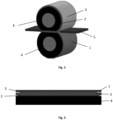
- the figures show a schematic construction of the device.
- the device for sterilization and disinfection is built of a housing, electrodes, a dielectric layer 3, a high-voltage supply and a release of electric field impulses.
- An elastic material 4 adjoins the at least one electrode.
- the basic factor used for disinfection to deactivate pathogens is a pulsed electric field of a high intensity and suitable parameters.
- a device for sterilization is applicable in disinfection of banknotes and it is intended to be used, inter alia, in automated teller machines.
- the device may be used in a method of ultra-fast disinfection of cash in order to decontaminate it before it is supplied to the user.
- the device comprises two electrodes - a grounded electrode 1 and a high-voltage electrode 2, both having a cylindrical shape as shown in Fig. 1 .
- the grounded electrode 1 is heated and to the high-voltage electrode 2 a dielectric layer 3 adjoins.
- a high-voltage supply is connected, and a release of electric field impulses.
- the dielectric layer 3 is a solid silicone, preferably of a thickness of 0.5-2 mm, which dielectric layer 3 has a cylindrical shape, and the electrodes are made of a copper sheet, preferably of a thickness of 0.02-0.1 mm.
- at least one electrode is made of an electroconductive fabric, preferably of a thickness of from 0.02 to 0.1 mm.
- an elastic material 4 adjoins both electrodes - the grounded electrode 1 and the high-voltage electrode 2.
- the elastic material 4 is a microporous rubber EPDM of a thickness of 2-10 mm and it has a cylindrical shape adjusted to the shape of the two electrodes. In operation, i.e. during passing the object 5 being disinfected between the two cylindrical electrodes, the elastic material 4 deforms to adjoin the object as closely as possible.
- the heater being in a form of an elastic PCB circuit made on a polyamide substrate.
- the thickness of the PCB circuit is up to 0.2 mm.
- the device in this embodiment, is applicable in a method for disinfection where high voltage is applied on the high-voltage electrode 2, and this causes generation of an electric field of a high voltage between the two electrodes.
- the object 5 being disinfected being a banknote in this embodiment, is passed by rotation of the electrodes and at the same time is being disinfected. Closer positioning of the electrodes relative to each other causes increased pressing against the object 5 being disinfected - a banknote. With the use of a higher pressure force the cylindrical elastic material 4 - in conformity with the shape of the electrode - is locally flattened to form a local flat area of the electrode. In operation of the electrodes, when the two electrodes are pressed against each other, the structure of the elastic layer 4 causes that the electrodes will deform and this will provide a greater surface of effective operation and adjournment to the object 5 being sterilized.
- the device of the invention in this embodiment, may be positioned within an electromagnetically sealed housing to protect other parts of the automated teller machine.
- a shielding is provided to protect the environment against the effects of the pulsed electric field.
- a device for sterilization is applicable in disinfection of drawings or posters and it is intended to be used in museums or archives.
- the device may be used in a method for ultra-fast disinfection of drawings and posters being porous objects, to eliminate fungi and live organisms.
- the device comprises two electrodes - a grounded electrode 1 and a high-voltage electrode 2, the two electrodes having a shape of a cuboid, as shown in Fig. 2 .
- the electrodes are copper sheets, preferably of a thickness of from 0.02 to 0.1 mm. An aware user will be aware that other materials may be used for electrodes.
- at least one electrode is made of an electroconductive fabric, preferably of a thickness of from 0.02 to 0.1 mm.
- the grounded electrode 1 is heated and the high-voltage electrode 2 adjoins a dielectric layer 3 and an elastic material 4.
- the high-voltage electrode 2 is connected to a high-voltage supply and a release of electric field impulses.
- the elastic material 4 adjoins solely the high-voltage electrode 2 and it is made of a microporous EPDM rubber, preferably of a thickness of 2-10 mm, and the dielectric layer 3, which is positioned between the object 5 being disinfected and the high-voltage electrode 2, is made of solid silicone, preferably of a thickness of 0.5-2 mm.
- the elastic material 4 and the dielectric layer 3 have a shape of a cuboid. The shape of the elastic material 4 corresponds to the shape of the electrode it adjoins.
- the grounded electrode 2 is additionally heated and, in this embodiment, a heater is used that has a form of an etched path on a first surface of a PCB printed circuit, and a person skilled in the art will be aware that also other embodiments of the heater are possible.
- the device in this embodiment, is applicable in a method for disinfection where high voltage is applied on the high-voltage electrode 2 and this generates high voltage electric field between the two electrodes with the object 5 being disinfected therebetween.
- the electrodes closely adjoin the object 5 being disinfected, by means of the elastic material 4 they are made from and due to the properties of the elastic material 4 adjoining the high-voltage electrode.
- the elastic material 4 along with the electrode deforms in operation, to adjoin possibly closely the object 5 being disinfected to provide the best effectiveness of disinfection and sterilization.
- a vacuum pump is used to remove air from the space between the electrodes - from the operation chamber, and the pressure therein is decreased or increased (as needed).
- the air may be replaced with another gas having microbicide properties or having better dielectric properties than the air. The use of the vacuum pump enables pumping in or out from the operational chamber between the electrodes to enable better adjoining the object being disinfected.
- the device provided by the invention may be placed in an electromagnetically sealed housing to protect other devices positioned nearby.
- a shielding is used to shield the environment against the effects of the pulsed electric field.
- a device for sterilization is applicable in disinfection of porous medical materials such as surgical thread or surgical cloth, and is applicable in production lines.
- the device comprises at least two electrodes - a grounded electrode 1 and a high-voltage electrode 2.
- the shape of the electrodes is adjusted to the objects 5 being sterilized.
- the electrodes can have a shape of a cuboid - if the object 5 subject to disinfection is e.g. a surgical cloth.
- a cylinder - of the object subject to disinfection is e.g. a thread.
- electrodes may have other, more diversified shapes, that are adjusted to the object to enable the most effective disinfection.
- electrodes are made of a copper sheet, preferably of a thickness of 0.01-0.1 mm.
- at least one electrode is made of an electrocoductive fabric, preferably of a thickness of from 0.02 to 0.1 mm.
- One of the electrodes in this embodiment the grounded electrode 1, is heated. Heating is effected by means of a heater which is in a form of an etched path on a first surface of a PCB printed circuit PCB in the case in which the electrode has a shape of a cuboid.
- the heater is in a form or an elastic PCB circuit, preferably made on a polyamide substrate and of a thickness of up to 0.2 mm, and a person skilled in the art will be aware that also other embodiments of the heater are possible.
- the second electrode is a high-voltage electrode 2 that is connected to a high-voltage supply and to a release of electric field impulses.
- an elastic material 4 adjoins to the both kinds of electrodes - the grounded electrode 1 and the high-voltage electrode 2.
- the elastic material 4 is a microporous EPDM rubber of a thickness of 2-10 mm and it has a shape adjusted in conformity with the shape of the electrodes.
- the elastic material 4 has such a shape and the object being disinfected is passed between the two cylindrical electrodes.
- the grounded electrode 1 is heated and to the high-voltage electrode 2 a dielectric layer 3 adjoins.
- the dielectric layer 3 is a solid silicone, preferably of a thickness of 0.5-2 mm, which dielectric layer 3 has a cylindrical shape.
- a further embodiment, shown in Fig. 3 uses two grounded electrodes 1 between which there is one high-voltage electrode 2 and all they of a cylindrical shape.
- the elastic material 4 which adjoins each of the electrodes is adjusted according to the shape of the electrodes and it has a cylindrical shape.
- the device in this embodiment is applicable in a method for disinfection in which high voltage is applied on the high-voltage electrode 2 causing generation of a high voltage electric field between the two electrodes.
- a vacuum pump is used to remove air from the space between the electrodes - from the operational chamber, and decreases or increases the pressure therein.
- the air may be replaced with another gas of microbicide properties or better dielectric properties than the air.
- the device provided by the invention may be placed in an electromagnetically sealed housing to protect other devices positioned nearby.
- a shielding is used to shield the environment against the effects of the pulsed electric field.
Landscapes
- Health & Medical Sciences (AREA)
- Epidemiology (AREA)
- Life Sciences & Earth Sciences (AREA)
- Animal Behavior & Ethology (AREA)
- General Health & Medical Sciences (AREA)
- Public Health (AREA)
- Veterinary Medicine (AREA)
- Apparatus For Disinfection Or Sterilisation (AREA)
Priority Applications (1)
| Application Number | Priority Date | Filing Date | Title |
|---|---|---|---|
| EP22199915.4A EP4349375A1 (fr) | 2022-10-06 | 2022-10-06 | Équipement de stérilisation et de désinfection |
Applications Claiming Priority (1)
| Application Number | Priority Date | Filing Date | Title |
|---|---|---|---|
| EP22199915.4A EP4349375A1 (fr) | 2022-10-06 | 2022-10-06 | Équipement de stérilisation et de désinfection |
Publications (1)
| Publication Number | Publication Date |
|---|---|
| EP4349375A1 true EP4349375A1 (fr) | 2024-04-10 |
Family
ID=84363733
Family Applications (1)
| Application Number | Title | Priority Date | Filing Date |
|---|---|---|---|
| EP22199915.4A Withdrawn EP4349375A1 (fr) | 2022-10-06 | 2022-10-06 | Équipement de stérilisation et de désinfection |
Country Status (1)
| Country | Link |
|---|---|
| EP (1) | EP4349375A1 (fr) |
Citations (5)
| Publication number | Priority date | Publication date | Assignee | Title |
|---|---|---|---|---|
| EP0803342B1 (fr) * | 1996-04-25 | 2002-12-11 | Japan Vilene Company, Ltd. | Procédé de traitement des surfaces internes et externes de matériaux non conducteurs |
| US20120213664A1 (en) * | 2009-11-03 | 2012-08-23 | The University Court Of The University Of Glasgow | Plasma generation and use of plasma generation apparatus |
| CN103910336A (zh) * | 2013-01-07 | 2014-07-09 | 同方环境股份有限公司 | 一种带防腐橡胶垫的板式臭氧发生器 |
| WO2020158967A1 (fr) * | 2019-01-29 | 2020-08-06 | (주)신영에어텍 | Générateur de plasma utilisant une décharge de barrière diélectrique et dispositif de purification d'air le comprenant |
| WO2020216675A2 (fr) * | 2019-04-26 | 2020-10-29 | Hochschule Für Angewandte Wissenschaft Und Kunst Hildesheim/Holzminden/Göttingen | Dispositif de traitement de textiles au moyen d'un plasma physique |
-
2022
- 2022-10-06 EP EP22199915.4A patent/EP4349375A1/fr not_active Withdrawn
Patent Citations (5)
| Publication number | Priority date | Publication date | Assignee | Title |
|---|---|---|---|---|
| EP0803342B1 (fr) * | 1996-04-25 | 2002-12-11 | Japan Vilene Company, Ltd. | Procédé de traitement des surfaces internes et externes de matériaux non conducteurs |
| US20120213664A1 (en) * | 2009-11-03 | 2012-08-23 | The University Court Of The University Of Glasgow | Plasma generation and use of plasma generation apparatus |
| CN103910336A (zh) * | 2013-01-07 | 2014-07-09 | 同方环境股份有限公司 | 一种带防腐橡胶垫的板式臭氧发生器 |
| WO2020158967A1 (fr) * | 2019-01-29 | 2020-08-06 | (주)신영에어텍 | Générateur de plasma utilisant une décharge de barrière diélectrique et dispositif de purification d'air le comprenant |
| WO2020216675A2 (fr) * | 2019-04-26 | 2020-10-29 | Hochschule Für Angewandte Wissenschaft Und Kunst Hildesheim/Holzminden/Göttingen | Dispositif de traitement de textiles au moyen d'un plasma physique |
Similar Documents
| Publication | Publication Date | Title |
|---|---|---|
| AU2015329934B2 (en) | Device for generating a cold atmospheric pressure plasma | |
| JP2016531654A (ja) | プラズマを用いた滅菌処理システム | |
| CN102714912B (zh) | 等离子体发生装置和等离子体发生装置的用途 | |
| Gadri et al. | Sterilization and plasma processing of room temperature surfaces with a one atmosphere uniform glow discharge plasma (OAUGDP) | |
| KR101948063B1 (ko) | 플라즈마 멸균장치 | |
| US9387269B2 (en) | Cold plasma jet hand sanitizer | |
| KR101824805B1 (ko) | 플라즈마 멸균장치 | |
| US5750072A (en) | Sterilization by magnetic field stimulation of a mist or vapor | |
| US8747763B2 (en) | Plasma sterilization apparatus | |
| JP3974442B2 (ja) | 殺菌装置、及び、殺菌方法 | |
| KR101978057B1 (ko) | 이극 접지 패드를 구비한 오존 방출 없는 플라즈마 피부처리 장치 | |
| CN115768942B (zh) | 低温织物介电阻挡放电装置 | |
| KR101922507B1 (ko) | 프락셔널 플라즈마를 이용한 피부 치료장치 | |
| EP3845113A1 (fr) | Lave-vaisselle et son procédé de commande | |
| WO2022265006A1 (fr) | Unité de génération de plasma, dispositif de génération de plasma et système de stérilisation | |
| JP2004209188A (ja) | 密封容器に内包された物品の殺菌方法 | |
| Kikuchi et al. | Effects of environmental humidity and temperature on sterilization efficiency of dielectric barrier discharge plasmas in atmospheric pressure air | |
| US20090016930A1 (en) | Sanitization using high electric fields | |
| Roth et al. | Increasing the surface energy and sterilization of nonwoven fabrics by exposure to a one atmosphere uniform glow discharge plasma (OAUGDP) | |
| CN213373889U (zh) | 电磁口罩消毒机 | |
| EP4265278A1 (fr) | Dispositif de stérilisation et de désinfection d'objets | |
| JP2014018703A (ja) | 電界発生装置 | |
| KR102673336B1 (ko) | 음이온을 이용한 치료장치 및 그 제어 방법 | |
| TWI612981B (zh) | 滅菌電漿系統 | |
| EP4159042A1 (fr) | Dispositif compact de désinfection d'aliments |
Legal Events
| Date | Code | Title | Description |
|---|---|---|---|
| PUAI | Public reference made under article 153(3) epc to a published international application that has entered the european phase |
Free format text: ORIGINAL CODE: 0009012 |
|
| STAA | Information on the status of an ep patent application or granted ep patent |
Free format text: STATUS: THE APPLICATION HAS BEEN PUBLISHED |
|
| AK | Designated contracting states |
Kind code of ref document: A1 Designated state(s): AL AT BE BG CH CY CZ DE DK EE ES FI FR GB GR HR HU IE IS IT LI LT LU LV MC ME MK MT NL NO PL PT RO RS SE SI SK SM TR |
|
| STAA | Information on the status of an ep patent application or granted ep patent |
Free format text: STATUS: THE APPLICATION IS DEEMED TO BE WITHDRAWN |
|
| 18D | Application deemed to be withdrawn |
Effective date: 20241011 |