EP4349768A2 - Chariot de manutention doté d'un dispositif d'éclairage, système logistique doté de plusieurs chariots de manutention, procédé de fonctionnement du dispositif d'éclairage et du système logistique - Google Patents
Chariot de manutention doté d'un dispositif d'éclairage, système logistique doté de plusieurs chariots de manutention, procédé de fonctionnement du dispositif d'éclairage et du système logistique Download PDFInfo
- Publication number
- EP4349768A2 EP4349768A2 EP23194906.6A EP23194906A EP4349768A2 EP 4349768 A2 EP4349768 A2 EP 4349768A2 EP 23194906 A EP23194906 A EP 23194906A EP 4349768 A2 EP4349768 A2 EP 4349768A2
- Authority
- EP
- European Patent Office
- Prior art keywords
- industrial truck
- vehicle
- state parameter
- vehicle state
- control unit
- Prior art date
- Legal status (The legal status is an assumption and is not a legal conclusion. Google has not performed a legal analysis and makes no representation as to the accuracy of the status listed.)
- Pending
Links
Images


Classifications
-
- B—PERFORMING OPERATIONS; TRANSPORTING
- B66—HOISTING; LIFTING; HAULING
- B66F—HOISTING, LIFTING, HAULING OR PUSHING, NOT OTHERWISE PROVIDED FOR, e.g. DEVICES WHICH APPLY A LIFTING OR PUSHING FORCE DIRECTLY TO THE SURFACE OF A LOAD
- B66F17/00—Safety devices, e.g. for limiting or indicating lifting force
-
- B—PERFORMING OPERATIONS; TRANSPORTING
- B60—VEHICLES IN GENERAL
- B60Q—ARRANGEMENT OF SIGNALLING OR LIGHTING DEVICES, THE MOUNTING OR SUPPORTING THEREOF OR CIRCUITS THEREFOR, FOR VEHICLES IN GENERAL
- B60Q1/00—Arrangement of optical signalling or lighting devices, the mounting or supporting thereof or circuits therefor
- B60Q1/26—Arrangement of optical signalling or lighting devices, the mounting or supporting thereof or circuits therefor the devices being primarily intended to indicate the vehicle, or parts thereof, or to give signals, to other traffic
-
- B—PERFORMING OPERATIONS; TRANSPORTING
- B60—VEHICLES IN GENERAL
- B60L—PROPULSION OF ELECTRICALLY-PROPELLED VEHICLES; SUPPLYING ELECTRIC POWER FOR AUXILIARY EQUIPMENT OF ELECTRICALLY-PROPELLED VEHICLES; ELECTRODYNAMIC BRAKE SYSTEMS FOR VEHICLES IN GENERAL; MAGNETIC SUSPENSION OR LEVITATION FOR VEHICLES; MONITORING OPERATING VARIABLES OF ELECTRICALLY-PROPELLED VEHICLES; ELECTRIC SAFETY DEVICES FOR ELECTRICALLY-PROPELLED VEHICLES
- B60L1/00—Supplying electric power to auxiliary equipment of vehicles
- B60L1/14—Supplying electric power to auxiliary equipment of vehicles to electric lighting circuits
-
- B—PERFORMING OPERATIONS; TRANSPORTING
- B60—VEHICLES IN GENERAL
- B60L—PROPULSION OF ELECTRICALLY-PROPELLED VEHICLES; SUPPLYING ELECTRIC POWER FOR AUXILIARY EQUIPMENT OF ELECTRICALLY-PROPELLED VEHICLES; ELECTRODYNAMIC BRAKE SYSTEMS FOR VEHICLES IN GENERAL; MAGNETIC SUSPENSION OR LEVITATION FOR VEHICLES; MONITORING OPERATING VARIABLES OF ELECTRICALLY-PROPELLED VEHICLES; ELECTRIC SAFETY DEVICES FOR ELECTRICALLY-PROPELLED VEHICLES
- B60L15/00—Methods, circuits, or devices for controlling the traction-motor speed of electrically-propelled vehicles
- B60L15/10—Methods, circuits, or devices for controlling the traction-motor speed of electrically-propelled vehicles for automatic control superimposed on human control to limit the acceleration of the vehicle, e.g. to prevent excessive motor current
-
- B—PERFORMING OPERATIONS; TRANSPORTING
- B60—VEHICLES IN GENERAL
- B60L—PROPULSION OF ELECTRICALLY-PROPELLED VEHICLES; SUPPLYING ELECTRIC POWER FOR AUXILIARY EQUIPMENT OF ELECTRICALLY-PROPELLED VEHICLES; ELECTRODYNAMIC BRAKE SYSTEMS FOR VEHICLES IN GENERAL; MAGNETIC SUSPENSION OR LEVITATION FOR VEHICLES; MONITORING OPERATING VARIABLES OF ELECTRICALLY-PROPELLED VEHICLES; ELECTRIC SAFETY DEVICES FOR ELECTRICALLY-PROPELLED VEHICLES
- B60L53/00—Methods of charging batteries, specially adapted for electric vehicles; Charging stations or on-board charging equipment therefor; Exchange of energy storage elements in electric vehicles
- B60L53/60—Monitoring or controlling charging stations
- B60L53/67—Controlling two or more charging stations
-
- B—PERFORMING OPERATIONS; TRANSPORTING
- B60—VEHICLES IN GENERAL
- B60L—PROPULSION OF ELECTRICALLY-PROPELLED VEHICLES; SUPPLYING ELECTRIC POWER FOR AUXILIARY EQUIPMENT OF ELECTRICALLY-PROPELLED VEHICLES; ELECTRODYNAMIC BRAKE SYSTEMS FOR VEHICLES IN GENERAL; MAGNETIC SUSPENSION OR LEVITATION FOR VEHICLES; MONITORING OPERATING VARIABLES OF ELECTRICALLY-PROPELLED VEHICLES; ELECTRIC SAFETY DEVICES FOR ELECTRICALLY-PROPELLED VEHICLES
- B60L58/00—Methods or circuit arrangements for monitoring or controlling batteries or fuel cells, specially adapted for electric vehicles
- B60L58/10—Methods or circuit arrangements for monitoring or controlling batteries or fuel cells, specially adapted for electric vehicles for monitoring or controlling batteries
- B60L58/12—Methods or circuit arrangements for monitoring or controlling batteries or fuel cells, specially adapted for electric vehicles for monitoring or controlling batteries responding to state of charge [SoC]
-
- B—PERFORMING OPERATIONS; TRANSPORTING
- B60—VEHICLES IN GENERAL
- B60Q—ARRANGEMENT OF SIGNALLING OR LIGHTING DEVICES, THE MOUNTING OR SUPPORTING THEREOF OR CIRCUITS THEREFOR, FOR VEHICLES IN GENERAL
- B60Q1/00—Arrangement of optical signalling or lighting devices, the mounting or supporting thereof or circuits therefor
- B60Q1/26—Arrangement of optical signalling or lighting devices, the mounting or supporting thereof or circuits therefor the devices being primarily intended to indicate the vehicle, or parts thereof, or to give signals, to other traffic
- B60Q1/46—Arrangement of optical signalling or lighting devices, the mounting or supporting thereof or circuits therefor the devices being primarily intended to indicate the vehicle, or parts thereof, or to give signals, to other traffic for giving flashing caution signals during drive, other than signalling change of direction, e.g. flashing the headlights or hazard lights
-
- B—PERFORMING OPERATIONS; TRANSPORTING
- B60—VEHICLES IN GENERAL
- B60Q—ARRANGEMENT OF SIGNALLING OR LIGHTING DEVICES, THE MOUNTING OR SUPPORTING THEREOF OR CIRCUITS THEREFOR, FOR VEHICLES IN GENERAL
- B60Q1/00—Arrangement of optical signalling or lighting devices, the mounting or supporting thereof or circuits therefor
- B60Q1/26—Arrangement of optical signalling or lighting devices, the mounting or supporting thereof or circuits therefor the devices being primarily intended to indicate the vehicle, or parts thereof, or to give signals, to other traffic
- B60Q1/50—Arrangement of optical signalling or lighting devices, the mounting or supporting thereof or circuits therefor the devices being primarily intended to indicate the vehicle, or parts thereof, or to give signals, to other traffic for indicating other intentions or conditions, e.g. request for waiting or overtaking
-
- B—PERFORMING OPERATIONS; TRANSPORTING
- B60—VEHICLES IN GENERAL
- B60Q—ARRANGEMENT OF SIGNALLING OR LIGHTING DEVICES, THE MOUNTING OR SUPPORTING THEREOF OR CIRCUITS THEREFOR, FOR VEHICLES IN GENERAL
- B60Q1/00—Arrangement of optical signalling or lighting devices, the mounting or supporting thereof or circuits therefor
- B60Q1/26—Arrangement of optical signalling or lighting devices, the mounting or supporting thereof or circuits therefor the devices being primarily intended to indicate the vehicle, or parts thereof, or to give signals, to other traffic
- B60Q1/50—Arrangement of optical signalling or lighting devices, the mounting or supporting thereof or circuits therefor the devices being primarily intended to indicate the vehicle, or parts thereof, or to give signals, to other traffic for indicating other intentions or conditions, e.g. request for waiting or overtaking
- B60Q1/543—Arrangement of optical signalling or lighting devices, the mounting or supporting thereof or circuits therefor the devices being primarily intended to indicate the vehicle, or parts thereof, or to give signals, to other traffic for indicating other intentions or conditions, e.g. request for waiting or overtaking for indicating other states or conditions of the vehicle
-
- B—PERFORMING OPERATIONS; TRANSPORTING
- B66—HOISTING; LIFTING; HAULING
- B66F—HOISTING, LIFTING, HAULING OR PUSHING, NOT OTHERWISE PROVIDED FOR, e.g. DEVICES WHICH APPLY A LIFTING OR PUSHING FORCE DIRECTLY TO THE SURFACE OF A LOAD
- B66F9/00—Devices for lifting or lowering bulky or heavy goods for loading or unloading purposes
- B66F9/06—Devices for lifting or lowering bulky or heavy goods for loading or unloading purposes movable, with their loads, on wheels or the like, e.g. fork-lift trucks
- B66F9/075—Constructional features or details
-
- B—PERFORMING OPERATIONS; TRANSPORTING
- B66—HOISTING; LIFTING; HAULING
- B66F—HOISTING, LIFTING, HAULING OR PUSHING, NOT OTHERWISE PROVIDED FOR, e.g. DEVICES WHICH APPLY A LIFTING OR PUSHING FORCE DIRECTLY TO THE SURFACE OF A LOAD
- B66F9/00—Devices for lifting or lowering bulky or heavy goods for loading or unloading purposes
- B66F9/06—Devices for lifting or lowering bulky or heavy goods for loading or unloading purposes movable, with their loads, on wheels or the like, e.g. fork-lift trucks
- B66F9/075—Constructional features or details
- B66F9/07504—Accessories, e.g. for towing, charging, locking
-
- B—PERFORMING OPERATIONS; TRANSPORTING
- B66—HOISTING; LIFTING; HAULING
- B66F—HOISTING, LIFTING, HAULING OR PUSHING, NOT OTHERWISE PROVIDED FOR, e.g. DEVICES WHICH APPLY A LIFTING OR PUSHING FORCE DIRECTLY TO THE SURFACE OF A LOAD
- B66F9/00—Devices for lifting or lowering bulky or heavy goods for loading or unloading purposes
- B66F9/06—Devices for lifting or lowering bulky or heavy goods for loading or unloading purposes movable, with their loads, on wheels or the like, e.g. fork-lift trucks
- B66F9/075—Constructional features or details
- B66F9/07581—Remote controls
-
- B—PERFORMING OPERATIONS; TRANSPORTING
- B66—HOISTING; LIFTING; HAULING
- B66F—HOISTING, LIFTING, HAULING OR PUSHING, NOT OTHERWISE PROVIDED FOR, e.g. DEVICES WHICH APPLY A LIFTING OR PUSHING FORCE DIRECTLY TO THE SURFACE OF A LOAD
- B66F9/00—Devices for lifting or lowering bulky or heavy goods for loading or unloading purposes
- B66F9/06—Devices for lifting or lowering bulky or heavy goods for loading or unloading purposes movable, with their loads, on wheels or the like, e.g. fork-lift trucks
- B66F9/075—Constructional features or details
- B66F9/20—Means for actuating or controlling masts, platforms, or forks
- B66F9/24—Electrical devices or systems
-
- G—PHYSICS
- G07—CHECKING-DEVICES
- G07C—TIME OR ATTENDANCE REGISTERS; REGISTERING OR INDICATING THE WORKING OF MACHINES; GENERATING RANDOM NUMBERS; VOTING OR LOTTERY APPARATUS; ARRANGEMENTS, SYSTEMS OR APPARATUS FOR CHECKING NOT PROVIDED FOR ELSEWHERE
- G07C5/00—Registering or indicating the working of vehicles
- G07C5/08—Registering or indicating performance data other than driving, working, idle, or waiting time, with or without registering driving, working, idle or waiting time
- G07C5/0816—Indicating performance data, e.g. occurrence of a malfunction
- G07C5/0825—Indicating performance data, e.g. occurrence of a malfunction using optical means
-
- B—PERFORMING OPERATIONS; TRANSPORTING
- B60—VEHICLES IN GENERAL
- B60L—PROPULSION OF ELECTRICALLY-PROPELLED VEHICLES; SUPPLYING ELECTRIC POWER FOR AUXILIARY EQUIPMENT OF ELECTRICALLY-PROPELLED VEHICLES; ELECTRODYNAMIC BRAKE SYSTEMS FOR VEHICLES IN GENERAL; MAGNETIC SUSPENSION OR LEVITATION FOR VEHICLES; MONITORING OPERATING VARIABLES OF ELECTRICALLY-PROPELLED VEHICLES; ELECTRIC SAFETY DEVICES FOR ELECTRICALLY-PROPELLED VEHICLES
- B60L2200/00—Type of vehicles
- B60L2200/40—Working vehicles
- B60L2200/42—Fork lift trucks
-
- B—PERFORMING OPERATIONS; TRANSPORTING
- B60—VEHICLES IN GENERAL
- B60L—PROPULSION OF ELECTRICALLY-PROPELLED VEHICLES; SUPPLYING ELECTRIC POWER FOR AUXILIARY EQUIPMENT OF ELECTRICALLY-PROPELLED VEHICLES; ELECTRODYNAMIC BRAKE SYSTEMS FOR VEHICLES IN GENERAL; MAGNETIC SUSPENSION OR LEVITATION FOR VEHICLES; MONITORING OPERATING VARIABLES OF ELECTRICALLY-PROPELLED VEHICLES; ELECTRIC SAFETY DEVICES FOR ELECTRICALLY-PROPELLED VEHICLES
- B60L2200/00—Type of vehicles
- B60L2200/40—Working vehicles
- B60L2200/44—Industrial trucks or floor conveyors
-
- B—PERFORMING OPERATIONS; TRANSPORTING
- B60—VEHICLES IN GENERAL
- B60L—PROPULSION OF ELECTRICALLY-PROPELLED VEHICLES; SUPPLYING ELECTRIC POWER FOR AUXILIARY EQUIPMENT OF ELECTRICALLY-PROPELLED VEHICLES; ELECTRODYNAMIC BRAKE SYSTEMS FOR VEHICLES IN GENERAL; MAGNETIC SUSPENSION OR LEVITATION FOR VEHICLES; MONITORING OPERATING VARIABLES OF ELECTRICALLY-PROPELLED VEHICLES; ELECTRIC SAFETY DEVICES FOR ELECTRICALLY-PROPELLED VEHICLES
- B60L53/00—Methods of charging batteries, specially adapted for electric vehicles; Charging stations or on-board charging equipment therefor; Exchange of energy storage elements in electric vehicles
-
- B—PERFORMING OPERATIONS; TRANSPORTING
- B60—VEHICLES IN GENERAL
- B60Q—ARRANGEMENT OF SIGNALLING OR LIGHTING DEVICES, THE MOUNTING OR SUPPORTING THEREOF OR CIRCUITS THEREFOR, FOR VEHICLES IN GENERAL
- B60Q2800/00—Features related to particular types of vehicles not otherwise provided for
- B60Q2800/20—Utility vehicles, e.g. for agriculture, construction work
-
- B—PERFORMING OPERATIONS; TRANSPORTING
- B60—VEHICLES IN GENERAL
- B60Q—ARRANGEMENT OF SIGNALLING OR LIGHTING DEVICES, THE MOUNTING OR SUPPORTING THEREOF OR CIRCUITS THEREFOR, FOR VEHICLES IN GENERAL
- B60Q2900/00—Features of lamps not covered by other groups in B60Q
- B60Q2900/40—Several lamps activated in sequence, e.g. sweep effect, progressive activation
Definitions
- the invention relates to an industrial truck with a lighting device, comprising at least one vehicle light and a control unit for controlling the vehicle light.
- the invention also relates to a logistics system with at least one charger and an electrically driven industrial truck with a lighting device.
- the invention relates to a logistics system, comprising a comparison unit and at least a first and a second such industrial truck.
- the invention also relates to a method for operating a lighting device of an industrial truck, wherein the lighting device comprises at least one vehicle light and a control unit for controlling the vehicle light.
- the invention further relates to a method for operating a logistics system, comprising a comparison unit and at least a first and a second industrial truck.
- Vehicle lighting which includes various vehicle lights, but which are only partially comparable to the vehicle lights of a lighting system on a motor vehicle used on public roads.
- vehicle lighting of a motor vehicle registered for road traffic is subject to legal regulations.
- Certain vehicle lights are intended for certain functions, each of which is assigned specific colors.
- Vehicle lighting includes, for example and among other things, vehicle lights for the high beam, dipped beam and parking lights, for the direction indicator (blinker), tail lights (rear lights), brake lights, etc.
- Industrial trucks that are not operated on public roads are not subject to legal regulations, but usually also have the prescribed vehicle lighting.
- industrial trucks can be equipped with other vehicle lights, such as warning lights or the like.
- these additional vehicle lights are attached to the industrial truck for a very specific purpose and indicate, for example, that the industrial truck is ready for operation.
- an industrial truck with a lighting device, comprising at least one vehicle light and a control unit for controlling the vehicle light, wherein the industrial truck is developed in that the control unit is configured to detect at least one vehicle condition parameter and to control the vehicle light in a pattern based on the at least one vehicle condition parameter.
- vehicle information characterized by the vehicle status parameter can be communicated via one or more vehicle lights present on the industrial truck.
- This makes it possible for a person who is within sight of the industrial truck to obtain information relating to at least one vehicle status parameter in a simple and quick manner.
- the person for example a logistics employee, can thus quickly and efficiently locate, for example, a suitable industrial truck or one intended for a specific task.
- the vehicle light is preferably a vehicle light that is already present on the industrial truck and which can also fulfill a different task in a different context.
- the pattern in which the vehicle light is controlled by the control unit can be a color, a light intensity and/or a rhythmic sequence of the emitted light signals.
- the vehicle light comprises several light sources, for example an LED light strip
- a possible pattern can be the control of individual selected Light sources, for example the LED light strip, the control of several light sources of the vehicle light or even the control of all light sources can be provided.
- This pattern, in which the light sources are controlled can in particular be combined with another pattern, which consists for example of the light intensity and/or a rhythmic sequence. This results in a combined pattern, for example a dynamic light pattern.
- the vehicle status parameter particularly characterizes a status of the industrial truck or a status of at least one of its components, modules or parts.
- the vehicle status parameter characterizes a parameter of an energy storage device, for example a traction battery, of the industrial truck.
- the vehicle status parameter can indicate a charge status, a maximum storage capacity and/or a status of the traction battery of the industrial truck.
- the vehicle light is controlled depending on the charge status in a pattern that characterizes the charge status. For example, the vehicle light is activated in red if the charge status is below a certain limit, for example less than 10%. If the charge status is in a predetermined middle range, for example between 10% and 70%, the vehicle light is activated in yellow. If the charge status is above a certain limit, for example greater than 70%, the vehicle light can be controlled in green. The logistics employee is thus able to quickly and easily recognize the charge status of the industrial truck.
- the vehicle status parameter can also indicate, for example, that the industrial truck requires servicing.
- the vehicle light is activated, for example, by flashing red. This means that the logistics employee can immediately see that the industrial truck is the one on which a service order is to be fulfilled.
- the vehicle status parameter characterizes a value in an error memory of the industrial truck.
- the industrial truck is advantageously further developed in that the at least one vehicle lamp is arranged in an upper half, in particular in an upper third, furthermore in particular in an upper quarter of a body of the industrial truck.
- the arrangement of the vehicle light in the aforementioned areas of the industrial truck body allows the light signal emitted by the vehicle light to be recognized from a great distance or in a situation in which the industrial truck is partially obscured.
- the aforementioned upper fraction (half, third, quarter) of the industrial truck body is determined, for example, in relation to the maximum height of the industrial truck body.
- the maximum height is determined, for example, in the area of a roof structure at a highest point of the industrial truck, apart from its mast.
- the upper half of the industrial truck body is the area of the body that extends above half the maximum height of the body.
- the vehicle light is arranged in the area of a roof structure of the industrial truck or at a highest point of the industrial truck body. As already mentioned, the high position of the vehicle light on the body improves its visibility.
- the vehicle lamp is part of a vehicle lighting system of the industrial truck.
- the use of a vehicle light which is part of the vehicle lighting of the industrial truck, is advantageous and efficient, since an existing vehicle light can be used for the purposes mentioned. It is therefore not necessary to attach an additional vehicle light to the industrial truck.
- the vehicle lighting of the industrial truck typically includes a front light, comparable to daytime running lights on cars, and a rear light to improve the visibility of the vehicle during operation.
- Industrial trucks are generally not used in public transport and therefore do not generally have the vehicle lights required by the regulatory requirements.
- the existing vehicle lights can advantageously be controlled to display the vehicle status parameter in a pattern that is characteristic of the vehicle status parameter.
- the vehicle lights of the vehicle lighting are controlled in a color that differs from the usual colors, such as those provided for operation on public roads. Due to this non-intuitive coloring, the light signal emitted by the industrial truck is directly recognized by the observer as a pattern that indicates a vehicle status parameter. Due to this obvious deviation, it is also advantageously easy to recognize that the light signal emitted by the corresponding vehicle light is not related to the normal operation of the industrial truck, but rather information regarding the vehicle parameters.
- the driving lights which are normally operated with white light, can be controlled in different colors to indicate the charge level of the traction battery. For example, the colors red, yellow, green can be used, as already explained above in the text.
- the industrial truck is further developed in that the control unit is further configured to detect a proximity signal and to activate a control of the vehicle light in response to successful detection of the proximity signal.
- the proximity signal is transmitted using suitable and generally known wireless communication technology for short distances, such as Bluetooth or WLAN.
- suitable and generally known wireless communication technology for short distances, such as Bluetooth or WLAN.
- a logistics employee carries a personal user device or tag with them that sends out the proximity signal.
- the detection of this proximity signal is advantageous because when the logistics employee approaches, the industrial truck emits a corresponding light signal on the vehicle lighting without the need for this signal to be activated separately.
- the industrial truck can indicate to the employee directly using a corresponding light signal that the vehicle parameter indicates that the industrial truck requires servicing.
- the service employee can then approach the industrial truck directly and carry out the necessary service work.
- the vehicle condition parameter is, according to further Embodiments include an equipment feature of the industrial truck, a charge level of a traction battery of the industrial truck, an operational readiness of the industrial truck and/or a service requirement of the industrial truck.
- the vehicle state parameter is in particular an internal vehicle state parameter.
- the pattern in which the vehicle light is controlled by the control unit characterizes in particular a value of this vehicle state parameter.
- the pattern can be selected in such a way that a specific equipment feature of the industrial truck is displayed.
- This equipment feature relates, for example, to the functionality of the industrial truck.
- a specific color code can indicate that the industrial truck is set up to perform a specific function.
- a different color code or a rhythm of the control of the vehicle light can, for example, indicate that the industrial truck is set up to be operated in a specific way.
- a classification of the industrial trucks can be made. For example, if a logistics employee only has authorization to operate a certain type of industrial truck, e.g. because certain internal training and qualifications have not yet been completed, the industrial truck can indicate, for example by using a corresponding color code: red (no access) and green (access permitted), that the logistics employee in question is authorized to operate the industrial truck.
- vehicle lamps which are part of the lighting of the industrial truck must be in a colour different from their usual or prescribed colour.
- different color according to the intended pattern (which may include the color).
- a certain equipment feature of the industrial truck is indicated by a light signal in green, although green is not a color in which a vehicle lamp of the vehicle lighting is operated according to the usual color scheme.
- the charge level of a traction battery on an industrial truck can also be indicated, for example by using color coding. This can also be done in combination with the industrial truck being ready for operation. For example, a green light can indicate that the traction battery charging process has finished. A white light can indicate that the industrial truck is fully operational. A yellow or orange light, on the other hand, can indicate that the traction battery charging process is not yet complete. A red light can indicate a system error on the industrial truck, and flashing red can indicate a critical system error. The industrial truck's light signals thus provide the user with comprehensive information about the truck's status.
- a single vehicle lamp can be used for all of these displays.
- vehicle lamp is not to be understood in such a restrictive way that it must be a single, separate vehicle lamp.
- vehicle lamp can also be a light segment of a larger lighting unit.
- the industrial truck is further developed in that the vehicle condition parameter is linked to a plurality of authorization categories and the proximity signal comprises information relating to an authorization category, and wherein the control unit is further configured to compare the authorization category of the vehicle state parameter and the authorization category of the proximity signal in response to successful detection of the proximity signal and to control the vehicle light depending on a comparison result.
- the authorization categories are authorizations for a service technician, a warehouse employee and a warehouse manager.
- the industrial truck can compare this category with the category of the vehicle status parameter. If, for example, the vehicle status parameter relates to a service requirement and a service technician approaches according to the authorization category in the proximity signal, the industrial truck can draw a positive comparison result and, for example, activate the vehicle light with a green light signal. If, on the other hand, a warehouse employee or a warehouse manager approaches, for example, the corresponding comparison result would be negative and the vehicle light would emit a red light signal, which indicates to the warehouse employee and warehouse manager that the corresponding industrial truck is blocked for normal operation.
- an authorization category can be derived from the presence of this equipment feature, for example an existing assistance system for automatic braking intervention or the like. For example, if a warehouse employee approaches the vehicle, who is required to If, according to the recommendation, vehicles with an assistance system for automatic braking intervention should always be operated, this authorization category can be integrated into a proximity signal.
- the authorization category is transmitted by a mobile unit that this warehouse employee carries along, together with the proximity signal. If appropriate communication takes place and a proximity signal categorized in this way is received from an industrial truck, the industrial truck can in turn carry out a comparison and, for example, if the equipment feature "assistance system for automatic braking intervention" is present on the industrial truck in question, draw a positive comparison result.
- the industrial truck would, for example, switch the vehicle light to green to indicate to the warehouse employee that the industrial truck in question has the equipment intended for him.
- a similar procedure can be used if, for example, a warehouse employee requires special training in order to be allowed to operate a certain industrial truck or industrial trucks in a certain category.
- the equipment feature is, for example, the maximum possible lifting load or lifting height. If certain limit values are exceeded, additional training may be required, for example.
- the employee's authorization category would indicate whether he or she has received appropriate training, i.e. whether he or she is authorized to operate industrial trucks that have the equipment feature in question. Again, depending on the comparison result, the industrial truck can control the vehicle light with the appropriate light signal.
- the vehicle status parameter is again a service requirement of the industrial truck.
- the existence of a service requirement for example the existence of a service order would be reflected in the corresponding authorization category. If a service employee approaches the industrial truck, the proximity signal sent out by a mobile unit that the service employee carries with him contains information about the owner's own authorization category, which identifies the owner of the mobile unit as a service employee. The existence of a service order and the identification of the employee as a service employee leads to a positive comparison result.
- the industrial truck can accordingly emit a light signal on the vehicle lamp, which indicates that the industrial truck requires service.
- control unit can be set up in such a way that it blocks the vehicle for further requests as soon as a positive comparison result has been found, so that, for example, the service can be carried out in any case.
- the vehicle status parameter relates, for example, to an equipment feature of the industrial truck, a charge level of a traction battery of the industrial truck, an operational readiness of the industrial truck and a service requirement of the industrial truck. From these parameters (in such a case, the vehicle status parameter is an array or vector), individual sub-parameters can be prioritized over others for the display of a corresponding light signal.
- the service requirement can be prioritized over other parameters.
- a service requirement can be prioritized over the display of a charge level of the traction battery.
- Which vehicle parameters are displayed can in turn be determined based on the authorization category, which is in the Proximity signal is present.
- the proximity signal in the associated authorization category can indicate that only one of the three subparameters mentioned above is displayed, for example a charge level of the traction battery to the warehouse employee and, in contrast, the service requirement to the service technician.
- the authorization category can also be an authorization to operate the industrial truck in question. For this purpose, for example, there is a corresponding list of authorized drivers in the control unit, if necessary also taking into account the respective individual qualifications or restrictions regarding equipment features and/or existing assistance systems.
- the industrial truck is developed in that the vehicle state parameter is an internal vehicle state parameter and the control unit is set up to detect the internal vehicle state parameter and at least one vehicle state parameter of at least one further industrial truck as at least one external vehicle state parameter, to compare the internal and the at least one external vehicle state parameter with each other and to control the vehicle light in a pattern which is based on a result of the comparison of the vehicle state parameters.
- the vehicle state parameter is an internal vehicle state parameter
- the control unit is set up to detect the internal vehicle state parameter and at least one vehicle state parameter of at least one further industrial truck as at least one external vehicle state parameter, to compare the internal and the at least one external vehicle state parameter with each other and to control the vehicle light in a pattern which is based on a result of the comparison of the vehicle state parameters.
- the control unit is therefore particularly designed to carry out a comparison between at least one internal vehicle parameter and one or more external vehicle status parameters. This is advantageous because it allows a property of the industrial truck to be determined in comparison to other industrial trucks. and can be displayed. If the vehicle status parameter is, for example, the charge level of the traction battery of the respective industrial truck, the industrial truck compares the charge level of its own traction battery with the charge level of the traction battery of another industrial truck. A light signal is then emitted on the vehicle lamp, the pattern of which is based on the result of this comparison.
- the absolute value of the charge level of the own traction battery be indicated in color-coded form, but this can also be compared to the charge level of the traction battery of the other industrial truck.
- an industrial truck with a green flashing vehicle light can indicate that it has a higher charge level of the traction battery than at least one other industrial truck. Since repeated interim charging of the traction battery is becoming more and more of a focus in practical applications, the industrial truck with the comparatively higher battery charge would be preferable for immediate operation.
- a similar display could also be made, for example, with regard to the need for service of one industrial truck compared to another. If one industrial truck requires less service than another, this can be indicated with a green light, for example. For example, the maintenance interval for this industrial truck is still longer or has not yet fallen below a critical value. A logistics employee can now select the vehicle that does not yet require urgent service. This way, unnecessary wear and tear on the industrial trucks can be avoided. Communication between the industrial trucks and By controlling the vehicle lights accordingly depending on the result of a comparison, the operation of a vehicle fleet can be improved overall.
- the comparison carried out is, for example, a greater/smaller comparison, the determination of a maximum or minimum, the clarification of the question whether certain characteristics, such as equipment features of the industrial truck, are present or not, i.e. a binary true/false comparison.
- detecting a parameter is understood to mean both receiving a corresponding parameter and querying a corresponding parameter.
- receiving and actively querying can also be combined with one another.
- the vehicle light does not have to be designed as a single, separate vehicle light. It can also be a segment of a larger lighting unit.
- the industrial truck is in particular an electrically powered industrial truck.
- a logistics system with at least one charger and an electrically driven industrial truck with a lighting device, comprising a vehicle lamp and a control unit for controlling the vehicle lamp, wherein this logistics system is further developed in that the control unit is set up to detect at least one state parameter of the charger and to control the vehicle lamp in a pattern based on the at least one state parameter of the charger.
- this logistics system is further developed by a central computer, which can also be implemented as a functional unit in a cloud, wherein the central computer is set up to query the status parameter of the charger and to communicate it to the industrial truck.
- the industrial truck can query the status parameter of the charger from the central computer. In other words, the communication of the status parameter of the charger does not have to take place directly between the charger and the industrial truck, but rather takes place in particular via the central computer according to the embodiments mentioned.
- a logistics unit comprising a comparison unit and at least a first and a second industrial truck according to one or more of the aforementioned embodiments, wherein the logistics system is further developed in that a first control unit of the first industrial truck is set up to detect a first internal vehicle state parameter and to transmit it to the comparison unit and a second control unit of the second industrial truck is set up to detect a second internal vehicle state parameter and to transmit it to the comparison unit, wherein the comparison unit is set up to compare the first and the second vehicle state parameters with each other, to generate a comparison result and to generate a first and a second control signal, wherein the first control signal indicates a relationship of the first vehicle state parameter to the comparison result and the second control signal indicates a relationship of the second vehicle state parameter to the comparison result, and wherein the comparison unit is further configured to transmit the first control signal to the first control unit and to transmit the second control signal to the second control unit, wherein the first control unit is configured to control a first vehicle light of the first industrial truck in a first pattern based on
- the industrial truck with the highest charge level of the traction battery can be indicated, for example by a green flashing light signal. It can also be indicated that an individual industrial truck is not ready for operation or is locked or that there is a system error on this industrial truck, so that a service technician can turn to this industrial truck directly.
- the display of these vehicle status parameters in comparison with the vehicle status parameters of other industrial trucks in the fleet allows efficient use of the vehicle fleet.
- the comparison unit can be implemented at different locations in the logistics system
- the logistics system comprises a central computer, which in turn comprises the comparison unit.
- the central computer is linked to the first and second industrial trucks.
- the central computer can be implemented in a cloud, and the same applies to the comparison unit.
- the comparison unit and/or the central computer can communicate with the individual industrial trucks via appropriate data connections.
- corresponding control signals are communicated to the industrial trucks.
- the industrial trucks On the basis of these control signals, the industrial trucks in turn control the corresponding vehicle light or lights.
- the comparison unit is arranged in the first or second industrial truck and that the industrial trucks are directly linked to each other in terms of data technology.
- the industrial trucks can communicate with each other via the central instance, for example a control computer of the logistics system.
- the higher-level instance such as the central computer of the logistics system, can advantageously be dispensed with for the desired functionality of the industrial trucks.
- the comparison unit is implemented, for example, as a functional unit in the vehicle control of the industrial truck.
- comparison unit In addition to the implementation of the comparison unit in the higher-level central computer or in one of the industrial trucks, it is also It is possible to implement the comparison unit in one or more chargers that are connected or coupled to the industrial trucks during a charging process.
- the logistics system is further developed by a first and a second charger, wherein the first charger is connected to the first industrial truck for charging a traction battery of the first industrial truck and the second charger is connected to the second industrial truck for charging a traction battery of the second industrial truck, wherein the comparison unit is arranged in the first or the second charger, and wherein the first and the second charger, the first charger and the first industrial truck and the second charger and the second industrial truck are coupled to one another in terms of data technology.
- the implementation of the comparison unit is advantageous depending on the architecture of the logistics system.
- Each of the locations mentioned has individual advantages depending on the desired functionality and the structure or architecture of the logistics system.
- the implementation of the comparison unit in a central computer requires comparatively little effort, but requires the industrial trucks to be able to communicate with this central computer.
- the object is further achieved by a method for operating a lighting device of an industrial truck, wherein the lighting device at least one vehicle lamp and a control unit for controlling the vehicle lamp, wherein this method is further developed in that the control unit detects at least one vehicle state parameter and controls the vehicle lamp in a pattern based on the at least one vehicle state parameter.
- the method for operating the lighting system of the industrial truck has the same or similar advantages as those already mentioned with regard to the industrial truck and the logistics system, so that repetition is not necessary.
- control unit further detects a proximity signal and, in response to successful detection of the proximity signal, activates a control of the vehicle lamp.
- the detection of a proximity signal is advantageous because the industrial trucks can display a light signal when a person, such as a service employee or a logistics employee, approaches, which indicates a vehicle parameter. For example, when a service employee approaches, the industrial truck whose vehicle parameter indicates a need for service can emit a corresponding light signal. Likewise, one or more industrial trucks can emit light signals that indicate the current charge level of the traction battery when a logistics employee approaches.
- the proximity signal is transmitted, for example, using Bluetooth, WLAN or another communication technology suitable for wireless data communication over short distances.
- the Proximity signal is generated in a logistics system, wherein different zones are defined within the logistics system, to which different functions are assigned. For example, zones with speed limits, warning zones, obstacle zones and the like can be defined within the logistics system.
- a parking zone for industrial trucks can also be defined, for example in combination with a loading zone. If the logistics system detects that an employee is entering such a zone, for example the loading zone, the logistics system generates a proximity signal. This can be received by the control unit of the industrial truck. In other words, the proximity signal can be generated directly in the industrial truck in question due to the approach of, for example, a logistics employee to this industrial truck. Alternatively or additionally, the proximity signal is generated when a central computer detects that a person has entered a corresponding zone. In order to detect the approach or entry of the person into the zone, the person carries, for example, a mobile user device, a tag or another device equipped with suitable communication technology.
- the method is further developed in that the vehicle status parameter is an equipment feature of the industrial truck, a charge level of a traction battery of the industrial truck, an operational readiness of the industrial truck and/or a service requirement of the industrial truck.
- the vehicle state parameter is linked to several authorization categories and the proximity signal comprises information relating to an authorization category and wherein in response to a If the proximity signal is successfully detected, the authorization category of the vehicle status parameter and the authorization category of the proximity signal are compared and the vehicle light is controlled depending on the comparison result.
- the vehicle state parameter is an internal vehicle state parameter and the pattern characterizes a value of the vehicle state parameter.
- the method is further developed in that the vehicle state parameter is an internal vehicle state parameter and the control unit detects the internal vehicle state parameter and at least one vehicle state parameter of at least one further industrial truck as at least one external vehicle state parameter, compares the internal and the at least one external vehicle state parameter with each other and controls the vehicle light in a pattern which is based on a result of the comparison of the vehicle state parameters.
- the vehicle state parameter is an internal vehicle state parameter and the control unit detects the internal vehicle state parameter and at least one vehicle state parameter of at least one further industrial truck as at least one external vehicle state parameter, compares the internal and the at least one external vehicle state parameter with each other and controls the vehicle light in a pattern which is based on a result of the comparison of the vehicle state parameters.
- the object is achieved by a method for operating a logistics system, comprising a comparison unit and at least a first and a second industrial truck according to one or more of the above-mentioned embodiments, wherein the method is further developed in that a first control unit of the first industrial truck determines a first internal vehicle state parameter detected and transmits it to the comparison unit and a second control unit of the second industrial truck detects a second internal vehicle state parameter and transmits it to the comparison unit, wherein the comparison unit compares the first and the second vehicle state parameters with one another, produces a comparison result and generates a first and a second control signal, wherein the first control signal indicates a ratio of the first vehicle state parameter to the comparison result and the second control signal indicates a ratio of the second vehicle state parameter to the comparison result, and wherein the comparison unit further transmits the first control signal to the first control unit and transmits the second control signal to the second control unit, wherein the first control unit controls a first vehicle light of the first industrial truck in a first pattern based on the first control signal and
- the logistics system comprises a first and a second charger, wherein the first charger is connected to the first industrial truck for charging a traction battery of the first industrial truck and the second charger is connected to the second industrial truck for charging a traction battery of the second industrial truck, wherein the comparison unit is arranged in the first or the second charger, and wherein the first and the second charger, the The first charger and the first industrial truck and the second charger and the second industrial truck are connected to each other in terms of data technology.
- Embodiments of the invention may fulfill individual features or a combination of several features.
- Fig.1 shows a simplified schematic view of an industrial truck 2 with a lighting device 4, which comprises, for example, two vehicle lights 6.1 and 6.2. In general, the vehicle lights should also be designated with reference number 6.
- the industrial truck 2 comprises a body 8, which is placed on a chassis.
- the industrial truck 2 is, for example, a reach truck.
- the industrial truck 2 comprises the components typical for an industrial truck, such as a mast 10 and a lifting fork 12.
- the industrial truck 2 is an electrically powered industrial truck 2.
- the industrial truck 2 comprises a traction battery 14.
- the industrial truck 2 also includes a control unit 16, which is set up and equipped to control the vehicle lights 6.
- the control unit 16 can be designed as a separate unit or implemented as part of a vehicle control system 20. To control the vehicle lights 6, the control unit 16 is connected to them via suitable connecting lines 18.
- the control unit 16 is further configured to record at least one vehicle state parameter of the industrial truck 2.
- the vehicle state parameter is, for example, queried by the operating control 20 of the industrial truck 2, or the control unit 16 queries the vehicle state parameter from a unit of the industrial truck 2 in which the vehicle state parameter is present.
- the vehicle state parameter is a charge state of the traction battery 14.
- the charge state of the traction battery 14 can be present as a value in the vehicle control 20 of the industrial truck.
- the control unit 16 can query the charge state of the traction battery 14 directly from the traction battery 14.
- Other possible vehicle state parameters are, for example, an equipment feature of the industrial truck 2, an operational readiness of the industrial truck 2 and/or a service requirement of the industrial truck 2.
- An equipment feature of the industrial truck 2 is, for example, its design as a reach truck or its load capacity or maximum lifting height.
- Other equipment features can, for example, relate to the type or operation of the industrial truck 2.
- the equipment feature can, for example, indicate whether such a special qualification is required.
- Such information can be queried by the control unit 16 in the vehicle control 20.
- Another possible equipment feature is, for example, the presence of an assistance system, which can be prescribed for certain users, or vice versa, for which the user must have certain qualifications.
- the vehicle status parameter is the operational readiness of the industrial truck or a service requirement of the industrial truck.
- the operational readiness of the industrial truck 2 can also be stored in the vehicle control 20.
- the operational readiness indicates, for example, whether there is an error, a serious error or no error in the vehicle control of the industrial truck 2.
- a limited operational readiness can also be stored in a corresponding parameter in the vehicle control 20.
- a service requirement of the industrial truck 2 can be indicated in another, also for example in the vehicle control 20 Parameters can be stored. Such a parameter can, for example, indicate whether there is an urgent need for service or it can indicate a value for a remaining service interval. Such a parameter can also be fed from a cloud into the vehicle control 20 of the industrial truck 2.
- the control unit 16 is coupled to both the traction battery 14 and the vehicle control 20 via unspecified data lines.
- These are, for example, communication connections that are common in vehicle technology, for example a bus system such as a CAN bus, DC bus, Ethernet or the like. Communication can be digital or analog.
- the control unit 16 As soon as the control unit 16 has detected the vehicle state parameter, it is able to control the vehicle light 6 in a pattern based on the vehicle state parameter.
- the term "pattern" includes both the color of a light signal emitted by the vehicle light 6 and its switching rhythm, for example continuous light, flashing light in different rhythms, etc., as well as its intensity or luminosity.
- the control unit 16 can control the vehicle lights 6 in such a way that they indicate a charge state of the traction battery 14 based on the color of the emitted light signal. For example, a full traction battery can be indicated with green (e.g. charge state > 80%). An empty or insufficiently charged traction battery (e.g.
- charge state ⁇ 20% can be indicated with a red light signal and an acceptably charged traction battery (charge state between 20% and 80%) can be indicated with a yellow light signal.
- the operational readiness of the industrial truck can be positively indicated with a green light signal and negatively indicated with a red light signal or a red flashing light signal.
- the two vehicle lights 6.1, 6.2 differently for different purposes.
- the first vehicle light 6.1 can emit a light signal that provides information about the charge level of the traction battery 14, while the second light signal 6.2 emits a light signal that shows information about the operational readiness of the industrial truck 2.
- the vehicle lights 6.1, 6.2 are arranged in an upper area of the body 8. In this way, the vehicle lights 6 are clearly visible even from a distance.
- the vehicle lights 6 are located, for example, at a highest point of the body 8 of the industrial truck 2.
- the mast 10 is not considered to be part of the body of the industrial truck 2 in this context.
- the industrial truck 2 is shown as an example in a situation in which it is connected to a charger 22 via a charging cable 24.
- Fig.2 shows another schematically simplified view of an industrial truck 2, which is, for example, a counterbalance forklift truck.
- the traction battery 14 is, for example, a lead-acid battery or a lithium-ion battery.
- the industrial truck in Fig.2 is connected to a charger 22 via a charging cable 24.
- the control unit 16 is implemented as part of the vehicle control 20.
- the first vehicle light 6.1 of the industrial truck 2 is mounted in an upper area of the body 8, shining towards the rear.
- the second vehicle light 6.2 is a light provided on the roof of the body 8, which is also provided as a warning light. Rotating beacon is provided. To control the vehicle lights 6, these are connected to the vehicle control system 16 via corresponding connecting lines 18.
- Fig.3 shows another industrial truck 2.
- the industrial truck 2 is again an electrically powered industrial truck and for this purpose comprises a traction battery 14.
- the industrial truck 2 comprises, for example, a first vehicle light 6.1 and a second vehicle light 6.2, which are attached separately to the industrial truck 2.
- the third vehicle light 6.3 is, for example, the headlight of the industrial truck 2.
- the third vehicle light 6.3 is therefore part of the vehicle lighting of the industrial truck 2.
- the industrial truck 2 is again shown in a situation in which the traction battery 14 is being charged and for this purpose is connected to the charger 22 by means of a charging cable 24.
- the control unit 16 of the industrial truck 2 is also designed to detect a proximity signal 26. In response to a successful detection of the proximity signal 26, the control of one or more vehicle lights 6 is activated.
- the proximity signal 26 is sent, for example, by a mobile user terminal 28, which a service employee carries along, for example. This is, for example, a mobile phone, PDA, tablet or the like, or even a tag.
- the user terminal 28 and the control unit 16 of the industrial truck 2 are equipped with appropriate communication technology for wireless data transmission over short distances (for example WLAN or Bluetooth), so that the proximity signal 26 can be transmitted. If a user who is carrying the user terminal 28 approaches the industrial truck 2, the proximity signal 26 is transmitted and the Vehicle light 6 is activated. The user receives information about the status of the industrial truck 2.
- the proximity signal 26 can contain further information, for example specifying which vehicle parameter the light signals should provide information about. For example, the proximity signal itself can contain information that a charge level of the traction battery 14 should be displayed.
- the industrial truck 2 has a vehicle status parameter that is linked to an authorization category.
- the proximity signal 26 is also linked to information relating to an authorization category.
- the control unit 16 is set up to compare the authorization category of the vehicle status parameter and the authorization category of the proximity signal 26 in response to successful detection of the proximity signal 26.
- the vehicle light 6 is then controlled depending on the result of this comparison.
- the vehicle status parameter is a service requirement of the industrial truck 2.
- the associated authorization category which is linked to this vehicle status parameter, it would be stored, for example, whether a service order is present or not. If a service employee now approaches the corresponding industrial truck 2, its user terminal 28 is set up to send out a proximity signal 26, which is linked to a relevant authorization category, in this case the authorization category "service employee".
- the comparison that is now made within the industrial truck 2 based on the authorization category of the proximity signal 26 and the vehicle status parameter is positive, because there is a corresponding Service order and the proximity signal 26 identifies the employee as a service employee.
- control unit 16 can be set up to output, for example, a green light signal on the vehicle lamp 6, which indicates to the service employee that this is the relevant industrial truck 2 intended for service. At the same time, it can be provided that the control unit 16 blocks the industrial truck 2 for further use.
- the vehicle status parameter is always an internal vehicle status parameter that provides information about a status of the industrial truck 2 in question itself.
- the control unit 16 of the Fig. 1 to 3 can also be set up not only to query and thus record an internal vehicle status parameter, for example from the vehicle control 20 of the industrial truck 2, but also to record at least one further external vehicle status parameter.
- the external vehicle status parameter is transmitted, for example, via a wireless data connection 30 (cf. Fig.1 ) to the control unit of the industrial truck 2. It is also conceivable that the data transmission takes place via the charging cable 24, starting from the charger 22 and via the traction battery 14.
- the external vehicle state parameter identifies a vehicle state of another industrial truck 2.
- the control unit 16 is set up to compare the internal and the at least one external vehicle state parameter with one another. According to such an embodiment, the vehicle light 6 is then controlled in a pattern which is based on a result of the comparison of the two vehicle state parameters.
- the industrial truck 2 is sent the charge level of the traction battery 14 of another industrial truck 2 as an external vehicle status parameter.
- the control unit 16 compares this external charge level with the charge level of its own traction battery 14, the internal charge level. If the internal charge level is higher than the external charge level, the vehicle light 6 can emit a corresponding light signal, for example flashing green. In addition, corresponding information about the result of the comparison can be reported back to the other industrial truck 2. This is also done, for example, via the wireless data connection 30.
- the other industrial truck 2 that receives this information can now be set up in such a way that its control unit 16 controls the vehicle light 6 with yellow or red color according to the result of the comparison, which is intended to indicate that the charge level of the traction battery 14 of this industrial truck 2 is lower than the charge level of another industrial truck 2.
- a user who approaches these two industrial trucks 2 can thus easily and at first glance see which of the two industrial trucks 2 has the traction battery 14 with the better charge level, and put this industrial truck 2 into operation, while the other industrial truck 2 can still be charged.
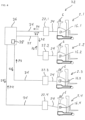
- Fig.4 shows a logistics system 32 in a schematically simplified representation.
- the logistics system 32 comprises several industrial trucks 2, four industrial trucks 2.1 to 2.4 are shown as an example.
- Each of the industrial trucks, which are still generally designated with reference number 2 can be designed as described in connection with the Fig. 1 to 3
- the industrial trucks 2.1..2.4 are each connected to a charging cable 24
- Chargers 22.1 to 22.4 are connected.
- the chargers 22.1..22.4 are in turn coupled to a central computer 36 of the logistics system 32 via suitable data lines 34.
- the central computer 36 comprises a comparison unit 38.
- the first industrial truck 2.1 comprises a first control unit 16.1, which is set up to record a first internal vehicle status parameter P1 of the first industrial truck 2.1 and to transmit it to the comparison unit 38.
- the data transfer takes place, for example, via the first charger 22.1. Alternatively, it can also take place via a direct data connection between the first industrial truck 2.1 and the central computer 36.
- the second industrial truck 2.2 comprises a second control unit 16.2, which is set up to record a second internal vehicle status parameter P2.
- the second industrial truck 2.2 also transmits the vehicle status parameter P2 to the comparison unit 38, whereby what has already been said about the first industrial truck 2.1 applies with regard to the data transfer.
- the comparison unit 38 is set up to compare the first and the second vehicle state parameters P1, P2 with each other.
- the vehicle state parameters P1, P2 can be, for example, a charge state of the respective traction battery 14 of the industrial truck 2.1, 2.2 or any other vehicle state parameter.
- the comparison unit 38 produces a comparison result and generates a first and a second control signal S1 and S2, respectively.
- the first control signal S1 indicates a ratio of the first vehicle state parameter P1 to the comparison result.
- the second control signal S2 indicates a ratio of the second vehicle state parameter P2 to the comparison result. If the vehicle state parameters P1, P2 are, for example, the charge state of the traction battery 14, the maximum charge level is determined as the comparison result, for example.
- the comparison result would be 80%.
- the individual vehicle state parameters P1, P2 are now related to this comparison result.
- the second vehicle state parameter (60% charge level) is smaller than the comparison result (80% charge level). Accordingly, information relating to the display of a red light signal could be generated as the second control signal S2, for example.
- the first control signal S1 on the other hand, would generate a green light signal because the charge level of the traction battery 14 of the first industrial truck 2.1 corresponds to the maximum value.
- the comparison unit 38 is set up to transmit the first control signal S1 to the first control unit 16.1 of the first industrial truck 2.1.
- the second control signal S2 is also transmitted to the second control unit 16.2 of the second industrial truck 2.2.
- the data communication can take place via the relevant chargers 22.1 or 22.2.
- Direct, for example wireless, communication can also be provided between the central computer 36 and the industrial trucks 2.1, 2.2 or their control units 16.1, 16.2.
- the first control unit 16.1 of the first industrial truck 2.1 is now set up to control a vehicle light 6 of the first industrial truck in a first pattern.
- This first pattern is, for example, a green light and is based on the first control signal S1.
- the second control unit 16.2 of the second industrial truck 2.2 is set up to control the vehicle light 6 of this industrial truck in a second pattern based on the second control signal S2. This would be, for example, the reproduction of a red light signal.
- the comparison explained above by way of example for the first and second industrial trucks 2.1, 2.2 can also be carried out with reference to several vehicle state parameters, for example a third vehicle state parameter P3 of the third industrial truck 2.3 with a fourth vehicle state parameter P4 of the fourth industrial truck 2.4.
- the comparison unit 38 carries out a comparison not only between a first and a second vehicle state parameter P1, P2, but between several vehicle state parameters, for example the four vehicle state parameters P1 to P4 of the four industrial trucks 2.1 to 2.4. Again, a comparison result is determined and the individual vehicle state parameters P1 .. P4 are assigned in relation to the determined comparison result.
- control signals S1..S4 are generated and then the respective control units 16.1..16.4 of the industrial trucks 2.1..2.4 generate corresponding light signals on the respective vehicle lights 6.
- the vehicle light 6 of the industrial truck with the highest charge level of the traction battery 14 will light up green.
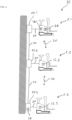
- Fig.5 shows another logistics system 32, comprising three industrial trucks 2.1..2.3. Deviating from the one in connection with Fig.4
- the logistics system 32 explained in Fig.5
- the logistics system 32 shown does not have a central computer 36.
- the comparison unit 38 is instead located in one of the industrial trucks 2.1..2.3, for example in the first industrial truck 2.1.
- the comparison unit 38 can be implemented as part of the vehicle control 20 of this industrial truck 2.1 or as part of the first control unit 16.1 of the industrial truck 2.1.
- the industrial trucks 2.1..2.3 are directly coupled to one another via wireless data connections 30 so that all industrial trucks 2.1..2.3 can communicate with one another.
- the comparison unit 38 is implemented in one of the chargers 22.1..22.3. This is shown as an example for the third charger 22.3. So that, as already mentioned, the required data exchange can take place, the chargers 22.1..22.3 are connected to one another by suitable data lines 34 so that the vehicle state parameters P1..P3 can reach the comparison unit 38 via the chargers 22.1..22.3, starting from the industrial trucks 2.1..2.3.
- the communication of the control signals S1 ..S3 takes place from the comparison unit 38 via the charging devices 22.1..22.3 to the industrial trucks 2.1..2.3 or to their control units 16.1 .. 16.3.
- the logistics system 32 is set up in such a way that it comprises at least one charger 22 and an electrically driven industrial truck 2.
- the industrial truck 2 comprises a lighting device 4, which in turn comprises at least one vehicle light 6.
- the industrial truck also comprises a control unit 16 for controlling the vehicle light 6.
- the control unit 16 of the industrial truck 2 is set up to detect at least one status parameter of the charger 22 and to control the vehicle light 6 in a pattern based on the at least one status parameter of the charger 22.
- the status parameter of the charger 22 can provide information about its performance, operational readiness or even a need for service.
- the logistics system 32 comprises a central computer 36, which can also be implemented in a cloud.
- the central computer 36 queries the status parameter of the charger 22 from the charger 22, for example, and communicates this to the industrial truck 2. It can also be provided that the industrial truck 2 queries the status parameter of the charger 22 from the central computer 36.
Landscapes
- Engineering & Computer Science (AREA)
- Mechanical Engineering (AREA)
- Transportation (AREA)
- Structural Engineering (AREA)
- Power Engineering (AREA)
- Life Sciences & Earth Sciences (AREA)
- Geology (AREA)
- Civil Engineering (AREA)
- Sustainable Energy (AREA)
- Sustainable Development (AREA)
- Chemical & Material Sciences (AREA)
- Combustion & Propulsion (AREA)
- Physics & Mathematics (AREA)
- General Physics & Mathematics (AREA)
- Forklifts And Lifting Vehicles (AREA)
- Lighting Device Outwards From Vehicle And Optical Signal (AREA)
Applications Claiming Priority (1)
| Application Number | Priority Date | Filing Date | Title |
|---|---|---|---|
| DE102022123668.4A DE102022123668A1 (de) | 2022-09-15 | 2022-09-15 | Flurförderzeug mit einer Beleuchtungseinrichtung, Logistiksystem mit mehreren Flurförderzeugen, Verfahren zum Betrieb der Beleuchtungseinrichtung und des Logistiksystems |
Publications (2)
| Publication Number | Publication Date |
|---|---|
| EP4349768A2 true EP4349768A2 (fr) | 2024-04-10 |
| EP4349768A3 EP4349768A3 (fr) | 2024-08-07 |
Family
ID=87929162
Family Applications (1)
| Application Number | Title | Priority Date | Filing Date |
|---|---|---|---|
| EP23194906.6A Pending EP4349768A3 (fr) | 2022-09-15 | 2023-09-01 | Chariot de manutention doté d'un dispositif d'éclairage, système logistique doté de plusieurs chariots de manutention, procédé de fonctionnement du dispositif d'éclairage et du système logistique |
Country Status (4)
| Country | Link |
|---|---|
| US (1) | US12545178B2 (fr) |
| EP (1) | EP4349768A3 (fr) |
| CN (1) | CN117698562A (fr) |
| DE (1) | DE102022123668A1 (fr) |
Families Citing this family (1)
| Publication number | Priority date | Publication date | Assignee | Title |
|---|---|---|---|---|
| DE102023128663A1 (de) | 2022-10-25 | 2024-04-25 | Uusi, Llc | Fahrzeuganordnung mit einem kapazitiven sensor |
Family Cites Families (17)
| Publication number | Priority date | Publication date | Assignee | Title |
|---|---|---|---|---|
| US6992461B2 (en) * | 2003-10-29 | 2006-01-31 | Hui-Hu Liang | Automotive-use charger flashing light array |
| CA2860745C (fr) * | 2006-09-14 | 2016-03-08 | Crown Equipment Corporation | Association d'un emetteur et d'un recepteur dans un systeme de telecommande supplementaire pour des vehicules de manutention de materiaux |
| AU2009236284B2 (en) * | 2008-04-18 | 2013-10-31 | The Raymond Corporation | System for managing operation of industrial vehicles to carry fragile loads |
| US7872572B2 (en) * | 2008-09-17 | 2011-01-18 | International Business Machines Corporation | Method and system for vehicle mounted infrared wavelength information displays for traffic camera viewers |
| US8473131B2 (en) * | 2009-09-28 | 2013-06-25 | Powerhydrant Llc | Method and system for charging electric vehicles |
| FR2977324B1 (fr) * | 2011-06-30 | 2014-01-24 | Ier Systems | Procede et systeme de connexion/deconnexion d'un vehicule electrique a une borne de charge. |
| GB201415821D0 (en) * | 2014-09-05 | 2014-10-22 | Laker Jonathan | Safety system |
| US9975472B2 (en) * | 2015-04-30 | 2018-05-22 | Tyri International, Inc. | Controllable lighting arrangement for a vehicle |
| TWI699639B (zh) * | 2016-10-13 | 2020-07-21 | 原相科技股份有限公司 | 充電系統以及充電方法 |
| DE102018108468A1 (de) * | 2018-04-10 | 2019-10-10 | Still Gmbh | Verfahren und Vorrichtung zur Anzeige des Ladezustands einer Batterie eines Flurförderzeugs beim Laden der Batterie |
| SE542680C2 (en) * | 2018-07-10 | 2020-06-23 | Scania Cv Ab | A method for controlling a vehicle lighting device, a control device, a vehicle lighting device, a vehicle, a computer program and a computer-readable medium |
| US20200114815A1 (en) * | 2018-10-15 | 2020-04-16 | R. Kemp Massengill | Anti-tailgating system |
| US10922980B2 (en) * | 2018-12-14 | 2021-02-16 | Bendix Commercial Vehicle Systems Llc | Platooning traffic annunciator |
| US11225163B2 (en) * | 2019-04-12 | 2022-01-18 | GM Global Technology Operations LLC | Electric vehicle charging platform |
| CN116137849B (zh) * | 2020-08-06 | 2026-04-17 | 克朗设备公司 | 物料搬运车辆的性能调优 |
| US12294917B2 (en) * | 2021-01-15 | 2025-05-06 | Oshkosh Corporation | Local fleet connectivity system hub |
| US12036918B2 (en) * | 2022-03-29 | 2024-07-16 | Caterpillar Paving Products Inc. | System and method for operating beacon lights in machines |
-
2022
- 2022-09-15 DE DE102022123668.4A patent/DE102022123668A1/de active Pending
-
2023
- 2023-09-01 EP EP23194906.6A patent/EP4349768A3/fr active Pending
- 2023-09-06 US US18/242,720 patent/US12545178B2/en active Active
- 2023-09-14 CN CN202311189072.0A patent/CN117698562A/zh active Pending
Also Published As
| Publication number | Publication date |
|---|---|
| US12545178B2 (en) | 2026-02-10 |
| CN117698562A (zh) | 2024-03-15 |
| US20240092258A1 (en) | 2024-03-21 |
| EP4349768A3 (fr) | 2024-08-07 |
| DE102022123668A1 (de) | 2024-03-21 |
Similar Documents
| Publication | Publication Date | Title |
|---|---|---|
| DE102018008213A1 (de) | Verfahren zum Visualisieren eines Übergangs über eine Straße | |
| DE102019126081A1 (de) | Kondensatorzustandsanzeigevorrichtung für Fahrzeuge | |
| DE102011115161A1 (de) | Anzeigevorrichtung für einen Ladezustand einer Kraftfahrzeug-Traktionsbatterie | |
| DE102012013602A1 (de) | Signalisierung eines Nothalteverfahrens eines Kraftfahrzeugs | |
| EP3546419B1 (fr) | Procédé et système permettant d'éviter les collisions dans une zone dangereuse d'un dispositif de logistique des marchandises | |
| DE202017102776U1 (de) | Dachträgersystem für Fahrzeug | |
| DE102019109953A1 (de) | Fahrzeugtrittbrettanordnung | |
| DE102016118873A1 (de) | Heckbeleuchtungssystem für ein Fahrzeug | |
| DE102005045721A1 (de) | System zur Unterstützung eines Fahrers eines Flurförderzeugs während der Fahrt | |
| EP4349768A2 (fr) | Chariot de manutention doté d'un dispositif d'éclairage, système logistique doté de plusieurs chariots de manutention, procédé de fonctionnement du dispositif d'éclairage et du système logistique | |
| DE102018006830A1 (de) | Außenhaut für ein Fahrzeug und Verfahren zur Darstellung von Informationen | |
| DE102016215484A1 (de) | Verfahren und Vorrichtung zum Signalisieren eines fahrerlosen Betriebszustands eines Kraftfahrzeugs | |
| EP0715288B1 (fr) | Méthode et dispositif pour réduire la quantité de données qui doit être transmise par véhicules d'une flotte de véhicules témoins | |
| EP3594062A1 (fr) | Procédé de fonctionnement d'un véhicule automobile autonome | |
| DE102021129019B4 (de) | Fahrzeug-ladezustands-anzeigesystem, fahrzeug-stromversorgungs-anzeigesystem und fahrzeug | |
| DE102021109065B3 (de) | Kupplungsbolzen für ein Zugfahrzeug eines Fahrzeugverbundes | |
| DE102019125245A1 (de) | System und Verfahren zum bedarfsorientierten Anpassen eines Durchlasses zwischen zwei Fahrzeugen | |
| EP2520537A1 (fr) | Procédé de gestion de flottes de chariots de manutention | |
| DE10219712A1 (de) | Wählbare Blinksequenz für ein Straßenfahrzeug-Beleuchtungssystem | |
| EP0997860A2 (fr) | Drapeau et système de signalisation pour sport mécanique | |
| EP4323261B1 (fr) | Pivot d'attelage de sellette pour la semi-remorque d'un camion semi-remorque | |
| DE102019008661A1 (de) | Lichtassistenzsystem für ein Fahrzeug | |
| DE102015207938A1 (de) | Verfahren zur Steuerung einer Leuchtintensität von Bremslichtern | |
| DE102018216394A1 (de) | Verfahren zum Betreiben eines Kraftfahrzeugs | |
| DE102020125683A1 (de) | Kraftfahrzeug mit Außenleuchten und einer Steuereinrichtung |
Legal Events
| Date | Code | Title | Description |
|---|---|---|---|
| PUAI | Public reference made under article 153(3) epc to a published international application that has entered the european phase |
Free format text: ORIGINAL CODE: 0009012 |
|
| STAA | Information on the status of an ep patent application or granted ep patent |
Free format text: STATUS: THE APPLICATION HAS BEEN PUBLISHED |
|
| AK | Designated contracting states |
Kind code of ref document: A2 Designated state(s): AL AT BE BG CH CY CZ DE DK EE ES FI FR GB GR HR HU IE IS IT LI LT LU LV MC ME MK MT NL NO PL PT RO RS SE SI SK SM TR |
|
| PUAL | Search report despatched |
Free format text: ORIGINAL CODE: 0009013 |
|
| AK | Designated contracting states |
Kind code of ref document: A3 Designated state(s): AL AT BE BG CH CY CZ DE DK EE ES FI FR GB GR HR HU IE IS IT LI LT LU LV MC ME MK MT NL NO PL PT RO RS SE SI SK SM TR |
|
| RIC1 | Information provided on ipc code assigned before grant |
Ipc: B60L 53/66 20190101ALI20240701BHEP Ipc: H04W 4/46 20180101ALI20240701BHEP Ipc: B66F 9/075 20060101ALI20240701BHEP Ipc: G07C 5/08 20060101ALI20240701BHEP Ipc: B60Q 1/50 20060101ALI20240701BHEP Ipc: B60Q 1/26 20060101ALI20240701BHEP Ipc: B66F 17/00 20060101ALI20240701BHEP Ipc: B66F 9/24 20060101AFI20240701BHEP |
|
| STAA | Information on the status of an ep patent application or granted ep patent |
Free format text: STATUS: REQUEST FOR EXAMINATION WAS MADE |
|
| 17P | Request for examination filed |
Effective date: 20250121 |