EP4353600A1 - Eingebettete selbstreinigende nah-uv-elektronik für eine fahrgastkontrolleinheit (pcu) - Google Patents
Eingebettete selbstreinigende nah-uv-elektronik für eine fahrgastkontrolleinheit (pcu) Download PDFInfo
- Publication number
- EP4353600A1 EP4353600A1 EP23203861.2A EP23203861A EP4353600A1 EP 4353600 A1 EP4353600 A1 EP 4353600A1 EP 23203861 A EP23203861 A EP 23203861A EP 4353600 A1 EP4353600 A1 EP 4353600A1
- Authority
- EP
- European Patent Office
- Prior art keywords
- pcu
- led units
- contact surface
- contact surfaces
- cabin
- Prior art date
- Legal status (The legal status is an assumption and is not a legal conclusion. Google has not performed a legal analysis and makes no representation as to the accuracy of the status listed.)
- Pending
Links
Images


Classifications
-
- A—HUMAN NECESSITIES
- A61—MEDICAL OR VETERINARY SCIENCE; HYGIENE
- A61L—METHODS OR APPARATUS FOR STERILISING MATERIALS OR OBJECTS IN GENERAL; DISINFECTION, STERILISATION OR DEODORISATION OF AIR; CHEMICAL ASPECTS OF BANDAGES, DRESSINGS, ABSORBENT PADS OR SURGICAL ARTICLES; MATERIALS FOR BANDAGES, DRESSINGS, ABSORBENT PADS OR SURGICAL ARTICLES
- A61L2/00—Disinfection or sterilisation of materials or objects, in general; Accessories therefor
- A61L2/24—Apparatus using programmed or automatic operation
-
- B—PERFORMING OPERATIONS; TRANSPORTING
- B64—AIRCRAFT; AVIATION; COSMONAUTICS
- B64D—EQUIPMENT FOR FITTING IN OR TO AIRCRAFT; FLIGHT SUITS; PARACHUTES; ARRANGEMENT OR MOUNTING OF POWER PLANTS OR PROPULSION TRANSMISSIONS IN AIRCRAFT
- B64D47/00—Equipment not otherwise provided for
- B64D47/02—Arrangements or adaptations of signal or lighting devices
-
- A—HUMAN NECESSITIES
- A61—MEDICAL OR VETERINARY SCIENCE; HYGIENE
- A61L—METHODS OR APPARATUS FOR STERILISING MATERIALS OR OBJECTS IN GENERAL; DISINFECTION, STERILISATION OR DEODORISATION OF AIR; CHEMICAL ASPECTS OF BANDAGES, DRESSINGS, ABSORBENT PADS OR SURGICAL ARTICLES; MATERIALS FOR BANDAGES, DRESSINGS, ABSORBENT PADS OR SURGICAL ARTICLES
- A61L2/00—Disinfection or sterilisation of materials or objects, in general; Accessories therefor
- A61L2/02—Disinfection or sterilisation of materials or objects, in general; Accessories therefor using physical processes
- A61L2/08—Radiation
- A61L2/084—Visible light
-
- B—PERFORMING OPERATIONS; TRANSPORTING
- B60—VEHICLES IN GENERAL
- B60K—ARRANGEMENT OR MOUNTING OF PROPULSION UNITS OR OF TRANSMISSIONS IN VEHICLES; ARRANGEMENT OR MOUNTING OF PLURAL DIVERSE PRIME-MOVERS IN VEHICLES; AUXILIARY DRIVES FOR VEHICLES; INSTRUMENTATION OR DASHBOARDS FOR VEHICLES; ARRANGEMENTS IN CONNECTION WITH COOLING, AIR INTAKE, GAS EXHAUST OR FUEL SUPPLY OF PROPULSION UNITS IN VEHICLES
- B60K35/00—Instruments specially adapted for vehicles; Arrangement of instruments in or on vehicles
- B60K35/10—Input arrangements, i.e. from user to vehicle, associated with vehicle functions or specially adapted therefor
-
- B—PERFORMING OPERATIONS; TRANSPORTING
- B60—VEHICLES IN GENERAL
- B60K—ARRANGEMENT OR MOUNTING OF PROPULSION UNITS OR OF TRANSMISSIONS IN VEHICLES; ARRANGEMENT OR MOUNTING OF PLURAL DIVERSE PRIME-MOVERS IN VEHICLES; AUXILIARY DRIVES FOR VEHICLES; INSTRUMENTATION OR DASHBOARDS FOR VEHICLES; ARRANGEMENTS IN CONNECTION WITH COOLING, AIR INTAKE, GAS EXHAUST OR FUEL SUPPLY OF PROPULSION UNITS IN VEHICLES
- B60K35/00—Instruments specially adapted for vehicles; Arrangement of instruments in or on vehicles
- B60K35/20—Output arrangements, i.e. from vehicle to user, associated with vehicle functions or specially adapted therefor
-
- B—PERFORMING OPERATIONS; TRANSPORTING
- B64—AIRCRAFT; AVIATION; COSMONAUTICS
- B64D—EQUIPMENT FOR FITTING IN OR TO AIRCRAFT; FLIGHT SUITS; PARACHUTES; ARRANGEMENT OR MOUNTING OF POWER PLANTS OR PROPULSION TRANSMISSIONS IN AIRCRAFT
- B64D11/00—Passenger or crew accommodation; Flight-deck installations not otherwise provided for
- B64D11/0015—Arrangements for entertainment or communications, e.g. radio, television
- B64D11/00155—Individual entertainment or communication system remote controls therefor, located in or connected to seat components, e.g. to seat back or arm rest
-
- A—HUMAN NECESSITIES
- A61—MEDICAL OR VETERINARY SCIENCE; HYGIENE
- A61L—METHODS OR APPARATUS FOR STERILISING MATERIALS OR OBJECTS IN GENERAL; DISINFECTION, STERILISATION OR DEODORISATION OF AIR; CHEMICAL ASPECTS OF BANDAGES, DRESSINGS, ABSORBENT PADS OR SURGICAL ARTICLES; MATERIALS FOR BANDAGES, DRESSINGS, ABSORBENT PADS OR SURGICAL ARTICLES
- A61L2/00—Disinfection or sterilisation of materials or objects, in general; Accessories therefor
- A61L2/02—Disinfection or sterilisation of materials or objects, in general; Accessories therefor using physical processes
- A61L2/08—Radiation
- A61L2/10—Ultraviolet [UV] radiation
-
- A—HUMAN NECESSITIES
- A61—MEDICAL OR VETERINARY SCIENCE; HYGIENE
- A61L—METHODS OR APPARATUS FOR STERILISING MATERIALS OR OBJECTS IN GENERAL; DISINFECTION, STERILISATION OR DEODORISATION OF AIR; CHEMICAL ASPECTS OF BANDAGES, DRESSINGS, ABSORBENT PADS OR SURGICAL ARTICLES; MATERIALS FOR BANDAGES, DRESSINGS, ABSORBENT PADS OR SURGICAL ARTICLES
- A61L2103/00—Materials or objects being the target of disinfection or sterilisation
- A61L2103/75—Room floors or walls
-
- A—HUMAN NECESSITIES
- A61—MEDICAL OR VETERINARY SCIENCE; HYGIENE
- A61L—METHODS OR APPARATUS FOR STERILISING MATERIALS OR OBJECTS IN GENERAL; DISINFECTION, STERILISATION OR DEODORISATION OF AIR; CHEMICAL ASPECTS OF BANDAGES, DRESSINGS, ABSORBENT PADS OR SURGICAL ARTICLES; MATERIALS FOR BANDAGES, DRESSINGS, ABSORBENT PADS OR SURGICAL ARTICLES
- A61L2202/00—Aspects relating to methods or apparatus for disinfecting or sterilising materials or objects
- A61L2202/10—Apparatus features
- A61L2202/11—Apparatus for generating biocidal substances, e.g. vaporisers, UV lamps
-
- A—HUMAN NECESSITIES
- A61—MEDICAL OR VETERINARY SCIENCE; HYGIENE
- A61L—METHODS OR APPARATUS FOR STERILISING MATERIALS OR OBJECTS IN GENERAL; DISINFECTION, STERILISATION OR DEODORISATION OF AIR; CHEMICAL ASPECTS OF BANDAGES, DRESSINGS, ABSORBENT PADS OR SURGICAL ARTICLES; MATERIALS FOR BANDAGES, DRESSINGS, ABSORBENT PADS OR SURGICAL ARTICLES
- A61L2202/00—Aspects relating to methods or apparatus for disinfecting or sterilising materials or objects
- A61L2202/10—Apparatus features
- A61L2202/14—Means for controlling sterilisation processes, data processing, presentation and storage means, e.g. sensors, controllers, programs
-
- B—PERFORMING OPERATIONS; TRANSPORTING
- B60—VEHICLES IN GENERAL
- B60K—ARRANGEMENT OR MOUNTING OF PROPULSION UNITS OR OF TRANSMISSIONS IN VEHICLES; ARRANGEMENT OR MOUNTING OF PLURAL DIVERSE PRIME-MOVERS IN VEHICLES; AUXILIARY DRIVES FOR VEHICLES; INSTRUMENTATION OR DASHBOARDS FOR VEHICLES; ARRANGEMENTS IN CONNECTION WITH COOLING, AIR INTAKE, GAS EXHAUST OR FUEL SUPPLY OF PROPULSION UNITS IN VEHICLES
- B60K2360/00—Indexing scheme associated with groups B60K35/00 or B60K37/00 relating to details of instruments or dashboards
- B60K2360/143—Touch sensitive instrument input devices
- B60K2360/1434—Touch panels
-
- B—PERFORMING OPERATIONS; TRANSPORTING
- B60—VEHICLES IN GENERAL
- B60K—ARRANGEMENT OR MOUNTING OF PROPULSION UNITS OR OF TRANSMISSIONS IN VEHICLES; ARRANGEMENT OR MOUNTING OF PLURAL DIVERSE PRIME-MOVERS IN VEHICLES; AUXILIARY DRIVES FOR VEHICLES; INSTRUMENTATION OR DASHBOARDS FOR VEHICLES; ARRANGEMENTS IN CONNECTION WITH COOLING, AIR INTAKE, GAS EXHAUST OR FUEL SUPPLY OF PROPULSION UNITS IN VEHICLES
- B60K2360/00—Indexing scheme associated with groups B60K35/00 or B60K37/00 relating to details of instruments or dashboards
- B60K2360/20—Optical features of instruments
- B60K2360/33—Illumination features
- B60K2360/345—Illumination of controls
-
- B—PERFORMING OPERATIONS; TRANSPORTING
- B60—VEHICLES IN GENERAL
- B60K—ARRANGEMENT OR MOUNTING OF PROPULSION UNITS OR OF TRANSMISSIONS IN VEHICLES; ARRANGEMENT OR MOUNTING OF PLURAL DIVERSE PRIME-MOVERS IN VEHICLES; AUXILIARY DRIVES FOR VEHICLES; INSTRUMENTATION OR DASHBOARDS FOR VEHICLES; ARRANGEMENTS IN CONNECTION WITH COOLING, AIR INTAKE, GAS EXHAUST OR FUEL SUPPLY OF PROPULSION UNITS IN VEHICLES
- B60K35/00—Instruments specially adapted for vehicles; Arrangement of instruments in or on vehicles
- B60K35/20—Output arrangements, i.e. from vehicle to user, associated with vehicle functions or specially adapted therefor
- B60K35/21—Output arrangements, i.e. from vehicle to user, associated with vehicle functions or specially adapted therefor using visual output, e.g. blinking lights or matrix displays
- B60K35/211—Output arrangements, i.e. from vehicle to user, associated with vehicle functions or specially adapted therefor using visual output, e.g. blinking lights or matrix displays producing three-dimensional [3D] effects, e.g. stereoscopic images
-
- B—PERFORMING OPERATIONS; TRANSPORTING
- B64—AIRCRAFT; AVIATION; COSMONAUTICS
- B64D—EQUIPMENT FOR FITTING IN OR TO AIRCRAFT; FLIGHT SUITS; PARACHUTES; ARRANGEMENT OR MOUNTING OF POWER PLANTS OR PROPULSION TRANSMISSIONS IN AIRCRAFT
- B64D11/00—Passenger or crew accommodation; Flight-deck installations not otherwise provided for
- B64D2011/0038—Illumination systems for cabins as a whole
Definitions
- PCU Passenger control units
- PSU passenger service units
- PCUs are generally high touch surfaces.
- a passenger may make repeated physical contact with a PCU during the course of a flight. If a given aircraft arrives, via a first flight, at an airport with an initial passenger complement and later departs said airport via a second flight with a partially or fully new passenger complement, each PCU (in addition to other high touch surfaces in galley areas, lavatory areas, and elsewhere throughout the passenger cabin) is a vehicle for potential transmission of influenza-A, COVID-19, and other communicable microorganisms.
- PCU modules may be illuminated to provide a passenger with visual guidance that facilitates PCU operation in a darkened cabin.
- Ultraviolet light or luminous output of certain wavelengths within the ultraviolet spectrum (e.g., 10-400 nm), has been shown effective at disinfecting high touch surfaces via prolonged exposure.
- challenges are associated with conventional approaches to disinfecting high touch surfaces via UV.
- ultraviolet-C wavelengths UVC or UV-C; e.g., 254 nm, 275 nm, or wavelengths 280 nm or less generally
- UVC or UV-C e.g., 254 nm, 275 nm, or wavelengths 280 nm or less generally
- UVA or UV-A ultraviolet-A
- UVC wavelengths at 222 nm are safe for humans due to the shorter wavelengths, but require cumbersome and expensive noble gas-filled excimer lamps for UV emission.
- a self-cleaning passenger control unit for an aircraft cabin
- the self-cleaning PCU includes an embedded electronic component installable in a cabin surface (for example, a set of contact surfaces allowing a passenger to control seat configuration, reading lights, cabin crew call, ventilation, in-flight entertainment (IFE) and/or other cabin services or functions.
- the embedded electronic component includes inner and outer films fused or bonded to inner and outer faces of an injected or molded transparent polycarbonate layer.
- the contact surfaces are set into the outer film and therefore are high-touch surfaces associated with frequent and/or long-term passenger contact. Each contact surface may be labeled to identify the cabin surface controllable by that contact surface.
- the inner film includes embedded electronic contacts (e.g., circuitry for receiving control input through the contact surfaces and transmitting control signals to the appropriate cabin services) and embedded near-ultraviolet (near-UV) LED units configured for continuous luminous output in the near-UIV range (e.g., wavelengths at or near 405 nm).
- the near-UV luminous output is directed through the injected polycarbonate layer to irradiate and disinfect the outer high-touch contact surfaces.
- the PCU includes an interface pluggable into aircraft systems and networks, allowing for transmission of control signals from the PCU to the appropriate cabin system or function.
- the near-UV LED units are oriented for lateral or indirect emission relative to the outer film and contact surfaces.
- the injected polycarbonate layer provides waveguides for directing the near-UV luminous output to the outer film.
- the inner film includes printed patterns for directing and/or diffusing the near-UV luminous output.
- the PCU includes negative contact surfaces, e.g., an illuminated transparent or translucent background and opaque or semi-opaque graphic elements identifying the controlled cabin system.
- the PCU includes positive contact surfaces, e.g., an opaque or semi-opaque background and illuminated graphic elements.
- the PCU incorporates three-dimensional (3D) graphic elements extending above the surrounding contact surface.
- controllable cabin systems include seat configurations, reading or cabin lights, fans or vents, or cabin crew call signals.
- the PCU includes additional LED units for altering the color of the luminous output, e.g., if the blue color of the near-UV LED output is undesirable.
- the PCU is a multiplanar PCU incorporating contact surfaces in multiple or staggered planes.
- the PCU is a partially or fully nonplanar PCU incorporating curved contact surfaces and/or conforming/contouring to a curved/nonplanar cabin surface.
- a letter following a reference numeral is intended to reference an embodiment of the feature or element that may be similar, but not necessarily identical, to a previously described element or feature bearing the same reference numeral (e.g., 1, 1a, 1b).
- reference numeral e.g. 1, 1a, 1b
- Such shorthand notations are used for purposes of convenience only and should not be construed to limit the disclosure in any way unless expressly stated to the contrary.
- any reference to “one embodiment” or “some embodiments” means that a particular element, feature, structure, or characteristic described in connection with the embodiment is included in at least one embodiment disclosed herein.
- the appearances of the phrase “in some embodiments” in various places in the specification are not necessarily all referring to the same embodiment, and embodiments may include one or more of the features expressly described or inherently present herein, or any combination or sub-combination of two or more such features, along with any other features which may not necessarily be expressly described or inherently present in the instant disclosure.
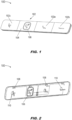
- FIG. 1 a self-cleaning/self-disinfecting PCU 100 is shown.
- the PCU 100 may be disposed on or near a passenger seat, e.g., either incorporated into the passenger seat or set into a wall surface or other surface proximate to the passenger seat.
- the PCU 100 may be incorporated into or near a particular passenger seat for use by the passenger occupying said passenger seat.
- the exterior surface of the PCU 100 may be divided into a set of individual contact surfaces 102 (e.g., button surfaces), each contact surface dedicated to the control of a particular cabin system or cabin function by the occupying passenger.
- individual contact surfaces 102 may allow the passenger, via physical contact with the contact surface, to, e.g.: call or alert a crewmember; activate/deactivate a reading light; convert the passenger seat to a reclined (102a) or berthed (102b) configuration; return the passenger seat to the upright configuration (102c); activate/deactivate a fan or gasper; engage with an in-flight entertainment (IFE) system; and/or interact with the aircraft and/or flight crew in various other ways.
- the individual contact surfaces 102, 102a-102c are high-touch surfaces in that one or more contact surfaces may be subject to frequent physical contact, e.g., either by a single passenger or by multiple passengers and/or crewmembers.
- each individual contact surface 102, 102a-c may be illuminated from within, such that each contact surface is sanitized via continuous near-ultraviolet (near-UV) irradiation.
- the self-cleaning PCU 100 may incorporate embedded electronic components which provide continuous irradiation of the contact surfaces 102 to luminous output in the near-ultraviolet (near UV) range, disinfecting the contact surfaces of any viral and bacterial microorganisms which may be deposited there via repeated passenger contact.
- each contact surface 102, 102a-c may be a negative contact surface incorporating transparent or translucent background layer 104 and one or more opaque or semi-opaque graphic elements 106.
- the background layer 104 may be fully transparent or translucent, such that the background layer is backlit via one or more light emitting diode (LED) units 108 embedded within the PCU 100.
- the background layer 104 may be backlit to facilitate distinction of one contact surface 102, 102a-c from the other contact surfaces, e.g., for ease of use of the PCU 100 in a darkened cabin, and for near-UV disinfection of the contact surfaces via the embedded LED units 108.
- the PCU 100 may include electronic contacts 110 embedded within the PCU.
- each electronic contact 110 may include circuitry for carrying control input provided by a passenger or other user (e.g., via engagement with a contact surface 102, 102a-102c) to the device or cabin system controlled by said contact surface, as discussed in detail below.
- the PCU 100 may comprise an embedded electronic component wherein an injected polycarbonate layer 300 (e.g., molded layer) is fused between an outer film 304 (e.g., exterior substrate) and an inner film 302 (e.g., interior substrate).
- an injected polycarbonate layer 300 e.g., molded layer
- the high-touch contact surfaces 102 may be incorporated into the outer film 304, such that the outer film may be divided into a set of contact surfaces, each contact surface including one or more graphic elements 106.
- the LED units 108 and electronic contacts 110 may be attached to the inner film 302, the LED units attached near an edge 306 of the PCU 100 and the electronic contacts centered behind each contact surface 102, such that the LED units and electronic traces are embedded within the injected polycarbonate layer 300.
- the LED units 108 may be attached to the inner film 302 near an intersection of edges 308 or otherwise not directly centered under a transparent or translucent portion of the outer film 304 and/or contact surfaces 102.
- the near-UV luminous output of the LED units 108 may include wavelengths between 380 nm and 420 nm, preferably at or around 405 nm in wavelength.
- the near-UV luminous output of the LED units 108 may be directed at and through the outer film 304 from the inside, continuously irradiating the outer film and its component contact surfaces 102 and providing long-term disinfection of the contact surfaces against microorganisms deposited there by passenger contact surface.
- the LED units 108 may be configured for lateral (e.g., indirect) luminous emission; for example, the luminous output of the LED units may not be aimed directly at the contact surfaces 102 or the outer film 304, but may be directed thereto via the injected polycarbonate layer 300.
- the LED units 108 may provide continuous self-disinfection of the contact surfaces 102 through continuous exposure to near-UV luminous output.
- luminous output at 405 nm is not associated with long-term damage to human tissue. Accordingly, the continuous luminous output at 405 nm presents no danger to passengers in the vicinity of the luminous output, even if the LED units 108 remain active while the passenger cabin is occupied, e.g., inflight.
- the near-UV luminous output of the LED units 108 may be associated with a soft blue tone that may be acceptable for use as backlighting to the contact surfaces 102 as described above.
- the embedded electronic component may include diffusive patterns 310 printed onto the inner film 302.
- the diffusive patterns 310 may promote the direction and/or diffusion of the near-UV luminous output of the LED units 108, such that the luminous output of the LED units (e.g., and the irradiation of the contact surfaces 102) is uniform as well as continuous.
- the efficacy of the self-cleaning PCU 100 in disinfecting the contact surfaces may depend on several factors including the ratio of near-UV LED units 108 to the surface area of the outer film 304 and the transmittance of the injected polycarbonate layer 300.
- the dosage of 405 nm near-UV radiation received by the contact surfaces 102 e.g., in joules per cm 2
- may be function of irradiance, e.g.: dosage J cm 2 irradiance mW cm 2 ⁇ transmittance ⁇ time sec
- irradiance mW cm 2 LED luminous flux lm ⁇ number of LED units PCU surface area .
- the irradiance shown by equation 2 may be optimized by the incorporation by the PCU 100 of additional near-UV LED units 108.
- the PCU 100 may be configured for higher or lower irradiance based on, e.g., the placement of the PCU relative to a passenger cabin or to a passenger (PCUs associated with passenger seats may be configured for lower overall irradiance while PCUs in higher traffic illuminated areas (or, e.g., handles, switches, and other high touch surfaces in lavatory or galley areas) may be configured for higher overall irradiance).
- the PCU 100 may improve upon conventional backlit embedded electronics by eliminating an air gap between the outer and inner films 302, 304.
- the substantially transparent or translucent injected polycarbonate layer 300 may be fused between outer and inner films 302, 304 such that the polycarbonate layer extends fully between the outer and inner films and may serve as a waveguide for directing the lateral luminous output 400 of the LED units 108 toward (402) the outer film and its component contact surfaces (102, FIG. 3 ) in a uniform fashion.
- the distance between the near-UV LED units 108 and the outer film (and its component contact surfaces 102) may be significantly reduced with respect to a conventional backlit PCU.
- the embedded electronic component of the self-cleaning PCU 100 may incorporate a significantly thinner injected polycarbonate layer 300 (e.g., a width 404 of 2 mm or less) and eliminate the air gap entirely (e.g., a total width 406 of 4 mm for the embedded electronic component as a whole).
- the reduction in distance between the near-UV LED units 108 and the outer film 304 may be associated with a 20 percent increase in transmittance via the injected polycarbonate layer 300 (e.g., based on the 4 mm - 2 mm reduction in width described above).
- the PCU 100 may include an interface 408 insertable into a port (not shown) set within the cabin surface into which the PCU is installed.
- the port may provide (e.g., via physical power and/or data connections) links to cabin systems and aircraft networks such that when the PCU 100 is installed, control input provided via the contact surfaces 102 by a user may be carried as control signals via the electronic contacts (110, FIG. 1 ) and through the interface 402 to the corresponding cabin systems.
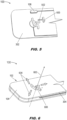
- the PCU 100 may incorporate additional LED units 500 embedded into the inner film 302 and the injected polycarbonate layer (300, FIG. 4 ).
- the additional LED units 500 may provide continuous luminous output at other desired wavelengths within the visible spectrum (c. 380-700 nm) to correct the blue color otherwise associated with the near-UV LED units 108 (e.g., if said color is undesirable).
- the visible luminous output through the outer film (304, FIG. 4 ) may retain the disinfectant properties of the luminous output of the near-UV LED units 108, but may appear as light of another desired color, including white light, depending on the distribution and/or wavelengths of the additional LED units 500.
- the individual contact surfaces 102 of the PCU 100 may incorporate three-dimensional graphic elements 600.
- the three-dimensional graphic elements 600 may be raised, or may extend above the background layer 104 of the contact surface relative to a z-axis 602.
- the PCU 100 may incorporate positive contact surfaces 102 (as opposed to the negative contact surfaces shown, e.g., by FIG. 1 ). rather than positive, contact surfaces 102.
- a positive contact surface 102 may incorporate an opaque or semi-opaque background layer 106 and translucent or transparent graphic elements 108, 600, such that the contact surface 102 is backlit, and disinfected, via near-UV luminous output 604 directed from the near-UV LED units (108, FIG. 5 ) toward the outer film 304 and through the graphic elements (104, FIG. 1 ).
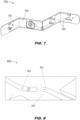
- the multiplanar self-cleaning PCU 700 may be implemented and may function similarly to the self-cleaning PCU 100 of FIGS. 1 through 6 , except that the multiplanar PCU 700 may incorporate an inner film 302, outer film (304, FIG. 4 ), injected polycarbonate layer (300, FIG. 4 ) and contact surfaces 702, 704 in multiple and/or staggered planes.
- the multiplanar self-cleaning PCU 700 may be fashioned to contour or conform to a multiplanar cabin surface.
- the nonplanar self-cleaning PCU 800 may be implemented and may function similarly to the self-cleaning PCU 100 of FIGS. 1 through 6 , except that the inner film 302, outer film 304, injected polycarbonate layer 300, and contact surfaces 802 may be partially or fully nonplanar.
- the nonplanar self-cleaning PCU 800 may be fashioned to conform or contour to a curved cabin surface 804, such that each contact surface 802 may be curved or nonplanar throughout its individual surface area, or that the set of contact surfaces collectively conforms to the curved cabin surface.
- Embodiments of the inventive concepts disclosed herein may improve upon conventional PCUs by providing a safe and perpetual self-disinfecting capability that is "always on", e.g., provides continuous disinfection of high touch surfaces at relatively low power.
- the self-disinfecting PCU may provide continuous protection by remaining active inflight without potential harm to passengers or flight crew.
- recommended near-UV dosage for eliminating viral and bacterial microorganisms may be realized with 30 minutes or less of exposure.
- embodiments of the methods disclosed herein may include one or more of the steps described herein. Further, such steps may be carried out in any desired order and two or more of the steps may be carried out simultaneously with one another. Two or more of the steps disclosed herein may be combined in a single step, and in some embodiments, one or more of the steps may be carried out as two or more sub-steps. Further, other steps or sub-steps may be carried in addition to, or as substitutes to one or more of the steps disclosed herein.
Landscapes
- Health & Medical Sciences (AREA)
- Engineering & Computer Science (AREA)
- Veterinary Medicine (AREA)
- Animal Behavior & Ethology (AREA)
- General Health & Medical Sciences (AREA)
- Public Health (AREA)
- Life Sciences & Earth Sciences (AREA)
- Epidemiology (AREA)
- Aviation & Aerospace Engineering (AREA)
- Chemical & Material Sciences (AREA)
- Combustion & Propulsion (AREA)
- Transportation (AREA)
- Mechanical Engineering (AREA)
- Apparatus For Disinfection Or Sterilisation (AREA)
Applications Claiming Priority (1)
| Application Number | Priority Date | Filing Date | Title |
|---|---|---|---|
| US17/966,561 US20240123104A1 (en) | 2022-10-14 | 2022-10-14 | Embedded near-ultraviolet self-cleaning electronics for passenger control unit (pcu) |
Publications (1)
| Publication Number | Publication Date |
|---|---|
| EP4353600A1 true EP4353600A1 (de) | 2024-04-17 |
Family
ID=88417568
Family Applications (1)
| Application Number | Title | Priority Date | Filing Date |
|---|---|---|---|
| EP23203861.2A Pending EP4353600A1 (de) | 2022-10-14 | 2023-10-16 | Eingebettete selbstreinigende nah-uv-elektronik für eine fahrgastkontrolleinheit (pcu) |
Country Status (2)
| Country | Link |
|---|---|
| US (1) | US20240123104A1 (de) |
| EP (1) | EP4353600A1 (de) |
Citations (10)
| Publication number | Priority date | Publication date | Assignee | Title |
|---|---|---|---|---|
| US20150174276A1 (en) * | 2011-08-16 | 2015-06-25 | Microsoft Technology Licensing, Llc | Disinfecting touch-based screen automatically |
| US20160271280A1 (en) * | 2015-03-18 | 2016-09-22 | Rayvio Corporation | Applications of uv leds for disinfection |
| US10377351B2 (en) * | 2017-06-28 | 2019-08-13 | Ford Global Technologies, Llc | Display for a vehicle |
| US10667396B2 (en) * | 2017-08-25 | 2020-05-26 | Tactotek Oy | Multilayer structure for hosting electronics and related method of manufacture |
| US20210379217A1 (en) * | 2020-06-08 | 2021-12-09 | The Boeing Company | Visible light sanitizing systems and methods |
| WO2021254619A1 (en) * | 2020-06-18 | 2021-12-23 | Huawei Technologies Co., Ltd. | Self-sanitizing electronic device |
| US20220055751A1 (en) * | 2020-08-19 | 2022-02-24 | B/E Aerospace, Inc. | Integrated aircraft seat control panel |
| US20220088243A1 (en) * | 2020-09-18 | 2022-03-24 | Japan Display Inc. | Display device and sterilization device |
| WO2022148743A1 (en) * | 2021-01-11 | 2022-07-14 | Signify Holding B.V. | Lightguide based luminaire for disinfection and illumination |
| US20220288253A1 (en) * | 2021-03-12 | 2022-09-15 | Kenall Manufacturing Company | Virucidal effects of 405 nm visible light on sars-cov2 and influenza a virus |
Family Cites Families (5)
| Publication number | Priority date | Publication date | Assignee | Title |
|---|---|---|---|---|
| US5993019A (en) * | 1997-10-03 | 1999-11-30 | Delco Electronics Corporation | Molded two part button with illuminated graphic |
| DE102004032631A1 (de) * | 2004-07-05 | 2006-02-09 | Hella Kgaa Hueck & Co. | Optische Anzeigeeinrichtung |
| US9511159B2 (en) * | 2014-07-02 | 2016-12-06 | At&T Intellectual Property I, L.P. | Method and apparatus for sterilizing a surface |
| US10777370B1 (en) * | 2018-01-03 | 2020-09-15 | David Worsham | Pushbutton switch with light-transmitting indicia on the pushbutton |
| US20210361797A1 (en) * | 2020-05-22 | 2021-11-25 | Paul Binun | Systems and methods for pathogen proliferation reduction |
-
2022
- 2022-10-14 US US17/966,561 patent/US20240123104A1/en active Pending
-
2023
- 2023-10-16 EP EP23203861.2A patent/EP4353600A1/de active Pending
Patent Citations (10)
| Publication number | Priority date | Publication date | Assignee | Title |
|---|---|---|---|---|
| US20150174276A1 (en) * | 2011-08-16 | 2015-06-25 | Microsoft Technology Licensing, Llc | Disinfecting touch-based screen automatically |
| US20160271280A1 (en) * | 2015-03-18 | 2016-09-22 | Rayvio Corporation | Applications of uv leds for disinfection |
| US10377351B2 (en) * | 2017-06-28 | 2019-08-13 | Ford Global Technologies, Llc | Display for a vehicle |
| US10667396B2 (en) * | 2017-08-25 | 2020-05-26 | Tactotek Oy | Multilayer structure for hosting electronics and related method of manufacture |
| US20210379217A1 (en) * | 2020-06-08 | 2021-12-09 | The Boeing Company | Visible light sanitizing systems and methods |
| WO2021254619A1 (en) * | 2020-06-18 | 2021-12-23 | Huawei Technologies Co., Ltd. | Self-sanitizing electronic device |
| US20220055751A1 (en) * | 2020-08-19 | 2022-02-24 | B/E Aerospace, Inc. | Integrated aircraft seat control panel |
| US20220088243A1 (en) * | 2020-09-18 | 2022-03-24 | Japan Display Inc. | Display device and sterilization device |
| WO2022148743A1 (en) * | 2021-01-11 | 2022-07-14 | Signify Holding B.V. | Lightguide based luminaire for disinfection and illumination |
| US20220288253A1 (en) * | 2021-03-12 | 2022-09-15 | Kenall Manufacturing Company | Virucidal effects of 405 nm visible light on sars-cov2 and influenza a virus |
Also Published As
| Publication number | Publication date |
|---|---|
| US20240123104A1 (en) | 2024-04-18 |
Similar Documents
| Publication | Publication Date | Title |
|---|---|---|
| EP3929084B1 (de) | Desinfektionssystem | |
| EP3925630B1 (de) | Tragbare hygienisierungssysteme und verfahren mit reichweitenführung | |
| EP3929085B1 (de) | Desinfektionssystem | |
| EP4353600A1 (de) | Eingebettete selbstreinigende nah-uv-elektronik für eine fahrgastkontrolleinheit (pcu) | |
| EP4233918A2 (de) | Vorrichtung zur inaktivierung von bakterien und/oder viren | |
| EP3970790B1 (de) | Beleuchtungseinheiten zur erzeugung von sichtbarem licht mit gemischter desinfizierender elektromagnetischer strahlung | |
| CN205602142U (zh) | 旅客服务装置 | |
| EP3825232B1 (de) | Beleuchtete flugzeugpassagierkabinengasper | |
| EP4036012B1 (de) | Frischluftleitungsknopfsanitisierung | |
| EP4177108B1 (de) | Flugzeugpassagierlicht | |
| JP7697829B2 (ja) | 紫外線光遮蔽システム | |
| JP2018007804A (ja) | キャビン内空気清浄装置 | |
| KR101961762B1 (ko) | 살균기능을 갖는 부드러운 광 출력의 led 매립등 | |
| US4903175A (en) | Illumination module | |
| DE102021214190A1 (de) | Griffstange und System ausgelegt für ein Transportmittel und Transportmittel ausgelegt für einen Personen- und/oder Gütertransport | |
| US20230034613A1 (en) | System and method for providing and monitoring uv illumination in an interior of an aircraft | |
| KR102390393B1 (ko) | 항공기용 살균 장치 및 이를 이용한 항공기 내부의 살균 시스템 | |
| CN115377789A (zh) | 红外照射器 | |
| KR20210144251A (ko) | 엘리베이터의 살균형 조작패널 |
Legal Events
| Date | Code | Title | Description |
|---|---|---|---|
| PUAI | Public reference made under article 153(3) epc to a published international application that has entered the european phase |
Free format text: ORIGINAL CODE: 0009012 |
|
| STAA | Information on the status of an ep patent application or granted ep patent |
Free format text: STATUS: THE APPLICATION HAS BEEN PUBLISHED |
|
| AK | Designated contracting states |
Kind code of ref document: A1 Designated state(s): AL AT BE BG CH CY CZ DE DK EE ES FI FR GB GR HR HU IE IS IT LI LT LU LV MC ME MK MT NL NO PL PT RO RS SE SI SK SM TR |
|
| STAA | Information on the status of an ep patent application or granted ep patent |
Free format text: STATUS: REQUEST FOR EXAMINATION WAS MADE |
|
| 17P | Request for examination filed |
Effective date: 20241016 |
|
| RBV | Designated contracting states (corrected) |
Designated state(s): AL AT BE BG CH CY CZ DE DK EE ES FI FR GB GR HR HU IE IS IT LI LT LU LV MC ME MK MT NL NO PL PT RO RS SE SI SK SM TR |
|
| GRAP | Despatch of communication of intention to grant a patent |
Free format text: ORIGINAL CODE: EPIDOSNIGR1 |
|
| STAA | Information on the status of an ep patent application or granted ep patent |
Free format text: STATUS: GRANT OF PATENT IS INTENDED |
|
| RIC1 | Information provided on ipc code assigned before grant |
Ipc: B64D 47/02 20060101AFI20250915BHEP Ipc: A61L 2/10 20060101ALI20250915BHEP Ipc: B64D 11/00 20060101ALI20250915BHEP Ipc: G06F 3/01 20060101ALI20250915BHEP |
|
| INTG | Intention to grant announced |
Effective date: 20250925 |