EP4353620A2 - Reusable plastic container and method for recycling - Google Patents
Reusable plastic container and method for recycling Download PDFInfo
- Publication number
- EP4353620A2 EP4353620A2 EP23202631.0A EP23202631A EP4353620A2 EP 4353620 A2 EP4353620 A2 EP 4353620A2 EP 23202631 A EP23202631 A EP 23202631A EP 4353620 A2 EP4353620 A2 EP 4353620A2
- Authority
- EP
- European Patent Office
- Prior art keywords
- container
- sealing
- reusable plastic
- plastic container
- cup
- Prior art date
- Legal status (The legal status is an assumption and is not a legal conclusion. Google has not performed a legal analysis and makes no representation as to the accuracy of the status listed.)
- Pending
Links
Images





Classifications
-
- B—PERFORMING OPERATIONS; TRANSPORTING
- B65—CONVEYING; PACKING; STORING; HANDLING THIN OR FILAMENTARY MATERIAL
- B65D—CONTAINERS FOR STORAGE OR TRANSPORT OF ARTICLES OR MATERIALS, e.g. BAGS, BARRELS, BOTTLES, BOXES, CANS, CARTONS, CRATES, DRUMS, JARS, TANKS, HOPPERS, FORWARDING CONTAINERS; ACCESSORIES, CLOSURES, OR FITTINGS THEREFOR; PACKAGING ELEMENTS; PACKAGES
- B65D1/00—Rigid or semi-rigid containers having bodies formed in one piece, e.g. by casting metallic material, by moulding plastics, by blowing vitreous material, by throwing ceramic material, by moulding pulped fibrous material or by deep-drawing operations performed on sheet material
- B65D1/22—Boxes or like containers with side walls of substantial depth for enclosing contents
- B65D1/26—Thin-walled containers, e.g. formed by deep-drawing operations
- B65D1/265—Drinking cups
-
- B—PERFORMING OPERATIONS; TRANSPORTING
- B65—CONVEYING; PACKING; STORING; HANDLING THIN OR FILAMENTARY MATERIAL
- B65D—CONTAINERS FOR STORAGE OR TRANSPORT OF ARTICLES OR MATERIALS, e.g. BAGS, BARRELS, BOTTLES, BOXES, CANS, CARTONS, CRATES, DRUMS, JARS, TANKS, HOPPERS, FORWARDING CONTAINERS; ACCESSORIES, CLOSURES, OR FITTINGS THEREFOR; PACKAGING ELEMENTS; PACKAGES
- B65D77/00—Packages formed by enclosing articles or materials in preformed containers, e.g. boxes, cartons, sacks or bags
- B65D77/10—Container closures formed after filling
- B65D77/20—Container closures formed after filling by applying separate lids or covers, i.e. flexible membrane or foil-like covers
- B65D77/2024—Container closures formed after filling by applying separate lids or covers, i.e. flexible membrane or foil-like covers the cover being welded or adhered to the container
-
- B—PERFORMING OPERATIONS; TRANSPORTING
- B65—CONVEYING; PACKING; STORING; HANDLING THIN OR FILAMENTARY MATERIAL
- B65D—CONTAINERS FOR STORAGE OR TRANSPORT OF ARTICLES OR MATERIALS, e.g. BAGS, BARRELS, BOTTLES, BOXES, CANS, CARTONS, CRATES, DRUMS, JARS, TANKS, HOPPERS, FORWARDING CONTAINERS; ACCESSORIES, CLOSURES, OR FITTINGS THEREFOR; PACKAGING ELEMENTS; PACKAGES
- B65D25/00—Details of other kinds or types of rigid or semi-rigid containers
- B65D25/34—Coverings or external coatings
-
- B—PERFORMING OPERATIONS; TRANSPORTING
- B65—CONVEYING; PACKING; STORING; HANDLING THIN OR FILAMENTARY MATERIAL
- B65B—MACHINES, APPARATUS OR DEVICES FOR, OR METHODS OF, PACKAGING ARTICLES OR MATERIALS; UNPACKING
- B65B3/00—Packaging plastic material, semiliquids, liquids or mixed solids and liquids, in individual containers or receptacles, e.g. bags, sacks, boxes, cartons, cans, or jars
- B65B3/04—Methods of, or means for, filling the material into the containers or receptacles
-
- B—PERFORMING OPERATIONS; TRANSPORTING
- B65—CONVEYING; PACKING; STORING; HANDLING THIN OR FILAMENTARY MATERIAL
- B65B—MACHINES, APPARATUS OR DEVICES FOR, OR METHODS OF, PACKAGING ARTICLES OR MATERIALS; UNPACKING
- B65B51/00—Devices for, or methods of, sealing or securing package folds or closures; Devices for gathering or twisting wrappers, or necks of bags
- B65B51/02—Applying adhesives or sealing liquids
-
- B—PERFORMING OPERATIONS; TRANSPORTING
- B65—CONVEYING; PACKING; STORING; HANDLING THIN OR FILAMENTARY MATERIAL
- B65B—MACHINES, APPARATUS OR DEVICES FOR, OR METHODS OF, PACKAGING ARTICLES OR MATERIALS; UNPACKING
- B65B51/00—Devices for, or methods of, sealing or securing package folds or closures; Devices for gathering or twisting wrappers, or necks of bags
- B65B51/10—Applying or generating heat or pressure or combinations thereof
- B65B51/22—Applying or generating heat or pressure or combinations thereof by friction or ultrasonic or high-frequency electrical means
- B65B51/225—Applying or generating heat or pressure or combinations thereof by friction or ultrasonic or high-frequency electrical means by ultrasonic welding
-
- B—PERFORMING OPERATIONS; TRANSPORTING
- B65—CONVEYING; PACKING; STORING; HANDLING THIN OR FILAMENTARY MATERIAL
- B65B—MACHINES, APPARATUS OR DEVICES FOR, OR METHODS OF, PACKAGING ARTICLES OR MATERIALS; UNPACKING
- B65B55/00—Preserving, protecting or purifying packages or package contents in association with packaging
- B65B55/24—Cleaning of, or removing dust from, containers, wrappers, or packaging ; Preventing of fouling
-
- B—PERFORMING OPERATIONS; TRANSPORTING
- B65—CONVEYING; PACKING; STORING; HANDLING THIN OR FILAMENTARY MATERIAL
- B65B—MACHINES, APPARATUS OR DEVICES FOR, OR METHODS OF, PACKAGING ARTICLES OR MATERIALS; UNPACKING
- B65B7/00—Closing containers or receptacles after filling
- B65B7/16—Closing semi-rigid or rigid containers or receptacles not deformed by, or not taking-up shape of, contents, e.g. boxes or cartons
- B65B7/28—Closing semi-rigid or rigid containers or receptacles not deformed by, or not taking-up shape of, contents, e.g. boxes or cartons by applying separate preformed closures, e.g. lids, covers
- B65B7/2842—Securing closures on containers
-
- B—PERFORMING OPERATIONS; TRANSPORTING
- B65—CONVEYING; PACKING; STORING; HANDLING THIN OR FILAMENTARY MATERIAL
- B65B—MACHINES, APPARATUS OR DEVICES FOR, OR METHODS OF, PACKAGING ARTICLES OR MATERIALS; UNPACKING
- B65B7/00—Closing containers or receptacles after filling
- B65B7/16—Closing semi-rigid or rigid containers or receptacles not deformed by, or not taking-up shape of, contents, e.g. boxes or cartons
- B65B7/28—Closing semi-rigid or rigid containers or receptacles not deformed by, or not taking-up shape of, contents, e.g. boxes or cartons by applying separate preformed closures, e.g. lids, covers
- B65B7/2842—Securing closures on containers
- B65B7/2878—Securing closures on containers by heat-sealing
-
- B—PERFORMING OPERATIONS; TRANSPORTING
- B65—CONVEYING; PACKING; STORING; HANDLING THIN OR FILAMENTARY MATERIAL
- B65D—CONTAINERS FOR STORAGE OR TRANSPORT OF ARTICLES OR MATERIALS, e.g. BAGS, BARRELS, BOTTLES, BOXES, CANS, CARTONS, CRATES, DRUMS, JARS, TANKS, HOPPERS, FORWARDING CONTAINERS; ACCESSORIES, CLOSURES, OR FITTINGS THEREFOR; PACKAGING ELEMENTS; PACKAGES
- B65D1/00—Rigid or semi-rigid containers having bodies formed in one piece, e.g. by casting metallic material, by moulding plastics, by blowing vitreous material, by throwing ceramic material, by moulding pulped fibrous material or by deep-drawing operations performed on sheet material
- B65D1/40—Details of walls
- B65D1/42—Reinforcing or strengthening parts or members
-
- B—PERFORMING OPERATIONS; TRANSPORTING
- B65—CONVEYING; PACKING; STORING; HANDLING THIN OR FILAMENTARY MATERIAL
- B65D—CONTAINERS FOR STORAGE OR TRANSPORT OF ARTICLES OR MATERIALS, e.g. BAGS, BARRELS, BOTTLES, BOXES, CANS, CARTONS, CRATES, DRUMS, JARS, TANKS, HOPPERS, FORWARDING CONTAINERS; ACCESSORIES, CLOSURES, OR FITTINGS THEREFOR; PACKAGING ELEMENTS; PACKAGES
- B65D25/00—Details of other kinds or types of rigid or semi-rigid containers
- B65D25/20—External fittings
- B65D25/205—Means for the attachment of labels, cards, coupons or the like
-
- B—PERFORMING OPERATIONS; TRANSPORTING
- B65—CONVEYING; PACKING; STORING; HANDLING THIN OR FILAMENTARY MATERIAL
- B65D—CONTAINERS FOR STORAGE OR TRANSPORT OF ARTICLES OR MATERIALS, e.g. BAGS, BARRELS, BOTTLES, BOXES, CANS, CARTONS, CRATES, DRUMS, JARS, TANKS, HOPPERS, FORWARDING CONTAINERS; ACCESSORIES, CLOSURES, OR FITTINGS THEREFOR; PACKAGING ELEMENTS; PACKAGES
- B65D25/00—Details of other kinds or types of rigid or semi-rigid containers
- B65D25/34—Coverings or external coatings
- B65D25/36—Coverings or external coatings formed by applying sheet material
-
- B—PERFORMING OPERATIONS; TRANSPORTING
- B65—CONVEYING; PACKING; STORING; HANDLING THIN OR FILAMENTARY MATERIAL
- B65D—CONTAINERS FOR STORAGE OR TRANSPORT OF ARTICLES OR MATERIALS, e.g. BAGS, BARRELS, BOTTLES, BOXES, CANS, CARTONS, CRATES, DRUMS, JARS, TANKS, HOPPERS, FORWARDING CONTAINERS; ACCESSORIES, CLOSURES, OR FITTINGS THEREFOR; PACKAGING ELEMENTS; PACKAGES
- B65D51/00—Closures not otherwise provided for
- B65D51/18—Arrangements of closures with protective outer cap-like covers or of two or more co-operating closures
- B65D51/20—Caps, lids, or covers co-operating with an inner closure arranged to be opened by piercing, cutting, or tearing
-
- B—PERFORMING OPERATIONS; TRANSPORTING
- B65—CONVEYING; PACKING; STORING; HANDLING THIN OR FILAMENTARY MATERIAL
- B65D—CONTAINERS FOR STORAGE OR TRANSPORT OF ARTICLES OR MATERIALS, e.g. BAGS, BARRELS, BOTTLES, BOXES, CANS, CARTONS, CRATES, DRUMS, JARS, TANKS, HOPPERS, FORWARDING CONTAINERS; ACCESSORIES, CLOSURES, OR FITTINGS THEREFOR; PACKAGING ELEMENTS; PACKAGES
- B65D77/00—Packages formed by enclosing articles or materials in preformed containers, e.g. boxes, cartons, sacks or bags
- B65D77/10—Container closures formed after filling
- B65D77/20—Container closures formed after filling by applying separate lids or covers, i.e. flexible membrane or foil-like covers
- B65D77/2004—Container closures formed after filling by applying separate lids or covers, i.e. flexible membrane or foil-like covers the cover being maintained on the container by mechanical means, e.g. crimping, clamping, riveting
- B65D77/2016—Container closures formed after filling by applying separate lids or covers, i.e. flexible membrane or foil-like covers the cover being maintained on the container by mechanical means, e.g. crimping, clamping, riveting the cover being maintained by projections or recesses on the container
-
- B—PERFORMING OPERATIONS; TRANSPORTING
- B65—CONVEYING; PACKING; STORING; HANDLING THIN OR FILAMENTARY MATERIAL
- B65D—CONTAINERS FOR STORAGE OR TRANSPORT OF ARTICLES OR MATERIALS, e.g. BAGS, BARRELS, BOTTLES, BOXES, CANS, CARTONS, CRATES, DRUMS, JARS, TANKS, HOPPERS, FORWARDING CONTAINERS; ACCESSORIES, CLOSURES, OR FITTINGS THEREFOR; PACKAGING ELEMENTS; PACKAGES
- B65D81/00—Containers, packaging elements, or packages, for contents presenting particular transport or storage problems, or adapted to be used for non-packaging purposes after removal of contents
- B65D81/38—Containers, packaging elements, or packages, for contents presenting particular transport or storage problems, or adapted to be used for non-packaging purposes after removal of contents with thermal insulation
- B65D81/3876—Containers, packaging elements, or packages, for contents presenting particular transport or storage problems, or adapted to be used for non-packaging purposes after removal of contents with thermal insulation insulating sleeves or jackets for cans, bottles, barrels, etc.
-
- B—PERFORMING OPERATIONS; TRANSPORTING
- B65—CONVEYING; PACKING; STORING; HANDLING THIN OR FILAMENTARY MATERIAL
- B65B—MACHINES, APPARATUS OR DEVICES FOR, OR METHODS OF, PACKAGING ARTICLES OR MATERIALS; UNPACKING
- B65B57/00—Automatic control, checking, warning, or safety devices
- B65B57/02—Automatic control, checking, warning, or safety devices responsive to absence, presence, abnormal feed, or misplacement of binding or wrapping material, containers, or packages
-
- B—PERFORMING OPERATIONS; TRANSPORTING
- B65—CONVEYING; PACKING; STORING; HANDLING THIN OR FILAMENTARY MATERIAL
- B65D—CONTAINERS FOR STORAGE OR TRANSPORT OF ARTICLES OR MATERIALS, e.g. BAGS, BARRELS, BOTTLES, BOXES, CANS, CARTONS, CRATES, DRUMS, JARS, TANKS, HOPPERS, FORWARDING CONTAINERS; ACCESSORIES, CLOSURES, OR FITTINGS THEREFOR; PACKAGING ELEMENTS; PACKAGES
- B65D2203/00—Decoration means, markings, information elements, contents indicators
- B65D2203/10—Transponders
-
- B—PERFORMING OPERATIONS; TRANSPORTING
- B65—CONVEYING; PACKING; STORING; HANDLING THIN OR FILAMENTARY MATERIAL
- B65D—CONTAINERS FOR STORAGE OR TRANSPORT OF ARTICLES OR MATERIALS, e.g. BAGS, BARRELS, BOTTLES, BOXES, CANS, CARTONS, CRATES, DRUMS, JARS, TANKS, HOPPERS, FORWARDING CONTAINERS; ACCESSORIES, CLOSURES, OR FITTINGS THEREFOR; PACKAGING ELEMENTS; PACKAGES
- B65D2251/00—Details relating to container closures
- B65D2251/0003—Two or more closures
- B65D2251/0006—Upper closure
- B65D2251/0018—Upper closure of the 43-type
-
- B—PERFORMING OPERATIONS; TRANSPORTING
- B65—CONVEYING; PACKING; STORING; HANDLING THIN OR FILAMENTARY MATERIAL
- B65D—CONTAINERS FOR STORAGE OR TRANSPORT OF ARTICLES OR MATERIALS, e.g. BAGS, BARRELS, BOTTLES, BOXES, CANS, CARTONS, CRATES, DRUMS, JARS, TANKS, HOPPERS, FORWARDING CONTAINERS; ACCESSORIES, CLOSURES, OR FITTINGS THEREFOR; PACKAGING ELEMENTS; PACKAGES
- B65D2251/00—Details relating to container closures
- B65D2251/0003—Two or more closures
- B65D2251/0068—Lower closure
- B65D2251/0093—Membrane
-
- Y—GENERAL TAGGING OF NEW TECHNOLOGICAL DEVELOPMENTS; GENERAL TAGGING OF CROSS-SECTIONAL TECHNOLOGIES SPANNING OVER SEVERAL SECTIONS OF THE IPC; TECHNICAL SUBJECTS COVERED BY FORMER USPC CROSS-REFERENCE ART COLLECTIONS [XRACs] AND DIGESTS
- Y02—TECHNOLOGIES OR APPLICATIONS FOR MITIGATION OR ADAPTATION AGAINST CLIMATE CHANGE
- Y02W—CLIMATE CHANGE MITIGATION TECHNOLOGIES RELATED TO WASTEWATER TREATMENT OR WASTE MANAGEMENT
- Y02W30/00—Technologies for solid waste management
- Y02W30/50—Reuse, recycling or recovery technologies
- Y02W30/80—Packaging reuse or recycling, e.g. of multilayer packaging
Definitions
- the invention relates to a cup-shaped reusable plastic container and a method for reprocessing a cup-shaped reusable plastic container.
- the object of the present invention was to overcome the disadvantages of the prior art and to provide a cup-shaped reusable plastic container which can be reused in a sustainable manner.
- the invention relates to a cup-shaped reusable plastic container, which reusable plastic container preferably comprises a food-safe plastic material, and which reusable plastic container comprises a container shell, which container shell has an open end and an end closed with a base, wherein a longitudinal axis of the reusable plastic container extends between the open end and the closed end, and wherein the open end has a sealing edge with a sealing surface, which sealing surface is designed such that the sealing surface can be connected to a first sealing film, i.e. can be sealed onto it.
- the container shell has a wall thickness which is from 0.5 mm to 4.0 mm, and that the sealing edge has a sealing edge thickness which extends in the axial direction of the longitudinal axis, and which Sealing edge thickness is from 0.8 mm to 4.0 mm, and that the sealing surface is designed such that the sealing surface can be connected to a further sealing film after removal of the first sealing film from the sealing surface of the sealing edge and after cleaning of the reusable plastic container.
- the wall thickness of the container shell is preferably between 1.0 mm and 2.5 mm.
- a wall thickness of between 1.3 mm and 2.0 mm is particularly preferred, with a wall thickness of 1.5 mm having proven particularly advantageous. This is in contrast to conventional Wegwerk plastic containers, which usually have a wall thickness of between 0.3 mm and 1.0 mm.
- the sealing edge thickness of the sealing edge is preferably between 1.0 mm and 2.5 mm.
- a sealing edge thickness of between 1.3 mm and 2.0 mm is particularly preferred, with a sealing edge thickness of 1.5 mm having proven particularly advantageous. This is in contrast to conventional Wegwerk plastic containers, which usually have a sealing edge thickness of between 0.5 mm and 0.8 mm.
- the cup-shaped reusable plastic container according to the invention brings with it the surprising advantage that it is sufficiently stable and durable to be able to be reused repeatedly, and at the same time is sufficiently light to be comfortable and easy to handle. This applies both to the transport of goods, in which the weight of packaging material should be kept as low as possible in the interests of sustainability, and to handling by a user, for whom excessive packaging weight is also disadvantageous.
- the cup-shaped reusable plastic container according to the invention in particular the specified sealing edge thickness of the sealing edge, as well as the design of the sealing surface in such a way that it can be reused after cleaning, brings with it the surprising advantage that it can be repeatedly processed and resealed without, or at least largely without, having to accept any compromises in terms of the quality of the packaging or the sealability.
- a reusable container is surprisingly provided which offers a user the same or almost the same advantages in terms of use that he is used to from a conventional container, i.e. a disposable plastic cup, and which nevertheless works particularly well is reusable or can be made particularly easy to reuse.
- the reusable container therefore meets both the requirements that a user places on packaging containers and the requirements that the industry places on a reusable container.
- sealing film covers every type of sealing film known in the professional world.
- Aluminum foil, plastic foil, as well as hybrid or composite foils are known.
- the sealing films can be of different types. Adhesive processes and welding processes are common for sealing, to name just a few.
- sealing films are connected to a sealing surface of a sealing edge in such a way that they close a container or cup, whereby the connection between the sealing film and the sealing surface can be released by peeling the sealing film off the sealing surface. This is usually done with the help of a pull tab also formed by the film. This gives a user access to the contents of the container.
- the original, i.e. the first-applied sealing film and the additional sealing film(s) can be of the same type or different. It is also possible that a process for applying the sealing films always involves the same methods, or that different application processes can be carried out.
- the cleaning of the reusable plastic container can be carried out as a process step in the course of a reprocessing process.
- the connection and thus the sealing of the container with another sealing film after cleaning can be carried out in particular after use, cleaning and refilling of the reusable plastic container.
- the container in particular the inner surface of the container and/or the sealing surface, is provided with a coating, in particular with a SiOx coating, which coating gives the inner surface or the sealing surface a particularly smooth surface.
- a coating in particular with a SiOx coating, which coating gives the inner surface or the sealing surface a particularly smooth surface.
- the container shell has a conical section, which conical section extends from the closed end towards the open end, and that the container shell has a cylindrical section, which cylindrical section extends from the open end towards the closed end, wherein, viewed in the radial direction to the longitudinal axis, i.e. when viewed at 90° to the longitudinal axis, a circular cross-section of the cylindrical section is larger than a maximum circular cross-section of the conical section.
- the conical section is aligned, as is known per se for cup-shaped containers, such that the diameter of the conical section is smaller at the bottom and becomes continuously wider towards the top, i.e. towards the open end of the container.
- a conical transition section is formed between the conical section and the cylindrical section, wherein a first angle between the longitudinal axis and the conical section is smaller than a second angle between the longitudinal axis and the conical transition section. It can also be the case that the transition section is at least substantially conical and that in the transition area between the conical section and the transition section, as well as in the transition area between the transition section and the cylindrical section, a chamfer, groove or curve running inwards in the direction of the longitudinal axis is formed.
- a minimum circular cross-section of the transition section corresponds to the maximum circular cross-section of the conical section
- a maximum circular cross-section of the transition section corresponds to the circular cross-section of the cylindrical section
- the container shell is formed with depressions, which depressions extend essentially parallel to the longitudinal axis over the cylindrical section. If the depressions also extend over the transition section or over part of the transition section, and if the transition section is conical, the depressions in the region of the transition section are aligned parallel to the shell of the transition section, instead of parallel to the longitudinal axis.
- the depressions can, for example, be groove-shaped and, when viewed in the axial direction, i.e. along the longitudinal axis, have a semicircular or circular segment-shaped cross-section.
- the depressions can be of the same or different shapes and each have the same or different lengths or longitudinal extensions.
- the recesses have a depth, viewed in the radial direction to the longitudinal axis, which depth amounts to 1% to 70% of the wall thickness of the container shell.
- the center of mass of the reusable plastic container can be outside the longitudinal axis. This can be achieved, for example, by differences in the material thickness. However, it is also conceivable that this is achieved by different materials with different densities.
- Containers are usually symmetrical and have a center of gravity that lies on the longitudinal axis.
- a design where the center of gravity lies outside the longitudinal axis has the advantage that such a container, when it is transported in a returnable container machine or in a washing system and is lying on its side, i.e. not standing on its base but guided along its outer surface, has little or no tendency to roll. This generally enables good transportability and conveyability, and in particular also facilitates detection/shape recognition in a returnable container machine and makes cleaning in a washing tray easier.
- the center of mass of the reusable plastic container viewed along its container height, is located in a half of the container height facing the closed end, in particular in a third of the container height facing the closed end. In other words, this means that the center of mass of the container is less far away from the container base than from the upper open end of the container. This is in contrast to known cup-shaped containers, in which the center of mass is closer to the upper open container than to the container base.
- container height refers to the maximum axial longitudinal extent of the container.
- the center of mass of the container is preferably within the area or volume enclosed by the container shell.
- the base is circular and has different base thicknesses along its diameter, which base thickness is between 0.5 mm and 4.0 mm.
- the base can have a base thickness that increases continuously or gradually from the base center to the base outer diameter.
- the Bottom has partial thickenings.
- the transition area from the bottom to the container shell can be designed with a thickening, such as a thickened groove.
- the base thickness is the same as the wall thickness. It can also be advantageous if the base thickness is thicker or at least slightly thicker than the wall thickness.
- the base thickness of the base is from 1.0 mm to 2.5 mm. A base thickness of 1.3 mm to 2.0 mm is particularly preferred, with a base thickness of 1.5 mm having proven particularly advantageous.
- the wall thickness of the container shell is different.
- one half of the container shell, viewed in axial section, can be designed with a greater wall thickness.
- the container shell has a homogeneous wall thickness and that one or more partial thickenings with greater wall thicknesses are formed in the container shell.
- a detectable element is applied or introduced onto or into the base and/or onto or into the container shell.
- detectable elements are known to experts. It is at the discretion of the expert to select one or more of these known elements, depending on which detector or in which process the detection is required or should take place. By providing a detectable element, detection in an empty bottle vending machine can be made easier, for example to calculate a possible deposit value. It is also conceivable that the detectable element is used in a reprocessing plant to identify the container type and also to simplify storage logistics.
- a detectable element can be an element with a magnetically readable code. It is also conceivable that the detectable element is an NFC chip, an RFID chip or a label comprising an NFC chip or RFID chip. It is also conceivable that the detectable element is a watermark, a barcode or a QR code.
- detectable element it can be incorporated into the material or applied directly to the surface, for example glued on. It can also be useful if the detectable element is not visible or recognizable to an observer. If the detectable element has a sufficiently large mass, the detectable element can also be used to ensure that the center of mass of the container lies outside the longitudinal axis.
- a sealing aid is applied to the sealing surface of the sealing edge, preferably a sealing aid that can be removed without leaving any residue.
- the sealing aid can be, for example, a hot-sealing varnish.
- the sealing aid can be applied partially or completely to the sealing surface. This has the advantage that reprocessing is made easier and thus reuse is made comparatively inexpensive and energy-efficient. It is conceivable that after the sealing aid has been removed without leaving any residue, another sealing aid is applied to the sealing edge. It is conceivable that the sealing aid is designed in such a way that it bonds with a sealing film in such a way that when the sealing film is pulled off the sealing edge, it is pulled off together with it, so that no or only a small amount of the sealing aid remains on the sealing edge. It is also conceivable that the sealing aid is designed in such a way that it can be washed with or without detergent in a washing process. can also be removed without the use of sealing agent-dissolving chemicals or auxiliary materials.
- the open end has a thread, in particular an external thread, which thread can be connected to another thread, in particular to an internal thread, of a closure element designed as a screw cap. It is of course also conceivable for the open end to be designed with an internal thread, which can be connected to a screw cap comprising a complementary external thread. Alternatively or in addition to a thread, the open end can be designed with a bayonet closure mechanism.
- a sealing film if an additional closure element is provided, can be made relatively thin, or has to be designed to be relatively less puncture-resistant and less resistant to transverse pressure.
- any sealing aid applied to the sealing surface can be designed to be relatively weakly adhesive and thus particularly easy to remove without leaving residue.
- an additional screw cap can also enable a user to reseal the product, which can also offer good protection against leakage if the product is transported lying down.
- a screw cap can also be designed with a ring, which ring detaches from the screw cap when it is opened for the first time and thus serves as proof of authenticity for the user.
- the open end has a striking edge, which striking edge can be connected to a closure element designed as a striking cover.
- the striking edge and striking cover are complementary in shape to one another, so that an essentially positive connection is realized.
- a sealing film if an additional closure element is provided, can be made comparatively thin, or has to be designed to be relatively less puncture-resistant and less stable against transverse pressure.
- any sealing aid applied to the sealing surface can be designed to be relatively weakly adhesive and thus particularly easy to remove without leaving residue.
- an additional impact lid or bounce lid can also enable a user to reseal the product, which can also offer good leak protection in the event of lying down transport.
- a bounce lid can also be fitted with a
- the container may be designed with an opening, a tab or an undercut, which opening, tab or undercut can be pressed in or broken off before opening for the first time and thus serves as proof of authenticity for the user. In order to enable the container to be reused, it may be useful if such an opening is provided on the lid and not on the container's impact edge.
- the container can be designed with a means of proving authenticity, particularly if a further closure element is provided in addition to the sealing element.
- this can be a ring which is connected to the closure element by means of predetermined breaking points or weakenings. It is also conceivable that a ring is designed as a pull-off ring or pull-off tape, which can also have an additional sealing or sealing function in addition to proving authenticity. This can have a positive effect on the shelf life of a filling material contained in the container.
- the sealing edge is designed in such a way that the sealing edge can be brought into engagement with locking elements of a closure element designed as a reusable plastic lid.
- the reusable plastic container is designed as a combination packaging container and comprises an outer part, which outer part encases the reusable plastic container, wherein the outer part is formed from a blank, which blank has a substantially circular ring-segment-shaped basic shape, which blank has a first end section and a second end section, wherein the blank is wound into a jacket and the first end section and the second end section are coupled to one another in an overlapping region, wherein the outer part further has a first end face and a second end face and the first end face and the second end face are spaced apart from one another, wherein the outer part has a longitudinal extension in a direction starting from the first end face to the second end face.
- the casing of the outer part prefferably has a receiving area and an area, which area, viewed in the longitudinal extension, is arranged between the receiving area and the second end face, and for an area of the open end to be received in the receiving area of the casing of the outer part.
- the area that is received in the receiving area of the casing can be the sealing edge or part of the sealing edge.
- the blank can form high-quality and attractive outer packaging for a container, whereby the blank can also fulfill a function as proof of originality and is therefore considered "tamper evident".
- the container is encased by an outer part, such as the one provided by the WO 2020/245148 A1 known to the applicant of the same name.
- External parts of the types described can be used to improve the stability of the container, protect the contents from light and thermal effects and thus improve the shelf life of the contents contained in the container.
- visually appealing designs and required product labels can be applied easily and reliably.
- the containers themselves can be manufactured neutrally, i.e. without product labels, and can therefore be reused particularly flexibly in a reuse process. For example, different bottling plants or different dairies can reuse the same container and provide it with individual packaging designs.
- the container has an alignment means in the area of its base, in particular a groove or a raised area, which is designed for fixing and/or positioning the container.
- the alignment means formed in the base, in particular on the underside of the base can be
- the outer part can be designed as a projection or a recess.
- a tool or a coupling means of a device can engage with the alignment means, for example by means of a toothing, spreading effect, or vacuum or negative pressure.
- An alignment means can also be used for the exact positioning or alignment of the container during collection, sorting, cleaning, refilling, etc.
- the sealing edge can be circular, as is known and customary, and can extend outwards over the casing in a constant axial direction when the container is viewed.
- the open end can also have a sealing edge that projects out over the casing of the container in some areas.
- the sealing edge is designed, for example, with extensions or beaks that extend over the casing of the container in a radial direction to the cone axis, i.e. 90° to the cone axis when the container is viewed. These extensions or beaks can be accommodated as a sealing edge area in a receiving area of the casing of an outer part.
- a sealing edge that projects out over the casing of the container in some areas can also be realized, for example, by an elliptical sealing edge that extends over the casing of the container in a radial direction to the cone axis, i.e. 90° to the cone axis when the container is viewed, at two opposite positions, for example.
- Such an elliptical sealing edge can be accommodated in a receiving area of the casing of an outer part.
- filling residue refers to any residue that may be present in or on the container. This includes residues of the original filling material, such as a dairy product or any other food residues, as well as any contamination that may arise, for example, during the collection of empties or during transport.
- the process described is to be understood as meaning that the process steps are carried out in an industrial cleaning and reprocessing process or in a suitable facility.
- any pre-cleaning can be carried out in advance of the first cleaning described, for example by a user at home and before the empty containers are returned by manually rinsing or washing the container. This washing can also lead to residues of the contents, or more precisely, detergent residues.
- the first cleaning and processing of the sealing surface are carried out in a joint or simultaneous process step.
- the sealing surface of the sealing edge can be reconnected or resealed during the first cleaning. This is the case, for example, because a sealing aid on the sealing surface can be removed without residue by a washing process.
- the filling material that is introduced into the container during refilling can be either the original filling material or a different type of filling material.
- the process, and in particular the process step of reconnecting the sealing surface with a new sealing film can be repeated several times so that the service life of the container and thus its sustainability can be further increased.
- the process and the design of the container enable multiple reuse without, or at least largely without, any loss of quality.
- Reconnecting the sealing surface with another, i.e. a new, sealing film can also be done using a different sealing method than the initial sealing with the first sealing film.
- the sealing with the first sealing film is done by heat sealing and that the sealing with the respective other sealing films is done by cold sealing, or vice versa.
- adhesive layers can be provided on the sealing film or possibly also on the sealing edge for sealing.
- the method according to the invention brings with it the surprising advantage that reprocessing and thus reuse of a reusable container is possible in a simple manner.
- a second cleaning of the reusable plastic container is carried out to remove processing residues.
- the second cleaning can include the same cleaning methods and process steps as the first cleaning. However, it is also conceivable that other process steps are appropriate for the second cleaning.
- the first cleaning can essentially comprise a washing process
- the second cleaning can comprise a thermal or pneumatic or chemical process.
- a second cleaning using compressed air can be advantageous.
- a sealing aid is applied to the sealing surface of the sealing edge before the additional sealing film is connected to the sealing surface of the sealing edge.
- a mechanical, chemical and/or thermal cleaning step is carried out during the first and/or second cleaning of the sealing surface of the sealing edge.
- a mechanical, chemical and/or thermal processing step is carried out when processing the sealing surface of the sealing edge to restore the connectability.
- a plasma treatment is carried out during the first and/or second cleaning of the sealing surface of the sealing edge.
- a laser treatment or an energetic treatment, such as radiation treatment with ionized radiation is carried out during the first and/or second cleaning.
- sealing surface of the sealing edge is reconnected to the other sealing film by ultrasonic welding.
- the first or original sealing film was applied to the sealing surface by ultrasonic welding. This has the advantage that the container can be sealed reliably.
- a reusable plastic container 2 is shown as an example for a variety of possible different shapes, wherein the reusable plastic containers 2 are cup-shaped or bowl-shaped so that they can hold a filling material.
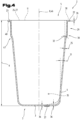
- the Fig.1 The reusable plastic container 2 shown is in the Fig.4 shown again, but in view and cut through the longitudinal axis 8, i.e. in axial section.
- the reusable plastic container 2 comprises a food-safe plastic material.
- the reusable plastic container 2 preferably comprises a recycled food-safe plastic material.
- the reusable plastic container 2 comprises a base 3 and a container casing 4.
- the container 2 also has an open end 5 on its side facing away from the base 3.
- a flange 6 projecting outwards beyond the container casing 4 can be provided in the region of its open end 5.
- the base 3 forms a closed end 7 for the container casing 4.
- the container 2 has an essentially conical or truncated cone-shaped basic shape.
- the open end 5 has a sealing edge 22 with a sealing surface 23, which sealing surface 23 is designed such that the sealing surface 23 can be connected to a first sealing film 24.
- the flange 6 can be designed as a sealing flange.
- the sealing foil 24, 27 is in the Fig.1 before connecting to the sealing surface 23, i.e. in an exploded view.
- the sealing film 24, 27 is connected to the sealing surface 23, or seals and completely covers the open end 5, so that the reusable plastic container 2 is closed.
- sealing films 24 can have a tab or an extension by means of which it is easier for a user to pull the sealing film 24, 27 off the sealing edge 22. For the sake of simplicity, such a tab is not shown.
- the container 2 is preferably formed by a component produced in a deep-drawing process, which can be produced quickly and, above all, in a short cycle time.
- the deep-drawing process is well known and will therefore not be discussed in more detail.
- the deep-drawing process is particularly suitable for producing the container 2 with a sufficient wall thickness from a layer of a deformable material using a deep-drawing tool, which ensures tightness during storage, use and disposal.
- the container 2 can also be formed using other manufacturing processes, such as an injection molding process.
- a longitudinal axis 8 extends in the axial direction between the open end 5 and the end 7 closed with the base 3, which can also represent a central axis if the design is symmetrical.
- a further closure element 11 for example a screw cap, a snap-on lid or a reusable plastic lid 40 (for example in the Fig.7 shown) or to connect them with it.
- the container 2 In the axial direction and thus in the direction of the longitudinal axis 8, the container 2 has a container height 9 between its open end 5, in particular the flange 6 or the sealing edge 22, and the base 3, whereby the receiving volume of the container 2 for receiving a filling material is determined depending on the cross-sectional dimensions.
- the container height 9 in conjunction with the cross-sectional dimensions thus defines a receiving space of the container 2.
- the container shell 4 is understood to be that section of the container 2 which extends between the open end 5, in particular the flange 6, and the base 3 in a predominantly axial direction.
- the container 2 with its container shell 4 is preferably designed in such a way that it preferably tapers conically from the open end 5 to the base 3. tapered, i.e. essentially frustoconical.
- the longitudinal axis 8 corresponds to the cone axis 46.
- the container casing 4 has a wall thickness 25, which wall thickness 25 is from 0.5 mm to 4.0 mm.
- the sealing edge 22 also has a sealing edge thickness 26, which sealing edge thickness 26 extends in the axial direction of the longitudinal axis 8, and which sealing edge thickness 26 is from 0.8 mm to 4.0 mm.
- the sealing surface 23 is designed such that the sealing surface 23 can be connected to a further sealing film 27 after the first sealing film 24 has been removed from the sealing surface 23 of the sealing edge 22, and after the reusable plastic container 2 has been cleaned.
- the container shell 4 can have a conical section 28.
- This conical section 28 extends from the closed end 7 in the direction of the open end 5.
- the container shell 4 can have a cylindrical section 29, which cylindrical section 29 extends from the open end 5 in the direction of the closed end 7.
- a circular cross-section of the cylindrical section 29 is larger than a maximum circular cross-section of the conical section 28.
- the cylindrical section 29 thus represents a ring-like, cylindrical widening which adjoins the conical section 28.
- a conical transition section 30 can be formed between the conical section 28 and the cylindrical section 29, wherein a first angle 31 between the longitudinal axis 8 and the conical section 28 is smaller than a second angle 32 between the longitudinal axis 8 and the conical transition section 30. This enables a widening of the diameter or the circular cross-section from the conical section 28 to the cylindrical section 29.
- the transition section 30 forms a shoulder or a stop area 47 running around the jacket, which, when two or more reusable plastic containers 2 of the same design are stacked on top of one another in the axial direction or inserted into one another, serve as a stop for a flange 6 or for a lower area or a bottom side 48 of the sealing edge 22.
- the underside 48 of the sealing edge 22 refers to the side or surface of the sealing edge 22 facing the base 3.
- the center of mass 35 of the reusable plastic container 2 can take. Specifically, it is shown here that the center of mass 35 of the reusable plastic container 2 can lie outside the longitudinal axis 8, i.e. cannot lie directly on the longitudinal axis 8. The center of mass 35 can lie along its container height 9 in a half facing the closed end 7 or in a third of the container height 9 facing the closed end 7. In the example shown, the center of mass 35 is also closer to the container casing 4 than to the longitudinal axis 8, i.e. is further away from the longitudinal axis 8 than from the container casing 4.
- a possible design of the base 3 and the container shell 4 in the transition area to the base 3 is shown by dashed lines, with the base thickness 36 increasing radially outwards.
- the base 3 is circular or has a round cross-section. Viewed along its diameter, the base 3 has different base thicknesses 36, which can be between 0.5 mm and 4.0 mm.
- the wall thickness 25 of the container shell 4 is different. In the example shown in the Fig.4 the base thickness 36 increases radially from the base center outwards.
- the wall thickness 25 of the container shell 4 is larger or increasing in the transition area to the base 3.
- a detectable element 37 for example an RFID chip or an NFC chip, is applied or inserted into the base 3.
- a sealing aid 38 can be applied to the sealing surface 23 of the sealing edge 22, which can preferably be removed without leaving residue.
- a sealing aid 38 can be a heat-sealing varnish or an adhesive.
- the sealing aid 38 is applied to the sealing film 24, 27 and that the sealing aid 38 only comes into contact with the sealing surface 23 of the sealing edge 22 when the sealing film 24, 27 is sealed on.
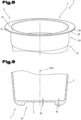
- FIG.2 and 3 Two further embodiments of cup-shaped reusable plastic containers 2 are shown, but each without the sealing film 24, 27, i.e. in the opened or unsealed state. Essentially, reference is made here to the parts of the description in connection with the Fig.1 and Fig.4
- the reusable plastic containers 2 in the Fig.2 and 3 Recesses 33 in the container shell 4, which recesses 33 extend essentially parallel to the longitudinal axis 8 over the cylindrical section 29.
- the recesses 33 have a depth 34 in the radial direction to the longitudinal axis 8, i.e. 90° to the longitudinal axis 8, which depth 34 can be from 1% to 70% of the wall thickness 25 of the container shell 4.
- a further embodiment of a cup-shaped reusable plastic container 2 is shown.
- the reusable plastic container 2 can be closable by means of a further - not shown in detail - closure element.
- the open end 5 can have a thread 39, in particular an external thread, which thread 39 can be connected to a further thread, in particular to an internal thread, of a closure element designed as a screw cap.
- the thread 39 shown is to be understood as an example only; the exact design of the thread 39 is a matter for the expert's skills.
- a thread 39 is expediently designed to be sufficiently stable so that the reusable plastic container 2 can be used, cleaned and refilled several times without risking premature final disposal due to a damaged thread 39.
- the open end 5 has a striking edge, which striking edge can be connected to a closure element designed as a striking lid.
- Fig.7 is a variant or further development of the cup-shaped reusable plastic container 2 according to the Fig.1 and 4 shown, whereby the sealing edge 22 is designed in such a way that the sealing edge 22 can be brought into engagement with locking elements 41 of a closure element designed as a reusable plastic lid 40.
- the Plastic container 2 is sealed with the sealing film 24, 27 as shown and that the reusable plastic lid 40 is additionally applied.
- the plastic container 2 has already been opened, or that the sealing film 24, 27 has been removed, and that the reusable plastic lid 40 thus closes the container without the sealing film 24, 27.
- the reusable plastic container 2 is designed as a combination packaging container 1.
- the reusable plastic container 2 comprises an outer part 12, which outer part 12 encases the reusable plastic container 2, wherein the outer part 12 is formed from a mostly flat blank 13, which blank 13 has a substantially circular ring-segment-shaped basic shape, which blank 13 has a first end section 14 and a second end section 15, wherein the blank 13 is wound into a jacket and the first end section 14 and the second end section 15 are coupled to one another in an overlap region 16, wherein the outer part 12 further has a first end face 19 and a second end face 20 and the first end face 19 and the second end face 20 are spaced apart from one another, wherein the outer part 12 has a longitudinal extension 42 in a direction starting from the first end face 19 to the second end face 20.
- the combination packaging container 1 When looking at the combination packaging container 1 in the three-dimensional view shown, the combination packaging container 1 has a total height 10 which extends from the base 3 to the highest area of the second end face 20 of the outer part 12. The total height can thus be greater than the container height 9 and also greater than the construction height 21 of the outer part 12.
- the casing of the outer part 12 has a receiving region 43 and a region 44, which region 44 is arranged between the receiving region 43 and the second end face 20 when viewed in the longitudinal extension 42, and that a region 45 of the open end 5 is received in the receiving region 43 of the casing of the outer part 12.
- the sleeve-shaped outer part 12 is preferably formed from a cellulose material, such as a cardboard material, with sufficient strength with regard to the absorption and transmission of particularly axially acting pressure forces and from a flat blank 13 is wound into a sheath.
- Blank 13 is usually printed in its undeformed flat position and optionally provided with an additional coating.
- Cellulose material is usually used as the material for blank 13, although this can also be cardboard or strong paper produced using a recycling process. If a layer or ply of the outer part 12 is made from a recycling material, an additional layer made of a higher quality paper can be arranged on or connected to at least one of the surfaces. This additional layer is used to ensure perfect printing for the production of decorations, labels and product information.
- the sleeve-like or jacket-like outer part 12 leads to an additional reinforcement or stiffening effect of the container 2 and thus of the entire combination packaging container 1. This provides, on the one hand, high strength and good thermal insulation and, on the other hand, optimal light protection for the contents of the packaging container.
- the cardboard is additionally coated or sealed with a water-repellent material in the area of the cut edges. This is particularly advantageous when the combination packaging container 1 is exposed to increased moisture. Coating the cardboard used for the outer part 12 with a water-repellent layer prevents the cardboard from swelling in a moist environment and ultimately becoming detached from the container casing 4 of the combination packaging container 1.
- a reusable plastic container 2 with an elliptical sealing edge 22 is shown.
- the open end 5 has a sealing edge 22 that partially protrudes over the container shell 4 of the container 2.
- a sealing edge 22 that partially protrudes over the container shell 4 of the container 2 can be realized by an elliptical sealing edge 22 that extends in the radial direction to the cone axis 46, i.e. when looking at the container 90° to the cone axis 46, for example at two opposite positions over the container shell 4. This is particularly the case when the reusable plastic container 2 is combined with an outer part 12 to form a combination packaging container 1.
- the container (2) has an alignment means (49) in the area of its base (3), in particular a groove or - not shown - a protrusion, which serves to Fixing and/or positioning of the container (2).
- the alignment means 49 formed in the base 3, in particular on the underside of the base 3, can be designed as a projection or, as shown, as a recess.
- the alignment means 49 can also be designed, for example, as a toothing in the container base 3. This is particularly evident from the bottom view according to Fig.10 outlined.
- a star-shaped alignment means 49 or an alignment means 49 with a gear-like contour is provided in the base 3.
- a tool or a coupling means of a device can engage in the alignment means 49, for example by means of teeth, a spreading effect, as well as vacuum or negative pressure.
- the required design, as well as a height of a protrusion or a depth of a groove or a toothing, can be adapted to the respective tool or coupling means of a device. Particularly because the base 3 is comparatively thick, such an alignment means 49 can be easily integrated into the base 3.
- the reusable plastic containers 2 shown in the figures can be processed in a reprocessing process in such a way that repeated or multiple use is possible.
- the process provides that a used, second-hand container 2 is provided, with a first sealing film 24 already removed from the sealing surface 23 of the sealing edge 22.
- the removed sealing film can also be a further sealing film 27 that has already been removed. This is particularly the case if the reusable plastic container 2 has already been treated several times in the reprocessing process.
- the reusable plastic container 2 is then subjected to a first cleaning, with any filling residues being removed. This is done, for example, by means of a washing process, if necessary using detergents.
- the sealing surface 23 of the sealing edge 22 is processed so that it is suitable for restoring the ability of the sealing surface 23 of the sealing edge 22 to be connected to a sealing film 24, 27.
- the processing restores the original state of the sealing surface 23 at least substantially.
- the reusable plastic container 2 is then filled with a filling material. This can be the same as the original or previously contained filling material, but also a different filling material. After refilling, the reusable plastic container 2 is closed or sealed by reconnecting the sealing surface 23 of the sealing edge 22 with another sealing film 27.
- a method step can also be provided, for example, in which after processing the sealing surface 23 of the sealing edge 22 and before refilling the reusable plastic container 2, a second cleaning of the reusable plastic container 2 is carried out to remove any processing residues.
- Processing residues can be, for example, cleaning agent residues or grinding residues.
- a sealing aid 38 can be applied to the sealing surface 23 of the sealing edge 22 before the further sealing film 27 is connected to the sealing surface 23 of the sealing edge 22.
- a mechanical, chemical and/or thermal cleaning step can be carried out.
- a plasma treatment can be carried out.
- the sealing surface 23 of the sealing edge 22 may be reconnected to the further sealing film 27 by ultrasonic welding.
Landscapes
- Engineering & Computer Science (AREA)
- Mechanical Engineering (AREA)
- Ceramic Engineering (AREA)
- Closures For Containers (AREA)
- Packages (AREA)
- Details Of Rigid Or Semi-Rigid Containers (AREA)
- Containers Having Bodies Formed In One Piece (AREA)
Abstract
Die Erfindung betrifft einen becherförmigen Mehrweg-Kunststoffbehälter (2) dessen offenes Ende (5) einen Siegelrand (22) mit einer Siegelfläche (23) aufweist, welche Siegelfläche (23) derart ausgebildet ist, dass die Siegelfläche (23) mit einer ersten Siegelfolie (24) verbindbar ist. Der Behältermantel (4) weist eine Wandstärke (25) auf, welche von 0,5 mm bis 4,0mm beträgt. Der Siegelrand (22) weist eine Siegelranddicke (26) auf, welche sich in axialer Richtung der Längsachse (8) erstreckt, und welche Siegelranddicke (26) von 0,8 mm bis 4,0 mm beträgt. Die Siegelfläche (23) ist derart ausgebildet, dass die Siegelfläche (23) nach einem Entfernen der ersten Siegelfolie (24) von der Siegelfläche (23) des Siegelrandes (22), und nach einer Reinigung des Mehrweg-Kunststoffbehälters (2) mit einer weiteren Siegelfolie (27) verbindbar ist. Die Erfindung betrifft auch ein Verfahren zur Wiederaufbereitung eines becherförmigen Mehrweg-Kunststoffbehälters.

Description
Die Erfindung betrifft einen becherförmigen Mehrweg-Kunststoffbehälter, sowie ein Verfahren zur Wiederaufbereitung eines becherförmigen Mehrweg-Kunststoffbehälters.The invention relates to a cup-shaped reusable plastic container and a method for reprocessing a cup-shaped reusable plastic container.
Aufgrund von immer höher werdenden Umweltanforderungen an Produkte und Produktverpackungen wird es immer wichtiger, ein Wiederverwenden und damit ein Kreislaufleben, zu ermöglichen. Beim Wiederverwenden soll es dabei möglich sein, Produkte, sowie Produktverpackung ohne oder weitgehend ohne Qualitätseinbußen einer erneuten bzw. mehrmaligen Verwendung zuzuführen. Hierbei ist es weiters erforderlich, dass Produkte und Produktverpackungen ohne unverhältnismäßig großen Reinigungs- und Wiederaufbereitungsaufwand wiederverwendbar gemacht werden können. Produkte und Produktverpackungen, welche zur Wiederverwendung bestimmt sind, sollen daher sowohl nachhaltig herstellbar, als auch auf nachhaltige, also auf ressourcenschonende Art und Weise wiederverwendbar sein oder wiederverwendbar gemacht werden.Due to ever-increasing environmental requirements for products and product packaging, it is becoming increasingly important to enable reuse and thus a circular life. When reusing, it should be possible to reuse products and product packaging again or several times without or largely without any loss of quality. It is also necessary that products and product packaging can be made reusable without disproportionately large amounts of cleaning and reprocessing effort. Products and product packaging that are intended for reuse should therefore be both sustainably manufactured and reusable or made reusable in a sustainable, i.e. resource-saving, manner.
Aufgabe der vorliegenden Erfindung war es, die Nachteile des Standes der Technik zu überwinden und einen becherförmigen Mehrweg-Kunststoffbehälter zur Verfügung zu stellen, welcher auf nachhaltige Art und Weise, wiederverwendbar ist.The object of the present invention was to overcome the disadvantages of the prior art and to provide a cup-shaped reusable plastic container which can be reused in a sustainable manner.
Diese Aufgabe wird durch eine Vorrichtung und ein Verfahren gemäß den Ansprüchen gelöst.This object is achieved by a device and a method according to the claims.
Die Erfindung betrifft einen becherförmiger Mehrweg-Kunststoffbehälter, welcher Mehrweg-Kunststoffbehälter bevorzugt ein lebensmittelechtes Kunststoffmaterial umfasst, und welcher Mehrweg-Kunststoffbehälter einen Behältermantel umfasst, welcher Behältermantel ein offenes Ende und ein mit einem Boden verschlossenes Ende aufweist, wobei sich eine Längsachse des Mehrweg-Kunststoffbehälters zwischen dem offenen Ende und dem verschlossenes Ende erstreckt, und wobei das offene Ende einen Siegelrand mit einer Siegelfläche aufweist, welche Siegelfläche derart ausgebildet ist, dass die Siegelfläche mit einer ersten Siegelfolie verbindbar ist, also auf diese aufsiegelbar ist.The invention relates to a cup-shaped reusable plastic container, which reusable plastic container preferably comprises a food-safe plastic material, and which reusable plastic container comprises a container shell, which container shell has an open end and an end closed with a base, wherein a longitudinal axis of the reusable plastic container extends between the open end and the closed end, and wherein the open end has a sealing edge with a sealing surface, which sealing surface is designed such that the sealing surface can be connected to a first sealing film, i.e. can be sealed onto it.
Dabei ist vorgesehen, dass der Behältermantel eine Wandstärke aufweist, welche Wandstärke von 0,5 mm bis 4,0 mm beträgt, und dass der Siegelrand eine Siegelranddicke aufweist, welche Siegelranddicke sich in axialer Richtung der Längsachse erstreckt, und welche Siegelranddicke von 0,8 mm bis 4,0 mm beträgt, und dass die Siegelfläche derart ausgebildet ist, dass die Siegelfläche nach einem Entfernen der ersten Siegelfolie von der Siegelfläche des Siegelrandes, und nach einer Reinigung des Mehrweg-Kunststoffbehälters mit einer weiteren Siegelfolie verbindbar ist.It is provided that the container shell has a wall thickness which is from 0.5 mm to 4.0 mm, and that the sealing edge has a sealing edge thickness which extends in the axial direction of the longitudinal axis, and which Sealing edge thickness is from 0.8 mm to 4.0 mm, and that the sealing surface is designed such that the sealing surface can be connected to a further sealing film after removal of the first sealing film from the sealing surface of the sealing edge and after cleaning of the reusable plastic container.
Bevorzugt beträgt die Wandstärke des Behältermantels von 1,0 mm bis 2,5 mm. Besonders bevorzugt ist eine Wandstärke von 1,3 mm bis 2,0 mm, wobei sich insbesondere eine Wandstärke von 1,5 mm als vorteilhaft herausgestellt hat. Dies im Gegensatz zu herkömmlichen Wegwerk-Kunststoffbehältern, welche üblicherweise eine Wandstärke von 0,3 mm bis 1,0 mm aufweisen.The wall thickness of the container shell is preferably between 1.0 mm and 2.5 mm. A wall thickness of between 1.3 mm and 2.0 mm is particularly preferred, with a wall thickness of 1.5 mm having proven particularly advantageous. This is in contrast to conventional Wegwerk plastic containers, which usually have a wall thickness of between 0.3 mm and 1.0 mm.
Bevorzugt beträgt die Siegelranddicke des Siegelrandes von 1,0 mm bis 2,5 mm. Besonders bevorzugt ist eine Siegelranddicke von 1,3 mm bis 2,0 mm, wobei sich insbesondere eine Siegelranddicke von 1,5 mm als vorteilhaft herausgestellt hat. Dies im Gegensatz zu herkömmlichen Wegwerk-Kunststoffbehältern, welche üblicherweise eine Siegelranddicke von 0,5 mm bis 0,8 mm aufweisen.The sealing edge thickness of the sealing edge is preferably between 1.0 mm and 2.5 mm. A sealing edge thickness of between 1.3 mm and 2.0 mm is particularly preferred, with a sealing edge thickness of 1.5 mm having proven particularly advantageous. This is in contrast to conventional Wegwerk plastic containers, which usually have a sealing edge thickness of between 0.5 mm and 0.8 mm.
Der erfindungsgemäße becherförmige Mehrweg-Kunststoffbehälter, insbesondere die angegebene Wandstärke des Behältermantels, bringt den überraschenden Vorteil mit sich, dass dieser ausreichend stabil und langlebig ist, um einer Wiederverwendung auch wiederholt zugeführt werden zu können, und zugleich ausreichend leicht ist, um bequem und einfach handhabbar zu sein. Dies sowohl im Hinblick auf einen Warentransport, bei welchem das Gewicht von Verpackungsmaterial im Sinne einer Nachhaltigkeit möglichst geringgehalten werden sollen, als auch im Hinblick auf eine Handhabung durch einen Benutzer, für welchen ein zu hohes Verpackungsgewicht ebenso nachteilig ist. Der erfindungsgemäße becherförmige Mehrweg-Kunststoffbehälter, insbesondere die angegebene Siegelranddicke des Siegelrandes, sowie die Ausbildung der Siegelfläche dergestalt, dass diese nach einer Reinigung wiederverwendbar ist, bringt den überraschenden Vorteil mit sich, dass dieser wiederholt aufbereitet und wiederversiegelt werden kann, ohne oder zumindest weitgehend ohne Abstriche im Hinblick auf die Qualität der Verpackung oder die Versiegelbarkeit in Kauf nehmen zu müssen. Insbesondere in Kombination der erfindungsgemäßen Merkmale wird überraschenderweise ein Mehrweg-Behälter zur Verfügung gestellt, welcher für einen Benutzer dieselben oder annähernd dieselben Vorteile in Bezug auf Nutzung bietet, welche er von einem herkömmlichen Behälter, also von einem Wegwerf-Kunststoffbecher gewohnt ist, und welcher dennoch besonders gut wiederverwendbar ist bzw. besonders einfach Wiederverwendbar gemacht werden kann. Demnach erfüllt der Mehrweg-Behälter sowohl die Anforderungen, die ein Benutzer an die Verpackungsbehälter stellt, als auch die Anforderungen, die die Industrie an einen Mehrweg-Behälter stellt.The cup-shaped reusable plastic container according to the invention, in particular the specified wall thickness of the container shell, brings with it the surprising advantage that it is sufficiently stable and durable to be able to be reused repeatedly, and at the same time is sufficiently light to be comfortable and easy to handle. This applies both to the transport of goods, in which the weight of packaging material should be kept as low as possible in the interests of sustainability, and to handling by a user, for whom excessive packaging weight is also disadvantageous. The cup-shaped reusable plastic container according to the invention, in particular the specified sealing edge thickness of the sealing edge, as well as the design of the sealing surface in such a way that it can be reused after cleaning, brings with it the surprising advantage that it can be repeatedly processed and resealed without, or at least largely without, having to accept any compromises in terms of the quality of the packaging or the sealability. In particular, in combination with the features according to the invention, a reusable container is surprisingly provided which offers a user the same or almost the same advantages in terms of use that he is used to from a conventional container, i.e. a disposable plastic cup, and which nevertheless works particularly well is reusable or can be made particularly easy to reuse. The reusable container therefore meets both the requirements that a user places on packaging containers and the requirements that the industry places on a reusable container.
Der Begriff Siegelfolie umfasst dabei jegliche in der Fachwelt bekannte Art von Siegelfolie. So sind sowohl Aluminiumfolien, Kunststofffolien, als auch Hybrid- bzw. Kompositfolien bekannt. Je nach Art der Applikation als Aufbringung bzw. Versiegelung können die Siegelfolien verschieden beschaffen sein. Zum Versiegeln sind, um nur einige nicht abschließend zu nennen, Klebeprozesse und auch Schweißprozesse üblich. Siegelfolien sind wie an sich bekannt derart mit einer Siegelfläche eines Siegelrandes verbunden, dass sie einen Behälter oder Becher verschließen, wobei die Verbindung zwischen Siegelfolie und Siegelfläche lösbar ist indem die Siegelfolie von der Siegelfläche abziehbar ist. Dies zumeist mit Hilfe einer ebenfalls durch die Folie gebildeten Abziehlasche. Dadurch erhält ein Benutzer Zugriff zu einem in dem Behälter umfassten Füllgut. Die ursprüngliche, also die erstapplizierte Siegelfolie und die weitere bzw. die weiteren Siegelfolien können dabei gleichartig, aber auch verschiedenartig sein. So kann es auch sein, dass ein Verfahren zum Aufbringen der Siegelfolien stets dieselben Methoden umfasst, oder verschiedene Verfahren zur Applikation durchgeführt werden können.The term sealing film covers every type of sealing film known in the professional world. Aluminum foil, plastic foil, as well as hybrid or composite foils are known. Depending on the type of application or sealing, the sealing films can be of different types. Adhesive processes and welding processes are common for sealing, to name just a few. As is well known, sealing films are connected to a sealing surface of a sealing edge in such a way that they close a container or cup, whereby the connection between the sealing film and the sealing surface can be released by peeling the sealing film off the sealing surface. This is usually done with the help of a pull tab also formed by the film. This gives a user access to the contents of the container. The original, i.e. the first-applied sealing film and the additional sealing film(s) can be of the same type or different. It is also possible that a process for applying the sealing films always involves the same methods, or that different application processes can be carried out.
Die Reinigung des Mehrweg-Kunststoffbehälters kann als Verfahrensschritt im Zuge eines Wiederaufbereitungsverfahren erfolgen. Das Verbinden und damit das Verschließen des Behälters mit einer weiteren Siegelfolie nach der Reinigung kann insbesondere nach einem Gebrauch, einer Reinigung und einer Wiederbefüllung des Mehrweg-Kunststoffbehälters erfolgen.The cleaning of the reusable plastic container can be carried out as a process step in the course of a reprocessing process. The connection and thus the sealing of the container with another sealing film after cleaning can be carried out in particular after use, cleaning and refilling of the reusable plastic container.
Es kann auch sein, dass der Behälter, insbesondere die Innenfläche des Behälters und/oder die Siegelfläche mit einer Beschichtung, insbesondere mit einer SiOx Beschichtung ausgebildet ist, welche Beschichtung der Innenfläche bzw. der Siegelfläche eine besonders glatte Oberfläche verleiht. Eine solche Weiterbildung hat den Vorteil, dass dadurch eine gründliche, hygienische Reinigung auch bei mehrmaliger Verwendung und Reinigung verbessert wird. Ein beschichteter Siegelrand hat den Vorteil, dass etwaig anhaftende Rückstände einer vorherigen Siegelfolie bzw. eines Klebers gut entfernbar sind.It is also possible that the container, in particular the inner surface of the container and/or the sealing surface, is provided with a coating, in particular with a SiOx coating, which coating gives the inner surface or the sealing surface a particularly smooth surface. Such a development has the advantage that thorough, hygienic cleaning is improved even after repeated use and cleaning. A coated sealing edge has the advantage that any residues of a previous sealing film or adhesive can be easily removed.
Des Weiteren kann es zweckmäßig sein, wenn der Behältermantel einen kegelförmigen Abschnitt aufweist, welcher kegelförmige Abschnitt sich von dem verschlossenen Ende in Richtung zum offenen Ende erstreckt, und dass der Behältermantel einen zylinderförmigen Abschnitt aufweist, welcher zylinderförmige Abschnitt sich von dem offenen Ende in Richtung zum verschlossenen Ende erstreckt, wobei in radialer Richtung zur Längsachse betrachtet, also bei Betrachtung 90° zur Längsachse, ein Kreisquerschnitt des zylinderförmigen Abschnitts größer ist, als ein maximaler Kreisquerschnitt des kegelförmigen Abschnitts. Der kegelförmige Abschnitt ist dabei, wie bei becherförmigen Behältern an sich bekannt, derart ausgerichtet, dass der Durchmesser des kegelförmigen Abschnitts bodenseitig kleiner ist und nach oben hin, also in Richtung des offenen Endes des Behälters kontinuierlich breiter wird.Furthermore, it can be expedient if the container shell has a conical section, which conical section extends from the closed end towards the open end, and that the container shell has a cylindrical section, which cylindrical section extends from the open end towards the closed end, wherein, viewed in the radial direction to the longitudinal axis, i.e. when viewed at 90° to the longitudinal axis, a circular cross-section of the cylindrical section is larger than a maximum circular cross-section of the conical section. The conical section is aligned, as is known per se for cup-shaped containers, such that the diameter of the conical section is smaller at the bottom and becomes continuously wider towards the top, i.e. towards the open end of the container.
Dies bringt den Vorteil mit sich, dass ein derart ausgebildeter Becher sowohl besonders gut von einem Benutzer gehalten werden kann, weil der zylinderförmige obere Abschnitt mit seinem größeren Kreisquerschnitt quasi als Anschlag für die Hand bzw. die Finger des Benutzers wirken. Zudem können mehrere derart ausgebildeter Behälter auch platzsparend ineinander steckbar und stapelbar sein.This has the advantage that a cup designed in this way can be held particularly well by a user because the cylindrical upper section with its larger circular cross-section acts as a stop for the user's hand or fingers. In addition, several containers designed in this way can also be nested and stacked to save space.
Ferner kann vorgesehen sein, dass zwischen dem kegelförmigen Abschnitt und dem zylinderförmigen Abschnitt ein kegelförmiger Übergangsabschnitt ausgebildet ist, wobei ein erster Winkel zwischen der Längsachse und dem kegelförmigen Abschnitt kleiner ist als ein zweiter Winkel zwischen der Längsachse und dem kegelförmiger Übergangsabschnitt. Es kann auch sein, dass der Übergangsabschnitt zumindest im Wesentlichen kegelförmig ist und dass in dem Übergangsbereich zwischen dem kegelförmigen Abschnitt und dem Übergangsabschnitt, sowie in dem Übergangsbereich zwischen dem Übergangsabschnitt und dem zylindrischen Abschnitt jeweils eine in Umfangsrichtung umlaufende Fase, Hohlkehle oder nach innen in Richtung Längsachse gehkehrte Rundung ausgebildet ist. Bei Betrachtung des Behälters in radialer Richtung zur Längsachse, respektive 90° zur Längsachse, entspricht ein minimaler Kreisquerschnitt des Übergangsabschnitts dem maximalen Kreisquerschnitt des kegelförmigen Abschnitts, und ein maximaler Kreisquerschnitt des Übergangsabschnitts entspricht dem Kreisquerschnitt des zylinderförmigen Abschnitts.Furthermore, it can be provided that a conical transition section is formed between the conical section and the cylindrical section, wherein a first angle between the longitudinal axis and the conical section is smaller than a second angle between the longitudinal axis and the conical transition section. It can also be the case that the transition section is at least substantially conical and that in the transition area between the conical section and the transition section, as well as in the transition area between the transition section and the cylindrical section, a chamfer, groove or curve running inwards in the direction of the longitudinal axis is formed. When viewing the container in the radial direction to the longitudinal axis, or 90° to the longitudinal axis, a minimum circular cross-section of the transition section corresponds to the maximum circular cross-section of the conical section, and a maximum circular cross-section of the transition section corresponds to the circular cross-section of the cylindrical section.
Dies bringt den Vorteil mit sich, dass durch einen zweiten Winkel, der größer ist als ein erster Winkel ein Übergangsabschnitt geschaffen wird, welcher eine Durchmesservergrößerung vom kegelförmigen zum zylindrischen Abschnitt auf technisch einfache und optisch ansprechende Art und Weise ermöglicht.This has the advantage that a second angle, which is larger than a first angle, creates a transition section which allows an increase in diameter from conical to cylindrical section in a technically simple and visually appealing manner.
Darüber hinaus kann vorgesehen sein, dass der Behältermantel mit Vertiefungen ausgebildet ist, welche Vertiefungen sich im Wesentlichen parallel zur Längsachse über den zylinderförmigen Abschnitt erstrecken. Wenn sich die Vertiefungen zusätzlich auch über den Übergangsabschnitt oder über einen Teil des Übergangsabschnitts erstrecken, und wenn der Übergangsabschnitt kegelförmig ist, so sind die Vertiefungen im Bereich des Übergangsabschnitts parallel zum Mantel des Übergangsabschnitts ausgerichtet, anstelle parallel zur Längsachse. Die Vertiefungen können dabei beispielsweise rillenförmig sein und bei Betrachtung in axialer Richtung, also entlang der Längsachse einen halbkreisförmigen oder kreissegmentförmigen Querschnitt aufweisen. Dabei können die Vertiefungen gleichartig, aber auch verschiedenartig geformt sein und jeweils gleiche, aber auch unterschiedliche Längen bzw. Längserstreckungen aufweisen.Furthermore, it can be provided that the container shell is formed with depressions, which depressions extend essentially parallel to the longitudinal axis over the cylindrical section. If the depressions also extend over the transition section or over part of the transition section, and if the transition section is conical, the depressions in the region of the transition section are aligned parallel to the shell of the transition section, instead of parallel to the longitudinal axis. The depressions can, for example, be groove-shaped and, when viewed in the axial direction, i.e. along the longitudinal axis, have a semicircular or circular segment-shaped cross-section. The depressions can be of the same or different shapes and each have the same or different lengths or longitudinal extensions.
Dies bringt den Vorteil mit sich, dass der Behälter im Zuge einer Reinigung, welche insbesondere bei der Wiederaufbereitung für eine Wiederverwendung durchgeführt werden kann, vergleichsweise schnell und ohne oder zumindest weitgehend ohne den Einsatz von zusätzlichem Energieaufwand durch Wärme oder Konvektion, trocknet. Insbesondere kann durch das Vorsehen von Vertiefungen in dem zylindrischen Abschnitt, sowie gegebenenfalls auch in dem Übergangsabschnitt eine gute Belüftung ermöglicht werden.This has the advantage that the container dries relatively quickly during cleaning, which can be carried out in particular during reprocessing for reuse, and without, or at least largely without, the use of additional energy through heat or convection. In particular, good ventilation can be made possible by providing recesses in the cylindrical section and, if necessary, also in the transition section.
Vorteilhaft ist auch eine Ausprägung, gemäß welcher vorgesehen sein kann, dass die Vertiefungen in radialer Richtung zur Längsachse betrachtet eine Tiefe aufweisen, welche Tiefe von 1% bis 70% der Wandstärke des Behältermantels beträgt.Also advantageous is a design according to which it can be provided that the recesses have a depth, viewed in the radial direction to the longitudinal axis, which depth amounts to 1% to 70% of the wall thickness of the container shell.
Dies bringt den Vorteil mit sich, dass der Behälter im Zuge einer Reinigung, welche insbesondere bei der Wiederaufbereitung für eine Wiederverwendung durchgeführt werden kann, vergleichsweise schnell und ohne oder zumindest weitgehend ohne den Einsatz von zusätzlichem Energieaufwand durch Wärme oder Konvektion, trocknet.This has the advantage that the container dries comparatively quickly and without, or at least largely without, the use of additional energy through heat or convection during cleaning, which can be carried out in particular during reprocessing for reuse.
Gemäß einer Weiterbildung ist es möglich, dass ein Masseschwerpunkt des Mehrweg-Kunststoffbehälters außerhalb der Längsachse liegt. Dies kann beispielsweise durch Unterschiede in der Materialdicke realisiert werden. Es ist aber auch denkbar, dass dies durch unterschiedliche Materialien mit verschiedener Dichte realisiert wird. Üblicherweise sind Behälter symmetrisch ausgebildet und weisen einen Schwerpunkt auf, welcher auf der Längsachse liegt. Eine Ausbildung, wonach der Schwerpunkt außerhalb der Längsachse liegt, bringt den Vorteil mit sich, dass ein solcher Behälter, wenn er in einem Leergutautomaten für Mehrwegbehälter oder in einer Waschanlage transportiert wird, und dabei seitlich liegt, also nicht auf seinem Boden steht, sondern entlang seiner Mantelfläche geführt wird, nicht oder nur wenig bzw. vergleichsweise wenig zu Rollbewegungen neigt. So kann generell eine gute Transportierbarkeit bzw. Förderbarkeit ermöglicht werden, und im speziellen auch eine Detektion / Formerkennung in einem Leergutautomaten erleichtert werden und eine Reinigung in einer Waschablage vereinfacht werden.According to a further development, it is possible for the center of mass of the reusable plastic container to be outside the longitudinal axis. This can be achieved, for example, by differences in the material thickness. However, it is also conceivable that this is achieved by different materials with different densities. Containers are usually symmetrical and have a center of gravity that lies on the longitudinal axis. A design where the center of gravity lies outside the longitudinal axis has the advantage that such a container, when it is transported in a returnable container machine or in a washing system and is lying on its side, i.e. not standing on its base but guided along its outer surface, has little or no tendency to roll. This generally enables good transportability and conveyability, and in particular also facilitates detection/shape recognition in a returnable container machine and makes cleaning in a washing tray easier.
Ferner kann es zweckmäßig sein, wenn der Masseschwerpunkt des Mehrweg-Kunststoffbehälters entlang seiner Behälterhöhe gesehen in einer dem verschlossenen Ende zugwandten Hälfte der Behälterhöhe liegt, insbesondere in einem dem verschlossenen Ende zugewandten Drittel der Behälterhöhe, liegt. Damit ist mit anderen Worten gemeint, dass der Masseschwerpunkt des Behälters weniger weit vom Behälterboden distanziert ist als vom oberen offenen Ende des Behälters. Dies im Gegensatz zu bekannten becherförmigen Behältern, bei welchen der Masseschwerpunkt zum oberen offenen Behälter nähergelegen ist als dem Behälterboden. Mit dem Begriff Behälterhöhe ist die maximale axiale Längserstreckung des Behälters gemeint. Bevorzugt liegt der Masseschwerpunkt des Behälters innerhalb des durch den Behältermantel umfassten Bereichs bzw. Volumens.Furthermore, it can be expedient if the center of mass of the reusable plastic container, viewed along its container height, is located in a half of the container height facing the closed end, in particular in a third of the container height facing the closed end. In other words, this means that the center of mass of the container is less far away from the container base than from the upper open end of the container. This is in contrast to known cup-shaped containers, in which the center of mass is closer to the upper open container than to the container base. The term container height refers to the maximum axial longitudinal extent of the container. The center of mass of the container is preferably within the area or volume enclosed by the container shell.
Dies bringt den Vorteil mit sich, dass ein solcher Behälter, wenn er in einem Leergutautomaten für Mehrwegbehälter oder in einer Waschanlage transportiert wird, und dabei seitlich liegt, also nicht auf seinem Boden steht, sondern entlang seiner Mantelfläche geführt wird, nicht oder nur wenig bzw. vergleichsweise wenig zu Rollbewegungen neigt. So kann generell eine gute Transportierbarkeit bzw. Förderbarkeit ermöglicht werden, und im speziellen auch eine Detektion / Formerkennung in einem Leergutautomaten erleichtert werden und eine Reinigung in einer Waschanlage vereinfacht werden.This has the advantage that such a container, when it is transported in a returnable container machine or in a washing system and is lying on its side, i.e. not standing on its base but guided along its outer surface, has little or no tendency to roll. This generally enables good transportability and conveyability, and in particular also facilitates detection/shape recognition in a returnable container machine and makes cleaning in a washing system easier.
Darüber hinaus kann vorgesehen sein, dass der Boden kreisförmig ist und entlang seines Durchmessers unterschiedliche Bodendicken aufweist, welche Bodendicke zwischen 0,5 mm und 4,0 mm beträgt. Bei Betrachtung des Bodens im Axialschnitt kann der Boden dabei einen vom Bodenmittelpunkt hin zum Bodenaußendurchmesser kontinuierlich bzw. graduell zunehmenden Bodendickenverlauf aufweisen. Es ist aber beispielsweise auch denkbar, dass der Boden partielle Verdickungen aufweist. So kann beispielsweise der Übergangsbereich vom Boden in den Behältermantel mit einer Verdickung ausgebildet sein, etwa als verdickte Hohlkehle.In addition, it can be provided that the base is circular and has different base thicknesses along its diameter, which base thickness is between 0.5 mm and 4.0 mm. When looking at the base in axial section, the base can have a base thickness that increases continuously or gradually from the base center to the base outer diameter. However, it is also conceivable, for example, that the Bottom has partial thickenings. For example, the transition area from the bottom to the container shell can be designed with a thickening, such as a thickened groove.
Bevorzugt weist die Bodendicke dieselbe Stärke auf, wie dir Wandstärke. Es kann auch vorteilhaft sein, wenn die Bodendicke stärker oder zumindest geringfügig stärker ist als die Wandstärke. Bevorzugt beträgt die Bodendicke des Bodens von 1,0 mm bis 2,5 mm. Besonders bevorzugt ist eine Bodendicke von 1,3 mm bis 2,0 mm, wobei sich insbesondere eine Bodendicke von 1,5 mm als vorteilhaft herausgestellt hat.Preferably, the base thickness is the same as the wall thickness. It can also be advantageous if the base thickness is thicker or at least slightly thicker than the wall thickness. Preferably, the base thickness of the base is from 1.0 mm to 2.5 mm. A base thickness of 1.3 mm to 2.0 mm is particularly preferred, with a base thickness of 1.5 mm having proven particularly advantageous.
Dies bringt den Vorteil mit sich, dass ein solcher Behälter, wenn er in einem Leergutautomaten für Mehrwegbehälter oder in einer Waschanlage transportiert wird, und dabei seitlich liegt, also nicht auf seinem Boden steht, sondern entlang seiner Mantelfläche geführt wird, nicht oder nur wenig bzw. vergleichsweise wenig zu Rollbewegungen neigt. So kann generell eine gute Transportierbarkeit bzw. Förderbarkeit ermöglicht werden, und im speziellen auch eine Detektion / Formerkennung in einem Leergutautomaten erleichtert werden und eine Reinigung in einer Waschablage vereinfacht werden.This has the advantage that such a container, when it is transported in a returnable container machine or in a washing system and is lying on its side, i.e. not standing on its floor but guided along its outer surface, has little or no tendency to roll. This generally enables good transportability and conveyability, and in particular also facilitates detection/shape recognition in a returnable container machine and makes cleaning in a washing tray easier.
Des Weiteren kann vorgesehen sein, dass die Wandstärke des Behältermantels verschieden ist. Beispielsweise kann eine Hälfte des Behältermantels, im Axialschnitt betrachtet, mit einer größeren Wandstärke ausgebildet sein. Es kann auch sein, dass der Behältermantel eine homogene Wandstärke aufweist und dass im Behältermantel eine oder mehrere partielle Verdickungen mit größeren Wandstärken ausgebildet sind.Furthermore, it can be provided that the wall thickness of the container shell is different. For example, one half of the container shell, viewed in axial section, can be designed with a greater wall thickness. It can also be the case that the container shell has a homogeneous wall thickness and that one or more partial thickenings with greater wall thicknesses are formed in the container shell.
Dies bringt den Vorteil mit sich, dass ein solcher Behälter, wenn er in einem Leergutautomaten für Mehrwegbehälter oder in einer Waschanlage transportiert wird, und dabei seitlich liegt, also nicht auf seinem Boden steht, sondern entlang seiner Mantelfläche geführt wird, nicht oder nur wenig bzw. vergleichsweise wenig zu Rollbewegungen neigt. So kann generell eine gute Transportierbarkeit bzw. Förderbarkeit ermöglicht werden, und im speziellen auch eine Detektion / Formerkennung in einem Leergutautomaten erleichtert werden und eine Reinigung in einer Waschablage vereinfacht werden.This has the advantage that such a container, when it is transported in a returnable container machine or in a washing system and is lying on its side, i.e. not standing on its floor but guided along its outer surface, has little or no tendency to roll. This generally enables good transportability and conveyability, and in particular also facilitates detection/shape recognition in a returnable container machine and makes cleaning in a washing tray easier.
Gemäß einer besonderen Ausprägung ist es möglich, dass auf oder in den Boden und/oder auf oder in den Behältermantel ein detektierbares Element aufgebracht oder eingebracht ist.According to a particular embodiment, it is possible that a detectable element is applied or introduced onto or into the base and/or onto or into the container shell.
Der Fachwelt ist eine Vielzahl an detektierbaren Elementen bekannt. Es liegt im Ermessen des Fachmanns, eines oder mehrere dieser bekannten Elemente auszuwählen, je nachdem, mit welchem Detektor oder auch in welchem Prozess die Detektion erforderlich ist bzw. erfolgen soll. Durch das Vorsehen eines detektierbaren Elements kann eine Detektion in einem Leergutautomaten erleichtert werden, dies beispielsweise zur Berechnung eines etwaigen Pfandwertes. Es ist auch denkbar, dass das detektierbare Element in einer Wideraufbereitungsanlage zur Erkennung der Behältertype und auch Vereinfachung der Lagerlogistik dient. Bei einem detektierbaren Element kann es sich um ein Element mit einer magnetisch lesbaren Codierung handeln. Es ist auch denkbar, dass es sich bei dem detektierbaren Element um einen NFC-Chip, einen RFID-Chip oder ein Etikett umfassend einen NFC-Chip oder RFID-Chip handeln. Es ist auch denkbar, dass das detektierbare Element ein Watermark, ein Barcode oder ein QR-Code ist. Es versteht sich von selbst, dass diese genannten Varianten keineswegs abschließend zu verstehen sind, und dass eine Vielzahl weiterer detektierbarer Elemente denkbar ist. Je nach Art des detektierbaren Elements kann dieses in das Material eingebracht sein, oder auch direkt auf die Überfläche aufgebracht, beispielsweise aufgeklebt sein. Es kann auch zweckmäßig sein, wenn das detektierbare Element für einen Betrachter nicht sichtbar bzw. nicht erkennbar ist. Wenn das detektierbare Element eine ausreichend große Masse aufweist, kann mittels des detektierbaren Element auch erreicht werden, dass ein Masseschwerpunkt des Behälters außerhalb der Längsachse liegt.A large number of detectable elements are known to experts. It is at the discretion of the expert to select one or more of these known elements, depending on which detector or in which process the detection is required or should take place. By providing a detectable element, detection in an empty bottle vending machine can be made easier, for example to calculate a possible deposit value. It is also conceivable that the detectable element is used in a reprocessing plant to identify the container type and also to simplify storage logistics. A detectable element can be an element with a magnetically readable code. It is also conceivable that the detectable element is an NFC chip, an RFID chip or a label comprising an NFC chip or RFID chip. It is also conceivable that the detectable element is a watermark, a barcode or a QR code. It goes without saying that these variants are by no means exhaustive and that a large number of other detectable elements are conceivable. Depending on the type of detectable element, it can be incorporated into the material or applied directly to the surface, for example glued on. It can also be useful if the detectable element is not visible or recognizable to an observer. If the detectable element has a sufficiently large mass, the detectable element can also be used to ensure that the center of mass of the container lies outside the longitudinal axis.
Entsprechend einer vorteilhaften Weiterbildung kann vorgesehen sein, dass auf der Siegelfläche des Siegelrandes ein Siegelhilfsmittel aufgebracht ist, bevorzugt ein bevorzugt ein rückstandsfrei entfernbares Siegelhilfsmittel aufgebracht ist.According to an advantageous development, it can be provided that a sealing aid is applied to the sealing surface of the sealing edge, preferably a sealing aid that can be removed without leaving any residue.
Bei dem Siegelhilfsmittel kann es sich beispielsweise um einen Heißsiegellack handeln. Das Siegelhilfsmittel kann dabei partiell oder vollflächig auf die Siegelfläche aufgetragen sein. Dies bringt den Vorteil mit sich, dass eine Wiederaufbereitung erleichtert wird und damit eine Wiederverwendung vergleichsweise kostengünstig und energieeffizient ermöglicht wird. Dabei ist es denkbar, dass nach dem rückstandsfreien Entfernen des Siegelhilfsmittels ein weiteres Siegelhilfsmittel auf den Siegelrand aufgebracht wird. Es ist denkbar, dass das Siegelhilfsmittel so beschaffen ist, dass es sich derart mit einer Siegelfolie verbindet, dass es beim Abziehen der Siegelfolie vom Siegelrand gemeinsam mit diesem abgezogen wird, sodass kein oder nur wenig Rückstand des Siegelhilfsmittels auf dem Siegelrand verbleibt. Es ist auch denkbar, dass das Siegelhilfsmittel so beschaffen ist, dass es in einem Waschprozess mit oder auch ohne den Einsatz von Siegelhilfsmittel-lösenden Chemikalien oder Hilfsstoffen entfernbar ist.The sealing aid can be, for example, a hot-sealing varnish. The sealing aid can be applied partially or completely to the sealing surface. This has the advantage that reprocessing is made easier and thus reuse is made comparatively inexpensive and energy-efficient. It is conceivable that after the sealing aid has been removed without leaving any residue, another sealing aid is applied to the sealing edge. It is conceivable that the sealing aid is designed in such a way that it bonds with a sealing film in such a way that when the sealing film is pulled off the sealing edge, it is pulled off together with it, so that no or only a small amount of the sealing aid remains on the sealing edge. It is also conceivable that the sealing aid is designed in such a way that it can be washed with or without detergent in a washing process. can also be removed without the use of sealing agent-dissolving chemicals or auxiliary materials.
Insbesondere kann es vorteilhaft sein, wenn das offene Ende ein Gewinde, insbesondere ein Außengewinde, aufweist, welches Gewinde mit einem weiteren Gewinde, insbesondere mit einem Innengewinde, eines als Schraubverschluss ausgebildeten Verschlusselements verbindbar ist. Es ist natürlich auch denkbar, dass das offene Ende mit einem Innengewinde ausgebildet ist, welches mit einem Schraubverschluss umfassend ein komplementäres Außengewinde verbindbar ist. Alternativ oder zusätzlich zu einem Gewinde kann das offene Ende mit einem Bajonettverschlussmechanismus ausgebildet sein.In particular, it can be advantageous if the open end has a thread, in particular an external thread, which thread can be connected to another thread, in particular to an internal thread, of a closure element designed as a screw cap. It is of course also conceivable for the open end to be designed with an internal thread, which can be connected to a screw cap comprising a complementary external thread. Alternatively or in addition to a thread, the open end can be designed with a bayonet closure mechanism.
Dies bringt den Vorteil mit sich, dass eine Siegelfolie, wenn ein zusätzliches Verschlusselement vorgesehen ist, vergleichsweise dünn ausgeführt sein kann, respektive vergleichsweise wenig durchstichfest und wenig querdruckstabil ausgebildet sein muss. Zudem kann ein etwaiges auf die Siegelfläche aufgebrachtes Siegelhilfsmittel vergleichsweise schwach haftend und damit besonders gut rückstandsfrei entfernbar ausgebildet sein. Insbesondere kann mittels eines zusätzlichen Schraubverschlusses auch eine Wiederverschließbarkeit für einen Benutzer ermöglicht sein, welche zudem auch einen guten Auslaufschutz im Falle eines liegenden Transportes bieten kann. Ein Schraubverschluss kann zudem wie an sich bekannt mit einem Ring ausgebildet sein, welcher Ring sich bei einem erstmaligen Öffnen vom Schraubdeckel löst und damit einem Benutzer als Originalitätsnachweis dient.This has the advantage that a sealing film, if an additional closure element is provided, can be made relatively thin, or has to be designed to be relatively less puncture-resistant and less resistant to transverse pressure. In addition, any sealing aid applied to the sealing surface can be designed to be relatively weakly adhesive and thus particularly easy to remove without leaving residue. In particular, an additional screw cap can also enable a user to reseal the product, which can also offer good protection against leakage if the product is transported lying down. As is known per se, a screw cap can also be designed with a ring, which ring detaches from the screw cap when it is opened for the first time and thus serves as proof of authenticity for the user.
Ferner kann vorgesehen sein, dass das offene Ende einen Schlagrand aufweist, welcher Schlagrand mit einem als Schlagdeckel ausgebildeten Verschlusselement verbindbar ist. Vorteilhafterweise sind Schlagrand und Schlagdeckel zueinander formkomplementär, sodass eine im Wesentlichen formschlüssige Verbindung realisiert ist.Furthermore, it can be provided that the open end has a striking edge, which striking edge can be connected to a closure element designed as a striking cover. Advantageously, the striking edge and striking cover are complementary in shape to one another, so that an essentially positive connection is realized.
Dies bringt den Vorteil mit sich, dass eine Siegelfolie, wenn ein zusätzliches Verschlusselement vorgesehen ist, vergleichsweise dünn ausgeführt sein kann, respektive vergleichsweise wenig durchstichfest und wenig querdruckstabil ausgebildet sein muss. Zudem kann ein etwaiges auf die Siegelfläche aufgebrachtes Siegelhilfsmittel vergleichsweise schwach haftend und damit besonders gut rückstandsfrei entfernbar ausgebildet sein. Insbesondere kann mittels eines zusätzlichen Schlagdeckels oder Prelldeckels auch eine Wiederverschließbarkeit für einen Benutzer ermöglicht sein, welche zudem auch einen guten Auslaufschutz im Falle eines liegenden Transportes bieten kann. Ein Schlagdeckel kann zudem wie an sich bekannt mit einem Durchbruch, einer Lasche oder einem Hinterschnitt ausgebildet sein, welcher Durchbruch, welche Lasche oder welcher Hinterschnitt vor einem erstmaligen Öffnen eingedrückt oder abgebrochen werden kann und damit einem Benutzer als Originalitätsnachweis dient. Um eine Wiederverwendbarkeit des Behälters zu ermöglichen, kann es hier zweckmäßig sein, wenn ein solcher Durchbruch am Deckel, und nicht am Schlagrand des Behälters vorgesehen ist.This has the advantage that a sealing film, if an additional closure element is provided, can be made comparatively thin, or has to be designed to be relatively less puncture-resistant and less stable against transverse pressure. In addition, any sealing aid applied to the sealing surface can be designed to be relatively weakly adhesive and thus particularly easy to remove without leaving residue. In particular, an additional impact lid or bounce lid can also enable a user to reseal the product, which can also offer good leak protection in the event of lying down transport. A bounce lid can also be fitted with a The container may be designed with an opening, a tab or an undercut, which opening, tab or undercut can be pressed in or broken off before opening for the first time and thus serves as proof of authenticity for the user. In order to enable the container to be reused, it may be useful if such an opening is provided on the lid and not on the container's impact edge.
Ganz generell kann der Behälter, insbesondere wenn zusätzlich zum Siegelelement ein weiteres Verschlusselement vorgesehen ist, mit einem Originalitätsnachweis-Mittel ausgebildet sein. Dabei kann es sich wie bereits beschrieben um einen Ring handeln, welcher mittels Sollbruchstellen bzw. Schwächungen mit dem Verschlusselement verbunden ist. Es ist auch denkbar, dass ein Ring als Abziehring oder Abziehband ausgebildet ist, welchem neben einem Nachweis der Originalität auch noch eine zusätzliche dichtende oder versiegelnde Funktion zukommen kann. Dies kann insbesondere eine Haltbarkeit eines in dem Behälter umfassten Füllgutes positiv beeinflussen.In general, the container can be designed with a means of proving authenticity, particularly if a further closure element is provided in addition to the sealing element. As already described, this can be a ring which is connected to the closure element by means of predetermined breaking points or weakenings. It is also conceivable that a ring is designed as a pull-off ring or pull-off tape, which can also have an additional sealing or sealing function in addition to proving authenticity. This can have a positive effect on the shelf life of a filling material contained in the container.
Darüber hinaus kann vorgesehen sein, dass der Siegelrand derart ausgebildet ist, dass der Siegelrand mit Rastelementen eines als Mehrweg-Kunststoffdeckel ausgebildeten Verschlusselements in Eingriff bringbar ist.Furthermore, it can be provided that the sealing edge is designed in such a way that the sealing edge can be brought into engagement with locking elements of a closure element designed as a reusable plastic lid.
Dies bringt den Vorteil mit sich, dass eine Haltbarkeit eines in dem Behälter enthaltenen Füllgutes, beispielsweise eines Molkereierzeugnisses oder eines Schüttguts, verbessert bzw. verlängert werden kann. Dadurch wird eine Verschwendung reduziert und damit die Nachhaltigkeit verbessert.This has the advantage that the shelf life of a product contained in the container, such as a dairy product or bulk product, can be improved or extended. This reduces waste and thus improves sustainability.
Vorteilhaft ist auch eine Ausprägung, gemäß welcher vorgesehen sein kann, dass der Mehrweg-Kunststoffbehälter als Kombi-Verpackungsbehälter ausgebildet ist und ein Außenteil umfasst, welches Außenteil den Mehrweg-Kunststoffbehälter ummantelt, wobei das Außenteil aus einem Zuschnitt gebildet ist, welcher Zuschnitt eine im Wesentlichen kreisringsegmentförmige Grundform aufweist, welcher Zuschnitt einen ersten Endabschnitt und einen zweiten Endabschnitt aufweist, wobei der Zuschnitt zu einem Mantel gewickelt ist und dabei der erste Endabschnitt und der zweite Endabschnitt in einem Überlappungsbereich miteinander gekoppelt sind, wobei das Außenteil weiters eine erste Stirnseite und eine zweite Stirnseite aufweist und die erste Stirnseite und die zweite Stirnseite voneinander beabstandet sind, wobei das Außenteil eine Längserstreckung in einer Richtung ausgehend von der ersten Stirnseite zur zweiten Stirnseite aufweist.Also advantageous is a form according to which it can be provided that the reusable plastic container is designed as a combination packaging container and comprises an outer part, which outer part encases the reusable plastic container, wherein the outer part is formed from a blank, which blank has a substantially circular ring-segment-shaped basic shape, which blank has a first end section and a second end section, wherein the blank is wound into a jacket and the first end section and the second end section are coupled to one another in an overlapping region, wherein the outer part further has a first end face and a second end face and the first end face and the second end face are spaced apart from one another, wherein the outer part has a longitudinal extension in a direction starting from the first end face to the second end face.
Gemäß einer Weiterbildung ist es möglich, dass der Mantel des Außenteils einen Aufnahmebereich und einen Bereich aufweist, welcher Bereich in Längserstreckung betrachtet zwischen dem Aufnahmebereich und der zweiten Stirnseite angeordnet ist, und dass ein Bereich des offenen Endes in dem Aufnahmebereich des Mantels des Außenteils aufgenommen ist. Bei dem Bereich, der in dem Aufnahmebereich des Mantels aufgenommen ist kann es sich um den Siegelrand bzw. um einen Teil des Siegelrandes handeln.According to a further development, it is possible for the casing of the outer part to have a receiving area and an area, which area, viewed in the longitudinal extension, is arranged between the receiving area and the second end face, and for an area of the open end to be received in the receiving area of the casing of the outer part. The area that is received in the receiving area of the casing can be the sealing edge or part of the sealing edge.
Dies bringt den Vorteil mit sich, dass durch den Aufnahmebereich und den Bereich, welcher in Längserstreckung betrachtet zwischen dem Aufnahmebereich und der zweiten Stirnseite angeordnet ist, erreicht werden kann, dass der Zuschnitt und ein mit dem Zuschnitt umwickelter becherförmiger Behälter voneinander getrennt werden müssen, um einen Zugriff zu einem in dem Behälter umfassten Füllgut zu ermöglichen. Dadurch kann eine verbesserte Trennung und ein verbessertes Recycling gewährleistet werden. Zudem kann der Zuschnitt eine hochwertige und ansprechende Umverpackung eines Behälters bilden, wobei der Zuschnitt zudem eine Funktion als Originalitätsnachweis erfüllen kann und damit als "tamper evident" gilt.This has the advantage that the receiving area and the area which, viewed in the longitudinal direction, is arranged between the receiving area and the second end face, mean that the blank and a cup-shaped container wrapped with the blank must be separated from one another in order to allow access to a filling material contained in the container. This can ensure improved separation and recycling. In addition, the blank can form high-quality and attractive outer packaging for a container, whereby the blank can also fulfill a function as proof of originality and is therefore considered "tamper evident".
Alternativ oder zusätzlich ist es auch möglich, dass der Behälter mittels eines Außenteils ummantelt ist, so wie dieses beispielsweise durch die
Außenteile der beschriebenen Arten können dazu dienen, die Stabilität des Behälters zu verbessern, das Füllgut vor einem Lichteintrag und einer thermischen Einwirkung zu schützen und damit die Haltbarkeit eines im Behälter umfassten Füllgutes zu verbessern. Darüber hinaus können optisch ansprechende Designs, sowie erforderliche Produktkennzeichnungen einfach und zuverlässig angebracht werden. Durch den Einsatz von den Behältern ummantelnden Außenteilen können die Behälter selbst neutral, also ohne Produktkennzeichnungen hergestellt werden und sind damit in einem Wiederverwendungsprozess besonders flexibel wiedereinsetzbar. So können beispielsweise verschiedene Abfüllbetriebe bzw. verschiedene Molkereien denselben Behälter wiederverwenden und mit individuellen Verpackungsdesigns versehen.External parts of the types described can be used to improve the stability of the container, protect the contents from light and thermal effects and thus improve the shelf life of the contents contained in the container. In addition, visually appealing designs and required product labels can be applied easily and reliably. By using external parts that cover the containers, the containers themselves can be manufactured neutrally, i.e. without product labels, and can therefore be reused particularly flexibly in a reuse process. For example, different bottling plants or different dairies can reuse the same container and provide it with individual packaging designs.
Gemäß einer vorteilhaften Weiterbildung kann vorgesehen sein, dass der Behälter im Bereich seines Bodens ein Ausrichtungsmittel, insbesondere eine Rille oder eine Erhebung, aufweist, welche zur Fixierung und/oder zur Positionierung des Behälters ausgebildet ist. Das im Boden, insbesondere an der Unterseite des Bodens ausgebildete Ausrichtungsmittel kann als Vorsprung oder als Rücksprung ausgebildet sein. Durch Koppelung eines Koppelungsmittels einer Vorrichtung zum Anbringen des Außenteils am Behälter mit diesem Ausrichtungsmittel im Behälterboden kann dieser fixiert werden und auch ausgerichtet werden. Dies kann ein Anbringen des Außenteils sowohl im Falle eines Umwickelns, als auch im Falle eines axialen Aufschiebens erleichtern. Das Ausrichtungsmittel kann beispielsweise auch als Verzahnung im Behälterboden ausgebildet sein. Ein Werkzeug bzw. ein Koppelungsmittel einer Vorrichtung kann in das Ausrichtungsmittel eingreifen, beispielsweise durch Verzahnung, Spreizwirkung, sowie Vakuum bzw. Unterdruck. Ein Ausrichtungsmittel kann weiters zur exakten Positionierung, respektive Ausrichtung des Behälters im Zuge einer Sammlung, Sortierung, Reinigung, Wiederbefüllung, usw. dienen.According to an advantageous development, it can be provided that the container has an alignment means in the area of its base, in particular a groove or a raised area, which is designed for fixing and/or positioning the container. The alignment means formed in the base, in particular on the underside of the base, can be The outer part can be designed as a projection or a recess. By coupling a coupling means of a device for attaching the outer part to the container with this alignment means in the container base, the latter can be fixed in place and also aligned. This can make attaching the outer part easier both in the case of wrapping it around and in the case of axially sliding it on. The alignment means can also be designed, for example, as a toothing in the container base. A tool or a coupling means of a device can engage with the alignment means, for example by means of a toothing, spreading effect, or vacuum or negative pressure. An alignment means can also be used for the exact positioning or alignment of the container during collection, sorting, cleaning, refilling, etc.
Der Siegelrand kann dabei wie an sich bekannt und gebräuchlich kreisrund sein und sich bei Betrachtung des Behälters in axialer Richtung konstant über den Mantel nach außen erstrecken. Es kann aber auch sein, dass das offene Ende einen über den Behältermantel des Behälters bereichsweise auskragenden Siegelrand aufweist. Damit ist gemeint, dass der Siegelrand beispielsweise mit Fortsätzen oder Schnäbeln ausgebildet ist, welche sich in radialer Richtung zur Kegelachse, also bei Betrachtung des Behälters 90° zur Kegelachse, über den Behältermantel des Behälters erstrecken. Diese Fortsätze oder Schnäbel können als Bereich Siegelrandes in einem Aufnahmebereich des Mantels eines Außenteils aufgenommen sein. Ein über den Behältermantel des Behälters bereichsweise auskragender Siegelrand kann beispielsweise auch durch einen elliptischen Siegelrand realisiert sein, welcher sich in radialer Richtung zur Kegelachse, also bei Betrachtung des Behälters 90° zur Kegelachse, an beispielsweise zwei gegenüberliegenden Positionen über den Behältermantel des Behälters erstreckt. Ein solcher elliptischer Siegelrand kann in einem Aufnahmebereich des Mantels eines Außenteils aufgenommen sein.The sealing edge can be circular, as is known and customary, and can extend outwards over the casing in a constant axial direction when the container is viewed. However, the open end can also have a sealing edge that projects out over the casing of the container in some areas. This means that the sealing edge is designed, for example, with extensions or beaks that extend over the casing of the container in a radial direction to the cone axis, i.e. 90° to the cone axis when the container is viewed. These extensions or beaks can be accommodated as a sealing edge area in a receiving area of the casing of an outer part. A sealing edge that projects out over the casing of the container in some areas can also be realized, for example, by an elliptical sealing edge that extends over the casing of the container in a radial direction to the cone axis, i.e. 90° to the cone axis when the container is viewed, at two opposite positions, for example. Such an elliptical sealing edge can be accommodated in a receiving area of the casing of an outer part.
Erfindungsgemäß ist auch ein Verfahren zur Wiederaufbereitung eines becherförmigen Mehrweg-Kunststoffbehälters vorgesehen. Das Verfahren umfasst die Verfahrensschritte:
- Bereitstellen eines becherförmigen Behälters, welcher Mehrweg-Kunststoffbehälter einen Behältermantel umfasst, welcher Behältermantel ein offenes Ende und ein mit einem Boden verschlossenes Ende aufweist, wobei sich eine Längsachse des Mehrweg-Kunststoffbehälters zwischen dem offenen Ende und dem verschlossenen Ende erstreckt, und wobei das offene Ende einen Siegelrand mit einer Siegelfläche aufweist, von welcher Siegelfläche eine erste Siegelfolie entfernt ist,
- erste Reinigung des Mehrweg-Kunststoffbehälters zur Entfernung von Füllrückständen,
- Bearbeiten der Siegelfläche des Siegelrandes zur Wiederherstellung der Verbindbarkeit der Siegelfläche des Siegelrandes mit einer Siegelfolie,
- Wiederbefüllen des Mehrweg-Kunststoffbehälters mit einem Füllgut,
- Wiederverbinden der Siegelfläche des Siegelrandes mit einer weiteren Siegelfolie.
- Providing a cup-shaped container, which reusable plastic container comprises a container shell, which container shell has an open end and an end closed with a bottom, wherein a longitudinal axis of the reusable plastic container extends between the open end and the closed end, and wherein the open end has a sealing edge with a sealing surface, of which sealing surface a first Sealing foil is removed,
- first cleaning of the reusable plastic container to remove filling residues,
- Processing the sealing surface of the sealing edge to restore the ability of the sealing surface of the sealing edge to be connected to a sealing film,
- Refilling the reusable plastic container with a filling material,
- Reconnecting the sealing surface of the sealing edge with another sealing film.
Mit dem Begriff Füllrückstände sind jegliche Rückstände gemeint, welche in oder auf dem Behälter vorhanden sein können. Dies umfasst sowohl Rückstände des ursprünglich enthaltenen Füllgutes, wie etwa eines Molkereiproduktes oder jegliche sonstige Lebensmittelrückstände, als auch etwaige Verschmutzungen, welche beispielsweise im Zuge eine Leergutsammlung oder eines Transportes entstehen können.The term filling residue refers to any residue that may be present in or on the container. This includes residues of the original filling material, such as a dairy product or any other food residues, as well as any contamination that may arise, for example, during the collection of empties or during transport.
Insbesondere ist der beschriebene Prozess dahingehend zu verstehen, dass die Verfahrensschritte in einem industriellen Reinigungs- und Wiederaufbereitungsverfahren bzw. in einer dafür geeigneten Anlage durchgeführt werden. Natürlich ist es auch denkbar, dass eine etwaige Vorreinigung im Vorfeld zur beschriebenen ersten Reinigung, beispielsweise von einem Benutzer zuhause und vor der Leergutrückgabe durch händisches Ausspülen oder Auswaschen des Behälters erfolgen kann. Auch durch dieses Auswaschen kann es zu Füllgutrückständen, genauer gesagt zu Waschmittelrückständen kommen.In particular, the process described is to be understood as meaning that the process steps are carried out in an industrial cleaning and reprocessing process or in a suitable facility. Of course, it is also conceivable that any pre-cleaning can be carried out in advance of the first cleaning described, for example by a user at home and before the empty containers are returned by manually rinsing or washing the container. This washing can also lead to residues of the contents, or more precisely, detergent residues.
Dabei ist es denkbar, dass die erste Reinigung und das Bearbeiten der Siegelfläche in einem gemeinsamen bzw. gleichzeitigen Verfahrensschritt durchgeführt werden. Insbesondere ist es denkbar, dass bereits im Zuge der ersten Reinigung eine Verbindbarkeit bzw. Wiederversiegelbarkeit der Siegelfläche des Siegelrandes wieder hergestellt wird. Dies beispielsweise, weil ein Siegelhilfsmittel auf der Siegelfläche durch einen Waschprozess rückstandsfrei entfernbar ist.It is conceivable that the first cleaning and processing of the sealing surface are carried out in a joint or simultaneous process step. In particular, it is conceivable that the sealing surface of the sealing edge can be reconnected or resealed during the first cleaning. This is the case, for example, because a sealing aid on the sealing surface can be removed without residue by a washing process.
Bei dem Füllgut, welches im Zuge der Wiederbefüllung in den Behälter eingebracht wird, kann es sich sowohl um das ursprüngliche, als auch um ein andersartiges Füllgut handeln.The filling material that is introduced into the container during refilling can be either the original filling material or a different type of filling material.
Bevorzugt kann das Verfahren, und dabei insbesondere der Verfahrensschritt des Wiederverbindens der Siegelfläche mit einer neuen Siegelfolie, mehrfach wiederholt werden, sodass eine Lebensdauer des Behälters und damit eine Nachhaltigkeit weiter erhöht werden kann.Preferably, the process, and in particular the process step of reconnecting the sealing surface with a new sealing film, can be repeated several times so that the service life of the container and thus its sustainability can be further increased.
Das Verfahren, sowie die Konstruktion des Behälters ermöglichen eine mehrmalige Wiederverwendung ohne oder zumindest weitgehend ohne Qualitätseinbußen.The process and the design of the container enable multiple reuse without, or at least largely without, any loss of quality.
Das Wiederverbinden der Siegelfläche mit einer weiteren, also mit einer neuen Siegelfolie kann auch mit einem anderen Versiegelungsverfahren erfolgen, wie das erstmalige Versiegeln mit der ersten Siegelfolie. So ist es beispielsweise denkbar, dass das Versiegeln mit der ersten Siegelfolie durch Heißversiegeln erfolgt, und dass das Versiegeln mit den jeweiligen weiteren Siegelfolien durch Kaltversiegeln erfolgt, oder umgekehrt. Beim Kaltversiegeln können wie an sich bekannt Kleberschichten an der Siegelfolie oder gegebenenfalls auch am Siegelrand zur Versiegelung vorgesehen sein.Reconnecting the sealing surface with another, i.e. a new, sealing film can also be done using a different sealing method than the initial sealing with the first sealing film. For example, it is conceivable that the sealing with the first sealing film is done by heat sealing and that the sealing with the respective other sealing films is done by cold sealing, or vice versa. As is known, with cold sealing, adhesive layers can be provided on the sealing film or possibly also on the sealing edge for sealing.
Das erfindungsgemäße Verfahren bringt den überraschenden Vorteil mit sich, dass eine Wiederaufbereitung und damit einhergehend eine Wiederverwendung eines Mehrweg-Behälters auf einfache Art und Weise möglich ist.The method according to the invention brings with it the surprising advantage that reprocessing and thus reuse of a reusable container is possible in a simple manner.
Darüber hinaus kann vorgesehen sein, dass nach dem Bearbeiten der Siegelfläche des Siegelrandes und vor dem Wiederbefüllen des Mehrweg-Kunststoffbehälters eine zweite Reinigung des Mehrweg-Kunststoffbehälters zur Entfernung von Bearbeitungsrückständen durchgeführt wird.In addition, it may be provided that after processing the sealing surface of the sealing edge and before refilling the reusable plastic container, a second cleaning of the reusable plastic container is carried out to remove processing residues.
Dies bringt den Vorteil mit sich, dass eine Wiederversiegelbarkeit des Behälters verbessert werden kann. Darüber hinaus kann auch verhindert werden, dass etwaige Bearbeitungsrückstände, beispielsweise Reinigungsmittelrückstände oder durch abrasive Bearbeitung angefallenes Mikroplastik, mit dem Füllgut in Berührung kommen und dieses kontaminieren. Die zweite Reinigung kann dabei dieselben Reinigungsmethoden und Prozessschritte umfassen, wie die erste Reinigung. Es ist aber auch denkbar, dass für die zweite Reinigung andere Verfahrensschritte zweckmäßig sind. Beispielsweise kann die erste Reinigung im Wesentlichen einen Waschprozess umfassen, und die zweite Reinigung einen thermischen oder einen pneumatischen oder einen chemischen Prozess umfassen. Insbesondere wenn ein bearbeiten der Siegelfläche durch mechanische Bearbeitung, beispielsweise durch Abschleifen oder andere abrasive verfahren erfolgt, kann eine zweite Reinigung mittels Druckluft vorteilhaft sein.This has the advantage that the re-sealability of the container can be improved. In addition, it can also prevent any processing residues, for example cleaning agent residues or microplastics resulting from abrasive processing, from coming into contact with the contents and contaminating them. The second cleaning can include the same cleaning methods and process steps as the first cleaning. However, it is also conceivable that other process steps are appropriate for the second cleaning. For example, the first cleaning can essentially comprise a washing process, and the second cleaning can comprise a thermal or pneumatic or chemical process. In particular, if the sealing surface is processed by mechanical processing, for example by grinding or other abrasive processes, a second cleaning using compressed air can be advantageous.
Des Weiteren kann vorgesehen sein, dass vor dem Verbinden der weiteren Siegelfolie mit der Siegelfläche des Siegelrandes auf die Siegelfläche des Siegelrandes ein Siegelhilfsmittel aufgebracht wird.Furthermore, it can be provided that a sealing aid is applied to the sealing surface of the sealing edge before the additional sealing film is connected to the sealing surface of the sealing edge.
Dies bringt den Vorteil mit sich, dass eine besonders gute Wiederverbindbarkeit bzw. Wiederversiegelbarkeit erzielbar ist. Beim sogenannten Heißversiegeln können Heißssiegellacke aufgetragen werden, beim sogenannten Kaltversiegeln können Klebstoffe aufgetragen werden. Es ist aber auch denkbar, dass Siegelhilfsmittel auf der Siegelfolie vorgesehen sind, anstatt auf dem Siegelrand.This has the advantage that particularly good reconnectability or resealing can be achieved. With so-called hot sealing, hot sealing varnishes can be applied, while with so-called cold sealing, adhesives can be applied. However, it is also conceivable that sealing aids are provided on the sealing film instead of on the sealing edge.
Gemäß einer besonderen Ausprägung ist es möglich, dass bei der ersten und/oder bei der zweiten Reinigung der Siegelfläche des Siegelrandes ein mechanischer, chemischer und/oder ein thermischer Reinigungsschritt durchgeführt wird. Alternativ oder zusätzlich ist es auch denkbar, dass beim Bearbeiten der Siegelfläche des Siegelrandes zur Wiederherstellung der Verbindbarkeit ein mechanischer, chemischer und/oder ein thermischer Bearbeitungsschritt durchgeführt wird.According to a particular embodiment, it is possible that a mechanical, chemical and/or thermal cleaning step is carried out during the first and/or second cleaning of the sealing surface of the sealing edge. Alternatively or additionally, it is also conceivable that a mechanical, chemical and/or thermal processing step is carried out when processing the sealing surface of the sealing edge to restore the connectability.
Dies bringt den Vorteil mit sich, dass ein verwendeter Behälter zuverlässig wieder in seinen Ursprungs- oder Neuzustand oder zumindest weitgehend in seinen Ursprungs- oder Neuzustand verbracht werden kann, sodass eine Wiederverwendung erleichtert wird.This has the advantage that a used container can be reliably returned to its original or new condition, or at least largely to its original or new condition, thus making reuse easier.
Entsprechend einer vorteilhaften Weiterbildung kann vorgesehen sein, dass bei der ersten und/oder bei der zweiten Reinigung der Siegelfläche des Siegelrandes eine Plasmabehandlung durchgeführt wird.According to an advantageous further development, it can be provided that a plasma treatment is carried out during the first and/or second cleaning of the sealing surface of the sealing edge.
Dies bringt den Vorteil mit sich, dass verwendeter Behälter zuverlässig wieder in seinen Ursprungs- oder Neuzustand oder zumindest weitgehend in seinen Ursprungs- oder Neuzustand verbracht werden kann, sodass eine Wiederverwendung erleichtert wird.This has the advantage that used containers can be reliably returned to their original or new condition, or at least largely to their original or new condition, thus making reuse easier.
Es kann auch sein, dass bei der ersten und/oder bei der zweiten Reinigung eine Laserbehandlung oder eine energetische Behandlung, beispielsweise eine Strahlenanwendungen, etwa mit ionisierter Strahlung durchgeführt wird.It is also possible that a laser treatment or an energetic treatment, such as radiation treatment with ionized radiation, is carried out during the first and/or second cleaning.
Insbesondere kann es vorteilhaft sein, wenn die Siegelfläche des Siegelrandes mit der weiteren Siegelfolie durch Ultraschallschweißen wiederverbunden wird.In particular, it can be advantageous if the sealing surface of the sealing edge is reconnected to the other sealing film by ultrasonic welding.
Natürlich ist es auch denkbar, dass ebenso die erste bzw. ursprüngliche Siegelfolie durch Ultraschalschweißen auf die Siegelfläche aufgebracht wurde. Dies bringt den Vorteil mit sich, dass eine zuverlässiges Verschließen des Behälters durchgeführt werden kann.Of course, it is also conceivable that the first or original sealing film was applied to the sealing surface by ultrasonic welding. This has the advantage that the container can be sealed reliably.
Zum besseren Verständnis der Erfindung wird diese anhand der nachfolgenden Figuren näher erläutert.For a better understanding of the invention, it is explained in more detail with reference to the following figures.
Es zeigen jeweils in stark vereinfachter, schematischer Darstellung:
- Fig. 1
- einen Mehrweg-Kunststoffbehälter in dreidimensionaler Darstellung,
- Fig. 2
- einen Mehrweg-Kunststoffbehälter mit Vertiefungen in dreidimensionaler Darstellung,
- Fig. 3
- einen weiteren Mehrweg-Kunststoffbehälter mit Vertiefungen in dreidimensionaler Darstellung,
- Fig. 4
- den Mehrweg-Kunststoffbehälter auf
Fig. 1 in Ansicht, geschnitten, - Fig. 5
- einen Kombi-Verpackungsbehälter in dreidimensionaler Darstellung,
- Fig. 6
- einen Mehrweg-Kunststoffbehälter mit Gewinde in dreidimensionaler Darstellung,
- Fig. 7
- einen Mehrweg-Kunststoffbehälter mit Mehrweg-Kunststoffdeckel in dreidimensionaler Darstellung,
- Fig. 8
- einen Mehrweg-Kunststoffbehälter mit einem elliptischen Siegelrand in dreidimensionaler Darstellung,
- Fig. 9
- ein Ausführungsbeispiel eines Behälterbodens in Ansicht, geschnitten,
- Fig. 10
- ein weiteres Ausführungsbeispiel eines Behälterbodens in Unteransicht.
- Fig.1
- a reusable plastic container in three-dimensional representation,
- Fig.2
- a reusable plastic container with recesses in three-dimensional representation,
- Fig.3
- another reusable plastic container with recesses in three-dimensional representation,
- Fig.4
- the reusable plastic container on
Fig.1 in view, cut, - Fig.5
- a combination packaging container in three-dimensional representation,
- Fig.6
- a reusable plastic container with thread in three-dimensional representation,
- Fig.7
- a reusable plastic container with a reusable plastic lid in three-dimensional representation,
- Fig.8
- a reusable plastic container with an elliptical sealing edge in three-dimensional representation,
- Fig.9
- an embodiment of a container bottom in view, cut,
- Fig.10
- another embodiment of a container bottom in bottom view.
Einführend sei festgehalten, dass in den unterschiedlich beschriebenen Ausführungsformen gleiche Teile mit gleichen Bezugszeichen bzw. gleichen Bauteilbezeichnungen versehen werden, wobei die in der gesamten Beschreibung enthaltenen Offenbarungen sinngemäß auf gleiche Teile mit gleichen Bezugszeichen bzw. gleichen Bauteilbezeichnungen übertragen werden können. Auch sind die in der Beschreibung gewählten Lageangaben, wie z.B. oben, unten, seitlich usw. auf die unmittelbar beschriebene sowie dargestellte Figur bezogen und sind diese Lageangaben bei einer Lageänderung sinngemäß auf die neue Lage zu übertragen.To begin with, it should be noted that in the different embodiments described, identical parts are provided with identical reference symbols or identical component designations, whereby the disclosures contained in the entire description can be transferred analogously to identical parts with identical reference symbols or identical component designations. The position information chosen in the description, such as top, bottom, side, etc., also refers to the figure directly described and shown, and these position information must be transferred analogously to the new position if the position changes.
Der Begriff "insbesondere" wird nachfolgend so verstanden, dass es sich dabei um eine mögliche speziellere Ausbildung oder nähere Spezifizierung eines Gegenstands oder eines Verfahrensschritts handeln kann, aber nicht unbedingt eine zwingende, bevorzugte Ausführungsform desselben oder eine zwingende Vorgehensweise darstellen muss.The term "in particular" is understood below to mean that it may refer to a possible more specific embodiment or more detailed specification of an object or a method step, but does not necessarily have to represent a mandatory, preferred embodiment of the same or a mandatory procedure.
In ihrer vorliegenden Verwendung sollen die Begriffe "umfassend", "weist auf", "aufweisend", "schließt ein", "einschließlich", "enthält", "enthaltend" und jegliche Variationen dieser eine nicht ausschließliche Einbeziehung abdecken.As used herein, the terms “comprising,” “comprises,” “having,” “includes,” “including,” “contains,” “containing,” and any variations thereof are intended to cover non-exclusive inclusion.
Als weiterer Begriff kann auch noch "wahlweise" verwendet werden. Darunter wird verstanden, dass dieser Verfahrensschritt oder diese Anlagenkomponente grundsätzlich vorhanden ist, jedoch je nach Einsatzbedingungen eingesetzt werden kann, dies jedoch nicht zwingend erfolgen muss.Another term that can be used is "optional". This means that this process step or system component is basically present, but can be used depending on the operating conditions, although this is not mandatory.
Die Figuren werden nachfolgend weitgehend in einer Zusammenschau beschrieben, um unnötige Wiederholungen zu vermeiden. Auf Besonderheiten und Unterschiede zwischen den Figuren und Ausführungsbeispielen wird dabei näher eingegangen.The figures are described below largely in summary to avoid unnecessary repetition. Special features and differences between the figures and embodiments are discussed in more detail.
In der
Der Behälter 2 wird bevorzugt durch einen in einem Tiefziehvorgang hergestellten Bauteil gebildet, welcher rasch und vor allem in kurzer Zykluszeit herstellbar ist. Der Vorgang des Tiefziehens ist hinlänglich bekannt und wird deshalb nicht näher darauf eingegangen. Der Tiefziehvorgang eignet sich besonders dazu, um aus einer umzuformenden Schicht aus einem umformbaren Werkstoff mittels eines Tiefziehwerkzeuges den Behälter 2 mit einer doch ausreichenden Wandstärke herzustellen, welche die Dichtheit während der Lagerung, Benutzung bis hin zur Entsorgung gewährleistet.Der Behälter 2 kann aber auch mittels anderer Herstellverfahren ausgeformt werden, wie z.B. mittels eines Spritzgussvorganges.The
Durch die becher- bzw. schalenförmige Ausbildung des Behälter 2 erstreckt sich in Axialrichtung zwischen dem offenen Ende 5 und dem mit dem Boden 3 verschlossenen Ende 7 eine Längsachse 8, welche bei symmetrischer Ausbildung auch eine Mittelachse darstellen kann. Im Bereich des Flansches 6 oder im Bereich des Siegelrandes 22 ist es möglich, zusätzlich zu einer Siegelfolie 24, 27 ein weiteres Verschlusselement 11 beispielsweise einen Schraubverschluss, einen Schlagdeckel oder einen Mehrweg-Kunststoffdeckel 40 (beispielhaft in der
In Axialrichtung und somit in Richtung der Längsachse 8 weist der Behälter 2 zwischen seinem offenen Ende 5, insbesondere dem Flansch 6 oder dem Siegelrand 22, und dem Boden 3 eine Behälterhöhe 9 auf, wodurch in Abhängigkeit von den Querschnittsabmessungen das Aufnahmevolumen des Behälters 2 zur Aufnahme eines Füllguts festgelegt wird. Durch die Behälterhöhe 9 in Verbindung mit den Querschnittsabmessungen wird somit ein Aufnahmeraum des Behälters 2 definiert.In the axial direction and thus in the direction of the longitudinal axis 8, the
Als Behältermantel 4 wird jener Abschnitt des Behälters 2 verstanden, welcher sich zwischen dem offenen Ende 5, insbesondere dem Flansch 6, und dem Boden 3 in überwiegend axialer Richtung erstreckt. Bevorzugt wird der Behälter 2 mit seinem Behältermantel 4 derart ausgebildet, dass sich dieser ausgehend vom offenen Ende 5 hin zum Boden 3 bevorzugt konisch verjüngt, also im Wesentlichen kegelstumpfförmig ist. Bei dieser Ausbildung entspricht die Längsachse 8 der Kegelachse 46.The
Besonders in der Schnittansicht in der
In den
Zudem ist in den
In dem in der
Mittels strichlierter Linien ist eine denkbare Ausbildung des Bodens 3 sowie des Behältermantels 4 im Übergangsbereich zum Boden 3 gezeigt, wobei die Bodendicke 36 radial nach außen gesehen zunimmt. Der Boden 3 ist kreisförmig bzw. weist einen runden Kreisquerschnitt auf. Entlang seines Durchmessers betrachtet weist der Boden 3 unterschiedliche Bodendicken 36 auf, welche Bodendicke 36 zwischen 0,5 mm und 4,0 mm betragen können. Ebenso kann es sein, dass die Wandstärke 25 des Behältermantels 4 verschieden ist. Im gezeigten Beispiel in der
Um eine Verbindbarkeit mit einer Siegelfolie 24, 27 zu erleichtern kann auf der Siegelfläche 23 des Siegelrandes 22 ein Siegelhilfsmittel 38 aufgebracht sein, welches bevorzugt rückstandsfrei entfernbar ist. Beispielsweise kann es sich bei einem Siegelhilfsmittel 38 um einen Heißsiegellack oder einen Kleber handeln. Es ist aber auch denkbar, dass das Siegelhilfsmittel 38 auf der Siegelfolie 24, 27 aufgebracht ist und dass das Siegelhilfsmittel 38 erst mit der Siegelfläche 23 des Siegelrandes 22 in Kontakt kommt, wenn die Siegelfolie 24, 27 aufgesiegelt wird.In order to facilitate connection to a sealing film 24, 27, a sealing
In den
In der
Alternativ, jedoch nicht figürlich gezeigt ist es auch denkbar, dass das offene Ende 5 einen Schlagrand aufweist, welcher Schlagrand mit einem als Schlagdeckel ausgebildeten Verschlusselement verbindbar ist.Alternatively, but not shown in the figure, it is also conceivable that the
In der
In der
Bei Betrachtung des Kombi-Verpackungsbehälters 1 in der gezeigten dreidimensionalen Ansicht weist der Kombi-Verpackungsbehälter 1 eine Gesamthöhe 10 auf welche sich von dem Boden 3 bis hin zum höchsten Bereich der zweiten Stirnseite 20 des Außenteils 12 erstreckt. Die Gesamthöhe kann somit größer sein, als die Behälterhöhe 9 und auch größer als die Bauhöhe 21 des Außenteils 12.When looking at the
In der
Das manschettenförmige Außenteil 12 wird bevorzugt aus einem Zellulose-Werkstoff, wie einem Kartonmaterial, mit einer ausreichenden Festigkeit in Bezug auf die Aufnahme und Übertragung von insbesondere axial wirkenden Druckkräften gebildet und aus einem ebenflächigen Zuschnitt 13 zu einem Mantel gewickelt. Der Zuschnitt 13 wird zumeist in seiner unverformten ebenen Lage bedruckt sowie gegebenenfalls noch mit einer zusätzlichen Beschichtung versehen. Insbesondere ist es natürlich auch denkbar, dass der Zuschnitt 13 mehrteilig ausgebildet ist. Als Werkstoff für den Zuschnitt 13 wird zumeist ein Zellulosematerial verwendet, wobei dies auch ein im Recyclingverfahren hergestellter Karton oder Starkpapier sein kann. Wird eine Schicht bzw. Lage des Außenteils 12 aus einem Recyclingmaterial gebildet, kann auf zumindest einer der Oberflächen eine zusätzliche Schicht aus einem hochwertigeren Papier angeordnet bzw. damit verbunden sein. Diese zusätzliche Schicht dient einer einwandfreien Bedruckung zur Herstellung von Verzierungen, Beschriftungen sowie Produktinformationen.The sleeve-shaped outer part 12 is preferably formed from a cellulose material, such as a cardboard material, with sufficient strength with regard to the absorption and transmission of particularly axially acting pressure forces and from a flat blank 13 is wound into a sheath. Blank 13 is usually printed in its undeformed flat position and optionally provided with an additional coating. In particular, it is of course also conceivable for blank 13 to be made up of several parts. Cellulose material is usually used as the material for blank 13, although this can also be cardboard or strong paper produced using a recycling process. If a layer or ply of the outer part 12 is made from a recycling material, an additional layer made of a higher quality paper can be arranged on or connected to at least one of the surfaces. This additional layer is used to ensure perfect printing for the production of decorations, labels and product information.
Das manschettenartige bzw. mantelartige Außenteil 12 führt zu einem zusätzlichen Verstärkung- bzw. Versteifungseffekt des Behälters 2 und somit des gesamten Kombi-Verpackungsbehälters 1. Damit ist zum einen eine hohe Festigkeit und gute Wärmeisolierung und zum anderen ein optimaler Lichtschutz für den Inhalt des Verpackungsbehältnisses gegeben.The sleeve-like or jacket-like outer part 12 leads to an additional reinforcement or stiffening effect of the
Dabei kann insbesondere auch vorgesehen sein, dass der Karton im Bereich der Schnittkanten zusätzlich mit einem wasserabweisenden Material beschichtet oder versiegelt wird. Dies ist besonders dann von Vorteil, wenn die Kombi-Verpackungsbehälter 1 einem erhöhten Feuchtigkeitszutritt ausgesetzt sind. Durch die Beschichtung des für das Außenteil 12 verwendeten Kartons mit einer wasserabweisenden Schicht wird nämlich verhindert, dass es in einer feuchten Umgebung zu einem Aufquellen des Kartons und schließlich zu einem Ablösen vom Behältermantel 4 des Kombi-Verpackungsbehälters 1 kommt.In particular, it can also be provided that the cardboard is additionally coated or sealed with a water-repellent material in the area of the cut edges. This is particularly advantageous when the
In der
Es kann auch sein, dass der Behälter (2) im Bereich seines Bodens (3) ein Ausrichtungsmittel (49), insbesondere eine Rille oder - nicht dargestellt - eine Erhebung, aufweist, welche zur Fixierung und/oder zur Positionierung des Behälters (2) ausgebildet ist. Eine solche Variante ist beispielhaft und stellvertretend für eine Vielzahl an möglichen Ausführungen anhand der
Die in den Figuren gezeigten Mehrweg-Kunststoffbehälter 2 können in einem Verfahren zur Wiederaufbereitung derart bearbeitet werden, dass eine wiederholte bzw. eine mehrmalige Verwendung ermöglicht ist. Das Verfahren sieht vor, dass ein verwendeter, gebrauchter Behälter 2 bereitgestellt wird, wobei von der Siegelfläche 23 des Siegelrandes 22 eine erste Siegelfolie 24 bereits entfernt ist. Es kann sich bei der entfernten Siegelfolie auch bereits um eine entfernte weitere Siegelfolie 27 handeln. Dies insbesondere, wenn der Mehrweg-Kunststoffbehälter 2 bereits mehrmals in dem Verfahren zur Wiederaufbereitung behandelt wurde. Nachfolgend wird der Mehrweg-Kunststoffbehälter 2 einer ersten erste Reinigung unterzogen, wobei jegliche Füllrückstände entfernt werden. Dies beispielsweise mittels eines Waschprozesses, gegebenenfalls unter Einsatz von Waschmitteln. Gleichzeitig mit der ersten Reinigung, im Zuge der ersten Reinigung oder nach der ersten Reinigung wird die Siegelfläche 23 des Siegelrandes 22 bearbeitet, sodass diese zur Wiederherstellung der Verbindbarkeit der Siegelfläche 23 des Siegelrandes 22 mit einer Siegelfolie 24, 27 geeignet ist. Insbesondere wird durch die Bearbeitung eine ursprünglicher Zustand der Siegelfläche 23 zumindest im Wesentlichen wiederhergestellt. Anschließend wird der Mehrweg-Kunststoffbehälter 2 mit einem Füllgut, wiederbefüllt. Dabei kann es sich um ein dem ursprünglich oder zuvor enthaltenen Füllgut, aber auch um ein anderes Füllgut handeln. Nach dem Wiederbefüllen erfolgt ein Verschließen bzw. ein Versiegeln des Mehrweg-Kunststoffbehälters 2, indem die Siegelfläche 23 des Siegelrandes 22 mit einer weiteren Siegelfolie 27 wiederverbunden wird.The reusable
Es kann auch ein Verfahrensschritt vorgesehen sein, beispielsweise welchem nach dem Bearbeiten der Siegelfläche 23 des Siegelrandes 22 und vor dem Wiederbefüllen des Mehrweg-Kunststoffbehälters 2 eine zweite Reinigung des Mehrweg-Kunststoffbehälters 2 zur Entfernung von etwaigen Bearbeitungsrückständen durchgeführt wird. Bei Bearbeitungsrückständen kann es sich beispielsweise um Reinigungsmittelrückstände, oder um Schleifrückstände handeln. Gegebenenfalls kann vor dem Verbinden der weiteren Siegelfolie 27 mit der Siegelfläche 23 des Siegelrandes 22 auf die Siegelfläche 23 des Siegelrandes 22 ein Siegelhilfsmittel 38 aufgebracht werden. Bei der ersten und/oder bei der zweiten Reinigung der Siegelfläche 23 des Siegelrandes 22 kann ein mechanischer, chemischer und/oder ein thermischer Reinigungsschritt durchgeführt werden. Bei der ersten und/oder bei der zweiten Reinigung der Siegelfläche 23 des Siegelrandes 22 kann eine Plasmabehandlung durchgeführt werden. Zudem kann es sein, dass die Siegelfläche 23 des Siegelrandes 22 mit der weiteren Siegelfolie 27 durch Ultraschallschweißen wiederverbunden wird.A method step can also be provided, for example, in which after processing the sealing
Die Ausführungsbeispiele zeigen mögliche Ausführungsvarianten, wobei an dieser Stelle bemerkt sei, dass die Erfindung nicht auf die speziell dargestellten Ausführungsvarianten derselben eingeschränkt ist, sondern vielmehr auch diverse Kombinationen der einzelnen Ausführungsvarianten untereinander möglich sind und diese Variationsmöglichkeit aufgrund der Lehre zum technischen Handeln durch gegenständliche Erfindung im Können des auf diesem technischen Gebiet tätigen Fachmannes liegt.The embodiments show possible embodiment variants, whereby it should be noted at this point that the invention is not restricted to the specifically illustrated embodiment variants thereof, but rather various combinations of the individual embodiment variants with each other are also possible and this possibility of variation lies within the skill of the person skilled in the art in this technical field due to the teaching of technical action through objective invention.
Der Schutzbereich ist durch die Ansprüche bestimmt. Die Beschreibung und die Zeichnungen sind jedoch zur Auslegung der Ansprüche heranzuziehen. Einzelmerkmale oder Merkmalskombinationen aus den gezeigten und beschriebenen unterschiedlichen Ausführungsbeispielen können für sich eigenständige erfinderische Lösungen darstellen. Die den eigenständigen erfinderischen Lösungen zugrundeliegende Aufgabe kann der Beschreibung entnommen werden.The scope of protection is determined by the claims. However, the description and the drawings must be used to interpret the claims. Individual features or combinations of features from the different embodiments shown and described can represent independent inventive solutions in themselves. The task underlying the independent inventive solutions can be taken from the description.
Sämtliche Angaben zu Wertebereichen in gegenständlicher Beschreibung sind so zu verstehen, dass diese beliebige und alle Teilbereiche daraus mitumfassen, z.B. ist die Angabe 1 bis 10 so zu verstehen, dass sämtliche Teilbereiche, ausgehend von der unteren Grenze 1 und der oberen Grenze 10 mit umfasst sind, d.h. sämtliche Teilbereiche beginnen mit einer unteren Grenze von 1 oder größer und enden bei einer oberen Grenze von 10 oder weniger, z.B. 1 bis 1,7, oder 3,2 bis 8,1, oder 5,5 bis 10.All information on value ranges in the description in question is to be understood as including any range and all subranges thereof, e.g. the
Der Ordnung halber sei abschließend darauf hingewiesen, dass zum besseren Verständnis des Aufbaus Elemente teilweise unmaßstäblich und/oder vergrößert und/oder verkleinert dargestellt wurden.
Claims (23)
Applications Claiming Priority (1)
| Application Number | Priority Date | Filing Date | Title |
|---|---|---|---|
| ATA50783/2022A AT525879B1 (en) | 2022-10-10 | 2022-10-10 | Reusable plastic containers and reprocessing methods |
Publications (2)
| Publication Number | Publication Date |
|---|---|
| EP4353620A2 true EP4353620A2 (en) | 2024-04-17 |
| EP4353620A3 EP4353620A3 (en) | 2024-07-17 |
Family
ID=87973336
Family Applications (1)
| Application Number | Title | Priority Date | Filing Date |
|---|---|---|---|
| EP23202631.0A Pending EP4353620A3 (en) | 2022-10-10 | 2023-10-10 | Reusable plastic container and method for recycling |
Country Status (4)
| Country | Link |
|---|---|
| US (2) | US20240116665A1 (en) |
| EP (1) | EP4353620A3 (en) |
| AT (1) | AT525879B1 (en) |
| CA (1) | CA3215901A1 (en) |
Families Citing this family (3)
| Publication number | Priority date | Publication date | Assignee | Title |
|---|---|---|---|---|
| EP4705207A1 (en) * | 2023-05-05 | 2026-03-11 | Berry Global, Inc. | Container for package |
| US20250128856A1 (en) * | 2023-09-30 | 2025-04-24 | Nathan Morris | Container apparatus and methods of forming the same |
| DE102024003490A1 (en) | 2024-10-24 | 2026-04-30 | Buena Vista Media GmbH | Reusable container with reusable lid and hygiene seal |
Citations (1)
| Publication number | Priority date | Publication date | Assignee | Title |
|---|---|---|---|---|
| WO2020245148A1 (en) | 2019-06-07 | 2020-12-10 | Greiner Packaging Ag | Sleeve-shaped outer part, combination packaging container equipped therewith, and method for separating the combination packaging container |
Family Cites Families (24)
| Publication number | Priority date | Publication date | Assignee | Title |
|---|---|---|---|---|
| DE7122251U (en) * | 1971-06-09 | 1971-09-30 | Kommanditgesellschaft Neupack Gmbh | Slip lid with container |
| US4049122A (en) * | 1974-10-21 | 1977-09-20 | Maxwell Earl G | Nestable non-corrosive container for pressurized beverages and processes for manufacture and handling thereof |
| JPS6238892Y2 (en) * | 1980-06-13 | 1987-10-03 | ||
| WO1997034817A1 (en) * | 1996-03-15 | 1997-09-25 | Athena Kogyo Co., Ltd. | Heat insulating container and method of manufacturing the same |
| US6070507A (en) * | 1997-03-03 | 2000-06-06 | Abbott Laboratories | Method for punching a sealed package from first and second webs |
| US6530496B2 (en) * | 2001-01-12 | 2003-03-11 | Megatrade International, Inc. | Weight biased vacuum flask |
| JP4681802B2 (en) * | 2002-07-19 | 2011-05-11 | 出光ユニテック株式会社 | Multilayer sheet, thermoformed container, lid material, and easy-open packaging |
| US20050082295A1 (en) * | 2003-10-21 | 2005-04-21 | Little People Limited | Drinking cup including a food storage element |
| EP1690800A1 (en) * | 2005-02-15 | 2006-08-16 | Alcan Technology & Management AG | Packaging |
| JP4725886B2 (en) * | 2005-05-27 | 2011-07-13 | 株式会社吉野工業所 | Synthetic resin cup-shaped container |
| EP2183106B1 (en) * | 2007-08-24 | 2016-10-12 | Selig Sealing Products, Inc. | Multi-purpose covering for hygienically covering a container top |
| DE202007016006U1 (en) * | 2007-11-15 | 2008-04-30 | Optipack Gmbh | container |
| JP2017171309A (en) * | 2016-03-20 | 2017-09-28 | 有限会社K・Mプランニング | container |
| GB2569999A (en) * | 2018-01-09 | 2019-07-10 | Compass Contract Services U K Ltd | Method of preparing and serving a meal package |
| CN208412403U (en) * | 2018-03-12 | 2019-01-22 | 湖南万容纸塑包装有限公司 | A kind of container |
| US20190322435A1 (en) * | 2018-04-18 | 2019-10-24 | The Quaker Oats Company | Reusable Playable Rigid Packages |
| WO2020061807A1 (en) * | 2018-09-26 | 2020-04-02 | 金箭印刷科技(昆山)有限公司 | Carrier used for preparing beverage and fabrication method therefor |
| ES2984318T3 (en) * | 2018-10-11 | 2024-10-29 | Kellanova | Packaging subset, a packaging set, and a methodology for preparing a packaging set |
| IT201900001393A1 (en) * | 2019-01-31 | 2020-07-31 | Pastificio Rana Spa | CONTAINER FOR PACKAGING SAUCES |
| HRP20231651T1 (en) * | 2019-04-19 | 2024-03-15 | Siropack Italia S.R.L. | PRODUCTION PROCEDURE OF CONTAINERS FOR FOOD PRODUCTS |
| DE202019103880U1 (en) * | 2019-07-15 | 2020-10-16 | Roland Dieckelmann | Food pack |
| ES2915250T3 (en) * | 2020-01-15 | 2022-06-21 | Becton Dickinson France | Medical device packaging |
| US20220281631A1 (en) * | 2021-03-03 | 2022-09-08 | Pactiv LLC | Container having a rolled rim, and method of making the same |
| BE1028778B1 (en) * | 2021-04-26 | 2022-06-01 | Pack2Change | FOOD PACKAGING |
-
2022
- 2022-10-10 AT ATA50783/2022A patent/AT525879B1/en active
-
2023
- 2023-10-05 CA CA3215901A patent/CA3215901A1/en active Pending
- 2023-10-06 US US18/377,411 patent/US20240116665A1/en active Pending
- 2023-10-10 EP EP23202631.0A patent/EP4353620A3/en active Pending
-
2025
- 2025-02-03 US US19/043,649 patent/US20250178771A1/en active Pending
Patent Citations (1)
| Publication number | Priority date | Publication date | Assignee | Title |
|---|---|---|---|---|
| WO2020245148A1 (en) | 2019-06-07 | 2020-12-10 | Greiner Packaging Ag | Sleeve-shaped outer part, combination packaging container equipped therewith, and method for separating the combination packaging container |
Also Published As
| Publication number | Publication date |
|---|---|
| US20240116665A1 (en) | 2024-04-11 |
| AT525879A4 (en) | 2023-09-15 |
| EP4353620A3 (en) | 2024-07-17 |
| US20250178771A1 (en) | 2025-06-05 |
| AT525879B1 (en) | 2023-09-15 |
| CA3215901A1 (en) | 2024-04-10 |
Similar Documents
| Publication | Publication Date | Title |
|---|---|---|
| EP4353620A2 (en) | Reusable plastic container and method for recycling | |
| AT506750A1 (en) | METHOD FOR PRODUCING A COMBINED PACKAGING CONTAINER AND A COATED EXTERNAL PART | |
| EP4265536A2 (en) | Sleeve-shaped outer part, combination packaging container equipped therewith, and method for separating the combination packaging container | |
| DE102008051208A1 (en) | Carrying handle for a container | |
| WO2009103096A1 (en) | Package comprising a container and a lid | |
| EP2206655B1 (en) | Lid for closing a container opening, packaging with a container and such a lid and method for sealing a container with such a lid | |
| WO2024013328A1 (en) | Recyclable packaging tube | |
| AT512873B1 (en) | Combined packaging containers | |
| AT500064B1 (en) | PACKAGING BOX IN PLASTIC | |
| WO2019057265A1 (en) | INLINER | |
| DE102009046507A1 (en) | Package i.e. tubular bag, for packing e.g. noodles, has upper edge section including adhesive layer provided between another adhesive layer and package material, and release layer provided adjacent to former adhesive layer | |
| EP1882637A1 (en) | Packing container | |
| EP0229984A2 (en) | Glass-walled package for flowable contents | |
| EP1922255A1 (en) | Tubular bag provided with an openable tubular bag body | |
| DE102022128475B3 (en) | Reusable container especially for food | |
| DE202008005664U1 (en) | Packaging system of stackable packaging units | |
| DE68908141T2 (en) | Tightly sealed paper container with an opening device. | |
| AT528516B1 (en) | A sealing lid for closing an opening of a goods receiving container, and a container comprising a goods receiving container and a sealing lid. | |
| AT526840B1 (en) | Combined packaging container with a container and an outer part | |
| EP4353613A1 (en) | Exterior part and combination packaging container equipped with same, method for producing same, and method for opening same | |
| EP3700828A1 (en) | Bottle having a closure means retainer | |
| AT500066B1 (en) | Foodstuff plastics packaging tub, with a beaker body and a removable lid, has a lid coupling structure at the upper rim of the beaker body and around the lid to give a sealed fit when the lid is replaced | |
| DE102022108251A1 (en) | Packaging for a detergent or cleaning agent | |
| DE102008020472B4 (en) | Device for housing gaskets during transport and method for transporting gaskets | |
| DE202006009712U1 (en) | Outer packaging for magazine boxes |
Legal Events
| Date | Code | Title | Description |
|---|---|---|---|
| PUAI | Public reference made under article 153(3) epc to a published international application that has entered the european phase |
Free format text: ORIGINAL CODE: 0009012 |
|
| STAA | Information on the status of an ep patent application or granted ep patent |
Free format text: STATUS: THE APPLICATION HAS BEEN PUBLISHED |
|
| AK | Designated contracting states |
Kind code of ref document: A2 Designated state(s): AL AT BE BG CH CY CZ DE DK EE ES FI FR GB GR HR HU IE IS IT LI LT LU LV MC ME MK MT NL NO PL PT RO RS SE SI SK SM TR |
|
| PUAL | Search report despatched |
Free format text: ORIGINAL CODE: 0009013 |
|
| AK | Designated contracting states |
Kind code of ref document: A3 Designated state(s): AL AT BE BG CH CY CZ DE DK EE ES FI FR GB GR HR HU IE IS IT LI LT LU LV MC ME MK MT NL NO PL PT RO RS SE SI SK SM TR |
|
| RIC1 | Information provided on ipc code assigned before grant |
Ipc: B65B 7/28 20060101ALI20240612BHEP Ipc: B65D 81/38 20060101ALI20240612BHEP Ipc: B65D 1/42 20060101ALI20240612BHEP Ipc: B65D 1/26 20060101ALI20240612BHEP Ipc: B65D 51/20 20060101ALI20240612BHEP Ipc: B65D 25/36 20060101ALI20240612BHEP Ipc: B65D 77/20 20060101AFI20240612BHEP |
|
| STAA | Information on the status of an ep patent application or granted ep patent |
Free format text: STATUS: REQUEST FOR EXAMINATION WAS MADE |
|
| 17P | Request for examination filed |
Effective date: 20250116 |
|
| STAA | Information on the status of an ep patent application or granted ep patent |
Free format text: STATUS: EXAMINATION IS IN PROGRESS |
|
| 17Q | First examination report despatched |
Effective date: 20251223 |