EP4353620A2 - Récipient réutilisable en matière plastique et procédé de recyclage - Google Patents
Récipient réutilisable en matière plastique et procédé de recyclage Download PDFInfo
- Publication number
- EP4353620A2 EP4353620A2 EP23202631.0A EP23202631A EP4353620A2 EP 4353620 A2 EP4353620 A2 EP 4353620A2 EP 23202631 A EP23202631 A EP 23202631A EP 4353620 A2 EP4353620 A2 EP 4353620A2
- Authority
- EP
- European Patent Office
- Prior art keywords
- container
- sealing
- reusable plastic
- plastic container
- cup
- Prior art date
- Legal status (The legal status is an assumption and is not a legal conclusion. Google has not performed a legal analysis and makes no representation as to the accuracy of the status listed.)
- Pending
Links
Images





Classifications
-
- B—PERFORMING OPERATIONS; TRANSPORTING
- B65—CONVEYING; PACKING; STORING; HANDLING THIN OR FILAMENTARY MATERIAL
- B65D—CONTAINERS FOR STORAGE OR TRANSPORT OF ARTICLES OR MATERIALS, e.g. BAGS, BARRELS, BOTTLES, BOXES, CANS, CARTONS, CRATES, DRUMS, JARS, TANKS, HOPPERS, FORWARDING CONTAINERS; ACCESSORIES, CLOSURES, OR FITTINGS THEREFOR; PACKAGING ELEMENTS; PACKAGES
- B65D1/00—Rigid or semi-rigid containers having bodies formed in one piece, e.g. by casting metallic material, by moulding plastics, by blowing vitreous material, by throwing ceramic material, by moulding pulped fibrous material or by deep-drawing operations performed on sheet material
- B65D1/22—Boxes or like containers with side walls of substantial depth for enclosing contents
- B65D1/26—Thin-walled containers, e.g. formed by deep-drawing operations
- B65D1/265—Drinking cups
-
- B—PERFORMING OPERATIONS; TRANSPORTING
- B65—CONVEYING; PACKING; STORING; HANDLING THIN OR FILAMENTARY MATERIAL
- B65D—CONTAINERS FOR STORAGE OR TRANSPORT OF ARTICLES OR MATERIALS, e.g. BAGS, BARRELS, BOTTLES, BOXES, CANS, CARTONS, CRATES, DRUMS, JARS, TANKS, HOPPERS, FORWARDING CONTAINERS; ACCESSORIES, CLOSURES, OR FITTINGS THEREFOR; PACKAGING ELEMENTS; PACKAGES
- B65D77/00—Packages formed by enclosing articles or materials in preformed containers, e.g. boxes, cartons, sacks or bags
- B65D77/10—Container closures formed after filling
- B65D77/20—Container closures formed after filling by applying separate lids or covers, i.e. flexible membrane or foil-like covers
- B65D77/2024—Container closures formed after filling by applying separate lids or covers, i.e. flexible membrane or foil-like covers the cover being welded or adhered to the container
-
- B—PERFORMING OPERATIONS; TRANSPORTING
- B65—CONVEYING; PACKING; STORING; HANDLING THIN OR FILAMENTARY MATERIAL
- B65D—CONTAINERS FOR STORAGE OR TRANSPORT OF ARTICLES OR MATERIALS, e.g. BAGS, BARRELS, BOTTLES, BOXES, CANS, CARTONS, CRATES, DRUMS, JARS, TANKS, HOPPERS, FORWARDING CONTAINERS; ACCESSORIES, CLOSURES, OR FITTINGS THEREFOR; PACKAGING ELEMENTS; PACKAGES
- B65D25/00—Details of other kinds or types of rigid or semi-rigid containers
- B65D25/34—Coverings or external coatings
-
- B—PERFORMING OPERATIONS; TRANSPORTING
- B65—CONVEYING; PACKING; STORING; HANDLING THIN OR FILAMENTARY MATERIAL
- B65B—MACHINES, APPARATUS OR DEVICES FOR, OR METHODS OF, PACKAGING ARTICLES OR MATERIALS; UNPACKING
- B65B3/00—Packaging plastic material, semiliquids, liquids or mixed solids and liquids, in individual containers or receptacles, e.g. bags, sacks, boxes, cartons, cans, or jars
- B65B3/04—Methods of, or means for, filling the material into the containers or receptacles
-
- B—PERFORMING OPERATIONS; TRANSPORTING
- B65—CONVEYING; PACKING; STORING; HANDLING THIN OR FILAMENTARY MATERIAL
- B65B—MACHINES, APPARATUS OR DEVICES FOR, OR METHODS OF, PACKAGING ARTICLES OR MATERIALS; UNPACKING
- B65B51/00—Devices for, or methods of, sealing or securing package folds or closures; Devices for gathering or twisting wrappers, or necks of bags
- B65B51/02—Applying adhesives or sealing liquids
-
- B—PERFORMING OPERATIONS; TRANSPORTING
- B65—CONVEYING; PACKING; STORING; HANDLING THIN OR FILAMENTARY MATERIAL
- B65B—MACHINES, APPARATUS OR DEVICES FOR, OR METHODS OF, PACKAGING ARTICLES OR MATERIALS; UNPACKING
- B65B51/00—Devices for, or methods of, sealing or securing package folds or closures; Devices for gathering or twisting wrappers, or necks of bags
- B65B51/10—Applying or generating heat or pressure or combinations thereof
- B65B51/22—Applying or generating heat or pressure or combinations thereof by friction or ultrasonic or high-frequency electrical means
- B65B51/225—Applying or generating heat or pressure or combinations thereof by friction or ultrasonic or high-frequency electrical means by ultrasonic welding
-
- B—PERFORMING OPERATIONS; TRANSPORTING
- B65—CONVEYING; PACKING; STORING; HANDLING THIN OR FILAMENTARY MATERIAL
- B65B—MACHINES, APPARATUS OR DEVICES FOR, OR METHODS OF, PACKAGING ARTICLES OR MATERIALS; UNPACKING
- B65B55/00—Preserving, protecting or purifying packages or package contents in association with packaging
- B65B55/24—Cleaning of, or removing dust from, containers, wrappers, or packaging ; Preventing of fouling
-
- B—PERFORMING OPERATIONS; TRANSPORTING
- B65—CONVEYING; PACKING; STORING; HANDLING THIN OR FILAMENTARY MATERIAL
- B65B—MACHINES, APPARATUS OR DEVICES FOR, OR METHODS OF, PACKAGING ARTICLES OR MATERIALS; UNPACKING
- B65B7/00—Closing containers or receptacles after filling
- B65B7/16—Closing semi-rigid or rigid containers or receptacles not deformed by, or not taking-up shape of, contents, e.g. boxes or cartons
- B65B7/28—Closing semi-rigid or rigid containers or receptacles not deformed by, or not taking-up shape of, contents, e.g. boxes or cartons by applying separate preformed closures, e.g. lids, covers
- B65B7/2842—Securing closures on containers
-
- B—PERFORMING OPERATIONS; TRANSPORTING
- B65—CONVEYING; PACKING; STORING; HANDLING THIN OR FILAMENTARY MATERIAL
- B65B—MACHINES, APPARATUS OR DEVICES FOR, OR METHODS OF, PACKAGING ARTICLES OR MATERIALS; UNPACKING
- B65B7/00—Closing containers or receptacles after filling
- B65B7/16—Closing semi-rigid or rigid containers or receptacles not deformed by, or not taking-up shape of, contents, e.g. boxes or cartons
- B65B7/28—Closing semi-rigid or rigid containers or receptacles not deformed by, or not taking-up shape of, contents, e.g. boxes or cartons by applying separate preformed closures, e.g. lids, covers
- B65B7/2842—Securing closures on containers
- B65B7/2878—Securing closures on containers by heat-sealing
-
- B—PERFORMING OPERATIONS; TRANSPORTING
- B65—CONVEYING; PACKING; STORING; HANDLING THIN OR FILAMENTARY MATERIAL
- B65D—CONTAINERS FOR STORAGE OR TRANSPORT OF ARTICLES OR MATERIALS, e.g. BAGS, BARRELS, BOTTLES, BOXES, CANS, CARTONS, CRATES, DRUMS, JARS, TANKS, HOPPERS, FORWARDING CONTAINERS; ACCESSORIES, CLOSURES, OR FITTINGS THEREFOR; PACKAGING ELEMENTS; PACKAGES
- B65D1/00—Rigid or semi-rigid containers having bodies formed in one piece, e.g. by casting metallic material, by moulding plastics, by blowing vitreous material, by throwing ceramic material, by moulding pulped fibrous material or by deep-drawing operations performed on sheet material
- B65D1/40—Details of walls
- B65D1/42—Reinforcing or strengthening parts or members
-
- B—PERFORMING OPERATIONS; TRANSPORTING
- B65—CONVEYING; PACKING; STORING; HANDLING THIN OR FILAMENTARY MATERIAL
- B65D—CONTAINERS FOR STORAGE OR TRANSPORT OF ARTICLES OR MATERIALS, e.g. BAGS, BARRELS, BOTTLES, BOXES, CANS, CARTONS, CRATES, DRUMS, JARS, TANKS, HOPPERS, FORWARDING CONTAINERS; ACCESSORIES, CLOSURES, OR FITTINGS THEREFOR; PACKAGING ELEMENTS; PACKAGES
- B65D25/00—Details of other kinds or types of rigid or semi-rigid containers
- B65D25/20—External fittings
- B65D25/205—Means for the attachment of labels, cards, coupons or the like
-
- B—PERFORMING OPERATIONS; TRANSPORTING
- B65—CONVEYING; PACKING; STORING; HANDLING THIN OR FILAMENTARY MATERIAL
- B65D—CONTAINERS FOR STORAGE OR TRANSPORT OF ARTICLES OR MATERIALS, e.g. BAGS, BARRELS, BOTTLES, BOXES, CANS, CARTONS, CRATES, DRUMS, JARS, TANKS, HOPPERS, FORWARDING CONTAINERS; ACCESSORIES, CLOSURES, OR FITTINGS THEREFOR; PACKAGING ELEMENTS; PACKAGES
- B65D25/00—Details of other kinds or types of rigid or semi-rigid containers
- B65D25/34—Coverings or external coatings
- B65D25/36—Coverings or external coatings formed by applying sheet material
-
- B—PERFORMING OPERATIONS; TRANSPORTING
- B65—CONVEYING; PACKING; STORING; HANDLING THIN OR FILAMENTARY MATERIAL
- B65D—CONTAINERS FOR STORAGE OR TRANSPORT OF ARTICLES OR MATERIALS, e.g. BAGS, BARRELS, BOTTLES, BOXES, CANS, CARTONS, CRATES, DRUMS, JARS, TANKS, HOPPERS, FORWARDING CONTAINERS; ACCESSORIES, CLOSURES, OR FITTINGS THEREFOR; PACKAGING ELEMENTS; PACKAGES
- B65D51/00—Closures not otherwise provided for
- B65D51/18—Arrangements of closures with protective outer cap-like covers or of two or more co-operating closures
- B65D51/20—Caps, lids, or covers co-operating with an inner closure arranged to be opened by piercing, cutting, or tearing
-
- B—PERFORMING OPERATIONS; TRANSPORTING
- B65—CONVEYING; PACKING; STORING; HANDLING THIN OR FILAMENTARY MATERIAL
- B65D—CONTAINERS FOR STORAGE OR TRANSPORT OF ARTICLES OR MATERIALS, e.g. BAGS, BARRELS, BOTTLES, BOXES, CANS, CARTONS, CRATES, DRUMS, JARS, TANKS, HOPPERS, FORWARDING CONTAINERS; ACCESSORIES, CLOSURES, OR FITTINGS THEREFOR; PACKAGING ELEMENTS; PACKAGES
- B65D77/00—Packages formed by enclosing articles or materials in preformed containers, e.g. boxes, cartons, sacks or bags
- B65D77/10—Container closures formed after filling
- B65D77/20—Container closures formed after filling by applying separate lids or covers, i.e. flexible membrane or foil-like covers
- B65D77/2004—Container closures formed after filling by applying separate lids or covers, i.e. flexible membrane or foil-like covers the cover being maintained on the container by mechanical means, e.g. crimping, clamping, riveting
- B65D77/2016—Container closures formed after filling by applying separate lids or covers, i.e. flexible membrane or foil-like covers the cover being maintained on the container by mechanical means, e.g. crimping, clamping, riveting the cover being maintained by projections or recesses on the container
-
- B—PERFORMING OPERATIONS; TRANSPORTING
- B65—CONVEYING; PACKING; STORING; HANDLING THIN OR FILAMENTARY MATERIAL
- B65D—CONTAINERS FOR STORAGE OR TRANSPORT OF ARTICLES OR MATERIALS, e.g. BAGS, BARRELS, BOTTLES, BOXES, CANS, CARTONS, CRATES, DRUMS, JARS, TANKS, HOPPERS, FORWARDING CONTAINERS; ACCESSORIES, CLOSURES, OR FITTINGS THEREFOR; PACKAGING ELEMENTS; PACKAGES
- B65D81/00—Containers, packaging elements, or packages, for contents presenting particular transport or storage problems, or adapted to be used for non-packaging purposes after removal of contents
- B65D81/38—Containers, packaging elements, or packages, for contents presenting particular transport or storage problems, or adapted to be used for non-packaging purposes after removal of contents with thermal insulation
- B65D81/3876—Containers, packaging elements, or packages, for contents presenting particular transport or storage problems, or adapted to be used for non-packaging purposes after removal of contents with thermal insulation insulating sleeves or jackets for cans, bottles, barrels, etc.
-
- B—PERFORMING OPERATIONS; TRANSPORTING
- B65—CONVEYING; PACKING; STORING; HANDLING THIN OR FILAMENTARY MATERIAL
- B65B—MACHINES, APPARATUS OR DEVICES FOR, OR METHODS OF, PACKAGING ARTICLES OR MATERIALS; UNPACKING
- B65B57/00—Automatic control, checking, warning, or safety devices
- B65B57/02—Automatic control, checking, warning, or safety devices responsive to absence, presence, abnormal feed, or misplacement of binding or wrapping material, containers, or packages
-
- B—PERFORMING OPERATIONS; TRANSPORTING
- B65—CONVEYING; PACKING; STORING; HANDLING THIN OR FILAMENTARY MATERIAL
- B65D—CONTAINERS FOR STORAGE OR TRANSPORT OF ARTICLES OR MATERIALS, e.g. BAGS, BARRELS, BOTTLES, BOXES, CANS, CARTONS, CRATES, DRUMS, JARS, TANKS, HOPPERS, FORWARDING CONTAINERS; ACCESSORIES, CLOSURES, OR FITTINGS THEREFOR; PACKAGING ELEMENTS; PACKAGES
- B65D2203/00—Decoration means, markings, information elements, contents indicators
- B65D2203/10—Transponders
-
- B—PERFORMING OPERATIONS; TRANSPORTING
- B65—CONVEYING; PACKING; STORING; HANDLING THIN OR FILAMENTARY MATERIAL
- B65D—CONTAINERS FOR STORAGE OR TRANSPORT OF ARTICLES OR MATERIALS, e.g. BAGS, BARRELS, BOTTLES, BOXES, CANS, CARTONS, CRATES, DRUMS, JARS, TANKS, HOPPERS, FORWARDING CONTAINERS; ACCESSORIES, CLOSURES, OR FITTINGS THEREFOR; PACKAGING ELEMENTS; PACKAGES
- B65D2251/00—Details relating to container closures
- B65D2251/0003—Two or more closures
- B65D2251/0006—Upper closure
- B65D2251/0018—Upper closure of the 43-type
-
- B—PERFORMING OPERATIONS; TRANSPORTING
- B65—CONVEYING; PACKING; STORING; HANDLING THIN OR FILAMENTARY MATERIAL
- B65D—CONTAINERS FOR STORAGE OR TRANSPORT OF ARTICLES OR MATERIALS, e.g. BAGS, BARRELS, BOTTLES, BOXES, CANS, CARTONS, CRATES, DRUMS, JARS, TANKS, HOPPERS, FORWARDING CONTAINERS; ACCESSORIES, CLOSURES, OR FITTINGS THEREFOR; PACKAGING ELEMENTS; PACKAGES
- B65D2251/00—Details relating to container closures
- B65D2251/0003—Two or more closures
- B65D2251/0068—Lower closure
- B65D2251/0093—Membrane
-
- Y—GENERAL TAGGING OF NEW TECHNOLOGICAL DEVELOPMENTS; GENERAL TAGGING OF CROSS-SECTIONAL TECHNOLOGIES SPANNING OVER SEVERAL SECTIONS OF THE IPC; TECHNICAL SUBJECTS COVERED BY FORMER USPC CROSS-REFERENCE ART COLLECTIONS [XRACs] AND DIGESTS
- Y02—TECHNOLOGIES OR APPLICATIONS FOR MITIGATION OR ADAPTATION AGAINST CLIMATE CHANGE
- Y02W—CLIMATE CHANGE MITIGATION TECHNOLOGIES RELATED TO WASTEWATER TREATMENT OR WASTE MANAGEMENT
- Y02W30/00—Technologies for solid waste management
- Y02W30/50—Reuse, recycling or recovery technologies
- Y02W30/80—Packaging reuse or recycling, e.g. of multilayer packaging
Definitions
- the invention relates to a cup-shaped reusable plastic container and a method for reprocessing a cup-shaped reusable plastic container.
- the object of the present invention was to overcome the disadvantages of the prior art and to provide a cup-shaped reusable plastic container which can be reused in a sustainable manner.
- the invention relates to a cup-shaped reusable plastic container, which reusable plastic container preferably comprises a food-safe plastic material, and which reusable plastic container comprises a container shell, which container shell has an open end and an end closed with a base, wherein a longitudinal axis of the reusable plastic container extends between the open end and the closed end, and wherein the open end has a sealing edge with a sealing surface, which sealing surface is designed such that the sealing surface can be connected to a first sealing film, i.e. can be sealed onto it.
- the container shell has a wall thickness which is from 0.5 mm to 4.0 mm, and that the sealing edge has a sealing edge thickness which extends in the axial direction of the longitudinal axis, and which Sealing edge thickness is from 0.8 mm to 4.0 mm, and that the sealing surface is designed such that the sealing surface can be connected to a further sealing film after removal of the first sealing film from the sealing surface of the sealing edge and after cleaning of the reusable plastic container.
- the wall thickness of the container shell is preferably between 1.0 mm and 2.5 mm.
- a wall thickness of between 1.3 mm and 2.0 mm is particularly preferred, with a wall thickness of 1.5 mm having proven particularly advantageous. This is in contrast to conventional Wegwerk plastic containers, which usually have a wall thickness of between 0.3 mm and 1.0 mm.
- the sealing edge thickness of the sealing edge is preferably between 1.0 mm and 2.5 mm.
- a sealing edge thickness of between 1.3 mm and 2.0 mm is particularly preferred, with a sealing edge thickness of 1.5 mm having proven particularly advantageous. This is in contrast to conventional Wegwerk plastic containers, which usually have a sealing edge thickness of between 0.5 mm and 0.8 mm.
- the cup-shaped reusable plastic container according to the invention brings with it the surprising advantage that it is sufficiently stable and durable to be able to be reused repeatedly, and at the same time is sufficiently light to be comfortable and easy to handle. This applies both to the transport of goods, in which the weight of packaging material should be kept as low as possible in the interests of sustainability, and to handling by a user, for whom excessive packaging weight is also disadvantageous.
- the cup-shaped reusable plastic container according to the invention in particular the specified sealing edge thickness of the sealing edge, as well as the design of the sealing surface in such a way that it can be reused after cleaning, brings with it the surprising advantage that it can be repeatedly processed and resealed without, or at least largely without, having to accept any compromises in terms of the quality of the packaging or the sealability.
- a reusable container is surprisingly provided which offers a user the same or almost the same advantages in terms of use that he is used to from a conventional container, i.e. a disposable plastic cup, and which nevertheless works particularly well is reusable or can be made particularly easy to reuse.
- the reusable container therefore meets both the requirements that a user places on packaging containers and the requirements that the industry places on a reusable container.
- sealing film covers every type of sealing film known in the professional world.
- Aluminum foil, plastic foil, as well as hybrid or composite foils are known.
- the sealing films can be of different types. Adhesive processes and welding processes are common for sealing, to name just a few.
- sealing films are connected to a sealing surface of a sealing edge in such a way that they close a container or cup, whereby the connection between the sealing film and the sealing surface can be released by peeling the sealing film off the sealing surface. This is usually done with the help of a pull tab also formed by the film. This gives a user access to the contents of the container.
- the original, i.e. the first-applied sealing film and the additional sealing film(s) can be of the same type or different. It is also possible that a process for applying the sealing films always involves the same methods, or that different application processes can be carried out.
- the cleaning of the reusable plastic container can be carried out as a process step in the course of a reprocessing process.
- the connection and thus the sealing of the container with another sealing film after cleaning can be carried out in particular after use, cleaning and refilling of the reusable plastic container.
- the container in particular the inner surface of the container and/or the sealing surface, is provided with a coating, in particular with a SiOx coating, which coating gives the inner surface or the sealing surface a particularly smooth surface.
- a coating in particular with a SiOx coating, which coating gives the inner surface or the sealing surface a particularly smooth surface.
- the container shell has a conical section, which conical section extends from the closed end towards the open end, and that the container shell has a cylindrical section, which cylindrical section extends from the open end towards the closed end, wherein, viewed in the radial direction to the longitudinal axis, i.e. when viewed at 90° to the longitudinal axis, a circular cross-section of the cylindrical section is larger than a maximum circular cross-section of the conical section.
- the conical section is aligned, as is known per se for cup-shaped containers, such that the diameter of the conical section is smaller at the bottom and becomes continuously wider towards the top, i.e. towards the open end of the container.
- a conical transition section is formed between the conical section and the cylindrical section, wherein a first angle between the longitudinal axis and the conical section is smaller than a second angle between the longitudinal axis and the conical transition section. It can also be the case that the transition section is at least substantially conical and that in the transition area between the conical section and the transition section, as well as in the transition area between the transition section and the cylindrical section, a chamfer, groove or curve running inwards in the direction of the longitudinal axis is formed.
- a minimum circular cross-section of the transition section corresponds to the maximum circular cross-section of the conical section
- a maximum circular cross-section of the transition section corresponds to the circular cross-section of the cylindrical section
- the container shell is formed with depressions, which depressions extend essentially parallel to the longitudinal axis over the cylindrical section. If the depressions also extend over the transition section or over part of the transition section, and if the transition section is conical, the depressions in the region of the transition section are aligned parallel to the shell of the transition section, instead of parallel to the longitudinal axis.
- the depressions can, for example, be groove-shaped and, when viewed in the axial direction, i.e. along the longitudinal axis, have a semicircular or circular segment-shaped cross-section.
- the depressions can be of the same or different shapes and each have the same or different lengths or longitudinal extensions.
- the recesses have a depth, viewed in the radial direction to the longitudinal axis, which depth amounts to 1% to 70% of the wall thickness of the container shell.
- the center of mass of the reusable plastic container can be outside the longitudinal axis. This can be achieved, for example, by differences in the material thickness. However, it is also conceivable that this is achieved by different materials with different densities.
- Containers are usually symmetrical and have a center of gravity that lies on the longitudinal axis.
- a design where the center of gravity lies outside the longitudinal axis has the advantage that such a container, when it is transported in a returnable container machine or in a washing system and is lying on its side, i.e. not standing on its base but guided along its outer surface, has little or no tendency to roll. This generally enables good transportability and conveyability, and in particular also facilitates detection/shape recognition in a returnable container machine and makes cleaning in a washing tray easier.
- the center of mass of the reusable plastic container viewed along its container height, is located in a half of the container height facing the closed end, in particular in a third of the container height facing the closed end. In other words, this means that the center of mass of the container is less far away from the container base than from the upper open end of the container. This is in contrast to known cup-shaped containers, in which the center of mass is closer to the upper open container than to the container base.
- container height refers to the maximum axial longitudinal extent of the container.
- the center of mass of the container is preferably within the area or volume enclosed by the container shell.
- the base is circular and has different base thicknesses along its diameter, which base thickness is between 0.5 mm and 4.0 mm.
- the base can have a base thickness that increases continuously or gradually from the base center to the base outer diameter.
- the Bottom has partial thickenings.
- the transition area from the bottom to the container shell can be designed with a thickening, such as a thickened groove.
- the base thickness is the same as the wall thickness. It can also be advantageous if the base thickness is thicker or at least slightly thicker than the wall thickness.
- the base thickness of the base is from 1.0 mm to 2.5 mm. A base thickness of 1.3 mm to 2.0 mm is particularly preferred, with a base thickness of 1.5 mm having proven particularly advantageous.
- the wall thickness of the container shell is different.
- one half of the container shell, viewed in axial section, can be designed with a greater wall thickness.
- the container shell has a homogeneous wall thickness and that one or more partial thickenings with greater wall thicknesses are formed in the container shell.
- a detectable element is applied or introduced onto or into the base and/or onto or into the container shell.
- detectable elements are known to experts. It is at the discretion of the expert to select one or more of these known elements, depending on which detector or in which process the detection is required or should take place. By providing a detectable element, detection in an empty bottle vending machine can be made easier, for example to calculate a possible deposit value. It is also conceivable that the detectable element is used in a reprocessing plant to identify the container type and also to simplify storage logistics.
- a detectable element can be an element with a magnetically readable code. It is also conceivable that the detectable element is an NFC chip, an RFID chip or a label comprising an NFC chip or RFID chip. It is also conceivable that the detectable element is a watermark, a barcode or a QR code.
- detectable element it can be incorporated into the material or applied directly to the surface, for example glued on. It can also be useful if the detectable element is not visible or recognizable to an observer. If the detectable element has a sufficiently large mass, the detectable element can also be used to ensure that the center of mass of the container lies outside the longitudinal axis.
- a sealing aid is applied to the sealing surface of the sealing edge, preferably a sealing aid that can be removed without leaving any residue.
- the sealing aid can be, for example, a hot-sealing varnish.
- the sealing aid can be applied partially or completely to the sealing surface. This has the advantage that reprocessing is made easier and thus reuse is made comparatively inexpensive and energy-efficient. It is conceivable that after the sealing aid has been removed without leaving any residue, another sealing aid is applied to the sealing edge. It is conceivable that the sealing aid is designed in such a way that it bonds with a sealing film in such a way that when the sealing film is pulled off the sealing edge, it is pulled off together with it, so that no or only a small amount of the sealing aid remains on the sealing edge. It is also conceivable that the sealing aid is designed in such a way that it can be washed with or without detergent in a washing process. can also be removed without the use of sealing agent-dissolving chemicals or auxiliary materials.
- the open end has a thread, in particular an external thread, which thread can be connected to another thread, in particular to an internal thread, of a closure element designed as a screw cap. It is of course also conceivable for the open end to be designed with an internal thread, which can be connected to a screw cap comprising a complementary external thread. Alternatively or in addition to a thread, the open end can be designed with a bayonet closure mechanism.
- a sealing film if an additional closure element is provided, can be made relatively thin, or has to be designed to be relatively less puncture-resistant and less resistant to transverse pressure.
- any sealing aid applied to the sealing surface can be designed to be relatively weakly adhesive and thus particularly easy to remove without leaving residue.
- an additional screw cap can also enable a user to reseal the product, which can also offer good protection against leakage if the product is transported lying down.
- a screw cap can also be designed with a ring, which ring detaches from the screw cap when it is opened for the first time and thus serves as proof of authenticity for the user.
- the open end has a striking edge, which striking edge can be connected to a closure element designed as a striking cover.
- the striking edge and striking cover are complementary in shape to one another, so that an essentially positive connection is realized.
- a sealing film if an additional closure element is provided, can be made comparatively thin, or has to be designed to be relatively less puncture-resistant and less stable against transverse pressure.
- any sealing aid applied to the sealing surface can be designed to be relatively weakly adhesive and thus particularly easy to remove without leaving residue.
- an additional impact lid or bounce lid can also enable a user to reseal the product, which can also offer good leak protection in the event of lying down transport.
- a bounce lid can also be fitted with a
- the container may be designed with an opening, a tab or an undercut, which opening, tab or undercut can be pressed in or broken off before opening for the first time and thus serves as proof of authenticity for the user. In order to enable the container to be reused, it may be useful if such an opening is provided on the lid and not on the container's impact edge.
- the container can be designed with a means of proving authenticity, particularly if a further closure element is provided in addition to the sealing element.
- this can be a ring which is connected to the closure element by means of predetermined breaking points or weakenings. It is also conceivable that a ring is designed as a pull-off ring or pull-off tape, which can also have an additional sealing or sealing function in addition to proving authenticity. This can have a positive effect on the shelf life of a filling material contained in the container.
- the sealing edge is designed in such a way that the sealing edge can be brought into engagement with locking elements of a closure element designed as a reusable plastic lid.
- the reusable plastic container is designed as a combination packaging container and comprises an outer part, which outer part encases the reusable plastic container, wherein the outer part is formed from a blank, which blank has a substantially circular ring-segment-shaped basic shape, which blank has a first end section and a second end section, wherein the blank is wound into a jacket and the first end section and the second end section are coupled to one another in an overlapping region, wherein the outer part further has a first end face and a second end face and the first end face and the second end face are spaced apart from one another, wherein the outer part has a longitudinal extension in a direction starting from the first end face to the second end face.
- the casing of the outer part prefferably has a receiving area and an area, which area, viewed in the longitudinal extension, is arranged between the receiving area and the second end face, and for an area of the open end to be received in the receiving area of the casing of the outer part.
- the area that is received in the receiving area of the casing can be the sealing edge or part of the sealing edge.
- the blank can form high-quality and attractive outer packaging for a container, whereby the blank can also fulfill a function as proof of originality and is therefore considered "tamper evident".
- the container is encased by an outer part, such as the one provided by the WO 2020/245148 A1 known to the applicant of the same name.
- External parts of the types described can be used to improve the stability of the container, protect the contents from light and thermal effects and thus improve the shelf life of the contents contained in the container.
- visually appealing designs and required product labels can be applied easily and reliably.
- the containers themselves can be manufactured neutrally, i.e. without product labels, and can therefore be reused particularly flexibly in a reuse process. For example, different bottling plants or different dairies can reuse the same container and provide it with individual packaging designs.
- the container has an alignment means in the area of its base, in particular a groove or a raised area, which is designed for fixing and/or positioning the container.
- the alignment means formed in the base, in particular on the underside of the base can be
- the outer part can be designed as a projection or a recess.
- a tool or a coupling means of a device can engage with the alignment means, for example by means of a toothing, spreading effect, or vacuum or negative pressure.
- An alignment means can also be used for the exact positioning or alignment of the container during collection, sorting, cleaning, refilling, etc.
- the sealing edge can be circular, as is known and customary, and can extend outwards over the casing in a constant axial direction when the container is viewed.
- the open end can also have a sealing edge that projects out over the casing of the container in some areas.
- the sealing edge is designed, for example, with extensions or beaks that extend over the casing of the container in a radial direction to the cone axis, i.e. 90° to the cone axis when the container is viewed. These extensions or beaks can be accommodated as a sealing edge area in a receiving area of the casing of an outer part.
- a sealing edge that projects out over the casing of the container in some areas can also be realized, for example, by an elliptical sealing edge that extends over the casing of the container in a radial direction to the cone axis, i.e. 90° to the cone axis when the container is viewed, at two opposite positions, for example.
- Such an elliptical sealing edge can be accommodated in a receiving area of the casing of an outer part.
- filling residue refers to any residue that may be present in or on the container. This includes residues of the original filling material, such as a dairy product or any other food residues, as well as any contamination that may arise, for example, during the collection of empties or during transport.
- the process described is to be understood as meaning that the process steps are carried out in an industrial cleaning and reprocessing process or in a suitable facility.
- any pre-cleaning can be carried out in advance of the first cleaning described, for example by a user at home and before the empty containers are returned by manually rinsing or washing the container. This washing can also lead to residues of the contents, or more precisely, detergent residues.
- the first cleaning and processing of the sealing surface are carried out in a joint or simultaneous process step.
- the sealing surface of the sealing edge can be reconnected or resealed during the first cleaning. This is the case, for example, because a sealing aid on the sealing surface can be removed without residue by a washing process.
- the filling material that is introduced into the container during refilling can be either the original filling material or a different type of filling material.
- the process, and in particular the process step of reconnecting the sealing surface with a new sealing film can be repeated several times so that the service life of the container and thus its sustainability can be further increased.
- the process and the design of the container enable multiple reuse without, or at least largely without, any loss of quality.
- Reconnecting the sealing surface with another, i.e. a new, sealing film can also be done using a different sealing method than the initial sealing with the first sealing film.
- the sealing with the first sealing film is done by heat sealing and that the sealing with the respective other sealing films is done by cold sealing, or vice versa.
- adhesive layers can be provided on the sealing film or possibly also on the sealing edge for sealing.
- the method according to the invention brings with it the surprising advantage that reprocessing and thus reuse of a reusable container is possible in a simple manner.
- a second cleaning of the reusable plastic container is carried out to remove processing residues.
- the second cleaning can include the same cleaning methods and process steps as the first cleaning. However, it is also conceivable that other process steps are appropriate for the second cleaning.
- the first cleaning can essentially comprise a washing process
- the second cleaning can comprise a thermal or pneumatic or chemical process.
- a second cleaning using compressed air can be advantageous.
- a sealing aid is applied to the sealing surface of the sealing edge before the additional sealing film is connected to the sealing surface of the sealing edge.
- a mechanical, chemical and/or thermal cleaning step is carried out during the first and/or second cleaning of the sealing surface of the sealing edge.
- a mechanical, chemical and/or thermal processing step is carried out when processing the sealing surface of the sealing edge to restore the connectability.
- a plasma treatment is carried out during the first and/or second cleaning of the sealing surface of the sealing edge.
- a laser treatment or an energetic treatment, such as radiation treatment with ionized radiation is carried out during the first and/or second cleaning.
- sealing surface of the sealing edge is reconnected to the other sealing film by ultrasonic welding.
- the first or original sealing film was applied to the sealing surface by ultrasonic welding. This has the advantage that the container can be sealed reliably.
- a reusable plastic container 2 is shown as an example for a variety of possible different shapes, wherein the reusable plastic containers 2 are cup-shaped or bowl-shaped so that they can hold a filling material.
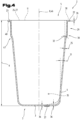
- the Fig.1 The reusable plastic container 2 shown is in the Fig.4 shown again, but in view and cut through the longitudinal axis 8, i.e. in axial section.
- the reusable plastic container 2 comprises a food-safe plastic material.
- the reusable plastic container 2 preferably comprises a recycled food-safe plastic material.
- the reusable plastic container 2 comprises a base 3 and a container casing 4.
- the container 2 also has an open end 5 on its side facing away from the base 3.
- a flange 6 projecting outwards beyond the container casing 4 can be provided in the region of its open end 5.
- the base 3 forms a closed end 7 for the container casing 4.
- the container 2 has an essentially conical or truncated cone-shaped basic shape.
- the open end 5 has a sealing edge 22 with a sealing surface 23, which sealing surface 23 is designed such that the sealing surface 23 can be connected to a first sealing film 24.
- the flange 6 can be designed as a sealing flange.
- the sealing foil 24, 27 is in the Fig.1 before connecting to the sealing surface 23, i.e. in an exploded view.
- the sealing film 24, 27 is connected to the sealing surface 23, or seals and completely covers the open end 5, so that the reusable plastic container 2 is closed.
- sealing films 24 can have a tab or an extension by means of which it is easier for a user to pull the sealing film 24, 27 off the sealing edge 22. For the sake of simplicity, such a tab is not shown.
- the container 2 is preferably formed by a component produced in a deep-drawing process, which can be produced quickly and, above all, in a short cycle time.
- the deep-drawing process is well known and will therefore not be discussed in more detail.
- the deep-drawing process is particularly suitable for producing the container 2 with a sufficient wall thickness from a layer of a deformable material using a deep-drawing tool, which ensures tightness during storage, use and disposal.
- the container 2 can also be formed using other manufacturing processes, such as an injection molding process.
- a longitudinal axis 8 extends in the axial direction between the open end 5 and the end 7 closed with the base 3, which can also represent a central axis if the design is symmetrical.
- a further closure element 11 for example a screw cap, a snap-on lid or a reusable plastic lid 40 (for example in the Fig.7 shown) or to connect them with it.
- the container 2 In the axial direction and thus in the direction of the longitudinal axis 8, the container 2 has a container height 9 between its open end 5, in particular the flange 6 or the sealing edge 22, and the base 3, whereby the receiving volume of the container 2 for receiving a filling material is determined depending on the cross-sectional dimensions.
- the container height 9 in conjunction with the cross-sectional dimensions thus defines a receiving space of the container 2.
- the container shell 4 is understood to be that section of the container 2 which extends between the open end 5, in particular the flange 6, and the base 3 in a predominantly axial direction.
- the container 2 with its container shell 4 is preferably designed in such a way that it preferably tapers conically from the open end 5 to the base 3. tapered, i.e. essentially frustoconical.
- the longitudinal axis 8 corresponds to the cone axis 46.
- the container casing 4 has a wall thickness 25, which wall thickness 25 is from 0.5 mm to 4.0 mm.
- the sealing edge 22 also has a sealing edge thickness 26, which sealing edge thickness 26 extends in the axial direction of the longitudinal axis 8, and which sealing edge thickness 26 is from 0.8 mm to 4.0 mm.
- the sealing surface 23 is designed such that the sealing surface 23 can be connected to a further sealing film 27 after the first sealing film 24 has been removed from the sealing surface 23 of the sealing edge 22, and after the reusable plastic container 2 has been cleaned.
- the container shell 4 can have a conical section 28.
- This conical section 28 extends from the closed end 7 in the direction of the open end 5.
- the container shell 4 can have a cylindrical section 29, which cylindrical section 29 extends from the open end 5 in the direction of the closed end 7.
- a circular cross-section of the cylindrical section 29 is larger than a maximum circular cross-section of the conical section 28.
- the cylindrical section 29 thus represents a ring-like, cylindrical widening which adjoins the conical section 28.
- a conical transition section 30 can be formed between the conical section 28 and the cylindrical section 29, wherein a first angle 31 between the longitudinal axis 8 and the conical section 28 is smaller than a second angle 32 between the longitudinal axis 8 and the conical transition section 30. This enables a widening of the diameter or the circular cross-section from the conical section 28 to the cylindrical section 29.
- the transition section 30 forms a shoulder or a stop area 47 running around the jacket, which, when two or more reusable plastic containers 2 of the same design are stacked on top of one another in the axial direction or inserted into one another, serve as a stop for a flange 6 or for a lower area or a bottom side 48 of the sealing edge 22.
- the underside 48 of the sealing edge 22 refers to the side or surface of the sealing edge 22 facing the base 3.
- the center of mass 35 of the reusable plastic container 2 can take. Specifically, it is shown here that the center of mass 35 of the reusable plastic container 2 can lie outside the longitudinal axis 8, i.e. cannot lie directly on the longitudinal axis 8. The center of mass 35 can lie along its container height 9 in a half facing the closed end 7 or in a third of the container height 9 facing the closed end 7. In the example shown, the center of mass 35 is also closer to the container casing 4 than to the longitudinal axis 8, i.e. is further away from the longitudinal axis 8 than from the container casing 4.
- a possible design of the base 3 and the container shell 4 in the transition area to the base 3 is shown by dashed lines, with the base thickness 36 increasing radially outwards.
- the base 3 is circular or has a round cross-section. Viewed along its diameter, the base 3 has different base thicknesses 36, which can be between 0.5 mm and 4.0 mm.
- the wall thickness 25 of the container shell 4 is different. In the example shown in the Fig.4 the base thickness 36 increases radially from the base center outwards.
- the wall thickness 25 of the container shell 4 is larger or increasing in the transition area to the base 3.
- a detectable element 37 for example an RFID chip or an NFC chip, is applied or inserted into the base 3.
- a sealing aid 38 can be applied to the sealing surface 23 of the sealing edge 22, which can preferably be removed without leaving residue.
- a sealing aid 38 can be a heat-sealing varnish or an adhesive.
- the sealing aid 38 is applied to the sealing film 24, 27 and that the sealing aid 38 only comes into contact with the sealing surface 23 of the sealing edge 22 when the sealing film 24, 27 is sealed on.
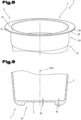
- FIG.2 and 3 Two further embodiments of cup-shaped reusable plastic containers 2 are shown, but each without the sealing film 24, 27, i.e. in the opened or unsealed state. Essentially, reference is made here to the parts of the description in connection with the Fig.1 and Fig.4
- the reusable plastic containers 2 in the Fig.2 and 3 Recesses 33 in the container shell 4, which recesses 33 extend essentially parallel to the longitudinal axis 8 over the cylindrical section 29.
- the recesses 33 have a depth 34 in the radial direction to the longitudinal axis 8, i.e. 90° to the longitudinal axis 8, which depth 34 can be from 1% to 70% of the wall thickness 25 of the container shell 4.
- a further embodiment of a cup-shaped reusable plastic container 2 is shown.
- the reusable plastic container 2 can be closable by means of a further - not shown in detail - closure element.
- the open end 5 can have a thread 39, in particular an external thread, which thread 39 can be connected to a further thread, in particular to an internal thread, of a closure element designed as a screw cap.
- the thread 39 shown is to be understood as an example only; the exact design of the thread 39 is a matter for the expert's skills.
- a thread 39 is expediently designed to be sufficiently stable so that the reusable plastic container 2 can be used, cleaned and refilled several times without risking premature final disposal due to a damaged thread 39.
- the open end 5 has a striking edge, which striking edge can be connected to a closure element designed as a striking lid.
- Fig.7 is a variant or further development of the cup-shaped reusable plastic container 2 according to the Fig.1 and 4 shown, whereby the sealing edge 22 is designed in such a way that the sealing edge 22 can be brought into engagement with locking elements 41 of a closure element designed as a reusable plastic lid 40.
- the Plastic container 2 is sealed with the sealing film 24, 27 as shown and that the reusable plastic lid 40 is additionally applied.
- the plastic container 2 has already been opened, or that the sealing film 24, 27 has been removed, and that the reusable plastic lid 40 thus closes the container without the sealing film 24, 27.
- the reusable plastic container 2 is designed as a combination packaging container 1.
- the reusable plastic container 2 comprises an outer part 12, which outer part 12 encases the reusable plastic container 2, wherein the outer part 12 is formed from a mostly flat blank 13, which blank 13 has a substantially circular ring-segment-shaped basic shape, which blank 13 has a first end section 14 and a second end section 15, wherein the blank 13 is wound into a jacket and the first end section 14 and the second end section 15 are coupled to one another in an overlap region 16, wherein the outer part 12 further has a first end face 19 and a second end face 20 and the first end face 19 and the second end face 20 are spaced apart from one another, wherein the outer part 12 has a longitudinal extension 42 in a direction starting from the first end face 19 to the second end face 20.
- the combination packaging container 1 When looking at the combination packaging container 1 in the three-dimensional view shown, the combination packaging container 1 has a total height 10 which extends from the base 3 to the highest area of the second end face 20 of the outer part 12. The total height can thus be greater than the container height 9 and also greater than the construction height 21 of the outer part 12.
- the casing of the outer part 12 has a receiving region 43 and a region 44, which region 44 is arranged between the receiving region 43 and the second end face 20 when viewed in the longitudinal extension 42, and that a region 45 of the open end 5 is received in the receiving region 43 of the casing of the outer part 12.
- the sleeve-shaped outer part 12 is preferably formed from a cellulose material, such as a cardboard material, with sufficient strength with regard to the absorption and transmission of particularly axially acting pressure forces and from a flat blank 13 is wound into a sheath.
- Blank 13 is usually printed in its undeformed flat position and optionally provided with an additional coating.
- Cellulose material is usually used as the material for blank 13, although this can also be cardboard or strong paper produced using a recycling process. If a layer or ply of the outer part 12 is made from a recycling material, an additional layer made of a higher quality paper can be arranged on or connected to at least one of the surfaces. This additional layer is used to ensure perfect printing for the production of decorations, labels and product information.
- the sleeve-like or jacket-like outer part 12 leads to an additional reinforcement or stiffening effect of the container 2 and thus of the entire combination packaging container 1. This provides, on the one hand, high strength and good thermal insulation and, on the other hand, optimal light protection for the contents of the packaging container.
- the cardboard is additionally coated or sealed with a water-repellent material in the area of the cut edges. This is particularly advantageous when the combination packaging container 1 is exposed to increased moisture. Coating the cardboard used for the outer part 12 with a water-repellent layer prevents the cardboard from swelling in a moist environment and ultimately becoming detached from the container casing 4 of the combination packaging container 1.
- a reusable plastic container 2 with an elliptical sealing edge 22 is shown.
- the open end 5 has a sealing edge 22 that partially protrudes over the container shell 4 of the container 2.
- a sealing edge 22 that partially protrudes over the container shell 4 of the container 2 can be realized by an elliptical sealing edge 22 that extends in the radial direction to the cone axis 46, i.e. when looking at the container 90° to the cone axis 46, for example at two opposite positions over the container shell 4. This is particularly the case when the reusable plastic container 2 is combined with an outer part 12 to form a combination packaging container 1.
- the container (2) has an alignment means (49) in the area of its base (3), in particular a groove or - not shown - a protrusion, which serves to Fixing and/or positioning of the container (2).
- the alignment means 49 formed in the base 3, in particular on the underside of the base 3, can be designed as a projection or, as shown, as a recess.
- the alignment means 49 can also be designed, for example, as a toothing in the container base 3. This is particularly evident from the bottom view according to Fig.10 outlined.
- a star-shaped alignment means 49 or an alignment means 49 with a gear-like contour is provided in the base 3.
- a tool or a coupling means of a device can engage in the alignment means 49, for example by means of teeth, a spreading effect, as well as vacuum or negative pressure.
- the required design, as well as a height of a protrusion or a depth of a groove or a toothing, can be adapted to the respective tool or coupling means of a device. Particularly because the base 3 is comparatively thick, such an alignment means 49 can be easily integrated into the base 3.
- the reusable plastic containers 2 shown in the figures can be processed in a reprocessing process in such a way that repeated or multiple use is possible.
- the process provides that a used, second-hand container 2 is provided, with a first sealing film 24 already removed from the sealing surface 23 of the sealing edge 22.
- the removed sealing film can also be a further sealing film 27 that has already been removed. This is particularly the case if the reusable plastic container 2 has already been treated several times in the reprocessing process.
- the reusable plastic container 2 is then subjected to a first cleaning, with any filling residues being removed. This is done, for example, by means of a washing process, if necessary using detergents.
- the sealing surface 23 of the sealing edge 22 is processed so that it is suitable for restoring the ability of the sealing surface 23 of the sealing edge 22 to be connected to a sealing film 24, 27.
- the processing restores the original state of the sealing surface 23 at least substantially.
- the reusable plastic container 2 is then filled with a filling material. This can be the same as the original or previously contained filling material, but also a different filling material. After refilling, the reusable plastic container 2 is closed or sealed by reconnecting the sealing surface 23 of the sealing edge 22 with another sealing film 27.
- a method step can also be provided, for example, in which after processing the sealing surface 23 of the sealing edge 22 and before refilling the reusable plastic container 2, a second cleaning of the reusable plastic container 2 is carried out to remove any processing residues.
- Processing residues can be, for example, cleaning agent residues or grinding residues.
- a sealing aid 38 can be applied to the sealing surface 23 of the sealing edge 22 before the further sealing film 27 is connected to the sealing surface 23 of the sealing edge 22.
- a mechanical, chemical and/or thermal cleaning step can be carried out.
- a plasma treatment can be carried out.
- the sealing surface 23 of the sealing edge 22 may be reconnected to the further sealing film 27 by ultrasonic welding.
Landscapes
- Engineering & Computer Science (AREA)
- Mechanical Engineering (AREA)
- Ceramic Engineering (AREA)
- Closures For Containers (AREA)
- Packages (AREA)
- Details Of Rigid Or Semi-Rigid Containers (AREA)
- Containers Having Bodies Formed In One Piece (AREA)
Applications Claiming Priority (1)
| Application Number | Priority Date | Filing Date | Title |
|---|---|---|---|
| ATA50783/2022A AT525879B1 (de) | 2022-10-10 | 2022-10-10 | Mehrweg-Kunststoffbehälter und Verfahren zur Wiederaufbereitung |
Publications (2)
| Publication Number | Publication Date |
|---|---|
| EP4353620A2 true EP4353620A2 (fr) | 2024-04-17 |
| EP4353620A3 EP4353620A3 (fr) | 2024-07-17 |
Family
ID=87973336
Family Applications (1)
| Application Number | Title | Priority Date | Filing Date |
|---|---|---|---|
| EP23202631.0A Pending EP4353620A3 (fr) | 2022-10-10 | 2023-10-10 | Récipient réutilisable en matière plastique et procédé de recyclage |
Country Status (4)
| Country | Link |
|---|---|
| US (2) | US20240116665A1 (fr) |
| EP (1) | EP4353620A3 (fr) |
| AT (1) | AT525879B1 (fr) |
| CA (1) | CA3215901A1 (fr) |
Families Citing this family (3)
| Publication number | Priority date | Publication date | Assignee | Title |
|---|---|---|---|---|
| MX2025013237A (es) * | 2023-05-05 | 2026-02-03 | Berry Global Inc | Recipiente para paquetes |
| US20250128856A1 (en) * | 2023-09-30 | 2025-04-24 | Nathan Morris | Container apparatus and methods of forming the same |
| DE102024003490A1 (de) | 2024-10-24 | 2026-04-30 | Buena Vista Media GmbH | Mehrwegbehälter mit Mehrwegdeckel und Hygienesiegel |
Citations (1)
| Publication number | Priority date | Publication date | Assignee | Title |
|---|---|---|---|---|
| WO2020245148A1 (fr) | 2019-06-07 | 2020-12-10 | Greiner Packaging Ag | Pièce externe en forme de manchette ainsi que conteneur d'emballage combiné muni de celle-ci et procédé de séparation du conteneur d'emballage combiné |
Family Cites Families (24)
| Publication number | Priority date | Publication date | Assignee | Title |
|---|---|---|---|---|
| DE7122251U (de) * | 1971-06-09 | 1971-09-30 | Kommanditgesellschaft Neupack Gmbh | Stülpdeckel mit Behälter |
| US4049122A (en) * | 1974-10-21 | 1977-09-20 | Maxwell Earl G | Nestable non-corrosive container for pressurized beverages and processes for manufacture and handling thereof |
| JPS6238892Y2 (fr) * | 1980-06-13 | 1987-10-03 | ||
| KR100272113B1 (ko) * | 1996-03-15 | 2000-12-01 | 도시아키 시모노 | 단열성용기와 그 제조방법 |
| US6070507A (en) * | 1997-03-03 | 2000-06-06 | Abbott Laboratories | Method for punching a sealed package from first and second webs |
| US6530496B2 (en) * | 2001-01-12 | 2003-03-11 | Megatrade International, Inc. | Weight biased vacuum flask |
| JP4681802B2 (ja) * | 2002-07-19 | 2011-05-11 | 出光ユニテック株式会社 | 多層シート、熱成形容器、蓋材、及び易開封性包装体 |
| US20050082295A1 (en) * | 2003-10-21 | 2005-04-21 | Little People Limited | Drinking cup including a food storage element |
| EP1690800A1 (fr) * | 2005-02-15 | 2006-08-16 | Alcan Technology & Management AG | Emballage |
| JP4725886B2 (ja) * | 2005-05-27 | 2011-07-13 | 株式会社吉野工業所 | 合成樹脂製カップ状容器 |
| EP2183106B1 (fr) * | 2007-08-24 | 2016-10-12 | Selig Sealing Products, Inc. | Couverture multifonction pour recouvrir de manière hygiénique un dessus de contenant |
| DE202007016006U1 (de) * | 2007-11-15 | 2008-04-30 | Optipack Gmbh | Behälter |
| JP2017171309A (ja) * | 2016-03-20 | 2017-09-28 | 有限会社K・Mプランニング | 容器 |
| GB2569999A (en) * | 2018-01-09 | 2019-07-10 | Compass Contract Services U K Ltd | Method of preparing and serving a meal package |
| CN208412403U (zh) * | 2018-03-12 | 2019-01-22 | 湖南万容纸塑包装有限公司 | 一种容器 |
| US20190322435A1 (en) * | 2018-04-18 | 2019-10-24 | The Quaker Oats Company | Reusable Playable Rigid Packages |
| US12122590B2 (en) * | 2018-09-26 | 2024-10-22 | Golden Arrow Printing Technology (Kunshan) Co., Ltd. | Carrier used for preparing beverage and method for fabrication of the same |
| US11981495B2 (en) * | 2018-10-11 | 2024-05-14 | Kellogg Company | Packaging subassembly, a packaging assembly and a methodology for preparing a packaging assembly |
| IT201900001393A1 (it) * | 2019-01-31 | 2020-07-31 | Pastificio Rana Spa | Contenitore per il confezionamento di sughi |
| ES2967918T3 (es) * | 2019-04-19 | 2024-05-06 | Siropack Italia S R L | Método para fabricar un contenedor para productos alimenticios |
| DE202019103880U1 (de) * | 2019-07-15 | 2020-10-16 | Roland Dieckelmann | Lebensmittelpackung |
| ES2915250T3 (es) * | 2020-01-15 | 2022-06-21 | Becton Dickinson France | Embalaje para dispositivos médicos |
| US12623807B2 (en) * | 2021-03-03 | 2026-05-12 | Pactiv LLC | Method of forming a container having a rolled rim |
| BE1028778B1 (fr) * | 2021-04-26 | 2022-06-01 | Pack2Change | Emballage alimentaire |
-
2022
- 2022-10-10 AT ATA50783/2022A patent/AT525879B1/de active
-
2023
- 2023-10-05 CA CA3215901A patent/CA3215901A1/fr active Pending
- 2023-10-06 US US18/377,411 patent/US20240116665A1/en active Pending
- 2023-10-10 EP EP23202631.0A patent/EP4353620A3/fr active Pending
-
2025
- 2025-02-03 US US19/043,649 patent/US20250178771A1/en active Pending
Patent Citations (1)
| Publication number | Priority date | Publication date | Assignee | Title |
|---|---|---|---|---|
| WO2020245148A1 (fr) | 2019-06-07 | 2020-12-10 | Greiner Packaging Ag | Pièce externe en forme de manchette ainsi que conteneur d'emballage combiné muni de celle-ci et procédé de séparation du conteneur d'emballage combiné |
Also Published As
| Publication number | Publication date |
|---|---|
| EP4353620A3 (fr) | 2024-07-17 |
| US20240116665A1 (en) | 2024-04-11 |
| US20250178771A1 (en) | 2025-06-05 |
| AT525879B1 (de) | 2023-09-15 |
| CA3215901A1 (fr) | 2024-04-10 |
| AT525879A4 (de) | 2023-09-15 |
Similar Documents
| Publication | Publication Date | Title |
|---|---|---|
| AT525879B1 (de) | Mehrweg-Kunststoffbehälter und Verfahren zur Wiederaufbereitung | |
| EP4265536A2 (fr) | Pièce externe en forme de manchette ainsi que conteneur d'emballage combiné muni de celle-ci et procédé de séparation du conteneur d'emballage combiné | |
| EP4144658B1 (fr) | Seau doté d'une enveloppe intérieure et emballage | |
| DE102008051208A1 (de) | Tragegriff für einen Behälter | |
| WO2009103096A1 (fr) | Emballage composé d'un contenant et d'un couvercle | |
| EP2206655B1 (fr) | Couvercle destiné à fermer une ouverture de récipient, emballage doté d'un récipient et d'un tel couvercle ainsi que procédé de scellage d'un récipient doté d'un tel couvercle | |
| EP4554870A1 (fr) | Tube d'emballage recyclable | |
| AT512873B1 (de) | Kombi-Verpackungsbehälter | |
| AT500064B1 (de) | Verpackungsbehälter aus kunststoff | |
| WO2019057265A1 (fr) | Revêtement intérieur | |
| DE102009046507A1 (de) | Wiederverschließbare Verpackung mit Doppelklebstelle | |
| DE2735836A1 (de) | Verschlussdeckel fuer behaelter | |
| EP1922255A1 (fr) | Sachet tubulaire pourvu d'un corps pouvant etre dechire | |
| DE102022128475B3 (de) | Wiederverwendbarer Behälter insbesondere für Lebensmittel | |
| DE202008005664U1 (de) | Verpackungssystem aus stapelbaren Verpackungseinheiten | |
| DE68908141T2 (de) | Dicht versiegelter Papierbehälter mit einer Öffnungsvorrichtung. | |
| AT526840B1 (de) | Kombi-Verpackungsbehälter mit einem Behälter und einem Außenteil | |
| DE102020102544A1 (de) | Schalen- oder becherförmiger Verpackungsbehälter | |
| EP3107817B1 (fr) | Couvercle de fermeture muni d'une garantie d'inviolabilité et unité d'emballage munie dudit couvercle | |
| DE102006036137A1 (de) | Verpackungsbehälter | |
| EP4353613A1 (fr) | Pièce extérieure et récipient d'emballage combiné équipé de celle-ci, procédé de fabrication et procédé d'ouverture | |
| WO2019081336A1 (fr) | Bouteille comprenant un moyen de maintien de moyen de fermeture | |
| AT500066B1 (de) | Verpackungsbehälter mit deckel | |
| DE19939570A1 (de) | Getränkeflasche mit abnehmbarem Becher, Getränkeflasche, und Verfahren zum Anbringen eines abnehmbaren Bechers am Bodenende einer Getränkeflasche | |
| DE102022108251A1 (de) | Verpackung für ein Wasch- oder Reinigungsmittel |
Legal Events
| Date | Code | Title | Description |
|---|---|---|---|
| PUAI | Public reference made under article 153(3) epc to a published international application that has entered the european phase |
Free format text: ORIGINAL CODE: 0009012 |
|
| STAA | Information on the status of an ep patent application or granted ep patent |
Free format text: STATUS: THE APPLICATION HAS BEEN PUBLISHED |
|
| AK | Designated contracting states |
Kind code of ref document: A2 Designated state(s): AL AT BE BG CH CY CZ DE DK EE ES FI FR GB GR HR HU IE IS IT LI LT LU LV MC ME MK MT NL NO PL PT RO RS SE SI SK SM TR |
|
| PUAL | Search report despatched |
Free format text: ORIGINAL CODE: 0009013 |
|
| AK | Designated contracting states |
Kind code of ref document: A3 Designated state(s): AL AT BE BG CH CY CZ DE DK EE ES FI FR GB GR HR HU IE IS IT LI LT LU LV MC ME MK MT NL NO PL PT RO RS SE SI SK SM TR |
|
| RIC1 | Information provided on ipc code assigned before grant |
Ipc: B65B 7/28 20060101ALI20240612BHEP Ipc: B65D 81/38 20060101ALI20240612BHEP Ipc: B65D 1/42 20060101ALI20240612BHEP Ipc: B65D 1/26 20060101ALI20240612BHEP Ipc: B65D 51/20 20060101ALI20240612BHEP Ipc: B65D 25/36 20060101ALI20240612BHEP Ipc: B65D 77/20 20060101AFI20240612BHEP |
|
| STAA | Information on the status of an ep patent application or granted ep patent |
Free format text: STATUS: REQUEST FOR EXAMINATION WAS MADE |
|
| 17P | Request for examination filed |
Effective date: 20250116 |
|
| STAA | Information on the status of an ep patent application or granted ep patent |
Free format text: STATUS: EXAMINATION IS IN PROGRESS |
|
| 17Q | First examination report despatched |
Effective date: 20251223 |