EP4354358A2 - Halbleiter-supraleiter-hybridanordnung und deren herstellung - Google Patents
Halbleiter-supraleiter-hybridanordnung und deren herstellung Download PDFInfo
- Publication number
- EP4354358A2 EP4354358A2 EP24160621.9A EP24160621A EP4354358A2 EP 4354358 A2 EP4354358 A2 EP 4354358A2 EP 24160621 A EP24160621 A EP 24160621A EP 4354358 A2 EP4354358 A2 EP 4354358A2
- Authority
- EP
- European Patent Office
- Prior art keywords
- superconductor
- component
- semiconductor
- layer
- superconductor material
- Prior art date
- Legal status (The legal status is an assumption and is not a legal conclusion. Google has not performed a legal analysis and makes no representation as to the accuracy of the status listed.)
- Granted
Links
Images




Classifications
-
- H—ELECTRICITY
- H10—SEMICONDUCTOR DEVICES; ELECTRIC SOLID-STATE DEVICES NOT OTHERWISE PROVIDED FOR
- H10N—ELECTRIC SOLID-STATE DEVICES NOT OTHERWISE PROVIDED FOR
- H10N60/00—Superconducting devices
- H10N60/01—Manufacture or treatment
-
- H—ELECTRICITY
- H10—SEMICONDUCTOR DEVICES; ELECTRIC SOLID-STATE DEVICES NOT OTHERWISE PROVIDED FOR
- H10N—ELECTRIC SOLID-STATE DEVICES NOT OTHERWISE PROVIDED FOR
- H10N60/00—Superconducting devices
- H10N60/10—Junction-based devices
-
- H—ELECTRICITY
- H10—SEMICONDUCTOR DEVICES; ELECTRIC SOLID-STATE DEVICES NOT OTHERWISE PROVIDED FOR
- H10D—INORGANIC ELECTRIC SEMICONDUCTOR DEVICES
- H10D30/00—Field-effect transistors [FET]
- H10D30/60—Insulated-gate field-effect transistors [IGFET]
- H10D30/64—Double-diffused metal-oxide semiconductor [DMOS] FETs
- H10D30/66—Vertical DMOS [VDMOS] FETs
-
- H—ELECTRICITY
- H10—SEMICONDUCTOR DEVICES; ELECTRIC SOLID-STATE DEVICES NOT OTHERWISE PROVIDED FOR
- H10N—ELECTRIC SOLID-STATE DEVICES NOT OTHERWISE PROVIDED FOR
- H10N60/00—Superconducting devices
- H10N60/01—Manufacture or treatment
- H10N60/0156—Manufacture or treatment of devices comprising Nb or an alloy of Nb with one or more of the elements of group IVB, e.g. titanium, zirconium or hafnium
-
- H—ELECTRICITY
- H10—SEMICONDUCTOR DEVICES; ELECTRIC SOLID-STATE DEVICES NOT OTHERWISE PROVIDED FOR
- H10N—ELECTRIC SOLID-STATE DEVICES NOT OTHERWISE PROVIDED FOR
- H10N60/00—Superconducting devices
- H10N60/01—Manufacture or treatment
- H10N60/0268—Manufacture or treatment of devices comprising copper oxide
- H10N60/0801—Manufacture or treatment of filaments or composite wires
-
- H—ELECTRICITY
- H10—SEMICONDUCTOR DEVICES; ELECTRIC SOLID-STATE DEVICES NOT OTHERWISE PROVIDED FOR
- H10N—ELECTRIC SOLID-STATE DEVICES NOT OTHERWISE PROVIDED FOR
- H10N60/00—Superconducting devices
- H10N60/01—Manufacture or treatment
- H10N60/0912—Manufacture or treatment of Josephson-effect devices
-
- H—ELECTRICITY
- H10—SEMICONDUCTOR DEVICES; ELECTRIC SOLID-STATE DEVICES NOT OTHERWISE PROVIDED FOR
- H10N—ELECTRIC SOLID-STATE DEVICES NOT OTHERWISE PROVIDED FOR
- H10N60/00—Superconducting devices
- H10N60/10—Junction-based devices
- H10N60/12—Josephson-effect devices
-
- H—ELECTRICITY
- H10—SEMICONDUCTOR DEVICES; ELECTRIC SOLID-STATE DEVICES NOT OTHERWISE PROVIDED FOR
- H10N—ELECTRIC SOLID-STATE DEVICES NOT OTHERWISE PROVIDED FOR
- H10N60/00—Superconducting devices
- H10N60/10—Junction-based devices
- H10N60/128—Junction-based devices having three or more electrodes, e.g. transistor-like structures
-
- H—ELECTRICITY
- H10—SEMICONDUCTOR DEVICES; ELECTRIC SOLID-STATE DEVICES NOT OTHERWISE PROVIDED FOR
- H10N—ELECTRIC SOLID-STATE DEVICES NOT OTHERWISE PROVIDED FOR
- H10N60/00—Superconducting devices
- H10N60/20—Permanent superconducting devices
- H10N60/203—Permanent superconducting devices comprising high-Tc ceramic materials
-
- H—ELECTRICITY
- H10—SEMICONDUCTOR DEVICES; ELECTRIC SOLID-STATE DEVICES NOT OTHERWISE PROVIDED FOR
- H10N—ELECTRIC SOLID-STATE DEVICES NOT OTHERWISE PROVIDED FOR
- H10N60/00—Superconducting devices
- H10N60/80—Constructional details
- H10N60/805—Constructional details for Josephson-effect devices
-
- H—ELECTRICITY
- H10—SEMICONDUCTOR DEVICES; ELECTRIC SOLID-STATE DEVICES NOT OTHERWISE PROVIDED FOR
- H10N—ELECTRIC SOLID-STATE DEVICES NOT OTHERWISE PROVIDED FOR
- H10N60/00—Superconducting devices
- H10N60/80—Constructional details
- H10N60/85—Superconducting active materials
-
- G—PHYSICS
- G06—COMPUTING OR CALCULATING; COUNTING
- G06N—COMPUTING ARRANGEMENTS BASED ON SPECIFIC COMPUTATIONAL MODELS
- G06N10/00—Quantum computing, i.e. information processing based on quantum-mechanical phenomena
- G06N10/40—Physical realisations or architectures of quantum processors or components for manipulating qubits, e.g. qubit coupling or qubit control
Definitions
- Certain semiconductor-superconductor hybrid devices have applications in quantum computing, for example, topological quantum computing.
- Topological quantum computing is based on the phenomenon whereby non-abelian anyons, in the form of "Majorana zero modes" (MZMs), can be formed in regions where a semiconductor is coupled to a superconductor.
- a non-abelian anyon is a type of quasiparticle, meaning not a particle per se, but an excitation in an electron liquid that behaves at least partially like a particle.
- An MZM is a particular bound state of such quasiparticles. Under certain conditions, these states can be formed close to the semiconductor-superconductor interface in a nanowire formed from a length of semiconductor coated with a superconductor. When MZMs are induced in the nanowire, it is said to be in the "topological regime".
- a magnetic field conventionally applied externally, and also cooling of the nanowire to, or below, a temperature that induces superconducting behaviour in the superconductor material. It may also involve gating a part of the nanowire with an electrostatic potential.
- a quantum bit is an element upon which a measurement with two possible outcomes can be performed, but which at any given time (when not being measured) can in fact be in a quantum superposition of the two states corresponding to the different outcomes.
- the device is cooled to a temperature where the superconductor (e.g. Aluminium) exhibits superconducting behaviour.
- the superconductor e.g. Aluminium
- the superconductor causes a proximity effect in the adjacent semiconductor, whereby a region of the semiconductor near the interface with the superconductor also exhibits superconducting properties. I.e., a topological phase behaviour is induced in the adjacent semiconductor as well as the superconductor. It is in this region of the semiconductor where the MZMs are formed.
- Another condition for inducing the topological phase where MZMs can form is the application of a magnetic field in order to lift the spin degeneracy in the semiconductor.
- Degeneracy in the context of a quantum system refers to the case where different quantum states have the same energy level. Lifting the degeneracy means causing such states to adopt different energy levels.
- Spin degeneracy refers to the case where different spin states have the same energy level. Spin degeneracy can be lifted by means of a magnetic field, causing an energy level split between the differently spin-polarized electrons. This is known as the Zeeman effect.
- the g-factor refers to the coefficient between the applied magnetic field and the spin splitting. Typically, the magnetic field is applied by an external electromagnet.
- a method of fabricating a semiconductor-superconductor hybrid device comprises: providing a workpiece comprising a semiconductor component, a layer of a first superconductor material on the semiconductor component, and a layer of a second superconductor material on the layer of first superconductor material, the second superconductor material being different from the first superconductor material; etching the layer of the second superconductor material to expose a portion of the first superconductor material; and oxidising the portion of the first superconductor material to form a passivating layer on the semiconductor component.
- the device comprises a semiconductor component; a first superconductor component over a first portion of the semiconductor component, the first superconductor component comprising a first superconductor material; a second superconductor component on the first superconductor component, the second superconductor component comprising a second superconductor material different from the first superconductor material; and a passivating layer over a second portion of the semiconductor component, the passivating layer comprising an oxide of the first superconductor material.
- a method of etching a workpiece comprising a lead component.
- the method comprises: forming a mask on the lead component, the mask defining exposed regions of the lead component; and contacting the exposed regions with an etchant composition.
- the etchant composition comprises acetic acid and propan-2-ol.
- the verb 'to comprise' is used as shorthand for 'to include or to consist of'.
- the verb 'to comprise' is intended to be an open term, the replacement of this term with the closed term 'to consist of' is explicitly contemplated, particularly where used in connection with chemical compositions.
- the term "superconductor” refers to a material which becomes superconductive when cooled to a temperature below a critical temperature, Tc, of the material. The use of this term is not intended to limit the temperature of the device.
- a “nanowire” as referred to herein is an elongate member having a nano-scale width, and a length-to-width ratio of at least 100, or at least 500, or at least 1000.
- a typical example of a nanowire has a width in the range 10 to 500 nm, optionally 50 to 100 nm or 75 to 125 nm.
- Lengths are typically of the order of micrometres, e.g. at least 1 ⁇ m, or at least 10 ⁇ m.
- Coupled in the context of the present disclosure refers in particular to the hybridisation of energy levels between two materials or components.
- Volumes are measured at 25 °C and a pressure of 1 atm (101325 Pa).
- workpiece may refer in particular to an unfinished device obtained after one or more fabrication steps.
- Aluminium has various favourable properties, including good lattice matching with, and good coupling to, various semiconductor materials.
- Described herein are semiconductor-superconductor hybrid devices in which a first superconductor connects a further superconductor to a semiconductor, and in which a passivating layer protects the semiconductor component from degradation.
- a layer of a first superconductor material is formed on a semiconductor component.
- the layer of the first superconductor material is grown epitaxially on the semiconductor component.
- Fig. 2a shows a semiconductor component 20 with a layer of first superconductor material 22 arranged directly on the semiconductor component 20.
- the nature of the material which forms the semiconductor component is not particularly limited.
- silicon, germanium, or silicon/germanium semiconductors may be used.
- the semiconductor component may comprise a III-V semiconductor.
- III-V semiconductor materials include those of general formula: InAs x Sb 1-x (Formula 1) where x is in the range 0 to 1.
- Indium arsenide, InAs has been found to have good handling properties, and provides devices with good performance.
- Indium antimonide, InSb may provide further improvements to device performance but may have less favourable handling properties.
- the ternary mixtures have intermediate properties between those of the binary compounds InAs and InSb. Improvements in device performance compared to InAs may be observed when x is in the range 0 to 0.7, or 0.01 to 0.7. Values of x in the range 0.35 to 0.45 may provide a particularly good balance of device performance and handling properties.
- the semiconductor component may comprise indium arsenide.
- indium arsenide As components of hybrid devices may be fabricated by epitaxial growth processes, good lattice matching between component materials may be desirable. Indium arsenide has good compatibility with aluminium in particular.
- Fig. 2 shows a single layer of semiconductor. More than one semiconductor component may be present. For example, there may be a first semiconductor component in the form of a nanowire, supported by a second semiconductor component in the form of a wafer.
- a more elaborate device may comprise a network of nanowires arranged on a wafer, or a semiconductor heterostructure comprising a shallow planar electron gas.
- Indium phosphide is one example of a semiconductor which may be useful as a wafer material. Indium phosphide has a higher band-gap than materials of Formula 1, so may not interfere with the operation of devices based on these materials.
- the first superconductor material is selected to be a material which may be readily grown on the semiconductor material. Good lattice matching between the first superconductor material and semiconductor material may be helpful in this regard.
- the first superconductor material is further selected such that a second superconductor component can be selectively etched.
- the first superconductor component may be selected such that an etchant for the second superconductor material does not etch the first superconductor material.
- the first superconductor component may be selected such that an etchant for the second superconductor material etches the first superconductor component at a rate which is slow enough to allow selective removal of the second superconductor material while retaining the first superconductor material.
- the first superconductor material may be a material which undergoes self-limiting oxidation to a certain depth, for example when exposed to atmospheric oxygen.
- the first superconductor material desirably forms an oxide which acts as a dielectric.
- Aluminium may be particularly preferred as the first superconductor material.
- a variant uses indium as the first superconductor material.
- the thickness of the layer of first superconductor material is selected to allow for formation of a passivating layer later in the process.
- a passivating layer is a layer that protects the semiconductor component from reactive species, while allowing access to the semiconductor component. "Access" in the present context means that an electrostatic field can be applied to the semiconductor component through the passivating layer.
- the thickness of the layer of first superconductor material may be selected such that the complete thickness of the exposed portions of the first superconductor material will oxidise at block 104.
- the precise thickness for achieving this varies depending on the superconductor material chosen, the selected reaction conditions, and the orientation of the crystal of first superconductor material, amongst other things.
- the layer of first superconductor material typically has a thickness of less than or equal to 4 nm, for example, 2 to 3 nm. Aluminium layers of thickness less than or equal to 3 nm will typically fully oxidise when exposed to atmospheric oxygen.
- the layer of aluminium may have a thickness of at least 2 nm, because continuous layers thinner than this are more difficult to manufacture reliably.
- the layer of first superconductor material may have a thickness of less than or equal to 10 nm, optionally less than or equal to 8 nm. When exposed to oxygen in the air, indium layers will oxidise down to a depth of approximately 10 nm.
- the starting layer thickness may be increased to compensate for this.
- a layer of a second superconductor material 24 is formed on the layer of the first superconductor material 22.
- the second superconductor material is different from the first superconductor material.
- a workpiece obtained by this step is illustrated in Fig. 2b .
- aluminium has good compatibility with semiconductor materials, it has a relatively small superconducting gap.
- a layer of a further superconductor having a larger superconducting gap may be formed on the aluminium layer.
- the aluminium layer may facilitate epitaxial growth of the layer of second superconductor.
- the aluminium layer may provide good coupling between the semiconductor component and the second superconductor.
- the semiconductor material and the first superconductor material may be selected so as to avoid a large Schottky barrier, in other words high resistance, at an interface between the semiconductor material and the first superconductor material.
- the materials of Formula 1 typically do not form a large Schottky barrier when interfacing with metals such as aluminium. Instead, the conduction band at the surface of the semiconductor can be pulled down below the chemical potential. This may allow good transport across the interface and a good proximity effect when the first superconductor material is in a superconducting phase.
- metals have plenty of occupied and available electron states around the chemical potential ensuring good transport across metal-metal interfaces.
- the second superconductor material may be any superconductor material which can be etched selectively from the first superconductor material.
- the second superconductor material may for example be selected from indium, vanadium, niobium, and lead; e.g. indium, vanadium and lead; more particularly, lead. Layers of these materials may be grown at low temperatures, e.g. temperatures below 0°C. The use of low temperatures may be preferred when aluminium is used as the first superconductor material. Thin layers of aluminium tend to become discontinuous if exposed to excessive heat.
- Lead may be particularly preferred for some applications.
- Lead has a superconductor gap which is about 6 times greater than that of aluminium.
- a large superconductor gap may be useful in the context of a device for topological quantum computing, because it may increase the energy gap between the computationally-useful Majorana zero modes and higher energy states. It is desirable to avoid transfer of electrons from Majorana zero modes into higher energy states as this may result in the loss of information.
- a portion of the layer of the second superconductor material is etched to expose a portion of the first superconductor material.
- This may comprise lithography using a mask. Workpieces obtained at various stages of a lithographic process are illustrated schematically in Figs. 2C to 2E .
- a layer of resist 26 may be applied to the layer of second superconductor material 24 to provide a workpiece as illustrated in Fig. 2C .
- One example technique for applying a layer of resist is spin-coating.
- a portion of the layer of resist 26 is selectively exposed. Exposure causes material in the exposed portion of the resist to undergo a reaction which alters the solubility of the resist in a developer. The nature of the exposure is selected as appropriate based on the nature of the resist.
- the portions of the layer of resist to be exposed are selected based on the desired device structure, and also on the nature of the resist.
- the resist may be a positive resist. A positive resist becomes more soluble in the developer when exposed.
- the resist may be a negative resist. A negative resist becomes less in the developer when exposed.
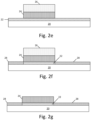
- the resist 26 is developed, for example by contacting the resist with a suitable solvent. This forms a mask which exposes a portion of the second superconductor material, as shown in Fig. 2d .
- the exposed portion of the metal component is etched to form a structure as in Fig. 2e .
- Reagents and conditions used for the etching are selected such that the second superconductor material is removed selectively, without removing the first superconductor material.
- the exposed portion of the first superconductor material 22 is oxidised to form a passivating layer 28 on the semiconductor component 20, as shown in Fig. 2f .
- the oxidation may be the result of exposing the first semiconductor material to the etchant.
- the etching and oxidation may thus be implemented as a single process step.
- the oxidation may be the result of exposing the first semiconductor material to oxygen, e.g. to oxygen in the air.
- any remaining resist 26 may be stripped, for example by dipping the workpiece in an appropriate solvent.
- the semiconductor-superconductor hybrid device illustrated in Fig. 2g includes a semiconductor component 20, a first superconductor component 22 on a first portion of the semiconductor component 20, a passivating layer 28 on a second portion of the semiconductor component 20, and a second superconductor component 24 on the first superconductor component 22.
- the first and second superconductor components comprise first and second superconductor materials, respectively.
- the first and second superconductor materials are different from one another.
- the passivating layer comprises an oxide of the first superconductor material.
- the first superconductor component 22 couples the second superconductor component 24 to the semiconductor component 20.
- Passivating layer 28 covers those portions of the semiconductor component 20 which are not provided with superconductor components. This protects the semiconductor component 20 from its environment. Oxygen from the atmosphere and certain reagents used during fabrication may otherwise degrade the semiconductor component 20.
- the passivating layer 28 comprises an oxide, rather than a metal, an electrostatic field may be applied to the semiconductor component 20 through the passivating layer 28 when the device is in use.
- Fig. 2g is a simplified schematic view of the device.
- semiconductor-superconductor hybrid devices include Josephson junctions and devices capable of generating a Majorana zero mode.
- a mask is formed on the lead component.
- the mask exposes portions of the lead component.
- Forming a mask typically comprises applying a resist to the workpiece; selectively exposing the resist; and developing the resist. Such a process is discussed above with reference to Fig. 2 .
- the exposed portions of the lead component are contacted with an etchant composition.
- the etchant composition comprises a solution of acetic acid in propan-2-ol.
- Propan-2-ol may also be referred to as isopropyl alcohol, IPA.
- the amount of acetic acid present in the etchant composition may be in the range 5 % to 20 %, optionally 10 % to 20 %, 14 to 18 %, 15 to 17 %, or may be about 16 % by volume based on the total volume of the etchant composition.
- a nanowire of indium arsenide was grown on a chip using the vapour-liquid-solid, VLS, technique.
- the indium arsenide was coated with a layer of aluminium having a thickness of approximately 1 nm, by epitaxial growth.
- a layer of lead was then grown epitaxially on the layer of aluminium.
- a scanning electron microscopy, SEM, micrograph of the nanowire is shown in Fig. 4 .
- the chip is spin-coated with an electron beam lithography, ELB, resist.
- Example resists include poly(methyl methacrylate) and methylmethacrylate.
- the resist was developed chemically, forming small structures in the resist and exposing selected areas of the lead.
- the exposed lead was etched using an etchant that is selective against aluminium. All lead not covered by resist is removed, exposing the aluminium layer in these regions.
- a solution comprising about 16 % acetic acid, by volume, in propan-2-ol is particularly useful for this process. Such a solution may not attack the EBL resist.
- the exposed aluminium is oxidised to form Al 2 O 3 .
- This oxidation may occur by a reaction with the etchant, and/or by contact with atmospheric oxygen.
- the resist is then stripped using a solvent.
- a method of fabricating a semiconductor-superconductor hybrid device which method comprises:
- Providing the workpiece may comprise forming the layer of the first superconductor material by epitaxial growth on the semiconductor component; and forming the layer of the second superconductor material by epitaxial growth on the layer of the first superconductor material, the second superconductor material being different from the first superconductor material. Such steps may be performed in advance of from the remaining steps of the method.
- the first superconductor material may be aluminium. Aluminium has good compatibility with various semiconductor materials, in particular those of Formula 1.
- the first semiconductor material may be indium.
- the layer of the first superconductor material may have a thickness selected to allow for the formation of the passivating layer.
- the thickness may be selected such that exposed portions of the first superconductor material will be substantially fully oxidised.
- the thickness of the layer of first superconductor material is typically less than or equal to 4 nm, optionally less than or equal to 3 nm. Aluminium layers having thicknesses in these ranges may fully oxidise on exposure to air, for example.
- the layer of aluminium is typically has a thickness which is greater than or equal to 2 nm. Layers with smaller thicknesses could in principle be used, however complete oxidation is already achieved for a 2 nm thick layer and the fabrication of continuous layers having thicknesses below 2 nm may be difficult.
- the layer of first superconductor material may have a thickness of less than or equal to 10 nm, or less than or equal to 8 nm. Indium layers having thicknesses in these ranges may fully oxidise on exposure to air, for example.
- the nature of the second superconductor material is not particularly limited provided that a layer of the material can be fabricated on the layer of first superconductor material without disrupting the structure of the layer of first superconductor material.
- the second superconductor material is selected to have a larger superconducting gap than aluminium.
- materials useful as the second superconductor material include materials selected from lead, indium, vanadium, niobium, tantalum, tin, and rhenium. These materials in particular may be grown on aluminium without exposing the aluminium to excessive temperatures.
- the second superconductor material may be lead.
- Lead has a superconducting gap which is more than 6 times larger than aluminium (C. Kittel (2004) Introduction to Solid State Physics. Wiley. ISBN: 9780471415268).
- the thickness of the layer of second superconductor material may be selected as appropriate depending on the materials chosen. For some materials, layer thickness may have an impact on superconductivity. The thickness is selected to allow the material to display superconductivity at the operating temperature of the device.
- the thickness of the lead layer is not particularly limited.
- a monolayer of lead may sustain superconductive properties (Cherkez et al, Phys. Rev. X 4, 011033 (2014)). Resistance to the effects of an applied magnetic field may increase as thickness decreases. Providing a lead layer which is as thin as possible may be preferred for some applications.
- Niobium may be a preferred second superconductor material for some applications. Niobium is the strongest elemental superconductor, i.e. has a particularly large superconductor gap.
- the etching is performed using conditions selected such that a portion of the second superconductor material is removed to expose a portion of the first superconductor material. Partial removal, i.e. a reduction in thickness, of the portion of first superconductor material may be tolerated so long as the etching does not expose any portion of the semiconductor material and the passivating layer will be thick enough to protect the semiconductor component from oxidation. The thickness of the first superconductor layer may be increased to compensate for partial removal at the etching stage.
- the etching may comprise contacting the second superconductor material with an etchant composition comprising an acid selected from nitric acid and acetic acid.
- the etchant composition may be glacial acetic acid.
- the etchant composition may comprise acetic acid and propan-2-ol. This etchant composition has been found to be particularly useful. It has been observed that attack of masks used in lithography by the etchant is reduced when propan-2-ol is included in the etchant composition.
- the acetic acid may be present in the etchant composition in an amount in the range 5 % to 20 %, e.g. 10 % to 20 %, 14 to 18 %, or 15 to 17 %, or in an amount of about 16 %, by volume based on the total volume of the etchant composition. Concentrations in these ranges are particularly effective for avoiding degradation of the mask, while still providing a good etching rate.
- This etchant composition may be particularly advantageous when used in combination with a resist comprising an acrylate polymer.
- acrylate polymers include poly(methacrylic acid), poly(acrylic acid), poly(methyl acrylate), and methylmethacrylate-methacrylic acid copolymers.
- the etching may comprise reactive ion etching using chloride ions. Reactive ion etching using chloride ions selectively removes niobium, without removing aluminium.
- the methods described herein may be performed at a temperature less than or equal to 0°C. This is particularly applicable when the first superconductor material comprises aluminium. It has been found that it is preferable to keep the temperature of the aluminium as low as possible during fabrication. An aluminium layer which is not covered by another component tends to degrade and become discontinuous, forming discrete blobs of aluminium, if exposed to excessive heat. Controlling the temperature during fabrication may therefore improve the properties of the finished device.
- the methods provided herein may further comprise, before the etching:
- the resist may be a photoresist.
- the etching may comprise optical lithography. Developers used for optical lithography may damage certain materials, in particular aluminium.
- the second superconductor component covers the first superconductor component thereby protecting the first superconductor component from the developer. The workpiece used may therefore be compatible with optical lithography processes.
- Optical lithography allows the resist to be exposed quickly. Optical lithography may therefore be preferred for the fabrication of larger devices.
- the resist may be an electron beam resist.
- the etching may comprise electron beam lithography. Electron beam lithography may allow for higher resolution than optical lithography.
- electron beam resists examples include acrylate polymers such as poly(methacrylic acid), poly(methyl acrylate), and methylmethacrylate-methacrylic acid copolymers.
- the nature of the exposing and developing steps may be selected as appropriate depending on the resist chosen.
- One of skill in the art will be familiar with lithographic processes.
- the methods provided herein may further comprise fabricating a gate electrode for applying an electrostatic field to the semiconductor component. Electrostatic gating is useful for various types of semiconductor-superconductor hybrid devices. Since the passivating layer obtained using the methods described herein comprises an oxide, the semiconductor component of the device can be electrostatically gated through the passivating layer.
- Another aspect provides a semiconductor-superconductor hybrid device, comprising:
- the passivating layer is obtainable by the method as described above.
- the first superconductor component and the passivating layer may be formed integrally to one another.
- a continuous layer may be arranged on the semiconductor component, the continuous layer comprising a portion corresponding to the passivating layer, and a portion corresponding to the first superconductor component.
- the first superconductor material may be aluminium.
- the second superconductor material may be selected from lead, indium, vanadium, niobium, tantalum, tin, and rhenium.
- the second superconductor material may be lead.
- the semiconductor component may comprise a material of Formula 1, for example, indium arsenide.
- the device may further comprise one or more additional components.
- An additional component may be provided on a third portion of the semiconductor component, with the passivating layer extending over the additional component. Examples of such additional components include ferromagnetic insulator components.
- the semiconductor-superconductor hybrid device may further comprise a gate electrode for applying an electrostatic field to the semiconductor component.
- Examples of semiconductor-superconductor hybrid devices include Josephson junctions and devices capable of generating Majorana zero modes.
- a still further aspect provides a method of etching a workpiece comprising a lead component, which method comprises:
- the acetic acid may be present in the etchant composition in an amount in the range 5% to 20%, e.g. 10 % to 20 %, optionally 14 to 18 %, further optionally 15 to 17 %, or about 16 % by volume based on the total volume of the etchant composition. Concentrations in these ranges are particularly effective for avoiding degradation of the mask, while still providing a good etching rate.
- the mask may comprise an acrylate polymer.
- acrylate polymers include poly(methacrylic acid), poly(acrylic acid), poly(methyl acrylate), and methylmethacrylate-methacrylic acid copolymers.
- the workpiece may further comprise an aluminium component.
- the method may further comprise contacting the aluminium component with the etchant composition to oxidise the aluminium component.
- the aluminium component may be configured to be fully oxidised.
- the aluminium component may have a thickness less than or equal to 4 nm.
- the workpiece may further comprise a semiconductor component.
- the semiconductor component may be arranged under the aluminium component whereby the aluminium component protects the semiconductor component from the etchant composition.
- a related aspect provides the use of propan-2-ol in an etchant composition to prevent degradation of a mask by the etchant composition, wherein the etchant composition includes acetic acid.
- the acetic acid may be present in the etchant composition in an amount in the range 5 % to 20 %, optionally 10 % to 20 %, optionally 14 to 18 %, further optionally 15 to 17 %, or about 16 % by volume based on the total volume of the etchant composition. Concentrations in these ranges are particularly effective for avoiding degradation of the mask, while still providing a good etching rate.
- the mask may comprise an acrylate polymer.
- acrylate polymers include poly(methacrylic acid), poly(acrylic acid), poly(methyl acrylate), and methylmethacrylate-methacrylic acid copolymers.
- a still further aspect provides a kit comprising an etchant composition and a composition for forming a lithography mask, wherein the etchant composition comprises acetic acid and propan-2-ol.
- the acetic acid may be present in the etchant composition in an amount of 10% to 20% by volume.
- the composition for forming the lithography resist may be for forming a photoresist or for forming an electron beam resist.
- the composition for forming a lithography mask may comprise a composition for forming a layer of an acrylate polymer on a workpiece.
- acrylate polymers include poly(methacrylic acid), poly(acrylic acid), poly(methyl acrylate), and methylmethacrylate-methacrylic acid copolymers.
Landscapes
- Engineering & Computer Science (AREA)
- Manufacturing & Machinery (AREA)
- Chemical & Material Sciences (AREA)
- Ceramic Engineering (AREA)
- Superconductor Devices And Manufacturing Methods Thereof (AREA)
- Internal Circuitry In Semiconductor Integrated Circuit Devices (AREA)
Applications Claiming Priority (4)
| Application Number | Priority Date | Filing Date | Title |
|---|---|---|---|
| US201962944093P | 2019-12-05 | 2019-12-05 | |
| US16/796,671 US11211543B2 (en) | 2019-12-05 | 2020-02-20 | Semiconductor-superconductor hybrid device and its fabrication |
| EP20830437.8A EP4070391B1 (de) | 2019-12-05 | 2020-12-04 | Halbleiter-supraleiter-hybridvorrichtung und ihre herstellung |
| PCT/US2020/063459 WO2021113746A1 (en) | 2019-12-05 | 2020-12-04 | Semiconductor-superconductor hybrid device and its fabrication |
Related Parent Applications (2)
| Application Number | Title | Priority Date | Filing Date |
|---|---|---|---|
| EP20830437.8A Division EP4070391B1 (de) | 2019-12-05 | 2020-12-04 | Halbleiter-supraleiter-hybridvorrichtung und ihre herstellung |
| EP20830437.8A Division-Into EP4070391B1 (de) | 2019-12-05 | 2020-12-04 | Halbleiter-supraleiter-hybridvorrichtung und ihre herstellung |
Publications (3)
| Publication Number | Publication Date |
|---|---|
| EP4354358A2 true EP4354358A2 (de) | 2024-04-17 |
| EP4354358A3 EP4354358A3 (de) | 2024-07-24 |
| EP4354358B1 EP4354358B1 (de) | 2026-03-11 |
Family
ID=76210628
Family Applications (2)
| Application Number | Title | Priority Date | Filing Date |
|---|---|---|---|
| EP20830437.8A Active EP4070391B1 (de) | 2019-12-05 | 2020-12-04 | Halbleiter-supraleiter-hybridvorrichtung und ihre herstellung |
| EP24160621.9A Active EP4354358B1 (de) | 2019-12-05 | 2020-12-04 | Herstellung einer halbleiter-supraleiter-hybridanordnung |
Family Applications Before (1)
| Application Number | Title | Priority Date | Filing Date |
|---|---|---|---|
| EP20830437.8A Active EP4070391B1 (de) | 2019-12-05 | 2020-12-04 | Halbleiter-supraleiter-hybridvorrichtung und ihre herstellung |
Country Status (7)
| Country | Link |
|---|---|
| US (3) | US11211543B2 (de) |
| EP (2) | EP4070391B1 (de) |
| JP (1) | JP7646656B2 (de) |
| KR (1) | KR102769512B1 (de) |
| CN (1) | CN114788026A (de) |
| AU (1) | AU2020395314A1 (de) |
| WO (1) | WO2021113746A1 (de) |
Families Citing this family (7)
| Publication number | Priority date | Publication date | Assignee | Title |
|---|---|---|---|---|
| US11211543B2 (en) | 2019-12-05 | 2021-12-28 | Microsoft Technology Licensing, Llc | Semiconductor-superconductor hybrid device and its fabrication |
| WO2021110275A1 (en) | 2019-12-05 | 2021-06-10 | Microsoft Technology Licensing Llc | Method of selectively etching a metal component |
| US20210280763A1 (en) * | 2019-12-23 | 2021-09-09 | Microsoft Technology Licensing, Llc | Superconductor heterostructures for semiconductor-superconductor hybrid structures |
| CN117256212A (zh) * | 2021-04-29 | 2023-12-19 | 微软技术许可有限责任公司 | 半导体器件以及用于制造和操作器件的方法 |
| KR20240024824A (ko) * | 2021-06-29 | 2024-02-26 | 마이크로소프트 테크놀로지 라이센싱, 엘엘씨 | 정전기적으로 경계 지어진 활성 영역을 갖는 반도체 디바이스 |
| CN115968251B (zh) | 2021-10-08 | 2025-11-14 | 腾讯科技(深圳)有限公司 | 量子比特组件、量子比特组件制备方法、芯片及设备 |
| EP4430934A1 (de) | 2021-11-10 | 2024-09-18 | Microsoft Technology Licensing, LLC | Verfahren zur herstellung einer vorrichtung mit passivierungsschicht |
Family Cites Families (35)
| Publication number | Priority date | Publication date | Assignee | Title |
|---|---|---|---|---|
| US3366519A (en) * | 1964-01-20 | 1968-01-30 | Texas Instruments Inc | Process for manufacturing multilayer film circuits |
| US3725213A (en) * | 1970-04-13 | 1973-04-03 | Texas Instruments Inc | Method of forming superconductive barrier devices |
| JPS6224677A (ja) * | 1985-07-24 | 1987-02-02 | Nippon Telegr & Teleph Corp <Ntt> | 超伝導回路用接地面の形成方法 |
| US4904980A (en) * | 1988-08-19 | 1990-02-27 | Westinghouse Electric Corp. | Refractory resistors with etch stop for superconductor integrated circuits |
| US5084437A (en) * | 1990-02-28 | 1992-01-28 | Westinghouse Electric Corp. | Method for making high-current, ohmic contacts between semiconductors and oxide superconductors |
| DE69222555T2 (de) * | 1991-03-28 | 1998-03-12 | Sumitomo Electric Industries | Verfahren zur Reinigung einer dünnen Schicht eines Supraleiteroxyd |
| EP0968979A1 (de) * | 1998-06-30 | 2000-01-05 | Siemens Aktiengesellschaft | Ätzen von Metalloxidkeramiken auf Bi-Basis |
| JP2002094370A (ja) | 2000-09-14 | 2002-03-29 | Nec Corp | 超伝導半導体ハイブリッド集積回路 |
| US6740595B2 (en) | 2002-04-12 | 2004-05-25 | Infineon Technologies Ag | Etch process for recessing polysilicon in trench structures |
| US7833904B2 (en) | 2005-06-16 | 2010-11-16 | The Trustees Of Columbia University In The City Of New York | Methods for fabricating nanoscale electrodes and uses thereof |
| JP5588597B2 (ja) * | 2007-03-23 | 2014-09-10 | 富士フイルム株式会社 | 導電性材料の製造方法及び製造装置 |
| JP2009048778A (ja) * | 2007-08-13 | 2009-03-05 | Kawai Musical Instr Mfg Co Ltd | 透明導電層の形成方法及び積層構造体の形成方法 |
| JP2009164250A (ja) * | 2007-12-28 | 2009-07-23 | Mitsubishi Heavy Ind Ltd | 透明導電酸化膜の導電分離部形成方法およびこれを用いて製造された多接合型光電変換装置 |
| WO2010016720A2 (ko) * | 2008-08-04 | 2010-02-11 | 고려대학교 산학협력단 | 2세대 고온 초전도 선재의 용융확산 접합방법 |
| JP5286502B2 (ja) | 2009-03-27 | 2013-09-11 | 独立行政法人科学技術振興機構 | 強磁性半導体素子 |
| KR20120050235A (ko) | 2010-11-10 | 2012-05-18 | 에스케이하이닉스 주식회사 | 자기터널접합소자 및 그 제조 방법 |
| KR20130016826A (ko) | 2011-08-09 | 2013-02-19 | 에스케이하이닉스 주식회사 | 반도체 소자 제조 방법 |
| WO2015017659A1 (en) | 2013-07-31 | 2015-02-05 | Advanced Technology Materials, Inc. | AQUEOUS FORMULATIONS FOR REMOVING METAL HARD MASK AND POST-ETCH RESIDUE WITH Cu/W COMPATIBILITY |
| CN106575667B (zh) * | 2014-07-02 | 2020-07-31 | 哥本哈根大学 | 半导体约瑟夫森结及其相关的传输子量子位 |
| KR101535386B1 (ko) | 2014-07-09 | 2015-07-08 | 노재호 | 잉크 또는 도료 식각용 식각용액 및 이를 이용한 잉크 또는 도료 패턴의 제조방법 |
| US10403808B2 (en) * | 2015-12-30 | 2019-09-03 | Google Inc. | Fabrication of interlayer dielectrics with high quality interfaces for quantum computing devices |
| US10763420B2 (en) | 2016-06-13 | 2020-09-01 | Intel Corporation | Josephson Junction damascene fabrication |
| US9780285B1 (en) | 2016-08-16 | 2017-10-03 | Northrop Grumman Systems Corporation | Superconductor device interconnect structure |
| US10003005B2 (en) | 2016-08-23 | 2018-06-19 | Northrop Grumman Systems Corporation | Superconductor device interconnect |
| EP3703141B1 (de) | 2016-09-15 | 2021-08-04 | Google LLC | Schutzschicht zur reduzierung von ionenmühlenschäden |
| US11035044B2 (en) | 2017-01-23 | 2021-06-15 | Versum Materials Us, Llc | Etching solution for tungsten and GST films |
| DE102017002616A1 (de) * | 2017-03-20 | 2018-09-20 | Forschungszentrum Jülich GmbH | Verfahren zur in-situ Herstellung von "Majorana-Materialien - Supraleiter" Hybridnetzwerken, sowie eine durch das Verfahren hergestellte Hybridstruktur |
| WO2019151141A1 (ja) | 2018-02-05 | 2019-08-08 | 富士フイルム株式会社 | 処理液、及び、処理方法 |
| US10692010B2 (en) | 2018-07-20 | 2020-06-23 | Microsoft Technology Licensing, Llc | Form and fabrication of semiconductor-superconductor nanowires and quantum devices based thereon |
| US10879464B2 (en) | 2019-01-11 | 2020-12-29 | Microsoft Technology Licensing, Llc | Semiconductor and ferromagnetic insulator heterostructure |
| EP4059136B1 (de) | 2019-11-15 | 2025-01-29 | Microsoft Technology Licensing LLC | Parametrischer verstärker und dessen verwendungen |
| US11211543B2 (en) | 2019-12-05 | 2021-12-28 | Microsoft Technology Licensing, Llc | Semiconductor-superconductor hybrid device and its fabrication |
| WO2021110275A1 (en) | 2019-12-05 | 2021-06-10 | Microsoft Technology Licensing Llc | Method of selectively etching a metal component |
| WO2021110274A1 (en) | 2019-12-05 | 2021-06-10 | Microsoft Technology Licensing Llc | Semiconductor-ferromagnetic insulator-superconductor hybrid devices |
| US11380836B2 (en) * | 2020-03-16 | 2022-07-05 | International Business Machines Corporation | Topological qubit device |
-
2020
- 2020-02-20 US US16/796,671 patent/US11211543B2/en active Active
- 2020-12-04 EP EP20830437.8A patent/EP4070391B1/de active Active
- 2020-12-04 AU AU2020395314A patent/AU2020395314A1/en not_active Abandoned
- 2020-12-04 CN CN202080084194.1A patent/CN114788026A/zh active Pending
- 2020-12-04 JP JP2022530890A patent/JP7646656B2/ja active Active
- 2020-12-04 EP EP24160621.9A patent/EP4354358B1/de active Active
- 2020-12-04 KR KR1020227021272A patent/KR102769512B1/ko active Active
- 2020-12-04 WO PCT/US2020/063459 patent/WO2021113746A1/en not_active Ceased
-
2021
- 2021-12-23 US US17/561,330 patent/US12171147B2/en active Active
-
2024
- 2024-05-23 US US18/673,084 patent/US20240315148A1/en active Pending
Non-Patent Citations (2)
| Title |
|---|
| C. KITTEL: "Introduction to Solid State Physics", 2004, WILEY |
| CHERKEZ ET AL., PHYS. REV. X, vol. 4, no. 011033, 2014 |
Also Published As
| Publication number | Publication date |
|---|---|
| US11211543B2 (en) | 2021-12-28 |
| US20220149262A1 (en) | 2022-05-12 |
| KR102769512B1 (ko) | 2025-02-17 |
| CN114788026A (zh) | 2022-07-22 |
| EP4070391B1 (de) | 2024-09-04 |
| AU2020395314A1 (en) | 2022-06-30 |
| JP2025083376A (ja) | 2025-05-30 |
| US12171147B2 (en) | 2024-12-17 |
| JP2023504045A (ja) | 2023-02-01 |
| US20210175408A1 (en) | 2021-06-10 |
| KR20220109419A (ko) | 2022-08-04 |
| WO2021113746A1 (en) | 2021-06-10 |
| EP4070391A1 (de) | 2022-10-12 |
| US20240315148A1 (en) | 2024-09-19 |
| EP4354358A3 (de) | 2024-07-24 |
| EP4354358B1 (de) | 2026-03-11 |
| JP7646656B2 (ja) | 2025-03-17 |
Similar Documents
| Publication | Publication Date | Title |
|---|---|---|
| US12171147B2 (en) | Semiconductor-superconductor hybrid device and its fabrication | |
| US20240292761A1 (en) | Semiconductor-superconductor hybrid device, its manufacture and uses | |
| KR102674372B1 (ko) | 반도체-강자성 절연체-초전도체 하이브리드 디바이스 | |
| US12480046B2 (en) | Method of selectively etching a metal component | |
| EP4049322B1 (de) | Halbleiter-supraleiter-hybridvorrichtung | |
| US20190259931A1 (en) | Capping layer for reducing ion mill damage | |
| US12581869B2 (en) | Side-gated semiconductor-superconductor hybrid devices | |
| US20230354720A1 (en) | Method of patterning a layer of superconductor material | |
| EP4268290B1 (de) | Verfahren zum selektiven ätzen eines metallteils | |
| US20250006486A1 (en) | Method of fabricating a device having a passivating layer | |
| WO2024039396A1 (en) | Method of fabricating a semiconductor device using masked deposition |
Legal Events
| Date | Code | Title | Description |
|---|---|---|---|
| PUAI | Public reference made under article 153(3) epc to a published international application that has entered the european phase |
Free format text: ORIGINAL CODE: 0009012 |
|
| STAA | Information on the status of an ep patent application or granted ep patent |
Free format text: STATUS: REQUEST FOR EXAMINATION WAS MADE |
|
| 17P | Request for examination filed |
Effective date: 20240229 |
|
| AC | Divisional application: reference to earlier application |
Ref document number: 4070391 Country of ref document: EP Kind code of ref document: P |
|
| AK | Designated contracting states |
Kind code of ref document: A2 Designated state(s): AL AT BE BG CH CY CZ DE DK EE ES FI FR GB GR HR HU IE IS IT LI LT LU LV MC MK MT NL NO PL PT RO RS SE SI SK SM TR |
|
| REG | Reference to a national code |
Ref country code: DE Ipc: H10N0060010000 Ref legal event code: R079 Ref document number: 602020068680 Country of ref document: DE Free format text: PREVIOUS MAIN CLASS: G06N0010400000 |
|
| PUAL | Search report despatched |
Free format text: ORIGINAL CODE: 0009013 |
|
| AK | Designated contracting states |
Kind code of ref document: A3 Designated state(s): AL AT BE BG CH CY CZ DE DK EE ES FI FR GB GR HR HU IE IS IT LI LT LU LV MC MK MT NL NO PL PT RO RS SE SI SK SM TR |
|
| RIC1 | Information provided on ipc code assigned before grant |
Ipc: G06N 10/40 20220101ALI20240617BHEP Ipc: H10N 60/10 20230101ALI20240617BHEP Ipc: H10N 60/01 20230101AFI20240617BHEP |
|
| STAA | Information on the status of an ep patent application or granted ep patent |
Free format text: STATUS: EXAMINATION IS IN PROGRESS |
|
| 17Q | First examination report despatched |
Effective date: 20241220 |
|
| RIC1 | Information provided on ipc code assigned before grant |
Ipc: G06N 10/40 20220101ALI20250319BHEP Ipc: H10N 60/12 20230101ALI20250319BHEP Ipc: H10N 60/10 20230101ALI20250319BHEP Ipc: H10N 60/01 20230101AFI20250319BHEP |
|
| GRAP | Despatch of communication of intention to grant a patent |
Free format text: ORIGINAL CODE: EPIDOSNIGR1 |
|
| STAA | Information on the status of an ep patent application or granted ep patent |
Free format text: STATUS: GRANT OF PATENT IS INTENDED |
|
| INTG | Intention to grant announced |
Effective date: 20250519 |
|
| RIN1 | Information on inventor provided before grant (corrected) |
Inventor name: MANFRA, MICHAEL JAMES Inventor name: MARCUS, CHARLES MASAMED Inventor name: DRACHMANN, ASBJOERN CENNET CLIFF Inventor name: GARDNER, GEOFFREY CHARLES |
|
| GRAJ | Information related to disapproval of communication of intention to grant by the applicant or resumption of examination proceedings by the epo deleted |
Free format text: ORIGINAL CODE: EPIDOSDIGR1 |
|
| STAA | Information on the status of an ep patent application or granted ep patent |
Free format text: STATUS: EXAMINATION IS IN PROGRESS |
|
| INTC | Intention to grant announced (deleted) | ||
| P01 | Opt-out of the competence of the unified patent court (upc) registered |
Free format text: CASE NUMBER: UPC_APP_4539_4354358/2025 Effective date: 20250826 |
|
| GRAJ | Information related to disapproval of communication of intention to grant by the applicant or resumption of examination proceedings by the epo deleted |
Free format text: ORIGINAL CODE: EPIDOSDIGR1 |
|
| GRAP | Despatch of communication of intention to grant a patent |
Free format text: ORIGINAL CODE: EPIDOSNIGR1 |
|
| GRAP | Despatch of communication of intention to grant a patent |
Free format text: ORIGINAL CODE: EPIDOSNIGR1 |
|
| STAA | Information on the status of an ep patent application or granted ep patent |
Free format text: STATUS: GRANT OF PATENT IS INTENDED |
|
| INTG | Intention to grant announced |
Effective date: 20251106 |
|
| GRAS | Grant fee paid |
Free format text: ORIGINAL CODE: EPIDOSNIGR3 |
|
| GRAA | (expected) grant |
Free format text: ORIGINAL CODE: 0009210 |
|
| STAA | Information on the status of an ep patent application or granted ep patent |
Free format text: STATUS: THE PATENT HAS BEEN GRANTED |
|
| AC | Divisional application: reference to earlier application |
Ref document number: 4070391 Country of ref document: EP Kind code of ref document: P |
|
| AK | Designated contracting states |
Kind code of ref document: B1 Designated state(s): AL AT BE BG CH CY CZ DE DK EE ES FI FR GB GR HR HU IE IS IT LI LT LU LV MC MK MT NL NO PL PT RO RS SE SI SK SM TR |
|
| REG | Reference to a national code |
Ref country code: CH Ref legal event code: F10 Free format text: ST27 STATUS EVENT CODE: U-0-0-F10-F00 (AS PROVIDED BY THE NATIONAL OFFICE) Effective date: 20260311 Ref country code: GB Ref legal event code: FG4D |
|
| REG | Reference to a national code |
Ref country code: DE Ref legal event code: R096 Ref document number: 602020068680 Country of ref document: DE |
|
| REG | Reference to a national code |
Ref country code: IE Ref legal event code: FG4D |
|
| REG | Reference to a national code |
Ref country code: NL Ref legal event code: FP |
|
| PG25 | Lapsed in a contracting state [announced via postgrant information from national office to epo] |
Ref country code: RS Free format text: LAPSE BECAUSE OF FAILURE TO SUBMIT A TRANSLATION OF THE DESCRIPTION OR TO PAY THE FEE WITHIN THE PRESCRIBED TIME-LIMIT Effective date: 20260611 |
|
| PG25 | Lapsed in a contracting state [announced via postgrant information from national office to epo] |
Ref country code: ES Free format text: LAPSE BECAUSE OF FAILURE TO SUBMIT A TRANSLATION OF THE DESCRIPTION OR TO PAY THE FEE WITHIN THE PRESCRIBED TIME-LIMIT Effective date: 20260311 |
|
| PG25 | Lapsed in a contracting state [announced via postgrant information from national office to epo] |
Ref country code: GR Free format text: LAPSE BECAUSE OF FAILURE TO SUBMIT A TRANSLATION OF THE DESCRIPTION OR TO PAY THE FEE WITHIN THE PRESCRIBED TIME-LIMIT Effective date: 20260612 |
|
| REG | Reference to a national code |
Ref country code: LT Ref legal event code: MG9D |
|
| PG25 | Lapsed in a contracting state [announced via postgrant information from national office to epo] |
Ref country code: LT Free format text: LAPSE BECAUSE OF FAILURE TO SUBMIT A TRANSLATION OF THE DESCRIPTION OR TO PAY THE FEE WITHIN THE PRESCRIBED TIME-LIMIT Effective date: 20260311 |
|
| PG25 | Lapsed in a contracting state [announced via postgrant information from national office to epo] |
Ref country code: NO Free format text: LAPSE BECAUSE OF FAILURE TO SUBMIT A TRANSLATION OF THE DESCRIPTION OR TO PAY THE FEE WITHIN THE PRESCRIBED TIME-LIMIT Effective date: 20260611 |
|
| PG25 | Lapsed in a contracting state [announced via postgrant information from national office to epo] |
Ref country code: SE Free format text: LAPSE BECAUSE OF FAILURE TO SUBMIT A TRANSLATION OF THE DESCRIPTION OR TO PAY THE FEE WITHIN THE PRESCRIBED TIME-LIMIT Effective date: 20260311 Ref country code: FI Free format text: LAPSE BECAUSE OF FAILURE TO SUBMIT A TRANSLATION OF THE DESCRIPTION OR TO PAY THE FEE WITHIN THE PRESCRIBED TIME-LIMIT Effective date: 20260311 |
|
| PG25 | Lapsed in a contracting state [announced via postgrant information from national office to epo] |
Ref country code: HR Free format text: LAPSE BECAUSE OF FAILURE TO SUBMIT A TRANSLATION OF THE DESCRIPTION OR TO PAY THE FEE WITHIN THE PRESCRIBED TIME-LIMIT Effective date: 20260311 |
|
| PG25 | Lapsed in a contracting state [announced via postgrant information from national office to epo] |
Ref country code: LV Free format text: LAPSE BECAUSE OF FAILURE TO SUBMIT A TRANSLATION OF THE DESCRIPTION OR TO PAY THE FEE WITHIN THE PRESCRIBED TIME-LIMIT Effective date: 20260311 |
|
| PG25 | Lapsed in a contracting state [announced via postgrant information from national office to epo] |
Ref country code: BG Free format text: LAPSE BECAUSE OF FAILURE TO SUBMIT A TRANSLATION OF THE DESCRIPTION OR TO PAY THE FEE WITHIN THE PRESCRIBED TIME-LIMIT Effective date: 20260311 |