EP4360421A2 - Outil - Google Patents
Outil Download PDFInfo
- Publication number
- EP4360421A2 EP4360421A2 EP23000136.4A EP23000136A EP4360421A2 EP 4360421 A2 EP4360421 A2 EP 4360421A2 EP 23000136 A EP23000136 A EP 23000136A EP 4360421 A2 EP4360421 A2 EP 4360421A2
- Authority
- EP
- European Patent Office
- Prior art keywords
- drive unit
- attachment
- electrical
- attachment device
- working tool
- Prior art date
- Legal status (The legal status is an assumption and is not a legal conclusion. Google has not performed a legal analysis and makes no representation as to the accuracy of the status listed.)
- Pending
Links
Images




Classifications
-
- A—HUMAN NECESSITIES
- A01—AGRICULTURE; FORESTRY; ANIMAL HUSBANDRY; HUNTING; TRAPPING; FISHING
- A01B—SOIL WORKING IN AGRICULTURE OR FORESTRY; PARTS, DETAILS, OR ACCESSORIES OF AGRICULTURAL MACHINES OR IMPLEMENTS, IN GENERAL
- A01B33/00—Tilling implements with rotary driven tools, e.g. in combination with fertiliser distributors or seeders, with grubbing chains, with sloping axles, with driven discs
- A01B33/02—Tilling implements with rotary driven tools, e.g. in combination with fertiliser distributors or seeders, with grubbing chains, with sloping axles, with driven discs with tools on horizontal shaft transverse to direction of travel
- A01B33/021—Tilling implements with rotary driven tools, e.g. in combination with fertiliser distributors or seeders, with grubbing chains, with sloping axles, with driven discs with tools on horizontal shaft transverse to direction of travel with rigid tools
-
- A—HUMAN NECESSITIES
- A01—AGRICULTURE; FORESTRY; ANIMAL HUSBANDRY; HUNTING; TRAPPING; FISHING
- A01B—SOIL WORKING IN AGRICULTURE OR FORESTRY; PARTS, DETAILS, OR ACCESSORIES OF AGRICULTURAL MACHINES OR IMPLEMENTS, IN GENERAL
- A01B33/00—Tilling implements with rotary driven tools, e.g. in combination with fertiliser distributors or seeders, with grubbing chains, with sloping axles, with driven discs
- A01B33/08—Tools; Details, e.g. adaptations of transmissions or gearings
- A01B33/082—Transmissions; Gearings; Power distribution
-
- A—HUMAN NECESSITIES
- A01—AGRICULTURE; FORESTRY; ANIMAL HUSBANDRY; HUNTING; TRAPPING; FISHING
- A01B—SOIL WORKING IN AGRICULTURE OR FORESTRY; PARTS, DETAILS, OR ACCESSORIES OF AGRICULTURAL MACHINES OR IMPLEMENTS, IN GENERAL
- A01B35/00—Other machines for working soil
- A01B35/16—Other machines for working soil with rotating or circulating non-propelled tools
-
- A—HUMAN NECESSITIES
- A01—AGRICULTURE; FORESTRY; ANIMAL HUSBANDRY; HUNTING; TRAPPING; FISHING
- A01B—SOIL WORKING IN AGRICULTURE OR FORESTRY; PARTS, DETAILS, OR ACCESSORIES OF AGRICULTURAL MACHINES OR IMPLEMENTS, IN GENERAL
- A01B35/00—Other machines for working soil
- A01B35/20—Tools; Details
-
- A—HUMAN NECESSITIES
- A01—AGRICULTURE; FORESTRY; ANIMAL HUSBANDRY; HUNTING; TRAPPING; FISHING
- A01B—SOIL WORKING IN AGRICULTURE OR FORESTRY; PARTS, DETAILS, OR ACCESSORIES OF AGRICULTURAL MACHINES OR IMPLEMENTS, IN GENERAL
- A01B71/00—Construction or arrangement of setting or adjusting mechanisms, of implement or tool drive or of power take-off; Means for protecting parts against dust, or the like; Adapting machine elements to or for agricultural purposes
-
- A—HUMAN NECESSITIES
- A01—AGRICULTURE; FORESTRY; ANIMAL HUSBANDRY; HUNTING; TRAPPING; FISHING
- A01D—HARVESTING; MOWING
- A01D69/00—Driving mechanisms or parts thereof for harvesters or mowers
- A01D69/02—Driving mechanisms or parts thereof for harvesters or mowers electric
Definitions
- the invention relates to a pushed or towed attachment mounted on a carrier vehicle, wherein the working tools are electrically driven via a battery motor unit.
- hand-held tools such as lawn mowers or tillers in which the working tools such as blades are electrically powered.
- These well-known hand-held tools are supplied with electrical energy via an electrical supply network or via integrated batteries.
- attachments with movable working tools e.g. in the form of an attached flail mower, which are pushed or pulled by a carrier vehicle such as a small tractor, quad, wheel loader or municipal vehicle.
- a carrier vehicle such as a small tractor, quad, wheel loader or municipal vehicle.
- the state of the art is that they carry a mulching rotor as a working tool that is oriented transversely to the direction of machine travel.
- the rotation of the mulching rotor cuts the vegetation on the worked area to a preset height and chops it up.
- the respective working tool is usually powered by a hydraulic motor.
- the carrier vehicle provides the hydraulic energy through a standardized coupling of the attachment to the vehicle's hydraulic system. Attachments with a hydraulic unit installed on the attachment and powered by a combustion or electric motor are also known, which provides the necessary hydraulic energy for the working tools.
- the known carrier vehicles are usually equipped with combustion engines, which, through energy conversion, provide the driving force for the carrier vehicle as well as additional mechanical and hydraulic drive energy for the work tools of the attachments. Due to the combustion engine, these known carrier vehicles generate both harmful noise emissions and exhaust emissions.
- new low-emission or zero-emission carrier vehicles have been on the market. such as tractors, wheel loaders or municipal vehicles.
- These new carrier vehicles are mainly electrically powered and have an integrated energy storage device in the form of batteries.
- These new carrier vehicles also have a hydraulic energy source for operating currently known work equipment, but the energy conversion from electrical energy to hydraulic energy is very inefficient, so that the total running time of the carrier vehicle with hydraulically powered work equipment is extremely low and therefore only partially suitable for practical use.
- some of the electrically powered carrier vehicles also offer a second, powerful electrical energy source in addition to the standardized 12V electrical energy source.
- the standardized 12V energy source is only designed for low electrical outputs, such as for driving lights, and can only be used to a very limited extent to operate electrical work tools in attachments.
- the second new electrical energy source in the carrier vehicle is specially designed for electrical work tools in attachments and is intended to replace the hydraulic energy source. This significantly increases the total running time of the carrier vehicle with an electrically operated attachment.
- there is no standardized second energy source for the various carrier vehicles so different electrical voltages are provided here. This means that the electric motors in the attachments have to be adapted to the respective carrier vehicle. This leads to the disadvantage that, on the one hand, the attachments can no longer be operated in the usual way with different carrier vehicles and, on the other hand, the production of the individual attachments is more complex and the procurement of the individual electrical components is more expensive.
- a tractor with a power socket is described to which attachments with electrically driven rotating working elements are attached.
- the voltage for the electrical drive elements of the attachment is provided and regulated on the tractor side via a power socket.
- the speed of the electrical drive elements is controlled by changing the voltage on the tractor side.
- the regulation is carried out by means of a job computer installed on the tractor. In this case, ⁇ the manufacturer of the attachment must always provide control software for the tractor-side job computer. Due to the lack of standardization of tractor-side power sockets and job computers, such systems have not established themselves on the market. Furthermore, such attachments are much more expensive to purchase than standard attachments due to the more complex production and programming of software. A further disadvantage is that the attachment can only be operated with a tractor with the appropriate power socket and job computer and not with a standard tractor.
- the invention is therefore based on the object of creating an attachment with electrical work tools that can be operated with a wide variety of carrier vehicles and can use a wide variety of electrical energy sources.
- the attachment according to claim 1 has at least one electric drive unit, furthermore a buffer storage for electrical energy and a charging unit for a wide variety of electrical voltages.
- the buffer storage supplies the electric drive unit with energy, so that the drive unit can advantageously also be operated independently.
- the charging unit can be coupled to a wide variety of electrical energy sources from different carrier vehicles or other energy sources and supply the buffer storage with electrical energy, for example during work.
- the charging unit can advantageously charge the buffer storage, for example by connecting it to a public electrical supply network, even without a carrier vehicle.
- the drive unit can also be operated without a buffer storage by being supplied with energy directly from the carrier vehicle.
- the drive unit is also advantageously used in hand-held tools, for example. This means that they are produced in large quantities, are easy to obtain and are also inexpensive.
- the output speed can be advantageously adapted to the required speed of the working tools.
- the attachment 1 shown is intended to be pulled along the ground by a self-propelled carrier vehicle in order to use a rotating working tool 4 to flail and chop up the vegetation on the area to be worked on at a preset height.
- the attachment 1 consists of a housing 2, which has two rollers 3 that are adjustable in height. The rollers 3 support the attachment 1 against the ground and thus also determine the working height of the working tool 4.
- the housing 2 has a number of holes to accommodate other components required for operation (e.g. mulching rotor, drive components, etc.) with corresponding fastening means.
- radial bearings 5 arranged coaxially to one another are provided on the two outer sides for holding the working tool 4 in the form of a mulching rotor.
- a multi-part attachment mount 6 consisting of two lower link mounts 7 and an upper link mount 8 for a carrier vehicle.
- the attachment mount 6 can advantageously be designed differently depending on the type of carrier vehicle.
- An electric drive unit 9 is arranged centrally above the housing 2.
- An angle gear 10 is connected to the housing 2 in front of the drive unit 9.
- the drive shaft 37 of the drive unit 9 is torsionally connected to a first output shaft of the angle gear 10.
- the second output shaft of the angle gear 10 is torsionally connected to a drive shaft 11.
- the drive shaft 11 runs transversely to the housing 2 and penetrates the left housing side 12:
- the drive shaft 11 is held in the opening in the housing side 12 via a radial bearing 13.
- a first chain wheel 14 is torsionally connected to the drive shaft 11.
- Another chain wheel 15 is torsionally connected in the left axis of the work tool 4.
- the two sprockets 14 and 15 are connected in a force-locking manner by means of a chain 16.
- the drive unit 9 thus drives the working tool 4 via the angle gear 10, the drive shaft 11 and the chain drive 35 consisting of 14, 15 and 16.
- the chain drive 35 is only shown here as an example; toothed belt drives or power belt drives or similar can also be used to advantage. Different diameters of the sprockets 14 and 15 can also be used to achieve reductions or transmissions.
- the angle gear 10 can also be designed as a reduction or transmission gear, so that the speed of the working tool 4 can be different from the output speed of the drive unit 15.
- a movable ejection plate 17 is arranged in the rear area of the housing 2. The ejection plate and thus the ejection distance of the mulched material is adjusted via a length-adjustable adjusting means 29, which is connected in an articulated manner to the ejection plate 17 and in an articulated manner to the housing 2.
- the adjusting means 29 is advantageously designed as an electric linear unit.
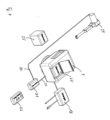
- Fig.3 shows the electric drive unit 9 with an integrated electric motor 36 and an integrated energy storage unit 25.
- the integrated energy storage unit 25 supplies the electric drive unit with energy.
- the energy storage unit 25 is advantageously rechargeable and can be replaced without tools. For example, several energy storage units 25 can also be carried on the work device 1. If necessary, discharged energy storage units 25 can be replaced with charged energy storage units 25 in the drive unit 9.
- the drive unit 9 is connected to a charger 18 mounted on the work device 1 via an electrical line 23.
- the charger 18 advantageously has several further electrical cables 19 and 20 with corresponding electrical couplings 21 and 22.
- the task of the charger 18 is to supply the energy storage unit 25 integrated in the drive unit 9 with external energy. In a further advantageous embodiment, the charger 18 can also supply the drive unit 9 directly with energy.
- the charger 18 is able to absorb a wide variety of electrical voltages and convert them into the voltage required for the energy storage unit 25 or for the drive unit 9.
- the charger 18 can be connected via the electrical coupling 21 either to the electrical energy source of the carrier vehicle or via the electrical coupling 22 to a public electrical supply network. By connecting the charger 18 to a public electrical supply network, the energy storage device 25 can also be charged when the implement 1 is at rest without a carrier vehicle.
- the drive unit 9 is also connected to an operating unit 26 via a further electrical line 27 and is thus supplied with electrical energy.
- the operating unit 26 is in turn connected to the electrical actuating means 29 via a further electrical line 30.
- the operating unit 26 serves, on the one hand, to switch the integrated electric motor 36 in the drive unit 9 on and off and, on the other hand, to control other electrical consumers such as the actuating means 29.
- the operating unit 26 can advantageously be operated from the carrier vehicle.
- Fig. 4 shows a further embodiment of the drive unit 9 in connection with an operating unit 32.
- the drive unit 9 is connected to a control unit 31 via the electrical line.
- the control unit 31 is in turn connected to the electrical actuating means 29 via a further electrical line 30.
- the operating unit 32 and the control unit 31 are advantageously connected to one another wirelessly (eg via radio).
- the operating unit 32 sends corresponding operating signals to the control unit 32, which in turn controls the integrated electric motor 36 in the drive unit 9 on or off and, on the other hand, controls other electrical consumers such as the actuating means 29.
- Fig.5 shows the electric drive unit 9 with an integrated electric motor 36 and an integrated energy storage unit 25.
- the drive unit 9 is supplied with energy by the integrated energy storage unit 25.
- the charger 33 shown in this embodiment is mounted on the work device 1, can accommodate the energy storage unit 25 directly and is not connected to the drive unit 9.
- the task of the charger 33 is to recharge the energy storage unit 25 with external energy. There are therefore two energy storage units 25 in alternating use on the work device 1.
- the first energy storage unit 25 supplies the drive unit 9 with energy and the second energy storage unit 25 is charged by the charger 33 during work.
- the charger 33 is also able to absorb a wide variety of electrical voltages and convert them into the voltage required for the energy storage unit 25.
- the charger 33 can be connected either to the electrical energy source of the carrier vehicle via the electrical coupling 21 or to a public electrical supply network via the electrical coupling 22. By connecting the charger 33 to a public electrical supply network, the energy storage device 25 can also be charged when the implement 1 is at rest without a carrier vehicle. In a further advantageous embodiment, the charger 33 can also be supplied with energy via one or more photovoltaic modules 34 mounted on the implement 1. The photovoltaic module 34 also makes it possible to charge the energy storage device 25 without a carrier vehicle. The charger 33 can also advantageously supply other electrical consumers such as the control unit 31 with electrical energy.
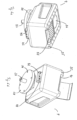
- Fig. 6a and Fig. 6b show an exemplary drive unit 9 consisting of a drive housing 35 in which an electric motor 36 is installed.
- the drive shaft 37 of the electric motor 36 protrudes from the lower drive housing 9.
- the drive unit 9 has a mounting flange 38 with mounting holes 39 for receiving the drive unit 9.
- the drive housing 9 also has a battery compartment 41 that can be closed with a cover 40.
- the energy storage device 25 is accommodated in the battery compartment 41 via corresponding guides and electrical contacts and is electrically connected to the drive unit 9.
- an electrical connection unit 42 is also provided, which has electrical contacts 43 for e.g. a control unit 31, for a charger 18, 33 or for other electrical consumers.
- Fig.7 shows another exemplary embodiment of the drive unit 9, in which an electric cable 44 is connected to the drive unit 15 via electrical contacts instead of an energy storage device. At the other end of the electric cable is the already known electric coupling 21, which is connected to the carrier vehicle. The carrier vehicle thus supplies the drive unit 15 directly with energy.
Landscapes
- Life Sciences & Earth Sciences (AREA)
- Engineering & Computer Science (AREA)
- Environmental Sciences (AREA)
- Mechanical Engineering (AREA)
- Soil Sciences (AREA)
- Power Engineering (AREA)
- Agricultural Machines (AREA)
Applications Claiming Priority (1)
| Application Number | Priority Date | Filing Date | Title |
|---|---|---|---|
| DE202022002184.4U DE202022002184U1 (de) | 2022-10-06 | 2022-10-06 | Anbaugerät |
Publications (2)
| Publication Number | Publication Date |
|---|---|
| EP4360421A2 true EP4360421A2 (fr) | 2024-05-01 |
| EP4360421A3 EP4360421A3 (fr) | 2024-07-31 |
Family
ID=84283211
Family Applications (1)
| Application Number | Title | Priority Date | Filing Date |
|---|---|---|---|
| EP23000136.4A Pending EP4360421A3 (fr) | 2022-10-06 | 2023-10-04 | Outil |
Country Status (2)
| Country | Link |
|---|---|
| EP (1) | EP4360421A3 (fr) |
| DE (1) | DE202022002184U1 (fr) |
Citations (1)
| Publication number | Priority date | Publication date | Assignee | Title |
|---|---|---|---|---|
| DE10010819A1 (de) | 2000-03-08 | 2001-09-13 | Lemken Gmbh & Co Kg | Traktor mit Stromsteckdose |
Family Cites Families (4)
| Publication number | Priority date | Publication date | Assignee | Title |
|---|---|---|---|---|
| DE102007024644A1 (de) * | 2007-05-24 | 2008-11-27 | Deere & Company, Moline | Vorrichtung zum Übertragen elektrischer Energie von einem landwirtschaftlichen Arbeitsfahrzeug auf ein an das Arbeitsfahrzeug ankoppelbares Anbaugerät |
| PL2502477T3 (pl) * | 2011-03-14 | 2014-03-31 | Alois Poettinger Maschf Ges M B H | Urządzenie gospodarstwa rolnego do uprawy |
| EP3469872B1 (fr) * | 2017-10-12 | 2022-09-28 | MULAG FAHRZEUGWERK Heinz Wössner GmbH & CO. KG | Appareil de travail, véhicule de travail doté d'un tel dispositif de travail, système modulaire de fabrication d'appareil de travail ainsi que procédé de fonctionnement d'au moins l'appareil de travail |
| DE102019112958A1 (de) * | 2019-05-16 | 2020-11-19 | Technische Universität Dresden | Verfahren zur landwirtschaftlichen Bodenbearbeitung, Werkzeugsystem, Generatormodul sowie deren Verwendung |
-
2022
- 2022-10-06 DE DE202022002184.4U patent/DE202022002184U1/de active Active
-
2023
- 2023-10-04 EP EP23000136.4A patent/EP4360421A3/fr active Pending
Patent Citations (1)
| Publication number | Priority date | Publication date | Assignee | Title |
|---|---|---|---|---|
| DE10010819A1 (de) | 2000-03-08 | 2001-09-13 | Lemken Gmbh & Co Kg | Traktor mit Stromsteckdose |
Also Published As
| Publication number | Publication date |
|---|---|
| EP4360421A3 (fr) | 2024-07-31 |
| DE202022002184U1 (de) | 2022-11-10 |
Similar Documents
| Publication | Publication Date | Title |
|---|---|---|
| EP1228681B1 (fr) | Appareil faucheur | |
| DE69535364T2 (de) | Elektrisch-selbstfahrender Rasenmäher | |
| EP1926622B1 (fr) | Systeme d'entrainement pour un vehicule utilitaire industriel ou agricole | |
| DE202014000738U1 (de) | Radlader mit Energiespeichereinheit | |
| DE102019218277A1 (de) | Hybrid Transmission Module for Work Vehicles | |
| BE1026409B1 (de) | Antriebssystem für einen feldhäcksler | |
| DE102019211496A1 (de) | Landwirtschaftliches Fahrzeuggespann | |
| DE102012100541A1 (de) | Fahrbare Vorrichtung zum Zerkleinern von Pflanzen | |
| DE102011078192A1 (de) | Generatoreinheit für ein landwirtschaftliches oder kommunales Nutzfahrzeug | |
| DE202021105282U1 (de) | Elektroantriebsstruktur für eine Arbeitsmaschine | |
| EP0685146A1 (fr) | Plate-forme de coupe détachable | |
| EP4357530B1 (fr) | Balayeuse | |
| EP3608151B1 (fr) | Engin de damage de pistes doté d'un train de roulement à chenille | |
| EP4360421A2 (fr) | Outil | |
| EP3469872B1 (fr) | Appareil de travail, véhicule de travail doté d'un tel dispositif de travail, système modulaire de fabrication d'appareil de travail ainsi que procédé de fonctionnement d'au moins l'appareil de travail | |
| EP3608150A1 (fr) | Engin de damage de pistes doté d'un train de roulement à chenille | |
| DE102017126682B4 (de) | Arbeitsgerät, Arbeitsfahrzeug mit einem solchen Arbeitsgerät, Baukasten zum Herstellen des Arbeitsgerätes sowie Verfahren zum Betreiben wenigstens des Arbeitsgerätes | |
| EP1391370A1 (fr) | Véhicule de travail dirigeable automoteur | |
| DE102010042499B4 (de) | Landwirtschaftliches Nutzfahrzeug, insebesondere Traktor | |
| DE102022105616A1 (de) | Landwirtschaftliche Arbeitsmaschine mit mindestens einer autonomen Einheit | |
| DE102023000339A1 (de) | Kehrmaschine | |
| DE202023000190U1 (de) | Kehrmaschine mit seitlichem Tellerbessen | |
| DE19913201A1 (de) | Selbstfahrender Combi-Futtermischwagen | |
| DE102011001046A1 (de) | Als Arbeitsgerät ausgebildetes Fahrzeug sowie fahrzeugbasierter Arbeitsgerätesatz | |
| DE102022100543A1 (de) | Fernsteuerbare selbstfahrende Rasenpflegevorrichtung |
Legal Events
| Date | Code | Title | Description |
|---|---|---|---|
| PUAI | Public reference made under article 153(3) epc to a published international application that has entered the european phase |
Free format text: ORIGINAL CODE: 0009012 |
|
| STAA | Information on the status of an ep patent application or granted ep patent |
Free format text: STATUS: THE APPLICATION HAS BEEN PUBLISHED |
|
| AK | Designated contracting states |
Kind code of ref document: A2 Designated state(s): AL AT BE BG CH CY CZ DE DK EE ES FI FR GB GR HR HU IE IS IT LI LT LU LV MC ME MK MT NL NO PL PT RO RS SE SI SK SM TR |
|
| PUAL | Search report despatched |
Free format text: ORIGINAL CODE: 0009013 |
|
| AK | Designated contracting states |
Kind code of ref document: A3 Designated state(s): AL AT BE BG CH CY CZ DE DK EE ES FI FR GB GR HR HU IE IS IT LI LT LU LV MC ME MK MT NL NO PL PT RO RS SE SI SK SM TR |
|
| RIC1 | Information provided on ipc code assigned before grant |
Ipc: A01D 69/02 20060101ALI20240627BHEP Ipc: A01B 71/00 20060101AFI20240627BHEP |
|
| STAA | Information on the status of an ep patent application or granted ep patent |
Free format text: STATUS: REQUEST FOR EXAMINATION WAS MADE |
|
| 17P | Request for examination filed |
Effective date: 20250126 |