EP4361967A1 - Capacité de perception spécifique à une situation pour véhicules autonomes et semi-autonomes - Google Patents
Capacité de perception spécifique à une situation pour véhicules autonomes et semi-autonomes Download PDFInfo
- Publication number
- EP4361967A1 EP4361967A1 EP22204464.6A EP22204464A EP4361967A1 EP 4361967 A1 EP4361967 A1 EP 4361967A1 EP 22204464 A EP22204464 A EP 22204464A EP 4361967 A1 EP4361967 A1 EP 4361967A1
- Authority
- EP
- European Patent Office
- Prior art keywords
- perception
- specific
- networks
- vehicle
- network
- Prior art date
- Legal status (The legal status is an assumption and is not a legal conclusion. Google has not performed a legal analysis and makes no representation as to the accuracy of the status listed.)
- Granted
Links
Images




Classifications
-
- G—PHYSICS
- G06—COMPUTING OR CALCULATING; COUNTING
- G06V—IMAGE OR VIDEO RECOGNITION OR UNDERSTANDING
- G06V20/00—Scenes; Scene-specific elements
- G06V20/50—Context or environment of the image
- G06V20/56—Context or environment of the image exterior to a vehicle by using sensors mounted on the vehicle
- G06V20/58—Recognition of moving objects or obstacles, e.g. vehicles or pedestrians; Recognition of traffic objects, e.g. traffic signs, traffic lights or roads
-
- G—PHYSICS
- G06—COMPUTING OR CALCULATING; COUNTING
- G06F—ELECTRIC DIGITAL DATA PROCESSING
- G06F18/00—Pattern recognition
- G06F18/20—Analysing
- G06F18/285—Selection of pattern recognition techniques, e.g. of classifiers in a multi-classifier system
Definitions
- the disclosed technology relates to methods and systems for providing environment perception for a vehicle having an Automated Driving System (ADS).
- ADS Automated Driving System
- the disclosed technology relates to methods and systems enabling the use of specialized neural networks for different traffic situations or conditions for optimizing situational performance with limited computational resources.
- ADAS driver-assistance systems
- ADS Automated Driving System
- An ADS may be construed as a complex combination of various components that can be defined as systems where perception, decision making, and operation of the vehicle are performed by electronics and machinery instead of a human driver, and as introduction of automation into road traffic. This includes handling of the vehicle, destination, as well as awareness of surroundings. While the automated system has control over the vehicle, it allows the human operator to leave all or at least some responsibilities to the system.
- An ADS commonly combines a variety of sensors to perceive the vehicle's surroundings, such as e.g. radar, LIDAR, sonar, camera, navigation system e.g. GPS, odometer and/or inertial measurement units (IMUs), upon which advanced control systems may interpret sensory information to identify appropriate navigation paths, as well as obstacles, free-space areas, and/or relevant signage.
- the herein disclosed technology seeks to mitigate, alleviate or eliminate one or more of the above-identified deficiencies and disadvantages in the prior art to address various problems relating to large computational footprints for providing high performing perception capability for autonomous and semi-autonomous vehicles.
- a first aspect of the disclosed technology comprises a computer-implemented method for providing environment perception for a vehicle having an Automated Driving System (ADS).
- the ADS comprises a generalized perception network comprising a generally trained machine-learning algorithm configured to provide a perception output for a scene depicted in one or more input images.
- the ADS further comprises a plurality of specific perception networks, where each specific perception network comprises a specifically trained machine-learning algorithm configured to provide a perception output for a scene depicted in one or more input images.
- each specifically trained machine-learning algorithm is trained with data associated with a specific traffic situation such that each specifically trained machine-learning algorithm is trained for a different traffic situation as compared to the other specifically trained machine-learning algorithms of the plurality of specific perception networks.
- the method comprises obtaining sensor data from one or more vehicle-mounted sensors, where the obtained sensor data comprises information about a surrounding environment of the vehicle. Further, the method comprises selecting one or more specific perception networks for activation out of the plurality of specific perception networks based on a current traffic situation indicated in (or inferable/derivable from) the obtained sensor data. The method further comprises feeding at least a portion of the obtained sensor data to each of the selected one or more specific perception networks and to the generalized perception network in order to obtain an output from each of the selected one or more specific perception networks and the generalized perception network. The method further comprises fusing the obtained outputs from each of the selected one or more specific perception networks and the generalized perception network, where the fused output comprises one or more perception output in relation to the surrounding environment of the vehicle. Further, the method comprises transmitting the fused output to a module of the ADS.
- a second aspect of the disclosed technology comprises a computer program product comprising instructions which, when the program is executed by a computing device, causes the computer to carry out the method according to any one of the embodiments disclosed herein.
- a third aspect of the disclosed technology comprises a (non-transitory) computer-readable storage medium comprising instructions which, when executed by a computing device, causes the computer to carry out the method according to any one of the embodiments disclosed herein.
- non-transitory is intended to describe a computer-readable storage medium (or “memory”) excluding propagating electromagnetic signals, but are not intended to otherwise limit the type of physical computer-readable storage device that is encompassed by the phrase computer-readable medium or memory.
- the terms “non-transitory computer readable medium” or “tangible memory” are intended to encompass types of storage devices that do not necessarily store information permanently, including for example, random access memory (RAM).
- Program instructions and data stored on a tangible computer-accessible storage medium in non-transitory form may further be transmitted by transmission media or signals such as electrical, electromagnetic, or digital signals, which may be conveyed via a communication medium such as a network and/or a wireless link.
- the term “non-transitory”, as used herein is a limitation of the medium itself (i.e., tangible, not a signal) as opposed to a limitation on data storage persistency (e.g., RAM vs. ROM).
- a fourth aspect of the disclosed technology comprises a system for providing environment perception for a vehicle.
- the system comprises a generalized perception network comprising a generally trained machine-learning algorithm configured to provide a perception output for a scene depicted in one or more input images.
- the system further comprises a plurality of specific perception networks, where each specific perception network comprises a specifically trained machine-learning algorithm configured to provide a perception output for a scene depicted in one or more input images.
- each specifically trained machine-learning algorithm is trained with data associated with a specific traffic situation such that each specifically trained machine-learning algorithm is trained for a different traffic situation as compared to the other specifically trained machine-learning algorithms of the plurality of specific perception networks.
- the system comprises control circuitry configured to obtain sensor data from one or more vehicle-mounted sensors, where the obtained sensor data comprises information about a surrounding environment of the vehicle.
- the control circuitry is further configured to select one or more specific perception networks for activation out of the plurality of specific perception networks based on a current traffic situation indicated in the obtained sensor data.
- the control circuitry is configured to feed at least a portion of the obtained sensor data to each of the selected one or more specific perception networks and to the generalized perception network in order to obtain an output from each of the selected one or more specific perception networks and the generalized perception network.
- the control circuitry is further configured to fuse the obtained outputs from each of the selected one or more specific perception networks and the generalized perception network, where the fused output comprises one or more perception output in relation to the surrounding environment of the vehicle. Furthermore, the control circuitry is configured to transmit the fused output to a module of an Automated Driving System (ADS) of the vehicle.
- ADS Automated Driving System
- a fifth aspect of the disclosed technology comprises a vehicle comprising a system according to the fourth aspect of the disclosed technology.
- An advantage of some embodiments is that specific situational performance and safety may be improved for an Automated Driving System (ADS). Thereby leading overall improved road safety for ADS-equipped vehicles.
- ADS Automated Driving System
- An advantage of some embodiments is that new updates of the perception software of the ADS may be launched in a safer manner as so called “local dark launches” (e.g. only in a small sub-portion of possible situations for the ADS). Thereby improving overall system safety when new updates are being deployed.
- An advantage of some embodiments is that the herein proposed technology is that they enable for contained and targeted improvements/updates for the perception functionality of an ADS.
- the present disclosure when the present disclosure is described in terms of a method, it may also be embodied in apparatus comprising one or more processors, one or more memories coupled to the one or more processors, where computer code is loaded to implement the method.
- the one or more memories may store one or more computer programs that perform the steps, services and functions disclosed herein when executed by the one or more processors in some embodiments.
- first, second, etc. may be used herein to describe various elements or features, these elements should not be limited by these terms. These terms are only used to distinguish one element from another.
- a first signal could be termed a second signal, and, similarly, a second signal could be termed a first signal, without departing from the scope of the embodiments.
- the first signal and the second signal are both signals, but they are not the same signal.
- ADSs Automated Driving Systems
- Vision and object detection/classification are particularly challenging and often rely on (deep) neural networks that have been fed with vast amounts of training data in order to provide adequate performance across the large variety of use-cases.
- these networks are associated with large computational footprints translating into heavy requirements on the computational power available for solving the various perception tasks across the variety of use-cases or situations that might occur.
- a technical challenge with deploying high performance perception capability in the automotive field is the limited computational resources available, which limits the allowable computational footprint of the environment perception of the vehicle.
- the training data used for training the machine-learning algorithms for solving this perception task comprises images that typically include different pedestrians both near and far, to make the machine-learning algorithm (e.g. artificial neural network) robust in terms of pedestrian detections.
- VRU Vulnerable Road User
- the machine-learning algorithm will then learn the features (e.g. patterns in the pixel data) that are associated with pedestrians being present, e.g. in a bounded box or pixel-by-pixel. If one does a good job with this training, the result is a machine-learning algorithm that will provide adequate performance at detecting pedestrians in general, i.e. "regardless" of the distance to the ego-vehicle or of the pedestrians attire (e.g. if they wear a specific garment or not).
- a machine-learning algorithm whose general objective is to have a relatively high performance in all situation (i.e. solving the perception task on a "general level"), it is likely that the performance will not be optimal for every specific situation.
- the trade-off from achieving a good generalisation is typically such that one achieves less performance in each specific case both due to the relative scarcity of examples of the specific type, but also due to the need for the machine-learning algorithm to find larger scope for the generalisations it makes.
- Fig. 2 is a schematic illustration of the horizon of interest 201a, 201b in two cases with differing ego-speeds (as indicated by the extending in front of the vehicle 1).
- the top-most vehicle 1 is traveling at a higher speed than the bottom-most vehicle 1, which forms a need for accurately detecting and/or classifying objects at greater distances in front of the vehicle more relevant, while reducing the need for accurately detecting and/or classifying objects at greater distances to the side of the vehicle 1.
- a traffic jam scenario i.e. a low speed scenario
- the perception system e.g. employing a traffic jam pilot
- VRUs vulnerable road users located to the side of the vehicle are more relevant in the traffic jam scenario since there is a higher risk that these pedestrians traverse a planned path/trajectory of the vehicle while it is moving at slow speed, as compared to a "normal" highway scenario where the vehicle is traveling at far greater speeds. For example if there are persons getting out of their vehicles (in a traffic jam), or persons taking the opportunity to cross the road right in front of the ego-vehicle since traffic is moving slowly.
- the safety of the ADS may be improved by employing the system in accordance with the embodiments disclosed herein.
- the safety of the ADS may be improved by having a perception system capable of employing a specialized perception network that is specifically trained to detect pedestrians within 0 to 10m from the ego-vehicle.
- a generalized perception network which has, out of necessity, been trained to make generalizations and trade-offs to capture pixel patterns that are associated with pedestrians both far away and close, as well as moving at different speeds.
- the embodiments disclosed herein utilize a system or method capable of utilizing specialized perception networks for different situations/conditions and switching between them in order to improve situational perception performance of the ADS while limiting computational resource usage.
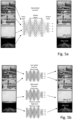
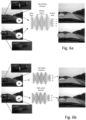
- Figs. 5a-5b and 6a-6b are schematic illustrations that show how the specialized perception networks ( Figs. 5b and 6b ) can be used to improve the environment perception for a vehicle in specific traffic situations. In other words, the figures show how the incorporation of selected specialized networks can aid the environment perception functionality of the ADS in specific situations.
- Fig. 5a illustrates the perception output, in the form of VRU detection, from a generalized perception network for four different input images.
- the generalized perception network has difficulties with detecting VRUs that are far away from the vehicle and in night-time conditions (bottom two images). So, as illustrated in Fig. 5b , by selecting a suitable specific perception network, the overall reliability of the environment perception of the ADS for these specific situations is improved. For the top two input images, one can select a specific perception network that is configured for optimal performance at low speed, daytime situations for close range detection of VRUs.
- Figs. 6a and 6b illustrate a case where the perception output is in the form of segmentation, and how high speed (and motion blur of the wheels), as indicated in the bottom image, can negatively affect the perception output causing the generalized network to miss an object.
- the high speed situation one can select a specific perception network that is configured for optimal performance at high speed, daytime situations for image segmentation.
- An Automated Driving System may be understood as hardware and software that are collectively capable of performing the dynamic driving task on a sustained basis.
- the ADS may comprise a level 3 feature or higher according to SAE J3016 levels of driving automation for on-road vehicles.
- the ADS may for example comprise various autonomous features or functions such as e.g. a traffic jam pilot, a highway pilot, or any other SAE J3016 level 3+ ADS feature.
- the ADS may comprise features or functions of any level according to SAE J3016 levels of driving automation for on-road vehicles that utilizes environment perception.
- an ADS-equipped vehicle may be understood as an autonomous vehicle, driver-less vehicle, or robotic vehicle, i.e. a vehicle incorporating vehicular automation, that is, a vehicle that is capable of sensing its environment and moving safely with little or no human input.
- Fig. 1 is a schematic flowchart representation of a (computer-implemented) method S100 for providing environment perception for a vehicle having an Automated Driving System (ADS) in accordance with some embodiments.
- ADS Automated Driving System
- “environment perception” may be understood as the ADS's understanding of the world around the vehicle, i.e. the processed output of a collection of data from vehicle sensors.
- “environment perception” may be understood as a function to enable the ADS of the vehicle that provides crucial information on the surrounding environment, such as e.g. free-space areas (or free drivable areas) and surrounding objects' locations, velocities, and predictions of their future states, and so forth.
- the vehicle may be any road vehicle such as a car (as illustrated herein), a motorcycle, a (cargo) truck, a bus, etc.
- the ADS comprises a perception system having a generalized perception network comprising a generally trained machine-learning algorithm configured to provide a perception output for a scene depicted in one or more input images.
- the ADS further comprises a plurality of specific perception networks, where each specific perception network comprises a specifically trained machine-learning algorithm configured to provide a perception output for a scene depicted in one or more input images. Moreover, each specifically trained machine-learning algorithm is trained with data associated with a specific traffic situation such that each specifically trained machine-learning algorithm is trained for a different traffic situation as compared to the other specifically trained machine-learning algorithms of the plurality of specific perception networks
- a perception output may in the present context be understood as a perception functionality, a perception feature or a solution to a perception task. Accordingly, the perception output may be in the form of free-space estimation, object detection, object classification, semantic segmentation, instance segmentation, and so forth.
- the generally trained machine-learning algorithm is trained with a training dataset covering a larger variety of traffic situations than a training dataset used to train any one of the specifically trained machine-learning algorithms.
- the generalized perception network is capable of providing sufficiently accurate or reliable perception output over a larger variety of scenarios or situations that the vehicle may be exposed to as compared to the individual specific perception networks.
- this does not necessarily mean that the generally trained machine-learning algorithm has been trained with a greater number of data samples than each of the specifically trained machine-learning algorithms, but merely that the training data samples cover more varied (traffic) scenarios or situations.
- the machine-learning algorithms of the perception networks may for example be in the form of artificial neural networks such as deep neural networks.
- the machine-learning algorithms (may also be referred to as machine-learning models, neural networks, and so forth) are implemented in some embodiments using publicly available suitable software development machine learning code elements, for example, such as those which are available in Python, Keras and TensorFlow or in any other suitable software development platform, in any manner known to be suitable to someone of ordinary skill in the art.
- each specific perception network out of the plurality of specific perception networks is configured to handle a different perception task as compared to the other specific perception networks of the plurality of specific perception networks.
- the phrase "trained for a different traffic situation" in relation to the specifically trained machine-learning algorithms may comprise that the specific perception networks have different perception tasks.
- one specific perception network may be configured to detect "partial pedestrians" in slow-moving traffic
- another specific perception network may be configured to detect small vehicles when the vehicle is moving at high speed on a highway
- another specific perception network may be configured to detect pedestrians at slow speed in poor lighting conditions (e.g.
- another specific perception network may be configured to detect lane or road boundaries in snowy conditions, and so forth.
- This list is not to be understood as an exhaustive list, but as readily understood to someone of ordinary skill in the art, there are various specific perception tasks that can be applied in the context of the specific perception networks as disclosed herein.
- a specifically trained machine-learning algorithm may be configured to solve a perception task in relation to detection and/or classification of partial VRUs, road works, snow covered objects, specific country sign detection, or warning light detection.
- the method S100 comprises obtaining S101 sensor data from one or more vehicle-mounted sensors, the obtained sensor data comprising information about a surrounding environment of the vehicle.
- a vehicle-mounted sensor may for example be a monocular camera, a stereo camera, a radar device, a lidar device, an ultrasonic device, and so forth.
- a vehicle-mounted sensor may be in the form of a gyroscope, an accelerometer, or an odometer.
- the sensor data may further comprise one or more vehicle state parameters such as a speed of the ego-vehicle, an orientation of the ego-vehicle, and so forth.
- the sensor data may be in the form of raw sensor data, or processed sensor data.
- the term "sensor data from one or more vehicle-mounted sensor” should be understood as term “sensor data originating from one or more vehicle-mounted sensor”.
- the method S100 further comprises selecting S102 one or more specific perception networks for activation out of the plurality of specific perception networks based on a current traffic situation indicated in the obtained S101 sensor data.
- the obtained S101 sensor data may indicate a traffic situation in which the ego-vehicle and the surrounding vehicles are moving at slow speed (e.g. less than 10 km/h), that the traffic is dense, and that it is daytime lighting conditions.
- a specific perception network comprising a machine-learning algorithm specifically trained for that traffic situation is then suitably selected S102.
- selecting one or more networks of activation may be understood as a selection of one or more networks that are subsequently to be used for providing environment perception for the vehicle.
- each specific perception network is associated with a corresponding set of operational parameters, which define a traffic situation.
- the operational parameters may also be referred to as scenario parameters herein
- the operational parameters may for example comprise ego-state or vehicle state parameters (such as e.g. ego-vehicle speed), traffic density, type of road, time of day, weather conditions, or any Operational Design Domain (ODD) aspects.
- the step of selecting S102 one or more specific perception networks for activation may comprise comparing the sensor data with each corresponding set of operational parameters and selecting the one or more specific perception networks for activation out of the plurality of specific perception networks based on the comparison.
- the selection is made so that the one or more specific perception networks that have operational parameters that best correspond to the current operational parameters as inferred from the obtained S101 sensor data.
- An Operational design domain is to be understood as a description of the operating domains in which an automated or a semi-automated driving system (i.e. AD or ADAS) is designed to function, including, but not limited to, geographic, roadway (e.g. type, surface, geometry, edges and markings), environmental parameters, connectivity, surrounding objects, and speed limitations. That is, the ADS feature may be associated with a specific environmental scenario and only configured to operate within an environment fulfilling a set of scenario parameters, example scenarios are traffic jams, highway/expressway cruising, etc.
- the ODD may further define an allowable exposure rate to driving scenarios and their dynamics (e.g. traffic lights, intersections, jaywalkers, snow, ice, cut-ins, large animals, etc.).
- the scenario parameters may for example be obtained from sensor data from one or more vehicle-mounted sensors or communication data obtained from a remote server, or another vehicle via a Vehicle-to-Vehicle (V2V) communication protocol.
- the scenario parameters may for example be type of road, weather data, speed limitations, traffic density, number of available lanes, presence of road work, and so forth.
- the obtained S101 sensor data further comprises information about one or more vehicle state parameters (such as a a current speed of the vehicle) and map data (e.g. HD map data) of the surrounding environment of the vehicle.
- vehicle state parameters such as a a current speed of the vehicle
- map data e.g. HD map data
- the method S100 may further comprise determining a set of current operational parameters based on the obtained sensor data.
- the step of comparing the sensor data with each corresponding set of operational parameters may comprise comparing the determined set of current operational parameters with each corresponding set of operational parameters and selecting the one or more specific perception networks for activation out of the plurality of specific perception networks whose set of operational parameters (best) correspond to the determined set of current operational parameters.
- the one or more selected specific perception networks are the ones which is/are associated with the operational parameters that have the highest similarity to the determined set of current operational parameters.
- the specific traffic situations comprise different ranges of the current speed of the vehicle.
- the specifically trained machine-learning algorithms of the plurality of specific perception networks may be trained for different ranges of the current ego-vehicle speed. For example, a first specifically trained machine-learning algorithm may be trained to provide a perception output for when the vehicle is traveling at speed of 0-20 km/h, a second specifically trained machine-learning algorithm may be trained to provide a perception output for when the vehicle is traveling at speed of 21-60 km/h, a third specifically trained machine-learning algorithm may be trained to provide a perception output for when the vehicle is traveling at speed of 61-120 km/h.
- one of the three specific perception networks is selected depending on the ego-vehicle speed as indicated in the obtained S101 sensor data.
- the different ranges of the current ego-vehicle speed are overlapping.
- a first specifically trained machine-learning algorithm may be trained to provide a perception output for when the vehicle is traveling at speed of 0-25 km/h
- a second specifically trained machine-learning algorithm may be trained to provide a perception output for when the vehicle is traveling at speed of 15-65 km/h
- a third specifically trained machine-learning algorithm may be trained to provide a perception output for when the vehicle is traveling at speed of 60-120 km/h.
- the ADS further comprises a plurality of machine-learning classification systems comprising a corresponding machine-learning classification system for each specific perception network, wherein each machine-learning classification system is trained on the same dataset as a corresponding specific perception network.
- the step of selecting one or more specific perception networks for activation may comprise feeding the obtained sensor data to each corresponding machine-learning classification system in order to distinguish S107 new experiences from experiences known to each machine-learning classification system in the obtained sensor data and to output an anomaly value indicative of a level of matching between the current traffic situation and a traffic situation that the corresponding specific perception network is trained for, and selecting the one or more specific perception networks for activation out of the plurality of specific perception networks based on each output anomaly value.
- Each machine-learning classification system may for example comprise an autoencoder (see e.g. ref. 41 in Fig. 7 ) trained on the same dataset as the respective corresponding specific perception network, and the anomaly value may be a reconstruction error.
- an autoencoder see e.g. ref. 41 in Fig. 7
- the anomaly value may be a reconstruction error.
- FIG. 7 shows in more detail how an autoencoder machine learning model 41, which is fed input similar to its training data and input which is not similar to its training data can be used to infer if a specific perception network should be selected for a current traffic situation according to some embodiments of the disclosed technology.
- it can be used to infer if the current operational parameters (as indicated in the obtained sensor data) correspond to the operational parameters of a specific perception network.
- the reconstruction error may be used to generate a training data similarity score for the input accordingly, in which the value of the training data similarity score can be used to determine if the corresponding specific perception network should be selected for activation.
- High reconstruction errors correspond to the input 42a on which basis a low training data similarity score is assigned for the corresponding specific perception network.
- the reconstruction error is low, it means the input data segment 42b contains features which are similar to features of the training data that was used to train the corresponding specific perception network (and the autoencoder).
- the machine-learning classification system then outputs a training data similarity score for that input data segment 42b.
- the degree of similarity between the input and output can be determined based on any technique for calculating a reconstruction error known to someone of ordinary skill in the art.
- the selection S102 of the one or more specific perception networks for activation may be based on an output from a clustering algorithm.
- the clustering algorithm may have been configured to form N-dimensional clusters based on the training data sets used for the training of the specifically trained machine-learning algorithms of the plurality of specific perception networks.
- the obtained sensor data may accordingly be fed to the clustering algorithm which maps the obtained sensor data to the formed clusters in order to derive a training data similarity score relative to each cluster.
- a high training data similarity score would indicate a high correlation between the obtained S101 sensor data and the specific traffic situation that a specifically trained machine-learning algorithm has been trained for.
- the method S100 further comprises feeding S103 at least a portion of the obtained sensor data to each of the selected S102 one or more specific perception networks and to the generalized perception network in order to obtain an output from each of the selected one or more specific perception networks and the generalized perception network.
- the obtained sensor data may be fed as input to each of the selected S102 one or more specific perception networks and to the generalized perception network. This is because a larger dataset (of the obtained sensor data) can be used for the selection S102, while only a subset of all available sensor data may be relevant to feed to the selected S102 one or more specific perception networks and to the generalized perception network.
- various types of data may be used to determine the current state of the vehicle and the surrounding environment (e.g. camera images, map data, lidar data, accelerometer data), while only camera images may be relevant to feed as input to the selected S102 one or more specific perception networks and to the generalized perception network.
- the step of feeding at least the portion of the obtained sensor data comprises controlling S108 one or more switches so to feed a data stream comprising at least the portion of the obtained sensor data only to the selected one or more specific perception networks and to the generalized perception network.
- the specifically trained machine-learning algorithms of the plurality of specific perception networks are artificial neural networks that share a common network architecture, each artificial neural network having an individual weights-matrix for the common network architecture.
- the step of feeding at least the portion of the obtained sensor data may comprise switching S109 the weights-matrix (trained weights) of the common network architecture in accordance with the selected one or more specific perception networks.
- the method S100 comprises fusing S104 the obtained outputs from each of the selected one or more specific perception networks and the generalized perception network.
- the fused S104 output comprises one or more perception output in relation to the surrounding environment of the vehicle.
- the fused S104 output always comprises the output from the generalized perception network.
- the term "fusing" the obtained outputs may be construed as a process of combining the different data sets so that the subsequent systems that process the data for making decisions and/or controlling the vehicle performs better than had it just been given either one of the datasets.
- the fusing S104 of the obtained outputs may be in the form of feature and/or decision-level data fusion using suitable data fusion techniques include artificial neural networks, evolutionary algorithms, particle swarm optimization, decision tree, clustering algorithms, fuzzy logic inference, object matching algorithms, and voting algorithms, as readily appreciated by a skilled person in the art.
- suitable data fusion techniques include artificial neural networks, evolutionary algorithms, particle swarm optimization, decision tree, clustering algorithms, fuzzy logic inference, object matching algorithms, and voting algorithms, as readily appreciated by a skilled person in the art.
- the fusion S104 may be an addition of outputs.
- an advantage of combining the output from the generalized perception network and the selected specific perception network(s) is that the baseline performance level of the environment perception functionality of the ADS is maintained at a high level while getting high-level performance for a specifically critical perception task in any given situation. Thereby improving the overall environment perception functionality of the ADS across a wide variety of traffic scenarios and situations, thereby providing a more performant and safer ADS.
- another advantage of combining the output from the generalized perception network and the selected specific perception network(s) is that potential negative effects on the environment perception functionality of the ADS during transitions/switching between the specific perception networks may be alleviated.
- the method comprises transmitting S105 the fused S104 output to a (different) module of the ADS.
- the fused S104 output may be transmitted S104 to a decision and control module of the ADS so to control (i.e. manoeuvre) the vehicle based on information comprised in the fused S104 output.
- the fused S104 output may be transmitted S104 to a module of the ADS configured to display or notify the driver of a traffic situation via an Human-Machine Interface (HMI) of the vehicle based on information comprised in the fused S104 output.
- HMI Human-Machine Interface
- the fused S104 output may be transmitted S104 to another perception functionality of the ADS such as e.g. an object tracking algorithm.
- Executable instructions for performing these functions are, optionally, included in a non-transitory computer-readable storage medium or other computer program product configured for execution by one or more processors.
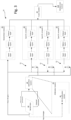
- Figs. 3 and 4 are schematic block diagram representations of a system 10 for providing environment perception for a vehicle in accordance with some embodiments.
- the system 10 comprises a generalized perception network 21 and a plurality of specific perception networks 22.
- the generalized perception network has a generally trained machine-learning algorithm configured to provide perception characteristics for a scene depicted in one or more input images.
- Each specific perception network has a specifically trained machine-learning algorithm configured to provide a perception output for a scene depicted in one or more input images.
- each specifically trained machine-learning algorithm is trained with data associated with a specific traffic situation such that each specifically trained machine-learning algorithm is trained for a different traffic situation as compared to the other specifically trained machine-learning algorithms of the plurality of specific perception networks.
- Figs. 3 and 4 serve to further elucidate the above-described embodiments related to the selection and switching process for providing environment perception for a vehicle by schematically illustrating the flow of information and the various process steps.
- the system 10 comprises control circuitry 11 (e.g. one or more processors) configured to perform the functions of the methods disclosed herein, where the functions may be included in a non-transitory computer-readable storage medium 12 or other computer program product configured for execution by the control circuitry 11.
- the control circuitry 11 of the apparatus 10 may be configured to execute the instructions stored in a computer-readable storage medium to perform the method discussed in in the foregoing.
- control circuitry 11 is represented as various software/hardware modules 24 or systems 23 each of them linked to one or more specific functions of the control circuitry 11.
- Figs. 3 and 4 are substantially similar and mainly serve to how the system 10 acts for two different traffic situations, where the system in Fig. 3 has a selected first specific perception network to be active, while in Fig. 4 a second specific perception network is selected to be active.
- control circuitry 11 is configured to obtain sensor data 20 from one or more vehicle-mounted sensors, where the obtained sensor data comprising information about a surrounding environment of the vehicle.
- the sensor data may further comprise information about one or more vehicle state parameters (e.g. a current speed of the vehicle) and map data associated with the surrounding environment of the vehicle.
- the control circuitry 11 is further configured to select one or more specific perception networks 22 for activation out of the plurality of specific perception networks 22 based on a current traffic situation indicated in the obtained sensor data 20. Furthermore, the control circuitry 11 is configured to feed at least a portion of the obtained sensor data 20 to each of the selected one or more specific perception networks and to the generalized perception network 21 in order to obtain an output from each of the selected one or more specific perception networks and the generalized perception network 21.
- control circuitry 11 may be configured to control the selection of the one or more specific perception networks 22 or to control the feeding of the sensor data to the selected one or more specific perception networks by controlling one or more switches 31 so to feed a data stream comprising at least the portion of the obtained sensor data only to the selected one or more specific perception networks and to the generalized perception network.
- control circuitry 11 may be configured to control which of the specific perception networks 22 that is to be active by controlling a set of switches 31.
- the selection of which one or more specific perception networks 22 that is/are to be active may for example be realized by a suitably configured arbitration system/module/algorithm 23.
- each specific perception network 22 is associated with a corresponding set of operational parameters. Accordingly, the control circuitry 11 (or the arbitration system 23) may be configured to compare the sensor data with each corresponding set of operational parameters and selecting the one or more specific perception networks for activation out of the plurality of specific perception networks based on the comparison.
- control circuitry 11 is configured to determining a set of current operational parameters based on the obtained sensor data, and to compare the determined set of current operational parameters with each corresponding set of operational parameters. Accordingly, the control circuitry 11 (or the arbitration system 23) may be configured to select the one or more specific perception networks for activation out of the plurality of specific perception networks whose set of operational parameters (best) correspond to the determined set of current operational parameters.
- control circuitry 11 may be configured to employ a plurality of machine-learning classification systems 41 comprising a corresponding machine-learning classification system 41 for each specific perception network, where each machine-learning classification system 41 is trained on the same dataset as a corresponding specific perception network 22.
- the arbitration system 23 may comprise the plurality of machine-learning classification systems 41.
- control circuitry 11 may be configured to select the one or more specific perception networks for activation by feeding the obtained sensor data to each corresponding machine-learning classification system in order to distinguish new experiences from experiences known to each machine-learning classification system in the obtained sensor data, and to output an anomaly value indicative of a level of matching between the current traffic situation and a traffic situation that the corresponding specific perception network is trained for. Accordingly, the control circuitry 11 may be configured to select the one or more specific perception networks for activation out of the plurality of specific perception networks based on each output anomaly value.
- the machine-learning classification systems may be in the form of autoencoders, and the anomaly values in the form of a reconstruction error.
- control circuitry 11 is configured to fuse (e.g. by means of a fusion module 24) the obtained outputs from each of the selected one or more specific perception networks and the generalized perception network.
- the fused output accordingly comprises one or more perception output (e.g. object detections, object classification, segmentations, free-space estimations, etc.) in relation to the surrounding environment of the vehicle.
- the fusion module 24 may employ any suitable data fusion technique as known in the art, such as e.g. the use of artificial neural networks, evolutionary algorithms, particle swarm optimization, decision tree, clustering algorithms, fuzzy logic inference, object matching algorithms, and voting algorithms, as readily appreciated by a skilled person in the art.
- control circuitry 11 is configured to transmit the fused output to a module of an Automated Driving System (ADS) of the vehicle 1.
- ADS Automated Driving System
- the fused output is transmitted to a decision and control module 318 of the ADS for controlling the vehicle based on the fused output.
- the fused output is transmitted to another perception module/function (e.g. an object tracking algorithm) for further processing.
- the further processed output may then be transmitted to the decision and control module 318 of the ADS for controlling the vehicle.
- the fused output may be transmitted to a human-machine-interface (HMI) of the vehicle in order to notify an occupant of the vehicle of the environment perception of the vehicle.
- the HMI may for example comprise an audio transducer, a tactile transducer, and/or a graphical display.
- the switching architecture i.e. the switches 31
- the switching architecture may be placed at the output of the specific perception networks 22 and thereby control which of the specific perception networks 22 that is to be active by controlling which of the perception outputs that are to be fused/combined to form the fused output. This may further reduce any potential negative effects on the environment perception functionality of the ADS during transitions/switching between the specific perception networks since the output from each and every specific perception network is readily available at any time.
- the system 10 may be understood as an architecture that allows switch/controlling which perception software that is/are active depending on a situation that the vehicle is currently exposed to.
- the specific perception networks 22 may as mentioned comprise specifically trained machine-learning algorithms that are trained and optimized on data for specific purposes. Such specific situations can be determined using any combination of the following factors (but not limited to): ego speed (camera settings/speed), traffic situations, road conditions, environmental conditions (illumination, weather), traffic conditions, time, geographic location, sensor condition, and so forth.
- Data from the perception system e.g. processed or raw sensor data from one or more cameras, lidars, radar, ultrasonic sensors, etc.
- vehicle state parameters e.g. current speed of ego-vehicle
- map data are used to select which of the specific perception networks that is/are most suitable to be active.
- the sensor data, and optionally, the vehicle state parameters and map data are used to determine which situation or state that the vehicle is in.
- This arbitration that decides which specific network(s) is/are to be active may consider any operational/situational parameters.
- the operational/situational parameters include but are not limited to ego state such as speed, traffic situation, road type, weather condition, location, and any other ODD aspects.
- the arbitration is made by checking a similarity between the sensor data and the training data consumed by the specifically trained machine-learning algorithms by utilizing a plurality of machine-learning classification systems
- the selected networks are fed with appropriate input data (e.g. one or more camera images captured by a vehicle-mounted camera).
- appropriate input data e.g. one or more camera images captured by a vehicle-mounted camera.
- the active networks' output are consumed by a fusion module 24 that combined the output from the active networks.
- the output from the fusion module 24 may subsequently be used as input by other perception functions (e.g. object tracking algorithms or for further fusion with data from other sensors).
- the fusion module 24 combines the outputs from the active networks and feeds/transmits the fused output to a subsequent step in the processing.
- the fusion is an addition of outputs. Thereby, the use of complex fusion networks are avoided and performance of the situation specific networks are included in the combined output. Even if the generalized network 21 includes a fusion network.
- the fusion module 24 may include more complex functionality, such as e.g., object matching, voting based systems, etc.
- all of the perception networks 21, 22 are fed with the input data while only the output from the selected specific perception networks and the generalized network is allowed to be relayed to the fusion module 24.
- Fig. 8 is a schematic illustration of an ADS-equipped vehicle 1 comprising a system 10 for providing environment perception for a vehicle 1 in accordance with some embodiments.
- a vehicle is any form of motorized transport.
- the vehicle 1 may be any road vehicle such as a car (as illustrated herein), a motorcycle, a (cargo) truck, a bus, etc.
- the apparatus 10 comprises control circuitry 11 and a memory 12.
- the control circuitry 11 may physically comprise one single circuitry device. Alternatively, the control circuitry 11 may be distributed over several circuitry devices. As an example, the apparatus 10 may share its control circuitry 11 with other parts of the vehicle 1 (e.g. the ADS 310).
- the control circuitry 11 may comprise one or more processors, such as a central processing unit (CPU), microcontroller, or microprocessor.
- the one or more processors may be configured to execute program code stored in the memory 12, in order to carry out various functions and operations of the vehicle 1 in addition to the methods disclosed herein.
- the processor(s) may be or include any number of hardware components for conducting data or signal processing or for executing computer code stored in the memory 12.
- the memory 12 optionally includes high-speed random access memory, such as DRAM, SRAM, DDR RAM, or other random access solid-state memory devices; and optionally includes non-volatile memory, such as one or more magnetic disk storage devices, optical disk storage devices, flash memory devices, or other non-volatile solid-state storage devices.
- the memory 12 may include database components, object code components, script components, or any other type of information structure for supporting the various activities of the present description.
- the memory 12 further stores map data 308.
- the map data 308 may for instance be used by the ADS 310 of the vehicle 1 in order to perform autonomous functions of the vehicle 1.
- the map data 308 may comprise high-definition (HD) map data.
- the memory 12, even though illustrated as a separate element from the ADS 310, may be provided as an integral element of the ADS 310.
- any distributed or local memory device may be utilized in the realization of the present inventive concept.
- the control circuitry 11 may be distributed e.g. such that one or more processors of the control circuitry 11 is provided as integral elements of the ADS 310 or any other system of the vehicle 1.
- any distributed or local control circuitry device may be utilized in the realization of the present inventive concept.
- the ADS 310 is configured carry out the functions and operations of the autonomous or semi-autonomous functions of the vehicle 1.
- the ADS 310 can comprise a number of modules, where each module is tasked with different functions of the ADS 310.
- the vehicle 1 comprises a number of elements which can be commonly found in autonomous or semi-autonomous vehicles. It will be understood that the vehicle 1 can have any combination of the various elements shown in Fig. 8 . Moreover, the vehicle 1 may comprise further elements than those shown in Fig. 8 . While the various elements is herein shown as located inside the vehicle 1, one or more of the elements can be located externally to the vehicle 1. For example, the map data may be stored in a remote server and accessed by the various components of the vehicle 1 via the communication system 326. Further, even though the various elements are herein depicted in a certain arrangement, the various elements may also be implemented in different arrangements, as readily understood by the skilled person. It should be further noted that the various elements may be communicatively connected to each other in any suitable way. The vehicle 1 of Fig. 8 should be seen merely as an illustrative example, as the elements of the vehicle 1 can be realized in several different ways.
- the vehicle 1 further comprises a sensor system 320.
- the sensor system 320 is configured to acquire sensory data about the vehicle itself and/or of its surroundings.
- the sensor system 320 may for example comprise a Global Navigation Satellite System (GNSS) module 322 (such as a GPS) configured to collect geographical position data of the vehicle 1.
- GNSS Global Navigation Satellite System
- the sensor system 320 may further comprise one or more sensors 324.
- the sensor(s) 324 may be any type of on-board sensors, such as cameras, LIDARs and RADARs, ultrasonic sensors, gyroscopes, accelerometers, odometers etc. It should be appreciated that the sensor system 320 may also provide the possibility to acquire sensory data directly or via dedicated sensor control circuitry in the vehicle 1.
- the vehicle 1 further comprises a communication system 326.
- the communication system 326 is configured to communicate with external units, such as other vehicles (i.e. via vehicle-to-vehicle (V2V) communication protocols), remote servers (e.g. cloud servers), databases or other external devices, i.e. vehicle-to-infrastructure (V2I) or vehicle-to-everything (V2X) communication protocols.
- the communication system 318 may communicate using one or more communication technologies.
- the communication system 318 may comprise one or more antennas (not shown).
- Cellular communication technologies may be used for long range communication such as to remote servers or cloud computing systems.
- the cellular communication technology used may also be used for V2V, V2I or V2X communication.
- Examples of cellular radio technologies are GSM, GPRS, EDGE, LTE, 5G, 5G NR, and so on, also including future cellular solutions.
- GSM Global System for Mobile communications
- GPRS Global System for Mobile communications
- EDGE Evolved Universal Terrestrial Radio Access
- LTE Long Term Evolution
- 5G 5G NR
- future cellular solutions such as Wireless Local Area (LAN), e.g. IEEE 802.11 based solutions, for communicating with other vehicles in the vicinity of the vehicle 1 or with local infrastructure elements.
- LAN Wireless Local Area
- ETSI is working on cellular standards for vehicle communication and for instance 5G is considered as a suitable solution due to the low latency and efficient handling of high bandwidths and communication channels.
- the communication system 326 may further provide the possibility to send output to a remote location (e.g. remote operator or control center) by means of the one or more antennas. Moreover, the communication system 326 may be further configured to allow the various elements of the vehicle 1 to communicate with each other. As an example, the communication system may provide a local network setup, such as CAN bus, I2C, Ethernet, optical fibers, and so on. Local communication within the vehicle may also be of a wireless type with protocols such as WiFi, LoRa, Zigbee, Bluetooth, or similar mid/short range technologies.
- the vehicle 1 further comprises a maneuvering system 320.
- the maneuvering system 328 is configured to control the maneuvering of the vehicle 1.
- the maneuvering system 328 comprises a steering module 330 configured to control the heading of the vehicle 1.
- the maneuvering system 328 further comprises a throttle module 332 configured to control actuation of the throttle of the vehicle 1.
- the maneuvering system 328 further comprises a braking module 334 configured to control actuation of the brakes of the vehicle 1.
- the various modules of the maneuvering system 328 may also receive manual input from a driver of the vehicle 1 (i.e. from a steering wheel, a gas pedal and a brake pedal respectively).
- the maneuvering system 328 may be communicatively connected to the ADS 310 of the vehicle, to receive instructions on how the various modules of the maneuvering system 328 should act.
- the ADS 310 can control the maneuvering of the vehicle 1, for example via the decision and control module 318.
- the ADS 310 may comprise a localization module 312 or localization block/system.
- the localization module 312 is configured to determine and/or monitor a geographical position and heading of the vehicle 1, and may utilize data from the sensor system 320, such as data from the GNSS module 322. Alternatively, or in combination, the localization module 312 may utilize data from the one or more sensors 324.
- the localization system may alternatively be realized as a Real Time Kinematics (RTK) GPS in order to improve accuracy.
- RTK Real Time Kinematics
- the ADS 310 may further comprise a perception module 314 or perception block/system 314.
- the perception module 314 may refer to any commonly known module and/or functionality, e.g. comprised in one or more electronic control modules and/or nodes of the vehicle 1, adapted and/or configured to interpret sensory data - relevant for driving of the vehicle 1 - to identify e.g. obstacles, vehicle lanes, relevant signage, appropriate navigation paths etc.
- the perception module 314 may thus be adapted to rely on and obtain inputs from multiple data sources, such as automotive imaging, image processing, computer vision, and/or in-car networking, etc., in combination with sensory data e.g. from the sensor system 320.
- the system 10 for providing environment perception for a vehicle 1 may be implemented as an integrated or integral component of the perception module 314 of the ADS 310.
- the localization module 312 and/or the perception module 314 may be communicatively connected to the sensor system 320 in order to receive sensory data from the sensor system 320.
- the localization module 312 and/or the perception module 314 may further transmit control instructions to the sensor system 320.
- a non-transitory computer-readable storage medium storing one or more programs configured to be executed by one or more processors of a vehicle control system, the one or more programs comprising instructions for performing the method according to any one of the above-discussed embodiments.
- a cloud computing system can be configured to perform any of the methods presented herein.
- the cloud computing system may comprise distributed cloud computing resources that jointly perform the methods presented herein under control of one or more computer program products.
- a computer-accessible medium may include any tangible or non-transitory storage media or memory media such as electronic, magnetic, or optical media-e.g., disk or CD/DVD-ROM coupled to computer system via bus.
- tangible and non-transitory are intended to describe a computer-readable storage medium (or “memory”) excluding propagating electromagnetic signals, but are not intended to otherwise limit the type of physical computer-readable storage device that is encompassed by the phrase computer-readable medium or memory.
- the terms “non-transitory computer-readable medium” or “tangible memory” are intended to encompass types of storage devices that do not necessarily store information permanently, including for example, random access memory (RAM).
- Program instructions and data stored on a tangible computer-accessible storage medium in non-transitory form may further be transmitted by transmission media or signals such as electrical, electromagnetic, or digital signals, which may be conveyed via a communication medium such as a network and/or a wireless link.
- transmission media or signals such as electrical, electromagnetic, or digital signals, which may be conveyed via a communication medium such as a network and/or a wireless link.
- parts of the described solution may be implemented either in the vehicle 1, in a system located external the vehicle 1, or in a combination of internal and external the vehicle; for instance in a server in communication with the vehicle, a so called cloud solution.
- sensor data may be sent to an external system and that system performs the steps to select one or more specific perception networks for activation.
- the different features and steps of the embodiments may be combined in other combinations than those described.
Landscapes
- Engineering & Computer Science (AREA)
- Theoretical Computer Science (AREA)
- Data Mining & Analysis (AREA)
- General Physics & Mathematics (AREA)
- Physics & Mathematics (AREA)
- Computer Vision & Pattern Recognition (AREA)
- Multimedia (AREA)
- Life Sciences & Earth Sciences (AREA)
- Artificial Intelligence (AREA)
- Bioinformatics & Cheminformatics (AREA)
- Bioinformatics & Computational Biology (AREA)
- Evolutionary Biology (AREA)
- Evolutionary Computation (AREA)
- General Engineering & Computer Science (AREA)
- Traffic Control Systems (AREA)
Priority Applications (1)
| Application Number | Priority Date | Filing Date | Title |
|---|---|---|---|
| EP22204464.6A EP4361967B1 (fr) | 2022-10-28 | 2022-10-28 | Capacité de perception spécifique à une situation pour véhicules autonomes et semi-autonomes |
Applications Claiming Priority (1)
| Application Number | Priority Date | Filing Date | Title |
|---|---|---|---|
| EP22204464.6A EP4361967B1 (fr) | 2022-10-28 | 2022-10-28 | Capacité de perception spécifique à une situation pour véhicules autonomes et semi-autonomes |
Publications (2)
| Publication Number | Publication Date |
|---|---|
| EP4361967A1 true EP4361967A1 (fr) | 2024-05-01 |
| EP4361967B1 EP4361967B1 (fr) | 2026-03-11 |
Family
ID=84044925
Family Applications (1)
| Application Number | Title | Priority Date | Filing Date |
|---|---|---|---|
| EP22204464.6A Active EP4361967B1 (fr) | 2022-10-28 | 2022-10-28 | Capacité de perception spécifique à une situation pour véhicules autonomes et semi-autonomes |
Country Status (1)
| Country | Link |
|---|---|
| EP (1) | EP4361967B1 (fr) |
Cited By (1)
| Publication number | Priority date | Publication date | Assignee | Title |
|---|---|---|---|---|
| CN119749401A (zh) * | 2025-01-24 | 2025-04-04 | 广汽本田汽车有限公司 | 一种汽车自动鸣笛控制方法、装置及存储介质 |
-
2022
- 2022-10-28 EP EP22204464.6A patent/EP4361967B1/fr active Active
Non-Patent Citations (3)
| Title |
|---|
| LEE JONG TAEK ET AL: "Deep Learning-Based Vehicle Classification Using an Ensemble of Local Expert and Global Networks", 2017 IEEE CONFERENCE ON COMPUTER VISION AND PATTERN RECOGNITION WORKSHOPS (CVPRW), IEEE, 21 July 2017 (2017-07-21), pages 920 - 925, XP033145869, DOI: 10.1109/CVPRW.2017.127 * |
| PAVLITSKAYA SVETLANA ET AL: "Using Mixture of Expert Models to Gain Insights into Semantic Segmentation", 2020 IEEE/CVF CONFERENCE ON COMPUTER VISION AND PATTERN RECOGNITION WORKSHOPS (CVPRW), IEEE, 14 June 2020 (2020-06-14), pages 1399 - 1406, XP033799225, DOI: 10.1109/CVPRW50498.2020.00179 * |
| VALADA ABHINAV ET AL: "AdapNet: Adaptive semantic segmentation in adverse environmental conditions", 2017 IEEE INTERNATIONAL CONFERENCE ON ROBOTICS AND AUTOMATION (ICRA), IEEE, 29 May 2017 (2017-05-29), pages 4644 - 4651, XP033127282, DOI: 10.1109/ICRA.2017.7989540 * |
Cited By (1)
| Publication number | Priority date | Publication date | Assignee | Title |
|---|---|---|---|---|
| CN119749401A (zh) * | 2025-01-24 | 2025-04-04 | 广汽本田汽车有限公司 | 一种汽车自动鸣笛控制方法、装置及存储介质 |
Also Published As
| Publication number | Publication date |
|---|---|
| EP4361967B1 (fr) | 2026-03-11 |
Similar Documents
| Publication | Publication Date | Title |
|---|---|---|
| US12223429B2 (en) | Leveraging multidimensional sensor data for computationally efficient object detection for autonomous machine applications | |
| US12524010B2 (en) | Controlling autonomous vehicles using safe arrival times | |
| US20250305836A1 (en) | Neural network training using ground truth data augmented with map information for autonomous machine applications | |
| US12001958B2 (en) | Future trajectory predictions in multi-actor environments for autonomous machine | |
| EP4394626A1 (fr) | Classification d'objets présents sur une route | |
| CN112435460A (zh) | 交通灯状态监控和交通灯到车道的分配的方法和系统 | |
| US20240190331A1 (en) | Methods and apparatuses for adaptive high beam control for a vehicle | |
| US20240140486A1 (en) | Methods and apparatuses for closed-loop evaluation for autonomous vehicles | |
| CN110341703A (zh) | 车辆控制装置、车辆控制方法及存储介质 | |
| EP4148600A1 (fr) | Échantillonnage attentionnel pour la détection à longue distance dans des véhicules autonomes | |
| EP4361967B1 (fr) | Capacité de perception spécifique à une situation pour véhicules autonomes et semi-autonomes | |
| US12240487B2 (en) | Platform for perception system development for automated driving systems | |
| US20230090338A1 (en) | Method and system for evaluation and development of automated driving system features or functions | |
| CN119600563A (zh) | 用于收集数据以用于对象检测模型的后续训练的方法 | |
| EP4738283A1 (fr) | Ensemble de niveau intermédiaire pour fusion de capteurs | |
| US20230091986A1 (en) | Method and system for evaluation and development of automated driving system features | |
| US20250100441A1 (en) | Streetlight blocks enhanced adaptive high beam control | |
| US20240391493A1 (en) | Method and device for determining free-space | |
| EP4431974A1 (fr) | Génération de représentation d'un environnement environnant d'un véhicule |
Legal Events
| Date | Code | Title | Description |
|---|---|---|---|
| PUAI | Public reference made under article 153(3) epc to a published international application that has entered the european phase |
Free format text: ORIGINAL CODE: 0009012 |
|
| STAA | Information on the status of an ep patent application or granted ep patent |
Free format text: STATUS: THE APPLICATION HAS BEEN PUBLISHED |
|
| AK | Designated contracting states |
Kind code of ref document: A1 Designated state(s): AL AT BE BG CH CY CZ DE DK EE ES FI FR GB GR HR HU IE IS IT LI LT LU LV MC ME MK MT NL NO PL PT RO RS SE SI SK SM TR |
|
| STAA | Information on the status of an ep patent application or granted ep patent |
Free format text: STATUS: REQUEST FOR EXAMINATION WAS MADE |
|
| 17P | Request for examination filed |
Effective date: 20241028 |
|
| RBV | Designated contracting states (corrected) |
Designated state(s): AL AT BE BG CH CY CZ DE DK EE ES FI FR GB GR HR HU IE IS IT LI LT LU LV MC ME MK MT NL NO PL PT RO RS SE SI SK SM TR |
|
| GRAP | Despatch of communication of intention to grant a patent |
Free format text: ORIGINAL CODE: EPIDOSNIGR1 |
|
| STAA | Information on the status of an ep patent application or granted ep patent |
Free format text: STATUS: GRANT OF PATENT IS INTENDED |
|
| INTG | Intention to grant announced |
Effective date: 20251009 |
|
| P01 | Opt-out of the competence of the unified patent court (upc) registered |
Free format text: CASE NUMBER: UPC_APP_0018092_4361967/2025 Effective date: 20251217 |
|
| GRAS | Grant fee paid |
Free format text: ORIGINAL CODE: EPIDOSNIGR3 |
|
| GRAA | (expected) grant |
Free format text: ORIGINAL CODE: 0009210 |
|
| STAA | Information on the status of an ep patent application or granted ep patent |
Free format text: STATUS: THE PATENT HAS BEEN GRANTED |
|
| AK | Designated contracting states |
Kind code of ref document: B1 Designated state(s): AL AT BE BG CH CY CZ DE DK EE ES FI FR GB GR HR HU IE IS IT LI LT LU LV MC ME MK MT NL NO PL PT RO RS SE SI SK SM TR |
|
| REG | Reference to a national code |
Ref country code: CH Ref legal event code: F10 Free format text: ST27 STATUS EVENT CODE: U-0-0-F10-F00 (AS PROVIDED BY THE NATIONAL OFFICE) Effective date: 20260311 Ref country code: GB Ref legal event code: FG4D |
|
| REG | Reference to a national code |
Ref country code: DE Ref legal event code: R096 Ref document number: 602022032030 Country of ref document: DE |
|
| REG | Reference to a national code |
Ref country code: IE Ref legal event code: FG4D |