EP4394626A1 - Classification d'objets présents sur une route - Google Patents
Classification d'objets présents sur une route Download PDFInfo
- Publication number
- EP4394626A1 EP4394626A1 EP22216820.5A EP22216820A EP4394626A1 EP 4394626 A1 EP4394626 A1 EP 4394626A1 EP 22216820 A EP22216820 A EP 22216820A EP 4394626 A1 EP4394626 A1 EP 4394626A1
- Authority
- EP
- European Patent Office
- Prior art keywords
- vehicle
- images
- labelled
- target object
- annotated
- Prior art date
- Legal status (The legal status is an assumption and is not a legal conclusion. Google has not performed a legal analysis and makes no representation as to the accuracy of the status listed.)
- Pending
Links
Images

Classifications
-
- G—PHYSICS
- G06—COMPUTING OR CALCULATING; COUNTING
- G06V—IMAGE OR VIDEO RECOGNITION OR UNDERSTANDING
- G06V30/00—Character recognition; Recognising digital ink; Document-oriented image-based pattern recognition
- G06V30/10—Character recognition
- G06V30/19—Recognition using electronic means
- G06V30/191—Design or setup of recognition systems or techniques; Extraction of features in feature space; Clustering techniques; Blind source separation
- G06V30/19147—Obtaining sets of training patterns; Bootstrap methods, e.g. bagging or boosting
-
- G—PHYSICS
- G06—COMPUTING OR CALCULATING; COUNTING
- G06V—IMAGE OR VIDEO RECOGNITION OR UNDERSTANDING
- G06V20/00—Scenes; Scene-specific elements
- G06V20/50—Context or environment of the image
- G06V20/52—Surveillance or monitoring of activities, e.g. for recognising suspicious objects
- G06V20/54—Surveillance or monitoring of activities, e.g. for recognising suspicious objects of traffic, e.g. cars on the road, trains or boats
-
- B—PERFORMING OPERATIONS; TRANSPORTING
- B60—VEHICLES IN GENERAL
- B60W—CONJOINT CONTROL OF VEHICLE SUB-UNITS OF DIFFERENT TYPE OR DIFFERENT FUNCTION; CONTROL SYSTEMS SPECIALLY ADAPTED FOR HYBRID VEHICLES; ROAD VEHICLE DRIVE CONTROL SYSTEMS FOR PURPOSES NOT RELATED TO THE CONTROL OF A PARTICULAR SUB-UNIT
- B60W60/00—Drive control systems specially adapted for autonomous road vehicles
- B60W60/001—Planning or execution of driving tasks
-
- G—PHYSICS
- G06—COMPUTING OR CALCULATING; COUNTING
- G06F—ELECTRIC DIGITAL DATA PROCESSING
- G06F18/00—Pattern recognition
- G06F18/20—Analysing
- G06F18/21—Design or setup of recognition systems or techniques; Extraction of features in feature space; Blind source separation
- G06F18/217—Validation; Performance evaluation; Active pattern learning techniques
- G06F18/2178—Validation; Performance evaluation; Active pattern learning techniques based on feedback of a supervisor
- G06F18/2185—Validation; Performance evaluation; Active pattern learning techniques based on feedback of a supervisor the supervisor being an automated module, e.g. intelligent oracle
-
- G—PHYSICS
- G06—COMPUTING OR CALCULATING; COUNTING
- G06V—IMAGE OR VIDEO RECOGNITION OR UNDERSTANDING
- G06V10/00—Arrangements for image or video recognition or understanding
- G06V10/70—Arrangements for image or video recognition or understanding using pattern recognition or machine learning
- G06V10/764—Arrangements for image or video recognition or understanding using pattern recognition or machine learning using classification, e.g. of video objects
-
- G—PHYSICS
- G06—COMPUTING OR CALCULATING; COUNTING
- G06V—IMAGE OR VIDEO RECOGNITION OR UNDERSTANDING
- G06V10/00—Arrangements for image or video recognition or understanding
- G06V10/70—Arrangements for image or video recognition or understanding using pattern recognition or machine learning
- G06V10/77—Processing image or video features in feature spaces; using data integration or data reduction, e.g. principal component analysis [PCA] or independent component analysis [ICA] or self-organising maps [SOM]; Blind source separation
- G06V10/774—Generating sets of training patterns; Bootstrap methods, e.g. bagging or boosting
-
- G—PHYSICS
- G06—COMPUTING OR CALCULATING; COUNTING
- G06V—IMAGE OR VIDEO RECOGNITION OR UNDERSTANDING
- G06V20/00—Scenes; Scene-specific elements
- G06V20/50—Context or environment of the image
- G06V20/56—Context or environment of the image exterior to a vehicle by using sensors mounted on the vehicle
- G06V20/58—Recognition of moving objects or obstacles, e.g. vehicles or pedestrians; Recognition of traffic objects, e.g. traffic signs, traffic lights or roads
-
- G—PHYSICS
- G06—COMPUTING OR CALCULATING; COUNTING
- G06V—IMAGE OR VIDEO RECOGNITION OR UNDERSTANDING
- G06V20/00—Scenes; Scene-specific elements
- G06V20/50—Context or environment of the image
- G06V20/56—Context or environment of the image exterior to a vehicle by using sensors mounted on the vehicle
- G06V20/58—Recognition of moving objects or obstacles, e.g. vehicles or pedestrians; Recognition of traffic objects, e.g. traffic signs, traffic lights or roads
- G06V20/582—Recognition of moving objects or obstacles, e.g. vehicles or pedestrians; Recognition of traffic objects, e.g. traffic signs, traffic lights or roads of traffic signs
-
- G—PHYSICS
- G06—COMPUTING OR CALCULATING; COUNTING
- G06V—IMAGE OR VIDEO RECOGNITION OR UNDERSTANDING
- G06V20/00—Scenes; Scene-specific elements
- G06V20/50—Context or environment of the image
- G06V20/56—Context or environment of the image exterior to a vehicle by using sensors mounted on the vehicle
- G06V20/58—Recognition of moving objects or obstacles, e.g. vehicles or pedestrians; Recognition of traffic objects, e.g. traffic signs, traffic lights or roads
- G06V20/584—Recognition of moving objects or obstacles, e.g. vehicles or pedestrians; Recognition of traffic objects, e.g. traffic signs, traffic lights or roads of vehicle lights or traffic lights
-
- G—PHYSICS
- G06—COMPUTING OR CALCULATING; COUNTING
- G06V—IMAGE OR VIDEO RECOGNITION OR UNDERSTANDING
- G06V20/00—Scenes; Scene-specific elements
- G06V20/70—Labelling scene content, e.g. deriving syntactic or semantic representations
-
- B—PERFORMING OPERATIONS; TRANSPORTING
- B60—VEHICLES IN GENERAL
- B60W—CONJOINT CONTROL OF VEHICLE SUB-UNITS OF DIFFERENT TYPE OR DIFFERENT FUNCTION; CONTROL SYSTEMS SPECIALLY ADAPTED FOR HYBRID VEHICLES; ROAD VEHICLE DRIVE CONTROL SYSTEMS FOR PURPOSES NOT RELATED TO THE CONTROL OF A PARTICULAR SUB-UNIT
- B60W2420/00—Indexing codes relating to the type of sensors based on the principle of their operation
- B60W2420/40—Photo, light or radio wave sensitive means, e.g. infrared sensors
- B60W2420/403—Image sensing, e.g. optical camera
Definitions
- the disclosed technology relates to methods and systems for determining an association of at least one object to a target object class, wherein the at least one object is present in a surrounding environment of a vehicle travelling on a road.
- the disclosed technology relates to recognition and classification of objects being present in the surrounding environment of the vehicle.
- ADAS driver-assistance systems
- ACC adaptive cruise control
- forward collision warning etc.
- AD Autonomous Driving
- ADAS and AD will herein be referred to under the common term Automated Driving System (ADS) corresponding to all of the different levels of automation as for example defined by the SAE J3016 levels (0 - 5) of driving automation, and in particular for level 4 and 5.
- ADS Automated Driving System
- An ADS may be construed as a complex combination of various components that can be defined as systems where perception, decision making, and operation of the vehicle are performed by electronics and machinery instead of or in tandem with a human driver, and as introduction of automation into road traffic. This includes handling of the vehicle, destination, as well as awareness of surroundings. While the automated system has control over the vehicle, it allows the human operator to leave all or at least some responsibilities to the system.
- An ADS commonly combines a variety of sensors to perceive the vehicle's surroundings, such as e.g. radar, LIDAR, sonar, camera, navigation system e.g. GPS, odometer and/or inertial measurement units (IMUs), upon which advanced control systems may interpret sensory information to identify appropriate navigation paths, as well as obstacles, free-space areas, and/or relevant signage.
- An imperative aspect of achieving reliable autonomous functionality for the intended autonomous and semi-autonomous vehicles is to obtain a comprehensive understanding of the objects present in the surrounding environment of the vehicle.
- a nearly endless variety of objects such as different traffic signs, signals or wild life, etc. exists on the roads across different countries and geographical regions.
- the number of semantic traffic sign classes are already large and differing in various countries.
- different countries typically have different appearances of common traffic sign classes as well as their own specific object classes. This renders the task of detection, recognition and classification of these objects to be substantially challenging.
- One conventional solution to tackle this problem is to use deep learning algorithms trained on a large amount of labelled data set representing these objects.
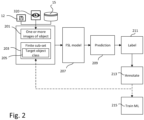
- the method also comprises determining, based on the obtained sensor data comprising one or more images of the at least one object and the obtained finite sub-set of annotated images, a preliminary association between the at least one object and the target object class.
- the method further comprises producing an image label for the one or more images of the at least one object in order to obtain one or more labelled images indicating the preliminary association of the at least one object with the target object class.
- the method comprises selecting the one or more labelled images for generating a corresponding object identification annotation for the one or more labelled images.
- the method may further comprise transmitting the selected one or more labelled images of the at least one object to a remote server and/or storing the selected one or more labelled images in a memory of the vehicle for a subsequent transmission to the remote server for generating the corresponding object identification annotation based at least on the transmitted one or more labelled images of the at least one object from the vehicle.
- the method may further comprise storing the selected one or more labelled images in a memory of the vehicle and generating the corresponding object identification annotation for the one or more labelled images of the at least one object.
- the method may further comprise obtaining a set of selected one or more labelled images of the at least one object from a remote server and/or from a plurality of vehicles travelling on the road, wherein the set of selected one or more labelled images of the at least one object comprises the one or more labelled images of the at least one object produced and selected by each vehicle of the plurality of vehicle.
- the method may further comprise generating the corresponding object identification annotation based on the obtained set of the selected one or more labelled images of the at least one object.
- the method may further comprise forming a training data set for a machine learning, ML, algorithm configured for identification of the at least one object based on the generated object identification annotation. Additionally or alternatively, the method may comprise transmitting the generated object identification annotation to a remote server for forming the training data set for the machine learning, ML, algorithm.
- the method may further comprise obtaining, from the remote server, an updated finite sub-set of annotated images being updated with the generated object identification annotation for the one or more labelled images of the at least one object. Additionally or alternatively the method may further comprise updating the finite sub-set of annotated images with the generated object identification annotation for the one or more labelled images of the at least one object.
- the present inventors have accordingly realized that by using a data-driven approach according to the presented method and systems herein scalability, speed and reproducibility can be achieved in classification of objects such as roadside objects including traffic objects without the stringent requirements on massive data collection.
- the data-driven approach of the present disclosure provides a flexible, cost-efficient, and rapid approach for generating training data for training neural networks and ML algorithms, specifically for objects for which many samples of real-world data are neither collected nor available. This also greatly contributes to solving the problem of identification of rare objects in scenarios involving multiple environmental variables or conditions happening simultaneously or outside the conventional levels.
- the method may further comprise determining the preliminary association between the at least one object and the target object class by means of a few shot learning model.
- the vehicle may comprise an Automated Driving System, ADS and the method may be performed by a processing circuitry of the vehicle.
- ADS Automated Driving System
- a (non-transitory) computer-readable storage medium storing one or more programs configured to be executed by one or more processors of a processing system, the one or more programs comprising instructions for performing the method according to any one of the embodiments of the method disclosed herein.
- non-transitory is intended to describe a computer-readable storage medium (or “memory”) excluding propagating electromagnetic signals, but are not intended to otherwise limit the type of physical computer-readable storage device that is encompassed by the phrase computer-readable medium or memory.
- the terms “non-transitory computer readable medium” or “tangible memory” are intended to encompass types of storage devices that do not necessarily store information permanently, including for example, random access memory (RAM).
- Program instructions and data stored on a tangible computer-accessible storage medium in non-transitory form may further be transmitted by transmission media or signals such as electrical, electromagnetic, or digital signals, which may be conveyed via a communication medium such as a network and/or a wireless link.
- the term “non-transitory”, as used herein is a limitation of the medium itself (i.e., tangible, not a signal) as opposed to a limitation on data storage persistency (e.g., RAM vs. ROM).
- a computer program product comprising instructions which, when the program is executed by one or more processors of a processing system, causes the processing system to carry out the method according to any one of the embodiments of the method disclosed herein.
- a system for determining an association of at least one object to a target object class the at least one object being present in a surrounding environment of a vehicle travelling on a road.
- the system comprises processing circuitry configured to obtain sensor data from a sensor system of the vehicle, the sensor data comprising one or more images, captured by a vehicle-mounted camera, of the surrounding environment of the vehicle.
- the processing circuitry is further configured to determine a presence of the at least one object in the surrounding environment of the vehicle based on the obtained sensor data and to obtain a finite sub-set of annotated images being representative of at least the target object class, the finite sub-set comprising a number of annotated images smaller than a threshold value number.
- the processing circuitry is further configured to determine, based on the obtained sensor data comprising one or more images of the at least one object and the obtained finite sub-set of annotated images, a preliminary association between the at least one object and the target object class.
- the processing circuitry is further configured to produce an image label for the one or more images of the at least one object in order to obtain one or more labelled images indicating the preliminary association of the at least one object with the target object class.
- a vehicle comprising one or more vehicle-mounted sensors configured to monitor a surrounding environment of the vehicle.
- the vehicle further comprises a localization system configured to monitor a pose of the vehicle i.e. geographical position and heading of the vehicle on a road.
- the vehicle further comprises a system according to the fourth aspect and various embodiments of the fourth aspect.
- the vehicle may further comprise an ADS system for controlling one or more of acceleration, steering, and braking of the vehicle.
- the present disclosure when the present disclosure is described in terms of a method, it may also be embodied in apparatus comprising one or more processors, one or more memories coupled to the one or more processors, where computer code is loaded to implement the method.
- the one or more memories may store one or more computer programs that perform the steps, services and functions disclosed herein when executed by the one or more processors in some embodiments.
- phrase “if it is determined' or “when it is determined” or “in an instance of” may be construed to mean “upon determining or “in response to determining” or “upon detecting and identifying occurrence of an event” or “in response to detecting occurrence of an event” depending on the context.
- first, second, etc. may be used herein to describe various elements or features, these elements should not be limited by these terms. These terms are only used to distinguish one element from another.
- a first signal could be termed a second signal, and, similarly, a second signal could be termed a first signal, without departing from the scope of the embodiments.
- the first signal and the second signal are both signals, but they are not the same signal.
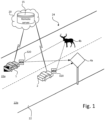
- Fig. 1 shows a schematic perspective top view of a vehicle 1 in a hatched line shaded pattern.
- the vehicle 1 may also be referred to as the ego-vehicle.
- Fig. 1 shows at least one external vehicle 2 traveling on the same portion 24 of a road 22 as the ego vehicle 1.
- the at least one external vehicle 2 may be present in portion 24 at the same time as the ego vehicle 1, however in several embodiments the at least one external vehicle 2 may be present in portion 24 of road 22 at another occasion i.e. point in time than the ego vehicle 1.
- the ego vehicle 1 and the at least one external vehicle 2 may be comprised in a fleet of vehicles and thus in several embodiments and aspects data from the fleet of vehicles comprising one or more vehicles 1, 2 may be collected and analyzed. It should be appreciated that even though in the examples of this description such as in Fig. 1 only one external vehicle 2 is illustrated and described, examples and embodiments can be equally applied to a plurality of vehicles comprised in the fleet. Vehicle 2 may be an identical or similar vehicle to the ego vehicle 1 i.e. having the same or similar functionalities and components and capable of executing and performing various aspects of the presented technology herein.
- the road 22 may be any type of road e.g. part of a motorway, freeway or expressway.
- the road may also be a country road, rural road or any other carriageway.
- the road may have a plurality of lanes such as more than one lane in the same travelling direction e.g. two or more lanes 22a, 22b or at least one lane in each travelling direction as is usually the case for rural roads.
- the road 22 has two lanes 22a and 22b extending in the same direction in this example.
- the vehicle 1 and/or the at least one external vehicle 2 may comprise an Automated Driving System (ADS).
- ADS comprises both ADAS and AD systems.
- the ADS of the ego vehicle may comprise one or more ADS features that are preferably a level 2 feature or higher according to SAE J3016 levels of driving automation for on-road vehicles.
- an ADS feature may be in the form of an autopilot feature, a traffic jam pilot, a highway pilot, or any other SAE J3016 level 2+ ADS feature.
- the at least one object 4a, 4b depicted in Fig. 1 which may be arranged or may be present at any part of the road 22 e.g. on the road portion 24 on which the travelling vehicle 1 is depicted.
- the at least one object 4a, 4b may be a traffic object comprising traffic signs or signals such as traffic lights or warning signs, etc.
- the at least one object 4a, 4b may include wild life or various species of animals.
- the at least one object may be any type of object present on the road examples of which may include debris, construction materials, different vegetation, fallen trees, other vehicles, roadside obstacles, road barriers, etc.
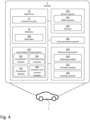
- the ego vehicle 1 comprises a control system 10 or otherwise referred to as the control apparatus 10 which may be a separate entity or may be a part of the overall ADS architecture of the vehicle, and may accordingly be a module or component of the ADS.
- the control system 10 of the vehicle 1 comprises control circuitry 11 or otherwise referred to as processing circuitry 11 configured to obtain data comprising information about a surrounding environment of the vehicle 1.
- the information and data of the surrounding environment of the vehicle 1 may be obtained from a sensor system 320 of the vehicle 1.
- the surrounding environment of the ego-vehicle can be understood as a general area around the ego-vehicle in which objects (such as other vehicles, landmarks, obstacles, etc.) can be detected and identified by vehicle sensors (radar, LIDAR, cameras, etc.), i.e. within a sensor range of the ego-vehicle.
- objects such as other vehicles, landmarks, obstacles, etc.
- vehicle sensors radar, LIDAR, cameras, etc.
- the vehicle 1 may have access to and utilize map data, more specifically HD map data.
- An HD-map is in the present context to be understood as map comprising data with highly accurate and realistic representations of the road travelled upon by the vehicle 1.
- HD-maps may be understood as maps that are particularly built for autonomous driving purposes. These maps have an extremely high precision, oftentimes at a centimeter-level.
- the maps generally contain information such as where the lanes are, where the road boundaries are, where the curves are, how high the curves are, and so forth.
- the control system 10 is configured for obtaining sensor data from a sensor system 320 of the ego vehicle 1 travelling on the road 22.
- the obtained sensor data may comprise information about lane marker geometry on the one or more lanes of the road 22, lane marker type (e.g. solid, dashed, double marker, etc.) on the road 22, traffic sign information 4, road barrier information such as presence or characteristics of speed bumps or any other road obstruction objects, etc.
- the sensor data may comprise one or more images of the surrounding environment of the vehicle 1 being captured by a vehicle-mounted camera (not shown) as a part of the sensor system 320.
- the camera in the present context also includes a plurality of vehicle-mounted cameras mounted on several parts of the ego vehicle 1 for capturing images of a surrounding environment of the ego vehicle 1.
- the captured images may be stored locally in a memory 12 of the ego vehicle 1 and/or be transmitted to an external network 20 such as a cloud network 20, with which the ego vehicle 1 is in communication.
- the control system 10 of the ego vehicle 1 is further configured to determine a presence of at least one object 4a, 4b in the surrounding environment of the ego vehicle 1 based on the obtained sensor data.
- control system 10 is configured to obtain a finite sub-set of annotated images being representative of at least the target object class.
- the finite sub-set which may also be referred to as a support set comprises a number of annotated images smaller than a threshold value number.
- the control system 10 is configured to establish and determine the preliminary association based on the obtained sensor data from the sensor system 320 of the vehicle comprising the one or more images of the at least one object 4a, 4b as well as on the obtained finite sub-set of annotated images representative of the corresponding target object class.
- the vehicle 1 further comprises a maneuvering system 328.
- the maneuvering system 328 is configured to control the maneuvering of the vehicle 1.
- the maneuvering system 328 comprises a steering module 330 configured to control the heading of the vehicle 1.
- the maneuvering system 328 further comprises a throttle module 332 configured to control actuation of the throttle of the vehicle 1.
- the maneuvering system 328 further comprises a braking module 334 configured to control actuation of the brakes of the vehicle 1.
- the various modules of the maneuvering system 328 may also receive manual input from a driver of the vehicle 1 (i.e. from a steering wheel, a gas pedal and a brake pedal respectively).
Landscapes
- Engineering & Computer Science (AREA)
- Theoretical Computer Science (AREA)
- General Physics & Mathematics (AREA)
- Physics & Mathematics (AREA)
- Multimedia (AREA)
- Computer Vision & Pattern Recognition (AREA)
- Evolutionary Computation (AREA)
- Artificial Intelligence (AREA)
- General Health & Medical Sciences (AREA)
- Medical Informatics (AREA)
- Software Systems (AREA)
- Health & Medical Sciences (AREA)
- Databases & Information Systems (AREA)
- Computing Systems (AREA)
- Data Mining & Analysis (AREA)
- Automation & Control Theory (AREA)
- Human Computer Interaction (AREA)
- Transportation (AREA)
- Mechanical Engineering (AREA)
- Computational Linguistics (AREA)
- Life Sciences & Earth Sciences (AREA)
- Bioinformatics & Cheminformatics (AREA)
- Bioinformatics & Computational Biology (AREA)
- Evolutionary Biology (AREA)
- General Engineering & Computer Science (AREA)
- Traffic Control Systems (AREA)
Priority Applications (3)
| Application Number | Priority Date | Filing Date | Title |
|---|---|---|---|
| EP22216820.5A EP4394626A1 (fr) | 2022-12-27 | 2022-12-27 | Classification d'objets présents sur une route |
| CN202311813376.XA CN118262298A (zh) | 2022-12-27 | 2023-12-26 | 存在于道路上的对象的分类 |
| US18/396,315 US20240212319A1 (en) | 2022-12-27 | 2023-12-26 | Classification of objects present on a road |
Applications Claiming Priority (1)
| Application Number | Priority Date | Filing Date | Title |
|---|---|---|---|
| EP22216820.5A EP4394626A1 (fr) | 2022-12-27 | 2022-12-27 | Classification d'objets présents sur une route |
Publications (1)
| Publication Number | Publication Date |
|---|---|
| EP4394626A1 true EP4394626A1 (fr) | 2024-07-03 |
Family
ID=84604225
Family Applications (1)
| Application Number | Title | Priority Date | Filing Date |
|---|---|---|---|
| EP22216820.5A Pending EP4394626A1 (fr) | 2022-12-27 | 2022-12-27 | Classification d'objets présents sur une route |
Country Status (3)
| Country | Link |
|---|---|
| US (1) | US20240212319A1 (fr) |
| EP (1) | EP4394626A1 (fr) |
| CN (1) | CN118262298A (fr) |
Families Citing this family (3)
| Publication number | Priority date | Publication date | Assignee | Title |
|---|---|---|---|---|
| US12524458B2 (en) * | 2022-03-29 | 2026-01-13 | Fujifilm Business Innovation Corp. | Information processing apparatus, non-transitory computer readable medium storing program, and information processing method |
| US20230316770A1 (en) * | 2022-03-31 | 2023-10-05 | Amazon Technologies, Inc. | Perspective based vehicle shadow system |
| US12505172B1 (en) * | 2024-08-19 | 2025-12-23 | Autobrains Technologies Ltd | Automatically identifying faulty representations across classification detections |
Family Cites Families (4)
| Publication number | Priority date | Publication date | Assignee | Title |
|---|---|---|---|---|
| US10346724B2 (en) * | 2017-06-22 | 2019-07-09 | Waymo Llc | Rare instance classifiers |
| GB2622490B (en) * | 2019-02-14 | 2024-06-19 | Mobileye Vision Technologies Ltd | Systems and methods for vehicle navigation |
| SG11202110629VA (en) * | 2019-03-26 | 2021-10-28 | Agency Science Tech & Res | Method and system for image classification |
| JP7708385B2 (ja) * | 2019-05-24 | 2025-07-15 | モービルアイ ビジョン テクノロジーズ リミテッド | 画像分析に基づく車両ナビゲーションのためのシステム |
-
2022
- 2022-12-27 EP EP22216820.5A patent/EP4394626A1/fr active Pending
-
2023
- 2023-12-26 US US18/396,315 patent/US20240212319A1/en active Pending
- 2023-12-26 CN CN202311813376.XA patent/CN118262298A/zh active Pending
Non-Patent Citations (3)
| Title |
|---|
| ANH NGUYEN ET AL: "Deep Federated Learning for Autonomous Driving", ARXIV.ORG, CORNELL UNIVERSITY LIBRARY, 201 OLIN LIBRARY CORNELL UNIVERSITY ITHACA, NY 14853, 19 April 2022 (2022-04-19), XP091195047 * |
| SHRUTI JADON: "An Overview of Deep Learning Architectures in Few-Shots Learning Domain", ARXIV.ORG, 19 August 2020 (2020-08-19), XP081740736, DOI: 10.13140/RG.2.2.31573.24803 * |
| TALHA AZFAR ET AL: "Deep Learning based Computer Vision Methods for Complex Traffic Environments Perception: A Review", ARXIV.ORG, CORNELL UNIVERSITY LIBRARY, 201 OLIN LIBRARY CORNELL UNIVERSITY ITHACA, NY 14853, 9 November 2022 (2022-11-09), XP091365062 * |
Also Published As
| Publication number | Publication date |
|---|---|
| CN118262298A (zh) | 2024-06-28 |
| US20240212319A1 (en) | 2024-06-27 |
Similar Documents
| Publication | Publication Date | Title |
|---|---|---|
| US20240212319A1 (en) | Classification of objects present on a road | |
| CN115470884A (zh) | 用于自动驾驶系统的感知系统开发的平台 | |
| EP4279869B1 (fr) | Détermination d'un état d'un véhicule sur une route | |
| CN119903336A (zh) | 提供用于训练数据的注释的感知模型的计算机实现的方法 | |
| US12602931B2 (en) | Identification of unknown traffic objects | |
| US12147232B2 (en) | Method, system and computer program product for the automated locating of a vehicle | |
| US12240487B2 (en) | Platform for perception system development for automated driving systems | |
| US11983918B2 (en) | Platform for perception system development for automated driving system | |
| CN116394954A (zh) | 用于车辆的假设推理 | |
| US12116008B2 (en) | Attentional sampling for long range detection in autonomous vehicles | |
| US20250148372A1 (en) | Automated data annotation for machine learning applications | |
| US20250002056A1 (en) | Dynamic risk adaptation in a vehicle | |
| US20240135252A1 (en) | Lane-assignment for traffic objects on a road | |
| CN119600563A (zh) | 用于收集数据以用于对象检测模型的后续训练的方法 | |
| CN119903368A (zh) | 为训练数据的标注提供感知模型的计算机实施的方法 | |
| EP4361967B1 (fr) | Capacité de perception spécifique à une situation pour véhicules autonomes et semi-autonomes | |
| US20230090338A1 (en) | Method and system for evaluation and development of automated driving system features or functions | |
| US20250021893A1 (en) | Automated Data Generation by Neural Network Ensembles | |
| EP4431974A1 (fr) | Génération de représentation d'un environnement environnant d'un véhicule | |
| EP4738283A1 (fr) | Ensemble de niveau intermédiaire pour fusion de capteurs | |
| US20250209872A1 (en) | Methods and systems for setting dynamic triggers for event recordings for a vehicle | |
| EP4576023A1 (fr) | Procédé de génération d'un ensemble de données d'apprentissage annoté pour entraîner un algorithme de perception d'un système de conduite automatisée | |
| US20240140486A1 (en) | Methods and apparatuses for closed-loop evaluation for autonomous vehicles | |
| CN115840636A (zh) | 用于自动驾驶系统特征的评估和开发的方法和系统 |
Legal Events
| Date | Code | Title | Description |
|---|---|---|---|
| PUAI | Public reference made under article 153(3) epc to a published international application that has entered the european phase |
Free format text: ORIGINAL CODE: 0009012 |
|
| STAA | Information on the status of an ep patent application or granted ep patent |
Free format text: STATUS: THE APPLICATION HAS BEEN PUBLISHED |
|
| AK | Designated contracting states |
Kind code of ref document: A1 Designated state(s): AL AT BE BG CH CY CZ DE DK EE ES FI FR GB GR HR HU IE IS IT LI LT LU LV MC ME MK MT NL NO PL PT RO RS SE SI SK SM TR |
|
| STAA | Information on the status of an ep patent application or granted ep patent |
Free format text: STATUS: REQUEST FOR EXAMINATION WAS MADE |
|
| 17P | Request for examination filed |
Effective date: 20241216 |