EP4362812B1 - Appareil pour la collecte d'échantillons de fluide - Google Patents
Appareil pour la collecte d'échantillons de fluide Download PDFInfo
- Publication number
- EP4362812B1 EP4362812B1 EP22761652.1A EP22761652A EP4362812B1 EP 4362812 B1 EP4362812 B1 EP 4362812B1 EP 22761652 A EP22761652 A EP 22761652A EP 4362812 B1 EP4362812 B1 EP 4362812B1
- Authority
- EP
- European Patent Office
- Prior art keywords
- vessel
- reservoir
- seal
- seal element
- chamber
- Prior art date
- Legal status (The legal status is an assumption and is not a legal conclusion. Google has not performed a legal analysis and makes no representation as to the accuracy of the status listed.)
- Active
Links
Images



Classifications
-
- A—HUMAN NECESSITIES
- A61—MEDICAL OR VETERINARY SCIENCE; HYGIENE
- A61B—DIAGNOSIS; SURGERY; IDENTIFICATION
- A61B10/00—Instruments for taking body samples for diagnostic purposes; Other methods or instruments for diagnosis, e.g. for vaccination diagnosis, sex determination or ovulation-period determination; Throat striking implements
- A61B10/0045—Devices for taking samples of body liquids
- A61B10/0058—Devices for taking samples of body liquids for taking sperm samples
-
- B—PERFORMING OPERATIONS; TRANSPORTING
- B01—PHYSICAL OR CHEMICAL PROCESSES OR APPARATUS IN GENERAL
- B01L—CHEMICAL OR PHYSICAL LABORATORY APPARATUS FOR GENERAL USE
- B01L3/00—Containers or dishes for laboratory use, e.g. laboratory glassware; Droppers
- B01L3/50—Containers for the purpose of retaining a material to be analysed, e.g. test tubes
- B01L3/502—Containers for the purpose of retaining a material to be analysed, e.g. test tubes with fluid transport, e.g. in multi-compartment structures
-
- A—HUMAN NECESSITIES
- A61—MEDICAL OR VETERINARY SCIENCE; HYGIENE
- A61B—DIAGNOSIS; SURGERY; IDENTIFICATION
- A61B10/00—Instruments for taking body samples for diagnostic purposes; Other methods or instruments for diagnosis, e.g. for vaccination diagnosis, sex determination or ovulation-period determination; Throat striking implements
- A61B10/0045—Devices for taking samples of body liquids
-
- A—HUMAN NECESSITIES
- A61—MEDICAL OR VETERINARY SCIENCE; HYGIENE
- A61B—DIAGNOSIS; SURGERY; IDENTIFICATION
- A61B10/00—Instruments for taking body samples for diagnostic purposes; Other methods or instruments for diagnosis, e.g. for vaccination diagnosis, sex determination or ovulation-period determination; Throat striking implements
- A61B10/0096—Casings for storing test samples
-
- B—PERFORMING OPERATIONS; TRANSPORTING
- B01—PHYSICAL OR CHEMICAL PROCESSES OR APPARATUS IN GENERAL
- B01L—CHEMICAL OR PHYSICAL LABORATORY APPARATUS FOR GENERAL USE
- B01L3/00—Containers or dishes for laboratory use, e.g. laboratory glassware; Droppers
- B01L3/50—Containers for the purpose of retaining a material to be analysed, e.g. test tubes
- B01L3/508—Rigid containers without fluid transport within
-
- B—PERFORMING OPERATIONS; TRANSPORTING
- B01—PHYSICAL OR CHEMICAL PROCESSES OR APPARATUS IN GENERAL
- B01L—CHEMICAL OR PHYSICAL LABORATORY APPARATUS FOR GENERAL USE
- B01L2300/00—Additional constructional details
- B01L2300/04—Closures and closing means
-
- B—PERFORMING OPERATIONS; TRANSPORTING
- B01—PHYSICAL OR CHEMICAL PROCESSES OR APPARATUS IN GENERAL
- B01L—CHEMICAL OR PHYSICAL LABORATORY APPARATUS FOR GENERAL USE
- B01L2300/00—Additional constructional details
- B01L2300/06—Auxiliary integrated devices, integrated components
- B01L2300/0609—Holders integrated in container to position an object
-
- B—PERFORMING OPERATIONS; TRANSPORTING
- B01—PHYSICAL OR CHEMICAL PROCESSES OR APPARATUS IN GENERAL
- B01L—CHEMICAL OR PHYSICAL LABORATORY APPARATUS FOR GENERAL USE
- B01L2300/00—Additional constructional details
- B01L2300/08—Geometry, shape and general structure
- B01L2300/0832—Geometry, shape and general structure cylindrical, tube shaped
Definitions
- the present invention relates in general to the containment of biological fluids and, in specific embodiments, to collection of samples of biological fluids in relation to the field of assisted reproductive technologies.
- a method and apparatus for collection and preservation of fluid samples in accordance with the present invention results in collection of semen samples having improved viability both at the time of collection and after storage.
- the disclosed methods and apparatuses support a wide variety of applications for containment of or contact with biological fluids related to human and veterinary medicine and medical devices including, but not limited to, human reproductive medicine and animal husbandry.
- Assisted reproductive technologies were developed originally to treat individuals with obstructed ovarian tubes, but have matured to procedures which, according to the U.S. Center for Disease Control (2013), now accounts for up to 2% of the annual U.S. birth rate. Since the first human birth from in vitro fertilization in 1978, there have been significant improvements in stimulation protocols, fertilization and culture techniques, use of donor gametes and embryos, and patient selection. Further, the use of pre-implantation genetic diagnosis/pre-implantation genetic screening, an invasive harvesting of cells for genetic screening, has allowed improved selection of embryos to avoid aneuploidy and other genetic defects. These improvements resulted in constantly increasing pregnancy rates while allowing a steady decrease in the number of embryos transferred (Center for Disease Control, 25 2013).
- Such semen collection vessel is capable of extending the life of spermatozoa, and further improves conditions when utilized in connection with a semen extender solution, which may contain several ingredients including, but not limited to, nutrients to maintain its metabolic activity and to undergo the processes necessary for fertilization of the ova, proteins necessary for the sperm cells to grow and to mature into the spermatozoa, sugars to provide the sperm with energy, antimicrobial agents to reduce microbial contamination and prevent the spread of diseases that can be transported in the semen, and cryoprotectants to protect spermatozoa from damage due to ice crystal formation when frozen.
- This well-developed field has long-utilized semen extenders for improving the life of the collected samples.
- cryopreservation as well as the advancing state of the art in reproductive sciences, there remains a need for further enhancing the collection and storage of semen for improved semen quality and protection.
- the present disclosure relates to apparatuses and methods for collection, processing, and/or storage of biological fluids susceptible to degradation by oxidation.
- apparatuses and methods for collection and/or storage of mammalian semen samples are disclosed herein.
- the invention is further directed to apparatus, collections device and other medical devices that control free oxygen radicals within a biological fluid, and where this biological fluid is sperm, the amount of time available before a sperm must be used to fertilize an egg is increased.
- an apparatus for collection of fluids comprises a first vessel.
- the first vessel includes an upper portion and a lower portion.
- the upper portion is a wall, which can be of any suitable profile.
- the lower portion is a reservoir having a predetermined capacity.
- the wall and reservoir are joined such that the inner surface of the reservoir and the inner surface of the wall form a continuous surface.
- a suitable profile for the wall is one that will be effective as a collection means to cause liquid entering the top of the first vessel to collect in the reservoir by gravity flow.
- the apparatus comprises a reservoir seal means, wherein the reservoir has a first inner surface and the reservoir seal means has a bottom surface, such that when the reservoir seal means is installed, the first inner surface and the bottom surface circumscribe a sealed reservoir chamber
- the first vessel, second vessel, and lid can comprise a polymer, preferably a thermoplastic.
- blow molding means a manufacturing process that allows hollow plastic parts to be formed. Air pressure is used to inflate soft plastic into a mold cavity.
- the three main types of blow molding are: extrusion blow molding, injection blow molding, and injection stretch blow molding.
- “Mate,” as used herein, with respect to the apparatus means to form a connection between two components of the apparatus, such as between a lid and an edge or between two edges.
- Examples of such connections include, but are not limited to, overlapping edges, threaded connections, and tongue and groove connections. Connections can be self-securing, such as threaded connections or overlapping edges with interference such that the edges snap together. Alternatively, connections can be such that the components fit together but require external means such as tape to secure the connection.
- Thermoplastic means any polymer including but not limited to acrylonitrile butadiene styrene (“ABS”), polyamide (“PA”), polybutylene terephthalate (“PBT”), polycaprolactam, polycarbonate (“PC”), polyether ether ketone (“PEEK”), polyetherimide, polyethylene (“PE”; including ethylene homopolymers, such as, but not limited to, high density polyethylene and high-pressure, low density polyethylene; ethylene-alpha-olefin copolymers, such as, but not limited to, high density polyethylene, medium density polyethylene, and linear low density polyethylene; and copolymers of ethylene and polar comonomers, such as, but not limited to, ethylene-methyl-acrylate copolymer, ethylene-acrylic acid copolymer, ethylene-vinyl-acetate copolymer), polyethylene terephthalate (“PETP”), polymethyl methacrylate (“PMMA”), polyoxy
- ABS acrylon
- Upper end as used herein, with respect to the apparatus or component of the apparatus means the portion of apparatus or component of the apparatus, respectively, proximate to the bottom of the apparatus or component of the apparatus, respectively, when the apparatus is in the upright orientation resting on a horizontal surface.
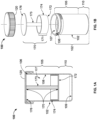
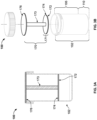
- FIGs. 1-6 show embodiments of the apparatus in the upright orientation.
- “Viability,” as used herein, means a sperm sample that exceeds one or more lower reference limits for a semen sample of at least 1.5 ml: total sperm count greater than or equal to 39 x 10 6 ; sperm concentration greater than or equal to 15 x 10 6 ; total motility greater than or equal to 40%; progressive motility greater than or equal to 32%; vitality greater than or equal to 58%; and sperm morphology greater than or equal to 4%, (percent).
- "Selected viability,” as used herein, means a one or more of the foregoing parameter selected by a user for determination of viability.
- the apparatus comprises at least one vessel having a reservoir at the bottom of the vessel as the collection and storage of biological fluids, such as, but not limited to, mammalian semen.
- the apparatus further comprises a reservoir seal means, which encloses the reservoir after a fluid sample is collected.
- the reservoir seal means comprises a seal element.
- the reservoir seal means comprises a seal element connected to a positioning element.
- the reservoir seal means comprises a seal element connected to a positioning element and the positioning element connected to a stabilizing element.
- a first chamber is circumscribed by the inner surface of the reservoir, the inner surface of the collection means, and the inner surface of the lid.
- a second chamber is formed, circumscribed by the inner surface of the reservoir and the bottom surface of the seal element.
- the second chamber has less volume than the first chamber and is circumscribed by less surface area than the first chamber.
- the reduced volume of the second chamber as compared to the first chamber also limits the amount of air to which a fluid sample is exposed during the time the sample is stored in the apparatus. It is believed, without wishing to be bound by any particular theory, that limiting the oxygen to which a sample of mammalian semen is exposed helps to maintain the viability of such sample. This becomes increasingly important as the time of storage increases.
- the material from which the reservoir, the collection means, lid, and/or seal element are fabricated comprise one or more antioxidants that counteract oxidative deterioration of the fluid sample, such as mammalian semen, due to exposure to oxygen. It is believed, without wishing to be bound by any particular theory, that the reduced size of the second chamber as compared to the first chamber promotes maintenance of a desired level of viability of a fluid sample such as mammalian semen by limiting reactants both in the vapor space and on the surface circumscribing the second chamber to which a fluid sample, such as mammalian semen, is exposed.
- the reduced volume of the second chamber as compared to the first chamber also limits the change in temperature to which a fluid sample is exposed during the time the sample is stored in the apparatus. It is believed, without wishing to be bound by any particular theory, that restricting the movement of the fluid sample to a smaller volume provides more less variation in temperature of a fluid sample, such as mammalian semen, and helps to maintain the viability of such sample. This becomes increasingly important as the time of storage increases. This temperature stabilization effect is further enhanced when the first vessel is inserted into a second vessel as described elsewhere in this disclosure.
- the apparatus is a single vessel surrounded by one or more layers of insulation material.
- Such one or more layers can have uniform or variable thickness and can be: a) applied directly to the exterior surface of the first vessel, such as by coating or lamination; b) wrapped around the container; c) formed into an envelope, box, or other container suited for containment of the apparatus; or d) a combination thereof.
- the apparatus comprises a first vessel and a second vessel, wherein the first vessel is configured to fit within the second vessel.
- the first vessel can be a close fit inside the second vessel or there can be an air gap between the outer surface of the first vessel and the inner surface of the second vessel.
- the apparatus comprising either one vessel or two vessels, is inserted into a container fabricated from an insulating material having a thermal effusivity less than equal to that of a foamed polystyrene cup.
- a desired level of viability of a mammalian semen sample stored in an apparatus as described herein can be maintained for greater than or equal to 1 hour, greater than or equal to 6 hours, greater than or equal to 12 hours, greater than or equal to 24 hours, greater than or equal to 48 hours, or greater than or equal to 72 hours.
- the second chamber is circumscribed by a surface comprising the inner surface of the reservoir and the bottom surface of the seal element.
- the seal element has a sealing surface that engages with the first vessel proximate to the upper end of the reservoir and/or the lower end of the collection means.
- the inner surface of the reservoir and the inner surface of the collection means form a continuous inner surface of the first vessel.
- the transition from the inner surface of the reservoir to the inner surface of the collection means is defined as the point at which the sealing surface of the seal element engages the continuous surface formed by the inner surface of the reservoir to the inner surface of the collection means.
- the engagement between the sealing surface of the seal element and the inner surface of the first vessel can be implemented by positioning, friction, pressure, suction, or a combination thereof.
- positioning of the sealing surface of the seal element relative to the inner surface of the first vessel is maintained by a reservoir means comprising a seal element, a positioning element, and a stabilizing element.
- the configuration of the stabilizing element is such that the stabilizing element is secured by engagement of the lid with the first vessel, such as, but not limited to, by a threaded connection between the lid and the first vessel securing the perimeter of a disc-shaped stabilizing element between the upper edge of the first vessel and the lid.
- the stabilizing element can be only a portion of a disc, wherein two or more contact points are provided for engagement between the upper edge of the first vessel and the lid.
- the sealing surface of the seal element is positioned close to the inner surface of the first vessel by connection of the seal element to the positioning element and connection of the positioning element to the stabilizing element.
- the fitment between the sealing surface of the seal element and the inner surface of the first vessel is such that the gap between the sealing surface of the seal element and the inner surface of the first vessel is less than the distance where the surface tension of a liquid sample, such as sample of mammalian semen, would overcome the forces of gravity is the apparatus was inverted such that the liquid sample would be retained in the second chamber upon such inversion.
- a liquid sample such as sample of mammalian semen
- a frictional connection between the sealing surface of the seal element on the inner surface of the first vessel when a reservoir means, comprising a seal element and a positioning element are engaged by manual application of force by a human or a machine through the positioning element connected to the seal element. Such force causes engagement between the sealing surface of the seal element and the inner surface of the first vessel by way of friction.
- pressure between the sealing surface of the seal element and the inner surface of the first vessel is maintained by a reservoir means comprising a seal element, a positioning element, and a stabilizing element.
- the configuration of the reservoir means is such that one or more of the seal element, the positioning element, and the stabilizing element is fabricated from a flexible material.
- the stabilizing element is secured by engagement of the lid with the first vessel, such as, but not limited to, by a threaded connection between the lid and the first vessel securing the perimeter of a disc-shaped stabilizing element between the upper edge of the first vessel and the lid.
- the stabilizing element can be only a portion of a disc, wherein two or more contact points are provided for engagement between the upper edge of the first vessel and the lid.
- the one or more of the seal element, the positioning element, and the stabilizing element are of a size and shape that one or more of the seal element, the positioning element, and the stabilizing element are cause to flex when the lid is fully engages with the upper edge of the first vessel.
- Such flexing of one or more of the seal element, the positioning element, and the stabilizing element produce a pressure between the sealing surface of the seal element and the inner surface of the first vessel.
- the inner surface 408 of the wall of the collection means is configured to have an increased ratio of surface area of the inner surface 408 of the collection means to the volume of the collection means 410.
- Means for increasing this ratio include, but are not limited to, one or more nubs, one or more circumferential ridges, one or more radial fins, or combinations thereof.
Landscapes
- Health & Medical Sciences (AREA)
- Life Sciences & Earth Sciences (AREA)
- General Health & Medical Sciences (AREA)
- Chemical & Material Sciences (AREA)
- Hematology (AREA)
- Engineering & Computer Science (AREA)
- Veterinary Medicine (AREA)
- Heart & Thoracic Surgery (AREA)
- Medical Informatics (AREA)
- Molecular Biology (AREA)
- Surgery (AREA)
- Animal Behavior & Ethology (AREA)
- Pathology (AREA)
- Public Health (AREA)
- Biomedical Technology (AREA)
- Analytical Chemistry (AREA)
- Clinical Laboratory Science (AREA)
- Chemical Kinetics & Catalysis (AREA)
- Reproductive Health (AREA)
- Sampling And Sample Adjustment (AREA)
- Investigating Or Analysing Biological Materials (AREA)
- Micro-Organisms Or Cultivation Processes Thereof (AREA)
Claims (17)
- Récipient (102) pour la collecte et la conservation d'échantillons de fluide, comprenant :a. des moyens de collecte (105) au niveau de l'extrémité supérieure du récipient ;b. un réservoir (110) au niveau de l'extrémité inférieure du récipient (102),c. des moyens d'étanchéité de réservoir (170) ; etd. un couvercle (120) adapté pour une fixation pouvant être scellée au récipient (102) :
dans lequel :le réservoir (110) comprend une surface intérieure (109) ;les moyens d'étanchéité de réservoir (170) sont configurés pour venir en prise avec le récipient (102) pour enfermer le réservoir (110) ; et caractérisé en ce que :la surface intérieure (108) du récipient (102) et la surface intérieure du couvercle (120) entourent une première chambre ;la surface intérieure (109) du réservoir (110) et une surface inférieure des moyens d'étanchéité de réservoir (170) entourent une seconde chambre ; etle rapport du volume de la seconde chambre au volume de la première chambre est inférieur ou égal à 0,20. - Récipient (102) selon la revendication 1, dans lequel les moyens d'étanchéité de réservoir (170) comprennent un élément d'étanchéité (171).
- Récipient (102) selon la revendication 2, dans lequel le réservoir (102), les moyens de collecte (105), le couvercle (120) et/ou l'élément d'étanchéité (171) sont fabriqués à partir d'un matériau comprenant un ou plusieurs antioxydants qui agissent à l'encontre d'une détérioration oxydative d'un échantillon de sperme de mammifère.
- Récipient (102) selon la revendication 2 ou 3, dans lequel :a. l'élément d'étanchéité (171) comprend une surface d'étanchéité (174) ;b. le récipient (102) présente une surface intérieure (108) ; etc. la surface d'étanchéité (174) de l'élément d'étanchéité (171) vient en prise avec la surface intérieure (108) du récipient (102) par positionnement, frottement, pression, aspiration, ou une combinaison de ceux-ci.
- Récipient (102) selon la revendication 4, dans lequel la mise en prise de la surface d'étanchéité (174) de l'élément d'étanchéité (171) avec la surface intérieure (108) du récipient (102) forme une connexion étanche à l'air.
- Récipient (102) selon la revendication 4 ou 5, dans lequel les moyens d'étanchéité de réservoir (170) comprennent en outre un élément de positionnement (173).
- Récipient (102) selon la revendication 6, dans lequel les moyens d'étanchéité de réservoir (170) comprennent en outre un élément de stabilisation (176).
- Récipient (102) selon l'une quelconque des revendications précédentes, comprenant en outre une couche d'isolation externe.
- Appareil (400) pour la collecte et la conservation d'échantillons de fluide, comprenant :a. un premier récipient (402) présentant des moyens de collecte (405) au niveau de l'extrémité supérieure du premier récipient (402) et un réservoir (410) au niveau de l'extrémité inférieure du premier récipient (402), etb. un second récipient (450), dans lequel le premier récipient (402) est inséré dans le second récipient (450) ;c. un couvercle (420) adapté pour une fixation pouvant être scellée au premier récipient (402) ; etd. des moyens d'étanchéité de réservoir (470) ;dans lequel :le réservoir (410) comprend une surface intérieure (102) ;les moyens d'étanchéité de réservoir (470) sont configurés pour venir en prise avec le premier récipient (402) pour enfermer le réservoir (410) ; et caractérisé en ce que :la surface intérieure (408) du premier récipient (402) et la surface intérieure du couvercle (420) entourent une première chambre ;la surface intérieure (409) du réservoir (410) et une surface inférieure des moyens d'étanchéité de réservoir (470) entourent une seconde chambre ; etle rapport du volume de la seconde chambre au volume de la première chambre est inférieur ou égal à 0,20.
- Appareil (400) selon la revendication 9, dans lequel les moyens d'étanchéité de réservoir (470) comprennent un élément d'étanchéité (471).
- Appareil (400) selon la revendication 9 ou 10, dans lequel le réservoir (402), les moyens de collecte (405), le couvercle (420) et/ou l'élément d'étanchéité (471) sont fabriqués à partir d'un matériau comprenant un ou plusieurs antioxydants qui agissent à l'encontre d'une détérioration oxydative d'un échantillon de sperme de mammifère.
- Appareil (400) selon la revendication 11, dans lequel :a. l'élément d'étanchéité (471) comprend une surface d'étanchéité (474) ;b. le premier récipient (402) présente une surface intérieure (408) ; etc. la surface d'étanchéité (474) de l'élément d'étanchéité (471) vient en prise avec la surface intérieure (408) du premier récipient (402) par positionnement, frottement, pression, aspiration, ou une combinaison de ceux-ci.
- Appareil (400) selon la revendication 12, dans lequel la mise en prise de la surface d'étanchéité (474) de l'élément d'étanchéité (471) avec la surface intérieure (408) du premier récipient (402) forme une connexion étanche à l'air.
- Appareil (400) selon la revendication 13, dans lequel les moyens d'étanchéité de réservoir (470) comprennent en outre un élément de positionnement (473).
- Appareil (400) selon la revendication 14, dans lequel les moyens d'étanchéité de réservoir (470) comprennent en outre un élément de stabilisation (476).
- Appareil (400) selon l'une quelconque des revendications 9 à 15, comprenant en outre une couche d'isolation, un espace d'air ou une combinaison de ceux-ci entre le premier récipient (402) et le second récipient (450).
- Appareil (400) selon l'une quelconque des revendications 9 à 16, comprenant en outre une couche d'isolation entourant l'appareil.
Applications Claiming Priority (2)
| Application Number | Priority Date | Filing Date | Title |
|---|---|---|---|
| US202163217025P | 2021-06-30 | 2021-06-30 | |
| PCT/US2022/035784 WO2023278742A1 (fr) | 2021-06-30 | 2022-06-30 | Appareil pour la collecte d'échantillons de fluide |
Publications (3)
| Publication Number | Publication Date |
|---|---|
| EP4362812A1 EP4362812A1 (fr) | 2024-05-08 |
| EP4362812B1 true EP4362812B1 (fr) | 2025-07-09 |
| EP4362812C0 EP4362812C0 (fr) | 2025-07-09 |
Family
ID=83149225
Family Applications (1)
| Application Number | Title | Priority Date | Filing Date |
|---|---|---|---|
| EP22761652.1A Active EP4362812B1 (fr) | 2021-06-30 | 2022-06-30 | Appareil pour la collecte d'échantillons de fluide |
Country Status (6)
| Country | Link |
|---|---|
| US (1) | US20230001406A1 (fr) |
| EP (1) | EP4362812B1 (fr) |
| AU (1) | AU2022301336A1 (fr) |
| CA (1) | CA3223462A1 (fr) |
| ES (1) | ES3037010T3 (fr) |
| WO (1) | WO2023278742A1 (fr) |
Families Citing this family (1)
| Publication number | Priority date | Publication date | Assignee | Title |
|---|---|---|---|---|
| WO2025145131A1 (fr) * | 2023-12-28 | 2025-07-03 | Innomed Eight, L.L.C. | Kits et méthodes de collecte et de filtration de sperme |
Family Cites Families (14)
| Publication number | Priority date | Publication date | Assignee | Title |
|---|---|---|---|---|
| US4073693A (en) * | 1976-06-08 | 1978-02-14 | American Home Products Corporation | Apparatus and method for conducting a plurality of biological tests |
| US6886357B2 (en) * | 1999-09-30 | 2005-05-03 | Gano, Iii John | Systems and methods for storing items with containers |
| US6864046B1 (en) | 2000-03-01 | 2005-03-08 | Texas Tech University | Method for collecting and preserving semen |
| US7759115B2 (en) * | 2003-02-10 | 2010-07-20 | Bio X Cell, Inc. | Incubation and/or storage container system and method |
| US7947026B2 (en) * | 2003-11-06 | 2011-05-24 | University Of Virginia Patent Foundation | Glans compatible single unit semen collection and storage device, kit and related methods of use |
| GB0707776D0 (en) * | 2007-04-23 | 2007-05-30 | Robio Systems Ltd | A Container for culturing and/or transporting embryos or oocytes. an insert for the container and a method of transporting same |
| EP2682747B1 (fr) * | 2012-07-02 | 2016-02-24 | ZECH, Josef | Dispositif de sélection de spermatozoides |
| US9757306B2 (en) * | 2013-03-13 | 2017-09-12 | Bayer Healthcare Llc | Vial container with collar cap |
| JP6605704B2 (ja) * | 2016-10-03 | 2019-11-13 | 浩一 岡田 | 精液保存用容器 |
| US10799422B2 (en) * | 2017-05-30 | 2020-10-13 | Spectrum Solutions L.L.C. | Sample collection kit including removable stopper |
| JP6952614B2 (ja) * | 2018-01-23 | 2021-10-20 | ミツボシプロダクトプラニング株式会社 | 採精容器 |
| FR3081292B1 (fr) * | 2018-05-24 | 2020-06-05 | Imv Technologies | Dispositif de collecte de semence animale |
| US11395501B2 (en) * | 2018-08-07 | 2022-07-26 | Rashieka Barr | Stackable infusion filtration and storage systems and methods of using the same |
| CN115701450A (zh) * | 2021-08-02 | 2023-02-10 | 邦睿生技股份有限公司 | 精子分选装置及方法 |
-
2022
- 2022-06-30 EP EP22761652.1A patent/EP4362812B1/fr active Active
- 2022-06-30 AU AU2022301336A patent/AU2022301336A1/en active Pending
- 2022-06-30 WO PCT/US2022/035784 patent/WO2023278742A1/fr not_active Ceased
- 2022-06-30 US US17/855,086 patent/US20230001406A1/en active Pending
- 2022-06-30 CA CA3223462A patent/CA3223462A1/fr active Pending
- 2022-06-30 ES ES22761652T patent/ES3037010T3/es active Active
Also Published As
| Publication number | Publication date |
|---|---|
| US20230001406A1 (en) | 2023-01-05 |
| ES3037010T3 (en) | 2025-09-26 |
| CA3223462A1 (fr) | 2023-01-05 |
| EP4362812A1 (fr) | 2024-05-08 |
| WO2023278742A1 (fr) | 2023-01-05 |
| AU2022301336A1 (en) | 2024-01-18 |
| EP4362812C0 (fr) | 2025-07-09 |
Similar Documents
| Publication | Publication Date | Title |
|---|---|---|
| JP3955094B2 (ja) | 人工生体器官の貯蔵および運搬のための装置および方法 | |
| EP3480290B1 (fr) | Ensemble destiné au transport d'un récipient de culture et unité permettant le transport de cellule ou de tissu biologique | |
| CN206285172U (zh) | 亲水iol包装系统及包含亲水iol包装系统的组合 | |
| JP6823074B2 (ja) | 低温検体キャリヤおよび関連する方法 | |
| EP3232779B1 (fr) | Dispositif de cryoconservation en système fermé | |
| US20130091890A1 (en) | Specimen freezing rate regulator device | |
| US20100196873A1 (en) | Systems and Methods for Cryopreservation of Cells | |
| EP4362812B1 (fr) | Appareil pour la collecte d'échantillons de fluide | |
| US20040157205A1 (en) | Incubation and/or storage container system and method | |
| US10834917B2 (en) | Methods for cryopreservation of biological materials | |
| EP4410429A2 (fr) | Dispositif régulateur de la vitesse de congélation de spécimens | |
| US20050160701A1 (en) | Tissue preservation assembly and method of making and using the same | |
| US20230287319A1 (en) | Petri dish | |
| CN211894402U (zh) | 一种肿瘤细胞采集运输保温箱 | |
| CN210929356U (zh) | 一种封闭式卵巢组织冷冻装置 | |
| JP2024544341A (ja) | 生物学的材料を保存するための包装器 | |
| CN205470675U (zh) | 一种保温箱 | |
| CN116710025A (zh) | 用于医疗产品的包装系统 | |
| US12382952B2 (en) | Cryostorage device | |
| WO2021102473A1 (fr) | Récipient amélioré d'incubation de culture intravaginale et procédé associé | |
| RU176704U1 (ru) | Контейнер для транспортировки в изотермических условиях и гомогенизации биопсийного материала для микробиологических исследований | |
| WO2021157653A1 (fr) | Contenant pour la cryoconservation | |
| AU2011202584A1 (en) | Method and basket apparatus for transporting biological samples |
Legal Events
| Date | Code | Title | Description |
|---|---|---|---|
| STAA | Information on the status of an ep patent application or granted ep patent |
Free format text: STATUS: UNKNOWN |
|
| STAA | Information on the status of an ep patent application or granted ep patent |
Free format text: STATUS: THE INTERNATIONAL PUBLICATION HAS BEEN MADE |
|
| PUAI | Public reference made under article 153(3) epc to a published international application that has entered the european phase |
Free format text: ORIGINAL CODE: 0009012 |
|
| STAA | Information on the status of an ep patent application or granted ep patent |
Free format text: STATUS: REQUEST FOR EXAMINATION WAS MADE |
|
| 17P | Request for examination filed |
Effective date: 20231219 |
|
| AK | Designated contracting states |
Kind code of ref document: A1 Designated state(s): AL AT BE BG CH CY CZ DE DK EE ES FI FR GB GR HR HU IE IS IT LI LT LU LV MC MK MT NL NO PL PT RO RS SE SI SK SM TR |
|
| DAV | Request for validation of the european patent (deleted) | ||
| DAX | Request for extension of the european patent (deleted) | ||
| GRAP | Despatch of communication of intention to grant a patent |
Free format text: ORIGINAL CODE: EPIDOSNIGR1 |
|
| STAA | Information on the status of an ep patent application or granted ep patent |
Free format text: STATUS: GRANT OF PATENT IS INTENDED |
|
| INTG | Intention to grant announced |
Effective date: 20250204 |
|
| GRAS | Grant fee paid |
Free format text: ORIGINAL CODE: EPIDOSNIGR3 |
|
| GRAA | (expected) grant |
Free format text: ORIGINAL CODE: 0009210 |
|
| STAA | Information on the status of an ep patent application or granted ep patent |
Free format text: STATUS: THE PATENT HAS BEEN GRANTED |
|
| AK | Designated contracting states |
Kind code of ref document: B1 Designated state(s): AL AT BE BG CH CY CZ DE DK EE ES FI FR GB GR HR HU IE IS IT LI LT LU LV MC MK MT NL NO PL PT RO RS SE SI SK SM TR |
|
| REG | Reference to a national code |
Ref country code: GB Ref legal event code: FG4D |
|
| REG | Reference to a national code |
Ref country code: CH Ref legal event code: EP |
|
| REG | Reference to a national code |
Ref country code: IE Ref legal event code: FG4D |
|
| REG | Reference to a national code |
Ref country code: DE Ref legal event code: R096 Ref document number: 602022017397 Country of ref document: DE |
|
| U01 | Request for unitary effect filed |
Effective date: 20250729 |
|
| U07 | Unitary effect registered |
Designated state(s): AT BE BG DE DK EE FI FR IT LT LU LV MT NL PT RO SE SI Effective date: 20250806 |
|
| REG | Reference to a national code |
Ref country code: ES Ref legal event code: FG2A Ref document number: 3037010 Country of ref document: ES Kind code of ref document: T3 Effective date: 20250926 |
|
| REG | Reference to a national code |
Ref country code: CH Ref legal event code: W10 Free format text: ST27 STATUS EVENT CODE: U-0-0-W10-W00 (AS PROVIDED BY THE NATIONAL OFFICE) Effective date: 20251008 |
|
| RAP4 | Party data changed (patent owner data changed or rights of a patent transferred) |
Owner name: RSI TECHNOLOGY GROUP, LLC |
|
| U1H | Name or address of the proprietor changed after the registration of the unitary effect |
Owner name: RSI TECHNOLOGY GROUP, LLC; US |
|
| REG | Reference to a national code |
Ref country code: GR Ref legal event code: EP Ref document number: 20250402026 Country of ref document: GR Effective date: 20251112 |
|
| PG25 | Lapsed in a contracting state [announced via postgrant information from national office to epo] |
Ref country code: IS Free format text: LAPSE BECAUSE OF FAILURE TO SUBMIT A TRANSLATION OF THE DESCRIPTION OR TO PAY THE FEE WITHIN THE PRESCRIBED TIME-LIMIT Effective date: 20251109 |
|
| PG25 | Lapsed in a contracting state [announced via postgrant information from national office to epo] |
Ref country code: NO Free format text: LAPSE BECAUSE OF FAILURE TO SUBMIT A TRANSLATION OF THE DESCRIPTION OR TO PAY THE FEE WITHIN THE PRESCRIBED TIME-LIMIT Effective date: 20251009 |
|
| PG25 | Lapsed in a contracting state [announced via postgrant information from national office to epo] |
Ref country code: HR Free format text: LAPSE BECAUSE OF FAILURE TO SUBMIT A TRANSLATION OF THE DESCRIPTION OR TO PAY THE FEE WITHIN THE PRESCRIBED TIME-LIMIT Effective date: 20250709 |
|
| PG25 | Lapsed in a contracting state [announced via postgrant information from national office to epo] |
Ref country code: PL Free format text: LAPSE BECAUSE OF FAILURE TO SUBMIT A TRANSLATION OF THE DESCRIPTION OR TO PAY THE FEE WITHIN THE PRESCRIBED TIME-LIMIT Effective date: 20250709 |
|
| PG25 | Lapsed in a contracting state [announced via postgrant information from national office to epo] |
Ref country code: RS Free format text: LAPSE BECAUSE OF FAILURE TO SUBMIT A TRANSLATION OF THE DESCRIPTION OR TO PAY THE FEE WITHIN THE PRESCRIBED TIME-LIMIT Effective date: 20251009 |
|
| PG25 | Lapsed in a contracting state [announced via postgrant information from national office to epo] |
Ref country code: SM Free format text: LAPSE BECAUSE OF FAILURE TO SUBMIT A TRANSLATION OF THE DESCRIPTION OR TO PAY THE FEE WITHIN THE PRESCRIBED TIME-LIMIT Effective date: 20250709 |
|
| PG25 | Lapsed in a contracting state [announced via postgrant information from national office to epo] |
Ref country code: SK Free format text: LAPSE BECAUSE OF FAILURE TO SUBMIT A TRANSLATION OF THE DESCRIPTION OR TO PAY THE FEE WITHIN THE PRESCRIBED TIME-LIMIT Effective date: 20250709 |