EP4375899A1 - Verfahren und vorrichtung zur empfehlung von aktivitäten an mindestens einen benutzer - Google Patents
Verfahren und vorrichtung zur empfehlung von aktivitäten an mindestens einen benutzer Download PDFInfo
- Publication number
- EP4375899A1 EP4375899A1 EP23307018.4A EP23307018A EP4375899A1 EP 4375899 A1 EP4375899 A1 EP 4375899A1 EP 23307018 A EP23307018 A EP 23307018A EP 4375899 A1 EP4375899 A1 EP 4375899A1
- Authority
- EP
- European Patent Office
- Prior art keywords
- activity
- user
- usr
- act
- recommendation
- Prior art date
- Legal status (The legal status is an assumption and is not a legal conclusion. Google has not performed a legal analysis and makes no representation as to the accuracy of the status listed.)
- Pending
Links
Images


Classifications
-
- H—ELECTRICITY
- H04—ELECTRIC COMMUNICATION TECHNIQUE
- H04W—WIRELESS COMMUNICATION NETWORKS
- H04W4/00—Services specially adapted for wireless communication networks; Facilities therefor
- H04W4/02—Services making use of location information
- H04W4/021—Services related to particular areas, e.g. point of interest [POI] services, venue services or geofences
-
- G—PHYSICS
- G06—COMPUTING OR CALCULATING; COUNTING
- G06Q—INFORMATION AND COMMUNICATION TECHNOLOGY [ICT] SPECIALLY ADAPTED FOR ADMINISTRATIVE, COMMERCIAL, FINANCIAL, MANAGERIAL OR SUPERVISORY PURPOSES; SYSTEMS OR METHODS SPECIALLY ADAPTED FOR ADMINISTRATIVE, COMMERCIAL, FINANCIAL, MANAGERIAL OR SUPERVISORY PURPOSES, NOT OTHERWISE PROVIDED FOR
- G06Q10/00—Administration; Management
- G06Q10/06—Resources, workflows, human or project management; Enterprise or organisation planning; Enterprise or organisation modelling
- G06Q10/063—Operations research, analysis or management
- G06Q10/0631—Resource planning, allocation, distributing or scheduling for enterprises or organisations
- G06Q10/06311—Scheduling, planning or task assignment for a person or group
-
- G—PHYSICS
- G06—COMPUTING OR CALCULATING; COUNTING
- G06N—COMPUTING ARRANGEMENTS BASED ON SPECIFIC COMPUTATIONAL MODELS
- G06N3/00—Computing arrangements based on biological models
- G06N3/02—Neural networks
Definitions
- the present invention relates to the field of information processing. More particularly, the present invention relates to a method and a device for recommending activities to at least one user, as well as a system, a computer program, and an associated information medium.
- the present invention finds a particularly advantageous application, although in no way limiting, for the implementation of decision support systems.
- the present invention aims to remedy all or part of the disadvantages of the prior art, in particular those explained above.
- the present invention proposes to provide a user with an activity recommendation based on activity detected in a remote location.
- the detection of the activity carried out in the remote location triggers the generation and sending of the recommendation, which makes it possible to provide a recommendation to the user in real time.
- the recommendation offered to the user is generated based on: the activity detected during implementation; and the link between the user and the detected activity, which makes it possible to obtain an up-to-date and personalized recommendation for the user.
- the present invention makes it possible to provide in real time up-to-date and personalized activity recommendations for a user taking into account activities currently being carried out in a remote location.
- the present invention finds an advantageous application for the implementation of real-time decision support systems, for example allowing optimization of material resources (e.g. the meeting rooms of a building) or temporal resources (e.g. a user's schedule).
- material resources e.g. the meeting rooms of a building
- temporal resources e.g. a user's schedule
- a said activity recommendation is sent only to a user.
- a said activity recommendation is sent to a plurality of users.
- said first activity is an activity carried out by one or more people located in the first location (e.g. the start of a presentation).
- said first activity is an activity associated with the first location, and thus with a change in the first location (e.g. launching a slideshow).
- said at least one activity recommendation is further generated based on a second activity detected being carried out by said at least one user.
- the activity of a user is detected, then used to generate the activity recommendation sent to the user.
- this embodiment makes it possible to dynamically adapt the activity recommendations provided to a user according to their current situation.
- this embodiment contributes to improving the relevance of the activity recommendations offered to the user.
- said at least one link (between said at least one user and said at least one first activity) comprises a so-called fixed link between said at least one user and at least one person associated with said at least one first activity, the fixed link being recorded in a database and being obtained from an identifier of said at least one user and an identifier of said at least one person (associated with said at least one first activity).
- This embodiment is advantageous in that it makes it possible to generate activity recommendations based on interpersonal relationships defined in a database. More generally, this embodiment makes it possible to personalize the recommendations provided to users.
- said at least one link (between said at least one user and said at least one first activity) comprises a so-called dynamic link between said at least one user and said at least one first activity, the dynamic link being determined depending on said at least one user and said at least one first activity.
- This embodiment makes it possible to adapt over time the activity recommendations sent to a user based on a current context and, thus, contributes to providing up-to-date recommendations to users.
- the method further comprises sending, to a terminal of another user (separate from said at least one user), another activity recommendation generated as a function of: said at least one recommendation of 'activities (sent to audit at least one user); and a link between the other user and said at least one activity recommendation.
- the recommendation of activities made to a second user is made based on the recommendation made to a first user and the link between these users.
- an inference mechanism i.e. chain reaction
- This embodiment makes it possible to coordinate the activities of several users.
- This embodiment is particularly advantageous for collectively optimizing the management of resources shared between several users (e.g. meeting rooms).
- said at least one activity recommendation and information representative of said at least one first detected activity are sent (via a communication network) to said at least one terminal of said at least one user.
- this embodiment it is proposed to transmit to the user, in addition to the recommendation, the detected activity having triggered the issuance of this recommendation.
- this embodiment makes it possible to contextualize the activity recommendations offered to users. This embodiment thus makes it possible to motivate the sending of recommendations to users and contributes to improving the relevance of these for users.
- said at least one activity recommendation is generated by a neural network.
- This embodiment makes it possible to automatically optimize the generation of recommendations from training or learning data in order to improve the relevance of the recommendations provided to users. In other words, this embodiment makes it possible to automatically learn to generate relevant recommendations for users.
- the method includes updating parameters (eg weights) of the neural network based on data indicating whether or not said at least one user has followed said at least one activity recommendation.
- parameters eg weights
- the neural network is optimized over time (i.e. online supervised training) taking into account the relevance of the recommendations made to a user, that is to say the acceptance or not of these by the user.
- this embodiment is advantageous in that it makes it possible to improve, over time and in a manner specific to a user, the relevance of the recommendations provided to the latter.
- said at least one piece of data is obtained by determining whether a third activity detected being carried out by said at least one user corresponds to said at least one activity recommendation previously sent.
- said at least one piece of data can be obtained by receiving a message from said at least one terminal of said at least one user, the message indicating whether or not said at least one user has followed said at least one activity recommendation.
- the first location is a meeting room equipped with said at least one sensor.
- This embodiment makes it possible to provide real-time recommendations for activities specific to the progress of a meeting or presentation for remote users.
- the method comprises obtaining said data measured by said at least one sensor, said measured data being used to detect said at least one first activity.
- This embodiment makes it possible to obtain data from sensors allowing the detection of activities and, thus, to adapt the detection of activities according to different scenarios.
- the activity recommendation device implements all or part of the steps of the activity recommendation method according to the invention.
- the system comprises a set of at least one sensor configured to capture measured data and to communicate with said activity recommendation device.
- said set of sensors comprises at least one sensor from: a camera; a microphone ; a network probe; a pressure sensor; a temperature sensor; a depth sensor; and a thermal camera.
- a computer program comprising instructions for implementing the steps of a method according to the invention, when the computer program is executed by at least one processor or a computer.
- the computer program may be made up of one or more sub-parts stored in the same memory or in separate memories.
- the program may use any programming language, and be in the form of source code, object code, or intermediate code between source code and object code, such as in a partially compiled form, or in any other desirable shape.
- a computer-readable information medium comprising a computer program according to the invention.
- the information carrier can be any entity or device capable of storing the program.
- the support may comprise a storage means, such as a non-volatile memory or ROM, for example a CD-ROM or a microelectronic circuit ROM, or even a magnetic recording means, for example a floppy disk or a hard disc.
- the storage medium may be a transmissible medium such as an electrical or optical signal, which may be conveyed via an electrical or optical cable, by radio or by a telecommunications network or by a computer network or by other means.
- the program according to the invention can in particular be downloaded onto a computer network.
- the information carrier may be an integrated circuit in which the program is incorporated, the circuit being adapted to execute or to be used in executing the method in question.
- the proposed activity recommendation device, system, computer program and information medium have the advantages described above in connection with the proposed activity recommendation method.
- the present invention relates to a method and device for recommending activities for a user, and a related system, computer program, and information medium.
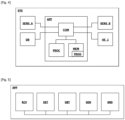
- FIG. 1A and the Figure 1B respectively represent an example of architecture of a system and steps of an activity recommendation method according to one embodiment of the invention.
- the SYS activity recommendation system comprises according to the embodiment illustrated by the Figure 1A : an activity recommendation APP device; a first set of at least one SENS_A sensor; and at least one terminal UE_1.
- the first set of sensors SENS_A is located in a first place LOC_A where one or more people PERS_X, PERS_Y are present, and that said at least one terminal UE_1 is associated with at least one user USR_1 present in a second place LOC_B.
- the activity recommendation device APP is configured to provide said at least one user USR_1 with at least one activity recommendation REC_1 following the detection of at least one activity being carried out in the first location LOC_A.
- first location LOC_A and the second location LOC_B are two distinct locations, or the same location.
- the APP system makes it possible in particular to offer recommendations for relevant activities for people with visual disabilities who are not able to see all the activities in progress in the place.
- the first LOC_A and the second location LOC_B are two distinct locations.
- the APP device implements the proposed activity recommendation method comprising at least one of the steps S10 to S70 described below.
- step S10 the device APP obtains first data measured DATA_A by the first set of at least one sensor SENS_A.
- measured data we use the term “measured data” here to designate data captured by one or more sensors, or produced from measurements made by one or more sensors. In the context of the invention, the measured data makes it possible to detect activities of people or places. Typically, the measured data can be captured by connected objects (more commonly referred to as IoT, an acronym for the English expression “Internet of Things”).
- IoT an acronym for the English expression “Internet of Things”.
- the first set of sensors SENS_A comprises at least one sensor from: a camera; a microphone ; a network probe; a pressure sensor; a temperature sensor; a depth sensor; and a thermal camera.
- the first location LOC_A may be a meeting room equipped with a camera SENS_A such that the first measured data DATA_A includes a plurality of images acquired from the meeting room LOC_A.
- the APP device receives the first measured data DATA_A from the set of sensors SENS_A via a communication network.
- embodiments could be considered in which the APP device reads the first measured data DATA_A on a memory of a storage device shared with the first set of sensors SENS_A, or in which the APP device captures the first data measured DATA_A using the first set of SENS_A sensors integrated into the APP device.
- a detector DET of the device APP detects, from the first measured data DATA_A, at least one first activity ACT_A being carried out in the first location LOC_A.
- the APP device analyzes the first measured data DATA_A to detect an ACT_A activity.
- an activity detected by the APP device is characterized by a description attribute and a detection time. Additionally, the term “activity” is used to refer to an activity of at least one person or an activity of at least one place.
- people activity we refer to an action carried out by at least one person.
- An activity detected by the APP device can for example belong to the following set of activities: the start or end of a presentation by a person; a conversation between people; an entry or exit of a person into a room, a movement or movement of a person, an expression of a person (e.g. a smile).
- one or more people may be subjects or complements of a detected activity, e.g. one person designates another person.
- place activity here we refer to activity associated with a place, and thus to any changes in the place not associated with a person.
- an activity associated with a location can belong to the following set of activities: a start or end of playing multimedia content (e.g. launching a slideshow, starting a projection of a film, etc.) ; opening or closing of a door; turning lights on or off, etc.
- the APP device detects an activity ACT_A being carried out by at least one person PERS_X-PERS_Y present in the first location LOC_1.
- the APP device detects from DATA_A images acquired by a SENS_A camera that a person PERS_X gets up, approaches a table and begins a presentation.
- the device APP detects in the first location LOC_A an activity ACT_A carried out by a person PERS_X for example characterized by the following description attribute: “A presentation is starting. ".
- the APP device detects, from data measured DATA by a SENS sensor, that playback of multimedia content has started.
- step S20 of detecting activities from measured data are for example described in the following documents: Florea et al., “Multimodal Deep Learning for Group Activity Recognition in Smart Office Environments”, Future Internet, 2020 ; Krishnan et al., “Activity recognition on streaming sensor data”, Pervasive and Mobile Computing, Volume 10, 2014 .
- the APP device may identify persons PERS_X-PERS_Y associated with detected activities ACT_A.
- a person identification step can in particular be implemented using voice or facial recognition techniques, or by using a network probe and the identifier of a terminal associated with a person, etc.
- the APP device can, from DATA_A images acquired by a SENS_A camera, detect that a person PERS_X has entered the meeting room LOC_A and obtain an identifier of this person PERS_X.
- steps S50-S70 are carried out if, and only if, said at least one activity ACT_A is detected, and in particular immediately following detection (i.e. under a time constraint).
- step S50 an OBT obtainer of the APP device obtains at least one LNK link between said at least one user USR_1 and said at least one first activity ACT_A detected.
- said at least one LNK link is obtained by the device APP from an identifier of said at least one user USR_1 and the description attribute of the first activity ACT_A.
- the device APP has detected in step S20 the start of a presentation ACT_A in the first location A.
- the device APP obtains in step S30 a list LNK of the participants registered to this presentation ACT_A, the list of LNK participants including an identifier of the user USR_1.
- the APP device can also determine in step S50 that the user USR_1 is not linked to the detected activity ACT_A and, thus, no link is obtained. In this case, the process continues in step S10 and the device APP continues to monitor the activities being carried out in the first location LOC_A.
- step S60 a generator GEN of the device APP analyzes said at least one first activity ACT_A and said at least one link LNK, then generates at least one activity recommendation REC_1 as a function.
- an activity recommendation designates a message intended for at least one user comprising a suggestion (proposal) of at least one action to be carried out and characterized by a description attribute (e.g. a character string ).
- an activity recommendation may suggest to a user to: carry out a certain activity; carry out an activity in addition to or instead of a first activity, or not do a certain activity.
- the start of a presentation ACT_A was detected in the first location LOC_A; and user USR_1 is linked to this presentation ACT_A as a participant. Then, according to this example, the activity recommendation REC_1 can indicate to the user USR_1 to go to the first location LOC_A to attend the current presentation.
- the REC_1 activity recommendation is generated by an artificial neural network.
- the neural network can take as input a description attribute of said at least one first activity ACT_A detected and said at least one LNK link (eg a type of link), and provide an ACT_A recommendation as output.
- embodiments could be considered in which the activity recommendation REC_1 is generated using a set of predefined rules.
- the APP device can also in step S60 determine based on said at least one activity ACT_A detected and said at least one LNK link that no activity recommendations are necessary or appropriate for said at least user USR_1. In this case, the process continues in step S10 and the device APP continues to monitor the activities being carried out in the first location LOC_A.
- step S70 the device APP sends said at least one activity recommendation REC_1 to said at least one terminal UE_1 of said at least one user USR_1 via a communication network.
- said at least one REC_1 activity recommendation is sent to only one user USR_1.
- said at least one REC_1 activity recommendation can be sent to several terminals associated with distinct users.
- an activity recommendation can be sent to a plurality of terminals of the same user (e.g. a laptop and a telephone).
- a terminal can designate any type of terminal such as a laptop or desktop computer, a telephone, a smartphone, a tablet, a projector, etc.
- said at least one terminal UE_1 is configured to receive said at least one activity recommendation REC_1 and to reproduce it, for example by using a screen or a speaker.
- the proposed APP device makes it possible to provide in real time up-to-date and personalized activity recommendations for a user by taking into account activities currently being carried out in a remote location.
- the detection of the activity carried out in the remote location triggers the generation and sending of the recommendation, which is thus provided in real time to the user.
- the recommendation proposed to the user is generated both based on the current activity detected and the link between the user and the detected activity, which allows obtaining an up-to-date and personalized recommendation for the user.
- the proposed device APP can be used to implement a decision support system making it possible to optimize material resources (e.g. the meeting rooms of a company) or time (e.g. employment). of a user's time).
- material resources e.g. the meeting rooms of a company
- time e.g. employment
- FIG. 2A and the Figure 2B respectively represent an example of architecture of a system and steps of an activity recommendation method according to one embodiment of the invention.
- FIGS. 1-10 illustrate an embodiment in which the APP device introduced above sends a user an activity recommendation based on the user's current activity.
- the SYS system comprises according to this embodiment a second set of at least one sensor SENS_B located in the second location LOC_B.
- This SENS_B assembly may include at least one sensor from: a camera; a microphone ; a network probe; a pressure sensor; a temperature sensor; a depth sensor; and a thermal camera.
- the APP device implements the proposed activity recommendation method comprising at least one of the steps S10 to S80 described below.
- steps S10 and S20 the device APP obtains first measured data DATA_A by the first set of sensors SENS_A and detects at least one first activity ACT_A being carried out in the first location LOC_A.
- the implementation of steps S10-S20 by the device APP is identical to that described with reference to Figures 1A and 1B .
- the device APP obtains second data measured DATA_B by the second set of sensors SENS_A and detects, from these, at least one second activity ACT_B being carried out by said at least one user USR_1.
- steps S30-S40 is in particular analogous to the implementation of steps S10-S20.
- steps S10-S20 and S30-S40 can be carried out in parallel (concurrently or simultaneously), or sequentially (in any order).
- the ACT_B activity of a user USR_1 can be detected before the ACT_A activity being carried out in the first LOC_A, or vice versa.
- step S50 the device APP obtains at least one LNK link between said at least one user USR_1 and said at least one first activity ACT_A detected.
- the APP device implements at least one of steps S51 and S52.
- step S51 the device APP obtains a so-called fixed link LNK_FIX between said at least one user USR_1 and at least one person PERS_X-PERS_Y associated with said at least one first activity ACT_A.
- the fixed link LNK_FIX is saved in a DB database.
- the fixed link LNK_FIX can thus be obtained from an identifier of said at least one user USR_1 and an identifier of said at least one person PERS_X-PERS_Y.
- a user USR_1 and a person PERS_X can be linked by belonging to the same company, or by being registered for the same event such as a meeting.
- step S52 the device APP determines at least one so-called dynamic link LNK_DYN between said at least one user USR_1 and said at least one first activity ACT_A detected.
- the dynamic link LNK_DYN is determined as a function of said at least one user USR_1 and said at least one first activity ACT_A from a set of decision rules.
- the dynamic link can be established between said at least one user USR_1 and the first location LOC_A in which the first activity ACT_A is carried out.
- the APP device can determine that the user USR_1 is linked by his responsibility to the first activity ACT_A.
- the dynamic link LNK_DYN can be established between said at least one user USR_1 and at least one person PERS_X-PERS_Y associated with the first activity ACT_A.
- the APP device can determine that the user USR_1 and the people PERS_X-PERS_Y are related by performing the same activity.
- said at least one LNK link comprises the fixed link LNK_FIX and/or the dynamic link LNK_DYN.
- step S60 the device APP generates at least one activity recommendation REC_1 based on said at least one first activity ACT_A, said at least one LNK link and said at least one second activity ACT_B.
- the proposed device APP uses the activity currently being carried out by a user to generate a recommendation of activities.
- the activity recommendations provided to a user are dynamically adapted to their current situation.
- said at least one recommendation REC_1 is generated by a neural network taking as input: a description attribute of said at least one first activity ACT_A; a description attribute of said at least one second activity ACT_B; and said at least one LNK link.
- step S70 the device APP sends, to said at least one terminal UE_1, said at least one activity recommendation REC_1 as well as representative information (eg a description attribute) of said at least one detected activity ACT_A.
- step S80 the APP device obtains at least one FDBK data item indicating whether or not said at least one user has followed said at least one activity recommendation.
- the APP device obtains said at least one FDBK data by detecting, from second measured data DATA_B, if the user USR_1 has modified his activity to follow the recommendation REC_1 which was sent to him. In other words, according to this embodiment, the device APP checks whether or not an activity detected being carried out by the user USR_1 corresponds to an activity recommendation REC_1 previously sent.
- the APP device can obtain said at least one piece of FDBK data by receiving a message from the terminal UE_1 indicating whether or not the user USR_1 has followed the activity recommendation REC_1. It may for example be a message sent following a response from the user USR_1 (acceptance or not of the recommendation) obtained via an interface of the terminal UE_1.
- the APP device updates, from said at least one FDBK data obtained, parameters (e.g. weights) of the neural network used to generate activity recommendations.
- parameters e.g. weights
- the neural network is optimized over time by taking into account the relevance of the recommendations made to a user.
- the proposed activity recommendation method may include one or more iterations of each of these steps.
- the APP device following detecting an ACT_A activity, generates and sends a plurality of activity recommendations for several users.
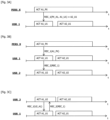
- FIG. 3A there Figure 3B and the Figure 3C represent examples of data obtained and processed by an activity recommendation system according to one embodiment of the invention. More precisely, these figures illustrate over time activities carried out by several users or people as well as activity recommendations provided to them.
- the APP device sends to a user USR_1 an activity recommendation REC_1 generated based on a detected activity A1_PX of a person PERS_X and the activity A1_U1 of the user USR_1.
- the Figure 3A illustrates a situation in which following the recommendation of activities REC_1, the user USR_1 interrupts his activity A1_U1 to carry out another activity A2_U1 as recommended.
- the first embodiment described here thus corresponds to the operation of the APP device as previously described with reference to the Figures 2A and 2B .
- the APP device sends to a first user USR_1 an activity recommendation REC_1 generated as a function of a detected activity A1_PX.
- the APP device sends to a second user USR_2 an activity recommendation REC_2 generated based on the activity recommendation REC_1 sent to the first user USR_1.
- the activity recommendation REC_2 is also generated as a function of a link between the second user USR_2 and said at least one activity recommendation REC_1.
- a link can be obtained by the APP device in a manner similar to step S50 described above.
- the link can be obtained from user identifiers USR_1 and USR_2 and the recommendation description attribute REC_1.
- FIG. 3B illustrates a situation in which following the recommendations of activities REC_1 and REC_2, the users USR_1 and USR_2 respectively carry out activities A2_U1 and A2_U2.
- a recommendation REC_1 is sent to a user USR_1 telling them to go to a meeting room LOC_B to attend a project progress meeting that starts ACT_A.
- user USR_1 is working on this project with another user USR_2.
- the device APP also sends a recommendation REC_2 to the user USR_2 to suggest that he participate in the meeting ACT_A.
- This second embodiment makes it possible to coordinate the activities of several users.
- the APP device could thus be used to collectively optimize the management of resources shared between several users (e.g. meeting rooms).
- a person associated with detected activity A1_U2 is a user USR_2.
- the device APP sends to the user USR_1 a recommendation of activities REC_1 generated following the detection of the activity A1_U2 of the user USR_2.
- the APP device can also send to the user USR_2 an activity recommendation REC_2 generated according to the activity recommendation REC_1 sent to the first user USR_1, as previously described.
- FIG 4 represents an example of software and hardware architecture of an activity recommendation system according to one embodiment of the invention.
- the first SENS_A and the second set of sensors SENS_B are included in the activity recommendation device APP.
- the SYS system is a decision support system for said at least one user USR_1.
- the activity recommendation APP device comprises, according to one embodiment illustrated by the figure 4 : at least one processing unit or PROC processor; and at least one MEM memory.
- the APP device has, according to one embodiment, the hardware architecture of a computer.
- the APP device may include a PROC processor, a random access memory, a MEM read only memory, and a non-volatile memory.
- the memory MEM associated with the device APP constitutes an information medium in accordance with the invention, readable by computer and by the processor PROC, on which a computer program PROG in accordance with the invention is recorded.
- the computer program PROG includes instructions for carrying out steps of an activity recommendation method according to the invention, when the program PROG is executed by the processor PROC.
- the PROG computer program defines functional and software modules of the APP monitoring device described below with reference to the figure 5 .
- the APP device has a COM communication device configured to communicate via a communication network with at least one of the following elements: the first set of at least one SENS_A sensor; the second set of at least one SENS_B sensor; the DB database; and said at least one terminal UE_1.
- a COM communication device configured to communicate via a communication network with at least one of the following elements: the first set of at least one SENS_A sensor; the second set of at least one SENS_B sensor; the DB database; and said at least one terminal UE_1.
- No limitation is attached to the nature of the communication interfaces between these devices, which can be wired or non-wired, and can implement any protocol known to those skilled in the art.
- FIG. 5 schematically represents an example of functional architecture of an activity recommendation device according to one embodiment of the invention.
- the APP device may comprise a corresponding element configured to carry out said step.
- two users USR_1 and USR2 are registered to participate in a presentation planned in a meeting room LOC_A.
- the APP device detects, from first data measured DATA_A by SENS_A sensors installed in the meeting room LOC_A, the launch of a slideshow ACT_A and therefore that the presentation begins.
- the device APP Upon detection of the launch of the slideshow ACT_A, the device APP generates for the users USR_1 and USR_2 an activity recommendation REC_1 suggesting going to the meeting room LOC_A.
- the activity recommendation REC_1 is sent to his computer UE_1 and, for the user USR_2 located in the cafeteria, the activity recommendation REC_1 is sent to his mobile phone.
- users USR_1 and USR_2 were able to optimize their time management and get to the meeting room LOC_A in good time when the presentation begins.
- a user USR_1 is playing ACT_B alone in his apartment LOC_A.
- the activity recommendation device APP detects, from second data measured DATA_B by sensors SENS_B located in the apartment LOC_B, the gaming activity ACT_B currently being carried out by the user USR_1. Furthermore, the APP device detects that other people PERS_X-PERS_Y start to play ACT_A in a common room LOC_A in the building of user USR_1. The APP device then sends an activity recommendation REC_1 to a terminal UE_1 of the user USR_1.
- Activity recommendation REC_1 tells user USR_1 that people PERS_X-PERS_Y are also playing ACT_A in common room LOC_A and suggests user USR_1 to join them.
- This second example illustrates in particular the fact that the proposed device APP makes it possible to provide in real time up-to-date and personalized activity recommendations for a user taking into account activities currently being carried out in a remote location. As such, the recommendations provided by the proposed APP are relevant to users.
- a user USR_1 participates, remotely from his home LOC_B, in a presentation made by a speaker PERS_X in an amphitheater LOC_A.
- the user USR_1 assumes that the presentation will continue like this without any intervention on his part being necessary, and therefore decides to leave his office ACT_B momentarily.
- the speaker PERS_X interrupts his presentation and begins to interact ACT_A with the participants.
- the APP device detects the new activity ACT_A of the speaker PERS_X as well as the activity ACT_B of the user USR_1 and therefore sends an activity recommendation REC_1 indicating to the user USR_1 to return to his office.
- the user USR_1 thus quickly returns to his office and can interact with the speaker PERS_X as if he had not been absent.
Landscapes
- Engineering & Computer Science (AREA)
- Business, Economics & Management (AREA)
- Human Resources & Organizations (AREA)
- Physics & Mathematics (AREA)
- Theoretical Computer Science (AREA)
- General Physics & Mathematics (AREA)
- Economics (AREA)
- Entrepreneurship & Innovation (AREA)
- Strategic Management (AREA)
- General Health & Medical Sciences (AREA)
- Molecular Biology (AREA)
- Software Systems (AREA)
- Mathematical Physics (AREA)
- General Engineering & Computer Science (AREA)
- Computing Systems (AREA)
- Evolutionary Computation (AREA)
- Data Mining & Analysis (AREA)
- Computer Networks & Wireless Communication (AREA)
- Signal Processing (AREA)
- Health & Medical Sciences (AREA)
- Life Sciences & Earth Sciences (AREA)
- Artificial Intelligence (AREA)
- Biomedical Technology (AREA)
- Biophysics (AREA)
- Computational Linguistics (AREA)
- Educational Administration (AREA)
- Game Theory and Decision Science (AREA)
- Development Economics (AREA)
- Operations Research (AREA)
- General Business, Economics & Management (AREA)
- Marketing (AREA)
- Tourism & Hospitality (AREA)
- Quality & Reliability (AREA)
- Information Retrieval, Db Structures And Fs Structures Therefor (AREA)
- Position Fixing By Use Of Radio Waves (AREA)
- Measurement Of The Respiration, Hearing Ability, Form, And Blood Characteristics Of Living Organisms (AREA)
Applications Claiming Priority (1)
| Application Number | Priority Date | Filing Date | Title |
|---|---|---|---|
| FR2212340A FR3142584A1 (fr) | 2022-11-25 | 2022-11-25 | Procédé et dispositif de recommandation d’activités à au moins un utilisateur |
Publications (1)
| Publication Number | Publication Date |
|---|---|
| EP4375899A1 true EP4375899A1 (de) | 2024-05-29 |
Family
ID=85122676
Family Applications (1)
| Application Number | Title | Priority Date | Filing Date |
|---|---|---|---|
| EP23307018.4A Pending EP4375899A1 (de) | 2022-11-25 | 2023-11-21 | Verfahren und vorrichtung zur empfehlung von aktivitäten an mindestens einen benutzer |
Country Status (3)
| Country | Link |
|---|---|
| US (1) | US20240179491A1 (de) |
| EP (1) | EP4375899A1 (de) |
| FR (1) | FR3142584A1 (de) |
Citations (1)
| Publication number | Priority date | Publication date | Assignee | Title |
|---|---|---|---|---|
| US10812279B1 (en) * | 2019-12-24 | 2020-10-20 | Capital One Services, Llc | Automated communication initiation based on an environment-related user availability determination |
Family Cites Families (2)
| Publication number | Priority date | Publication date | Assignee | Title |
|---|---|---|---|---|
| US9798933B1 (en) * | 2016-12-12 | 2017-10-24 | Logitech Europe, S.A. | Video conferencing system and related methods |
| US10609511B2 (en) * | 2017-12-08 | 2020-03-31 | Facebook, Inc. | Techniques for providing meeting location suggestions |
-
2022
- 2022-11-25 FR FR2212340A patent/FR3142584A1/fr active Pending
-
2023
- 2023-11-21 EP EP23307018.4A patent/EP4375899A1/de active Pending
- 2023-11-22 US US18/517,627 patent/US20240179491A1/en active Pending
Patent Citations (1)
| Publication number | Priority date | Publication date | Assignee | Title |
|---|---|---|---|---|
| US10812279B1 (en) * | 2019-12-24 | 2020-10-20 | Capital One Services, Llc | Automated communication initiation based on an environment-related user availability determination |
Non-Patent Citations (3)
| Title |
|---|
| FLOREA ET AL.: "Deep Learning for Group Activity Recognition in Smart Office Environments", FUTURE INTERNET, 2020 |
| FLOREA ET AL.: "Multimodal Deep Learning for Group Activity Recognition in Smart Office Environments", FUTURE INTERNET, 2020 |
| KRISHNAN ET AL.: "Activity recognition on streaming sensor data", PERVASIVE AND MOBILE COMPUTING, vol. 10, 2014 |
Also Published As
| Publication number | Publication date |
|---|---|
| FR3142584A1 (fr) | 2024-05-31 |
| US20240179491A1 (en) | 2024-05-30 |
Similar Documents
| Publication | Publication Date | Title |
|---|---|---|
| US11887016B2 (en) | Actionable suggestions for activities | |
| EP2586175B1 (de) | Verfahren und vorrichtung zur überprüfung der physischen erkennung zwischen einem anrufer und einem angerufenen | |
| EP3395086B1 (de) | System zum vorschlagen, starten und automatischen oder halbautomatischen herunterladen von anwendungen für ein intelligentes mobiles objekt | |
| FR3011426A1 (fr) | Procede et dispositif de transmission d'au moins une partie d'un signal lors d'une session de visioconference | |
| EP4375899A1 (de) | Verfahren und vorrichtung zur empfehlung von aktivitäten an mindestens einen benutzer | |
| JP7668921B2 (ja) | 情報処理装置 | |
| EP3336709B1 (de) | Verfahren zum einsatz eines ausgedehnten arbeitsplatzes, und entsprechendes einsatzsystem eines ausgedehnten arbeitsplatzes | |
| FR3133464A1 (fr) | Contrôle d’accès à un ensemble d’équipements dotés d’écran | |
| FR3111044A1 (fr) | Prédiction de situations émotionnelles négatives dans un habitat connecté pour promouvoir des services invoquant des émotions positives | |
| FR3089324A1 (fr) | Procédé de détermination d’un agent conversationnel sur un terminal | |
| FR2914089A1 (fr) | Appareil electronique communicant, systemes et procedes utilisant un tel appareil. | |
| EP3949317B1 (de) | Verfahren zur modifizierung von multimedia-inhalten | |
| EP3476110B1 (de) | Verfahren und vorrichtung zur verarbeitung eines multimediaobjekts | |
| WO2024079034A1 (fr) | Procédé de détermination d'au moins une action cible parmi un ensemble d'actions exécutables sur un terminal électronique | |
| FR3136082A1 (fr) | Procédé de gestion de la restitution d’au moins un contenu par un terminal, terminal et programme d’ordinateur correspondants. | |
| WO2017103480A1 (fr) | Système et procédé de réalisation d'un tour de table lors d'une réunion à distance | |
| EP2274882B1 (de) | Verfahren zum senden einer nachricht und entsprechende einrichtung und computerprogrammprodukt | |
| EP2979234A1 (de) | Zugang zu einer teilmenge von informationen bezüglich eines benutzers | |
| FR3139683A1 (fr) | Procédé d’enrichissement, dispositif électronique et produit programme d’ordinateur correspondant | |
| FR2961991A1 (fr) | Procede et dispositif de communication entre systemes de communication | |
| FR3137237A1 (fr) | Procédé de mise à disposition d’une séquence temporelle d’événements représentative d’une chronologie d’une réunion, procédé de restitution, dispositifs et programme d’ordinateur correspondant | |
| FR3079320A1 (fr) | Procede et dispositif de traitement de donnees d' un environnement de realite virtuelle en mode perception de l'accessibilite | |
| FR3156002A1 (fr) | Procédé de création d’élément multimédia, dispositif électronique et produit programme d’ordinateur correspondant | |
| WO2017025574A1 (fr) | Procédé de détermination automatique de recommandation(s) d'action(s) à effectuer auprès de personnes d'une organisation, et appareil informatique associé | |
| FR3102874A1 (fr) | Procédé de collecte d’information contenue dans des messages électroniques stockés dans un terminal |
Legal Events
| Date | Code | Title | Description |
|---|---|---|---|
| PUAI | Public reference made under article 153(3) epc to a published international application that has entered the european phase |
Free format text: ORIGINAL CODE: 0009012 |
|
| STAA | Information on the status of an ep patent application or granted ep patent |
Free format text: STATUS: THE APPLICATION HAS BEEN PUBLISHED |
|
| AK | Designated contracting states |
Kind code of ref document: A1 Designated state(s): AL AT BE BG CH CY CZ DE DK EE ES FI FR GB GR HR HU IE IS IT LI LT LU LV MC ME MK MT NL NO PL PT RO RS SE SI SK SM TR |
|
| STAA | Information on the status of an ep patent application or granted ep patent |
Free format text: STATUS: REQUEST FOR EXAMINATION WAS MADE |
|
| 17P | Request for examination filed |
Effective date: 20241016 |
|
| RBV | Designated contracting states (corrected) |
Designated state(s): AL AT BE BG CH CY CZ DE DK EE ES FI FR GB GR HR HU IE IS IT LI LT LU LV MC ME MK MT NL NO PL PT RO RS SE SI SK SM TR |