EP4377287B1 - Procédé de fabrication d'acide lactique - Google Patents
Procédé de fabrication d'acide lactique Download PDFInfo
- Publication number
- EP4377287B1 EP4377287B1 EP22743517.9A EP22743517A EP4377287B1 EP 4377287 B1 EP4377287 B1 EP 4377287B1 EP 22743517 A EP22743517 A EP 22743517A EP 4377287 B1 EP4377287 B1 EP 4377287B1
- Authority
- EP
- European Patent Office
- Prior art keywords
- lactic acid
- lactate
- monovalent
- water
- mole
- Prior art date
- Legal status (The legal status is an assumption and is not a legal conclusion. Google has not performed a legal analysis and makes no representation as to the accuracy of the status listed.)
- Active
Links
Images
Classifications
-
- B—PERFORMING OPERATIONS; TRANSPORTING
- B01—PHYSICAL OR CHEMICAL PROCESSES OR APPARATUS IN GENERAL
- B01D—SEPARATION
- B01D61/00—Processes of separation using semi-permeable membranes, e.g. dialysis, osmosis or ultrafiltration; Apparatus, accessories or auxiliary operations specially adapted therefor
- B01D61/42—Electrodialysis; Electro-osmosis ; Electro-ultrafiltration; Membrane capacitive deionization
- B01D61/422—Electrodialysis
-
- B—PERFORMING OPERATIONS; TRANSPORTING
- B01—PHYSICAL OR CHEMICAL PROCESSES OR APPARATUS IN GENERAL
- B01D—SEPARATION
- B01D61/00—Processes of separation using semi-permeable membranes, e.g. dialysis, osmosis or ultrafiltration; Apparatus, accessories or auxiliary operations specially adapted therefor
- B01D61/42—Electrodialysis; Electro-osmosis ; Electro-ultrafiltration; Membrane capacitive deionization
- B01D61/44—Ion-selective electrodialysis
-
- B—PERFORMING OPERATIONS; TRANSPORTING
- B01—PHYSICAL OR CHEMICAL PROCESSES OR APPARATUS IN GENERAL
- B01D—SEPARATION
- B01D61/00—Processes of separation using semi-permeable membranes, e.g. dialysis, osmosis or ultrafiltration; Apparatus, accessories or auxiliary operations specially adapted therefor
- B01D61/42—Electrodialysis; Electro-osmosis ; Electro-ultrafiltration; Membrane capacitive deionization
- B01D61/44—Ion-selective electrodialysis
- B01D61/445—Ion-selective electrodialysis with bipolar membranes; Water splitting
-
- C—CHEMISTRY; METALLURGY
- C07—ORGANIC CHEMISTRY
- C07C—ACYCLIC OR CARBOCYCLIC COMPOUNDS
- C07C51/00—Preparation of carboxylic acids or their salts, halides or anhydrides
- C07C51/02—Preparation of carboxylic acids or their salts, halides or anhydrides from salts of carboxylic acids
-
- C—CHEMISTRY; METALLURGY
- C07—ORGANIC CHEMISTRY
- C07C—ACYCLIC OR CARBOCYCLIC COMPOUNDS
- C07C51/00—Preparation of carboxylic acids or their salts, halides or anhydrides
- C07C51/41—Preparation of salts of carboxylic acids
- C07C51/412—Preparation of salts of carboxylic acids by conversion of the acids, their salts, esters or anhydrides with the same carboxylic acid part
-
- C—CHEMISTRY; METALLURGY
- C07—ORGANIC CHEMISTRY
- C07C—ACYCLIC OR CARBOCYCLIC COMPOUNDS
- C07C51/00—Preparation of carboxylic acids or their salts, halides or anhydrides
- C07C51/42—Separation; Purification; Stabilisation; Use of additives
- C07C51/43—Separation; Purification; Stabilisation; Use of additives by change of the physical state, e.g. crystallisation
- C07C51/44—Separation; Purification; Stabilisation; Use of additives by change of the physical state, e.g. crystallisation by distillation
-
- C—CHEMISTRY; METALLURGY
- C07—ORGANIC CHEMISTRY
- C07C—ACYCLIC OR CARBOCYCLIC COMPOUNDS
- C07C51/00—Preparation of carboxylic acids or their salts, halides or anhydrides
- C07C51/42—Separation; Purification; Stabilisation; Use of additives
- C07C51/47—Separation; Purification; Stabilisation; Use of additives by solid-liquid treatment; by chemisorption
-
- C—CHEMISTRY; METALLURGY
- C07—ORGANIC CHEMISTRY
- C07C—ACYCLIC OR CARBOCYCLIC COMPOUNDS
- C07C51/00—Preparation of carboxylic acids or their salts, halides or anhydrides
- C07C51/42—Separation; Purification; Stabilisation; Use of additives
- C07C51/48—Separation; Purification; Stabilisation; Use of additives by liquid-liquid treatment
-
- C—CHEMISTRY; METALLURGY
- C07—ORGANIC CHEMISTRY
- C07C—ACYCLIC OR CARBOCYCLIC COMPOUNDS
- C07C51/00—Preparation of carboxylic acids or their salts, halides or anhydrides
- C07C51/42—Separation; Purification; Stabilisation; Use of additives
- C07C51/487—Separation; Purification; Stabilisation; Use of additives by treatment giving rise to chemical modification
-
- C—CHEMISTRY; METALLURGY
- C07—ORGANIC CHEMISTRY
- C07C—ACYCLIC OR CARBOCYCLIC COMPOUNDS
- C07C59/00—Compounds having carboxyl groups bound to acyclic carbon atoms and containing any of the groups OH, O—metal, —CHO, keto, ether, groups, groups, or groups
- C07C59/01—Saturated compounds having only one carboxyl group and containing hydroxy or O-metal groups
- C07C59/08—Lactic acid
-
- C—CHEMISTRY; METALLURGY
- C07—ORGANIC CHEMISTRY
- C07D—HETEROCYCLIC COMPOUNDS
- C07D319/00—Heterocyclic compounds containing six-membered rings having two oxygen atoms as the only ring hetero atoms
- C07D319/10—1,4-Dioxanes; Hydrogenated 1,4-dioxanes
- C07D319/12—1,4-Dioxanes; Hydrogenated 1,4-dioxanes not condensed with other rings
-
- C—CHEMISTRY; METALLURGY
- C08—ORGANIC MACROMOLECULAR COMPOUNDS; THEIR PREPARATION OR CHEMICAL WORKING-UP; COMPOSITIONS BASED THEREON
- C08G—MACROMOLECULAR COMPOUNDS OBTAINED OTHERWISE THAN BY REACTIONS ONLY INVOLVING UNSATURATED CARBON-TO-CARBON BONDS
- C08G63/00—Macromolecular compounds obtained by reactions forming a carboxylic ester link in the main chain of the macromolecule
- C08G63/02—Polyesters derived from hydroxycarboxylic acids or from polycarboxylic acids and polyhydroxy compounds
- C08G63/06—Polyesters derived from hydroxycarboxylic acids or from polycarboxylic acids and polyhydroxy compounds derived from hydroxycarboxylic acids
-
- C—CHEMISTRY; METALLURGY
- C08—ORGANIC MACROMOLECULAR COMPOUNDS; THEIR PREPARATION OR CHEMICAL WORKING-UP; COMPOSITIONS BASED THEREON
- C08G—MACROMOLECULAR COMPOUNDS OBTAINED OTHERWISE THAN BY REACTIONS ONLY INVOLVING UNSATURATED CARBON-TO-CARBON BONDS
- C08G63/00—Macromolecular compounds obtained by reactions forming a carboxylic ester link in the main chain of the macromolecule
- C08G63/02—Polyesters derived from hydroxycarboxylic acids or from polycarboxylic acids and polyhydroxy compounds
- C08G63/06—Polyesters derived from hydroxycarboxylic acids or from polycarboxylic acids and polyhydroxy compounds derived from hydroxycarboxylic acids
- C08G63/08—Lactones or lactides
-
- C—CHEMISTRY; METALLURGY
- C08—ORGANIC MACROMOLECULAR COMPOUNDS; THEIR PREPARATION OR CHEMICAL WORKING-UP; COMPOSITIONS BASED THEREON
- C08G—MACROMOLECULAR COMPOUNDS OBTAINED OTHERWISE THAN BY REACTIONS ONLY INVOLVING UNSATURATED CARBON-TO-CARBON BONDS
- C08G63/00—Macromolecular compounds obtained by reactions forming a carboxylic ester link in the main chain of the macromolecule
- C08G63/78—Preparation processes
-
- C—CHEMISTRY; METALLURGY
- C12—BIOCHEMISTRY; BEER; SPIRITS; WINE; VINEGAR; MICROBIOLOGY; ENZYMOLOGY; MUTATION OR GENETIC ENGINEERING
- C12P—FERMENTATION OR ENZYME-USING PROCESSES TO SYNTHESISE A DESIRED CHEMICAL COMPOUND OR COMPOSITION OR TO SEPARATE OPTICAL ISOMERS FROM A RACEMIC MIXTURE
- C12P7/00—Preparation of oxygen-containing organic compounds
- C12P7/40—Preparation of oxygen-containing organic compounds containing a carboxyl group including Peroxycarboxylic acids
- C12P7/56—Lactic acid
Definitions
- An aspect of the present invention pertains to a process for manufacturing lactic acid in high purity in an economical manner.
- Lactic acid is often manufactured via fermentation of carbohydrates by micro-organisms.
- a common feature to all fermentation processes is the need to neutralise the acids excreted by the micro-organisms.
- a drop in pH below a critical value, depending on the micro-organism used in the process, could damage the micro-organism's metabolic process and bring the fermentation process to a stop. Therefore, it is common practice to add a base in the fermentation media in order to control the pH. This results in the lactic acid produced being present in the fermentation media in the form of a lactate salt.
- Electrodialysis is one of the purification processes that may be used in the production of lactic acid via fermentation.
- Water-splitting electrodialysis in particular allows the direct conversion of the lactate salt into lactic acid and base.
- bipolar membranes are generally used to split water into H + and OH - respectively, which combine with the anion and cation of the lactate salt respectively, resulting in the production of separate solutions of lactic acid and base.
- WO2011095631 is directed to a process for the preparation of lactic acid comprising the steps of:
- An aspect of the present invention pertains to a process for the preparation of lactic acid comprising the steps of:
- step c) may for instance be used in the fermentation process and the solution comprising monovalent base of step e) may be used in the salt exchange step b).
- Recovery step f) generally generates a solution comprising monovalent lactate salt and optionally lactic acid. This solution can, if so desired, be recycled at least in part to any of the process steps preceding the water-splitting electrodialysis, e.g., to one or more of step b), c), d), and e).
- step d) an aqueous medium is provided comprising the water soluble monovalent lactate salt at a concentration of more than 30 to at most 45 wt.%.
- This step may comprise a concentration step, if the product of step c) has a concentration step which is unattrac-tively low.
- This step may also comprise a dilution step if very high concentrations are obtained in step c). If the product from step c) already has a concentration in the desired range, no further concentration adjustment is required. In that case step d) will generally comprise nothing more than providing the product of step c) to step e).
- the concentration of the monovalent lactate salt concentration in the aqueous medium is relatively high, as this will ensure that less water has to be removed from the system in order to isolate the lactic acid. Additionally, it has been found that the use of relatively high monovalent lactate salt concentrations improves the performance of the water-splitting electrodialysis step, in particular when the monovalent lactate salt is potassium lactate.
- the aqueous medium comprising the water soluble monovalent lactate salt from step d) it is preferred for the aqueous medium comprising the water soluble monovalent lactate salt from step d) to have a water soluble monovalent lactate salt concentration of at least 32 wt.%. If the concentration is too high, it may become difficult to perform water-splitting electrodialysis. In some embodiments the current efficiency will be affected. It may therefore be preferred for the monovalent lactate salt concentration to be at most 40 wt.%. Further preferences will be discussed below.
- the aqueous medium comprising a magnesium lactate salt may preferably be provided by a fermentation process.
- the magnesium lactate salt is generally already present in an aqueous medium when it leaves the fermentation.
- a carbohydrate source is fermented to lactic acid by means of a lactic acid-producing micro-organism.
- a magnesium base is added as neutralising agent. This results in the formation of an aqueous medium comprising the corresponding magnesium lactate salt.
- the base anion of the magnesium base is preferably chosen from at least one of hydroxide, carbonate and hydrogencarbonate, and more preferably is hydroxide.
- the use of magnesium as the base cation is preferred, another alkaline earth metal cation, such as a calcium cation, may also be used.
- the amount of alkaline earth metal base added is determined by the amount of lactic acid produced and may be determined via pH control of the fermentation medium.
- biomass i.e. microbial cell matter
- Biomass removal may be effected, for example, by conventional methods including filtration, flotation, sedimentation, centrifugation, flocculation and combinations thereof. Separation of biomass from solid magnesium lactate crystals may also be carried out using a hydrocyclone. It is within the scope of the skilled person to determine an appropriate method. Other optional treatments prior to further processing include washing, filtration, (re)crystallisation, concentration and combinations thereof.
- Magnesium is a preferred alkaline earth metal, since the use of a magnesium base advantageously results in the formation of magnesium lactate in an appropriate crystalline form to enable separation of the crystalline material from the fermentation broth including the biomass. Separation of the magnesium lactate may be done by any known processing technique for solid/liquid separations. It may be done for instance via filtration using a filter with a suitable pore size to retain magnesium lactate on the filter and to enable subsequent removal of impurities by washing of the filter cake. The above-mentioned biomass separation is in principle not needed unless there is the wish to further process or (re-)use the remaining fermentation broth for specific purposes.
- the thus purified magnesium lactate is especially suitable for further processing as described herein and in particular when using water-splitting electrodialysis, wherein fermentation-derived products (e.g. sugar, protein, amino acids) may negatively interfere by, for instance, increasing the power consumption and fouling of the ion-permeable membranes.
- fermentation-derived products e.g. sugar, protein, amino acids
- the aqueous medium comprising the alkaline earth metal lactate salt, preferably the magnesium lactate salt, is subjected to a salt exchange reaction (step b), wherein a monovalent base is added to said aqueous medium to form a monovalent lactate salt and a solid alkaline earth metal base.
- the base anion is generally chosen to correspond to the base anion used as neutralising agent during fermentation.
- the monovalent base added is preferably one or more of a hydroxide, carbonate or hydrogencarbonate, more preferably a hydroxide, of a monovalent cation, the monovalent cation being sodium, potassium, lithium, ammonium, monoalkylammonium, dialkylammonium, trialkylammonium, or tetraalkylammonium, preferably sodium or potassium and more preferably sodium.
- the use of sodium and potassium bases advantageously results in a higher conversion of the alkaline metal earth lactate salt to the monovalent lactate salt than when ammonium bases are used. This is relevant for preparing a product with a low alkaline earth metal ion content suitable for water-splitting electrodialysis.
- the residual alkaline earth metal ions may nonetheless be removed by methods known to the skilled person, such as the use of ion exchange resins.
- potassium may be particularly preferred with regard to advantages associated to a subsequent water-splitting electrodialysis of the resulting potassium lactate salt, as explained in more detail below, when combined with a concentration of more than 30 wt.% potassium lactate, even more in particular more than 32 wt.%, in particular more than 33 wt.%.
- the amount of monovalent base is determined by stoichiometric and pH considerations. It may be preferred to use a surplus of base to obtain a high conversion and to ensure the removal of virtually all alkaline earth metal ions from the lactate. In general, it is preferred to perform the salt exchange reaction in two steps, wherein in the first step the pH is between 9 and 12, preferably between 9.5 and 11, and in the second step the pH is slightly increased to a pH between 10.5 and 12.
- the alkaline earth metal base formed in the salt exchange reaction typically is in solid form while the monovalent lactate salt is dissolved in the aqueous medium.
- the two components may therefore be separated by conventional solid-liquid separation processes, such as one or more of filtration, sedimentation, and centrifugation.
- the alkaline earth metal base obtained after separation may be recycled to the fermentation process, optionally after washing to remove residual alkaline salt.
- Additional treatments such as one or more of ion exchange treatment, activated carbon treatment, desalting electrodialysis, dilution, concentration (e.g. thermal or using a membrane) and filtration (e.g. nanofiltration) may be performed prior to water-splitting electrodialysis.
- ion exchange treatment activated carbon treatment
- desalting electrodialysis desalting electrodialysis
- dilution concentration (e.g. thermal or using a membrane)
- filtration e.g. nanofiltration
- an ion exchange step may be performed prior to electrodialysis to lower the alkaline earth metal content thereof.
- the process as described herein advantageously does not necessitate such additional treatments, especially when the lactate is provided via fermentation and a magnesium base is added in the fermentation process to provide magnesium lactate fermentation broth.
- a magnesium base for neutralization during fermentation which as discussed above provides magnesium lactate in an appropriate crystalline form, has been found to preclude the need of further purification steps generally required to remove the fermentation derived matter (e.g. sugar, protein and amino acid) from feeds for use in water-splitting electrodialysis. This advantageously lowers the complexity, power demand and costs generally associated to such electrodialytical processes.
- the aqueous medium comprising the monovalent lactate salt is then subjected to water-splitting electrodialysis.
- the aqueous medium comprising the water soluble monovalent lactate salt from step d) has a water soluble monovalent lactate salt concentration of more than 30 wt.% and at most 45 wt.%, in particular more than 32 wt.%. This is the initial concentration in the aqueous medium that is subjected to electrodialysis (the feed solution). It may be preferred for the monovalent lactate salt concentration to be at most 40 wt.%. In one aspect, the initial concentration is preferably from 32 to 38 wt%, even more preferably from 34 to 36 wt.%, as a most preferred concentration an initial concentration of about 35 wt.% may be mentioned.
- the aqueous medium comprising the monovalent lactate salt as obtained after the salt exchange reaction may be used directly as feed to the electrodialysis, or, if necessary, may be diluted or concentrated to adjust the salt concentration prior to water-splitting electrodialysis.
- Concentration may be carried out by for instance evaporation or conventional electrodialysis. Concentration may be preferably performed by evaporation (e.g. evaporation of water). Concentration by evaporation may be particularly preferred when concentrating to monovalent lactate salt concentrations of more than 30 wt.%. Evaporation may be preferably performed in an evaporator with mechanical vapour recompression. Alternatively, membrane concentration may also be used, or a combination of evaporation and membrane concentration.
- the lactic acid concentration of the resulting solution obtained after water-splitting electrodialysis will also be higher.
- the lactic acid concentration in the second solution obtained by water-splitting electrodialysis may be from 14 wt.% to 35 wt.%.
- the lactic acid concentration preferably is at least 20 wt.%, in particular at least 22 wt.%, more in particular at least 25 wt.%.
- a preferred upper limit may be 30 wt.%. In particular embodiments, the upper limit may be at most 29 wt.%, or 28 wt.%, or even 27 wt.%. A range of 25-30 wt.% is considered generally preferred.
- Removal of water prior to the water-splitting electrodialysis step means that less water needs to be removed after the water-splitting electrodialysis.
- a lactic acid containing solution such as the solution obtained after water-splitting electrodialysis
- a monovalent lactate salt such as the starting solution prior to water-splitting electrodialysis
- adjusting the concentration of the monovalent lactate salt in the aqueous medium to a value of more than 30 wt.% and at most 45 wt.% comprises a water removal step.
- Water removal may be preferably performed in an evaporator with mechanical vapour recompression.
- an initial concentration of the monovalent lactate salt within the above indicated range of more than 30 wt.% and preferably below 40 wt.% results in an improved performance of the water-splitting electrodialysis step. This may be particularly so when the monovalent lactate salt is potassium lactate.
- the water-splitting electrodialysis may be performed to a given degree of conversion (e.g. up to 99 mole% or up to 98 mole %) while using less energy than required for the same degree of conversion when starting with monovalent lactate salt solutions of lower concentration.
- the water-splitting electrodialysis may be performed to a higher degree of conversion for the same amount of energy as required to achieve a lower degree of conversion when starting with lower monovalent lactate salt concentrations.
- the concentration of the monovalent lactate salt in the aqueous medium may be determined by methods known to the skilled person, for instance by using conductivity measurements or Inductively Coupled Plasma mass spectrometry analysis, or methods like titration or Brix (refractometry).
- the water-splitting electrodialysis is carried out to a partial conversion of 40 to 99 mole%. It may be preferred for the partial conversion to be at least 50 mole%, in particular at least 60 mole%, more in particular at least 70 mole%, still more in particular at least 80 mole%, especially at least 85 mole%, or at least 90 mole%. It may be preferred for the partial conversion to be at most 98 mole%. Therefore, in one embodiment water-splitting electrodialysis is carried out to a partial conversion of 90-98 mol.%, in particular 90-95 mole%. In other embodiments the water-splitting electrodialysis may be performed to a conversion from 98 to 99 mole %, in particular higher than 98 mole% and of at most 99 mole%.
- a first solution comprising monovalent base and a second solution comprising lactic acid and monovalent lactate salt are produced in this process.
- a partial conversion of 40 to 99 mole% means that 40 to 99 mole% of the monovalent lactate salt present in the feed solution is converted into lactic acid. This results in the second solution produced by the electrodialysis comprising lactic acid in an amount of 40 to 99 mole%, calculated on the total molar amount of lactic acid and lactate present in the solution.
- the conductivity of the second solution will depend on the temperature of the electrodialysis process.
- the working temperature is chosen to optimise power consumption without compromising the performance and the life of the ion-specific permeable membranes. In general, values between 25 and 80°C may be mentioned.
- the water-splitting electrodialysis is performed at a temperature between 25 °C and 40 °C.
- the water-splitting electrodialysis as described herein may be performed using a conventional apparatus and conventional methods.
- the water-splitting electrodialysis is carried out in an electrodialysis apparatus provided with a cation exchange membrane and a bipolar membrane.
- a water-splitting electrodialysis cell comprises a two compartment unit.
- the aqueous medium comprising the monovalent lactate salt is introduced in the salt/acid compartment (or feed compartment).
- the monovalent cations are transported from the salt/acid compartment to the base compartment through the cation exchange membrane to produce the first solution comprising the monovalent base.
- H + ions are transported to the salt/acid compartment to produce the second solution comprising lactic acid and monovalent lactate salt.
- a water splitting electrodialysis cell comprises a three compartment unit, comprising a salt compartment, a base compartment, and an acid compartment.
- the aqueous medium comprising the monovalent lactate salt is introduced in the salt compartment (or feed compartment).
- the monovalent cations are transported from the salt compartment to the base compartment through the cation exchange membrane to produce the first solution comprising the monovalent base.
- lactate anions are transported from the salt compartment to the acid compartment through the anion exchange membrane to produce the second solution comprising the lactic acid.
- H+ and OH- ions are transported from the bipolar membrane to the acid and base compartments, respectively.
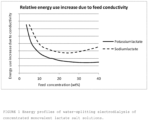
- Monovalent lactate salts of potassium may be particularly preferred as potassium lactate has been found to further improve the water-splitting electrodialysis step, by requiring lower energy consumption than other lactate salts, e.g., sodium lactate. This may be to the finding that potassium lactate solutions have a higher conductivity than sodium lactate solutions.
- potassium lactate solutions have been identified at a concentration of more than 30 wt.% to about 45 wt.%, in particular 40 wt.%, in particular at about 35 wt.%. Without being bound to any theory, this higher conductivity may explain lower voltage drops and lower energy use when working with potassium lactate. Potassium lactate solutions have also been found to have a lower viscosity than, e.g., sodium lactate solutions, which advantageously results in lowering pressure drops and in lowering the requirements on pumping energy when using the equipment in a water-splitting electrodialysis as described herein.
- a method as described herein further comprises recovering lactic acid from the second solution, produced by the water-splitting electrodialysis, comprising lactic acid and monovalent lactate salt.
- the second solution produced by the water-splitting electrodialysis is separated into lactic acid and a solution comprising the monovalent lactate salt.
- the separation may be achieved by one or more of vapour-liquid separation, liquid-liquid separation and solid-liquid separation.
- Ion exchange methods e.g. the use of ion exchange resins, may also be used to recover lactic acid from the second solution produced by the water-splitting electrodialysis.
- the lactic acid is separated from the monovalent lactate salt by means of vapour-liquid separation.
- Vapour-liquid separation may be performed by distillation or evaporation. Distillation is preferred, since it provides a substantially complete separation of the acid from the salt.
- the solution comprising lactic acid and monovalent lactate salt may be concentrated prior to distillation. Distillation is preferably carried out in a vacuum distillation unit. Vacuum distillation is found to be especially suited to separate lactic acid from lactate salt in a situation where the mixture of lactic acid and lactate salt is obtained by water-splitting electrodialysis being carried out to a partial conversion as described herein and where magnesium base is used for neutralisation in fermentation.
- the distillation process may comprise two or more distillation steps, the first distillation step preferably being carried out at a temperature from 80 to 150 °C, preferably from 100 to 140 °C, and a pressure between 40 and 250 mbar, preferably between 50 and 150 mbar, and the second distillation step preferably being carried out at a temperature from 80 to 200 °C, preferably from 100 to 200 °C, and a pressure between 0.01 and 50 mbar, preferably between 0.1 and 20 mbar.
- the first distillation step may comprise a combination of one or more film evaporators with distillation columns and serves the purpose of concentrating the lactic acid/lactate salt product stream as high as possible.
- the second distillation step may also comprise a combination of one or more film evaporators with one or more distillation units.
- the majority of the lactic acid in the product of the first distillation step is distilled, preferably under vacuum, forming a top fraction comprising the majority of the lactic acid and a distillation residue (bottom fraction) comprising the monovalent lactate salt.
- the second distillation step may be carried out in one or more short path distillation (SPD) devices having an inner condenser.
- SPD short path distillation
- the second distillation step comprises a film evaporator (preferably a falling film, a wiped film or a thin film evaporator) that is at the bottom of the evaporator directly in connection with- or is connected via a specifically U-shaped connection with- a vacuum distillation unit comprising a packing and preferably a cooling device so that it may be operated under reflux.
- a film evaporator preferably a falling film, a wiped film or a thin film evaporator
- the lactic acid is brought in vapour phase after which it enters the vacuum distillation through the connection at the bottom where it subsequently is distilled.
- the product from the first distillation step (the first bottom fraction) to be subjected to a conditioning step (so-called "preflash”) before it undergoes a second distillation step, the pressure in this conditioning step preferably being the same as that used in the second distillation.
- This preferred embodiment has the advantage that a residual quantity of water and dissolved gases are removed before the product is subjected to the second distillation step.
- the use of a preflash allows the lactic acid/monovalent lactate content to be increased so that in the second distillation step it is possible to obtain both a purer lactic acid product and to achieve more stable operation.
- Liquid-liquid separation may comprise extraction, and, for the recovery of lactic acid from the loaded solvent, back extraction, or other techniques.
- Liquid-liquid separation may also comprise filtration, e.g., ultrafiltration, microfiltration, nanofiltration, reverse osmosis, decantation, diffusion dialysis or donnan dialysis.
- Solid-liquid separation may comprise a crystallisation step.
- the lactic acid may be crystallised in a static crystallisation unit, by fractional crystallisation, by suspension crystallisation and/or by wash column crystallisation.
- the crystals may then be separated from the liquid phase of the solution crystals by filtration or centrifugation.
- the crystallisation may comprise one or more of a concentration step, such as a water evaporation step, a cooling step, a seeding step, and one or more washing steps.
- Solid-liquid separation, and in particular crystallisation has the disadvantage that, in order to ensure a product of high purity, the yields of recovery are generally low.
- the yield of recovery of lactic acid is about 46% and the purification factor is 15-20, which is the ratio of the amount of impurities in the product before and after crystallisation.
- the purification factor is 15-20, which is the ratio of the amount of impurities in the product before and after crystallisation.
- a second crystallisation step is required and the overall yield then drops to 22 %.
- Lactic acid may also be recovered from the second solution comprising lactic acid and monovalent lactate salt, by an ion exchange treatment, whereby residual monovalent cations in the second solution are replaced by protons by using, e.g., ion exchange resins.
- This method may be particularly suited for instance, when the water-splitting electrodialysis is performed to a high degree of conversion, of for instance at least 90 mole%, in particular at least 95 mole%, e.g., 98 to 99 mole %.
- the solution containing the monovalent lactate salt obtained after separation can be processed as desired. It can, if so desired, be recycled to earlier steps in the process so that it is provided to water-splitting electrodialysis. It can, e.g., be recycled at least in part to one or more of steps b), c), d), and e). This recycling step ensures that no substantial yield loss is suffered as a consequence of the partial conversion of the lactate into lactic acid during water-splitting electrodialysis.
- the lactic acid product obtained after recovery step f) may be in solid form, liquid form or in solution, and generally comprises at least 95 wt.% of lactic acid, preferably at least 97 wt.% of lactic acid, more preferably at least 99 wt.% of lactic acid, even more preferably at least 99.5 wt.% of lactic acid and most preferably at least 99.9 wt.% of lactic acid.
- the lactic acid obtained by the process according to an aspect of the invention is therefore of high purity and is suitable for direct use in, for example, synthetic processes, food applications and cosmetic applications.
- the lactic acid obtained is especially suited for the preparation of lactide and/or polylactic acid, wherein during the polymerisation of lactic acid the presence of impurities, such as lactate salts, may result in undesirable racemisation of lactic acid moieties leading to a lactide and polylactic acid product of lower quality.
- impurities such as lactate salts
- the amount of metal ions should be below 5 ppm.
- the presence of sodium sulfide, in quantities as low as 20 ppm, in lactic acid negatively affects the optical purity of the polylactic acid product.
- any conventional process as known to the person skilled in the art may be used for said manufacture of lactide and/or polylactic acid provided that the starting material containing lactic acid is made via the process as described herein.
- the process as described herein advantageously is accompanied by a low power consumption and ensures that no or substantially no waste by-products are generated.
- Example 1 Partial electrodialysis of sodium lactate solution.
- An Electrocell electrodialysis module (Sweden) was equipped with a Fu-matech FBM bipolar membrane, and a Neosepta CMB cation exchange membrane. A set-up with two electrode compartment and one feed compartment was used. The membrane areas of the bipolar and the cation exchange membrane was 0.01 m 2 . The first compartment comprised of the anode and the cation exchange side of the bipolar membrane, the second feed compartment of the anion exchange side of the bipolar membrane and the cation exchange membrane, and the third compartment of the cation exchange membrane and the cathode. 2 wt.% sulphuric acid in water was circulated through the anode compartment to ensure a high conductivity.
- a 20 wt.% sodium lactate solution was circulated through the middle compartment as a feed.
- a 8 wt.% sodium hydroxide solution was circulated through the cathode compartment to ensure a high conductivity at the cathode side, and to collect the sodium hydroxide produced.
- the three solutions were circulated with a peristaltic pump at 250 ml/min from a 500 ml glass buffer over the electrodialysis module.
- the glass buffer vessel were double walled and the temperature across the three compartments was kept between 40 and 60 °C with a water bath.
- the sulphuric acid, sodium hydroxide were reagent grade, and the Purac sodium lactate was of high purity food grade quality.
- the electrodialysis experiment was carried out a constant 7.5 A DC current.
- the sodium lactate solution in the feed compartment of the module was acidified batch wise through sodium removal through the cation exchange membrane to form sodium hydroxide in the cathode compartment, while protons generated by the bipolar membrane formed lactic acid with the original lactate ions.
- the experiment lasted for about 230 min, when all lactate was converted.
- the sodium lactate solution had a high conductivity and the voltage was relatively constant at 9.5 to 10.5 V.
- the voltage was relatively constant at 9.5 to 10.5 V.
- 80% of the sodium lactate was converted to lactic acid, with a residual sodium content of 0.84 wt.%, and the voltage increased to 12 V.
- the pH of the solution decreased to 3.1 from an initial pH of 6.0.
- the conversion had increased to 94%
- the residual sodium content had decreased to 0.25 wt.%
- the voltage had increased to 16 V
- the pH had decreased to 2.56.
- an electrodialysis up to 99 wt.% may be performed whilst still having an overall process which may be sufficiently economical. This may be the case, for instance, in methods where no vacuum distillation is performed to isolate lactic acid and other methods are chosen to recover lactic acid, e.g. the use of ion exchange resins. This may also be the case when higher starting concentrations are used and part of the water removal is performed before electrodialysis.
- the energy saved by not performing vacuum distillation and/or by performing water evaporation prior to water-splitting evaporation may compensate the energy required to go up to a conversion higher than 98 wt.%, e.g. up to 99 wt.%, and still provide an economically viable process.
- Example 2 Distillation of lactic acid from a solution of lactic acid and sodium lactate.
- a solution of lactic acid and sodium lactate was prepared by adding 98.4 grams of a 60 wt.% food grade sodium lactate solution to 4310 grams of a 49 wt.% food grade lactic acid solution.
- This solution is representative of a mixture of lactic acid and sodium lactate that is obtained after electrodialysis with partial conversion and that is concentrated by evaporation of water.
- a glass lab Short Path Distillation (SPD) unit was used to concentrate this solution further, and subsequently distil lactic acid from it.
- the lab SPD unit used was a glass KDL4 type unit, made by UIC.
- the SPD unit is essentially a double walled column, which can be heated with an oil bath to temperatures to above 100 °C.
- the liquid i.e. the lactate/lactic acid feed solution
- the SPD unit is equipped with a top stirrer and wipers in such a way that a liquid film may be produced on the inner wall of the SPD unit column from the liquid that is pumped in from the top.
- the top of the SPD unit is also connected to a vacuum system, comprising a glass column, which is indirectly cooled through a double wall by a cold finger at -60 °C, an oil operated vacuum pump and a pressure control unit with a vacuum meter and a pressure valve.
- a vacuum system comprising a glass column, which is indirectly cooled through a double wall by a cold finger at -60 °C, an oil operated vacuum pump and a pressure control unit with a vacuum meter and a pressure valve.
- a relatively high boiling compound like lactic acid can be evaporated from the feed.
- the evaporated lactic acid can then be condensed in the SPD unit, which is equipped with an inner condenser cooled by water at 55 °C.
- the lactic acid can be collected in a glass bulb placed directly under the inner condenser of the SPD unit.
- the part of the feed that is not evaporated can be collected using an outlet on the side wall at the bottom of the double walled SPD column. Vapours that are not trapped on
- the feed solution was led over the SPD unit for dewatering.
- the oil temperature was 120 °C, the vacuum pressure 100 mbar, and the feed rate 10 ml/min.
- the inner condenser of the SPD unit was operated with tap water. A fraction of 336 g of a dewatered mixture of lactic acid and sodium lactate was collected, and immediately passed over the SPD unit again. Now the oil temperature was 130 °C, the vacuum pressure 6 mbar, the feed flow rate was 15 ml/min, and the inner condenser of the SPD unit was cooled to 55 °C.
- this second SPD step at least half of the feed was distilled and recovered as a purified lactic acid, the overall recovery yield of lactic acid being of 65 % (based on the total weight of lactic acid present in the original feed).
- the feed to the SPD unit in this second step contained 5500-6000 ppm sodium, while the lactic acid product contained only 112 ppm sodium, i.e. a purification factor of about 49-54.
- the bulk of the lactic acid can be recovered in a pure form from the original mixture of lactic acid and sodium lactate using a short path distillation (SPD) unit.
- SPD short path distillation
- a pilot electrodialysis unit with multiple cell pairs of bipolar and cationic membranes was used in a batch experiment to prepare lactic acid from a model potassium lactate solution.
- the potassium lactate solution was obtained by diluting a food grade 60 wt.% potassium lactate solution (PURASAL ® HiPure P from Purac) to a 34 wt.% concentration of potassium lactate by addition of water.
- This experiment illustrates the suitability of a 34 wt.% monovalent lactate solution as a starting solution for obtaining lactic acid via water-splitting electrodialysis. Further, starting at 34 wt.% monovalent lactate concentration results in a lactic acid solution of 27 wt.%, which is more concentrated than solutions obtained when starting at lower concentrations of monovalent lactate salt (e.g. a solution of 17 wt.% lactic acid may be typically obtained when starting with a monovalent lactate salt solution of 21-23 wt.%). This means that in a process wherein the concentration of the starting monovalent lactate salt solution is relatively low (e.g.
- water may be preferably removed prior to electrodialysis to start with a higher monovalent lactate concentration, e.g. of at least 30 wt.% or higher (such as a 34 wt.% potassium lactate solution as in this example).
- a higher monovalent lactate concentration e.g. of at least 30 wt.% or higher (such as a 34 wt.% potassium lactate solution as in this example).
- the monovalent lactate salt is derived from a fermentation process.
Landscapes
- Chemical & Material Sciences (AREA)
- Organic Chemistry (AREA)
- Engineering & Computer Science (AREA)
- Oil, Petroleum & Natural Gas (AREA)
- Chemical Kinetics & Catalysis (AREA)
- Health & Medical Sciences (AREA)
- Water Supply & Treatment (AREA)
- General Chemical & Material Sciences (AREA)
- Zoology (AREA)
- Life Sciences & Earth Sciences (AREA)
- Wood Science & Technology (AREA)
- Polymers & Plastics (AREA)
- Medicinal Chemistry (AREA)
- Urology & Nephrology (AREA)
- Microbiology (AREA)
- Genetics & Genomics (AREA)
- Crystallography & Structural Chemistry (AREA)
- Biochemistry (AREA)
- Bioinformatics & Cheminformatics (AREA)
- General Engineering & Computer Science (AREA)
- General Health & Medical Sciences (AREA)
- Biotechnology (AREA)
- Organic Low-Molecular-Weight Compounds And Preparation Thereof (AREA)
- Preparation Of Compounds By Using Micro-Organisms (AREA)
- Separation Using Semi-Permeable Membranes (AREA)
- Water Treatment By Electricity Or Magnetism (AREA)
- Polyesters Or Polycarbonates (AREA)
- Electrolytic Production Of Non-Metals, Compounds, Apparatuses Therefor (AREA)
Claims (15)
- Procédé de préparation d'acide lactique comprenant les étapes consistant à :a) fournir un milieu aqueux comprenant du lactate de magnésium ;b) ajouter au milieu aqueux comprenant du lactate de magnésium une base monovalente pour former un milieu aqueux comprenant du sel de lactate monovalent soluble dans l'eau et une base de magnésium solide ;c) séparer la base de magnésium solide du milieu aqueux comprenant le sel de lactate monovalent soluble dans l'eau ;d) fournir un milieu aqueux comprenant le sel de lactate monovalent soluble dans l'eau en une concentration de plus de 30 % en poids et de 45 % en poids au maximum ;e) soumettre le milieu aqueux comprenant le sel de lactate monovalent soluble dans l'eau provenant de l'étape d) à une électrodialyse par dissociation d'eau, pour produire une première solution comprenant une base monovalente et une seconde solution comprenant de l'acide lactique et du sel de lactate monovalent, l'électrodialyse étant réalisée à une conversion partielle de 40 à 99 % en mole ;f) récupérer de l'acide lactique à partir de la seconde solution comprenant de l'acide lactique et du sel de lactate monovalent.
- Procédé selon la revendication 1, dans lequel, à l'étape d), un milieu aqueux est fourni comprenant le sel de lactate monovalent soluble dans l'eau en une concentration d'au moins 32 % en poids et/ou de 40 % en poids au maximum, et/ou de 32 à 38 % en poids, encore plus préférablement de 34 à 36 % en poids, et la concentration préférée entre toutes une concentration initiale d'environ 35 % en poids.
- Procédé selon l'une quelconque des revendications précédentes, dans lequel l'étape d) est une étape de concentration, une étape de dilution ou une étape dans laquelle la concentration n'est pas ajustée davantage, de préférence une étape de concentration dans laquelle l'eau est retirée.
- Procédé selon l'une quelconque des revendications précédentes, dans lequel la récupération d'acide lactique provenant de l'étape f) comprend la séparation de la seconde solution comprenant de l'acide lactique et du sel de lactate monovalent en acide lactique et une solution comprenant du sel de lactate monovalent, dans lequel la séparation est réalisée par le biais d'une ou plusieurs parmi une séparation vapeur-liquide, une séparation liquide-liquide et une séparation solide-liquide.
- Procédé selon la revendication 4, dans lequel la solution comprenant du sel de lactate monovalent est recyclée au moins en partie à des étapes antérieures du procédé de sorte qu'elle soit fournie à l'électrodialyse par dissociation d'eau, par exemple à une ou plusieurs des étapes b), c), d) et e).
- Procédé selon la revendication 3 ou 4, dans lequel la séparation est réalisée par le biais d'une séparation vapeur-liquide, dans lequel la séparation vapeur-liquide comprend une distillation, particulièrement une distillation réalisée dans une unité de distillation sous vide.
- Procédé selon l'une quelconque des revendications précédentes, dans lequel l'électrodialyse par dissociation d'eau est réalisée à une conversion partielle d'au moins 50 % en mole, particulièrement d'au moins 60 % en mole, plus particulièrement d'au moins 70 % en mole, encore plus particulièrement d'au moins 80 % en mole, spécialement d'au moins 85 % en mole, ou d'au moins 90 % en mole et/ou de 98 % en mole au maximum, particulièrement de 90-95 moles, ou de plus de 98 % en mole et de 99 % en mole au maximum.
- Procédé selon l'une quelconque des revendications précédentes, dans lequel le sel de lactate monovalent est du lactate de potassium ou du lactate de sodium, particulièrement du lactate de potassium.
- Procédé selon l'une quelconque des revendications précédentes dans lequel le sel de lactate monovalent est du lactate de potassium et à l'étape d) un milieu aqueux est fourni comprenant du lactate de potassium en une concentration d'au moins 32 % en poids et/ou de 40 % en poids au maximum, et/ou de 32 à 38 % en poids, encore plus préférablement de 34 à 36 % en poids, et la concentration préférée entre toutes une concentration initiale d'environ 35 % en poids.
- Procédé selon l'une quelconque des revendications précédentes, dans lequel l'électrodialyse par dissociation d'eau est réalisée dans un appareil d'électrodialyse doté d'une membrane échangeuse de cations et d'une membrane bipolaire.
- Procédé selon l'une quelconque des revendications précédentes, dans lequel le milieu aqueux comprenant le lactate de magnésium est fourni par fermentation, dans lequel une source de carbohydrates est fermentée au moyen d'un micro-organisme pour former de l'acide lactique, une base de magnésium étant ajoutée en tant qu'agent neutralisant pendant la fermentation pour fournir le lactate de magnésium.
- Procédé selon la revendication 11, dans lequel la base de magnésium est de l'hydroxyde de magnésium.
- Procédé selon la revendication 11 ou 12, dans lequel le milieu aqueux comprenant le lactate de magnésium est soumis à une étape de séparation pour éliminer une matière cellulaire microbienne avant l'étape b).
- Procédé selon l'une quelconque des revendications précédentes, dans lequel l'acide lactique obtenu après l'étape de récupération f) comprend au moins 95 % en poids d'acide lactique, particulièrement au moins 97 % en poids d'acide lactique, plus particulièrement au moins 99 % en poids d'acide lactique, au moins 99,5 % en poids, et le plus particulièrement au moins 99,9 % en poids d'acide lactique.
- Procédé de préparation de lactide et/ou d'acide polylactique, comprenant la préparation d'acide lactique en utilisant le procédé selon l'une quelconque des revendications 1 à 14 et la réaction de l'acide lactique pour former du lactide et/ou de l'acide polylactique.
Applications Claiming Priority (2)
| Application Number | Priority Date | Filing Date | Title |
|---|---|---|---|
| EP21188937 | 2021-07-30 | ||
| PCT/EP2022/071195 WO2023006876A1 (fr) | 2021-07-30 | 2022-07-28 | Procédé de fabrication d'acide lactique |
Publications (2)
| Publication Number | Publication Date |
|---|---|
| EP4377287A1 EP4377287A1 (fr) | 2024-06-05 |
| EP4377287B1 true EP4377287B1 (fr) | 2025-04-30 |
Family
ID=77168013
Family Applications (1)
| Application Number | Title | Priority Date | Filing Date |
|---|---|---|---|
| EP22743517.9A Active EP4377287B1 (fr) | 2021-07-30 | 2022-07-28 | Procédé de fabrication d'acide lactique |
Country Status (11)
| Country | Link |
|---|---|
| US (1) | US20240425438A1 (fr) |
| EP (1) | EP4377287B1 (fr) |
| JP (1) | JP2024531891A (fr) |
| KR (1) | KR20240042463A (fr) |
| CN (1) | CN117751097A (fr) |
| CA (1) | CA3227122A1 (fr) |
| ES (1) | ES3034883T3 (fr) |
| HU (1) | HUE072292T2 (fr) |
| MX (1) | MX2024001234A (fr) |
| PL (1) | PL4377287T3 (fr) |
| WO (1) | WO2023006876A1 (fr) |
Families Citing this family (3)
| Publication number | Priority date | Publication date | Assignee | Title |
|---|---|---|---|---|
| KR102799278B1 (ko) * | 2023-08-17 | 2025-04-23 | 한국화학연구원 | 알칼리금속 젖산염으로부터 젖산을 회수하는 방법 |
| KR102732559B1 (ko) * | 2023-11-07 | 2024-11-21 | 한국화학연구원 | 바이폴라막 전기투석 분리시 에너지 효율 및 피드내 유기산 이온과 비이온성 물질의 상대적 투과도 제어방법 |
| PL448837A1 (pl) | 2024-06-14 | 2025-12-15 | Orlen Południe Spółka Akcyjna | Sposób prowadzenia elektrodializy oraz sposoby otrzymywania kwasu mlekowego z wykorzystaniem tej elektrodializy |
Family Cites Families (3)
| Publication number | Priority date | Publication date | Assignee | Title |
|---|---|---|---|---|
| NL1013682C2 (nl) | 1999-11-26 | 2001-05-30 | Purac Biochem Bv | Werkwijze en inrichting voor het zuiveren van een waterige oplossing van melkzuur. |
| CN101018756B (zh) | 2004-06-17 | 2011-06-08 | 普拉克生化公司 | 由含乳酸镁的介质制备乳酸或乳酸盐的方法 |
| HUE025280T2 (en) | 2010-02-08 | 2016-02-29 | Purac Biochem Bv | Process for producing lactic acid |
-
2022
- 2022-07-28 US US18/292,609 patent/US20240425438A1/en active Pending
- 2022-07-28 JP JP2024505256A patent/JP2024531891A/ja active Pending
- 2022-07-28 CA CA3227122A patent/CA3227122A1/fr active Pending
- 2022-07-28 WO PCT/EP2022/071195 patent/WO2023006876A1/fr not_active Ceased
- 2022-07-28 CN CN202280052123.2A patent/CN117751097A/zh active Pending
- 2022-07-28 ES ES22743517T patent/ES3034883T3/es active Active
- 2022-07-28 PL PL22743517.9T patent/PL4377287T3/pl unknown
- 2022-07-28 KR KR1020247006364A patent/KR20240042463A/ko active Pending
- 2022-07-28 MX MX2024001234A patent/MX2024001234A/es unknown
- 2022-07-28 HU HUE22743517A patent/HUE072292T2/hu unknown
- 2022-07-28 EP EP22743517.9A patent/EP4377287B1/fr active Active
Also Published As
| Publication number | Publication date |
|---|---|
| HUE072292T2 (hu) | 2025-11-28 |
| CN117751097A (zh) | 2024-03-22 |
| KR20240042463A (ko) | 2024-04-02 |
| US20240425438A1 (en) | 2024-12-26 |
| EP4377287A1 (fr) | 2024-06-05 |
| JP2024531891A (ja) | 2024-09-03 |
| MX2024001234A (es) | 2024-02-13 |
| ES3034883T3 (en) | 2025-08-26 |
| WO2023006876A1 (fr) | 2023-02-02 |
| CA3227122A1 (fr) | 2023-02-02 |
| PL4377287T3 (pl) | 2025-12-01 |
Similar Documents
| Publication | Publication Date | Title |
|---|---|---|
| US8772440B2 (en) | Process for manufacturing lactic acid | |
| EP4377287B1 (fr) | Procédé de fabrication d'acide lactique | |
| US20220153677A1 (en) | Recovery of 3-hydroxypropionic acid | |
| US9926578B2 (en) | Process for manufacturing butanediol | |
| CN107250093A (zh) | 由发酵培养液使用纳滤纯化回收的母液来制造琥珀酸的方法 | |
| US20120259138A1 (en) | Methods and systems of producing dicarboxylic acids | |
| WO2025216904A1 (fr) | Récupération d'acide 3-hydroxypropionique à sucre résiduel réduit et teneur réduite en acide organique |
Legal Events
| Date | Code | Title | Description |
|---|---|---|---|
| STAA | Information on the status of an ep patent application or granted ep patent |
Free format text: STATUS: UNKNOWN |
|
| STAA | Information on the status of an ep patent application or granted ep patent |
Free format text: STATUS: THE INTERNATIONAL PUBLICATION HAS BEEN MADE |
|
| PUAI | Public reference made under article 153(3) epc to a published international application that has entered the european phase |
Free format text: ORIGINAL CODE: 0009012 |
|
| STAA | Information on the status of an ep patent application or granted ep patent |
Free format text: STATUS: REQUEST FOR EXAMINATION WAS MADE |
|
| 17P | Request for examination filed |
Effective date: 20240213 |
|
| AK | Designated contracting states |
Kind code of ref document: A1 Designated state(s): AL AT BE BG CH CY CZ DE DK EE ES FI FR GB GR HR HU IE IS IT LI LT LU LV MC MK MT NL NO PL PT RO RS SE SI SK SM TR |
|
| DAV | Request for validation of the european patent (deleted) | ||
| DAX | Request for extension of the european patent (deleted) | ||
| GRAP | Despatch of communication of intention to grant a patent |
Free format text: ORIGINAL CODE: EPIDOSNIGR1 |
|
| STAA | Information on the status of an ep patent application or granted ep patent |
Free format text: STATUS: GRANT OF PATENT IS INTENDED |
|
| INTG | Intention to grant announced |
Effective date: 20241128 |
|
| GRAS | Grant fee paid |
Free format text: ORIGINAL CODE: EPIDOSNIGR3 |
|
| GRAA | (expected) grant |
Free format text: ORIGINAL CODE: 0009210 |
|
| STAA | Information on the status of an ep patent application or granted ep patent |
Free format text: STATUS: THE PATENT HAS BEEN GRANTED |
|
| P01 | Opt-out of the competence of the unified patent court (upc) registered |
Free format text: CASE NUMBER: APP_13375/2025 Effective date: 20250318 |
|
| AK | Designated contracting states |
Kind code of ref document: B1 Designated state(s): AL AT BE BG CH CY CZ DE DK EE ES FI FR GB GR HR HU IE IS IT LI LT LU LV MC MK MT NL NO PL PT RO RS SE SI SK SM TR |
|
| REG | Reference to a national code |
Ref country code: CH Ref legal event code: EP Ref country code: GB Ref legal event code: FG4D |
|
| REG | Reference to a national code |
Ref country code: DE Ref legal event code: R096 Ref document number: 602022013962 Country of ref document: DE |
|
| REG | Reference to a national code |
Ref country code: IE Ref legal event code: FG4D |
|
| REG | Reference to a national code |
Ref country code: NL Ref legal event code: FP |
|
| PGFP | Annual fee paid to national office [announced via postgrant information from national office to epo] |
Ref country code: NL Payment date: 20250726 Year of fee payment: 4 |
|
| REG | Reference to a national code |
Ref country code: ES Ref legal event code: FG2A Ref document number: 3034883 Country of ref document: ES Kind code of ref document: T3 Effective date: 20250826 |
|
| REG | Reference to a national code |
Ref country code: AT Ref legal event code: MK05 Ref document number: 1789944 Country of ref document: AT Kind code of ref document: T Effective date: 20250430 |
|
| PGFP | Annual fee paid to national office [announced via postgrant information from national office to epo] |
Ref country code: HU Payment date: 20250704 Year of fee payment: 4 |
|
| PG25 | Lapsed in a contracting state [announced via postgrant information from national office to epo] |
Ref country code: PT Free format text: LAPSE BECAUSE OF FAILURE TO SUBMIT A TRANSLATION OF THE DESCRIPTION OR TO PAY THE FEE WITHIN THE PRESCRIBED TIME-LIMIT Effective date: 20250901 Ref country code: FI Free format text: LAPSE BECAUSE OF FAILURE TO SUBMIT A TRANSLATION OF THE DESCRIPTION OR TO PAY THE FEE WITHIN THE PRESCRIBED TIME-LIMIT Effective date: 20250430 |
|
| PGFP | Annual fee paid to national office [announced via postgrant information from national office to epo] |
Ref country code: ES Payment date: 20250801 Year of fee payment: 4 |
|
| PGFP | Annual fee paid to national office [announced via postgrant information from national office to epo] |
Ref country code: DE Payment date: 20250729 Year of fee payment: 4 |
|
| REG | Reference to a national code |
Ref country code: LT Ref legal event code: MG9D |
|
| PG25 | Lapsed in a contracting state [announced via postgrant information from national office to epo] |
Ref country code: NO Free format text: LAPSE BECAUSE OF FAILURE TO SUBMIT A TRANSLATION OF THE DESCRIPTION OR TO PAY THE FEE WITHIN THE PRESCRIBED TIME-LIMIT Effective date: 20250730 Ref country code: GR Free format text: LAPSE BECAUSE OF FAILURE TO SUBMIT A TRANSLATION OF THE DESCRIPTION OR TO PAY THE FEE WITHIN THE PRESCRIBED TIME-LIMIT Effective date: 20250731 |
|
| PGFP | Annual fee paid to national office [announced via postgrant information from national office to epo] |
Ref country code: IT Payment date: 20250731 Year of fee payment: 4 |
|
| PG25 | Lapsed in a contracting state [announced via postgrant information from national office to epo] |
Ref country code: BG Free format text: LAPSE BECAUSE OF FAILURE TO SUBMIT A TRANSLATION OF THE DESCRIPTION OR TO PAY THE FEE WITHIN THE PRESCRIBED TIME-LIMIT Effective date: 20250430 |
|
| PGFP | Annual fee paid to national office [announced via postgrant information from national office to epo] |
Ref country code: BE Payment date: 20250728 Year of fee payment: 4 |
|
| PG25 | Lapsed in a contracting state [announced via postgrant information from national office to epo] |
Ref country code: HR Free format text: LAPSE BECAUSE OF FAILURE TO SUBMIT A TRANSLATION OF THE DESCRIPTION OR TO PAY THE FEE WITHIN THE PRESCRIBED TIME-LIMIT Effective date: 20250430 |
|
| PG25 | Lapsed in a contracting state [announced via postgrant information from national office to epo] |
Ref country code: AT Free format text: LAPSE BECAUSE OF FAILURE TO SUBMIT A TRANSLATION OF THE DESCRIPTION OR TO PAY THE FEE WITHIN THE PRESCRIBED TIME-LIMIT Effective date: 20250430 |
|
| PGFP | Annual fee paid to national office [announced via postgrant information from national office to epo] |
Ref country code: FR Payment date: 20250728 Year of fee payment: 4 |
|
| PG25 | Lapsed in a contracting state [announced via postgrant information from national office to epo] |
Ref country code: RS Free format text: LAPSE BECAUSE OF FAILURE TO SUBMIT A TRANSLATION OF THE DESCRIPTION OR TO PAY THE FEE WITHIN THE PRESCRIBED TIME-LIMIT Effective date: 20250731 |
|
| PGFP | Annual fee paid to national office [announced via postgrant information from national office to epo] |
Ref country code: RO Payment date: 20250707 Year of fee payment: 4 |
|
| PG25 | Lapsed in a contracting state [announced via postgrant information from national office to epo] |
Ref country code: IS Free format text: LAPSE BECAUSE OF FAILURE TO SUBMIT A TRANSLATION OF THE DESCRIPTION OR TO PAY THE FEE WITHIN THE PRESCRIBED TIME-LIMIT Effective date: 20250830 |
|
| PG25 | Lapsed in a contracting state [announced via postgrant information from national office to epo] |
Ref country code: LV Free format text: LAPSE BECAUSE OF FAILURE TO SUBMIT A TRANSLATION OF THE DESCRIPTION OR TO PAY THE FEE WITHIN THE PRESCRIBED TIME-LIMIT Effective date: 20250430 |
|
| REG | Reference to a national code |
Ref country code: HU Ref legal event code: AG4A Ref document number: E072292 Country of ref document: HU |
|
| PG25 | Lapsed in a contracting state [announced via postgrant information from national office to epo] |
Ref country code: DK Free format text: LAPSE BECAUSE OF FAILURE TO SUBMIT A TRANSLATION OF THE DESCRIPTION OR TO PAY THE FEE WITHIN THE PRESCRIBED TIME-LIMIT Effective date: 20250430 Ref country code: SM Free format text: LAPSE BECAUSE OF FAILURE TO SUBMIT A TRANSLATION OF THE DESCRIPTION OR TO PAY THE FEE WITHIN THE PRESCRIBED TIME-LIMIT Effective date: 20250430 |
|
| PG25 | Lapsed in a contracting state [announced via postgrant information from national office to epo] |
Ref country code: CZ Free format text: LAPSE BECAUSE OF FAILURE TO SUBMIT A TRANSLATION OF THE DESCRIPTION OR TO PAY THE FEE WITHIN THE PRESCRIBED TIME-LIMIT Effective date: 20250430 |
|
| PGFP | Annual fee paid to national office [announced via postgrant information from national office to epo] |
Ref country code: PL Payment date: 20250703 Year of fee payment: 4 |
|
| PG25 | Lapsed in a contracting state [announced via postgrant information from national office to epo] |
Ref country code: EE Free format text: LAPSE BECAUSE OF FAILURE TO SUBMIT A TRANSLATION OF THE DESCRIPTION OR TO PAY THE FEE WITHIN THE PRESCRIBED TIME-LIMIT Effective date: 20250430 |
|
| PG25 | Lapsed in a contracting state [announced via postgrant information from national office to epo] |
Ref country code: SK Free format text: LAPSE BECAUSE OF FAILURE TO SUBMIT A TRANSLATION OF THE DESCRIPTION OR TO PAY THE FEE WITHIN THE PRESCRIBED TIME-LIMIT Effective date: 20250430 |
|
| REG | Reference to a national code |
Ref country code: DE Ref legal event code: R097 Ref document number: 602022013962 Country of ref document: DE |
|
| REG | Reference to a national code |
Ref country code: CH Ref legal event code: H13 Free format text: ST27 STATUS EVENT CODE: U-0-0-H10-H13 (AS PROVIDED BY THE NATIONAL OFFICE) Effective date: 20260224 |
|
| PLBE | No opposition filed within time limit |
Free format text: ORIGINAL CODE: 0009261 |
|
| STAA | Information on the status of an ep patent application or granted ep patent |
Free format text: STATUS: NO OPPOSITION FILED WITHIN TIME LIMIT |
|
| REG | Reference to a national code |
Ref country code: CH Ref legal event code: L10 Free format text: ST27 STATUS EVENT CODE: U-0-0-L10-L00 (AS PROVIDED BY THE NATIONAL OFFICE) Effective date: 20260311 |
|
| PG25 | Lapsed in a contracting state [announced via postgrant information from national office to epo] |
Ref country code: LU Free format text: LAPSE BECAUSE OF NON-PAYMENT OF DUE FEES Effective date: 20250728 |
|
| 26N | No opposition filed |
Effective date: 20260202 |
|
| PG25 | Lapsed in a contracting state [announced via postgrant information from national office to epo] |
Ref country code: CH Free format text: LAPSE BECAUSE OF NON-PAYMENT OF DUE FEES Effective date: 20250731 |