EP4379743A1 - Verfahren zur erkennung von wandernden körpern in einer brennstoffanordnung - Google Patents
Verfahren zur erkennung von wandernden körpern in einer brennstoffanordnung Download PDFInfo
- Publication number
- EP4379743A1 EP4379743A1 EP23208632.2A EP23208632A EP4379743A1 EP 4379743 A1 EP4379743 A1 EP 4379743A1 EP 23208632 A EP23208632 A EP 23208632A EP 4379743 A1 EP4379743 A1 EP 4379743A1
- Authority
- EP
- European Patent Office
- Prior art keywords
- detection
- operator
- video
- migrating
- bodies
- Prior art date
- Legal status (The legal status is an assumption and is not a legal conclusion. Google has not performed a legal analysis and makes no representation as to the accuracy of the status listed.)
- Pending
Links
Images



Classifications
-
- G—PHYSICS
- G21—NUCLEAR PHYSICS; NUCLEAR ENGINEERING
- G21C—NUCLEAR REACTORS
- G21C17/00—Monitoring; Testing ; Maintaining
- G21C17/06—Devices or arrangements for monitoring or testing fuel or fuel elements outside the reactor core, e.g. for burn-up, for contamination
-
- G—PHYSICS
- G21—NUCLEAR PHYSICS; NUCLEAR ENGINEERING
- G21C—NUCLEAR REACTORS
- G21C3/00—Reactor fuel elements and their assemblies; Selection of substances for use as reactor fuel elements
- G21C3/30—Assemblies of a number of fuel elements in the form of a rigid unit
- G21C3/32—Bundles of parallel pin-, rod-, or tube-shaped fuel elements
- G21C3/334—Assembling, maintenance or repair of the bundles
-
- G—PHYSICS
- G21—NUCLEAR PHYSICS; NUCLEAR ENGINEERING
- G21C—NUCLEAR REACTORS
- G21C17/00—Monitoring; Testing ; Maintaining
-
- G—PHYSICS
- G06—COMPUTING OR CALCULATING; COUNTING
- G06N—COMPUTING ARRANGEMENTS BASED ON SPECIFIC COMPUTATIONAL MODELS
- G06N3/00—Computing arrangements based on biological models
- G06N3/02—Neural networks
- G06N3/04—Architecture, e.g. interconnection topology
- G06N3/0464—Convolutional networks [CNN, ConvNet]
-
- G—PHYSICS
- G06—COMPUTING OR CALCULATING; COUNTING
- G06T—IMAGE DATA PROCESSING OR GENERATION, IN GENERAL
- G06T7/00—Image analysis
- G06T7/0002—Inspection of images, e.g. flaw detection
- G06T7/0004—Industrial image inspection
- G06T7/0008—Industrial image inspection checking presence/absence
-
- G—PHYSICS
- G06—COMPUTING OR CALCULATING; COUNTING
- G06V—IMAGE OR VIDEO RECOGNITION OR UNDERSTANDING
- G06V10/00—Arrangements for image or video recognition or understanding
- G06V10/70—Arrangements for image or video recognition or understanding using pattern recognition or machine learning
- G06V10/82—Arrangements for image or video recognition or understanding using pattern recognition or machine learning using neural networks
-
- G—PHYSICS
- G06—COMPUTING OR CALCULATING; COUNTING
- G06T—IMAGE DATA PROCESSING OR GENERATION, IN GENERAL
- G06T2207/00—Indexing scheme for image analysis or image enhancement
- G06T2207/20—Special algorithmic details
- G06T2207/20081—Training; Learning
-
- G—PHYSICS
- G06—COMPUTING OR CALCULATING; COUNTING
- G06T—IMAGE DATA PROCESSING OR GENERATION, IN GENERAL
- G06T2207/00—Indexing scheme for image analysis or image enhancement
- G06T2207/20—Special algorithmic details
- G06T2207/20084—Artificial neural networks [ANN]
-
- G—PHYSICS
- G06—COMPUTING OR CALCULATING; COUNTING
- G06V—IMAGE OR VIDEO RECOGNITION OR UNDERSTANDING
- G06V20/00—Scenes; Scene-specific elements
- G06V20/05—Underwater scenes
-
- G—PHYSICS
- G21—NUCLEAR PHYSICS; NUCLEAR ENGINEERING
- G21C—NUCLEAR REACTORS
- G21C3/00—Reactor fuel elements and their assemblies; Selection of substances for use as reactor fuel elements
- G21C3/30—Assemblies of a number of fuel elements in the form of a rigid unit
- G21C3/32—Bundles of parallel pin-, rod-, or tube-shaped fuel elements
- G21C3/3206—Means associated with the fuel bundle for filtering the coolant, e.g. nozzles, grids
-
- Y—GENERAL TAGGING OF NEW TECHNOLOGICAL DEVELOPMENTS; GENERAL TAGGING OF CROSS-SECTIONAL TECHNOLOGIES SPANNING OVER SEVERAL SECTIONS OF THE IPC; TECHNICAL SUBJECTS COVERED BY FORMER USPC CROSS-REFERENCE ART COLLECTIONS [XRACs] AND DIGESTS
- Y02—TECHNOLOGIES OR APPLICATIONS FOR MITIGATION OR ADAPTATION AGAINST CLIMATE CHANGE
- Y02E—REDUCTION OF GREENHOUSE GAS [GHG] EMISSIONS, RELATED TO ENERGY GENERATION, TRANSMISSION OR DISTRIBUTION
- Y02E30/00—Energy generation of nuclear origin
- Y02E30/30—Nuclear fission reactors
Definitions
- the present invention lies in the field of detection of migrating bodies at the base of fuel assemblies within nuclear power plants.
- a fuel assembly 1 among the plurality of assemblies constituting the core 2 of a nuclear reactor is shown.
- It comprises two upper 10 and lower 11 end pieces between which are the structure of the assembly (guide tubes 12 and grids 13), as well as fuel rods 14.
- the fuel assembly 1 rests on the lower plate of the core 2 by the lower end piece 11.
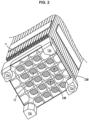
- the fuel assembly rests on the lower core plate 2 on four support points, which constitute feet 15a and 15b visible at the figure 2 annexed.
- the two feet 15b are perfectly flat, while the other two are provided with a bore allowing good positioning of the end piece 11 during the installation of the heart assembly 1.
- the stability of the assembly is obtained when the lower end piece 11 of the fuel assembly 1 rests on these four feet 15a and 15b, without interposing between these support points 15a and 15b and the bottom of the core 2 any foreign body or any roughness.
- CM foreign body or “migrating body” CM means any object of any material. They can have varied origins that are typically found in any industrial site and be endogenous or exogenous to it.
- it may be debris resulting from welding or machining operations. It can also be small components such as for example screws, bolts, washers, springs, metal shavings, etc., which can migrate and attach to the anti-debris grid 16.
- FIG. 2 illustrates an example of a CM migrant body stopped by the anti-debris grid 16. These CM migrant bodies come to lodge under or on the anti-debris grid 16 where they are blocked depending on the case.
- the nuclear fuel which produces the heat is contained in zirconium alloy tubes which are called fuel rods. These fuel rods are grouped into bundles of 264 rods, held together by a framework closed by end caps. The whole, framework + rods, forms a “fuel assembly”.
- the core of a reactor of a nuclear power plant is made up of 157, 193 or 205 (241 on an EPR) of these fuel assemblies, in particular and not limited to in the case of French nuclear power plants such as those held by the present applicant. .
- the lower end piece 11 of a fuel assembly 1 rests on the lower plate of the core 2, pierced with holes to allow the circulation of the cooling water, in the vertical direction, from bottom to top.
- This cooling water while circulating in the primary circuit, can become loaded with debris. possibly present, namely CM migrant bodies, as explained above.
- the assemblies are extracted to be inspected under water, from all angles, using cameras, in search of different defects, then returned in the heart for the next cycle or are placed in a cooling pool.
- ITV television inspections
- a migrating body CM may possibly, during reloading manipulations, pass through the anti-debris grid and end up between pencils 14.
- a migrating body still present can apply a deformation to this assembly.
- assembly 1 due to a migrating body CM during reloading may make the future extraction of this assembly from core 2 difficult.
- ITV television inspections
- CM migrant bodies are sometimes not detected by the operator, despite the fact that in the current protocol, each video is inspected individually by several operators, successively, according to the organization specific to the plant.
- This current television inspection technique is unassisted, so the video stream returned by the inspection camera is raw, with a human operator responsible for detecting CM migrating bodies from the video stream.
- a first operator is responsible for a “live” inspection, while images are taken using a camera at the bottom of the pool.
- the operator brings the fuel assembly 1 above the camera, then zooms in on the legs 15 and the anti-debris grid 16 which he inspects in detail (between 2 and 3 minutes per assembly).
- the third operator re-examines the video, assisted by the two reports from the two previous operators, and makes a final decision (presence or not of a migrating body to be extracted).
- the present invention aims to make the operation described above more reliable by overcoming the operators' lack of vigilance, via assistance in the detection of these migrating bodies.
- the present invention relates to a method of assisting in the detection of migrating bodies within a fuel assembly of a nuclear power plant and more particularly on the anti-debris grid of the lower end of said assembly, during from which at least one camera is directed towards said assembly and the stream of images recorded by said at least one camera is directed towards a man-machine interface which comprises at least one screen allowing a first operator to view said stream of video images , characterized in that it comprises a first step of detecting, using an image recognition algorithm, said migrating bodies, as well as at least a second step of alerting said operator if said algorithm has detected the potential presence of at least one migrating body.
- the expressions “false positive” and a “false negative” respectively mean the detection by the software of something which is not a migrating body, respectively a absence of detection of a real migrating body, not seen by the software, although it is present in the video.
- the present invention essentially relates to a method for detecting migrating bodies CM on the anti-debris grid 16 of a lower end piece 11 of a fuel assembly 1, which is implemented by a program which processes data from television inspection images (hereinafter ITV).
- ITV television inspection images
- this process makes it possible to analyze in real time and/or in deferred time, the video stream from a camera which is controlled in the direction of the fuel assembly 1 to detect migrating bodies CM and present them to the operators in charge. different ways.
- the process can be applied at each of the inspection stages.
- a camera controlled in direction we mean that said camera is fixed and that it zooms and implements rotations directed towards the assembly.
- the process In the case of real-time use by the operator operating the camera, the process generates an "alert”, particularly visual on the video stream using a detection algorithm to indicate that it has detected "something » at “such and such a place”, so that the operator pays attention to it and possibly decides to examine this area more specifically. It is also possible to generate another type of alert, such as an audio alert.
- step E1 represented in Figure 3 annexed.
- the video file of the inspection accompanied by the file of detections generated in the previous step are provided and are used by the method to present the same assistance as to the first operator, but additionally indicating, in the temporal progress bar of the video, the times at which migrant bodies are suspected of being present by the program. This corresponds to step E2 of the Figure 3 .
- a third and final operator responsible for a final viewing with support from the reports of the first two operators, and with the objective of deciding on the actions to be carried out, will also be able to benefit from the detections of the algorithm in his review, in particular from the functionality which allows you to go directly to the moments in the video where the migrating body is seen. This corresponds to step E3 of the Figure 3 .
- the “removal of doubt” by the latter operator is on the critical path to unit shutdown.
- the critical path is the entry into a retrocalendar counted from a previously fixed date of a future event - for example the divergence of the reactor - so that any delay before this event will lead to its shift in time, with penalizing consequences for the operation (production failure, etc.).
- the present method allows operators to focus directly on sections of the video where CM migrating bodies are suspected, without having to scan the entire video to search for them.
- the method according to the invention is based on an algorithm for image recognition and detection of migrant bodies CM which can consist of a version of “Yolov3” (convolutional neural network type detection algorithm), which is trained on a specific learning base constituted from archives of videos of migrant bodies.
- the learning base is created iteratively and following a specific methodology to minimize human labeling effort.
- the base can be enriched each time the lack of presence of at least one migrating body CM has been validated by the second and/or the third operator (in other words when the operator has validated that he was a “false positive”), and each time a CM was not automatically detected.
- the algorithm somehow learns from its mistakes.
- Yolov3's basic data augmentation uses only a left/right mirror, anisotropic scaling (contractions/stretches) and no rotations.
- each detection is characterized by a position (in the form of the four coordinates of an “axis aligned” bounding box framing the detection) and a confidence level (real number between 0.10 and 1.00) which reflects how the The algorithm estimates the reliability of the detection.
- VIDEO PLAYBACK TOOL INTEGRATING OR INTERFACING WITH THE DETECTION ALGORITHM
- the man-machine interface offered to operators to assist them in the task of searching for CMs during ITV can take the form of a video player in which the proposals for the detection algorithm are presented.
- This video player can, for example, have three different possible operating modes in its link with the detection algorithm (this choice configurable via a configuration file): A.
- the detection algorithm can be embedded in the video player.
- the detection neural network is provided to the tool under the form of a file in “ONNX” format (operated via “ML.Net”, that is to say the “framework” (in French “cadre”) of “open source machine learning” (in French “automatic learning open source”) from the Microsoft Company), and the tool's configuration file references this file.
- the video playback tool “feeds” the neural network with successive images of the video (or the stream from the camera), resizing them to 416x416, and recovers the detections to display them.
- the detection algorithm can be remote and run in/on a server.
- the tool's configuration file references the server to which it must connect.
- the video playback tool sends successive images to the server, and retrieves the detections to display them.
- the tool can be used to simply replay detections already made previously, in which case it reads as input the “detections file” in text format which lists all the detections associated with the video to display them.
- the association between the video and the associated detection file to open is automatic and is done by name.
- you open a video if a text file with the same name as the video (but in “.txt” format) is present, then the tool gives you the choice between using this existing file or redoing a detection session.
- the detection algorithm when the detection algorithm has finished processing a video (or a camera session), it offers to archive the list of detections via a text file, named identically to the video, and placed in the same location (same directory). In case such a file already existed, the old one is saved and indicated in a “backup” subdirectory (in French “save”).
- FIG. 4 shows how suspected CM migrant bodies can be presented to operators, on a computer screen.
- a certain number of interface elements facilitate the search and analysis of migrant bodies.
- each detection is associated with a vertical bar whose height corresponds to the confidence index of the detection.
- a “group of detections” therefore appears as a set of such contiguous bars, therefore as a single object.
- the left and right arrows i allow you to navigate directly from detection group to detection group.
- a group of detections is therefore a “same detection” (that is to say a priori of the same object), but which lasts over time. Navigating from one to the other allows very rapid visualization, for a video, of the different “candidate migrant bodies”.
- the advantage of displaying the vertical detection bars in the temporal progress bar is that this visual representation takes on very different aspects in the event of the presence of migrating bodies (contiguous groups of detections with a high average level of confidence) or in the event of presence of false positives (isolated detections most often of low level of confidence).
- Filtering detections allows you to suppress the presentation of detections whose associated confidence level is lower than the filter value.
- the level can thus be adapted to each video independently. It allows false positives to be removed, and to visualize in real time how this modifies the appearance of the temporal progress bar d equipped with the vertical bars associated with detections f and g.
- Generating a report via the m and n buttons, allows the operator to take screenshots n at different key times, then generate a report m. This report lists the “valid” detections according to the operator (moments in the video + screenshot).
- the video can be played in fast motion. In this mode, the video slows down to normal speed in areas where the algorithm has made detections.
- the tool does not send all the images of the video (or the camera stream) into the detection algorithm but only a certain ratio, at, namely the one which allows real time to be preserved.
- the temporal progress bar is colored green (or another color of your choice) for the moments that have been processed by the algorithm, and remains white (or other color) for the moments remaining. to treat.
- the progress of the green zone is visualized in real time (similar to online videos, which show the user which areas of the video have loaded and which have not yet).
- the user therefore has the choice, to reduce the image to 416x416, to reduce the video so that just the central square is taken, which is then reduced to 416x416, or to fit the entire video into a square of 416x416 (the length is reduced to 416, and the width is reduced by the same factor).
- This choice between the two reduction modes is entered in the configuration file via the parameters button l.
- the video tool positions itself at the moment of best detection (in terms of confidence level) of the largest continuous detection group (when there are detection groups), then takes a screenshot.
- This screenshot is named like the video, with a prefix of a 6-digit counter, in the format 000000_, which counts the total number of detections in this video.
- This image most often makes it possible to capture a moment where the CM is present (if it is a video which presents a real CM), and in the case where the moment captured does not show a CM, the appearance of the temporal progress bar gives a very good idea of the presence of CM in the video.
- False positives are very few (some entire videos do not show a single detection, over three minutes of video, or 4500 images).
- the average false positive rate “per image”, measured on a reference test set, is around 2%. Which means that over one minute of video (1500 images), there will be 30 “point” false detections (i.e. those that flash for a 25th of a second). Over a complete test campaign, more than half of the 3-minute videos contain fewer than 15 false detections (less than 0.3% false positives). In addition, when a false positive appears in a video, it is most often very occasional. Generally, it appears as an isolated flash of 1/25th of a second and does not attract attention.
- the first is the filtering of isolated detections (at a location in the assembly where there are no or too few other detections in the video).
- the navigation arrows b allow you to move from image to image, like in a slideshow, and the navigation arrows i, which allowed you to move from detection group to detection group, here allow you to move from one image comprising a detection to another image comprising a detection.
- the display of the vertical bars f and g illustrating the detections is retained and the filter h is also functional.
- the lower end piece 11 of fuel assembly 1 generally comprises twenty-four very characteristic screws which are placed in the same place, whatever the supplier of the assembly.
- Tracking the screws thus allows the creation of a benchmark relating to assembly 1 in which it becomes possible to carry out mapping and metrology of the CMs.
- artificial intelligence could learn to manipulate the camera itself to search for migrating bodies by capturing the videos itself and deciding by example herself to come and examine her suspicions of CM more closely.
- the method according to the invention can be implemented in each of the 3 CM detection stages.
- the tool can be offered to each of the three operators or only to a subset. So, for example, we could not only give it to the operator who does the live inspection, but just to the “proofreaders”, so as not to risk a drop in vigilance (paradoxically due to the assistance).
- the assistance can be used from the first step during the initial image taking, that is to say "live” ( therefore either with a machine powerful enough to use mode A described above, or the use of mode B described above).
- the operator can generate his report automatically (with the screenshots he considers interesting) via the appropriate functionality. It can then provide the video and the generated detection file as input to the second stage, for independent analysis (meaning it does not provide the report).
- the tool can be used in C mode (no detection via the algorithm, but simple rereading of the previously generated detection file) and the operator can also generate his report automatically. It will also have the possibility to edit the detections file and will be able to delete detections, by selecting them on the screen individually or by selecting an interval in the timeline.
- the video, the detection file possibly enriched by editing it during the second step, and the two reports generated are given to the operator responsible for the final review and the removal of doubt in the event of a problem. suspicion of CM.
- a fuel assembly is very expensive and failure to detect a migrating body can damage it and render it unusable.
- a migrating body can possibly, via various means, cause a piercing of the sheath of a pencil and cause a loss of the first safety barrier, with diffusion of fission products in the primary circuit.
- the migrant bodies missed by the method according to the current state of the art using three operators could be detected by the method according to the invention which directly indicated at which moments of the video to watch which, on the one hand increases the reliability of the CM search and, on the other hand, greatly limits the duration of viewing the operators, particularly for the last operator in its role of removing doubt.
- the solution according to the invention makes it possible to partly overcome the disadvantages associated with human fatigue when faced with such a task, which inevitably leads to forgetting.
Landscapes
- Engineering & Computer Science (AREA)
- Physics & Mathematics (AREA)
- Theoretical Computer Science (AREA)
- General Engineering & Computer Science (AREA)
- High Energy & Nuclear Physics (AREA)
- Plasma & Fusion (AREA)
- General Physics & Mathematics (AREA)
- Evolutionary Computation (AREA)
- Computer Vision & Pattern Recognition (AREA)
- Artificial Intelligence (AREA)
- Computing Systems (AREA)
- Health & Medical Sciences (AREA)
- General Health & Medical Sciences (AREA)
- Software Systems (AREA)
- Quality & Reliability (AREA)
- Medical Informatics (AREA)
- Biomedical Technology (AREA)
- Biophysics (AREA)
- Computational Linguistics (AREA)
- Data Mining & Analysis (AREA)
- Molecular Biology (AREA)
- Life Sciences & Earth Sciences (AREA)
- Mathematical Physics (AREA)
- Multimedia (AREA)
- Databases & Information Systems (AREA)
- Monitoring And Testing Of Nuclear Reactors (AREA)
- Image Processing (AREA)
Applications Claiming Priority (1)
| Application Number | Priority Date | Filing Date | Title |
|---|---|---|---|
| FR2212506A FR3142595B1 (fr) | 2022-11-29 | 2022-11-29 | Procédé d’aide à la détection de corps migrants au sein d’un assemblage combustible |
Publications (1)
| Publication Number | Publication Date |
|---|---|
| EP4379743A1 true EP4379743A1 (de) | 2024-06-05 |
Family
ID=85381241
Family Applications (1)
| Application Number | Title | Priority Date | Filing Date |
|---|---|---|---|
| EP23208632.2A Pending EP4379743A1 (de) | 2022-11-29 | 2023-11-08 | Verfahren zur erkennung von wandernden körpern in einer brennstoffanordnung |
Country Status (4)
| Country | Link |
|---|---|
| US (1) | US12562290B2 (de) |
| EP (1) | EP4379743A1 (de) |
| CN (1) | CN118116627A (de) |
| FR (1) | FR3142595B1 (de) |
Families Citing this family (1)
| Publication number | Priority date | Publication date | Assignee | Title |
|---|---|---|---|---|
| EP4718392A1 (de) * | 2024-09-26 | 2026-04-01 | Westinghouse Electric Sweden AB | Verfahren und system zur erkennung eines objekts auf komponenten |
Citations (4)
| Publication number | Priority date | Publication date | Assignee | Title |
|---|---|---|---|---|
| JP2013160738A (ja) | 2012-02-09 | 2013-08-19 | Tokyo Electric Power Co Inc:The | デブリの位置特定方法 |
| CN109243638A (zh) | 2018-09-05 | 2019-01-18 | 西安交通大学 | 核反应堆安全壳碎片迁移特性试验系统及其试验方法 |
| WO2021026649A1 (en) | 2019-08-12 | 2021-02-18 | Avidbots Corp | System and method of semi-autonomous cleaning of surfaces |
| FR3118270A1 (fr) | 2020-12-17 | 2022-06-24 | Electricite De France | Installation de nettoyage d’un assemblage combustible et procédé de nettoyage qui en fait usage |
Family Cites Families (5)
| Publication number | Priority date | Publication date | Assignee | Title |
|---|---|---|---|---|
| US8792705B2 (en) * | 2011-11-03 | 2014-07-29 | United Technologies Corporation | System and method for automated defect detection utilizing prior data |
| GB2538539A (en) * | 2015-05-20 | 2016-11-23 | Airbus Operations Ltd | Measuring surface of a liquid |
| KR102026983B1 (ko) * | 2018-03-29 | 2019-09-30 | 두산중공업 주식회사 | 가스터빈 내 파이프를 통과하는 유체의 오염물을 모니터링 하는 시스템 및 그 방법 |
| TW202022883A (zh) * | 2018-12-11 | 2020-06-16 | 晶睿通訊股份有限公司 | 神經網路物體分類的機器持續學習方法及其監控攝影設備 |
| JP7517812B2 (ja) * | 2019-11-22 | 2024-07-17 | 日立Geニュークリア・エナジー株式会社 | 原子炉の炉水水質を予測する装置 |
-
2022
- 2022-11-29 FR FR2212506A patent/FR3142595B1/fr active Active
-
2023
- 2023-11-08 EP EP23208632.2A patent/EP4379743A1/de active Pending
- 2023-11-24 CN CN202311579704.4A patent/CN118116627A/zh active Pending
- 2023-11-29 US US18/523,162 patent/US12562290B2/en active Active
Patent Citations (4)
| Publication number | Priority date | Publication date | Assignee | Title |
|---|---|---|---|---|
| JP2013160738A (ja) | 2012-02-09 | 2013-08-19 | Tokyo Electric Power Co Inc:The | デブリの位置特定方法 |
| CN109243638A (zh) | 2018-09-05 | 2019-01-18 | 西安交通大学 | 核反应堆安全壳碎片迁移特性试验系统及其试验方法 |
| WO2021026649A1 (en) | 2019-08-12 | 2021-02-18 | Avidbots Corp | System and method of semi-autonomous cleaning of surfaces |
| FR3118270A1 (fr) | 2020-12-17 | 2022-06-24 | Electricite De France | Installation de nettoyage d’un assemblage combustible et procédé de nettoyage qui en fait usage |
Also Published As
| Publication number | Publication date |
|---|---|
| US12562290B2 (en) | 2026-02-24 |
| FR3142595B1 (fr) | 2026-03-06 |
| FR3142595A1 (fr) | 2024-05-31 |
| US20240177877A1 (en) | 2024-05-30 |
| CN118116627A (zh) | 2024-05-31 |
Similar Documents
| Publication | Publication Date | Title |
|---|---|---|
| CN110619620B (zh) | 导致表面缺陷的异常定位方法、装置、系统及电子设备 | |
| US10937144B2 (en) | Pipe feature identification using pipe inspection data analysis | |
| EP0054596B1 (de) | Verfahren für die Inspektion und die automatische Sortierung von Objekten, die Konfigurationen mit dimensionellen Toleranzen aufweisen und platzabhängige Kriterien für die Verwerfung, Anlage und Schaltung dafür | |
| EP1859614B1 (de) | Verfahren zum auswählen von teilen eines audiovisuellen programms und einrichtung dafür | |
| CN103186780B (zh) | 视频字幕识别方法及装置 | |
| EP4379743A1 (de) | Verfahren zur erkennung von wandernden körpern in einer brennstoffanordnung | |
| FR2880154A1 (fr) | Procede et systeme de visualisation rapide de structures | |
| EP3271869A1 (de) | Verfahren zur verarbeitung eines asynchronen signals | |
| EP3937071A1 (de) | Verfahren zur unterstützung der echtzeitverfolgung von mindestens einer person auf bildsequenzen | |
| EP2104937A1 (de) | Verfahren zur erzeugung einer neuen zusammenfassung eines audiovisuellen dokuments, das bereits eine zusammenfassung und meldungen enthält, und empfänger, der das verfahren implementieren kann | |
| Abdo et al. | Surveys of benthic reef communities using underwater video | |
| FR3055162B1 (fr) | Procede de comptage et d'identification d'especes de poissons en un lieu donne | |
| JP5243486B2 (ja) | ケーブル位置検出装置、ケーブル位置検出方法及びケーブル位置検出プログラム | |
| WO2022106506A1 (fr) | Procédé et dispositif électronique d'aide à la surveillance d'un élément de réacteur nucléaire, programme d'ordinateur et système associés | |
| CN118941952A (zh) | 基于扩散算法的输电线路覆冰图片样本生成方法 | |
| WO2021058307A1 (fr) | Procede d'enregistrement de sequences de commande et de controle d'un robot de test, logiciel pour mise en oeuvre de ce procede | |
| Matzner et al. | Triton: Igiugig Video Analysis (Project Report) | |
| JP2009010548A5 (de) | ||
| FR3003381A1 (fr) | Dispositif de comptage automatique de poissons | |
| FR3010606A1 (fr) | Procede de synchronisation de metadonnees avec un document audiovisuel en utilisant des parties de trames et dispositif de production de telles metadonnees | |
| Huang et al. | Temporal defect point localization in pipe CCTV Videos with Transformers | |
| JPWO2019058864A1 (ja) | ガス検査レポート作成支援装置、ガス検査レポート作成支援方法、及び、ガス検査レポート作成支援プログラム | |
| FR3121468A1 (fr) | Procédé de détection de la consistance du marin excavé par un tunnelier | |
| Dietz et al. | Towards Open-Source Web-Based 3D Reconstruction for Non-Professionals | |
| WO2024184603A1 (fr) | Procédé de surveillance automatique |
Legal Events
| Date | Code | Title | Description |
|---|---|---|---|
| PUAI | Public reference made under article 153(3) epc to a published international application that has entered the european phase |
Free format text: ORIGINAL CODE: 0009012 |
|
| STAA | Information on the status of an ep patent application or granted ep patent |
Free format text: STATUS: REQUEST FOR EXAMINATION WAS MADE |
|
| 17P | Request for examination filed |
Effective date: 20231108 |
|
| AK | Designated contracting states |
Kind code of ref document: A1 Designated state(s): AL AT BE BG CH CY CZ DE DK EE ES FI FR GB GR HR HU IE IS IT LI LT LU LV MC ME MK MT NL NO PL PT RO RS SE SI SK SM TR |