EP4382050A1 - Stethoscope portable - Google Patents
Stethoscope portable Download PDFInfo
- Publication number
- EP4382050A1 EP4382050A1 EP23163007.0A EP23163007A EP4382050A1 EP 4382050 A1 EP4382050 A1 EP 4382050A1 EP 23163007 A EP23163007 A EP 23163007A EP 4382050 A1 EP4382050 A1 EP 4382050A1
- Authority
- EP
- European Patent Office
- Prior art keywords
- stethoscope
- wearable
- heart sound
- sound signals
- wearable stethoscope
- Prior art date
- Legal status (The legal status is an assumption and is not a legal conclusion. Google has not performed a legal analysis and makes no representation as to the accuracy of the status listed.)
- Pending
Links
Images



Classifications
-
- A—HUMAN NECESSITIES
- A61—MEDICAL OR VETERINARY SCIENCE; HYGIENE
- A61B—DIAGNOSIS; SURGERY; IDENTIFICATION
- A61B7/00—Instruments for auscultation
- A61B7/02—Stethoscopes
- A61B7/04—Electric stethoscopes
-
- A—HUMAN NECESSITIES
- A61—MEDICAL OR VETERINARY SCIENCE; HYGIENE
- A61B—DIAGNOSIS; SURGERY; IDENTIFICATION
- A61B5/00—Measuring for diagnostic purposes; Identification of persons
- A61B5/68—Arrangements of detecting, measuring or recording means, e.g. sensors, in relation to patient
- A61B5/6801—Arrangements of detecting, measuring or recording means, e.g. sensors, in relation to patient specially adapted to be attached to or worn on the body surface
- A61B5/6802—Sensor mounted on worn items
- A61B5/6804—Garments; Clothes
-
- A—HUMAN NECESSITIES
- A61—MEDICAL OR VETERINARY SCIENCE; HYGIENE
- A61B—DIAGNOSIS; SURGERY; IDENTIFICATION
- A61B5/00—Measuring for diagnostic purposes; Identification of persons
- A61B5/72—Signal processing specially adapted for physiological signals or for diagnostic purposes
- A61B5/7203—Signal processing specially adapted for physiological signals or for diagnostic purposes for noise prevention, reduction or removal
-
- H—ELECTRICITY
- H04—ELECTRIC COMMUNICATION TECHNIQUE
- H04R—LOUDSPEAKERS, MICROPHONES, GRAMOPHONE PICK-UPS OR LIKE ACOUSTIC ELECTROMECHANICAL TRANSDUCERS; ELECTRIC HEARING AIDS; PUBLIC ADDRESS SYSTEMS
- H04R1/00—Details of transducers, loudspeakers or microphones
- H04R1/46—Special adaptations for use as contact microphones, e.g. on musical instrument, on stethoscope
-
- H—ELECTRICITY
- H04—ELECTRIC COMMUNICATION TECHNIQUE
- H04R—LOUDSPEAKERS, MICROPHONES, GRAMOPHONE PICK-UPS OR LIKE ACOUSTIC ELECTROMECHANICAL TRANSDUCERS; ELECTRIC HEARING AIDS; PUBLIC ADDRESS SYSTEMS
- H04R17/00—Piezoelectric transducers; Electrostrictive transducers
- H04R17/02—Microphones
-
- H—ELECTRICITY
- H04—ELECTRIC COMMUNICATION TECHNIQUE
- H04R—LOUDSPEAKERS, MICROPHONES, GRAMOPHONE PICK-UPS OR LIKE ACOUSTIC ELECTROMECHANICAL TRANSDUCERS; ELECTRIC HEARING AIDS; PUBLIC ADDRESS SYSTEMS
- H04R17/00—Piezoelectric transducers; Electrostrictive transducers
- H04R17/02—Microphones
- H04R17/025—Microphones using a piezoelectric polymer
Definitions
- the present invention relates to technology field of body sound detection device, and more particularly, a wearable stethoscope.
- wearable sensors such as smart watches, bracelets, etc., which allow us to continuously monitor our health in a non-invasive manner.
- Bluetooth Low Energy (BLE) technology can be used to connect with mobile phones to record or analyze various sensing data. Uploading the sensing data to the cloud allows doctors to remotely monitor and track the health status of the elderly or patients 24 hours a day.
- wearable auscultation (heart sound) devices can provide real-time and effective detection and recording for abnormal heartbeat signals. Physicians can use this real-time physiological audio information to analyze and provide health warning and healthcare solutions.
- wearable medical devices are bulky, making users feel that there is a foreign body sensation while wearing them, and the battery to power the device should be replaced by users, which can cause inconvenience in life. Therefore, users resisted to wear wearable medical devices unless necessary.
- a wearable stethoscope which includes a clothing body, a sound sensor module configured to collect heart sound signals of a user, the sound sensor module having a diaphragm, a piezoelectric sensor, and a circuit board.
- the circuit board is electrically connected to the sound sensor and the piezoelectric sensor to preprocess the collected heart sound signals.
- the sound sensor is integrated with the clothing body.
- the diaphragm is disposed on a surface of the circuit board, a soundproof ring is disposed on the surface and encloses the diaphragm to form a resonant cavity, and the piezoelectric sound sensor is arranged on a side of the soundproof ring that is not in contact with the circuit board, wherein the piezoelectric sound sensor is directly attached to user's skin, or through the clothing body attached to the user's skin.
- the piezoelectric sound sensor includes a piezoelectric layer, and upper and lower surfaces of the piezoelectric layer have conductive electrodes.
- said sound sensor is integrated with the clothing body through a storage bag.
- the sound sensor is detachably integrated with the clothing body through a connecting piece.
- the connecting piece is a velcro felt, a buckle or a zipper.
- the clothing body is a tight-fitting clothing that fits the user's body, to facilitate the piezoelectric sensor of the stethoscope sensing the user's body sounds, especially the user's heart sound signals.
- the piezoelectric layer is made of polyvinylide fluoride (PVDF) polymer film, lead zirconate (PZT) film, or the like.
- PVDF polyvinylide fluoride
- PZT lead zirconate
- the circuit board at least includes a processing unit, electrically connected to the sound sensor module used to receive and process heart sound signals for obtaining preprocessed heart sound signals with background noise been removed; a storage unit, electrically connected to the processing unit, used to store the preprocessed heart sound signals; and a wireless transmission module, electrically connected to the processing unit, used to transmit the preprocessed heart sound signals outward to an external electronic computing device.
- a processing unit electrically connected to the sound sensor module used to receive and process heart sound signals for obtaining preprocessed heart sound signals with background noise been removed
- a storage unit electrically connected to the processing unit, used to store the preprocessed heart sound signals
- a wireless transmission module electrically connected to the processing unit, used to transmit the preprocessed heart sound signals outward to an external electronic computing device.
- a processing unit includes a filter, a signal amplifier electrically connected to the filter and an analog to digital converter electrically connected to the signal amplifier, for sequentially filtering, amplifying and digitizing the heart sound signals, and a microprocessor electrically connected to the analog to digital converter used to receive and process the digitalized heart sound signals to obtain preprocessed heart sound signals with background noise been removed.
- the microprocessor is a microcontroller, a digital signal processor (DSP), an application-specific integrated circuit (ASIC), a programmable logic circuit, or other digital data processing device that can execute instructions to perform processing operations.
- DSP digital signal processor
- ASIC application-specific integrated circuit
- programmable logic circuit or other digital data processing device that can execute instructions to perform processing operations.
- the wireless transmission module is connected to an antenna, and the antenna is configured to transmit output data and receive input data through a wireless communication channel.
- the storage unit includes read only memory (ROM), random access memory (RAM), electrically erasable programmable ROM (EEPROM), flash memory or the like.
- ROM read only memory
- RAM random access memory
- EEPROM electrically erasable programmable ROM
- flash memory or the like.
- the preprocessed heart sound signals are analyzed and cross-referenced with an existing database through an external electronic computing device communicatively coupled with the wearable stethoscope.
- the external electronic computing device is a smart phone.
- Consumption or medical wearable device has a variety of appearances, among which, wearable biosensors can be transformed into more diverse types, because they can appear in the form of gloves, clothes, bandages and implants, and can be utilized as non-invasive disease diagnosis and health monitoring tool.
- the most important function of the wearable medical device is to detect various information of human body, so the accuracy of its internal sensors is very important.
- a wearable stethoscope proposed by the present invention can be pasted on the human body or clothing by means of a patch, or can be integrated with the clothing. Through the compliance and ductility of soft materials, the sensing function is implemented in a fitting manner, which can take into account both functionality and comfort, enabling that people can monitor their physiological status in a comfortable wearing manner, and achieve the function of collecting sports data in real time.
- FIG. 1 shows a schematic diagram of integrating a stethoscope 10 with clothes 12 according to one embodiment of the present invention.
- the stethoscope 10 is a design in which a piezoelectric film is integrated into a soft substrate, and the detailed structure will be illustrated in Fig. 2 . Firstly, how to integrate the stethoscope 10 with clothes will be described below.
- the stethoscope 10 can be pasted on the human body using a patch, referring to the upper right diagram of FIG. 1 again, it shows that a pocket (accommodating bag) 12a sewn on the clothes 12 used as an accommodating space for integrating the stethoscope 10 into the clothes, forming the wearable stethoscope 100 as a whole.
- the stethoscope 10 is a detachable accessory arranged on the clothing body, for example, is arranged on the clothing body through a link, such as a buckle, a Velcro or a zipper and the like.
- a link such as a buckle, a Velcro or a zipper and the like.
- FIG. 1 shows utilizing Velcro felt (14a, 14b) to attach the stethoscope 10 onto the clothes to form a wearable stethoscope 100.
- Velcro is usually composed of two fabrics, one with a loop structure (hair surface) and the other with a hook structure (hook surface). When the two pieces of fabric are pressed together firmly, the hooks and loops combine to create a temporary fastening state. To separate these two pieces, just push them apart with force.
- one of the fabrics (e.g., 14a) of the Velcro felt is sewn on the clothes 12, and the stethoscope 10 is then set firmly on the other fabric (e.g., 14b) of the Velcro felt.
- the above-mentioned clothes are tight-fitting clothes that fit the body to facilitate the piezoelectric film (piezoelectric sensor) in the stethoscope 10 sensing body sounds, especially to sense heart sound signals.
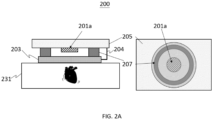
- FIG. 2A shows the structure of the proposed stethoscope 200 according to an embodiment of the present invention, the left figure is its cross-sectional view, and the right figure is its top view.
- the stethoscope 200 includes a diaphragm 201a, on which the diaphragm 201a is plated with conductive material, and the diaphragm 201a is packaged with a plastic frame (soundproof ring) 207 and a circuit board (hardware module 205), wherein the soundproof ring 207 and the circuit board 205 form a resonant cavity, which combined with the diaphragm 201a to form a microphone structure, a piezoelectric sensor 203 is arranged below the soundproof insulation ring 207, and is electrically connected to the circuit board 205 through a conductive wiring 204.
- the piezoelectric sensor directly or indirectly (through clothes) contacts user's skin 231 is used to measure the voltage signal generated by the vibration. That means, the piezoelectric sensor 203 can be used as a diaphragm to make up the functionality inefficiencies of the traditional capacitive sensor, which has poor response in low-frequency signals, such as the third and fourth heart sounds with frequencies around 20 Hz.
- the aforementioned piezoelectric sensor 203 is mainly a piezoelectric layer composed of piezoelectric material (for example, polyvinylidene fluoride (PVDF) polymer piezoelectric film, lead zirconate titanate (PZT) etc.) whose upper and lower surfaces are deposited with conductive metal (for example, aluminum, copper, etc.).
- piezoelectric material for example, polyvinylidene fluoride (PVDF) polymer piezoelectric film, lead zirconate titanate (PZT) etc.
- conductive metal for example, aluminum, copper, etc.
- the thickness of the piezoelectric sensor is less than 50 ⁇ m.
- FIG. 2B-2C shows the structure of the proposed stethoscope 200 according to another embodiment of the present invention, and FIG. 2B is its top view, stethoscope 200 includes a plurality of heart sound sensors 211 and corresponding drivers and detection circuits (hardware module 205) carried by a PCB circuit board; FIG. 2C is a side view of the stethoscope 200.
- the PCB circuit board is equipped with processors, filters, analog/digital (A/D) converters and other electronic components to collect body sounds, such as simultaneous acquisition of body sounds at multiple points in various positions of the user's body.
- a plurality of heart sound signals are collected, processed and then sent to an external electronic computing device for further analysis.
- the heart sound sensor 211 is made of a piezoelectric layer 211a, such as polyvinylidene fluoride (PVDF) polymer piezoelectric film, lead zirconate titanate (PZT) film and other similar materials, on which conductive metal (for example, aluminum (Al), copper (Cu), etc.) 211b is deposited on the upper and lower surfaces of the piezoelectric layer 211a as electrodes, and the piezoelectric patch formed on the flexible substrate 210 is used to sense the voltage signal generated by vibrations.
- PVDF polyvinylidene fluoride
- PZT lead zirconate titanate
- the wearable stethoscope 300 includes a plurality of heart sound sensors disposed on a hardware module and integrated on the clothing, and its functional block diagram is shown in FIG. 3 .
- the wearable stethoscope 300 can obtain body sounds from the human body through sound sensor module 301, including the diaphragm and the piezoelectric sensor shown in FIG. 1 , and can be configured as an auscultation device for monitoring physiological data and remote diagnosis.
- the wearable stethoscope 300 can receive and send data, and execute software applications, which includes sound sensor module 301 disposed on the hardware module, where the hardware module includes at least a microprocessor, a storage unit and a wireless transmission module.
- the microprocessor 325 may be a microcontroller, a digital signal processor (DSP), an application-specific integrated circuit (ASIC), a programmable logic circuit, or other digital data processing device that can execute instructions to perform processing operations according to the present invention.
- the microprocessor 325 can execute various application programs stored in the storage unit.
- the storage unit 327 may include read only memory (ROM), random access memory (RAM), electrically erasable programmable ROM (EEPROM), flash memory, or any memory commonly used in computers.
- ROM read only memory
- RAM random access memory
- EEPROM electrically erasable programmable ROM
- flash memory or any memory commonly used in computers.
- the wireless transmission module 329 is connected to the antenna 329a, and the antenna 329a is configured to transmit output data and receive input data through a wireless communication channel.
- the wireless communication channel can be a digital wireless communication channel, such as WiFi, Bluetooth, RFID, NFC, 3G/4G/5G or any other future wireless communication interface.
- the body sound signals are obtained from the human body through the sound sensor module 301, the noise is filtered by the filter 331, and the signal is amplified by the signal amplifier 333.
- the filtered and amplified body sound signals pass through an analog-to-digital converter (ADC) 335, which converts the analog sound signals into digital sound signals, and then processed by the microprocessor 325 to obtain de-noising and stable ECG signals and body sound signals.
- ADC analog-to-digital converter
- the microprocessor 325 can store the above-mentioned de-noising and stable body sound signals in the storage unit through instructions or programs, or send the above-mentioned signals to a mobile device, such as smart phone, through the wireless transmission module 329 for further analysis.
- the battery pack 337 provides power for the above-mentioned wearable stethoscope 300, and can cooperate with the power management unit 339 to optimize power utilization of the wearable stethoscope 300.
- the filter 331, the signal amplifier 333, the analog-to-digital converter 335 and the microprocessor 325 can be integrated into an integrated circuit (IC) as the processing unit 325a of the wearable stethoscope 300.
- IC integrated circuit
- the processing unit 325a combines the wireless transmission module 329, the storage unit 327, the battery pack 337 and the power management unit 339 as the hardware module (or system circuit board) of the wearable stethoscope 300.
- the filter 331, the signal amplifier 333, and the analog-to-digital converter 335 together formed as the processing unit 325a, which can be used as a preprocessing module for sequentially filtering, amplifying, and digitizing the plurality of heart sound signals.
- Flexible electronics refers to the use of thin-film or direct-injection metal printing to create electronic circuits instead of silicon-based circuit production methods applied in the past.
- This technology can produce bendable circuits, direct-injection circuits, or organicbased materials manufactured circuits, and can meet the needs of folding and waterproofing.
- a plurality of sound sensors i.e. sound sensor module 301
- a soft substrate such as plastics, fabric, polyimide (PI), or polyethylene terephthalate (PET). It can be incorporated with the performances of semiconductor devices and printed electronics having thin, light, large-area, and flexible characteristics. Soft electronics can convert the medical apparatus into a suitable form for patient to wearing on, improve the accuracy of physiological data collection, and help doctors to understand the patient's condition more accurately and provide suitable treatments.
- the sensing function is performed through the compliance and extensibility of the soft electronics on the device, which allows the device to take into account functionality, durability, and comfort at the same time, so that the patient can wear it comfortably.
- Real-time monitoring and recording of body information can be achieved by wearing a wearable medical device.
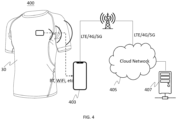
- the wearable stethoscope 400 includes a plurality of heart sound sensors and a system circuit board 203 (refer to FIG.s 2-3 ), which are integrated on the user's clothes 30, and can communicatively connect with mobile devices (such as, smart phone, tablet computer and other external electronic computing devices) 403.
- the heart sound data collected by the heart sound signal sensors of the wearable stethoscope 400 can be uploaded to the cloud server 407 by the mobile device 403 through wireless transmission (for example, wireless communication methods such as Bluetooth and WiFi) via cloud network 405.
- the collected heart sound data will be stored in the cloud data database.
- the above system also includes an application program installed in the mobile device, the application program includes instructions for receiving and sending data between the wearable stethoscope 400, the mobile device 403 and the cloud server 405.
- the application program can be operated based on the Android, Windows 10 or iOS operating system platform, and the collected data/signals, such as ECG signals, heart sound signals and their waveforms, can be uploaded to the cloud server 407 for storage, and the collected data/signals are analyzed, processed and cross-referenced with an existing database through data analysis and feature extraction algorithms to generate an evaluation report and provide medical advice accordingly.
- the collected data/signals such as ECG signals, heart sound signals and their waveforms
- the wearable device can detect the physiological condition of the patient and then make the most suitable processing and support, through real-time perception, and a large amount of data comparison and analysis, and subsequent summarization, interpretation and response.
- Smart medical care can be applied to physiological monitoring and general home health care.
- it can combine the software of smart phone and tablet computer to analyze and manage the collected physiological information (such as activity level, sleep quality, etc.), and at the same time interacts with the cooperated medical and nursing systems through wireless transmission to solve many difficulties faced by the present medical system.
Landscapes
- Health & Medical Sciences (AREA)
- Life Sciences & Earth Sciences (AREA)
- Engineering & Computer Science (AREA)
- Physics & Mathematics (AREA)
- Acoustics & Sound (AREA)
- Public Health (AREA)
- Surgery (AREA)
- Veterinary Medicine (AREA)
- General Health & Medical Sciences (AREA)
- Animal Behavior & Ethology (AREA)
- Biomedical Technology (AREA)
- Heart & Thoracic Surgery (AREA)
- Medical Informatics (AREA)
- Molecular Biology (AREA)
- Signal Processing (AREA)
- Pathology (AREA)
- Biophysics (AREA)
- Psychiatry (AREA)
- Artificial Intelligence (AREA)
- Computer Vision & Pattern Recognition (AREA)
- Physiology (AREA)
- Multimedia (AREA)
- Measuring Pulse, Heart Rate, Blood Pressure Or Blood Flow (AREA)
- Measuring And Recording Apparatus For Diagnosis (AREA)
Applications Claiming Priority (2)
| Application Number | Priority Date | Filing Date | Title |
|---|---|---|---|
| TW111213602U TWM640921U (zh) | 2022-12-08 | 2022-12-08 | 穿戴式聽診器 |
| TW111150605A TWI855485B (zh) | 2022-12-29 | 2022-12-29 | 穿戴式聽診器 |
Publications (1)
| Publication Number | Publication Date |
|---|---|
| EP4382050A1 true EP4382050A1 (fr) | 2024-06-12 |
Family
ID=91079185
Family Applications (1)
| Application Number | Title | Priority Date | Filing Date |
|---|---|---|---|
| EP23163007.0A Pending EP4382050A1 (fr) | 2022-12-08 | 2023-03-21 | Stethoscope portable |
Country Status (3)
| Country | Link |
|---|---|
| US (1) | US20240188923A1 (fr) |
| EP (1) | EP4382050A1 (fr) |
| JP (1) | JP7717763B2 (fr) |
Citations (4)
| Publication number | Priority date | Publication date | Assignee | Title |
|---|---|---|---|---|
| US20020124295A1 (en) * | 2000-10-30 | 2002-09-12 | Loel Fenwick | Clothing apparatus, carrier for a biophysical sensor, and patient alarm system |
| US20170180870A1 (en) * | 2015-12-18 | 2017-06-22 | International Business Machines Corporation | System for continuous monitoring of body sounds |
| WO2021222854A1 (fr) * | 2020-05-01 | 2021-11-04 | Reperio Health, Inc. | Systèmes portables de test de santé physique et dispositifs et procédés associés |
| WO2022177978A1 (fr) * | 2021-02-16 | 2022-08-25 | Mddriven Llc | Systèmes de détection et de surveillance physiologiques |
Family Cites Families (23)
| Publication number | Priority date | Publication date | Assignee | Title |
|---|---|---|---|---|
| JPS5641432Y2 (fr) * | 1975-09-11 | 1981-09-28 | ||
| JPS57160442A (en) * | 1981-03-26 | 1982-10-02 | Seikosha Kk | Stethoscope |
| US6661161B1 (en) * | 2002-06-27 | 2003-12-09 | Andromed Inc. | Piezoelectric biological sound monitor with printed circuit board |
| JP2004081250A (ja) * | 2002-08-22 | 2004-03-18 | Hitachi Maxell Ltd | 電子聴診器 |
| EP1880676A1 (fr) * | 2005-05-18 | 2008-01-23 | Takashi Yoshimine | Stethoscope |
| US7733224B2 (en) * | 2006-06-30 | 2010-06-08 | Bao Tran | Mesh network personal emergency response appliance |
| US8628478B2 (en) * | 2009-02-25 | 2014-01-14 | Empire Technology Development Llc | Microphone for remote health sensing |
| JP2013123493A (ja) * | 2011-12-13 | 2013-06-24 | Sharp Corp | 情報処理装置、聴診器、情報処理装置の制御方法、制御プログラムおよび記録媒体 |
| WO2013170018A1 (fr) * | 2012-05-11 | 2013-11-14 | 3M Innovative Properties Company | Capteur bioacoustique avec commande de vibrations sonores |
| TW201347728A (zh) * | 2012-05-17 | 2013-12-01 | Ind Tech Res Inst | 生理訊號感測結構及包括所述生理訊號感測結構的聽診器及其製造方法 |
| US11246213B2 (en) * | 2012-09-11 | 2022-02-08 | L.I.F.E. Corporation S.A. | Physiological monitoring garments |
| WO2017218857A1 (fr) * | 2016-06-15 | 2017-12-21 | Cvr Global, Inc. | Procédé de détection de blocage dans un vaisseau d'écoulement de fluide |
| US20180108440A1 (en) * | 2016-10-17 | 2018-04-19 | Jeffrey Stevens | Systems and methods for medical diagnosis and biomarker identification using physiological sensors and machine learning |
| JP7369702B2 (ja) * | 2018-03-06 | 2023-10-26 | コーニンクレッカ フィリップス エヌ ヴェ | 高周波胸壁オシレータ |
| US20210186368A1 (en) * | 2018-05-14 | 2021-06-24 | Respia Technologies Pty Ltd | Method and apparatus for determining potential onset of an acute medical condition |
| WO2020137212A1 (fr) * | 2018-12-26 | 2020-07-02 | 富士フイルム株式会社 | Stéthoscope et dispositif de dispositif électronique |
| CN109646042A (zh) * | 2019-01-29 | 2019-04-19 | 电子科技大学 | 一种基于压电传感器的可穿戴心音和肺音监测装置 |
| TW202110402A (zh) * | 2019-07-26 | 2021-03-16 | 日商富士軟片股份有限公司 | 聽診器 |
| EP4051119A4 (fr) * | 2019-10-29 | 2023-11-29 | Respiri Limited | Appareil de détection de bruits respiratoires |
| JP7367772B2 (ja) * | 2019-11-29 | 2023-10-24 | 株式会社村田製作所 | 生体音響センサおよびそれを備えた聴診器 |
| US11240579B2 (en) * | 2020-05-08 | 2022-02-01 | Level 42 Ai | Sensor systems and methods for characterizing health conditions |
| CN111544031A (zh) * | 2020-06-03 | 2020-08-18 | 华中科技大学同济医学院附属协和医院 | 一种呼吸音及肺部呼吸功能监测的电子听诊器及系统 |
| CN116867438A (zh) * | 2021-02-26 | 2023-10-10 | 富士胶片株式会社 | 电子听诊器 |
-
2023
- 2023-03-21 EP EP23163007.0A patent/EP4382050A1/fr active Pending
- 2023-03-30 US US18/128,238 patent/US20240188923A1/en active Pending
- 2023-07-28 JP JP2023123884A patent/JP7717763B2/ja active Active
Patent Citations (4)
| Publication number | Priority date | Publication date | Assignee | Title |
|---|---|---|---|---|
| US20020124295A1 (en) * | 2000-10-30 | 2002-09-12 | Loel Fenwick | Clothing apparatus, carrier for a biophysical sensor, and patient alarm system |
| US20170180870A1 (en) * | 2015-12-18 | 2017-06-22 | International Business Machines Corporation | System for continuous monitoring of body sounds |
| WO2021222854A1 (fr) * | 2020-05-01 | 2021-11-04 | Reperio Health, Inc. | Systèmes portables de test de santé physique et dispositifs et procédés associés |
| WO2022177978A1 (fr) * | 2021-02-16 | 2022-08-25 | Mddriven Llc | Systèmes de détection et de surveillance physiologiques |
Also Published As
| Publication number | Publication date |
|---|---|
| JP2024083227A (ja) | 2024-06-20 |
| JP7717763B2 (ja) | 2025-08-04 |
| US20240188923A1 (en) | 2024-06-13 |
Similar Documents
| Publication | Publication Date | Title |
|---|---|---|
| US12588822B2 (en) | Remote physiological monitor | |
| US9107586B2 (en) | Fitness monitoring | |
| US8369936B2 (en) | Wearable apparatus for measuring heart-related parameters and deriving human status parameters from sensed physiological and contextual parameters | |
| WO2016187536A1 (fr) | Dispositif de détection ultra-mince portable | |
| EP2583248A2 (fr) | Procédé et système de surveillance du sommeil et d'autres conditions physiologiques | |
| CN106943129A (zh) | 可穿戴的心率及呼吸监测装置、方法及其智能上衣 | |
| KR20250022006A (ko) | 심전도를 생성하기 위한 장치 | |
| TWM640921U (zh) | 穿戴式聽診器 | |
| Borges et al. | Overview of progress in Smart-Clothing project for health monitoring and sport applications | |
| TWI855485B (zh) | 穿戴式聽診器 | |
| CN111973164A (zh) | 智能可穿戴监测设备、系统及血压估算模型的训练方法 | |
| CN212630755U (zh) | 一种远程医疗监测救助平台 | |
| CN109480796A (zh) | 一种健康监测服装 | |
| EP4382050A1 (fr) | Stethoscope portable | |
| Suo et al. | Wearable Sensors for Vital Signs: A Review of 20 Years and Future Directions | |
| CN221671725U (zh) | 远程心电监护装置 | |
| RU2848456C2 (ru) | Система для дистанционного мониторинга жизненно важных показателей состояния здоровья человека | |
| US20250359767A1 (en) | Wearable Physiological Signal Sensing System | |
| US20220175291A1 (en) | Smart clothing for sensing heart physiological activities and lung respiratory conditions | |
| CN119055247A (zh) | 一种新型十二导联可穿戴心电监护衣 | |
| Burnham | Wearable Sensing Modalities for a Neck-Based Health Monitoring System |
Legal Events
| Date | Code | Title | Description |
|---|---|---|---|
| PUAI | Public reference made under article 153(3) epc to a published international application that has entered the european phase |
Free format text: ORIGINAL CODE: 0009012 |
|
| STAA | Information on the status of an ep patent application or granted ep patent |
Free format text: STATUS: REQUEST FOR EXAMINATION WAS MADE |
|
| 17P | Request for examination filed |
Effective date: 20230324 |
|
| AK | Designated contracting states |
Kind code of ref document: A1 Designated state(s): AL AT BE BG CH CY CZ DE DK EE ES FI FR GB GR HR HU IE IS IT LI LT LU LV MC ME MK MT NL NO PL PT RO RS SE SI SK SM TR |