EP4385367A1 - Coussin d'équilibrage de modules élastiques, coussin élastique et meuble - Google Patents
Coussin d'équilibrage de modules élastiques, coussin élastique et meuble Download PDFInfo
- Publication number
- EP4385367A1 EP4385367A1 EP22855326.9A EP22855326A EP4385367A1 EP 4385367 A1 EP4385367 A1 EP 4385367A1 EP 22855326 A EP22855326 A EP 22855326A EP 4385367 A1 EP4385367 A1 EP 4385367A1
- Authority
- EP
- European Patent Office
- Prior art keywords
- elastic
- pad
- limit
- base plate
- limit bosses
- Prior art date
- Legal status (The legal status is an assumption and is not a legal conclusion. Google has not performed a legal analysis and makes no representation as to the accuracy of the status listed.)
- Pending
Links
Images


Classifications
-
- A—HUMAN NECESSITIES
- A47—FURNITURE; DOMESTIC ARTICLES OR APPLIANCES; COFFEE MILLS; SPICE MILLS; SUCTION CLEANERS IN GENERAL
- A47C—CHAIRS; SOFAS; BEDS
- A47C27/00—Spring, stuffed or fluid mattresses or cushions specially adapted for chairs, beds or sofas
- A47C27/04—Spring, stuffed or fluid mattresses or cushions specially adapted for chairs, beds or sofas with spring inlays
- A47C27/06—Spring inlays or spring units therefor
- A47C27/07—Attaching, or interconnecting of, springs in spring inlays
-
- A—HUMAN NECESSITIES
- A47—FURNITURE; DOMESTIC ARTICLES OR APPLIANCES; COFFEE MILLS; SPICE MILLS; SUCTION CLEANERS IN GENERAL
- A47C—CHAIRS; SOFAS; BEDS
- A47C23/00—Spring mattresses with rigid frame or forming part of the bedstead, e.g. box springs; Divan bases; Slatted bed bases
- A47C23/002—Spring mattresses with rigid frame or forming part of the bedstead, e.g. box springs; Divan bases; Slatted bed bases with separate resilient support elements, e.g. elastomeric springs arranged in a two-dimensional matrix pattern
-
- A—HUMAN NECESSITIES
- A47—FURNITURE; DOMESTIC ARTICLES OR APPLIANCES; COFFEE MILLS; SPICE MILLS; SUCTION CLEANERS IN GENERAL
- A47C—CHAIRS; SOFAS; BEDS
- A47C27/00—Spring, stuffed or fluid mattresses or cushions specially adapted for chairs, beds or sofas
- A47C27/04—Spring, stuffed or fluid mattresses or cushions specially adapted for chairs, beds or sofas with spring inlays
- A47C27/06—Spring inlays or spring units therefor
- A47C27/063—Spring inlays or spring units therefor wrapped or otherwise protected
-
- A—HUMAN NECESSITIES
- A47—FURNITURE; DOMESTIC ARTICLES OR APPLIANCES; COFFEE MILLS; SPICE MILLS; SUCTION CLEANERS IN GENERAL
- A47C—CHAIRS; SOFAS; BEDS
- A47C27/00—Spring, stuffed or fluid mattresses or cushions specially adapted for chairs, beds or sofas
- A47C27/04—Spring, stuffed or fluid mattresses or cushions specially adapted for chairs, beds or sofas with spring inlays
- A47C27/06—Spring inlays or spring units therefor
- A47C27/065—Spring inlays or spring units therefor of special shape
Definitions
- the present disclosure relates to the field of furniture, and particularly to a balancing pad in use with elastic modules, and an elastic pad and a furniture comprising the same.
- Furniture such as beds is an indispensable object in people's life. Most of the conventional large-sized furniture is not easily disassembled or not easily restored after disassembly. However, with the development of modern life, it is required furniture especially such as beds are able to be disassembled and assembled more and more frequently to meet the needs of population migration and field leisure. During transportation, it is very difficult to disassemble and assemble the beds, resulting in that the beds which are still in use are sometimes discarded to reduce the transportation burden.
- a bed normally consists of a bed frame, an elastic pad, and an outer cover.
- a conventional elastic pad is usually one-piece, non-detachable and integral pad formed from a plurality of superimposed layers and springs.
- the integral pad is large in size and is not easy to be disassembled and stored.
- a conventional separately-pocketed spring mattress is intended to avoid two or more people lying in bed at the same time from affecting each other (e.g., if a weight difference between individuals is relatively large, one of them will inevitably affect the other when turning over or moving the body).
- each spring is individually packaged in a pocket or sleeve made of a nonwoven fabric or other material.
- the spring pockets are arranged in a pattern and then the outside of the arranged set of spring pockets is covered by a whole piece of foam rubber by adhesion, gluing or the like to form a furniture pad or a desired elastic pad in the form of the furniture pad.
- the separately-pocketed spring mattress is still an integral product that cannot be disassembled and is not easily transported.
- non-woven fabrics used for wrapping the pocketed springs are adhered to each other, and when the mattress is pressed, the plurality of pocketed springs cannot move up and down separately, thereby affecting the comfort of the mattress.
- the conventional mattresses also have a disadvantage that they are not easy to clean.
- the outer cover is often removable, and the sponge portion cannot be removed and not easily cleaned.
- the sponge portion that is not easily cleaned might cause a large hygienic hazard.
- one of the objects of the present disclosure is to enable an elastic pad to have better comfort.
- the present disclosure provides a balancing pad in use with elastic modules, comprising a base plate and a plurality of limit bosses arranged to space apart from each other on and protrude from a plate surface of the base plate, wherein the plurality of limit bosses form a plurality of receiving spaces spaced apart from each other, and each of the plurality of receiving spaces is configured to receive a corresponding elastic module of an elastic base pad so as to constrain a movement of the corresponding elastic module in a transverse direction of the base plate.
- the plurality of limit bosses are arranged to space apart from each other on and protrude from a plate surface of the base plate, and the plurality of limit bosses form the plurality of receiving spaces spaced apart from each other, and each of the plurality of receiving spaces can receive a corresponding elastic module of the elastic base pad so as to constrain the movement of the elastic modules in the transverse direction of the base plate.
- the balancing pad in use with the elastic modules may be laid on the elastic base pad having the plurality of elastic modules, and a portion of the elastic modules may be received in the respective receiving spaces.
- the limit bosses may effectively constrain the movement of the elastic modules in the transverse direction (i.e., in a direction parallel to the base plate), so as to effectively prevent the elastic modules from tilting as receiving a force, thereby effectively maintaining the support stability of the elastic modules. Therefore, when laid on the elastic base pad, the balancing pad in use with the elastic modules can constrain the movement of the respective elastic modules in the transverse direction, thereby effectively improving the stability of the elastic pad when being subjected to a pressure. As such, the elastic pad according to the disclosure may have better comfort.
- a cross-sectional size of each of the plurality of limit bosses is gradually reduced in a direction away from the base plate so that an inner size of the receiving space is gradually reduced in a direction closer to the base plate.
- each of the plurality of limit bosses is formed as a truncated body.
- the based plate is made of flexible material.
- each of the plurality of limit bosses is made of elastic material and formed as an elastic body.
- the elastic body comprises a flexible outer sleeve and an elastic member disposed within the flexible outer sleeve, wherein one end of the flexible outer sleeve is connected to the base plate, and the other end of the flexible outer sleeve extends away from the base plate.
- the flexible outer sleeve and the base plate are formed from the same material.
- the flexible outer sleeve is a nonwoven fabric sleeve
- the base plate is a nonwoven fabric plate
- one end of the elastic member is connected to the plate surface of the base plate, and the other end of the elastic member is connected to an end cap at an end of the flexible outer sleeve far away from the plate surface so that the elastic member is in a pre-compressed state.
- an outer peripheral profile of the elastic member is pressed against an inner peripheral surface of the outer sleeve.
- the elastic member is a spring.
- the plurality of limit bosses comprise a plurality of first limit bosses and a plurality of second limit bosses, wherein each of the receiving spaces is surrounded by the plurality of first limit bosses and the plurality of second limit bosses arranged alternately in sequence, wherein each of the first limit bosses is surrounded by the second limit bosses of surrounding receiving spaces.
- a plurality of first-row limit bosses and second-row limit bosses arranged alternately in sequence are provided on a plate surface of the base plate, wherein each row of the first-row limit bosses comprises a plurality of first limit bosses and second limit bosses adjacent alternately in sequence in the row direction; each row of the second-row limit bosses comprises a plurality of second limit bosses arranged apart from each other at an interval in the row direction, the interval being one said second limit boss; wherein each second limit boss in each row of said second-row limit bosses is aligned with each said first limit boss of an adjacent row in a column-wise direction, such that the interval serves as the receiving space.
- the present disclosure provides an elastic pad comprising an elastic base pad and a balancing pad according to the above-described embodiments, wherein the elastic base pad comprises a plurality of elastic modules, wherein the balancing pad is laid on the elastic based pad, and the plurality of elastic modules are received in the respective receiving spaces, and wherein the limit bosses can constrain movement of the elastic modules in a transverse direction.
- the balancing pad constrains the movement of the elastic modules in the transverse direction when laid on the elastic base pad, the stability of the elastic pad when subjected to a pressure can be effectively improved so that the elastic pad exhibit better comfort.
- the elastic module is formed in a truncated cone shape and is made to contact at least one limit boss in a form of a truncated cone.
- the elastic pad further comprises a flexible pad and an outer cover, wherein the flexible pad is laid on the base plate, and the outer cover covers the flexible pad and wraps around the balancing pad, the flexible pad and at least a part of the elastic base pad.
- the present disclosure provides a furniture comprising the above-described elastic pad. As stated above, the comfort of the furniture is significantly improved.
- the furniture includes, but is not limited to, mattresses, sofas, chairs, sofa beds, soft-packaged benches, and the like.
- FIG. 1, FIG. 2 and FIG. 3 schematically illustrate a balancing pad 13 in use with elastic modules according to a preferred embodiment of the present disclosure.
- the balancing pad 13 provided by the disclosure comprises a base plate 1 and a plurality of limit bosses 2, wherein the plurality of limit bosses 2 are arranged to space apart from each other on and protrude from a plate surface of the base plate 1, for example, the base plate 1 comprises a first plate surface and a second plate surface which are opposite in a thickness direction of the base plate, the plurality of limit bosses 2 are arranged on the first plate surface and extend away from the base plate 1, the plurality of limit bosses 2 form a plurality of receiving spaces 5 spaced apart from each other, and each of the plurality of receiving space 5 is configured to receive corresponding elastic modules 4 of an elastic base pad 3 so as to constrain the movement of the corresponding elastic modules 4 in a transverse direction of the base plate.
- the plurality of limit bosses 2 are arranged to space apart from each other on and protrude from a plate surface of the base plate 1, and the plurality of limit bosses 2 form the plurality of receiving spaces 5 spaced apart from each other, and the plurality of receiving spaces 5 can receive corresponding elastic modules 4 of the elastic base pad 3 so as to constrain the movement of the corresponding elastic modules 4 in the transverse direction of the base plate 1.
- the balancing pad 13 may be laid on the elastic base pad 3 having the plurality of elastic modules 4, and a portion of the elastic modules 4 may be received in the respective corresponding receiving space 5.
- the limit bosses 2 may effectively constrain the movement of the elastic modules 4 in the transverse direction (i.e., in a direction parallel to the base plate 1), so as to effectively prevent the elastic modules 4 from tilting as receiving a force, thereby effectively maintaining the support stability of the elastic modules 4. Therefore, when laid on the elastic base pad 3, the balancing pad 13 constrains the movement of the respective elastic modules 4 in the transverse direction, thereby effectively improving the stability of the elastic pad 12 when being subjected to a pressure, so that the elastic pad 12 has better comfort.
- the balancing pad may be used to make elastic pads for furniture.
- the limit bosses 2 may be connected on the plate surface on one side of the base plate 1 by adhesion, ultrasonic welding, loop-and-hook connection or in other manners.
- the number of limit bosses 2 may be determined according to the number of elastic modules 4, and therefore, the present disclosure does not limit the specific number of limit bosses 2.
- the limit bosses 2 protrude from the plate surface on one side of the base plate 1
- sizes of cross-sections of the limit bosses 2 may be the same in the protruding direction, so that an internal transverse dimension of the receiving spaces 5 may be made the same in the protruding direction, so that a portion of the elastic modules 4 may abut against the base plate 1 after entering the receiving space 5.
- the cross-sectional size of the limit boss 2 may be stepped in the protruding direction, so that a stop step may be formed in the receiving space 5. As such, a portion of the elastic module 4 may abut against the stop step after entering the receiving space 5.
- FIG. 1 FIG. 1, FIG.
- the cross-sectional size of each of the limit bosses 2 is gradually reduced in a direction away from the base plate 1 (in the protruding direction).
- the limit boss 2 may be formed as a frustum so that the inner size of the receiving space 5 is gradually reduced in a direction closer to the base plate 1, and a portion of the elastic module 4 may abut against a tapered outer peripheral surface of the frustum after entering into the receiving space 5.
- the elastic module 4 may be formed as a frustum body whose conical surface slope may be the same as the conical surface slope of the frustum, so that a portion of the frustum body may form a conical surface fit with the frustum in the receiving space 5 in a form-fitting manner, a portion of the elastic module 4 may be more stably and reliably received in the receiving space 5, and the balancing pad 13 provides a more stable and reliable constraint for the elastic module 4.
- the limit boss 2 when the limit boss 2 is formed as a frustum, the frustum may have a variety of shapes, for example, the frustum may be a polygonal frustum such as a quadrangular frustum.
- the limit boss 2 is formed as a truncated cone.
- the elastic module 4 may be formed as a truncated cone. As such, referring to FIG. 2 , FIG. 4 , FIG. 6, FIG. 7 and FIG.
- the conical surface of the truncated cone will form a conical surface fit with conical surfaces of the surrounding truncated cones.
- the conical surface fitting may not only limits the elastic module 4 in the transverse direction as well as the protruding direction (a direction perpendicular to the transverse direction), so that the elastic module 4 may be constrained more stably and reliably.
- the base plate 1 may not deform when the elastic pad is subjected to a pressure
- the base plate 1 may be a plastic plate having a predetermined thickness
- the base plate 1 is made of a flexible material, so that the base plate 1 is formed as a flexible body, that is, when the elastic pad is subjected to a pressure, the base plate 1 will flexibly deform to provide buffering, thereby further enabling the limit bosses to constrain the movement of the elastic modules 4 in the transverse direction, and effectively improving the stability of the elastic pad 12 when subjected to a pressure, so that the elastic pad 12 presents better comfort.
- the base plate 1 may be a plastic cloth having a predetermined thickness, or may be a silica gel pad, or may be a cloth layer.
- the base plate 1 may be a single layer or may be multiple layers which are sequentially laminated and connected.
- the base plate 1 when it is a cloth layer, it may include a single layer of canvas, or may include multiple layers of non-woven fabrics which are sequentially stacked. The multiple cloth layers may be joined together by an adhesive or ultrasonic welding.
- the limit boss 2 may not elastically deform when the elastic pad is pressed, for example, the limit boss 2 may be a plastic truncated cone.
- the limit boss 2 is made of an elastic material such that the limit boss 2 is formed as an elastic body. In this way, after the balancing pad is laid on the elastic base pad 3 to form the elastic pad 12, when the elastic pad is subjected to a pressure, the elastic module 4 will be correspondingly compressed to provide support.
- the elastic body will elastically deform to a certain degree to provide buffering, thereby further constraining the movement of the elastic modules 4 in the transverse direction, and effectively improving the stability of the elastic pad 12 when subjected to a pressure. Therefore, the elastic pad 12 presents better comfort.
- the elastic body may be of various types, for example, one type of elastic body may be a silica colloid, or another type of elastic body may be a sponge, for example, a sponge with a high elasticity.
- the sponge is easy to shape into a desired shape, low in cost, and easy to breathe.
- the elastic body may include a flexible outer sleeve 6 and an elastic member 7 disposed within the flexible outer sleeve 6.
- One end of the flexible outer sleeve 6 is connected to the base plate 1 and the other end of the flexible outer sleeve 6 extends away from the base plate 1.
- the flexible outer sleeve 6 can flexibly deform and can increase a contact area with the elastic module 4, thereby better limiting the movement of the elastic module 4 in the transverse direction.
- the elastic module 4 will be correspondingly compressed to provide support.
- the elastic member 7 elastically deforms to a certain degree and causes the flexible outer sleeve 6 to elastically deform to provide buffering, thereby further constraining the movement of the elastic modules 4 in the transverse direction, and effectively improving the stability of the elastic pad 12 when subjected to a pressure. Therefore, the elastic pad 12 presents better comfort.
- the flexible outer sleeve 6 and the base plate 1 may be formed from different materials.
- the flexible outer sleeve 6 may be formed of a plastic cloth and the base plate 1 may be formed of a silicone pad.
- the flexible outer sleeve 6 and the base plate 1 are formed from the same material. In this way, being made from the same material, the flexible outer sleeve 6 and the base plate 1 may be connected easily, and the cost may be reduced.
- the flexible outer sleeve 6 is a non-woven fabric sleeve
- the base plate 1 is a non-woven fabric plate
- the non-woven fabric sleeve and the non-woven fabric plate may be connected by sewing, adhesion or ultrasonic welding.
- the nonwoven fabric may enable the balancing pad to have good resistance against moisture and air permeability, and the nonwoven fabric may make the balancing pad more flexible and lighter, which can further enhance the comfort of the elastic pad.
- the elastic member 7 may be in a natural state within the flexible outer sleeve 6 when not subjected to a pressure.
- one end of the elastic member 7 is connected to the plate surface of the base plate 1, and the other end of the elastic member 7 is connected to an end cap at an end of the flexible outer sleeve 6 far away from the plate surface so that the elastic member 7 is in a pre-compressed state.
- the elastic member 7 may be made in a pre-compressed state while itself has a certain elastic strength.
- better elastic limitation may be further provided to the elastic modules 4.
- an outer peripheral profile of the elastic member 7 wrapped within the flexible outer sleeve 6 may keep a gap with a side sleeve wall of the flexible outer sleeve 6.
- the outer peripheral profile of the elastic member 7 is pressed against an inner peripheral surface of the outer sleeve.
- the elastic member 7, e.g., the elastic member 7 in the pre-compressed state may make the flexible outer sleeve 6 in a tensioned state, such that the outer peripheral surface of the flexible outer sleeve 6 can better contact with the elastic modules 4 to better limit the elastic modules 4 in the transverse direction.
- the elastic member 7 may be of various types, for example, in some embodiments, the elastic member 7 may be a silicone body such as a silicone truncated cone. Alternatively, in other embodiments, the elastic member 7 is a spring that provides good pre-compression strength and transverse limitation.
- the spring may be an equal-diameter spring, or may be a truncated cone-shaped spring as shown in FIG. 3 .
- the flexible outer sleeve 6 made of a non-woven fabric may be truncated cone-shaped, thereby forming the limit boss 2 as a truncated cone body.
- each receiving space 5 may be enclosed by independent limit bosses 2 which are not shared by other receiving spaces.
- adjacent receiving spaces 5 may share some limit bosses 2.
- the limit boss 2 may comprise a plurality of first limit bosses 8 and a plurality of second limit bosses 9, wherein each receiving space 5 is surrounded by the plurality of first limit bosses 8 and the plurality of second limit bosses 9 arranged alternately in sequence, wherein each of the first limit bosses 8 is surrounded by the second limit bosses 9 of the surrounding multiple receiving spaces 5.
- each first limit boss 8, while used to enclose the receiving space 5, is also enclosed at a center by the surrounding second limit bosses 9, so that each first limit boss 8 may limit the surrounding second limit bosses 9 in the transverse direction, thereby enabling the second limit bosses 9 to more stably and reliably constrain the elastic module 4 entering the receiving space 5 in the transverse direction.
- the plurality of first limit bosses 8 and the plurality of second limit bosses 9 may not be arranged in rows and columns on the base plate 1.
- a plurality of first-row limit bosses 10 and second-row limit bosses 11 arranged alternately in sequence are provided on a plate surface on one side of the base plate 1, wherein each row of the first-row limit bosses 10 comprises a plurality of first limit bosses 8 and second limit bosses 9 adjacent alternately in sequence in the row direction; each row of the second-row limit boss 11 comprises a plurality of second limit bosses 9 arranged apart from each other at an interval in the row direction, the interval being one second limit boss 9; wherein each second limit boss 9 in each row of second-row limit bosses 11 is aligned with each first limit boss 8 of an adjacent row in a columnwise direction such that the interval serves as the receiving space 5.
- first limit bosses 8 and four second limit bosses 9 are squarely arranged to together enclose a receiving space 5, the four first limit bosses 8 are respectively at four corner positions, and the first limit boss 8 at each corner position is enclosed in the middle by the four second limit bosses 9 of surrounding receiving spaces 5, so that adjacent receiving spaces 5 can share some of the first limit bosses 8 and the second limit bosses 9, thereby better constraining the movement of the elastic modules 4 in the transverse direction by virtue of such a constraining structure between the limit bosses.
- the present disclosure provides an elastic pad 12 including an elastic base pad 3 and the above-described balancing pad 13, wherein the elastic base pad 3 comprises a plurality of elastic modules 4, wherein the balancing pad 13 is laid on the elastic based pad 3, and the plurality of elastic modules 4 are received in respective receiving spaces 5, and wherein the limit bosses can constrain movement of the elastic modules 4 in the transverse direction.
- the balancing pad constrains the movement of the elastic modules in the transverse direction when laid on the elastic base pad, the stability of the elastic pad when subjected to a pressure can be effectively improved so that the elastic pad exhibit better comfort.
- the elastic module 4 may be of various types, for example, the elastic module 4 may be a column-shaped elastic block such as a rubber block.
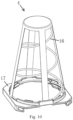
- the elastic module 4 may include a spring bracket 17 and a conical spring 16 disposed in the spring bracket 17.
- the elastic based pad 4 may include a foldable mounting support, the elastic bracket 17 is used to detachably mount the elastic module 4 to the foldable mounting support.
- a plurality of elastic modules 4 may be mounted to the foldable mounting supports by means of respective spring brackets 17, and then the balancing pad 13 may be laid on the elastic modules 4 so that a portion of each elastic module 4 enters and gets positioned in the corresponding receiving space 5.
- the balancing pad 13 Upon disassembly, the balancing pad 13 is removed, and then the elastic modules 4 are removed from the foldable mounting supports and sequentially nested and stacked together, and then the foldable mounting supports are folded. Therefore, the elastic pad 12 can be easily detached, and the removed elastic modules can be compressed or stacked and nested together, thereby greatly saving the storage and transportation space, and facilitating cleaning.
- the elastic pad further includes a flexible pad 14 and an outer cover 15, wherein the flexible pad 14 is laid on the base plate 1, and the outer cover 15 covers the flexible pad 14 and wraps around the balancing pad 13, the flexible pad 14 and at least a part of the elastic base pad 3.
- the outer cover 15 may wrap the elastic base pad 3 and the balancing pad 13 entirely, thereby enhancing the aesthetic appearance of the elastic pad 12.
- the outer cover 15 may enclose at least a portion of the elastic base pad 3 and the balancing pad 13 by a removable connection structure such as a zipper or a loop-and-hook.
- the flexible pad 14 may be a silicone pad or a cotton pad or a sponge pad such as a highly elastic sponge pad, or may be a flexible pad of other materials.
- the present disclosure provides a furniture comprising the above-described elastic pad 12. As stated above, the comfort of the furniture is significantly improved.
- Such furniture includes, but is not limited to, mattresses, sofas, chairs, sofa beds, soft-packaged benches, and the like.
Landscapes
- Mattresses And Other Support Structures For Chairs And Beds (AREA)
- Vibration Prevention Devices (AREA)
Applications Claiming Priority (2)
| Application Number | Priority Date | Filing Date | Title |
|---|---|---|---|
| CN202110925502.5A CN115191785B (zh) | 2021-08-12 | 2021-08-12 | 弹性模块平衡垫、弹性垫和家具 |
| PCT/CN2022/110296 WO2023016343A1 (fr) | 2021-08-12 | 2022-08-04 | Coussin d'équilibrage de modules élastiques, coussin élastique et meuble |
Publications (2)
| Publication Number | Publication Date |
|---|---|
| EP4385367A1 true EP4385367A1 (fr) | 2024-06-19 |
| EP4385367A4 EP4385367A4 (fr) | 2025-07-23 |
Family
ID=83573891
Family Applications (1)
| Application Number | Title | Priority Date | Filing Date |
|---|---|---|---|
| EP22855326.9A Pending EP4385367A4 (fr) | 2021-08-12 | 2022-08-04 | Coussin d'équilibrage de modules élastiques, coussin élastique et meuble |
Country Status (5)
| Country | Link |
|---|---|
| US (1) | US20240349904A1 (fr) |
| EP (1) | EP4385367A4 (fr) |
| JP (1) | JP7739594B2 (fr) |
| CN (1) | CN115191785B (fr) |
| WO (1) | WO2023016343A1 (fr) |
Families Citing this family (11)
| Publication number | Priority date | Publication date | Assignee | Title |
|---|---|---|---|---|
| SE544841C2 (en) * | 2021-01-22 | 2022-12-13 | Ikea Supply Ag | Mattress spring core arranged with spring pockets allowing improved shape and size stability |
| WO2023241038A1 (fr) | 2022-06-17 | 2023-12-21 | 冷鹭浩 | Coussin élastique, procédé d'assemblage de coussin élastique et meuble |
| CN115670171B (zh) | 2022-10-24 | 2025-09-26 | 厦门新技术集成有限公司 | 弹性模块单元、弹性垫和家具 |
| CN115717465A (zh) * | 2022-12-02 | 2023-02-28 | 福建思嘉环保材料科技有限公司 | 一种基于高阻燃陶土复合材料的环保运动地板 |
| CN115844162B (zh) * | 2022-12-19 | 2025-04-08 | 厦门新技术集成有限公司 | 弹性支撑组件、弹性垫及其组装方法和家具 |
| CN118285644B (zh) | 2023-01-04 | 2026-07-10 | 厦门新技术集成有限公司 | 罩盖、弹性垫和家具 |
| CN116172360B (zh) * | 2023-01-31 | 2025-12-09 | 厦门新技术集成有限公司 | 弹性垫及用于弹性垫的弹性组件 |
| CN116473388B (zh) * | 2023-01-31 | 2026-01-23 | 厦门新技术集成有限公司 | 弹性垫 |
| CN116250695A (zh) * | 2023-03-23 | 2023-06-13 | 厦门新技术集成有限公司 | 一种弹性单元、弹性模组及弹性垫 |
| CN116763095A (zh) * | 2023-05-05 | 2023-09-19 | 厦门新技术集成有限公司 | 一种平衡板及带平衡板的柔性垫 |
| CN121337143A (zh) * | 2024-07-16 | 2026-01-16 | 厦门新技术集成有限公司 | 一种浮动床 |
Family Cites Families (19)
| Publication number | Priority date | Publication date | Assignee | Title |
|---|---|---|---|---|
| JP3553346B2 (ja) * | 1997-10-30 | 2004-08-11 | ドリームベッド株式会社 | アサガオスプリングからなるポケットコイル構造体 |
| JP2004041602A (ja) * | 2002-07-16 | 2004-02-12 | Smc Japan:Kk | 椅子等のクッションばねユニット |
| JP5339590B2 (ja) * | 2008-11-07 | 2013-11-13 | フランスベッド株式会社 | マットレス装置 |
| JP5227243B2 (ja) * | 2009-04-23 | 2013-07-03 | 株式会社ニトリホールディングス | マットレス |
| CN105377082A (zh) * | 2013-03-14 | 2016-03-02 | 丝涟科技有限责任公司 | 具有交替线圈弹簧取向的被包装的非对称线圈内装弹簧 |
| EP2801297A1 (fr) * | 2013-05-08 | 2014-11-12 | You Bed AB | Dispositif de meuble avec fermeté réglable |
| CN203555438U (zh) * | 2013-11-13 | 2014-04-23 | 覃启军 | 一种弹簧床垫的弹簧垫芯结构 |
| CN204169490U (zh) * | 2014-10-26 | 2015-02-25 | 李海仁 | 一种弹性竹木床垫 |
| CN205457541U (zh) * | 2016-02-02 | 2016-08-17 | 福建省泉州大富豪家具有限公司 | 水疗床垫 |
| CN205903086U (zh) * | 2016-04-07 | 2017-01-25 | 普悠思玛国际有限公司 | 弹性床垫 |
| CN206933850U (zh) * | 2016-10-25 | 2018-01-30 | 长沙华嵘环境科技有限公司 | 床垫 |
| CN207220572U (zh) * | 2017-03-16 | 2018-04-13 | 长沙华嵘环境科技有限公司 | 床垫 |
| US10334958B2 (en) * | 2017-05-09 | 2019-07-02 | L&P Property Management Company | Glueless pocketed spring assembly with improved airflow |
| US10881217B2 (en) * | 2017-07-28 | 2021-01-05 | Purple Innovation, Llc | Mattresses including spacer fabric and related methods |
| CN208692681U (zh) * | 2017-08-14 | 2019-04-05 | 安吉万昌家具有限公司 | 一种透气散热弹簧床垫 |
| CN208709092U (zh) * | 2017-12-07 | 2019-04-09 | 广州市联柔机械设备有限公司 | 一种带柔软垫层的袋装弹簧及袋装弹簧床芯 |
| CN112674538A (zh) * | 2019-10-17 | 2021-04-20 | 厦门新技术集成有限公司 | 用于家具的弹性模块和弹性垫 |
| CN212698296U (zh) * | 2020-08-10 | 2021-03-16 | 合肥皖宝集团床垫有限公司 | 一种弹力可调节的无弹簧床垫结构 |
| CN213757509U (zh) * | 2020-12-24 | 2021-07-23 | 喜临门家具股份有限公司 | 一种使用体验好的床垫 |
-
2021
- 2021-08-12 CN CN202110925502.5A patent/CN115191785B/zh active Active
-
2022
- 2022-08-04 WO PCT/CN2022/110296 patent/WO2023016343A1/fr not_active Ceased
- 2022-08-04 EP EP22855326.9A patent/EP4385367A4/fr active Pending
- 2022-08-04 JP JP2024507900A patent/JP7739594B2/ja active Active
- 2022-08-04 US US18/682,846 patent/US20240349904A1/en active Pending
Also Published As
| Publication number | Publication date |
|---|---|
| JP2024529551A (ja) | 2024-08-06 |
| US20240349904A1 (en) | 2024-10-24 |
| CN115191785A (zh) | 2022-10-18 |
| EP4385367A4 (fr) | 2025-07-23 |
| CN115191785B (zh) | 2023-08-11 |
| WO2023016343A1 (fr) | 2023-02-16 |
| JP7739594B2 (ja) | 2025-09-16 |
Similar Documents
| Publication | Publication Date | Title |
|---|---|---|
| US20240349904A1 (en) | Elastic module balance cushion, elastic cushion, and furniture | |
| EP4385366A1 (fr) | Coussin d'équilibrage de module élastique, coussin élastique et meuble | |
| US20240423383A1 (en) | Elastic module, elastic mattress and furniture | |
| US20240285089A1 (en) | Elastic module and elastic mattress | |
| CN215533110U (zh) | 弹性模块平衡垫、弹性垫和家具 | |
| EP4385368A1 (fr) | Coussin d'équilibrage de module élastique, coussin élastique et meuble | |
| KR20250068656A (ko) | 탄성 모듈 유닛, 탄성 쿠션 및 가구 | |
| CN101568281A (zh) | 床垫 | |
| CN116250695A (zh) | 一种弹性单元、弹性模组及弹性垫 | |
| US20250024959A1 (en) | Elastic support module, elastic pad, and furniture | |
| JP6614613B2 (ja) | 敷きパッド | |
| JP2024530319A (ja) | 弾性クッション、側方包囲部材、弾性クッション層及び家具 | |
| KR102366492B1 (ko) | 접이식 매트리스 | |
| KR200479160Y1 (ko) | 퍼즐 조립식 매트리스 | |
| AU2013213967B2 (en) | A tie arrangement | |
| JP2024529780A (ja) | 弾性クッションと家具 | |
| JP2025530842A (ja) | 支持アンダーレイと弾性クッションと家具 | |
| CN218551890U (zh) | 平衡垫、弹性垫和家具 | |
| KR101046760B1 (ko) | 4면지퍼로 탈부착 가능한 필로우탑 | |
| CN120345786A (zh) | 一种具有弹簧骨架的可压缩坐具 | |
| US20110296616A1 (en) | Cushion with a stiffening insert |
Legal Events
| Date | Code | Title | Description |
|---|---|---|---|
| STAA | Information on the status of an ep patent application or granted ep patent |
Free format text: STATUS: THE INTERNATIONAL PUBLICATION HAS BEEN MADE |
|
| PUAI | Public reference made under article 153(3) epc to a published international application that has entered the european phase |
Free format text: ORIGINAL CODE: 0009012 |
|
| STAA | Information on the status of an ep patent application or granted ep patent |
Free format text: STATUS: REQUEST FOR EXAMINATION WAS MADE |
|
| 17P | Request for examination filed |
Effective date: 20240306 |
|
| AK | Designated contracting states |
Kind code of ref document: A1 Designated state(s): AL AT BE BG CH CY CZ DE DK EE ES FI FR GB GR HR HU IE IS IT LI LT LU LV MC MK MT NL NO PL PT RO RS SE SI SK SM TR |
|
| DAV | Request for validation of the european patent (deleted) | ||
| DAX | Request for extension of the european patent (deleted) | ||
| A4 | Supplementary search report drawn up and despatched |
Effective date: 20250620 |
|
| RIC1 | Information provided on ipc code assigned before grant |
Ipc: A47C 27/05 20060101AFI20250613BHEP Ipc: A47C 23/00 20060101ALI20250613BHEP Ipc: A47C 27/06 20060101ALI20250613BHEP Ipc: A47C 27/07 20060101ALI20250613BHEP |
|
| STAA | Information on the status of an ep patent application or granted ep patent |
Free format text: STATUS: EXAMINATION IS IN PROGRESS |
|
| 17Q | First examination report despatched |
Effective date: 20251208 |