EP4388877A1 - Micro-organisme capable de former un biofilm métabolique et ses procédés de production et d'utilisation - Google Patents
Micro-organisme capable de former un biofilm métabolique et ses procédés de production et d'utilisation Download PDFInfo
- Publication number
- EP4388877A1 EP4388877A1 EP22216428.7A EP22216428A EP4388877A1 EP 4388877 A1 EP4388877 A1 EP 4388877A1 EP 22216428 A EP22216428 A EP 22216428A EP 4388877 A1 EP4388877 A1 EP 4388877A1
- Authority
- EP
- European Patent Office
- Prior art keywords
- microorganism
- spore
- biofilm
- metabolic
- bacillus
- Prior art date
- Legal status (The legal status is an assumption and is not a legal conclusion. Google has not performed a legal analysis and makes no representation as to the accuracy of the status listed.)
- Withdrawn
Links
Images
Classifications
-
- A—HUMAN NECESSITIES
- A01—AGRICULTURE; FORESTRY; ANIMAL HUSBANDRY; HUNTING; TRAPPING; FISHING
- A01N—PRESERVATION OF BODIES OF HUMANS OR ANIMALS OR PLANTS OR PARTS THEREOF; BIOCIDES, e.g. AS DISINFECTANTS, AS PESTICIDES OR AS HERBICIDES; PEST REPELLANTS OR ATTRACTANTS; PLANT GROWTH REGULATORS
- A01N63/00—Biocides, pest repellants or attractants, or plant growth regulators containing microorganisms, viruses, microbial fungi, animals or substances produced by, or obtained from, microorganisms, viruses, microbial fungi or animals, e.g. enzymes or fermentates
- A01N63/20—Bacteria; Substances produced thereby or obtained therefrom
-
- A—HUMAN NECESSITIES
- A01—AGRICULTURE; FORESTRY; ANIMAL HUSBANDRY; HUNTING; TRAPPING; FISHING
- A01N—PRESERVATION OF BODIES OF HUMANS OR ANIMALS OR PLANTS OR PARTS THEREOF; BIOCIDES, e.g. AS DISINFECTANTS, AS PESTICIDES OR AS HERBICIDES; PEST REPELLANTS OR ATTRACTANTS; PLANT GROWTH REGULATORS
- A01N63/00—Biocides, pest repellants or attractants, or plant growth regulators containing microorganisms, viruses, microbial fungi, animals or substances produced by, or obtained from, microorganisms, viruses, microbial fungi or animals, e.g. enzymes or fermentates
- A01N63/20—Bacteria; Substances produced thereby or obtained therefrom
- A01N63/22—Bacillus
-
- A—HUMAN NECESSITIES
- A01—AGRICULTURE; FORESTRY; ANIMAL HUSBANDRY; HUNTING; TRAPPING; FISHING
- A01P—BIOCIDAL, PEST REPELLANT, PEST ATTRACTANT OR PLANT GROWTH REGULATORY ACTIVITY OF CHEMICAL COMPOUNDS OR PREPARATIONS
- A01P1/00—Disinfectants; Antimicrobial compounds or mixtures thereof
-
- C—CHEMISTRY; METALLURGY
- C11—ANIMAL OR VEGETABLE OILS, FATS, FATTY SUBSTANCES OR WAXES; FATTY ACIDS THEREFROM; DETERGENTS; CANDLES
- C11D—DETERGENT COMPOSITIONS; USE OF SINGLE SUBSTANCES AS DETERGENTS; SOAP OR SOAP-MAKING; RESIN SOAPS; RECOVERY OF GLYCEROL
- C11D3/00—Other compounding ingredients of detergent compositions covered in group C11D1/00
- C11D3/16—Organic compounds
- C11D3/38—Products with no well-defined composition, e.g. natural products
- C11D3/381—Microorganisms
-
- C—CHEMISTRY; METALLURGY
- C12—BIOCHEMISTRY; BEER; SPIRITS; WINE; VINEGAR; MICROBIOLOGY; ENZYMOLOGY; MUTATION OR GENETIC ENGINEERING
- C12N—MICROORGANISMS OR ENZYMES; COMPOSITIONS THEREOF; PROPAGATING, PRESERVING, OR MAINTAINING MICROORGANISMS; MUTATION OR GENETIC ENGINEERING; CULTURE MEDIA
- C12N1/00—Microorganisms; Compositions thereof; Processes of propagating, maintaining or preserving microorganisms or compositions thereof; Processes of preparing or isolating a composition containing a microorganism; Culture media therefor
- C12N1/20—Bacteria; Culture media therefor
-
- C—CHEMISTRY; METALLURGY
- C12—BIOCHEMISTRY; BEER; SPIRITS; WINE; VINEGAR; MICROBIOLOGY; ENZYMOLOGY; MUTATION OR GENETIC ENGINEERING
- C12N—MICROORGANISMS OR ENZYMES; COMPOSITIONS THEREOF; PROPAGATING, PRESERVING, OR MAINTAINING MICROORGANISMS; MUTATION OR GENETIC ENGINEERING; CULTURE MEDIA
- C12N9/00—Enzymes; Proenzymes; Compositions thereof; Processes for preparing, activating, inhibiting, separating or purifying enzymes
- C12N9/14—Hydrolases (3)
- C12N9/24—Hydrolases (3) acting on glycosyl compounds (3.2)
- C12N9/2402—Hydrolases (3) acting on glycosyl compounds (3.2) hydrolysing O- and S- glycosyl compounds (3.2.1)
- C12N9/2405—Glucanases
- C12N9/2408—Glucanases acting on alpha -1,4-glucosidic bonds
- C12N9/2411—Amylases
- C12N9/2414—Alpha-amylase (3.2.1.1.)
- C12N9/2417—Alpha-amylase (3.2.1.1.) from microbiological source
-
- C—CHEMISTRY; METALLURGY
- C12—BIOCHEMISTRY; BEER; SPIRITS; WINE; VINEGAR; MICROBIOLOGY; ENZYMOLOGY; MUTATION OR GENETIC ENGINEERING
- C12N—MICROORGANISMS OR ENZYMES; COMPOSITIONS THEREOF; PROPAGATING, PRESERVING, OR MAINTAINING MICROORGANISMS; MUTATION OR GENETIC ENGINEERING; CULTURE MEDIA
- C12N9/00—Enzymes; Proenzymes; Compositions thereof; Processes for preparing, activating, inhibiting, separating or purifying enzymes
- C12N9/14—Hydrolases (3)
- C12N9/48—Hydrolases (3) acting on peptide bonds (3.4)
- C12N9/50—Proteinases, e.g. Endopeptidases (3.4.21-3.4.25)
- C12N9/52—Proteinases, e.g. Endopeptidases (3.4.21-3.4.25) derived from bacteria or Archaea
- C12N9/54—Proteinases, e.g. Endopeptidases (3.4.21-3.4.25) derived from bacteria or Archaea bacteria being Bacillus
-
- C—CHEMISTRY; METALLURGY
- C12—BIOCHEMISTRY; BEER; SPIRITS; WINE; VINEGAR; MICROBIOLOGY; ENZYMOLOGY; MUTATION OR GENETIC ENGINEERING
- C12R—INDEXING SCHEME ASSOCIATED WITH SUBCLASSES C12C - C12Q, RELATING TO MICROORGANISMS
- C12R2001/00—Microorganisms ; Processes using microorganisms
- C12R2001/01—Bacteria or Actinomycetales ; using bacteria or Actinomycetales
- C12R2001/07—Bacillus
Definitions
- Microorganisms such as bacteria, fungi and algae can develop biofilms on surfaces.
- the development of biofilms initially begins completely harmlessly: individual cells of microorganisms attach themselves to surfaces and multiply in the moist environment. Some bacteria are able to build up a layer of mucus, which on the one hand serves as protection against environmental influences and on the other hand enables the organisms to accumulate nutrients even from a very nutrient-poor environment.
- waste products that are released from the cell to the outside.
- these waste products can cause discomfort in the environment (such as for example malodour) or even cause health problems in animals and/or humans.
- the disclosure pertains to a microorganism, or spore thereof, capable of forming a metabolic biofilm.
- certain microorganisms, or spores thereof are capable of forming metabolic biofilms, i.e., a biofilm which can quickly degrade microbial waste products within the biofilm, which otherwise would cause discomfort (e.g., malodour) or even health problems.
- the disclosed microorganisms, or spores thereof provide a novel approach to controlling the microbial waste products within the biofilm without significantly changing the microbiotic diversity.
- the advantage of this approach is that the biofilm stays on the surface for a long time, once the microorganisms, or spores thereof, are applied; and disinfectants, detergents or other potentially harmful substances (for animals or humans) are not needed.
- the microorganism, or spore thereof shares the abilities to withstand heat or chemical treatments as well as multiple washing steps with the other microorganisms in the biofilm, the treatment has a long-lasting, self-renewable property, which cannot be achieved by conventional methods (i.e., conventional cleaning agents and the like).
- the disclosure pertains to a method of producing a microorganism, or spore thereof, capable of forming a metabolic biofilm, comprising the steps of:
- the disclosure relates to the use of a microorganism, or spore thereof, (i) for inhibiting or reducing health risks and/or discomfort in the environment by producing a metabolic biofilm in households, during food processes, during fermentation processes, during pharmaceutical processes, in public health environments and/or (ii) for inhibiting and/or reducing malodour, in particular by producing a metabolic biofilm.
- treatment in said areas is a cumbersome task, since with conventional methods all areas comprising a biofilm need to be treated, whereas within the disclosed microorganism, or spore thereof, the application to one part of the area is sufficient, since the microorganism, or spore thereof, may expand its biofilm even to areas which were not originally treated.
- the present disclosure relates to uses of the microorganism, or spore thereof, for inhibiting or reducing malodour on a surface as compared to a surface not comprising the metabolic biofilm, optionally corresponding to an odour difference of at least 0.3 grades, of at least 0.5 grades, or at least 1.0 grade in the VDA odour test.
- this disclosure relates an article comprising the microorganism, or spore thereof and/or comprising a metabolic biofilm.
- this disclosure relates to a composition
- a composition comprising the microorganism, or spore thereof, and at least one further excipient, such as for example a buffer, a salt, a preservative, a deposit aid, a pharmaceutical excipient and/or a carrier.
- the microorganism, or spore thereof may be selected from a group consisting of at least one member of the Bacillus subtilis group, wherein the member of the Bacillus subtilis group is selected from the group consisting of Bacillus amyloliquefaciens, Bacillus tequilensis, Bacillus subtilis, Bacillus atrophaeus, Bacillus vallismortis, Bacillus licheniformis, Bacillus sonorensis, and Bacillus mojavensis; and/or a member of the Priestia (former Bacillus) megaterium, and/or a member of Bacillus velezensis, and/or a member of Bacillus pumilus, and/or a combination thereof.
- the member of the Bacillus subtilis group is selected from the group consisting of Bacillus amyloliquefaciens, Bacillus tequilensis, Bacillus subtilis, Bacillus atrophaeus
- Bacillus subtilis group means a sub-genus of the family Bacillaceae, genus Bacillus, comprising the species Bacillus amyloliquefaciens, Bacillus tequilensis, Bacillus licheniformis, Bacillus subtilis, Bacillus atrophaeus, Bacillus vallismortis, Bacillus licheniformis, Bacillus sonorensis and Bacillus mojavensis subgroup.
- Bacillus subtilis known also as the hay bacillus or grass bacillus, a Gram-positive, catalase-positive bacterium, found in soil and the gastrointestinal tract of ruminants and humans.
- B. subtilis is rod-shaped, and can form a tough, protective endospore, allowing it to tolerate extreme environmental conditions.
- B. subtilis has historically been classified as an obligate aerobe organism, though evidence exists that it is a facultative anaerobe.
- B . subtilis is considered the best studied Gram-positive bacterium and a model organism to study bacterial chromosome replication and cell differentiation.
- the microbial organism of the present disclosure may be used in a vegetative form and/or as spores. Spores are resistant structures used by microorganisms for survival under unfavorable conditions. The ability to prepare spores and vegetative cells is considered routine in the art ( Probiotics Antimicrob. Proteins, 2019 Sep; 11(3):731-747 ).
- the term "spore” or "spore thereof” is used hereinafter for bacterial spores which are resistant structures used for survival under unfavourable conditions by the bacteria. In some publications the synonym "endospore” may be used.
- the microorganism, or spore thereof may be isolated.
- the microorganism or spore thereof is a probiotic microorganism or spore thereof.
- the microorganism, or spore thereof is included in the list of QPS status recommended biological agents for safety risk assessments by the European food safety authority (ESA) as QPS-EFSA List 10.2903/j.efsa.2022.7408.
- ESA European food safety authority
- the microorganism itself does not represent any health risk and may be even used on surfaces of food-contact materials or in other health-sensitive areas.
- the microorganism, or spore thereof may fulfil the requirements necessary to be included in the QPS list.
- the microorganism, or spore thereof is heat-resistant, resistant to washing-drying cycles, hot washing, heat and/or to chemical stresses.
- it passes at least one, at least two, at least three, or all four tests selected from:
- the microorganism, or spore thereof passes the hot washing test to the extent that the ratio is less than 100, less than 50, or less than 20.
- the microorganism, or spore thereof passes the heat test to the extent that the ratio is less than 100, less than 50, or less than 20.
- the microorganism, or spore thereof passes the chemical stress test to the extent that the ratio is less than 100, less than 50, or less than 20.
- the microorganism, or spore thereof passes the amylase long-term polymer matrix test to the extent that the ratio is at least 1.5, at least 4, or at least 8.
- the microorganism, or spore thereof passes the protease long-term polymer matrix test to the extent that the ratio is at least 1.5, at least 4, or at least 8.
- a biofilm with metabolic activity is determined by the increased activity to convert resazurin to fluorescent resorufin as compared to a standard biofilm-forming microorganism Bacillus subtilis (Ehrenberg 1835) Cohn 1872; DSM-No. 402.
- the metabolic activity in the biofilm is increased by at least 2 times, at least 3 times, at least 4 times, 5 times, at least 10 times, as compared to the standard microorganism Bacillus subtilis (Ehrenberg 1835) Cohn 1872; DSM-No. 402 ("DSM402" hereinafter).
- microorganism, or spore thereof as disclosed herein is defined to be capable of forming a metabolic biofilm, if the microorganism or spore scores a fluorescence which is at least twice as high as a fluorescence scored by DSM402 under the same experimental conditions.
- the experimental conditions include
- MV mean values of fluorescence (arbitrary fluorescence units) are determined for each microorganism or spore and for control; MV of non-inoculated control is subtracted. Microorganisms and spores under investigation scoring at least twice the fluorescence value of DSM402 are capable of forming a metabolic biofilm.
- Amylase activity is based on absorbance detection of a product of the underlying enzymatic reaction. Absolute and relative amylase activity can be determined.
- the absolute amylase activity score is determined by an absorbance at 620 nm (cf. table 1 below).
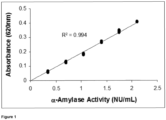
- the test (Phadebas AB, Sweden) is based on a water-insoluble, cross-linked starch polymer substrate which is hydrolyzed by ⁇ -amylase in the biofilm to form water-soluble blue fragments.
- the absorbance of the blue solution is a function of the ⁇ -amylase activity in the sample.
- amylase activity test may be performed as follows:
- Figure 1 shows that there is a linear relationship between absorbance and enzymatic activity.
- the absolute amylase activity score is determined in accordance with Table 1.
- Table 1 Comparison of absorbance and amylase activity score Absorbance amylase activity score 0 - 0.25 0 0.25 - 0.349 1 0.35 - 0.449 2 0.45 - 0.549 3 0.55 - 0.649 4 0.65 - 1 5
- the relative amylase activity is determined by calculating the ratio of the absorbance-result of the microorganism or spore under investigation and that of DSM402 For example, an absorbance-result of 0.25 of the sample and an absorbance-result of 0.05 of DSM402 will result in 0.25/0.05, i.e., a relative amylase activity of 5:1.
- the PU foam cubes used in this and the other tests discussed herein may be selected from standard household sponges, e.g. made of soft polyurethane having a spatial weight 20 kg/m 3 and having about 20 pores cm -1 .
- Protease activity is based on absorbance detection of a product of the underlying enzymatic reaction. Absolute and relative protease activity can be determined.
- the absolute protease activity score is determined by an absorbance at 440 nm of (cf. table 3 below).
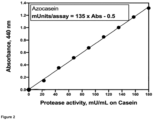
- the test (Azocasein-test; Megazyme, Ireland) is based on an azocasein (azo-casein) substrate solution.
- the substrate is hydrolyzed by all endo-proteases which are active on casein to form a blue dye.
- the absorbance of the blue solution is a function of the protease activity in the sample.
- the protease activity test may be performed as follows:
- Figure 2 shows that there is a linear relationship between absorbance and enzymatic activity.
- the absolute protease activity score is determined in accordance with Table 2.
- protease activity score then can be deduced from table 2.
- Table 2 Comparison of absorbance and protease activity score absorbance protease activity score 0 - 0.25 0 0.25 - 0.349 1 0.35 - 0.449 2 0.45 - 0.549 3 0.55 - 0.649 4 0.65 - 1 5
- the relative protease activity is determined by calculating the ratio of the absorbance-result of the microorganism or spore under investigation and that of DSM402 For example, an absorbance-result of 0.25 of the sample and an absorbance-result of 0.05 of DSM402 will result in 0.25/0.05, i.e., a relative protease activity of 5:1.
- CFU colony forming units
- the CFU/cm 2 can be determined by plating the 10 ml PBS-buffer on sterile tryptic soy agar plates (e.g. TSA-standard-plates) and incubating at 37°C for 24h. Colonies can then be counted and the CFU/cm 2 can be determined for each of the sections on that surface.
- sterile tryptic soy agar plates e.g. TSA-standard-plates
- microbial organisms or spores thereof, are sampled from the article by immersing a section of 1 cm 3 of the article in 10 ml PBS-buffer.
- the collected buffer solution is heat treated in a water bath at 80°C for 5 minutes.
- the 10 ml PBS-buffer solution is then plated on ready-to-use tryptic soy agar monitoring contact plates, e.g. TSA with LTH-Thio cont.-ICR+ (Merck-Millipore, USA) at 37°C for 24h. Colonies can then be counted and the CFU/cm 3 can be determined for each of the sections of that article.
- the specific strain of the microbial organisms, or spores thereof, can be determined by the gDNA determination described below.
- colonies are harvested for identification with sterile 10 ⁇ l inoculating loops (Neolab Migge GmbH, Germany) and resuspended in 20 ⁇ l bacterial protein extraction reagent, e.g. aqueous nonionic detergent solution comprising 20 mM Tris-HCl at pH 7.5 including lysozyme and DNase (e.g. B-Per reagent, FisherScientific, USA).
- 20 bacterial protein extraction reagent e.g. aqueous nonionic detergent solution comprising 20 mM Tris-HCl at pH 7.5 including lysozyme and DNase (e.g. B-Per reagent, FisherScientific, USA).
- the 1.1 kb PCR product is subsequently sequenced for strain identification. By doing so, gDNA per cm 3 or per cm 2 as well as strain diversity can be determined.
- the number of CFUs/cm 2 of the microbial organism, or spores thereof, on a surface of 1 cm 2 ; or CFUs/cm 3 of the microbial organism, or spores thereof, in volume of 1 cm 3 is determined according to the CFU-determination explained above.
- the surface or volume comprising the microbial organism, or spores thereof, is then washed in 10 ml PBS-buffer with a temperature of 80°C for 5 minutes.
- the number of CFUs/cm 2 (or CFUs/cm 3 ) of the microbial organism, or spores thereof, is determined as shown above.
- the ratio between CFUs before and after the washing step is calculated.
- Ratio CFUs/cm 2 (or CFUs/cm 3 ) before washing step / CFUs/cm 2 (or CFUs/cm 3 ) after washing step.
- the ratio is less than 100, less than 50, or less than 20 the microbial organism, or spores thereof, has passed the hot washing test.
- the number of CFUs/cm 2 of the microbial organism, or spores thereof, on a surface of 1 cm 2 ; or CFUs/cm 3 of the microbial organism, or spores thereof, in volume of 1 cm 3 is determined according to the CFU-determination explained above.
- the surface or volume comprising the microbial organism, or spores thereof, is then heated in a microwave for 5 minutes at 1000 Watt.
- the number of CFUs/cm 2 (or CFUs/cm 3 ) of the microbial organism, or spores thereof, is determined again according to the CFU-determination explained above.
- the ratio between CFUs before and after the heating step is calculated.
- Ratio CFUs/cm 2 (or CFUs/cm 3 ) before the heating step / CFUs/cm 2 (or CFUs/cm 3 ) after the heating step.
- the ratio is less than 100, less than 50, or less than 20 the microbial organism, or spores thereof, has passed the heat test.
- the number of CFUs/cm 2 of the microbial organism, or spores thereof, on a surface of 1 cm 2 or CFUs/cm 3 of the microbial organism, or spores thereof, in volume of 1 cm 3 is determined according to the CFU-determination explained above.
- the surface or volume comprising the microbial organism, or spores thereof, is then washed in 10 ml of PBS with 1 wt.-% hydrogen peroxide for 5 minutes.
- the number of CFUs/cm 2 (or CFUs/cm 3 ) of the microbial organism, or spores thereof, is determined again according to the CFU-determination explained above.
- the ratio between CFUs before and after the washing step is calculated.
- Ratio CFUs/cm 2 (or CFUs/cm 3 ) before washing step / CFUs/cm 2 (or CFUs/cm 3 ) after washing step.
- the ratio is less than 100, less than 50, or less than 20 the microbial organism, or spores thereof, has passed the chemical stress test.
- the "long-term polymer-matrix test” is performed to evaluate whether a microorganism or spore thereof is capable of maintaining amylase or protease activity even after a treatment that resembles actual use of an article, i.e. including multiple wet and dry cycles.
- the test is performed using cubes of 20 g of a sponge polymer-material made from soft polyurethane (PUR) foam material (spatial weight 20 kg/m 3 , having 20 pores cm -1 ).
- PUR soft polyurethane
- one half of the sponge polymer-matrix cubes is treated with 10 ml of a PBS-solution comprising about 1 * 10 5 CFU/cm 3 of the microbial organism, or spores thereof, ("sample"), the other half of the sponge polymer-matrix cubes is not inoculated (" control ").
- each of the sponge polymer-matrix cubes (sample as well as control) is subjected to 45 wash and dry cycles.
- the washing liquid consists of 5 L water, 3 ml Triton ® X 100 (4-(1,1,3,3-Tetramethylbutyl)-phenyl-polyethylenglykol), and 25 ml of a standard broth medium comprising:
- samples of the sponge polymer cubes are directly transferred into deep well plates and amylase and protease activity both of the "sample” as well as the "control” is determined as explained above.
- the ratio of the long-term polymer-matrix test is then calculated from the resulting activity values as follows:
- a microbial organism, or spore thereof, is considered to pass the amylase long-term polymer-matrix test if the ratio is at least 1.5, at least 2, at least 3, at least 4, at least 5, at least 6, at least 7, at least 8, at least 9, at least 10.
- a microbial organism, or spore thereof, is considered to pass the protease long-term polymer-matrix test if the ratio is at least 1.5, at least 2, at least 3, at least 4, at least 5, at least 6, at least 7, at least 8, at least 9, at least 10.
- Samples are prepared according to the procedure described above for the long-term polymer matrix test. This means that the sponges have undergone the wash and dry cycles as described above, including step d. After that, the odour test is performed.
- the odour test is performed at temperatures of 23°C +- 2°C. At least 24 hours before the test the dried sponges are kept at the same temperature in closed glass jars.
- a sample passes the VDA-odour test when the arithmetic median of the grades given to the sample by the at least 3 subjects show a grading of 3 or better (i.e., between grade 1 and 3).
- more than 3 subjects take part in the test, e.g. at least 6, at least 12, at least 24, at least 48 or at least 96.
- the Shannon index also known as Shannon's diversity index, Shannon-Wiener index, and (erroneously) Shannon-Weaver index is a measure originally proposed by Claude Shannon in 1948 to quantify the entropy (hence Shannon entropy) in strings of text. In present times, the Shannon-index is widely used in the area of ecology to describe the diversity of biomes.
- PAST software v.3.01 can be used to calculate the Shannon index as published in H, Harper D, Ryan P. PAST-Palaeontological Statistics, ver. 1.89. Palaeontol Electron. 2001;4(1):1-9 .
- surface roughness is a component of surface texture. It is quantified by the deviations in the direction of the normal vector of a real surface from its ideal form. If these deviations are large, the surface is rough; if they are small, the surface is smooth. In surface metrology, roughness is typically considered to be the high-frequency, short-wavelength component of a measured surface. When dealing with the roughness profile, Ra is referred to as defined in DIN EN ISO 4287:2010-07.
- water contact angle quantifies the wettability of a solid surface by a liquid via the Young equation.
- the water contact angle can be measured according to DIN 55660-2:2011-12, chapter 5.2.2. using a static method with a drop volume of 2 ⁇ l.
- surface denotes an area forming the outside part or uppermost layer of an article, i.e. usually the interface of the article and the surrounding atmosphere.
- the surface area of particulate surfaces (e.g. powders or granules) or of porous surfaces may be measured by B.E.T.-measurement according to DIN ISO 9277:2022.
- the microorganism, or spore thereof, and/or the metabolic biofilm has amylase activity, i.e., shows the conversion of starch into sugar by the action of enzymes such as amylase.
- Amylase activity can be measured using the well-known Phadebas test.
- Amylase activity can be represented by an absolute amylase activity score and/or a relative amylase activity ratio.
- the microorganism, or spore thereof, and/or the metabolic biofilm has an absolute amylase activity score of at least 1, at least 2, at least 3, or at least 4.
- the absolute amylase activity score may range up to 5, or up to 4.
- the relative amylase activity ratio may range from 1 to 5, from 2 to 5, from 3 to 4, or it may be about 3.
- the microorganism, or spore thereof, and/or the metabolic biofilm may have an amylase activity larger than an amylase activity of DSM402.
- the relative amylase activity ratio of at least 5:1, at least 6:1, at least 7:1, or at least 8:1.
- the relative amylase activity ratio may range up to 100:1, up to 50:1, up to 30:1, or up to 20:1.
- the relative amylase activity ratio may range from 5:1 to 100:1, from 6:1 to 50:1, from 7:1 to 30:1, or from 8:1 to 20:1.
- the microorganism, or spore thereof, and/or the metabolic biofilm has protease activity, i.e., has the activity to breakdown proteins into smaller polypeptides or amino acids.
- Protease activity can be measured using well-known protease tests. This property can be represented by an absolute protease activity score and/or a relative protease activity ratio.
- the microorganism, or spore thereof, and/or the metabolic biofilm has an absolute protease activity score of at least 1, at least 2, at least 3, or at least 4.
- the absolute protease activity score may range up to 5, or up to 4.
- the relative amylase activity ratio may range from 1 to 5, from 2 to 5, from 3 to 4, or it may be about 3 or about 4.
- the microorganism, or spore thereof, and/or the metabolic biofilm may have a protease activity larger than a protease activity of DSM402.
- the metabolic biofilm has a relative protease activity ratio of at least 1.2:1, at least 1.5:1, at least 2:1, at least 2.5:1, at least 3:1, at least 4:1, or at least 5:1.
- the relative protease activity ratio may range up to 100:1, up to 40:1, up to 20:1, or up to 13:1.
- the relative amylase activity ratio may range from 1.2:1 to 100:1, from 1.5:1 to 40:1, from 2:1 to 20:1, or from 4:1 to 13:1.
- the microorganism, or spore thereof does not have a negative impact on the diversity of the microbiome of the biofilm and is not a biocide. This is reflected by the alpha-diversity according to the Shannon-index, wherein a Shannon-index above 1.5 or higher shows a good diversity of microorganisms. This means that a metabolic biofilm as formed by the microorganism or spore thereof may have a Shannon index of more than 1.5.
- the microorganism or spore thereof having a Shannon index of more than X it is meant that the Shannon index of a biofilm as obtained after the wash and dry cycles according to the long-term polymer matrix test described hereinabove.
- the microorganism, or spore thereof, and/or the metabolic biofilm has an alpha-diversity reflected by a Shannon-index of at least 1.5, of at least 1.8, of at least 2.25, of at least 2.8, of at least 3, of at least 4, of at least 5, or of at least 6.
- the diversity and the type of the individual microorganism may be determined by CFU and gDNA determination.
- the microorganism, or spore thereof is applied to, or disposed on, a surface, wherein optionally
- the surface may be surface of an article, particularly a human-made article, i.e. it may exclude articles found in nature, e.g. stones, trees, earth.
- the article comprises the microorganism, or spore thereof and/or a metabolic biofilm.
- the microorganism, or spore thereof and/or the metabolic biofilm may disposed on a surface of said article.
- a surface herein, this may optionally refer to the surface of the article discussed herein.
- the metabolic biofilm optionally may be present on a surface of the built environment and/or on a surface of the article. In general, all surfaces which are susceptible to having biofilms are included.
- the microorganism, or spore thereof is applied to or disposed on a surface, wherein preferably the surface may be characterized by a surface roughness of at least 1 ⁇ m Ra, at least 2 ⁇ m Ra, at least 3 ⁇ m Ra, at least 5 ⁇ m Ra, at least 8 ⁇ m Ra, at least 10 ⁇ m Ra, at least 12 ⁇ m Ra, or at least 15 ⁇ m Ra.
- the microorganism, or spore thereof is applied to or disposed on a surface that has a minimum hydrophilicity defined by a water contact angle of less than 80°. In other embodiments a water contact angle of less than 60°, a water contact angle of less than 45°, a water contact angle of less than 30°, a water contact angle of less than 15° or less. In one embodiment the water contact angle is about 0° and the surface is considered hydrophilic.
- the surface may be selected from the group consisting of a biologic, polymeric, organic and/or inorganic surface.
- the article may be selected from
- the microorganism, or spore thereof may be applied on or into a material of the article or surface comprising or consisting of
- the concentration of the microorganism, or spore thereof is determined on the surface and/or in a volume of the article.
- the microorganism, or spore thereof may be present on the surface in a concentration of about 1 ⁇ 10 2 to 1 ⁇ 10 10 "colony forming units per surface" i.e., CFU/cm 2 .
- the microorganism, or spore thereof is present on the surface in a concentration of about 1 * 10 2 to 1 * 10 9 CFU/cm 2 , in a concentration of about 1 * 10 4 to 1 * 10 8 CFU/cm 2 , or in a concentration of about 1 * 10 6 to 1 * 10 8 CFU/cm 2 , in yet further embodiment in a concentration of about 1 ⁇ 10 7 CFU/cm 2 .
- the number of developing colonies is then represented as "colony forming units per volume", i.e., in CFU/cm 3 .
- the microorganism, or spore thereof may be present in the human-made article in a concentration of about 1 ⁇ 10 2 to 1 ⁇ 10 10 CFU/cm 3 .
- the microorganism, or spore thereof is present in a concentration of about 1 * 10 3 to 1 * 10 9 CFU/cm 3 , in a concentration of about 1 * 10 4 to 1 * 10 8 CFU/cm 3 , or in a concentration of about 1 * 10 6 to 1 * 10 8 CFU/cm 3 , in yet further embodiment in a concentration of about 1 ⁇ 10 7 CFU/cm 3 .
- the concentration of the microorganism, or spore thereof, on the surface and/or in the volume can be determined by measuring the genomic DNA.
- the gDNA is at least 1 ng gDNA / cm 3 , at least 5 ng gDNA / cm 3 , at least 10 ng gDNA / cm 3 , at least 15 ng gDNA / cm 3 , or at least 25 ng gDNA / cm 3 .
- the disclosure relates to a composition
- a composition comprising the microorganism, or spore thereof, and in some embodiments at least one further excipient, such as for example a buffer, a salt, a preservative, a deposit aid, a pharmaceutical excipient and/or a carrier.
- at least one further excipient such as for example a buffer, a salt, a preservative, a deposit aid, a pharmaceutical excipient and/or a carrier.
- the composition may be in the form of a solid, semi-solid, gel, liquid, aerosol, aqueous solution, emulsion, granules, and/or powder.
- the compositions may comprise combinations or blends of two or more of the microorganisms, or spores thereof, described herein.
- a combination or blend may comprise two or more species and/or two or more isolates.
- the isolates may include at least two, at least three or more isolates of spores or other vegetative cell state of the microorganism, or spore thereof.
- the composition may also be a ready-to-use (in-use) composition.
- the composition may furthermore be an active cleaning base ingredient to be incorporated into other cleaning or washing compositions.
- the composition may further comprise a "deposit aid", which facilitates the deposition to the surface of the built environment and/or a human-made article during a washing process, such as a laundry process, dishwasher process, or hand washing process.
- a deposit aid may be any excipient which improves the application, for example an emulsifier, a surfactant, a stabilizer, an adhesion aid, or the like.
- composition comprising the microorganism or spore thereof may be a washing agent, such as a dish-washing agent.
- a washing agent can be present as powdered or tablet solids, homogeneous solutions, or suspensions. It can in principle contain all known ingredients that are usual in such agents.
- the composition can contain, in particular, builder substances, surface-active surfactants, peroxygen compounds, water-miscible organic solvents, enzymes, sequestering agents, electrolytes, pH regulators, and further adjuvants such as silver corrosion inhibitors, foam regulators, additional peroxygen activators, and colouring agents and/or fragrances.
- this disclosure includes a composition comprising the microorganism or spore thereof for use in automatic dishwashing methods, including so-called "3 in 1" products that combine the conventional cleaner, rinse agent, and regenerating-salt agents in one microbial agent.
- Suitable in principle as builder components are all builders usually used in automatic dishwashing agents, for example polymeric alkali phosphates, which can be present in the form of their alkaline, neutral, or acid sodium or potassium salts.
- polymeric alkali phosphates which can be present in the form of their alkaline, neutral, or acid sodium or potassium salts.
- examples thereof are tetrasodium diphosphate, disodium dihydrogen diphosphate, pentasodium triphosphate, so-called sodium hexametaphosphate, and the corresponding potassium salts, or mixtures of sodium and potassium salts.
- compositions comprising the microorganism are optionally free of such phosphates.
- water-soluble builder components are, for example, organic polymers or natural or synthetic origin, chiefly polycarboxylates, which may act as co-builders especially in hard-water regions.
- Optional builders are, for example, polyacrylic acids and copolymers of maleic acid anhydride and acrylic acid, as well as the sodium salts of said polymeric acids.
- Commercially available products are, for example, Sokalan ® CP 5 and PA 30 of the BASF company.
- the polymers of natural origin usable as co-builders are, for example, oxidized starch and polyamino acids such as polyglutamic acid or polyaspartic acid.
- builder components are naturally occurring hydroxycarboxylic acids such as, for example, mono-, dihydroxysuccinic acid, 3-hydroxypropionic acid, and gluconic acid.
- the builder components are the salts of citric acid, in particular sodium citrate.
- Optional sodium citrate forms are anhydrous trisodium citrate and trisodium citrate dihydrate. Trisodium citrate dihydrate can be used as a finely or coarsely crystalline powder.
- the acids corresponding to the aforesaid co-builder salts can also be present.
- Suitable oxygen-based bleaching agents are principally alkali perborate mono- or tetrahydrate and/or alkali percarbonate, sodium may be the preferred alkali metal.
- the use of sodium percarbonate has advantages especially in cleaning agents for tableware, since it has useful effects on corrosion properties on glassware.
- the oxygen-based bleaching agent may therefore be an alkali percarbonate, in particular sodium percarbonate.
- known peroxycarboxylic acids for example dodecanediperacid or phthalimidopercarboxylic acids, which if applicable can be substituted on the aromatic portion, can be contained.
- bleaching-agent stabilizers such as, for example, phosphonates, borates or metaborates, and metasilicates, as well as magnesium salts such as magnesium sulfate, may furthermore be expedient.
- cleaning agents are usually utilized in an air atmosphere, the microbial agents according to this disclosure can also be free of bleaching agents, since the bleach catalysts already exhibit an effect in the presence of atmospheric oxygen.
- bleach activators cited above which carry O-and/or N-acyl groups having the aforesaid number of carbon atoms, and/or which carry optionally substituted benzoyl groups, are suitable.
- Multiply acylated alkylenediamines in particular tetraacetylethylendiamine (TAED), acylated glycolurils, in particular tetraacetyl glycoluril (TAGU), acylated triazine derivatives, in particular 1,5-diacetyl-2,4-dioxohexahydro-1 ,3,5-triazine (DADHT), acylated phenylsulfonates, in particular nonanoyl- or isononanoyloxybenzenesulfonate, acylated polyvalent alcohols, in particular triacetin, ethylene glycol diacetate, 2,5-diacetoxy-2,5-dihydrofuran, as well as acet
- the alkali carrier system optionally used in the composition is a mixture of carbonate and hydrogencarbonate, optionally sodium carbonate and hydrogencarbonate, which is contained in a quantity of up to 60 wt-%, optionally 10 wt-% to 40 wt-%.
- the ratio of carbonate to hydrogencarbonate varies depending on the pH that is ultimately desired, although an excess of sodium hydrogencarbonate is usually used, so that the weight ratio between hydrogencarbonate and carbonate is generally 1:1 to 15:1.
- composition 20 wt-% to 40 wt-% water-soluble organic builders, in particular alkali citrate, 5 wt-% to 15 wt-% alkali carbonate, and 20 wt-% to 40 wt-% alkali disilicate are contained.
- the composition can also, if applicable, contain surfactants, in particular low-foaming non-ionic surfactants that may provide better detachment of grease containing stains and serve as a wetting agent and, if applicable, as a granulating adjuvant in the context of manufacture of the composition comprising the microorganism.
- surfactants in particular low-foaming non-ionic surfactants that may provide better detachment of grease containing stains and serve as a wetting agent and, if applicable, as a granulating adjuvant in the context of manufacture of the composition comprising the microorganism.
- Their quantity can be up to 10 wt-%, in particular up to 5 wt-%, and is optionally in the range from 0.5 wt-% to 3 wt-%.
- These compounds include, optionally, C 12 -C 18 alkylpolyethylene-glycolpolypropylene-glycol ethers having respectively up to 8 units of ethylene oxide and propylene oxide units in the molecule. It is also possible, however, to use other known low-foaming non-ionic surfactants such as, for example, C 12 -C 18 alkylpolyethylene glycol-polybutylene glycol ethers having respectively up to 8 units of ethylene oxide and butylene oxide units in the molecule, endcapped alkylpolyalkylene glycol mixed ethers, and the foaming but environmentally attractive C 8 -C 14 alkyl polyglucosides having a degree of polymerization from approximately 1 to 4 (e.g. APG ® 225 and APG ® 600), and/or C 12 -C 14 alkyl polyethylene glycols having 3 to 8 ethylene oxide units in the molecule.
- surfactants from the family of the glucamides such as, for example, alkyl-N-methylglucamides, in which the alkyl part optionally derives from a fatty alcohol having a carbon chain length of C 6 to C 14 .
- surfactants are used as mixtures, for example the combination of alkyl polyglycoside with fatty alcohol ethoxylates, or glucamide with alkyl polyglycosides.
- Optional silver corrosion protection agents are organic disulfides, divalent phenols, trivalent phenols, optionally substituted benzotriazole, salts and/or complexes of manganese, titanium, zirconium, hafnium, vanadium, cobalt, or cerium, in which the aforesaid metals are present in one of the oxidations states II, III, IV, V, or VI.
- composition according to the present disclosure can contain enzymes such as proteases, amylases, pullulases, cutinases, and lipases, for example proteases such as BLAP ® , Optimase ® , Opticlean ® , Maxacal ® , Maxapem ® , Esperase ® , and/or Savinase ® , amylases such as Termamyl ® , Amylase-LT ® , Maxamyl ® , and/or Duramyl ® , lipases such as Lipolase ® , Lipomax ® , Lumafast ® , and/or Lipozym ® .
- proteases such as BLAP ® , Optimase ® , Opticlean ® , Maxacal ® , Maxapem ® , Esperase ® , and/or Savinase ®
- amylases such as Termamyl ®
- the enzymes that are used if applicable can be adsorbed onto carrier substances and/or embedded into encasing substances in order to protect them from premature inactivation. They are contained in the composition in quantities optionally not above 2 wt-%, in particular from 0.1 wt-% to 0.7 wt-%.
- compositions foam excessively upon use, they can also include up to 6 wt-%, optionally approximately 0.5 wt-% to 4 wt-%, of a foam-suppressing compound, optionally from the group of the silicone oils, mixtures of silicone oil and hydrophobized silicic acid, paraffins, paraffin-alcohol combinations, hydrophobized silicic acid, the bis-fatty acid amides, and other known defoamers obtainable commercially.
- a foam-suppressing compound optionally from the group of the silicone oils, mixtures of silicone oil and hydrophobized silicic acid, paraffins, paraffin-alcohol combinations, hydrophobized silicic acid, the bis-fatty acid amides, and other known defoamers obtainable commercially.
- ingredients in the composition are, for example, perfume oils.
- organic solvents usable in the composition are alcohols having 1 to 4 carbon atoms, in particular methanol, ethanol, isopropanol, and tert.-butanol, diols having 2 to 4 carbon atoms, in particular ethylene glycol and propylene glycol, as well as mixtures thereof, and the ethers derivable from the aforesaid compound classes.
- Water-miscible solvents of this kind are present in the compositions comprising the microorganism according to the present disclosure at optionally no more than 20 wt-%, in particular from 1 wt-% to 15 wt-%.
- the composition can contain system-compatible and environmentally compatible acids, for example citric acid, acetic acid, tartaric acid, malic acid, lactic acid, glycolic acid , succinic acid, glutaric acid, and/or adipic acid, but also mineral acids, in particular sulfuric acid, or alkali hydrogensulfates or bases, in particular ammonium hydroxides or alkali hydroxides pH regulators of this kind are contained in the composition optionally at no more than 10 wt-%, in particular from 0.5 wt-% to 6 wt-%.
- system-compatible and environmentally compatible acids for example citric acid, acetic acid, tartaric acid, malic acid, lactic acid, glycolic acid , succinic acid, glutaric acid, and/or adipic acid
- mineral acids in particular sulfuric acid, or alkali hydrogensulfates or bases, in particular ammonium hydroxides or alkali hydroxides pH regulators of this kind are contained in the composition optionally at no more than 10 wt
- the bleach catalyst is mixed with further raw materials and/or compounds, and the mixture is then compressed into tablets or phases thereof.
- composition in the form of aqueous solutions or those containing other usual solvents may be manufactured by mixing the ingredients, which can be placed, in substance or as a solution, into an automatic mixer.
- composition may be present as powdered, granular, or tablet preparations that can be manufactured in known fashion, for example by mixing, granulating, roller compacting, and/or by spray drying of the thermally insensitive components and mixing in the more-sensitive components, included among which are, in particular, enzymes, bleaching agents, and the bleach catalyst.
- composition in tablet form it is optional to proceed in such a way that all the constituents, or all the constituents provided for use together in one phase of the tablet, are mixed together in a mixer, and the mixture, or the mixtures in succession, are compressed by means of conventional tablet presses, for example eccentric presses or rotary tablet presses, at compression pressures in the range from 200 ⁇ 10 5 Pa to 1500 ⁇ 10 5 Pa.
- a tablet manufactured in this fashion optionally has a weight from 15 g to 40 g, in particular from 20 g to 30 g. It can be round, for example with a diameter from 35 mm to 40 mm, or can have any other desired shape, for example rectangular with optionally rounded edges.
- compositions in the form of non-dusting, shelf-stable, pourable powders and/or granulates having high bulk densities in the range from 800 to 1000 g/L can be manufactured by mixing the builder components with at least a portion of liquid mixture components in a first partial step of the method, with an increase in the bulk density of this premixture, and then, if desired after intervening drying, combining the further constituents of the agent, among them the microbial agent, with the premixture thus obtained.
- compositions for cleaning tableware can be used in both household and commercial dishwashers. They are added manually or by means of suitable metering devices.
- PU foam cubes (1x1x1 cm, ca. 25 mg) were distributed into single wells of 24-deepwell plates (DWP) and sterilized by autoclaving for 20 min at 121°C. Each well was subsequently filled with 2 ml medium (skim milk powder 0.8 g/L, soluble starch 4 g/L, olive oil 0.6 g/L, sterilized by autoclaving). After 5 min. incubation, each cube was then picked up with tweezers and transferred into an empty well of a new DWP.
- DWP 24-deepwell plates
- Each cube was subsequently inoculated (4 replicates per candidate strain) by pipetting 10 ⁇ l spores suspension (1E+05 CFU, in PBS buffer) onto the surface, non-inoculated cubes served as control. Inoculated cubes are incubated at 20°C for 7 days. After 2 and 4 days within the 7 day period, medium was again applied to each well as above and cubes were subsequently transferred to a new DWP.
- Metabolic activity of biofilms was assessed by transferring 150 ⁇ l of each well into a microtitre plate (e.g., Costar 3904, Corning) and fluorescence detection (Fluostar, BMG) with the following parameters: Excitation wavelength 440-412 nm, emission wavelength 590 nm, gain 15, prior mixing (5 sec, 1 mm orbital).
- the mean values (MV) obtained (arbitrary fluorescence units) of suitable candidates should reach a minimum of 30.000 (after subtraction of MV of non-inoculated control) or a minimum of 2x mean values obtained for control strain (DSM402) treated in the same way.
- Microorganisms scoring at least 2x mean values obtained for control strain (DSM402) are considered capable of forming a metabolic biofilm.
- PU foam cubes (1x1x1cm, ca. 25 mg) were distributed into single wells of 24 well deepwell plates (DWP) and sterilized by autoclaving for 20 min at 121°C. Each well was subsequently filled with 2 ml medium (Bacto Tryptone 10 g/L, NaCl 5 g/L, Bacto Yeast Extract 5 g/L, sterilized by autoclaving; glycerol 1%, MnSO 4 0.1 mM, filter sterilized and supplemented after autoclaving). After 5 min incubation, each cube was then picked up with tweezers and transferred into an empty well of a new DWP.
- 2 ml medium Bacto Tryptone 10 g/L, NaCl 5 g/L, Bacto Yeast Extract 5 g/L, sterilized by autoclaving; glycerol 1%, MnSO 4 0.1 mM, filter sterilized and supplemented after autoclaving.
- Each cube was subsequently inoculated (4 replicates per candidate strain) by pipetting 10 ⁇ l spores suspension (1E+05 CFU, in PBS buffer) onto the surface, non-inoculated cubes served as sterile control. Inoculated cubes were incubated at 20°C. After 72 hours, cubes were washed by applying 4 ml saline (0.9%) into each well and subsequent transfer with tweezers into a new DWP. This step was repeated two times. After washing, 2.5 ml of Phadebas solution (9 Phadebas tablets were dissolved in 65 ml of a 2.4 g/L starch solution, sterilized by autoclaving) are added to each well.
- Phadebas solution Phadebas tablets were dissolved in 65 ml of a 2.4 g/L starch solution, sterilized by autoclaving
- the DWP is incubated at 37°C on a Titramax at shaking speed 7 for 2 hours. From each well 200 ⁇ l samples are subsequently transferred into 1.5 ml reaction tubes and centrifuged (5 min, 1500 g). Supernatant samples (100 ⁇ l) were transferred into a 96 well microtitre plate (MTP) and the absorbance is measured at 620 nm against deionized water (when absorbance exceeds the measuring capability of the photometer, supernatant is diluted 10-fold using deionized water).
- MTP microtitre plate
- PU foam cubes (1x1x1cm, ca. 25 mg) were distributed into single wells of 24 well deepwell plates (DWP) and sterilized by autoclaving for 20 min at 121°C. Each well was subsequently filled with 2 ml medium (skim milk powder 0.8 g/L, soluble starch 4 g/L, olive oil 0.6 g/L, sterilized by autoclaving). After 5 min incubation, each cube was then picked up with tweezers and transferred into an empty well of a new DWP.
- DWP deepwell plates
- Each cube was subsequently inoculated (4 replicates per candidate strain) by pipetting 10 ⁇ l spores suspension (1E05 CFU, in PBS buffer) onto the surface, non-inoculated cubes served as control. Inoculated cubes were incubated at 20°C for 7 days. After 2 and 4 days, medium was again applied to each well as above and cubes were subsequently transferred to a new DWP. After 7 days, cubes were washed by applying 4 ml saline (0.9%) into each well and subsequent transfer with tweezers into a new DWP. This step was repeated two times. After washing, 2.5 ml of Azo-Casein (Megazyme, Ireland) solution were added to each well.
- Azo-Casein solution was prepared by mixing 26 ml medium (as above) and 39 ml Azo-Casein (0.8 g Azo-Casein powder reconstituted according to Manufacturer's instructions). The DWP was incubated at 37°C on a Titramax at shaking speed 7 for 6 hours. From each well 150 ⁇ l samples were subsequently transferred into 1.5 ml reaction tubes, 450 ⁇ l TCA (5%) were added, mixed by inverting and the tubes were centrifuged (5 min, 1500 g).
- a long-term polymer matrix test was performed in order to evaluate the presence of amylase activity after simulated use of the article, e.g. in the context of a household article with repeated wet and dry cycles. Initially, the long-term polymer matrix test was performed as described hereinabove, i.e. steps a. through d. After step d., sponges were harvested from the long-term polymer-matrix test by letting them dry completely without washing for 2 days at 22-25°C. Sponges can subsequently be stored in an airtight container for up to 4 weeks.
- a long-term polymer matrix test was performed in order to evaluate the presence of protease activity after simulated use of the article, e.g. in the context of a household article with repeated wet and dry cycles. Initially, the long-term polymer matrix test was performed as described hereinabove, i.e. steps a. through d. After step d., sponges were harvested from the long-term polymer-matrix test by letting them dry completely without washing for 2 days at 22-25°C. Sponges can subsequently be stored in an airtight container for up to 4 weeks.
Landscapes
- Life Sciences & Earth Sciences (AREA)
- Health & Medical Sciences (AREA)
- Engineering & Computer Science (AREA)
- Chemical & Material Sciences (AREA)
- Zoology (AREA)
- Wood Science & Technology (AREA)
- Biotechnology (AREA)
- Organic Chemistry (AREA)
- General Health & Medical Sciences (AREA)
- Genetics & Genomics (AREA)
- Microbiology (AREA)
- Bioinformatics & Cheminformatics (AREA)
- Biomedical Technology (AREA)
- General Engineering & Computer Science (AREA)
- Environmental Sciences (AREA)
- Medicinal Chemistry (AREA)
- Molecular Biology (AREA)
- Biochemistry (AREA)
- Virology (AREA)
- Pest Control & Pesticides (AREA)
- Plant Pathology (AREA)
- Chemical Kinetics & Catalysis (AREA)
- Dentistry (AREA)
- Agronomy & Crop Science (AREA)
- Tropical Medicine & Parasitology (AREA)
- General Chemical & Material Sciences (AREA)
- Oil, Petroleum & Natural Gas (AREA)
- Measuring Or Testing Involving Enzymes Or Micro-Organisms (AREA)
Priority Applications (3)
| Application Number | Priority Date | Filing Date | Title |
|---|---|---|---|
| EP22216428.7A EP4388877A1 (fr) | 2022-12-23 | 2022-12-23 | Micro-organisme capable de former un biofilm métabolique et ses procédés de production et d'utilisation |
| EP23838056.2A EP4637357A1 (fr) | 2022-12-23 | 2023-12-21 | Micro-organisme capable de former un biofilm métabolique et ses procédés de production et d'utilisation |
| PCT/EP2023/087481 WO2024133812A1 (fr) | 2022-12-23 | 2023-12-21 | Micro-organisme capable de former un biofilm métabolique et ses procédés de production et d'utilisation |
Applications Claiming Priority (1)
| Application Number | Priority Date | Filing Date | Title |
|---|---|---|---|
| EP22216428.7A EP4388877A1 (fr) | 2022-12-23 | 2022-12-23 | Micro-organisme capable de former un biofilm métabolique et ses procédés de production et d'utilisation |
Publications (1)
| Publication Number | Publication Date |
|---|---|
| EP4388877A1 true EP4388877A1 (fr) | 2024-06-26 |
Family
ID=84689300
Family Applications (2)
| Application Number | Title | Priority Date | Filing Date |
|---|---|---|---|
| EP22216428.7A Withdrawn EP4388877A1 (fr) | 2022-12-23 | 2022-12-23 | Micro-organisme capable de former un biofilm métabolique et ses procédés de production et d'utilisation |
| EP23838056.2A Pending EP4637357A1 (fr) | 2022-12-23 | 2023-12-21 | Micro-organisme capable de former un biofilm métabolique et ses procédés de production et d'utilisation |
Family Applications After (1)
| Application Number | Title | Priority Date | Filing Date |
|---|---|---|---|
| EP23838056.2A Pending EP4637357A1 (fr) | 2022-12-23 | 2023-12-21 | Micro-organisme capable de former un biofilm métabolique et ses procédés de production et d'utilisation |
Country Status (2)
| Country | Link |
|---|---|
| EP (2) | EP4388877A1 (fr) |
| WO (1) | WO2024133812A1 (fr) |
Families Citing this family (1)
| Publication number | Priority date | Publication date | Assignee | Title |
|---|---|---|---|---|
| CN119570658B (zh) * | 2024-11-23 | 2025-11-11 | 清华大学 | 巨大普里斯蒂亚氏菌及其浸出废料中稀土元素的方法 |
Citations (6)
| Publication number | Priority date | Publication date | Assignee | Title |
|---|---|---|---|---|
| WO2010028460A2 (fr) * | 2008-08-14 | 2010-03-18 | Peter Kerstens | Procédé biologique pour le traitement préventif de surfaces abiotiques |
| WO2012105805A2 (fr) * | 2011-01-31 | 2012-08-09 | Cj Cheiljedang Corporation | Probiotiques pour la lutte biologique contre vibrio sp. |
| CN111826323A (zh) * | 2020-08-05 | 2020-10-27 | 福建洛东生物技术有限公司 | 一种枯草芽孢杆菌及其制剂与应用 |
| US20210100854A1 (en) * | 2014-03-06 | 2021-04-08 | Research Institute At Nationwide Children's Hospital | Prebiotic formulations |
| WO2021195776A1 (fr) * | 2020-04-01 | 2021-10-07 | Lululemon Athletica Canada Inc. | Textile à biofilm amélioré et procédés de fabrication de celui-ci |
| EP4108751A1 (fr) * | 2021-06-24 | 2022-12-28 | Carl Freudenberg KG | Articles de nettoyage ménagers et commerciaux ayant une activité inhibitrice de moraxella sp. |
-
2022
- 2022-12-23 EP EP22216428.7A patent/EP4388877A1/fr not_active Withdrawn
-
2023
- 2023-12-21 EP EP23838056.2A patent/EP4637357A1/fr active Pending
- 2023-12-21 WO PCT/EP2023/087481 patent/WO2024133812A1/fr not_active Ceased
Patent Citations (6)
| Publication number | Priority date | Publication date | Assignee | Title |
|---|---|---|---|---|
| WO2010028460A2 (fr) * | 2008-08-14 | 2010-03-18 | Peter Kerstens | Procédé biologique pour le traitement préventif de surfaces abiotiques |
| WO2012105805A2 (fr) * | 2011-01-31 | 2012-08-09 | Cj Cheiljedang Corporation | Probiotiques pour la lutte biologique contre vibrio sp. |
| US20210100854A1 (en) * | 2014-03-06 | 2021-04-08 | Research Institute At Nationwide Children's Hospital | Prebiotic formulations |
| WO2021195776A1 (fr) * | 2020-04-01 | 2021-10-07 | Lululemon Athletica Canada Inc. | Textile à biofilm amélioré et procédés de fabrication de celui-ci |
| CN111826323A (zh) * | 2020-08-05 | 2020-10-27 | 福建洛东生物技术有限公司 | 一种枯草芽孢杆菌及其制剂与应用 |
| EP4108751A1 (fr) * | 2021-06-24 | 2022-12-28 | Carl Freudenberg KG | Articles de nettoyage ménagers et commerciaux ayant une activité inhibitrice de moraxella sp. |
Non-Patent Citations (3)
| Title |
|---|
| BIOSCI BIOTECHNOL BIOCHEM., vol. 56, no. 12, December 1992 (1992-12-01), pages 1995 - 2002 |
| H, HARPER DRYAN P: "PAST-Palaeontological Statistics", PALAEONTOL ELECTRON, vol. 4, no. 1, 2001, pages 1 - 9 |
| PROBIOTICS ANTIMICROB. PROTEINS, vol. 11, no. 3, September 2019 (2019-09-01), pages 731 - 747 |
Also Published As
| Publication number | Publication date |
|---|---|
| WO2024133812A1 (fr) | 2024-06-27 |
| EP4637357A1 (fr) | 2025-10-29 |
Similar Documents
| Publication | Publication Date | Title |
|---|---|---|
| Novak Babič et al. | Microorganisms populating the water-related indoor biome | |
| Di Bonaventura et al. | Influence of temperature on biofilm formation by Listeria monocytogenes on various food‐contact surfaces: relationship with motility and cell surface hydrophobicity | |
| JP7032430B2 (ja) | クリーニング組成物及びその使用 | |
| CN112352039B (zh) | 清洁组合物及其用途 | |
| CN110662829B (zh) | 清洁组合物及其用途 | |
| JP5902674B2 (ja) | バチルス・アミロリケファシエンス(Bacillusamyloliquefaciens)菌株 | |
| Chmielewski et al. | Biofilm formation and control in food processing facilities | |
| CN112368363A (zh) | 洗涤剂组合物及其用途 | |
| EP3342846B1 (fr) | Capsule auto-dissoluble pour la préparation de solutions de lavage | |
| CN109462994A (zh) | 包含酶的清洁组合物 | |
| CN112969775A (zh) | 清洁组合物 | |
| WO2017157781A1 (fr) | Procédé de lutte contre les mauvaises odeurs, en particulier dans les lave-vaisselle, à l'aide de spores bactériennes capables d'inhiber ou de prévenir la production de mauvaises odeurs | |
| JP2024526803A (ja) | 細菌芽胞を使用する染み除去の方法 | |
| WO2020008053A1 (fr) | Composition | |
| EP4388877A1 (fr) | Micro-organisme capable de former un biofilm métabolique et ses procédés de production et d'utilisation | |
| Walker et al. | Removal of microbial biofilms from dispense equipment: the effect of enzymatic pre‐digestion and detergent treatment | |
| EP0509985A1 (fr) | ENZYME BACTERIOLYTIQUE NAISSANT D'UNE SOUCHE DE -i(NOCARDIOPSIS), PRODUCTION ET UTILISATION D'UNE TELLE ENZYME. | |
| EP4232539A2 (fr) | Utilisation de polypeptides ayant une activité de dnase | |
| WO2004106481A2 (fr) | Composition detergente a activite anti-microbienne | |
| WO2017157775A1 (fr) | Procédé de lutte contre les mauvaises odeurs, en particulier dans les lave-vaisselle, au moyen de spores bactériennes aptes à inhiber ou prévenir la production de mauvaises odeurs | |
| JP4071632B2 (ja) | 洗濯物からの悪臭の削減 | |
| EP4389861A1 (fr) | Article de nettoyage domestique et/ou commercial | |
| EP4108086A1 (fr) | Agent microbien ayant une activité inhibitrice de moraxella sp. | |
| EP4680013A1 (fr) | Extraits fermentés de brevibacillus pour le nettoyage et la lutte contre les mauvaises odeurs et leur utilisation | |
| Ishizaki et al. | Evaluation of contaminated bacteria inside door-and conveyor-types of dishwashers used in food service facilities |
Legal Events
| Date | Code | Title | Description |
|---|---|---|---|
| PUAI | Public reference made under article 153(3) epc to a published international application that has entered the european phase |
Free format text: ORIGINAL CODE: 0009012 |
|
| STAA | Information on the status of an ep patent application or granted ep patent |
Free format text: STATUS: THE APPLICATION HAS BEEN PUBLISHED |
|
| AK | Designated contracting states |
Kind code of ref document: A1 Designated state(s): AL AT BE BG CH CY CZ DE DK EE ES FI FR GB GR HR HU IE IS IT LI LT LU LV MC ME MK MT NL NO PL PT RO RS SE SI SK SM TR |
|
| STAA | Information on the status of an ep patent application or granted ep patent |
Free format text: STATUS: REQUEST FOR EXAMINATION WAS MADE |
|
| 17P | Request for examination filed |
Effective date: 20241220 |
|
| STAA | Information on the status of an ep patent application or granted ep patent |
Free format text: STATUS: THE APPLICATION HAS BEEN WITHDRAWN |
|
| 18W | Application withdrawn |
Effective date: 20250926 |