EP4389092A1 - Article d'hygiène élastifié - Google Patents
Article d'hygiène élastifié Download PDFInfo
- Publication number
- EP4389092A1 EP4389092A1 EP23217021.7A EP23217021A EP4389092A1 EP 4389092 A1 EP4389092 A1 EP 4389092A1 EP 23217021 A EP23217021 A EP 23217021A EP 4389092 A1 EP4389092 A1 EP 4389092A1
- Authority
- EP
- European Patent Office
- Prior art keywords
- hygiene article
- flat material
- backsheet
- topsheet
- color
- Prior art date
- Legal status (The legal status is an assumption and is not a legal conclusion. Google has not performed a legal analysis and makes no representation as to the accuracy of the status listed.)
- Granted
Links
Images

Classifications
-
- A—HUMAN NECESSITIES
- A61—MEDICAL OR VETERINARY SCIENCE; HYGIENE
- A61F—FILTERS IMPLANTABLE INTO BLOOD VESSELS; PROSTHESES; DEVICES PROVIDING PATENCY TO, OR PREVENTING COLLAPSING OF, TUBULAR STRUCTURES OF THE BODY, e.g. STENTS; ORTHOPAEDIC, NURSING OR CONTRACEPTIVE DEVICES; FOMENTATION; TREATMENT OR PROTECTION OF EYES OR EARS; BANDAGES, DRESSINGS OR ABSORBENT PADS; FIRST-AID KITS
- A61F13/00—Bandages or dressings; Absorbent pads
- A61F13/15—Absorbent pads, e.g. sanitary towels, swabs or tampons for external or internal application to the body; Supporting or fastening means therefor; Tampon applicators
- A61F13/51—Absorbent pads, e.g. sanitary towels, swabs or tampons for external or internal application to the body; Supporting or fastening means therefor; Tampon applicators characterised by the outer layers of the pads
- A61F13/514—Backsheet, i.e. the impermeable cover or layer furthest from the skin
- A61F13/51496—Backsheet, i.e. the impermeable cover or layer furthest from the skin having visual effects
-
- A—HUMAN NECESSITIES
- A61—MEDICAL OR VETERINARY SCIENCE; HYGIENE
- A61F—FILTERS IMPLANTABLE INTO BLOOD VESSELS; PROSTHESES; DEVICES PROVIDING PATENCY TO, OR PREVENTING COLLAPSING OF, TUBULAR STRUCTURES OF THE BODY, e.g. STENTS; ORTHOPAEDIC, NURSING OR CONTRACEPTIVE DEVICES; FOMENTATION; TREATMENT OR PROTECTION OF EYES OR EARS; BANDAGES, DRESSINGS OR ABSORBENT PADS; FIRST-AID KITS
- A61F13/00—Bandages or dressings; Absorbent pads
- A61F13/15—Absorbent pads, e.g. sanitary towels, swabs or tampons for external or internal application to the body; Supporting or fastening means therefor; Tampon applicators
- A61F13/45—Absorbent pads, e.g. sanitary towels, swabs or tampons for external or internal application to the body; Supporting or fastening means therefor; Tampon applicators characterised by the shape
- A61F13/47—Sanitary towels, incontinence pads or napkins
- A61F13/472—Sanitary towels, incontinence pads or napkins specially adapted for female use
- A61F13/47263—Sanitary towels, incontinence pads or napkins specially adapted for female use with activating means, e.g. elastic, heat or chemical activatable means
-
- A—HUMAN NECESSITIES
- A61—MEDICAL OR VETERINARY SCIENCE; HYGIENE
- A61F—FILTERS IMPLANTABLE INTO BLOOD VESSELS; PROSTHESES; DEVICES PROVIDING PATENCY TO, OR PREVENTING COLLAPSING OF, TUBULAR STRUCTURES OF THE BODY, e.g. STENTS; ORTHOPAEDIC, NURSING OR CONTRACEPTIVE DEVICES; FOMENTATION; TREATMENT OR PROTECTION OF EYES OR EARS; BANDAGES, DRESSINGS OR ABSORBENT PADS; FIRST-AID KITS
- A61F13/00—Bandages or dressings; Absorbent pads
- A61F13/15—Absorbent pads, e.g. sanitary towels, swabs or tampons for external or internal application to the body; Supporting or fastening means therefor; Tampon applicators
- A61F13/45—Absorbent pads, e.g. sanitary towels, swabs or tampons for external or internal application to the body; Supporting or fastening means therefor; Tampon applicators characterised by the shape
- A61F13/47—Sanitary towels, incontinence pads or napkins
- A61F13/475—Sanitary towels, incontinence pads or napkins characterised by edge leakage prevention means
- A61F13/4751—Sanitary towels, incontinence pads or napkins characterised by edge leakage prevention means the means preventing fluid flow in a transversal direction
- A61F13/4757—Sanitary towels, incontinence pads or napkins characterised by edge leakage prevention means the means preventing fluid flow in a transversal direction the means being located outside the perimeter of the absorbent core
-
- A—HUMAN NECESSITIES
- A61—MEDICAL OR VETERINARY SCIENCE; HYGIENE
- A61F—FILTERS IMPLANTABLE INTO BLOOD VESSELS; PROSTHESES; DEVICES PROVIDING PATENCY TO, OR PREVENTING COLLAPSING OF, TUBULAR STRUCTURES OF THE BODY, e.g. STENTS; ORTHOPAEDIC, NURSING OR CONTRACEPTIVE DEVICES; FOMENTATION; TREATMENT OR PROTECTION OF EYES OR EARS; BANDAGES, DRESSINGS OR ABSORBENT PADS; FIRST-AID KITS
- A61F13/00—Bandages or dressings; Absorbent pads
- A61F13/15—Absorbent pads, e.g. sanitary towels, swabs or tampons for external or internal application to the body; Supporting or fastening means therefor; Tampon applicators
- A61F13/51—Absorbent pads, e.g. sanitary towels, swabs or tampons for external or internal application to the body; Supporting or fastening means therefor; Tampon applicators characterised by the outer layers of the pads
- A61F13/511—Topsheet, i.e. the permeable cover or layer facing the skin
- A61F13/513—Topsheet, i.e. the permeable cover or layer facing the skin characterised by its function or properties, e.g. stretchability, breathability, rewet, visual effect; having areas of different permeability
- A61F13/51394—Topsheet, i.e. the permeable cover or layer facing the skin characterised by its function or properties, e.g. stretchability, breathability, rewet, visual effect; having areas of different permeability creating a visual effect, e.g. having a printed or coloured topsheet, printed or coloured sub-layer but being visible from the topsheet, other than embossing for purposes of bonding, wicking, acquisition, leakage-prevention
-
- A—HUMAN NECESSITIES
- A61—MEDICAL OR VETERINARY SCIENCE; HYGIENE
- A61F—FILTERS IMPLANTABLE INTO BLOOD VESSELS; PROSTHESES; DEVICES PROVIDING PATENCY TO, OR PREVENTING COLLAPSING OF, TUBULAR STRUCTURES OF THE BODY, e.g. STENTS; ORTHOPAEDIC, NURSING OR CONTRACEPTIVE DEVICES; FOMENTATION; TREATMENT OR PROTECTION OF EYES OR EARS; BANDAGES, DRESSINGS OR ABSORBENT PADS; FIRST-AID KITS
- A61F13/00—Bandages or dressings; Absorbent pads
- A61F13/15—Absorbent pads, e.g. sanitary towels, swabs or tampons for external or internal application to the body; Supporting or fastening means therefor; Tampon applicators
- A61F13/84—Accessories, not otherwise provided for, for absorbent pads
- A61F2013/8497—Accessories, not otherwise provided for, for absorbent pads having decorations or indicia means
Definitions
- the present invention relates to a disposable pad-type hygiene article for adults for the absorption of body excretions, such as an incontinence pad, an incontinence napkin or a sanitary napkin.
- Such hygiene articles are typically placed in a crotch area of an undergarment so that they lie between the legs of a user during use.
- such hygiene products typically comprise a liquid-permeable topsheet facing the body and a liquid-impermeable backsheet facing the undergarment, as well as an absorbent body sandwiched between the topsheet and the backsheet for permanent liquid storage.
- the absorbent body often contains synthetic or natural fibers such as cellulose fibers and/or superabsorbent material, in particular a superabsorbent polymer (SAP) that has a high absorption capacity for body fluids, as absorbent material.
- SAP superabsorbent polymer
- a high absorption capacity a high total amount of absorbent material or a high proportion of SAP is often used.
- modern hygiene articles often have a high proportion of SAP in the absorbent body, as SAP can bind the bound liquid well even under pressure and therefore rewetting is advantageously low.
- swollen SAP carries the risk of so-called gel blocking, so that one-off large amounts of liquid or repeated fluid accumulation often cannot be absorbed quickly enough and there are no cavities for intermediate storage.
- EP3716927A1 teaches an absorbent pad-type hygiene article in the form of a sanitary napkin product with a topsheet, backsheet and absorbent body.
- the hygiene article is intended to take on a shell shape during use with the help of certain folds, which is intended to counteract leakage.
- the hygiene article has lateral elastic components in the form of band-shaped foam elastics between the topsheet and backsheet, which can contribute to the shape.
- EP2246017A1 also teaches an absorbent pad-type hygiene article with a topsheet, backsheet and absorbent body.
- the hygiene article has lateral elastic components made of a foam material, elastic threads or an elastic film material and which support the spontaneous formation of a shell-like shape.
- the hygiene article is intended to have a reduced risk of leakage and improved wearing comfort.
- Elastic components made of foam material are intended to increase the softness of the product for the user.
- EP2848236A1 teaches a pad product with leg cuffs which have elastic elements which are elastane or Lycra threads, foam strips or elastic film strips and are intended to improve the wearing properties.
- the elastic components are often introduced into the hygiene article in a stretched state, i.e. connected in a stretched state to other, non-stretched components of the hygiene article, for example in EP2246017A1 and EP2848236A1 described.
- the stretching forces are removed, the elastic components contract again and assume a relaxed state.
- the article changes from a flat, stretched-out state to a more or less pronounced three-dimensional, shell-like state, which is desired in the usage situation.
- the hygiene articles can be folded on themselves by the manufacturer. With articles folded in this way, it can be difficult for the user to see whether a hygiene article has such advantageous elastication. This is particularly the case when, for example in a care facility, various sanitary towel products with often similar external appearances are kept in stock. Even with unfolded hygiene articles that are stored in a cupboard, for example, especially in stacks, it may not be easy for the user to see whether the hygiene articles in stock have elastication. However, premature unfolding of folded hygiene articles and/or frequent handling of folded or unfolded hygiene articles should be avoided for reasons of hygiene and efficient work processes. It is therefore desirable to make elasticated hygiene articles easier to identify.
- the colored design of the elastic flat material gives the user a visually perceptible indication of the presence of an additional component, i.e. an elastic function in the hygiene article, which can be recognized in a simple and inexpensive way with the naked human eye, i.e., without the use of manual or instrumental testing of elastic properties.
- An elastic material that has been inserted into the hygiene article in a stretched state can lead to curling of the surrounding materials such as the backsheet and/or topsheet after the stretching forces have been removed.
- creases or folds that are visually similar to the curling can also arise in the overlap area as a result of packaging steps such as compression of the article. Curling caused by elastic material is often difficult to distinguish from such creases or folds, especially under less than optimal lighting conditions - if such curling is even recognizable.
- the arrangement of the elastic flat material between the top sheet and the back sheet makes it possible to avoid direct contact between the colored flat material and the wearer's skin or clothing during use. This can prevent the transfer of color pigments dissolved by abrasion, for example.
- the elastic flat material is preferably designed in one color. However, it can also be designed in multiple colors, in particular it can have a multi-colored pattern, for example a stripe pattern, dot pattern or scattered decorative pattern.
- color or “colored” used refers to the visual perception property of light output derived from the light spectrum and as such recognizable by humans through the eye. Colors are typically known as white, black, red, blue, green, yellow and mixtures thereof. Two colors are considered different from one another in the context of this invention if their color difference delta E measured according to the test method described below has a value greater than 5.0.
- the elastic flat material can be made of a coloured and/or pigmented material or can be coated or printed with a coloured and/or pigmented material on one or both sides.
- the elastic flat material can also single-layer or multi-layer, for example by means of coextrusion.
- a multi-layer elastic flat material can have layers of the same or different material or the same or different composition.
- a multi-layer elastic flat material can have layers of the same or different colors.
- the elastic flat material can have the same color or different colors on both sides, i.e. on the topsheet side of the flat material and the backsheet side of the flat material.
- the backsheet-side flat material colour F1 is to be understood as the colour of the elastic flat material as such in the unstretched state, i.e. before being inserted into the hygiene article or, if applicable, after the elastic flat material has been removed from the hygiene article for testing purposes, thus in the state of the natural initial extension of the elastic flat material without the influence of stretching forces.
- the external backsheet colour F2 is to be understood as the colour of the backsheet as such, i.e. before the backsheet is inserted into the hygiene article or, if applicable, after the backsheet is removed from the hygiene article for testing purposes, i.e. in the state of the natural initial extension of the backsheet.
- the backsheet is essentially white. This means that a predominant basic color of the backsheet is perceived by the viewer as white.
- white is understood to mean not only pure white or snow white, but also muted color nuances or color nuances with a slight color cast, such as cream white, milk white, ivory white, beige white, old white, off-white or champagne colored.
- the backsheet is also preferably lighter than the elasticized zone, in particular the outer backsheet color F2 is lighter than the color F3 of the elasticized zone.
- elastic zone is to be understood in the context of this invention as an effectively elasticized portion of the overlapping area, which is covered by the top sheet and the back sheet and by the respective elastic flat material.
- a respective section of the elastic flat material overlapping with the absorption body is for the determination of the color F3 described in more detail below and/or a subsequent
- the additional colour F6 of the elasticised zone described above is not to be considered as part of the elastic zone.
- the colour F3 of the respective elasticated zone is the colour of the intact hygiene article within the elasticated zone as viewed from the side facing away from the body.
- the elasticated zone may need to be stretched in the longitudinal direction of the hygiene article to such an extent that the essentially inelastic materials of the hygiene article, such as the backsheet and/or topsheet, can be spread out to their natural original extent without elastication and placed on a flat surface.
- the backsheet-side flat material color F1 is different from the outer backsheet color F2
- a user can easily and effortlessly recognize the presence of an additional component, i.e. an elasticization of the hygiene article, without having to hold the article in their hand.
- This advantageously promotes an effective workflow and helps to reduce the time required, for example when checking stock levels or removing hygiene articles from a stock, as well as the risk of contamination of hygiene articles.
- the colour difference ⁇ E of a maximum of 70.0 between the colour F3 of the respective elastic zone and the flat material colour F1 on the backsheet side improves the visual perceptibility of the elastic flat material from the outside by the user and reduces the risk of falsification of the colouring of the indication of the elastic properties provided by the manufacturer.
- the topsheet is at least partially permeable to liquids and comprises or consists of a nonwoven material or a film material or a combination thereof.
- the nonwoven material can be, for example, a spunbond or a staple fiber nonwoven.
- the backsheet can in particular comprise or consist of a water-impermeable film or a water-impermeable nonwoven-film composite material. Such materials often have an advantageous homogeneity, so that the color impression of the elastic zone viewed from outside the hygiene article is not unduly disturbed by structural or color heterogeneity of the topsheet and/or backsheet material.
- the visual perceptibility of the backsheet-side flat material color F1 of the elastic flat material is advantageously supported when viewed from the side of the hygiene article facing away from the body.
- the backsheet has an opacity of at most 85.0%, in particular at most 80.0%, further in particular at most 75.0%.
- the opacity of the backsheet is preferably at least 30.0%, more preferably at least 40.0%, more preferably at least 50.0%, more preferably at least 60.0%, more preferably at least 70.0%. This can reduce an unsightly impression of the hygiene article after use, i.e. after the absorption of bodily excretions when viewed from the backsheet side. When disposing of the used article, the user's impression is improved that the article safely contains the bodily excretions in a hygienic manner.
- the backsheet and the topsheet are connected to one another directly or indirectly using joining methods known to those skilled in the art, for example gluing, welding, ultrasonic welding or heat sealing.
- the overlapping area is located in the plane of the hygiene product in the flatly spread out and possibly unfolded state outside the absorption body and directly adjacent to the absorption body and preferably completely surrounds the absorption body along an outer absorption body edge.
- the absorbent body serves to store body excretions, such as urine, and for this purpose comprises liquid-absorbing material.
- Liquid-absorbing materials are well known in the art and comprise fibrous and/or particulate materials such as cellulose, superabsorbent polymer or mixtures thereof.
- the absorbent body can be single-layered or multi-layered and can comprise an optional intermediate and/or covering layer made of nonwoven, film or paper-like flat material.
- the absorbent hygiene article can comprise a liquid absorption and distribution layer which serves to quickly absorb body excretions and to pass them on to the absorbent body.
- the liquid absorption and distribution layer is preferably arranged between the top sheet and the back sheet and can be formed in one or more layers.
- a preferred material for the liquid absorption and distribution layer is a nonwoven material comprising fibers of natural or artificial origin. Suitable nonwoven materials are sufficiently described in the prior art.
- the fibers can be of a defined length (staple fibers) or continuous ("endless", for example a spunbonded nonwoven) or formed in situ.
- the fibers of artificial origin can be made from a single polymer or a polymer mixture.
- the nonwoven material can be consolidated by methods known to those skilled in the art, such as calendering, thermobonding, hot air consolidation or consolidation by means of a water jet.
- none of the respective elasticized zones is covered by the liquid absorption and distribution layer. This reduces the risk of impairing the color impression of the backsheet-side flat material color F1 and/or the topsheet-side flat material color F4 described in more detail below, as perceived from outside the hygiene article, and improves their perceptibility by the user.
- the elastic flat material is an elastic film material or an elastic foam material.
- the elastic foam material can advantageously provide a relatively soft haptic impression during use and thus improved wearing comfort.
- the elastic foam material comprises polyurethane foam or is formed from it.
- the elastic film material preferably comprises materials of synthetic origin or is formed from them.
- the elastic film material can comprise or consist of materials of natural origin, for example natural latex.
- the elastic film material preferably has a basis weight of 20-50 g/m 2 , in particular 22-45 g/m 2 , more particularly 25-40 g/m 2 .
- the elastic film material preferably has a thickness of 10-50 ⁇ m, in particular 15-45 ⁇ m, more particularly 20-40 ⁇ m.
- This has the advantage that the coloring of the elastic film material, for example through pigments mixed into the material, can be clearly visually perceptible with a relatively low consumption quantity and proportion of the coloring components in the film material. This advantageously reduces the risk of the elastic properties of the material being impaired, in this example through coloring substance admixtures, and conserves resources. It is also advantageous to use a film material that is not too thick and/or heavy so that it does not add too much bulk to the hygiene article and the wearing comfort can be improved.
- the elastic flat material has a transverse extension of 3 mm to 20 mm, in particular 5-18 mm, more particularly 10-16 mm. This has the advantage that the elastic zone is wide enough for a user to perceive it more easily.
- the flat material does not add too much bulk in the transverse direction of the hygiene article, so that wearing comfort can be improved.
- the elastic flat material preferably has a longitudinal extension of 90 mm to 250 mm, in particular 100 mm to 240 mm, more particularly 110 mm to 230 mm. This further supports good perceptibility of the color and thus the indication of the elastication by the user, since the elastic zone is better emphasized in its longitudinal extension.
- the longitudinal extension of the elastic flat material is to be understood here in the possibly unfolded and flatly spread hygiene article in such a way that the essentially inelastic materials of the hygiene article such as the backsheet and/or topsheet can be spread out to their natural original extension without elastication and placed on a flat surface.
- the elastic flat material is arranged completely in the overlapping area.
- the elastic flat material is advantageously completely covered by other components of the hygiene article such as the top sheet and/or back sheet and does not come into direct contact with the user's skin. This contributes to improved wearing comfort.
- the risk of impairment of the elastic properties and color perception due to overlapping of the elastic flat material with the absorbent body can be reduced.
- the integrity of the absorbent body can also be better preserved because it is not directly under the influence of the elastication and can therefore be unintentionally deformed.
- the elastic flat material at least partially overlaps with the absorbent body in an alternative embodiment.
- the elastic flat material is preferably arranged between the top sheet and the absorbent body or between the back sheet and the absorbent body.
- the longitudinal extent of the elastic flat material is preferably at least 20%, in particular 20-80%, further in particular 30-70%, further in particular 40-60% of the longitudinal extent of the hygiene article.
- the hygiene article has a front region, a rear region and a crotch region arranged between the front region and the rear region and lying between the legs of a user along the longitudinal direction, wherein the elastic flat material is arranged in the crotch region at least in the crotch region in the longitudinal direction.
- the elastic flat material can optionally extend into the front region and/or the rear region.
- the crotch region typically covers a micturition region, i.e. an area of the probable first contact of urine excretion with the hygiene article during micturition.
- Such an arrangement of the elastic flat material supports improved leak resistance and advantageous shaping of the hygiene article during use, since at least the crotch region can assume a shell-like shape.
- the front area, the rear area and the crotch area of the hygiene article preferably each extend over at least 20%, more particularly at least 25%, more particularly at least 30%, more particularly one third of the longitudinal extent of the hygiene article.
- the top sheet can be folded over to the side of the hygiene article facing away from the body and connected to the back sheet side facing away from the body. This can increase the impression of softness and improve wearing comfort, particularly in the elasticated crotch area.
- the backsheet has a basis weight of 15-35 g/m 2 , in particular 17-30 g/m 2 , more particularly 19-28 g/m 2 .
- a backsheet with a basis weight that is not too low can better conceal body fluids that are not very colorful, such as urine, in the used article, thus improving the user's hygienic impression.
- the basis weight of the backsheet is not too high, the perceptibility of the flat material color F1 on the backsheet side from the side of the hygiene article facing away from the body is not unduly impaired.
- the absorption body is preferably hourglass-shaped.
- hourglass-shaped is to be understood in such a way that the absorption body has a smaller cross-sectional area in the transverse direction, at least in a crotch area of the absorption body that is to lie between the legs of a user. Extension than in a front area and/or rear area of the absorption body. This allows the elastic flat material arranged in the overlapping area to be emphasized in an attention-grabbing manner and thus make it easier for the user to recognize it.
- the absorption body can also be rectangular or oval.
- the absorption body can also be symmetrical or asymmetrical in the longitudinal direction, so for example the rear area can extend the same distance or further or less in the longitudinal direction than the front area of the absorption body.
- the hygiene article is a folded hygiene article that is folded on itself along at least one fold line running in the transverse direction in the direction of the side facing the body in such a way that the top sheet lies on itself at least in some areas and that the back sheet forms a first surface and a second surface of the folded hygiene article that is to be positioned opposite the first surface, wherein the elastic flat material extends over the at least one fold line in such a way that the elastic flat material is visually perceptible when viewed from the first surface and from the second surface of the folded hygiene article.
- the topsheet-side flat material side has a topsheet-side flat material color F4, wherein the topsheet in the hygiene article has a topsheet side facing the body and a topsheet side facing away from the body, wherein the topsheet has an outer topsheet color F5 on the topsheet side facing the body, wherein the topsheet-side flat material color F4 is different from the outer topsheet color F5, wherein the topsheet has an opacity of at most 90.0%, in particular at most 80.0%, further in particular at most 70.0%, further in particular at most 60.0%, further in particular at most 50.0%, further in particular at most 40.0%, wherein the topsheet-side flat material color F4 of the elastic flat material within the elasticized zones is visually perceptible when viewed from the side of the hygiene article facing the body, wherein the respective elasticized zones have a further color F6 when viewed from the side of the hygiene article facing the body, wherein a Colour difference ⁇ E' between (i) the further colour F6 and (ii
- the topsheet-side flat material color F4 is the color of the elastic flat material as such in the unstretched state, i.e. before it is inserted into the hygiene article or, if applicable, after the elastic flat material has been removed from the hygiene article for testing purposes, i.e. in the state of the elastic flat material's natural initial extension without the influence of stretching forces.
- the external topsheet color F5 is the color of the topsheet as such, i.e. before the topsheet is inserted into the hygiene article or, if applicable, after the topsheet has been removed from the hygiene article for testing purposes, i.e. in the state of the topsheet's natural initial extension.
- the additional colour F6 of the respective elasticised zone is the colour of the intact hygiene article within the elasticised zone as viewed from the side facing the body.
- the elasticised zone may need to be stretched in the longitudinal direction of the hygiene article to such an extent that the essentially inelastic materials of the hygiene article, such as the backsheet and/or topsheet, can be spread out to their natural original extent without elasticisation and placed on a flat surface.
- topsheet-side flat material color F4 is different from the outer topsheet color F5
- a user can easily and inexpensively recognize the presence of an additional component, i.e. an elastication of the hygiene article, without having to pick up the article.
- an additional component i.e. an elastication of the hygiene article
- This advantageously promotes an effective workflow and helps to reduce the time required, for example when checking stock levels or when removing hygiene articles from a stock, as well as the risk of contamination of hygiene articles.
- the hygiene article when it is already inserted into a piece of clothing, the user can perceive the indication of the elastic properties from the side facing the body without having to remove the article from the garment. In the use situation, the user can get an impression of greater leakage protection through the elastication and thus an improved feeling of security.
- the colour difference AE' of a maximum of 50.0 between the further colour F6 of the respective elastic zone and the topsheet-side flat material colour F4 improves the visual perception of the elastic flat material from the outside by the user and reduces the risk of falsification of the colouring provided by the manufacturer for the indication of the elastic properties.
- the visual perceptibility of the topsheet-side flat material color F4 of the elastic flat material is advantageously supported when viewed from the side of the hygiene article facing the body.
- the opacity of the topsheet is preferably at least 10.0%, more preferably at least 20.0%, more preferably at least 25.0%, more preferably at least 30.0%. This can reduce an unsightly impression of the hygiene article after use, i.e. after the absorption of bodily excretions when viewed from the topsheet side. When disposing of the used article, the user's impression is improved that the article safely contains the bodily excretions in a hygienic manner.
- ⁇ E is greater than ⁇ E', with a ratio of ⁇ E to ⁇ E' having a value of 1.1-3.5, in particular 1.2-3.0, more particularly 1.3-2.5, more particularly 1.4-2.2.
- a ratio of ⁇ E to ⁇ E' having a value of 1.1-3.5, in particular 1.2-3.0, more particularly 1.3-2.5, more particularly 1.4-2.2.
- the topsheet has a basis weight of 5-30 g/m 2 , in particular 10-28 g/m 2 , more particularly 15-26 g/m 2 .
- a topsheet with a basis weight that is not too low can better conceal body fluids that are not very colorful, such as urine, in the used article, thus improving the hygienic impression for the user.
- a basis weight of the topsheet that is not too high improves the perceptibility of the flat material color F4 on the topsheet side from the side of the hygiene article facing the body.
- the topsheet is essentially white. This means that a predominant base color of the topsheet is perceived by the viewer as white.
- topsheet is understood to mean not only pure white or snow white, but also muted color nuances or color nuances with a slight color cast, such as cream white, milk white, ivory white, beige white, old white, off-white or champagne.
- the topsheet is also preferably lighter than the elasticized zone, in particular the outer topsheet color F5 is lighter than the other color F6 of the elasticized zone.
- a rather light and neutral predominant base color of the topsheet can advantageously provide an attractive and thus attention-increasing design, making it easier for the user to recognize the elastic zone, which is a different color relative to the topsheet.
- Color measurement according to the CIEL*a*b* color space and derived color differences delta E (also ⁇ E*; referred to in this invention as color differences ⁇ E or ⁇ E'):
- the CIEL*a*b* color space is standardized in DIN EN ISO 11664-4: 2012-06 Part 4.
- the CIEL*a*b* color space is essentially based on the representation of a color within a coordinate system with three axes.
- the L* axis represents the brightness between 0 (black) - 100 (white);
- the a* axis represents the green or red component, with negative values for green and positive values for red.
- the b* axis represents the blue or yellow component, with negative values for blue and positive values for yellow.
- a spectrophotometer is used as a testing device for color measurements, such as the Spectro-guide sphere gloss from BYK-Gardner.
- test sample backsheet, topsheet, elastic flat material or hygiene article
- a section of the backsheet material, topsheet material and/or the elastic flat material is used in its respective initial state before being inserted into a hygiene article.
- the Hygiene items may be separated in order to have the respective material (elastic flat material, backsheet or topsheet) available for measurement.
- the sample size must ultimately be determined by the measuring area specified by the measuring field limitation of the test device.
- the article is stretched straight and without twisting in a direction corresponding to the longitudinal direction of the hygiene article and fixed in this stretched state on a suitable base.
- the elastic zone is cut out of the hygiene article before stretching and fixing.
- the test device is calibrated according to the manufacturer's specifications and applicable standards.
- a standardized white test card is placed as a reference surface below the measurement sample in the area of the intended measuring field, so that the respective color measurements are always carried out against a standard surface.
- the respective upper side of the sample to be measured is arranged facing the testing device and its optical measuring field areas.
- the measuring head of the device is placed vertically and without additional pressure on the prepared sample and the desired top of the sample to be measured.
- the point on the sample relevant for the measurement is first determined using a component that has a measurement field limitation (so-called sample observer).
- sample observer a measurement field limitation
- the test device with its measuring opening is then placed opposite this measurement field.
- n 6 measurements are taken from one sample.
- the measurement is carried out at different locations.
- the mean value for L*, a* and b* as well as for the opacity is determined from the measured values.
- the measured values and the mean value are given to one decimal place.
- the color tones are given as L*, a*, b* values.
- the value is dimensionless.
- the opacity is given in percent [%].
- the value is dimensionless.
- the value is dimensionless. If given as an amount, the difference is described as such. Otherwise, it can be used to describe the direction of the brightness shift.
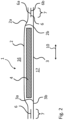
- Figure 1 shows schematically, not to scale, a top view of an exemplary absorbent hygiene article 1 with a topsheet 2 arranged on a side 16 of the hygiene article 1 facing the body, a backsheet 3 arranged on a side 17 of the hygiene article 1 facing away from the body, and an absorption body 4 arranged between the topsheet 2 and the backsheet 3.
- the hygiene article 1 has a longitudinal direction 11 and a transverse direction 10.
- the topsheet 2 and the backsheet 3 each extend in the transverse direction 10 and in the longitudinal direction 11 beyond the absorption body 4 and together form an overlap region 5 outside the absorption body 4.
- the hygiene article 1 has an elastic flat material 6 in the transverse direction 10 on both sides of the absorption body 4, which extends in the longitudinal direction 11 and is arranged between the topsheet 2 and the backsheet 3 and at least partially in the overlap region 5.
- the respective elastic flat material 6 forms together with the top sheet 2 and the back sheet 3 an elasticized zone 7 in the overlap area 5.
- the elastic flat material 6 has, as in Figure 2 As described in more detail, in the hygiene article 1, a topsheet-side flat material side 6a facing the topsheet 2 and a backsheet-side flat material side 6b facing the backsheet 3.
- the backsheet-side flat material side 6b has a backsheet-side flat material color F1.
- the backsheet 3 in the hygiene article 1 has a backsheet side 3a facing the body and a backsheet side 3b facing away from the body, with the backsheet 3 having an outer backsheet color F2 on the backsheet side 3b facing away from the body.
- the flat material color F1 on the backsheet side is different from the outer backsheet color F2.
- the backsheet 3 in this exemplary hygiene article 1 is a nonwoven-film composite material with an opacity of 71.7%. Alternatively, it would be conceivable to provide a film material as the backsheet.
- the backsheet-side flat material color F1 of the elastic flat material 6 within the elasticized zones 7 is visually perceptible when viewed from the side 17 of the hygiene article 1 facing away from the body.
- the hygiene article 1 has a color difference ⁇ E between (i) a color F3 of the respective elasticized zone 7 when viewed from the side 17 of the hygiene article 1 facing away from the body and (ii) the backsheet-side flat material color F1 of the elastic flat material 6 with a value for the color difference ⁇ E of 54.3.
- the hygiene article 1 shown is a pad-type hygiene article for adults for single use for the absorption of bodily excretions, such as an incontinence pad, an incontinence napkin or a sanitary napkin.
- Such hygiene articles are typically placed in the crotch area of an item of underwear so that they come to rest between the legs of a user during use.
- the hygiene article can have adhesive or fastening means on the side facing away from the body, such as adhesives or other fastening means that appear suitable to the person skilled in the art (not shown).
- the Figure 1 The hygiene article 1 shown is shown in a flat, spread-out state.
- the hygiene article 1 can have one or more optional fold lines 8, at which the hygiene article can be folded onto itself.
- Two optional fold lines 8 are shown as examples.
- the elastic flat material 6 of the hygiene article 1 has a transverse extension of 13 mm and a longitudinal extension of 145 mm in the flatly spread out hygiene article 1.
- the elastic flat material 6 is a green elastic film material with a thickness of 38 ⁇ m and a basis weight of 38 g/m 2 (available from the manufacturer RKW, WB0004.18).
- an elastic foam material can also be provided as the elastic flat material.
- the elastic flat material 6 is arranged completely in the overlapping area 5.
- the elastic flat material can also partially overlap with the absorption body, for example at a section of the elastic flat material that is at the end in the longitudinal direction.
- a section of the elastic flat material that overlaps with the absorption body is not to be considered as part of the elastic zone within the scope of the color measurements described.
- the absorption body 4 is hourglass-shaped and symmetrical in the longitudinal direction ( Figure 1 ).
- a rectangular or oval shape or any other shape that appears suitable to the person skilled in the art is also conceivable.
- the absorption body can be designed symmetrically or asymmetrically in the longitudinal direction, for example the rear region may extend longitudinally to the same extent, or further or less than, the front region.
- the hygiene article 1 shown has a front region 12, a rear region 13 and a crotch region 14 arranged between the front region 12 and the rear region 13 and lying between the legs of a user along the longitudinal direction.
- the elastic flat material 6 is arranged in the crotch region 14 in the longitudinal direction.
- the elastic flat material can optionally extend into the front region and/or the rear region.
- the crotch region 14 covers a micturition region 18, i.e. an area of the probable first contact of urine excretion with the hygiene article during micturition.
- a longitudinal extension 20 of the elastic flat material 6 is 42% of a longitudinal extension 21 of the hygiene article 1, measured in the flat, spread-out state.
- the backsheet 3 in this example consists of a water-impermeable, essentially white nonwoven-film composite material with a basis weight of 24 g/m 2 .
- a suitable nonwoven-film composite material is available, for example, as a "breathable textile backsheet” consisting of a "spunbond” spunbond made of polypropylene and a polyethylene film with a basis weight of 28 g/m 2 from the manufacturer INC Textiles.
- the backsheet made of nonwoven-film composite material offers the advantage of less noise during use and a more pleasant haptic impression on the outside of the article facing away from the body, formed by the nonwoven.
- the backsheet consists of a water-impermeable, essentially white film made of the polyolefin polyethylene and with a basis weight of 20 g/m 2 .
- a backsheet made of film material can give the user an improved impression of leak resistance, for example compared to a material with a textile appearance.
- the absorbent body is made up of a single layer.
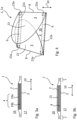
- the absorption body 4 can be designed as in Figure 3a schematically, not shown to scale, be multi-layered.
- the absorbent body 4 comprises a first absorbent body layer 19a arranged towards the side 16 facing the body and a second absorbent body layer 19b arranged towards the side 17 facing away from the body.
- the first absorbent body layer 19a and the second absorbent body layer 19b are in this example the same distance in the transverse direction 10 and in the longitudinal direction (not shown).
- the first absorbent body layer and the second absorbent body layer can extend to different distances in the transverse direction and/or the longitudinal direction.
- the first absorbent body layer and the second absorbent body layer can comprise an identical or a different composition of absorbent materials such as cellulose, superabsorbent polymer or mixtures thereof.
- the hygiene article 1 comprises an optional liquid absorption and distribution layer 15.
- the liquid absorption and distribution layer 15 and the absorbent body 4 extend the same distance in the transverse direction 10 and in the longitudinal direction (not shown). None of the elasticized zones 7 is covered by the liquid absorption and distribution layer 15.
- the liquid absorption and distribution layer and the absorbent body can extend to different distances in the transverse direction and/or the longitudinal direction.
- the liquid absorption and distribution layer 15 consists of a nonwoven material consisting of staple fibers of artificial origin and is arranged between the top sheet 2 and the back sheet 3, thereby between the top sheet 2 and the absorbent body 4.
- the liquid absorption and distribution layer can also be arranged between the absorbent body and the back sheet.
- Figure 4 is the exemplary hygiene article 1 from Figure 1 shown in folded state.
- the hygiene article 1 is folded on itself along two fold lines 8 running in the transverse direction 10 in the direction of the side 16 facing the body.
- the topsheet 2 lies on itself in some areas.
- the backsheet 3 forms a first surface 22 and a second surface 23 of the folded hygiene article 1a, which is to be positioned opposite the first surface 22.
- the elastic flat material 6 extends over the respective fold line 8, so that the elastic flat material 6 is visually perceptible when viewed from the first surface 22, 22a and from the second surface 23, 23a of the folded hygiene article 1a.
- the hygiene article has only one fold line or more than two fold lines, and that in the folded state the elastic flat material is visually perceptible from the first surface and from the second surface, which is to be positioned opposite the first surface.
- the hygiene article is folded in such a way that the elastic flat material is only visually perceptible from one of the first surface or the second surface. For reasons of clarity, the absorption body and the overlapping area are shown in Figure 4 not shown.
- the topsheet-side flat material side 6a shown in the exemplary hygiene article 1 has a topsheet-side flat material color F4, whereby the topsheet 2 in the hygiene article 1 has a topsheet side 2a facing the body and a topsheet side 2b facing away from the body.
- the topsheet 2 has an outer topsheet color F5 on the topsheet side 2a facing the body and the topsheet-side flat material color F4 is different from the outer topsheet color F5.
- the topsheet 2 in this exemplary hygiene article 1 is a liquid-permeable nonwoven material with an opacity of 36.2%.
- the nonwoven material is an essentially white spunbond from the manufacturer PFN with a basis weight of 25 g/m 2 and consisting of the polyolefin polypropylene.
- the fleece material offers the advantage of low noise levels during use and a pleasant and/or soft haptic impression with a textile feel on the outside of the article, which is formed by the fleece and faces the body.
- a film material or a combination of fleece and film as a top sheet.
- the topsheet-side flat material color F4 of the elastic flat material 6 of the exemplary hygiene article 1 is visually perceptible within the elasticized zones 7 when viewed from the side 16 of the hygiene article 1 facing the body.
- the respective elasticized zones 7 have a further color F6 when viewed from the side 16 of the hygiene article 1 facing the body.
- a color difference ⁇ E' between (i) the further color F6 and (ii) the topsheet-side flat material color F4 of the elastic flat material 6 has a value of at most 37.4.
- ⁇ E is greater than AE'.
- a ratio of ⁇ E to ⁇ E' has a value of 1.5.
Landscapes
- Health & Medical Sciences (AREA)
- Epidemiology (AREA)
- Engineering & Computer Science (AREA)
- Biomedical Technology (AREA)
- Heart & Thoracic Surgery (AREA)
- Vascular Medicine (AREA)
- Life Sciences & Earth Sciences (AREA)
- Animal Behavior & Ethology (AREA)
- General Health & Medical Sciences (AREA)
- Public Health (AREA)
- Veterinary Medicine (AREA)
- Physics & Mathematics (AREA)
- Fluid Mechanics (AREA)
- Dermatology (AREA)
- Absorbent Articles And Supports Therefor (AREA)
Applications Claiming Priority (1)
| Application Number | Priority Date | Filing Date | Title |
|---|---|---|---|
| DE102022134190.9A DE102022134190A1 (de) | 2022-12-20 | 2022-12-20 | Hygieneartikel mit Elastifizierung |
Publications (2)
| Publication Number | Publication Date |
|---|---|
| EP4389092A1 true EP4389092A1 (fr) | 2024-06-26 |
| EP4389092B1 EP4389092B1 (fr) | 2025-09-10 |
Family
ID=91270503
Family Applications (1)
| Application Number | Title | Priority Date | Filing Date |
|---|---|---|---|
| EP23217021.7A Active EP4389092B1 (fr) | 2022-12-20 | 2023-12-15 | Article d'hygiène élastifié |
Country Status (3)
| Country | Link |
|---|---|
| EP (1) | EP4389092B1 (fr) |
| DE (1) | DE102022134190A1 (fr) |
| ES (1) | ES3057880T3 (fr) |
Citations (10)
| Publication number | Priority date | Publication date | Assignee | Title |
|---|---|---|---|---|
| EP1174101A1 (fr) * | 2000-07-21 | 2002-01-23 | The Procter & Gamble Company | Article absorbant de couleur foncée |
| US20060025735A1 (en) * | 2004-07-30 | 2006-02-02 | Berg Charles J Jr | Absorbent article with color matched surfaces |
| EP2246017A1 (fr) | 2009-04-30 | 2010-11-03 | Attends Healthcare AB | Article absorbant |
| US20140100543A1 (en) * | 2002-12-20 | 2014-04-10 | The Procter & Gamble Company | Absorbent article having a color-pigmented and printed backsheet |
| EP2848236A1 (fr) | 2013-09-16 | 2015-03-18 | W. Pelz GmbH & Co. KG | Serviette hygiénique avec lisière de jambe |
| US20150148769A1 (en) * | 2012-06-11 | 2015-05-28 | Sca Hygiene Products Ab | Absorbent article |
| US10687993B2 (en) * | 2016-05-03 | 2020-06-23 | Essity Hygiene And Health Aktiebolag | Absorbent article with indicated absorption zone |
| EP3716927A1 (fr) | 2017-12-01 | 2020-10-07 | Essity Hygiene and Health Aktiebolag | Article absorbant |
| US20200352796A1 (en) * | 2017-08-22 | 2020-11-12 | Essity Hygiene And Health Aktiebolag | Disposable hygiene article |
| US20220192894A1 (en) * | 2019-05-29 | 2022-06-23 | Essity Hygiene And Health Aktiebolag | Absorbent pad with elastic elements |
Family Cites Families (1)
| Publication number | Priority date | Publication date | Assignee | Title |
|---|---|---|---|---|
| DE102018112121A1 (de) * | 2018-05-18 | 2019-11-21 | Paul Hartmann Ag | Inkontinenzartikel in Höschenform |
-
2022
- 2022-12-20 DE DE102022134190.9A patent/DE102022134190A1/de active Pending
-
2023
- 2023-12-15 EP EP23217021.7A patent/EP4389092B1/fr active Active
- 2023-12-15 ES ES23217021T patent/ES3057880T3/es active Active
Patent Citations (12)
| Publication number | Priority date | Publication date | Assignee | Title |
|---|---|---|---|---|
| EP1174101A1 (fr) * | 2000-07-21 | 2002-01-23 | The Procter & Gamble Company | Article absorbant de couleur foncée |
| US20140100543A1 (en) * | 2002-12-20 | 2014-04-10 | The Procter & Gamble Company | Absorbent article having a color-pigmented and printed backsheet |
| US20060025735A1 (en) * | 2004-07-30 | 2006-02-02 | Berg Charles J Jr | Absorbent article with color matched surfaces |
| EP2246017A1 (fr) | 2009-04-30 | 2010-11-03 | Attends Healthcare AB | Article absorbant |
| US20100280479A1 (en) * | 2009-04-30 | 2010-11-04 | Attends Healthcare Ab | Absorbent article |
| US20150148769A1 (en) * | 2012-06-11 | 2015-05-28 | Sca Hygiene Products Ab | Absorbent article |
| EP2848236A1 (fr) | 2013-09-16 | 2015-03-18 | W. Pelz GmbH & Co. KG | Serviette hygiénique avec lisière de jambe |
| EP2848236B1 (fr) * | 2013-09-16 | 2021-12-22 | W. Pelz GmbH & Co. KG | Serviette hygiénique avec lisière de jambe |
| US10687993B2 (en) * | 2016-05-03 | 2020-06-23 | Essity Hygiene And Health Aktiebolag | Absorbent article with indicated absorption zone |
| US20200352796A1 (en) * | 2017-08-22 | 2020-11-12 | Essity Hygiene And Health Aktiebolag | Disposable hygiene article |
| EP3716927A1 (fr) | 2017-12-01 | 2020-10-07 | Essity Hygiene and Health Aktiebolag | Article absorbant |
| US20220192894A1 (en) * | 2019-05-29 | 2022-06-23 | Essity Hygiene And Health Aktiebolag | Absorbent pad with elastic elements |
Also Published As
| Publication number | Publication date |
|---|---|
| DE102022134190A1 (de) | 2024-06-20 |
| ES3057880T3 (en) | 2026-03-05 |
| EP4389092B1 (fr) | 2025-09-10 |
Similar Documents
| Publication | Publication Date | Title |
|---|---|---|
| DE60207616T2 (de) | Wegwerfwindel mit sichtbarer Feuchtigkeitsanzeige | |
| DE69224972T2 (de) | Absorbtionsfähiges Hygieneprodukt | |
| DE60122729T2 (de) | Dunkelfarbiger, absorbierender Artikel | |
| DE69425327T2 (de) | Ausführung einer atmungsaktiven unteren Schicht für absorbierende Wegwerfartikel | |
| DE69427026T2 (de) | Ausführung einer atmungsaktiven doppellagigen unteren Schicht für absorbierende Wegwerfartikel | |
| DE69125545T2 (de) | Dünne Damenbinde | |
| DE69222374T2 (de) | Körperseitiges Element für absorbierende Artikel | |
| DE69610416T2 (de) | Lokalisiertes anbringen von feindenierfasern auf ein spinnvlies zur optimierung der hydrophobie von beinmanschetten in windeln und vorlagekissen | |
| DE69417044T2 (de) | Absorbierender artikel mit mehreren oberschichten | |
| DE69625479T2 (de) | Elastisches system für den taillenbereich mit verbesserten elastizitätsabnahmeeigenschaften für trainingshose | |
| DE69617424T2 (de) | Elastisches kleidungsstück | |
| DE69210257T2 (de) | Absorbierender artikel mit schnellverteilender und komfortabler oberschicht | |
| DE69524396T2 (de) | Zweifache perforierte Decklagen für absorbierende Artikel | |
| DE112014002335T5 (de) | Mit Öffnungen versehene Vliesmaterialien und Verfahren zu ihrer Bildung | |
| DE60008659T2 (de) | Ultradünner Artikel für Flüssigkeitskontrolle | |
| DE112018004898T5 (de) | Aufgebäumte elastomere Laminatstruktur, Passform und Textur | |
| DE112017006446T5 (de) | Absorptionsartikel zum Anziehen mit verbesserten elastomeren Laminaten | |
| DE202017005952U1 (de) | Absorptionsartikel mit Kanälen | |
| DE202017005950U1 (de) | Absorptionsartikel mit Kanälen | |
| DE112014002327T5 (de) | Saugfähiger Artikel mit doppeltem Kern | |
| DE112014000646T5 (de) | Windel mit Separator-Flächengebilde | |
| DE202017005956U1 (de) | Absorptionsartikel mit Kanälen | |
| DE112015003827T5 (de) | Absorptionsartikel mit grafischen Darstellungen | |
| DE102012208393A1 (de) | Inkontinenzartikel in Höschenform | |
| EP2410965B1 (fr) | Couche pour incontinence absorbante et jetable, pourvue de parties latérales |
Legal Events
| Date | Code | Title | Description |
|---|---|---|---|
| PUAI | Public reference made under article 153(3) epc to a published international application that has entered the european phase |
Free format text: ORIGINAL CODE: 0009012 |
|
| STAA | Information on the status of an ep patent application or granted ep patent |
Free format text: STATUS: THE APPLICATION HAS BEEN PUBLISHED |
|
| AK | Designated contracting states |
Kind code of ref document: A1 Designated state(s): AL AT BE BG CH CY CZ DE DK EE ES FI FR GB GR HR HU IE IS IT LI LT LU LV MC ME MK MT NL NO PL PT RO RS SE SI SK SM TR |
|
| STAA | Information on the status of an ep patent application or granted ep patent |
Free format text: STATUS: REQUEST FOR EXAMINATION WAS MADE |
|
| 17P | Request for examination filed |
Effective date: 20241217 |
|
| GRAP | Despatch of communication of intention to grant a patent |
Free format text: ORIGINAL CODE: EPIDOSNIGR1 |
|
| STAA | Information on the status of an ep patent application or granted ep patent |
Free format text: STATUS: GRANT OF PATENT IS INTENDED |
|
| RIC1 | Information provided on ipc code assigned before grant |
Ipc: A61F 13/84 20060101ALI20250407BHEP Ipc: A61F 13/514 20060101ALI20250407BHEP Ipc: A61F 13/513 20060101ALI20250407BHEP Ipc: A61F 13/475 20060101ALI20250407BHEP Ipc: A61F 13/472 20060101AFI20250407BHEP |
|
| INTG | Intention to grant announced |
Effective date: 20250424 |
|
| RIN1 | Information on inventor provided before grant (corrected) |
Inventor name: HORN, ANNETTE Inventor name: BAEHRLE, CHRISTIAN Inventor name: HERZOG, MORITZ |
|
| GRAS | Grant fee paid |
Free format text: ORIGINAL CODE: EPIDOSNIGR3 |
|
| GRAA | (expected) grant |
Free format text: ORIGINAL CODE: 0009210 |
|
| STAA | Information on the status of an ep patent application or granted ep patent |
Free format text: STATUS: THE PATENT HAS BEEN GRANTED |
|
| AK | Designated contracting states |
Kind code of ref document: B1 Designated state(s): AL AT BE BG CH CY CZ DE DK EE ES FI FR GB GR HR HU IE IS IT LI LT LU LV MC ME MK MT NL NO PL PT RO RS SE SI SK SM TR |
|
| REG | Reference to a national code |
Ref country code: GB Ref legal event code: FG4D Free format text: NOT ENGLISH |
|
| REG | Reference to a national code |
Ref country code: CH Ref legal event code: EP |
|
| REG | Reference to a national code |
Ref country code: DE Ref legal event code: R096 Ref document number: 502023001772 Country of ref document: DE |
|
| REG | Reference to a national code |
Ref country code: IE Ref legal event code: FG4D Free format text: LANGUAGE OF EP DOCUMENT: GERMAN |
|
| P01 | Opt-out of the competence of the unified patent court (upc) registered |
Free format text: CASE NUMBER: UPC_APP_7197_4389092/2025 Effective date: 20250916 |
|
| PG25 | Lapsed in a contracting state [announced via postgrant information from national office to epo] |
Ref country code: NO Free format text: LAPSE BECAUSE OF FAILURE TO SUBMIT A TRANSLATION OF THE DESCRIPTION OR TO PAY THE FEE WITHIN THE PRESCRIBED TIME-LIMIT Effective date: 20251210 |
|
| REG | Reference to a national code |
Ref country code: LT Ref legal event code: MG9D |
|
| PGFP | Annual fee paid to national office [announced via postgrant information from national office to epo] |
Ref country code: AT Payment date: 20260113 Year of fee payment: 3 |
|
| PG25 | Lapsed in a contracting state [announced via postgrant information from national office to epo] |
Ref country code: FI Free format text: LAPSE BECAUSE OF FAILURE TO SUBMIT A TRANSLATION OF THE DESCRIPTION OR TO PAY THE FEE WITHIN THE PRESCRIBED TIME-LIMIT Effective date: 20250910 |
|
| REG | Reference to a national code |
Ref country code: NL Ref legal event code: MP Effective date: 20250910 |
|
| PG25 | Lapsed in a contracting state [announced via postgrant information from national office to epo] |
Ref country code: HR Free format text: LAPSE BECAUSE OF FAILURE TO SUBMIT A TRANSLATION OF THE DESCRIPTION OR TO PAY THE FEE WITHIN THE PRESCRIBED TIME-LIMIT Effective date: 20250910 |
|
| PGFP | Annual fee paid to national office [announced via postgrant information from national office to epo] |
Ref country code: FR Payment date: 20251218 Year of fee payment: 3 |
|
| PG25 | Lapsed in a contracting state [announced via postgrant information from national office to epo] |
Ref country code: GR Free format text: LAPSE BECAUSE OF FAILURE TO SUBMIT A TRANSLATION OF THE DESCRIPTION OR TO PAY THE FEE WITHIN THE PRESCRIBED TIME-LIMIT Effective date: 20251211 |
|
| PG25 | Lapsed in a contracting state [announced via postgrant information from national office to epo] |
Ref country code: SE Free format text: LAPSE BECAUSE OF FAILURE TO SUBMIT A TRANSLATION OF THE DESCRIPTION OR TO PAY THE FEE WITHIN THE PRESCRIBED TIME-LIMIT Effective date: 20250910 |
|
| PG25 | Lapsed in a contracting state [announced via postgrant information from national office to epo] |
Ref country code: LV Free format text: LAPSE BECAUSE OF FAILURE TO SUBMIT A TRANSLATION OF THE DESCRIPTION OR TO PAY THE FEE WITHIN THE PRESCRIBED TIME-LIMIT Effective date: 20250910 |
|
| PG25 | Lapsed in a contracting state [announced via postgrant information from national office to epo] |
Ref country code: PL Free format text: LAPSE BECAUSE OF FAILURE TO SUBMIT A TRANSLATION OF THE DESCRIPTION OR TO PAY THE FEE WITHIN THE PRESCRIBED TIME-LIMIT Effective date: 20250910 Ref country code: BG Free format text: LAPSE BECAUSE OF FAILURE TO SUBMIT A TRANSLATION OF THE DESCRIPTION OR TO PAY THE FEE WITHIN THE PRESCRIBED TIME-LIMIT Effective date: 20250910 |
|
| PG25 | Lapsed in a contracting state [announced via postgrant information from national office to epo] |
Ref country code: RS Free format text: LAPSE BECAUSE OF FAILURE TO SUBMIT A TRANSLATION OF THE DESCRIPTION OR TO PAY THE FEE WITHIN THE PRESCRIBED TIME-LIMIT Effective date: 20251210 |
|
| PG25 | Lapsed in a contracting state [announced via postgrant information from national office to epo] |
Ref country code: NL Free format text: LAPSE BECAUSE OF FAILURE TO SUBMIT A TRANSLATION OF THE DESCRIPTION OR TO PAY THE FEE WITHIN THE PRESCRIBED TIME-LIMIT Effective date: 20250910 |
|
| REG | Reference to a national code |
Ref country code: ES Ref legal event code: FG2A Ref document number: 3057880 Country of ref document: ES Kind code of ref document: T3 Effective date: 20260305 |
|
| PG25 | Lapsed in a contracting state [announced via postgrant information from national office to epo] |
Ref country code: SM Free format text: LAPSE BECAUSE OF FAILURE TO SUBMIT A TRANSLATION OF THE DESCRIPTION OR TO PAY THE FEE WITHIN THE PRESCRIBED TIME-LIMIT Effective date: 20250910 |
|
| PGFP | Annual fee paid to national office [announced via postgrant information from national office to epo] |
Ref country code: ES Payment date: 20260119 Year of fee payment: 3 |
|
| PGFP | Annual fee paid to national office [announced via postgrant information from national office to epo] |
Ref country code: DE Payment date: 20251222 Year of fee payment: 3 |
|
| PG25 | Lapsed in a contracting state [announced via postgrant information from national office to epo] |
Ref country code: IT Free format text: LAPSE BECAUSE OF FAILURE TO SUBMIT A TRANSLATION OF THE DESCRIPTION OR TO PAY THE FEE WITHIN THE PRESCRIBED TIME-LIMIT Effective date: 20250910 Ref country code: RO Free format text: LAPSE BECAUSE OF FAILURE TO SUBMIT A TRANSLATION OF THE DESCRIPTION OR TO PAY THE FEE WITHIN THE PRESCRIBED TIME-LIMIT Effective date: 20250910 |
|
| PG25 | Lapsed in a contracting state [announced via postgrant information from national office to epo] |
Ref country code: IS Free format text: LAPSE BECAUSE OF FAILURE TO SUBMIT A TRANSLATION OF THE DESCRIPTION OR TO PAY THE FEE WITHIN THE PRESCRIBED TIME-LIMIT Effective date: 20260110 |
|
| PG25 | Lapsed in a contracting state [announced via postgrant information from national office to epo] |
Ref country code: PT Free format text: LAPSE BECAUSE OF FAILURE TO SUBMIT A TRANSLATION OF THE DESCRIPTION OR TO PAY THE FEE WITHIN THE PRESCRIBED TIME-LIMIT Effective date: 20260112 Ref country code: CZ Free format text: LAPSE BECAUSE OF FAILURE TO SUBMIT A TRANSLATION OF THE DESCRIPTION OR TO PAY THE FEE WITHIN THE PRESCRIBED TIME-LIMIT Effective date: 20250910 |
|
| PG25 | Lapsed in a contracting state [announced via postgrant information from national office to epo] |
Ref country code: SK Free format text: LAPSE BECAUSE OF FAILURE TO SUBMIT A TRANSLATION OF THE DESCRIPTION OR TO PAY THE FEE WITHIN THE PRESCRIBED TIME-LIMIT Effective date: 20250910 Ref country code: EE Free format text: LAPSE BECAUSE OF FAILURE TO SUBMIT A TRANSLATION OF THE DESCRIPTION OR TO PAY THE FEE WITHIN THE PRESCRIBED TIME-LIMIT Effective date: 20250910 |