EP4389718A1 - Künstlicher agglomerierter steinartikel mit glasmaterial granulat und verfahren zu seiner herstellung - Google Patents
Künstlicher agglomerierter steinartikel mit glasmaterial granulat und verfahren zu seiner herstellung Download PDFInfo
- Publication number
- EP4389718A1 EP4389718A1 EP22383260.1A EP22383260A EP4389718A1 EP 4389718 A1 EP4389718 A1 EP 4389718A1 EP 22383260 A EP22383260 A EP 22383260A EP 4389718 A1 EP4389718 A1 EP 4389718A1
- Authority
- EP
- European Patent Office
- Prior art keywords
- weight
- granulated
- vitreous material
- respect
- article
- Prior art date
- Legal status (The legal status is an assumption and is not a legal conclusion. Google has not performed a legal analysis and makes no representation as to the accuracy of the status listed.)
- Pending
Links
Images


Classifications
-
- C—CHEMISTRY; METALLURGY
- C04—CEMENTS; CONCRETE; ARTIFICIAL STONE; CERAMICS; REFRACTORIES
- C04B—LIME, MAGNESIA; SLAG; CEMENTS; COMPOSITIONS THEREOF, e.g. MORTARS, CONCRETE OR LIKE BUILDING MATERIALS; ARTIFICIAL STONE; CERAMICS; REFRACTORIES; TREATMENT OF NATURAL STONE
- C04B20/00—Use of materials as fillers for mortars, concrete or artificial stone according to more than one of groups C04B14/00 - C04B18/00 and characterised by shape or grain distribution; Treatment of materials according to more than one of the groups C04B14/00 - C04B18/00 specially adapted to enhance their filling properties in mortars, concrete or artificial stone; Expanding or defibrillating materials
- C04B20/02—Treatment
- C04B20/04—Heat treatment
-
- C—CHEMISTRY; METALLURGY
- C04—CEMENTS; CONCRETE; ARTIFICIAL STONE; CERAMICS; REFRACTORIES
- C04B—LIME, MAGNESIA; SLAG; CEMENTS; COMPOSITIONS THEREOF, e.g. MORTARS, CONCRETE OR LIKE BUILDING MATERIALS; ARTIFICIAL STONE; CERAMICS; REFRACTORIES; TREATMENT OF NATURAL STONE
- C04B26/00—Compositions of mortars, concrete or artificial stone, containing only organic binders, e.g. polymer or resin concrete
- C04B26/02—Macromolecular compounds
-
- C—CHEMISTRY; METALLURGY
- C04—CEMENTS; CONCRETE; ARTIFICIAL STONE; CERAMICS; REFRACTORIES
- C04B—LIME, MAGNESIA; SLAG; CEMENTS; COMPOSITIONS THEREOF, e.g. MORTARS, CONCRETE OR LIKE BUILDING MATERIALS; ARTIFICIAL STONE; CERAMICS; REFRACTORIES; TREATMENT OF NATURAL STONE
- C04B2111/00—Mortars, concrete or artificial stone or mixtures to prepare them, characterised by specific function, property or use
- C04B2111/54—Substitutes for natural stone, artistic materials or the like
Definitions
- the disclosure comprised herein relates to artificial agglomerated stone articles for construction, decoration, and architecture, as well as to the composition and manufacture thereof.
- the disclosure relates to the granulated inorganic materials used as filler in these articles, the properties and obtaining of same, as well as to the waste generated during the manufacture of said articles and the valorization thereof.
- Artificial agglomerated stone articles that typically simulate natural stones, and specifically those known as artificial stone surfaces, are common in the construction, decoration, architecture, and design sectors. The processes for the manufacture thereof on an industrial scale are well established today, and their applications partially overlap with those of ornamental natural stones such as marble or granite. Artificial agglomerated stone articles are typically used for manufacturing counters, kitchen countertops, sinks, shower trays, wall or floor coverings, stairs, or the like. For these uses, the aesthetic aspect and the conservation thereof over the entire useful life of the product are of vital importance. It is therefore necessary for these articles to have a high mechanical strength (to bending, abrasion, scratching), low porosity (low stainability), and high chemical resistance (for example, to acid etching).
- quartz agglomerated surfaces are the so-called quartz agglomerated surfaces. They can be manufactured simulating the colors and patterns of natural stone, or they can also have a completely artificial appearance, for example, with bright red or fuchsia colors.
- the basis of their composition and the technology currently used for their manufacture dates back to the late 1970s, developed by the Italian company Breton SpA, and is now known commercially in the industry as Bretonstone ® .
- the general concepts of this process are widely disclosed in the technical and patent literature, and are described, for example, in patent publication US4204820 .
- quartz granulate sometimes mixed with synthetic cristobalite and/or other inorganic granulates, with varying particle sizes, is initially mixed with a hardenable binder, usually a liquid organic resin.
- a hardenable binder usually a liquid organic resin.
- the resulting mixture is homogenized and distributed in a temporary mold or, alternatively, on a sheet of paper, where it is compacted by vacuum vibrocompaction and subsequently hardened to result in boards with dimensions that can often reach 3.2 ⁇ 1.6 m 2 , with thicknesses of 0.5-3 cm.
- Natural quartz and synthetic cristobalite despite being different materials, have several common characteristics leading them to be used extensively as granulated filler materials for the manufacture of durable construction/decoration surfaces, such characteristics being their high abundance and availability, hardness, translucence, luminosity, and their chemical inertness. However, they have at least one drawback.
- the fine fraction of respirable crystalline silica dust which is generated during the manufacture of artificial agglomerated stone articles containing quartz or cristobalite, or when this agglomerated material is processed mechanically, poses an occupational health risk to workers.
- machining processes are performed to cut, calibrate, and polish or brush the part that is being produced to the required dimensions, and to obtain the desired surface finish.
- These machining processes are usually performed in wet conditions, adding significant amounts of water, to cool and lubricate the machining tools and abrasives, and to prevent the formation of dust in the environment.
- the water in this machining is collected and added to the system again, after separating (for example, by decantation) the suspended solid material therein coming from the machining of the articles.
- the separated solid material is known in the trade as sludge, due to its appearance caused by the small particle size and its high water content.
- sludges are conventionally disposed of in landfills when they are not recycled into other products, which poses an environmental problem.
- WO2020099501 describes the use of sludges generated in the process of manufacturing artificial agglomerated stone together with other waste to produce a fertile artificial soil.
- Publication WO2009033943 in turn, relates to a treatment of sludges that includes drying, calcination, and cooling, before their use in the manufacture of new aggregate articles.
- WO2021074780 proposes the use of the sludges resulting from the machining of artificial agglomerated stone as part of the raw material for the manufacture of vitreous materials, namely frits.
- the mentioned document discloses that the proposed raw material composition supposedly produces frits with a hardness of at least 5 Mohs, and a silicon dioxide content in crystalline form of less than 1%.
- those frits are designed to be used as aggregates and filler materials in a mixture with a binder in the manufacture of articles in the form of a board or block.
- US20200299188A1 relates to the production of environmentallyfriendly artificial stones from fritted sands which are obtained from melting and cooling raw materials comprising coal gangue, extraction tailings of quartz, limestone, sodium feldspar, and potassium feldspar. According to this document, the artificial stone obtained has a low cost and high mechanical strength.
- the disclosure seeks to propose granulated vitreous materials suitable for use in artificial agglomerated stone articles, with improved aesthetic and chemical resistance properties.
- the disclosure intends to meet the need for artificial agglomerated stone articles which incorporate granulated vitreous materials, with an improved performance and aesthetics.
- Another objective of the present disclosure is to propose a method which allows using a high proportion of the sludges generated during the machining of the artificial agglomerated stones for the manufacture of granulated vitreous material, particularly when said stones comprise inorganic materials that are alternatives to quartz and/or cristobalite, for example sodium feldspar or soda-lime glass, which incorporate a high concentration of sodium into the stones.
- the disclosure comprised herein is based on the finding by the inventors that a vitreous material with a specific oxide composition has an excellent transparency and homogeneity, while at the same time a high chemical resistance, especially to acid etching.
- the disclosure relates to an artificial agglomerated stone article comprising a granulated vitreous material and a hardened binder, wherein the granulated vitreous material has a composition comprising: % by weight SiO 2 50 - 65% Al 2 O 3 1 - 7.5% CaO 23 - 39% Na 2 O 1 - 6% MgO 0 - 1.5%
- the disclosure relates to the use of a granulated vitreous material such as that defined in the first aspect, for the manufacture of an artificial agglomerated stone article.
- the disclosure relates to a method for the manufacture of an artificial agglomerated stone article comprising the following steps:
- this granulated vitreous material can be manufactured from the sludges generated during machining, e.g. calibration, polishing, brushing, and/or cutting, of artificial agglomerated stone. It has also been found that this method of manufacture also allows use for the first time of a high proportion of sludges collected during the machining of the agglomerated stone when this stone contains a high concentration of sodium in its composition, without the advantageous properties of transparency, homogeneity, and chemical resistance of the vitreous material deteriorating.
- a fourth aspect of the disclosure relates to a method of manufacturing a granulated vitreous material comprising the following steps:
- the disclosure relates to the use of the granulated vitreous material obtainable by the method of the fourth aspect for the manufacture of an artificial agglomerated stone article.
- the disclosure relates to an artificial agglomerated stone article comprising a granulated vitreous material obtainable by means of the method of the fourth aspect of the disclosure.
- the disclosure relates to a method for the manufacture of an artificial agglomerated stone article comprising the following steps:
- Additional aspects of the disclosure relate to the use of the agglomerated stone article of the first or sixth aspect as a construction and/or decoration material, for example for the manufacture of counters, kitchen countertops, sinks, bathroom sinks, shower trays, wall or floor coverings, stairs, or the like, and to the counters, kitchen countertops, sinks, bathroom sinks, shower trays, wall or floor coverings, stairs, or the like, obtained from the agglomerated stone article of the first or sixth aspect.
- both the lower limit and the upper limit are included in said range.
- % by weight means percentage by weight (w/w).
- composition is defined by the percentage by weight of the components that form same, these values may never add up to a value exceeding 100%.
- the amount of all the components comprised in said composition add up to 100% of the weight thereof.
- agglomerated stone or “artificial agglomerated stone” are generally used and understood in the technical field of the disclosure. For purposes of clarity, but without intending to be limiting, the terms “agglomerated stone” and “artificial agglomerated stone” refer herein at least to all the materials included in the definition contained in European standard EN 14618:2009.
- vitreous material is defined as an inorganic material, resulting from raw materials being melted and cooled to a rigid condition maintaining at least 20% by weight of amorphous phase in the composition thereof, and the rest may be made up of one or more crystalline phases.
- the vitreous material can be, for example, synthetic.
- the term “granule” or “granulate” refers to a material in the form of individual units (particles).
- the term encompasses units ranging from infinitesimal powder particles with sizes on the micrometer scale to comparatively large particles of material with sizes on the millimeter scale, for example from 1 ⁇ m to 10 mm.
- These terms encompass materials in the form of particles of various shapes and sizes, more or less edged or rounded, including grain particles, flakes, fines, powders, or combinations thereof.
- Granulated materials can be obtained in the desired particle size ranges (granulometry) by grinding and sieving/sorting, using methods known in the art.
- particle size also referred to as “particle diameter”, as used here, means the diameter of the individual particles. It can be measured statistically by the retention or the passage of a population of particles in calibrated sieves having openings with a known mesh size, where a particle will pass through (and will therefore be smaller than) or will be retained by (and will therefore be larger than) a certain sieve.
- a granulated material is said to have a particle size or a granulometry in a given range, it means that less than 1% of the particles of the total population of particles in a distribution by volume of this material have a particle size outside the given range.
- the particle size distribution of a sample can be measured, for example, by laser diffraction, for example with commercial equipment designed for that purpose (e.g., Malvern Panalytical Mastersizer 3000 equipped with a Hydro cell).
- the sample can be dispersed in demineralized water with the aid of an ultrasound probe.
- the laser diffractometer provides particle distribution curves (% particle volume vs. particle size) and statistical values, such as D10, D50, and D90, of the sample particle population (particle size values where 10%, 50%, or 90% of the sample particle population in a distribution by volume is below this value, respectively).
- binder is well known in the art and refers to a component that performs the function of holding together the granulated 'filler' material in order to form the artificial agglomerated stone article.
- the binder in unhardened or uncured form is mixed with the granulated material and subsequently hardened or cured to give cohesion and mechanical strength to the artificial agglomerated stone article.
- the binder can be organic, such as organic resins (e.g. thermoset or thermoplastic), or inorganic, such as cements or geopolymers.
- the binder of the different aspects of the disclosure can be a hardenable organic resin (before curing) or a hardened organic resin (after curing).
- organic resin or hardenable organic resin shall be understood to mean a material of a predominantly organic nature made up of a compound or a mixture of compounds, optionally together with a solvent.
- the compound or compounds of the mixture of compounds of the resin can be monomeric, oligomeric, or polymeric, optionally with varying molecular weights and degrees of crosslinking.
- At least some of the compounds of the hardenable organic resin, and optionally also the solvent, will have reactive functional groups capable of being subjected to curing or hardening by means of a crosslinking or curing reaction that hardens the organic resin, giving rise to a hardened organic resin (or hardened binder) when the curing step ends.
- composition in the different aspects and embodiments of the disclosure can be obtained by X-ray fluorescence (XRF), a well-established technique in the technological field of minerals, glass, and ceramics.
- XRF X-ray fluorescence
- the composition indicated in each case preferably corresponds to the average, calculated from at least 3 repetitions of the measurement, from the composition of samples containing a known amount of material to be analyzed (for example, 1 gram of material to be analyzed).
- the concentration of boron can also be determined by techniques known in the art. For example, by means of alkaline titrimetry, or by means of inductively coupled plasma (ICP) spectrometry.
- concentration of boron can be determined according to international standard ISO 21078-1:2008.
- high-power XRF can be used.
- the method used is alkaline titrimetry.
- the amount of crystalline phases and content of amorphous phase in the different aspects and embodiments of the disclosure can be determined by means of X-ray powder diffraction (XRD) analysis, for example using the Rietveld method combined with the use of an internal standard for quantification, a widely used technique in the technological field.
- XRD X-ray powder diffraction
- sludge refers to the solid waste resulting from the drying, decantation, concentration, and/or filtration of the suspension in water of the powder (particles with a particle size ⁇ 150 micrometers) produced during the wet machining of agglomerated stones.
- This dry waste can still contain a certain level of moisture (generally up to 30% w/w) but does not have the sludgy consistency of the initial suspension and is generally made up of differently sized particle aggregates together with small unadhered particles.
- the vitreous material according to the various aspects of the disclosure exhibits excellent properties of appearance and resistance to chemical etching that are superior to those of other vitreous materials with a different oxide composition. These properties render the granulated vitreous material of the disclosure particularly suitable for being used as a filler material in the manufacture of artificial agglomerated stone articles.
- the granulated vitreous material of the different aspects of the present disclosure has a composition comprising: % by weight SiO 2 50 - 65% Al 2 O 3 1 - 7.5% CaO 23 - 39% Na 2 O 1 - 6% MgO 0 - 1.5%
- the granulated vitreous material comprises 53 - 64% by weight of SiO 2 with respect to the weight of the granulated vitreous material. In certain embodiments, it comprises 53 - 63% by weight of SiO 2 .
- the granulated vitreous material comprises 2 - 7.5% by weight of Al 2 O 3 with respect to the weight of the granulated vitreous material. In certain embodiments, it comprises 3 - 7.5% by weight of Al 2 O 3 . In other embodiments, it comprises 4 - 7.5%, or even 4 - 7.2%, by weight of Al 2 O 3 .
- the granulated vitreous material comprises 24 - 37% by weight of CaO with respect to the weight of the granulated vitreous material. In certain embodiments, it comprises 25 - 36% by weight of CaO.
- the granulated vitreous material comprises 1 - 5% by weight of Na 2 O with respect to the weight of the granulated vitreous material. In certain embodiments, it comprises 1.5 - 5% by weight of Na 2 O. In other embodiments, it comprises 2 - 4% by weight of Na 2 O.
- the granulated vitreous material comprises MgO at a concentration of 0-1% by weight, or of 0 - 0.5% by weight, with respect to the weight of the granulated vitreous material.
- the granulated vitreous material may comprise 0.05 - 1% by weight, or 0.05 - 0.5% by weight, of MgO with respect to the weight of the granulated vitreous material.
- the sum of the percentages by weight of Al 2 O 3 , CaO, and Na 2 O in the granulated vitreous material is in the range of 33 - 42% by weight, or 34 - 41% by weight, with respect to the weight of the granulated vitreous material.
- the granulated vitreous material of the present disclosure has a composition comprising: % by weight SiO 2 53 - 64% Al 2 O 3 2 - 7.5% CaO 24 - 37% Na 2 O 1 - 5% MgO 0 - 1% wherein the sum of the percentages by weight of Al 2 O 3 , CaO, and Na 2 O is in the range of 33 - 42% by weight, and wherein the percentages by weight are with respect to the weight of the granulated vitreous material.
- the granulated vitreous material of the present disclosure has a composition comprising: % by weight SiO 2 53 - 63% Al 2 O 3 3 - 7.5% CaO 25 - 36% Na 2 O 1.5 - 5% MgO 0.05 - 0.5% wherein the sum of the percentages by weight of Al 2 O 3 , CaO, and Na 2 O is in the range of 33 - 42% by weight, and wherein the percentages by weight are with respect to the weight of the granulated vitreous material.
- oxides Al 2 O 3 , CaO, and Na 2 O have to be balanced for the sum thereof to be within the described ranges. As evidenced in the examples, if this sum is outside the claimed range, even if the remaining individual concentrations are in the claimed ranges, the properties of the granulated vitreous material are inferior.
- the granulated vitreous material of the disclosure comprises predominantly calcium silicates.
- the sum of the percentages by weight of SiO 2 +CaO in the composition can be in a range of 82 - 97% with respect to the weight of the material.
- the sum of the percentages by weight of SiO 2 +CaO in the granulated vitreous material is in a range of 85 - 95% with respect to the weight of the material.
- the granulated vitreous material may comprise boron.
- the proportion of B 2 O 3 in the composition of the granulated vitreous material can be in the range of 0 - 4% by weight, with respect to the weight of the granulated vitreous material.
- the proportion of B 2 O 3 is 0 - 3% by weight, with respect to the weight of the granulated vitreous material.
- the granulated vitreous material comprises 0.1 - 3% by weight, or even 0.5 - 2.5% by weight of B 2 O 3 with respect to the weight of the granulated vitreous material.
- the granulated vitreous material can have a composition wherein the sum of the proportion of SiO 2 +Al 2 O 3 +CaO+Na 2 O+B 2 O 3 is in the range of 92-99.9% by weight, or 95 - 99.9% by weight, with respect to the weight of the granulated vitreous material.
- the sum of the percentages of SiO 2 +Al 2 O 3 +CaO+Na 2 O+B 2 O 3 is in the range of 96 - 99.8% by weight, or 96.5 - 99.6% by weight, with respect to the weight of the granulated vitreous material.
- the granulated vitreous material may comprise K 2 O at a concentration of 0 - 2% by weight, or of 0 - 1.5% by weight, with respect to the weight of the granulated vitreous material.
- the granulated vitreous material may comprise 0.05 - 2% by weight, or 0.05 - 1.5% by weight, of K 2 O with respect to the weight of the granulated vitreous material.
- the granulated vitreous material may comprise Fe 2 O 3 at a concentration of 0 - 0.5% by weight, or even 0 - 0.2% by weight, with respect to the weight of the granulated vitreous material.
- the granulated vitreous material may comprise 0.05 - 0.5% by weight, or 0.05 - 0.2% by weight, of Fe 2 O 3 with respect to the weight of the granulated vitreous material.
- the granulated vitreous material may comprise TiOz at a concentration of 0 - 1.2% by weight, or even 0 - 1% by weight, with respect to the weight of the granulated vitreous material.
- the granulated vitreous material may comprise 0.05 - 1.2% by weight, or 0.05 - 1% by weight, of TiOz with respect to the weight of the granulated vitreous material.
- the granulated vitreous material of the present disclosure may further comprise: % by weight B 2 O 3 0 -3% K 2 O 0 - 2% Fe 2 O 3 0 - 0.5% TiO 2 0 - 1.2% with respect to the weight of the granulated vitreous material.
- the granulated vitreous material of the present disclosure further comprises: % by weight B 2 O 3 0.1 - 3% K 2 O 0.05 - 2% Fe 2 O 3 0.05 - 0.5% TiO 2 0.05 - 1.2% with respect to the weight of the granulated vitreous material.
- the granulated vitreous material may comprise other inorganic oxides such as ZrO 2 and/or BaO.
- the granulated vitreous material may comprise 0 - 0.3% by weight, or 0 - 0.1% by weight, of ZrO 2 with respect to the weight of the granulated vitreous material.
- the granulated vitreous material may comprise 0 - 0.3% by weight, or 0 - 0.1% by weight, of BaO with respect to the weight of the granulated vitreous material.
- the granulated vitreous material of the disclosure may comprise silica in crystalline form (e.g. as quartz, cristobalite, and/or tridymite).
- silica in crystalline form e.g. as quartz, cristobalite, and/or tridymite.
- the amount of crystalline silica in the granulated vitreous material is ⁇ 10% by weight, or even ⁇ 5% by weight, with respect to the weight of the granulated vitreous material.
- the amount of crystalline silica in the granulated vitreous material is ⁇ 2% by weight, or even ⁇ 1% by weight, with respect to the weight of the granulated vitreous material.
- the amount of crystalline silica in the granulated vitreous material is 0-10% by weight, or 0-5% by weight, or even 0-2% by weight or 0-1% by weight, with respect to the weight of the granulated vitreous material.
- the total content of amorphous or non-X-ray diffracting phase in the granulated vitreous material can be 90-100% by weight, or even 95-100% by weight, with respect to the weight of the granulated vitreous material, with the rest being made up of the sum of the crystalline phases comprised in said material (in the event that said crystalline phases are present).
- the sum of the crystalline phases for example, diopside, anorthite, quartz, wollastonite, albite, cristobalite, or others
- the sum of the crystalline phases in the granulated vitreous material is 0-10% by weight, or 0-5% by weight, with respect to the weight of the granulated vitreous material.
- the sum of the crystalline phases in the granulated vitreous material is 0-2% by weight, or even 0-1% by weight, with respect to the weight of the granulated vitreous material.
- the granulated vitreous material can have different particle sizes, for example, comprised between 0.01 mm and 5 mm. According to one embodiment, the vitreous material has a particle size in the range of 0.02-2 mm, or even 0.03-1.2 mm. In certain embodiments, the granulated vitreous material can have a particle size in the range of 0.01-1 mm, or even 0.02-0.7 mm.
- the vitreous material of the disclosure can be obtained by means of a first method that comprises using sludges coming from the machining of agglomerated stone.
- the concept of the present disclosure thereby allows this waste material to be recycled in a circular manner in the production of articles which generates such waste.
- this method has allowed use for the first time of a high proportion of the sludges generated during the machining of the agglomerated stone when this stone contains a high concentration of sodium in its composition, without the advantageous properties of transparency, homogeneity, and chemical resistance of the vitreous material deteriorating.
- the granulated vitreous material of the disclosure can be obtained by a first method which comprises:
- This method of preparing the granulated vitreous material uses materials (sludges) coming from wet machining or processing (i.e., with the addition of water) of agglomerated stone, such as cutting, calibration, grinding, polishing, or brushing of said agglomerated stone, especially in the case of boards or slabs.
- this method for the preparation of a vitreous material from the sludge generated in the machining of agglomerated stone allows the use of a large amount (for example >60% by weight) of sludge generated in the machining of agglomerated stone together with the mineral composition, even when the agglomerated stone contains a high concentration of sodium in the composition thereof, without the excellent properties of transparency, homogeneity, and chemical resistance of the final vitreous material deteriorating.
- the high sodium content of the starting agglomerated stone may be due, for example, to the presence of sodium feldspar or soda-lime glass granules in the composition of the agglomerated stone, instead of the quartz or cristobalite traditionally used as a filler material or filler.
- the composition of the agglomerated stone from which the sludge is generated determines the composition of the sludge generated in the machining of agglomerated stone. Therefore, in embodiments of the disclosure, the sludge of step a) is generated in the machining of agglomerated stone comprising feldspar and/or glass granules.
- the feldspar granules can be of sodium feldspar or albite, for example feldspar comprising Na 2 O in the range of 5-11.9% by weight with respect to the weight of the feldspar granules.
- the feldspar granules can be comprised in the agglomerated stone from which the sludge is generated in a proportion of 5-80% by weight, or of 10-70% by weight, with respect to the weight of the agglomerated stone.
- the agglomerated stone from which the sludge is generated may comprise glass granules with high concentrations of Na 2 O in the composition thereof.
- the agglomerated stone from which the sludge is generated comprises glass granules comprising 5-30% by weight, or 7-20% by weight, of Na 2 O with respect to the weight of the glass granules.
- the glass granules can be comprised in the agglomerated stone from which the sludge is generated in a proportion of 5-80% by weight, or of 10-70% by weight, with respect to the weight of the agglomerated stone.
- Glass is understood to mean an amorphous inorganic material that results from the more or less rapid cooling of a melt.
- materials known as frits obtained by the rapid cooling (fritting or quenching) of the melt, are included among what is understood as glass.
- the glass comprised in the agglomerated stone is soda-lime glass, such as the type frequently used in the manufacture of plate glass or glass for containers.
- the glass comprised in the agglomerated stone can be recycled glass.
- the agglomerated stone from which the sludge is generated comprises 2-12% by weight, or 2.5-10% by weight, of Na 2 O with respect to the weight of the agglomerated stone.
- the agglomerated stone from which the sludge is generated comprises 3-10% by weight, or 3.5-9% by weight, of Na 2 O with respect to the weight of the agglomerated stone.
- the agglomerated stone from which the sludge is generated may comprise quartz and/or cristobalite, for example in a proportion of 1-60% by weight, or of 5-50% by weight, with respect to the weight of the agglomerated stone.
- the agglomerated stone from which the sludge is generated comprises a hardened binder, such as an organic resin, in a proportion of 5-20% by weight, or of 5-15% by weight, with respect to the weight of the agglomerated stone.
- the hardened binder in the agglomerated stone from which the sludge is obtained is a hardened organic resin.
- Typical organic resins include polymer resins such as polyester resins, acrylic resins, epoxy resins, and vinyl resins.
- the organic resin is a polyester resin; more particularly an unsaturated polyester resin.
- the agglomerated stone from which the sludge is generated comprises:
- the agglomerated stone from which the sludge is generated may comprise 0-5% by weight of additives, such as pigments, with respect to the weight of the agglomerated stone.
- the agglomerated stone from which the sludge is generated comprises stone or stone-like granules (such as quartz, cristobalite, ceramic, glass, marble, or feldspar granules, or mixtures thereof) which have an overall composition comprising:
- the sum of the percentages of SiOz and Al 2 O 3 in the stone or stone-like granules is 65-97% by weight, or even 70-95% by weight, with respect to the weight of the stone or stone-like granules.
- the agglomerated stone from which the sludge is generated comprises stone or stone-like granules comprising: % by weight SiO 2 65 - 85% Al 2 O 3 4 - 12% CaO 0.5 - 10% Na 2 O 3 - 12% with respect to the weight of the stone or stone-like granules.
- the agglomerated stone from which the sludge is generated comprises stone or stone-like granules comprising:
- the agglomerated stone from which the sludge is generated comprises stone or stone-like granules with a composition comprising: % by weight SiO 2 65 - 85% Al 2 O 3 4.5 - 15% CaO 0.5 - 10% Na 2 O 4 - 11% with respect to the weight of the stone or stone-like granules.
- the composition of the stone or stone-like granules in the agglomerated stone from which the sludge is generated may comprise other additional components such as B 2 O 3 , MgO, K 2 O, Fe 2 O 3 , TiO 2 , ZrO 2 , BaO, CoO, or mixtures thereof; for example in a total amount less than 10% by weight, or even less than 5% by weight, with respect to the weight of the stone or stone-like granules.
- additional components such as B 2 O 3 , MgO, K 2 O, Fe 2 O 3 , TiO 2 , ZrO 2 , BaO, CoO, or mixtures thereof; for example in a total amount less than 10% by weight, or even less than 5% by weight, with respect to the weight of the stone or stone-like granules.
- additional components such as B 2 O 3 , MgO, K 2 O, Fe 2 O 3 , TiO 2 , ZrO 2 , BaO, CoO, or mixtures
- the sludges generated in the machining of agglomerated stone are obtained as an aqueous suspension during the production of this material, especially in the case of boards or slabs, during the machining processes for cutting, calibrating, and polishing or brushing the part that is being produced.
- the generated aqueous suspension is subjected to filtration and/or decantation, and the solid material is separated.
- These sludges can be stockpiled until having the desired amount.
- the sludges generated in the machining of agglomerated stone have a predominantly inorganic composition, with the possibility of there being an organic matter content coming from, for example, the binder used in the agglomerated stone or the protective paper sometimes used in the manufacture of these articles, as well as a certain water content.
- the sludges resulting from the machining of agglomerated stone may comprise predominantly stone or stone-like particles, such as quartz, cristobalite, ceramic, glass, marble, or feldspar, and in a smaller proportion binders such as hardened organic resins, water, abrasive particles of the machining tools, coloring agents or pigments and in some cases also pieces of paper or paper fibers.
- stone or stone-like particles such as quartz, cristobalite, ceramic, glass, marble, or feldspar
- binders such as hardened organic resins, water, abrasive particles of the machining tools, coloring agents or pigments and in some cases also pieces of paper or paper fibers.
- the sludge generated in the machining of agglomerated stone is obtained after separating, by means of decantation and/or filtration, the suspension of particles from the water in the aqueous suspension obtained during the machining of the agglomerated stone. After this separation, in one embodiment the water content of the sludge generated in the machining of agglomerated stone is 10-40% by weight, or 20-35% by weight, with respect to the weight of the sludge generated in the machining of agglomerated stone.
- the sludge generated in the machining of agglomerated stone comprises 55-80% by weight, or 60-75% by weight, of stone or stone-like particles (such as quartz, cristobalite, ceramic, glass, marble, or feldspar) with respect to the total weight of the sludge generated in the machining of agglomerated stone.
- stone or stone-like particles such as quartz, cristobalite, ceramic, glass, marble, or feldspar
- the sludge generated in the machining of agglomerated stone comprises 3-15% by weight, or 5-13% by weight, of a hardened binder (such as a hardened organic resin, for example polyester resin, including unsaturated polyester resin, acrylic resin, epoxy resin, or vinyl resin) with respect to the total weight of the sludge generated in the machining of agglomerated stone.
- a hardened binder such as a hardened organic resin, for example polyester resin, including unsaturated polyester resin, acrylic resin, epoxy resin, or vinyl resin
- the sludge generated in the machining of agglomerated stone comprises:
- the sludge generated in the machining of agglomerated stone may comprise other additional components such as abrasive particles coming from the machining tools, pigments, and/or pieces of paper or paper fibers (from the protective layers used during the compaction or curing of the agglomerated stone), for example in an amount less than or equal to 3% by weight, or even in an amount less than or equal to 2% by weight, with respect to the total weight of the sludge generated in the machining of agglomerated stone.
- additional components such as abrasive particles coming from the machining tools, pigments, and/or pieces of paper or paper fibers (from the protective layers used during the compaction or curing of the agglomerated stone), for example in an amount less than or equal to 3% by weight, or even in an amount less than or equal to 2% by weight, with respect to the total weight of the sludge generated in the machining of agglomerated stone.
- the sludge generated in the machining of agglomerated stone comprises:
- the sludge used generated in the machining of agglomerated stone comprises stone or stone-like particles with a mean composition as defined above for the stone or stone-like granules of the agglomerated stone from which the sludge is generated, with respect to the weight of the stone or stone-like particles.
- step a) the sludge generated in the machining of agglomerated stone is treated to produce a treated sludge.
- the objective of this treatment is to remove or reduce the non-inorganic components present in the sludge, such as the hardened binder coming from the agglomerated stone or other components such as possible paper fibers and/or water.
- step a) comprises treating a sludge generated in the machining of artificial stone until obtaining a treated sludge:
- the water content can be determined with a thermobalance set to 120°C for 15 minutes, for example with a one-gram sample.
- LOI loss on ignition
- step a) comprises heat treating the sludge generated in the machining of agglomerated stone.
- This treatment can be performed at a temperature of 30-1050°C, for example for at least 0.5 hours or even for at least 1 hour.
- This heat treatment can be performed by means of methods known to the person skilled in the art; for example, by means of air drying (e.g., in open and/or ventilated space) to remove or reduce the water and other volatile substances, or by heating in a furnace.
- step a) of treating a sludge generated in the machining of agglomerated stone comprises treating said sludge at a temperature of 30-120°C for at least 12 hours, for example air drying or drying in a furnace. It is thereby possible to remove or reduce the water and other volatile substance content of the sludge.
- step a) of treating a sludge generated in the machining of agglomerated stone comprises treating said sludge at a temperature of 400-1050°C, or even at a temperature of 500-1000°C. Calcination of the sludge thereby occurs, obtaining a treated sludge with a reduced loss on ignition, such as less than or equal to 3%, or 0.1 - 3%, by weight with respect to the weight of the treated sludge.
- the calcination time will depend on the temperature and on the design of the calciner.
- the sludge is treated with a temperature profile with a maximum between 400-1050°C, or even between 500-1000°C, with a residence time at that maximum temperature of 0.5-7 hours, or even of 1-6 hours, for example in a furnace.
- step a) comprises calcining said sludge by means of heating with a temperature profile with a maximum between 400-1050°C, or even between 500-1000°C, for example, with a residence time at that maximum temperature of 0.5-7 hours, or even of 1-6 hours.
- Calcination produces a calcined treated sludge with a reduced organic matter content, and/or with a loss on ignition of 0 - 3% by weight, or 0 - 2% by weight, or 0.1-3% by weight, or 0.1-2% by weight, with respect to the weight of the treated sludge.
- Calcination can suitably be performed, for example, in a furnace, such as a rotary furnace, with the treatment of the gases produced. Calcination may also comprise pyrolysis of the sludges in different atmospheres, or separate thermal processes in different steps characterized by different conditions of ambient atmosphere and temperature.
- step a) comprises:
- step a) comprises calcination of the sludge
- this step can be performed prior to and separately from steps b) and c). That is, in certain embodiments, the treated sludge that is combined with a mineral composition to give a mixture in step b) is a calcined treated sludge. The amount of organic matter present in the sludge is thereby reduced, and during step c) of heating (melting), the generation of gases with excessive organic compounds which cause contamination or which need expensive gas treatment systems is prevented.
- the treated sludge obtained after step a) has a composition comprising:
- the sum of the percentages of SiOz and Al 2 O 3 in the treated sludge is 65-97% by weight, or even 70-95% by weight, with respect to the weight of the treated sludge.
- the treated sludge has a composition comprising: % by weight SiO 2 65 - 85% Al 2 O 3 4 - 12% CaO 0.5 - 10% Na 2 O 3 - 12% with respect to the weight of the treated sludge.
- the treated sludge has a composition comprising:
- the treated sludge has a composition comprising: % by weight SiO 2 65 - 85% Al 2 O 3 4.5 - 15% CaO 0.5 - 10% Na 2 O 4 - 11% with respect to the weight of the treated sludge.
- the LOI is equal to or less than 3% by weight, or equal to or less than 2% by weight, or even equal to or less than 1% by weight, with respect to the weight of the treated sludge.
- the amount of LOI is in the range of 0.01-3% by weight, or 0.01-2% by weight, or even 0.01-1% by weight, with respect to the weight of the treated sludge.
- the composition of the treated sludge may comprise other additional components, like inorganic oxides such as B 2 O 3 , MgO, K 2 O, Fe 2 O 3 , TiO 2 , ZrO 2 , BaO, CoO, or mixtures thereof; for example in a total amount less than 10% by weight, or even less than 5% by weight, with respect to the weight of the treated sludge.
- inorganic oxides such as B 2 O 3 , MgO, K 2 O, Fe 2 O 3 , TiO 2 , ZrO 2 , BaO, CoO, or mixtures thereof.
- the treated sludge may comprise albite (NaAlSi 3 O 3 ) as the crystalline phase, which can be determined by means of XRD for example.
- the treated sludge comprises 15-70% by weight, or 20-60% by weight, of albite with respect to the weight of the treated sludge.
- the treated sludge comprises one or more crystalline silica phases, for example, in the form of quartz, tridymite, and/or cristobalite.
- the treated sludge comprises 5-60% by weight, or 15-55% by weight, of crystalline silica phases with respect to the weight of the treated sludge.
- the treated sludge comprises 1-30%, or 1-15% by weight, of amorphous or non-X-ray diffracting material with respect to the weight of the treated sludge.
- step b) the treated sludge is combined with a mineral composition to obtain a mixture with the composition necessary to obtain the vitreous material of the disclosure.
- the treated sludge used in step b) is calcined sludge.
- the mixture obtained in step b) has a chemical composition (oxide mixture) which, during melting, results in the composition of the vitreous material of the disclosure.
- a chemical composition oxide mixture
- the person skilled in the art would know, considering the losses on ignition and the decomposition of the minerals into volatile compounds, how to adjust the amount of treated sludge and of mineral composition to obtain a mixture with the chemical composition necessary to result in the vitreous material of the disclosure.
- the chemical composition of the treated sludge can be determined by known methods (e.g., by means of XRF) and the amount and composition of the mineral composition necessary to obtain a mixture with the desired final composition can be calculated.
- the composition of the mixture obtained by means of XRF in step b) is as it has been defined herein for the vitreous material of the disclosure.
- the combination of the treated sludge and the mineral composition can be performed by known methods, for example in an industrial mixer, to obtain a homogeneous mixture.
- the treated sludge and the mineral composition have a particle size less than 100 micrometers, for example with a D90 less than 60 micrometers, or even less than 45 micrometers, to favor the homogenization and melting of the mixture obtained in step b).
- the treated sludge can be in the mixture obtained in step b) in a proportion of 5-70% by weight, or of 10-65% by weight, with respect to the weight of this mixture.
- the mixture obtained in step b) comprises 30-95% by weight, or 35-90% by weight, of the mineral composition with respect to the weight of this mixture.
- the mixture obtained in step b) may comprise other inorganic components, such as synthetic silicates, glass (for example, frits), or other ceramic materials, in a proportion of 0-15% by weight with respect to the weight of said mixture.
- this method of preparing the vitreous material allows the incorporation in the mixture of step b) of high amounts of treated sludge even when this sludge has a high Na 2 O content (such as sludge comprising 3-12% by weight, or 3.5-11% by weight, of Na 2 O with respect to the weight of the treated sludge), without the properties of transparency, homogeneity, or resistance to chemical etching of the resulting material significantly deteriorating.
- a high Na 2 O content such as sludge comprising 3-12% by weight, or 3.5-11% by weight, of Na 2 O with respect to the weight of the treated sludge
- the mixture obtained in step b) comprises 20-70% by weight, or 25-65% by weight, of treated sludge with respect to the weight of the mixture, wherein the treated sludge comprises 3-12% by weight, or 3.5-11% by weight, of Na 2 O with respect to the weight of the treated sludge.
- the mineral composition used in step b) may comprise one or more minerals.
- the minerals comprised in this mineral composition can be selected, for example, from the minerals commonly used for the manufacture of glass or frits. There are a number of combinations that can result in the composition of the granulated vitreous material of the disclosure. The person skilled in the art knows how to identify the appropriate minerals and the proportion thereof, which will depend on the composition of each mineral in question and on the composition/proportion of the treated sludge, in order to arrive at the composition of the granulated vitreous material of the disclosure.
- the minerals in the mineral composition can be natural or synthetic, such as minerals of the type oxides, silicates, carbonates, aluminosilicates, borates.
- silica sand, quartz, sodium feldspar, potassium feldspar, and kaolin are possible raw materials which supply SiOz to the final composition of the granulated vitreous material.
- Alumina (calcined or hydrated), feldspars, and kaolin are examples of possible minerals supplying Al 2 O 3 .
- Calcium carbonate, lime, dolomite, or magnesite can be used as sources of CaO.
- the B 2 O 3 supply if needed, can be obtained using boric acid, colemanite, or borax.
- the minerals suitable for supplying the remaining chemical elements which are or can be comprised in the composition of the granulated vitreous material.
- the mineral composition used in step b) may comprise any mineral selected from the group made up of quartz, feldspar (for example, sodium feldspar, potassium feldspar), dolomite, calcium carbonate, sodium carbonate, lime, alumina, colemanite, or a mixture of two or more of same.
- feldspar for example, sodium feldspar, potassium feldspar
- dolomite calcium carbonate, sodium carbonate, lime, alumina, colemanite, or a mixture of two or more of same.
- step c) The mixture resulting after step b) is heated in step c) at a temperature reaching 1350-1600°C, or 1400-1550°C, at its maximum point to produce a molten material.
- the mixture is heated at the indicated maximum temperature for 0.3-1.5 h, or for 0.4-1.2 h.
- step c) is performed in an industrial melting furnace or a frit furnace.
- composition of the resulting molten material which corresponds with the composition of the vitreous material of the disclosure, results in a melt with low viscosity, which favors the homogenization and deaeration thereof.
- the composition of the molten material shows a low tendency for phase separation or for the occurrence of devitrification.
- the molten material obtained in step c) is cooled until reaching a temperature equal to or less than 100°C, or even equal to or less than 50°C, generating a solid and cooled vitreous material.
- it is cooled to a temperature of 10-100°C, or even of 10-50°C.
- it is cooled to a temperature of 10-30°C.
- This step of cooling can be performed rapidly (quenching) to prevent recrystallization of the molten material, such as a time equal to or less than 60 minutes, or even equal to or less than 40 minutes, for example in a time of 0.5-60 minutes, or even of 0.5-40 minutes.
- step d) comprises cooling the molten material obtained in step c) to a temperature equal to or less than 50°C, in a time equal to or less than 60 minutes, or even equal to or less than 40 minutes.
- the cooling time is considered to be the period of time it takes for the melt being removed from the furnace to reach the selected cooling temperature over its entire extension.
- the molten material is subjected to the cooling temperature directly after being removed from the furnace.
- This cooling can be carried out by means of methods known in the art; for example, by pouring the molten material onto a surface at the indicated cooling temperature, pouring the molten material onto a receptacle with circulating water at the indicated cooling temperature, passing the molten material between rollers cooled with water at the indicated cooling temperature, or by means of contact with air at the indicated cooling temperature.
- this method does not comprise any separate step of annealing, recrystallization, or tempering, with these steps being understood to be additional heat treatments of the material at temperatures greater than the cooling temperature for a period exceeding 5 minutes, or 1 minute, after the step of melting, and before or after the step of cooling and/or grinding.
- the chemical composition of the molten material (which corresponds with the composition of the vitreous material of the disclosure) together with its rapid cooling (for example, by quenching) result in an essentially amorphous cooled vitreous material.
- the vitreous material obtained in step d), and therefore the granulated vitreous material obtained in step e), may comprise silica in crystalline form (e.g. as quartz, cristobalite, and/or tridymite).
- the amount of crystalline silica in the vitreous material of step d) or in the granulated vitreous material of step e) is ⁇ 10% by weight, or even ⁇ 5% by weight, with respect to the weight of the vitreous material or of the granulated vitreous material, respectively.
- the amount of crystalline silica in the vitreous material of step d) or in the granulated vitreous material of step e) is ⁇ 2% by weight, or even ⁇ 1% by weight, with respect to the weight of the vitreous material or of the granulated vitreous material, respectively.
- the amount of crystalline silica in the vitreous material of step d) or in the granulated vitreous material of step e) is 0-10% by weight, or 0-5% by weight, or even 0-2% by weight or 0-1% by weight, with respect to the weight of the vitreous material or of the granulated vitreous material, respectively.
- the total content of amorphous phase in the vitreous material of step d) or in the granulated vitreous material of step e) can be in the range of 90-100% by weight, or even 95-100% by weight, with respect to the weight of the vitreous material or of the granulated vitreous material, respectively, with the rest being made up of the sum of the crystalline phases comprised in said material.
- the sum of the crystalline phases in the vitreous material of step d) or in the granulated vitreous material of step e) is 0-10% by weight, or 0-5% by weight, with respect to the weight of the vitreous material or of the granulated vitreous material, respectively.
- the sum of the crystalline phases in the vitreous material of step d) or in the granulated vitreous material of step e) is 0-2% by weight, or even 0-1% by weight, with respect to the weight of the vitreous material or of the granulated vitreous material, respectively.
- step e) the cooled vitreous material obtained in step d) is ground (or milled) to produce a granulated vitreous material. Grinding reduces the material to the desired particle size and can be accompanied by a step of sorting the granulate among defined particle size ranges.
- the grinding or milling, and the possible sorting can be performed for example in an industrial mill, and optionally a sieve and/or sorter, such as those known in the art.
- the vitreous material in step e) is ground or milled to a particle size of 0.01-5 mm.
- the vitreous material is ground or milled to a particle size of 0.02-2 mm, or even 0.03-1.2 mm.
- the vitreous material is ground or milled to a particle size of 0.01-1 mm, or even 0.02-0.7 mm.
- the granulated vitreous material of the disclosure is a granulated vitreous material obtained by means of this first method of preparing a granulated vitreous material.
- vitreous material of the disclosure can be obtained by means of a second method which comprises:
- the mineral composition used in step a') is selected or prepared such that it gives rise to a granulated vitreous material with the composition defined for the granulated vitreous material of the disclosure.
- the mineral composition used in step a') may comprise natural minerals and/or synthetic minerals, including minerals of the type oxides, silicates, carbonates, aluminosilicates, and/or borates.
- This mineral composition may comprise virgin materials, waste from other processes, and/or materials recycled after use.
- the minerals comprised in this mineral composition can be selected, for example, from the minerals commonly used for the manufacture of glass or frits. There are a number of combinations that can result in the composition of the granulated vitreous material of the disclosure. The person skilled in the art knows how to identify the appropriate minerals and the proportion thereof, which will depend on the composition of each mineral in question, in order to arrive at the composition of the granulated vitreous material of the disclosure.
- the mineral composition used in step a') may comprise any mineral selected from the group made up of quartz, feldspar (for example, sodium feldspar, potassium feldspar), dolomite, calcium carbonate, sodium carbonate, lime, alumina, colemanite, or a mixture of two or more of same.
- feldspar for example, sodium feldspar, potassium feldspar
- dolomite calcium carbonate, sodium carbonate, lime, alumina, colemanite, or a mixture of two or more of same.
- the granulated vitreous material of the disclosure is a granulated vitreous material obtained by means of this second method of preparing a granulated vitreous material.
- embodiments relate to the use of the granulated vitreous material of the disclosure for the manufacture of an artificial agglomerated stone article.
- the disclosure relates to the use of the granulated vitreous material obtained by means of the first method of preparing a granulated vitreous material for the manufacture of an artificial agglomerated stone article.
- the disclosure relates to an artificial agglomerated stone article containing the granulated vitreous material of the disclosure or the granulated vitreous material obtained by means of the first method of preparing a granulated vitreous material.
- the artificial agglomerated stone article may comprise inorganic fillers (or inorganic filler material) and a hardened binder, wherein the inorganic fillers comprise the granulated vitreous material of the present disclosure.
- the agglomerated stone article comprises 1-70% by weight, or 2-50% by weight, of the granulated vitreous material with respect to the weight of the agglomerated stone article. In one embodiment, the agglomerated stone article comprises 5-50% by weight, or 10-50% by weight, of the granulated vitreous material with respect to the weight of the agglomerated stone article.
- the agglomerated stone article may also comprise inorganic fillers other than the granulated vitreous material of the disclosure, such as stone or stone-like materials or ceramic materials.
- the agglomerated stone article comprises as inorganic fillers other natural or synthetic granulated inorganic materials, other than the granulated vitreous material of the disclosure.
- the granulated inorganic materials other than the granulated vitreous material of the disclosure can be stone materials, minerals, vitreous materials, and/or ceramic materials.
- the agglomerated stone article may comprise, in addition to the granulated vitreous material of the disclosure, quartz, glass, silica sand, feldspar sand, feldspar, granite, calcite, basalt, cristobalite, dolomite, ceramic, and/or mixtures thereof.
- the agglomerated stone article comprises 10-90% by weight, or 20-90% by weight, of other granulated inorganic materials other than the granulated vitreous material of the disclosure, with respect to the weight of the artificial agglomerated stone article.
- the artificial agglomerated stone article comprises at least 10% by weight of feldspar granules, or at least 20% by weight, or at least 30% by weight, with respect to the weight of the artificial agglomerated stone article.
- the artificial agglomerated stone article comprises 10-70% by weight of feldspar granules, or 20-70%, or even 40-70% of feldspar granules, with respect to the weight of the artificial agglomerated stone article.
- the feldspar is sodium feldspar or the mineral albite.
- the artificial agglomerated stone article may comprise micronized feldspar granules (for example sodium feldspar or albite) only with a particle size of 1-200 micrometers or 1-100 micrometers.
- the artificial agglomerated stone article comprises 1-30% by weight of micronized feldspar with respect to the weight of the artificial agglomerated stone article.
- the artificial agglomerated stone article has a low crystalline silica content. Therefore, in certain embodiments, at least 50% by weight, or at least 75% by weight, or at least 90% by weight, or even at least 95% by weight of the inorganic granulated materials other than the granulated vitreous material of the disclosure, have a low crystalline silica content, such as a crystalline silica content (quartz, cristobalite, or other crystalline polymorphs) of 0-30% by weight, or 0-20% by weight, or even 0-10% by weight, with respect to the weight of said inorganic granulated materials.
- a crystalline silica content such as a crystalline silica content (quartz, cristobalite, or other crystalline polymorphs) of 0-30% by weight, or 0-20% by weight, or even 0-10% by weight
- the artificial agglomerated stone article may comprise 0-30% by weight, or even 0-10% by weight, with respect to the weight of the artificial agglomerated stone article, of inorganic granulated materials other than the granulated vitreous material of the disclosure with a crystalline silica content of 30-100% by weight with respect to the weight of said inorganic granulated materials.
- the crystalline silica content of the artificial agglomerated stone article is ⁇ 50% by weight, or ⁇ 40% by weight, with respect to the weight of the artificial agglomerated stone article. In certain embodiments, the crystalline silica content of the artificial agglomerated stone article is ⁇ 25% by weight, or ⁇ 10% by weight, with respect to the weight of the artificial agglomerated stone article. In certain embodiments, the crystalline silica content of the artificial agglomerated stone article is 0-50% by weight, or 0-40% by weight, or 0-25% by weight, or even 0-10% by weight, with respect to the weight of the artificial agglomerated stone article.
- the weight of the inorganic filler (sum of the weights of the granulated vitreous material of the disclosure and of any other granulated inorganic material other than the granulated vitreous material of the disclosure) in the artificial agglomerated stone article is preferably 70-95% by weight, or even 85-95% by weight, with respect to the weight of the artificial agglomerated stone article.
- the artificial agglomerated stone article may comprise a hardened binder, for example a hardened organic resin (reacted or polymerized), which is suitably liquid when it is not hardened.
- This resin can be a hardened thermosetting organic resin, which is suitably liquid when it is not hardened, and can be selected from polyester resins (e.g., unsaturated polyester resins), acrylic resins (e.g. acrylate- and methacrylate-based resins), vinyl resins, and epoxy resins.
- the hardened organic resin can be obtained by curing or polymerization of a hardenable organic resin.
- the organic resin is an unsaturated polyester resin.
- the hardenable unsaturated polyester resin can be obtained by polymerization of unsaturated dicarboxylic acids (or anhydrides) with diols.
- an acid or anhydride such as maleic acid or anhydride, fumaric acid, (ortho)phthalic acid or anhydride, isophthalic acid, terephthalic acid, adipic acid, succinic acid or sebacic acid, or mixtures thereof, with a diol such as ethylene glycol, diethylene glycol, propylene glycol, butylene glycol, neopentyl glycol, hydrogenated bisphenol A, or mixtures thereof.
- the hardenable unsaturated polyester resin may also comprise an ethylenically unsaturated monomer, such as styrene, for example in an amount of 25-45% by weight with respect to the total weight of the resin.
- the hardenable unsaturated polyester resin is obtained by polymerization of a mixture comprising maleic acid or anhydride, (ortho)phthalic acid or anhydride and propylene glycol.
- the hardenable unsaturated polyester resin comprises an unsaturated polyester prepolymer comprising the following monomer units in the following proportions based on the weight of the prepolymer: 20-35% by weight of (ortho)phthalic anhydride, isophthalic acid, or mixtures thereof; 5-20% by weight of maleic anhydride, fumaric acid, or mixtures thereof; 10-25% by weight of propylene glycol; 0-15% by weight of ethylene glycol; and 0-15% by weight of diethylene glycol.
- the prepolymer can be diluted in 25-45% by weight of styrene, with respect to the weight of the resin.
- the artificial agglomerated stone article may comprise 5-30% by weight, or 5-20% by weight, or even 5-15% by weight, of hardened binder or hardened organic resin, with respect to the weight of the artificial agglomerated stone article.
- the artificial agglomerated stone article comprises 70-95% by weight, or even 80-95% by weight, of inorganic fillers (sum of the weights of the granulated vitreous material of the disclosure and of any other granulated inorganic material other than the granulated vitreous material of the disclosure) and 5-30% by weight, or even 5-20% by weight, of hardened binder or hardened organic resin, with respect to the weight of the artificial agglomerated stone article.
- the artificial agglomerated stone article may comprise additives, such as colorants or pigments, accelerants, or catalysts for the curing and/or hardening of the binder, adhesion promoters improving adhesion between the granulated vitreous material and the binder (for example, silanes), antimicrobial agents, stabilizers against UV light, or mixtures thereof.
- additives such as colorants or pigments, accelerants, or catalysts for the curing and/or hardening of the binder, adhesion promoters improving adhesion between the granulated vitreous material and the binder (for example, silanes), antimicrobial agents, stabilizers against UV light, or mixtures thereof.
- additives such as colorants or pigments, accelerants, or catalysts for the curing and/or hardening of the binder, adhesion promoters improving adhesion between the granulated vitreous material and the binder (for example, silanes), antimicrobial agents, stabilizers against UV light, or mixtures
- the artificial agglomerated stone article has an apparent density of 2000-2600 kg/m 3 or of 2100-2500 kg/m 3 .
- Apparent density can be measured according to standard EN 14617-1:2013-08.
- the artificial agglomerated stone article can be, for example, in the form of a block, slab, tile, sheet, board, or plate.
- the article can also have more complex forms and can include curved parts, such as in sinks, bathroom sinks, or shower trays.
- the dimensions of the artificial agglomerated stone article are at least 1500 mm long, at least 1000 mm wide, and 4-40 mm thick; preferably 2000-3500 mm long, 1000-1800 mm wide, and 4-40 mm thick.
- the artificial agglomerated stone material can be used for construction or decoration, for example for the manufacture of counters, kitchen countertops, sinks, bathroom sinks, shower trays, wall or floor coverings, stairs, or the like.
- the disclosure also relates to a method for the manufacture of the artificial agglomerated stone article of other aspects of the disclosure, which comprises:
- the mixture of step i) can optionally include other granulated inorganic materials.
- An unhardened agglomerated mixture is obtained after this step.
- the mixture can be prepared by known methods, for example, by stirring the components with the use of conventional mixers.
- the mixture of step i) comprises 1-70% by weight, or 2-50% by weight, of the granulated vitreous material of the disclosure with respect to the weight of the mixture.
- the mixture of step i) comprises 10-90% by weight, or 20-90% by weight, of other granulated inorganic materials other than the granulated vitreous material of the disclosure, with respect to the weight of the mixture.
- the mixture of step i) comprises 70-95% by weight, or even 80-95% by weight, of inorganic fillers (sum of the weights of the granulated vitreous material of the disclosure and of any other granulated inorganic material other than the granulated vitreous material of the disclosure) with respect to the weight of the mixture.
- the mixture of step i) comprises 5-30% by weight, or even 5-20% by weight, of hardened binder or hardened organic resin, with respect to the weight of the mixture.
- the mixture of step i) may include additives, such as colorants or pigments, curing catalysts, curing accelerants, adhesion promoters (for example, silanes), antimicrobial agents, stabilizers against UV radiation, or mixtures thereof.
- additives such as colorants or pigments, curing catalysts, curing accelerants, adhesion promoters (for example, silanes), antimicrobial agents, stabilizers against UV radiation, or mixtures thereof.
- additives can be present in the mixture of step i) in an amount of 0.01-5% by weight with respect to the weight of the mixture.
- the agglomerated mixture obtained in step i) can then be transported to a distributor device.
- Suitable distributors are known, such as those used for the distribution of the agglomerated (unhardened) mixtures in the manufacture of agglomerated quartz surfaces.
- This distributor device can be movable along the length of a temporary mold or of a support sheet.
- the distributor device deposits the agglomerated mixture in a temporary mold or on a support sheet, forming with the agglomerated mixture a preform which corresponds with the shape of the artificial agglomerated stone article to be produced, with slightly larger dimensions so as to offset the possible shrinkage that occurs during compaction and hardening.
- the support sheet can be a sheet of kraft paper or a sheet of plastic.
- a temporary mold formed by a tray of elastomeric material can be used.
- the distributor device preferably consists of a feed hopper which receives the mixture in its upper opening and a conveyor belt located below a bottom outlet opening of the hopper, which collects or extracts the mixture from the hopper and deposits it on the support sheet or in the temporary mold.
- Other distribution devices are possible.
- the (unhardened) agglomerated mixture which has been distributed in the mold or on the support sheet can preferably be covered with a protective sheet on its upper surface before being subjected to compaction in step ii).
- step ii) the unhardened mixture obtained after step i) is compacted by means of vacuum vibrocompaction to produce a compacted mixture.
- the agglomerated mixture is transported within a compaction area of a press, where it is introduced into a sealable chamber. Next, the chamber is sealed and the vacuum is created with suitable gas evacuation pumps. Once the desired vacuum level has been reached (for example, 5-40 mbar), the piston in the press exerts a compaction pressure simultaneously with the application of a vertical vibration of the piston. During vacuum vibrocompaction, the air trapped in the agglomerated mixture is substantially evacuated.
- the compacted mixture obtained after step ii) then moves on to a step iii) of hardening or curing.
- the step of hardening will depend on the type of binder used, as well as on whether or not suitable hardening catalysts or accelerants are used.
- the binder is an organic resin
- the compacted mixture can be subjected to the effect of the temperature in a curing furnace, conveniently heated at 80-120°C, with residence times in the furnace that can range between 20 and 60 minutes.
- the hardened compacted mixture is cooled to a temperature equal to or less than 40°C.
- Other types of hardening and curing are possible.
- the artificial agglomerated stone article is obtained after step iii) of hardening, and after separation from the mold or support sheet.
- This article which can be in the form of blocks, slabs, boards, plates, tiles, or sheets, can be cut and/or calibrated to the desired final dimensions and can receive the desired surface finish (polishing, pumicing, etc.) on one or both of its larger surfaces, depending on the intended application.
- XRF X-ray fluorescence
- Loss on ignition denotes the weight of volatile substances, and matter that breaks down into volatile substances, under the conditions of the measurement. Loss on ignition can also be determined separately by methods other than XRF, for example, by thermogravimetry.
- XRD powder X-ray diffraction
- the internal standard methodology requires that a known amount of reference standard (corundum, for example) be mixed and homogenized with each sample to be analyzed, optionally using a small amount of isopropanol or other mixing/homogenization adjuvant.
- a Ge(111) monochromator generating CuK ⁇ 1 radiation and an X'Celerator detector from commercial equipment (e.g., PANalytical X'Pert Pro automated diffractometer) can be used.
- X-ray diffraction patterns of the powder can be registered between 4° and 70° in 2 ⁇ to 60 s/pass, while rotating to increase the statistical distribution of the particles.
- software e.g., Brucker's DIFFRAC.EVA
- Quantification of crystalline and amorphous phases can be performed with the Rietveld refinement method, e.g., using TOPAS software (from Coelho Software).
- TOPAS software from Coelho Software
- the particle size, also referred to as particle diameter, of the granules can be measured by means of known sieve separation using sieves of different mesh size.
- the particle size distribution can be measured by laser diffraction with commercial equipment (e.g., Malvern Panalytical Mastersizer 3000 equipped with a Hydro cell).
- the granule sample can be dispersed in demineralized water assisted by an ultrasound probe.
- the laser diffractometer provides particle distribution curves (particle volume versus particle size) and the statistical values D10, D50, and D90 of the particle population (particle size values in a volumetric distribution where 10%, 50%, or 90% of the sample particle population in a volumetric distribution is below this value, respectively).
- a granulated material is said to have a particle size in a given range, it means that less than 1% of the particles by volume, of the total population of particles for this granulated material, have a particle size outside the given range. In one embodiment, less than 0.5% of the particles by volume, of the total population of particles for this granulated material, have a particle size outside the given range. In another embodiment, less than 0.1% of the particles by volume, of the total population of particles of this granulated material, have a particle size outside the given range.
- Example 1 Vitreous materials according to the disclosure and comparative materials from mineral mixtures.
- vitreous materials were prepared in a melting and cooling process, generally as described below.
- the minerals that formed the initial mineral composition were calcium carbonate, calcium oxide, sodium carbonate, dolomite, colemanite, quartz, and potassium and sodium feldspars. Their proportion was set based on their specific composition (previously obtained by means of XRF) to result in the vitreous material compositions, obtained by means of XRF, which are included in Table 1.
- Materials G1-G3 are embodiments according to the disclosure, whereas materials G4-G7 are included for purposes of comparison.
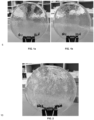
- Materials G1 and G2 showed a high transparency, with a homogeneous appearance, without the occurrence of non-melted regions or opalescence. Both G1 and G2 showed no sign of chemical etching when exposed to HCl or KOH.
- Figures 1a and 1b show images of materials G1 and G2, respectively, after exposure to HCl and KOH.
- Material G3 also exhibited good transparency and homogeneity, although it showed slight susceptibility to chemical etching with HCl, as can be seen in the image of this material depicted in Figure 5 .
- Vitreous materials G4 and G6 showed, in both cases, a visibly very high chemical etching with HCl.
- Figures 3a and 3b show images of materials G4 and G6, respectively, after the evaluation of the susceptibility to chemical etching.
- material G7 exhibited a large content of bubbles embedded in the vitreous matrix, as can be observed in Figure 4 .
- vitreous materials according to the disclosure have improved properties with respect to other comparative vitreous materials, which causes these compositions to exhibit significant advantages for use as a granulate in artificial agglomerated stone.
- the high transparency and high homogeneity, with an absence of imperfections in the granules, produce an effect of depth of color, brightness, absence of porosity and, in general, high surface homogeneity after polishing, which are all highly valued characteristics in articles of this type.
- the chemical inertness of the granulated vitreous materials of the disclosure increases the resistance to staining and the resistance to hydrolysis of the artificial agglomerated stone.
- Example 2 Vitreous materials according to the disclosure prepared from sludges.
- vitreous materials were prepared using as a raw material sludges generated during the calibration, polishing, and/or cutting of boards of artificial agglomerated stone with organic resin.
- the sludges were collected from the process water of an industrial production line for agglomerated products of this type. An amount of several kilograms of sludges was obtained by decantation of this water and air dried before disaggregating and subjecting same to a calcination heat treatment at a temperature of 600°C for a period of 4 hours.
- the crystalline phases included in the calcined sludges measured by XRD they were determined to present albite in a proportion of 44% by weight, quartz at 11% by weight, cristobalite at 30% by weight, and with less than 4% by weight of other crystalline mineral phases.
- the amorphous content (glass, organic matter) was estimated to be 11% by weight.
- vitreous materials L1-L4 were prepared following a procedure equivalent to that of vitreous materials G1-G7, with the difference being that the raw materials used comprised a mixture of different proportions of calcined sludges mixed with a mineral composition. Both the calcined sludges and the mineral composition were micronized to a particle size less than 100 micrometers, with a maximum of 10% by volume of particles with a size > 45 micrometers.
- the proportion by weight of calcined sludges with respect to the weight of the mineral composition for the production of vitreous materials L1-L4 was as indicated in Table 3.
- Table 3 Material L1 L2 L3 L4 Calcined sludge (% weight) 13 20 40 64 Mineral composition (% weight) 87 80 60 46
- the minerals in the mineral composition were the same as those in vitreous minerals G1-G7, although their proportion was adjusted, based on their previously determined composition and on the composition of the calcined sludges described above, to result in vitreous materials with the compositions which are included in Table 4.
- the crystalline mineral phases contained in materials L1 - L4, determined by XRD, are at a concentration by weight ⁇ 1%.
- Vitreous materials L1 - L4 have an essentially amorphous content.
- L1 - L4 showed a very good transparency and homogeneity. Additionally, L1 - L4 exhibited excellent resistance to chemical etching with both HCl and KOH, making them particularly suitable for use as granulates in artificial agglomerated stone.
- Example 3 Preparation of artificial agglomerated stone using vitreous materials according to the disclosure
- vitreous materials were prepared in a semi-industrial (or industrial) furnace and then granulated and sieved for use in the manufacture of artificial agglomerated stone articles.
- the raw materials comprised 40% by weight with respect to the weight of the raw materials, of sludges generated during the calibration, polishing, and/or cutting of boards of artificial agglomerated stone with organic resin, and 60% of a mineral composition comprising the minerals described for S2, but with the proportions thereof adjusted such that they result in the final composition of the vitreous material, considering the composition of the sludge.
- the sludges were treated and calcined as described in Example 2, with the exception that calcination took place at 900°C instead of 600°C.
- composition of the calcined sludge in this case was the composition shown in Table 5: Table 5 % by weight SiO 2 81.0 Al 2 O 3 9.8 Na 2 O 5.3 CaO 2.0 TiO 2 1.2 K 2 O 0.2 Fe 2 O 3 ⁇ 0.1 Loss on ignition 0.3 Rest 0.2
- the raw materials were ground to a particle size less than 100 micrometers, with a maximum of 10% by volume of particles with a size > 45 micrometers, before being mixed and homogenized.
- the raw materials were introduced into an industrial or semi-industrial furnace with a temperature profile with a maximum in the range of 1450-1550°C for a period of 30-60 minutes of residence time at that temperature.
- the melt was then taken out of the industrial furnace and discharged directly onto a platform with water recirculated at a temperature between 15 and 30°C.
- the cooled fractured material obtained was dried, ground, and sieved to a particle size between 40 and 300 micrometers.
- the three granulated vitreous materials exhibited good transparency, homogeneity, and an absence of non-melted regions or phase separation.
- the composition of granulated vitreous materials S1-S3 is shown in Table 6: Table 6 Composition Sum Al 2 O 3 +CaO+Na 2 O SiO 2 Al 2 O 3 CaO MgO Na 2 O K 2 O B 2 O 3 Fe 2 O 3 TiO 2 Rest S1* 57.0 4.1 25.5 9.9 2.0 1.4 ⁇ 0.1 ⁇ 0.1 ⁇ 0.1 0.1 31.6 S2 62.1 5.3 26.6 0.3 2.5 0.3 1.2 ⁇ 0.1 0.6 1.1 34.4 S3 60.6 5.4 26.9 0.3 2.5 1.0 1.2 0.1 0.1 1.9 34.8 * Comparative
- material S1 is a comparative material that does not have a composition according to the claims, with a content of MgO that is much higher than materials S2 and S3, and a sum of the percentages of the content of Al 2 O 3 +CaO+Na 2 O that is also far from the claimed values.
- the particle size cut of 40 - 300 micrometers of S1-S3 was used to manufacture slabs with a size of 30x30 cm 2 of artificial stone agglomerate.
- the composition of the slabs corresponded with the composition of a commercial artificial stone agglomerate article, Silestone ® Iconic Black
- the composition corresponded with the composition of a commercial artificial stone agglomerate, Silestone ® Pietra, where in both series the total 40-300 micrometer particle size cut of quartz contained in each of the commercial products was replaced with the 40 - 300 micrometer particle size cut of S1, S2, or S3 respectively.
- the inorganic fillers in the corresponding particle size cuts were mixed with a commercial hardenable liquid unsaturated polyester resin, and with usual additives and pigments already known in the art for the manufacture of these products by the vacuum vibrocompaction method.
- the mixture was deposited homogeneously distributed between two sheets of Kraft paper and vacuum vibrocompacting in a press suitable for this purpose, until most of the included air was removed. Then, the mixture was placed in a furnace at 85-95°C for 30-60 minutes to harden the resin. When the hardened slab was removed from the furnace and cooled to room temperature, it was calibrated to remove the paper and one of the larger surfaces of the slab was polished.
Landscapes
- Chemical & Material Sciences (AREA)
- Engineering & Computer Science (AREA)
- Ceramic Engineering (AREA)
- Materials Engineering (AREA)
- Structural Engineering (AREA)
- Organic Chemistry (AREA)
- Physics & Mathematics (AREA)
- Thermal Sciences (AREA)
- Glass Compositions (AREA)
Priority Applications (2)
| Application Number | Priority Date | Filing Date | Title |
|---|---|---|---|
| EP22383260.1A EP4389718A1 (de) | 2022-12-22 | 2022-12-22 | Künstlicher agglomerierter steinartikel mit glasmaterial granulat und verfahren zu seiner herstellung |
| PCT/EP2023/087184 WO2024133623A1 (en) | 2022-12-22 | 2023-12-21 | Artificial agglomerated stone article comprising granulated vitreous material and method for the manufacture of said article |
Applications Claiming Priority (1)
| Application Number | Priority Date | Filing Date | Title |
|---|---|---|---|
| EP22383260.1A EP4389718A1 (de) | 2022-12-22 | 2022-12-22 | Künstlicher agglomerierter steinartikel mit glasmaterial granulat und verfahren zu seiner herstellung |
Publications (1)
| Publication Number | Publication Date |
|---|---|
| EP4389718A1 true EP4389718A1 (de) | 2024-06-26 |
Family
ID=85278610
Family Applications (1)
| Application Number | Title | Priority Date | Filing Date |
|---|---|---|---|
| EP22383260.1A Pending EP4389718A1 (de) | 2022-12-22 | 2022-12-22 | Künstlicher agglomerierter steinartikel mit glasmaterial granulat und verfahren zu seiner herstellung |
Country Status (2)
| Country | Link |
|---|---|
| EP (1) | EP4389718A1 (de) |
| WO (1) | WO2024133623A1 (de) |
Citations (12)
| Publication number | Priority date | Publication date | Assignee | Title |
|---|---|---|---|---|
| US4204820A (en) | 1977-04-22 | 1980-05-27 | Marcello Toncelli | Slab forming conveying line |
| JPH06293533A (ja) * | 1993-04-05 | 1994-10-21 | Nippon Electric Glass Co Ltd | 中空ガラス球用組成物及びこれを用いて製造した中空ガラス球 |
| WO2009033943A1 (en) | 2007-09-10 | 2009-03-19 | Dario Toncelli | Process and plant for treating sludges resulting from the machining of articles of agglomerated stone material |
| EP2409959A1 (de) | 2009-03-18 | 2012-01-25 | Cosentino, S.a. | Brett oder platte aus steinagglomerat, enthaltend ein organisches bindemittel pflanzlichen ursprungs |
| EP3609853A1 (de) | 2017-04-11 | 2020-02-19 | Luca Toncelli | Verfahren zur herstellung von artikeln in form einer platte oder eines blocks mit einem härtenden bindemittel und dadurch erhaltene artikel |
| WO2020099501A1 (en) | 2018-11-14 | 2020-05-22 | Cosentino Research & Development, S.L. | Mixture for use as artificial soil comprising stone and/or ceramic machining sludges, method for preparation and uses thereof |
| US20200299188A1 (en) | 2019-03-21 | 2020-09-24 | Jinpan Chen | Environment-friendly Artificial Stone with Low Cost and High Strength and A Preparation Method Thereof |
| CN112110665A (zh) * | 2020-08-25 | 2020-12-22 | 华润电力(贺州)有限公司 | 一种人造岗石污泥回用制备人造岗石的方法 |
| WO2021019020A1 (en) | 2019-07-31 | 2021-02-04 | Cosentino Research & Development, S.L. | Artificial agglomerate stone article comprising synthetic silicate granules |
| WO2021018996A1 (en) | 2019-07-31 | 2021-02-04 | Cosentino Research & Development, S.L. | Artificial agglomerate stone article comprising synthetic silicate granules |
| EP3805176A1 (de) | 2019-10-08 | 2021-04-14 | Cosentino Research & Development, S.L. | Künstlicher agglomeratsteinartikel, feldspar-granulaten umfassend |
| WO2021074780A1 (en) | 2019-10-15 | 2021-04-22 | Luca Toncelli | Method for the production of granular materials designed to be used for manufacturing articles in slab or block form from a mix |
-
2022
- 2022-12-22 EP EP22383260.1A patent/EP4389718A1/de active Pending
-
2023
- 2023-12-21 WO PCT/EP2023/087184 patent/WO2024133623A1/en not_active Ceased
Patent Citations (12)
| Publication number | Priority date | Publication date | Assignee | Title |
|---|---|---|---|---|
| US4204820A (en) | 1977-04-22 | 1980-05-27 | Marcello Toncelli | Slab forming conveying line |
| JPH06293533A (ja) * | 1993-04-05 | 1994-10-21 | Nippon Electric Glass Co Ltd | 中空ガラス球用組成物及びこれを用いて製造した中空ガラス球 |
| WO2009033943A1 (en) | 2007-09-10 | 2009-03-19 | Dario Toncelli | Process and plant for treating sludges resulting from the machining of articles of agglomerated stone material |
| EP2409959A1 (de) | 2009-03-18 | 2012-01-25 | Cosentino, S.a. | Brett oder platte aus steinagglomerat, enthaltend ein organisches bindemittel pflanzlichen ursprungs |
| EP3609853A1 (de) | 2017-04-11 | 2020-02-19 | Luca Toncelli | Verfahren zur herstellung von artikeln in form einer platte oder eines blocks mit einem härtenden bindemittel und dadurch erhaltene artikel |
| WO2020099501A1 (en) | 2018-11-14 | 2020-05-22 | Cosentino Research & Development, S.L. | Mixture for use as artificial soil comprising stone and/or ceramic machining sludges, method for preparation and uses thereof |
| US20200299188A1 (en) | 2019-03-21 | 2020-09-24 | Jinpan Chen | Environment-friendly Artificial Stone with Low Cost and High Strength and A Preparation Method Thereof |
| WO2021019020A1 (en) | 2019-07-31 | 2021-02-04 | Cosentino Research & Development, S.L. | Artificial agglomerate stone article comprising synthetic silicate granules |
| WO2021018996A1 (en) | 2019-07-31 | 2021-02-04 | Cosentino Research & Development, S.L. | Artificial agglomerate stone article comprising synthetic silicate granules |
| EP3805176A1 (de) | 2019-10-08 | 2021-04-14 | Cosentino Research & Development, S.L. | Künstlicher agglomeratsteinartikel, feldspar-granulaten umfassend |
| WO2021074780A1 (en) | 2019-10-15 | 2021-04-22 | Luca Toncelli | Method for the production of granular materials designed to be used for manufacturing articles in slab or block form from a mix |
| CN112110665A (zh) * | 2020-08-25 | 2020-12-22 | 华润电力(贺州)有限公司 | 一种人造岗石污泥回用制备人造岗石的方法 |
Non-Patent Citations (1)
| Title |
|---|
| LEE M Y ET AL: "Artificial stone slab production using waste glass, stone fragments and vacuum vibratory compaction", CEMENT AND CONCRETE COMPOSITES, ELSEVIER APPLIED SCIENCE, BARKING, GB, vol. 30, no. 7, 1 August 2008 (2008-08-01), pages 583 - 587, XP022778039, ISSN: 0958-9465, [retrieved on 20080406], DOI: 10.1016/J.CEMCONCOMP.2008.03.004 * |
Also Published As
| Publication number | Publication date |
|---|---|
| WO2024133623A1 (en) | 2024-06-27 |
Similar Documents
| Publication | Publication Date | Title |
|---|---|---|
| US11891333B2 (en) | Artificial agglomerate stone article comprising synthetic silicate granules | |
| EP4003930B1 (de) | Künstlicher agglomerierter steinartikel mit synthetischen silikatgranulaten | |
| AU2020362305B2 (en) | Artificial agglomerate stone article comprising feldspar granules | |
| EP4175922B1 (de) | Künstlicher agglomerierter stein | |
| EP4389717A1 (de) | Künstlicher agglomerierter steinartikel, bestehend aus opakem weiss granulatiertem glasmaterial und verfahren zu seiner herstellung | |
| WO2024133623A1 (en) | Artificial agglomerated stone article comprising granulated vitreous material and method for the manufacture of said article | |
| KR20080017966A (ko) | 폐유리를 활용한 세라믹 타일 조성물 및 그 타일의제조방법 | |
| WO2023143826A1 (en) | Improved artificial agglomerated material | |
| US20230234888A1 (en) | Artificial agglomerated material | |
| AU2024346504A1 (en) | Synthetic stone and methods of forming synthetic stone |
Legal Events
| Date | Code | Title | Description |
|---|---|---|---|
| PUAI | Public reference made under article 153(3) epc to a published international application that has entered the european phase |
Free format text: ORIGINAL CODE: 0009012 |
|
| STAA | Information on the status of an ep patent application or granted ep patent |
Free format text: STATUS: THE APPLICATION HAS BEEN PUBLISHED |
|
| AK | Designated contracting states |
Kind code of ref document: A1 Designated state(s): AL AT BE BG CH CY CZ DE DK EE ES FI FR GB GR HR HU IE IS IT LI LT LU LV MC ME MK MT NL NO PL PT RO RS SE SI SK SM TR |
|
| STAA | Information on the status of an ep patent application or granted ep patent |
Free format text: STATUS: REQUEST FOR EXAMINATION WAS MADE |
|
| 17P | Request for examination filed |
Effective date: 20241211 |
|
| STAA | Information on the status of an ep patent application or granted ep patent |
Free format text: STATUS: EXAMINATION IS IN PROGRESS |
|
| 17Q | First examination report despatched |
Effective date: 20250424 |