EP4390419A1 - Verfahren und vorrichtung zur schätzung der batteriekapazität und computerspeichermedium - Google Patents
Verfahren und vorrichtung zur schätzung der batteriekapazität und computerspeichermedium Download PDFInfo
- Publication number
- EP4390419A1 EP4390419A1 EP22897312.9A EP22897312A EP4390419A1 EP 4390419 A1 EP4390419 A1 EP 4390419A1 EP 22897312 A EP22897312 A EP 22897312A EP 4390419 A1 EP4390419 A1 EP 4390419A1
- Authority
- EP
- European Patent Office
- Prior art keywords
- battery
- capacity
- voltage
- curve
- charging
- Prior art date
- Legal status (The legal status is an assumption and is not a legal conclusion. Google has not performed a legal analysis and makes no representation as to the accuracy of the status listed.)
- Granted
Links
Images
Classifications
-
- H—ELECTRICITY
- H01—ELECTRIC ELEMENTS
- H01M—PROCESSES OR MEANS, e.g. BATTERIES, FOR THE DIRECT CONVERSION OF CHEMICAL ENERGY INTO ELECTRICAL ENERGY
- H01M10/00—Secondary cells; Manufacture thereof
- H01M10/05—Accumulators with non-aqueous electrolyte
- H01M10/052—Li-accumulators
-
- G—PHYSICS
- G01—MEASURING; TESTING
- G01R—MEASURING ELECTRIC VARIABLES; MEASURING MAGNETIC VARIABLES
- G01R31/00—Arrangements for testing electric properties; Arrangements for locating electric faults; Arrangements for electrical testing characterised by what is being tested not provided for elsewhere
- G01R31/36—Arrangements for testing, measuring or monitoring the electrical condition of accumulators or electric batteries, e.g. capacity or state of charge [SoC]
- G01R31/382—Arrangements for monitoring battery or accumulator variables, e.g. SoC
- G01R31/3835—Arrangements for monitoring battery or accumulator variables, e.g. SoC involving only voltage measurements
-
- G—PHYSICS
- G01—MEASURING; TESTING
- G01R—MEASURING ELECTRIC VARIABLES; MEASURING MAGNETIC VARIABLES
- G01R19/00—Arrangements for measuring currents or voltages or for indicating presence or sign thereof
- G01R19/165—Indicating that current or voltage is either above or below a predetermined value or within or outside a predetermined range of values
- G01R19/16528—Indicating that current or voltage is either above or below a predetermined value or within or outside a predetermined range of values using digital techniques or performing arithmetic operations
-
- G—PHYSICS
- G01—MEASURING; TESTING
- G01R—MEASURING ELECTRIC VARIABLES; MEASURING MAGNETIC VARIABLES
- G01R19/00—Arrangements for measuring currents or voltages or for indicating presence or sign thereof
- G01R19/165—Indicating that current or voltage is either above or below a predetermined value or within or outside a predetermined range of values
- G01R19/16533—Indicating that current or voltage is either above or below a predetermined value or within or outside a predetermined range of values characterised by the application
- G01R19/16538—Indicating that current or voltage is either above or below a predetermined value or within or outside a predetermined range of values characterised by the application in AC or DC supplies
- G01R19/16542—Indicating that current or voltage is either above or below a predetermined value or within or outside a predetermined range of values characterised by the application in AC or DC supplies for batteries
-
- G—PHYSICS
- G01—MEASURING; TESTING
- G01R—MEASURING ELECTRIC VARIABLES; MEASURING MAGNETIC VARIABLES
- G01R31/00—Arrangements for testing electric properties; Arrangements for locating electric faults; Arrangements for electrical testing characterised by what is being tested not provided for elsewhere
- G01R31/36—Arrangements for testing, measuring or monitoring the electrical condition of accumulators or electric batteries, e.g. capacity or state of charge [SoC]
- G01R31/367—Software therefor, e.g. for battery testing using modelling or look-up tables
-
- G—PHYSICS
- G01—MEASURING; TESTING
- G01R—MEASURING ELECTRIC VARIABLES; MEASURING MAGNETIC VARIABLES
- G01R31/00—Arrangements for testing electric properties; Arrangements for locating electric faults; Arrangements for electrical testing characterised by what is being tested not provided for elsewhere
- G01R31/36—Arrangements for testing, measuring or monitoring the electrical condition of accumulators or electric batteries, e.g. capacity or state of charge [SoC]
- G01R31/374—Arrangements for testing, measuring or monitoring the electrical condition of accumulators or electric batteries, e.g. capacity or state of charge [SoC] with means for correcting the measurement for temperature or ageing
-
- G—PHYSICS
- G01—MEASURING; TESTING
- G01R—MEASURING ELECTRIC VARIABLES; MEASURING MAGNETIC VARIABLES
- G01R31/00—Arrangements for testing electric properties; Arrangements for locating electric faults; Arrangements for electrical testing characterised by what is being tested not provided for elsewhere
- G01R31/36—Arrangements for testing, measuring or monitoring the electrical condition of accumulators or electric batteries, e.g. capacity or state of charge [SoC]
- G01R31/378—Arrangements for testing, measuring or monitoring the electrical condition of accumulators or electric batteries, e.g. capacity or state of charge [SoC] specially adapted for the type of battery or accumulator
-
- G—PHYSICS
- G01—MEASURING; TESTING
- G01R—MEASURING ELECTRIC VARIABLES; MEASURING MAGNETIC VARIABLES
- G01R31/00—Arrangements for testing electric properties; Arrangements for locating electric faults; Arrangements for electrical testing characterised by what is being tested not provided for elsewhere
- G01R31/36—Arrangements for testing, measuring or monitoring the electrical condition of accumulators or electric batteries, e.g. capacity or state of charge [SoC]
- G01R31/382—Arrangements for monitoring battery or accumulator variables, e.g. SoC
- G01R31/3842—Arrangements for monitoring battery or accumulator variables, e.g. SoC combining voltage and current measurements
-
- G—PHYSICS
- G01—MEASURING; TESTING
- G01R—MEASURING ELECTRIC VARIABLES; MEASURING MAGNETIC VARIABLES
- G01R31/00—Arrangements for testing electric properties; Arrangements for locating electric faults; Arrangements for electrical testing characterised by what is being tested not provided for elsewhere
- G01R31/36—Arrangements for testing, measuring or monitoring the electrical condition of accumulators or electric batteries, e.g. capacity or state of charge [SoC]
- G01R31/385—Arrangements for measuring battery or accumulator variables
- G01R31/387—Determining ampere-hour charge capacity or SoC
- G01R31/388—Determining ampere-hour charge capacity or SoC involving voltage measurements
-
- G—PHYSICS
- G01—MEASURING; TESTING
- G01R—MEASURING ELECTRIC VARIABLES; MEASURING MAGNETIC VARIABLES
- G01R31/00—Arrangements for testing electric properties; Arrangements for locating electric faults; Arrangements for electrical testing characterised by what is being tested not provided for elsewhere
- G01R31/36—Arrangements for testing, measuring or monitoring the electrical condition of accumulators or electric batteries, e.g. capacity or state of charge [SoC]
- G01R31/392—Determining battery ageing or deterioration, e.g. state of health
-
- H—ELECTRICITY
- H01—ELECTRIC ELEMENTS
- H01M—PROCESSES OR MEANS, e.g. BATTERIES, FOR THE DIRECT CONVERSION OF CHEMICAL ENERGY INTO ELECTRICAL ENERGY
- H01M10/00—Secondary cells; Manufacture thereof
- H01M10/42—Methods or arrangements for servicing or maintenance of secondary cells or secondary half-cells
- H01M10/44—Methods for charging or discharging
-
- H—ELECTRICITY
- H02—GENERATION; CONVERSION OR DISTRIBUTION OF ELECTRIC POWER
- H02J—ELECTRIC POWER NETWORKS; CIRCUIT ARRANGEMENTS OR SYSTEMS FOR SUPPLYING OR DISTRIBUTING ELECTRIC POWER; SYSTEMS FOR STORING ELECTRIC ENERGY
- H02J7/00—Circuit arrangements for charging or discharging batteries or for supplying loads from batteries
- H02J7/80—Circuit arrangements for charging or discharging batteries or for supplying loads from batteries including monitoring or indicating arrangements
- H02J7/82—Control of state of charge [SOC]
- H02J7/825—Detection of fully charged condition
-
- H—ELECTRICITY
- H02—GENERATION; CONVERSION OR DISTRIBUTION OF ELECTRIC POWER
- H02J—ELECTRIC POWER NETWORKS; CIRCUIT ARRANGEMENTS OR SYSTEMS FOR SUPPLYING OR DISTRIBUTING ELECTRIC POWER; SYSTEMS FOR STORING ELECTRIC ENERGY
- H02J7/00—Circuit arrangements for charging or discharging batteries or for supplying loads from batteries
- H02J7/80—Circuit arrangements for charging or discharging batteries or for supplying loads from batteries including monitoring or indicating arrangements
- H02J7/84—Control of state of health [SOH]
-
- H—ELECTRICITY
- H01—ELECTRIC ELEMENTS
- H01M—PROCESSES OR MEANS, e.g. BATTERIES, FOR THE DIRECT CONVERSION OF CHEMICAL ENERGY INTO ELECTRICAL ENERGY
- H01M10/00—Secondary cells; Manufacture thereof
- H01M10/05—Accumulators with non-aqueous electrolyte
- H01M10/052—Li-accumulators
- H01M10/0525—Rocking-chair batteries, i.e. batteries with lithium insertion or intercalation in both electrodes; Lithium-ion batteries
-
- H—ELECTRICITY
- H01—ELECTRIC ELEMENTS
- H01M—PROCESSES OR MEANS, e.g. BATTERIES, FOR THE DIRECT CONVERSION OF CHEMICAL ENERGY INTO ELECTRICAL ENERGY
- H01M2220/00—Batteries for particular applications
- H01M2220/20—Batteries in motive systems, e.g. vehicle, ship, plane
-
- Y—GENERAL TAGGING OF NEW TECHNOLOGICAL DEVELOPMENTS; GENERAL TAGGING OF CROSS-SECTIONAL TECHNOLOGIES SPANNING OVER SEVERAL SECTIONS OF THE IPC; TECHNICAL SUBJECTS COVERED BY FORMER USPC CROSS-REFERENCE ART COLLECTIONS [XRACs] AND DIGESTS
- Y02—TECHNOLOGIES OR APPLICATIONS FOR MITIGATION OR ADAPTATION AGAINST CLIMATE CHANGE
- Y02E—REDUCTION OF GREENHOUSE GAS [GHG] EMISSIONS, RELATED TO ENERGY GENERATION, TRANSMISSION OR DISTRIBUTION
- Y02E60/00—Enabling technologies; Technologies with a potential or indirect contribution to GHG emissions mitigation
- Y02E60/10—Energy storage using batteries
Definitions
- the present disclosure relates to the technical field of battery management, and more specifically to a battery capacity estimation method and apparatus, and a computer storage medium.
- SOH State Of Health
- the main method is implemented by calculating the total electric quantity during the charging or discharging stage by fully charging and discharging the battery, or by charging and discharging within a certain State of Charge (SOC) range of the battery, and calculating the total battery capacity based on the charging or discharging electric quantity and the corresponding SOC range.
- SOC State of Charge
- the estimation accuracy in this method depends entirely on the accuracy of SOC. If there is a significant error in SOC estimation, it will affect the battery capacity estimation accuracy Especially for lithium iron phosphate batteries, the cumulative error of SOC will affect the accuracy of battery capacity. However, the error of the battery capacity can in turn affect the accuracy of SOC, leading to cross effects and ultimately rendering the estimation of battery capacity completely ineffective.
- the capacity of the battery is estimated according to the voltage knee point on the voltage-capacity curve in the battery charging process, the estimation accuracy of the battery capacity may be improved, the battery does not need to be emptied, and the using habit of a user is met.
- the method before the performing differentiation on the voltage-capacity curve, the method further includes performing smoothing filtering on the voltage-capacity curve.
- the method further includes: a state of health of the battery is estimated according to the actual capacity and a pre-calibrated initial capacity of the battery.
- the battery is a lithium iron phosphate battery.
- the initial capacity of the battery is determined by the following mode: the electric quantity of the battery is emptied and then constant-current charging is performed until reaching the full-charge state; and the initial capacity of the battery is recorded.
- an embodiment of the present disclosure provides a battery capacity estimation apparatus, including a memory and a processor.
- a computer program operated with the processor is stored in the memory, and the computer program executes the battery capacity estimation method when being operated with the processor.
- the capacity of the battery is estimated according to the voltage knee point on the voltage-capacity curve in the battery charging process, and the absolute value of SOC is not involved. Therefore, the estimation accuracy of the battery capacity may be improved, the battery does not need to be emptied, and the using habit of the user is met.
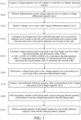
- FIG. 1 is a schematic flowchart of a battery capacity estimation method according to an embodiment of the present disclosure. As shown in FIG. 1 , the battery capacity estimation method includes:
- S110 A voltage-capacity curve of a battery is acquired in real time in a battery charging process.
- S140 A first height and a first width between each wave crest and an adjacent wave trough on the left, and a second height and a second width between each wave crest and an adjacent wave trough on the right are calculated.
- a voltage knee point in the voltage-capacity curve is determined according to a wave crest with a minimum determination index.
- S170 A pre-calibrated reference capacity value corresponding to the voltage knee point in the voltage-capacity curve is acquired.
- the voltage-battery capacity curve is detected in real time in the battery charging process, curve characteristics are analyzed, the voltage knee point is identified, and then the actual capacity of the battery is estimated according to the voltage knee point.
- the actual capacity of the battery is intelligently estimated according to the characteristic attributes of materials in the battery charging process, deep discharging does not need to be carried out on the battery, and the actual capacity of the battery may be accurately calculated under a condition that the initial SOC state of the battery is unknown.
- the calculation process does not involve the absolute value of the SOC, so cross influence with the calculation of the SOC is avoided.
- the test cost of a laboratory can be greatly reduced, and the calculation efficiency and accuracy of the battery capacity may be remarkably improved.
- the capacity of the battery is estimated according to the voltage knee point on the voltage-capacity curve in the battery charging process, the estimation accuracy of the battery capacity may be improved, the battery does not need to be emptied, and the using habit of the user is met.
- the voltage-capacity curve of the battery is acquired in real time, and the voltage knee point is determined in the voltage-capacity curve.
- the battery includes a lithium ion battery, and specifically can be a lithium iron phosphate battery.
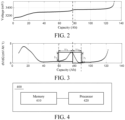
- the voltage knee point is one of multiple points with the fastest voltage change along with the capacity. The features of the voltage-capacity curve and the voltage knee point are described below with reference to FIG. 2 and FIG. 3 .
- FIG. 2 shows a voltage-capacity curve of a lithium ion battery.
- voltage platform areas There are three intervals where the voltage changes slowly with capacity in the voltage-capacity curve of lithium-ion battery, which are called voltage platform areas.
- the voltage knee point used for estimating the SOH of the battery is between the second voltage platform area and the third voltage platform area, which is the point with the fastest voltage change along with the capacity in the interval.
- the battery can be subjected to constant-current charge to reach the full-charge state after the electric quantity of the battery is emptied, and the initial capacity (recorded as Q new ) of the battery is recorded.
- the actual capacity of the battery is calculated according to the characteristics of the voltage knee point, and the calculation of the actual capacity of the battery according to the SOC is avoided, so that the problems that the estimation accuracy of the SOH is influenced by the error accumulation of the SOC and the precision of the SOC is influenced by the error of the SOH are avoided.
- the battery capacity in the voltage-capacity curve is calculated by a battery management system according to the SOC.
- the actual capacity of thee battery is calculated through the pre-calibrated reference capacity value corresponding to the voltage knee point in this embodiment of the present disclosure.
- the electric quantity of the battery is emptied, and then the battery is subjected to constant-current charging to reach the full-charge state.
- the voltage-capacity curve is recorded in the battery charging process.
- the reference capacity value corresponding to thee voltage knee point is determined through offline calibration by analyzing the characteristics of the voltage-capacity curve.
- the charging electric quantity between the voltage knee point and the full-charge state is calculated, the time for reaching the voltage knee point and the time for reaching the full-charge state can be recorded. Calculation is carried out according to the actual charging current and the time for charging the battery from the voltage knee point to the full-charge state. Because the reference capacity value corresponding to the voltage knee point is an accurate value, the charging electric quantity is also an accurate value, and the accurate actual capacity of the battery may be obtained by summing the reference capacity value and the charging electric quantity.
- the SOC absolute value is not involved in the process of estimating the actual capacity of the battery, so that the defect that the SOC estimation accuracy is excessively depended when the actual capacity of the battery is calculated in a traditional mode may be avoided.
- the battery does not need to be emptied, and the using habit of a common user is met. Experiments prove that the actual capacity of the battery can be accurately calculated when charging may be started with the SOC lower than 60%.
- the feature peak is identified according to the ratio of the perimeter to the area of each wave crest, and the voltage knee point determined according to the feature peak is the voltage knee point meeting the constant capacity characteristic.
- the multiple wave crests are identified in the voltage differential-capacity curve, and the first height and the first width between each wave crest and the adjacent wave trough on the left, and the second height and the second width between each wave crest and the adjacent wave trough on the right are calculated.
- the first height is a difference value of the voltage differential between each wave crest and the adjacent wave trough on the left
- the first width is a difference value of the capacity between each wave crest and the adjacent wave trough on the left
- the second height is an absolute value of the difference value of the voltage differential between each wave crest and the adjacent wave trough on the right
- the second width is an absolute value of the difference value of the capacity between each wave crest and the adjacent wave trough on the right.
- the determination index for each wave crest is calculated according to the first height, the first width, the second height, and the second width.
- a sum of the ratios of the perimeters to the areas of the left and right half-edge peaks of each wave crest is taken the determination index.
- the method further includes performing smoothing filtering on the voltage-capacity curve. After the voltage knee point is determined, the actual capacity of the battery can be estimated according to the mode described above.
- the voltage-capacity curve is detected and analyzed in real time in the battery charging process, the battery does not need to be subjected to deep discharge, the using habit of the user is met, and the method has great technical advantages and market value.
- the initial SOC of the battery does not need to be determined, the absolute value of the SOC is not involved, and the actual capacity of the battery can be calculated only by identifying the voltage knee point in the charging process, so that the estimation accuracy of the actual capacity of the battery is improved.
- the SOH of the battery can be obtained, and the estimation accuracy and speed of the SOH are improved.
- the voltage knee point is identified, automatic identification is realized by using the perimeter/area feature, and threshold setting does not need to be manually carried out according to different vehicle types and different aging degrees, so that the universality is improved.
- FIG. 4 is a schematic block diagram of a battery capacity estimation apparatus 400 according to an embodiment of the present disclosure.
- the battery capacity estimation apparatus 400 includes a memory 410, a processor 420, and a computer program stored in the memory 410 and operated with the processor 420.
- the processor 420 can implement the battery capacity estimation method as described above when executing the computer program.
- An embodiment of the present disclosure further provides a computer storage medium, a computer program is stored in the computer storage medium, and the computer program can be executed to implement the battery capacity estimation method according to this embodiment of the present disclosure.
- the battery capacity estimation apparatus 400 and the computer storage medium are configured to achieve the above mentioned battery capacity estimation method, and therefore the battery capacity estimation device and the computer storage medium also have similar advantages.
- the disclosed device and method may be implemented in other manners.
- the described device embodiment is merely an example.
- the unit division is merely a logical function division and may be other division during actual implementation.
- multiple units or components may be combined or integrated into another system, or some features may be ignored or not performed.
- All component embodiments of the present disclosure can be implemented through hardware, or software modules running on one or more processors, or a combination thereof. Those skilled in the art should understand that some or all of the functions of some modules according to embodiments of the present disclosure can be implemented in practice using the microprocessor or the DSP.
- the present disclosure can also be implemented as an apparatus program (e.g., a computer program and a computer program product) for executing a part or all of the methods described herein.
- Such a program implementing the present disclosure can be stored in the computer readable medium, or can be in a form of one or more signals. Such signals can be downloaded from an Internet website, or provided on a carrier signal, or provided in any other form.
Landscapes
- General Physics & Mathematics (AREA)
- Physics & Mathematics (AREA)
- Engineering & Computer Science (AREA)
- General Chemical & Material Sciences (AREA)
- Chemical Kinetics & Catalysis (AREA)
- Electrochemistry (AREA)
- Chemical & Material Sciences (AREA)
- Manufacturing & Machinery (AREA)
- Power Engineering (AREA)
- Charge And Discharge Circuits For Batteries Or The Like (AREA)
- Secondary Cells (AREA)
- Health & Medical Sciences (AREA)
- General Health & Medical Sciences (AREA)
- Medical Informatics (AREA)
- Tests Of Electric Status Of Batteries (AREA)
Applications Claiming Priority (2)
| Application Number | Priority Date | Filing Date | Title |
|---|---|---|---|
| CN202111422355.6A CN116184222B (zh) | 2021-11-26 | 2021-11-26 | 电池容量的估计方法、装置和计算机存储介质 |
| PCT/CN2022/118754 WO2023093225A1 (zh) | 2021-11-26 | 2022-09-14 | 电池容量的估计方法、装置和计算机存储介质 |
Publications (3)
| Publication Number | Publication Date |
|---|---|
| EP4390419A1 true EP4390419A1 (de) | 2024-06-26 |
| EP4390419A4 EP4390419A4 (de) | 2024-12-25 |
| EP4390419B1 EP4390419B1 (de) | 2025-10-29 |
Family
ID=86444804
Family Applications (1)
| Application Number | Title | Priority Date | Filing Date |
|---|---|---|---|
| EP22897312.9A Active EP4390419B1 (de) | 2021-11-26 | 2022-09-14 | Verfahren und vorrichtung zur schätzung der batteriekapazität und computerspeichermedium |
Country Status (13)
| Country | Link |
|---|---|
| US (1) | US12578393B2 (de) |
| EP (1) | EP4390419B1 (de) |
| JP (1) | JP7738168B2 (de) |
| KR (1) | KR102925653B1 (de) |
| CN (1) | CN116184222B (de) |
| AU (1) | AU2022397745B2 (de) |
| CA (1) | CA3232287A1 (de) |
| CL (1) | CL2024001154A1 (de) |
| ES (1) | ES3054284T3 (de) |
| IL (1) | IL311584A (de) |
| MX (1) | MX2024004339A (de) |
| PL (1) | PL4390419T3 (de) |
| WO (1) | WO2023093225A1 (de) |
Families Citing this family (5)
| Publication number | Priority date | Publication date | Assignee | Title |
|---|---|---|---|---|
| CN116430242B (zh) * | 2023-05-31 | 2025-07-11 | 深蓝汽车科技有限公司 | 电芯容量的估计方法、装置、服务器及存储介质 |
| CN119846493A (zh) * | 2023-12-15 | 2025-04-18 | 重庆弗迪电池研究院有限公司 | 电池容量确定方法及电池健康状态确定方法 |
| CN119881686A (zh) * | 2024-12-12 | 2025-04-25 | 比亚迪股份有限公司 | 标定方法、装置、计算机装置、电子设备、介质及产品 |
| CN120199928B (zh) * | 2025-05-23 | 2025-09-16 | 比亚迪股份有限公司 | 电压拐点的确定方法、均衡方法、装置、设备及介质 |
| CN121142348B (zh) * | 2025-11-19 | 2026-04-21 | 宁德时代新能源科技股份有限公司 | 电池容量计算方法、ocv曲线修正方法、设备、介质及产品 |
Family Cites Families (24)
| Publication number | Priority date | Publication date | Assignee | Title |
|---|---|---|---|---|
| JPH06342044A (ja) * | 1993-05-31 | 1994-12-13 | Omron Corp | バッテリー計測装置 |
| CN100517930C (zh) * | 2005-03-15 | 2009-07-22 | 三菱电机株式会社 | 转换器 |
| JP4561859B2 (ja) * | 2008-04-01 | 2010-10-13 | トヨタ自動車株式会社 | 二次電池システム |
| JP5282789B2 (ja) * | 2011-01-11 | 2013-09-04 | 株式会社デンソー | リチウムイオン二次電池の電池容量検出装置 |
| EP2610629B1 (de) * | 2011-12-29 | 2015-06-10 | BlackBerry Limited | Erkennung des Restkapazitätspegels eines Akkumulators |
| JP5940145B2 (ja) | 2012-04-20 | 2016-06-29 | 日立オートモティブシステムズ株式会社 | 二次電池システム、二次電池の劣化状態判断方法 |
| JP2013247003A (ja) * | 2012-05-28 | 2013-12-09 | Sony Corp | 二次電池の充電制御装置、二次電池の充電制御方法、二次電池の充電状態推定装置、二次電池の充電状態推定方法、二次電池の劣化度推定装置、二次電池の劣化度推定方法、及び、二次電池装置 |
| KR102080632B1 (ko) * | 2013-10-28 | 2020-04-14 | 현대모비스 주식회사 | 배터리관리시스템 및 그 운용방법 |
| CN104931882B (zh) * | 2014-03-21 | 2018-04-20 | 比亚迪股份有限公司 | 动力电池容量修正的方法和装置 |
| CN108226783B (zh) | 2016-12-21 | 2019-12-10 | 比亚迪股份有限公司 | Soc估算方法和soc估算装置以及电动汽车 |
| JP2019056595A (ja) * | 2017-09-20 | 2019-04-11 | 三菱自動車工業株式会社 | 二次電池システム |
| JP6301048B1 (ja) | 2017-10-05 | 2018-03-28 | 三菱電機株式会社 | 組電池の管理装置および組電池システム |
| KR102206606B1 (ko) * | 2017-11-16 | 2021-01-21 | 주식회사 엘지화학 | 배터리 여유 용량 추정 장치 |
| KR101930646B1 (ko) * | 2017-11-22 | 2019-03-11 | 주식회사 포스코아이씨티 | 이차 미분 전압곡선을 이용한 배터리 용량 추정 장치 및 방법 |
| CN108008183B (zh) | 2017-11-28 | 2021-01-15 | 深圳市路畅科技股份有限公司 | 一种电量测量方法、系统、设备及计算机存储介质 |
| CN110320477B (zh) | 2018-03-30 | 2021-09-03 | 比亚迪股份有限公司 | 动力电池组的soc计算方法、装置和电动汽车 |
| CN110549909B (zh) * | 2018-03-30 | 2021-06-18 | 比亚迪股份有限公司 | 动力电池组的soh计算方法、装置和电动汽车 |
| WO2020026058A1 (ja) * | 2018-07-31 | 2020-02-06 | 株式会社半導体エネルギー研究所 | 蓄電システムおよび蓄電システムの動作方法 |
| KR102677986B1 (ko) * | 2018-12-21 | 2024-06-21 | 주식회사 엘지에너지솔루션 | 배터리 관리 장치 및 방법 |
| KR20200093228A (ko) * | 2019-01-28 | 2020-08-05 | 세방전지(주) | Lfp 전지의 soc 산출 장치 및 방법 |
| KR102768486B1 (ko) * | 2019-02-22 | 2025-02-19 | 주식회사 엘지에너지솔루션 | 배터리 상태 추정 장치 및 방법 |
| CN112578296B (zh) * | 2019-09-27 | 2022-03-15 | 比亚迪股份有限公司 | 电池容量估算方法和装置及计算机存储介质 |
| JP2021150076A (ja) | 2020-03-17 | 2021-09-27 | 株式会社豊田自動織機 | 蓄電装置 |
| CN111551868B (zh) * | 2020-05-08 | 2022-04-12 | 浙江吉利控股集团有限公司 | 一种磷酸铁锂电池系统的一致性分析方法 |
-
2021
- 2021-11-26 CN CN202111422355.6A patent/CN116184222B/zh active Active
-
2022
- 2022-09-14 PL PL22897312.9T patent/PL4390419T3/pl unknown
- 2022-09-14 CA CA3232287A patent/CA3232287A1/en active Pending
- 2022-09-14 AU AU2022397745A patent/AU2022397745B2/en active Active
- 2022-09-14 JP JP2024510620A patent/JP7738168B2/ja active Active
- 2022-09-14 IL IL311584A patent/IL311584A/en unknown
- 2022-09-14 MX MX2024004339A patent/MX2024004339A/es unknown
- 2022-09-14 ES ES22897312T patent/ES3054284T3/es active Active
- 2022-09-14 EP EP22897312.9A patent/EP4390419B1/de active Active
- 2022-09-14 WO PCT/CN2022/118754 patent/WO2023093225A1/zh not_active Ceased
- 2022-09-14 KR KR1020247008537A patent/KR102925653B1/ko active Active
-
2024
- 2024-03-20 US US18/610,753 patent/US12578393B2/en active Active
- 2024-04-12 CL CL2024001154A patent/CL2024001154A1/es unknown
Also Published As
| Publication number | Publication date |
|---|---|
| MX2024004339A (es) | 2024-04-24 |
| IL311584A (en) | 2024-05-01 |
| PL4390419T3 (pl) | 2026-03-23 |
| CL2024001154A1 (es) | 2024-08-16 |
| JP7738168B2 (ja) | 2025-09-11 |
| AU2022397745B2 (en) | 2025-10-02 |
| KR102925653B1 (ko) | 2026-02-11 |
| JP2024541168A (ja) | 2024-11-08 |
| KR20240049310A (ko) | 2024-04-16 |
| AU2022397745A1 (en) | 2024-04-04 |
| WO2023093225A1 (zh) | 2023-06-01 |
| US12578393B2 (en) | 2026-03-17 |
| CA3232287A1 (en) | 2023-06-01 |
| EP4390419A4 (de) | 2024-12-25 |
| CN116184222B (zh) | 2025-01-14 |
| ES3054284T3 (en) | 2026-02-02 |
| US20240230771A1 (en) | 2024-07-11 |
| CN116184222A (zh) | 2023-05-30 |
| EP4390419B1 (de) | 2025-10-29 |
Similar Documents
| Publication | Publication Date | Title |
|---|---|---|
| EP4390419A1 (de) | Verfahren und vorrichtung zur schätzung der batteriekapazität und computerspeichermedium | |
| CN108828461B (zh) | 动力电池soh值估算方法及系统 | |
| CN110988690B (zh) | 电池健康状态修正方法、装置、管理系统以及存储介质 | |
| JP6844683B2 (ja) | 蓄電素子管理装置、socのリセット方法、蓄電素子モジュール、蓄電素子管理プログラム及び移動体 | |
| CN107402353B (zh) | 一种对锂离子电池的荷电状态进行滤波估计的方法及系统 | |
| CN106249171B (zh) | 一种用于宽采样间隔的动力电池系统辨识和状态估计方法 | |
| EP1688754B1 (de) | Batterieverwaltungsvorrichtung | |
| CN107167743B (zh) | 基于电动车辆的荷电状态估算方法和装置 | |
| CN112986842B (zh) | 电池荷电状态的估算方法、装置及设备 | |
| JP6509725B2 (ja) | バッテリの充電状態の推定 | |
| CN105021996A (zh) | 储能电站bms的电池soh估算方法 | |
| CN112858924A (zh) | 动力电池剩余能量估算方法、装置、车辆及存储介质 | |
| CN113447821A (zh) | 评估电池荷电状态的方法 | |
| CN108931732A (zh) | 用于估算电池组或电池单元的电流和荷电状态的方法 | |
| CN109061482B (zh) | 电池健康度预测方法及装置 | |
| CN114778946B (zh) | 一种电池阻抗的测量方法、装置、设备及介质 | |
| CN115219918A (zh) | 一种基于容量衰退组合模型的锂离子电池寿命预测方法 | |
| CN115236527A (zh) | 用于确定电池单体的充电状态的电子电路 | |
| CN113296010A (zh) | 一种基于差分电压分析的电池健康状态在线评估方法 | |
| CN112394290B (zh) | 电池包soh的估算方法、装置、计算机设备和存储介质 | |
| CN108519557B (zh) | 一种适用于稀疏数据的动力电池参数辨识方法 | |
| CN117277459A (zh) | 电池充电控制方法及装置 | |
| CN115389945B (zh) | 退役电池soh的确定方法、装置、电子设备以及存储介质 | |
| CN114578229A (zh) | 动力电池健康状态确定方法、装置和可读存储介质 | |
| CN121899683A (zh) | 电池健康状态估计方法、装置、设备及存储介质 |
Legal Events
| Date | Code | Title | Description |
|---|---|---|---|
| STAA | Information on the status of an ep patent application or granted ep patent |
Free format text: STATUS: THE INTERNATIONAL PUBLICATION HAS BEEN MADE |
|
| PUAI | Public reference made under article 153(3) epc to a published international application that has entered the european phase |
Free format text: ORIGINAL CODE: 0009012 |
|
| STAA | Information on the status of an ep patent application or granted ep patent |
Free format text: STATUS: REQUEST FOR EXAMINATION WAS MADE |
|
| 17P | Request for examination filed |
Effective date: 20240318 |
|
| AK | Designated contracting states |
Kind code of ref document: A1 Designated state(s): AL AT BE BG CH CY CZ DE DK EE ES FI FR GB GR HR HU IE IS IT LI LT LU LV MC MK MT NL NO PL PT RO RS SE SI SK SM TR |
|
| A4 | Supplementary search report drawn up and despatched |
Effective date: 20241125 |
|
| RIC1 | Information provided on ipc code assigned before grant |
Ipc: G01R 31/396 20190101ALI20241119BHEP Ipc: G01R 31/388 20190101AFI20241119BHEP |
|
| DAV | Request for validation of the european patent (deleted) | ||
| DAX | Request for extension of the european patent (deleted) | ||
| GRAP | Despatch of communication of intention to grant a patent |
Free format text: ORIGINAL CODE: EPIDOSNIGR1 |
|
| STAA | Information on the status of an ep patent application or granted ep patent |
Free format text: STATUS: GRANT OF PATENT IS INTENDED |
|
| RIC1 | Information provided on ipc code assigned before grant |
Ipc: H01M 10/052 20100101ALI20250516BHEP Ipc: G01R 31/388 20190101AFI20250516BHEP |
|
| INTG | Intention to grant announced |
Effective date: 20250528 |
|
| GRAS | Grant fee paid |
Free format text: ORIGINAL CODE: EPIDOSNIGR3 |
|
| P01 | Opt-out of the competence of the unified patent court (upc) registered |
Free format text: CASE NUMBER: UPC_APP_2195_4390419/2025 Effective date: 20250801 |
|
| GRAA | (expected) grant |
Free format text: ORIGINAL CODE: 0009210 |
|
| STAA | Information on the status of an ep patent application or granted ep patent |
Free format text: STATUS: THE PATENT HAS BEEN GRANTED |
|
| AK | Designated contracting states |
Kind code of ref document: B1 Designated state(s): AL AT BE BG CH CY CZ DE DK EE ES FI FR GB GR HR HU IE IS IT LI LT LU LV MC MK MT NL NO PL PT RO RS SE SI SK SM TR |
|
| REG | Reference to a national code |
Ref country code: CH Ref legal event code: F10 Free format text: ST27 STATUS EVENT CODE: U-0-0-F10-F00 (AS PROVIDED BY THE NATIONAL OFFICE) Effective date: 20251029 Ref country code: GB Ref legal event code: FG4D |
|
| REG | Reference to a national code |
Ref country code: NL Ref legal event code: FP |
|
| REG | Reference to a national code |
Ref country code: DE Ref legal event code: R096 Ref document number: 602022024200 Country of ref document: DE |
|
| REG | Reference to a national code |
Ref country code: IE Ref legal event code: FG4D |
|
| REG | Reference to a national code |
Ref country code: ES Ref legal event code: FG2A Ref document number: 3054284 Country of ref document: ES Kind code of ref document: T3 Effective date: 20260202 |
|
| REG | Reference to a national code |
Ref country code: LT Ref legal event code: MG9D |
|
| PG25 | Lapsed in a contracting state [announced via postgrant information from national office to epo] |
Ref country code: NO Free format text: LAPSE BECAUSE OF FAILURE TO SUBMIT A TRANSLATION OF THE DESCRIPTION OR TO PAY THE FEE WITHIN THE PRESCRIBED TIME-LIMIT Effective date: 20260129 |
|
| PG25 | Lapsed in a contracting state [announced via postgrant information from national office to epo] |
Ref country code: FI Free format text: LAPSE BECAUSE OF FAILURE TO SUBMIT A TRANSLATION OF THE DESCRIPTION OR TO PAY THE FEE WITHIN THE PRESCRIBED TIME-LIMIT Effective date: 20251029 Ref country code: HR Free format text: LAPSE BECAUSE OF FAILURE TO SUBMIT A TRANSLATION OF THE DESCRIPTION OR TO PAY THE FEE WITHIN THE PRESCRIBED TIME-LIMIT Effective date: 20251029 |
|
| PG25 | Lapsed in a contracting state [announced via postgrant information from national office to epo] |
Ref country code: RS Free format text: LAPSE BECAUSE OF FAILURE TO SUBMIT A TRANSLATION OF THE DESCRIPTION OR TO PAY THE FEE WITHIN THE PRESCRIBED TIME-LIMIT Effective date: 20260129 |
|
| PG25 | Lapsed in a contracting state [announced via postgrant information from national office to epo] |
Ref country code: IS Free format text: LAPSE BECAUSE OF FAILURE TO SUBMIT A TRANSLATION OF THE DESCRIPTION OR TO PAY THE FEE WITHIN THE PRESCRIBED TIME-LIMIT Effective date: 20260228 |
|
| PG25 | Lapsed in a contracting state [announced via postgrant information from national office to epo] |
Ref country code: PT Free format text: LAPSE BECAUSE OF FAILURE TO SUBMIT A TRANSLATION OF THE DESCRIPTION OR TO PAY THE FEE WITHIN THE PRESCRIBED TIME-LIMIT Effective date: 20260302 |
|
| PG25 | Lapsed in a contracting state [announced via postgrant information from national office to epo] |
Ref country code: LV Free format text: LAPSE BECAUSE OF FAILURE TO SUBMIT A TRANSLATION OF THE DESCRIPTION OR TO PAY THE FEE WITHIN THE PRESCRIBED TIME-LIMIT Effective date: 20251029 |