EP4390970A2 - Kernreaktor mit schnellen salzschmelzen (s) mit primärkreislaufarchitektur für vielseitigen betrieb in brennstoff und betriebsverfahren - Google Patents
Kernreaktor mit schnellen salzschmelzen (s) mit primärkreislaufarchitektur für vielseitigen betrieb in brennstoff und betriebsverfahren Download PDFInfo
- Publication number
- EP4390970A2 EP4390970A2 EP23216750.2A EP23216750A EP4390970A2 EP 4390970 A2 EP4390970 A2 EP 4390970A2 EP 23216750 A EP23216750 A EP 23216750A EP 4390970 A2 EP4390970 A2 EP 4390970A2
- Authority
- EP
- European Patent Office
- Prior art keywords
- reactor
- molten salt
- nuclear reactor
- exchanger
- primary circuit
- Prior art date
- Legal status (The legal status is an assumption and is not a legal conclusion. Google has not performed a legal analysis and makes no representation as to the accuracy of the status listed.)
- Pending
Links
- 150000003839 salts Chemical class 0.000 title claims abstract description 86
- 239000000446 fuel Substances 0.000 title claims description 14
- 239000007788 liquid Substances 0.000 claims abstract description 43
- 238000006243 chemical reaction Methods 0.000 claims abstract description 12
- 230000004992 fission Effects 0.000 claims abstract description 9
- 239000012530 fluid Substances 0.000 claims description 21
- 239000000203 mixture Substances 0.000 claims description 20
- JFALSRSLKYAFGM-UHFFFAOYSA-N uranium(0) Chemical compound [U] JFALSRSLKYAFGM-UHFFFAOYSA-N 0.000 claims description 15
- 239000000463 material Substances 0.000 claims description 12
- 230000002093 peripheral effect Effects 0.000 claims description 9
- JFALSRSLKYAFGM-OIOBTWANSA-N uranium-235 Chemical compound [235U] JFALSRSLKYAFGM-OIOBTWANSA-N 0.000 claims description 9
- 229910020978 NaCl—UCl3 Inorganic materials 0.000 claims description 8
- OKTJSMMVPCPJKN-UHFFFAOYSA-N Carbon Chemical group [C] OKTJSMMVPCPJKN-UHFFFAOYSA-N 0.000 claims description 7
- 229910002804 graphite Inorganic materials 0.000 claims description 7
- 239000010439 graphite Substances 0.000 claims description 7
- 230000004907 flux Effects 0.000 claims description 4
- 238000010438 heat treatment Methods 0.000 claims description 4
- HBMJWWWQQXIZIP-UHFFFAOYSA-N silicon carbide Chemical compound [Si+]#[C-] HBMJWWWQQXIZIP-UHFFFAOYSA-N 0.000 claims description 4
- 229910052770 Uranium Inorganic materials 0.000 description 12
- 238000004088 simulation Methods 0.000 description 10
- 229910052778 Plutonium Inorganic materials 0.000 description 8
- FAPWRFPIFSIZLT-UHFFFAOYSA-M Sodium chloride Chemical compound [Na+].[Cl-] FAPWRFPIFSIZLT-UHFFFAOYSA-M 0.000 description 8
- 230000008878 coupling Effects 0.000 description 7
- 238000010168 coupling process Methods 0.000 description 7
- 238000005859 coupling reaction Methods 0.000 description 7
- OYEHPCDNVJXUIW-UHFFFAOYSA-N plutonium atom Chemical compound [Pu] OYEHPCDNVJXUIW-UHFFFAOYSA-N 0.000 description 7
- ZSLUVFAKFWKJRC-IGMARMGPSA-N 232Th Chemical compound [232Th] ZSLUVFAKFWKJRC-IGMARMGPSA-N 0.000 description 5
- 229910052776 Thorium Inorganic materials 0.000 description 5
- 239000010935 stainless steel Substances 0.000 description 5
- 229910001220 stainless steel Inorganic materials 0.000 description 5
- XKRFYHLGVUSROY-UHFFFAOYSA-N Argon Chemical compound [Ar] XKRFYHLGVUSROY-UHFFFAOYSA-N 0.000 description 4
- PXHVJJICTQNCMI-UHFFFAOYSA-N Nickel Chemical compound [Ni] PXHVJJICTQNCMI-UHFFFAOYSA-N 0.000 description 4
- XUIMIQQOPSSXEZ-UHFFFAOYSA-N Silicon Chemical compound [Si] XUIMIQQOPSSXEZ-UHFFFAOYSA-N 0.000 description 4
- 229910052768 actinide Inorganic materials 0.000 description 4
- 150000001255 actinides Chemical class 0.000 description 4
- 230000008901 benefit Effects 0.000 description 4
- 238000004519 manufacturing process Methods 0.000 description 4
- 238000000034 method Methods 0.000 description 4
- 238000004513 sizing Methods 0.000 description 4
- 239000011780 sodium chloride Substances 0.000 description 4
- 230000007704 transition Effects 0.000 description 4
- 238000009395 breeding Methods 0.000 description 3
- 230000001488 breeding effect Effects 0.000 description 3
- 238000013461 design Methods 0.000 description 3
- 101100536354 Drosophila melanogaster tant gene Proteins 0.000 description 2
- TWRXJAOTZQYOKJ-UHFFFAOYSA-L Magnesium chloride Chemical compound [Mg+2].[Cl-].[Cl-] TWRXJAOTZQYOKJ-UHFFFAOYSA-L 0.000 description 2
- CPLXHLVBOLITMK-UHFFFAOYSA-N Magnesium oxide Chemical compound [Mg]=O CPLXHLVBOLITMK-UHFFFAOYSA-N 0.000 description 2
- 229910052786 argon Inorganic materials 0.000 description 2
- 238000004364 calculation method Methods 0.000 description 2
- 230000006378 damage Effects 0.000 description 2
- 238000009826 distribution Methods 0.000 description 2
- 238000005516 engineering process Methods 0.000 description 2
- 235000021183 entrée Nutrition 0.000 description 2
- 239000011261 inert gas Substances 0.000 description 2
- 229910052759 nickel Inorganic materials 0.000 description 2
- 230000001869 rapid Effects 0.000 description 2
- 230000001172 regenerating effect Effects 0.000 description 2
- 229910010271 silicon carbide Inorganic materials 0.000 description 2
- 238000007711 solidification Methods 0.000 description 2
- 230000008023 solidification Effects 0.000 description 2
- 239000000725 suspension Substances 0.000 description 2
- JFALSRSLKYAFGM-FTXFMUIASA-N uranium-233 Chemical compound [233U] JFALSRSLKYAFGM-FTXFMUIASA-N 0.000 description 2
- FYYHWMGAXLPEAU-UHFFFAOYSA-N Magnesium Chemical compound [Mg] FYYHWMGAXLPEAU-UHFFFAOYSA-N 0.000 description 1
- 241000711981 Sais Species 0.000 description 1
- 229910045601 alloy Inorganic materials 0.000 description 1
- 239000000956 alloy Substances 0.000 description 1
- 238000004458 analytical method Methods 0.000 description 1
- 230000001174 ascending effect Effects 0.000 description 1
- JZKFIPKXQBZXMW-UHFFFAOYSA-L beryllium difluoride Chemical compound F[Be]F JZKFIPKXQBZXMW-UHFFFAOYSA-L 0.000 description 1
- 239000000919 ceramic Substances 0.000 description 1
- 238000012512 characterization method Methods 0.000 description 1
- 150000003841 chloride salts Chemical class 0.000 description 1
- 238000010276 construction Methods 0.000 description 1
- 230000008030 elimination Effects 0.000 description 1
- 238000003379 elimination reaction Methods 0.000 description 1
- 239000013529 heat transfer fluid Substances 0.000 description 1
- 238000007654 immersion Methods 0.000 description 1
- 230000010354 integration Effects 0.000 description 1
- PQXKHYXIUOZZFA-UHFFFAOYSA-M lithium fluoride Chemical compound [Li+].[F-] PQXKHYXIUOZZFA-UHFFFAOYSA-M 0.000 description 1
- 229910052749 magnesium Inorganic materials 0.000 description 1
- 239000011777 magnesium Substances 0.000 description 1
- 229910001629 magnesium chloride Inorganic materials 0.000 description 1
- 239000000395 magnesium oxide Substances 0.000 description 1
- 238000012423 maintenance Methods 0.000 description 1
- 239000003758 nuclear fuel Substances 0.000 description 1
- 238000005025 nuclear technology Methods 0.000 description 1
- 230000008929 regeneration Effects 0.000 description 1
- 238000011069 regeneration method Methods 0.000 description 1
- 238000011160 research Methods 0.000 description 1
- 239000007787 solid Substances 0.000 description 1
- 230000001629 suppression Effects 0.000 description 1
- ZSLUVFAKFWKJRC-UHFFFAOYSA-N thorium Chemical compound [Th] ZSLUVFAKFWKJRC-UHFFFAOYSA-N 0.000 description 1
- 230000001960 triggered effect Effects 0.000 description 1
- WFKWXMTUELFFGS-UHFFFAOYSA-N tungsten Chemical compound [W] WFKWXMTUELFFGS-UHFFFAOYSA-N 0.000 description 1
- 229910052721 tungsten Inorganic materials 0.000 description 1
- 239000010937 tungsten Substances 0.000 description 1
Images


Classifications
-
- G—PHYSICS
- G21—NUCLEAR PHYSICS; NUCLEAR ENGINEERING
- G21D—NUCLEAR POWER PLANT
- G21D1/00—Details of nuclear power plant
- G21D1/006—Details of nuclear power plant primary side of steam generators
-
- G—PHYSICS
- G21—NUCLEAR PHYSICS; NUCLEAR ENGINEERING
- G21C—NUCLEAR REACTORS
- G21C1/00—Reactor types
- G21C1/02—Fast fission reactors, i.e. reactors not using a moderator ; Metal cooled reactors; Fast breeders
- G21C1/03—Fast fission reactors, i.e. reactors not using a moderator ; Metal cooled reactors; Fast breeders cooled by a coolant not essentially pressurised, e.g. pool-type reactors
-
- G—PHYSICS
- G21—NUCLEAR PHYSICS; NUCLEAR ENGINEERING
- G21C—NUCLEAR REACTORS
- G21C1/00—Reactor types
- G21C1/32—Integral reactors, i.e. reactors wherein parts functionally associated with the reactor but not essential to the reaction, e.g. heat exchangers, are disposed inside the enclosure with the core
-
- G—PHYSICS
- G21—NUCLEAR PHYSICS; NUCLEAR ENGINEERING
- G21C—NUCLEAR REACTORS
- G21C11/00—Shielding structurally associated with the reactor
- G21C11/06—Reflecting shields, i.e. for minimising loss of neutrons
-
- G—PHYSICS
- G21—NUCLEAR PHYSICS; NUCLEAR ENGINEERING
- G21C—NUCLEAR REACTORS
- G21C15/00—Cooling arrangements within the pressure vessel containing the core; Selection of specific coolants
- G21C15/24—Promoting flow of the coolant
- G21C15/243—Promoting flow of the coolant for liquids
-
- G—PHYSICS
- G21—NUCLEAR PHYSICS; NUCLEAR ENGINEERING
- G21C—NUCLEAR REACTORS
- G21C15/00—Cooling arrangements within the pressure vessel containing the core; Selection of specific coolants
- G21C15/24—Promoting flow of the coolant
- G21C15/26—Promoting flow of the coolant by convection, e.g. using chimneys, using divergent channels
-
- G—PHYSICS
- G21—NUCLEAR PHYSICS; NUCLEAR ENGINEERING
- G21C—NUCLEAR REACTORS
- G21C3/00—Reactor fuel elements and their assemblies; Selection of substances for use as reactor fuel elements
- G21C3/42—Selection of substances for use as reactor fuel
- G21C3/44—Fluid or fluent reactor fuel
- G21C3/54—Fused salt, oxide or hydroxide compositions
-
- G—PHYSICS
- G21—NUCLEAR PHYSICS; NUCLEAR ENGINEERING
- G21C—NUCLEAR REACTORS
- G21C5/00—Moderator or core structure; Selection of materials for use as moderator
- G21C5/02—Details
-
- G—PHYSICS
- G21—NUCLEAR PHYSICS; NUCLEAR ENGINEERING
- G21D—NUCLEAR POWER PLANT
- G21D1/00—Details of nuclear power plant
- G21D1/02—Arrangements of auxiliary equipment
-
- Y—GENERAL TAGGING OF NEW TECHNOLOGICAL DEVELOPMENTS; GENERAL TAGGING OF CROSS-SECTIONAL TECHNOLOGIES SPANNING OVER SEVERAL SECTIONS OF THE IPC; TECHNICAL SUBJECTS COVERED BY FORMER USPC CROSS-REFERENCE ART COLLECTIONS [XRACs] AND DIGESTS
- Y02—TECHNOLOGIES OR APPLICATIONS FOR MITIGATION OR ADAPTATION AGAINST CLIMATE CHANGE
- Y02E—REDUCTION OF GREENHOUSE GAS [GHG] EMISSIONS, RELATED TO ENERGY GENERATION, TRANSMISSION OR DISTRIBUTION
- Y02E30/00—Energy generation of nuclear origin
- Y02E30/30—Nuclear fission reactors
Definitions
- the present invention relates to the field of molten salt(s) nuclear reactors (acronym RSF or MSR, English acronym for “Molten Sait Reactor”). More particularly, it concerns the field of so-called small or medium power MSR reactors or AMR in English (acronym for “Advanced Modular Reactor”),
- the main objective of the invention is thus to adapt the architecture of the primary circuit of such reactors, more particularly those with fast neutrons, to allow great versatility both in terms of fuel (uranium, plutonium, thorium, minor actinides) and in operating mode (burner or regenerator).
- molten salt reactor(s) we mean here and in the context of the invention, the usual technological meaning, namely a nuclear reactor in which the nuclear fuel is in liquid form, dissolved in a molten salt, at a temperature typically between 500 and 900 °C, which acts as a heat carrier.
- Molten salt(s) reactors are based on the use of a molten salt, for example lithium fluoride (LiF) and beryllium fluoride (BeF2), or even sodium chloride (NaCl) and magnesium (MgCl2), serving as both a heat transfer fluid and a moderator as the primary fluid within the reactor vessel, which is metallic or ceramic, such as SiC.
- a molten salt for example lithium fluoride (LiF) and beryllium fluoride (BeF2), or even sodium chloride (NaCl) and magnesium (MgCl2), serving as both a heat transfer fluid and a moderator as the primary fluid within the reactor vessel, which is metallic or ceramic, such as SiC.
- the tank contains the molten salt at high temperature, typically between 500 to 900°C, generally at ambient pressure.
- the fissile fuel can be uranium 235, plutonium or uranium 233, the latter then resulting from the conversion of thorium.
- a molten salt(s) reactor can itself ensure its breeding using a fertile blanket containing the fertile isotope to be irradiated.
- the nuclear reaction is triggered by the concentration of fissile material in the fuel within the reactor vessel, by the geometry or by the materials present within the critical zone, for example, a graphite moderator block.
- a molten salt(s) reactor can therefore be moderated by graphite, producing thermal neutrons, or without a moderator producing fast neutrons.
- moderators thus defines the two main families of molten salt(s) reactors, respectively thermal neutrons and fast neutrons.
- molten salt reactors were evaluated and then selected as part of the Generation IV International Forum. They are now the subject of research with a view to deployment as fourth generation reactors, in particular as small modular reactors (SMR) which are advanced nuclear reactors (Anglo-Saxon acronym AMR for “Advanced Nuclear Reactors”), whose power capacity can go up to 300 MWe per unit: [1].
- SMR small modular reactors
- AMR Advanced Nuclear Reactors
- fast neutron molten salt reactors have the advantage of benefiting from great versatility both in terms of fuel that can be used (uranium, plutonium, thorium, minor actinides ) and in operating mode (burner or regenerator).
- a “regenerative” mode of a nuclear reactor is an operation according to which it produces from fertile material all or part of the fissile fuel that it consumes.
- neutrons generated by fission in the reactor core, are absorbed by fertile material which in turn produces new fissilians.
- a fast neutron molten salt reactor can use as fissile isotopes: uranium 235, uranium 233, fissile isotopes of plutonium and fissile isotopes of minor actinides.
- a fast neutron molten salt reactor can use the same fissile isotopes listed above and as fertile isotopes: uranium 238, thorium 232, fertile isotopes of plutonium and isotopes fissilians of minor actinides.
- the aim of the invention is therefore to respond at least in part to this need.
- the term "devoid of moderator material” means any material which makes it possible to qualify a nuclear reactor as a thermal neutron nuclear reactor.
- the kinetic energy of a fast neutron is greater than 1eV, while that of a thermal neutron is less than 1eV, typically of the order of 0.025eV.
- a reactor with molten salt(s) according to the invention is qualified as fast neutrons.
- a molten salt(s) reactor according to the invention can have a thermal neutron fraction of 0 to 0.05 and a fast fraction of 0.6 to 0.65.
- the material of a neutron reflector according to the invention can be chosen from graphite, silicon carbide, MgO, nickel, stainless steel, tungsten.
- the nuclear reactor comprises a second shell arranged concentrically inside the first shell, so as to guide the combustible liquid which rises between the two zones where it is deflected.
- the interior of the second shell advantageously defines a space in which nuclear reaction control and/or safety rods extend.
- this second shell forms an open column arranged coaxially inside the first shell and in the center of the reactor vessel.
- This central column advantageously makes it possible to direct the ascending combustible liquid thus guided into the annular space between first and second shells, and to provide a location for control and/or safety bars.
- the exterior diameter of the second ferrule is between 5 and 30% the interior diameter of the first ferrule.
- first ferrule and where appropriate the second ferrule is(are) fixed by suspension to the cover cap closing the reactor vessel.
- the first ferrule and, where appropriate, the second ferrule is(are) preferably made of stainless steel.
- the core cover plug can be supported or formed integrally with the reactor closure slab forming the upper part of the reactor well.
- the reactor comprises at least one deflector, preferably in the form of a torus portion, arranged below and/or above the first shell so as to distribute the flow of the liquid deflected molten salt(s) fuel.
- these toroidal deflector(s) make it possible to optimize the distribution of the flow of the combustible liquid within the reactor vessel.
- the baffle(s) is(are) preferably made of stainless steel.
- the reactor vessel comprises a sky, usually called a cell sky, filled with an inert gas, such as argon, above the combustible liquid with molten salt(s). ).
- This sky makes it possible to absorb the thermal expansion of the combustible salt liquid within the reactor vessel, when it undergoes a variation in level.
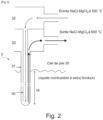
- the heat exchanger(s) comprises a bundle of tubes, of the bayonet tube type, with hollow tubes each opening inside a blind tube, defining the part exchange with the secondary circuit, immersed substantially vertically at least partially in the combustible liquid with molten salt(s), the hollow tubes opening out being connected to an inlet collector and the blind tubes being connected to a secondary fluid outlet manifold.
- the secondary fluid inlet and outlet collectors are arranged in the stack roof. With such an arrangement, direct contact between these collectors and the salt of the primary circuit is avoided, which increases their lifespan as well as the operating safety of the exchangers, since the only submerged part remains part of the height of the beam of tubes.
- the temperature of the molten salt(s) fuel liquid in the primary circuit can be between 500 and 900°C.
- the secondary fluid circulating in the exchanger(s) is based on a mixture of molten salts NaCl-MgCl 2 , NaCl-MgCl 2 -KCl or even NaCl-MgCl 2 -KCl-ZnCl 2 .
- the temperature of the secondary fluid at the inlet of the exchanger(s) is of the order of 550°C while its temperature at the outlet of the exchanger(s) is of the order of 600°C.
- the power of the nuclear reactor is advantageously less than 300 MWth, which corresponds to a power range sought for SMR type reactors.
- the invention essentially consists of producing a nuclear reactor with molten salt(s) of the fast neutron type, whose architecture with a cylindrical shell in the reactor vessel free of moderator or at least of a moderator making it possible to qualify a reactor as a thermal neutron reactor, which makes it possible to properly separate the fluidic zones between those delimited at its periphery in which the heat exchanger(s) between primary and secondary circuit is (are) arranged and the area inside the shell, the bottom of which defines the reactor core within which the nuclear fission chain reactions occur, and a neutron reflector at the periphery of the core allows the use of several types of combustible liquid.
- This shell thus makes it possible to guarantee circulation of the primary liquid with chloride salt and uranium/plutonium fuel only by natural convection within the reactor vessel.
- the liquid with molten salt(s) at the cold temperature leaving the exchanger descends to the periphery of the core, changes direction at the bottom of the tank at the level of a lower turning zone, which can preferably be implemented by a deflector with partial toric section, then rises while heating in the central part of the core.
- the liquid with molten salt(s) continues to rise to a level above the exchanger then is returned to it by a turning zone upper, preferably implemented by a deflector with partial toric section.
- primary fluid By “primary fluid”, “secondary fluid”, “tertiary fluid”, we mean the fluid which constitutes respectively the primary, secondary and tertiary circuit.
- temperatures, powers, volumes, flow rates, etc. indicated are for information purposes only.
- other temperatures can be considered depending on the configurations, in particular power of molten salt(s) reactor, volume of molten salt(s) combustible liquid, power requirement for the application considered...
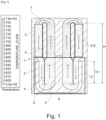
- FIG. 1 a nuclear reactor 1 with molten salt(s) of the fast neutron type, according to a primary circuit configuration according to one embodiment of the invention.
- This figure 1 is a digital simulation view obtained by a coupling of digital fluid mechanics (MFN or CFD, English acronym for “Computational Fluid Dynamics”) and neutronics in 3D, as explained below.
- MFN digital fluid mechanics
- CFD Computer Fluid Dynamics
- the reactor 1 with a central axis
- This reactor vessel 2 internally delimits a primary fuel circuit in liquid form in which at least one salt is melted.
- the interior of tank 2 is devoid of moderating material. In other words, the combustible liquid with molten salt(s) fills and circulates inside the tank without being moderated.
- a single heat exchanger 3 between the primary circuit of the reactor and a secondary circuit is arranged inside the reactor vessel 2.
- the ferrule 4 consists of an upper part 40 facing the exchange zone ZE which is in the form of a cylindrical ring closed on itself, and a lower part 41 facing the core C which is in the form of a hollow cylinder.
- the height H1 of the lower part 41 of the shell 4 is equal to 1 m.
- a second shell 5 is arranged concentrically inside the first shell 4.
- the interior of the second shell 5 defines a space in which control and/or safety rods for nuclear reactions can extend.
- the ferrules 4, 5 can be made of stainless steel or a nickel-based alloy.
- the ferrules 4, 5 are advantageously fixed by suspension to the cover cap closing the reactor vessel 2.
- a first deflector 6 in the form of a torus portion.
- a second deflector 7 also in the form of a torus portion.
- the combustible liquid with molten salt(s) circulates only by natural convection in a loop from the bottom of the zone central defining the reactor core C within which the fission reactions occur, from which it rises by heating to the top of the central zone between the shells 4 and 5 where it is deflected by the deflector 7 towards the top of the peripheral zone to cross exchanger 3 then descends towards the bottom of the peripheral zone where it is diverted by deflector 7 towards the core of reactor C.
- the shell 5 makes it possible to guide the combustible liquid which rises between the two zones where it is deflected, that is to say in the central zone of the reactor from the deviation zone by the deflector 6 passing through the core C up to the deflection zone by the deflector 7.
- the deflectors 6, 7, by their shapes and their arrangement, each allow the flow of deflected molten salt(s) combustible liquid to be distributed.
- a neutron reflector 21 made of silicon carbide is arranged at the periphery of the core C against the reactor vessel 2.
- the configuration of the figure 1 is dedicated to a combustible liquid with molten salt(s) of the primary circuit being a mixture of NaCl-UCl3, preferably in proportions of 25 to 30 mol%, and of PuCl3, preferably in proportions of 9 to 11 % mol, as salts, with natural uranium.
- the reactor vessel 2 comprising a sky, usually called a cell sky 20, filled with an inert gas, such as argon, above the combustible liquid with molten salt(s).
- a sky usually called a cell sky 20
- an inert gas such as argon
- the single heat exchanger 3 comprising a bundle of bayonet tubes defining the exchange part with the secondary circuit.
- each bayonet tube comprises a hollow tube 30 each opening into a blind tube 31.
- Each tube 30, 31 is immersed substantially vertically in the combustible liquid with molten salt(s) at a partial immersion height Hi.
- Each open hollow tube 30 is connected to an inlet collector 32 while each blind tube is connected to an outlet collector 33 of the secondary fluid.
- the inlet 32 and outlet 33 collectors of the secondary fluid are advantageously arranged in the stack head 20.
- the inventors carried out sizing simulations of a reactor 1, such as that shown in figure 1 .
- the inventors have carried out pre-sizing calculations on the primary circuit of a reactor as shown in figure 1 from digital simulation tools coupling CFD thermohydraulics, in order to determine the local speed and temperature fields and 3D neutronics, in order to determine the achievement of criticality and the spatial distribution of power.
- the CFD digital simulation software may be that known under the name TrioCFD.
- TrioCFD This TrioCFD code was developed by the Applicant and validated to effectively deal with various physical problems, such as turbulent flows, fluid/solid coupling, multiphase flows or flows in porous media: [3].
- the 3D neutron simulation software may be that known under the name ERANOS.
- ERANOS This ERANOS software was developed and validated with the aim of providing a suitable basis for reliable neutron calculations of existing or future advanced fast reactor cores: [4].
- the ERANOS software was used with the European nuclear data library JEFF3.1.1 provided by the nuclear energy agency NEA (Anglo-Saxon acronym for “Nuclear Energy Agency”).
- Publication [5] is an example of sizing by coupling CFD thermohydraulics with 3D neutronics.
- FIG. 3 illustrates a case of reactor 1 obtained by the aforementioned digital coupling simulation, for a combustible liquid with a mixture of NaCl-25% UCl3-9% PuCl3 salts with uranium depleted to 0.7%.
- the neutron reflector is made of SiC.
- FIG. 4 illustrates a case of reactor 1 obtained by the aforementioned digital coupling simulation, for a combustible liquid with a mixture of NaCl-UCl 3 at 34 mol% with uranium U235 enriched to 20%.
- the neutron reflector is made of graphite.
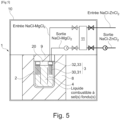
- FIG. 5 illustrates an example of integration of the reactor 1 which has just been described within a reactor building 10 and the secondary and tertiary circuits.
- the secondary fluid consists of a mixture of NaCl-MgCl 2 salts which enters by forced convection into exchanger 3 at 550°C and leaves at 600°C.
- the tertiary fluid consists of a mixture of NaCl-ZnCl 2 salts which enters by forced convection into the exchanger 11 at 500°C and leaves at 550°C.
Landscapes
- Physics & Mathematics (AREA)
- Engineering & Computer Science (AREA)
- Plasma & Fusion (AREA)
- General Engineering & Computer Science (AREA)
- High Energy & Nuclear Physics (AREA)
- Chemical & Material Sciences (AREA)
- Chemical Kinetics & Catalysis (AREA)
- Structure Of Emergency Protection For Nuclear Reactors (AREA)
- Organic Low-Molecular-Weight Compounds And Preparation Thereof (AREA)
Applications Claiming Priority (1)
| Application Number | Priority Date | Filing Date | Title |
|---|---|---|---|
| FR2213883A FR3143822A1 (fr) | 2022-12-19 | 2022-12-19 | Réacteur nucléaire à sel(s) fondu(s), de type à neutrons rapides, à architecture du circuit primaire permettant une exploitation versatile en combustible et en mode de fonctionnement. |
Publications (2)
| Publication Number | Publication Date |
|---|---|
| EP4390970A2 true EP4390970A2 (de) | 2024-06-26 |
| EP4390970A3 EP4390970A3 (de) | 2024-10-23 |
Family
ID=85727233
Family Applications (1)
| Application Number | Title | Priority Date | Filing Date |
|---|---|---|---|
| EP23216750.2A Pending EP4390970A3 (de) | 2022-12-19 | 2023-12-14 | Kernreaktor mit schnellen salzschmelzen (s) mit primärkreislaufarchitektur für vielseitigen betrieb in brennstoff und betriebsverfahren |
Country Status (4)
| Country | Link |
|---|---|
| US (1) | US20250022620A1 (de) |
| EP (1) | EP4390970A3 (de) |
| CN (1) | CN118231008A (de) |
| FR (1) | FR3143822A1 (de) |
Family Cites Families (2)
| Publication number | Priority date | Publication date | Assignee | Title |
|---|---|---|---|---|
| CA2967473A1 (en) * | 2014-12-29 | 2016-07-07 | Terrapower, Llc | Nuclear materials processing |
| US10867710B2 (en) * | 2015-09-30 | 2020-12-15 | Terrapower, Llc | Molten fuel nuclear reactor with neutron reflecting coolant |
-
2022
- 2022-12-19 FR FR2213883A patent/FR3143822A1/fr active Pending
-
2023
- 2023-12-14 EP EP23216750.2A patent/EP4390970A3/de active Pending
- 2023-12-18 US US18/542,937 patent/US20250022620A1/en active Pending
- 2023-12-19 CN CN202311752521.8A patent/CN118231008A/zh active Pending
Non-Patent Citations (6)
| Title |
|---|
| A.R. BAKERR.W. ROSS: "Comparison of the value ofplutonium and uranium isotopes in fast reactors.", PROC. CONF. BREEDING, ECONOMICS AND SAFETY IN LARGE FAST BREEDER REACTORS (ARGONNE NATIONAL LABORATORY, 1963, pages 329 - 364 |
| E. MERLE-LUCOTTEM. ALLIBERTM. BROVCHENKOD. HEUERV. GHETTAA. LAUREAUP.RUBIOLO: "Thorium Energy for the World", 2016, SPRINGER INTERNATIONAL PUBLISHING, article "Introduction to the Physics of Thorium Molten Salt Fast Reactor (MSFR) Concepts" |
| G.RIMPAULT, PHYSOR2002-INTERNATIONAL CONFÉRENCE ON THE NEW FRONTIERS OF NUCLEAR TECHNOLOGY: REACTOR PHYSICS, SAFETY AND HIGH-PERFORMANCE COMPUTING, October 2002 (2002-10-01) |
| JIRI KREPEL ET AL.: "Self-Sustaining Breeding in Advanced Reactors: Characterization of Selected Reactors", ENCYCLOPEDIA OF NUCLEAR ENERGY, 2021, pages 801 - 819, Retrieved from the Internet <URL:https://www.sciencedirect.com/science/article/pii/B9780128197257001239?via%3Dihub> |
| MARCO TIBERGA ET AL.: "Results from a multi-physics numerical benchmark for codes dedicated to molten sait fast reactors", ANNALS OF NUCLEAR ENERGY, vol. 142, 2020, pages 107428, XP086132030, DOI: 10.1016/j.anucene.2020.107428 |
| PIERRE-EMMANUEL ANGELI: "OVERVIEW OF THE TRIOCFD CODE: MAIN FEATURES, V&V PROCEDURES AND TYPICAL APPLICATIONS TO NUCLEAR", NURETH-16, 4 September 2015 (2015-09-04) |
Also Published As
| Publication number | Publication date |
|---|---|
| FR3143822A1 (fr) | 2024-06-21 |
| EP4390970A3 (de) | 2024-10-23 |
| CN118231008A (zh) | 2024-06-21 |
| US20250022620A1 (en) | 2025-01-16 |
Similar Documents
| Publication | Publication Date | Title |
|---|---|---|
| JP6000403B2 (ja) | 燃料アッセンブリ | |
| US10497479B2 (en) | Nuclear reactor configured to have molten fuel pass through plural heat exchangers before returning to core | |
| CN101299351B (zh) | 水冷双区增殖核反应堆堆芯及采用该堆芯的核反应堆 | |
| CN102906821B (zh) | 模块化核裂变废料转化反应堆 | |
| EP1085525A1 (de) | Leichtwasserreaktorkern und Brennstabbündel | |
| EP1913600B1 (de) | Brennelement mit makrostrukturierter platte | |
| RU2668230C1 (ru) | Ядерный реактор на быстрых нейтронах с жидкометаллическим теплоносителем | |
| WO2022223504A1 (fr) | Pastille de combustible nucleaire integrant un insert metallique ou alliage metallique conducteur thermique a disques pleins ou a trou selon l'axe central | |
| EP4390969A2 (de) | Kernreaktor mit einem schmelzsalz (s) vom schnellen neutronentyp, dessen primärkreislauf durch natürliche konvektion fliesst | |
| EP4390971A2 (de) | Kernreaktor mit einem schnellen salzschmelzesalz(en) mit einem mit inerten flüssigen salzen gefüllten behälter um den reaktorbehälter als reststromauslasssystem | |
| WO2022223510A1 (fr) | Pastille de combustible nucléaire intégrant un insert métallique ou alliage métallique conducteur thermique à disques pleins et tige pleine reliant les disques selon l'axe central, crayon et assemblage de combustible nucléaire associés, utilisation en réacteur à eau sous pression (rep) | |
| US4526741A (en) | Fuel assembly for the production of tritium in light water reactors | |
| EP4390970A2 (de) | Kernreaktor mit schnellen salzschmelzen (s) mit primärkreislaufarchitektur für vielseitigen betrieb in brennstoff und betriebsverfahren | |
| FR2810785A1 (fr) | Element combustible et reacteur nucleaire a refrigerant gazeux utilisant des elements combustibles de ce type | |
| FR2809225A1 (fr) | Element combustible monobloc et reacteur nucleaire a eau bouillante et a spectre rapide utilisant des elements de ce type | |
| FR3146368A1 (fr) | Réacteur nucléaire à caloporteur liquide et assemblages combustibles solides, intégrant un système d’évacuation de la puissance nominale à bain de métal liquide et à matériau(x) (MCP) pour l’évacuation de la puissance résiduelle en cas accidentel. | |
| FR3164054A1 (fr) | Réacteur nucléaire à sel(s) fondu(s), à réflecteur neutronique et barres en matériau absorbant neutronique agencées autour de la cuve de réacteur et mobiles en translation verticale. | |
| CN113436758B (zh) | 用于空间推进的径向流动高温气冷堆燃料组件及工作方法 | |
| FR3164052A1 (fr) | Réacteur nucléaire à sel(s) fondu(s), de type à neutrons rapides à cuve de sécurité autour de la cuve de réacteur et réservoir de vidange en-dessous des cuves. | |
| FR2921509A1 (fr) | Assemblage combustible pour reacteur nucleaire a neutrons rapides | |
| WO2026003208A1 (fr) | Centrale nucléaire à bâtiment nucléaire logeant au moins deux réacteurs nucléaires à sel(s) fondu(s), de type à neutrons rapides et à moyens de transfert de liquide combustible à sel(s) fondu(s) entre les deux cuves de réacteur; procédé afférent de démarrage et de fonctionnement de l'installation. | |
| CN114188043A (zh) | 燃料模块及其应用 | |
| FR3146369A1 (fr) | Réacteur nucléaire à caloporteur liquide en convection forcée et assemblages combustibles solides, intégrant un système d’évacuation de la puissance nominale à bain de métal liquide et à matériau(x) (MCP) pour l’évacuation de la puissance résiduelle en cas accidentel. | |
| FR3161981A1 (fr) | Pastille de combustible nucléaire intégrant au moins une cavité, dénuée de matière fissile, à section transversale sous la forme d’au moins une portion de spirale non débouchante vers l’extérieur de la pastille, Procédés de fabrication associés. | |
| WO2024256546A1 (fr) | Reacteur nucleaire calogene a caloporteur en metal liquide et a cœur comprenant des tubes etanches au caloporteur logeant chacun des particules de combustible nucleaire, dites triso |
Legal Events
| Date | Code | Title | Description |
|---|---|---|---|
| PUAI | Public reference made under article 153(3) epc to a published international application that has entered the european phase |
Free format text: ORIGINAL CODE: 0009012 |
|
| STAA | Information on the status of an ep patent application or granted ep patent |
Free format text: STATUS: REQUEST FOR EXAMINATION WAS MADE |
|
| 17P | Request for examination filed |
Effective date: 20231214 |
|
| AK | Designated contracting states |
Kind code of ref document: A2 Designated state(s): AL AT BE BG CH CY CZ DE DK EE ES FI FR GB GR HR HU IE IS IT LI LT LU LV MC ME MK MT NL NO PL PT RO RS SE SI SK SM TR |
|
| RIC1 | Information provided on ipc code assigned before grant |
Ipc: G21C 5/02 20060101ALI20240625BHEP Ipc: G21C 11/06 20060101ALI20240625BHEP Ipc: G21C 3/54 20060101ALI20240625BHEP Ipc: G21C 1/32 20060101ALI20240625BHEP Ipc: G21C 1/03 20060101AFI20240625BHEP |
|
| PUAL | Search report despatched |
Free format text: ORIGINAL CODE: 0009013 |
|
| AK | Designated contracting states |
Kind code of ref document: A3 Designated state(s): AL AT BE BG CH CY CZ DE DK EE ES FI FR GB GR HR HU IE IS IT LI LT LU LV MC ME MK MT NL NO PL PT RO RS SE SI SK SM TR |
|
| RIC1 | Information provided on ipc code assigned before grant |
Ipc: G21C 5/02 20060101ALI20240918BHEP Ipc: G21C 11/06 20060101ALI20240918BHEP Ipc: G21C 3/54 20060101ALI20240918BHEP Ipc: G21C 1/32 20060101ALI20240918BHEP Ipc: G21C 1/03 20060101AFI20240918BHEP |
|
| RAP3 | Party data changed (applicant data changed or rights of an application transferred) |
Owner name: COMMISSARIAT A L'ENERGIE ATOMIQUE ET AUX ENERGIESALTERNATIVES |