EP4392020B1 - Nanosystèmes liquides cristallins lyotropes avec macromolécules bioactives encapsulées - Google Patents
Nanosystèmes liquides cristallins lyotropes avec macromolécules bioactives encapsulées Download PDFInfo
- Publication number
- EP4392020B1 EP4392020B1 EP22765189.0A EP22765189A EP4392020B1 EP 4392020 B1 EP4392020 B1 EP 4392020B1 EP 22765189 A EP22765189 A EP 22765189A EP 4392020 B1 EP4392020 B1 EP 4392020B1
- Authority
- EP
- European Patent Office
- Prior art keywords
- och
- composition
- liquid crystalline
- lyotropic liquid
- block copolymer
- Prior art date
- Legal status (The legal status is an assumption and is not a legal conclusion. Google has not performed a legal analysis and makes no representation as to the accuracy of the status listed.)
- Active
Links
Images
Classifications
-
- A—HUMAN NECESSITIES
- A61—MEDICAL OR VETERINARY SCIENCE; HYGIENE
- A61K—PREPARATIONS FOR MEDICAL, DENTAL OR TOILETRY PURPOSES
- A61K9/00—Medicinal preparations characterised by special physical form
- A61K9/10—Dispersions; Emulsions
- A61K9/127—Synthetic bilayered vehicles, e.g. liposomes or liposomes with cholesterol as the only non-phosphatidyl surfactant
- A61K9/1274—Non-vesicle bilayer structures, e.g. liquid crystals, tubules, cubic phases or cochleates; Sponge phases
-
- A—HUMAN NECESSITIES
- A61—MEDICAL OR VETERINARY SCIENCE; HYGIENE
- A61K—PREPARATIONS FOR MEDICAL, DENTAL OR TOILETRY PURPOSES
- A61K47/00—Medicinal preparations characterised by the non-active ingredients used, e.g. carriers or inert additives; Targeting or modifying agents chemically bound to the active ingredient
- A61K47/06—Organic compounds, e.g. natural or synthetic hydrocarbons, polyolefins, mineral oil, petrolatum or ozokerite
- A61K47/08—Organic compounds, e.g. natural or synthetic hydrocarbons, polyolefins, mineral oil, petrolatum or ozokerite containing oxygen, e.g. ethers, acetals, ketones, quinones, aldehydes, peroxides
- A61K47/14—Esters of carboxylic acids, e.g. fatty acid monoglycerides, medium-chain triglycerides, parabens or PEG fatty acid esters
-
- A—HUMAN NECESSITIES
- A61—MEDICAL OR VETERINARY SCIENCE; HYGIENE
- A61K—PREPARATIONS FOR MEDICAL, DENTAL OR TOILETRY PURPOSES
- A61K9/00—Medicinal preparations characterised by special physical form
- A61K9/48—Preparations in capsules, e.g. of gelatin, of chocolate
- A61K9/50—Microcapsules having a gas, liquid or semi-solid filling; Solid microparticles or pellets surrounded by a distinct coating layer, e.g. coated microspheres, coated drug crystals
- A61K9/51—Nanocapsules; Nanoparticles
- A61K9/5107—Excipients; Inactive ingredients
- A61K9/5123—Organic compounds, e.g. fats, sugars
Definitions
- the invention relates to compositions of physicochemically stable nanostructured colloidal systems in the form of lyotropic liquid crystals, comprising of amphiphilic lipids, salts of medium-chain fatty acid or their derivatives, copolymers as stabilizers and a bioactive macromolecule comprising peptide bonds.
- Lyotropic liquid crystals represent an intermediate state of matter between solid and liquid and they are formed through dispersion and self-assembly of amphiphilic molecules to water.
- Amphiphilic molecules present different properties between their distinct structural parts (hydrophilic-hydrophobic, polar-nonpolar), and are self-assembled to supramolecular structures with a morphology which is highly dependent from their chemical nature, their concentration and the solvent medium.
- Other factors that play an important role in the morphology of lyotropic liquid crystals and is directly related to the solvent medium, are the temperature, pH and ionic strength.
- the most important mesophases of self-assembled amphiphilic molecules observed include mono- or bilayer, micellar, cubic, hexagonal or bicontinuous cubic phases.
- the scientific community is particularly attracted by the cubic and hexagonal non-bilayer mesophases, as they can form nanoparticulated lyotropic liquid crystal dispersions, suitable to be used as nanocarriers for the delivery of a wide range of active pharmaceutical ingredients.
- These mesophases present significant advantages, including the ability of controlled release due to the extensive organization of their internal morphology (short range order).
- Glyceryl monooleate is an amphiphilic, polar, unsaturated monoglyceride being widely used as an emulsifier, also designated as a safe and inert substance by US Food and Drug Administration (FDA).
- FDA US Food and Drug Administration
- the amphiphilic character of GMO is due to the presence of the hydrophilic glycerol-moiety at the head of the molecule and the hydrophobic hydrocarbon-moiety at the tail of the molecule, thus allowing it to self-assemble in aqueous media forming characteristic, thermodynamically stable liquid crystal structures.
- surfactants further affects GMO's properties in aqueous solutions, allowing the stabilization of different supramolecular structures, such as cubic and hexagonal, which are ideal for drug entrapment.
- these structures are not physicochemically stable for long time, due to the hydrolysis of the ester bond of the GMO, which breaks the hydrophobic hydrocarbon chain from the hydrophilic glycerol, furthermore due to the double bond oxidation of the hydrocarbon chain.
- Amphiphilic polymers represent another class of molecules widely used in several pharmaceutical forms, not only as emulsion stabilizers but also as viscosity regulators. Amphiphilic polymers, like all other amphiphilic molecules, are self-organized to various characteristic structures depending on the dispersion medium. A special category of this family consists of amphiphilic triblock copolymers, which although they show great complexity, at the same time, they are formed in a variety of morphologies particularly useful in various applications.
- Triblock copolymer poly(ethylene oxide)-b-poly(propylene oxide)-b-poly(ethylene oxide) (PEO-b-PPO-b-PEO), also known as Poloxamer, has been reported for the stabilization of cubic GMO structures in aqueous media ( M. Chountoulesi, et al. Cubic lyotropic liquid crystals as drug delivery carriers: Physicochemical and morphological studies. International Journal of Pharmaceutics 2018, 550, 57-70 ).
- Medium chain fatty acids especially those carrying between 6 and 12 carbon atoms in the aliphatic lipid chain, and their derivatives are commonly used as permeation enhancers to increase the bioavailability of certain orally administered pharmaceutical substances.
- the sodium salt of decanoic acid (C10) and the sodium salt of 8-((2-hydroxybenzoyl)amino) octanoic acid (Salcaprozate sodium - SNAC) represent two characteristic candidates of this family and numeral clinical studies reported as regards their safety and stability towards this direction ( Twarog, C.; et al. Intestinal Permeation Enhancers for Oral Delivery of Macromolecules: A Comparison between Salcaprozate Sodium (SNAC) and Sodium Caprate (C10). Pharmaceutics 2019, 11, 78 ).
- Insulin is a peptide hormone produced by ⁇ -cells in the pancreas. It plays a dominant role in the metabolism of carbohydrates, fats and proteins in the human body, and most importantly, in the regulation of blood glucose levels. Insulin deficiency is the cause of diabetes mellitus.
- SNAC-coated insulin microspheres have been developed to protect the drug substance from enzyme degradation while at the same time these microspheres exhibit increased permeability from the gastrointestinal tract [ R. Ql and Q. N. Ping, Gastrointestinal absorption enhancement of insulin by administration of enteric microspheres and SNAC to rats. J. Microencapsulation, 2004 (21) 37-45 ].
- Another report relates to insulin nanocubicles stabilized by GMO and non-ionic copolymer Pluronic F-127 (Poloxamer 407) in a mixture of ethanol and propyleneglycol [ H. Chung, et al. Self-assembled "nanocubicle” as a carrier for peroral insulin delivery. Diabetologia 2002 (45) 448-451 ].
- Several nanocarrier formulations for insulin delivery related to chitosan coated nanoparticles, PLGA-insulin nanoparticles, dextran-insulin nanoparticles, and solid lipid-insulin nanoparticles are reported in the recent literature [ Sharma et al. Nanoparticle based insulin delivery system: the next generation efficient therapy for Type 1 diabetes J Nanobiotechnol2015 (13), 74 (13 pages )].
- Document EP2331072 relates to oral compositions comprising a protein, an absorption enhancer, and a protease inhibitor.
- the present invention relates to compositions of physicochemically stable colloid systems in the form of lyotropic liquid crystals comprising glycerol monooleate, a salt of C6-C12 fatty acid or its derivative with an aromatic substituent, an amphiphilic block copolymer with the following chemical formula H(OCH 2 CH 2 ) a (OCH(CH 3 )CH 2 ) b (OCH 2 CH 2 ) a OH, wherein 2 ⁇ a ⁇ 150 and 15 ⁇ b ⁇ 70 and a bioactive macromolecule with peptide bonds.
- the lyotropic liquid crystalline nanoparticles of the present invention present a nanocompartmentalized internal structure, which although is consistent, at the same time, is highly loose, allowing it to be highly flexible to encapsulate a variety of bioactive macromolecules with peptide bonds of different structures and different molecular weights, without affecting their physicochemical characteristics overall.
- the self-assembled nanoparticles of the present invention in the form of lyotropic liquid crystals carrying encapsulated bioactive macromolecules having peptide bonds, form time-stable colloidal nanosystems in terms of size, size distribution and ⁇ -potential, regardless of their internal structure organization after the encapsulation of bioactive macromolecules with peptide bonds.
- the self-assembled nanoparticles with encapsulated bioactive macromolecules having peptide bonds have an average diameter ranging from 50 nm to 900 nm, preferably between 100 nm and 500 nm, more preferably between 100 nm and 300 nm.
- the concentration of glycerol monooleate in the composition of lyotropic liquid crystalline nanoparticles ranges from 10 mg/mL to 100 mg/mL, preferably ranges from 20 mg/mL to 80 mg/mL, more preferably is 20 mg/mL.
- the salt of medium-chain fatty acid used for the development of the lyotropic liquid crystalline nanoparticles is selected among the alkali salts of fatty acids having from 6 to 12 carbon atoms in their aliphatic chain or their derivatives with an aromatic substituent.
- the salt of the C6-C12 fatty acid used for the development of lyotropic liquid crystalline nanoparticles is selected between the alkaline salts octanoic, decanoic or dodecanoic acids and its derivative is selected among the alkaline salts of 8-((2-hydroxybenzoyl)amino)octanoic acid.
- the salt of the C6-C12 fatty acid or its derivative with an aromatic substituent, used for the development of lyotropic liquid crystalline nanoparticles of the present invention is the sodium salt of octanoic acid.
- the salt of the C6-C12 fatty acid or its derivative with an aromatic substituent, used for the development of lyotropic liquid crystalline nanoparticles of the present invention is the sodium salt of decanoic acid.
- the salt of the C6-C12 fatty acid or its derivative with an aromatic substituent, used for the development of lyotropic liquid crystalline nanoparticles of the present invention is the sodium salt of dodecanoic acid.
- the salt of the C6-C12 fatty acid or its derivative with an aromatic substituent, used for the development of lyotropic liquid crystalline nanoparticles of the present invention is the sodium salt of 8-((2-hydroxybenzoyl)amino)octanoic acid.
- the amphiphilic block copolymer for the development of lyotropic liquid crystalline nanoparticles has the following chemical formula H(OCH 2 CH 2 ) a (OCH(CH 3 )CH 2 ) b (OCH 2 CH 2 ) a OH, wherein, 2 ⁇ a ⁇ 150 and 15 ⁇ b ⁇ 70, preferably is selected among those wherein 60 ⁇ a ⁇ 150 and 25 ⁇ b ⁇ 70, more preferably is selected among those wherein 95 ⁇ a ⁇ 105 and 55 ⁇ b ⁇ 70.
- the amphiphilic block copolymer for the development of lyotropic liquid crystalline nanoparticles has the chemical formula H(OCH 2 CH 2 ) 80 (OCH(CH 3 )CH 2 ) 27 (OCH 2 CH 2 ) 80 OH.
- the amphiphilic block copolymer for the development of lyotropic liquid crystalline nanoparticles has the chemical formula H(OCH 2 CH 2 ) 64 (OCH(CH 3 )CH 2 ) 37 (OCH 2 CH 2 ) 64 OH.
- the amphiphilic block copolymer for the development of lyotropic liquid crystalline nanoparticles has the chemical formula H(OCH 2 CH 2 ) 141 (OCH(CH 3 )CH 2 ) 44 (OCH 2 CH 2 ) 141 OH.
- the amphiphilic block copolymer for the development of lyotropic liquid crystalline nanoparticles has the chemical formula H(OCH 2 CH 2 ) 101 (OCH(CH 3 )CH 2 ) 56 (OCH 2 CH 2 ) 101 OH
- the amphiphilic block copolymer for the development of lyotropic liquid crystalline nanoparticles has the chemical formula H(OCH 2 CH 2 ) 98 (OCH(CH 3 )CH 2 ) 67 (OCH 2 CH 2 ) 98 OH
- the weight ratio in milligrams (mg) of glycerol monooleate to the salt of C6-C12 fatty acid or its derivative with an aromatic substituent, to the amphiphilic block copolymer, per milliliter (mL) in the final composition is 20:A:B, wherein 1 ⁇ A ⁇ 10 and 1 ⁇ B ⁇ 10, preferably 2 ⁇ A ⁇ 4 and 3 ⁇ B ⁇ 7.
- the weight ratio in milligrams (mg) of glycerol monooleate to the salt of C6-C12 fatty acid or its derivative with an aromatic substituent, to the amphiphilic block copolymer, per milliliter (mL) in the final composition is 20:2:5.
- the lyotropic liquid crystalline nanoparticles in the composition of the present invention consist of glycerol monooleate, the sodium salt of octanoic acid and the copolymer H(OCH 2 CH 2 ) a (OCH(CH 3 )CH 2 ) b (OCH 2 CH 2 ) a OH, wherein 95 ⁇ a ⁇ 105 and 55 ⁇ b ⁇ 70 in a weight ratio 20:2:5 per mL of the final composition solution.
- the lyotropic liquid crystalline nanoparticles in the composition of the present invention consist of glycerol monooleate, the sodium salt of octanoic acid and the copolymer H(OCH 2 CH 2 ) 98 (OCH(CH 3 )CH 2 ) 67 (OCH 2 CH 2 ) 98 OH in a weight ratio 20:4:5 per mL of the final composition solution.
- the lyotropic liquid crystalline nanoparticles in the composition of the present invention consist of glycerol monooleate, the sodium salt of 8-((2-hydroxybenzoyl)amino)octanoic acid and the copolymer H(OCH 2 CH 2 ) a (OCH(CH 3 )CH 2 ) b (OCH 2 CH 2 ) a OH, wherein 95 ⁇ a ⁇ 105 and 55 ⁇ b ⁇ 70 in a weight ratio 20:2:5 per mL of the final composition solution.
- the lyotropic liquid crystalline nanoparticles in the composition of the present invention consist of glycerol monooleate, the sodium salt of 8-((2-hydroxybenzoyl)amino)octanoic acid and the copolymer H(OCH 2 CH 2 ) 98 (OCH(CH 3 )CH 2 ) 67 (OCH 2 CH 2 ) 98 OH in a weight ratio 20:2:5 per mL of the final composition solution.
- the lyotropic liquid crystalline nanoparticles in the composition of the present invention consist of glycerol monooleate, the sodium salt of 8-((2-hydroxybenzoyl)amino)octanoic acid and the copolymer H(OCH 2 CH 2 ) 98 (OCH(CH 3 )CH 2 ) 67 (OCH 2 CH 2 ) 98 OH in a weight ratio 20:4:5 per mL of the final composition solution.
- the bioactive macromolecule having peptide bonds in the composition of lyotropic liquid crystalline nanoparticles is selected between enzymes, proteins and hormones.
- the bioactive macromolecule having peptide bonds in the composition of lyotropic liquid crystalline nanoparticles is the lysozyme enzyme.
- the bioactive macromolecule having peptide bonds in the composition of lyotropic liquid crystalline nanoparticles is the bovine serum albumin protein (BSA).
- BSA bovine serum albumin protein
- the bioactive macromolecule having peptide bonds in the composition of lyotropic liquid crystalline nanoparticles is insulin hormone.
- the bioactive macromolecule having peptide bonds in the composition of lyotropic liquid crystalline nanoparticles is calcitonin hormone.
- the bioactive macromolecule having peptide bonds in the composition of lyotropic liquid crystalline nanoparticles is the octapeptide octreotide.
- the bioactive macromolecule having peptide bonds in the composition of lyotropic liquid crystalline nanoparticles is a glucagon-like peptide 1 (GLP-1) analogue, preferably liraglutide, semaglutide or dulaglutide.
- GLP-1 glucagon-like peptide 1
- the concentration of the bioactive macromolecule having peptide bonds in the composition of lyotropic liquid crystalline nanoparticles is 0.5 mg/mL.
- the concentration of the bioactive macromolecule having peptide bonds in the composition of lyotropic liquid crystalline nanoparticles is 1.0 mg/mL.
- the weight ratio of glycerol monooleate to the salt of C6-C12 fatty acid or its derivative with an aromatic substituent, to the amphiphilic block copolymer, to the bioactive macromolecule having peptide bonds, in the final composition is 20:A:B:C, wherein 1 ⁇ A ⁇ 10, 1 ⁇ B ⁇ 10 and 0.01 ⁇ C ⁇ 10, preferably wherein 2 ⁇ A ⁇ 4, 3 ⁇ B ⁇ 7 and 0.1 ⁇ C ⁇ 5, more preferably is 20:2:5:0.5 or 20:2:5:1 or 20:4:5:0.5 or 20:4:5:1.
- the composition of the present invention consists of glycerol monooleate, the sodium salt of octanoic acid, the block copolymer H(OCH 2 CH 2 ) a (OCH(CH 3 )CH 2 ) b (OCH 2 CH 2 ) a OH, wherein 95 ⁇ a ⁇ 105 and 55 ⁇ b ⁇ 70 and insulin, in a weight ratio of 20:2:5:0.5 per mL of the final composition solution.
- the composition of the present invention consists of glycerol monooleate, the sodium salt of octanoic acid, the block copolymer H(OCH 2 CH 2 ) a (OCH(CH 3 )CH 2 ) b (OCH 2 CH 2 ) a OH, wherein 95 ⁇ a ⁇ 105 and 55 ⁇ b ⁇ 70 and insulin, in a weight ratio of 20:4:5:1.0 per mL of the final composition solution.
- the composition of the present invention consists of glycerol monooleate, the sodium salt of 8-((2-hydroxybenzoyl)amino)octanoic acid, the block copolymer H(OCH 2 CH 2 ) a (OCH(CH 3 )CH 2 ) b (OCH 2 CH 2 ) a OH, wherein 95 ⁇ a ⁇ 105 and 55 ⁇ b ⁇ 70 and insulin, in a weight ratio of 20:2:5:0.5 per mL of the final composition solution.
- the composition of the present invention consists of glycerol monooleate, the sodium salt of 8-((2-hydroxybenzoyl)amino)octanoic acid, the block copolymer H(OCH 2 CH 2 ) a (OCH(CH 3 )CH 2 ) b (OCH 2 CH 2 ) a OH, wherein 95 ⁇ a ⁇ 105 and 55 ⁇ b ⁇ 70 and insulin, in a weight ratio of 20:4:5:1.0 per mL of the final composition solution.
- composition of the current invention consisting of glycerol monooleate, the sodium salt of octanoic acid, the block copolymer H(OCH 2 CH 2 ) 98 (OCH(CH 3 )CH 2 ) 67 (OCH 2 CH 2 ) 98 OH and insulin in a weight ratio of 20:2:5:0.5 per mL of the final composition solution, presents an unexpectantly high insulin entrapment in a weight percentage of more than 99% and significantly improved physicochemical stability in simulated gastric and intestinal environment conditions.
- the composition of the present invention consists of glycerol monooleate, the sodium salt of octanoic acid, the block copolymer H(OCH 2 CH 2 ) a (OCH(CH 3 )CH 2 ) b (OCH 2 CH 2 ) a OH, wherein 95 ⁇ a ⁇ 105 and 55 ⁇ b ⁇ 70 and bovine serum albumin, in a weight ratio of 20:2:5:0.5 per mL of the final composition solution.
- the composition of the present invention consists of glycerol monooleate, the sodium salt of octanoic acid, the block copolymer H(OCH 2 CH 2 ) a (OCH(CH 3 )CH 2 ) b (OCH 2 CH 2 ) a OH, wherein 95 ⁇ a ⁇ 105 and 55 ⁇ b ⁇ 70 and bovine serum albumin, in a weight ratio of 20:2:5:1.0 per mL of the final composition solution.
- the composition of the present invention consists of glycerol monooleate, the sodium salt of 8-((2-hydroxybenzoyl)amino)octanoic acid, the block copolymer H(OCH 2 CH 2 ) a (OCH(CH 3 )CH 2 ) b (OCH 2 CH 2 ) a OH, wherein 95 ⁇ a ⁇ 105 and 55 ⁇ b ⁇ 70 and bovine serum albumin, in a weight ratio of 20:2:5:0.5 per mL of the final composition solution.
- composition of the current invention consisting of glycerol monooleate, the sodium salt of 8-((2-hydroxybenzoyl)amino)octanoic acid, the block copolymer H(OCH 2 CH 2 ) 98 (OCH(CH 3 )CH 2 ) 67 (OCH 2 CH 2 ) 98 OH and bovine serum albumin in a weight ratio of 20:2:5:0.5 per mL of the final composition solution, presents significantly improved physicochemical stability in simulated gastric and intestinal environment conditions.
- the composition of the present invention consists of glycerol monooleate, the sodium salt of 8-((2-hydroxybenzoyl)amino)octanoic acid, the block copolymer H(OCH 2 CH 2 ) a (OCH(CH 3 )CH 2 ) b (OCH 2 CH 2 ) a OH, wherein 95 ⁇ a ⁇ 105 and 55 ⁇ b ⁇ 70 and bovine serum albumin, in a weight ratio of 20:2:5:1.0 per mL of the final composition solution.
- the composition of the present invention consists of glycerol monooleate, the sodium salt of octanoic acid, the block copolymer H(OCH 2 CH 2 ) a (OCH(CH 3 )CH 2 ) b (OCH 2 CH 2 ) a OH, wherein 95 ⁇ a ⁇ 105 and 55 ⁇ b ⁇ 70 and lysozyme, in a weight ratio of 20:2:5:0.5 per mL of the final composition solution.
- the composition of the present invention consists of glycerol monooleate, the sodium salt of octanoic acid, the block copolymer H(OCH 2 CH 2 ) a (OCH(CH 3 )CH 2 ) b (OCH 2 CH 2 ) a OH, wherein 95 ⁇ a ⁇ 105 and 55 ⁇ b ⁇ 70 and lysozyme, in a weight ratio of 20:2:5:1.0 per mL of the final composition solution.
- the composition of the present invention consists of glycerol monooleate, the sodium salt of 8-((2-hydroxybenzoyl)amino)octanoic acid, the block copolymer H(OCH 2 CH 2 ) a (OCH(CH 3 )CH 2 ) b (OCH 2 CH 2 ) a OH, wherein 95 ⁇ a ⁇ 105 and 55 ⁇ b ⁇ 70 and lysozyme, in a weight ratio of 20:2:5:0.5 per mL of the final composition solution.
- the composition of the present invention consists of glycerol monooleate, the sodium salt of 8-((2-hydroxybenzoyl)amino)octanoic acid, the block copolymer H(OCH 2 CH 2 ) a (OCH(CH 3 )CH 2 ) b (OCH 2 CH 2 ) a OH, wherein 95 ⁇ a ⁇ 105 and 55 ⁇ b ⁇ 70 and lysozyme, in a weight ratio of 20:2:5:1.0 per mL of the final composition solution.
- the composition of the present invention consists of glycerol monooleate, the sodium salt of octanoic acid, the block copolymer H(OCH 2 CH 2 ) a (OCH(CH 3 )CH 2 ) b (OCH 2 CH 2 ) a OH, wherein 95 ⁇ a ⁇ 105 and 55 ⁇ b ⁇ 70 and octreotide, in a weight ratio of 20:A:B:0.5, wherein 1 ⁇ A ⁇ 10, and 1 ⁇ B ⁇ 10, per mL of the final composition solution.
- the composition of the present invention consists of glycerol monooleate, the sodium salt of 8-((2-hydroxybenzoyl)amino)octanoic acid, the block copolymer H(OCH 2 CH 2 ) a (OCH(CH 3 )CH 2 ) b (OCH 2 CH 2 ) a OH, wherein 95 ⁇ a ⁇ 105 and 55 ⁇ b ⁇ 70 and octreotide, in a weight ratio of 20:A:B:0.5, wherein 1 ⁇ A ⁇ 10, and 1 ⁇ B ⁇ 10, per mL of the final composition solution.
- the composition of the present invention consists of glycerol monooleate, the sodium salt of octanoic acid, the block copolymer H(OCH 2 CH 2 ) a (OCH(CH 3 )CH 2 ) b (OCH 2 CH 2 ) a OH, wherein 95 ⁇ a ⁇ 105 and 55 ⁇ b ⁇ 70 and a GLP-1 analogue, in a weight ratio of 20:A:B:C, wherein 1 ⁇ A ⁇ 10, 1 ⁇ B ⁇ 10 and 0.01 ⁇ C ⁇ 10, preferably wherein 2 ⁇ A ⁇ 4, 3 ⁇ B ⁇ 7 and 0.5 ⁇ C ⁇ 6, per mL of the final composition solution.
- the composition of the present invention consists of glycerol monooleate, the sodium salt of 8-((2-hydroxybenzoyl)amino)octanoic acid, the block copolymer H(OCH 2 CH 2 ) a (OCH(CH 3 )CH 2 ) b (OCH 2 CH 2 ) a OH, wherein 95 ⁇ a ⁇ 105 and 55 ⁇ b ⁇ 70 and a GLP-1 analogue, in a weight ratio of 20:A:B:C, wherein 1 ⁇ A ⁇ 10, 1 ⁇ B ⁇ 10 and 0.01 ⁇ C ⁇ 10, preferably wherein 2 ⁇ A ⁇ 4, 3 ⁇ B ⁇ 7 and 0.5 ⁇ C ⁇ 6, per mL of the final composition solution.
- the composition of the present invention consists of glycerol monooleate, the sodium salt of octanoic acid, the block copolymer H(OCH 2 CH 2 ) a (OCH(CH 3 )CH 2 ) b (OCH 2 CH 2 ) a OH, wherein 95 ⁇ a ⁇ 105and 55 ⁇ b ⁇ 70 and liraglutide, in a weight ratio of 20:A:B:6, wherein 1 ⁇ A ⁇ 10, and 1 ⁇ B ⁇ 10, per mL of the final composition solution.
- the composition of the present invention consists of glycerol monooleate, the sodium salt of 8-((2-hydroxybenzoyl)amino)octanoic acid, the block copolymer H(OCH 2 CH 2 ) a (OCH(CH 3 )CH 2 ) b (OCH 2 CH 2 ) a OH, wherein 95 ⁇ a ⁇ 105 and 55 ⁇ b ⁇ 70 and liraglutide, in a weight ratio of 20:A:B:6, wherein 1 ⁇ A ⁇ 10, and 1 ⁇ B ⁇ 10, per mL of the final composition solution.
- the composition of the present invention consists of glycerol monooleate, the sodium salt of octanoic acid, the block copolymer H(OCH 2 CH 2 ) a (OCH(CH 3 )CH 2 ) b (OCH 2 CH 2 ) a OH, wherein 95 ⁇ a ⁇ 105 and 55 ⁇ b ⁇ 70 and semaglutide, in a weight ratio of 20:A:B:1, wherein 1 ⁇ A ⁇ 10, and 1 ⁇ B ⁇ 10, per mL of the final composition solution.
- the composition of the present invention consists of glycerol monooleate, the sodium salt of 8-((2-hydroxybenzoyl)amino)octanoic acid, the block copolymer H(OCH 2 CH 2 ) a (OCH(CH 3 )CH 2 ) b (OCH 2 CH 2 ) a OH, wherein 95 ⁇ a ⁇ 105 and 55 ⁇ b ⁇ 70 and semaglutide, in a weight ratio of 20:A:B:1, wherein 1 ⁇ A ⁇ 10, and 1 ⁇ B ⁇ 10, per mL of the final composition solution.
- the composition of the present invention consists of glycerol monooleate, the sodium salt of octanoic acid, the block copolymer H(OCH 2 CH 2 ) a (OCH(CH 3 )CH 2 ) b (OCH 2 CH 2 ) a OH, wherein 95 ⁇ a ⁇ 105 and 55 ⁇ b ⁇ 70 and dulaglutide, in a weight ratio of 20:A:B:C, wherein 1 ⁇ A ⁇ 10, 1 ⁇ B ⁇ 10 and 0.5 ⁇ C ⁇ 5, per mL of the final composition solution.
- the composition of the present invention consists of glycerol monooleate, the sodium salt of 8-((2-hydroxybenzoyl)amino)octanoic acid, the block copolymer H(OCH 2 CH 2 ) a (OCH(CH 3 )CH 2 ) b (OCH 2 CH 2 ) a OH, wherein 95 ⁇ a ⁇ 105 and 55 ⁇ b ⁇ 70 and dulaglutide, in a weight ratio of 20:A:B:C, wherein 1 ⁇ A ⁇ 10, 1 ⁇ B ⁇ 10 and 0.5 ⁇ C ⁇ 5, per mL of the final composition solution.
- the composition in the form of lyotropic liquid crystalline nanoparticles with encapsulated bioactive macromolecules having peptide bonds is formulated with pharmaceutically acceptable excipients to be suitable for oral, intranasal, subcutaneous, intraperitoneal, intravenous or topical administration.
- composition in the form of lyotropic liquid crystalline nanoparticles with encapsulated bioactive macromolecules having peptide bonds is formulated with pharmaceutically acceptable excipients to be suitable for oral administration.
- composition in the form of lyotropic liquid crystalline nanoparticles with encapsulated bioactive macromolecules having peptide bonds, for oral administration may be further coated with pH-responsive polymers which allow sustained release in the desired environment.
- composition in the form of lyotropic liquid crystalline nanoparticles with encapsulated bioactive macromolecules having peptide bonds, for oral administration may be coated with synthetic acrylic and methacrylic polymers suitable for pH-dependent release.
- the composition in the form of lyotropic liquid crystalline nanoparticles with encapsulated bioactive macromolecules having peptide bonds, for oral administration is coated with methacrylic acid-ethyl acrylate copolymer (1:1) for targeted release in the duodenum at pH values above than 5.5.
- the composition in the form of lyotropic liquid crystalline nanoparticles with encapsulated bioactive macromolecules having peptide bonds, for oral administration is coated with methacrylic acid-methyl methacrylate copolymer (1:1) for targeted release in the medium of the small intestine at pH values above than 6.0.
- the composition in the form of lyotropic liquid crystalline nanoparticles with encapsulated bioactive macromolecules having peptide bonds, for oral administration is coated with methacrylic acid-methyl methacrylate copolymer (1:2) for targeted release in the small intestine at pH values above than 7.0.
- the composition in the form of lyotropic liquid crystalline nanoparticles with encapsulated bioactive macromolecules having peptide bonds, for oral administration is coated with the high permeability ethyl acrylate-methyl methacrylate-trimethylaminoethyl methacrylate chloride copolymer (1:2:0.2) for sustained release.
- Example 1 Composition in the form of lyotropic liquid crystalline nanoparticles consisting of glyceryl monooleate, the sodium salt of 8-((2-hydroxybenzoyl)amino)octanoic acid, H(OCH 2 CH 2 ) 98 (OCH(CH 3 )CH 2 ) 67 (OCH 2 CH 2 ) 98 OH copolymer and insulin, in a weight ratio 20:2:5:0.5 per mL of the final composition.
- a 20 mg/mL glycerol monooleate solution in purified water is prepared under mild heating (50° C).
- An aqueous solution of the sodium salt of 8-((2-hydroxybenzoyl)amino)octanoic acid followed by an aqueous solution of H(OCH 2 CH 2 ) 98 (OCH(CH 3 )CH 2 ) 67 (OCH 2 CH 2 ) 98 OH copolymer, followed by an aqueous solution of insulin are added in the solution of glyceryl monoleate, so that the weight ratio of the components in the final composition is 20:2:5:0.5 mg per mL.
- the mixture is heated at 50° C for 5 minutes, then it was sonicated in a bath sonicator, until a milky dispersion was formed, further followed by followed by two 1-min sonication cycles (amplitude 70, cycle 0,7), and interrupted by a 1-min resting period, using a probe sonicator.
- the resultant dispersion is allowed to anneal for 30 min.
- the final dispersion is opaque white and stored at room temperature.
- the average hydrodynamic diameter (D h ) representing the particle size and the particle size distribution (Polydispersity Index - PDI) of the nanoparticles in the composition of Example 1 is determined by the Dynamic Light Scattering (DLS) technique.
- the ⁇ -potential of the nanoparticles is determined by the Electrophoretic Light Scattering (ELS) technique.
- ELS Electrophoretic Light Scattering
- Example 1 Average hydrodynamic diameter (D h ), Polydispersity Index (PDI) and ⁇ - potential of the compositions of Example 1 Parameter Empty Nanocarrier Composition of Example 1 D h (nm) 136.0 ⁇ 0.6 128.0 ⁇ 2.2 PDI 0.310 ⁇ 0.011 0.440 ⁇ 0.060 ⁇ -potential (mV) -10.0 ⁇ 0.5 -42.0 ⁇ 0.3
- colloidal suspensions of the nanoparticles of the present invention show remarkable physicochemical stability over time in both their particle size and their size distribution.
- the morphology of the compositions of Example 1 was studied and qualitatively evaluated by cryogenic transmission electron microscopy (cryo-TEM).
- cryo-TEM cryogenic transmission electron microscopy
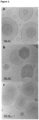
- the empty nanosystem which does not contain the encapsulated insulin ( Figure 1a )
- the whole morphology tends to donut-like morphology, indicating a modulated liquid crystalline mesophase, which appeared for the first time in the prior art.
- the unique morphology resembles also to the cell with its nucleus inside enclosed by the porous nuclear membrane/envelop.
- Example 1 The empty nanostructures of Example 1 exhibited sizes of 160-900 nm and membrane thickness of 3-4 nm.
- the presence of the dispersed, crowded vesicular structures causes a further stabilization of the liquid crystalline nanoparticles by forming a "coating" layer of material, covering the ordered nanoparticles, helping to keep them dispersed in aqueous solution.
- the bubble-like outer vesicle exhibits a protective role over the inner irregular nanocompartmentalized core.
- the nanostructures of Example 1 with entrapped insulin present sizes of 40 -220 nm, furthermore, are co-existing with a prevailing population of small, spherical vesicles with no inner structure, with sizes 15-330 nm.
- the lyotropic liquid crystalline nanostructures with entrapped insulin are also co-existing with perforated porous-like structures of many inner intersecting layers and an apparent dense inner core with highly disordered interior ( Figure 1c ). Their total sizes are in the range of 130-550 nm, with a membrane thickness of 3-4 nm.
- Example 2 Composition in the form of lyotropic liquid crystalline nanoparticles consisting of glyceryl monooleate, the sodium salt of 8-((2-hydroxybenzoyl)amino)octanoic acid, H(OCH 2 CH 2 ) 98 (OCH(CH 3 )CH 2 ) 67 (OCH 2 CH 2 ) 98 OH copolymer and bovine serum albumin, in a weight ratio 20:2:5:0.5 per mL of the final composition.
- a 20 mg/mL glycerol monooleate solution in purified water is prepared under mild heating (50° C).
- An aqueous solution of the sodium salt of 8-((2-hydroxybenzoyl)amino)octanoic acid followed by an aqueous solution of H(OCH 2 CH 2 ) 98 (OCH(CH 3 )CH 2 ) 67 (OCH 2 CH 2 ) 98 OH copolymer, followed by an aqueous solution of bovine serum albumin were added in the solution of glyceryl monooleate, in order to prepare two new nanosystems in which the weight ratio of the components in the final composition is 20:2:5:0.5 mg per mL and 20:2:5:1.0, respectively.
- the mixture is heated at 50° C for 5 minutes, then it was sonicated in a bath sonicator, until a milky dispersion was formed, further followed by two 1-min sonication cycles (amplitude 70, cycle 0,7), and interrupted by a 1-min resting period, using a probe sonicator.
- the resultant dispersions are allowed to anneal for 30 min.
- the final dispersions are opaque white and stored at room temperature.
- the average hydrodynamic diameter (D h ) representing the particle size and the particle size distribution (Polydispersity Index - PDI) of the nanoparticles in the composition of Example 2 is determined by the Dynamic Light Scattering (DLS) technique.
- the ⁇ -potential of the nanoparticles is determined by the Electrophoretic Light Scattering (ELS) technique.
- the physicochemical and morphological characteristics of the nanoparticles immediately after their preparation are summarized in Table 2. Table 2.
- Example 2 Average hydrodynamic diameter (D h ), Polydispersity Index (PDI) and ⁇ - potential of the compositions of Example 2 Parameter Empty Nanocarrier Composition of Example 2 with a weight ratio 20:2:5:0.5 mg / mL Composition of Example 2 with a weight ratio 20:2:5:1.0 mg / mL D h (nm) 138.0 ⁇ 0.6 160.0 ⁇ 6.5 176.0 ⁇ 4.0 PDI 0.320 ⁇ 0.011 0.480 ⁇ 0.014 0.480 ⁇ 0.018 ⁇ -potential (mV) -10.0 ⁇ 0.5 -36.0 ⁇ 1.0 -45.0 ⁇ 2.0
- colloidal suspensions of the nanoparticles of the present invention show remarkable physicochemical stability over time in both their particle size and their size distribution.
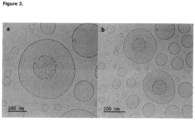
- Example 2 The morphology of the compositions of Example 2 was studied and qualitatively evaluated by cryogenic transmission electron microscopy (cryo-TEM). In the presence of bovine serum albumin ( Figure 2 ), no significant changes were observed in the morphological behavior, in comparison to the corresponding blank nanosystem ( Figure 1a ). Briefly, the characteristic double-compartment nanostructure, with an inner, irregular, perforated porous-like structure being enclosed in an outer vesicle is disclosed again ( Figure 2a ). The vesicles containing irregular structures inside, exhibiting sizes of 200-800 nm and membrane thickness of 3-4 nm, while the population of the empty vesicles had sizes at 10-600 nm and membrane thickness of 3-4 nm ( Figure 2b ).
Landscapes
- Health & Medical Sciences (AREA)
- Chemical & Material Sciences (AREA)
- Veterinary Medicine (AREA)
- General Health & Medical Sciences (AREA)
- Public Health (AREA)
- Engineering & Computer Science (AREA)
- Animal Behavior & Ethology (AREA)
- Life Sciences & Earth Sciences (AREA)
- Medicinal Chemistry (AREA)
- Pharmacology & Pharmacy (AREA)
- Epidemiology (AREA)
- Bioinformatics & Cheminformatics (AREA)
- Optics & Photonics (AREA)
- Nanotechnology (AREA)
- Biomedical Technology (AREA)
- Physics & Mathematics (AREA)
- Chemical Kinetics & Catalysis (AREA)
- General Chemical & Material Sciences (AREA)
- Oil, Petroleum & Natural Gas (AREA)
- Dispersion Chemistry (AREA)
- Medicinal Preparation (AREA)
- Medicines That Contain Protein Lipid Enzymes And Other Medicines (AREA)
- Peptides Or Proteins (AREA)
Claims (9)
- Composition sous forme de nanoparticules cristallines liquides lyotropes comprenant du monooléate de glycérol, un sel d'un acide gras en C6-C12 ou son dérivé avec un substituant aromatique, un copolymère séquencé amphiphile de formule chimique H(OCH2CH2)a(OCH(CH3)CH2)b(OCH2CH2)aOH, dans laquelle 2 ≤ a ≤ 150 et 15 ≤ b ≤ 70, et une macromolécule bioactive comportant des liaisons peptidiques.
- Composition selon la revendication 1, dans laquelle le sel de l'acide gras en C6-C12 est choisi parmi les sels alcalins de l'acide octanoïque, décanoïque ou dodé-canoïque, et son dérivé est choisi parmi les sels alcalins de l'acide 8-((2-hydroxy-benzoyl)amino)octanoïque, de préférence le sel de sodium de l'acide octanoïque et de l'acide 8-((2-hydroxybenzoyl)amino)octanoïque, plus préférablement le sel de sodium de l'acide 8-((2-hydroxybenzoyl)amino)octandique.
- Composition selon l'une quelconque des revendications 1 et 2, dans laquelle le copolymère séquencé amphiphile de formule chimique H(OCH2CH2)a(OCH(CH3)CH2)b(OCH2CH2)aOH, dans laquelle, 2 ≤ a ≤ 150 et 15 ≤ b ≤ 70, est de préférence choisi parmi ceux dans lesquels 60 ≤ a ≤ 150 et 25 ≤ b ≤ 70, plus préférablement, est choisi parmi ceux dans lesquels 95 ≤ a ≤ 105 et 55 ≤ b ≤ 70.
- Composition selon l'une quelconque des revendications 1 à 3, dans laquelle la macromolécule bioactive comportant des liaisons peptidiques est choisie parmi les enzymes, les protéines et les hormones, de préférence parmi le lysozyme, l'albumine sérique bovine, l'insuline, la calcitonine, l'octréotide, le liraglutide, le sémaglutide et le dulaglutide.
- Composition selon l'une quelconque des revendications 1 à 4, dans laquelle la concentration en monooléate de glycérol dans la composition, est de 10 mg/ml à 100 mg/ml, de préférence de 20 mg/ml à 80 mg/ml, plus préférablement est de 20 mg/ml.
- Composition selon l'une quelconque des revendications 1 à 5, dans laquelle le rapport pondéral entre le monooléate de glycérol, le sel d'acide gras en C6-C12 ou son dérivé avec un substituant aromatique et le copolymère séquencé amphiphile, dans la composition finale, est de 20:A:B, dans lequel 1 ≤ A ≤ 10 et 1 ≤ B ≤ 10, de préférence 2 ≤ A ≤ 4 et 3 ≤ B ≤ 7, plus préférablement est de 20:2:5 ou 20:4:5.
- Composition selon l'une quelconque des revendications 1 à 6, dans laquelle la concentration de la macromolécule bioactive comportant des liaisons peptidiques est comprise entre 0,01 mg/ml et 10,0 mg/ml dans la composition finale, de préférence entre 0,1 mg/ml et 5,0 mg/ml dans la composition finale.
- Composition selon l'une quelconque des revendications 1 à 7, dans laquelle le rapport pondéral entre le monooléate de glycérol, le sel d'acide gras en C6-C12 ou son dérivé avec un substituant aromatique, le copolymère séquencé amphiphile et la macromolécule bioactive comportant des liaisons peptidiques, dans la composition finale, est de 20:A:B:C, dans lequel 1 ≤ A ≤ 10, 1 ≤ B ≤ 10 et 0,01 ≤ C ≤ 10, de préférence dans lequel 2 ≤ A ≤ 4, 3 ≤ B ≤ 7 et 0,1 ≤ C ≤ 5, plus préférablement est de 20:2:5:0,5 ou 20:2:5:1 ou 20:4:5:0,5 ou 20:4:5:1.
- Composition selon l'une quelconque des revendications 1 à 8, qui est formulée avec des excipients pharmaceutiquement acceptables pour une administration orale, intranasale, sous-cutanée, intrapéritonéale, intraveineuse ou topique, de préférence pour une administration orale.
Priority Applications (3)
| Application Number | Priority Date | Filing Date | Title |
|---|---|---|---|
| SM20250260T SMT202500260T1 (it) | 2021-08-23 | 2022-07-29 | Nanosistemi cristallini liquidi liotropici con macromolecole bioattive incapsulate |
| RS20250652A RS66968B1 (sr) | 2021-08-23 | 2022-07-29 | Liotropni tečnokristalni nanosistemi sa inkapsuliranim bioaktivnim makromolekulima |
| HRP20250784TT HRP20250784T1 (hr) | 2021-08-23 | 2022-07-29 | Liotropni tekući kristalni nanosustavi s inkapsuliranim bioaktivnim makromolekulima |
Applications Claiming Priority (4)
| Application Number | Priority Date | Filing Date | Title |
|---|---|---|---|
| GR20210100567A GR1010363B (el) | 2021-08-23 | 2021-08-23 | Νανοσωματιδια λυοτροπικων λιπιδικων υγρων κρυσταλλων για χρηση ως συστηματα μεταφορας δραστικων φαρμακευτικων ουσιων |
| GR20220100481A GR1010501B (el) | 2022-06-08 | 2022-06-08 | Νανοσυστηματα βιοδραστικων μακρομοριων σε μορφη νανοδομημενων λυοτροπικων υγρων κρυσταλλων |
| GR20220100584A GR1010458B (el) | 2022-07-21 | 2022-07-21 | Νανοσυστηματα βιοδραστικων μακρομοριων με πεπτιδικους δεσμους σε μορφη νανοδομημενων λυοτροπικων υγρων κρυσταλλων |
| PCT/GR2022/000040 WO2023026067A1 (fr) | 2021-08-23 | 2022-07-29 | Nanosystèmes liquides cristallins lyotropes avec macromolécules bioactives encapsulées |
Publications (3)
| Publication Number | Publication Date |
|---|---|
| EP4392020A1 EP4392020A1 (fr) | 2024-07-03 |
| EP4392020B1 true EP4392020B1 (fr) | 2025-06-04 |
| EP4392020C0 EP4392020C0 (fr) | 2025-06-04 |
Family
ID=83193410
Family Applications (1)
| Application Number | Title | Priority Date | Filing Date |
|---|---|---|---|
| EP22765189.0A Active EP4392020B1 (fr) | 2021-08-23 | 2022-07-29 | Nanosystèmes liquides cristallins lyotropes avec macromolécules bioactives encapsulées |
Country Status (16)
| Country | Link |
|---|---|
| EP (1) | EP4392020B1 (fr) |
| JP (1) | JP2024534784A (fr) |
| KR (1) | KR20240063870A (fr) |
| AU (1) | AU2022334840A1 (fr) |
| CA (1) | CA3226264A1 (fr) |
| ES (1) | ES3034635T3 (fr) |
| HR (1) | HRP20250784T1 (fr) |
| HU (1) | HUE071985T2 (fr) |
| IL (1) | IL310347A (fr) |
| JO (1) | JOP20240038A1 (fr) |
| MX (1) | MX2024002306A (fr) |
| PL (1) | PL4392020T3 (fr) |
| RS (1) | RS66968B1 (fr) |
| SM (1) | SMT202500260T1 (fr) |
| WO (1) | WO2023026067A1 (fr) |
| ZA (1) | ZA202401363B (fr) |
Family Cites Families (2)
| Publication number | Priority date | Publication date | Assignee | Title |
|---|---|---|---|---|
| PL1682091T3 (pl) * | 2003-11-07 | 2017-09-29 | Camurus Ab | Kompozycje lipidów i kationowych peptydów |
| JP5740689B2 (ja) | 2008-08-18 | 2015-06-24 | エンテラ バイオ エルティーディー. | タンパク質の経口投与用の方法および組成物 |
-
2022
- 2022-07-29 RS RS20250652A patent/RS66968B1/sr unknown
- 2022-07-29 AU AU2022334840A patent/AU2022334840A1/en active Pending
- 2022-07-29 ES ES22765189T patent/ES3034635T3/es active Active
- 2022-07-29 WO PCT/GR2022/000040 patent/WO2023026067A1/fr not_active Ceased
- 2022-07-29 MX MX2024002306A patent/MX2024002306A/es unknown
- 2022-07-29 HR HRP20250784TT patent/HRP20250784T1/hr unknown
- 2022-07-29 HU HUE22765189A patent/HUE071985T2/hu unknown
- 2022-07-29 SM SM20250260T patent/SMT202500260T1/it unknown
- 2022-07-29 CA CA3226264A patent/CA3226264A1/fr active Pending
- 2022-07-29 JP JP2024509016A patent/JP2024534784A/ja active Pending
- 2022-07-29 IL IL310347A patent/IL310347A/en unknown
- 2022-07-29 PL PL22765189.0T patent/PL4392020T3/pl unknown
- 2022-07-29 EP EP22765189.0A patent/EP4392020B1/fr active Active
- 2022-07-29 KR KR1020247006324A patent/KR20240063870A/ko active Pending
-
2024
- 2024-02-14 ZA ZA2024/01363A patent/ZA202401363B/en unknown
- 2024-02-22 JO JOJO/P/2024/0038A patent/JOP20240038A1/ar unknown
Also Published As
| Publication number | Publication date |
|---|---|
| HRP20250784T1 (hr) | 2025-09-26 |
| ZA202401363B (en) | 2025-04-30 |
| CA3226264A1 (fr) | 2023-03-02 |
| AU2022334840A1 (en) | 2024-02-08 |
| MX2024002306A (es) | 2024-03-07 |
| JOP20240038A1 (ar) | 2024-02-22 |
| ES3034635T3 (en) | 2025-08-20 |
| IL310347A (en) | 2024-03-01 |
| PL4392020T3 (pl) | 2025-10-13 |
| KR20240063870A (ko) | 2024-05-10 |
| RS66968B1 (sr) | 2025-07-31 |
| SMT202500260T1 (it) | 2025-09-12 |
| EP4392020C0 (fr) | 2025-06-04 |
| EP4392020A1 (fr) | 2024-07-03 |
| WO2023026067A1 (fr) | 2023-03-02 |
| HUE071985T2 (hu) | 2025-10-28 |
| JP2024534784A (ja) | 2024-09-26 |
Similar Documents
| Publication | Publication Date | Title |
|---|---|---|
| Gaballa et al. | Cubosomes: composition, preparation, and drug delivery applications. | |
| JP3487860B2 (ja) | 逆ミセル(l2)構造または正常ミセル(l1)構造を形成する制御放出組成物 | |
| KR100638041B1 (ko) | 수용성 약물의 경구투여용 나노입자 조성물 및 그의제조방법 | |
| Cheow et al. | Factors affecting drug encapsulation and stability of lipid–polymer hybrid nanoparticles | |
| JP3604381B2 (ja) | 微粒子の調製 | |
| US10052289B2 (en) | Composition comprising an active agent with low aqueous solubility | |
| KR101245022B1 (ko) | 약제학적 지질 조성물 | |
| Kaur et al. | Cubosomes as potential nanocarrier for drug delivery: a comprehensive review | |
| JP2010502822A (ja) | ポリマー安定化リポソーム組成物および使用方法 | |
| Mansour et al. | Intranasal versus intraperitoneal Myrj 59-stabilized cubosomes: A potential armamentarium of effective anti-diabetic therapy | |
| Sharma et al. | Cubosome: a potential liquid crystalline carrier system | |
| JP2022103337A (ja) | カルベジロール分散系の非経口徐放送達 | |
| KR20230031188A (ko) | 치료적 폴리엔 마크롤리드의 제약 조성물 및 그의 사용 방법 | |
| Malmsten | Block copolymers in pharmaceutics | |
| EP4392020B1 (fr) | Nanosystèmes liquides cristallins lyotropes avec macromolécules bioactives encapsulées | |
| EP1658842A1 (fr) | Nanoparticules de derives polyoxyethylenes | |
| OA21631A (en) | Lyotropic liquid crystalline nanosystems with encapsulated bioactive macromolecules. | |
| CN117835969A (zh) | 具有经封装的生物活性大分子的溶致液晶纳米系统 | |
| EA050595B1 (ru) | Лиотропные жидкокристаллические наносистемы, содержащие капсулированные биологически активные макромолекулы | |
| GR1010501B (el) | Νανοσυστηματα βιοδραστικων μακρομοριων σε μορφη νανοδομημενων λυοτροπικων υγρων κρυσταλλων | |
| Kumari et al. | Formulation Considerations and Application of Nanostructured Lipid Carriers (NLC) for Ocular Delivery. | |
| Jeong et al. | Formulation issues around lipid-based oral and parenteral delivery systems | |
| CN113694027B (zh) | 聚合物囊泡及其制备方法、载药囊泡 | |
| Vu et al. | Incorporation of nanomaterials into delivery systems of antioxidants: A review | |
| Bhatti et al. | Therapeutic Valuation and Challenges of Lipid Nanocarriers in Oral Drug Delivery System |
Legal Events
| Date | Code | Title | Description |
|---|---|---|---|
| REG | Reference to a national code |
Ref country code: HR Ref legal event code: TUEP Ref document number: P20250784T Country of ref document: HR |
|
| STAA | Information on the status of an ep patent application or granted ep patent |
Free format text: STATUS: UNKNOWN |
|
| STAA | Information on the status of an ep patent application or granted ep patent |
Free format text: STATUS: THE INTERNATIONAL PUBLICATION HAS BEEN MADE |
|
| PUAI | Public reference made under article 153(3) epc to a published international application that has entered the european phase |
Free format text: ORIGINAL CODE: 0009012 |
|
| STAA | Information on the status of an ep patent application or granted ep patent |
Free format text: STATUS: REQUEST FOR EXAMINATION WAS MADE |
|
| 17P | Request for examination filed |
Effective date: 20240221 |
|
| AK | Designated contracting states |
Kind code of ref document: A1 Designated state(s): AL AT BE BG CH CY CZ DE DK EE ES FI FR GB GR HR HU IE IS IT LI LT LU LV MC MK MT NL NO PL PT RO RS SE SI SK SM TR |
|
| GRAP | Despatch of communication of intention to grant a patent |
Free format text: ORIGINAL CODE: EPIDOSNIGR1 |
|
| STAA | Information on the status of an ep patent application or granted ep patent |
Free format text: STATUS: GRANT OF PATENT IS INTENDED |
|
| INTG | Intention to grant announced |
Effective date: 20250102 |
|
| RAP3 | Party data changed (applicant data changed or rights of an application transferred) |
Owner name: UNI-PHARMA KLEON TSETIS PHARMACEUTICALLABORATORIES S.A. |
|
| GRAS | Grant fee paid |
Free format text: ORIGINAL CODE: EPIDOSNIGR3 |
|
| GRAA | (expected) grant |
Free format text: ORIGINAL CODE: 0009210 |
|
| STAA | Information on the status of an ep patent application or granted ep patent |
Free format text: STATUS: THE PATENT HAS BEEN GRANTED |
|
| AK | Designated contracting states |
Kind code of ref document: B1 Designated state(s): AL AT BE BG CH CY CZ DE DK EE ES FI FR GB GR HR HU IE IS IT LI LT LU LV MC MK MT NL NO PL PT RO RS SE SI SK SM TR |
|
| REG | Reference to a national code |
Ref country code: GB Ref legal event code: FG4D |
|
| REG | Reference to a national code |
Ref country code: CH Ref legal event code: EP |
|
| REG | Reference to a national code |
Ref country code: DE Ref legal event code: R096 Ref document number: 602022015602 Country of ref document: DE |
|
| REG | Reference to a national code |
Ref country code: IE Ref legal event code: FG4D |
|
| U01 | Request for unitary effect filed |
Effective date: 20250626 |
|
| U07 | Unitary effect registered |
Designated state(s): AT BE BG DE DK EE FI FR IT LT LU LV MT NL PT RO SE SI Effective date: 20250703 |
|
| REG | Reference to a national code |
Ref country code: HR Ref legal event code: ODRP Ref document number: P20250784T Country of ref document: HR Payment date: 20250728 Year of fee payment: 4 |
|
| REG | Reference to a national code |
Ref country code: ES Ref legal event code: FG2A Ref document number: 3034635 Country of ref document: ES Kind code of ref document: T3 Effective date: 20250820 |
|
| REG | Reference to a national code |
Ref country code: GR Ref legal event code: EP Ref document number: 20250401477 Country of ref document: GR Effective date: 20250808 Ref country code: SK Ref legal event code: T3 Ref document number: E 46689 Country of ref document: SK |
|
| REG | Reference to a national code |
Ref country code: HR Ref legal event code: T1PR Ref document number: P20250784 Country of ref document: HR |
|
| U20 | Renewal fee for the european patent with unitary effect paid |
Year of fee payment: 4 Effective date: 20250828 |
|
| PGFP | Annual fee paid to national office [announced via postgrant information from national office to epo] |
Ref country code: SM Payment date: 20250725 Year of fee payment: 4 |
|
| PGFP | Annual fee paid to national office [announced via postgrant information from national office to epo] |
Ref country code: ES Payment date: 20250829 Year of fee payment: 4 |
|
| PGFP | Annual fee paid to national office [announced via postgrant information from national office to epo] |
Ref country code: MC Payment date: 20250731 Year of fee payment: 4 Ref country code: NO Payment date: 20250825 Year of fee payment: 4 Ref country code: GR Payment date: 20250730 Year of fee payment: 4 |
|
| PGFP | Annual fee paid to national office [announced via postgrant information from national office to epo] |
Ref country code: TR Payment date: 20250901 Year of fee payment: 4 |
|
| PGFP | Annual fee paid to national office [announced via postgrant information from national office to epo] |
Ref country code: HU Payment date: 20250903 Year of fee payment: 4 |
|
| PGFP | Annual fee paid to national office [announced via postgrant information from national office to epo] |
Ref country code: HR Payment date: 20250728 Year of fee payment: 4 |
|
| PGFP | Annual fee paid to national office [announced via postgrant information from national office to epo] |
Ref country code: AL Payment date: 20250724 Year of fee payment: 4 |
|
| PGFP | Annual fee paid to national office [announced via postgrant information from national office to epo] |
Ref country code: CH Payment date: 20250828 Year of fee payment: 4 |
|
| PGFP | Annual fee paid to national office [announced via postgrant information from national office to epo] |
Ref country code: IE Payment date: 20250724 Year of fee payment: 4 Ref country code: CZ Payment date: 20250722 Year of fee payment: 4 Ref country code: RS Payment date: 20250729 Year of fee payment: 4 |
|
| PGFP | Annual fee paid to national office [announced via postgrant information from national office to epo] |
Ref country code: SK Payment date: 20250625 Year of fee payment: 4 |
|
| PGFP | Annual fee paid to national office [announced via postgrant information from national office to epo] |
Ref country code: IS Payment date: 20250821 Year of fee payment: 4 |
|
| REG | Reference to a national code |
Ref country code: HU Ref legal event code: AG4A Ref document number: E071985 Country of ref document: HU |
|
| PGFP | Annual fee paid to national office [announced via postgrant information from national office to epo] |
Ref country code: MK Payment date: 20250725 Year of fee payment: 4 |
|
| VS25 | Lapsed in a validation state [announced via postgrant information from nat. office to epo] |
Ref country code: MD Free format text: LAPSE BECAUSE OF FAILURE TO SUBMIT A TRANSLATION OF THE DESCRIPTION OR TO PAY THE FEE WITHIN THE PRESCRIBED TIME-LIMIT Effective date: 20250604 |
|
| PGFP | Annual fee paid to national office [announced via postgrant information from national office to epo] |
Ref country code: CY Payment date: 20250724 Year of fee payment: 4 |
|
| VS25 | Lapsed in a validation state [announced via postgrant information from nat. office to epo] |
Ref country code: MA Free format text: FAILURE TO ELECT DOMICILE IN THE NATIONAL COUNTRY Effective date: 20250905 |
|
| VS25 | Lapsed in a validation state [announced via postgrant information from nat. office to epo] |
Ref country code: MA Free format text: LAPSE BECAUSE OF FAILURE TO SUBMIT A TRANSLATION OF THE DESCRIPTION OR TO PAY THE FEE WITHIN THE PRESCRIBED TIME-LIMIT Effective date: 20250604 |
|
| PLBE | No opposition filed within time limit |
Free format text: ORIGINAL CODE: 0009261 |
|
| STAA | Information on the status of an ep patent application or granted ep patent |
Free format text: STATUS: NO OPPOSITION FILED WITHIN TIME LIMIT |
|
| REG | Reference to a national code |
Ref country code: CH Ref legal event code: L10 Free format text: ST27 STATUS EVENT CODE: U-0-0-L10-L00 (AS PROVIDED BY THE NATIONAL OFFICE) Effective date: 20260416 |
|
| PGFP | Annual fee paid to national office [announced via postgrant information from national office to epo] |
Ref country code: PL Payment date: 20250725 Year of fee payment: 4 |