EP4394059A1 - Composant mécanique et palier à roulement - Google Patents
Composant mécanique et palier à roulement Download PDFInfo
- Publication number
- EP4394059A1 EP4394059A1 EP22872921.6A EP22872921A EP4394059A1 EP 4394059 A1 EP4394059 A1 EP 4394059A1 EP 22872921 A EP22872921 A EP 22872921A EP 4394059 A1 EP4394059 A1 EP 4394059A1
- Authority
- EP
- European Patent Office
- Prior art keywords
- steel
- equal
- mass percent
- mechanical component
- less
- Prior art date
- Legal status (The legal status is an assumption and is not a legal conclusion. Google has not performed a legal analysis and makes no representation as to the accuracy of the status listed.)
- Pending
Links
Images





Classifications
-
- C—CHEMISTRY; METALLURGY
- C22—METALLURGY; FERROUS OR NON-FERROUS ALLOYS; TREATMENT OF ALLOYS OR NON-FERROUS METALS
- C22C—ALLOYS
- C22C38/00—Ferrous alloys, e.g. steel alloys
- C22C38/18—Ferrous alloys, e.g. steel alloys containing chromium
- C22C38/22—Ferrous alloys, e.g. steel alloys containing chromium with molybdenum or tungsten
-
- F—MECHANICAL ENGINEERING; LIGHTING; HEATING; WEAPONS; BLASTING
- F16—ENGINEERING ELEMENTS AND UNITS; GENERAL MEASURES FOR PRODUCING AND MAINTAINING EFFECTIVE FUNCTIONING OF MACHINES OR INSTALLATIONS; THERMAL INSULATION IN GENERAL
- F16C—SHAFTS; FLEXIBLE SHAFTS; ELEMENTS OR CRANKSHAFT MECHANISMS; ROTARY BODIES OTHER THAN GEARING ELEMENTS; BEARINGS
- F16C33/00—Parts of bearings; Special methods for making bearings or parts thereof
- F16C33/30—Parts of ball or roller bearings
- F16C33/58—Raceways; Race rings
- F16C33/64—Special methods of manufacture
-
- C—CHEMISTRY; METALLURGY
- C21—METALLURGY OF IRON
- C21D—MODIFYING THE PHYSICAL STRUCTURE OF FERROUS METALS; GENERAL DEVICES FOR HEAT TREATMENT OF FERROUS OR NON-FERROUS METALS OR ALLOYS; MAKING METAL MALLEABLE, e.g. BY DECARBURISATION OR TEMPERING
- C21D1/00—General methods or devices for heat treatment, e.g. annealing, hardening, quenching or tempering
- C21D1/06—Surface hardening
-
- C—CHEMISTRY; METALLURGY
- C21—METALLURGY OF IRON
- C21D—MODIFYING THE PHYSICAL STRUCTURE OF FERROUS METALS; GENERAL DEVICES FOR HEAT TREATMENT OF FERROUS OR NON-FERROUS METALS OR ALLOYS; MAKING METAL MALLEABLE, e.g. BY DECARBURISATION OR TEMPERING
- C21D1/00—General methods or devices for heat treatment, e.g. annealing, hardening, quenching or tempering
- C21D1/18—Hardening; Quenching with or without subsequent tempering
-
- C—CHEMISTRY; METALLURGY
- C21—METALLURGY OF IRON
- C21D—MODIFYING THE PHYSICAL STRUCTURE OF FERROUS METALS; GENERAL DEVICES FOR HEAT TREATMENT OF FERROUS OR NON-FERROUS METALS OR ALLOYS; MAKING METAL MALLEABLE, e.g. BY DECARBURISATION OR TEMPERING
- C21D9/00—Heat treatment, e.g. annealing, hardening, quenching or tempering, adapted for particular articles; Furnaces therefor
- C21D9/32—Heat treatment, e.g. annealing, hardening, quenching or tempering, adapted for particular articles; Furnaces therefor for gear wheels, worm wheels, or the like
-
- C—CHEMISTRY; METALLURGY
- C21—METALLURGY OF IRON
- C21D—MODIFYING THE PHYSICAL STRUCTURE OF FERROUS METALS; GENERAL DEVICES FOR HEAT TREATMENT OF FERROUS OR NON-FERROUS METALS OR ALLOYS; MAKING METAL MALLEABLE, e.g. BY DECARBURISATION OR TEMPERING
- C21D9/00—Heat treatment, e.g. annealing, hardening, quenching or tempering, adapted for particular articles; Furnaces therefor
- C21D9/40—Heat treatment, e.g. annealing, hardening, quenching or tempering, adapted for particular articles; Furnaces therefor for rings; for bearing races
-
- C—CHEMISTRY; METALLURGY
- C22—METALLURGY; FERROUS OR NON-FERROUS ALLOYS; TREATMENT OF ALLOYS OR NON-FERROUS METALS
- C22C—ALLOYS
- C22C38/00—Ferrous alloys, e.g. steel alloys
- C22C38/02—Ferrous alloys, e.g. steel alloys containing silicon
-
- C—CHEMISTRY; METALLURGY
- C22—METALLURGY; FERROUS OR NON-FERROUS ALLOYS; TREATMENT OF ALLOYS OR NON-FERROUS METALS
- C22C—ALLOYS
- C22C38/00—Ferrous alloys, e.g. steel alloys
- C22C38/18—Ferrous alloys, e.g. steel alloys containing chromium
-
- C—CHEMISTRY; METALLURGY
- C23—COATING METALLIC MATERIAL; COATING MATERIAL WITH METALLIC MATERIAL; CHEMICAL SURFACE TREATMENT; DIFFUSION TREATMENT OF METALLIC MATERIAL; COATING BY VACUUM EVAPORATION, BY SPUTTERING, BY ION IMPLANTATION OR BY CHEMICAL VAPOUR DEPOSITION, IN GENERAL; INHIBITING CORROSION OF METALLIC MATERIAL OR INCRUSTATION IN GENERAL
- C23C—COATING METALLIC MATERIAL; COATING MATERIAL WITH METALLIC MATERIAL; SURFACE TREATMENT OF METALLIC MATERIAL BY DIFFUSION INTO THE SURFACE, BY CHEMICAL CONVERSION OR SUBSTITUTION; COATING BY VACUUM EVAPORATION, BY SPUTTERING, BY ION IMPLANTATION OR BY CHEMICAL VAPOUR DEPOSITION, IN GENERAL
- C23C8/00—Solid state diffusion of only non-metal elements into metallic material surfaces; Chemical surface treatment of metallic material by reaction of the surface with a reactive gas, leaving reaction products of surface material in the coating, e.g. conversion coatings, passivation of metals
- C23C8/06—Solid state diffusion of only non-metal elements into metallic material surfaces; Chemical surface treatment of metallic material by reaction of the surface with a reactive gas, leaving reaction products of surface material in the coating, e.g. conversion coatings, passivation of metals using gases
- C23C8/08—Solid state diffusion of only non-metal elements into metallic material surfaces; Chemical surface treatment of metallic material by reaction of the surface with a reactive gas, leaving reaction products of surface material in the coating, e.g. conversion coatings, passivation of metals using gases only one element being applied
- C23C8/24—Nitriding
- C23C8/26—Nitriding of ferrous surfaces
-
- C—CHEMISTRY; METALLURGY
- C23—COATING METALLIC MATERIAL; COATING MATERIAL WITH METALLIC MATERIAL; CHEMICAL SURFACE TREATMENT; DIFFUSION TREATMENT OF METALLIC MATERIAL; COATING BY VACUUM EVAPORATION, BY SPUTTERING, BY ION IMPLANTATION OR BY CHEMICAL VAPOUR DEPOSITION, IN GENERAL; INHIBITING CORROSION OF METALLIC MATERIAL OR INCRUSTATION IN GENERAL
- C23C—COATING METALLIC MATERIAL; COATING MATERIAL WITH METALLIC MATERIAL; SURFACE TREATMENT OF METALLIC MATERIAL BY DIFFUSION INTO THE SURFACE, BY CHEMICAL CONVERSION OR SUBSTITUTION; COATING BY VACUUM EVAPORATION, BY SPUTTERING, BY ION IMPLANTATION OR BY CHEMICAL VAPOUR DEPOSITION, IN GENERAL
- C23C8/00—Solid state diffusion of only non-metal elements into metallic material surfaces; Chemical surface treatment of metallic material by reaction of the surface with a reactive gas, leaving reaction products of surface material in the coating, e.g. conversion coatings, passivation of metals
- C23C8/06—Solid state diffusion of only non-metal elements into metallic material surfaces; Chemical surface treatment of metallic material by reaction of the surface with a reactive gas, leaving reaction products of surface material in the coating, e.g. conversion coatings, passivation of metals using gases
- C23C8/28—Solid state diffusion of only non-metal elements into metallic material surfaces; Chemical surface treatment of metallic material by reaction of the surface with a reactive gas, leaving reaction products of surface material in the coating, e.g. conversion coatings, passivation of metals using gases more than one element being applied in one step
- C23C8/30—Carbo-nitriding
- C23C8/32—Carbo-nitriding of ferrous surfaces
-
- C—CHEMISTRY; METALLURGY
- C23—COATING METALLIC MATERIAL; COATING MATERIAL WITH METALLIC MATERIAL; CHEMICAL SURFACE TREATMENT; DIFFUSION TREATMENT OF METALLIC MATERIAL; COATING BY VACUUM EVAPORATION, BY SPUTTERING, BY ION IMPLANTATION OR BY CHEMICAL VAPOUR DEPOSITION, IN GENERAL; INHIBITING CORROSION OF METALLIC MATERIAL OR INCRUSTATION IN GENERAL
- C23C—COATING METALLIC MATERIAL; COATING MATERIAL WITH METALLIC MATERIAL; SURFACE TREATMENT OF METALLIC MATERIAL BY DIFFUSION INTO THE SURFACE, BY CHEMICAL CONVERSION OR SUBSTITUTION; COATING BY VACUUM EVAPORATION, BY SPUTTERING, BY ION IMPLANTATION OR BY CHEMICAL VAPOUR DEPOSITION, IN GENERAL
- C23C8/00—Solid state diffusion of only non-metal elements into metallic material surfaces; Chemical surface treatment of metallic material by reaction of the surface with a reactive gas, leaving reaction products of surface material in the coating, e.g. conversion coatings, passivation of metals
- C23C8/80—After-treatment
-
- F—MECHANICAL ENGINEERING; LIGHTING; HEATING; WEAPONS; BLASTING
- F16—ENGINEERING ELEMENTS AND UNITS; GENERAL MEASURES FOR PRODUCING AND MAINTAINING EFFECTIVE FUNCTIONING OF MACHINES OR INSTALLATIONS; THERMAL INSULATION IN GENERAL
- F16C—SHAFTS; FLEXIBLE SHAFTS; ELEMENTS OR CRANKSHAFT MECHANISMS; ROTARY BODIES OTHER THAN GEARING ELEMENTS; BEARINGS
- F16C33/00—Parts of bearings; Special methods for making bearings or parts thereof
- F16C33/30—Parts of ball or roller bearings
- F16C33/32—Balls
-
- F—MECHANICAL ENGINEERING; LIGHTING; HEATING; WEAPONS; BLASTING
- F16—ENGINEERING ELEMENTS AND UNITS; GENERAL MEASURES FOR PRODUCING AND MAINTAINING EFFECTIVE FUNCTIONING OF MACHINES OR INSTALLATIONS; THERMAL INSULATION IN GENERAL
- F16C—SHAFTS; FLEXIBLE SHAFTS; ELEMENTS OR CRANKSHAFT MECHANISMS; ROTARY BODIES OTHER THAN GEARING ELEMENTS; BEARINGS
- F16C33/00—Parts of bearings; Special methods for making bearings or parts thereof
- F16C33/30—Parts of ball or roller bearings
- F16C33/58—Raceways; Race rings
- F16C33/62—Selection of substances
-
- C—CHEMISTRY; METALLURGY
- C21—METALLURGY OF IRON
- C21D—MODIFYING THE PHYSICAL STRUCTURE OF FERROUS METALS; GENERAL DEVICES FOR HEAT TREATMENT OF FERROUS OR NON-FERROUS METALS OR ALLOYS; MAKING METAL MALLEABLE, e.g. BY DECARBURISATION OR TEMPERING
- C21D2211/00—Microstructure comprising significant phases
- C21D2211/001—Austenite
Definitions
- the present invention relates to a mechanical component and a rolling bearing. Specifically, the present invention relates to a mechanical component including a quenched and tempered steel and relates to a rolling bearing including the mechanical component.
- Electric vehicle BEV
- PHEV plug-in hybrid electric vehicle
- HEV hybrid electric vehicle
- e-Axle an electric axle (e-Axle) in place of an engine, an electric brake, an electric variable valve mechanism (VTC), an electric compressor, and the like have been applied.
- VTC electric variable valve mechanism
- an electric vehicle in order to extend a travel distance with a small amount of electric power (improve electric power efficiency), it is desired to reduce the weight of the electric vehicle and to increase the speed and output of a motor in accordance with miniaturization of a unit. Accordingly, various components are required to be miniaturized, rotated at a high speed, and increased in strength. For example, as highspeed rotation or miniaturization of the motor progresses, the amount of heat generated in the rolling bearing increases, and the temperature of the rolling bearing during use increases. In addition, there is a high possibility that the viscosity of a lubricating oil is reduced or the amount of oil or grease is reduced in order to reduce the torque of the rolling bearing or the like, and then the amount of heat generated in the rolling bearing further increases. Therefore, a rolling bearing used in an electric vehicle is required to maintain dimensional stability and high hardness at high temperature.
- the structure of a constituent material of a quenched and temped rolling bearing includes precipitates such as martensite, residual austenite, undissolved carbides, and nitrides.
- An appropriate amount of residual austenite is effective for improving a clean oil rolling fatigue life and an indentation-induced rolling fatigue life.
- the present invention has been made in view of the above problem of the related art. Specifically, the present invention provides a mechanical component and a rolling bearing capable of suppressing a temporal change in dimension and improving a rolling fatigue life induced by an indentation on a surface.
- a mechanical component according to a first aspect of the present invention includes a steel and has a surface.
- the steel is quenched and tempered.
- the mechanical component includes a nitrided layer on the surface and a core farther away from the surface than the nitrided layer.
- a nitrogen concentration in the steel on the surface is greater than or equal to 0.01 mass percent.
- a hardness of the steel on the surface is greater than or equal to 820 Hv.
- An amount of residual austenite in the steel in the core is greater than or equal to 0.1 volume percent and less than or equal to 9 volume percent.
- a dislocation density of the residual austenite in the steel in the core is greater than or equal to 4.0 ⁇ 10 14 m -2 .
- the steel is high carbon steel or bearing steel.
- a dimensional change rate after retaining at 160°C for 2500 hours may be less than or equal to 40 ⁇ 10 -5 .
- a dimensional change rate after retaining at 160°C for 2500 hours may be less than or equal to 15 ⁇ 10 -5 .
- the dimensional change rate is a value obtained by dividing a value obtained by subtracting a dimension of the mechanical component before the retaining from a dimension of the mechanical component after the retaining (a difference in dimension of the mechanical component before and after the retaining) by the dimension of the mechanical component before the retaining.
- a rolling bearing of the present invention includes an inner ring, an outer ring, and a rolling element. At least one of the inner ring, the outer ring, or the rolling element is the mechanical component described above.
- the high carbon steel include SK85 specified in JIS standards.
- Specific examples of the bearing steel include SUJ2, SUJ3, SUJ4, and SUJ5 specified in JIS standards, 50100, 51100, 52100, and A485 Grade1 specified in ASTM standards, 100Cr6, 100CrMnSi4-4, 100CrMnSi6-4, 100CrMo7, 100CrMo7-3, and 100 CrMnMoSi8-4-6 specified in ISO standards, 105Cr4 specified in DIN standards, and GCr4, GCr15, GCr15SiMn, GCrSiMo, and GCr18 Mo specified in GB/T.
- the hardness of the steel on the surface of inner ring 10 is greater than or equal to 820 Hv.
- the hardness of the steel on the surface of inner ring 10 is measured by a Vickers hardness test method defined in JIS standard (JIS Z 2244: 2009).
- the load in measuring the hardness of the steel on the surface of inner ring 10 is 300 g.
- the hardness of the steel on the surface of inner ring 10 is obtained by measuring at least three points or more and averaging the obtained measured values.
- a dislocation density of the residual austenite in the steel in core 12 is greater than or equal to 4.0 ⁇ 10 14 m -2 .
- a dislocation density of martensite in the steel in core 12 is preferably greater than or equal to 6.0 ⁇ 10 14 m -2 .
- the dislocation density of the residual austenite in the steel in core 12 is greater than or equal to 1.0 ⁇ 10 15 m -2 .
- a dimensional change rate of inner ring 10 after retaining at 160°C for 2500 hours is less than or equal to 40 ⁇ 10 -5 .
- the dimensional change rate of inner ring 10 after retaining at 160°C for 2500 hours is preferably less than or equal to 15 ⁇ 10 -5 .
- the dimensional change rate of inner ring 10 is calculated by dividing a value obtained by subtracting the dimension of inner ring 10 before the retaining from the dimension of inner ring 10 after the retaining by the dimension of inner ring 10 before the retaining.
- Fig. 3 is a step chart illustrating the method of manufacturing inner ring 10.
- the method of manufacturing inner ring 10 includes a preparation step S1, a nitriding step S2, a quenching step S3, a cooling step S4, a tempering step S5, and a post-treatment step S6.
- a processing target member 20 is prepared.
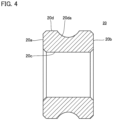
- Fig. 4 is a sectional view of processing target member 20.
- processing target member 20 has a ring shape and has a first end surface 20a, a second end surface 20b, an inner peripheral surface 20c, and an outer peripheral surface 20d.
- First end surface 20a, second end surface 20b, inner peripheral surface 20c, and outer peripheral surface 20d are surfaces to be first end surface 10a, second end surface 10b, inner peripheral surface 10c, and outer peripheral surface 10d, respectively, after an end of post-treatment step S6.
- Processing target member 20 includes the same steel as inner ring 10.
- nitriding step S2 processing target member 20 is subjected to nitriding treatment.
- the nitriding treatment for processing target member 20 is performed by heating and retaining processing target member 20 in an atmosphere gas containing a nitrogen source.
- the heating temperature and the nitrogen concentration in the atmosphere gas in nitriding step S2 are set so that a compound layer is not formed on the surface of processing target member 20.
- nitrogen enters inside from the surface of processing target member 20, and the nitrogen forms solid solution in processing target member 20.
- Nitriding step S2 is performed such that nitrogen reaches inside of a position to be the surface of inner ring 10 after post-treatment step S6 is performed.
- a nitrocarburizing step may be performed on processing target member 20.
- the nitrocarburizing treatment on processing target member 20 is performed by heating and retaining the processing target member with a nitrogen source and a carbon source in an atmosphere gas.
- the heating temperature and the carbon concentration and the nitrogen concentration in the atmosphere gas in the nitrocarburizing step are set so that a compound layer is not formed on the surface of processing target member 20.
- carbon and nitrogen enter inside from the surface of processing target member 20, and the carbon and nitrogen form solid solution in processing target member 20.
- the nitrocarburizing step is performed such that nitrogen and carbon reach inside of a position to be the surface of inner ring 10 after post-treatment step S6 is performed.
- quenching step S3 processing target member 20 is quenched.
- Processing target member 20 is quenched by heating and retaining processing target member 20 to a temperature higher than or equal to an A 1 transformation point of the steel constituting processing target member 20, and then cooling processing target member 20 to a temperature lower than or equal to an Ms transformation point of the steel constituting the member to be processed.
- martensite and residual austenite are generated in the steel constituting processing target member 20.
- quenching step S3 may be repeated by heating processing target member 20 to higher than or equal to A 1 transformation point.
- cooling step S4 processing target member 20 is subjected to a sub-zero treatment.
- cryo treatment (super sub-zero treatment) may be performed on processing target member 20.
- processing target member 20 is cooled to a temperature higher than -100°C and lower than or equal to room temperature.
- processing target member 20 is cooled to a temperature lower than or equal to -100°C.
- the amount of residual austenite in the steel in core 12 is reduced by performing the sub-zero treatment or the cryo treatment. Specifically, in inner ring 10, when the steel constituting inner ring 10 is high carbon steel or bearing steel, the amount of residual austenite in the steel in core 12 is less than or equal to 9 volume percent, and when the steel constituting inner ring 10 is low carbon steel or carburized steel, the amount of residual austenite in the steel in core 12 is less than or equal to 5 volume percent.
- inner ring 10 is not tempered at high temperature, the decomposition of martensite on the surface of inner ring 10 progresses slightly.
- the nitrogen concentration in the steel on the surface of inner ring 10 is greater than or equal to 0.01 mass percent, and the steel on the surface of inner ring 10 is strengthened by solid solution.
- the hardness of the steel on the surface of inner ring 10 is greater than or equal to 820 Hv.
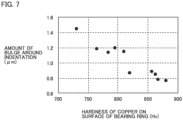
- the amount of bulge around the indentation sharply decreases.
- the rolling fatigue life starting from the indentation is also improved.
- indentation is less likely to be formed on the surface of inner ring 10, and thus, a static load capacity of the rolling bearing using inner ring 10 is improved.
- High residual compressive stress may be applied to the surface of the rolling element by a pressurization step, and indentation is less likely to be formed than on the surface of the bearing ring (inner ring, outer ring). Therefore, when only the bearing ring is used as the mechanical component according to the embodiment, an indentation-induced rolling fatigue life of the rolling bearing is also improved.
- the dislocation density of martensite in the steel in core 12 of each sample and the amount of residual austenite of the martensite in the steel in core 12 of each sample were adjusted by changing the cooling temperature and the retaining time in the sub-zero treatment or the cryo treatment.
- condition C is satisfied if the dislocation density of martensite in the steel in core 12 of the sample is greater than or equal to 6.0 ⁇ 10 14 m -2 .
- condition C is satisfied, and the dimensional change rate after retaining at 160°C for 2500 hours was less than or equal to 15 ⁇ 10 -5 .
- condition C was not satisfied, and the dimensional change rate after retaining at 160°C for 2500 hours exceeded 15 ⁇ 10 -5 .
- the steel constituting inner ring 10 according to the modification is high carbon steel or bearing steel.
- the steel constituting inner ring 10 according to the modification preferably contains less than 0.77 mass percent of carbon, less than or equal to 4.0 mass percent of chromium, greater than or equal to 0.10 mass percent and less than or equal to 0.70 mass percent of silicon, and less than or equal to 0.25 mass percent of molybdenum.
- inner ring 10 according to the modification preferably satisfies the relationship of 934893.48 + 379.96 ⁇ X - 330.96 ⁇ Y 2 - 5.41 ⁇ 10 4 ⁇ logY + 783.83 ⁇ logX 2 ⁇ 0 (Formula 3).
- a method of manufacturing inner ring 10 according to the modification is similar to the method of manufacturing inner ring 10, and will not be described here.
- An effect of inner ring 10 according to the modification is similar to the effect of inner ring 10, and will not be described here.
- Fig. 6 illustrates the relationship between the hardness of steel on the surface of inner ring 10 according to the modification and the bulge around the indentation.
- Samples 20 to 38 were prepared in order to evaluate a relationship between the hardness, the dislocation density of martensite, and the nitrogen concentration on the surface of a mechanical component including steel having been quenched and temped. Samples 20 to 38 have a ring shape with an inner diameter of 54 mm, an outer diameter of 60 mm, and a width of 15 mm. In samples 20 to 38, a steel type, the nitrogen concentration in the steel at the surface of the sample, and the dislocation density of the martensite of the steel at the surface of the sample were changed as shown in Table 3. "OK” and "NG” described in the column of "satisfaction of Formula 3" in Table 3 mean that Formula 3 shown above is satisfied and Formula 3 is not satisfied, respectively.
- Condition D is that the dislocation density of residual austenite in the steel in core 12 of the sample is greater than or equal to 4.0 ⁇ 10 14 m -2 .
- Condition E is that the amount of residual austenite in the steel in core 12 of the sample is less than or equal to 9 volume percent.
- condition D and condition E were satisfied. On the other hand, in sample 31, condition D and condition E were not satisfied. In samples 22 and 28, the dimensional change rate after retaining at 160°C for 2500 hours was less than or equal to 40 ⁇ 10 -5 . On the other hand, in sample 31, the dimensional change rate after retaining at 160°C for 2500 hours exceeded 50 ⁇ 10 -5 . This comparison has made it clear that the dimensional change of the mechanical component is suppressed by satisfying condition D and condition E.
- Condition F is that the dislocation density of residual austenite in the steel in core 12 of the sample is greater than or equal to 6.0 ⁇ 10 14 m -2 .
- condition F was satisfied, and the dimensional change rate after retaining at 160°C for 2500 hours was less than or equal to 15 ⁇ 10 -5 .
- condition F was not satisfied, and the dimensional change rate after retaining at 160°C for 2500 hours exceeded 15 ⁇ 10 -5 . This comparison has made it clear that the dimensional change of the mechanical component is further suppressed by satisfying condition F.
Landscapes
- Chemical & Material Sciences (AREA)
- Engineering & Computer Science (AREA)
- Mechanical Engineering (AREA)
- Organic Chemistry (AREA)
- Materials Engineering (AREA)
- Metallurgy (AREA)
- General Engineering & Computer Science (AREA)
- Physics & Mathematics (AREA)
- Thermal Sciences (AREA)
- Crystallography & Structural Chemistry (AREA)
- Chemical Kinetics & Catalysis (AREA)
- Manufacturing & Machinery (AREA)
- Rolling Contact Bearings (AREA)
Applications Claiming Priority (4)
| Application Number | Priority Date | Filing Date | Title |
|---|---|---|---|
| JP2021156803A JP2023047716A (ja) | 2021-09-27 | 2021-09-27 | 機械部品 |
| JP2021156802 | 2021-09-27 | ||
| JP2022146401A JP7428768B2 (ja) | 2021-09-27 | 2022-09-14 | 機械部品及び転がり軸受 |
| PCT/JP2022/035125 WO2023048169A1 (fr) | 2021-09-27 | 2022-09-21 | Composant mécanique et palier à roulement |
Publications (2)
| Publication Number | Publication Date |
|---|---|
| EP4394059A1 true EP4394059A1 (fr) | 2024-07-03 |
| EP4394059A4 EP4394059A4 (fr) | 2024-12-18 |
Family
ID=85720720
Family Applications (1)
| Application Number | Title | Priority Date | Filing Date |
|---|---|---|---|
| EP22872921.6A Pending EP4394059A4 (fr) | 2021-09-27 | 2022-09-21 | Composant mécanique et palier à roulement |
Country Status (3)
| Country | Link |
|---|---|
| US (1) | US20240410039A1 (fr) |
| EP (1) | EP4394059A4 (fr) |
| WO (1) | WO2023048169A1 (fr) |
Cited By (2)
| Publication number | Priority date | Publication date | Assignee | Title |
|---|---|---|---|---|
| EP4502215A4 (fr) * | 2022-03-29 | 2025-08-20 | Ntn Toyo Bearing Co Ltd | Composant de machine |
| EP4600520A4 (fr) * | 2022-10-04 | 2026-01-07 | Ntn Toyo Bearing Co Ltd | Composant mécanique, palier à roulement et vis à billes |
Family Cites Families (6)
| Publication number | Priority date | Publication date | Assignee | Title |
|---|---|---|---|---|
| JP2001099163A (ja) | 1999-09-30 | 2001-04-10 | Nsk Ltd | 転がり軸受 |
| JP2004232858A (ja) * | 2003-01-08 | 2004-08-19 | Ntn Corp | ころがり軸受およびその製造方法 |
| JP2004339575A (ja) * | 2003-05-16 | 2004-12-02 | Nsk Ltd | 転動装置部品の製造方法 |
| JP2006322017A (ja) * | 2005-05-17 | 2006-11-30 | Nsk Ltd | 転がり軸受 |
| JP6725235B2 (ja) * | 2015-11-10 | 2020-07-15 | 株式会社ジェイテクト | 転がり摺動部材及びその製造方法並びに転がり軸受 |
| US20190101029A1 (en) * | 2017-09-27 | 2019-04-04 | Roller Bearing Company Of America, Inc. | Roller hydraulic valve lifter bearing |
-
2022
- 2022-09-21 EP EP22872921.6A patent/EP4394059A4/fr active Pending
- 2022-09-21 WO PCT/JP2022/035125 patent/WO2023048169A1/fr not_active Ceased
- 2022-09-21 US US18/696,036 patent/US20240410039A1/en active Pending
Cited By (2)
| Publication number | Priority date | Publication date | Assignee | Title |
|---|---|---|---|---|
| EP4502215A4 (fr) * | 2022-03-29 | 2025-08-20 | Ntn Toyo Bearing Co Ltd | Composant de machine |
| EP4600520A4 (fr) * | 2022-10-04 | 2026-01-07 | Ntn Toyo Bearing Co Ltd | Composant mécanique, palier à roulement et vis à billes |
Also Published As
| Publication number | Publication date |
|---|---|
| WO2023048169A1 (fr) | 2023-03-30 |
| EP4394059A4 (fr) | 2024-12-18 |
| US20240410039A1 (en) | 2024-12-12 |
Similar Documents
| Publication | Publication Date | Title |
|---|---|---|
| JP7428768B2 (ja) | 機械部品及び転がり軸受 | |
| EP4394059A1 (fr) | Composant mécanique et palier à roulement | |
| JP7843893B2 (ja) | 機械部品 | |
| KR20250162813A (ko) | 전동부재 및 구름베어링 | |
| KR20240012362A (ko) | 궤도륜 및 샤프트 | |
| JP2023047716A (ja) | 機械部品 | |
| EP3779221B1 (fr) | Élément bague de roulement intermédiaire d'un palier à roulement, bague de roulement, palier à roulement et procédé de production associé | |
| JP7778170B2 (ja) | 機械部品及び転がり軸受 | |
| EP4600520A1 (fr) | Composant mécanique, palier à roulement et vis à billes | |
| CN117980521A (zh) | 机械部件和滚动轴承 | |
| US12060926B2 (en) | Ball screw, method for manufacturing ball screw, power steering device, and method for manufacturing power steering device | |
| EP4737752A1 (fr) | Palier à roulement et unité d'entraînement pour véhicule | |
| JP7499810B2 (ja) | 玉軸受 | |
| EP1811052A1 (fr) | Element roulant/glissant, transmission toroidale a variation continue l'utilisant et procede de fabrication d'element roulant/glissant | |
| WO2026094670A1 (fr) | Élément de roulement et palier à roulement | |
| EP4682392A1 (fr) | Palier à roulement et unité d'entraînement pour véhicule | |
| JP2025005759A (ja) | 転がり軸受及び車両用駆動ユニット | |
| JP2025005760A (ja) | 転がり軸受及び車両用駆動ユニット | |
| CN117957336A (zh) | 机械部件 | |
| JP2007071279A (ja) | ボールねじ | |
| CN118541501A (zh) | 轴构件和滚动轴承 | |
| JP2022135052A (ja) | 円筒ころ軸受及びそれを有する多段式圧延機 | |
| JP2023080746A (ja) | 機械部品 |
Legal Events
| Date | Code | Title | Description |
|---|---|---|---|
| STAA | Information on the status of an ep patent application or granted ep patent |
Free format text: STATUS: THE INTERNATIONAL PUBLICATION HAS BEEN MADE |
|
| PUAI | Public reference made under article 153(3) epc to a published international application that has entered the european phase |
Free format text: ORIGINAL CODE: 0009012 |
|
| STAA | Information on the status of an ep patent application or granted ep patent |
Free format text: STATUS: REQUEST FOR EXAMINATION WAS MADE |
|
| 17P | Request for examination filed |
Effective date: 20240328 |
|
| AK | Designated contracting states |
Kind code of ref document: A1 Designated state(s): AL AT BE BG CH CY CZ DE DK EE ES FI FR GB GR HR HU IE IS IT LI LT LU LV MC MK MT NL NO PL PT RO RS SE SI SK SM TR |
|
| REG | Reference to a national code |
Ref country code: DE Ref legal event code: R079 Free format text: PREVIOUS MAIN CLASS: C21D0009400000 Ipc: C21D0001060000 |
|
| A4 | Supplementary search report drawn up and despatched |
Effective date: 20241114 |
|
| RIC1 | Information provided on ipc code assigned before grant |
Ipc: F16C 33/64 20060101ALI20241108BHEP Ipc: F16C 33/62 20060101ALI20241108BHEP Ipc: F16C 33/32 20060101ALI20241108BHEP Ipc: C23C 8/80 20060101ALI20241108BHEP Ipc: C23C 8/32 20060101ALI20241108BHEP Ipc: C23C 8/26 20060101ALI20241108BHEP Ipc: C22C 38/22 20060101ALI20241108BHEP Ipc: C22C 38/18 20060101ALI20241108BHEP Ipc: C22C 38/02 20060101ALI20241108BHEP Ipc: C21D 9/40 20060101ALI20241108BHEP Ipc: C21D 9/32 20060101ALI20241108BHEP Ipc: C21D 1/06 20060101AFI20241108BHEP |
|
| DAV | Request for validation of the european patent (deleted) | ||
| DAX | Request for extension of the european patent (deleted) | ||
| STAA | Information on the status of an ep patent application or granted ep patent |
Free format text: STATUS: EXAMINATION IS IN PROGRESS |
|
| 17Q | First examination report despatched |
Effective date: 20250603 |