EP4397799A1 - Dispositif de traitement de vêtements et procédé de commande associé - Google Patents
Dispositif de traitement de vêtements et procédé de commande associé Download PDFInfo
- Publication number
- EP4397799A1 EP4397799A1 EP22864877.0A EP22864877A EP4397799A1 EP 4397799 A1 EP4397799 A1 EP 4397799A1 EP 22864877 A EP22864877 A EP 22864877A EP 4397799 A1 EP4397799 A1 EP 4397799A1
- Authority
- EP
- European Patent Office
- Prior art keywords
- clothing
- drainage
- drum
- water
- treatment device
- Prior art date
- Legal status (The legal status is an assumption and is not a legal conclusion. Google has not performed a legal analysis and makes no representation as to the accuracy of the status listed.)
- Pending
Links
Images







Classifications
-
- D—TEXTILES; PAPER
- D06—TREATMENT OF TEXTILES OR THE LIKE; LAUNDERING; FLEXIBLE MATERIALS NOT OTHERWISE PROVIDED FOR
- D06F—LAUNDERING, DRYING, IRONING, PRESSING OR FOLDING TEXTILE ARTICLES
- D06F33/00—Control of operations performed in washing machines or washer-dryers
- D06F33/30—Control of washing machines characterised by the purpose or target of the control
- D06F33/48—Preventing or reducing imbalance or noise
-
- D—TEXTILES; PAPER
- D06—TREATMENT OF TEXTILES OR THE LIKE; LAUNDERING; FLEXIBLE MATERIALS NOT OTHERWISE PROVIDED FOR
- D06F—LAUNDERING, DRYING, IRONING, PRESSING OR FOLDING TEXTILE ARTICLES
- D06F34/00—Details of control systems for washing machines, washer-dryers or laundry dryers
- D06F34/14—Arrangements for detecting or measuring specific parameters
- D06F34/18—Condition of the laundry, e.g. nature or weight
-
- D—TEXTILES; PAPER
- D06—TREATMENT OF TEXTILES OR THE LIKE; LAUNDERING; FLEXIBLE MATERIALS NOT OTHERWISE PROVIDED FOR
- D06F—LAUNDERING, DRYING, IRONING, PRESSING OR FOLDING TEXTILE ARTICLES
- D06F33/00—Control of operations performed in washing machines or washer-dryers
- D06F33/30—Control of washing machines characterised by the purpose or target of the control
- D06F33/32—Control of operational steps, e.g. optimisation or improvement of operational steps depending on the condition of the laundry
- D06F33/34—Control of operational steps, e.g. optimisation or improvement of operational steps depending on the condition of the laundry of water filling
-
- D—TEXTILES; PAPER
- D06—TREATMENT OF TEXTILES OR THE LIKE; LAUNDERING; FLEXIBLE MATERIALS NOT OTHERWISE PROVIDED FOR
- D06F—LAUNDERING, DRYING, IRONING, PRESSING OR FOLDING TEXTILE ARTICLES
- D06F33/00—Control of operations performed in washing machines or washer-dryers
- D06F33/30—Control of washing machines characterised by the purpose or target of the control
- D06F33/32—Control of operational steps, e.g. optimisation or improvement of operational steps depending on the condition of the laundry
- D06F33/42—Control of operational steps, e.g. optimisation or improvement of operational steps depending on the condition of the laundry of draining
-
- D—TEXTILES; PAPER
- D06—TREATMENT OF TEXTILES OR THE LIKE; LAUNDERING; FLEXIBLE MATERIALS NOT OTHERWISE PROVIDED FOR
- D06F—LAUNDERING, DRYING, IRONING, PRESSING OR FOLDING TEXTILE ARTICLES
- D06F2103/00—Parameters monitored or detected for the control of domestic laundry washing machines, washer-dryers or laundry dryers
- D06F2103/02—Characteristics of laundry or load
- D06F2103/04—Quantity, e.g. weight or variation of weight
-
- D—TEXTILES; PAPER
- D06—TREATMENT OF TEXTILES OR THE LIKE; LAUNDERING; FLEXIBLE MATERIALS NOT OTHERWISE PROVIDED FOR
- D06F—LAUNDERING, DRYING, IRONING, PRESSING OR FOLDING TEXTILE ARTICLES
- D06F2103/00—Parameters monitored or detected for the control of domestic laundry washing machines, washer-dryers or laundry dryers
- D06F2103/26—Imbalance; Noise level
-
- D—TEXTILES; PAPER
- D06—TREATMENT OF TEXTILES OR THE LIKE; LAUNDERING; FLEXIBLE MATERIALS NOT OTHERWISE PROVIDED FOR
- D06F—LAUNDERING, DRYING, IRONING, PRESSING OR FOLDING TEXTILE ARTICLES
- D06F2103/00—Parameters monitored or detected for the control of domestic laundry washing machines, washer-dryers or laundry dryers
- D06F2103/52—Parameters monitored or detected for the control of domestic laundry washing machines, washer-dryers or laundry dryers related to electric heating means, e.g. temperature or voltage
-
- D—TEXTILES; PAPER
- D06—TREATMENT OF TEXTILES OR THE LIKE; LAUNDERING; FLEXIBLE MATERIALS NOT OTHERWISE PROVIDED FOR
- D06F—LAUNDERING, DRYING, IRONING, PRESSING OR FOLDING TEXTILE ARTICLES
- D06F2105/00—Systems or parameters controlled or affected by the control systems of washing machines, washer-dryers or laundry dryers
- D06F2105/08—Draining of washing liquids
-
- D—TEXTILES; PAPER
- D06—TREATMENT OF TEXTILES OR THE LIKE; LAUNDERING; FLEXIBLE MATERIALS NOT OTHERWISE PROVIDED FOR
- D06F—LAUNDERING, DRYING, IRONING, PRESSING OR FOLDING TEXTILE ARTICLES
- D06F2105/00—Systems or parameters controlled or affected by the control systems of washing machines, washer-dryers or laundry dryers
- D06F2105/46—Drum speed; Actuation of motors, e.g. starting or interrupting
- D06F2105/48—Drum speed
-
- D—TEXTILES; PAPER
- D06—TREATMENT OF TEXTILES OR THE LIKE; LAUNDERING; FLEXIBLE MATERIALS NOT OTHERWISE PROVIDED FOR
- D06F—LAUNDERING, DRYING, IRONING, PRESSING OR FOLDING TEXTILE ARTICLES
- D06F29/00—Combinations of a washing machine with other separate apparatus in a common frame or the like, e.g. with rinsing apparatus
-
- Y—GENERAL TAGGING OF NEW TECHNOLOGICAL DEVELOPMENTS; GENERAL TAGGING OF CROSS-SECTIONAL TECHNOLOGIES SPANNING OVER SEVERAL SECTIONS OF THE IPC; TECHNICAL SUBJECTS COVERED BY FORMER USPC CROSS-REFERENCE ART COLLECTIONS [XRACs] AND DIGESTS
- Y02—TECHNOLOGIES OR APPLICATIONS FOR MITIGATION OR ADAPTATION AGAINST CLIMATE CHANGE
- Y02B—CLIMATE CHANGE MITIGATION TECHNOLOGIES RELATED TO BUILDINGS, e.g. HOUSING, HOUSE APPLIANCES OR RELATED END-USER APPLICATIONS
- Y02B40/00—Technologies aiming at improving the efficiency of home appliances, e.g. induction cooking or efficient technologies for refrigerators, freezers or dish washers
Definitions
- the large-sized clothing treatment device is mainly supposed to have ordinary clothing and include the washing course accordingly, the large-sized clothing treatment device may be unsuitable for washing delicate clothes such as the underwear or the baby clothes.
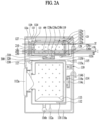
- the second processing unit 120 may be provided in a drawer type in order to avoid interference with the front-load type clothing treatment device.
- the first processing unit 110 and the second processing unit 120 may be provided inside one cabinet 111 forming the exterior.
- the first cabinet 111 which forms an exterior of the first processing unit 110 and the second cabinet 121 which forms an exterior of the second processing unit 120 may be coupled to form one body.
- FIGS. 2A and 2B illustrate that the first processing unit 110 is provided inside one cabinet 111 together with the second processing unit 120. However, it is merely for a description, and the first processing unit 110 and the second processing unit 120 are allowed to be provided separately so that an additional cabinet is included.
- the first water supply unit 115 may include a first water supply pipe 115a connecting an external water supply source and the first tub 112 and include a first water supply valve 115b for adjusting an amount of flow in the first water supply pipe 115a.
- the cabinet 111 may further include a partition 111b for dividing the first processing unit 110 and the second processing unit 120.
- a branch valve 125e may be provided as a three-way valve or the like to a part at which the branch pipe 125c and the second water supply pipe 125a are connected.
- the spray nozzle 125d may supply supplied water to the second tub 122 in a form of spray.
- the first processing unit 110 may include a first heater 118 for heating water in the first tub 112 and a hot air supply unit 119 for supplying hot air to the first tub 112.
- the second processing unit 120 also may include a second heater 128 and a second hot air supply unit 129 as described for the first processing unit 110.
- first processing unit 110 and the second processing unit 120 may include a power source unit for supplying power to the first processing unit 110 and the second processing unit 120.
- FIG. 3 is a diagram illustrating configuration of a controller of a clothing treatment device according to example embodiments of the present disclosure. Referring to FIG. 3 , the controller of the clothing treatment device and each element of the clothing treatment device which is controlled by the controller are illustrated.
- the controller 700 may control all elements of the first processing unit 110 and the second processing unit 120.
- the controller 700 may be connected to the control panel C so as to send and receive a control signal.
- the controller 700 may be provided integrally with the control panel C or provided separately from the control panel C.
- connection unit 111a for electrically connecting the first processing unit 110 and the second processing unit 120 may be provided.
- connection unit 111a may perform a role of sending the control signal of the controller 700 which is provided to one of the first processing unit 110 and the second processing unit 120.
- control methods and configuration of a washing stroke, a rinsing stroke, and a dehydration stroke may be described with the second processing unit 120 as a reference.
- the second driving unit 300 may have a large load due to resistance of the water when the second drum 200 is rotated while the water is in the second tub 122.
- Removing the water of the clothing while the eccentricity is resolved by draining the water in the second tub 122 and simultaneously rotating the second drum may be defined as dehydration with remaining water.
- Removing the water of the clothing by rotating the second drum 200 at the high speed with the water in the second tub 122 all drained may be defined as general dehydration so as to be distinguished from the dehydration with the remaining water.
- a rotation speed of the second drum 200 in the general dehydration may be faster than a rotation speed of the second drum 200 in the dehydration with the remaining water.
- the rotation speed of the second drum 200 in the dehydration with the remaining water may be referred to as a second speed
- the rotation speed of the second drum 200 in the general dehydration may be referred to as a third speed.
- the above-described effect may be derived only when a predetermined weight or more of clothing is received inside the second drum 200.
- the vibration of the second drum 200 may be further intensified when the dehydration with the remaining water is performed.
- the water which is received in the second tub 122 may generate larger vibration by rotation of the second drum 200. Shaking or a wave phenomenon of the water in the second tub 122 may occur by the second drum 200 because the predetermined weight or less of clothing does not absorb the shaking or the wave phenomenon.
- a sum of a weight of the water and a weight of the clothing in the second tub 122 and a range of a possible rotation speed of the second drum 200 at a time of the dehydration with the remaining water may be in an area including a resonance point at which excessive vibration of the second processing unit 120 occurs.
- a weight of the entire second processing unit and the rotation speed of the second drum 200 may correspond to an area in which excessive vibration occurs.
- the excessive vibration may be required to be prevented by varying a control method depending on a weight of the clothing, a time point of the drainage, and a rotation speed of the drum.
- the clothing treatment device of example embodiments may include one or more temperature sensors 122d, and a position of a temperature sensor is not limited to a position described in the figure.
- the vibration sensor 122e may sense the vibration due to the rotation of the drum. Through this, the vibration which occurs by the rotation during a washing course, and accordingly, the controller 700 may control the rotation. Through this, when a dehydration course and high-speed rotation is performed, vibration therein may be measured. When the vibration exceeds a preset value, a control method for prevention thereof may be performed. For example, an operation of a washing machine may be controlled in order to allow the rotation by reducing the rotation speed or so that the dehydration operation is performed after a clothing dispersion operation is performed.
- the clothing dispersion operation may be performed by adjusting the rotation speed of the drum, and placement of the clothing inside the drum may be changed by accelerating or decelerating of the rotation speed of the drum. Meanwhile, in example embodiments, when a margin is present in the temperature of the power module in a first dehydration stroke when the clothing dispersion operation is performed, an additional water supply operation may be performed. Through this, the vibration may be reduced when clothing having fabric texture that may greatly generate the vibration is dehydrated.
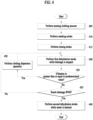
- FIG. 4 is a flowchart illustrating a washing process according to example embodiments of the present disclosure.
- the clothing treatment device may perform a washing stroke.
- water supply may be performed, and the drum may be rotated.
- detergent may be introduced with the water supply to perform the washing.
- the drum may be rotated in the washing stroke, and through this, the clothing inside the drum may be washed.
- the clothing treatment device may perform a rinsing stroke.
- Another water supply operation may be additionally provided for the rinsing stroke, and a detergent component may be removed from the clothing through the rinsing stroke.
- the washing stroke and the rinsing stroke may be performed without being distinguished additionally.
- additional water supply may be performed before the rinsing stroke.
- drainage may be performed during the rinsing stroke depending on example embodiments, and the controller may control an amount of remaining water in a tub after the drainage. Through this, the amount of the remaining water in the tub may be adjusted in an operation in which the dehydration stroke which is subsequently performed is started.
- the amount of the remaining water may be determined based on at least one of a weight of laundry in the drum, an attribute of the laundry, and a temperature of a power module.
- the drainage may be performed through a drainage pump, but is not limited thereto.
- the drainage may be also performed in a method of draining water inside the tub to an outside by an action of gravity or the like without additional control of the pump.
- the weight of the laundry may be referred to as the clothing amount
- the attribute of the laundry may be referred to as fabric texture.
- the clothing treatment device may perform a first dehydration stroke in a state in which the drainage is stopped.
- dehydration may be performed without draining at least a portion of rinsing water after the rinsing stroke.
- abnormal vibration that may occur with resonance occurrence due to the rotation may be reduced by using remaining rinsing water as a weight for a weight increase in a driving unit with which the rotation is performed.
- an operation of accelerating a rotation speed of the drum up to drainage RPM in the state in which the drainage is stopped by the first dehydration stroke, an operation of accelerating a rotation speed of the drum up to drainage RPM in the state in which the drainage is stopped.
- the rinsing water which is not drained when the first dehydration stroke is performed may be referred to as the remaining water, and the amount of the remaining water may be determined variously depending on a washing environment as set in the above operations.
- the clothing treatment device may determine whether vibration is greater than or equal to a predetermined value while accelerating up to the drainage RPM.
- a predetermined vibration value may be a preset value or a value determined adaptively depending on the clothing amount in the clothing treatment device.
- the clothing treatment device may identify whether the rotation speed of the drum reaches the drainage RPM.
- the drainage RPM may be greater than or equal to a resonance RPM band, but is not limited thereto.
- the drainage RPM may be determined depending on a weight of a load in the drum. In example embodiments, the weight of the load may be determined based on at least one of the weight of the laundry or a weight of the remaining water.
- An operation load may be increased in the driving unit for rotating the drum depending on the weight of the load. In example embodiments, the operation load of the driving unit may be identified based on the temperature of the power module.
- the rotation speed of the drum may be increased while the first dehydration stroke is performed.
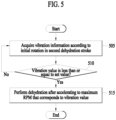
- FIG. 5 is a flowchart illustrating a method of adjusting maximum RPM depending on a vibration value according to example embodiments of the present disclosure.
- the maximum rotation speed in the second dehydration stroke is described as being adjusted based on the vibration information according to the initial rotation in the second dehydration stroke, but is not limited thereto.
- the maximum rotation speed in the second dehydration stroke may be determined based on a vibration value obtained in at least a portion of periods of the first dehydration.
- the maximum rotation speed in the second dehydration stroke may be determined based on a vibration value obtained after a dehydration resonance band is passed in the first dehydration stroke.
- FIG. 6 is a flowchart illustrating a method of adjusting an amount of remaining water, drainage RPM, and maximum RPM in a dehydration stroke based on a power module temperature and vibration information according to example embodiments of the present disclosure.
- the clothing treatment device may acquire information associated with a previously performed washing process.
- the acquired information may be information stored in a storage unit of the clothing treatment device.
- the information may include a temperature of a power module and vibration information on the power module.
- the temperature and the vibration information are collected, at least one of a clothing amount, fabric texture, the drainage RPM, and the maximum RPM may be acquired together.
- Each operation parameter has been determined also in the previous washing process, and based on information recorded based thereon, directions of the following operations may be determined.
- the clothing treatment device may determine, by referring to the acquired information, the amount of the remaining water and the drainage RPM for laundry for which washing is currently performed.
- the amount of the remaining water and the drainage RPM may be determined based on a clothing amount of the current laundry, fabric texture of the current laundry, and a temperature of the power module in a current washing stroke.
- the maximum RPM may be determined based on at least one piece of information among pieces of the above information which is taken into consideration.
- an operation of determining RPM may be performed when the following rinsing stroke is currently performed or after performance of the rinsing stroke.
- the clothing treatment device may perform a second dehydration stroke while performing the drainage.
- a rotation speed in the second dehydration stroke may be higher than the rotation speed in the first dehydration stroke.
- the clothing treatment device may increase a drum rotation speed up to the maximum RPM determined in operation 610.
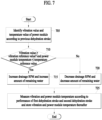
- FIG. 7 is flowchart illustrating a method of determining drainage RPM and an amount of remaining water based on a power module temperature and vibration information based on example embodiments of the present disclosure.
- a vibration value and a temperature of a power module according to rotation RPM in a washing process corresponding to at least one of an amount of remaining water, a clothing amount, and fabric texture may be identified in each dehydration stroke.
- the vibration value and a temperature value in the washing process corresponding to at least one piece of the above information may be identified, and based thereon, the drainage RPM and the amount of the remaining water may be determined.
- At least one of whether the vibration value identified in the previous washing process is greater than or equal to a vibration reference value and whether the temperature value of the power module is less than a temperature reference value may be identified.
- maximum RPM may be changed. Changing the maximum RPM may be also performed in a direction of reducing the vibration and in a direction in which the power module does not exceed the temperature reference value.
- FIG. 8 is a flowchart illustrating a method of adjusting drainage RPM and an amount of remaining water based on a recent operation history according to example embodiments of the present disclosure.
- N is a natural number
- the clothing treatment device may identify vibration and a power module temperature corresponding to a dehydrated clothing amount from the memory.
- the clothing treatment device may identify whether to correspond to a change condition based on recent N-time operation information. Determining whether to correspond to the change condition may be performed based on at least one of a comparison between a vibration value and a vibration reference value and a comparison between a temperature value of a power module and a reference temperature value.
- the drainage RPM and the amount of the remaining water may be adjusted.
- at least one of increasing the drainage RPM and increasing the amount of the remaining water may be performed.
- at least one of decreasing the drainage RPM and decreasing the amount of the remaining water may be performed based on the drainage RPM and the amount of the remaining water which are adjusted as such.
- the changed amount of the remaining water and the changed drainage RPM may be stored in operation 820.
- a graph 1000 of performing the dehydration with the remaining water when dehydration for laundry generating high vibration is performed.
Landscapes
- Engineering & Computer Science (AREA)
- Textile Engineering (AREA)
- Control Of Washing Machine And Dryer (AREA)
Applications Claiming Priority (2)
| Application Number | Priority Date | Filing Date | Title |
|---|---|---|---|
| KR1020210115090A KR102765086B1 (ko) | 2021-08-30 | 2021-08-30 | 의류 처리 장치 및 그 제어 방법 |
| PCT/KR2022/011041 WO2023033368A1 (fr) | 2021-08-30 | 2022-07-27 | Dispositif de traitement de vêtements et procédé de commande associé |
Publications (2)
| Publication Number | Publication Date |
|---|---|
| EP4397799A1 true EP4397799A1 (fr) | 2024-07-10 |
| EP4397799A4 EP4397799A4 (fr) | 2025-08-20 |
Family
ID=85412629
Family Applications (1)
| Application Number | Title | Priority Date | Filing Date |
|---|---|---|---|
| EP22864877.0A Pending EP4397799A4 (fr) | 2021-08-30 | 2022-07-27 | Dispositif de traitement de vêtements et procédé de commande associé |
Country Status (4)
| Country | Link |
|---|---|
| US (1) | US20240352639A1 (fr) |
| EP (1) | EP4397799A4 (fr) |
| KR (1) | KR102765086B1 (fr) |
| WO (1) | WO2023033368A1 (fr) |
Families Citing this family (1)
| Publication number | Priority date | Publication date | Assignee | Title |
|---|---|---|---|---|
| JP2025000267A (ja) * | 2023-06-19 | 2025-01-07 | 青島海爾洗衣机有限公司 | 洗濯機 |
Family Cites Families (12)
| Publication number | Priority date | Publication date | Assignee | Title |
|---|---|---|---|---|
| KR0175631B1 (ko) * | 1996-03-26 | 1999-05-01 | 김광호 | 세탁기의 탈수행정 제어방법 |
| JP3316427B2 (ja) * | 1997-07-23 | 2002-08-19 | 三洋電機株式会社 | 遠心脱水装置 |
| US6609264B2 (en) * | 2001-09-21 | 2003-08-26 | Maytag Corporation | Pump cycling control system for a washing machine |
| KR101183906B1 (ko) * | 2006-03-22 | 2012-09-19 | 삼성전자주식회사 | 세탁기 |
| KR101455773B1 (ko) * | 2008-01-18 | 2014-11-04 | 삼성전자 주식회사 | 세탁기의 탈수 제어방법 |
| KR101466338B1 (ko) * | 2008-07-08 | 2014-11-27 | 삼성전자 주식회사 | 세탁기의 제어방법 |
| KR20110009923A (ko) * | 2009-07-23 | 2011-01-31 | 엘지전자 주식회사 | 세탁물 처리기기 및 세탁물 처리방법 |
| KR102060066B1 (ko) * | 2013-04-17 | 2019-12-27 | 엘지전자 주식회사 | 세탁물 처리장치 및 이의 제어방법 |
| KR101661962B1 (ko) * | 2015-02-02 | 2016-10-04 | 엘지전자 주식회사 | 세탁기의 제어방법 |
| KR101624532B1 (ko) | 2015-09-10 | 2016-05-26 | 엘지전자 주식회사 | 세탁기의 제어방법 |
| KR101757434B1 (ko) | 2016-07-07 | 2017-07-12 | 인하대학교 산학협력단 | 세탁기 진동 저감 메커니즘 |
| KR102047709B1 (ko) * | 2018-08-17 | 2019-11-22 | 엘지전자 주식회사 | 의류처리장치 및 그 제어방법 |
-
2021
- 2021-08-30 KR KR1020210115090A patent/KR102765086B1/ko active Active
-
2022
- 2022-07-27 EP EP22864877.0A patent/EP4397799A4/fr active Pending
- 2022-07-27 US US18/686,503 patent/US20240352639A1/en active Pending
- 2022-07-27 WO PCT/KR2022/011041 patent/WO2023033368A1/fr not_active Ceased
Also Published As
| Publication number | Publication date |
|---|---|
| KR102765086B1 (ko) | 2025-02-11 |
| KR20230032344A (ko) | 2023-03-07 |
| US20240352639A1 (en) | 2024-10-24 |
| EP4397799A4 (fr) | 2025-08-20 |
| WO2023033368A1 (fr) | 2023-03-09 |
Similar Documents
| Publication | Publication Date | Title |
|---|---|---|
| KR101999701B1 (ko) | 의류처리장치 및 그 제어방법 | |
| US9957653B2 (en) | Laundry treating appliance with tumble pattern control | |
| US8381343B2 (en) | Washing machine and control method for disentangling clothes in the washing machine | |
| KR102060067B1 (ko) | 의류처리장치 및 그 제어방법 | |
| EP2565315A2 (fr) | Machine à laver et son procédé de commande | |
| KR102448503B1 (ko) | 세탁기 및 그 제어 방법 | |
| CN101586298A (zh) | 洗衣机和控制洗衣机的方法 | |
| KR102047709B1 (ko) | 의류처리장치 및 그 제어방법 | |
| KR101029798B1 (ko) | 드럼 세탁기의 탈수 제어 방법 | |
| EP1776498A2 (fr) | Lave-linge et procede de commande de celui-ci | |
| EP4397799A1 (fr) | Dispositif de traitement de vêtements et procédé de commande associé | |
| EP2400053B1 (fr) | Séchoir et machine à laver et à sécher | |
| JP2012170685A (ja) | ドラム式洗濯機 | |
| US9187856B2 (en) | Washing machine and washing method | |
| KR20200009831A (ko) | 의류처리장치의 제어방법 | |
| US20150176184A1 (en) | Washing machine with improved balancing characteristics and control method thereof | |
| US20210207303A1 (en) | Laundry processing machine and method of controlling same | |
| US20090293205A1 (en) | Washing machine and method of controlling a washing machine | |
| JP2014180406A (ja) | 洗濯機 | |
| KR20180098933A (ko) | 의류처리장치 및 그 제어방법 | |
| JP2011206139A (ja) | 衣類乾燥機 | |
| KR102405804B1 (ko) | 의류처리장치 및 그의 제어방법 | |
| KR20170111261A (ko) | 의류처리장치의 제어방법 | |
| KR102352398B1 (ko) | 의류처리장치 | |
| KR20220083451A (ko) | 세탁기 및 그 제어 방법 |
Legal Events
| Date | Code | Title | Description |
|---|---|---|---|
| STAA | Information on the status of an ep patent application or granted ep patent |
Free format text: STATUS: THE INTERNATIONAL PUBLICATION HAS BEEN MADE |
|
| PUAI | Public reference made under article 153(3) epc to a published international application that has entered the european phase |
Free format text: ORIGINAL CODE: 0009012 |
|
| STAA | Information on the status of an ep patent application or granted ep patent |
Free format text: STATUS: REQUEST FOR EXAMINATION WAS MADE |
|
| 17P | Request for examination filed |
Effective date: 20240325 |
|
| AK | Designated contracting states |
Kind code of ref document: A1 Designated state(s): AL AT BE BG CH CY CZ DE DK EE ES FI FR GB GR HR HU IE IS IT LI LT LU LV MC MK MT NL NO PL PT RO RS SE SI SK SM TR |
|
| DAV | Request for validation of the european patent (deleted) | ||
| DAX | Request for extension of the european patent (deleted) | ||
| REG | Reference to a national code |
Ref country code: DE Ref legal event code: R079 Free format text: PREVIOUS MAIN CLASS: D06F0037220000 Ipc: D06F0033480000 |
|
| A4 | Supplementary search report drawn up and despatched |
Effective date: 20250718 |
|
| RIC1 | Information provided on ipc code assigned before grant |
Ipc: D06F 33/48 20200101AFI20250714BHEP Ipc: D06F 29/00 20060101ALN20250714BHEP Ipc: D06F 103/26 20200101ALN20250714BHEP Ipc: D06F 103/52 20200101ALN20250714BHEP Ipc: D06F 105/08 20200101ALN20250714BHEP Ipc: D06F 105/48 20200101ALN20250714BHEP |