EP4406736A1 - Récipient tubulaire flexible - Google Patents
Récipient tubulaire flexible Download PDFInfo
- Publication number
- EP4406736A1 EP4406736A1 EP23153338.1A EP23153338A EP4406736A1 EP 4406736 A1 EP4406736 A1 EP 4406736A1 EP 23153338 A EP23153338 A EP 23153338A EP 4406736 A1 EP4406736 A1 EP 4406736A1
- Authority
- EP
- European Patent Office
- Prior art keywords
- layer
- flexible tube
- laminated material
- tube container
- barrier
- Prior art date
- Legal status (The legal status is an assumption and is not a legal conclusion. Google has not performed a legal analysis and makes no representation as to the accuracy of the status listed.)
- Pending
Links
Images


Classifications
-
- B—PERFORMING OPERATIONS; TRANSPORTING
- B32—LAYERED PRODUCTS
- B32B—LAYERED PRODUCTS, i.e. PRODUCTS BUILT-UP OF STRATA OF FLAT OR NON-FLAT, e.g. CELLULAR OR HONEYCOMB, FORM
- B32B27/00—Layered products comprising a layer of synthetic resin
- B32B27/32—Layered products comprising a layer of synthetic resin comprising polyolefins
-
- B—PERFORMING OPERATIONS; TRANSPORTING
- B32—LAYERED PRODUCTS
- B32B—LAYERED PRODUCTS, i.e. PRODUCTS BUILT-UP OF STRATA OF FLAT OR NON-FLAT, e.g. CELLULAR OR HONEYCOMB, FORM
- B32B1/00—Layered products having a non-planar shape
- B32B1/08—Tubular products
-
- B—PERFORMING OPERATIONS; TRANSPORTING
- B32—LAYERED PRODUCTS
- B32B—LAYERED PRODUCTS, i.e. PRODUCTS BUILT-UP OF STRATA OF FLAT OR NON-FLAT, e.g. CELLULAR OR HONEYCOMB, FORM
- B32B27/00—Layered products comprising a layer of synthetic resin
- B32B27/06—Layered products comprising a layer of synthetic resin as the main or only constituent of a layer, which is next to another layer of the same or of a different material
- B32B27/08—Layered products comprising a layer of synthetic resin as the main or only constituent of a layer, which is next to another layer of the same or of a different material of synthetic resin
-
- B—PERFORMING OPERATIONS; TRANSPORTING
- B32—LAYERED PRODUCTS
- B32B—LAYERED PRODUCTS, i.e. PRODUCTS BUILT-UP OF STRATA OF FLAT OR NON-FLAT, e.g. CELLULAR OR HONEYCOMB, FORM
- B32B7/00—Layered products characterised by the relation between layers; Layered products characterised by the relative orientation of features between layers, or by the relative values of a measurable parameter between layers, i.e. products comprising layers having different physical, chemical or physicochemical properties; Layered products characterised by the interconnection of layers
- B32B7/04—Interconnection of layers
- B32B7/12—Interconnection of layers using interposed adhesives or interposed materials with bonding properties
-
- B—PERFORMING OPERATIONS; TRANSPORTING
- B65—CONVEYING; PACKING; STORING; HANDLING THIN OR FILAMENTARY MATERIAL
- B65D—CONTAINERS FOR STORAGE OR TRANSPORT OF ARTICLES OR MATERIALS, e.g. BAGS, BARRELS, BOTTLES, BOXES, CANS, CARTONS, CRATES, DRUMS, JARS, TANKS, HOPPERS, FORWARDING CONTAINERS; ACCESSORIES, CLOSURES, OR FITTINGS THEREFOR; PACKAGING ELEMENTS; PACKAGES
- B65D65/00—Wrappers or flexible covers; Packaging materials of special type or form
- B65D65/38—Packaging materials of special type or form
- B65D65/40—Applications of laminates for particular packaging purposes
-
- B—PERFORMING OPERATIONS; TRANSPORTING
- B32—LAYERED PRODUCTS
- B32B—LAYERED PRODUCTS, i.e. PRODUCTS BUILT-UP OF STRATA OF FLAT OR NON-FLAT, e.g. CELLULAR OR HONEYCOMB, FORM
- B32B2250/00—Layers arrangement
- B32B2250/24—All layers being polymeric
- B32B2250/242—All polymers belonging to those covered by group B32B27/32
-
- B—PERFORMING OPERATIONS; TRANSPORTING
- B32—LAYERED PRODUCTS
- B32B—LAYERED PRODUCTS, i.e. PRODUCTS BUILT-UP OF STRATA OF FLAT OR NON-FLAT, e.g. CELLULAR OR HONEYCOMB, FORM
- B32B2255/00—Coating on the layer surface
- B32B2255/10—Coating on the layer surface on synthetic resin layer or on natural or synthetic rubber layer
-
- B—PERFORMING OPERATIONS; TRANSPORTING
- B32—LAYERED PRODUCTS
- B32B—LAYERED PRODUCTS, i.e. PRODUCTS BUILT-UP OF STRATA OF FLAT OR NON-FLAT, e.g. CELLULAR OR HONEYCOMB, FORM
- B32B2255/00—Coating on the layer surface
- B32B2255/20—Inorganic coating
- B32B2255/205—Metallic coating
-
- B—PERFORMING OPERATIONS; TRANSPORTING
- B32—LAYERED PRODUCTS
- B32B—LAYERED PRODUCTS, i.e. PRODUCTS BUILT-UP OF STRATA OF FLAT OR NON-FLAT, e.g. CELLULAR OR HONEYCOMB, FORM
- B32B2307/00—Properties of the layers or laminate
- B32B2307/30—Properties of the layers or laminate having particular thermal properties
-
- B—PERFORMING OPERATIONS; TRANSPORTING
- B32—LAYERED PRODUCTS
- B32B—LAYERED PRODUCTS, i.e. PRODUCTS BUILT-UP OF STRATA OF FLAT OR NON-FLAT, e.g. CELLULAR OR HONEYCOMB, FORM
- B32B2307/00—Properties of the layers or laminate
- B32B2307/50—Properties of the layers or laminate having particular mechanical properties
- B32B2307/514—Oriented
-
- B—PERFORMING OPERATIONS; TRANSPORTING
- B32—LAYERED PRODUCTS
- B32B—LAYERED PRODUCTS, i.e. PRODUCTS BUILT-UP OF STRATA OF FLAT OR NON-FLAT, e.g. CELLULAR OR HONEYCOMB, FORM
- B32B2307/00—Properties of the layers or laminate
- B32B2307/70—Other properties
- B32B2307/72—Density
-
- B—PERFORMING OPERATIONS; TRANSPORTING
- B32—LAYERED PRODUCTS
- B32B—LAYERED PRODUCTS, i.e. PRODUCTS BUILT-UP OF STRATA OF FLAT OR NON-FLAT, e.g. CELLULAR OR HONEYCOMB, FORM
- B32B2307/00—Properties of the layers or laminate
- B32B2307/70—Other properties
- B32B2307/732—Dimensional properties
- B32B2307/737—Dimensions, e.g. volume or area
- B32B2307/7375—Linear, e.g. length, distance or width
- B32B2307/7376—Thickness
-
- B—PERFORMING OPERATIONS; TRANSPORTING
- B32—LAYERED PRODUCTS
- B32B—LAYERED PRODUCTS, i.e. PRODUCTS BUILT-UP OF STRATA OF FLAT OR NON-FLAT, e.g. CELLULAR OR HONEYCOMB, FORM
- B32B2439/00—Containers; Receptacles
-
- B—PERFORMING OPERATIONS; TRANSPORTING
- B32—LAYERED PRODUCTS
- B32B—LAYERED PRODUCTS, i.e. PRODUCTS BUILT-UP OF STRATA OF FLAT OR NON-FLAT, e.g. CELLULAR OR HONEYCOMB, FORM
- B32B2439/00—Containers; Receptacles
- B32B2439/02—Open containers
-
- B—PERFORMING OPERATIONS; TRANSPORTING
- B32—LAYERED PRODUCTS
- B32B—LAYERED PRODUCTS, i.e. PRODUCTS BUILT-UP OF STRATA OF FLAT OR NON-FLAT, e.g. CELLULAR OR HONEYCOMB, FORM
- B32B2439/00—Containers; Receptacles
- B32B2439/40—Closed containers
-
- B—PERFORMING OPERATIONS; TRANSPORTING
- B32—LAYERED PRODUCTS
- B32B—LAYERED PRODUCTS, i.e. PRODUCTS BUILT-UP OF STRATA OF FLAT OR NON-FLAT, e.g. CELLULAR OR HONEYCOMB, FORM
- B32B2597/00—Tubular articles, e.g. hoses, pipes
Definitions
- the invention relates to a flexible tube container, also call squeezable tube container formed from a laminated material. Said tubes are designed to store and distribute liquid to pasty products.
- laminated materials comprising several layers are widely used as they represent advantages in terms of product protection and mechanical properties.
- an aluminum barrier layer is usually used to improve impermeability.
- Such aluminum layer is firmly bonded to layers of plastic materials. This presents a problem for recycling the laminated materials, as the plastic materials and aluminum cannot be easily separated and sorted into separate recycling channels.
- Oxide materials such as Aluminum (AlOx) and silicon (SiOx) oxide materials, have been found to be promising barrier materials compatible with recycling issues.
- a barrier layer comprises a thin oxide material barrier coated on a polymer carrier layer, especially polyolefin.
- plastic materials are often incompatible with one another. This means that the recycling of incompatible mixed materials leads to a recycled material with degraded properties, which will no longer respond to noble applications with high added value. It is recommended within a same device to use compatible plastic materials because the properties of recycled plastics drop rapidly if they are contaminated with incompatible plastics.
- the present invention attempts to solve at least one of the above mentioned problems and propose a flexible tube container comprising a tube head and a skirt formed from a recyclable laminated material, the laminated material comprising an inner layer made of PE, an outer layer made of PE and an barrier layer comprising an aluminum oxide (AlOx) material barrier and a carrier layer made of polyolefin coated by said oxide material barrier, the laminated material having a total melt flow index between 0.5 and 1.6 g/10 min at 190°C and 2.16 kg according to the ASTM D1238 measurement.
- AlOx aluminum oxide
- melt flow index makes it possible to ensure that the laminated material, and more advantageously the flexible tube container, will be able to be remelted into a material which can be reused. In other words, it makes it possible to ensure that the laminated material, and more advantageously the flexible tube container are recyclable.
- melt flow index values outside this range the reuse of materials is not guaranteed because they may not give sufficient final results.
- the invention can also comprise any of the following features taken individually or in any technically possible combination:
- the terms “outer”, “inner”, “upper” and “lower”, and the like, used with respect to the various layers refer to the laminated material with the intended outer or upper surface uppermost and the intended inner or lower (product-contacting) surface lowermost.
- these terms and the terms “over”, “under” or “on” do not imply that the layers are necessarily directly in contact.
- the upper layer being “formed on” the barrier layer does not preclude the presence of one or more other intervening layers located between the upper layer and the barrier layer.
- layers may be provided under the inner layer, i.e. between the inner layer and the product, or above the outer layer (like decorative layers).
- container is used herein to refer to an item which may contain a product. Such products are usually liquids, gels or pastes. Preferred containers include tubes and pouches.
- the container may further comprise a lid or a cap and, if necessary, attachment means for the lid or cap (such as a tube head or shoulder) before it forms a useful commercial container.
- the laminated material of the invention can form a tube skirt, an insert of a tube head or a combination thereof.
- flexible as used herein describes a laminate or a container made thereof which can bend or be bent easily and which does not break (unless it is bent too much).
- flexible indicates that if the container is subjected to a force, for example, by being filled with a liquid, or by applying pressure with a finger or a hand, it will change its form without breaking.
- a flexible container can also be considered to be a "squeezable" container.
- adheresive layer refers to a layer which is placed between two layers with the object of ensuring that the two layers are joined together.
- AlOx means aluminum oxide which is to say a material containing aluminum, oxygen, and optionally other elements, in which x, the ratio of oxygen to aluminum atoms, is from about 0.1 to about 2. These alternative values of x apply to any use of the term AlOx in this specification to define a composite barrier coating or layer.
- polymer refers to a large molecule, or macromolecule, composed of many repeated subunits.
- polyolefin refers to any of a class of polymers produced from a simple olefin as a monomer.
- PP refers to polypropylene
- OPP refers to oriented polypropylene
- PE polyethylene
- HDPE high density polyethylene
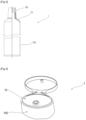
- the invention relates to a flexible tube container 1 comprising a tube head 10 and a skirt 100.
- Said tube skirt 100 is formed by rolling a sheet of a recyclable laminated material 200.
- the flexible tube container 1 can also comprise a cap 20.
- the tube head 10 comprises a wall with a distribution opening and is attached or linked to the tube skirt 100.
- the head 10 can comprise a shoulder 11 and a neck 12.
- the neck advantageously comprises thread.
- the cap can be screwed on the neck in order to block the distribution opening.
- the cap can be snapped on the neck, the neck comprising snap function such as an annular rib cooperating with flanges or tabs of the cap.
- the tube can comprise a head 10 with no neck.
- the head comprises only the wall with a distribution opening, this wall being attached directly to the skirt.
- This shoulderless configuration allows to reduce the quantity of material used to form the head.
- the tube 1 can also comprise an insert located inside the container and attached to the internal surface of the tube head.
- the cap advantageously comprise a punch configured to pierce or cut the insert during the first use of the container.
- the container according to this embodiment comprises a ring mounted on the head. Said ring allows to maintain the cap in a first position, called waiting position, in which the pinch is kept at distance from the insert.
- the skirt 100 comprises a longitudinal weld or join 110.
- this longitudinal weld 110 is obtained by overlapping the edges of the laminated material 200 forming the skirt 100. More particularly, portions of the laminate are folded onto each other in a tubular configuration such that a first side edge of the laminate covers a second side edge of the laminate. Then, an upper surface of the laminate is in facing contact with a lower surface of the laminate. An overlap side seam is formed by means of heating the laminate such that the upper surface of the laminate is bonded to the lower surface of the laminate. The overlap side seam forms the longitudinal weld 110. Said longitudinal weld 110 can be visible from the outside of the tube container 1. According to another embodiment, the longitudinal weld 110 is non visible.
- said flexible tube skirt 100 is intended to be fixed to the tube head 10 in order to form the flexible tube container 1.
- the tube head 10 is advantageously overmoulded on the skirt 100.
- the skirt 100 is advantageously fixed to the shoulder periphery.
- Said tube head 10 is advantageously made of PE but can be made in any other suitable material such as PP (polypropylene).
- the tube head can be produced as a separate piece of plastic and then attached to the skirt by heating the edge of the shoulder and the edge of the skirt and compress them together.
- Embodiments of the structures of the recyclable laminated material 200 according to the invention are illustrated at figure 6 .
- the recyclable laminated material 200 comprises an inner layer 30 made of PE, an outer layer 40 made of PE and an barrier layer 50 comprising an aluminum oxide (AlOx) material barrier 52 and a carrier layer 54 made of polyolefin coated by said oxide material barrier 52.
- the laminated material 200 has a total melt flow index between 0.5 and 1.6 g/10 min at 190°C and 2.16 kg according to the ASTM D1238 measurement, preferably between 0.5 and 1.2 g/10 min at 190°C and 2.16 kg according to the ASTM D1238 measurement, more preferably between 1 and 1.2 g/10 min at 190°C and 2.16 kg according to the ASTM D1238 measurement.
- the flexible tube container 1 has a total melt flow index comprised between 0.2 and 1.61 g/10 min at 190°C and 2.16 kg according to the ASTM D1238 measurement.
- the tube head has a total melt flow index between 1.5 and 10 g/10 min at 190°C and 2.16 kg according to the ASTM D1238 measurement.
- melt flow Index or melt flow rate (MFR) is a measure of the ease of flow of the melt of a thermoplastic polymer. It is defined as the mass of polymer, in grams, flowing in ten minutes through a capillary of a specific diameter and length by a pressure applied via prescribed alternative gravimetric weights for alternative prescribed temperatures. The method is described in the similar standards ASTM D1238 and ISO 1133. Here, the sample has been tested at 190°C and 2.16 kg.
- the melt flow index of the laminated material 200 or of the flexible tube container 1 can be measured from a melt blended material obtained by granulation and melt extrusion of the different parts.
- Such a Melt flow index makes it possible to ensure that the laminated material 200, and more advantageously the flexible tube container 1, will be able to be remelted into a material which can be reused, in other words it makes it possible to ensure that the laminated material 200, and more advantageously the flexible tube container 1 are recyclable.
- melt flow index values outside this range the reuse of materials is not guaranteed because they may not give sufficient final results.
- the laminated material 200 has a density between 0.941 and 0.98 g/cm 3 , preferably between 0.941 and 0.965 g/cm 3 .
- the laminated material 200 comprises at least 55% by weight of HDPE.
- Aluminum Oxide material barriers are particularly interesting in recyclable laminated materials as they have good barrier properties while having a very low thickness and thus represent a small amount of the laminated material 200.
- the carrier layer 54 represents most of the thickness of the barrier layer 50 as the aluminum oxide material is advantageously a thin layer coated on the carrier layer 54. This small amount of aluminum oxide material has no impact on the recycling stream and thus the laminated material 200 and the flexible tube container 1 can be recycled as a whole, with the barrier layer 50.
- the barrier layer 50 comprising said carrier layer 54 and said aluminum oxide material 52 coating has a thickness between 10 and 30 ⁇ m. More preferably, the barrier layer 50 has a thickness between 15 and 20 ⁇ m.
- a thin inorganic layer of aluminum oxide is evaporated in a vacuum environment to a carrier layer 54 substrate.
- the coating of aluminum oxide material 52 has a thickness less than 0.1 ⁇ m.
- the carrier layer 54 is made of polyolefin.
- the polyolefin is PP and/or PE.
- a carrier layer 54 comprising PE, and more advantageously made of PE, improves the recyclability of the laminated material 200 and therefore the recyclability of the flexible tube container 1.
- the carrier layer 54 is an oriented polyethylene (OPE).
- OPE oriented polyethylene
- a carrier layer 54 comprising PP or made of PP can also be used without impacting the recyclability of the laminated material 200 or the of the flexible tube container 1.
- the carrier layer 54 comprises a material which is potentially not in PE, and is limited within the laminated material 200, which is advantageous for the recyclability.
- a carrier layer 54 made of PP combined with inner and outer layers 30, 40 in PE improve also the permeability properties of the laminated material 200, especially compared to a laminate with inner and outer layers also in PP.
- the carrier layer 54 is an oriented PP (OPP) or oriented polyethylene (OPE).
- the barrier layer 50 is located between the inner layer 30 and the outer layer 40.
- Said inner layer 30 can be composed by a plurality of single layers.
- said outer layer 40 can be composed by a plurality of single layers.
- the number of single layers composing the inner layer 30 and the outer layer 40 is not limited to the example illustrated in the figure 6 .
- the different single layers can be cast type films or blown type film.
- the different layers are joined together by lamination process in order to obtain the laminated material 200 according to the invention.
- Said laminated material 200 can be obtained by different lamination process, as extrusion lamination process or adhesive lamination process.
- the inner layer 30 has a MFI higher than the MFI of the carrier layer 50.
- the inner layer 30 will better flow than the carrier layer 54.
- the sealing is improved especially in the overlapping region when forming the tube skirt from this laminated material 200. The delamination issues are especially reduced.
- the inner layer 30 has a MFI at least equal to 4 g/10 min at 230°C and 2.16 kg according to the ASTM D1238 measurement. More advantageously, the inner layer 30 has a MFI comprised between 8 and 12 g/10 min at 230°C and 2.16 kg according to the ASTM D1238 measurement, preferably of 10 g/10 min at 230°C and 2.16 kg according to the ASTM D1238 measurement.
- An inner layer 30 having such MFI presents a good ability to flow.
- the covering of the edges of the aluminum oxide material barrier 52 is ensured and the sealing of the side seam is improved.
- the carrier layer 54 has a MFI comprised between 0.5 and 5 g/10 min at 230°C and 2.16 kg according to the ASTM D1238 measurement. More advantageously, the carrier layer 54 has a MFI comprised between 0.8 and 2 g/10 min at 230°C and 2.16 kg according to the ASTM D1238 measurement, preferably of 1 g/10 min at 230°C and 2.16 kg according to the ASTM D1238 measurement. This limits the movement of the carrier layer 54, protects the aluminum oxide material barrier 52 and thus ensures a sustainable barrier layer 50.
- the outer layer 40 has a MFI at least equal to 5 g/10 min at 230°C and 2.16 kg according to the ASTM D1238 measurement. More advantageously, the outer layer 40 has a MFI comprised between 5 and 10 g/10 min at 230°C and 2.16 kg according to the ASTM D1238 measurement, preferably of 7 g/10 min at 230°C and 2.16 kg according to the ASTM D1238 measurement.
- the carrier layer 54 is made of oriented polypropylene (OPP).
- OPP oriented polypropylene
- the type of PP used to form OPP layer is particularly advantageous for forming the carrier layer 54 as it presents a sensibly low melt flow index and thus a low ability to flow.
- the carrier layer 54 has a sensibly low melt flow index the aluminum oxide material barrier 52 stays stable, the cut edge is protected and the sealing is improved especially in the overlapping region.
- OPP presents a high resistance to heat and protecting the barrier coating during the lamination process.
- the laminated material 200 comprises an adhesive layer 60 between the barrier layer 50 and the inner layer 30 and/or between the barrier layer 50 and the outer layer 40.
- Said adhesive layer 60 is used to connect the inner layer 30 and barrier layer 50 as well as the outer layer 40 and the barrier layer 50 and to prevent any delamination problems.
- the adhesive layer 60 is an anhydride modified ethylene acrylate resin.
- the laminated material comprises at least one intermediate layer 40.
- This intermediate layer 40 can be located between the inner layer 30 and the barrier layer 50 and/or between the outer layer 40 and the barrier layer 50.
- the total thickness of the laminated material 200 is an important feature as it will influence its mechanical properties.
- the total thickness of the laminated material 200 is between 150 and 300 ⁇ m. More advantageously, the total thickness of the laminated material 200 is between 200 and 250 ⁇ m. Such thickness is well adapted for forming flexible tube, in particular toothpaste tube.
- the inner layer 30 In order to flow, the inner layer 30 require a minimum thickness. If the inner layer 30 is too thin, not enough material will be “available” to flow and the covering of the cut edges of the oxide material barrier 52 will not be achieved.
- the thickness of the inner layer 30 also influences the absorption of some products that will be contained in the flexible tube container 1. Some part of the product that will be contained in the flexible tube container 1, for example the flavors, can be absorbed by the layers placed between the product and the barrier 52, here the inner layer 30. If the inner layer 30 is too thick, the retention rate will be too high and might lead to a deterioration of said inner layer 30. Thus, there is a need for a compromise between retention rate requiring a low thickness and appropriate flow requiring a high thickness.
- the thickness of the inner layer (30) is between 50 and 120 ⁇ m.
- the thickness of the outer layer is comprised between 80 and 150 ⁇ m.
- the thickness of the carrier layer is comprised between 10 ⁇ m and 30 ⁇ m.
- figure 6 is schematic representation and that the layers are not at scale.
- the aluminum oxide material barrier 52 can be carried by carrier layer 54 on its side facing the inner layer 30.
- the aluminum oxide barrier 52 of the barrier layer 50 is oriented toward the inner layer 30. This configuration of the barrier layer 50 allows stopping the migration of part of the product that will be contained in the flexible tube container 1 before it reaches the carrier layer 54 and thus it reduces the absorption rate.
- aluminum oxide barrier is oriented toward the outer layer 40.
- the laminated material 200 having a substantially symmetrical layering structure from either side of said barrier layer 50.
- the symmetry of the laminated material 200 can influence some physical properties of the laminated material 200.
- the symmetry improves the roundness of the skirt 200 made thereby.
- the roundness of the tube allows increasing production rates when forming and filling tubes.
- the following structures are exemplary embodiments of laminated material 200 according to the present invention.
- the invention is not restricted to the specific laminated material 200 of the exemplary embodiments but encompasses other laminated material structures falling within the scope of the appended claims.
- the different layers of these exemplary embodiments of laminated material 200 are described starting from the external layer, i.e. the intended outer surface uppermost, to the internal layer, i.e. the intended inner (product-contacting) surface lowermost.
- This embodiment is schematically represented at figure 6 .
- Said embodiment is constituted of:
- the laminated material 200 is obtained from these different layers by adhesive lamination.
- the outer layer 40 has a thickness of 152 ⁇ m.
- the carrier layer 54 and the aluminum oxide material barrier 52 represent the barrier layer 50.
- the AlOx barrier 52 has a thickness less than 0.1 ⁇ m.
- Said barrier layer has a thickness of 16 ⁇ m.
- the inner layer 30 has a thickness of 81 ⁇ m.
- the laminated material 200 has a total thickness of 249 ⁇ m.
- the laminated material 200 has a total melt flow index of 1.28 g/10 min at 190°C and 2.16 kg according to the ASTM D1238 measurement and a density of 0.96 g/cm 3 .
- This embodiment is schematically represented at Fig 6 .
- Said embodiment is constituted of:
- the laminated material 200 is obtained from these different layers by adhesive lamination.
- the outer layer 40 has a thickness of 107 ⁇ m.
- the carrier layer 54 and the aluminum oxide material barrier 52 represent the barrier layer 50.
- the AlOx barrier 52 has a thickness less than 0.1 ⁇ m.
- Said barrier layer has a thickness of 16 ⁇ m.
- the inner layer 30 has a thickness of 106 ⁇ m.
- the laminated material 200 has a total thickness of 250 ⁇ m.
- the laminated material 200 has a total melt flow index of 1.59 g/10 min at 190°C and 2.16 kg according to the ASTM D1238 measurement and a density of 0.95 g/cm 3 .
- This embodiment is schematically represented at Fig 6 .
- Said embodiment is constituted of:
- the laminated material 200 is obtained from these different layers by adhesive lamination.
- the outer layer 40 has a thickness of 107 ⁇ m.
- the carrier layer 54 and the aluminum oxide material barrier 52 represent the barrier layer 50.
- the AlOx barrier 52 has a thickness less than 0.1 ⁇ m.
- Said barrier layer has a thickness of 16 ⁇ m.
- the inner layer 30 has a thickness of 106 ⁇ m.
- the laminated material 200 has a total thickness of 250 ⁇ m.
- the laminated material 200 has a total melt flow index of 1.59 g/10 min at 190°C and 2.16 kg according to the ASTM D1238 measurement and a density of 0.95 g/cm 3 .
- the tube skirt 100 is formed by rolling a sheet, especially a flat sheet, of a laminated material 200 as described above. More particularly, portions of the sheet are folded onto each other in a tubular configuration such that a first side edge of the sheet covers a second side edge of the sheet. Then, an upper surface of the outer layer 40 is in facing contact with a lower surface of the inner layer 30. An overlap side seam 110 is formed by means of heating the sheet such that the upper surface of the outer layer 40 is bonded to the lower surface of the inner layer 30.
- the inner layer 30 has a good ability to flow, when the side seam 110 is formed, the inner layer 30 flows and cover the cut edge of the oxide material barrier 52. Thus, the cut edge is protected from the product that will be contained by the tube and the sealing is improved especially in the overlapping region 110. Furthermore, as the carrier layer 54 does not flow, or at least not much, when the side seam 110 is formed, the aluminum oxide material barrier 52 stays stable and a sustainable protection is ensured. Thus, the sealing of the tube skirt 100 is improved and the time life of a product contained in the flexible tube container 1 comprising said laminated material 200 is extended.
Landscapes
- Engineering & Computer Science (AREA)
- Mechanical Engineering (AREA)
- Tubes (AREA)
Priority Applications (2)
| Application Number | Priority Date | Filing Date | Title |
|---|---|---|---|
| EP23153338.1A EP4406736A1 (fr) | 2023-01-25 | 2023-01-25 | Récipient tubulaire flexible |
| PCT/EP2024/051115 WO2024156576A1 (fr) | 2023-01-25 | 2024-01-18 | Contenant de tube flexible |
Applications Claiming Priority (1)
| Application Number | Priority Date | Filing Date | Title |
|---|---|---|---|
| EP23153338.1A EP4406736A1 (fr) | 2023-01-25 | 2023-01-25 | Récipient tubulaire flexible |
Publications (1)
| Publication Number | Publication Date |
|---|---|
| EP4406736A1 true EP4406736A1 (fr) | 2024-07-31 |
Family
ID=85174093
Family Applications (1)
| Application Number | Title | Priority Date | Filing Date |
|---|---|---|---|
| EP23153338.1A Pending EP4406736A1 (fr) | 2023-01-25 | 2023-01-25 | Récipient tubulaire flexible |
Country Status (2)
| Country | Link |
|---|---|
| EP (1) | EP4406736A1 (fr) |
| WO (1) | WO2024156576A1 (fr) |
Citations (3)
| Publication number | Priority date | Publication date | Assignee | Title |
|---|---|---|---|---|
| WO2020193562A1 (fr) * | 2019-03-27 | 2020-10-01 | Albea Services | Matériau stratifié pour former un récipient souple et jupe de tube souple comprenant ledit matériau stratifié |
| US20220032590A1 (en) * | 2019-08-27 | 2022-02-03 | Hoffmann Neopac Ag | Recyclable, collapsible tube with barrier properties |
| WO2022216239A1 (fr) * | 2021-04-05 | 2022-10-13 | Kim Pack Co., Ltd. | Tube stratifié barrière recyclé et recyclable |
-
2023
- 2023-01-25 EP EP23153338.1A patent/EP4406736A1/fr active Pending
-
2024
- 2024-01-18 WO PCT/EP2024/051115 patent/WO2024156576A1/fr not_active Ceased
Patent Citations (3)
| Publication number | Priority date | Publication date | Assignee | Title |
|---|---|---|---|---|
| WO2020193562A1 (fr) * | 2019-03-27 | 2020-10-01 | Albea Services | Matériau stratifié pour former un récipient souple et jupe de tube souple comprenant ledit matériau stratifié |
| US20220032590A1 (en) * | 2019-08-27 | 2022-02-03 | Hoffmann Neopac Ag | Recyclable, collapsible tube with barrier properties |
| WO2022216239A1 (fr) * | 2021-04-05 | 2022-10-13 | Kim Pack Co., Ltd. | Tube stratifié barrière recyclé et recyclable |
Also Published As
| Publication number | Publication date |
|---|---|
| WO2024156576A1 (fr) | 2024-08-02 |
Similar Documents
| Publication | Publication Date | Title |
|---|---|---|
| CA3091114C (fr) | Tube repliable et recyclage presentant des caracteristiques de barriere | |
| EP3283394B1 (fr) | Récipient souple muni d'une valve de pulvérisation | |
| EP3672801B1 (fr) | Emballage en plastique recyclable | |
| US20220212453A1 (en) | Laminated material for forming a flexible container and flexible tube skirt comprising said laminated material | |
| CA2977513A1 (fr) | Emballage recyclable fait d'une structure de pellicule coextrudee | |
| JP7743397B2 (ja) | ポストコンシューマー樹脂を用いる可撓性パウチ | |
| JPWO2017002753A1 (ja) | 積層体、包装袋、口栓付包装袋および水素水入り口栓付包装袋 | |
| WO2021152969A1 (fr) | Stratifié, sac d'emballage et procédé de fabrication associé | |
| WO2021053043A1 (fr) | Tube comprenant une tête de tube et une jupe de tube constituée d'un matériau stratifié comprenant une pluralité de couches de papier | |
| EP4406736A1 (fr) | Récipient tubulaire flexible | |
| EP4619235A1 (fr) | Matériaux fonctionnels et recyclables à réticulation par faisceau d'électrons pour diverses applications d'emballage | |
| CN117580706A (zh) | 柔性管容器 | |
| EP3482928B1 (fr) | Matériau stratifié pour former un récipient souple, ensemble comprenant ledit matériau stratifié et tête de tube, et récipient souple comprenant ledit ensemble et capuchon | |
| EP4606726A1 (fr) | Récipient tubulaire flexible | |
| EP4570693A1 (fr) | Tube comportant un épaulement en matériau stratifié | |
| US20260109824A1 (en) | Recyclable high barrier packaging films | |
| US20200148455A1 (en) | Flexible Container with Three-Dimensional Random Loop Material | |
| JP7657834B2 (ja) | シーラントフィルムおよびその用途 | |
| EP4601872B1 (fr) | Stratifié d'emballage multicouche recyclable avec revêtement barrière | |
| CA3205272C (fr) | Contenant en polypropylene recyclable | |
| JP6547468B2 (ja) | 医療用フィルムおよび高周波ウェルダー加工包装体 | |
| WO2026089739A1 (fr) | Films d'emballage haute barrière recyclables | |
| EP4644284A1 (fr) | Récipient tubulaire flexible | |
| US12612230B2 (en) | Recyclable polypropylene container | |
| EP4624146A1 (fr) | Tube comportant une jupe en materiau stratifie |
Legal Events
| Date | Code | Title | Description |
|---|---|---|---|
| PUAI | Public reference made under article 153(3) epc to a published international application that has entered the european phase |
Free format text: ORIGINAL CODE: 0009012 |
|
| STAA | Information on the status of an ep patent application or granted ep patent |
Free format text: STATUS: THE APPLICATION HAS BEEN PUBLISHED |
|
| AK | Designated contracting states |
Kind code of ref document: A1 Designated state(s): AL AT BE BG CH CY CZ DE DK EE ES FI FR GB GR HR HU IE IS IT LI LT LU LV MC ME MK MT NL NO PL PT RO RS SE SI SK SM TR |
|
| P01 | Opt-out of the competence of the unified patent court (upc) registered |
Free format text: CASE NUMBER: APP_51488/2024 Effective date: 20240912 |
|
| STAA | Information on the status of an ep patent application or granted ep patent |
Free format text: STATUS: REQUEST FOR EXAMINATION WAS MADE |
|
| 17P | Request for examination filed |
Effective date: 20250130 |
|
| RAP3 | Party data changed (applicant data changed or rights of an application transferred) |
Owner name: ALBEA SERVICES |