EP4410233A2 - Implant dentaire temporaire ainsi qu'un procédé de fabrication d'un implant dentaire temporaire - Google Patents
Implant dentaire temporaire ainsi qu'un procédé de fabrication d'un implant dentaire temporaire Download PDFInfo
- Publication number
- EP4410233A2 EP4410233A2 EP24151085.8A EP24151085A EP4410233A2 EP 4410233 A2 EP4410233 A2 EP 4410233A2 EP 24151085 A EP24151085 A EP 24151085A EP 4410233 A2 EP4410233 A2 EP 4410233A2
- Authority
- EP
- European Patent Office
- Prior art keywords
- dental implant
- temporary dental
- screw
- zro
- temporary
- Prior art date
- Legal status (The legal status is an assumption and is not a legal conclusion. Google has not performed a legal analysis and makes no representation as to the accuracy of the status listed.)
- Pending
Links
Images






Classifications
-
- A—HUMAN NECESSITIES
- A61—MEDICAL OR VETERINARY SCIENCE; HYGIENE
- A61C—DENTISTRY; APPARATUS OR METHODS FOR ORAL OR DENTAL HYGIENE
- A61C8/00—Means to be fixed to the jaw-bone for consolidating natural teeth or for fixing dental prostheses thereon; Dental implants; Implanting tools
- A61C8/0012—Means to be fixed to the jaw-bone for consolidating natural teeth or for fixing dental prostheses thereon; Dental implants; Implanting tools characterised by the material or composition, e.g. ceramics, surface layer, metal alloy
-
- A—HUMAN NECESSITIES
- A61—MEDICAL OR VETERINARY SCIENCE; HYGIENE
- A61C—DENTISTRY; APPARATUS OR METHODS FOR ORAL OR DENTAL HYGIENE
- A61C8/00—Means to be fixed to the jaw-bone for consolidating natural teeth or for fixing dental prostheses thereon; Dental implants; Implanting tools
- A61C8/0018—Means to be fixed to the jaw-bone for consolidating natural teeth or for fixing dental prostheses thereon; Dental implants; Implanting tools characterised by the shape
- A61C8/0022—Self-screwing
-
- C—CHEMISTRY; METALLURGY
- C04—CEMENTS; CONCRETE; ARTIFICIAL STONE; CERAMICS; REFRACTORIES
- C04B—LIME, MAGNESIA; SLAG; CEMENTS; COMPOSITIONS THEREOF, e.g. MORTARS, CONCRETE OR LIKE BUILDING MATERIALS; ARTIFICIAL STONE; CERAMICS; REFRACTORIES; TREATMENT OF NATURAL STONE
- C04B35/00—Shaped ceramic products characterised by their composition; Ceramics compositions; Processing powders of inorganic compounds preparatory to the manufacturing of ceramic products
- C04B35/01—Shaped ceramic products characterised by their composition; Ceramics compositions; Processing powders of inorganic compounds preparatory to the manufacturing of ceramic products based on oxide ceramics
- C04B35/48—Shaped ceramic products characterised by their composition; Ceramics compositions; Processing powders of inorganic compounds preparatory to the manufacturing of ceramic products based on oxide ceramics based on zirconium or hafnium oxides, zirconates, zircon or hafnates
- C04B35/486—Fine ceramics
-
- C—CHEMISTRY; METALLURGY
- C04—CEMENTS; CONCRETE; ARTIFICIAL STONE; CERAMICS; REFRACTORIES
- C04B—LIME, MAGNESIA; SLAG; CEMENTS; COMPOSITIONS THEREOF, e.g. MORTARS, CONCRETE OR LIKE BUILDING MATERIALS; ARTIFICIAL STONE; CERAMICS; REFRACTORIES; TREATMENT OF NATURAL STONE
- C04B35/00—Shaped ceramic products characterised by their composition; Ceramics compositions; Processing powders of inorganic compounds preparatory to the manufacturing of ceramic products
- C04B35/01—Shaped ceramic products characterised by their composition; Ceramics compositions; Processing powders of inorganic compounds preparatory to the manufacturing of ceramic products based on oxide ceramics
- C04B35/48—Shaped ceramic products characterised by their composition; Ceramics compositions; Processing powders of inorganic compounds preparatory to the manufacturing of ceramic products based on oxide ceramics based on zirconium or hafnium oxides, zirconates, zircon or hafnates
- C04B35/486—Fine ceramics
- C04B35/488—Composites
- C04B35/4885—Composites with aluminium oxide
-
- C—CHEMISTRY; METALLURGY
- C04—CEMENTS; CONCRETE; ARTIFICIAL STONE; CERAMICS; REFRACTORIES
- C04B—LIME, MAGNESIA; SLAG; CEMENTS; COMPOSITIONS THEREOF, e.g. MORTARS, CONCRETE OR LIKE BUILDING MATERIALS; ARTIFICIAL STONE; CERAMICS; REFRACTORIES; TREATMENT OF NATURAL STONE
- C04B35/00—Shaped ceramic products characterised by their composition; Ceramics compositions; Processing powders of inorganic compounds preparatory to the manufacturing of ceramic products
- C04B35/622—Forming processes; Processing powders of inorganic compounds preparatory to the manufacturing of ceramic products
- C04B35/64—Burning or sintering processes
- C04B35/645—Pressure sintering
- C04B35/6455—Hot isostatic pressing
-
- A—HUMAN NECESSITIES
- A61—MEDICAL OR VETERINARY SCIENCE; HYGIENE
- A61C—DENTISTRY; APPARATUS OR METHODS FOR ORAL OR DENTAL HYGIENE
- A61C8/00—Means to be fixed to the jaw-bone for consolidating natural teeth or for fixing dental prostheses thereon; Dental implants; Implanting tools
- A61C8/0089—Implanting tools or instruments
-
- C—CHEMISTRY; METALLURGY
- C04—CEMENTS; CONCRETE; ARTIFICIAL STONE; CERAMICS; REFRACTORIES
- C04B—LIME, MAGNESIA; SLAG; CEMENTS; COMPOSITIONS THEREOF, e.g. MORTARS, CONCRETE OR LIKE BUILDING MATERIALS; ARTIFICIAL STONE; CERAMICS; REFRACTORIES; TREATMENT OF NATURAL STONE
- C04B2235/00—Aspects relating to ceramic starting mixtures or sintered ceramic products
- C04B2235/02—Composition of constituents of the starting material or of secondary phases of the final product
- C04B2235/30—Constituents and secondary phases not being of a fibrous nature
- C04B2235/32—Metal oxides, mixed metal oxides, or oxide-forming salts thereof, e.g. carbonates, nitrates, (oxy)hydroxides, chlorides
- C04B2235/3224—Rare earth oxide or oxide forming salts thereof, e.g. scandium oxide
-
- C—CHEMISTRY; METALLURGY
- C04—CEMENTS; CONCRETE; ARTIFICIAL STONE; CERAMICS; REFRACTORIES
- C04B—LIME, MAGNESIA; SLAG; CEMENTS; COMPOSITIONS THEREOF, e.g. MORTARS, CONCRETE OR LIKE BUILDING MATERIALS; ARTIFICIAL STONE; CERAMICS; REFRACTORIES; TREATMENT OF NATURAL STONE
- C04B2235/00—Aspects relating to ceramic starting mixtures or sintered ceramic products
- C04B2235/02—Composition of constituents of the starting material or of secondary phases of the final product
- C04B2235/30—Constituents and secondary phases not being of a fibrous nature
- C04B2235/32—Metal oxides, mixed metal oxides, or oxide-forming salts thereof, e.g. carbonates, nitrates, (oxy)hydroxides, chlorides
- C04B2235/3224—Rare earth oxide or oxide forming salts thereof, e.g. scandium oxide
- C04B2235/3225—Yttrium oxide or oxide-forming salts thereof
-
- C—CHEMISTRY; METALLURGY
- C04—CEMENTS; CONCRETE; ARTIFICIAL STONE; CERAMICS; REFRACTORIES
- C04B—LIME, MAGNESIA; SLAG; CEMENTS; COMPOSITIONS THEREOF, e.g. MORTARS, CONCRETE OR LIKE BUILDING MATERIALS; ARTIFICIAL STONE; CERAMICS; REFRACTORIES; TREATMENT OF NATURAL STONE
- C04B2235/00—Aspects relating to ceramic starting mixtures or sintered ceramic products
- C04B2235/65—Aspects relating to heat treatments of ceramic bodies such as green ceramics or pre-sintered ceramics, e.g. burning, sintering or melting processes
- C04B2235/656—Aspects relating to heat treatments of ceramic bodies such as green ceramics or pre-sintered ceramics, e.g. burning, sintering or melting processes characterised by specific heating conditions during heat treatment
- C04B2235/6562—Heating rate
-
- C—CHEMISTRY; METALLURGY
- C04—CEMENTS; CONCRETE; ARTIFICIAL STONE; CERAMICS; REFRACTORIES
- C04B—LIME, MAGNESIA; SLAG; CEMENTS; COMPOSITIONS THEREOF, e.g. MORTARS, CONCRETE OR LIKE BUILDING MATERIALS; ARTIFICIAL STONE; CERAMICS; REFRACTORIES; TREATMENT OF NATURAL STONE
- C04B2235/00—Aspects relating to ceramic starting mixtures or sintered ceramic products
- C04B2235/65—Aspects relating to heat treatments of ceramic bodies such as green ceramics or pre-sintered ceramics, e.g. burning, sintering or melting processes
- C04B2235/656—Aspects relating to heat treatments of ceramic bodies such as green ceramics or pre-sintered ceramics, e.g. burning, sintering or melting processes characterised by specific heating conditions during heat treatment
- C04B2235/6567—Treatment time
-
- C—CHEMISTRY; METALLURGY
- C04—CEMENTS; CONCRETE; ARTIFICIAL STONE; CERAMICS; REFRACTORIES
- C04B—LIME, MAGNESIA; SLAG; CEMENTS; COMPOSITIONS THEREOF, e.g. MORTARS, CONCRETE OR LIKE BUILDING MATERIALS; ARTIFICIAL STONE; CERAMICS; REFRACTORIES; TREATMENT OF NATURAL STONE
- C04B2235/00—Aspects relating to ceramic starting mixtures or sintered ceramic products
- C04B2235/65—Aspects relating to heat treatments of ceramic bodies such as green ceramics or pre-sintered ceramics, e.g. burning, sintering or melting processes
- C04B2235/658—Atmosphere during thermal treatment
- C04B2235/6581—Total pressure below 1 atmosphere, e.g. vacuum
-
- C—CHEMISTRY; METALLURGY
- C04—CEMENTS; CONCRETE; ARTIFICIAL STONE; CERAMICS; REFRACTORIES
- C04B—LIME, MAGNESIA; SLAG; CEMENTS; COMPOSITIONS THEREOF, e.g. MORTARS, CONCRETE OR LIKE BUILDING MATERIALS; ARTIFICIAL STONE; CERAMICS; REFRACTORIES; TREATMENT OF NATURAL STONE
- C04B2235/00—Aspects relating to ceramic starting mixtures or sintered ceramic products
- C04B2235/70—Aspects relating to sintered or melt-casted ceramic products
- C04B2235/94—Products characterised by their shape
-
- C—CHEMISTRY; METALLURGY
- C04—CEMENTS; CONCRETE; ARTIFICIAL STONE; CERAMICS; REFRACTORIES
- C04B—LIME, MAGNESIA; SLAG; CEMENTS; COMPOSITIONS THEREOF, e.g. MORTARS, CONCRETE OR LIKE BUILDING MATERIALS; ARTIFICIAL STONE; CERAMICS; REFRACTORIES; TREATMENT OF NATURAL STONE
- C04B2235/00—Aspects relating to ceramic starting mixtures or sintered ceramic products
- C04B2235/70—Aspects relating to sintered or melt-casted ceramic products
- C04B2235/95—Products characterised by their size, e.g. microceramics
Definitions
- the present invention relates to a dental implant, preferably a temporary dental implant, which can be used universally.
- the dental implant comprises a zirconium dioxide ceramic, in particular a material combination of a zirconium oxide (ZrO 2 ) and an aluminum oxide (Al 2 O 3 ) or a material combination of a zirconium oxide (ZrO 2 ) and a diatomite trioxide (Er 2 O 3 ) for medical use.
- the present invention also relates to a method for producing a temporary dental implant.
- Dental implants are used in dental therapy to completely replace one or more diseased or missing teeth.
- Temporary implants are used in medicine to provide stable fixation.
- Temporary dental implants made of titanium are often chosen. It is possible to leave the temporary implants in the patient.
- Microscrews are known for use in pre-implant augmentative surgery to fix very small bone fragments.
- Microscrews made of chromium-cobalt-molybdenum alloys as implants generally demonstrate good tissue integration and removability as well as good rigidity in the fixation of the fragments.
- Temporary dental implants are used in maxillofacial traumatology. Their main purpose was to create contact or distance osteogenesis with sufficient rigidity in the area of the bones of the facial skull. Since the stabilization of the fragments was the main focus, care was taken to ensure that the material was sufficiently dimensioned, which made the repositioning of facial skull fractures with small fragment sizes more difficult. For this reason, temporary dental implants were developed that also made it possible to fix smaller fragments.
- a dental implant in particular a temporary dental implant or a bone implant made of metal, metal alloys or hybrid materials, is potentially reactive when in contact with biological tissue and body fluids and can cause intolerances, allergies and rejection reactions.
- a temporary dental implant according to the invention comprises a material combination of zirconium dioxide ceramic.
- the temporary dental implant comprises a material combination of a zirconium oxide (ZrO 2 ) and an aluminum oxide (Al 2 O 3 ) or a material combination of a zirconium oxide (ZrO 2 ) and a di-erbium trioxide (Er 2 O 3 ).
- a material combination of zirconium dioxide ceramic preferably a material combination of a zirconium oxide (ZrO 2 ) and an aluminum oxide (Al 2 O 3 ) or a material combination of a zirconium oxide (ZrO 2 ) and a dimer trioxide (Er 2 O 3 ), offers the advantage that this temporary dental implant does not cause any intolerance in the patient.
- These material combinations are 100% biologically neutral, have a high level of stability and strength and are very well tolerated.
- the materials used zirconium oxide (ZrO 2 ), aluminum oxide (Al 2 O 3 ) and diatomaceous earth trioxide (Er 2 O 3 ) and their material combinations, have the advantageous material properties that they are neutral, biocompatible, i.e. well tolerated by tissues in contact with bone and soft tissue, mineral, non-metallic, non-magnetic, non-conductive and non-radioactive. These materials and material combinations do not react with body fluids. Even if these materials and material combinations are exposed to strong acids, these materials are not attacked. They are stable, corrosion-resistant and durable.
- the zirconium oxide (ZrO 2 ) is doped with yttrium oxide (Y 2 O 3 ) as a stabilizer.
- the concentration of yttrium oxide (Y 2 O 3 ) is between 2 wt% and 8 wt%, in particular between 3 wt% and 6 wt%.
- the dental implant can be designed as a temporary dental implant.
- the dental implant remains in the patient's jaw for a maximum of one year.
- an implant can stay in a patient's jaw for between three and six months.
- the dental implant can remain in the patient's jaw for longer than six months.
- the dental implant comprises a micro-osteosynthesis screw.
- a temporary dental implant can also be a bone implant, a bone-block-granulate-augmentation screw or the like.
- the attachment, insertion and reconstruction is carried out by means of augmentation.
- augmentation is the reconstruction of lost jawbone using the patient's own bone or foreign material, in particular to create sufficient bone so that a dental prosthesis can be stabilized on the jaw ridge or a dental implant can be inserted.
- Augmentation procedures are also used in periodontology to rebuild alveolar bone lost due to periodontitis.
- a drill advantageously comprises at least the core diameter of the dental implant, in particular + 0.2 mm of the core diameter of the temporary dental implant, depending on the bone quality/density.
- the drill has a diameter of 2.85 mm.
- the drill preferably comprises a ceramic drill.
- a ceramic countersink drill preferably with a diameter of 4.4 mm, can be used to form a countersink hole or a conical extension.
- the ceramic drill and the ceramic countersink drill can be a material combination of zirconium dioxide ceramic, preferably a Material combination of a zirconium oxide (ZrO 2 ) and an aluminum oxide (Al 2 O 3 ) or a material combination of a zirconium oxide (ZrO 2 ) and a di-erbium trioxide (Er 2 O 3 ).
- the temporary dental implant can be used as an aid for securing augmentations in bone defects such as osteosynthesis, reconstructions, implantology and in oral and maxillofacial surgery. Furthermore, the temporary dental implant can also be used for attaching and holding prostheses.
- the zirconium oxide (ZrO 2 ) is yttrium stabilized.
- the concentration of zirconium oxide comprises more than 80 wt%, in particular more than 90 wt%, preferably more than 94.5 wt%.
- the concentration of aluminum oxide is less than 10 wt%, in particular less than 7 wt%, preferably less than 5.5 wt%.
- the dierbium trioxide (Er 2 O 3 ) comprises a concentration of less than 10 wt.%, in particular less than 7 wt.%, preferably less than 5 wt.%.
- This material combination of zirconium oxide (ZrO 2 ) and dierbium trioxide (Er 2 O 3 ) provides a high-strength ceramic.
- HIP means hot isostatic pressing. This is a development in manufacturing technology in which powders and solids, especially ceramics and metals, are hot-pressed and sintered at the same time.
- the temporary dental implants undergo a HIP process to To increase quality, this can in particular compact the structure and reduce or shrink nano-cracks.
- a temporary dental implant may include a screw body and a screw head.
- the screw body can advantageously have a diameter in the thread core of 1.0 mm to 4.5 mm, in particular a diameter in the thread core of 1.5 mm to 4.0 mm, preferably a diameter in the thread core of 2.0 mm to 3.5 mm.
- the screw body advantageously has a thread length of 8 mm to 18 mm.
- the total length of the screw body can be between 10 mm and 25 mm, preferably between 14 mm and 20 mm.
- the temporary dental implant comprises a continuous thread on the screw body up to the screw head. This advantageously ensures that the temporary dental implant can be screwed in and out.
- the surfaces remain untreated after mechanical processing. This can delay the growth of the dental implant into the bone.
- the edges of the screw body are advantageously broken.
- the temporary dental implant can withstand a torque of up to 100 Ncm without being damaged.
- torque forces of 30 to 35 Ncm occur, which can provide a high level of safety.
- the safety factor is greater than 3. This can also prevent the temporary dental implants from breaking when screwing in.
- the screw adapter has a safety factor of greater than 4.
- the material zirconium oxide (ZrO 2 ), in particular yttrium zirconium oxide, with 94.80% by weight and aluminum oxide (Al 2 O 3 ) with ⁇ 5% by weight is hot isostatically densified in a HIP cycle.
- the HIP cycle is preferably carried out according to a defined temperature-pressure program in a protective gas atmosphere:
- a pressure vessel filled with samples is evacuated for a period of 5 minutes at about 1.2 mbar.
- a protective gas such as argon
- the pressure vessel is evacuated again for a period of 5 minutes at about 1.2 mbar.
- the pressure is then built up to 200 bar.
- the temperature is then increased to approx. 1350°C at a rate of 10 K/min. During the heating process, the pressure is further increased to approx. 1500 bar.
- a temporary dental implant produced using the aforementioned HIP process surprisingly has high mechanical strengths. It is also advantageous that the temporary dental implant according to the invention, which comprises a material combination of zirconium oxide and aluminum oxide, has a high level of compatibility compared to the metals, metal alloys or hybrid materials used to date, such as titanium or chromium-cobalt-molybdenum alloys, and can be very easily integrated into the target organism.
- a temporary dental implant which comprises a material combination of zirconium oxide (ZrO 2 ), in particular yttrium zirconium oxide, with 94.80% by weight and aluminum oxide (Al 2 O 3 ) with ⁇ 5% by weight, which is hot isostatically re-compacted.
- the temporary dental implant can have projections on its surface which can enlarge the surface of a dental implant connecting element with respect to the bone tissue into which the dental implant connecting element can be introduced and can thereby support the strength of the connection between the dental implant connecting element and the bone tissue and can be designed to be compatible with the bone tissue of the target organism and to be able to be integrated without splintering of the temporary dental implant.
- the temporary dental implant advantageously has a defined cross-sectional plane q with a defined cross-section Q and a defined length L.
- the cross-section Q through the temporary dental implant has a ratio of > 2 in the largest diameter to the length L of the temporary dental implant. This means that the temporary dental implant is longer than its cross-section Q.
- the cross-section Q along the longitudinal axis L of the temporary dental implant can vary.
- Projections arranged along the longitudinal axis on the surface of a cross-section Q of the temporary dental implant can be arranged in a thread-like manner around a core with a round cross-section Q of the temporary dental implant and have a height of 10% to 30% of the total diameter of the cross-section of the temporary dental implant at the respective position along the longitudinal axis of the implant connecting element.
- the core can be cylindrical or at least partially conical along its longitudinal axis in order to support the integration of the temporary dental implant depending on the location in the bone tissue.
- the temporary dental implant can also be designed in a pin-like manner for advancement, for example for pressing into the bone tissue, and can have any cross-sectional shape, with the projections being arranged along the longitudinal axis of the temporary dental implant to match the direction of advance.
- the present invention also relates to a screw adapter for screwing in and/or removing a temporary dental implant according to the invention, comprising a screw receptacle and a screw body, wherein the screw receptacle comprises a zirconium dioxide ceramic, preferably a material combination of a zirconium oxide (ZrO 2 ) and an aluminum oxide (Al 2 O 3 ) or a material combination of a zirconium oxide (ZrO 2 ) and a di-erbium trioxide (Er 2 O 3 ).
- a zirconium dioxide ceramic preferably a material combination of a zirconium oxide (ZrO 2 ) and an aluminum oxide (Al 2 O 3 ) or a material combination of a zirconium oxide (ZrO 2 ) and a di-erbium trioxide (Er 2 O 3 ).
- the screw adapter made of zirconium dioxide ceramic preferably a material combination of zirconium oxide (ZrO 2 ) and aluminum oxide (Al 2 O 3 ) or a material combination of zirconium oxide (ZrO 2 ) and diatomaceous earth (Er 2 O 3 ), germ-free and sterile work is possible and abrasion on the screw head of the temporary dental implant is avoided.
- a screw adapter made of metals or metal alloys such as steel, steel alloys, titanium, titanium alloys or chromium-cobalt-molybdenum alloys
- Abrasion of a metal or metal alloy should be avoided because, on the one hand, the abrasion can remain in a patient's mouth and the patient could swallow the abrasion. Furthermore, abrasion means that when the temporary dental implant is unscrewed, the screw receptacle no longer grips properly and unscrewing is no longer possible or is very difficult.
- the screw body of the screw adapter comprises a zirconium dioxide ceramic, in particular a material combination of a zirconium oxide (ZrO 2 ) and an aluminum oxide (Al 2 O 3 ) or a material combination of a zirconium oxide (ZrO 2 ) and a diatomite trioxide (Er 2 O 3 ).
- ZrO 2 zirconium oxide
- Al 2 O 3 aluminum oxide
- Er 2 O 3 diatomite trioxide
- a screw body of the screw adapter made of a zirconium dioxide ceramic in particular of a A material combination of a zirconium oxide (ZrO 2 ) and an aluminum oxide (Al 2 O 3 ) or a material combination of a zirconium oxide (ZrO 2 ) and a di-erbium trioxide (Er 2 O 3 ) provides a stable, corrosion-resistant and durable component.
- the zirconia ceramic may comprise a TZP ceramic, an ATZ ceramic, a ZTA ceramic and/or TZ-PX-525 ceramic.
- Fig.1 shows a schematic diagram of an implant connecting element, which is preferably designed as a temporary dental implant.
- a temporary dental implant 1 comprises a material combination of a Zirconium oxide (ZrO 2 ), in particular yttrium zirconium oxide, with 94.80% by weight and aluminium oxide (Al 2 O 3 ) with ⁇ 5% by weight, the material combination being hot isostatically densified.
- the temporary dental implant 1 has projections 20 on a surface of a core 10, which enlarge the surface of the temporary dental implant 1 with respect to a bone tissue 30 into which the temporary dental implant 1 can be inserted. This supports and increases the strength of the connection between the temporary dental implant 1 and the bone tissue 30. This creates a design that is compatible with the bone tissue 30 of the target organism, and the temporary dental implant 1 can be integrated without splintering.
- the temporary dental implant 1 has a defined cross-sectional plane q along the longitudinal axis with a potentially varying defined cross-section Q and a defined length.
- the cross-section Q through the temporary dental implant 1 has a ratio of > 2 in the largest diameter to the length of the temporary dental implant 1. This means that the temporary dental implant 1 is longer than its cross-section Q.
- the cross-section Q along the longitudinal axis L of the temporary dental implant 1 can vary.
- the projections 20 of the temporary dental implant 1 are arranged in a thread-like manner around the core 10 with a round cross-section Q of the temporary dental implant 1 and have a height of up to 30%, in particular up to 20% of the total diameter of the cross-section Q of the temporary dental implant 1 prevailing at the respective position along the longitudinal axis of the temporary dental implant 1.
- the temporary dental implant 1 can be integrated into the bone tissue 30.
- the core 10 can be cylindrical or at least partially conical along its longitudinal axis L in order to support the integrability of the temporary dental implant 1 depending on the location in the bone tissue 30.
- the temporary dental implant 1 comprises a core 10 with projections 20 and comprises a screw body 21 and a screw head 11 (see Figures 2 to 7 ). The edges of the screw head 11 are broken. This is to prevent the mucous membrane of a patient from tearing, because the The augmentation material is supplied with blood via the mucous membrane. The surfaces of the temporary dental implant 1 are not processed, in particular not roughened, so that the growth of the temporary dental implant 1 to the bone can be delayed.
- the temporary dental implant 1 can be designed as a pin-like dental implant connecting element for advancement, for example for pressing into the bone tissue, and can have any cross-sectional shape Q, wherein the projections 20 are arranged on the surface of the core 10 to match the advancement direction along the longitudinal axis L of the dental implant connecting element.
- Fig 2 shows a preferred embodiment of a temporary dental implant 1 comprising thread-shaped projections 20 with a thread core of 1.6 mm, a total length of 10 mm and a thread length of 7.2 mm.
- Fig 2a shows a preferred embodiment of a temporary dental implant 1 comprising thread-shaped projections 20 with a thread core of 1.6 mm, a total length of 10 mm and a thread length of 6.0 mm.
- Fig. 3 shows a further preferred embodiment of a temporary dental implant 1 with thread-shaped projections 20 with a thread core of 1.6 mm, a total length of 10 mm and a thread length of 9.2 mm.
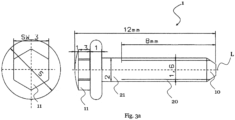
- Fig. 3a shows a further preferred embodiment of a temporary dental implant 1 with thread-shaped projections 20 with a thread core of 1.6 mm, a total length of 12 mm and a thread length of 8.0 mm.
- Fig. 4a another preferred embodiment of a temporary dental implant 1 with thread-shaped projections 20 with a Thread core of 2 mm, a total length of 14 mm and a thread length of 11.2 mm.
- Fig. 4b a further preferred embodiment of a temporary dental implant 1 with thread-shaped projections 20 with a thread core of 2 mm, a total length of 14 mm and a thread length of 7.2 mm.
- Fig.5 a further preferred embodiment of a temporary dental implant 1 with thread-shaped projections 20 with a thread core of 2.4 mm, a total length of 16 mm and a thread length of 12 mm.
- Fig.6 a further preferred embodiment of a temporary dental implant 1 with thread-shaped projections 20 with a thread core of 2.4 mm and a thread length of 14.5 mm and a total length of 18 mm.
- Fig.7 a further preferred embodiment of a temporary dental implant 1 with thread-shaped projections 20 with a thread core of 2.4 mm and a thread length of 14.5 mm and a total length of 20 mm.
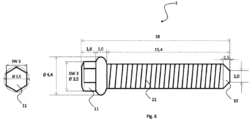
- Fig.8 shows a further preferred embodiment of a temporary dental implant 1 with thread-shaped projections, with a thread core of 2.4 mm and a thread length of 15.4 mm and a total length of 18 mm.
- the preferred embodiments of the temporary dental implant according to the invention preferably have total lengths of 10 mm, 14 mm, 16 mm, 18 mm and 20 mm and preferably thread lengths of 7.2 mm, 9.2 mm, 11.2 mm, 12 mm, 14.5 mm and 15.4 mm.
- the surfaces of the temporary dental implants are advantageously smooth, not roughened or treated. As a result, the growth of the temporary dental implant into the bone can be delayed. The edges of the screw body 11 are broken.
- Fig. 9a shows a screw adapter 40 comprising a screw receptacle 41 and a temporary dental implant 1 with a screw body 21.
- the screw receptacle 41 and the screw adapter 40 advantageously comprise a body made of a material combination of a zirconium oxide (ZrO 2 ) and an aluminum oxide (Al 2 O 3 ) or a material combination of a zirconium oxide (ZrO 2 ) and a dimer trioxide (Er 2 O 3 ).
- the screw receptacle 41 and the screw adapter 40 can also comprise a zirconium ceramic such as a TZP ceramic, an ATZ ceramic and/or a ZTA ceramic and/or a TZ-PX-525 ceramic.
- the screw body 21 made of a material combination of a zirconium oxide (ZrO 2 ) and an aluminum oxide (Al 2 O 3 ) or a material combination of a zirconium oxide (ZrO 2 ) and a diatomaceous earth trioxide (Er 2 O 3 ) is firmly connected to a screw adapter 40 and transmits a torque M from a drive (not shown) to the screw head 11.
- Fig. 9b shows a screw adapter 40 comprising a screw receptacle 41 and a temporary dental implant 1 with a screw body 21.
- the screw adapter 40 in this embodiment comprises a continuous body made of a material combination of a zirconium oxide (ZrO 2 ) and an aluminum oxide (Al 2 O 3 ) or a material combination of a zirconium oxide (ZrO 2 ) and a diatomite trioxide (Er 2 O 3 ), which transmits the torque M from the drive (not shown) to the screw head 11.
- the surface of the screw adapter 41 comprises a material combination of a zirconium oxide (ZrO 2 ) and an aluminum oxide (Al 2 O 3 ) or a material combination of a zirconium oxide (ZrO 2 ) and a diatomite trioxide (Er 2 O 3 ) and provides the screw receptacle 41.
- Fig.10 shows different views of a preferred embodiment of a screw adapter 40.
- the materials used consisting of a material combination of zirconium oxide (ZrO 2 ) and aluminum oxide (Al 2 O 3 ) or a material combination of zirconium oxide (ZrO 2 ) and dimer trioxide (Er 2 O 3 ), as well as their material combinations, have the advantageous material properties of being neutral, biocompatible, non-metallic, non-magnetic, non-conductive and non-radioactive. These materials and material combinations do not react with body fluids. Even if these materials and material combinations are exposed to strong acids, these materials are not attacked. They are stable, corrosion-resistant and durable.
- the temporary dental implant can be screwed in and/or removed germ-free and sterile and abrasion on the screw head of the temporary dental implant is avoided.
- Fig. 11 shows a temperature-pressure curve of a preferred embodiment of a HIP cycle.
- a pressure vessel filled with samples is evacuated for a period of 5 minutes at about 1.2 mbar. After 3 purging cycles with a protective gas such as argon, the pressure vessel is evacuated again for a period of about 5 minutes at about 1.2 mbar.
- the pressure is then built up to 200 bar.
- the temperature is then increased to approx. 1350°C at a rate of 10 K/min. During the heating process, the pressure is further increased to approx. 1500 bar.
- Figure 12 is a schematic view of drilling and inserting a temporary dental implant into a patient's base bone.
- a maximum permissible torque is applied depending on the diameter of the temporary dental implant 1.
- the screwdriver 45 includes another screw adapter that can be brought into engagement with the screw adapter 40.
- the final fixation is carried out using a torque ratchet 47. This ensures that the maximum permissible torque is not exceeded and that impairment or damage to the temporary dental implant 1 is prevented.
Landscapes
- Chemical & Material Sciences (AREA)
- Engineering & Computer Science (AREA)
- Ceramic Engineering (AREA)
- Health & Medical Sciences (AREA)
- Manufacturing & Machinery (AREA)
- Materials Engineering (AREA)
- Structural Engineering (AREA)
- Organic Chemistry (AREA)
- Composite Materials (AREA)
- Oral & Maxillofacial Surgery (AREA)
- Orthopedic Medicine & Surgery (AREA)
- Dentistry (AREA)
- Epidemiology (AREA)
- Life Sciences & Earth Sciences (AREA)
- Animal Behavior & Ethology (AREA)
- General Health & Medical Sciences (AREA)
- Public Health (AREA)
- Veterinary Medicine (AREA)
- Inorganic Chemistry (AREA)
- Materials For Medical Uses (AREA)
- Dental Preparations (AREA)
- Dental Prosthetics (AREA)
Applications Claiming Priority (1)
| Application Number | Priority Date | Filing Date | Title |
|---|---|---|---|
| DE102023000090.6A DE102023000090A1 (de) | 2023-01-12 | 2023-01-12 | Temporäres Zahnimplantat sowie ein Verfahren zur Herstellung eines temporären Zahnimplantats |
Publications (2)
| Publication Number | Publication Date |
|---|---|
| EP4410233A2 true EP4410233A2 (fr) | 2024-08-07 |
| EP4410233A3 EP4410233A3 (fr) | 2024-11-13 |
Family
ID=89573621
Family Applications (1)
| Application Number | Title | Priority Date | Filing Date |
|---|---|---|---|
| EP24151085.8A Pending EP4410233A3 (fr) | 2023-01-12 | 2024-01-10 | Implant dentaire temporaire ainsi qu'un procédé de fabrication d'un implant dentaire temporaire |
Country Status (2)
| Country | Link |
|---|---|
| EP (1) | EP4410233A3 (fr) |
| DE (1) | DE102023000090A1 (fr) |
Family Cites Families (9)
| Publication number | Priority date | Publication date | Assignee | Title |
|---|---|---|---|---|
| DE3325490A1 (de) * | 1983-07-14 | 1985-01-24 | Elektroschmelzwerk Kempten GmbH, 8000 München | Feuerfeste, elektrisch leitfaehige mischwerkstoffe und verfahren zu ihrer herstellung durch isostatisches heisspressen |
| EP0218853B1 (fr) * | 1985-09-06 | 1994-11-09 | Toray Industries, Inc. | Méthode de production d'un matériau de zircone fritté |
| DE102005001185B4 (de) * | 2005-01-10 | 2009-09-10 | Bongard, Peter, Dr. | Zahnimplantat |
| DE102005013200B4 (de) * | 2005-03-16 | 2014-05-28 | Peter A. Ehrl | Zweiteiliges Zahnimplantat aus Keramik |
| RU2698021C1 (ru) * | 2013-12-04 | 2019-08-21 | 3М Инновейтив Пропертиз Компани | Стоматологическая заготовка для фрезерования, способ ее изготовления и использования |
| WO2015168332A2 (fr) * | 2014-04-30 | 2015-11-05 | Osseodyne Surgical Solutions, Llc | Implant chirurgical pour osséo-intégration |
| EP3659989A1 (fr) * | 2018-11-29 | 2020-06-03 | Ivoclar Vivadent AG | Barbotine et procédé de fabrication de structures tridimensionnelles céramiques et vitrocéramiques |
| EP3811896B1 (fr) * | 2019-10-22 | 2024-05-01 | Nadja Rohr | Implant dentaire |
| DE102020210075A1 (de) * | 2020-08-07 | 2022-02-10 | Nature Implants GmbH | Dentalimplantat |
-
2023
- 2023-01-12 DE DE102023000090.6A patent/DE102023000090A1/de active Pending
-
2024
- 2024-01-10 EP EP24151085.8A patent/EP4410233A3/fr active Pending
Also Published As
| Publication number | Publication date |
|---|---|
| EP4410233A3 (fr) | 2024-11-13 |
| DE102023000090A1 (de) | 2024-07-18 |
Similar Documents
| Publication | Publication Date | Title |
|---|---|---|
| EP1450722B1 (fr) | Implant dentaire c ramique | |
| EP2046235B9 (fr) | Implant dentaire en céramique | |
| DE102005013200B4 (de) | Zweiteiliges Zahnimplantat aus Keramik | |
| EP2688512A1 (fr) | Implant dentaire ayant une première partie à filetage conique et une seconde partie à filetage cylindrique | |
| CH615340A5 (fr) | ||
| DD281749A5 (de) | Implantat fuer den ersatz eines zahnes oder ausserhalb des knochengewebes | |
| DE202010018144U1 (de) | Universaldistraktor zur Knochenregeneration | |
| DE202007004943U1 (de) | Schraubenimplantat für einen Kieferknochen | |
| EP1216010A1 (fr) | Implant dentaire intra-osseux en forme de vis | |
| WO2015185597A2 (fr) | Membrane de distraction à base de magnésium | |
| EP2986247B1 (fr) | Implant dentaire d'un seul tenant, kit comprenant un implant dentaire et un dispositif de cintrage d'un implant | |
| EP2018878A1 (fr) | Implants en zircon et en céramique dotés d'un revêtement en titane ou en oxyde de titane de la partie introaosseuse | |
| EP4410233A2 (fr) | Implant dentaire temporaire ainsi qu'un procédé de fabrication d'un implant dentaire temporaire | |
| EP3995102B1 (fr) | Vis de reconstitution osseuse ainsi que système de modification d'un os humain ou animal | |
| DE3034086C2 (de) | Verankerungsvorrichtung für die Befestigung von Zähnen oder Zahnprothesen | |
| EP3897448B1 (fr) | Implant dentaire | |
| CH673579A5 (fr) | ||
| DE102005001185B4 (de) | Zahnimplantat | |
| EP3151780A1 (fr) | Implant de distraction à mécanisme amélioré | |
| EP3914188B1 (fr) | Vis occlusale, système d'implant dentaire et ensemble | |
| EP2438885A1 (fr) | Implant dentaire monopièce et instrument de pliage | |
| DE102009011461A1 (de) | Knochenschraube | |
| DE202010002259U1 (de) | Einteiliges Zahnimplantat aus Zirkonoxidkeramik | |
| EP3197387A1 (fr) | Implant de distraction avec mécanisme amélioré | |
| DE202020107610U1 (de) | Stützstruktur zur Fixierung eines Dentalimplantats, insbesondere eines Dentalimplantatskörpers |
Legal Events
| Date | Code | Title | Description |
|---|---|---|---|
| PUAI | Public reference made under article 153(3) epc to a published international application that has entered the european phase |
Free format text: ORIGINAL CODE: 0009012 |
|
| STAA | Information on the status of an ep patent application or granted ep patent |
Free format text: STATUS: THE APPLICATION HAS BEEN PUBLISHED |
|
| AK | Designated contracting states |
Kind code of ref document: A2 Designated state(s): AL AT BE BG CH CY CZ DE DK EE ES FI FR GB GR HR HU IE IS IT LI LT LU LV MC ME MK MT NL NO PL PT RO RS SE SI SK SM TR |
|
| PUAL | Search report despatched |
Free format text: ORIGINAL CODE: 0009013 |
|
| AK | Designated contracting states |
Kind code of ref document: A3 Designated state(s): AL AT BE BG CH CY CZ DE DK EE ES FI FR GB GR HR HU IE IS IT LI LT LU LV MC ME MK MT NL NO PL PT RO RS SE SI SK SM TR |
|
| RIC1 | Information provided on ipc code assigned before grant |
Ipc: C04B 35/486 20060101ALI20241009BHEP Ipc: C04B 35/645 20060101ALI20241009BHEP Ipc: C04B 35/488 20060101ALI20241009BHEP Ipc: A61C 8/00 20060101AFI20241009BHEP |
|
| STAA | Information on the status of an ep patent application or granted ep patent |
Free format text: STATUS: REQUEST FOR EXAMINATION WAS MADE |
|
| 17P | Request for examination filed |
Effective date: 20250512 |
|
| STAA | Information on the status of an ep patent application or granted ep patent |
Free format text: STATUS: EXAMINATION IS IN PROGRESS |