EP4410536A2 - Film - Google Patents
Film Download PDFInfo
- Publication number
- EP4410536A2 EP4410536A2 EP24175790.5A EP24175790A EP4410536A2 EP 4410536 A2 EP4410536 A2 EP 4410536A2 EP 24175790 A EP24175790 A EP 24175790A EP 4410536 A2 EP4410536 A2 EP 4410536A2
- Authority
- EP
- European Patent Office
- Prior art keywords
- film
- naked collation
- layer
- outer sealing
- sealing layer
- Prior art date
- Legal status (The legal status is an assumption and is not a legal conclusion. Google has not performed a legal analysis and makes no representation as to the accuracy of the status listed.)
- Pending
Links
Images



Classifications
-
- B—PERFORMING OPERATIONS; TRANSPORTING
- B32—LAYERED PRODUCTS
- B32B—LAYERED PRODUCTS, i.e. PRODUCTS BUILT-UP OF STRATA OF FLAT OR NON-FLAT, e.g. CELLULAR OR HONEYCOMB, FORM
- B32B27/00—Layered products comprising a layer of synthetic resin
- B32B27/06—Layered products comprising a layer of synthetic resin as the main or only constituent of a layer, which is next to another layer of the same or of a different material
- B32B27/08—Layered products comprising a layer of synthetic resin as the main or only constituent of a layer, which is next to another layer of the same or of a different material of synthetic resin
-
- B—PERFORMING OPERATIONS; TRANSPORTING
- B29—WORKING OF PLASTICS; WORKING OF SUBSTANCES IN A PLASTIC STATE IN GENERAL
- B29C—SHAPING OR JOINING OF PLASTICS; SHAPING OF MATERIAL IN A PLASTIC STATE, NOT OTHERWISE PROVIDED FOR; AFTER-TREATMENT OF THE SHAPED PRODUCTS, e.g. REPAIRING
- B29C43/00—Compression moulding, i.e. applying external pressure to flow the moulding material; Apparatus therefor
- B29C43/22—Compression moulding, i.e. applying external pressure to flow the moulding material; Apparatus therefor of articles of indefinite length
- B29C43/30—Making multilayered or multicoloured articles
-
- B—PERFORMING OPERATIONS; TRANSPORTING
- B32—LAYERED PRODUCTS
- B32B—LAYERED PRODUCTS, i.e. PRODUCTS BUILT-UP OF STRATA OF FLAT OR NON-FLAT, e.g. CELLULAR OR HONEYCOMB, FORM
- B32B27/00—Layered products comprising a layer of synthetic resin
- B32B27/32—Layered products comprising a layer of synthetic resin comprising polyolefins
-
- B—PERFORMING OPERATIONS; TRANSPORTING
- B32—LAYERED PRODUCTS
- B32B—LAYERED PRODUCTS, i.e. PRODUCTS BUILT-UP OF STRATA OF FLAT OR NON-FLAT, e.g. CELLULAR OR HONEYCOMB, FORM
- B32B27/00—Layered products comprising a layer of synthetic resin
- B32B27/32—Layered products comprising a layer of synthetic resin comprising polyolefins
- B32B27/327—Layered products comprising a layer of synthetic resin comprising polyolefins comprising polyolefins obtained by a metallocene or single-site catalyst
-
- B—PERFORMING OPERATIONS; TRANSPORTING
- B32—LAYERED PRODUCTS
- B32B—LAYERED PRODUCTS, i.e. PRODUCTS BUILT-UP OF STRATA OF FLAT OR NON-FLAT, e.g. CELLULAR OR HONEYCOMB, FORM
- B32B7/00—Layered products characterised by the relation between layers; Layered products characterised by the relative orientation of features between layers, or by the relative values of a measurable parameter between layers, i.e. products comprising layers having different physical, chemical or physicochemical properties; Layered products characterised by the interconnection of layers
- B32B7/02—Physical, chemical or physicochemical properties
- B32B7/027—Thermal properties
-
- B—PERFORMING OPERATIONS; TRANSPORTING
- B65—CONVEYING; PACKING; STORING; HANDLING THIN OR FILAMENTARY MATERIAL
- B65D—CONTAINERS FOR STORAGE OR TRANSPORT OF ARTICLES OR MATERIALS, e.g. BAGS, BARRELS, BOTTLES, BOXES, CANS, CARTONS, CRATES, DRUMS, JARS, TANKS, HOPPERS, FORWARDING CONTAINERS; ACCESSORIES, CLOSURES, OR FITTINGS THEREFOR; PACKAGING ELEMENTS; PACKAGES
- B65D71/00—Bundles of articles held together by packaging elements for convenience of storage or transport, e.g. portable segregating carrier for plural receptacles such as beer cans or pop bottles; Bales of material
- B65D71/06—Packaging elements holding or encircling completely or almost completely the bundle of articles, e.g. wrappers
- B65D71/08—Wrappers shrunk by heat or under tension, e.g. stretch films or films tensioned by compressed articles
-
- B—PERFORMING OPERATIONS; TRANSPORTING
- B65—CONVEYING; PACKING; STORING; HANDLING THIN OR FILAMENTARY MATERIAL
- B65D—CONTAINERS FOR STORAGE OR TRANSPORT OF ARTICLES OR MATERIALS, e.g. BAGS, BARRELS, BOTTLES, BOXES, CANS, CARTONS, CRATES, DRUMS, JARS, TANKS, HOPPERS, FORWARDING CONTAINERS; ACCESSORIES, CLOSURES, OR FITTINGS THEREFOR; PACKAGING ELEMENTS; PACKAGES
- B65D75/00—Packages comprising articles or materials partially or wholly enclosed in strips, sheets, blanks, tubes or webs of flexible sheet material, e.g. in folded wrappers
- B65D75/38—Articles or materials enclosed in two or more wrappers disposed one inside the other
-
- B—PERFORMING OPERATIONS; TRANSPORTING
- B32—LAYERED PRODUCTS
- B32B—LAYERED PRODUCTS, i.e. PRODUCTS BUILT-UP OF STRATA OF FLAT OR NON-FLAT, e.g. CELLULAR OR HONEYCOMB, FORM
- B32B2250/00—Layers arrangement
- B32B2250/03—3 layers
-
- B—PERFORMING OPERATIONS; TRANSPORTING
- B32—LAYERED PRODUCTS
- B32B—LAYERED PRODUCTS, i.e. PRODUCTS BUILT-UP OF STRATA OF FLAT OR NON-FLAT, e.g. CELLULAR OR HONEYCOMB, FORM
- B32B2250/00—Layers arrangement
- B32B2250/04—4 layers
-
- B—PERFORMING OPERATIONS; TRANSPORTING
- B32—LAYERED PRODUCTS
- B32B—LAYERED PRODUCTS, i.e. PRODUCTS BUILT-UP OF STRATA OF FLAT OR NON-FLAT, e.g. CELLULAR OR HONEYCOMB, FORM
- B32B2250/00—Layers arrangement
- B32B2250/05—5 or more layers
-
- B—PERFORMING OPERATIONS; TRANSPORTING
- B32—LAYERED PRODUCTS
- B32B—LAYERED PRODUCTS, i.e. PRODUCTS BUILT-UP OF STRATA OF FLAT OR NON-FLAT, e.g. CELLULAR OR HONEYCOMB, FORM
- B32B2250/00—Layers arrangement
- B32B2250/24—All layers being polymeric
- B32B2250/242—All polymers belonging to those covered by group B32B27/32
-
- B—PERFORMING OPERATIONS; TRANSPORTING
- B32—LAYERED PRODUCTS
- B32B—LAYERED PRODUCTS, i.e. PRODUCTS BUILT-UP OF STRATA OF FLAT OR NON-FLAT, e.g. CELLULAR OR HONEYCOMB, FORM
- B32B2264/00—Composition or properties of particles which form a particulate layer or are present as additives
- B32B2264/10—Inorganic particles
- B32B2264/102—Oxide or hydroxide
- B32B2264/1021—Silica
-
- B—PERFORMING OPERATIONS; TRANSPORTING
- B32—LAYERED PRODUCTS
- B32B—LAYERED PRODUCTS, i.e. PRODUCTS BUILT-UP OF STRATA OF FLAT OR NON-FLAT, e.g. CELLULAR OR HONEYCOMB, FORM
- B32B2270/00—Resin or rubber layer containing a blend of at least two different polymers
-
- B—PERFORMING OPERATIONS; TRANSPORTING
- B32—LAYERED PRODUCTS
- B32B—LAYERED PRODUCTS, i.e. PRODUCTS BUILT-UP OF STRATA OF FLAT OR NON-FLAT, e.g. CELLULAR OR HONEYCOMB, FORM
- B32B2307/00—Properties of the layers or laminate
- B32B2307/30—Properties of the layers or laminate having particular thermal properties
- B32B2307/31—Heat sealable
-
- B—PERFORMING OPERATIONS; TRANSPORTING
- B32—LAYERED PRODUCTS
- B32B—LAYERED PRODUCTS, i.e. PRODUCTS BUILT-UP OF STRATA OF FLAT OR NON-FLAT, e.g. CELLULAR OR HONEYCOMB, FORM
- B32B2307/00—Properties of the layers or laminate
- B32B2307/40—Properties of the layers or laminate having particular optical properties
- B32B2307/412—Transparent
-
- B—PERFORMING OPERATIONS; TRANSPORTING
- B32—LAYERED PRODUCTS
- B32B—LAYERED PRODUCTS, i.e. PRODUCTS BUILT-UP OF STRATA OF FLAT OR NON-FLAT, e.g. CELLULAR OR HONEYCOMB, FORM
- B32B2307/00—Properties of the layers or laminate
- B32B2307/70—Other properties
- B32B2307/746—Slipping, anti-blocking, low friction
-
- B—PERFORMING OPERATIONS; TRANSPORTING
- B32—LAYERED PRODUCTS
- B32B—LAYERED PRODUCTS, i.e. PRODUCTS BUILT-UP OF STRATA OF FLAT OR NON-FLAT, e.g. CELLULAR OR HONEYCOMB, FORM
- B32B2553/00—Packaging equipment or accessories not otherwise provided for
Definitions
- the present invention concerns a naked collation film, a naked collation package and a method of forming a naked collation package comprising said naked collation film.
- Naked collation is an effective way to reduce packaging costs and materials.
- a number of individually packaged articles for example cigarette packs
- Naked collation eliminates the need for the box or carton, thereby reducing packaging materials.
- a naked collation film An essential characteristic of a naked collation film is that it must be capable of sealing to itself, but not (under the selected sealing conditions) to the film used to wrap each individual packet. It is therefore evident that a naked collation film must comprise inner and outer surfaces that are sealable to each other but not (under the selected sealing conditions) to the individual packet film (also known as the unit wrap film).
- a naked collation film Another essential characteristic of a naked collation film is that it must be non-blocking. That is to say, it must not have a tendency to stick to itself even under the somewhat harsh conditions of temperature and pressure that may prevail in for example a shipping container or warehouse wherein multiple packages are likely to be stacked upon each other, or in compilation immediately post-production when the packs may still be somewhat warm following production. "Pack-to-pack blocking" under such circumstances is highly undesirable.
- WO2009024810 is concerned with a naked collation package comprising an arrangement of individual packages, individually packaged in a polyolefinic filmic material, that are packed together in said naked collation package in a naked collation film, wherein the naked collation film comprises a sealable polyolefin film having a polyolefinic core layer C, an polyolefinic inner sealing layer A and a polyolefinic outer sealing layer B, the polyolefinic material of the inner sealing layer A being selected for sealing incompatibility with the filmic polyolefinic material of the individual packages under a specified sealing condition, and the polyolefinic material of the outer sealing layer B being selected for sealing compatibility with B and for sealing compatibility with A under the selected sealing condition, the individual packages being arranged in an ordered configuration inside the package and with the naked collation film wrapped around the ordered configuration of individual packages and sealed to itself (A to B) at a girth seal, and sealed to itself (B to B and optionally A to B) at envelope seals at each end of the
- WO2012164308 describes a method for forming a naked collation package comprising a) providing an arrangement of packages individually wrapped in a filmic material; b) providing a naked collation film for nakedly wrapping said individually wrapped packages, the naked collation film comprising a polyolefinic core layer C, an inner sealing layer A on the inner surface of the naked collation film and a polyolefinic outer sealing layer B on the outer surface of the naked collation film, the material of the inner sealing layer A being selected for sealing incompatibility with the filmic material of the individually wrapped packages under a specified sealing condition and heat shrinking condition, and the polyolefinic material of the outer sealing layer B being selected for sealing compatibility with B and for sealing compatibility with A under the specified sealing condition, wherein layers A and B are formed of different materials and layer B comprises at least one polyolefinic polymer and an antiblock component comprising at least 0.2% by weight of the layer of silicone; c) arranging the individually wrapped packages in an ordered configuration; d) arranging the naked collation film
- WO2018096480 describes a biaxially oriented multilayer film particularly suitable for use as the external covering of articles packaged individually (naked collation packaging), wherein said biaxially oriented multilayer film comprises at least one external layer (A) comprising at least one ethylene polymer having a melting point ⁇ 100°C, one central layer (B) which comprises at least one propylene polymer having a melting point ⁇ 140°C, and one internal layer (C) comprising at least one ethylene polymer having a melting point 105°C-115°C and density 0.910-0.940 g/cm3.
- A external layer
- B which comprises at least one propylene polymer having a melting point ⁇ 140°C
- C internal layer comprising at least one ethylene polymer having a melting point 105°C-115°C and density 0.910-0.940 g/cm3.
- US6358579 discloses sealable layers of individual packaging films composed of an ethylene homopolymer, of a copolymer of propylene as principal component and ethylene, preferably in amounts of not more than 10% by weight (based on the copolymer), of a copolymer of propylene as principal component and 1-butene, preferably in amounts of from 10 to 15% by weight (based on the copolymer), of a terpolymer made from propylene, ethylene and an alpha-olefin having from 4 to 10 carbon atoms, preferably one made from 93.2 to 99.0% by weight of propylene, from 0.5 to 1.9% by weight of ethylene and from 0.5 to 4.9% by weight of an alpha-olefin having from 4 to 10 carbon atoms, or of a mixture of these polymers.
- US6777067 discloses a polypropylene film comprising at least one heat-sealable layer, and contains an extensive listing of suitable heat-sealable olefinic polymers, including copolymers and terpolymers.
- US5900294 discloses a polyolefinic multilayer film comprises a base layer containing polypropylene and at least one outer layer.
- the outer layer comprises a C3/C4-olefin resin composition with a low degree of crystallinity and has a minimum heat-sealing temperature of below 84 DEG C.
- a process for the production of the multilayer film and the use thereof are also said to be described.
- EP0645417 discloses a biaxially oriented polypropylene film whose n-heptane-insoluble content has a chain isotacticity index, measured by ⁇ 13>C-NMR spectroscopy, of at least 95%.
- the base layer contains from 1 to 15% by weight of a natural or synthetic resin having a softening point of from 70 to 170 DEG C.
- the disclosure is also said to relate to a process for the production of the polypropylene film and to the use thereof.
- DE3635928 discloses a multipack system comprising an arrangement of individual packs in which the individual packing takes place in a biaxially stretch-oriented polypropylene film having modified polyolefinic heat-sealing layers.
- the characterising features of the multipack system are said to be that the outer wrapping film comprises a heat-sealable, biaxially stretch-oriented multilayer polypropylene film produced by coextrusion with a symmetrical structure in which the outer layers contain an added low-molecular-weight hydrocarbon resin and have been corona-treated.
- the multipack system according to the disclosure is said to be distinguished by the fact that the outer wrapping film is heat-sealable to itself, but does not heat-seal the biaxially oriented polypropylene films of the individual packs.
- US5302427 discloses a printable, biaxially oriented polyolefin multilayer packaging film which is low-temperature sealing on both sides and comprises a base layer and at least one sealing layer on each side of the base layer, the base layer containing a peroxide-degraded propylene homopolymer and each sealing layer containing an ethylene/propylene/butylene terpolymer and a propylene/butylene copolymer, one outer sealing layer containing a polydiorganosiloxane and silicon dioxide particles and not being corona-treated and the polydiorganosiloxane being added in the form of a masterbatch during the film production.
- US5436041 discloses a transparent, printable, biaxially orientated polyolefin multilayer packaging film which can be sealed on both sides, having a base layer B and different top layers A and C located on both sides thereof in accordance with a layer build-up of ABC.
- the base layer B contains a peroxidically degraded polypropylene polymer having a degradation factor in the range from about 3 to about 10.
- Top layer A contains a polymer mixture of two or more of the following co- and/or terpolymers: a copolymer of ethylene and propylene or ethylene and butylene or propylene and butylene or ethylene and another alpha -olefin having 5 to 10 carbon atoms or propylene and another alpha -olefin having 5 to 10 carbon atoms, or a terpolymer of ethylene and propylene and butylene or ethylene and propylene and another alpha -olefin having 5 to 10 carbon atoms.
- This polymer mixture of top layer A further contains a high-viscosity polydiorganosiloxane and silicon dioxide and, optionally, other added additives.
- Top layer C contains a copolymer of ethylene and propylene or ethylene and butylene or propylene and butylene or ethylene and another alpha -olefin having 5 to 10 carbon atoms or propylene and another alpha -olefin having 5 to 10 carbon atoms, or a terpolymer of ethylene and propylene and butylene or ethylene and propylene and another alpha -olefin having 5 to 10 carbon atoms and, optionally, other additives.
- Top-layer C has a non-cohesive covering of polydialkylsiloxane on its outer surface.
- US2013011669 discloses heat-sealable, oriented, multilayer films including i) a polyolefin core layer; and ii) a heat-sealable layer a blend of 10.0 wt % to 50.0 wt % of a propylene-based elastomer and 50.0 wt % to 90.0 wt % of a propylene-based polymer, wherein the heat-sealable layer includes less than 1.0 wt % ethylene homopolymer or ethylene-based copolymer and wherein the heat-sealable layer has a Haze of ⁇ 5.0 and a seal strength of ⁇ 2.00 ⁇ 102 g/2.54 cm at 82° C. (180° F.).
- the heat-sealable layer has a Haze of ⁇ 5.0 and a seal strength of ⁇ 3.00 ⁇ 102 g/2.54 cm at 90° C. (194° F.).
- EP3034300 discloses multilayer films for naked collation of packed products to form packs of 6 or more packed pieces comprising at least a core layer, an inner layer and an outer layer consisting of one or more olefin (co)polymers wherein outer layer (co)polymers having a melting temperature in the range 65°C-85°C, inner layer (co)polymers having a melting temperature in the range 65°C-105°C, core layer propylene and/or butene (co)polymers having melting temperature higher than 140°C, wherein the film wrapping the single packed units is formed of one or more olefin (co)polymers having melting temperature higher than 120°C, the inner layer of the multilayer films being in contact with the film wrapping the single packed units (film O) forming the package the outer layer of the multilayer film has a thickness comprised between 0.35 and ⁇ 0.5 ⁇ m.
- the object of the present invention is to provide a naked collation film with improved performance, for example with respect to providing a high incompatibility window, good sealing conditions at low sealing temperatures and strong optical performance whilst avoiding problems of pack-to-pack blocking.
- the invention provides a naked collation film comprising a polyolefinic inner sealing layer on one surface of the film and a polyolefinic outer sealing layer on the opposite surface of the film, the outer sealing layer being sealable to itself and to the inner sealing layer and both the inner and outer sealing layers comprising C4, and at least one of C2 and C3 polyolefins, preferably C2, C3 and C4 polyolefins, wherein at least one of the sealing layers has a C4 polyolefin content of greater than 10mol%, preferably greater than 10.5 mol%, more preferably greater than 11.0mol%, still more preferably greater than 11.5mol%, most preferably greater than 12.0mol% relative to the total polyolefin content of that sealing layer.
- the invention provides a naked collation film comprising a polyolefinic inner sealing layer on one surface of the film and a polyolefinic outer sealing layer on the opposite surface of the film, the outer sealing layer being sealable to itself and to the inner sealing layer and both the inner and outer sealing layers comprising C2 and C4, and optionally also C3 polyolefin, preferably C2, C3 and C4 polyolefins, wherein at least one of the sealing layers has a C4:C2 molar ratio of at least 1.2, preferably at least 1.5, more preferably at least 1.6, most preferably at least 1.7.
- the invention provides a naked collation film comprising a polyolefinic inner sealing layer on one surface of the film and a polyolefinic outer sealing layer on the opposite surface of the film, the outer sealing layer being sealable to itself and to the inner sealing layer and both the inner and outer sealing layers comprising C3 and C4 polyolefins, and optionally also C2 polyolefin, preferably C2, C3 and C4 polyolefins, wherein at least one of the sealing layers has a C4:C3 molar ratio of at least 0.15, preferably at least 0.16, more preferably at least 0.17, most preferably at least 0.20.
- naked collation films according to the above aspects are non-blocking.
- non-blocking is meant that the films pass the pack-to-pack blocking test detailed herein.
- the invention also provides naked collation package comprising a plurality of individually wrapped packages packaged within a sealed naked collation film as defined above.
- each individually wrapped package comprises a further polyolefin film in contact with said inner sealing layer.
- the further polyolefin film may or may not contain C4, and will typically contain at least two of C2, C3 and C4, or at least one of C2, C3 and C4 in combination with other polymers or copolymers or blends thereof, such as copolymers including C6 and/or C8.
- the further polyolefin film may be a multi-layer film, in which case the outer layer (which in use of the invention will generally be in contact with the inner sealing layer of the naked collation film) may or may not contain C4, and will typically contain at least two of C2, C3 and C4.
- in means the inner or outer surface of a layer of the naked collation film, the naked collation film, the unit wrap film and/or the film in use.
- the use of such term to designate the surface of the layers should not be taken as limiting and it would be understood by the skilled person that "in” and “inner” or “out” and “outer” are interchangeable.
- in/IN would be construed to be the same as “inner/inner”.
- the invention also provides a method for forming a naked collation package comprising:
- there may be an additional step comprising heat shrinking the naked collation film by exposing it to a heat shrinking condition, causing the naked collation film to shrink and closely surround the arrangement of packages, without being sealed to the packages.
- the method preferably further comprises one or more of the following steps, which can be performed before or after any of steps a) to d), if appropriate: a-1) forming a film tube with overlapping edges; a-2) forming a girth seal by sealing together the overlapping edges of a film tube; a-3) forming envelope seals at each end of the package by folding in a film tube and sealing the folded ends.
- the inventors of the present invention have surprisingly found that a naked collation film with a monomeric ratio content as provided herein is advantageous for many reasons.
- the naked collation film wrap according to the present invention exhibits an increased performance incompatibility window (i.e., an increased range of sealing temperature of the naked collation film below the temperature at which (undesirable) sealing occurs between the naked collation film and the film of an individually wrapped package within the naked collation film).
- the naked collation films of the invention exhibit advantageously low seal initiation temperatures and strong optical properties.
- At least the outer sealing layer of the naked collation film comprises at least one copolymer or terpolymer having a melting point above 75°C, preferably above 80°C.
- multilayer film is to be construed in accordance with the normal use of the word to relate to a film comprising at least 2 layers.
- the multilayer film may, for example, comprise at least 2 layers, at least 3 layers, at least 4 layers, or more.
- the film may comprise an inner layer, an outer layer, and at least one core layer.
- any characteristics or the like described in accordance with the "multilayer film” of the invention may be construed to refer to the characteristics of the multilayer film itself (i.e. including all the layers present in the multilayer film) and/or referring to one or more of the individual layers of said multilayer film.
- Such disclosure will be clear to the skilled person.
- the monomeric ratios of the polymeric film for example the monomeric ratio of C4/C3, is to be construed as the average monomeric molar ratio of the polymers in the particular layer of the multilayer film being referred to in context. Therefore, the monomeric content will typically be spoken of in the context of the monomeric ratio of one or more of the individual layers of said multilayer film.
- the multilayer polymeric film may optionally comprise a blend of polyolefinic copolymers.
- Each polyolefinic copolymer may optionally comprise at least one copolymer of propylene and ethylene or butylene.
- the polyolefinic copolymer may optionally comprise at least one terpolymer, optionally wherein the terpolymer is of ethylene, propylene and butene.
- copolymers in this sense it is meant any number of constituent polymer parts, for example, ethylene, propylene, butene, or any olefin having up to 10 carbon atoms.
- Bipolymers, terpolymers and copolymers of four or more constituent polymer parts fall under the term "copolymer", for example.
- both random and block copolymers are included in this definition and said multilayer polymer film and/or the individual layers of said film may additionally or alternatively comprise blends of one or more homopolymers, copolymers or mixtures thereof.
- the inner and/or outer layers of the multilayer film may be the same or different.
- the multilayer polymeric film comprises at least one terpolymer of ethylene, propylene and butene
- propylene is preferably present as the principal constituent.
- composition of the inner and outer sealing layer of the naked collation film may be the same or different.
- the inner layer and/or the outer sealing layer of the film may optionally comprise C2 olefinic polymer in an amount of between about 0 and about 20 mol%, for example between about 1 and about 15 mol%, or from about 2 to about 12 mol %.
- the inner layer and/or the outer sealing layer of the film may optionally comprise C3 olefinic polymer in an amount of between about 55 mol% and about 95 mol%, between about 60 mol% and about 90 mol%, between about 65 mol% and about 85 mol%, between about 70 mol% and about 85 mol%.
- the inner sealing layer and/or the outer sealing layer of the film may comprise C4 olefinic polymer in an amount of between about 10 mol% and about 40 mol%, for example between about 10 mol% and about 35 mol%, for example between about 10 mol% and about 30 mol%, for example between about 10 mol% and about 25 mol%, for example between about 10 mol% and about 20 mol%.
- One or both of the inner and outer sealing layers may comprise C2, C3 and C4 polyolefins.
- One or both of the inner and outer sealings layers may comprise at least two co-polymers and/or one terpolymer.
- the inner and/or outer layer layers of the multilayer polymeric film are to be construed as sealing layers.
- the naked collation multilayer film may for example have sealing compatibility with itself (A to B, A to A and/or B to B) at the sealing condition, but has sealing incompatibility (at the sealing condition) with the filmic polyolefinic material of an individually wrapped package.
- sealing incompatibility is by providing films according as described herein.
- sealing compatibility or “compatibility” is to be construed to mean that the seal strength at the sealing condition is at least 200g/25mm.
- sealing compatibility refers to a substantial functional seal at the selected sealing condition between respective sealing layers (whether inner or outer) of the multilayer polymeric film.
- sealing incompatibility or “incompatibility” is to be construed to mean that the seal strength at the sealing condition is less than 50g/25mm.
- sealing incompatibility refers to a substantial absence of sealing at the selected sealing condition between the inner sealing layer and the external outer surface of the filmic polyolefinic material of the individually wrapped packages.
- the naked collation film may be construed to exhibit tack between the inner layer of a naked collation film and the outer layer of a naked collation film and/or unit wrap when the film is heated to a temperature above the sealing initiation temperature.
- tack is to be construed to mean a seal strength at the sealing condition of greater than 50g/25mm, but substantially under 200g/25mm, which is undesirable.
- the films used in the processes of the present invention are preferably non-blocking and therefore exhibit good (i.e. low) thermal blocking properties.
- the inventors of the present invention have advantageously found that good thermal blocking properties are achieved with films according to the present invention due to the sealing layers comprising C4 and at least one of C2 and C3.
- the naked collation film according to the invention may optionally comprise additional layers as well as the hitherto identified inner and outer layers.
- additional layers may for example include lamination layers, printable layers, UV barrier layers, oxygen permeability or barrier layers, water vapour permeability or barrier layers, and the like.
- additional layers may be provided by co-extrusion, by post-coextrusion coating, by coextrusion coating or by combinations of two or more thereof, for example.
- the polymeric film may be made by any process in the art, including, but not limited to, cast sheet, cast film, or blown film.
- the naked collation film of the present invention can be of a variety of thicknesses according to the application requirements. For example, they may be from about 10 to about 240 ⁇ m thick, preferably from about 12 to 50 ⁇ m thick, and most preferably from about 15 to about 30 ⁇ m thick.
- Each sealing layer may for example independently have a thickness of from about 0.05 ⁇ m to about 2 ⁇ m, preferably from about 0.075 ⁇ m to about 1.5 ⁇ m, more preferably from about 0.1 ⁇ m to about 1.0 ⁇ m, most preferably from about 0.15 ⁇ m to about 0.5 ⁇ m.
- the naked collation film may optionally comprise, for example, in at least one of the layers functional materials for other purposes, for example, relating to the functional or aesthetic characteristics of the film.
- Suitable functional materials may be selected from, but are not limited to, one or more of the following, mixtures therefore and/or combinations thereof UV absorbers, dyes; pigments, colorants, metallised and/or pseudo-metallised coatings; lubricants, anti-static agents (cationic, anionic and/or non-ionic, e.g. poly-(oxyethylene) sorbitan monooleate), anti-oxidants (e.g. phosphorous acid, tris (2,4-di-tert-butyl phenyl) ester), surface-active agents, stiffening aids, slip aids (for example hot slips aids or cold slip aids which improve the ability of a film to slide satisfactorily across surfaces at about room temperature, e.g.
- micro-crystalline wax e.g., gloss improvers, prodegradants, barrier coatings to alter the gas and/or moisture permeability properties of the film (such as polyvinylidene halides, e.g. PVdC); anti-blocking aids (for example microcrystalline wax, e.g. with an average particle size from about 0.1 to about 0.6 ⁇ m); tack reducing additives (e.g. fumed silica, silica, silicone gum); particulate materials (e.g. talc); additives to increase COF (e.g. silicon carbide); additives to improve ink adhesion and/or printability, additives to increase stiffness and/or increase shrinkage (e.g. hydrocarbon resin and/or hydrogenated hydrocarbon resin).
- PVdC polyvinylidene halides
- anti-blocking aids for example microcrystalline wax, e.g. with an average particle size from about 0.1 to about 0.6 ⁇ m
- tack reducing additives e.g
- the hydrocarbon resin and/or hydrogenated hydrocarbon resins that may be used to increase stiffness and/or increase shrinkage may comprise one or more of C5 resins and/or C9 resins.
- suitable C5 resins and/or C9 resins may include Constab TM MA 00956 PP, Oppera TM PR 120, Regalite TM R 1125, Arkon TM P-125 and/or mixtures of two or more thereof.
- the naked collation film according to the present invention may be used as overpacking or as a wrap around a configuration of articles, for example cigarette packets, that are individually wrapped in a filmic material.
- the filmic material may, for example, be a polyolefin material.
- the filmic material may be construed as a "unit wrap".
- the unit wrap may comprise at least one layer, at least two layers, or at least three layers, for example. Accordingly, the unit wrap may at least comprise an internal and external surface.
- the external surface of the filmic material of the unit wrap preferably comprises at least one polyolefinic component. Typically these may comprise one or more of C2, C3 and/or C4, and sometimes C8 olefinic polymers. C3 olefinic polymer is the predominant material in preferred embodiments.
- the C4 mol % content of the naked collation film is preferably greater in the naked collation film than in the filmic material of the unit wrap.
- the C4 mol % content of the inner layer of the naked collation film is preferably greater in the naked collation film inner layer than in the outer layer of the filmic material of the unit wrap.
- the film material wrapping the individual packets for example a polyolefinic material, suitably comprises a polypropylenic (C3) olefinic polymer and may further comprise C2 and/or C4 olefinic polymers.
- a polyolefinic material suitably comprises a polypropylenic (C3) olefinic polymer and may further comprise C2 and/or C4 olefinic polymers.
- 16 samples of biaxially oriented film were prepared using a standard bubble process in which polymer layers are extruded from a core extruder and sealing layer extruders to create a three-layer polymer tube.
- This polymer tube passes through a cooling system and is subsequently re-heated blown to form a bubble by passing air down the inside of the polymer tube.
- This bubble is then cooled before being collapsed by convergence rollers, slit to form two polymeric film sheets, processed over rollers and surface treated by corona treatment before being collected in rolls. Further details of the bubble process may be found in, for example, EP0410792 and GB2000175.6 and Biaxial Stretching of Film, Principles and Applications, 2011, Ed. Mark T. DeMeuse, ISBN 978-1-84569-675-7 .
- a standard antiblock/slip package was added to the polymer mixture of the sealing layer(s) to assist downstream processing.
- the antiblock/slip package added to the outer layer comprised 1.2% PDMS (silicone gum) and 0.1% silica AB.
- the antiblock/slip package added to the inner layer comprised 0.5% PDMS (silica gum) and 0.1% silica AB.
- the core layer of the films were composed of polypropylene homopolymer.
- Sample 3 comprises at most 8.4 mol% C4 in its sealing layers, a C4/C2 mol ratio of at most 0.84 and a C4/C3 mol ratio of at most 0.1 and is therefore a comparative Example.
- the method used to determine the melting point (T m ) in the below examples of the polymers is similar to the method used in accordance with ASTM D3418. However, the method used for determining the T m of the polymers in Table 1 uses a faster heating rate than in ASTM D3418, thus, the observed melting point is approximately 2% higher than that seen when measured by ASTM D3418.
- the melting temperature of the polymer samples were determined by the following method: A differential scanning calorimeter (Perkin Elmer Diamond TM DSC) capable of heating or cooling at rates in excess of 20°C per minute was used.
- the DSC was first calibrated using the same heating rate as that to be used for the samples (20°C/minute).
- a known weight of indium (ca. 10mg) was crimped into an aluminium pan and heated from 0°C to 170°C at 20°C per minute using an uncalibrated temperature scale.
- the temperature scale of the instrument was checked against the observed melting point of the standard. The observed melting point for these materials should be taken as the onset of melting.
- Polymer granules were cut to size to give a mass of approximately 8.5 mg. This size adequately fits into the aluminium sample pan.
- the side of the sample facing the base of the pan should be flat and smooth.
- Films were punched out to a size approximately equal to the sample pan dimensions, for example a paper hole punch may be used to create the required size, and crimped tightly to ensure good contact is made with the base of the sample pan.
- the base of the sample pan should not be damaged or deformed to ensure good contact with the heat source.
- the sample was placed into the centre of the cell and a purge of nitrogen was maintained throughout the test at 30ml/minute to provide an inert atmosphere.
- An initial heating step was carried out at 20°C/minute from 0°C to 210°C.
- the sample was held at 210°C for three minutes to ensure complete melting had occurred and to eliminate the thermal history.
- the sample was then cooled at 20°C/minute to 0°C and a resulting cooling curve was recorded. This curve may be used for the determination of any crystallisation transitions.
- the sample was immediately re-heated to 210°C at 20°C/minute and the resulting heating curve was recorded. This curve was used for the determination of any melting transitions. The observed melting point was taken as the onset of melting.
- each sample comprises a core layer C of homopolymer (polypropylene) and two coextruded sealing layers of ethylene-propylene, or propylene-butylene copolymers or ethylene-propylene-butylene terpolymers in the blended amounts indicated in Table 2 on respective surfaces of the core layer, namely one outer layer O (designated "OUTER") and one inner layer I (designated "INNER").
- Each sample comprises in its sealing layers a blend of polymeric materials as detailed.
- the "content” column with subheadings "C2", “C3” and “C4" give the molar percentages of each polymer in the copolymer and/or terpolymer blend in a given sample and the following two columns with the heading "Sample " and subheadings "IN” and “OUT” give the molar percentages of each polymer in the copolymers and/or terpolymers constituting the INNER layer and OUTER layer respectively.
- Sample 1 comprises in its sealing layers three different components:
- the sealing initiation temperatures required for sealing the INNER and OUTER sealing layers of each of the samples were determined by the following method:
- the seal initiation temperature (SIT) is considered to be the lowest temperature at which a seal is formed under a set pressure and dwell time between two surfaces of a film, and its strength is at least 200g/25mm.
- the seal initiation temperature of the IN/OUT seal of the naked collation film was taken to be the lowest temperature at which a seal strength of at least 200g/25mm was achieved.
- the seals in these examples were prepared using an RDM heat sealer with a pressure set at 5psi and a dwell time at 0.5 seconds, in accordance with ASTM F2029.
- the seal strength was determined using an RDM seal puller, after cooling, in accordance with ASTM F88.
- the seal strength was measured using an RDM puller with a pulling speed (or jaw separation rate) at 300 mm/min. The peak strength was recorded as the seal strength.
- the RDM heat sealer jaw configuration was metal to rubber.
- the upper jaw was made of metal with a Teflon coating applied to the surface to prevent the film from sticking to the jaw.
- the lower jaw was made of a metal base with a rubber top. During the test, the upper jaw was heated and the lower jaw was maintained at ambient temperature (atmospheric pressure (101.325 kPa) and a temperature of 25°C). Thus, only the upper jaw was heated.
- the sample was cut in a machine direction into 25 mm wide strips.
- the temperature of the upper jaw started at a low temperature, for example 65°C (the starting temperature is dependent on film surface configuration, for example IN/IN, OUT/OUT, IN/OUT).
- a low temperature for example 65°C
- three seals film cut in a machine direction
- an average seal strength was calculated.
- the sealing temperature was increased by 2°C and the procedure was repeated until the seal strength reached at least 200g/25mm.
- the lowest temperature at which a seal strength reached at least 200g/25mm occurred is referred to as the seal initiation temperature.
- the tack initiation temperature required for tacking the INNER sealing layer to a unit wrap packaging film commonly used for packaging individual items (shown as package P in Figure 1 ) within a naked collation package was also determined, in respect of three 20 ⁇ m thickness commercially available unit wrap films designated GLT, GLS and ZXA.
- GLT and GLS are commercially available from Innovia Films Limited of Lowther R & D Centre, West Road, Wigton, Cumbria, England, CA7 9XX;
- ZXA is commercially available from Innovia Films México S.A. de C.V. of AV. Colorines 255, Col Centro, Zacapu, C.P. 58600 Michoacán, Mexico.
- Each unit wrap packaging film has a three layer structure comprising a homopolymeric polypropylene core layer and inner and outer copolymeric skin layers.
- the outer skin layers comprise: in the case of GLT a terpolymer of polyethylene, polypropylene and polybutylene, having a C4 content of 15.3 mol%; in the case of GLS a blend of copolymers of polyethylene and polyhexylene and of polyethylene and polyoctylene, having a C4 content of 0 mol %; and in the case of ZXA a copolymer of polyethylene and polypropylene, having a C4 content of 0 mol %.
- GLS and GLT films were produced by a bubble process; ZXA by a tenter process.
- the lowest temperature at which tacking (a seal strength of at least 50g/25mm) between the INNER layer of the naked collation film and the OUTER layer of the unit wrap packaging film was achieved was measured and compared against the lowest temperature at which a seal strength of at least 200g/25mm was achieved (the SIT) for that of the naked collation film sample to itself (IN/OUT) and the difference presented as the "incompatibility window".
- SIT lowest temperature at which a seal strength of at least 200g/25mm was achieved
- the incompatibility window namely the tack initiation temperature required for tacking the INNER layer of the naked collation film to the OUTER layer of the unit wrap packaging film minus the sealing temperature required for sealing the naked collation film sample to itself (IN/OUT) was determined using a three-layer hybrid test as described below.
- the incompatibility window was determined using the temperature range between the seal initiation temperature (SIT) of the IN/OUT seal of the naked collation film (at least 200g/25mm), the method of which is described above, and the temperature where tack occurs (> 50g/25mm) between the inner layer of the naked collation film and the outer layer of the unit wrap film.
- SIT seal initiation temperature
- the incompatibility window was determined using a laboratory heat sealer in accordance with ASTM F2029 and a seal strength tester (after cooling in accordance with ASTM F88).
- the RDM heat sealer jaw configuration used in this test was metal to rubber.
- the upper jaw was made of metal with a Teflon coating applied to the surface to prevent film from sticking to the jaw.
- the lower jaw was made of a metal base with a rubber top.
- the upper jaw was heated, and the lower jaw was maintained at ambient temperature (atmospheric pressure (101.325 kPa) and a temperature of 25°C).
- ambient temperature atmospheric pressure (101.325 kPa) and a temperature of 25°C.
- the temperature of the upper jaw started at a low temperature, for example 65°C
- the film strips were arranged in a configuration of (top) naked collation / naked collation / unit wrap (bottom). The inner surface of each strip was facing downwards.
- the first part of the test determines the seal initiation temperature (SIT) of the naked collation IN/OUT surface configuration.
- SIT seal initiation temperature
- the upper jaw temperature was increased by 2°C until the seal strength reached at least 200g/25mm; for the below examples, this temperature is referred to as SIT.
- SIT seal initiation temperature
- each sample generated a data set comprising a range of three sealing incompatibility window values and a lower C4 mol% value and an upper C4 mol% value.
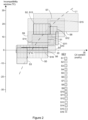
- Each of these data sets can be summarised graphically as a rectangle in mol%-temperature space defined by the highest and lowest sealing incompatibility window values (in oC) and the upper and lower mol% values. These rectangles are plotted in Figure 2 .
- sample 1 shown as rectangle S1 in Figure 2
- Sample 17 is characterised by mol% values of 16% and 17.6% and an upper incompatibility value of 12°C and a lower incompatibility value of 8°C.
- Sample 17 (S17) exceptionally, appears as a horizontal line because its three sealing incompatibility temperature values are identical, namely 2°C.
- Samples S2 and S13 overlap almost completely.
- C4 content there is a positive correlation between C4 content and positive sealing incompatibility value, and this is shown by dashed line L1.
- a value of at least +2°C is desirable to minimise the risk of undesirable sealing of the naked collation film to a package film. It will be seen this can typically be achieved by ensuring a C4 content of 10mol% or greater.
- the most preferred film samples in accordance with the invention have an average C4 polyolefin content in the inner and outer sealing layers of greater than 10mol% relative to the total polyolefin content of those sealing layers.
- Table 4 Sample Inner Layer Outer Layer C4/C2 C4/C3 C3/C2 C4/C2 C4/C3 C3/C2 1 4.00 0.20 20.00 3.14 0.23 13.71 2 1.62 0.13 12.77 24.14 0.21 117.71 3 0.84 0.10 8.16 0.37 0.05 7.33 4 3.17 0.25 12.50 0.41 0.04 9.22 5 2.00 0.21 9.50 0.81 0.05 17.42 6 4.00 0.20 20.00 0.36 0.05 7.90 7 4.00 0.20 20.00 4.24 0.31 13.81 8 1.62 0.13 12.77 6.52 0.40 16.21 9 0.84 0.10 8.16 7.78 0.24 32.04 10 3.17 0.25 12.50 2.22 0.28 7.89 11 2.00 0.21 9.50 2.42 0.25 9.65 12 4.00 0.20 20.00 3.70 0.26 14.30 13 1.62 0.13 12.77 1.99 0.23 8.71 14 3.17 0.25 12.50 0.91 0.13 7.18 15 2.00 0.21 9.50 0.71 0.11 6.76 16 4
- the sealing incompatibility window data sets are plotted against C4/C2 molar ratio in Figure 3 in a similar manner to the plot of Figure 2 .
- the strong positive correlation of sealing incompatibility window value with C4/C2 molar ratio is illustrated by line L2.
- a (desirable) positive sealing incompatibility will be obtained for a C4/C2 molar ratio of at least 1.2.
- the sealing incompatibility window data sets are plotted against C4/C3 molar ratio in Figure 4 in a similar manner to the plot of Figure 2 .
- the strong positive correlation of sealing incompatibility window value with C4/C3 molar ratio is illustrated by line L3.
- a (desirable) positive sealing incompatibility will be obtained for a C4/C3 molar ratio of at least 0.15.
- the coefficients of friction remain relatively low, and thus the films according to the present invention exhibit good hot slip properties.
- heat seal thresholds were carried using three-layer hybrid test (as outlined above).
- the inner seal of the naked collation film sample is tested against the outer of the unit wrap, with bottom jaw off.
- the unit wrap films selected for this test were GLS20, GLT20, and ZXA20, all polyolefinic unit wrap films.
- GLS20 and GLT20 are commercially available from Innovia Films Ltd, Wigton, Cumbria;
- ZXA20 is commercially available from Innovia Films Mexico SA de CV, Zacapu, Mexico.
- the samples were tested to determine the temperature at which seals were formed.
- the test was performed using heat seal apparatus operated at a pressure of 5 psi with a dwell time of 0.5 seconds.
- the incompatibility window has a positive value. It will be appreciated that the larger the positive incompatibility window, the more advantageous this is operationally.
- the incompatibility range or "incompatibility window" needs to be sufficiently broad to enable sealings to be performed without fluctuations in heat seal temperature resulting in the naked collation film being sealed to the filmic wraps of the individual packages in the bundles.
- the naked collation films according to the present invention advantageously perform to substantially the same performance independent of the composition of the unit wrap. Therefore, different unit wrap materials can be employed in accordance with a naked collation film according to the present invention without sacrificing the naked collation film's performance.
- the optical properties render the films suitable for use as naked collation films.
- a comparative example of a blocking biaxially oriented film was prepared using the same method as described above under "preparation of films".
- C1 is a Comparative Example in accordance with Example 1 of EP3034300A1 , which is a blocking film.
- the sealing layers of C1 comprise a single C4-C3 polyolefin copolymer with a standard antiblock/slip package in the outer layer of 6% sliding masterbatch ABVT3 NSC ® (commercialized by Schulman) and 1% antiblock masterbatch based on SiO 2 particles having a 2 ⁇ m diameter (commercialized by Constab) and a standard antiblock/slip package in the inner layer 6% antiblock masterbatch ABVT30N ® (commercialized by Schulman), 1% antiblock masterbatch based on silica particles having a 2 ⁇ m diameter (commercialized by Constab).
- the incompatibility window of C1 was determined in accordance with the same procedure detailed above in relation to the films of the invention.
- Table 9 Sample Content Sample Content (IN) Content (OUT) Seal Initiation Temperature/ °C (SIT) Incompatibility Window / °C C2 C3 C4 IN OUT C2 C3 C4 C2 C3 C4 (IN/OUT) GLT20 GLS20 ZXA20 C1 - 74 26 100% 100% 0 74 26 0 74 26 106 26 38 34
- Sheets of film were cut out using a cutting template (a rigid plate measuring 93 ⁇ 68mm) and wrapped around wooden blocks (teak or similar hardwood), with the test side facing outwards, and positioned such that the test surfaces of the two wrapped blocks are in contact with one another.
- the wooden blocks were 72 ⁇ 42 ⁇ 10mm weighing approx. 30g with a self-adhesive felt covering on the test side.
- the two wrapped blocks were placed squarely on a metal plate, with the test sides of the film in contact with one another, and a 200g ( ⁇ 2g) weight was placed on top of the blocks.
- the samples were placed in a thermostatically controlled oven for 72 hours at 60°C, after which the samples were removed from the oven and cooled for at least 30 minutes prior to further measurement as described below.
- the top block was held and the weight removed.
- the sample was placed in the cradle of an electric horizontal test stand with a Sauter TM gauge (model FK50) attached.
- the gauge speed was set to 800 mm/min.
- the test apparatus pushes the top block along the surface of the lower block held in place in the cradle of the apparatus, and the peak reading is recorded as the force required (in N) to initiate relative lateral movement between the blocks, requiring lateral separation (unblocking) of the sheets.
- comparative example C1 demonstrates a wide incompatibility window, it is unsuitable for use in naked collation packaging on account of its blocking tendency.
- a film In order for a film to be "non-blocking" in accordance with the invention, it is necessary for the film consistently, or at least on an average of 5 repeat tests, to pass the blocking test under conditions of 60° for 72 hrs, and preferred that it also consistently, or at least on an average of 5 repeat tests, passes the blocking test at 75°C for 3 hrs.
Landscapes
- Chemical & Material Sciences (AREA)
- Chemical Kinetics & Catalysis (AREA)
- Physics & Mathematics (AREA)
- Thermal Sciences (AREA)
- Engineering & Computer Science (AREA)
- Mechanical Engineering (AREA)
- Laminated Bodies (AREA)
- Wrappers (AREA)
- Packages (AREA)
Applications Claiming Priority (4)
| Application Number | Priority Date | Filing Date | Title |
|---|---|---|---|
| GBGB2105310.3A GB202105310D0 (en) | 2021-04-14 | 2021-04-14 | Film |
| GB202111513 | 2021-08-11 | ||
| PCT/EP2022/060090 WO2022219143A1 (fr) | 2021-04-14 | 2022-04-14 | Film d'emballage pour assemblage à nu |
| EP22723371.5A EP4323190A1 (fr) | 2021-04-14 | 2022-04-14 | Film d'emballage pour assemblage à nu |
Related Parent Applications (1)
| Application Number | Title | Priority Date | Filing Date |
|---|---|---|---|
| EP22723371.5A Division EP4323190A1 (fr) | 2021-04-14 | 2022-04-14 | Film d'emballage pour assemblage à nu |
Publications (2)
| Publication Number | Publication Date |
|---|---|
| EP4410536A2 true EP4410536A2 (fr) | 2024-08-07 |
| EP4410536A3 EP4410536A3 (fr) | 2024-10-09 |
Family
ID=81653484
Family Applications (2)
| Application Number | Title | Priority Date | Filing Date |
|---|---|---|---|
| EP24175790.5A Pending EP4410536A3 (fr) | 2021-04-14 | 2022-04-14 | Film |
| EP22723371.5A Pending EP4323190A1 (fr) | 2021-04-14 | 2022-04-14 | Film d'emballage pour assemblage à nu |
Family Applications After (1)
| Application Number | Title | Priority Date | Filing Date |
|---|---|---|---|
| EP22723371.5A Pending EP4323190A1 (fr) | 2021-04-14 | 2022-04-14 | Film d'emballage pour assemblage à nu |
Country Status (13)
| Country | Link |
|---|---|
| US (1) | US20240217225A1 (fr) |
| EP (2) | EP4410536A3 (fr) |
| JP (1) | JP2024519193A (fr) |
| KR (1) | KR20240005705A (fr) |
| BR (1) | BR112023021274A2 (fr) |
| CL (1) | CL2023003026A1 (fr) |
| GB (4) | GB2637386B (fr) |
| MX (1) | MX2023012092A (fr) |
| PL (1) | PL451572A1 (fr) |
| TR (1) | TR2024006108A1 (fr) |
| UA (1) | UA130593C2 (fr) |
| WO (1) | WO2022219143A1 (fr) |
| ZA (2) | ZA202309423B (fr) |
Citations (16)
| Publication number | Priority date | Publication date | Assignee | Title |
|---|---|---|---|---|
| DE3635928A1 (de) | 1986-10-22 | 1988-04-28 | Hoechst Ag | Sammelpacksystem |
| EP0410792A2 (fr) | 1989-07-28 | 1991-01-30 | W.R. Grace & Co.-Conn. | Procédé en deux étapes de soufflage pour la fabrication de films minces et résistants |
| EP0483675A2 (fr) | 1990-11-01 | 1992-05-06 | Montell North America Inc. | Polymère de propylène et produits laminés |
| US5302427A (en) | 1990-10-08 | 1994-04-12 | Hoechst Aktiengesellschaft | Printable, biaxially oriented polyolefin multilayer film |
| EP0645417A1 (fr) | 1993-09-27 | 1995-03-29 | Hoechst Aktiengesellschaft | Feuille en polypropylène étirée biaxialement ayant des propriétés de barrière et méchanique améliorées |
| US5436041A (en) | 1992-02-24 | 1995-07-25 | Hoechst Aktiengesellschaft | Transparent polyolefin multilayer film having a low sealing temperature on one side, process for its production and its use |
| US5900294A (en) | 1993-02-13 | 1999-05-04 | Hoechst Aktiengesellschaft | Biaxially oriented multilayer polyolefin film which can be heat-sealed at low temperatures, process for the production thereof, and the uses thereof |
| US6358579B1 (en) | 1999-05-26 | 2002-03-19 | Mitsubishi Polyester Film Gmbh | Multiple-pack system comprising a sealable polyester film |
| US6777067B1 (en) | 1998-02-12 | 2004-08-17 | Hoechst Trespaphan Gmbh | Heat sealable, biaxally oriented polypropylene film with improved barrier properties |
| WO2009024810A1 (fr) | 2007-08-23 | 2009-02-26 | Innovia Films Limited | Emballage d'assemblage à nu |
| WO2012164308A1 (fr) | 2011-06-02 | 2012-12-06 | Innovia Films Limited | Emballage |
| US20130011669A1 (en) | 2011-07-08 | 2013-01-10 | Pang-Chia Lu | Multi-Layer Films Having Improved Sealing Properties |
| EP3034300A1 (fr) | 2014-12-19 | 2016-06-22 | Irplast S.p.A. | Films multicouches |
| US20170037161A1 (en) | 2012-09-14 | 2017-02-09 | Mitsui Chemicals, Inc. | 1-butene alpha-olefin copolymer composition |
| WO2018096480A1 (fr) | 2016-11-23 | 2018-05-31 | Irplast S.P.A. | Film multicouche |
| WO2018211107A1 (fr) | 2017-05-19 | 2018-11-22 | Abu Dhabi Polymers Co. Ltd (Borouge) L.L.C. | Composition de copolymère aléatoire de propylène à température d'initiation d'étanchéité réduite |
Family Cites Families (7)
| Publication number | Priority date | Publication date | Assignee | Title |
|---|---|---|---|---|
| JPS6036388B2 (ja) * | 1979-07-13 | 1985-08-20 | 東洋紡績株式会社 | 密着性の良好な包装材料 |
| DE3624543A1 (de) * | 1986-07-19 | 1988-01-21 | Wolff Walsrode Ag | Heisssiegelbare mehrschichtfolien aus polyolefinen |
| DE19652734A1 (de) * | 1996-12-18 | 1998-06-25 | Hoechst Trespaphan Gmbh | Beidseitig siegelfähige orientierte Polyolefin-Mehrschichtfolie, Verfahren zu ihrer Herstellung und ihre Verwendung |
| JP2004338721A (ja) * | 2003-05-13 | 2004-12-02 | Tohcello Co Ltd | オーバーラップ包装用フィルム |
| JP5094499B2 (ja) * | 2008-03-27 | 2012-12-12 | 三井化学株式会社 | 積層体およびその用途 |
| ITMI20110770A1 (it) * | 2011-05-06 | 2012-11-07 | Irplast Spa | Film multistrato |
| WO2017002033A1 (fr) * | 2015-06-30 | 2017-01-05 | Irplast S.P.A. | Films multicouches pour rassembler à nu des produits conditionnés |
-
2022
- 2022-04-14 TR TR2024/006108A patent/TR2024006108A1/tr unknown
- 2022-04-14 UA UAA202304883A patent/UA130593C2/uk unknown
- 2022-04-14 GB GB2417001.1A patent/GB2637386B/en active Active
- 2022-04-14 EP EP24175790.5A patent/EP4410536A3/fr active Pending
- 2022-04-14 MX MX2023012092A patent/MX2023012092A/es unknown
- 2022-04-14 GB GB2417010.2A patent/GB2637387B/en active Active
- 2022-04-14 PL PL451572A patent/PL451572A1/pl unknown
- 2022-04-14 US US18/553,789 patent/US20240217225A1/en active Pending
- 2022-04-14 GB GB2205558.6A patent/GB2608487B/en active Active
- 2022-04-14 JP JP2023562599A patent/JP2024519193A/ja active Pending
- 2022-04-14 WO PCT/EP2022/060090 patent/WO2022219143A1/fr not_active Ceased
- 2022-04-14 KR KR1020237036837A patent/KR20240005705A/ko active Pending
- 2022-04-14 GB GB2313580.9A patent/GB2623426B/en active Active
- 2022-04-14 BR BR112023021274A patent/BR112023021274A2/pt unknown
- 2022-04-14 EP EP22723371.5A patent/EP4323190A1/fr active Pending
-
2023
- 2023-10-09 ZA ZA2023/09423A patent/ZA202309423B/en unknown
- 2023-10-11 CL CL2023003026A patent/CL2023003026A1/es unknown
-
2024
- 2024-02-14 ZA ZA2024/01353A patent/ZA202401353B/en unknown
Patent Citations (16)
| Publication number | Priority date | Publication date | Assignee | Title |
|---|---|---|---|---|
| DE3635928A1 (de) | 1986-10-22 | 1988-04-28 | Hoechst Ag | Sammelpacksystem |
| EP0410792A2 (fr) | 1989-07-28 | 1991-01-30 | W.R. Grace & Co.-Conn. | Procédé en deux étapes de soufflage pour la fabrication de films minces et résistants |
| US5302427A (en) | 1990-10-08 | 1994-04-12 | Hoechst Aktiengesellschaft | Printable, biaxially oriented polyolefin multilayer film |
| EP0483675A2 (fr) | 1990-11-01 | 1992-05-06 | Montell North America Inc. | Polymère de propylène et produits laminés |
| US5436041A (en) | 1992-02-24 | 1995-07-25 | Hoechst Aktiengesellschaft | Transparent polyolefin multilayer film having a low sealing temperature on one side, process for its production and its use |
| US5900294A (en) | 1993-02-13 | 1999-05-04 | Hoechst Aktiengesellschaft | Biaxially oriented multilayer polyolefin film which can be heat-sealed at low temperatures, process for the production thereof, and the uses thereof |
| EP0645417A1 (fr) | 1993-09-27 | 1995-03-29 | Hoechst Aktiengesellschaft | Feuille en polypropylène étirée biaxialement ayant des propriétés de barrière et méchanique améliorées |
| US6777067B1 (en) | 1998-02-12 | 2004-08-17 | Hoechst Trespaphan Gmbh | Heat sealable, biaxally oriented polypropylene film with improved barrier properties |
| US6358579B1 (en) | 1999-05-26 | 2002-03-19 | Mitsubishi Polyester Film Gmbh | Multiple-pack system comprising a sealable polyester film |
| WO2009024810A1 (fr) | 2007-08-23 | 2009-02-26 | Innovia Films Limited | Emballage d'assemblage à nu |
| WO2012164308A1 (fr) | 2011-06-02 | 2012-12-06 | Innovia Films Limited | Emballage |
| US20130011669A1 (en) | 2011-07-08 | 2013-01-10 | Pang-Chia Lu | Multi-Layer Films Having Improved Sealing Properties |
| US20170037161A1 (en) | 2012-09-14 | 2017-02-09 | Mitsui Chemicals, Inc. | 1-butene alpha-olefin copolymer composition |
| EP3034300A1 (fr) | 2014-12-19 | 2016-06-22 | Irplast S.p.A. | Films multicouches |
| WO2018096480A1 (fr) | 2016-11-23 | 2018-05-31 | Irplast S.P.A. | Film multicouche |
| WO2018211107A1 (fr) | 2017-05-19 | 2018-11-22 | Abu Dhabi Polymers Co. Ltd (Borouge) L.L.C. | Composition de copolymère aléatoire de propylène à température d'initiation d'étanchéité réduite |
Non-Patent Citations (1)
| Title |
|---|
| "Biaxial Stretching of Film, Principles and Applications", 2011 |
Also Published As
| Publication number | Publication date |
|---|---|
| GB2637387B (en) | 2025-11-26 |
| GB2623426B (en) | 2025-01-15 |
| PL451572A1 (pl) | 2025-09-15 |
| GB2637386B (en) | 2025-11-26 |
| GB2608487A (en) | 2023-01-04 |
| EP4410536A3 (fr) | 2024-10-09 |
| KR20240005705A (ko) | 2024-01-12 |
| ZA202309423B (en) | 2025-08-27 |
| MX2023012092A (es) | 2023-10-25 |
| GB202417010D0 (en) | 2025-01-01 |
| EP4323190A1 (fr) | 2024-02-21 |
| ZA202401353B (en) | 2024-08-28 |
| GB2608487B (en) | 2023-10-18 |
| GB2623426A (en) | 2024-04-17 |
| US20240217225A1 (en) | 2024-07-04 |
| GB202205558D0 (en) | 2022-06-01 |
| BR112023021274A2 (pt) | 2023-12-12 |
| CL2023003026A1 (es) | 2024-04-05 |
| GB202417001D0 (en) | 2025-01-01 |
| TR2024006108A1 (tr) | 2025-10-21 |
| UA130593C2 (uk) | 2026-03-25 |
| WO2022219143A1 (fr) | 2022-10-20 |
| GB2637387A (en) | 2025-07-23 |
| JP2024519193A (ja) | 2024-05-09 |
| GB2637386A (en) | 2025-07-23 |
| GB202313580D0 (en) | 2023-10-18 |
Similar Documents
| Publication | Publication Date | Title |
|---|---|---|
| EP0681914B1 (fr) | Film thermorétractable et étirable multicouche | |
| EP0687558B1 (fr) | Film étirable en polyoléfine | |
| CN103895307B (zh) | 聚烯烃系未拉伸多层膜 | |
| JPH07504930A (ja) | ヒートシール可能な熱可塑性フィルム | |
| EP3544805B1 (fr) | Film multicouche | |
| JP6352340B2 (ja) | パッケージ | |
| KR20230105683A (ko) | 폴리올레핀계 수지 필름 및 그것을 사용한 적층체 | |
| KR20140130497A (ko) | 네이키드 컬레이션 패키지 및 이를 형성시키는 방법 | |
| KR20230109154A (ko) | 폴리올레핀계 수지 필름 및 그것을 사용한 적층체 | |
| WO2006118030A1 (fr) | Film de resine de polypropylene a couches multiples thermoscellable et materiau d’emballage | |
| EP1581389B1 (fr) | Film de polypropylene thermoscellable a orientation biaxiale | |
| NO792259L (no) | Frenmgangsmaate ved fremstilling av varmesveisbare polyolefinfilmer | |
| US20240217225A1 (en) | Naked collation package film | |
| EP2928778B1 (fr) | Procédé de formation d'un emballage | |
| JPH09150488A (ja) | 積層フィルム | |
| EA049152B1 (ru) | Пленка для бескорпусной групповой упаковки | |
| EA050435B1 (ru) | Пленка | |
| CN117440888A (zh) | 裸式整理包装膜 | |
| WO2002000430A2 (fr) | Film multicouche a couche thermocollante en evoh a calibre eleve | |
| HK40009122A (en) | Package | |
| MX2007008046A (es) | Pelicula de polipropileno bi-orientado que comprende orientacion de rasgadura, un proceso para preparar la pelicula y un articulo que la comprende. | |
| HK1188971A (en) | Package | |
| HK40009122B (en) | Package |
Legal Events
| Date | Code | Title | Description |
|---|---|---|---|
| PUAI | Public reference made under article 153(3) epc to a published international application that has entered the european phase |
Free format text: ORIGINAL CODE: 0009012 |
|
| STAA | Information on the status of an ep patent application or granted ep patent |
Free format text: STATUS: THE APPLICATION HAS BEEN PUBLISHED |
|
| AC | Divisional application: reference to earlier application |
Ref document number: 4323190 Country of ref document: EP Kind code of ref document: P |
|
| AK | Designated contracting states |
Kind code of ref document: A2 Designated state(s): AL AT BE BG CH CY CZ DE DK EE ES FI FR GB GR HR HU IE IS IT LI LT LU LV MC MK MT NL NO PL PT RO RS SE SI SK SM TR |
|
| REG | Reference to a national code |
Ref country code: DE Ref legal event code: R079 Free format text: PREVIOUS MAIN CLASS: B32B0007027000 Ipc: B32B0027080000 |
|
| PUAL | Search report despatched |
Free format text: ORIGINAL CODE: 0009013 |
|
| AK | Designated contracting states |
Kind code of ref document: A3 Designated state(s): AL AT BE BG CH CY CZ DE DK EE ES FI FR GB GR HR HU IE IS IT LI LT LU LV MC MK MT NL NO PL PT RO RS SE SI SK SM TR |
|
| RIC1 | Information provided on ipc code assigned before grant |
Ipc: B32B 7/027 20190101ALI20240903BHEP Ipc: B32B 27/32 20060101ALI20240903BHEP Ipc: B32B 27/08 20060101AFI20240903BHEP |
|
| STAA | Information on the status of an ep patent application or granted ep patent |
Free format text: STATUS: REQUEST FOR EXAMINATION WAS MADE |
|
| 17P | Request for examination filed |
Effective date: 20250131 |
|
| STAA | Information on the status of an ep patent application or granted ep patent |
Free format text: STATUS: EXAMINATION IS IN PROGRESS |
|
| 17Q | First examination report despatched |
Effective date: 20260611 |