EP4411248A1 - Utilisation de la chaleur résiduelle dans un appareil de cuisson - Google Patents
Utilisation de la chaleur résiduelle dans un appareil de cuisson Download PDFInfo
- Publication number
- EP4411248A1 EP4411248A1 EP24150489.3A EP24150489A EP4411248A1 EP 4411248 A1 EP4411248 A1 EP 4411248A1 EP 24150489 A EP24150489 A EP 24150489A EP 4411248 A1 EP4411248 A1 EP 4411248A1
- Authority
- EP
- European Patent Office
- Prior art keywords
- dish
- cooking
- residual heat
- temperature
- cooking appliance
- Prior art date
- Legal status (The legal status is an assumption and is not a legal conclusion. Google has not performed a legal analysis and makes no representation as to the accuracy of the status listed.)
- Withdrawn
Links
Images


Classifications
-
- F—MECHANICAL ENGINEERING; LIGHTING; HEATING; WEAPONS; BLASTING
- F24—HEATING; RANGES; VENTILATING
- F24C—DOMESTIC STOVES OR RANGES ; DETAILS OF DOMESTIC STOVES OR RANGES, OF GENERAL APPLICATION
- F24C7/00—Stoves or ranges heated by electric energy
- F24C7/08—Arrangement or mounting of control or safety devices
- F24C7/082—Arrangement or mounting of control or safety devices on ranges, e.g. control panels, illumination
- F24C7/085—Arrangement or mounting of control or safety devices on ranges, e.g. control panels, illumination on baking ovens
-
- A—HUMAN NECESSITIES
- A47—FURNITURE; DOMESTIC ARTICLES OR APPLIANCES; COFFEE MILLS; SPICE MILLS; SUCTION CLEANERS IN GENERAL
- A47J—KITCHEN EQUIPMENT; COFFEE MILLS; SPICE MILLS; APPARATUS FOR MAKING BEVERAGES
- A47J27/00—Cooking-vessels
- A47J27/004—Cooking-vessels with integral electrical heating means
Definitions
- the present invention relates to a cooking appliance.
- the invention relates to a household appliance which is designed to cook a food or a dish using heat.
- An oven in a household is designed to heat food to a predetermined temperature and thus cook it.
- Typical cooking temperatures are usually in a range of around 60 °C to around 260 °C.
- the cooking chamber of the cooking appliance is usually well insulated thermally to prevent uncontrolled heat loss. Nevertheless, after the cooking process has been completed, a considerable amount of thermal energy is stored in the cooking appliance, which usually remains unused.
- CH 678 996 A5 suggests switching off an oven early during cooking and using residual heat stored in the oven for the cooking process.
- EP311813 relates to a method for controlling an oven to utilize residual heat. To do this, a dish is first cooked with the oven switched on and then with the oven switched off. The oven can then be controlled to keep the dish inside it warm below the cooking temperature using a low energy input.
- a delicate dish such as a soufflé
- Other foods such as pizza, require a high energy input to achieve the desired cooking result. It is often difficult to decide which dish can be cooked in which way using residual heat. If the dish is not cooked sufficiently, the cooking process may be incomplete and the dish may be inedible. If the dish is overcooked, it may spoil and may also be unfit for consumption.
- One object underlying the present invention is to provide an improved technology for using residual heat in a cooking appliance.
- the invention solves this problem by means of the subject matter of the independent claims. Subclaims give preferred embodiments.
- a method for utilizing residual heat in a cooking appliance comprises steps of determining a residual heat available in the cooking appliance after cooking a first dish; and determining a second dish that can be cooked using the residual heat.
- the cooking appliance can, for example, comprise an oven, a warming cabinet or a sous-vide cooker. It is preferred that the first dish is cooked in a conventional manner, whereby heat can be supplied by means of a heating system of the cooking appliance until the end of cooking of the first dish. Optionally, the heating can also be switched off before the end of cooking in order to cook the first dish at least partially with residual heat from the cooking appliance. The remaining residual heat is preferably used to cook another dish.
- the other dish can, for example, comprise a supplement or a side dish for the first dish.
- the second dish can also comprise, for example, a dessert that is to be consumed after the first dish.
- the second dish can be determined on the basis of a temperature curve that occurs when the heat supply in the cooking appliance is switched off.
- the temperature curve can be determined on the basis of a current temperature and a cooling behavior of the cooking appliance.
- the cooling behavior can be a typical property of the appliance that essentially depends on an inside and an outside temperature.
- the outside temperature corresponds to a living room temperature that varies relatively little.
- the inside temperature can be determined using a sensor.
- a heat capacity of the cooking appliance can be determined experimentally and stored for future use.
- the heat capacity of the cooking appliance is provided in the form of a manufacturer's specification.
- the specification can relate to a device type to which the cooking appliance in question is assigned.
- heat capacities for a variety of different cooking devices are stored for the application of the method.
- the heat capacity of the cooking appliance can be determined during the heating process. It is possible to determine which temperature profile will occur in the cooking chamber when the heating of the cooking appliance is switched on and there is no food in the cooking chamber. In other words: an impulse response of the temperature in the cooking chamber to a predetermined heat supply can be determined. A heat capacity determined in this way can be used as a basis for determining the temperature profile during cooling.
- a temperature profile in the cooking appliance is determined on the basis of a temperature when the second dish is placed in and the ingredients included in the second dish.
- the amount of heat that the ingredients of the second dish absorb from the cooking chamber until an energy balance is reached It is also possible to take into account the chemical reaction heat that the ingredients of the second dish absorb during the cooking process.
- a type of ingredient, their combination and/or a chemical process to be taken into account can be taken into account.
- a cooking time of the second dish is determined on the basis of the temperature profile. As long as a predetermined cooking temperature is exceeded, a lower temperature can lead to a longer cooking time. Since the temperature in the cooking chamber is constantly decreasing due to a lack of energy supply, a cooking time of the second dish can be longer than if the temperature were kept constant. By determining the changed cooking time, the second dish can be cooked more efficiently at a predetermined time. Opening the cooking chamber to check the temperature of the second dish, which would result in residual heat being lost, can be avoided.
- the second dish is determined on the basis of a user-controlled specification.
- the specification may, for example, comprise a category of the second dish, such as a dessert, a side dish or a sauce.
- the specification may also relate to a quantity, such as 2, 4 or 6 portions.
- the specification may relate to a time required for preparing or cooking the second dish.
- a maximum amount that can be cooked using the residual heat can be determined. At the same time, it can be determined whether the amount makes sense in view of the second dish or not. For example, a warning can be given against cooking only 100 g of bread or only one potato. The decision as to whether the specified amount makes sense or not can also be left to the user.
- the cooking of the second dish can be controlled in the cooking appliance.
- the cooking appliance can be controlled to dissipate as little of the residual heat as possible to the outside.
- the opening of an appliance door can be prevented.
- a heating mode can be set that makes optimal use of the residual heat. If the temperature in the cooking chamber drops below a predetermined value, a fan can be activated, for example, to improve the circulation of remaining heat in the appliance.
- the second dish can be selected with reference to a collection of recipes. It is preferred that information on the preparation of a selected second dish is provided. The information can in particular relate to processing steps, ingredients and their quantities. A processing or resting time can also be specified.
- the specific information can be transmitted partially or completely to a food processor.
- the food processor can comprise a multifunctional device that can, for example, stir, knead, cut and grate.
- a more advanced food processor comprises a scale that can be used to determine the amount of an added ingredient.
- the food processor can also comprise a heater to heat ingredients.
- a time sequence control can be provided so that the food processor can automatically carry out a sequence of processing steps.
- the food processor can, for example, provide a filling or dough that can then be cooked in the cooking device.
- a device for utilizing residual heat in a cooking appliance comprises a device for determining a residual heat that is available in the cooking appliance after cooking a first dish; and a device for determining a second dish that can be cooked using the residual heat.
- the device may use a collection of second dishes, which may alternatively be maintained in a local data store or in an external resource.
- FIG. 1 shows a system 100 for using residual heat in a cooking appliance 105.
- the system 100 comprises a device 110 that can be coupled to the cooking appliance 105.
- the device 110 comprises a processing device 115, an interaction device 120 and an optional data memory 125.
- the device 110 can be connected to a food processor 130.
- the interaction device 120 comprises an input device and/or an output device for communicating with a user 135.
- the user 135 can, for example, formulate a specification or a request and capture a result of the device 110 via the interaction device 120.
- the data storage 125 is designed to store information relating to a large number of dishes.
- an external resource can be used where the information about the dish is stored.
- the resource can, for example, include a server or a service in a cloud.
- the information includes a collection of recipes.
- the information can be structured or searchable to make it easier to find a suitable dish. It is also preferred that the information includes an indication of a cooking behavior of a described dish.
- the cooking behavior can relate to a minimum cooking temperature to be maintained, a usual cooking time, a preferred cooking temperature or an amount of energy used for cooking.
- the food processor 130 is preferably designed to assist a user 135 in the preparation or cooking of a dish. To this end, the food processor 130 can carry out predetermined processing steps, such as chopping, grinding, mixing, kneading, weighing, etc., in an automated or partially automated manner. In one embodiment, the food processor 130 can be controlled by the processing device 115 to carry out a predetermined processing step.
- a first dish 140 is located in the cooking device 105 for cooking.
- a second dish 145 should be placed in and cooked as far as possible without any further energy consumption by the cooking device 105.
- the device 110 can support a user 135 in selecting a suitable second dish 145 and optionally in preparing it or planning a cooking sequence.
- Figure 2 shows a flow chart of a method 200 for utilizing residual heat in a cooking appliance 105.
- a first cooking process can be detected, which includes the cooking of a first dish 140 in the cooking appliance 105.
- it can be determined at which temperature the cooking process takes place or which temperature the cooking appliance has when the first cooking process is completed. In a further embodiment, this determination can be made by observing operating parameters of the cooking appliance 105.
- an end of the first cooking process can be determined.
- the end can be determined, for example, depending on the first dish 140 and the selected cooking temperature in the cooking device 105.
- the end of the first cooking process can also be determined, for example, by manual input from a user 135.
- a cooking device 105 intended for cooking the first dish 140 can be determined.
- a device type can be queried or entered by the user 135.
- a characteristic feature of the cooking device 105 with regard to its heat capacity can also be determined experimentally.
- an impulse response of a temperature of the cooking device 105 to the activation of a heater is evaluated for this purpose.
- a usable residual heat in the cooking device 105 can be determined. To do this, it can be taken into account how much energy is stored in the cooking device 105 when the first dish 140 is removed from it and the second dish 145 is inserted. In addition, it can be determined which temperature then prevails in a cooking chamber of the cooking device 105. A cooling behavior of the cooking device due to unavoidable release of heat to an environment of the cooking device 105 can also be taken into account.
- a user preference of a user 135 can be recorded.
- the user preference can include a criterion for selecting a second dish 145 from a plurality of known second dishes 145.
- the user preference can include a type of second dish 145 (side dish, dessert, etc.), a required quantity, or a type (e.g., pastry, dessert, casserole).
- a recipe suggestion for a second dish 145 can be determined in a step 230.
- the recipe suggestion can include information about which activities or requirements must be met to implement the recipe.
- the user 135 can decide on a recipe or generate further suggestions by specifying further specifications in step 225.
- the user 135 can conversely specify in step 225 how many portions or which quantity of the second dish 145 should be prepared. Recipes that cannot be safely cooked in the desired quantity with the available residual heat can be removed from the suggestions.
- the user 135 can decide on one of the suggestions or interactively request the determination of new recipe suggestions in step 230 by changing his specifications in step 225.
- the user 135 If the user 135 has decided on a recipe for a second dish 145, he can be instructed in a step 235 to prepare a second process for the second dish 145. To do this, he can be provided with the necessary information such as ingredients, quantities and processing steps. Optionally, the user 135 can be supported in the preparation of the second dish 145 using the food processor 130.
- the user 135 can then place the second dish 145 in the cooking appliance 105.
- the first dish 140 is removed from the cooking chamber of the cooking appliance 105 at the same time or as shortly before as possible. It is also preferred that a heat supply of the cooking appliance 105 is already deactivated at the time the second dish 145 is placed.
- the second cooking process of the second dish 145 in the cooking device 105 can be controlled.
- a fresh air supply or a fan in a cooking chamber of the cooking device 105 can be controlled in such a way that the residual heat remaining in the device can be used as effectively as possible to cook the second dish 145. If a predetermined cooking time is determined on the basis of the selected second dish 145, a quantity converted and a usable residual heat in the cooking device 105 may be, has elapsed, the user 135 may be prompted to remove the finished second dish 145.
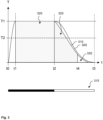
- Figure 3 shows example temperature curves on a cooking appliance 105. It should be noted that the curves shown are purely exemplary and are presented in a qualitative manner. A time is shown horizontally and a temperature in the cooking appliance 105 is shown vertically.
- a first temperature profile 305 relates to a normal preparation of a first dish 140 in the cooking appliance 105.
- a second temperature profile 310 relates to the use of residual heat for cooking a second dish 145.
- an activation 315 of a heating device of the cooking appliance 105 is shown over time.
- the heating device is switched on to heat the cooking device 105 to a predetermined cooking temperature T1 for the first dish 140.
- the device 105 reaches this temperature at a time t1.
- the first dish 140 can then be placed in a cooking chamber of the cooking device 105 and cooked.
- the first dish 140 is completely cooked at a time t2 and can be removed from the device 105.
- the heating device of the cooking device 105 can be switched off, as symbolized by a bright area of activation 315.
- the cooking device 105 then cools down slowly and reaches the temperature of an environment at a time t3.
- This process essentially uses energy that is shown between the times t1 and t2 as the first area 320 under the first temperature curve 305.
- the first dish 140 can also be placed in the cooking device 105 while it is heating up; in this case, a corresponding portion of the area between t0 and t1 under the first curve 305 can be counted as the first area 320.
- a second area 325 between the times t2 and t3 under the first curve 305 shows an amount of energy that remains unused.
- the second temperature curve 310 can arise between times t2 and t3. This decreases overall more quickly than the first temperature curve 305, since the second dish 145 absorbs heat from the cooking device 105.
- a second area 325 represents energy used to cook the second dish 145. It is assumed that the second dish 145 is a time t4 which is before time t3, is fully cooked and is removed from the cooking appliance 105.
- the second dish 145 can usually be cooked at a second cooking temperature T2. This temperature only exists temporarily in the cooking chamber of the cooking device 105 when cooling from the cooking temperature T1 to an ambient temperature.
- the duration for which the second dish 145 should remain in the cooking chamber is usually related to the cooking temperature T2. The duration can be adjusted depending on the temperature profile 305 in order to control safe and not excessive cooking of the second dish 145.
- a third area 330 between times t4 and t3 below the second curve 310 represents an amount of energy that escapes unused from the cooking device 105 after cooking the second dish 145. It can be seen that this amount of energy is small compared to the other energy amounts described. In the manner described herein, the cooking device 105 can therefore be operated with increased efficiency.
Landscapes
- Engineering & Computer Science (AREA)
- Chemical & Material Sciences (AREA)
- Combustion & Propulsion (AREA)
- Mechanical Engineering (AREA)
- General Engineering & Computer Science (AREA)
- Food Science & Technology (AREA)
- Cookers (AREA)
Applications Claiming Priority (1)
| Application Number | Priority Date | Filing Date | Title |
|---|---|---|---|
| DE102023200814.9A DE102023200814B3 (de) | 2023-02-01 | 2023-02-01 | Nutzung von Restwärme in einem Gargerät |
Publications (1)
| Publication Number | Publication Date |
|---|---|
| EP4411248A1 true EP4411248A1 (fr) | 2024-08-07 |
Family
ID=89473985
Family Applications (1)
| Application Number | Title | Priority Date | Filing Date |
|---|---|---|---|
| EP24150489.3A Withdrawn EP4411248A1 (fr) | 2023-02-01 | 2024-01-05 | Utilisation de la chaleur résiduelle dans un appareil de cuisson |
Country Status (2)
| Country | Link |
|---|---|
| EP (1) | EP4411248A1 (fr) |
| DE (1) | DE102023200814B3 (fr) |
Citations (4)
| Publication number | Priority date | Publication date | Assignee | Title |
|---|---|---|---|---|
| EP0311813A2 (fr) | 1987-10-13 | 1989-04-19 | LEDA Logarithmic Electrical Devices for Automation S.r.l. | Résistance électrique variable par pression et procédé de fabrication |
| CH678996A5 (en) | 1989-05-31 | 1991-11-29 | Electrolux Ag | Procedure and device for heating food in oven - where oven is automatically switched off shortly before completion of cooking and heat is recovered while allowing temp. to fall |
| DE102012208440A1 (de) * | 2012-05-21 | 2013-11-21 | BSH Bosch und Siemens Hausgeräte GmbH | Gargerät |
| DE102017131403A1 (de) * | 2017-12-29 | 2019-07-04 | Rational International Ag | Verfahren zum Anzeigen eines Bedienmenüs und Ansteuern eines Gargeräts |
Family Cites Families (4)
| Publication number | Priority date | Publication date | Assignee | Title |
|---|---|---|---|---|
| DE102007046923A1 (de) * | 2007-09-28 | 2009-04-23 | Rational Ag | Verfahren zur vereinfachten Programmierung von Programmen eines Gargerätes und Gargerät zum Durchführen solch eines Verfahrens |
| DE102008028027A1 (de) * | 2008-06-12 | 2009-12-17 | BSH Bosch und Siemens Hausgeräte GmbH | Hausgerätvorrichtung |
| DE102009003037A1 (de) * | 2009-05-12 | 2010-11-18 | BSH Bosch und Siemens Hausgeräte GmbH | Verfahren zum Durchführen eines Zubereitungsvorgangs für ein Lebensmittel |
| KR102350474B1 (ko) | 2015-06-30 | 2022-01-17 | 삼성전자주식회사 | 자동보온기능을 구비한 가열조리장치 및 그 제어방법 |
-
2023
- 2023-02-01 DE DE102023200814.9A patent/DE102023200814B3/de not_active Expired - Fee Related
-
2024
- 2024-01-05 EP EP24150489.3A patent/EP4411248A1/fr not_active Withdrawn
Patent Citations (4)
| Publication number | Priority date | Publication date | Assignee | Title |
|---|---|---|---|---|
| EP0311813A2 (fr) | 1987-10-13 | 1989-04-19 | LEDA Logarithmic Electrical Devices for Automation S.r.l. | Résistance électrique variable par pression et procédé de fabrication |
| CH678996A5 (en) | 1989-05-31 | 1991-11-29 | Electrolux Ag | Procedure and device for heating food in oven - where oven is automatically switched off shortly before completion of cooking and heat is recovered while allowing temp. to fall |
| DE102012208440A1 (de) * | 2012-05-21 | 2013-11-21 | BSH Bosch und Siemens Hausgeräte GmbH | Gargerät |
| DE102017131403A1 (de) * | 2017-12-29 | 2019-07-04 | Rational International Ag | Verfahren zum Anzeigen eines Bedienmenüs und Ansteuern eines Gargeräts |
Also Published As
| Publication number | Publication date |
|---|---|
| DE102023200814B3 (de) | 2024-03-21 |
Similar Documents
| Publication | Publication Date | Title |
|---|---|---|
| DE69635892T2 (de) | Ofen zum garen von lebensmitteln | |
| EP2031306A1 (fr) | Procédé et appareil de cuisson pour cuire selon la valeur C | |
| EP2537418B1 (fr) | Procédé de cuisson d'un produit de cuisson au moyen de vapeur | |
| EP2999928B1 (fr) | Procédé et appareil de cuisson | |
| CH712395A2 (de) | Kombigargerät mit Steuerung. | |
| EP3751202A1 (fr) | Procédé de fonctionnement d'un appareil de cuisson et appareil de cuisson | |
| DE102012013275B4 (de) | Verfahren zum Durchführen eines Garvorgangs mit einem Koch- und/oder Bratgerät | |
| EP3730015B1 (fr) | Appareil electromenager | |
| DE102019107558A1 (de) | Verfahren zum Betrieb einer Kochstelle eines Kochfelds, vorzugsweise eines Induktionskochfelds, mit einem Kochgeschirr | |
| DE102010054382B4 (de) | Verfahren zur Steuerung eines Gargerätes und Gargerät mit Gerätesteuerung | |
| DE102023200814B3 (de) | Nutzung von Restwärme in einem Gargerät | |
| DE102007043371A1 (de) | Garverfahren mit taupunktgeregelter Dampfzufuhr | |
| DE60305422T2 (de) | Verfahren und Gerät zum automatischen Kochen von geschälten Körnern | |
| EP2256415B1 (fr) | Procédé d'exécution d'un programme de cuisson sans préchauffage séparé dans un four de cuisson | |
| DE102011120280B4 (de) | Verfahren zum Druckgaren von Lebensmitteln sowie Druckgargerät | |
| EP4179929B1 (fr) | Système et procédé de préparation des aliments | |
| EP3710752B1 (fr) | Système de préparation d'aliment | |
| EP3804588B1 (fr) | Processeur de cuisson | |
| EP3984424B1 (fr) | Système pourvu de robot de cuisine et procédé | |
| EP3696623B1 (fr) | Appareil de commande et procédé de fonctionnement d'un appareil électroménager pour la fabrication d'un aliment | |
| DE102020212057A1 (de) | Garsystem mit Koordinierungseinrichtung für ein gemeinsam geltendes Soll-Garzeitende | |
| DE102021212629A1 (de) | Vorrichtung und Verfahren zum Betreiben eines Motors einer Küchenmaschine | |
| DE102007008894A1 (de) | Verfahren zum Durchführen eines Garvorgangs | |
| EP3524888B1 (fr) | Procédé de commande d'un appareil de cuisson ainsi qu'appareil de cuisson | |
| WO2019219362A1 (fr) | Procédé de fonctionnement d'un appareil électroménager à micro-ondes |
Legal Events
| Date | Code | Title | Description |
|---|---|---|---|
| PUAI | Public reference made under article 153(3) epc to a published international application that has entered the european phase |
Free format text: ORIGINAL CODE: 0009012 |
|
| STAA | Information on the status of an ep patent application or granted ep patent |
Free format text: STATUS: THE APPLICATION HAS BEEN PUBLISHED |
|
| AK | Designated contracting states |
Kind code of ref document: A1 Designated state(s): AL AT BE BG CH CY CZ DE DK EE ES FI FR GB GR HR HU IE IS IT LI LT LU LV MC ME MK MT NL NO PL PT RO RS SE SI SK SM TR |
|
| STAA | Information on the status of an ep patent application or granted ep patent |
Free format text: STATUS: THE APPLICATION IS DEEMED TO BE WITHDRAWN |
|
| 18D | Application deemed to be withdrawn |
Effective date: 20250208 |