EP4411808A1 - Feuille thermoconductrice - Google Patents
Feuille thermoconductrice Download PDFInfo
- Publication number
- EP4411808A1 EP4411808A1 EP22876402.3A EP22876402A EP4411808A1 EP 4411808 A1 EP4411808 A1 EP 4411808A1 EP 22876402 A EP22876402 A EP 22876402A EP 4411808 A1 EP4411808 A1 EP 4411808A1
- Authority
- EP
- European Patent Office
- Prior art keywords
- thermally conductive
- conductive sheet
- sheet
- volume
- matrix
- Prior art date
- Legal status (The legal status is an assumption and is not a legal conclusion. Google has not performed a legal analysis and makes no representation as to the accuracy of the status listed.)
- Withdrawn
Links
Images
Classifications
-
- C—CHEMISTRY; METALLURGY
- C09—DYES; PAINTS; POLISHES; NATURAL RESINS; ADHESIVES; COMPOSITIONS NOT OTHERWISE PROVIDED FOR; APPLICATIONS OF MATERIALS NOT OTHERWISE PROVIDED FOR
- C09K—MATERIALS FOR MISCELLANEOUS APPLICATIONS, NOT PROVIDED FOR ELSEWHERE
- C09K5/00—Heat-transfer, heat-exchange or heat-storage materials, e.g. refrigerants; Materials for the production of heat or cold by chemical reactions other than by combustion
- C09K5/08—Materials not undergoing a change of physical state when used
- C09K5/14—Solid materials, e.g. powdery or granular
-
- C—CHEMISTRY; METALLURGY
- C08—ORGANIC MACROMOLECULAR COMPOUNDS; THEIR PREPARATION OR CHEMICAL WORKING-UP; COMPOSITIONS BASED THEREON
- C08L—COMPOSITIONS OF MACROMOLECULAR COMPOUNDS
- C08L83/00—Compositions of macromolecular compounds obtained by reactions forming in the main chain of the macromolecule a linkage containing silicon with or without sulfur, nitrogen, oxygen or carbon only; Compositions of derivatives of such polymers
- C08L83/04—Polysiloxanes
-
- C—CHEMISTRY; METALLURGY
- C08—ORGANIC MACROMOLECULAR COMPOUNDS; THEIR PREPARATION OR CHEMICAL WORKING-UP; COMPOSITIONS BASED THEREON
- C08L—COMPOSITIONS OF MACROMOLECULAR COMPOUNDS
- C08L91/00—Compositions of oils, fats or waxes; Compositions of derivatives thereof
-
- H—ELECTRICITY
- H10—SEMICONDUCTOR DEVICES; ELECTRIC SOLID-STATE DEVICES NOT OTHERWISE PROVIDED FOR
- H10W—GENERIC PACKAGES, INTERCONNECTIONS, CONNECTORS OR OTHER CONSTRUCTIONAL DETAILS OF DEVICES COVERED BY CLASS H10
- H10W40/00—Arrangements for thermal protection or thermal control
- H10W40/20—Arrangements for cooling
- H10W40/25—Arrangements for cooling characterised by their materials
-
- H—ELECTRICITY
- H10—SEMICONDUCTOR DEVICES; ELECTRIC SOLID-STATE DEVICES NOT OTHERWISE PROVIDED FOR
- H10W—GENERIC PACKAGES, INTERCONNECTIONS, CONNECTORS OR OTHER CONSTRUCTIONAL DETAILS OF DEVICES COVERED BY CLASS H10
- H10W40/00—Arrangements for thermal protection or thermal control
- H10W40/20—Arrangements for cooling
- H10W40/25—Arrangements for cooling characterised by their materials
- H10W40/251—Organics
-
- C—CHEMISTRY; METALLURGY
- C08—ORGANIC MACROMOLECULAR COMPOUNDS; THEIR PREPARATION OR CHEMICAL WORKING-UP; COMPOSITIONS BASED THEREON
- C08G—MACROMOLECULAR COMPOUNDS OBTAINED OTHERWISE THAN BY REACTIONS ONLY INVOLVING UNSATURATED CARBON-TO-CARBON BONDS
- C08G77/00—Macromolecular compounds obtained by reactions forming a linkage containing silicon with or without sulfur, nitrogen, oxygen or carbon in the main chain of the macromolecule
- C08G77/04—Polysiloxanes
- C08G77/12—Polysiloxanes containing silicon bound to hydrogen
-
- C—CHEMISTRY; METALLURGY
- C08—ORGANIC MACROMOLECULAR COMPOUNDS; THEIR PREPARATION OR CHEMICAL WORKING-UP; COMPOSITIONS BASED THEREON
- C08G—MACROMOLECULAR COMPOUNDS OBTAINED OTHERWISE THAN BY REACTIONS ONLY INVOLVING UNSATURATED CARBON-TO-CARBON BONDS
- C08G77/00—Macromolecular compounds obtained by reactions forming a linkage containing silicon with or without sulfur, nitrogen, oxygen or carbon in the main chain of the macromolecule
- C08G77/04—Polysiloxanes
- C08G77/20—Polysiloxanes containing silicon bound to unsaturated aliphatic groups
-
- C—CHEMISTRY; METALLURGY
- C08—ORGANIC MACROMOLECULAR COMPOUNDS; THEIR PREPARATION OR CHEMICAL WORKING-UP; COMPOSITIONS BASED THEREON
- C08G—MACROMOLECULAR COMPOUNDS OBTAINED OTHERWISE THAN BY REACTIONS ONLY INVOLVING UNSATURATED CARBON-TO-CARBON BONDS
- C08G77/00—Macromolecular compounds obtained by reactions forming a linkage containing silicon with or without sulfur, nitrogen, oxygen or carbon in the main chain of the macromolecule
- C08G77/80—Siloxanes having aromatic substituents, e.g. phenyl side groups
-
- C—CHEMISTRY; METALLURGY
- C08—ORGANIC MACROMOLECULAR COMPOUNDS; THEIR PREPARATION OR CHEMICAL WORKING-UP; COMPOSITIONS BASED THEREON
- C08K—Use of inorganic or non-macromolecular organic substances as compounding ingredients
- C08K3/00—Use of inorganic substances as compounding ingredients
- C08K3/18—Oxygen-containing compounds, e.g. metal carbonyls
- C08K3/20—Oxides; Hydroxides
- C08K3/22—Oxides; Hydroxides of metals
- C08K2003/2227—Oxides; Hydroxides of metals of aluminium
-
- C—CHEMISTRY; METALLURGY
- C08—ORGANIC MACROMOLECULAR COMPOUNDS; THEIR PREPARATION OR CHEMICAL WORKING-UP; COMPOSITIONS BASED THEREON
- C08K—Use of inorganic or non-macromolecular organic substances as compounding ingredients
- C08K2201/00—Specific properties of additives
- C08K2201/001—Conductive additives
-
- C—CHEMISTRY; METALLURGY
- C08—ORGANIC MACROMOLECULAR COMPOUNDS; THEIR PREPARATION OR CHEMICAL WORKING-UP; COMPOSITIONS BASED THEREON
- C08K—Use of inorganic or non-macromolecular organic substances as compounding ingredients
- C08K2201/00—Specific properties of additives
- C08K2201/002—Physical properties
- C08K2201/005—Additives being defined by their particle size in general
-
- C—CHEMISTRY; METALLURGY
- C08—ORGANIC MACROMOLECULAR COMPOUNDS; THEIR PREPARATION OR CHEMICAL WORKING-UP; COMPOSITIONS BASED THEREON
- C08K—Use of inorganic or non-macromolecular organic substances as compounding ingredients
- C08K2201/00—Specific properties of additives
- C08K2201/014—Additives containing two or more different additives of the same subgroup in C08K
-
- C—CHEMISTRY; METALLURGY
- C08—ORGANIC MACROMOLECULAR COMPOUNDS; THEIR PREPARATION OR CHEMICAL WORKING-UP; COMPOSITIONS BASED THEREON
- C08K—Use of inorganic or non-macromolecular organic substances as compounding ingredients
- C08K5/00—Use of organic ingredients
- C08K5/0008—Organic ingredients according to more than one of the "one dot" groups of C08K5/01 - C08K5/59
- C08K5/0016—Plasticisers
Definitions
- the present invention relates to a thermally conductive sheet.
- a heat-dissipating element such as a heat sink is generally used in order to dissipate heat generated from a heating element such as a semiconductor element or a machine part.
- a thermally conductive sheet is disposed between a heating element and a heat-dissipating element for the purpose of increasing the efficiency of heat transfer to the heat-dissipating element.
- the thermally conductive sheet is generally used by being compressed when disposed inside an electronic device, and because of this, high flexibility is required, and further in order to enhance the heat-dissipating property, it is necessary to increase the thermal conductivity.
- Patent Literature 1 proposes a putty-like heat-dissipating sheet containing silicone having a low crosslink density as a base resin and containing a thermally conductive filler in a large amount based on the base resin.
- thermally conductive filler in blending a thermally conductive filler in a large amount, when the base resin and the thermally conductive filler are mixed, these components are not sufficiently combined by the influence of the shortage of the base resin, and part of the thermally conductive filler may be left in a powdery state, or the like, therefore it may be difficult to form the thermally conductive composition into a sheet.
- the thermally conductive fillers cannot be sufficiently combined, and for example, when the heat-dissipating sheet is peeled off from the release sheet, the heat-dissipating sheet may be damaged, or part of the heat-dissipating sheet may remain on the release sheet.
- an object of the present invention is to provide a thermally conductive sheet being excellent in peelability and having less migration of a plasticizer to an adherend, while securing high thermal conductivity and good flexibility.
- the present inventors have carried out diligent studies and as a result, found that the above problem can be solved by containing methyl phenyl silicone and a hydrocarbon compound that is liquid at 25°C, in a thermally conductive sheet including a matrix formed of an organopolysiloxane and a thermally conductive filler, and completed the present invention.
- the present invention provides the following [1] to [12].
- thermoly conductive sheet being excellent in peelability and having less migration of a plasticizer to an adherend, while securing high thermal conductivity and good flexibility.
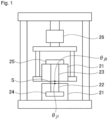
- Fig. 1 is a schematic diagram of a thermal resistance measuring instrument.
- the thermally conductive sheet of the present invention includes: a matrix formed of an organopolysiloxane; a thermally conductive filler; methyl phenyl silicone; and a hydrocarbon compound that is liquid at 25°C.
- a matrix formed of an organopolysiloxane a thermally conductive filler
- methyl phenyl silicone a thermally conductive filler
- a hydrocarbon compound that is liquid at 25°C a hydrocarbon compound that is liquid at 25°C.
- the thermally conductive sheet in the present invention includes a matrix formed of an organopolysiloxane.
- the organopolysiloxane may be of either the condensation reaction type or the addition reaction type, and the addition reaction type is preferable because this type is easy to highly fill with a thermally conductive filler, and the curing temperature can be easily adjusted with a catalyst or the like.
- the matrix can be obtained, for example, by curing a curable silicone composition.
- the curable silicone composition may be composed of, for example, a base resin and a curing agent.
- the curable silicone composition preferably contains an alkenyl group-containing organopolysiloxane as a base resin and a hydrogen organopolysiloxane as a curing agent from the viewpoint of facilitating high filling with a thermally conductive filler in the case of an addition reaction type.
- the curable silicone composition is preferably liquid before curing.
- the curable silicone composition is liquid before curing, it is easy to highly fill the same with a thermally conductive filler and it is easy to disperse a hydrocarbon compound in the curable silicone composition.
- the term "liquid” refers to a liquid at normal temperature (23°C) and 1 atmosphere.
- an organopolysiloxane having at least a dimethylsiloxane unit can be used.
- the alkenyl group-containing organopolysiloxane include a vinyl-both terminated organopolysiloxane such as vinyl-both terminated polydimethylsiloxane, a vinyl-both terminated dimethylsiloxane-diphenylsiloxane copolymer, a vinyl-both terminated dimethylsiloxane-methyl phenyl siloxane copolymer, or a vinyl-both terminated dimethylsiloxane-diethylsiloxane copolymer.
- the hydrogen organopolysiloxane is a compound having two or more hydrosilyl groups (SiH), and can cure an alkenyl group-containing organopolysiloxane as a base resin.
- the matrix is preferably three-dimensionally crosslinked in order to be able to secure the shape retainability of the thermally conductive sheet.
- a curable silicone composition containing at least an alkenyl group-containing organopolysiloxane having at least 3 or more alkenyl groups in one molecule or a hydrogen organopolysiloxane having at least 3 or more hydrogen atoms to be added to a silicon atom may be cured.
- a curable silicone composition containing at least a hydrogen organopolysiloxane having at least 3 or more hydrogen atoms to be added to a silicon atom is preferable.
- the lower limit of the content of the matrix is preferably 3% by volume or more, more preferably 4% by volume or more, and further preferably 5% by volume or more, based on the total amount of the thermally conductive sheet.
- the upper limit of the content of the matrix is preferably 30% by volume or less, more preferably 20% by volume or less, and further preferably 15% by volume or less, based on the total amount of the thermally conductive sheet.
- the content of the matrix is preferably 3 to 30% by volume, more preferably 4 to 20% by volume, and further preferably 5 to 15% by volume, based on the total amount of the thermally conductive sheet.
- the content of the matrix is equal to or more than these lower limit values, it is easy to form a thermally conductive sheet, and when the content is equal to or less than these upper limit values, the content of the thermally conductive filler can be increased, and the thermal resistance value of the thermally conductive sheet obtained can be reduced.
- the range shown by “to” means a range of not less than a predetermined numerical value and not more than a predetermined numerical value that are shown before and after “to.”
- the thermally conductive sheet contains a thermally conductive filler.
- the thermally conductive filler is contained in a state of being dispersed in the matrix. By containing the thermally conductive filler in a state of being dispersed in the matrix, the thermally conductive property of the thermally conductive sheet can be enhanced, and the heat-dissipating property thereof can be enhanced.
- the thermally conductive filler may be a non-anisotropic filler, an anisotropic filler, or a combination thereof.
- the non-anisotropic filler has an aspect ratio of 2 or less and preferably 1.5 or less.
- the aspect ratio is set to 2 or less, it is possible to prevent the viscosity of the thermally conductive composition from increasing and to achieve high filling the thermally conductive composition with the thermally conductive filler.
- non-anisotropic filler examples include a metal, a metal oxide, a metal nitride, a metal hydroxide, a carbon material, and a non-metal oxide, nitride, and carbide.
- shape of the non-anisotropic filler examples include a spherical or irregular powder.
- examples of the metal include aluminum, copper, and nickel
- examples of the metal oxide include aluminum oxide, magnesium oxide, and zinc oxide
- examples of the metal nitride include aluminum nitride.
- examples of the metal hydroxide include aluminum hydroxide.
- examples of the carbon material include spheroidal graphite.
- examples of the non-metal oxide, nitride, and carbide include quartz, boron nitride, and silicon carbide.
- aluminum oxide and aluminum nitride are preferable, and aluminum oxide is more preferable.
- non-anisotropic filler one of those described above may be used alone or two or more may be used in combination.
- the average particle size of the non-anisotropic filler is preferably 0.1 to 100 ⁇ m and more preferably 0.3 to 90 ⁇ m. By setting the average particle size to the above lower limit value or more, the specific surface area of the non-anisotropic filler does not become larger than necessary, and the viscosity of the liquid composition is less likely to increase even when the non-anisotropic filler is blended in a large amount, to facilitate high filling with the non-anisotropic filler.
- non-anisotropic filler used for filling, it is preferable to use two or more non-anisotropic fillers having different particle sizes in combination.
- the average particle size of the non-anisotropic filler can be measured by observation using an electron microscope or the like. More specifically, the particle sizes of 50 arbitrary anisotropic fillers are measured using an electron microscope, an optical microscope, or an X-ray CT apparatus, and the average value (arithmetic average value) thereof can be used as the average particle size.
- the anisotropic filler is a filler that has anisotropy in shape and can be oriented.
- the anisotropic filler is preferably at least one selected from the group consisting of a fibrous material and a flaky material.
- the anisotropic filler generally has a high aspect ratio and has an aspect ratio of more than 2, and one having an aspect ratio of 5 or more can also be used.
- the upper limit of the aspect ratio is not particularly limited, and is practically 100.
- the aspect ratio is the ratio of the length in the major axis direction to the length in the minor axis direction, and in the fibrous material, the aspect ratio means fiber length/fiber diameter, and in the flaky material, the aspect ratio means the length in the major axis direction/the thickness of the flaky material.
- the average fiber length thereof is preferably 10 to 500 ⁇ m, more preferably 20 to 350 ⁇ m, and further preferably 50 to 300 ⁇ m.
- the average fiber length of the fibrous material is preferably shorter than the thickness of the thermally conductive sheet. Being shorter than the thickness prevents the fibrous material from protruding more than necessary from the surface of the thermally conductive sheet.
- the average fiber length can be calculated by observing the anisotropic filler using a microscope. More specifically, the fiber lengths of 50 arbitrary anisotropic fillers are measured using, for example, an electron microscope or an optical microscope, and the average value (arithmetic average value) thereof can be used as the average fiber length.
- the average particle size thereof is preferably 10 to 400 ⁇ m, more preferably 15 to 300 ⁇ m, and further preferably 20 to 200 ⁇ m.
- the average particle size of the flaky material can be calculated by observing the anisotropic filler using a microscope and using the major axis diameter as the diameter. More specifically, the major axis diameters of 50 arbitrary anisotropic fillers are measured using, for example, an electron microscope or an optical microscope, and the average value (arithmetic average value) thereof can be used as the average particle size.
- the anisotropic filler a known material having a thermally conductive property may be used.
- Specific examples of the anisotropic filler include a carbon-based material typified by a carbon fiber or a flaky carbon powder, a metal material typified by a metal fiber and a metal oxide, boron nitride and a metal nitride, a metal carbide, a metal hydroxide, and a polyparaphenylene benzoxazole fiber.
- One anisotropic filler may be used alone or two or more may be used in combination.
- the lower limit of the content of the thermally conductive filler is preferably 50% by volume or more, more preferably 60% by volume or more, and further preferably 70% by volume or more, based on the total amount of the thermally conductive sheet.
- the upper limit of the content of the thermally conductive filler is preferably 90% by volume or less, more preferably 87% by volume or less, and further preferably 84% by volume or less, based on the total amount of the thermally conductive sheet.
- the content of the thermally conductive filler is preferably in the range of 50 to 90% by volume, more preferably in the range of 60 to 87% by volume, and further preferably in the range of 70 to 84% by volume, based on the total amount of the thermally conductive sheet.
- the thermal resistance value of the thermally conductive sheet decreases and the heat-dissipating property increases.
- the content of the thermally conductive filler is equal to or less than these upper limit values, the fluidity of the thermally conductive composition is prevented from decreasing, it is easy to form the thermally conductive composition into a sheet, and it is easy to obtain a thermally conductive sheet having a good surface condition.
- the thermally conductive sheet of the present invention includes methyl phenyl silicone and a hydrocarbon compound that is liquid at 25°C.
- Methyl phenyl silicone and a hydrocarbon compound that is liquid at 25°C are contained as plasticizers in the thermally conductive sheet.
- Methyl phenyl silicone is a non-reactive silicone having a structural formula in which the silicon atom in the polysiloxane bond is partially substituted with a phenyl group instead of a methyl group as a side chain.
- methyl phenyl silicone for example, a compound having at least either a methyl phenyl siloxane unit or a diphenylsiloxane unit and a dimethylsiloxane unit may be used.
- the thermally conductive sheet contains methyl phenyl silicone, thereby improving the peelability from an adherend such as a release sheet.
- an adherend such as a release sheet.
- a hydrocarbon compound that is liquid at 25°C is further contained as a plasticizer, the amount of the plasticizer component migrating to the adherend or the like can be suppressed. The principle thereof is not clear, but it is presumed as follows.
- methyl phenyl silicone By containing a phenyl group, it is difficult for methyl phenyl silicone to be compatible with the matrix, and thus methyl phenyl silicone is easily relatively unevenly distributed on the surface of the thermally conductive sheet, and methyl phenyl silicone unevenly distributed on the surface of the thermally conductive sheet plays the role of suppressing bleeding of a further plasticizer in the thermally conductive sheet. As a result, the migration of the plasticizer including methyl phenyl silicone to the adherend can be suppressed. In addition, methyl phenyl silicone is easily relatively unevenly distributed on the surface, therefore it is possible to improve also the peelability of the thermally conductive sheet.
- thermally conductive sheet can easily have good flexibility by containing methyl phenyl silicone.
- methyl phenyl silicone can be added in an oil state or an oligomer state, and is preferably added in an oil state in that it can be compatible with further plasticizer and more effectively prevent a further plasticizer from migrating to the adherend or the like.
- the kinematic viscosity at 25°C of methyl phenyl silicone is preferably in the range of 10 to 100,000 cSt, and from the viewpoint of dispersibility in the matrix, more preferably in the range of 100 to 1000 cSt. The kinematic viscosity shall be measured according to JIS Z 8803:2011.
- methyl phenyl silicone it is preferable to use methyl phenyl silicone oil having a refractive index of 1.427 or more as measured according to JIS K 0062:1992.
- the refractive index is an index of the amount of a phenyl group in methyl phenyl silicone oil.
- methyl phenyl silicone oil having a high refractive index reportedly has a higher content of a phenyl group than methyl phenyl silicone oil having a low refractive index. Because of this, by using methyl phenyl silicone oil having a high refractive index, migration of a further plasticizer can be more effectively suppressed even when the content of methyl phenyl silicone is relatively low. Then, the amount created by reducing the content of methyl phenyl silicone oil can be used for further filling with the thermally conductive filler, and thus it is possible to provide a thermally conductive sheet having higher thermal conductivity.
- the refractive index of this methyl phenyl silicone can be measured, for example, by a method according to JIS K 0062:1992 after applying a pressure to the thermally conductive composition or a formed product obtained by curing thereof with a roller or the like and isolating the bled oil.
- the lower limit of the content of methyl phenyl silicone is preferably 5 parts by volume or more, more preferably 10 parts by volume or more, and further preferably 20 parts by volume or more per 100 parts by volume of the matrix.
- the upper limit of the content of methyl phenyl silicone is preferably 100 parts by volume or less, more preferably 70 parts by volume or less, and further preferably 50 parts by volume or less per 100 parts by volume of the matrix.
- the methyl phenyl silicone is preferably included in an amount of 5 to 100 parts by volume, more preferably 10 to 70 parts by volume, and further preferably 20 to 50 parts by volume per 100 parts by volume of the matrix.
- methyl phenyl silicone When the content of methyl phenyl silicone is 5 parts by volume or more, bleeding of a further plasticizer such as a hydrocarbon compound can be prevented, and as a result, the amount migrating to the adherend can be suppressed. In addition, sufficient flexibility can be imparted to the thermally conductive sheet, and the thermally conductive sheet can be easily made putty-like.
- the amount of methyl phenyl silicone bled from the thermally conductive sheet can be prevented from becoming larger than necessary.
- reduction in the shape retainability, the mechanical strength, or the like of the thermally conductive sheet can also be prevented.
- the hydrocarbon compound used in the present invention is liquid at 25°C.
- a hydrocarbon compound that is liquid at 25°C even when a thermally conductive filler is contained in a large amount, a thermally conductive sheet that is excellent in flexibility can be obtained, and the thermally conductive sheet can be easily made putty-like.
- Specific examples of the hydrocarbon compound that is liquid at 25°C include squalane, squalene, paraffin, pristane, and polyisobutylene.
- the hydrocarbon compound used in the present invention is preferably liquid paraffin.
- liquid paraffin as the hydrocarbon compound, the flexibility of the thermally conductive sheet can be further improved.
- the average molecular weight of the hydrocarbon compound is preferably 200 to 500, more preferably 225 to 350, and further preferably 250 to 300.
- the average molecular weight of the hydrocarbon compound is equal to or more than the above lower limit value, the amount of the hydrocarbon compound migrating to the adherend can be easily suppressed. In addition, reduction in the mechanical strength or the like of the thermally conductive sheet can also be easily suppressed.
- the average molecular weight of the hydrocarbon compound is equal to or less than the above upper limit value, the compatibility with a further component is excellent, making it easy to form a high-quality thermally conductive sheet. In addition, the flexibility of the thermally conductive sheet can be easily enhanced.
- the density of the hydrocarbon compound is not particularly limited, and is preferably 0.80 to 0.90 g/cm 3 , more preferably 0.82 to 0.87 g/cm 3 , and further preferably 0.83 to 0.86 g/cm 3 .
- the kinematic viscosity at 40°C of the hydrocarbon compound is preferably 100 cSt or less, preferably 70 cSt or less, and further preferably 50 cSt or less.
- the kinematic viscosity is equal to or less than the above upper limit value, the flexibility of the thermally conductive sheet can be easily enhanced, and the thermally conductive sheet can also be easily made putty-like.
- the hydrocarbon compound is more likely to be compatible with a further component constituting the thermally conductive sheet, making it easier to obtain a high-quality thermally conductive sheet.
- the kinematic viscosity at 40°C of the hydrocarbon compound is preferably 3 cSt or more, more preferably 5 cSt or more, and further preferably 8 cSt or more.
- the kinematic viscosity of the hydrocarbon compound is equal to or more than the above lower limit value, the amount thereof migrating to the adherend can be easily suppressed, and reduction in the mechanical strength or the like of the thermally conductive sheet can also be easily suppressed.
- the kinematic viscosity at 40°C of the hydrocarbon compound is preferably in the range of 3 to 100 cSt, more preferably in the range of 5 to 70 cSt, and further preferably in the range of 8 to 50 cSt.
- the lower limit of the content of the hydrocarbon compound is preferably 1 part by volume or more, more preferably 5 parts by volume or more, and further preferably 10 parts by volume or more per 100 parts by volume of the matrix.
- the upper limit of the content of the hydrocarbon compound is preferably 80 parts by volume or less, more preferably 60 parts by volume or less, and further preferably 30 parts by volume or less per 100 parts by volume of the matrix.
- the content of the hydrocarbon compound is preferably 1 to 80 parts by volume, more preferably 5 to 60 parts by volume, and further preferably 10 to 30 parts by volume per 100 parts by volume of the matrix.
- the content of the hydrocarbon compound is equal to or more than the above lower limit value, a thermally conductive sheet that is excellent in flexibility can be obtained, and the thermally conductive sheet can be easily made putty-like.
- the content of the hydrocarbon compound is equal to or less than the above upper limit value, the amount thereof migrating to the adherend can be suppressed.
- a plasticizer other than the above hydrocarbon compound and methyl phenyl silicone may be used.
- a plasticizer it is preferable to use a non-reactive silicone oil other than methyl phenyl silicone.
- the silicone oil used as the further plasticizer include a straight silicone oil, and among such oils, dimethyl silicone oil is more preferable. By containing dimethyl silicone oil, the flexibility of the thermally conductive sheet can be more easily improved.
- the kinematic viscosity at 25°C of dimethyl silicone oil is preferably in the range of 10 to 100,000 cSt, and from the viewpoint of dispersibility in the matrix and flexibility, more preferably in the range of 50 to 1,000 cSt.
- the thermally conductive sheet of the present invention contains dimethyl silicone oil
- the lower limit of the content of dimethyl silicone oil is preferably 2 parts by volume or more, more preferably 5 parts by volume or more, and further preferably 10 parts by volume or more per 100 parts by volume of the matrix.
- the upper limit of the content of dimethyl silicone oil is preferably 100 parts by volume or less, more preferably 70 parts by volume or less, and further preferably 50 parts by volume or less per 100 parts by volume of the matrix.
- the content of dimethyl silicone oil is preferably 2 to 100 parts by volume, more preferably 5 to 70 parts by volume, and further preferably 10 to 50 parts by volume per 100 parts by volume of the matrix.
- the content of the dimethyl silicone oil is equal to or more than the above lower limit value, a thermally conductive sheet that is excellent in flexibility can be obtained, and the thermally conductive sheet can be easily made putty-like.
- the content of dimethyl silicone oil is equal to or less than the above upper limit value, the amount thereof migrating to the adherend can be suppressed.
- the thermally conductive sheet according to the present invention may contain a dispersant.
- a dispersant include a silane compound.
- Examples of the silane compound include an alkoxysilane compound.
- the alkoxysilane compound is a compound having a structure in which 1 to 3 of the four bonds of the silicon atom (Si) are bonded to alkoxy groups and the remaining bond(s) is(are) bonded to an organic substituent.
- Examples of the alkoxy group of the alkoxysilane compound include a methoxy group, an ethoxy group, a propoxy group, a butoxy group, a pentoxy group, and a hexoxy group.
- the alkoxysilane compound may be contained as a dimer.
- an alkoxysilane compound having a methoxy group or an ethoxy group is preferable from the viewpoint of easy availability.
- the number of alkoxy groups of the alkoxysilane compound is preferably 3 from the viewpoint of enhancing the affinity for the thermally conductive filler as an inorganic substance.
- the alkoxysilane compound is more preferably at least one selected from the group consisting of a trimethoxysilane compound and a triethoxysilane compound.
- Examples of a functional group included in the organic substituent of the alkoxysilane compound include an acryloyl group, an alkyl group, a carboxyl group, a vinyl group, a methacryloyle group, an aromatic group, an amino group, an isocyanate group, an isocyanurate group, an epoxy group, a hydroxyl group, and a mercapto group.
- the organic substituent of the alkoxysilane compound preferably does not include an amino group, an isocyanate group, an isocyanurate group, a hydroxyl group, or a mercapto group.
- the alkoxysilane compound facilitates high filling with the thermally conductive filler by enhancing the dispersibility of the thermally conductive filler, and thus it is preferable to include an alkylalkoxysilane compound having an alkyl group bonded to a silicon atom, that is, an alkoxysilane compound having an alkyl group as an organic substituent.
- the number of carbon atoms of the alkyl group bonded to the silicon atom is preferably 4 or more.
- the number of carbon atoms of the alkyl group bonded to the silicon atom is preferably 16 or less from the viewpoint of causing the viscosity of the alkoxysilane compound itself to be relatively low and suppressing the viscosity of the thermally conductive composition to a low level.
- the alkoxysilane compound one or two or more can be used.
- the alkoxysilane compound include an alkyl group-containing alkoxysilane compound, a vinyl group-containing alkoxysilane compound, an acryloyl group-containing alkoxysilane compound, a methacryloyle group-containing alkoxysilane compound, an aromatic group-containing alkoxysilane compound, an amino group-containing alkoxysilane compound, an isocyanate group-containing alkoxysilane compound, an isocyanurate group-containing alkoxysilane compound, an epoxy group-containing alkoxysilane compound, and a mercapto group-containing alkoxysilane compound.
- an alkyl group-containing alkoxysilane compound is preferable.
- alkyl group-containing alkoxysilane compound examples include methyltrimethoxysilane, dimethyldimethoxysilane, trimethylmethoxysilane, methyltriethoxysilane, dimethyldiethoxysilane, ethyltrimethoxysilane, n-propyltrimethoxysilane, n-propyltriethoxysilane, isobutyltrimethoxysilane, isobutyltriethoxysilane, n-hexyltrimethoxysilane, n-hexyltriethoxysilane, cyclohexylmethyldimethoxysilane, n-octyltriethoxysilane, and n-decyltrimethoxysilane.
- alkyl group-containing alkoxysilane compounds at least one selected from the group consisting of isobutyltrimethoxysilane, isobutyltriethoxysilane, n-hexyltrimethoxysilane, n-hexyltriethoxysilane, cyclohexylmethyldimethoxysilane, n-octyltriethoxysilane, and n-decyltrimethoxysilane is preferable, at least one selected from the group consisting of n-octyltriethoxysilane and n-decyltrimethoxysilane is more preferable, and n-decyltrimethoxysilane is particularly preferable.
- the dispersant may be a volatile compound.
- the volatile compound means a compound having at least either one of the following properties: the temperature T1 at which the weight loss when the temperature is raised under a condition of 2°C/min in thermogravimetric analysis is 90% is in the range of 70 to 300°C, and the boiling point (1 atm) is in the range of 60 to 200°C.
- the temperature T1 at which the weight loss is 90% means the temperature at which when the weight of a sample before thermogravimetric analysis is 100%, the weight is reduced by 90% (that is, the temperature at which the weight is 10% of the weight before measurement).
- a volatile silane compound among the above silane compounds may be used as the dispersant.
- the dispersant may be blended into the thermally conductive composition before cured, but when the dispersant is a volatile compound, part or all of the dispersant may be volatilized by the heating during curing the thermally conductive composition. Therefore, even when a dispersant is blended into the thermally conductive composition before cured, the dispersant may not be contained in the thermally conductive sheet after curing the thermally conductive composition.
- the thermally conductive sheet may optionally contain an additive other than the above.
- the additive include at least one or more selected from the group consisting of a pressure-sensitive adhesive, a flame retardant, an antioxidant, a colorant, an antisettling agent, and the like.
- a curing catalyst or the like that accelerates the curing may be blended.
- the curing catalyst include a platinum-based catalyst.
- the thermally conductive sheet of the present invention is preferably putty-like.
- the putty-like thermally conductive sheet has high flexibility, and thus can be moderately compressed and disposed inside an electronic device. Because of this, the putty-like thermally conductive sheet can be closely contacted with an electronic component, a heat-dissipating element, or the like inside an electronic device, and can enhance the heat-dissipating property.
- being putty-like is, for example, the property of retaining the shape without deforming under the own weight and being unable or being unlikely to return to the original shape when deformed by a load or the like.
- Such a property can be expressed by a "static load Fs" and a "dynamic load Fd.”
- the “dynamic load Fd” is the load at the time of pressing at a predetermined speed that is not slow, and is an index that indicates the hardness (that is, the magnitude of stress against deformation) of a sheet (cured material).
- the “dynamic load Fd” is also related to shape retainability in which the sheet shape is maintained.
- the "static load Fs" is the load when a predetermined time has passed after pressing to a predetermined depth, and is an index of the magnitude of the repulsive force from a deformed state (that is, the force to return to the original shape).
- Fd when being putty-like is expressed by Fd and Fs, Fd has a relatively moderately large value and Fs has a relatively small value.
- the thermally conductive sheet of the present invention preferably has a ratio Fs/Fd, expressed by the static load Fs and the dynamic load Fd, of less than 0.35.
- Fs/Fd is less than 0.35, good flexibility can be imparted to the thermally conductive sheet, and the thermally conductive sheet can be made putty-like.
- Fs/Fd is more preferably 0.30 or less, further preferably 0.25 or less, and more further preferably 0.20 or less.
- the lower limit of Fs/Fd is not particularly limited, but is preferably 0.05 or more, and more preferably 0.10 or more, from the viewpoint of the shape retainability and the handleability of the thermally conductive sheet.
- Fs/Fd is preferably 0.05 or more and less than 0.35, more preferably 0.05 to 0.3, further preferably 0.10 to 0.25, and more further preferably 0.10 to 0.20.
- the dynamic load Fd may be equal to or less than a certain value, and is preferably 100 N or less, more preferably 50 N or less, and further preferably 30 N or less.
- the lower limit of the dynamic load Fd is not particularly limited, and is, for example, 5 N or more.
- the range of the dynamic load Fd is preferably 5 to 100 N, more preferably 5 to 50 N, and further preferably 5 to 30 N.
- Fs and Fd can each be measured by the method described in the Examples.
- Fs/Fd can be set within the above range by adjusting the blending ratio of each component of the thermally conductive sheet and the crosslink density of the matrix. For example, Fs/Fd tends to decrease when increasing the blending ratio of methyl phenyl silicone, the hydrocarbon compound, and a plasticizer other than these. In addition, Fs/Fd tends to decrease even when reducing the crosslink density of the matrix.
- the lower limit of the 40% compressive load of the thermally conductive sheet of the present invention is preferably 1 N or more, more preferably 2 N or more, and further preferably 3 N or more.
- the upper limit of the 40% compressive load of the thermally conductive sheet of the present invention is preferably 25 N or less, more preferably 20 N or less, and further preferably 15 N or less.
- the 40% compressive load of the thermally conductive sheet of the present invention is preferably 1 to 25 N, more preferably 2 to 20 N, and further preferably 3 to 15 N.
- the lower limit of the compressibility when the sheet is compressed with a force of 8 psi (hereinafter referred to as "8 psi compressibility") is preferably 20% or more, more preferably 25%, and further preferably 30% or more.
- the upper limit of the compressibility when the sheet is compressed with a force of 8 psi is preferably 70% or less, more preferably 65% or less, and further preferably 60% or less.
- the compressibility when the sheet is compressed with a force of 8 psi is preferably 20 to 70%, more preferably 25 to 65%, and further preferably 30 to 60%.
- thermally conductive sheet When the 40% compressive load and the 8 psi compressibility are equal to or more than their respective lower limit values, a thermally conductive sheet that is excellent in shape retainability and handleability can be obtained. In addition, when the 40% compressive load and the 8 psi compressibility are equal to or less than their respective upper limit values, the thermally conductive sheet is excellent in flexibility.
- the 40% compressive load and the 8 psi compressibility can each be measured by the method described in the Examples.
- the thermal resistance value of the thermally conductive sheet of the present invention is preferably 2.00°C/W or less, more preferably 1.50°C/W or less, and further preferably 1.20°C/W or less.
- the thermal resistance value is such a value, the thermally conductive sheet easily transfers heat from a heating element to a heat-dissipating element.
- the smaller the thermal resistance value, the better, and the thermal resistance value may be, for example, 0.1°C/W or more.
- the above thermal resistance value is the thermal resistance value in the thickness direction measured in a state in which the thermally conductive sheet is compressed by 30%, and is specifically measured by the method described in the Examples.
- the thickness of the thermally conductive sheet is not particularly limited, and may be appropriately set according to the shape and application of the electronic device on which the thermally conductive sheet is mounted, and may be in the range of, for example, 0.1 to 5 mm.
- the thermally conductive sheet may form a thermally conductive sheet laminated body including a thermally conductive sheet and a release sheet attached to at least one side of the thermally conductive sheet by attaching the release sheet to one or both sides of the thermally conductive sheet.
- the release sheet protects the thermally conductive sheet before use of the thermally conductive sheet, and may be peeled off from the thermally conductive sheet when the thermally conductive sheet is used.
- the thermally conductive sheet is excellent in peelability, and thus it is possible to prevent part of the thermally conductive sheet from remaining on the release sheet when the thermally conductive sheet is peeled off from the release sheet.
- the release sheet may be a resin sheet, or a resin sheet having at least one side subjected to a release treatment. As the resin sheet, the resin sheet used to produce the thermally conductive sheet may be used as it is, as described in the production method described later.
- the method for producing the thermally conductive sheet of the present invention is not particularly limited, and the thermally conductive sheet can be produced, for example, by a production method including the following steps X and Y.
- step X at least a matrix precursor, a thermally conductive filler, methyl phenyl silicone, and a hydrocarbon compound that is liquid at 25°C are mixed to obtain a thermally conductive composition.
- the matrix precursor consists of the component(s) before cured for constituting the matrix, and the above curable silicone composition or the like may be used.
- a plasticizer other than methyl phenyl silicone and the hydrocarbon compound, a dispersant, an additive, or the like may optionally be appropriately further mixed.
- a known kneader, kneading roll, mixer, or vibration stirrer may be used for mixing each component constituting the thermally conductive composition.
- the thermally conductive composition preferably has fluidity from the viewpoint of being able to uniformly mix each component.
- the dispersant blended in the thermally conductive composition is a volatile compound, at least part thereof may be volatilized by the heating in step Y.
- the dispersant may be blended in an amount of, for example, 1 to 30 parts by volume, preferably 5 to 20 parts by volume, per 100 parts by volume of the matrix precursor.
- Step Y is a step of curing the thermally conductive composition by heating.
- the temperature at which the thermally conductive composition is heated is not particularly limited as long as a matrix precursor such as a curable silicone composition can be cured by heating, and may be higher than room temperature (23°C), and the thermally conductive composition may preferably be heated at a temperature of 50°C or more.
- the heating temperature is not particularly limited, and may be a temperature at which the thermally conductive composition is not thermally degraded, and is, for example, 180°C or less, and preferably 150°C or less.
- the heating of the thermally conductive composition may be carried out in one stage or in two or more stages.
- the heating temperature may be within the above range in at least one of the stages, and the heating temperature is preferably within the above range in all stages.
- the total heating time is, for example, about 10 minutes to 3 hours.
- the thermally conductive composition may be semi-cured in the first stage, and the thermally conductive composition may be fully cured by heating in the second and subsequent stages.
- the thermally conductive composition contains a dispersant that is a volatile compound
- at least part of the dispersant may be volatilized by the heating.
- the thermally conductive composition may be formed into a predetermined shape such as a block or a sheet, and then cured as described above and by heating.
- the thermally conductive composition contains an anisotropic filler as the thermally conductive filler
- the anisotropic filler may be oriented in one direction and then cured by heating.
- the anisotropic filler may be oriented by a magnetic field orientation method, a flow orientation method, or the like.
- the thermally conductive composition obtained in step X may be preferably injected into a mold and formed into a predetermined shape such as a block or a sheet.
- the thermally conductive composition may be sandwiched between two resin sheets and pressurized to form the same into a sheet.
- the method for sandwiching the thermally conductive composition between two resin sheets is not particularly limited, and examples thereof include a method involving applying the thermally conductive composition onto the surface of one of the two resin sheets and overlaying the other resin sheet on the application side.
- the means for pressurization is not particularly limited, and the pressurization may be carried out using, for example, a roll or a press.
- the two resin sheets are not particularly limited, and may be low gas-permeable films or gas-permeable films.
- one of the two resin films may be a gas-permeable film, or the both may be gas-permeable films.
- a gas-permeable film when a dispersant that is a volatile compound is blended into the thermally conductive composition, the dispersant can be easily volatilized from the thermally conductive composition during the heating in step Y.
- the gas permeability means the property of a liquid being unable to permeate but a gas being able to permeate
- the oxygen permeability of the gas-permeable film is, for example, 5 ⁇ 10 3 cm 3 /(m 2 •day•MPa) or more.
- the oxygen permeability of the low gas-permeable film is less than 5.0 ⁇ 10 3 cm 3 /m 2 •day•MPa.
- the oxygen permeability is measured according to JIS K7126-2.
- the gas-permeable film examples include a porous film and a non-porous gas-permeable film.
- the porous film is a film having a plurality of pores, and is formed from a mixture of a polymer and a filler, a mixture of polymers, or the like.
- the non-porous gas-permeable film is a film that has no pores as formed in a porous film and has gas permeability. Among these, the non-porous gas-permeable film is preferable as the gas-permeable film.
- the polymer constituting the gas-permeable film is not particularly limited, and examples thereof include low-density polyethylene, linear low-density polyethylene, polymethylpentene, ethyl cellulose, and a fluorine-based resin such as polytetrafluoroethylene or a fluorine-modified resin.
- a non-porous gas-permeable film formed from polymethylpentene is preferable.
- the gas-permeable film formed from polymethylpentene has high gas permeability while it has a moderate thickness, and thus when the matrix is cured, the volatile compound can be suitably volatilized, and further, when the gas-permeable film is peeled off from the sheet, the gas-permeable film is excellent in peelability.
- the matrix precursor does not penetrate into a pore when the thermally conductive composition is applied, and thus the peelability is particularly excellent, and further, unevenness due to a pore is not formed because of the absence of a pore on the film surface, and a primary sheet having little unevenness and a good surface condition can be obtained.
- the gas-permeable film may be a gas-permeable film using the polymer alone, or may be used as a multilayer gas-permeable film obtained by laminating a plurality of resin layers formed from polymers having different gas-permeabilities. In this case, even when a resin other than the above polymer is used, by forming a thin resin layer, a multilayer gas-permeable film having an oxygen permeability of 5.0 ⁇ 10 3 cm 3 /m 2 •day•MPa or more as a whole may be configured.
- the resin sheet on the surface is peeled off and used, and thus the resin sheet is preferably a release film made of a resin having good peelability or a release film having a release layer on at least one surface thereof.
- the thickness of the resin film is not particularly limited, and is, for example, 5 to 300 ⁇ m, preferably 10 to 250 ⁇ m, and more preferably 30 to 200 ⁇ m.
- the thickness may be appropriately adjusted in such a way as to provide the desired oxygen permeability.
- the thermally conductive filler includes an anisotropic filler
- the anisotropic filler may be oriented by a magnetic field orientation method or a flow orientation method.
- the thermally conductive composition may be injected into a mold or the like and then placed in a magnetic field to orient the anisotropic filler along the magnetic field. Then, an oriented formed product may be obtained by curing a matrix precursor such as a curable silicone composition. The curing of the thermally conductive composition may be carried out under the heating conditions as described above.
- the oriented formed product is preferably block-shaped, and may be sheet-shaped.
- the oriented formed product can be used as a thermally conductive sheet as it is without being sliced.
- the orientation of the anisotropic filler can be enhanced.
- a shear force is applied to the thermally conductive composition to produce a primary sheet in which the anisotropic filler is oriented along the plane direction. More specifically, in the flow orientation method, first, the thermally conductive composition prepared in step X is stretched flat while a shear force is applied thereto, to form the same into a sheet (primary sheet). By applying a shear force, the anisotropic filler can be oriented in the shear direction.
- the thermally conductive composition may be applied onto a resin film using a coating applicator such as a bar coater or a doctor blade, or by extrusion, discharge from a nozzle, or the like, and then optionally dried, or the thermally conductive composition may be semi-cured or fully cured.
- the thickness of the primary sheet is preferably about 50 to 5000 ⁇ m.
- the anisotropic filler is oriented in one direction along the plane direction of the sheet.
- the primary sheet may be used as a thermally conductive sheet by curing the thermally conductive composition as it is without forming a block as described later.
- a plurality of primary sheets may be overlaid and laminated such that the orientation direction is the same, then adhered to each other by hot pressing or the like while being optionally cured by heating, to form a laminated block (block-shaped oriented formed product).
- the primary sheets when forming a laminated block, may be overlaid after irradiating at least one of the mutually overlaid sides of the primary sheets with vacuum ultraviolet radiation.
- the primary sheets When the primary sheets are overlaid via the side irradiated with vacuum ultraviolet radiation, the primary sheets can be firmly adhered to each other.
- a primary sheet in the case of irradiating the primary sheet with vacuum ultraviolet radiation, a primary sheet may be fully cured before being overlaid on another primary sheet, and when the primary sheets are overlaid to form a laminated block, the primary sheets do not need to be cured by heating or the like.
- the obtained oriented formed product may be cut by slicing or the like perpendicularly to the direction in which the anisotropic filler is oriented.
- the slicing may be carried out, for example, with a shear blade.
- the sheet-shaped formed product obtained by cutting may be used as a thermally conductive sheet as it is, or may be further subjected to another treatment.
- each surface that is a cut surface may be polished.
- the polishing of the surface may be carried out using, for example, abrasive paper.
- the thermally conductive sheet is used inside an electronic device or the like. Specifically, the thermally conductive sheet is interposed between a heating element and a heat-dissipating element, conducts heat generated by the heating element, and transfers the heat to the heat-dissipating element to dissipate the heat from the heat-dissipating element.
- the heating element include various electronic parts such as a CPU, a power amplifier, and a power supply such as a battery used inside an electronic device.
- examples of the heat-dissipating element include a heat sink, a heat pipe, a heat pump, and a metal housing of an electronic device.
- the thermally conductive sheet is used by causing both surfaces to be in close contact with the heating element and the heat-dissipating element, respectively, and being compressed.
- the present invention further provides a thermally conductive composition.
- the thermally conductive composition is cured to form a thermally conductive sheet.
- the thermally conductive composition includes an alkenyl group-containing organopolysiloxane, a hydrogen organopolysiloxane, a thermally conductive filler, methyl phenyl silicone, and a hydrocarbon compound that is liquid at 25°C.
- the hydrocarbon compound included in the thermally conductive composition is preferably liquid paraffin.
- the thermally conductive composition may contain a plasticizer other than methyl phenyl silicone.
- the plasticizer other than methyl phenyl silicone included in the thermally conductive composition is preferably dimethyl silicone oil.
- the thermally conductive composition may further contain a dispersant and an additive.
- alkenyl group-containing organopolysiloxane the hydrogen organopolysiloxane, the thermally conductive filler, and methyl phenyl silicone, the hydrocarbon compound that is liquid at 25°C, the plasticizer other than methyl phenyl silicone, the dispersant, and the additive are as described above, and the content thereof is also as described above, and thus detailed description thereof will be omitted.
- the content of each component is partly based on the total amount of the thermally conductive sheet, but the thermally conductive sheet is formed from a thermally conductive composition, and thus in the thermally conductive composition, the content based on the total amount of the thermally conductive sheet described above can be regarded as the content based on the total amount of the thermally conductive composition.
- the content of each component is partly per 100 parts by volume of the matrix, but as described above, the matrix is formed from a matrix precursor such as a curable silicone composition, and in the thermally conductive composition, the component means a component before cured (for example, curable silicone resin) for constituting the matrix, contained in the thermally conductive composition. Therefore, in the thermally conductive composition, the content per 100 parts by volume of the matrix described above can be regarded as the content per 100 parts by volume of the matrix precursor.
- the matrix precursor is typically a curable silicone composition, and more specifically is composed of an alkenyl group-containing organopolysiloxane and a hydrogen organopolysiloxane.
- the polymethylpentene film was peeled off from the thermally conductive sheet obtained in each of the Examples and the Comparative Examples.
- the weight of the residue of the thermally conductive sheet migrating to the polymethylpentene film per area of 10 mm ⁇ 10 mm was measured. Specifically, the residual amount was calculated by subtracting the weight of the 10 mm ⁇ 10 mm polymethylpentene film before use from the weight of the 10 mm ⁇ 10 mm polymethylpentene film after peeled off from the thermally conductive sheet.
- a test piece having a size of 12 mm ⁇ 12 mm and a thickness of 2 mm was created, and then the thermally conductive sheet was compressed using a load cell by 40% of the original thickness of the thermally conductive sheet, and the load when this state was maintained for 8 minutes was measured.
- a test piece having a size of 12 mm ⁇ 12 mm and a thickness of 2 mm was created, and then the compressibility of the thermally conductive sheet was calculated when the thermally conductive sheet was compressed with a compressive stress of 8 psi using a load cell.
- test piece having a size of 15 mm ⁇ 15 mm and a thickness of 2 mm was created, and then Fs and Fd were measured using a load cell according to the following procedures (1) and (2).
- the thickness of the test piece was the same as the thickness of the thermally conductive sheet.
- the thermal resistance value was measured using a thermal resistance measuring instrument as shown in Fig. 1 by the method shown below.
- each test piece S having a size of 12 mm ⁇ 12 mm was created for the present test. Then, each test piece S was attached onto a copper block 22 having a measurement surface of 12 mm ⁇ 12 mm and having a side surface covered with a thermal insulator 21, and sandwiched between the copper block 22 and an upper copper block 23, and a load was applied using a load cell 26 such that the thickness was 1.4 mm (70% of the original thickness).
- the lower copper block 22 is in contact with a heater 24.
- the upper copper block 23 is covered with the thermal insulator 21 and connected to a heat sink 25 with a fan.
- the heater 24 was caused to generate heat at an amount of heat generated of 25 W, and 10 minutes after the temperature became in a substantially steady state, the temperature of the upper copper block 23 ( ⁇ j0 ), the temperature of the lower copper block 22 ( ⁇ j1 ), and the amount of heat generated of the heater (Q) were measured, and the thermal resistance value of each sample was determined from the following expression (1).
- Thermal resistance ⁇ j 1 ⁇ j 0 / Q
- ⁇ j1 is the temperature of the lower copper block 22
- ⁇ j0 is the temperature of the upper copper block 23
- Q is the amount of heat generated.
- thermally conductive composition created according to the blending in Table 1 was sandwiched between two polymethylpentene films and stretched using a spacer such that the thickness of the thermally conductive composition was 2 mm, and then the composition was cured by heating at 80°C for 12 hours to obtain a thermally conductive sheet.
- Thermally conductive sheets having a thickness of 2 mm were obtained in the same manner as in Example 1 except that the blending of the thermally conductive composition was changed as shown in Table 1.
- Table 1 Exam ple 1 Exam ple 2 Exam ple 3 Exam ple 4 Exam ple 5 Compara tive Example 1 Compara tive Example 2 Compara tive Example 3 Blendi ng (parts by volum e) Matrix Alkenyl group-containing organopolysilox ane 49.4 49.4 49.4 49.4 49.4 49.4 49.4 49.4 49.4 49.4 49.4 49.4 49.4 49.4 49.4 49.4 49.4 49.4 49.4 49.4 49.4 49.4 49.4 49.4 49.4 49.4 49.4 49.4 49.4 49.1 49.1 Hydrogen organopolysilox ane 50.6 50.6 50.6 50.6 50.6 50.6 50.9 Plastici zer Dimethyl silicone 41.4 35.6 28.7 24.1 60.9 52.9 3
- the thermally conductive sheets satisfying the requirements of the present invention had high thermal conductivity and good flexibility, were excellent in peelability, and were able to suppress the amount thereof migrating to the adherend.
- the thermally conductive sheet created in Comparative Example 1 contained a hydrocarbon compound that was liquid at 25°C but did not contain methyl phenyl silicone, and thus had insufficient flexibility, had insufficient peelability, and were unable to suppress the amount thereof migrating to the adherend.
- the thermally conductive composition was powdery, and no thermally conductive sheet was able to be created.
- the thermally conductive sheet did not contain a hydrocarbon compound that was liquid at 25°C, and thus had insufficient flexibility and was unable to be made even putty-like.
- Example 4 For Example 4 and Comparative Example 1, migrants were analyzed by infrared spectroscopy. Infrared spectroscopy was carried out by the ATR method (diamond prism) using Nicolet iS5 (manufactured by Thermo Fisher Scientific Inc.).
- the mass ratio of dimethyl silicone:methyl phenyl silicone:liquid paraffin was estimated from comparison of the absorbance with the reference for the infrared absorption spectrum, and then was found to be 6:76:18 for Example 4 and 88:0:12 for Comparative Example 1.
- Example 4 the blending ratio was 28:37:34, and thus the proportion of methyl phenyl silicone in the migrant was large.
- the amount migrating was 0.06 mg, and thus it can be presumed that methyl phenyl silicone reduces the migration and suppresses the migration of dimethyl silicone and liquid paraffin. That is, it can be presumed that methyl phenyl silicone was relatively unevenly distributed on the surface to suppress bleeding and migration of a further plasticizer, whereas migration of methyl phenyl silicone itself was suppressed, and as a result, the amount migrating to the release sheet was able to be suppressed. In addition, it can be presumed that the uneven distribution of methyl phenyl silicone on the surface also improves the peelability.
- Comparative Example 1 the blending ratio was 72:0:28, and thus the migration proportion of dimethyl silicone was large. In addition, the amount migrating was 1.3 mg, which was overwhelmingly larger than in Example 4, and the migration of dimethyl silicone and liquid paraffin was unable to be sufficiently suppressed.
Landscapes
- Chemical & Material Sciences (AREA)
- Chemical Kinetics & Catalysis (AREA)
- Organic Chemistry (AREA)
- Engineering & Computer Science (AREA)
- Medicinal Chemistry (AREA)
- Polymers & Plastics (AREA)
- Health & Medical Sciences (AREA)
- Oil, Petroleum & Natural Gas (AREA)
- Physics & Mathematics (AREA)
- Combustion & Propulsion (AREA)
- Thermal Sciences (AREA)
- Materials Engineering (AREA)
- Compositions Of Macromolecular Compounds (AREA)
- Cooling Or The Like Of Semiconductors Or Solid State Devices (AREA)
- Manufacture Of Macromolecular Shaped Articles (AREA)
Applications Claiming Priority (2)
| Application Number | Priority Date | Filing Date | Title |
|---|---|---|---|
| JP2021160133 | 2021-09-29 | ||
| PCT/JP2022/036313 WO2023054536A1 (fr) | 2021-09-29 | 2022-09-28 | Feuille thermoconductrice |
Publications (1)
| Publication Number | Publication Date |
|---|---|
| EP4411808A1 true EP4411808A1 (fr) | 2024-08-07 |
Family
ID=85780711
Family Applications (1)
| Application Number | Title | Priority Date | Filing Date |
|---|---|---|---|
| EP22876402.3A Withdrawn EP4411808A1 (fr) | 2021-09-29 | 2022-09-28 | Feuille thermoconductrice |
Country Status (5)
| Country | Link |
|---|---|
| EP (1) | EP4411808A1 (fr) |
| JP (2) | JP7271039B1 (fr) |
| CN (1) | CN117813685A (fr) |
| TW (1) | TW202330763A (fr) |
| WO (1) | WO2023054536A1 (fr) |
Families Citing this family (1)
| Publication number | Priority date | Publication date | Assignee | Title |
|---|---|---|---|---|
| WO2025105476A1 (fr) * | 2023-11-17 | 2025-05-22 | 積水化学工業株式会社 | Corps de fourniture de feuilles thermoconductrices et procédé de fabrication de celui-ci |
Family Cites Families (6)
| Publication number | Priority date | Publication date | Assignee | Title |
|---|---|---|---|---|
| JP3719382B2 (ja) * | 2000-10-25 | 2005-11-24 | 信越化学工業株式会社 | 電磁波吸収性シリコーンゴム組成物 |
| JP6771218B2 (ja) * | 2016-10-21 | 2020-10-21 | 積水ポリマテック株式会社 | 熱伝導性組成物および熱伝導性部材 |
| WO2019004150A1 (fr) * | 2017-06-27 | 2019-01-03 | 積水ポリマテック株式会社 | Feuille thermoconductrice |
| KR102924449B1 (ko) * | 2018-11-20 | 2026-02-09 | 세키수이 폴리머텍 가부시키가이샤 | 열전도성 시트 및 그 제조방법 |
| JP7050704B2 (ja) * | 2019-02-07 | 2022-04-08 | 信越化学工業株式会社 | 熱伝導性粘着層を有する熱伝導性シリコーンゴムシート |
| JP7473103B2 (ja) * | 2019-11-26 | 2024-04-23 | 積水ポリマテック株式会社 | 熱伝導性シート及びその製造方法 |
-
2022
- 2022-09-28 CN CN202280056139.0A patent/CN117813685A/zh not_active Withdrawn
- 2022-09-28 WO PCT/JP2022/036313 patent/WO2023054536A1/fr not_active Ceased
- 2022-09-28 EP EP22876402.3A patent/EP4411808A1/fr not_active Withdrawn
- 2022-09-28 JP JP2022574661A patent/JP7271039B1/ja active Active
- 2022-09-29 TW TW111136982A patent/TW202330763A/zh unknown
-
2023
- 2023-04-19 JP JP2023068696A patent/JP2023099539A/ja active Pending
Also Published As
| Publication number | Publication date |
|---|---|
| JP2023099539A (ja) | 2023-07-13 |
| TW202330763A (zh) | 2023-08-01 |
| CN117813685A (zh) | 2024-04-02 |
| JP7271039B1 (ja) | 2023-05-11 |
| JPWO2023054536A1 (fr) | 2023-04-06 |
| WO2023054536A1 (fr) | 2023-04-06 |
Similar Documents
| Publication | Publication Date | Title |
|---|---|---|
| JP6892725B1 (ja) | 熱伝導性シート及びその製造方法 | |
| EP3885135B1 (fr) | Feuille thermoconductrice et procédé de fabrication d'une telle feuille thermoconductrice | |
| JP7650071B2 (ja) | 熱伝導性シート及びその製造方法 | |
| EP4225001A1 (fr) | Feuille thermoconductrice, son procédé de fixation et son procédé de production | |
| EP4159432A1 (fr) | Feuille thermoconductrice et son procédé de fabrication | |
| WO2021166370A1 (fr) | Feuille thermoconductrice, et procédé de fabrication de celle-ci | |
| EP3813104A1 (fr) | Feuille thermoconductrice | |
| JP7271039B1 (ja) | 熱伝導性シート | |
| WO2022210419A1 (fr) | Procédé de fabrication de feuille thermoconductrice | |
| TW202231831A (zh) | 導熱性片、其裝配方法及製造方法 | |
| EP4159433A1 (fr) | Procédé de production d'une feuille thermoconductrice et corps multicouche | |
| US12370729B2 (en) | Heat conductive sheet and method for producing same | |
| WO2022137762A1 (fr) | Feuille thermoconductrice, son procédé d'installation et son procédé de fabrication | |
| EP4503119A1 (fr) | Feuille thermoconductrice, son procédé d'installation et son procédé de fabrication | |
| EP4693396A1 (fr) | Feuille thermoconductrice et son procédé de fabrication | |
| EP4503120A1 (fr) | Feuille thermoconductrice | |
| JP7089322B1 (ja) | 熱伝導性シート、その装着方法及び製造方法 | |
| WO2024204754A1 (fr) | Feuille thermoconductrice et son procédé de fabrication | |
| WO2024204755A1 (fr) | Feuille thermoconductrice et son procédé de production | |
| TW202247380A (zh) | 導熱性構件之製造方法、及分配器裝置 | |
| US20240417615A1 (en) | Thermally conductive sheet |
Legal Events
| Date | Code | Title | Description |
|---|---|---|---|
| STAA | Information on the status of an ep patent application or granted ep patent |
Free format text: STATUS: THE INTERNATIONAL PUBLICATION HAS BEEN MADE |
|
| PUAI | Public reference made under article 153(3) epc to a published international application that has entered the european phase |
Free format text: ORIGINAL CODE: 0009012 |
|
| STAA | Information on the status of an ep patent application or granted ep patent |
Free format text: STATUS: REQUEST FOR EXAMINATION WAS MADE |
|
| STAA | Information on the status of an ep patent application or granted ep patent |
Free format text: STATUS: THE APPLICATION HAS BEEN WITHDRAWN |
|
| 17P | Request for examination filed |
Effective date: 20240216 |
|
| AK | Designated contracting states |
Kind code of ref document: A1 Designated state(s): AL AT BE BG CH CY CZ DE DK EE ES FI FR GB GR HR HU IE IS IT LI LT LU LV MC MK MT NL NO PL PT RO RS SE SI SK SM TR |
|
| 18W | Application withdrawn |
Effective date: 20240724 |