EP4412295A1 - Verfahren und vorrichtung zur rückkopplung eines kanalstatus - Google Patents
Verfahren und vorrichtung zur rückkopplung eines kanalstatus Download PDFInfo
- Publication number
- EP4412295A1 EP4412295A1 EP22885568.0A EP22885568A EP4412295A1 EP 4412295 A1 EP4412295 A1 EP 4412295A1 EP 22885568 A EP22885568 A EP 22885568A EP 4412295 A1 EP4412295 A1 EP 4412295A1
- Authority
- EP
- European Patent Office
- Prior art keywords
- value
- information
- terminal device
- sinr
- cqi
- Prior art date
- Legal status (The legal status is an assumption and is not a legal conclusion. Google has not performed a legal analysis and makes no representation as to the accuracy of the status listed.)
- Pending
Links
- 238000000034 method Methods 0.000 title claims abstract description 206
- 230000009467 reduction Effects 0.000 claims description 113
- 238000013139 quantization Methods 0.000 claims description 55
- 230000015654 memory Effects 0.000 claims description 51
- 238000012545 processing Methods 0.000 claims description 43
- 238000004891 communication Methods 0.000 claims description 34
- 238000004590 computer program Methods 0.000 claims description 19
- 239000011159 matrix material Substances 0.000 description 88
- 238000004364 calculation method Methods 0.000 description 39
- 230000000875 corresponding effect Effects 0.000 description 32
- 230000006870 function Effects 0.000 description 26
- 238000004422 calculation algorithm Methods 0.000 description 23
- 230000008569 process Effects 0.000 description 19
- 230000005540 biological transmission Effects 0.000 description 16
- 238000005259 measurement Methods 0.000 description 15
- 239000013598 vector Substances 0.000 description 13
- 238000010586 diagram Methods 0.000 description 10
- 238000012549 training Methods 0.000 description 10
- 230000011664 signaling Effects 0.000 description 9
- 230000001186 cumulative effect Effects 0.000 description 7
- 238000000354 decomposition reaction Methods 0.000 description 7
- 238000005516 engineering process Methods 0.000 description 7
- 238000013528 artificial neural network Methods 0.000 description 6
- 238000013507 mapping Methods 0.000 description 5
- 230000001360 synchronised effect Effects 0.000 description 5
- 238000013473 artificial intelligence Methods 0.000 description 4
- 230000006835 compression Effects 0.000 description 4
- 238000007906 compression Methods 0.000 description 4
- 230000006837 decompression Effects 0.000 description 4
- 238000010295 mobile communication Methods 0.000 description 4
- 238000012360 testing method Methods 0.000 description 4
- 238000013527 convolutional neural network Methods 0.000 description 3
- 238000013135 deep learning Methods 0.000 description 3
- 238000003062 neural network model Methods 0.000 description 3
- 230000001413 cellular effect Effects 0.000 description 2
- 230000008859 change Effects 0.000 description 2
- 230000002596 correlated effect Effects 0.000 description 2
- 238000013461 design Methods 0.000 description 2
- 230000000977 initiatory effect Effects 0.000 description 2
- 230000007774 longterm Effects 0.000 description 2
- 230000003068 static effect Effects 0.000 description 2
- 238000007630 basic procedure Methods 0.000 description 1
- 230000009286 beneficial effect Effects 0.000 description 1
- 239000003795 chemical substances by application Substances 0.000 description 1
- 230000001010 compromised effect Effects 0.000 description 1
- 230000003247 decreasing effect Effects 0.000 description 1
- 230000001419 dependent effect Effects 0.000 description 1
- 230000008713 feedback mechanism Effects 0.000 description 1
- 230000003993 interaction Effects 0.000 description 1
- 238000010801 machine learning Methods 0.000 description 1
- 230000007246 mechanism Effects 0.000 description 1
- 230000003287 optical effect Effects 0.000 description 1
- 238000011160 research Methods 0.000 description 1
- 238000013468 resource allocation Methods 0.000 description 1
- 230000008054 signal transmission Effects 0.000 description 1
- 238000010408 sweeping Methods 0.000 description 1
- 238000012546 transfer Methods 0.000 description 1
Images




Classifications
-
- H—ELECTRICITY
- H04—ELECTRIC COMMUNICATION TECHNIQUE
- H04W—WIRELESS COMMUNICATION NETWORKS
- H04W24/00—Supervisory, monitoring or testing arrangements
- H04W24/10—Scheduling measurement reports ; Arrangements for measurement reports
-
- H—ELECTRICITY
- H04—ELECTRIC COMMUNICATION TECHNIQUE
- H04B—TRANSMISSION
- H04B17/00—Monitoring; Testing
- H04B17/30—Monitoring; Testing of propagation channels
- H04B17/309—Measuring or estimating channel quality parameters
- H04B17/336—Signal-to-interference ratio [SIR] or carrier-to-interference ratio [CIR]
-
- H—ELECTRICITY
- H04—ELECTRIC COMMUNICATION TECHNIQUE
- H04B—TRANSMISSION
- H04B7/00—Radio transmission systems, i.e. using radiation field
- H04B7/02—Diversity systems; Multi-antenna system, i.e. transmission or reception using multiple antennas
- H04B7/04—Diversity systems; Multi-antenna system, i.e. transmission or reception using multiple antennas using two or more spaced independent antennas
- H04B7/06—Diversity systems; Multi-antenna system, i.e. transmission or reception using multiple antennas using two or more spaced independent antennas at the transmitting station
- H04B7/0613—Diversity systems; Multi-antenna system, i.e. transmission or reception using multiple antennas using two or more spaced independent antennas at the transmitting station using simultaneous transmission
- H04B7/0615—Diversity systems; Multi-antenna system, i.e. transmission or reception using multiple antennas using two or more spaced independent antennas at the transmitting station using simultaneous transmission of weighted versions of same signal
- H04B7/0619—Diversity systems; Multi-antenna system, i.e. transmission or reception using multiple antennas using two or more spaced independent antennas at the transmitting station using simultaneous transmission of weighted versions of same signal using feedback from receiving side
- H04B7/0621—Feedback content
- H04B7/0626—Channel coefficients, e.g. channel state information [CSI]
-
- H—ELECTRICITY
- H04—ELECTRIC COMMUNICATION TECHNIQUE
- H04B—TRANSMISSION
- H04B7/00—Radio transmission systems, i.e. using radiation field
- H04B7/02—Diversity systems; Multi-antenna system, i.e. transmission or reception using multiple antennas
- H04B7/04—Diversity systems; Multi-antenna system, i.e. transmission or reception using multiple antennas using two or more spaced independent antennas
- H04B7/06—Diversity systems; Multi-antenna system, i.e. transmission or reception using multiple antennas using two or more spaced independent antennas at the transmitting station
- H04B7/0613—Diversity systems; Multi-antenna system, i.e. transmission or reception using multiple antennas using two or more spaced independent antennas at the transmitting station using simultaneous transmission
- H04B7/0615—Diversity systems; Multi-antenna system, i.e. transmission or reception using multiple antennas using two or more spaced independent antennas at the transmitting station using simultaneous transmission of weighted versions of same signal
- H04B7/0619—Diversity systems; Multi-antenna system, i.e. transmission or reception using multiple antennas using two or more spaced independent antennas at the transmitting station using simultaneous transmission of weighted versions of same signal using feedback from receiving side
- H04B7/0621—Feedback content
- H04B7/0632—Channel quality parameters, e.g. channel quality indicator [CQI]
-
- H—ELECTRICITY
- H04—ELECTRIC COMMUNICATION TECHNIQUE
- H04B—TRANSMISSION
- H04B7/00—Radio transmission systems, i.e. using radiation field
- H04B7/02—Diversity systems; Multi-antenna system, i.e. transmission or reception using multiple antennas
- H04B7/04—Diversity systems; Multi-antenna system, i.e. transmission or reception using multiple antennas using two or more spaced independent antennas
- H04B7/06—Diversity systems; Multi-antenna system, i.e. transmission or reception using multiple antennas using two or more spaced independent antennas at the transmitting station
- H04B7/0613—Diversity systems; Multi-antenna system, i.e. transmission or reception using multiple antennas using two or more spaced independent antennas at the transmitting station using simultaneous transmission
- H04B7/0615—Diversity systems; Multi-antenna system, i.e. transmission or reception using multiple antennas using two or more spaced independent antennas at the transmitting station using simultaneous transmission of weighted versions of same signal
- H04B7/0619—Diversity systems; Multi-antenna system, i.e. transmission or reception using multiple antennas using two or more spaced independent antennas at the transmitting station using simultaneous transmission of weighted versions of same signal using feedback from receiving side
- H04B7/0658—Feedback reduction
-
- H—ELECTRICITY
- H04—ELECTRIC COMMUNICATION TECHNIQUE
- H04L—TRANSMISSION OF DIGITAL INFORMATION, e.g. TELEGRAPHIC COMMUNICATION
- H04L1/00—Arrangements for detecting or preventing errors in the information received
- H04L1/0001—Systems modifying transmission characteristics according to link quality, e.g. power backoff
- H04L1/0023—Systems modifying transmission characteristics according to link quality, e.g. power backoff characterised by the signalling
- H04L1/0026—Transmission of channel quality indication
-
- H—ELECTRICITY
- H04—ELECTRIC COMMUNICATION TECHNIQUE
- H04L—TRANSMISSION OF DIGITAL INFORMATION, e.g. TELEGRAPHIC COMMUNICATION
- H04L1/00—Arrangements for detecting or preventing errors in the information received
- H04L1/0001—Systems modifying transmission characteristics according to link quality, e.g. power backoff
- H04L1/0023—Systems modifying transmission characteristics according to link quality, e.g. power backoff characterised by the signalling
- H04L1/0028—Formatting
- H04L1/0029—Reduction of the amount of signalling, e.g. retention of useful signalling or differential signalling
Definitions
- Embodiments of this application relate to the communication field, and more specifically, to a channel state feedback method and apparatus.
- a network device for example, a base station
- a terminal device needs to obtain downlink channel information fed back by a terminal device, to perform processing such as precoding on downlink data.
- a terminal device compresses channel information in spatial domain or frequency domain.
- the terminal device projects the channel information onto a discrete Fourier transform (discrete Fourier transform, DFT) radix in spatial domain or frequency domain, to describe channel information of an original channel in spatial domain and frequency domain based on a projection result.
- DFT discrete Fourier transform
- Embodiments of this application provide a channel state feedback method and apparatus, to improve accuracy of feedback information.
- a channel state feedback method may be performed by a terminal device, or may be performed by a chip or a circuit disposed in the terminal device. This is not limited in this application. For ease of description, the following uses an example in which the terminal device performs the method.
- the channel state feedback method includes: A terminal device receives first indication information from a network device. The terminal device reduces a first value of first information to a second value based on the first indication information. The second value is used to determine channel state feedback information.
- the first information includes channel state indicator CQI information or signal-to-interference-plus-noise ratio SINR information.
- the terminal device reduces the first value of the CQI information or the SINR information to the second value based on the first indication information.
- the channel state feedback information determined based on the second value is more accurate than channel state feedback information determined based on the first value. This improves accuracy of the channel state feedback information.
- the method further includes: The terminal device receives a second probability value from the network device.
- the second probability value is used to determine whether to reduce the first value of the first information to the second value. That the terminal device determines, based on the first indication information, whether to reduce the first value of the first information to the second value includes that the terminal device determines a first probability value based on the first indication information, and the terminal device determines, based on the first probability value and the second probability value, to reduce the first value of the first information to the second value.
- the first indication information is reduction indication information delivered by the network device based on a configuration.
- the reduction indication information indicates the terminal device to calculate the second value based on the first value of the first information.
- the terminal device may determine, based on the first probability value and the second probability value, whether to reduce the first value of the CQI information or the SINR information to the second value. In this way, the terminal device does not directly reduce the first value, and accuracy of this solution is improved.
- that the terminal device determines, based on the first probability value and the second probability value, to reduce the first value of the first information to the second value includes: The terminal device determines, based on the first probability value, the second probability value, and a first threshold, to reduce the first value of the first information to the second value.
- the terminal device obtains a plurality of reduction values based on the first indication information, and obtains a plurality of first probability values based on the plurality of reduction values.
- the terminal device compares the second probability value sent by the network device to the terminal device with each of the first probability values, to obtain a quantity N of first probability values that are greater than or equal to the second probability value.
- N is greater than the first threshold
- the terminal device determines to perform reduction.
- N is less than the first threshold
- the terminal device determines not to perform reduction.
- the terminal device determines to perform or not to perform reduction.
- the first threshold is predefined, the first threshold is sent by the network device to the terminal device, or the first threshold is determined by the terminal device and the network device through negotiation.
- the first indication information includes at least one of the following information: a reduction value, cosine similarity of an AI model, and a normalized mean square error of the AI model.
- the reduction value represents a difference between the first value and the second value.
- the AI model is used to determine the channel state feedback information.
- the cosine similarity of the AI model and the normalized mean square error of the AI model are used to calculate the reduction value.
- a square of the cosine similarity of the AI model is used to calculate the reduction value.
- the terminal device obtains the first indication information.
- the first indication information includes the cosine similarity of the AI model.
- the reduction value obtained through calculation based on the cosine similarity of the AI model by the terminal device is the square of the cosine similarity of the AI model.
- the terminal device reduces the first value of the first information by the square of the cosine similarity of the AI model, to obtain the second value.
- the channel state feedback information is generated based on the second value.
- the terminal device calculates the reduction value based on the square of the cosine similarity of the AI model. Compared with another algorithm, the calculation procedure is simpler. This reduces calculation complexity for the terminal device and ensures accuracy of the reduction value.
- the first information is the CQI information
- the first value is a first CQI value
- the first information is the SINR information
- the first value is a first SINR value
- the first information is the SINR information
- the first value is a first SINR value
- the second indication information is from the network device, and the second indication information indicates a quantization manner of the SINR information.
- the terminal device determines the channel state feedback information based on the third SINR value.
- the terminal device directly sends the third SINR value, to avoid information loss in a procedure of mapping the SINR value to the CQI value. This can enable the network device to obtain a more accurate channel interference status and improves accuracy of resource configuration information delivered by the network device to the terminal device.
- the resource configuration information may be information about a modulation and coding scheme with which the terminal device performs data transmission through the downlink channel, or may be time-frequency resource allocation information of the terminal device, precoding information of the terminal device, or the like.
- a type of the resource configuration information is not limited in this application.
- the second indication information further includes at least one of the following: a quantity of quantization bits, a quantization range, or a quantization step.
- the method further includes: The terminal device receives a channel state information reference signal CSI-RS from the network device.
- the terminal device determines the channel eigenvector based on the CSI-RS.
- the method further includes: The terminal device determines the channel state feedback information based on the second value.
- the terminal device sends the channel state feedback information to the network device.
- the first indication information is carried in radio resource control (radio resource control, RRC) configuration information.
- RRC radio resource control
- the first indication information may be further carried in higher layer signaling configuration information (for example, non-access stratum (NAS) signaling information) or configured by using an application layer protocol.
- higher layer signaling configuration information for example, non-access stratum (NAS) signaling information
- NAS non-access stratum
- a channel state feedback method may be performed by a network device, or may be performed by a chip or a circuit disposed in the network device. This is not limited in this application. For ease of description, the following uses an example in which a network device performs the method.
- the channel state feedback method includes: A network device determines first indication information.
- the first indication information indicates a terminal device to reduce a first value of first information to a second value.
- the network device sends the first indication information to the terminal device.
- the second value is used to determine channel state feedback information.
- the first information includes channel state indicator CQI information or signal-to-interference-plus-noise ratio SINR information.
- the network device determines the first indication information and sends the first indication information to the terminal device.
- the first indication information indicates the terminal device to reduce the first value of the CQI information or the SINR information to the second value.
- the channel state feedback information determined based on the second value is more accurate than channel state feedback information determined based on the first value. This can improve accuracy of the channel state feedback information.
- the method further includes: The network device sends a second probability value to the terminal device.
- the second probability value is used to determine whether to reduce the first value of the first information to the second value.
- the first probability value and the second probability value may be used to determine whether to reduce the first value of the CQI information or the SINR information to the second value. In this way, the terminal device does not directly reduce the first value, and accuracy of this solution is improved.
- the first indication information further includes at least one of the following information: a reduction value, cosine similarity of an AI model, and a normalized mean square error of the AI model.
- the reduction value represents a difference between the first value and the second value.
- the AI model is used to determine the channel state feedback information.
- the cosine similarity of the AI model and the normalized mean square error of the AI model are used to calculate the reduction value.
- a square of the cosine similarity of the AI model is used to calculate the reduction value.
- the first information is the CQI information
- the first value is a first CQI value
- the second value is a second CQI value.
- the first CQI value is obtained based on a first SINR value
- the second CQI is used to determine the channel state feedback information.
- the first SINR value is determined based on a channel eigenvector, and the channel eigenvector indicates information about a downlink channel.
- the first information is the SINR information
- the first value is a first SINR value
- the second SINR value is used to determine a second CQI value
- the second CQI value is used to determine the channel state feedback information.
- the first information is the SINR information
- the first value is a first SINR value
- the method further includes: The network device sends second indication information to the terminal device.
- the second indication information indicates a quantization manner of the SINR information.
- the network device sends the second indication information to indicate the quantization manner of the SINR information.
- the terminal device directly quantizes the second SINR value to obtain a third SINR value, and sends the third SINR value to the network device.
- the network device receives the third SINR value, to avoid information loss in a procedure of mapping the SINR value to the CQI value. This can enable the network device to obtain a more accurate channel interference status and improves accuracy of resource configuration information delivered by the network device to the terminal device.
- the second indication information further includes at least one of the following: a quantity of quantization bits, a quantization range, or a quantization step.
- the method further includes: The network device sends a reference signal CSI-RS to the terminal device.
- the CSI-RS is used to determine the channel eigenvector.
- the first indication information is carried in RRC configuration information.
- a channel state feedback apparatus includes: a transceiver unit, configured to receive first indication information from a network device; and a processing unit, configured to reduce a first value of first information to a second value based on the first indication information.
- the second value is used to determine channel state feedback information.
- the first information includes channel state indicator CQI information or signal-to-interference-plus-noise ratio SINR information.
- the transceiver unit is further configured to receive a second probability value from the network device.
- the second probability value is used to determine whether to reduce the first value of the first information to the second value. That the processing unit is further configured to determine, based on the first indication information, whether to reduce the first value of the first information to the second value includes: The processing unit determines the first probability value based on the first indication information. The processing unit determines to reduce the first value of the first information to the second value based on the first probability value and the second probability value.
- the transceiver unit is configured to receive the first indication information from the network device.
- the first indication information includes a first threshold, and the first threshold is used to determine whether to reduce the first value of the first information to the second value.
- the first indication information further includes at least one of the following information: a reduction value, cosine similarity of an AI model, and a normalized mean square error of the AI model.
- the reduction value represents a difference between the first value and the second value.
- the AI model is used to determine the channel state feedback information.
- the cosine similarity of the AI model and the normalized mean square error of the AI model are used to calculate the reduction value.
- a square of the cosine similarity of the AI model is used to calculate the reduction value.
- the processing unit determines the first CQI value based on a first SINR value, where the first SINR value is determined based on a channel eigenvector, and the channel eigenvector indicates information about a downlink channel.
- the processing unit reduces the first CQI value of the CQI information to the second CQI value based on the first indication information.
- the processing unit when the first information is the SINR information, the first value is a first SINR value, and the second value is a second SINR value, reduce, by the processing unit, a first value of first information to a second value based on the first indication information includes: The processing unit reduces the first SINR value of the SINR information to the second SINR value based on the first indication information. After the processing unit reduces a first value of first information to a second value based on the first indication information, the method further includes: The processing unit determines a second CQI value based on the second SINR value.
- the processing unit when the first information is the SINR information, the first value is a first SINR value, and the second value is a second SINR value, reduce, by the processing unit, a first value of first information to a second value based on the first indication information includes: The processing unit reduces the first SINR value of the SINR information to the second SINR value based on the first indication information. After the processing unit reduces a first value of first information to a second value based on the first indication information, the method further includes: The processing unit quantizes the second SINR value based on second indication information to generate a third SINR value.
- the second indication information is from the network device, and the second indication information indicates a quantization manner of the SINR information.
- the processing unit determines the channel state feedback information based on the third SINR value.
- the second indication information further includes at least one of the following: a quantity of quantization bits, a quantization range, or a quantization step.
- the transceiver unit is further configured to receive, by the processing unit, a channel state information reference signal CSI-RS from the network device.
- the processing unit is further configured to determine, by the processing unit, the channel state feedback information based on the second value.
- the transceiver unit is further configured to send, by the processing unit, the channel state feedback information to the network device.
- the first indication information is carried in RRC configuration information.
- a channel state feedback apparatus includes: a processing unit, configured to determine first indication information.
- the first indication information indicates to reduce a first value of first information to a second value; and a transceiver unit, configured to send the first indication information to a terminal device.
- the second value is used to determine channel state feedback information.
- the first information includes channel state indicator CQI information or signal-to-interference-plus-noise ratio SINR information.
- the processing unit is configured to determine the first indication information.
- the first indication information includes a first threshold, and the first threshold is used to determine whether to reduce the first value of the first information to the second value.
- the first indication information further includes at least one of the following information: a reduction value, cosine similarity of an AI model, and a normalized mean square error of the AI model.
- the reduction value represents a difference between the first value and the second value.
- the AI model is used to determine the channel state feedback information.
- the cosine similarity of the AI model and the normalized mean square error of the AI model are used to calculate the reduction value.
- a square of the cosine similarity of the AI model is used to calculate the reduction value.
- the first information is the CQI information
- the first value is a first CQI value
- the second value is a second CQI value.
- the first CQI value is obtained based on a first SINR value
- the second CQI is used to determine the channel state feedback information.
- the first SINR value is determined based on a channel eigenvector, and the channel eigenvector indicates information about a downlink channel.
- the first information is the SINR information
- the first value is a first SINR value
- the second SINR value is used to determine a second CQI value
- the second CQI value is used to determine the channel state feedback information.
- the first information is the SINR information
- the first value is a first SINR value
- the transceiver unit is further configured to send second indication information to the terminal device.
- the second indication information indicates a quantization manner of the SINR information.
- the second indication information further includes at least one of the following: a quantity of quantization bits, a quantization range, or a quantization step.
- the transceiver unit is further configured to send a channel state information reference signal CSI-RS to the terminal device.
- the CSI-RS is used to determine the channel eigenvector, and the channel eigenvector indicates information about a downlink channel.
- a communication apparatus includes a processor.
- the processor is coupled to a memory.
- the memory is configured to store a program or instructions.
- the communication apparatus is enabled to perform the method according to the first aspect, the second aspect, and the possible implementations of the first aspect and the second aspect.
- processors there are one or more processors, and there are one or more memories.
- the memory may be integrated with the processor, or the memory may be disposed separately from the processor.
- the communication apparatus further includes a transmitter (transmitter) and a receiver (receiver).
- a communication system includes the terminal device and the network device.
- a computer-readable medium stores a computer program (this may also be referred to as code or instructions).
- a computer program When the computer program is run, a computer is enabled to perform the method according to any one of the first aspect, the second aspect, or possible implementations of the first aspect and the second aspect.
- a chip system includes a memory and a processor.
- the memory is configured to store a computer program.
- the processor is configured to store the computer program.
- the processor is configured to invoke the computer program from the memory and run the computer program, to enable a communication device on which the chip system is installed to perform the method according to any one of the first aspect, the second aspect, or possible implementations of the first aspect and the second aspect.
- the chip system may include an input chip or interface configured to send information or data, and an output chip or interface configured to receive information or data.
- a global system for mobile communications global system for mobile communications
- code division multiple access code division multiple access
- CDMA code division multiple access
- WCDMA wideband code division multiple access
- general packet radio service general packet radio service, GPRS
- LTE long term evolution
- LTE frequency division duplex frequency division duplex
- TDD time division duplex
- UMTS universal mobile telecommunications system
- WiMAX worldwide interoperability for microwave access
- 5G 5th generation
- new radio new radio
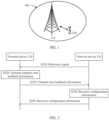
- FIG. 1 is a schematic diagram of a communication system 100 applicable to a channel state feedback method according to an embodiment of this application.
- the communication system 100 may include at least one terminal device, for example, a terminal device 120 shown in FIG. 1 .
- a network device 110 and the terminal device 120 may communicate with each other through a radio link.
- a plurality of antennas may be provided for each communication device, for example, the network device 110 or the terminal device 120.
- the provided plurality of antennas may include at least one transmit antenna for transmitting a signal and at least one receive antenna for receiving a signal. Therefore, in the communication system 100, communication devices, for example, the network device 110 and the terminal device 120, may communicate with each other by using a multi-antenna technology.
- FIG. 1 merely shows a scenario to which the channel state feedback method provided in this application is applicable, to help understand embodiments of this application, and does not constitute any limitation on the protection scope of this application.
- the communication system 100 may further include another network device or may further include another terminal device, which is not shown in FIG. 1 .
- the channel state feedback method provided in this application is also applicable to another scenario, for example, a cellular system. A scenario to which this application is applicable is not described herein.
- the terminal device in embodiments of this application may also be referred to as user equipment, an access terminal, a subscriber unit, a subscriber station, a mobile station, a remote station, a remote terminal, a mobile device, a user terminal, a terminal, a wireless communication device, a user agent, a user apparatus, or the like.
- the terminal device may be a cellular phone, a cordless phone, a session initiation protocol (session initiation protocol, SIP) phone, a wireless local loop (wireless local loop, WLL) station, a personal digital assistant (personal digital assistant, PDA), a handheld device having a wireless communication function, a computing device, another processing device connected to a wireless modem, a vehicle-mounted device, a wearable device, a terminal device in a 5G network, or a terminal device in a future evolved public land mobile network (public land mobile network, PLMN).
- a specific form of the terminal device is not limited in embodiments of this application.
- the terminal device may be an apparatus configured to implement a function of the terminal device, or may be an apparatus that can support the terminal device to implement the function, for example, a chip system.
- the apparatus may be mounted in the terminal.
- the chip system may include a chip, or may include a chip and another discrete component.
- the network device in embodiments of this application may be a device configured to communicate with the terminal device.
- the network device may be a network device (base transceiver station, BTS) in a global system for mobile communications (global system for mobile communications, GSM) system or a code division multiple access (code division multiple access, CDMA) system, a network device (NodeB, NB) in a wideband code division multiple access (wideband code division multiple access, WCDMA) system, an evolved network device (evolved NodeB, eNB or eNodeB) in an LTE system, or a radio controller in a cloud radio access network (cloud radio access network, CRAN) scenario.
- BTS base transceiver station
- GSM global system for mobile communications
- CDMA code division multiple access
- NodeB, NB wideband code division multiple access
- WCDMA wideband code division multiple access
- evolved NodeB, eNB or eNodeB evolved network device
- cloud radio access network cloud radio access network
- the network device may be a relay node, an access point, a vehicle-mounted device, a wearable device, a network device in a future 5G network, a network device in a future evolved PLMN network, or the like. This is not limited in the embodiments of this application.
- the network device may be an apparatus configured to implement a function of the network device, or may be an apparatus that can support the network device to implement the function, for example, a chip system.
- the apparatus may be mounted in the network device.
- a specific structure of an execution body of a method provided in the embodiments of this application is not specifically limited in the embodiments shown below, provided that a program that records code of the method provided in the embodiments of this application can be run to perform communication according to the method provided in the embodiments of this application.
- the method provided in the embodiments of this application may be performed by a terminal device or a network device, or a functional module that is in the terminal device or the network device and that can invoke and execute the program.
- a network device may process a to-be-sent signal by using a precoding matrix that matches the channel state, so that a precoded to-be-sent signal adapts to a channel.
- a receiver may suppress impact of signals between a plurality of receivers, and a signal-to-interference-plus-noise ratio of a received signal is maximized. Therefore, the to-be-sent signal is precoded, to improve quality (for example, a signal-to-interference-plus-noise ratio (signal-to-interference-plus-noise ratio, SINR)) of the received signal. Therefore, transmission between a sending device and the plurality of receivers can be performed on a same time-frequency resource by using the precoding technology, in other words, MU-MIMO is implemented.
- the sending device may alternatively perform precoding in another manner. For example, when channel information (for example, but not limited to a channel matrix) cannot be obtained, precoding is performed by using a preset precoding matrix or by using weighted processing. For brevity, specific content of the precoding technology is not described in this application.
- a time division duplexing (time division duplexing, TDD) mode on uplink and downlink channels, signals are transmitted on a same frequency domain resource and different time domain resources.
- TDD time division duplexing
- the network device may measure the uplink channel based on an uplink reference signal, for example, a sounding reference signal (sounding reference signal, SRS).
- the downlink channel may be estimated based on the uplink channel, so that a precoding matrix used for downlink transmission can be determined.
- the precoding matrix that is used for downlink transmission and that is determined based on the uplink channel may not adapt to the downlink channel.
- the network device may perform downlink precoding based on channel state information (channel state information, CSI) fed back by the terminal device to the network device.
- channel state information channel state information, CSI
- FIG. 2 is a schematic flowchart of a channel state feedback method according to this application.
- the feedback procedure includes: S210: A network device sends a reference signal to a terminal device, or a terminal device receives a reference signal from a network device. For specific descriptions of the reference signal, refer to the following related descriptions.
- the terminal device receives the reference signal, and can perform channel measurement based on the reference signal, to obtain final channel state feedback information through calculation.
- the channel state feedback information includes CSI of a downlink channel.
- the method procedure shown in FIG. 2 further includes S220: The terminal device generates the channel state feedback information based on the received reference signal. Specifically, the terminal device further needs to send the channel state feedback information to the network device.
- the method procedure shown in FIG. 2 further includes S230: The terminal device sends the obtained channel state feedback information to the network device.
- the network device can send resource configuration information to the terminal device based on the channel state feedback information.
- the method shown in FIG. 2 further includes S250:
- the network device sends the resource configuration information to the terminal device based on first indication information.
- the resource configuration information includes a modulation and coding scheme (modulation and coding scheme, MCS).
- the modulation and coding scheme indicates a corresponding modulation and coding scheme with which the terminal device performs data transmission through a downlink channel.
- the network device determines, based on a channel rank indicator (rank indicator, RI) fed back by the terminal device, a quantity of flows for transmitting the data to the terminal device.
- the network device determines, based on a channel state indicator (channel quality indicator, CQI) fed back by the terminal device, a modulation order and a channel coding rate for transmitting the data to the terminal device.
- the network device determines, based on a precoding matrix indicator (precoding matrix indicator, PMI) fed back by the terminal device, precoding for transmitting the data to the terminal device.
- precoding matrix indicator precoding matrix indicator
- Reference signal reference signal
- the RS may also be referred to as a pilot (pilot), a reference sequence, or the like.
- the reference signal may be a reference signal for channel measurement.
- the reference signal may be a channel state information reference signal (channel state information reference signal, CSI-RS) used for downlink channel measurement, or may be a sounding reference signal (sounding reference signal, SRS) used for uplink channel measurement.
- CSI-RS channel state information reference signal
- SRS sounding reference signal
- Precoding matrix indicator precoding matrix indicator, PMI
- the PMI may indicate a precoding matrix.
- the precoding matrix may be, for example, a precoding matrix determined by the terminal device based on a channel matrix of each frequency-domain element.
- the matrix may be a precoding matrix that is in a predefined codebook and that is closest to the precoding matrix determined based on the channel matrix.
- the precoding matrix may be determined by the terminal device through channel estimation or the like or based on channel reciprocity.
- a specific method of determining the precoding matrix by the terminal device is not limited to the foregoing description. For specific implementations, refer to conventional technologies. For brevity, implementations are not enumerated herein.
- the precoding matrix may be obtained by performing singular value decomposition (singular value decomposition, SVD) on the channel matrix or a covariance matrix of the channel matrix, or may be obtained by performing eigenvalue decomposition (eigenvalue decomposition, EVD) on the covariance matrix of the channel matrix.
- singular value decomposition singular value decomposition
- eigenvalue decomposition eigenvalue decomposition
- the precoding matrix determined by the terminal device may be referred to as a to-be-fed precoding matrix, or a to-be-reported precoding matrix.
- the terminal device may indicate the to-be-fed-back precoding matrix through the PMI, so that the network device restores the precoding matrix based on the PMI.
- the precoding matrix recovered by the network device based on the PMI may be the same as or similar to the to-be-fed-back precoding matrix.
- a higher degree of approximation between the precoding matrix determined by the network device based on the PMI and the precoding matrix determined by the terminal device in downlink channel measurement indicates that the precoding matrix that is used for data transmission and that is determined by the network device is more capable of adapting to the downlink channel. Therefore, signal transmission quality can be improved.
- the PMI is merely a name, and should not constitute any limitation on this application. This application does not exclude a possibility of defining signaling with other names in a future protocol for a same or similar function.
- the network device may determine, based on feedback of the terminal device, a precoding matrix corresponding to one or more frequency domain units.
- the precoding matrix determined by the network device may be directly used for downlink data transmission.
- Some beamforming methods including, for example, zero-forcing (zero-forcing, ZF), regularized zero-forcing (regularized zero-forcing, RZF), minimum mean-squared error (minimum mean-squared error, MMSE), and maximum signal-to-leakage-and-noise (signal-to-leakage-and-noise, SLNR), may also be used to obtain a precoding matrix finally used for downlink data transmission. This is not limited in this application. Unless specifically described, all precoding matrices below may be precoding matrices determined based on the method provided in this application.
- Modulation and coding scheme (modulation and coding scheme, MCS):
- Rates in LTE and NR are configured based on MCS indexes.
- An MCS is a rate table in which concerned factors affecting a communication rate are used as a column of the table, and MCS indexes are used as a row. Therefore, each MCS index actually corresponds to a physical transmission rate in a group of parameters.
- CSI is channel state information, and is a type of information fed back by a terminal device to a network device.
- CSI mainly includes three parts: a CQI, an RI, and a PMI.
- the CQI is feedback information sent by the terminal device to the network device through a downlink channel.
- the value is represented in 4 bits.
- Each CQI corresponds to a different modulation scheme and a different code rate, as shown in table 1.
- Table 1 CQI index (CQI index) Modulation (Modulation) scheme Code rate x 1024 Efficiency 0 out of range 1 QPSK 78 0.1523 2 QPSK 120 0.2344 3 QPSK 193 0.3770 ... ... ... ... 14 64QAM 873 5.1152 15 64QAM 948 5.5547
- a CQI is generally determined based on a value of a signal-to-interference-plus-noise ratio (signal-to-interference-plus-noise ratio, SINR).
- SINR signal-to-interference-plus-noise ratio
- a terminal device obtains channel measurement information and interference information by measuring a resource related to downlink CSI measurement, to further obtain an SINR through calculation. Based on the SINR, the terminal device may determine, by searching an SINR-BLER table stored in the terminal device, a CQI level that needs to be reported. An important piece of information for determining the CQI is the SINR value. Calculation of the SINR value is related to channel quality, interference information, noise power, and a receive algorithm of the terminal device.
- the SINR value is further related to precoding by the network device. If the precoding by the network device can match a channel (for example, an amplitude obtained after a channel matrix is multiplied by a precoding matrix is large), an SINR value received by the terminal device can be increased. Therefore, when the SINR value is calculated, it is necessary to determine a to-be-used precoding assumption.
- precoding assumptions in different CSI feedback manners are specified in the specification.
- different methods for determining a precoding matrix W are defined in the specification.
- the formula is used to measure and calculate a channel state, where [ x ] is a reference signal sent by a network device, W(i) is a precoding matrix, and [ y ] is a signal obtained through precoding by the terminal device.
- a precoding matrix W(i) is associated with a PMI.
- a precoding matrix W is associated with downlink channel information obtained through measurement by the terminal device.
- the precoding assumption is a precoding matrix corresponding to a reported PMI.
- the precoding assumption is obtained by multiplying a wideband precoding matrix by a random subband precoding matrix.
- the precoding assumption is an identity matrix.
- a to-be-used precoding assumption is predefined. In this assumption, in subsequent data transmission, a precoding matrix used by the network device is the precoding matrix corresponding to the PMI reported by the terminal device. In this case, an SINR value calculated by the terminal device is basically close to an SINR value in subsequent data transmission when a downlink channel and interference do not change greatly.
- the network device determines, based on a CQI value reported by the terminal device, an MCS allocated to the terminal device.
- an MCS allocated to the terminal device When the SINR value obtained through calculation when the terminal device reports the CQI is basically close to the SINR value in subsequent transmission, a bit error rate is generally low in the corresponding MCS.
- the deep learning is a learning process in which a deep neural network is used to represent a feature.
- a neural network usually includes two phases: training and testing.
- the training is a process of extracting model parameters from training data by using a neural network model.
- the testing is to run test data by using a trained model (a neural network model + a model parameter) and view a result.
- An available framework obtained by uniformly abstracting phase data in a training process is referred to as a training framework.
- This application mainly relates to application of an AI neural network model in a CQI feedback procedure.
- An AI neural network architecture is not limited in this application.
- to-be-fed-back CSI may be compressed by using the sparsity of a channel in time domain, frequency domain, and spatial domain.
- the compressed CSI is transmitted to a network device end through a feedback link.
- the network device side reconstructs an original sparse channel matrix based on a feedback value.
- the terminal device performs AI-based encoding (optionally, performing AI-based quantization or non-AI-based quantization) based on architectures of an autoencoder and decoder in an AI network.
- AI-based encoding optionally, performing AI-based quantization or non-AI-based quantization
- a channel after AI encoding is usually a floating-point number, and quantization further needs to be performed.
- AI-based quantization is performed.
- the entire neural network includes three parts: an AI encoder, an AI quantizer, and an AI decoder.
- the AI quantizer and the AI encoder are sent to the terminal device together.
- the terminal device After performing AI quantization, the terminal device sends a quantized bit to the network device.
- An AI dequantizer (a structure parameter of the AI dequantizer may be the same as that of the AI quantizer, and the AI dequantizer is only used for an operation inverse to that of the AI quantizer) and an AI decoder are disposed on the network device side.
- non-AI-based quantization for example, equal-step quantization
- Uniform quantization is performed for an interval within which an encoded floating-point number falls, and the network device side performs reconstruction based on AI decoding.
- a dimension of information input to the encoder is usually inconsistent with a dimension of information output after the information is encoded by the encoder. It may be understood that the encoder compresses the information. In embodiments of this application, a ratio of the dimension of the information output from the encoder to the dimension of the information input to the encoder is referred to as a compression rate of the encoder, a compression percentage of the encoder, compression efficiency of the encoder, or the like.
- the information input to the encoder is 4-bit information
- the information output from the encoder is 2-bit information.
- a dimension of information input to the decoder is usually inconsistent with a dimension of information output after the information is decoded by the decoder. It may be understood that the decoder decompresses the information.
- a ratio of the dimension of the information input to the decoder to the dimension of the information output from the decoder is referred to as a decompression rate of the decoder, a decompression percentage of the decoder, decompression efficiency of the decoder, or the like.
- the information input to the decoder is 2-bit information
- the information output from the decoder is 4-bit information.
- FIG. 3 is a schematic diagram of an AI-based CSI feedback procedure according to an embodiment of this application.
- a network device and a terminal device perform joint training to obtain an encoder and a decoder through training.
- the encoder is deployed in the terminal device, and the decoder is deployed in the network device.
- the terminal device obtains downlink channel information through measurement based on a downlink reference signal.
- the downlink channel information is encoded by the encoder to obtain compressed codeword information that is to be fed back to an air interface.
- the compressed codeword information is fed back to the network device through a feedback link.
- the network device decodes the compressed codeword information by using a locally deployed decoder, to obtain reconstruction information of the channel information fed back by the terminal device.
- the terminal device needs to compress and feed back all channel information. A large amount of information needs to be fed back. If channel information is compressed and transmitted only in an AI-based manner, for example, compressing PMI information, a CQI calculation problem and a precoding assumption problem in a CQI calculation procedure are not considered. In view of this, this application provides a channel state feedback method, to resolve a CQI calculation problem and improve accuracy of feedback information.
- FIG. 3 is a schematic diagram of an AI-based CSI feedback procedure according to an embodiment of this application.
- a framework including an encoder and a decoder may be referred to as an AI model or an AI architecture. This is not limited.
- a network device and a terminal device perform joint training to obtain an encoder and a decoder through training.
- the encoder compresses and encodes input information into a vector or matrix.
- the vector or matrix output by the encoder is input to the decoder, to restore the original input.
- network structures of the encoder and the decoder are not limited.
- An AI model for example, a convolutional neural network (convolutional neural network, CNN) or a fully connected neural network (fully connected neural network) may be used.
- the AI model used in this application is not described herein.
- the encoder is deployed in the terminal device, and the decoder is deployed in the network device.
- the terminal device obtains downlink channel information through measurement based on a downlink reference signal.
- the downlink channel information is encoded by the encoder to obtain encoded information.
- the encoded information is fed back to the network device through a feedback link.
- the network device decodes the encoded information by using a locally deployed decoder, to obtain the channel information fed back by the terminal device.
- the encoder and the decoder are generally trained in an offline state, and then, the trained encoder and decoder are used for online encoding and decoding of a channel.
- the encoder mentioned in this application may also include a quantizer, and the decoder may include a dequantizer. This is not limited in this application.
- the terminal device calculates a CQI, generally in a procedure in which a precoding assumption is made based on an eigenvector, there may be loss in a channel eigenvector when the terminal device performs AI encoding on the channel eigenvector. Consequently, a CQI value calculated by the terminal device is large. In addition, a significant error exists in channel feedback information generated by the terminal device. A manner in which the network device determines a matched MCS that is to be allocated to the terminal device is related to the channel feedback information sent by the terminal device. Therefore, when the terminal device reports inaccurate channel feedback information, an MCS allocated by the network device may not match the channel. Consequently, a throughput of the terminal device is low.
- FIG. 4 is a schematic flowchart of a channel state feedback method according to this application.
- the method shown in FIG. 4 is a feedback channel state architecture based on an AI model.
- An encoder and a decoder that are jointly trained by a network device and a terminal device are respectively deployed at a terminal device side and a network device side.
- a possible implementation in which the terminal device and the network device determine a required AI model is that the network device is responsible for managing the encoder and the decoder.
- the network device has the entire AI model, and sends the encoder in the AI model to the terminal device.
- a sending manner may be configured through RRC, another piece of higher layer signaling, or an application layer protocol. This is not limited in this application.
- the method shown in FIG. 4 may include the following steps.
- S410 is included, and S410 is the same as S210.
- S410 is the same as S210.
- the terminal device can generate channel state feedback information based on the reference signal.
- the method procedure shown in FIG. 4 further includes: S420: The terminal device generates the channel state feedback information.
- the terminal device obtains an eigenvector of a downlink channel based on the received reference signal.
- the terminal device encodes the obtained eigenvector of the downlink channel by using an encoder, to obtain an encoded result.
- the encoded result is quantized to generate the channel state feedback information.
- the channel information obtained by the terminal device based on the received reference signal is a Nr ⁇ Nt ⁇ M channel matrix, where Nr is a quantity of antennas of the terminal device, Nt is a quantity of antennas of a base station, and M is a quantity of resource blocks (resource blocks, RBs) or a quantity of subcarriers.
- the eigenvector obtained by the terminal device based on the obtained channel information is a R ⁇ Nt ⁇ M matrix, where R is a channel rank.
- the AI encoder performs AI encoding on the matrix R ⁇ Nt ⁇ M as input.
- the AI encoder is a fully connected layer.
- Output of the fully connected layer is a D dimensional vector.
- the eigenvector may be compressed into a D dimensional vector.
- the D dimensional vector is input to an AI quantizer.
- the quantizer includes a L ⁇ D dimensional matrix.
- For the input D dimensional vector a vector at a shortest distance (for example, a Euclidean distance) from the input D dimensional vector is found in L vectors.
- An index of the vector is used as quantized channel state feedback information, and is sent to the network device by the terminal device.
- the AI quantizer, the AI encoder, and an AI decoder may be obtained through joint training.
- Channel state feedback information is used to feed back a channel state.
- Channel state feedback may be understood as that the terminal device feeds back a measured channel between the network device and the terminal device.
- channel state feedback means feeding back a channel that is to between the network device and the terminal device and that is measured by the terminal device.
- the network device has 32 antennas
- the terminal device has two antennas
- a measurement bandwidth is 100 RBs.
- the terminal device measures the reference signal sent by the network device, through channel estimation, a 32 ⁇ 2 channel matrix may be obtained through measurement on each reference signal. Therefore, a size of all measured channels is 32 ⁇ 2 ⁇ 100.
- a subband size is 4 RBs per subband. Therefore, a final to-be-reported matrix is a 32 ⁇ 2 ⁇ 25 complex matrix.
- channel ranks may be low.
- a matrix rank may be 1.
- to-be-reported channel information is a 32 ⁇ 25 matrix (singular value decomposition/eigenvalue decomposition is performed on each subband to obtain a 32 ⁇ 1 eigenvector).
- the terminal device maps each eigenvector to a predefined codebook, describes each eigenvector by using a PMI, and reports the eigenvector.
- the eigenvector may be encoded in an AI manner, and the eigenvector is restored by the AI decoder on the network device side.
- a CSI reporting configuration delivered by the network device information such as a configuration ID or reporting content is defined.
- Content such as reporting PMI and not reporting PMI may be configured based on different CSI reporting configurations. For example, if an RRC information element for AI PMI reporting is added, first, when AI CSI is used for reporting, an AI-related configuration may be added to a report Quantity configuration, to indicate that a PMI is reported by using an AI manner.
- the terminal device may send the channel state feedback information to the network device.
- the method procedure shown in FIG. 4 further includes the following step.
- the terminal device sends the channel state feedback information to the network device, or the network device receives the channel state feedback information from the terminal device.
- the network device may determine, based on the channel state feedback information, a resource required by the downlink channel.
- the method procedure shown in FIG. 4 further includes the following step.
- S440 The network device determines the resource required by the downlink channel, and generates resource configuration information.
- the channel state feedback information includes PMI information, RI information, and CQI information that are generated by the terminal device.
- the PMI information is information encoded by using the AI encoder in the terminal device.
- the channel feedback information includes PMI information, RI information, and CQI information that are reported by the terminal device.
- the PMI information is information encoded by using the AI encoder in the terminal device.
- the channel state feedback information that is sent by the terminal device and that is received by the network device includes the RI information, the CQI information, and the PMI information that is encoded by using the AI encoder in the terminal device.
- the network device then performs decoding by using the decoder to obtain key information of the downlink channel.
- the key information of the downlink channel may include precoding information of the downlink channel and/or rank information of the downlink channel, and quality information of the downlink channel.
- the network device determines to-be-allocated RBs based on CQI information on different frequency band resources, to further determine MCS information on corresponding RBs.
- the network device may determine, based on PMI information and RI information on a corresponding RB, precoding and a rank that are to be used for the downlink channel.
- the resource required by the downlink channel is used to generate the resource configuration information.
- the network device generates the resource configuration information based on the downlink channel information, and sends the resource configuration information to the terminal device.
- the method procedure shown in FIG. 4 further includes the following step.
- the network device sends the resource configuration information to the terminal device, or the terminal device receives the resource configuration information from the network device.
- the resource configuration information includes information about an MCS that is to be allocated by the network device to the downlink channel corresponding to the terminal device.
- the terminal device encodes and quantizes the obtained channel eigenvector by using the encoder, to obtain the channel state feedback information.
- the terminal device sends the channel state feedback information to the network device.
- the network device decodes the received channel state feedback information.
- the procedure of encoding and decoding the channel state information improves transmission accuracy of the channel state feedback information and improves a degree of matching between an MCS allocated by the network device to the terminal device and the channel.
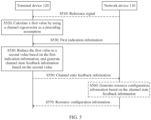
- FIG. 5 is a schematic flowchart of a channel state feedback method according to an embodiment of this application. The method may include the following step.
- a network device sends a reference signal to a terminal device, or a terminal device receives a reference signal from a network device.
- a reference signal may be sent in two manners: a beamformed manner and a non-beamformed manner.
- Manner 1 In a non-beamformed manner, the network device does not precode the to-be-sent reference signal. This is equivalent to sending the to-be-sent reference signal in all directions.
- Manner 2 In a beamformed manner, the network device precodes the to-be-sent reference signal and sends the precoded to-be-sent reference signal.
- the terminal device performs downlink channel measurement based on the received reference signal, precoding information has been superimposed on the measured downlink channel.
- a transmit end sends reference signals in a compressed sensing-based precoding mode to the terminal device.
- the compressed sensing-based reference signals are superimposed on a same time-frequency resource for sending. This can save a time-frequency resource.
- a receive end may restore the aliased reference signals by using an iterative algorithm, so as to perform estimation on the entire channel. Because estimated channel information includes precoding when the reference signal is sent in the beamformed manner, the terminal device does not need to make an additional precoding assumption. In other words, the terminal device may use one identity matrix as the precoding assumption.
- step S510 is an optional step.
- the terminal device performs channel estimation and obtains the channel eigenvector based on a public signal (for example, a synchronization signal) of a cell, without obtaining the channel eigenvector based on the reference signal.
- a public signal for example, a synchronization signal
- the terminal device can obtain an eigenvector of a downlink channel based on the reference signal.
- the terminal device obtains downlink channel information, namely, CSI, based on reference signal measurement.
- the CSI mainly includes parameters such as a precoding matrix indicator (PMI), a rank indicator (RI), and a channel quality indicator (CQI), and is used to describe downlink channel information.
- the PMI is used to describe an eigenvector of a downlink channel.
- the RI is used to describe a rank of a channel.
- the CQI is used to describe the overall quality of a channel, and includes a channel interference status in addition to useful signal quality information.
- the terminal device obtains a first SINR value through calculation by using the obtained eigenvector of the downlink channel as the precoding assumption.
- the method procedure shown in FIG. 5 further includes: S520: The terminal device calculates a first value by using the channel eigenvector as the precoding assumption.
- the terminal device receives the reference signal sent by the network device.
- the terminal device obtains the channel eigenvector of the downlink channel based on the reference signal.
- the terminal device calculates the first value of first information by using the obtained eigenvector of the downlink channel as the precoding assumption.
- the terminal device After obtaining the first value, calculates a second value based on first indication information sent by the network device.
- the method procedure shown in FIG. 5 further includes the following steps.
- the network device sends first indication information to the terminal device, or the terminal device receives first indication information from the network device.
- S540 The terminal device reduces the first value of the first information to the second value based on the first indication information.
- the second value is used to determine channel state feedback information.
- the terminal device may generate the channel state feedback information based on the second value.
- That the terminal device reduces the first value of the first information to the second value based on the first indication information may be interpreted as that the terminal device reduces the first information to the second value from the first value based on the first indication information.
- the first indication information is a reduction value in a channel state feedback configuration sent by the network device.
- the terminal device uses the channel eigenvector as a precoding assumption and performs calculation to obtain the first value of the first information, and calculates the second value based on the reduction value sent by the network device.
- the first indication information is AI model information in the channel state feedback configuration sent by the network device.
- the terminal device further calculates a required reduction value based on a model parameter, and reduces the first value of the first information by the reduction value obtained through calculation to obtain the second value.
- the first information is CQI information
- the first value of the first information is a first CQI value
- a second value is a second CQI value.
- the first information is SINR information
- the first value of the first information is a first SINR value
- a second value is a second SINR value
- the first indication information may be a reduction value directly configured by the network device and sent to the terminal device.
- the terminal device receives the reduction value of the first indication information.
- the network device configures an SINR reduction value as one of ⁇ 0.5, 1, 1.5, 2 ⁇ .
- the terminal device After receiving the first indication information, when calculating the second SINR value, the terminal device directly calculates the second SINR value based on the first SINR value according to the reduction value of the first indication information.
- code in an RRC information element is as follows.
- the first indication information is AI model information configured by the network device.
- the first indication information that is sent by the network device and that is received by the terminal device is the AI model information.
- the network device configures the AI model information in a CSI report information element in the code.
- the AI model information is used as auxiliary information of the AI model and is delivered with the AI model.
- a manner in which the network device sends the first indication information includes sending the first indication information through RRC signaling configuration, physical layer signaling configuration (for example, downlink control information), application layer protocol configuration, media access control-control element (medium access control-control element, MAC-CE) configuration, or another piece of higher layer signaling configuration. This is not limited in this application.
- the AI model information is used to measure a degree of matching between channel information restored by the AI model and original channel information.
- the AI model information may specifically include information such as cosine similarity of the AI model or a normalized mean square error of the AI model. Content of the AI model information used herein is not limited in this application.
- the terminal device can generate channel state feedback information based on the second value. It should be noted that the channel state feedback information is determined based on the second value of the first information.
- the following uses an example in which the first indication information is the AI model information, and the AI model information includes cosine similarity of an AI model.
- W is an original channel matrix
- W is a restored channel matrix.
- a value interval of the indicator ⁇ is [0, 1]. If the value is closer to 1, this indicates that a channel matrix decoded by a network device decoder is closer to the original channel and performance of channel information restoration is better.
- the terminal device determines a reduction value based on model performance information in the first indication information sent by the network device.
- a rank of the channel matrix is 1.
- g is a receive vector used by the terminal device
- W is the channel eigenvector
- I + n represents interference and noise power that are multiplied by the receive vector.
- H ' is a conjugate matrix of H. S is the maximum singular value/eigenvalue of the matrix H, and U is the left eigenvector of the matrix H.
- w ⁇ is an eigenvector restored by the AI encoder. According to the definition of the cosine similarity, when a modulus value of the eigenvector is 1, a rightmost equation may be further obtained.
- ⁇ 2 in the formula may be used as a reduction value for calculating the downlink channel CQI.
- the terminal device multiplies the first value by a corresponding reduction value ⁇ 2 .
- the terminal device determines a new SINR value of the downlink channel, and performs mapping to obtain a new CQI value, namely, the second value.
- a corresponding formula may also be obtained similarly.
- ⁇ ji is cosine similarity
- a ij is an element in a matrix obtained by multiplying a receive matrix and a channel left eigenvector
- S is a channel eigenvector.
- SINR i ideal is a SINR value calculated by the terminal device by making a precoding assumption based on the eigenvector of the channel.
- the cosine similarity ⁇ ji may form a symmetric matrix, indicating cosine similarity between a restored channel eigenvector i and an actual channel eigenvector j.
- cosine similarity in an example of embodiments of this application may also be the statistical mean, for example, the mean of the cosine similarity of the AI model.
- AI model performance of the AI model varies based on different pieces of test data. Therefore, the cosine similarity of the AI model presents a probability distribution feature. When a variance of probability distribution density is small, it is appropriate to use the statistical mean to express cosine similarity performance.
- the reduction value calculated by the terminal device may be very small.
- cosine similarity restored by the AI model is mu-sigma, which is less than the statistical mean mu
- the reduction value calculated by the terminal device based on a model parameter is small. Consequently, the CQI value reported by the terminal device may still be very large.
- embodiments of this application proposes to indicate a distribution feature of AI model performance.
- the following two indication manners are used as an example:
- the terminal device uses a plurality of samples in probability distribution, for example, cosine similarity corresponding to locations such as mu, mu-sigma, and mu-2sigma.
- the network device directly indicates to the terminal device information such as a distribution type, the mean, and/or a variance.
- the cosine similarity matrix is an identity matrix.
- the restored eigenvector is consistent with the actual eigenvector.
- the network device in different ranks, configures information about the cosine similarity of the AI model in the first indication information and sends the first indication information to the terminal device.
- the terminal device calculates the reduction value based on cosine similarity of the AI model in different rank values in the first indication information.
- the terminal device reduces the first value of the first information to the second value based on the reduction value obtained through calculation.
- the terminal device then sends the channel state feedback information generated based on the second value to the network device.
- This application provides two implementations for CQI reduction. There is another manner of determining a CQI value. This is not limited in this application.
- Manner 1 The terminal device directly reduces an SINR value, and the terminal device performs mapping again based on a reduced SINR value to determine a corresponding CQI, namely, the second CQI.
- the first information is SINR information
- the first value is a first SINR value
- the second value is a second SINR value.
- the terminal device reduces the first SINR to the second SINR based on the first indication information, and the terminal device maps the second SINR value to the second CQI.
- the terminal device first maps an original SINR value obtained through calculation to an original CQI, namely, the first CQI.
- the terminal device obtains a new CQI, namely, the second CQI, after decreasing the first CQI by several levels based on the first CQI and the first indication information.
- the first information is CQI information
- the first value is the first CQI value
- the second value is the second CQI value.
- the terminal device determines the first CQI value based on the first SINR value.
- the first SINR value is determined by the terminal device based on a channel eigenvector.
- the terminal device reduces the first CQI to the second CQI based on the first indication information.
- the terminal device calculates the SINR value, maps the SINR value to a to-be-reported CQI value, and determines whether a CQI mismatch may occur.
- a reduction value threshold for the CQI level obtained through calculation may be obtained based on the reduction value calculation manner.
- the threshold is calculated according to (CQI threshold + reduction value). Therefore, a reduction range for each CQI level may be obtained based on the threshold obtained through calculation.
- the terminal device first determines whether the original SINR value obtained through calculation falls within the reduction range. If the SINR value falls within the reduction range, based on a CQI level predefined by the network device, the CQI value to be reported by the terminal device is reduced.
- the terminal device lowers, for the to-be-reported CQI value, the reduction value obtained through calculation by one level based on the configured reduction level 1, and reports the to-be-reported CQI value.
- CQI calculation depends on an SINR value calculated by the terminal device.
- the first value of the first information may not be reduced.
- the terminal device may generate the channel state feedback information based on the second CQI.
- the terminal device sends the channel state feedback information to the network device.
- the method procedure shown in FIG. 5 further includes the following step.
- the terminal device sends the channel state feedback information to the network device, or the network device receives the channel state feedback information from the terminal device.
- the network device may determine, based on the channel state feedback information, a resource required by the downlink channel.
- the method procedure shown in FIG. 5 further includes the following step.
- S560 The network device generates resource configuration information based on the channel state feedback information, or it is interpreted as that the network device determines a resource required by the downlink channel.
- S560 is the same as S440. For specific descriptions, refer to the descriptions of S440 in FIG. 4 . To avoid repetition, details are not described herein again.
- the method procedure shown in FIG. 5 further includes the following step.
- S570 The network device sends the resource configuration information to the terminal device, or the terminal device receives the resource configuration information from the network device.
- the resource configuration information may include resource information about an MCS that is to be allocated by the network device to the downlink channel corresponding to the terminal device.
- a step in which the network device sends the first indication information is added to the method shown in FIG. 5 .
- the terminal device performs reduction calculation on the initially calculated first value of the first information based on the received first indication information.
- the terminal device generates the channel state feedback information based on the second value obtained through another round of calculation. This improves accuracy of the channel state feedback information determined by the terminal device, and improves a degree of matching between a resource allocated by the network device for the terminal device and a resource required by the terminal device.
- the terminal device may determine a plurality of reduction values. For example, the terminal device may obtain a plurality of cosine similarity values based on samples in cosine similarity distribution of the AI model. In this way, a plurality of reduction values may be calculated according to a predefined formula.
- the predefined formula may be a square of the cosine similarity or a reduction value calculation formula when the rank > 1.
- probabilities of CQI mismatches are also different. For example, if the reduction value calculated by the terminal device is small, a CQI mismatch may not occur on the network device. When the reduction value calculated by the terminal device is relatively large, a CQI mismatch may occur on the network device.
- the terminal device may greatly reduce the first value of the first information, so that the second CQI generated by the terminal is low. In this case, although a low bit error rate of the network device is ensured, a throughput of the terminal device is also low.
- This application proposes a probability-based flexible mechanism for resolving the problem. Even if a mismatch may occur on a network device side, if a probability of occurrence of such a situation is low, the terminal device may still use a small reduction value, to enable the terminal device to report a CQI level as high as possible.
- the terminal device may map the SINR value obtained through calculation to the CQI, and the terminal device does not reduce the SINR value. Otherwise, a reduction value to be used may be determined based on a sample value of the cosine similarity corresponding to the maximum probability of occurrence of a mismatch, instead of simply selecting the mean of the cosine similarity as the reduction value.
- the reduction value is determined highly dependent on the AI model, and configuration and updating of the AI model and configuration of the reduction value may not be performed synchronously.
- the AI model is transmitted through another higher layer signaling/application layer protocol, and a reduction value configuration is configured in RRC as a CSI reporting configuration. Consequently, the model may be changed, but the back-back value is not changed. Therefore, a default processing manner is required to deal with this situation.
- the default processing manner may include the following.
- Manner 1 A default reduction value of the terminal device is 0, in other words, reduction is not performed.
- Manner 2 The terminal device calculates the CQI using a fixed precoding assumption, instead of calculating the CQI based on a channel eigenvector. This can avoid a CQI mismatch.
- the two manners are essentially default processing manners for reduction value feedback on a basis that the AI model of the terminal device is changed. There is another processing manner. This is not limited in this application.
- FIG. 6 shows a schematic flowchart of another channel state feedback method.
- the method may include step S610 to step S650.
- S610 and S620 are the same as S510 and S520 in FIG. 5 . For brevity, details are not described herein again.
- the network device sends first indication information and a second probability value to the terminal device, or the terminal device receives first indication information and a second probability value that are sent by the network device.
- the network device configures the first indication information for the terminal device through RRC signaling.
- Configuration content indicates "AIPMI-CQI", and in the field, the first indication information configures a distribution-related parameter about an AI model (for example, cosine similarity of the AI model, and normalized mean square error of the AI model), and the second probability value.
- the configured information for channel state feedback is used by the terminal device to determine whether a reduction calculation needs to be performed on the second value. For example, the following code may be used for implementation.
- the network device When configuring the first indication information, the network device sends the second probability value to the terminal device at the same time.
- the second probability value may also be a probability value about CQI mismatch tolerance.
- the AI model cannot restore the original eigenvector with 100% accuracy. Therefore, there is a chance that a CQI calculated by the terminal device is higher than an actual CQI of the channel. In other words, a CQI received by the network device may be a mismatch.
- the first probability provided by the network device is an upper limit of a probability that this case is allowed to occur.
- the network device sends the first indication information and the second probability value to the terminal device.
- the terminal device receives the first indication information and the second probability value that are sent by the network device.
- the method shown in FIG. 6 further includes the following step.
- the terminal device determines, based on the received first indication information and the second probability value, whether to perform reduction calculation on the first value.
- the terminal device further generates the channel state feedback information based on a determining result.
- the terminal device needs to obtain a plurality of reduction values based on the first indication information, and obtain a plurality of first probability values based on the plurality of reduction values.
- the first probability value may be referred to as a CQI mismatch probability value.
- the terminal device compares each of the plurality of CQI mismatch probability values with the second probability value.
- a quantity of CQI mismatch probability values that are greater than or equal to the second probability value is N.
- the terminal device determines to perform reduction.
- the terminal device determines not to perform reduction.
- the terminal device determines to perform or not to perform reduction.
- the first threshold is predefined, the first threshold is sent by the network device to the terminal device, or the first threshold is determined by the terminal device and the network device through negotiation. This is not limited in this application.
- the terminal device obtains a plurality of reduction values (for example, 0.36 dB, 0.6 dB, and 0.86 dB shown in table 2) based on the first indication information.
- a plurality of CQI mismatch probability values (for example, 0.12, 0.097, and 0.057 shown in table 2) are obtained based on the plurality of reduction values.
- the second probability value received by the terminal device is 0.1
- the first threshold is 1
- a quantity N of CQI mismatch probability values for example, 0.12
- the terminal device may determine not to perform reduction, or the terminal device may determine to perform reduction.
- the terminal device obtains a plurality of reduction values (for example, 0.36 dB, 0.6 dB, and 0.86 dB shown in table 2) based on the first indication information.
- a plurality of CQI mismatch probability values (for example, 0.12, 0.097, and 0.057 shown in table 2) are obtained based on the plurality of reduction values.
- the second probability value received by the terminal device is 0.08, and the first threshold is 1, a quantity N of CQI mismatch probability values (for example, 0.12 and 0.097) that are in the plurality of CQI mismatch probability values and that are greater than the second probability value is 2, and a value of N is greater the first threshold.
- the terminal device determines to perform reduction.
- a CQI mismatch probability a probability of falling into a reduction range ⁇ a cumulative probability of samples.
- a reduction value corresponding to a maximum mismatch probability may be selected as the reduction value. For example, if the maximum CQI mismatch probability value is 0.12 as shown in table 2, the terminal device should select 0.36 dB as the reduction value for calculation.
- the terminal device may calculate a reduction value threshold based on a threshold that is configured by the network device and that is used for allowing a mismatch to occur, and an SINR range corresponding to the current CQI level.
- the terminal device may obtain a lower limit of a square of the cosine similarity based on an inverse operation of a predefined formula, to determine a performance distribution location and a corresponding cumulative probability of the cosine similarity.
- a mismatch threshold configured by the network device is 0.1
- an SINR range corresponding to the current CQI level calculated by the terminal device is 2 dB
- a reduction range in reduction indication information delivered by the network device is 0.2 dB.
- a rank is 1. It can be obtained that the square of the cosine similarity needs to be at least 0.95. Further, the terminal device determines, based on distribution of the cosine similarity, a cumulative probability that a square of the cosine similarity is greater than 0.95.
- the cumulative probability is greater than the second probability value, in other words, the probability that the cosine similarity of the AI model is greater than the lower limit of the cosine similarity and is greater than a specific threshold, reduction is not performed. If the cumulative probability is less than or equal to the second probability value, reduction is performed. Optionally, reduction may be performed when the cumulative probability is greater than or equal to the second probability value.
- the terminal device determines and generates the channel state feedback information, and sends the channel state feedback information to the network device, or the network device receives the channel state feedback information sent by the terminal device.
- the terminal device when determining that reduction is not performed on the first value, the terminal device generates the channel state feedback information based on the first value calculated in step 620.
- the SINR value needs to be further mapped to a CQI.
- the terminal device when determining, based on step 640, that the first value needs to be reduced, the terminal device reduces the first value calculated in step 620, and then generates the channel state feedback information.
- the terminal device after generating the channel state feedback information, the terminal device sends the channel state feedback information to the network device.
- the method shown in FIG. 6 further includes the following step.
- the terminal device sends the channel state feedback information to the network device, or the network device receives the channel state feedback information sent by the terminal device.
- a required reduction value is further determined with reference to distribution of the AI model information. Moreover, the terminal device determines, based on the second probability value sent by the network device and the first probability value obtained by the terminal device based on the first indication information, whether a reduction calculation needs to be performed on the first value. Compared with the foregoing embodiments, in this embodiment, the terminal device determines whether the first value needs to be reduced. This avoids an error when the terminal device calculates the reduction value based on a single statistical value, and improves accuracy of feedback information.
- FIG. 7 is a schematic flowchart of a specific example of another channel state feedback method according to this application.
- S710 is the same as S510 in FIG. 5 .
- S510 in FIG. 5 .
- details are not described herein again.
- the terminal device obtains a channel eigenvector based on the reference signal, and generates a first SINR value.
- the terminal device obtains the channel eigenvector based on the reference signal, uses an identity matrix as a precoding assumption.
- the terminal device calculates the first SINR value by using a receiver algorithm of the terminal device and/or a typical receiver algorithm (for example, an MRC algorithm).
- the network device when the network device sends the reference signal in a beamformed manner, the network device has precoded the to-be-sent reference signal. Therefore, when the terminal device calculates the first SINR by using the identity matrix, it may be considered that for a channel matrix, precoding information has been considered. No additional precoding matrix assumption is required.
- the terminal device calculates the first SINR value and uses the channel eigenvector as a precoding assumption. This is the same as S620 in FIG. 6 . For brevity, details are not described herein again.
- the terminal device obtains the channel eigenvector, and calculates the first SINR value by using the receiver algorithm of the terminal device and/or the typical receiver algorithm. If the terminal device obtains an SINR value by using the receiver algorithm of the terminal device, the SINR value obtained by the terminal device is the first SINR value. If the terminal device separately obtains different SINR values by using the receiver algorithm of the terminal device and the typical receiver algorithm, in this case, the terminal device may use an SINR value obtained by using the typical receiver algorithm as an SINR reference value, and sends, to the network device, a difference between the SINR value obtained by using the receiver algorithm of the terminal device and the SINR reference value.
- the network device obtains, by using the typical receiver algorithm, the SINR reference value that is the same as that of the terminal device, and analyzes a difference between the SINR reference value and an SINR reported by the terminal device, to obtain channel state information.
- the terminal device directly sends the SINR value, instead of sending a CQI. This avoids information loss when the terminal device maps the SINR value for generating the CQI. In this way, the network device can determine a channel state more accurately.
- the typical receiver algorithm may be configured by the network device and sent to the terminal device.
- the typical receiver algorithm is predefined.
- the typical receiver algorithm is determined by the terminal device and the network device through negotiation. This is not limited in this application.
- the terminal device receives first indication information and second indication information from the network device, or the network device sends first indication information or second indication information to the terminal device.
- first indication information and the second indication information may be sent via one message.
- first indication information and the second indication information are carried in one message.
- first indication information and the second indication information may be sent via different messages.
- the first indication information is carried in a message # 1
- the second indication information is carried in a message # 2.
- a second SINR value determined by the terminal device based on the first indication information is the same as the second value determined in S540 in FIG. 5 . For brevity, details are not described again.
- S750 The terminal device generates a third SINR value based on the second indication information and the second SINR value.
- the network device when configuring the first indication information for the terminal device, the network device configures content of the first indication information as "AIPMI-SINR", to indicate that the terminal device reports the PMI by using an AI manner and reports the SINR value.
- the second indication information configured by the network device includes a quantization manner of the SINR. The following code may be used for implementation.
- the second indication information sent by the network device indicates a third SINR value directly sent by the terminal device to the network device.
- the third SINR value may be an SINR value, or may be a difference between the SINR and an SINR reference value.
- the SINR reference value is obtained by using a plurality of typical receiver algorithms. For example, an SINR value calculated by the terminal device by using the MRC receive algorithm is used as the SINR reference value. When the terminal device sends the SINR reference value, an SINR range is small. Therefore, the SINR is described more accurately with a same overhead.
- the second indication information sent by the network device includes SINR quantization configuration information.
- the terminal device quantizes the second SINR value based on the SINR quantization configuration information to obtain a third SINR value, and sends the third SINR value to the network device.
- the second indication information sent by the network device includes at least one of the following: a quantization range, a quantity of quantization bits, or a quantization step.
- the quantization range, the quantity of quantization bits, and the quantization step are all SINR quantization configuration information. In this embodiment, examples are separately used to describe quantization manners.
- Manner 1 The quantity of quantization bits, the quantization range, and the quantization step are all set as defined in the standard. In this case, the network device does not need to additionally provide a quantization-related configuration in RRC configuration.
- Manner 2 The quantity of quantization bits is fixed, and the network device configures, through RRC, the SINR range reported by the terminal device. In this case, a uniform step is used.
- the second indication information includes a fixed quantity of quantization bits configured by the network device for the terminal device. Specifically, the terminal device quantizes the SINR value by using the uniform step based on the fixed quantity of quantization bits, to obtain the reported SINR range.
- Manner 3 The quantization range is fixed, and the network device configures, through RRC, a quantity of bits used by the terminal device for reporting. In this case, a uniform step is used.
- the second indication information includes the fixed SINR value range configured by the network device for the terminal device. Specifically, the terminal device quantizes the SINR value by using the uniform step based on the fixed SINR value range, to obtain a quantity of reported bits.
- the terminal device quantizes the to-be-reported SINR value based on different quantization manners configured by the network device for the terminal device, and then sends the quantized SINR value to the network device.
- the terminal device directly sends the third SINR value obtained by quantizing the second SINR value to the network device.
- the terminal device calculates a difference between the SINR calculated by using the receiver algorithm of the terminal device and the SINR value calculated by using the typical receiver algorithm, and then sends the SINR difference to the network device as the third SINR value.
- the terminal device sends the third SINR value to the network device, or the network device receives the third SINR value sent by the terminal device.
- the method shown in FIG. 7 further includes the following step.
- S760 The terminal device sends the third SINR value to the network device, or the network device receives the third SINR value sent by the terminal device.
- the method shown in FIG. 7 further includes the following step.
- the network device determines a channel interference status based on the third SINR value sent by the terminal device, and further determines resource configuration information.
- the network device determines the channel interference status based on the received SINR value with reference to AI-encoded channel information (for example, PMI information). If the terminal device reports the SINR difference to the network device, the network device calculates, based on the SINR value obtained by using the typical receiver algorithm and the SINR difference reported by the terminal device, the SINR value obtained by using the receiver algorithm of the terminal device, to determine the channel interference status.
- the network device determines information such as an MCS resource allocated to the terminal device with reference to the channel state, the channel interference status, and a precoding status of the network device.
- the network device after determining the resource configuration information, sends the resource configuration information to the terminal device.
- the method shown in FIG. 7 further includes the following step.
- S780 The network device sends the resource configuration information to the terminal device, or the terminal device receives the resource configuration information sent by the network device.
- the terminal device reports the SINR, instead of sending a CQI value.
- the SINR value does not need to be mapped for obtaining a CQI value. Because CQI values are discrete and SINR values are continuous, some information may be lost when an SINR is mapped to a CQI value.
- the network device is enabled to obtain a more accurate channel interference status. This improves accuracy of the resource configuration information delivered by the network device to the terminal device.
- FIG. 8 is a schematic flowchart of another channel state feedback method according to an embodiment.
- S810 is the same as S510 in FIG. 5 .
- S510 in FIG. 5 .
- the terminal device determines a first channel eigenvector based on the obtained reference signal.
- the terminal device encodes the first channel eigenvector to generate a third channel eigenvector, and performs AI-decoding on the third channel eigenvector to generate a second channel eigenvector.
- the terminal device encodes the first channel eigenvector by using an AI encoder to obtain the third eigenvector.
- the terminal device decodes the third channel eigenvector by using an AI decoder to generate the second channel eigenvector.
- the second channel eigenvector is used to calculate a first CQI.
- the AI encoder and/or the AI decoder may be configured by the network device for the terminal device in advance, or may be obtained by the terminal device.
- the AI decoder is a low-complexity decoder.
- the Al decoder is configured to determine a precoding matrix assumption in calculation for the first CQI, so that the network device and the terminal device have a same precoding assumption.
- S830 The terminal device generates a first CQI value based on the second channel eigenvector.
- the terminal device decodes, by using the low-complexity decoder, the third channel eigenvector obtained through encoding, and makes a precoding assumption based on the second channel eigenvector obtained through decoding to generate the first CQI.
- the terminal device sends the third channel eigenvector and the first CQI to the network device.
- the network device receives the third channel eigenvector and the first CQI that are sent by the terminal device.
- the network device receives the third channel eigenvector and the first CQI that are sent by the terminal device, to further determine a channel state and a channel interference status, and generate resource configuration information.
- the method shown in FIG. 8 further includes the following step.
- the network device generates the resource configuration information based on the third channel eigenvector and the first CQI.
- the network device further decodes the third channel eigenvector sent by the terminal device to obtain a precoding matrix.
- the network device decodes the obtained third channel eigenvector and the first CQI by using a low-complexity decoder that is the same as that of the terminal device, to obtain a rough channel eigenvector, and determines a channel interference status based on the rough eigenvector and the first CQI obtained by the network device.
- the network device further generates and sends the resource configuration information based on the precoding matrix and the determined channel interference status.
- the method procedure shown in FIG. 8 further includes the following step.
- the network device sends the resource configuration information to the terminal device, or the terminal device receives the resource configuration information from the network device.
- the resource configuration information includes information about an MCS that is to be allocated by the network device to the downlink channel corresponding to the terminal device.
- the first CQI and the third channel eigenvector that are sent by the terminal device to the network device shown in FIG. 8 ensure that the terminal device and the network device have the same precoding assumption.
- the network device determines a channel interference status more accurately based on the received first CQI and the third channel eigenvector that is obtained through encoding. This resolves a problem that a resource allocated to the terminal device by the network device based on a CQI with a significant error has a low matching degree.
- the network device and the terminal device maintain the same precoding assumption, so that the network device can obtain an accurate channel interference status. This improves accuracy of the resource configuration information sent by the network device to the terminal device.
- Sequence numbers of the foregoing processes do not mean execution sequences in the foregoing method embodiments.
- the execution sequences of the processes should be determined based on functions and internal logic of the processes, and should not be construed as any limitation on the implementation processes of embodiments of this application.
- terminal device and/or the network device in the foregoing method embodiments may perform some or all of the steps in the embodiments. These steps or operations are merely examples. In embodiments of this application, other operations or variants of the various operations may be further included.
- the transmit end device or the receive end device may be divided into functional modules based on the foregoing method examples.
- each functional module may be obtained through division based on each corresponding function, or two or more functions may be integrated into one processing module.
- the integrated module may be implemented in a form of hardware, or may be implemented in a form of a software functional module.
- module division is an example, and is merely a logical function division. In actual implementation, another division manner may be used.
- An example in which each functional module is obtained through division based on each corresponding function is used below for description.
- FIG. 9 is a schematic block diagram of an example of an information transmission device 900 according to this application.
- a channel state feedback device shown in FIG. 9 may be used to implement any device, for example, the terminal device and the network device, in any method in FIG. 4 to FIG. 8 .
- the information transmission device 900 may be a physical device, may be a component (for example, an integrated circuit or a chip) of the physical device, or may be a functional module in the physical device.
- the channel state feedback device 900 includes one or more processors 910.
- the processor 910 may invoke an interface to implement receiving and sending functions.
- the interface may be a logical interface or a physical interface. This is not limited.
- the interface may be a transceiver circuit, an input/output interface, or an interface circuit.
- the transceiver circuit, the input/output interface, or the interface circuit that is configured to implement the receiving and sending functions may be separated, or may be integrated together.
- the transceiver circuit or the interface circuit may be configured to read and write code/data, or the transceiver circuit or the interface circuit may be configured to transmit or transfer a signal.
- the interface may be implemented through a transceiver.
- the information transmission device 900 may further include a transceiver 930.
- the transceiver 930 may also be referred to as a transceiver unit, a transceiver, a transceiver circuit, or the like, and is configured to implement a transceiver function.
- the channel state feedback device 900 may further include a memory 920.
- a specific deployment location of the memory 920 is not specifically limited in this embodiment of this application.
- the memory may be integrated into the processor, or may be independent of the processor.
- the channel state feedback device 900 does not include a memory, the channel state feedback device 900 only needs to have a processing function, and the memory may be deployed at another location (for example, a cloud system).
- the processor 910, the memory 920, and the transceiver 930 communicate with each other through an internal connection path, to transmit a control signal and/or a data signal.
- the channel state feedback device 900 may further include another apparatus although not shown, for example, an input apparatus, an output apparatus, or a battery.
- the memory 920 may store an execution instruction used to perform the method in embodiments of this application.
- the processor 910 may execute instructions stored in the memory 920 and complete, in combination with other hardware (for example, the transceiver 930), steps performed in the following method.
- other hardware for example, the transceiver 930
- the method disclosed in embodiments of this application may be applied to the processor 910, or may be implemented by the processor 910.
- the processor 910 may be an integrated circuit chip with a signal processing capability. In an implementation process, the steps of the method may be performed through a hardware integrated logic circuit in the processor or by using instructions in a form of software.
- the foregoing processor may be a general purpose processor, a digital signal processor (digital signal processor, DSP), an application-specific integrated circuit (application-specific integrated circuit, ASIC), a field programmable gate array (field programmable gate array, FPGA) or another programmable logic device, a discrete gate or transistor logic device, or a discrete hardware component.
- the general-purpose processor may be a microprocessor, or the processor may be any conventional processor or the like. Steps of the methods disclosed with reference to embodiments of this application may be directly executed and accomplished by using a hardware decoding processor, or may be executed and accomplished by using a combination of hardware and software modules in the decoding processor.
- the software module may be located in a mature storage medium in the art, such as a random access memory (random access memory, RAM), a flash memory, a read-only memory (read-only memory, ROM), a programmable read-only memory, an electrically erasable programmable memory, or a register.
- the storage medium is located in the memory, and a processor reads instructions in the memory and completes the steps in the foregoing methods in combination with hardware of the processor.
- the memory 920 may be a volatile memory or a nonvolatile memory, or may include both a volatile memory and a nonvolatile memory.
- the non-volatile memory may be a read-only memory ROM, a programmable read-only memory (programmable ROM, PROM), an erasable programmable read-only memory (erasable PROM, EPROM), an electrically erasable programmable read-only memory (electrically EPROM, EEPROM), or a flash memory.
- the volatile memory may be a random access memory RAM, and may serve as an external cache.
- RAMs may be used, for example, a static random access memory (static RAM, SRAM), a dynamic random access memory (dynamic RAM, DRAM), a synchronous dynamic random access memory (synchronous DRAM, SDRAM), a double data rate synchronous dynamic random access memory (double data rate SDRAM, DDR SDRAM), an enhanced synchronous dynamic random access memory (enhanced SDRAM, ESDRAM), a synchronous link dynamic random access memory (synchlink-DRAM, SLDRAM), and a direct rambus dynamic random access memory (direct rambus RAM, DR RAM).
- static random access memory static random access memory
- DRAM dynamic random access memory
- DRAM dynamic random access memory
- SDRAM synchronous dynamic random access memory
- double data rate SDRAM double data rate SDRAM
- DDR SDRAM double data rate SDRAM
- ESDRAM enhanced synchronous dynamic random access memory
- SLDRAM synchronous link dynamic random access memory
- direct rambus RAM direct rambus RAM
- FIG. 10 is a schematic block diagram of a channel state feedback apparatus 1000 according to this application.
- the channel state feedback apparatus 1000 may be a general-purpose computer device or a chip in the general-purpose computer device. This is not limited in embodiments of this application.
- the channel state feedback apparatus includes a processing unit 1010 and a transceiver unit 1020.
- the channel state feedback apparatus 1000 may be any device related to this application, and may implement functions that can be implemented by the device. It should be understood that the channel state feedback apparatus 1000 may be a physical device, may be a component (for example, an integrated circuit or a chip) of the physical device, or may be a functional module in the physical device.
- the channel state feedback apparatus 1000 may be the terminal device (for example, the terminal device 120) in the foregoing method embodiment, or may be a chip configured to implement functions of the terminal device (for example, the terminal device 120) in the foregoing method embodiment.
- the transceiver unit is configured to receive first indication information from the network device.
- the first information includes channel state indicator CQI information or signal to interference plus noise ratio SINR information.
- the processing unit is configured to reduce a first value of first information to a second value based on first indication information.
- the transceiver unit is further configured to receive a second probability value from the network device.
- the processing unit is further configured to determine a first probability value based on the first indication information, and determines to reduce the first value of the first information to the second value based on the first probability value and the second probability value.
- the channel state feedback apparatus 1000 is a terminal device (for example, the terminal device 120), a communication interface (for example, a transceiver or an input/output interface) may be used to implement the transceiver unit 1020 in the channel state feedback apparatus 1000.
- a communication interface for example, a transceiver or an input/output interface
- At least one processor corresponding to, for example, the processor 910 shown in FIG. 9 , may be used to implement the processing unit 1010 in the channel state feedback apparatus 1000.
- the channel state feedback apparatus 1000 may further include a storage unit.
- the storage unit may be configured to store instructions or data.
- the processing unit may invoke the instructions or data stored in the storage unit, to implement a corresponding operation.
- the channel state feedback apparatus 1000 may be the network device (for example, the network device 110) in the foregoing method embodiment, or may be a chip configured to implement functions of the network device (for example, the network device 110) in the foregoing method embodiment.
- the transceiver unit is configured to send first indication information to a terminal device.
- First information includes channel state indicator CQI information or signal-to-interference-plus-noise ratio SINR information.
- a communication interface for example, a transceiver or an input/output interface
- a transceiver or an input/output interface may be used to implement the transceiver unit 1020 in the channel state feedback apparatus 1000.
- At least one processor corresponding to, for example, the processor 910 shown in FIG. 9 , may be used to implement the processing unit 1010 in the channel state feedback apparatus 1000.
- the channel state feedback apparatus 1000 may further include a storage unit.
- the storage unit may be configured to store instructions or data.
- the processing unit may invoke the instructions or data stored in the storage unit, to implement a corresponding operation.
- the channel state feedback apparatus 1000 is presented in a form of a functional module.
- the "module” herein may be an application-specific integrated circuit ASIC, a circuit, a processor that executes one or more software or firmware programs and a memory, an integrated logic circuit, and/or another component capable of providing the foregoing functions.
- ASIC application-specific integrated circuit
- FIG. 9 may be used to implement the processing unit 1010.
- the computer device shown in FIG. 9 includes the memory 920
- the processor 910 and the memory 920 may be used to implement the processing unit 1010.
- the transceiver 9 may be used to implement the transceiver unit 1020.
- the transceiver 930 includes a receiving function and a sending function.
- the processor executes a computer program stored in a memory to implement a function of the processing module.
- a function and/or an implementation procedure of the transceiver unit 1020 may alternatively be implemented by using a pin, a circuit, or the like.
- the memory may be a storage unit in the chip, for example, a register or a cache.
- the storage unit may alternatively be a storage unit that is in the channel state feedback apparatus and that is located outside the chip, for example, the memory 920 shown in FIG. 9 , or may be a storage unit that is deployed in another system or device but not located in the computer device.
- a computer-readable medium may include but is not limited to: a magnetic storage component (for example, a hard disk drive, a floppy disk, or a magnetic tape), an optical disc (for example, a compact disc (compact disc, CD) and a digital versatile disc (digital versatile disc, DVD)), a smart card, and a flash memory component (for example, an erasable programmable read-only memory (erasable programmable read-only memory, EPROM), a card, a stick, or a key drive).
- a magnetic storage component for example, a hard disk drive, a floppy disk, or a magnetic tape
- an optical disc for example, a compact disc (compact disc, CD) and a digital versatile disc (digital versatile disc, DVD)
- a smart card for example, an erasable programmable read-only memory (erasable programmable read-only memory, EPROM), a card, a stick, or a key drive).
- EPROM erasable programmable read
- various storage media described in this specification may represent one or more devices and/or other machine-readable media that are configured to store information.
- machine-readable media may include but is not limited to various other media that can store, contain and/or carry instructions and/or data.
- this application further provides a computer program product.
- the computer program product includes a computer program or a group of instructions.
- the computer program or the group of instructions are run on a computer, the computer is enabled to perform the method in any one of embodiments shown in FIG. 4 to FIG. 8 .
- this application further provides a computer-readable storage medium.
- the computer-readable medium stores a program or a group of instructions.
- the program or the group of instructions are run on a computer, the computer is enabled to perform the method in any one of embodiments shown in FIG. 4 to FIG. 8 .
- this application further provides a communication system.
- the communication system includes the foregoing apparatus or device.
- a component may be, but is not limited to, a process that runs on a processor, a processor, an object, an executable file, an execution thread, a program, and/or a computer.
- a computing device and an application that runs on the computing device may be components.
- One or more components may reside within a process and/or a thread of execution, and a component may be located on one computer and/or distributed between two or more computers.
- these components may be executed from various computer-readable media that store various data structures.
- the components may communicate by using a local and/or remote process and according to, for example, a signal having one or more data packets (for example, data from two components interacting with another component in a local system, a distributed system, and/or across a network such as the Internet interacting with other systems by using the signal).
- a signal having one or more data packets (for example, data from two components interacting with another component in a local system, a distributed system, and/or across a network such as the Internet interacting with other systems by using the signal).
Landscapes
- Engineering & Computer Science (AREA)
- Computer Networks & Wireless Communication (AREA)
- Signal Processing (AREA)
- Quality & Reliability (AREA)
- Physics & Mathematics (AREA)
- Electromagnetism (AREA)
- Mobile Radio Communication Systems (AREA)
Applications Claiming Priority (3)
| Application Number | Priority Date | Filing Date | Title |
|---|---|---|---|
| CN202111257784 | 2021-10-27 | ||
| CN202111518890.1A CN116032419B (zh) | 2021-10-27 | 2021-12-10 | 用于反馈信道状态的方法和装置 |
| PCT/CN2022/122154 WO2023071683A1 (zh) | 2021-10-27 | 2022-09-28 | 用于反馈信道状态的方法和装置 |
Publications (2)
| Publication Number | Publication Date |
|---|---|
| EP4412295A1 true EP4412295A1 (de) | 2024-08-07 |
| EP4412295A4 EP4412295A4 (de) | 2025-02-19 |
Family
ID=86090209
Family Applications (1)
| Application Number | Title | Priority Date | Filing Date |
|---|---|---|---|
| EP22885568.0A Pending EP4412295A4 (de) | 2021-10-27 | 2022-09-28 | Verfahren und vorrichtung zur rückkopplung eines kanalstatus |
Country Status (4)
| Country | Link |
|---|---|
| US (1) | US20240275461A1 (de) |
| EP (1) | EP4412295A4 (de) |
| CN (1) | CN116032419B (de) |
| WO (1) | WO2023071683A1 (de) |
Families Citing this family (10)
| Publication number | Priority date | Publication date | Assignee | Title |
|---|---|---|---|---|
| US20230412230A1 (en) * | 2021-10-19 | 2023-12-21 | Samsung Electronics Co., Ltd. | Systems, methods, and apparatus for artificial intelligence and machine learning based reporting of communication channel information |
| CN118353582A (zh) * | 2023-01-13 | 2024-07-16 | 北京紫光展锐通信技术有限公司 | 通信方法与装置、终端设备、网络设备和芯片 |
| CN121176054A (zh) * | 2023-05-15 | 2025-12-19 | Oppo广东移动通信有限公司 | 通信方法和设备 |
| CN119586052A (zh) * | 2023-06-28 | 2025-03-07 | 北京小米移动软件有限公司 | Csi反馈的确定方法、装置、设备、系统及存储介质 |
| WO2025024995A1 (zh) * | 2023-07-28 | 2025-02-06 | Oppo广东移动通信有限公司 | 信息压缩方法及装置、终端设备、网络设备 |
| WO2025087309A1 (en) * | 2023-10-24 | 2025-05-01 | Mediatek Inc. | Fallback mode for compressed sensing |
| CN120263240A (zh) * | 2024-01-04 | 2025-07-04 | 维沃移动通信有限公司 | 信息传输方法、装置及通信设备 |
| CN120730488A (zh) * | 2024-03-29 | 2025-09-30 | 华为技术有限公司 | 一种通信方法及通信装置 |
| WO2025208504A1 (zh) * | 2024-04-03 | 2025-10-09 | 富士通株式会社 | 信道状态信息的处理方法、装置和通信系统 |
| CN118019068B (zh) * | 2024-04-10 | 2024-06-18 | 中国电子科技集团公司第十研究所 | 一种基于神经网络的链路在线自适应速率控制方法 |
Family Cites Families (8)
| Publication number | Priority date | Publication date | Assignee | Title |
|---|---|---|---|---|
| CN110034788B (zh) * | 2018-01-12 | 2021-12-28 | 华为技术有限公司 | 信道状态信息的测量方法和装置 |
| WO2020025109A1 (en) * | 2018-07-31 | 2020-02-06 | Huawei Technologies Co., Ltd. | Differential cqi value reporting procedure |
| WO2020056775A1 (zh) * | 2018-09-21 | 2020-03-26 | Oppo广东移动通信有限公司 | 反馈信息、接收信息的方法和设备 |
| CN111277360B (zh) * | 2019-01-11 | 2023-02-21 | 维沃移动通信有限公司 | 信道状态信息csi报告的传输方法、终端及网络设备 |
| CN112243246B (zh) * | 2019-07-17 | 2022-04-29 | 成都华为技术有限公司 | 用于信道测量的接收参数的确定方法和装置 |
| CN112312464B (zh) * | 2019-07-31 | 2023-12-29 | 华为技术有限公司 | 上报信道状态信息的方法和通信装置 |
| CN112398518B (zh) * | 2019-08-14 | 2022-06-10 | 大唐移动通信设备有限公司 | 一种信息传输方法、装置及通信设备 |
| EP4049392B1 (de) * | 2019-10-22 | 2024-04-17 | Telefonaktiebolaget LM Ericsson (publ) | Statistische kanalzustandsinformationsmeldung |
-
2021
- 2021-12-10 CN CN202111518890.1A patent/CN116032419B/zh active Active
-
2022
- 2022-09-28 WO PCT/CN2022/122154 patent/WO2023071683A1/zh not_active Ceased
- 2022-09-28 EP EP22885568.0A patent/EP4412295A4/de active Pending
-
2024
- 2024-04-25 US US18/646,434 patent/US20240275461A1/en active Pending
Also Published As
| Publication number | Publication date |
|---|---|
| CN116032419B (zh) | 2025-11-28 |
| CN116032419A (zh) | 2023-04-28 |
| WO2023071683A1 (zh) | 2023-05-04 |
| US20240275461A1 (en) | 2024-08-15 |
| EP4412295A4 (de) | 2025-02-19 |
Similar Documents
| Publication | Publication Date | Title |
|---|---|---|
| EP4412295A1 (de) | Verfahren und vorrichtung zur rückkopplung eines kanalstatus | |
| US8665984B2 (en) | Method and system for precoding data | |
| US8649456B2 (en) | System and method for channel information feedback in a wireless communications system | |
| US9094072B2 (en) | MIMO beamforming method and method of constructing a differential codebook for a wireless network | |
| EP2621107B1 (de) | Verfahren und endgerät für kanalstatusinformationsfeedback | |
| WO2020221582A1 (en) | Methods and apparatuses for csi reporting in a wireless communication system | |
| EP4106221A1 (de) | Verfahren zur rückmeldung von kanalzustandsinformationen, vorrichtung, endgerät und netzwerkseite sowie speichermedium | |
| KR20130006682A (ko) | 정보 피드백 및 프리코딩을 위한 방법 및 장치 | |
| US11296759B2 (en) | Precoding matrix index reporting method, communications apparatus, and medium | |
| US20110243207A1 (en) | System and Method for Adapting Codebooks | |
| US8855577B2 (en) | System and method for assisted open loop multiple input, multiple output communications | |
| EP4466799A1 (de) | Hybride modelllernlösung für csi-meldung | |
| EP2557718A1 (de) | Verfahren und vorrichtung für hierarchische rückkopplung mit rauminformationsunterstützung | |
| US8982973B2 (en) | Correlation-matrix feedback method and system for antenna array | |
| US10805020B2 (en) | Method and apparatus for implementing framework for enhanced channel feedback | |
| CN101834706A (zh) | 一种信道信息的码本量化反馈方法及系统 | |
| WO2024165391A1 (en) | Channel quality indicator feedback |
Legal Events
| Date | Code | Title | Description |
|---|---|---|---|
| STAA | Information on the status of an ep patent application or granted ep patent |
Free format text: STATUS: THE INTERNATIONAL PUBLICATION HAS BEEN MADE |
|
| PUAI | Public reference made under article 153(3) epc to a published international application that has entered the european phase |
Free format text: ORIGINAL CODE: 0009012 |
|
| STAA | Information on the status of an ep patent application or granted ep patent |
Free format text: STATUS: REQUEST FOR EXAMINATION WAS MADE |
|
| 17P | Request for examination filed |
Effective date: 20240429 |
|
| AK | Designated contracting states |
Kind code of ref document: A1 Designated state(s): AL AT BE BG CH CY CZ DE DK EE ES FI FR GB GR HR HU IE IS IT LI LT LU LV MC MK MT NL NO PL PT RO RS SE SI SK SM TR |
|
| REG | Reference to a national code |
Ref country code: DE Ref legal event code: R079 Free format text: PREVIOUS MAIN CLASS: H04W0024100000 Ipc: H04L0001000000 |
|
| DAV | Request for validation of the european patent (deleted) | ||
| DAX | Request for extension of the european patent (deleted) | ||
| A4 | Supplementary search report drawn up and despatched |
Effective date: 20250116 |
|
| RIC1 | Information provided on ipc code assigned before grant |
Ipc: H04W 24/10 20090101ALI20250110BHEP Ipc: H04B 17/336 20150101ALI20250110BHEP Ipc: H04B 7/06 20060101ALI20250110BHEP Ipc: H04L 1/00 20060101AFI20250110BHEP |