EP4415075A1 - Sekundärbatterie mit nichtwässrigem elektrolyten - Google Patents
Sekundärbatterie mit nichtwässrigem elektrolyten Download PDFInfo
- Publication number
- EP4415075A1 EP4415075A1 EP23217967.1A EP23217967A EP4415075A1 EP 4415075 A1 EP4415075 A1 EP 4415075A1 EP 23217967 A EP23217967 A EP 23217967A EP 4415075 A1 EP4415075 A1 EP 4415075A1
- Authority
- EP
- European Patent Office
- Prior art keywords
- positive electrode
- active material
- electrode active
- nonaqueous electrolyte
- secondary battery
- Prior art date
- Legal status (The legal status is an assumption and is not a legal conclusion. Google has not performed a legal analysis and makes no representation as to the accuracy of the status listed.)
- Pending
Links
Images

Classifications
-
- H—ELECTRICITY
- H01—ELECTRIC ELEMENTS
- H01M—PROCESSES OR MEANS, e.g. BATTERIES, FOR THE DIRECT CONVERSION OF CHEMICAL ENERGY INTO ELECTRICAL ENERGY
- H01M4/00—Electrodes
- H01M4/02—Electrodes composed of, or comprising, active material
- H01M4/13—Electrodes for accumulators with non-aqueous electrolyte, e.g. for lithium-accumulators; Processes of manufacture thereof
- H01M4/131—Electrodes based on mixed oxides or hydroxides, or on mixtures of oxides or hydroxides, e.g. LiCoOx
-
- H—ELECTRICITY
- H01—ELECTRIC ELEMENTS
- H01M—PROCESSES OR MEANS, e.g. BATTERIES, FOR THE DIRECT CONVERSION OF CHEMICAL ENERGY INTO ELECTRICAL ENERGY
- H01M10/00—Secondary cells; Manufacture thereof
- H01M10/05—Accumulators with non-aqueous electrolyte
- H01M10/052—Li-accumulators
-
- H—ELECTRICITY
- H01—ELECTRIC ELEMENTS
- H01M—PROCESSES OR MEANS, e.g. BATTERIES, FOR THE DIRECT CONVERSION OF CHEMICAL ENERGY INTO ELECTRICAL ENERGY
- H01M10/00—Secondary cells; Manufacture thereof
- H01M10/05—Accumulators with non-aqueous electrolyte
- H01M10/052—Li-accumulators
- H01M10/0525—Rocking-chair batteries, i.e. batteries with lithium insertion or intercalation in both electrodes; Lithium-ion batteries
-
- H—ELECTRICITY
- H01—ELECTRIC ELEMENTS
- H01M—PROCESSES OR MEANS, e.g. BATTERIES, FOR THE DIRECT CONVERSION OF CHEMICAL ENERGY INTO ELECTRICAL ENERGY
- H01M10/00—Secondary cells; Manufacture thereof
- H01M10/05—Accumulators with non-aqueous electrolyte
- H01M10/056—Accumulators with non-aqueous electrolyte characterised by the materials used as electrolytes, e.g. mixed inorganic/organic electrolytes
-
- H—ELECTRICITY
- H01—ELECTRIC ELEMENTS
- H01M—PROCESSES OR MEANS, e.g. BATTERIES, FOR THE DIRECT CONVERSION OF CHEMICAL ENERGY INTO ELECTRICAL ENERGY
- H01M10/00—Secondary cells; Manufacture thereof
- H01M10/05—Accumulators with non-aqueous electrolyte
- H01M10/056—Accumulators with non-aqueous electrolyte characterised by the materials used as electrolytes, e.g. mixed inorganic/organic electrolytes
- H01M10/0564—Accumulators with non-aqueous electrolyte characterised by the materials used as electrolytes, e.g. mixed inorganic/organic electrolytes the electrolyte being constituted of organic materials only
- H01M10/0566—Liquid materials
- H01M10/0569—Liquid materials characterised by the solvents
-
- H—ELECTRICITY
- H01—ELECTRIC ELEMENTS
- H01M—PROCESSES OR MEANS, e.g. BATTERIES, FOR THE DIRECT CONVERSION OF CHEMICAL ENERGY INTO ELECTRICAL ENERGY
- H01M10/00—Secondary cells; Manufacture thereof
- H01M10/05—Accumulators with non-aqueous electrolyte
- H01M10/058—Construction or manufacture
- H01M10/0587—Construction or manufacture of accumulators having only wound construction elements, i.e. wound positive electrodes, wound negative electrodes and wound separators
-
- H—ELECTRICITY
- H01—ELECTRIC ELEMENTS
- H01M—PROCESSES OR MEANS, e.g. BATTERIES, FOR THE DIRECT CONVERSION OF CHEMICAL ENERGY INTO ELECTRICAL ENERGY
- H01M4/00—Electrodes
- H01M4/02—Electrodes composed of, or comprising, active material
- H01M4/36—Selection of substances as active materials, active masses, active liquids
- H01M4/362—Composites
-
- H—ELECTRICITY
- H01—ELECTRIC ELEMENTS
- H01M—PROCESSES OR MEANS, e.g. BATTERIES, FOR THE DIRECT CONVERSION OF CHEMICAL ENERGY INTO ELECTRICAL ENERGY
- H01M4/00—Electrodes
- H01M4/02—Electrodes composed of, or comprising, active material
- H01M4/36—Selection of substances as active materials, active masses, active liquids
- H01M4/48—Selection of substances as active materials, active masses, active liquids of inorganic oxides or hydroxides
- H01M4/50—Selection of substances as active materials, active masses, active liquids of inorganic oxides or hydroxides of manganese
- H01M4/505—Selection of substances as active materials, active masses, active liquids of inorganic oxides or hydroxides of manganese of mixed oxides or hydroxides containing manganese for inserting or intercalating light metals, e.g. LiMn2O4 or LiMn2OxFy
-
- H—ELECTRICITY
- H01—ELECTRIC ELEMENTS
- H01M—PROCESSES OR MEANS, e.g. BATTERIES, FOR THE DIRECT CONVERSION OF CHEMICAL ENERGY INTO ELECTRICAL ENERGY
- H01M4/00—Electrodes
- H01M4/02—Electrodes composed of, or comprising, active material
- H01M4/36—Selection of substances as active materials, active masses, active liquids
- H01M4/48—Selection of substances as active materials, active masses, active liquids of inorganic oxides or hydroxides
- H01M4/52—Selection of substances as active materials, active masses, active liquids of inorganic oxides or hydroxides of nickel, cobalt or iron
- H01M4/525—Selection of substances as active materials, active masses, active liquids of inorganic oxides or hydroxides of nickel, cobalt or iron of mixed oxides or hydroxides containing iron, cobalt or nickel for inserting or intercalating light metals, e.g. LiNiO2, LiCoO2 or LiCoOxFy
-
- H—ELECTRICITY
- H01—ELECTRIC ELEMENTS
- H01M—PROCESSES OR MEANS, e.g. BATTERIES, FOR THE DIRECT CONVERSION OF CHEMICAL ENERGY INTO ELECTRICAL ENERGY
- H01M4/00—Electrodes
- H01M4/02—Electrodes composed of, or comprising, active material
- H01M4/62—Selection of inactive substances as ingredients for active masses, e.g. binders, fillers
- H01M4/624—Electric conductive fillers
- H01M4/625—Carbon or graphite
-
- H—ELECTRICITY
- H01—ELECTRIC ELEMENTS
- H01M—PROCESSES OR MEANS, e.g. BATTERIES, FOR THE DIRECT CONVERSION OF CHEMICAL ENERGY INTO ELECTRICAL ENERGY
- H01M4/00—Electrodes
- H01M4/02—Electrodes composed of, or comprising, active material
- H01M2004/021—Physical characteristics, e.g. porosity, surface area
-
- H—ELECTRICITY
- H01—ELECTRIC ELEMENTS
- H01M—PROCESSES OR MEANS, e.g. BATTERIES, FOR THE DIRECT CONVERSION OF CHEMICAL ENERGY INTO ELECTRICAL ENERGY
- H01M4/00—Electrodes
- H01M4/02—Electrodes composed of, or comprising, active material
- H01M2004/026—Electrodes composed of, or comprising, active material characterised by the polarity
- H01M2004/028—Positive electrodes
-
- H—ELECTRICITY
- H01—ELECTRIC ELEMENTS
- H01M—PROCESSES OR MEANS, e.g. BATTERIES, FOR THE DIRECT CONVERSION OF CHEMICAL ENERGY INTO ELECTRICAL ENERGY
- H01M2220/00—Batteries for particular applications
- H01M2220/20—Batteries in motive systems, e.g. vehicle, ship, plane
-
- H—ELECTRICITY
- H01—ELECTRIC ELEMENTS
- H01M—PROCESSES OR MEANS, e.g. BATTERIES, FOR THE DIRECT CONVERSION OF CHEMICAL ENERGY INTO ELECTRICAL ENERGY
- H01M2300/00—Electrolytes
- H01M2300/0017—Non-aqueous electrolytes
- H01M2300/002—Inorganic electrolyte
-
- H—ELECTRICITY
- H01—ELECTRIC ELEMENTS
- H01M—PROCESSES OR MEANS, e.g. BATTERIES, FOR THE DIRECT CONVERSION OF CHEMICAL ENERGY INTO ELECTRICAL ENERGY
- H01M2300/00—Electrolytes
- H01M2300/0017—Non-aqueous electrolytes
- H01M2300/0025—Organic electrolyte
- H01M2300/0028—Organic electrolyte characterised by the solvent
- H01M2300/0037—Mixture of solvents
- H01M2300/0042—Four or more solvents
-
- Y—GENERAL TAGGING OF NEW TECHNOLOGICAL DEVELOPMENTS; GENERAL TAGGING OF CROSS-SECTIONAL TECHNOLOGIES SPANNING OVER SEVERAL SECTIONS OF THE IPC; TECHNICAL SUBJECTS COVERED BY FORMER USPC CROSS-REFERENCE ART COLLECTIONS [XRACs] AND DIGESTS
- Y02—TECHNOLOGIES OR APPLICATIONS FOR MITIGATION OR ADAPTATION AGAINST CLIMATE CHANGE
- Y02E—REDUCTION OF GREENHOUSE GAS [GHG] EMISSIONS, RELATED TO ENERGY GENERATION, TRANSMISSION OR DISTRIBUTION
- Y02E60/00—Enabling technologies; Technologies with a potential or indirect contribution to GHG emissions mitigation
- Y02E60/10—Energy storage using batteries
Definitions
- the present disclosure relates to a nonaqueous electrolyte secondary battery.
- Recent nonaqueous electrolyte secondary batteries such as lithium ion secondary batteries are suitably used for, for example, portable power supplies for devices such as personal computers and portable terminals, and vehicle driving power supplies for vehicles such as battery electric vehicles (BEVs), hybrid electric vehicles (HEVs), and plug-in hybrid electric vehicles (PHEVs).
- BEVs battery electric vehicles
- HEVs hybrid electric vehicles
- PHEVs plug-in hybrid electric vehicles
- a positive electrode active material is typically used for a positive electrode of a nonaqueous electrolyte secondary battery, and a lithium nickel manganese composite oxide is known as a positive electrode active material (see, for example, Patent Document 1). It is also known that characteristics of the nonaqueous electrolyte secondary battery varies depending on a BET specific surface area of the positive electrode active material, and the range of the BET specific surface area of the positive electrode active material used in the battery widely ranges from about 0.1 m 2 /g to a value exceeding 10 m 2 /g.
- Patent Document 1 JP2019-175721A
- a positive electrode active material having a small BET specific surface area has advantages of high stability and capability of providing a nonaqueous electrolyte secondary battery with high durability.
- the positive electrode active material has a small BET specific surface area, a reaction area is small, and thus, a trade-off that output characteristics deteriorate arises. It is therefore significantly difficult to achieve both a small BET specific surface area and excellent output characteristics, and development of a nonaqueous electrolyte secondary battery having excellent output characteristics while using a positive electrode active material with a small BET specific surface area has been demanded.
- Embodiments of the present disclosure provide nonaqueous electrolyte secondary batteries each having excellent output characteristics while using a positive electrode active material with a BET specific surface area.
- a nonaqueous electrolyte secondary battery disclosed here includes a positive electrode, a negative electrode, and a nonaqueous electrolyte.
- the positive electrode includes a positive electrode active material layer containing a positive electrode active material.
- the positive electrode active material includes a lithium nickel cobalt manganese composite oxide.
- the positive electrode active material has a BET specific surface area of 1.8 m 2 /g to 2.8 m 2 /g. A ratio of the BET specific surface area to an average particle size (D50) of the positive electrode active material is 0.62 or more.
- the nonaqueous electrolyte contains a nonaqueous solvent and an electrolyte salt.
- the nonaqueous solvent contains methyl acetate.
- This configuration can provide nonaqueous electrolyte secondary batteries each having excellent output characteristics while using a positive electrode active material with a small BET specific surface area.
- a “secondary battery” herein refers to a storage device enabling repetitive charging and discharging.
- a “lithium ion secondary battery” herein refers to a secondary battery that uses lithium ions as charge carriers and performs charge and discharge by movement of charges accompanying lithium ions between positive and negative electrodes.
- a lithium ion secondary battery 100 illustrated in FIG. 1 is a sealed battery in which a flat wound electrode body 20 and a nonaqueous electrolyte 80 are housed in a flat square battery case (i.e., an outer container) 30.
- the battery case 30 includes a positive electrode terminal 42 and a negative electrode terminal 44 for external connection, and a thin safety valve 36 configured such that when the internal pressure of the battery case 30 increases to a predetermined level or more, the safety valve 36 releases the internal pressure.
- the battery case 30 has an injection port (not shown) for injecting the nonaqueous electrolyte 80.
- the positive electrode terminal 42 is electrically connected to a positive electrode current collector plate 42a.
- the negative electrode terminal 44 is electrically connected to a negative electrode current collector plate 44a.
- a material for the battery case 30 is, for example, a metal material that is lightweight and has high thermal conductivity, such as aluminum. It should be noted that FIG. 1 does not strictly illustrate the amount of the nonaqueous electrolyte 80.
- the nonaqueous electrolyte 80 contains a nonaqueous solvent and an electrolyte salt.
- the nonaqueous solvent contains methyl acetate.
- Methyl acetate acts to reduce a viscosity of the nonaqueous electrolyte 80.
- a volume ratio of methyl acetate in the nonaqueous solvent is not particularly limited as long as advantages of the present disclosure are obtained. From the viewpoint of desirable reduction of viscosity of the nonaqueous electrolyte 80, the volume ratio of methyl acetate in the nonaqueous solvent is, for example, 1% by volume or more, desirably 2% by mass or more, more desirably 3% by mass or more. On the other hand, the volume ratio of methyl acetate in the nonaqueous solvent is, for example, 40% by mass or less, desirably 35% by mass or less, more desirably 30% by mass or less.
- the nonaqueous solvent may include an organic solvent other than methyl acetate.
- the organic solvent include carbonates, ethers, nitriles, sulfones, and lactones, and among these, carbonates are especially desirable.
- the carbonates include ethylene carbonate (EC), propylene carbonate (PC), diethyl carbonate (DEC), dimethyl carbonate (DMC), ethyl methyl carbonate (EMC), monofluoroethylene carbonate (MFEC), difluoroethylene carbonate (DFEC), monofluoromethyl difluoromethyl carbonate (F-DMC), and trifluorodimethyl carbonate (TFDMC).
- Such organic solvents may be used alone, or two or more of them may be used in combination.
- Such organic solvents may be used alone, or two or more of them may be used in combination.
- the nonaqueous solvent typically contains methyl acetate and carbonates, for example, and may contain only methyl acetate and carbonates.
- the electrolyte salt include lithium salts (desirably LiPF 6 ) such as LiPF 6 , LiBF 4 , and lithium bis(fluorosulfonyl)imide (LiFSI).
- LiPF 6 lithium salts
- LiBF 4 lithium bis(fluorosulfonyl)imide
- LiFSI lithium bis(fluorosulfonyl)imide
- a concentration of the electrolyte salt is desirably 0.7 mol/L or more and 1.3 mol/L or less.
- nonaqueous electrolyte 80 may include components not described above, for example, various additives exemplified by: a film forming agent such as vinylene carbonate (VC) and an oxalato complex; a gas generating agent such as biphenyl (BP) or cyclohexylbenzene (CHB); and a thickener, to the extent that the effects of the present disclosure are not significantly impaired.
- a film forming agent such as vinylene carbonate (VC) and an oxalato complex
- a gas generating agent such as biphenyl (BP) or cyclohexylbenzene (CHB)
- CHB cyclohexylbenzene
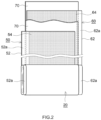
- a positive electrode sheet 50 and a negative electrode sheet 60 are stacked with two long separator sheets 70 interposed therebetween and are wound in the longitudinal direction.
- a positive electrode active material layer 54 is formed on one or each (each in this example) surface of an elongated positive electrode current collector 52 along the longitudinal direction.
- a negative electrode active material layer 64 is formed on one or each (each in this example) surface of an elongated negative electrode current collector 62 along the longitudinal direction.
- a positive electrode active material layer non-formed portion 52a i.e., a portion where no positive electrode active material layer 54 is formed and the positive electrode current collector 52 is exposed
- a negative electrode active material layer non-formed portion 62a i.e., a portion where no negative electrode active material layer 64 is formed and the negative electrode current collector 62 is exposed
- the positive electrode current collector plate 42a and the negative electrode current collector plate 44a are respectively joined to the positive electrode active material layer non-formed portion 52a and the negative electrode active material layer non-formed portion 62a.
- the positive electrode current collector 52 constituting the positive electrode sheet 50 may be a known positive electrode current collector for use in a lithium ion secondary battery, and examples of the positive electrode current collector 52 include sheets or foil of highly conductive metals (e.g., aluminum, nickel, titanium, and stainless steel).
- the positive electrode current collector 52 is desirably aluminum foil.
- the positive electrode current collector 52 are not particularly limited, and may be appropriately determined depending on battery design.
- the thickness thereof is not particularly limited, and is, for example, 5 ⁇ m or more and 35 ⁇ m or less, desirably 7 ⁇ m or more and 20 ⁇ m or less.
- the positive electrode active material layer 54 contains a positive electrode active material.
- a positive electrode active material at least a lithium nickel cobalt manganese composite oxide is used.
- the lithium nickel cobalt manganese composite oxide has a crystal structure of layered structure.
- the "lithium nickel cobalt manganese composite oxide” herein includes not only oxides including Li, Ni, Co, Mn, and O as constituent elements, but also oxides including one or more additive elements besides the foregoing elements.
- the additive elements include transition metal elements and typical metal elements, such as Mg, Ca, Al, Ti, V, Cr, Y, Zr, Nb, Mo, Hf, Ta, W, Na, Fe, Zn, and Sn.
- the additive element may be a metalloid element such as B, C, Si, or P, and a nonmetal element such as S, F, Cl, Br, or I.
- a percentage of nickel in a total content of metal elements except for lithium is desirably 30% by mole or more, more desirably 50% by mole or more.
- the lithium nickel cobalt manganese composite oxide desirably has the composition expressed by Formula (I): Li 1+x Ni y Co z Mn (1-y-z) M ⁇ O 2 - ⁇ Q ⁇ (I)
- x, y, z, ⁇ , and ⁇ respectively satisfy -0.3 ⁇ x ⁇ 0.3, 0.1 ⁇ y ⁇ 0.9, 0 ⁇ z ⁇ 0.5, 0 ⁇ ⁇ ⁇ 0.1, and 0 ⁇ ⁇ ⁇ 0.5.
- M is at least one element selected from the group consisting of Zr, Mo, W, Mg, Ca, Na, Fe, Cr, Zn, Sn, B, and Al.
- Q is at least one element selected from the group consisting of F, Cl, and Br.
- x desirably satisfies 0 ⁇ x ⁇ 0.3, more desirably satisfies 0 ⁇ x ⁇ 0.15.
- y and z desirably satisfy 0.30 ⁇ y ⁇ 0.88 and 0.02 ⁇ z ⁇ 0.45, more desirably satisfy 0.50 ⁇ y ⁇ 0.88 and 0.02 ⁇ z ⁇ 0.25, ⁇ desirably satisfies 0 ⁇ ⁇ ⁇ 0.01, may be 0, and ⁇ desirably satisfies 0 ⁇ ⁇ ⁇ 0.1, more desirably satisfies 0.
- lithium nickel cobalt manganese composite oxide only one type of a lithium nickel cobalt manganese composite oxide may be used, or two or more types of lithium nickel cobalt manganese composite oxides having different compositions, particle shapes, and the like may be used in combination.
- the positive electrode active material has a BET specific surface area of 1.8 m 2 /g to 2.8 m 2 /g.
- the range of a BET specific surface area of a positive electrode active material used in a lithium ion secondary battery is in a range starting from about 0.1 m 2 /g and exceeding 10 m 2 /g, and thus, this embodiment employs a positive electrode active material having a small BET specific surface area.
- the positive electrode active material having the BET specific surface area in the range described above has high stability.
- a ratio of the BET specific surface area to the average particle size (D50) of the positive electrode active material is 0.62 or more.
- the configuration in which the ratio of the BET specific surface area to the average particle size (D50) of the positive electrode active material is 0.62 or more means that a positive electrode active material having a large BET specific surface area relative to the average particle size (D50) is used.
- the configuration in which the ratio of the BET specific surface area to the average particle size (D50) is 0.62 or more is a configuration obtained by forming positive electrode active material particles as hollow particles. That is, the hollow particles have larger surface areas therein due to inner voids, and therefore, it is possible to increase the ratio of the BET specific surface area to the average particle size (D50).
- the positive electrode active material is generally hollow particles.
- the nonaqueous electrolyte 80 contains methyl acetate so that the viscosity of the nonaqueous electrolyte 80 is thereby reduced.
- the combination of the positive electrode active material and the nonaqueous electrolyte 80 as described above therefore, facilitates entering of the nonaqueous electrolyte 80 having a reduced viscosity into hollow portions (i.e., inner voids) of the hollow particles, and accordingly, the contact area between the nonaqueous electrolyte 80 and the positive electrode active material can be increased. As a result, the reaction area can be increased, and output characteristics of the lithium ion secondary battery 100 can be enhanced.
- the ratio of the BET specific surface area to the average particle size (D50) of the positive electrode active material is desirably 0.70 or more, more desirably 0.80 or more.
- the upper limit of this ratio is defined by technical limitations, and may be 3.0 or less, 2.0 or less, 1.5 or less, or 1.0 or less.
- the "specific surface area” herein refers to a surface area calculated by analysis with a BET method (e.g., single-point BET method) based on a gas adsorption amount measured with a gas adsorption method (constant-volume adsorption method) using nitrogen (N 2 ) gas as an adsorbate.
- the BET specific surface area can be measured with a commercially available specific surface area analyzer.
- the "average particle size (D50)" herein refers to a median diameter (D50), and means a particle size corresponding to a cumulative frequency of 50 % by volume from the small-size particle side in volume-based particle size distribution based on a laser diffraction and scattering method.
- the average particle size (D50) can be obtained by using a commercially available particle size distribution analyzer of a laser diffraction and scattering type.
- the positive electrode active material has a BET specific surface area of 1.8 m 2 /g to 2.8 m 2 /g, and a ratio of the BET specific surface area to the average particle size (D50) of the positive electrode active material is 0.62 or more, the average particle size (D50) of the positive electrode active material is about 4.52 ⁇ m at most.
- the average particle size (D50) of the positive electrode active material is desirably 1.0 ⁇ m or more, more desirably 2.0 ⁇ m or more.
- the positive electrode active material is generally hollow particles.
- the "hollow particles” herein refer to particles having inner voids larger than gaps between primary particles in secondary particles (so-called solid particles) formed by simply agglomerated primary particles.
- the hollow particles typically include shell portions constituted by a lithium nickel manganese cobalt composite oxide, and hollow portions formed inside the shell portions.
- the hollow particles also typically have through holes penetrating the shell portions such that the nonaqueous electrolyte 80 can enter the hollow portions.
- the number of the hollow portions in one hollow particle is not particularly limited, and may be one or two or more.
- the number of the through holes in one hollow particle is not particularly limited, and may be one or two or more.
- a porosity of the hollow particles is not particularly limited, and is typically 20% to 50%. It should be noted that the porosity of hollow particles can be determined as follows. A cross-sectional electron microscopic image of hollow particles is obtained, and a proportion of a total area of voids to an area of the entire particles (sum of an area occupied by the particles and an area of the voids) is calculated in terms of percentage. This value is calculated for 100 or more hollow particles, and an average of the obtained values is defined as a porosity of the hollow particles.
- a DBP absorption amount of the hollow particles is not particularly limited, and is typically 35 mL/100g to 50 mL/100g. It should be noted that the DBP absorption amount can be measured by using dibutyl phthalate (DBP) as a reagent liquid and in conformity with the method described in JIS K6217-4:2008, and can be obtained as an average of results of three measurements.
- DBP dibutyl phthalate
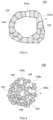
- FIGS. 3 and 4 show examples of hollow particles.
- a hollow particle 10A includes one hollow portion 14A, and in the hollow particle 10A, primary particles 12A of a lithium nickel manganese cobalt composite oxide are connected in a ring shape to form a shell portion.
- the primary particles 12A form a single layer, but the primary particles 12A may be stacked in the thickness direction of the shell portion to form multiple layers.
- the shell portion surrounds the hollow portion 14A.
- the shell portion has through holes 14Aa, and each of the through holes 14Aa has an opening width h that is enough to allow the nonaqueous electrolyte 80 to enter the hollow portion 14A.
- primary particles 12B are agglomerated more loosely than usual, and accordingly, a hollow particle 10B has relatively large hollow portions 14B. It should be noted that in FIG. 4 , some primary particles 12B appear to be separated from other particles, but this is because FIG. 4 is a cross-sectional view, and these particles are actually in contact with other primary particles (not shown) in an area not shown in the drawing.
- agglomerated primary particles 12B form shell portions each surrounding the corresponding one of the hollow portions 14B. Each of the shell portions has a through hole 14Ba with an opening width h that is enough to allow the nonaqueous electrolyte 80 to enter the hollow particle 10B.
- the positive electrode active material used in this embodiment can be obtained according to a known method.
- the positive electrode active material may contain a positive electrode active material other than the lithium nickel manganese cobalt composite oxide within a range that does not significantly inhibit the effects of the present disclosure (e.g., less than 20% by mass, desirably 10% by mass or less, more desirably 5% by mass or less, with respect to the total mass of the positive electrode active material).
- the positive electrode active material may consist only of a lithium nickel manganese cobalt composite oxide.
- a content of the positive electrode active material in the positive electrode active material layer 54 is not specifically limited, and is, for example, 80 % by mass or more, desirably 87 % by mass or more, more desirably 90 % by mass or more, even more desirably 95 % by mass or more, much more desirably 97 % by mass or more.
- the positive electrode active material layer 54 may include components other than the positive electrode active material, such as trilithium phosphate, a binder, and a conductive agent.
- a content of trilithium phosphate in the positive electrode active material layer 54 is not particularly limited, and is desirably 1% by mass or more and 15% by mass or less, more desirably 2% by mass or more and 12% by mass or less.
- binder examples include polyvinylidene fluoride (PVdF).
- PVdF polyvinylidene fluoride
- a content of the binder in the positive electrode active material layer 54 is not particularly limited, and is desirably 0.1 % by mass or more and 10 % by mass or less, more desirably 0.2 % by mass or more and 5 % by mass or less, even more desirably 0.3 % by mass or more and 2 % by mass or less.
- the conductive agent include carbon materials such as carbon black (e.g., acetylene black (AB)), carbon nanotubes (CNTs), and graphite.
- the conductive agent is desirably CNTs.
- the CNTs have high conductivity, and in addition, each have a hollow structure.
- the nonaqueous electrolyte 80 whose viscosity has been reduced by methyl acetate can be distributed in the hollow portions of the CNTs, and wettability between the positive electrode active material layer 54 and the nonaqueous electrolyte 80 can be improved. As a result, output characteristics and other characteristics of the lithium ion secondary battery 100 can be further enhanced.
- the type of the CNTs is not particularly limited, and single-walled carbon nanotubes (SWCNTs), double- walled carbon nanotubes (DWCNTs), multi-walled carbon nanotubes (MWCNTs), and so forth can be used. These carbon nanotubes may be used alone or two or more types of them may be used in combination.
- the CNTs may be produced by a method such as an arc discharge method, a laser ablation method, or a chemical vapor deposition method.
- MWCNTs have larger inner diameters than those of SWCNTs. Accordingly, since the nonaqueous electrolyte 80 having a viscosity reduced by methyl acetate can be more easily distributed in the hollow portion of the CNTs, the CNTs are desirably MWCNTs.
- An average length of the CNTs is not particularly limited.
- the average length of the CNTs is desirably 15 ⁇ m or less, more desirably 8.0 ⁇ m or less, and even more desirably 5.0 ⁇ m or less.
- the average length of the CNTs is desirably 0.1 ⁇ m or more.
- the average diameter of the CNTs is not particularly limited, and is, for example, 0.1 nm to 150 nm. Since the nonaqueous electrolyte 80 is easily distributed in the hollow portions of the CNTs, the average diameter of the CNTs is desirably 1.0 nm or more, more desirably 2.0 nm or more. On the other hand, when the average diameter of the CNTs is excessively large, flexibility of particles of the CNTs decreases so that the shape of the CNTs approach a rod shape, resulting in difficulty in covering the positive electrode active material with the CNTs. As a result, the degree of enhancement of wettability of the surface of the positive electrode active material might be small. In view of this, the average diameter of the CNTs is desirably 100 nm or less, more desirably 50 nm or less.
- the average length and the average diameter of the CNTs can be determined by taking an electron micrograph of the CNTs, and obtaining average values of lengths and diameters of 100 or more CNTs, respectively. Specifically, for example, a CNT dispersion is diluted and then dried, thereby preparing a measurement sample. This sample is observed with a scanning electron microscope (SEM), lengths and diameters of 100 or more CNTs are obtained, and averages of the obtained lengths and diameters are calculated. At this time, if CNTs are agglomerated again, a length and a diameter of the aggregate of the CNTs are obtained.
- SEM scanning electron microscope
- the content of CNTs in the positive electrode active material layer 54 is not particularly limited.
- the content of the CNTs in the positive electrode active material layer 54 is excessively small, the effects described above might degrade.
- inconvenience such as an increase in viscosity of the positive electrode slurry and a decrease in impregnating ability of the nonaqueous electrolyte 80 into the positive electrode active material layer 54 might occur in production of the lithium ion secondary battery 100.
- the content of the CNTs in the positive electrode active material layer 54 is desirably 0.1 % by mass or more and 3.0 % by mass or less, more desirably 0.3 % by mass or more and 2.5 % by mass or less, even more desirably 0.5 % by mass or more and 2.0 % by mass or less.
- the content of the material in the positive electrode active material layer 54 is not specifically limited, and is desirably 1% by mass or more and 15% by mass or less, more desirably 3% by mass or more and 13% by mass or less.
- the positive electrode active material layer may further include a disperser of carbon nanotubes (CNT disperser).
- CNT disperser examples include a surfactant-type disperser (also called a low molecular disperser), a polymeric disperser, and an inorganic disperser.
- the CNT disperser may be anionic, cationic, amphoteric, or nonionic.
- the CNT disperser may have, in the molecular structure thereof, at least one functional group selected from the group consisting of an anionic group, a cationic group, and a nonionic group.
- the surfactant refers to an amphiphilic material with a chemical structure in which a hydrophilic moiety and a lipophilic moiety are included in a molecule structure and are bound together by a covalent bond.
- the CNT disperser include: polycondensed aromatic surfactants such as a naphthalenesulfonic acid formalin condensate sodium salt, a naphthalenesulfonic acid formalin condensate ammonium salt, and a methyl naphthalenesulfonic acid formalin condensate sodium salt; polycarboxylic acid and a salt thereof such as polyacrylic acid and a salt thereof and polymethacrylic acid and a salt thereof; triazine derivative dispersers (desirably a disperser including a carbazolyl group or a benzimidazolyl group); polyvinylpyrrolidone (PVP); polymers having a polynuclear aromatic group such as pyrene or anthracene in a side chain; and polynuclear aromatic ammonium derivatives such as a pyrene ammonium derivative (e.g., a compound in which an ammonium bromide group is introduced to
- the CNT disperser desirably includes a polynuclear aromatic group.
- the CNT disperser is desirably a polymer having a polynuclear aromatic group in a side chain, and a polynuclear aromatic ammonium derivative.
- a content of the CNT disperser may be appropriately determined depending on the types of CNTs and the CNT disperser.
- the proportion of the CNT disperser is excessively small, dispersibility might be insufficient.
- the proportion of the CNT disperser is excessively large, the CNT disperser excessively adheres to the CNT surface, thereby causing the possibility of a resistance increase.
- the amount of use of the CNT disperser is, for example, 1 part by mass to 400 parts by mass, desirably 20 parts by mass to 200 parts by mass, with respect to 100 parts by mass of CNTs.
- the amount of use of the CNT disperser is, for example, 1 part by mass to 100 parts by mass, desirably 4 parts by mass to 40 parts by mass, with respect to 100 parts by mass of the CNTs.
- the thickness of the positive electrode active material layer 54 is not particularly limited, and is, for example, 10 ⁇ m or more and 400 ⁇ m or less, desirably 20 ⁇ m or more and 300 ⁇ m or less.
- the weight per unit area of the positive electrode active material layer 54 is not particularly limited, and desirably 4 mg/cm 2 or more, more desirably 8 mg/cm 2 or more, even more desirably 10 mg/cm 2 or more, especially desirably 20 mg/cm 2 or more.
- the weight per unit area of the positive electrode active material layer 54 may be 50 mg/cm 2 or less, or 40 mg/cm 2 or less.
- the positive electrode sheet 50 may include an insulating layer (not shown) at the boundary between the positive electrode active material layer non-formed portion 52a and the positive electrode active material layer 54.
- the insulating layer may contain ceramic particles, for example.
- the negative electrode current collector 62 constituting the negative electrode sheet 60 a known negative electrode current collector for use in a lithium ion secondary battery may be used, and examples of the negative electrode current collector include sheets or foil of highly conductive metals (e.g., copper, nickel, titanium, and stainless steel).
- the negative electrode current collector 62 is desirably copper foil.
- the thickness of the foil is not particularly limited, and is, for example, 5 ⁇ m or more and 35 ⁇ m or less, desirably 6 ⁇ m or more and 20 ⁇ m or less.
- the negative electrode active material layer 64 contains a negative electrode active material.
- the negative electrode active material include carbon materials such as graphite, hard carbon, and soft carbon.
- Graphite may be natural graphite or artificial graphite, and may be amorphous carbon-coated graphite in which graphite is coated with an amorphous carbon material.
- the average particle size (median particle size: D50) of the negative electrode active material is not specifically limited, and is, for example, 0.1 ⁇ m or more and 50 ⁇ m or less, desirably 1 ⁇ m or more and 25 ⁇ m or less, more desirably 5 ⁇ m or more and 20 ⁇ m or less. It should be noted that the average particle size (D50) of the negative electrode active material can be determined by, for example, a laser diffraction/scattering method.
- the negative electrode active material layer 64 can include components other than the active material, such as a binder or a thickener.
- a binder examples include styrene-butadiene rubber (SBR) and polyvinylidene fluoride (PVdF).
- the thickener examples include carboxymethyl cellulose (CMC).
- a content of the negative electrode active material in the negative electrode active material layer 64 is desirably 90% by mass or more, more desirably 95% by mass or more and 99% by mass or less.
- a content of the binder in the negative electrode active material layer 64 is desirably 0.1% by mass or more and 8% by mass or less, more desirably 0.5% by mass or more and 3% by mass or less.
- a content of the thickener in the negative electrode active material layer 64 is desirably 0.3% by mass or more and 3% by mass or less, more desirably 0.5% by mass or more and 2% by mass or less.
- the thickness of the negative electrode active material layer 64 is not particularly limited, and is, for example, 10 ⁇ m or more and 400 ⁇ m or less, desirably 20 ⁇ m or more and 300 ⁇ m or less.
- the weight per unit area of the negative electrode active material layer 64 is not particularly limited, and desirably 4 mg/cm 2 or more, more desirably 8 mg/cm 2 or more, even more desirably 10 mg/cm 2 or more, especially desirably 20 mg/cm 2 or more.
- the weight per unit area of the negative electrode active material layer 64 may be 50 mg/cm 2 or less, or 40 mg/cm 2 or less.
- the separator 70 examples include a porous sheet (film) of a resin such as polyethylene (PE), polypropylene (PP), polyester, cellulose, or polyamide.
- the porous sheet may have a single-layer structure or a laminated structure of two or more layers (e.g., three-layer structure in which PP layers are stacked on each surface of a PE layer).
- a heat-resistance layer (HRL) containing, for example, ceramic particles may be provided on a surface of the separator 70.
- the thickness of the separator 70 is not particularly limited, and is, for example, 5 ⁇ m or more and 50 ⁇ m or less, desirably 10 ⁇ m or more and 30 ⁇ m or less.
- An air permeability of the separator 70 obtained by a Gurley permeability test is not particularly limited, and is desirably 350 sec./100 cc or less.
- the lithium ion secondary battery 100 has excellent output characteristics. Since the positive electrode active material has a small BET specific surface area, the positive electrode active material has high stability, and accordingly, the lithium ion secondary battery 100 also has high durability.
- the lithium ion secondary battery 100 is applicable to various applications. Examples of suitable applications include drive power supplies to be mounted on vehicles such as battery electric vehicles (BEVs), hybrid electric vehicles (HEVs), and plug-in hybrid electric vehicles (PHEVs).
- BEVs battery electric vehicles
- HEVs hybrid electric vehicles
- PHEVs plug-in hybrid electric vehicles
- the lithium ion secondary battery 100 can be used as a storage battery for, for example, a small-size power storage device.
- the lithium ion secondary battery 100 Since the lithium ion secondary battery 100 has excellent output characteristics, the lithium ion secondary battery 100 is especially desirably applicable to drive power supplies mounted on vehicles such as battery electric vehicles (BEVs), hybrid electric vehicles (HEVs), and plug-in hybrid electric vehicles (PHEVs) (especially drive power supply for HEVs).
- BEVs battery electric vehicles
- HEVs hybrid electric vehicles
- PHEVs plug-in hybrid electric vehicles
- the lithium ion secondary battery 100 can be used in a form of a battery module in which a plurality of batteries are typically connected in series and/or in parallel.
- the lithium ion secondary battery 100 including the flat wound electrode body 20 as an example.
- the lithium ion secondary battery can also be configured as a lithium ion secondary battery including a stacked-type electrode body (i.e., electrode body in which a plurality of positive electrodes and a plurality of negative electrodes are alternately stacked).
- the lithium ion secondary battery can also be configured as a cylindrical lithium ion secondary battery or a laminated-case lithium ion secondary battery.
- the secondary battery according to this embodiment can be configured as a nonaqueous secondary battery other than a lithium ion secondary battery according to a known method.
- LiNi 0.50 Co 0.20 Mn 0.30 O 2 having a BET specific surface area and an average particle size (D50) shown in Table 1 was prepared.
- a positive electrode active material of Comparative Example 3 was solid particles, and positive electrode active materials of the examples and the other comparative examples were hollow particles.
- NMP N-methyl-2-pyrrolidone
- This negative electrode slurry was applied onto copper foil and dried, thereby producing a negative electrode sheet.
- a polyolefin porous film as a separator was sandwiched between the thus-produced positive electrode sheet and negative electrode sheet, thereby producing an electrode body.
- an electrode opposed area was about 20 cm 2 .
- This electrode body was placed in a laminated case having an opening at an end.
- a mixed solvent including ethylene carbonate (EC), ethyl methyl carbonate (EMC), dimethyl carbonate (DMC), and methyl acetate at a volume ratio of 30 : 30-x : 40 : x was prepared.
- the value of x is shown in Table 1.
- LiPF 6 as an electrolyte salt was dissolved at a concentration of 1.1 mol/L, thereby preparing a nonaqueous electrolyte. This nonaqueous electrolyte was injected into the laminated case, and the opening of the laminated case was heat bonded, thereby sealing the laminated case. In this manner, a single-layer laminated cell with a capacity of about 20 mAh was obtained as an evaluation lithium ion secondary battery.
- Each evaluation lithium ion secondary battery was subjected to initial charge at a current value of 1/3 C, and then subjected to an aging treatment at 60°C for 24 hours. Thereafter, each evaluation lithium ion secondary battery was adjusted to have a state of charge (SOC) of 50%, and then placed in an environment of 25°C.
- SOC state of charge
- the evaluation lithium ion secondary batteries were discharged to a predetermined cut voltage with various current values, and times (second) in which battery voltages reached the cut voltage were measured. Based on the measurement results, an output with which the battery voltage reached the cut voltage in 10 seconds (10-second output) was measured.
- an output of Comparative Example 1 is " 1.00," ratios of outputs of the examples and the other comparative examples to Comparative Example 1 were calculated. Table 1 shows the results.
- the positive electrode active material has a BET specific surface area of 1.8 m 2 /g to 2.8 m 2 /g, a ratio of the BET specific surface area to the average particle size (D50) of the positive electrode active material is 0.62 or more, and the nonaqueous solvent of the nonaqueous electrolyte contains methyl acetate. Accordingly, it can be understood that the nonaqueous electrolyte secondary battery disclosed here has enhanced output characteristics while using the positive electrode active material with a small BET specific surface area.
- the nonaqueous electrolyte secondary battery disclosed here is any one of items [1] to [7].
Landscapes
- Chemical & Material Sciences (AREA)
- Chemical Kinetics & Catalysis (AREA)
- Electrochemistry (AREA)
- General Chemical & Material Sciences (AREA)
- Engineering & Computer Science (AREA)
- Inorganic Chemistry (AREA)
- Manufacturing & Machinery (AREA)
- Materials Engineering (AREA)
- Condensed Matter Physics & Semiconductors (AREA)
- General Physics & Mathematics (AREA)
- Physics & Mathematics (AREA)
- Composite Materials (AREA)
- Battery Electrode And Active Subsutance (AREA)
- Secondary Cells (AREA)
Applications Claiming Priority (1)
| Application Number | Priority Date | Filing Date | Title |
|---|---|---|---|
| JP2023016580A JP7731925B2 (ja) | 2023-02-07 | 2023-02-07 | 非水電解液二次電池 |
Publications (1)
| Publication Number | Publication Date |
|---|---|
| EP4415075A1 true EP4415075A1 (de) | 2024-08-14 |
Family
ID=89224393
Family Applications (1)
| Application Number | Title | Priority Date | Filing Date |
|---|---|---|---|
| EP23217967.1A Pending EP4415075A1 (de) | 2023-02-07 | 2023-12-19 | Sekundärbatterie mit nichtwässrigem elektrolyten |
Country Status (5)
| Country | Link |
|---|---|
| US (1) | US20240274788A1 (de) |
| EP (1) | EP4415075A1 (de) |
| JP (1) | JP7731925B2 (de) |
| KR (1) | KR20240123756A (de) |
| CN (1) | CN118472173A (de) |
Citations (5)
| Publication number | Priority date | Publication date | Assignee | Title |
|---|---|---|---|---|
| KR101696524B1 (ko) * | 2011-06-07 | 2017-01-13 | 스미토모 긴조쿠 고잔 가부시키가이샤 | 니켈 복합 수산화물과 그의 제조 방법, 비수계 전해질 이차 전지용 정극 활물질과 그의 제조 방법, 및 비수계 전해질 이차 전지 |
| CN108352528A (zh) * | 2015-11-05 | 2018-07-31 | 住友化学株式会社 | 锂二次电池用正极活性物质、锂二次电池用正极活性物质的制造方法、锂二次电池用正极以及锂二次电池 |
| JP2019175721A (ja) | 2018-03-29 | 2019-10-10 | 三洋電機株式会社 | 非水電解質二次電池用正極の製造方法及び非水電解質二次電池の製造方法 |
| EP3553856A1 (de) * | 2016-12-07 | 2019-10-16 | Sumitomo Chemical Company, Limited | Positivelektrodenaktivmaterial für lithiumsekundärbatterien, positivelektrode für lithiumsekundärbatterien und lithiumsekundärbatterie |
| US20220069352A1 (en) * | 2018-12-25 | 2022-03-03 | Daikin Industries, Ltd. | Electrolytic solution for lithium-ion secondary battery, lithium-ion secondary battery, and module |
Family Cites Families (3)
| Publication number | Priority date | Publication date | Assignee | Title |
|---|---|---|---|---|
| JP6582730B2 (ja) | 2014-08-29 | 2019-10-02 | 三菱ケミカル株式会社 | 非水系電解液及びそれを用いた非水系電解液二次電池 |
| JP6799551B2 (ja) | 2018-02-07 | 2020-12-16 | 住友化学株式会社 | リチウム二次電池用正極活物質の製造方法 |
| JP7417135B2 (ja) | 2021-07-21 | 2024-01-18 | 日亜化学工業株式会社 | 非水電解質二次電池用正極活物質及びその製造方法 |
-
2023
- 2023-02-07 JP JP2023016580A patent/JP7731925B2/ja active Active
- 2023-12-19 EP EP23217967.1A patent/EP4415075A1/de active Pending
-
2024
- 2024-02-02 KR KR1020240016378A patent/KR20240123756A/ko active Pending
- 2024-02-04 CN CN202410156926.3A patent/CN118472173A/zh active Pending
- 2024-02-05 US US18/433,115 patent/US20240274788A1/en active Pending
Patent Citations (5)
| Publication number | Priority date | Publication date | Assignee | Title |
|---|---|---|---|---|
| KR101696524B1 (ko) * | 2011-06-07 | 2017-01-13 | 스미토모 긴조쿠 고잔 가부시키가이샤 | 니켈 복합 수산화물과 그의 제조 방법, 비수계 전해질 이차 전지용 정극 활물질과 그의 제조 방법, 및 비수계 전해질 이차 전지 |
| CN108352528A (zh) * | 2015-11-05 | 2018-07-31 | 住友化学株式会社 | 锂二次电池用正极活性物质、锂二次电池用正极活性物质的制造方法、锂二次电池用正极以及锂二次电池 |
| EP3553856A1 (de) * | 2016-12-07 | 2019-10-16 | Sumitomo Chemical Company, Limited | Positivelektrodenaktivmaterial für lithiumsekundärbatterien, positivelektrode für lithiumsekundärbatterien und lithiumsekundärbatterie |
| JP2019175721A (ja) | 2018-03-29 | 2019-10-10 | 三洋電機株式会社 | 非水電解質二次電池用正極の製造方法及び非水電解質二次電池の製造方法 |
| US20220069352A1 (en) * | 2018-12-25 | 2022-03-03 | Daikin Industries, Ltd. | Electrolytic solution for lithium-ion secondary battery, lithium-ion secondary battery, and module |
Also Published As
| Publication number | Publication date |
|---|---|
| US20240274788A1 (en) | 2024-08-15 |
| CN118472173A (zh) | 2024-08-09 |
| JP2024111890A (ja) | 2024-08-20 |
| KR20240123756A (ko) | 2024-08-14 |
| JP7731925B2 (ja) | 2025-09-01 |
Similar Documents
| Publication | Publication Date | Title |
|---|---|---|
| EP3471170B1 (de) | Sekundärbatterie mit wasserfreiem elektrolyt | |
| EP3611783B1 (de) | Elektrode für sekundärbatterie und sekundärbatterie | |
| KR20220031207A (ko) | 분리막 및 이를 포함하는 이차 전지 | |
| EP3961756B1 (de) | Positivelektrode für sekundärbatterie sowie sekundärbatterie | |
| JP7668828B2 (ja) | 非水電解液二次電池 | |
| US20240274788A1 (en) | Nonaqueous electrolyte secondary battery | |
| EP4141985A1 (de) | Positive elektrode und sekundärbatterie mit wasserfreiem elektrolyt damit | |
| EP4492488A2 (de) | Sekundärbatterie mit nichtwässrigem elektrolyten | |
| EP4435895A1 (de) | Sekundärbatterie mit nichtwässrigem elektrolyten | |
| EP4322247A1 (de) | Negativelektrode und sekundärbatterie damit | |
| US20240088446A1 (en) | Nonaqueous electrolyte secondary battery | |
| EP4718515A1 (de) | Negative elektrode einer sekundärbatterie und sekundärbatterie mit der negativen elektrode | |
| EP4718507A1 (de) | Negativelektrode einer sekundärbatterie, verfahren zur herstellung der negativelektrode und sekundärbatterie mit der negativelektrode | |
| EP4718506A1 (de) | Negativelektrode einer sekundärbatterie, verfahren zur herstellung der negativelektrode und sekundärbatterie mit der negativelektrode | |
| EP4718522A1 (de) | Negativelektrode einer sekundärbatterie, verfahren zur herstellung der negativelektrode und sekundärbatterie mit der negativelektrode | |
| JP7752657B2 (ja) | 二次電池の負極、および当該負極を用いた二次電池 | |
| EP4407702A1 (de) | Sekundärbatterie mit nichtwässrigem elektrolyten | |
| EP4718513A1 (de) | Negativelektrode für sekundärbatterie und sekundärbatterie mit negativelektrode | |
| US20240396043A1 (en) | Negative electrode of secondary battery, method for fabricating the negative electrode, and secondary battery using the negative electrode | |
| US20260094815A1 (en) | Negative electrode for secondary battery and secondary battery with negative electrode | |
| KR20240160021A (ko) | 리튬 이온 이차 전지 | |
| JP2024010882A (ja) | 二次電池 | |
| EP4503181A1 (de) | Positivelektrodenaktivmaterial |
Legal Events
| Date | Code | Title | Description |
|---|---|---|---|
| PUAI | Public reference made under article 153(3) epc to a published international application that has entered the european phase |
Free format text: ORIGINAL CODE: 0009012 |
|
| STAA | Information on the status of an ep patent application or granted ep patent |
Free format text: STATUS: REQUEST FOR EXAMINATION WAS MADE |
|
| 17P | Request for examination filed |
Effective date: 20231219 |
|
| AK | Designated contracting states |
Kind code of ref document: A1 Designated state(s): AL AT BE BG CH CY CZ DE DK EE ES FI FR GB GR HR HU IE IS IT LI LT LU LV MC ME MK MT NL NO PL PT RO RS SE SI SK SM TR |