EP4418183A1 - Système indicateur pour un récipient de produit périssable - Google Patents
Système indicateur pour un récipient de produit périssable Download PDFInfo
- Publication number
- EP4418183A1 EP4418183A1 EP23156962.5A EP23156962A EP4418183A1 EP 4418183 A1 EP4418183 A1 EP 4418183A1 EP 23156962 A EP23156962 A EP 23156962A EP 4418183 A1 EP4418183 A1 EP 4418183A1
- Authority
- EP
- European Patent Office
- Prior art keywords
- indicating
- container
- containers
- perishable
- product
- Prior art date
- Legal status (The legal status is an assumption and is not a legal conclusion. Google has not performed a legal analysis and makes no representation as to the accuracy of the status listed.)
- Withdrawn
Links
Images

Classifications
-
- G—PHYSICS
- G06—COMPUTING OR CALCULATING; COUNTING
- G06Q—INFORMATION AND COMMUNICATION TECHNOLOGY [ICT] SPECIALLY ADAPTED FOR ADMINISTRATIVE, COMMERCIAL, FINANCIAL, MANAGERIAL OR SUPERVISORY PURPOSES; SYSTEMS OR METHODS SPECIALLY ADAPTED FOR ADMINISTRATIVE, COMMERCIAL, FINANCIAL, MANAGERIAL OR SUPERVISORY PURPOSES, NOT OTHERWISE PROVIDED FOR
- G06Q10/00—Administration; Management
- G06Q10/08—Logistics, e.g. warehousing, loading or distribution; Inventory or stock management
- G06Q10/083—Shipping
- G06Q10/0832—Special goods or special handling procedures, e.g. handling of hazardous or fragile goods
-
- G—PHYSICS
- G06—COMPUTING OR CALCULATING; COUNTING
- G06Q—INFORMATION AND COMMUNICATION TECHNOLOGY [ICT] SPECIALLY ADAPTED FOR ADMINISTRATIVE, COMMERCIAL, FINANCIAL, MANAGERIAL OR SUPERVISORY PURPOSES; SYSTEMS OR METHODS SPECIALLY ADAPTED FOR ADMINISTRATIVE, COMMERCIAL, FINANCIAL, MANAGERIAL OR SUPERVISORY PURPOSES, NOT OTHERWISE PROVIDED FOR
- G06Q10/00—Administration; Management
- G06Q10/08—Logistics, e.g. warehousing, loading or distribution; Inventory or stock management
-
- G—PHYSICS
- G06—COMPUTING OR CALCULATING; COUNTING
- G06Q—INFORMATION AND COMMUNICATION TECHNOLOGY [ICT] SPECIALLY ADAPTED FOR ADMINISTRATIVE, COMMERCIAL, FINANCIAL, MANAGERIAL OR SUPERVISORY PURPOSES; SYSTEMS OR METHODS SPECIALLY ADAPTED FOR ADMINISTRATIVE, COMMERCIAL, FINANCIAL, MANAGERIAL OR SUPERVISORY PURPOSES, NOT OTHERWISE PROVIDED FOR
- G06Q10/00—Administration; Management
- G06Q10/08—Logistics, e.g. warehousing, loading or distribution; Inventory or stock management
- G06Q10/083—Shipping
- G06Q10/0833—Tracking
-
- A—HUMAN NECESSITIES
- A61—MEDICAL OR VETERINARY SCIENCE; HYGIENE
- A61J—CONTAINERS SPECIALLY ADAPTED FOR MEDICAL OR PHARMACEUTICAL PURPOSES; DEVICES OR METHODS SPECIALLY ADAPTED FOR BRINGING PHARMACEUTICAL PRODUCTS INTO PARTICULAR PHYSICAL OR ADMINISTERING FORMS; DEVICES FOR ADMINISTERING FOOD OR MEDICINES ORALLY; BABY COMFORTERS; DEVICES FOR RECEIVING SPITTLE
- A61J9/00—Feeding-bottles in general
- A61J9/02—Feeding-bottles in general with thermometers
Definitions
- This invention relates to storage of perishable products, for example the storage of expressed or formula milk in a container, such as a baby bottle for baby feeding.
- the invention in particular relates to an indicator system for use with such a container.
- breast milk is the best choice for feeding a baby. If a mother is not able to breast feed whenever the baby needs feeding, breast pumps are used to express milk to enable storage so that the baby can be fed at a different time. Breast milk is precious, so parents do not want to spoil or waste it. Thus, the milk has to be stored until the baby is to be fed, preferably chilled or frozen, as otherwise the storage time is limited.
- the storage of milk in a fridge or freezer creates a problem of milk management, in particular which stored milk has to be fed when. Different storage temperatures give a different shelf life. There is for example a 6 - 6 - 6 rule used as a guideline, that breast milk goes bad after six hours at room temperature, six days in the fridge and six months in the freezer.
- containers of stored breast milk are often identified by a day and even time of the day when the milk was expressed.
- Some common labeling methods include a label which is hand-made from masking tape, a manufactured adhesive labeling material, or a piece of paper held to the side of the container with a rubber band.
- an indicating system for providing a usage recommendation for a perishable product stored in a container, which product is one of a set of perishable products, including other perishable products each stored in respective other containers with their own respective other indicating systems, comprising:
- This system provides advice to a user about the usage, e.g., consumption, of a perishable product, taking into account other perishable products also having indicating systems.
- the indicating system indicates to a user when the contents of a particular container (of a set) is the one that should be consumed next.
- the indicating system indicates to a user when the contents of a particular container (of a set) is the one that should be used next. This avoids the need for the user to make any complicated calculations, and it avoids the need to fill in and apply labels or other markings.
- the indicating system at the location of the container itself provides an indication to the user. For example, with a set of containers, one will generate an output to show that the content is the next to be used.
- the output device may be a display unit such as an LED or LED arrangement at the container itself. This avoids the need to use an app.
- the output device is a transmitter for transmitting the determination to a remote external display unit.
- the remote external display unit can for example identify the container that should next be used using a numbered system for the indicating system.
- the system preferably further comprises a transmitting unit for transmitting data derived from the sensor data to the indicating systems of the other containers.
- a transmitting unit for transmitting data derived from the sensor data to the indicating systems of the other containers.
- the transmission may be wireless, or the containers may be connected by a common supporting cradle which provides electrical (wired) interconnection between the indicating units of the containers.
- the processor may be further configured to determine from the sensor data if the perishable product is out of date. Thus, a warning can then be given by the output device that the content should no longer be used.
- the processor may be further configured to determine from the sensor data if the perishable product can continue to be stored.
- the indicating system and the respective other indicating systems for example form a mesh network. This means all the indicator systems can be the same, with no need for a master unit. This simplifies the implementation. It avoids the need to connect to an external network.
- the indicating system and the respective other indicating systems are for example configured to communicate over the mesh network at predetermined intervals. This saves power.
- the processor is for example configured to control the output device to indicate periodically the usage recommendation. This also saves power.
- the indication may be generated by an output device in the form of a bistable display element, so that power is only consumed when the output is changed.
- the system is preferably a battery-operated system, comprising a battery for powering the sensor, transmitting unit, receiving unit, processor, and output device.
- the processor is for example configured to determine a degree of spoiling based on the storage temperatures over time and associated time durations at those storage temperatures.
- the storage temperature may indicate if the perishable product is being stored at room temperature, at fridge temperature or at freezer temperature. Each unit of time at these different temperatures (or different temperature categories) may then contribute different amounts of spoiling, and when a threshold is reached the perishable product may then be deemed to be spoiled.
- the processor may be configured to determine that the perishable product should be the next to be used when it has the greatest degree of spoiling and not exceeding a spoiling threshold.
- the system for example comprises an adapter for fitting to a milk storage bottle.
- the system is for monitoring milk storage, such as breast milk or formula milk.
- milk storage such as breast milk or formula milk.
- the invention may be applied to any perishable products to reduce wastage, by ensuring food or drinks are consumed before they are spoiled or other perishable products are used before they are perished.
- the invention also provides a milk storage system comprising a milk container and the indicating system defined above, wherein the sensor is for monitoring the milk temperature.
- the system may be formed as an integral part of the container.
- the invention also provides a monitoring system for monitoring perishable products stored in a set of containers, comprising a plurality of the indicating systems each as defined above, and each associated with a respective container.
- the invention also provides a method for providing a usage recommendation for a perishable product stored in a container using an indicating system, which product is one a set of perishable products including other perishable products each stored in respective other containers with their own respective other indicating systems, comprising:
- the received data is for example information derived from the sensor data of other indicating systems.
- the comparing is for example a comparison between information derived from the local sensor data and the received information derived from the sensor data of the other indicating systems.
- This "derived information" is for example a level of freshness, i.e., a degree of spoiling.
- the usage recommendation is preferably a determination that the perishable product in the container should be the next to be used.
- the method may further comprise transmitting data derived from the sensor data to the indicating systems of the other containers.
- the method may further comprise determining from the sensor data if the perishable product is out of date.
- the invention also provides a computer program comprising computer program code means which is adapted, when said program is run on the processor of the indicating system defined above, to perform the method defined above.
- the invention also provides a processor for running the computer program.
- the invention provides a system for indicating usage recommendations for a perishable product (e.g., an edible product such as food or milk for a baby, or a perishable product such as a medication) stored in a container, and which takes account of perishable products stored in other containers.
- a perishable product e.g., an edible product such as food or milk for a baby, or a perishable product such as a medication
- the usage recommendation is whether the product is the most suitable for usage, out of a set of perishable products.
- the temperature is monitored, and temperature information (or data derived from that temperature information) from other containers is received. By comparing sensor data, the usage recommendation is provided, for example it is determined if the perishable product in the container should be the next to be used.
- the temperature information (or data derived from it) is preferably also sent to the other containers so that they can make similar determinations.
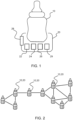
- Fig. 1 shows a milk bottle and an adapter to function as an indicating system, in particular to provide guidance to assist a user in deciding when the contained milk should be consumed.
- the milk bottle 10 in this example sits on an adapter 20 in the form of a base.
- the adapter functions as an indicating system.
- the indicating system comprises a sensor 22 which measures at least the temperature of the bottle (and hence the bottle content assuming a stable temperature) over time.
- Other sensors such as volume sensors measuring the volume of milk within in the container, or movement sensors measuring the movement of the bottle can be included.
- a processor 24 receives the temperature measurement data (and other sensor data, if any) and has an internal timing device so that the temperature is monitored over time.
- a memory may be used to stored data over time, although it may simply store a current degree of spoiling as explained further below.
- a transceiver 26 includes a transmitting unit for transmitting sensor data, or more particularly information derived from the sensor data, to the indicating systems of other containers and a receiving unit for receiving sensor data, or more particularly information derived from the sensor data, from the indicating systems of the other containers.
- information derived from the temperature monitoring data is shared between a set of indicating systems, with each indicating system associated with a respective container and hence a respective perishable product (i.e., a milk sample in this example).
- the sensor data is collected, stored locally, and processed locally with an algorithm to determine the freshness level (referred to below as a "degree of spoiling").
- the degree of spoiling at that moment is transmitted to the indicating system of all other containers. Based on the degree of spoiling of the other containers at that moment, the container can thus indicate if it is the preferred container for usage.
- An output device 28 is used to indicate to a user the usage recommendation, which in preferred examples is that the content of a particular container should be consumed next.
- the output device may be display, or LED arrangement at the container adapter, but instead the output device may a communications system to communicate with a remote display device.
- a battery 29 powers the electronics (sensor, processor, memory and output device).
- the processor 24 controls the communication with the other indicating systems, and in one example this implements a mesh network.
- the processor runs a program which compares the data received from other containers (i.e., the degree of spoiling) with the locally derived degree of spoiling , and, based on the comparison determines if the container should be used for the next feeding installment.
- the analysis of the locally collected sensor data also enables a determination of whether the perishable product is out of date or if it can continue to be stored.
- the indicator system of each container in this way logs the temperature of the content and time duration that the content is in the container. The time durations at different temperatures may then be used to derive the degree of spoiling.
- a maximum score of 600 may indicate a minimum degree of spoiling. Every 1 hour at room temperature will result in an increase in spoiling equivalent to a deduction of 100 points. Every 1 day in the fridge and every 1 month in the freezer may then also equate to the same 100 points. In this way, the 6-6-6 rule mentioned above is applied, but in a manner which allows combinations of room temperature, fridge temperature and freezer temperature.
- the temperature monitoring may be binned into three bins corresponding to room (e.g. 10 to 25 degrees), fridge (e.g. 0 to 10 degrees) and freezer (e.g. below 0 degrees).
- room e.g. 10 to 25 degrees
- fridge e.g. 0 to 10 degrees
- freezer e.g. below 0 degrees
- the actual temperature may be fed into a more accurate formula which applies weights to the measured temperature more finely.
- a degree of spoiling may be derived, and a threshold is reached when the perishable is product is spoiled (the threshold being zero in this example).
- the degree of spoiling may count up instead of down, e.g., from a minimum spoiling of zero to a maximum spoiling of e.g., 600.
- the indicating system will indicate this visually with for example a red LED or display.
- the indicator systems share their degree of spoiling scores over the mesh network at regular intervals. Thus, each indicator system within the network knows the scores of the other indicator systems.
- the output device indicates to the user it is the right container to pick for the present feeding instance.
- the system is not dependent on an internet connection and server, which can be hard to achieve inside a freezer/fridge with the door closed, whereas the mesh network can work well within the freezer or fridge.
- the system may be powered by single-use batteries or rechargeable batteries. While the battery efficiency will be reduced by the low temperatures in a freezer or fridge, they are be able to supply enough energy to power the electronics, especially as the electronics may use low-energy consuming components and may also work only at intervals.
- a typical CR2032 coin cell is for example sufficient for such application and has an operating range from -30°C to +80°C.
- the output device comprises a local display device, it for example comprises a LED display.
- the LED display may be activated only for a short period at intervals, for example every 10 seconds.
- the display may be a bistable display element, for example as used in e-readers. Such displays only need a short pulse of energy to change the information displayed on them.
- the indicator systems at the containers may be clearly numbered, and the external display device can display the number of the indicator system that has been determined.
- the indicator system is coupled to the container in use so that the local temperature is monitored. However, the indicator system is also removable for cleaning of the container.
- the indicator system may be attached externally to the container, as shown, but it may instead be incorporated as part of the design of the container, for example in an extra compartment at the bottom of the container that may be removable.
- the indicator system may instead be carried by the bottle for example as a sleeve or label.
- the indicator system can also be provided inside the bottle, but this is less preferred as the electronics housing will then need to be designed to allow contact with the milk, and this adds cost and complexity.
- the container may be any suitable perishable product container, for example made from plastics, glass, metal or silicone.
- the indicator system may for example be able to detect when it is connected to a container, for example using a simple electrical or optical switch mechanism that is activated by the coupling between the indicator system and the container.
- the system starts to count time. The system will then reset when it is removed from the container, typically when the container is warmed up and used, or cleaned.
- the indicator system can also generate a signal that indicates that the battery needs to be changed, for example a blinking LED.
- Fig. 2 shows in schematic form a set of milk bottles (which may be assumed to include integrated indicator units, not separately shown), connected to form a mesh network.
- Wireless communication is used, such as Bluetooth or Zigbee.
- any other communications means may be used such as optical communication or high frequency audio but these have self-evident inherent disadvantages and are thus not preferred.
- the mesh network does not need to communicate constantly, but could exchange information at regular intervals.
- the mesh network for example maintains connection in the background constantly, at regular intervals such as every few hundred milliseconds.
- the containers in the network will send their current degree of spoiling at regular interval such as every 10 seconds.
- the indicator system of a particular container stops sending any degree of spoiling data, such that a given number of reports have been missed, the associated container may be removed from the comparison list.
- a centralized network may also be used instead of the independent mesh network, such as based on Wi-Fi.
- a centralized network it is then possible to perform the ranking of degree of spoiling centrally, for example on an App.
- the degree of spoiling, as well as a consumption amount may be read out using an app (but still without requiring a centralized system).
- the consumption amount may be derived from the containers that are removed from the set because their content is being consumed.
- the user can also see the amount of milk added to the set of containers on a daily basis and the amount of consumption. The user thus can obtain a clear picture if more milk expression is required or if it should be reduced.
- Fig. 3 shows a method for indicating if s product stored in a container is the most suitable for usage.
- the container is one of a set of containers, and each container has a respective indicating systems.
- step 30 local sensor data is collected including a monitored temperature of the perishable product over time.
- step 32 information derived from the sensor data (i.e., the degree of spoiling) is transmitted to the indicating systems of the other containers.
- step 34 data is received from the indicating systems of the other containers.
- the collected sensor data is compared with the received sensor data thereby to determine if the perishable product in the container should be the next to be used.
- the determination that the perishable product in the container should be the next to be used is output in step 38.
- the invention is described with reference to a milk bottle.
- the invention may be applied to different perishable products. They may all be the same, but equally there may be different perishable products with different storage possibilities, and the system can then provide advice of which perishable products should be used to avoid them spoiling.
- the degree of spoiling different types of food product can be compared even if they have very different storage requirements and recommended durations. In this way, food storage can be managed to reduce food waste.
Landscapes
- Business, Economics & Management (AREA)
- Engineering & Computer Science (AREA)
- Economics (AREA)
- Quality & Reliability (AREA)
- Entrepreneurship & Innovation (AREA)
- Human Resources & Organizations (AREA)
- Marketing (AREA)
- Operations Research (AREA)
- Development Economics (AREA)
- Strategic Management (AREA)
- Tourism & Hospitality (AREA)
- Physics & Mathematics (AREA)
- General Business, Economics & Management (AREA)
- General Physics & Mathematics (AREA)
- Theoretical Computer Science (AREA)
- Details Of Rigid Or Semi-Rigid Containers (AREA)
Priority Applications (4)
| Application Number | Priority Date | Filing Date | Title |
|---|---|---|---|
| EP23156962.5A EP4418183A1 (fr) | 2023-02-16 | 2023-02-16 | Système indicateur pour un récipient de produit périssable |
| EP24700639.8A EP4666232A1 (fr) | 2023-02-16 | 2024-01-23 | Système indicateur pour contenant de produit périssable |
| PCT/EP2024/051473 WO2024170228A1 (fr) | 2023-02-16 | 2024-01-23 | Système indicateur pour contenant de produit périssable |
| CN202420283546.1U CN222265757U (zh) | 2023-02-16 | 2024-02-06 | 指示系统、乳汁存储系统和监测系统 |
Applications Claiming Priority (1)
| Application Number | Priority Date | Filing Date | Title |
|---|---|---|---|
| EP23156962.5A EP4418183A1 (fr) | 2023-02-16 | 2023-02-16 | Système indicateur pour un récipient de produit périssable |
Publications (1)
| Publication Number | Publication Date |
|---|---|
| EP4418183A1 true EP4418183A1 (fr) | 2024-08-21 |
Family
ID=85277890
Family Applications (1)
| Application Number | Title | Priority Date | Filing Date |
|---|---|---|---|
| EP23156962.5A Withdrawn EP4418183A1 (fr) | 2023-02-16 | 2023-02-16 | Système indicateur pour un récipient de produit périssable |
Country Status (2)
| Country | Link |
|---|---|
| EP (1) | EP4418183A1 (fr) |
| WO (1) | WO2024170228A1 (fr) |
Citations (7)
| Publication number | Priority date | Publication date | Assignee | Title |
|---|---|---|---|---|
| US20160125717A1 (en) * | 2014-11-04 | 2016-05-05 | Loominocity, Inc. | Perishable food timing system |
| US20170087524A1 (en) * | 2015-09-28 | 2017-03-30 | Smita Deshpande | Mixing device with anti-spoilage monitor |
| WO2018017776A1 (fr) * | 2016-07-21 | 2018-01-25 | Clinical Biotechnology Research Institute At Rsfh | Système de suivi de conteneurs |
| US20190213536A1 (en) * | 2015-03-30 | 2019-07-11 | Zest Labs, Inc. | Actively managed food delivery |
| US20200317445A1 (en) * | 2019-04-03 | 2020-10-08 | Trumed Systems, Inc. | Automated smart storage of products |
| US10877013B2 (en) * | 2016-09-29 | 2020-12-29 | Inteligistics, Inc. | System, method, and apparatus for condition monitoring of food and other perishable products as well as environmentally sensitive industrial supply chains |
| US20220375320A1 (en) * | 2014-12-04 | 2022-11-24 | Wide Afternoon, LLC | Systems And Methods For Managing Information Associated With Storage Containers |
-
2023
- 2023-02-16 EP EP23156962.5A patent/EP4418183A1/fr not_active Withdrawn
-
2024
- 2024-01-23 WO PCT/EP2024/051473 patent/WO2024170228A1/fr not_active Ceased
Patent Citations (7)
| Publication number | Priority date | Publication date | Assignee | Title |
|---|---|---|---|---|
| US20160125717A1 (en) * | 2014-11-04 | 2016-05-05 | Loominocity, Inc. | Perishable food timing system |
| US20220375320A1 (en) * | 2014-12-04 | 2022-11-24 | Wide Afternoon, LLC | Systems And Methods For Managing Information Associated With Storage Containers |
| US20190213536A1 (en) * | 2015-03-30 | 2019-07-11 | Zest Labs, Inc. | Actively managed food delivery |
| US20170087524A1 (en) * | 2015-09-28 | 2017-03-30 | Smita Deshpande | Mixing device with anti-spoilage monitor |
| WO2018017776A1 (fr) * | 2016-07-21 | 2018-01-25 | Clinical Biotechnology Research Institute At Rsfh | Système de suivi de conteneurs |
| US10877013B2 (en) * | 2016-09-29 | 2020-12-29 | Inteligistics, Inc. | System, method, and apparatus for condition monitoring of food and other perishable products as well as environmentally sensitive industrial supply chains |
| US20200317445A1 (en) * | 2019-04-03 | 2020-10-08 | Trumed Systems, Inc. | Automated smart storage of products |
Non-Patent Citations (1)
| Title |
|---|
| ROMEIRO LUCAS A W ET AL: "Low-Cost Monitoring Device for Cold-Chain using Edge Computing", 2021 IEEE INTERNATIONAL SYMPOSIUM ON DYNAMIC SPECTRUM ACCESS NETWORKS (DYSPAN), IEEE, 13 December 2021 (2021-12-13), pages 274 - 279, XP034070951, DOI: 10.1109/DYSPAN53946.2021.9677079 * |
Also Published As
| Publication number | Publication date |
|---|---|
| WO2024170228A1 (fr) | 2024-08-22 |
Similar Documents
| Publication | Publication Date | Title |
|---|---|---|
| CN217118247U (zh) | 具有交互式彩色灯的瓶组件 | |
| EP3667212B1 (fr) | Boîte de stockage frigorifique et système de gestion de boîte de stockage frigorifique | |
| US11093721B2 (en) | Apparatus and method for monitoring and communicating data associated with a product/item | |
| US7212955B2 (en) | Consumer product status monitoring | |
| US20190387375A1 (en) | System and method for food quality monitoring and intelligent restocking | |
| US7140768B2 (en) | System and method of monitoring temperature | |
| JP5829816B2 (ja) | 細胞培養器および培養状態監視システム | |
| US20220093235A1 (en) | Method for tracking consumption of supplements by a user | |
| US20230274110A1 (en) | Apparatus and method for monitoring and communicating data associated with a product/item | |
| WO2009075785A2 (fr) | Surveillance redondante | |
| US10959896B2 (en) | Medical cart | |
| US20130227971A1 (en) | Wireless food safety monitor system | |
| JP2014126231A (ja) | 賞味期限または残量アラーム通知ユニット | |
| FI127190B (en) | A method for administering a user medication | |
| EP4418183A1 (fr) | Système indicateur pour un récipient de produit périssable | |
| WO2017190678A1 (fr) | Appareil pour recevoir un contenant | |
| CN222265757U (zh) | 指示系统、乳汁存储系统和监测系统 | |
| CN118490533A (zh) | 用于易腐产品容器的指示器系统 | |
| US20030036885A1 (en) | Consumer product status monitoring | |
| US11293813B1 (en) | Temperature monitoring and labeling system | |
| CN110345706A (zh) | 一种大数据冰柜及操作方法 | |
| CN220691721U (zh) | 婴幼儿奶容器附件 | |
| US12276551B2 (en) | Wireless temperature monitoring buffering sensor and system | |
| US20260031223A1 (en) | IoMT ENABLED ENDOSCOPE STATUS DISPLAY DEVICE | |
| CN104460565A (zh) | 具电源监控的移动护理平台及其电源监控系统与方法 |
Legal Events
| Date | Code | Title | Description |
|---|---|---|---|
| PUAI | Public reference made under article 153(3) epc to a published international application that has entered the european phase |
Free format text: ORIGINAL CODE: 0009012 |
|
| STAA | Information on the status of an ep patent application or granted ep patent |
Free format text: STATUS: THE APPLICATION HAS BEEN PUBLISHED |
|
| AK | Designated contracting states |
Kind code of ref document: A1 Designated state(s): AL AT BE BG CH CY CZ DE DK EE ES FI FR GB GR HR HU IE IS IT LI LT LU LV MC ME MK MT NL NO PL PT RO RS SE SI SK SM TR |
|
| STAA | Information on the status of an ep patent application or granted ep patent |
Free format text: STATUS: THE APPLICATION IS DEEMED TO BE WITHDRAWN |
|
| 18D | Application deemed to be withdrawn |
Effective date: 20250222 |