EP4420663A2 - Regulierbarer chimärer antigenrezeptor - Google Patents
Regulierbarer chimärer antigenrezeptor Download PDFInfo
- Publication number
- EP4420663A2 EP4420663A2 EP24173692.5A EP24173692A EP4420663A2 EP 4420663 A2 EP4420663 A2 EP 4420663A2 EP 24173692 A EP24173692 A EP 24173692A EP 4420663 A2 EP4420663 A2 EP 4420663A2
- Authority
- EP
- European Patent Office
- Prior art keywords
- domain
- switch
- intracellular signaling
- rcar
- antigen binding
- Prior art date
- Legal status (The legal status is an assumption and is not a legal conclusion. Google has not performed a legal analysis and makes no representation as to the accuracy of the status listed.)
- Withdrawn
Links
Images
























Classifications
-
- C—CHEMISTRY; METALLURGY
- C07—ORGANIC CHEMISTRY
- C07K—PEPTIDES
- C07K16/00—Immunoglobulins [IG], e.g. monoclonal or polyclonal antibodies
- C07K16/18—Immunoglobulins [IG], e.g. monoclonal or polyclonal antibodies against material from animals or humans
- C07K16/28—Immunoglobulins [IG], e.g. monoclonal or polyclonal antibodies against material from animals or humans against receptors, cell surface antigens or cell surface determinants
- C07K16/2863—Immunoglobulins [IG], e.g. monoclonal or polyclonal antibodies against material from animals or humans against receptors, cell surface antigens or cell surface determinants against receptors for growth factors, growth regulators
-
- A—HUMAN NECESSITIES
- A61—MEDICAL OR VETERINARY SCIENCE; HYGIENE
- A61K—PREPARATIONS FOR MEDICAL, DENTAL OR TOILETRY PURPOSES
- A61K31/00—Medicinal preparations containing organic active ingredients
- A61K31/33—Heterocyclic compounds
- A61K31/395—Heterocyclic compounds having nitrogen as a ring hetero atom, e.g. guanethidine or rifamycins
- A61K31/435—Heterocyclic compounds having nitrogen as a ring hetero atom, e.g. guanethidine or rifamycins having six-membered rings with one nitrogen as the only ring hetero atom
- A61K31/4353—Heterocyclic compounds having nitrogen as a ring hetero atom, e.g. guanethidine or rifamycins having six-membered rings with one nitrogen as the only ring hetero atom ortho- or peri-condensed with heterocyclic ring systems
- A61K31/436—Heterocyclic compounds having nitrogen as a ring hetero atom, e.g. guanethidine or rifamycins having six-membered rings with one nitrogen as the only ring hetero atom ortho- or peri-condensed with heterocyclic ring systems the heterocyclic ring system containing a six-membered ring having oxygen as a ring hetero atom, e.g. rapamycin
-
- A—HUMAN NECESSITIES
- A61—MEDICAL OR VETERINARY SCIENCE; HYGIENE
- A61K—PREPARATIONS FOR MEDICAL, DENTAL OR TOILETRY PURPOSES
- A61K40/00—Cellular immunotherapy
- A61K40/10—Cellular immunotherapy characterised by the cell type used
- A61K40/11—T-cells, e.g. tumour infiltrating lymphocytes [TIL] or regulatory T [Treg] cells; Lymphokine-activated killer [LAK] cells
-
- A—HUMAN NECESSITIES
- A61—MEDICAL OR VETERINARY SCIENCE; HYGIENE
- A61K—PREPARATIONS FOR MEDICAL, DENTAL OR TOILETRY PURPOSES
- A61K40/00—Cellular immunotherapy
- A61K40/30—Cellular immunotherapy characterised by the recombinant expression of specific molecules in the cells of the immune system
- A61K40/31—Chimeric antigen receptors [CAR]
-
- A—HUMAN NECESSITIES
- A61—MEDICAL OR VETERINARY SCIENCE; HYGIENE
- A61K—PREPARATIONS FOR MEDICAL, DENTAL OR TOILETRY PURPOSES
- A61K40/00—Cellular immunotherapy
- A61K40/40—Cellular immunotherapy characterised by antigens that are targeted or presented by cells of the immune system
- A61K40/41—Vertebrate antigens
- A61K40/42—Cancer antigens
- A61K40/4202—Receptors, cell surface antigens or cell surface determinants
- A61K40/4203—Receptors for growth factors
- A61K40/4204—Epidermal growth factor receptors [EGFR]
-
- A—HUMAN NECESSITIES
- A61—MEDICAL OR VETERINARY SCIENCE; HYGIENE
- A61K—PREPARATIONS FOR MEDICAL, DENTAL OR TOILETRY PURPOSES
- A61K40/00—Cellular immunotherapy
- A61K40/40—Cellular immunotherapy characterised by antigens that are targeted or presented by cells of the immune system
- A61K40/41—Vertebrate antigens
- A61K40/42—Cancer antigens
- A61K40/4202—Receptors, cell surface antigens or cell surface determinants
- A61K40/421—Immunoglobulin superfamily
- A61K40/4211—CD19 or B4
-
- A—HUMAN NECESSITIES
- A61—MEDICAL OR VETERINARY SCIENCE; HYGIENE
- A61K—PREPARATIONS FOR MEDICAL, DENTAL OR TOILETRY PURPOSES
- A61K40/00—Cellular immunotherapy
- A61K40/40—Cellular immunotherapy characterised by antigens that are targeted or presented by cells of the immune system
- A61K40/41—Vertebrate antigens
- A61K40/42—Cancer antigens
- A61K40/4254—Adhesion molecules, e.g. NRCAM, EpCAM or cadherins
- A61K40/4255—Mesothelin [MSLN]
-
- A—HUMAN NECESSITIES
- A61—MEDICAL OR VETERINARY SCIENCE; HYGIENE
- A61P—SPECIFIC THERAPEUTIC ACTIVITY OF CHEMICAL COMPOUNDS OR MEDICINAL PREPARATIONS
- A61P35/00—Antineoplastic agents
-
- A—HUMAN NECESSITIES
- A61—MEDICAL OR VETERINARY SCIENCE; HYGIENE
- A61P—SPECIFIC THERAPEUTIC ACTIVITY OF CHEMICAL COMPOUNDS OR MEDICINAL PREPARATIONS
- A61P37/00—Drugs for immunological or allergic disorders
- A61P37/02—Immunomodulators
- A61P37/04—Immunostimulants
-
- C—CHEMISTRY; METALLURGY
- C07—ORGANIC CHEMISTRY
- C07K—PEPTIDES
- C07K14/00—Peptides having more than 20 amino acids; Gastrins; Somatostatins; Melanotropins; Derivatives thereof
- C07K14/435—Peptides having more than 20 amino acids; Gastrins; Somatostatins; Melanotropins; Derivatives thereof from animals; from humans
- C07K14/705—Receptors; Cell surface antigens; Cell surface determinants
- C07K14/70503—Immunoglobulin superfamily
- C07K14/7051—T-cell receptor (TcR)-CD3 complex
-
- C—CHEMISTRY; METALLURGY
- C07—ORGANIC CHEMISTRY
- C07K—PEPTIDES
- C07K14/00—Peptides having more than 20 amino acids; Gastrins; Somatostatins; Melanotropins; Derivatives thereof
- C07K14/435—Peptides having more than 20 amino acids; Gastrins; Somatostatins; Melanotropins; Derivatives thereof from animals; from humans
- C07K14/705—Receptors; Cell surface antigens; Cell surface determinants
- C07K14/70503—Immunoglobulin superfamily
- C07K14/70521—CD28, CD152
-
- C—CHEMISTRY; METALLURGY
- C07—ORGANIC CHEMISTRY
- C07K—PEPTIDES
- C07K14/00—Peptides having more than 20 amino acids; Gastrins; Somatostatins; Melanotropins; Derivatives thereof
- C07K14/435—Peptides having more than 20 amino acids; Gastrins; Somatostatins; Melanotropins; Derivatives thereof from animals; from humans
- C07K14/705—Receptors; Cell surface antigens; Cell surface determinants
- C07K14/70503—Immunoglobulin superfamily
- C07K14/70539—MHC-molecules, e.g. HLA-molecules
-
- C—CHEMISTRY; METALLURGY
- C07—ORGANIC CHEMISTRY
- C07K—PEPTIDES
- C07K14/00—Peptides having more than 20 amino acids; Gastrins; Somatostatins; Melanotropins; Derivatives thereof
- C07K14/435—Peptides having more than 20 amino acids; Gastrins; Somatostatins; Melanotropins; Derivatives thereof from animals; from humans
- C07K14/705—Receptors; Cell surface antigens; Cell surface determinants
- C07K14/70578—NGF-receptor/TNF-receptor superfamily, e.g. CD27, CD30, CD40, CD95
-
- C—CHEMISTRY; METALLURGY
- C07—ORGANIC CHEMISTRY
- C07K—PEPTIDES
- C07K14/00—Peptides having more than 20 amino acids; Gastrins; Somatostatins; Melanotropins; Derivatives thereof
- C07K14/435—Peptides having more than 20 amino acids; Gastrins; Somatostatins; Melanotropins; Derivatives thereof from animals; from humans
- C07K14/705—Receptors; Cell surface antigens; Cell surface determinants
- C07K14/71—Receptors; Cell surface antigens; Cell surface determinants for growth factors; for growth regulators
-
- C—CHEMISTRY; METALLURGY
- C12—BIOCHEMISTRY; BEER; SPIRITS; WINE; VINEGAR; MICROBIOLOGY; ENZYMOLOGY; MUTATION OR GENETIC ENGINEERING
- C12N—MICROORGANISMS OR ENZYMES; COMPOSITIONS THEREOF; PROPAGATING, PRESERVING, OR MAINTAINING MICROORGANISMS; MUTATION OR GENETIC ENGINEERING; CULTURE MEDIA
- C12N9/00—Enzymes; Proenzymes; Compositions thereof; Processes for preparing, activating, inhibiting, separating or purifying enzymes
- C12N9/10—Transferases (2.)
- C12N9/12—Transferases (2.) transferring phosphorus containing groups, e.g. kinases (2.7)
- C12N9/1205—Phosphotransferases with an alcohol group as acceptor (2.7.1), e.g. protein kinases
-
- C—CHEMISTRY; METALLURGY
- C12—BIOCHEMISTRY; BEER; SPIRITS; WINE; VINEGAR; MICROBIOLOGY; ENZYMOLOGY; MUTATION OR GENETIC ENGINEERING
- C12N—MICROORGANISMS OR ENZYMES; COMPOSITIONS THEREOF; PROPAGATING, PRESERVING, OR MAINTAINING MICROORGANISMS; MUTATION OR GENETIC ENGINEERING; CULTURE MEDIA
- C12N9/00—Enzymes; Proenzymes; Compositions thereof; Processes for preparing, activating, inhibiting, separating or purifying enzymes
- C12N9/90—Isomerases (5.)
-
- C—CHEMISTRY; METALLURGY
- C12—BIOCHEMISTRY; BEER; SPIRITS; WINE; VINEGAR; MICROBIOLOGY; ENZYMOLOGY; MUTATION OR GENETIC ENGINEERING
- C12Y—ENZYMES
- C12Y502/00—Cis-trans-isomerases (5.2)
-
- A—HUMAN NECESSITIES
- A61—MEDICAL OR VETERINARY SCIENCE; HYGIENE
- A61K—PREPARATIONS FOR MEDICAL, DENTAL OR TOILETRY PURPOSES
- A61K2239/00—Indexing codes associated with cellular immunotherapy of group A61K40/00
- A61K2239/10—Indexing codes associated with cellular immunotherapy of group A61K40/00 characterized by the structure of the chimeric antigen receptor [CAR]
- A61K2239/23—On/off switch
-
- A—HUMAN NECESSITIES
- A61—MEDICAL OR VETERINARY SCIENCE; HYGIENE
- A61K—PREPARATIONS FOR MEDICAL, DENTAL OR TOILETRY PURPOSES
- A61K2239/00—Indexing codes associated with cellular immunotherapy of group A61K40/00
- A61K2239/10—Indexing codes associated with cellular immunotherapy of group A61K40/00 characterized by the structure of the chimeric antigen receptor [CAR]
- A61K2239/23—On/off switch
- A61K2239/24—Dimerizable CARs; CARs with adapter
-
- A—HUMAN NECESSITIES
- A61—MEDICAL OR VETERINARY SCIENCE; HYGIENE
- A61K—PREPARATIONS FOR MEDICAL, DENTAL OR TOILETRY PURPOSES
- A61K2239/00—Indexing codes associated with cellular immunotherapy of group A61K40/00
- A61K2239/38—Indexing codes associated with cellular immunotherapy of group A61K40/00 characterised by the dose, timing or administration schedule
-
- A—HUMAN NECESSITIES
- A61—MEDICAL OR VETERINARY SCIENCE; HYGIENE
- A61K—PREPARATIONS FOR MEDICAL, DENTAL OR TOILETRY PURPOSES
- A61K2239/00—Indexing codes associated with cellular immunotherapy of group A61K40/00
- A61K2239/46—Indexing codes associated with cellular immunotherapy of group A61K40/00 characterised by the cancer treated
- A61K2239/48—Blood cells, e.g. leukemia or lymphoma
-
- C—CHEMISTRY; METALLURGY
- C07—ORGANIC CHEMISTRY
- C07K—PEPTIDES
- C07K2317/00—Immunoglobulins specific features
- C07K2317/60—Immunoglobulins specific features characterized by non-natural combinations of immunoglobulin fragments
- C07K2317/62—Immunoglobulins specific features characterized by non-natural combinations of immunoglobulin fragments comprising only variable region components
- C07K2317/622—Single chain antibody (scFv)
-
- C—CHEMISTRY; METALLURGY
- C07—ORGANIC CHEMISTRY
- C07K—PEPTIDES
- C07K2319/00—Fusion polypeptide
-
- C—CHEMISTRY; METALLURGY
- C07—ORGANIC CHEMISTRY
- C07K—PEPTIDES
- C07K2319/00—Fusion polypeptide
- C07K2319/01—Fusion polypeptide containing a localisation/targetting motif
- C07K2319/03—Fusion polypeptide containing a localisation/targetting motif containing a transmembrane segment
-
- C—CHEMISTRY; METALLURGY
- C07—ORGANIC CHEMISTRY
- C07K—PEPTIDES
- C07K2319/00—Fusion polypeptide
- C07K2319/40—Fusion polypeptide containing a tag for immunodetection, or an epitope for immunisation
- C07K2319/41—Fusion polypeptide containing a tag for immunodetection, or an epitope for immunisation containing a Myc-tag
-
- C—CHEMISTRY; METALLURGY
- C07—ORGANIC CHEMISTRY
- C07K—PEPTIDES
- C07K2319/00—Fusion polypeptide
- C07K2319/40—Fusion polypeptide containing a tag for immunodetection, or an epitope for immunisation
- C07K2319/43—Fusion polypeptide containing a tag for immunodetection, or an epitope for immunisation containing a FLAG-tag
-
- C—CHEMISTRY; METALLURGY
- C07—ORGANIC CHEMISTRY
- C07K—PEPTIDES
- C07K2319/00—Fusion polypeptide
- C07K2319/70—Fusion polypeptide containing domain for protein-protein interaction
Definitions
- the invention relates generally to a Regulatable Chimeric Antigen Receptor (RCAR) and cells expressing RCARs, as well as methods of making and using the same, e.g., to target and inactivate or kill target cells, e.g., cancer cells.
- RCAR Regulatable Chimeric Antigen Receptor
- ACT Adoptive cell transfer
- Embodiments of the invention address the optimization of safety and efficacy in the use of RCARX cells to provide an immune response.
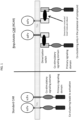
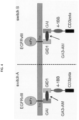
- Embodiments of the invention are based, in part, on the discovery that a CAR molecule can be partitioned such that a "binding domain” and a “signaling domain” are each linked to two separate “switch domains.” In such embodiments, activation of signaling through the CAR only occurs when the switch domains, and hence the binding domain and the signaling domain, are brought together by a dimerization molecule, i.e. to switch "on” signaling through the CAR.
- Embodiments of the invention include, inter alia, the use of a dimerization switch that turns "on" the activation of a signal to allow external, e.g., temporal, control over the immune effector response mediated by a cell containing a RCAR.
- the RCAR includes a dimerization switch that, upon the presence of a dimerization molecule, can couple an intracellular signaling domain to an extracellular recognition element, e.g., an antigen binding domain, an inhibitory counter ligand binding domain, or costimulatory ECD domain.
- the invention features, a regulatable chimeric antigen receptor (RCAR), e.g., an isolated RCAR, wherein the RCAR comprises:
- the transmembrane domain can be disposed on the intracellular signaling member or the antigen binding member. In an embodiment, a transmembrane domain can be disposed on the intracellular signaling member and a transmembrane domain or membrane anchor (membrane anchor and membrane anchoring domain are used interchangeably herein) can be disposed on the antigen binding member.
- the first and second switch domains can form an intracellular or an extracellular dimerization switch.
- the dimerization switch can be a homodimerization switch or a heterodimerization switch.
- an RCAR can include a member, e.g., an intracellular signaling member, that comprises one or more intracellular signaling domains, as, e.g., is described above.
- an antigen binding member can comprise an intracellular signaling domain, e.g., a costimulatory signaling domain.
- the intracellular signaling domain is a primary intracellular signaling domain, selected, e.g., from the list in Table 1.
- the primary intracellular signaling domain comprises a CD3zeta domain.
- the intracellular signaling domain is a costimulatory signaling domain, e.g., selected from the list in Table 2.
- the costimulatory signaling domain comprises a 4-1BB domain.
- the RCAR comprises a second intracellular signaling domain.
- the second intracellular signaling domain is a primary intracellular signaling domain, e.g., selected from the list in Table 1.
- the second intracellular signaling domain is a costimulatory signaling domain, e.g., selected from the list in Table 2.
- the first and second intracellular signaling domains comprise :
- the RCAR comprises a third intracellular signaling domain.
- the third intracellular signaling domain is a primary intracellular signaling domain, e.g., selected from the list in Table 1.
- the third intracellular signaling domain is a costimulatory signaling domain, e.g., selected from the list in Table 2.
- one of the first, second and third intracellular signaling domain is a primary intracellular signaling domain, e.g., selected from the list in Table 1, and the other two are costimulatory signaling domains, e.g., selected from, Table 2.
- two of the first, second and third intracellular signaling domains are primary intracellular signaling domains, e.g., selected from the list in Table 1, and the other is a costimulatory signaling domain, e.g., selected from, Table 2.
- each of the first, second and third intracellular signaling domains is a primary intracellular signaling domain, e.g., selected from the list in Table 1,
- each of the first, second and third intracellular signaling domains is a costimulatory signaling domain, e.g., selected from the list in Table 2.
- the first, second, and third intracellular signaling domains comprise: a CD28 domain; a 4-1BB domain, and a CD3zeta domain.
- the RCAR comprises a fourth intracellular signaling domain.
- the fourth intracellular signaling domain is a primary intracellular signaling domain, e.g., selected from the list in Table 1.
- the fourth intracellular signaling domain is a costimulatory signaling domain, e.g., selected from the list in Table 2.
- one of the first, second third and fourth intracellular signaling domain is a primary intracellular signaling domain, e.g., selected from the list in Table 1 and the other three are costimulatory signaling domains, e.g., selected from the list in Table 2.
- two of the first, second, third, and fourth intracellular signaling domains are primary intracellular signaling domains, e.g., selected from the list in Table 1, and the other two are costimulatory signaling domain, e.g., selected from the list in Table 2.
- three of the first, second, third, and fourth intracellular signaling domains a
- re primary intracellular signaling domains e.g., selected from the list in Table 1
- the other is a costimulatory signaling domain, e.g., selected from the list in Table 2.
- each of the first, second, third, and fourth intracellular signaling domains is a primary intracellular signaling domain, e.g., selected from the list in Table 1.
- each of the first, second, third, and fourth intracellular signaling domains is a costimulatory signaling domain, e.g., selected from the list in Table 2.
- the order of switch domain and the intracellular signaling domain (isd) or domains is as follows, beginning with the amino terminus:
- the order of switch domain and the intracellular signaling domain (isd) or domains is as follows, beginning with the carboxy terminus:
- the invention features, a RCAR, e.g., an isolated RCAR, wherein the RCAR comprises:
- the antigen binding member optionally comprises one or more co-stimulatory signaling domains described herein.
- the intracellular signaling domain further comprises one or more co-stimulatory signaling domains described herein.
- the first and second switch domains can form an intracellular or an extracellular dimerization switch.
- the dimerization switch can be a homodimerization switch or a heterodimerization switch.
- the first and/or second transmembrane domain comprises the transmembrane region(s) of e.g., the alpha, beta or zeta chain of the T-cell receptor, CD28, CD3 epsilon, CD45, CD4, CD5, CD8 (e.g., CD8 alpha, CD8 beta), CD9, CD16, CD22, CD33, CD37, CD64, CD80, CD86, CD134, CD137, CD154, KIRDS2, OX40, CD2, CD27, LFA-1 (CD11a, CD18), ICOS (CD278), 4-1BB (CD137), GITR, CD40, BAFFR, HVEM (LIGHTR), SLAMF7, NKp80 (KLRF1), CD160, CD19, IL2R beta, IL2R gamma, IL7R ⁇ , ITGA1, VLA1, CD49a, ITGA4, IA4, CD49D, ITGA6, VLA-6, CD49f, ITG
- the first transmembrane domain disposed on the antigen binding member and the second transmembrane domain disposed on the intracellular signaling member can be the same transmembrane domain, e.g., have the same sequence, or can be different transmembrane domains, e.g., have different sequences.
- the RCAR can include any of a variety of dimerization switches, e.g., a dimerization switch described in the section following immediately hereafter, sometimes referred to herein as the Dimerization Switch Module.
- the switch domains are components of a heterodimerization switch.
- the switch domains are components of a homodimerization switch.
- the dimerization switch is intracellular.
- the dimerization switch is extracellular.
- the transmembrane domain disposed on the antigen binding member and the dimerization switch e.g., a heterodimerization switch or homodimerization switch, is intracellular.
- transmembrane domain disposed on the intracellular signaling member and the dimerization switch e.g., heterodimerization or homodimerization switch, is extracellular.
- the dimerization switch comprises a FKBP-FRB based switch.
- the dimerization switch comprises: a switch domain comprising a rapamycin analog binding sequence having at least 80, 85, 90, 95, 98, or 99 % identity with FKBP, and a switch domain comprising a rapamycin analog binding sequence binding sequence having at least 80, 85, 90, 95, 98, or 99% identity with FRB.
- the dimerization switch comprises an FKBP-based switch domain and an FRB-based switch domain described herein.
- the dimerization switch comprises: a switch domain comprising a rapamycin analog binding sequence that differs by no more than 10, 9, 8, 7, 6, 5, 4, 3, 2, or 1 amino acid residues from the corresponding sequence of FKBP, and a switch domain comprising a rapamycin analog binding sequence that differs by no more than 10, 9, 8, 7, 6, 5, 4, 3, 2, or 1 amino acid residues from the corresponding sequence of FRB.
- the dimerization switch comprises an FRB binding fragment or analog of FKBP and an FKBP binding fragment or analog of FRB
- the FKBP binding fragment or analog of FRB comprises one or more mutations which enhances the formation of a complex between an FKBP switch domain, an FRB switch domain, and the dimerization molecule, or a mutation described in the section herein entitled MODIFIED FKBP/FRB-BASED DIMERIZATION SWITCHES.
- the FKBP binding fragment or analog of FRB comprises: an E2032 mutation, e.g., an E2032I mutation or E2032L mutation; a T2098 mutation, e.g., a T2098L mutation; or an E2032 and a T2098 mutation, e.g., an E2032I and a T2098L or an E2032L and a T2098L mutation.
- the dimerization molecule is an mTOR inhibitor, e.g., an allosteric mTOR inhibitor, e.g., rapamycin or a rapalog, e.g., RAD001.
- an mTOR inhibitor e.g., an allosteric mTOR inhibitor, e.g., rapamycin or a rapalog, e.g., RAD001.
- any of the dosing regimes or formulations of an allosteric mTOR inhibitor, e.g., RAD001, described in the section here for a low, immune enhancing, dose of an allosteric mTOR inhibitor, e.g., RAD001, can be administered to dimerize an FKBP-FRB based switch.
- the switch is an FKBP-FRB based switch and the dimerization molecule is RAD001.
- the dimerization switch comprises: a switch domain comprising a rapamycin, or rapamycin analog, binding sequence from FKBP, and a switch domain comprising a rapamycin, or rapamycin analog, binding sequence from FRB, e.g., a sequence comprising a lysine at residue 2098.
- the dimerization switch comprises: a switch domain comprising a rapamycin analog binding sequence from FKBP, and a switch domain comprising a rapamycin analog binding sequence from FRB, e.g., a sequence comprising a lysine at residue 2098.
- the dimerization switch comprises: a switch domain comprising an AP21967 binding sequence from FKBP, and a switch domain comprising an AP21967 binding sequence from FRB, e.g., a sequence comprising a lysine at residue 2098.
- the first switch domain comprises an AP21967 binding sequence from FRB, e.g., a sequence comprising a lysine at residue 2098; and, the second switch domain comprises an AP21967 binding sequence from FKBP.
- the dimerization molecule is a rapamycin analogue, e.g., AP21967.
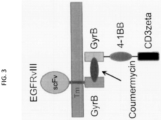
- the dimerization switch comprises a GyrB-GyrB based switch.
- the dimerization switch comprises: a switch domain comprising a coumermycin binding sequence having at least 80, 85, 90, 95, 98, or 99 % identity with the 24 K Da amino terminal sub-domain of GyrB.
- the dimerization switch comprises: a switch domain comprising a coumermycin binding sequence that differs by no more than 10, 9, 8, 7, 6, 5, 4, 3, 2, or 1 amino acid residues from the corresponding sequence of 24 K Da amino terminal sub-domain of GyrB.
- the dimerization switch comprises: a switch domain comprising a coumermycin binding sequence from the 24 K Da amino terminal sub-domain of GyrB.
- the dimerization switch comprises: the 24 K Da amino terminal sub-domain of GyrB.
- the dimerization molecule is a coumermycin.
- the dimerization switch comprises a GAI-GID1 based switch.
- the dimerization switch comprises: a GID1 switch domain comprising a gibberellin, or gibberellin analog, e.g., GA 3 , binding sequence having at least 80, 85, 90, 95, 98, or 99 % identity with GID1, and a switch domain comprising a GAI switch domain having at least 80, 85, 90, 95, 98, or 99 % identity with GAI.
- GID1 switch domain comprising a gibberellin, or gibberellin analog, e.g., GA 3 , binding sequence having at least 80, 85, 90, 95, 98, or 99 % identity with GID1
- a switch domain comprising a GAI switch domain having at least 80, 85, 90, 95, 98, or 99 % identity with GAI.
- the dimerization switch comprises: a GID1 switch domain comprising a gibberellin, or gibberellin analog, e.g., GA 3 , binding sequence that differs by no more than 10, 9, 8, 7, 6, 5, 4, 3, 2, or 1 amino acid residues from the corresponding sequence of a GID1 described herein, and a GAI switch domain that differs by no more than 10, 9, 8, 7, 6, 5, 4, 3, 2, or 1 amino acid residues from the corresponding sequence of a GAI described herein.
- a GID1 switch domain comprising a gibberellin, or gibberellin analog, e.g., GA 3 , binding sequence that differs by no more than 10, 9, 8, 7, 6, 5, 4, 3, 2, or 1 amino acid residues from the corresponding sequence of a GAI described herein.
- the dimerization molecule is GA 3 -AM.
- the dimerization molecule is GA 3 .
- the dimerization molecule is a small molecule, e.g., is other than a polypeptide.
- the dimerization molecule is a polypeptide, e.g., a polypeptide, e.g., an antibody molecule, or a non-antibody scaffold, e.g., a fribronectin or adnectin, having specific affinity for one or both of the first and second switch domains.
- the dimerization molecule e.g. a polypeptide
- the dimerization molecule is an antibody molecule.
- the dimerization switch comprises a Halo-tag/SNAP-tag based switch.
- the dimerization switch comprises: a Halo-tag switch domain comprising having at least 80, 85, 90, 95, 98, or 99 % identity with SEQ ID NO: 14, and a SNAP-tag switch domain having at least 80, 85, 90, 95, 98, or 99 % identity with SEQ ID NO: 15.
- the dimerization switch comprises: a Halo-tag switch domain comprising that differs by no more than 10, 9, 8, 7, 6, 5, 4, 3, 2, or 1 amino acid residues from SEQ ID NO: 14, and a SNAP-tag switch domain that differs by no more than 10, 9, 8, 7, 6, 5, 4, 3, 2, or 1 amino acid residues from SEQ ID: 15.
- the dimerization molecule comprises structure 5.
- the dimerization molecule comprises three or more domains, e.g., protein tags that bind a switch domain, e.g., a polypeptide, e.g., an antibody molecule or non-antibody scaffold, having affinity for the domain.
- a switch domain e.g., a polypeptide, e.g., an antibody molecule or non-antibody scaffold, having affinity for the domain.
- the dimerization molecule is a non-covalent dimerization molecule.
- the dimerization molecule is covalent dimerization molecule.
- the dimerization switch e.g., a homodimerization switch, e.g., an extracellular homodimerization switch
- the dimerization switch comprises switch domains that comprise tag molecules, e.g., a c-myc peptide tag, flag peptide tag, HA peptide tag or V5 peptide tag
- the dimerization switch comprises polypeptides with affinity for the switch domains, e.g., antibody molecules and non-antibody scaffold.
- the RCAR further comprises a second order dimerization switch.
- the dimerization molecule has a valency of greater than two, e.g., it is multi-valent, and binds, and thus clusters or dimerizes, more than two switch domains.
- Embodiments of the dimerization switches described herein may feature multiple switch domains, sometimes referred to herein as a multi switch.
- a multi switch comprises plurality of, e.g., 2, 3, 4, 5, 6, 7, 8, 9, or 10, switch domains, independently, on a first member, e.g., an antigen binding member, and a second member, e.g., an intracellular signaling member, as described in the section herein entitled MULTIPLE SWITCH DOMAINS.
- the first member e.g., an antigen binding member
- the second member e.g., an intracellular signaling member
- the first member comprises a first and a second switch domain, e.g., a FKBP-based switch domain and a FRB-based switch domain
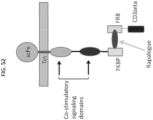
- the second member comprises a first and a second switch domain, e.g., a FKBP-based switch domain and a FRB-based switch domain. See, e.g., Fig. 55B .
- the first member and the second member comprises a plurality of homodimerization switch domains, e.g., GyrB-based switch domains.
- an RCAR can include a member, e.g., an antigen binding member, comprising an intracellular signaling domain, e.g., a costimulatory signaling domain. While not wishing to be bound by theory, it is believed that the presence of such a domain promotes persistence of the member in a cell without significant activation in the absence of dimerization switch mediated association of members of the RCAR. Embodiments of such members are described in the section following immediately hereafter, sometimes referred to herein as the Persistence Module.
- the RCAR comprises:
- the antigen binding member comprises: a plurality, e.g., 2 or 3 costimulatory signaling domains, chosen e.g., from Table 2, and in embodiments, no primary intracellular signaling domain.
- the antigen binding member comprises: a plurality, e.g., 2 or 3, costimulatory signaling domains selected from 41BB, CD28, CD27, ICOS, and OX40.
- the two or more costimulatory domains can be the same costimulatory signaling domain or different costimulatory signaling domains.
- the antigen binding member comprises the following costimulatory signaling domains, from the extracellular to intracellular direction:
- the antigen binding member comprises the following costimulatory signaling domains: CD28-41BB.
- the antigen binding member comprises the following costimulatory signaling domains: CD28-OX40.
- the antigen binding member comprises: a plurality, e.g., 2 or 3 costimulatory signaling domains, chosen e.g., from Table 2, e.g., a combination of costimulatory signaling domains describd herein, and the intracellular binding domain comprises a CD3zeta domain.
- an antigen binding member having two or more costimulatory signaling domains does not comprise a primary intracellular signaling domain.
- the first and second switch domains comprise a FKBP-FRB based switch, which comprises a switch domain comprising a FRB binding fragment or analog of FKBP and a switch domain comprising an FKBP binding fragment or analog of FRB, and the FKBP binding fragment or analog of FRB comprises one or more mutations which enhances the formation of a complex between an FKBP switch domain, an FRB switch domain, and the dimerization molecule, or a mutation described in the section herein entitled MODIFIED FKBP/FRB-BASED DIMERIZATION SWITCHES.
- the FKBP binding fragment or analog of FRB comprises: an E2032 mutation, e.g., an E2032I mutation or E2032L mutation; a T2098 mutation, e.g., a T2098L mutation; or an E2032 and a T2098 mutation, e.g., an E2032I and a T2098L or an E2032L and a T2098L mutation.
- the RCAR comprises a multi switch comprising a plurality of, e.g., 2, 3, 4, 5, 6, 7, 8, 9, or 10, switch domains, independently, on a first member, e.g., an antigen binding member, and a the second member, e.g., an intracellular signaling member, as described in the section herein entitled MULTIPLE SWITCH DOMAINS .
- the first member comprises a plurality of first switch domains, e.g., FKBP-based switch domains
- the second member comprises a plurality of second switch domains, e.g., FRB-based switch domains.
- the first member comprises a first and a second switch domain, e.g., a FKBP-based switch domain and a FRB-based switch domain
- the second member comprises a first and a second switch domain, e.g., a FKBP-based switch domain and a FRB-based switch domain.
- the antigen binding member comprises a plurality of antigen binding domains.
- the antigen binding member comprises a plurality of, e.g., 2, 3, 4, or 5, antigen binding domains, e.g., scFvs, wherein each antigen binding domain binds to a target antigen.
- two or more of the antigen binding domains can bind to different antigens.
- two or more of the antigen binding domains can bind to the same antigen, e.g., the same or different epitopes on the same antigen.
- a linker or hinge region is optionally disposed between two or each of the antigen binding domains.
- the RCAR comprises
- the order of elements on the antigen binding member is as follows, beginning with the amino terminus:
- the order of elements on the intracellular signaling member is as follows, with beginning with the amino terminus:
- the order of elements on the antigen binding member is as follows, with beginning with the carboxy terminus:
- the order of elements on the intracellular signaling member is as follows, beginning with the carboxy terminus:
- the first and second switch domains form a FKBP-FRB based switch.
- the one of the first and second dimerization switches comprises: a switch domain comprising a rapamycin or rapamycin analog binding sequence having at least 80, 85, 90, 95, 98, or 99 % identity with FKBP, and the other comprises a switch domain comprising a rapamycin or rapamycin analog binding sequence binding sequence having at least 80, 85, 90, 95, 98, or 99 % identity with FRB.
- the dimerization molecule is an mTOR inhibitor, e.g., an allosteric mTOR inhibitor, e.g., rapamycin or a rapalog, e.g., RAD001.
- an mTOR inhibitor e.g., an allosteric mTOR inhibitor, e.g., rapamycin or a rapalog, e.g., RAD001.
- any of the dosing regimes or formulations of an allosteric mTOR inhibitor, e.g., RAD001, described in the section here for a low, immune enhancing, dose of an allosteric mTOR inhibitor, e.g., RAD001, can be administered to dimerize an FKBP-FRB based switch.
- the switch is an FKBP-FRB based switch and the dimerization molecule is RAD001.
- the dimerization switch comprises a GyrB-GyrB based switch, e.g., an GyrB-GyrB based switch described herein, e.g., an GyrB-GyrB based switch as described herein, e.g., in the Dimerization Switch Module.
- the dimerization switch comprises a GAI-GID1 based switch, e.g., an GAI-GID1 based switch described herein, e.g., an GAI-GID1 based switch as described herein, e.g., in the Dimerization Switch Module.
- the dimerization switch comprises a Halotag/SNAP-tag based switch, e.g., a Halotag/SNAP-tag based switch described herein, e.g., a Halotag/SNAP-tag based switch as described herein, e.g., in the Dimerization Switch Module.
- the RCAR comprises:
- an RCAR comprises an auxiliary antigen binding member. Embodiments of such are described in the section below, sometimes referred to herein as the Auxilliary Binding Domain Module.
- the RCAR further comprises c) an auxiliary antigen binding member comprising:
- the auxiliary antigen binding domain does not comprise a switch domain that can form a dimerization switch with a switch domain on the antigen binding member or the intracellular signaling member.
- the auxiliary antigen binding member does not comprise an intracellular signaling domain.
- said second antigen is a cancer cell surface antigen.
- the RCAR further comprises d) a second auxiliary antigen binding member comprising
- said third antigen is different from the antigen recognized by the antigen binding domain of the antigen binding member and different from the antigen recognized by the antigen binding domain of the auxiliary antigen binding member.
- the RCAR further comprises:
- the RCAR further comprises comprises an unswitched auxiliary antigen binding member comprising:
- the unswitched auxiliary antigen binding member further comprises a costimulatory signaling domain.
- the intracellular signaling member unswitched auxiliary antigen binding member comprises a primary intracellular signaling domain and a costimulatory signaling domain.
- the unswitched auxiliary antigen binding member comprises a 4-1BB domain.
- the unswitched auxiliary antigen binding member comprises a CD3zeta domain.
- unswitched auxiliary antigen binding member comprises a CD3zeta domain and a 4-1BB domain.
- the RCAR is associated with, e.g., is provided in the same cell with: an inhibitor of an inhibitory molecule, e.g., an inhibitor of an inhibitory molecule of Table 3.
- the RCAR is associated with, e.g., is provided in the same cell with, an shRNA that targets a inhibitory molecule, e.g. a coinhibitory molecule from Table 3.
- a inhibitory molecule e.g. a coinhibitory molecule from Table 3.
- the shRNA targets PD1.
- the antigen binding domain binds to a target antigen on a cancer cell but does not activate the RCARX cell, e.g., a RCART cell, until a dimerization molecule is administered.
- the antigen binding domain binds to a target antigen on a target cell, e.g., a cancer cell, but does not promote an immune effector response, e.g., a T cell activation, until the dimerization molecule, e.g., a heterodimerization molecule or homodimerization molecule, is administered.
- a target cell e.g., a cancer cell
- an immune effector response e.g., a T cell activation
- the intracellular signaling member comprises a primary intracellular signaling domain and a costimulatory signaling domain.
- the intracellular signaling member comprises a 4-1BB domain.
- the intracellular signaling member comprises a CD3zeta domain.
- the intracellular signaling member comprises a CD3zeta domain and a 4-1BB domain.
- the RCAR further comprises an inhibitory counter ligand binding member comprising,
- the inhibitory counter ligand binding member comprises a switch domain that can form a dimerization switch with a switch domain on the intracellular signaling member.
- the inhibitory counter ligand binding member does not comprise a switch domain that can form a dimerization switch with a switch domain on the intracellular signaling member.
- the inhibitory counter ligand binding domain is selected from Table 4.
- the RCAR comprises
- the RCAR comprises:
- the transmembrane domain is disposed between the second switch domain and the antigen binding domain.
- the intracellular signaling member does not comprise a transmembrane domain.
- the RCAR comprises:
- the RCAR comprises:
- the RCAR comprises
- the second switch domain is disposed between the antigen binding domain and a membrane anchor or transmembrane domain.
- the antigen binding member does not comprise a transmembrane domain.
- the second switch domain is linked to the antigen binding domain tethered to a membrane anchor and the first switch domain is linked to the transmembrane domain.
- the dimerization molecule is selected from an antibody molecule, a dual-specific antibody, a monospecific antibody, a non-antibody scaffold, e.g., a fibronectin or adnectin, and a peptide.
- first switch domain and second switch domain are different and the heterodimerization molecule is a dual specific antibody molecule that binds to the first switch domain and the second switch domain.
- the RCAR comprises:
- the dimerization switch comprises a first and second FKBP-FRB based switch domain described herein, e.g., in the Switch Domain Module herein above.
- the FKBP-FRB based switch comprises a switch domain comprising a FRB binding fragment or analog of FKBP and a switch domain comprising an FKBP binding fragment or analog of FRB
- the FKBP binding fragment or analog of FRB comprises one or more mutations which enhances the formation of a complex between an FKBP switch domain, an FRB switch domain, and the dimerization molecule, or a mutation described in the section herein entitled MODIFIED FKBP/FRB-BASED DIMERIZATION SWITCHES.
- the FKBP binding fragment or analog of FRB comprises: an E2032 mutation, e.g., an E20321 mutation or E2032L mutation; a T2098 mutation, e.g., a T2098L mutation; or an E2032 and a T2098 mutation, e.g., an E2032I and a T2098L or an E2032L and a T2098L mutation.
- the RCAR comprises an extracelluar FKBP-FRB based switch, e.g., the RCAR comprises:
- the dimerization switch comprises a first and second FKBP-FRB based switch domain described herein, e.g., in the Switch Domain Module herein above.
- the dimerization molecule is an mTOR inhibitor, e.g., an allosteric mTOR inhibitor, e.g., rapamycin or a rapalog, e.g., RAD001.
- an mTOR inhibitor e.g., an allosteric mTOR inhibitor, e.g., rapamycin or a rapalog, e.g., RAD001.
- any of the dosing regimes or formulations of an allosteric mTOR inhibitor, e.g., RAD001, described in the section here for a low, immune enhancing, dose of an allosteric mTOR inhibitor, e.g., RAD001, can be administered to dimerize an FKBP-FRB based switch.
- the switch is an FKBP-FRB based switch and the dimerization molecule is RAD001.
- the RCAR comprises an intracelluar FKBP-FRB based switch, e.g., the RCAR comprises:
- the dimerization switch comprises a first and second FKBP-FRB based switch domain described herein, e.g., in the Switch Domain Module herein above.
- the dimerization molecule is an mTOR inhibitor, e.g., an allosteric mTOR inhibitor, e.g., rapamycin or a rapalog, e.g., RAD001.
- an mTOR inhibitor e.g., an allosteric mTOR inhibitor, e.g., rapamycin or a rapalog, e.g., RAD001.
- any of the dosing regimes or formulations of an allosteric mTOR inhibitor, e.g., RAD001, described in the section here for a low, immune enhancing, dose of an allosteric mTOR inhibitor, e.g., RAD001, can be administered to dimerize an FKBP-FRB based switch.
- the switch is an FKBP-FRB based switch and the dimerization molecule is RAD001.
- the switch domains are components of a heterodimerization switch.
- the switch domains are components of a homodimerization switch.
- the dimerization switch comprises a FKBP-FRB based switch, e.g., an FKBP-FRB based switch described herein, e.g., an FKBP-FRB based switch as described herein, e.g., in the Dimerization Switch Module.
- a FKBP-FRB based switch e.g., an FKBP-FRB based switch described herein, e.g., an FKBP-FRB based switch as described herein, e.g., in the Dimerization Switch Module.
- the dimerization switch comprises a GyrB-GyrB based switch, e.g., an GyrB-GyrB based switch described herein, e.g., an GyrB-GyrB based switch as described herein, e.g., in the Dimerization Switch Module.
- the dimerization switch comprises a GAI-GID1 based switch, e.g., an GAI-GID1 based switch described herein, e.g., an GAI-GID1 based switch as described herein, e.g., in the Dimerization Switch Module.
- the dimerization switch comprises a Halotag/SNAP-tag based switch, e.g., a Halotag/SNAP-tag based switch described herein, e.g., a Halotag/SNAP-tag based switch as described herein, e.g., in the Dimerization Switch Module.
- the RCAR comprises:
- the switch domains are components of a heterodimerization switch.
- the switch domains are components of a homodimerization switch.
- the dimerization switch comprises a FKBP-FRB based switch, e.g., an FKBP-FRB based switch described herein, e.g., an FKBP-FRB based switch as described herein, e.g., in the Dimerization Switch Module.
- a FKBP-FRB based switch e.g., an FKBP-FRB based switch described herein, e.g., an FKBP-FRB based switch as described herein, e.g., in the Dimerization Switch Module.
- the dimerization switch comprises a GyrB-GyrB based switch, e.g., an GyrB-GyrB based switch described herein, e.g., an GyrB-GyrB based switch as described herein, e.g., in the Dimerization Switch Module.
- the dimerization switch comprises a GAI-GID1 based switch, e.g., an GAI-GID1 based switch described herein, e.g., an GAI-GID1 based switch as described herein, e.g., in the Dimerization Switch Module.
- the dimerization switch comprises a Halotag/SNAP-tag based switch, e.g., a Halotag/SNAP-tag based switch described herein, e.g., a Halotag/SNAP-tag based switch as described herein, e.g., in the Dimerization Switch Module.
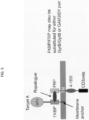
- An embodiment provides RCARs wherein the antigen binding member is not tethered to the surface of the CAR cell. This allows a cell having an intracellular signaling member to be conveniently be paired with one or more antigen binding domains, without transforming the cell with sequence that encodes the antigen binding member, as is discussed in the section herein entitled, UNIVERSAL RCARS. These are sometimes referred to herein as universal RCARs.
- the RCAR comprises:
- the first and second switch domains comprises FKBP/FRB based switch.
- the first switch domain comprises an FRB binding fragment of FKBP.
- the second switch domain comprises an FKBP binding fragment of FRB.
- the FKBP-FRB based switch comprises a switch domain comprising a FRB binding fragment or analog of FKBP and a switch domain comprising an FKBP binding fragment or analog of FRB
- the FKBP binding fragment or analog of FRB comprises one or more mutations which enhances the formation of a complex between an FKBP switch domain, an FRB switch domain, and the dimerization molecule, or a mutation described in the section herein entitled MODIFIED FKBP/FRB-BASED DIMERIZATION SWITCHES.
- the FKBP binding fragment or analog of FRB comprises: an E2032 mutation, e.g., an E20321 mutation or E2032L mutation; a T2098 mutation, e.g., a T2098L mutation; or an E2032 and a T2098 mutation, e.g., an E2032I and a T2098L or an E2032L and a T2098L mutation.
- the RCAR comprises a multi switch comprising a plurality of, e.g., 2, 3, 4, 5, 6, 7, 8, 9, or 10, switch domains, independently, on a first member, e.g., an antigen binding member, and a the second member, e.g., an intracellular signaling member, as described in the section herein entitled MULTIPLE SWITCH DOMAINS.
- the first member comprises a plurality of first switch domains, e.g., FKBP-based switch domains
- the second member comprises a plurality of second switch domains, e.g., FRB-based switch domains.
- the first member comprises a first and a second switch domain, e.g., a FKBP-based switch domain and a FRB-based switch domain
- the second member comprises a first and a second switch domain, e.g., a FKBP-based switch domain and a FRB-based switch domain.
- the intracellular signaling member comprises a primary signaling domain, e.g., form Table 1, and a costimulatory signaling domain, e.g., from Table 2.
- the intracellular signaling member comprises a primary signaling domain, e.g., form Table 1, and plurality, e.g., 2 or 3, costimulatory signaling domain, e.g., from Table 2.
- the two or more costimulatory domains can be the same costimulatory signaling domain or different costimulatory signaling domains.
- the intracellular signaling member comprises CD3zeta.
- the RCAR further comprises: c) a second antigen binding member comprising:
- the antigen binding member comprises a plurality of, e.g., 2, 3, 4, or 5, antigen binding domains, e.g., scFvs, wherein each antigen binding domain binds to a target antigen.
- two or more of the antigen binding domains can bind to different antigens.
- two or more of the antigen binding domains can bind to the same antigen, e.g., the same or different epitopes on the same antigen.
- a linker or hinge region is optionally disposed between two or each of the antigen binding domains.
- a RCAR e.g., an isolated RCAR comprising:
- the antigen binding member does not comprise a switch domain that forms a dimerization switch with an intracellular signaling member switch.
- the antigen binding member does not comprise an intracellular signaling domain.
- two copies of the first switch domain are components of a homodimerization switch.
- the RCAR further comprises:
- dimerization of the switch domains results in clustering of intracellular signaling members.
- dimerization of the switch domains results in an increase in signaling by the intracellular signaling domains.
- the dimerization switch is extracellular.
- the dimerization switch is intracellular.
- the RCAR comprises:
- the RCAR comprises:
- the RCAR comprises:
- the RCAR comprises:
- the intracellular signaling domain is a primary intracellular signaling domain, selected, e.g., from Table 1.
- the primary intracellular signaling domain comprises a CD3zeta domain.
- the intracellular signaling domain is a costimulatory signaling domain, e.g., selected from the list in Table 2.
- the costimulatory signaling domain comprises a 4-1BB domain.
- the RCAR comprises a second intracellular signaling domain.
- the second intracellular signaling domain is a primary intracellular signaling domain, e.g., selected from the list in Table 1.
- the second intracellular signaling domain is a costimulatory signaling domain, e.g., selected from the list in Table 2.
- the first and second intracellular signaling domains comprise:
- the RCAR comprises a third intracellular signaling domain.
- the third intracellular signaling domain is a primary intracellular signaling domain, e.g., selected from the list in Table 1.
- the third intracellular signaling domain is a costimulatory signaling domain, e.g., selected from the list in Table 2.
- one of the first, second and third intracellular signaling domain is a primary intracellular signaling domain, e.g., selected from the list in Table 1, and the other two are costimulatory signaling domains, e.g., selected from the list in Table 2.
- two of the first, second and third intracellular signaling domains are primary intracellular signaling domains, e.g., selected from the list in Table 1, and the other is a costimulatory signaling domain, e.g., selected from the list in Table 2.
- each of the first, second and third intracellular signaling domains is a primary intracellular signaling domain, e.g., selected from the list in Table 1.
- each of the first, second and third intracellular signaling domains is a costimulatory signaling domain, e.g., selected from the list in Table 2.
- the first, second, and third intracellular signaling domains comprise: A CD28 domain; a 4-1BB domain, and a CD3zeta domain.
- the RCAR comprises a fourth intracellular signaling domain.
- the fourth intracellular signaling domain is a primary intracellular signaling domain, e.g., selected from the list in Table 1.
- the fourth intracellular signaling domain is a costimulatory signaling domain, e.g., selected from the list in Table 2.
- one of the first, second third and fourth intracellular signaling domain is a primary intracellular signaling domain, e.g., selected from the list in Table 1 and the other three are costimulatory signaling domains, e.g., selected from the list in Table 2.
- two of the first, second, third, and fourth intracellular signaling domains are primary intracellular signaling domains, e.g., selected from the list in Table 1, and the other two are costimulatory signaling domain, e.g., selected from the list in Table 2.
- three of the first, second, third, and fourth intracellular signaling domains are primary intracellular signaling domains, e.g., selected from the list in Table 1, and the other is a costimulatory signaling domain, e.g., selected from the list in Table 2.
- each of the first, second, third, and fourth intracellular signaling domains is a primary intracellular signaling domain, e.g., selected from the list in Table 1.
- each of the first, second, third, and fourth intracellular signaling domains is a costimulatory signaling domain, e.g., selected from the list in Table 2.
- the order of switch domain and the intracellular signaling domain (isd) or domains is as follows, beginning with the amino terminus:
- the order of switch domain and the intracellular signaling domain (isd) or domains is as follows, beginning with the carboxy terminus:
- the dimerization molecule e.g., a polypeptide, e.g., an antibody molecule
- a first moiety e.g., a first variable region
- a second moiety e.g., a second variable region
- the first and second switch domains are components of a heterodimerization switch.
- the dimerization molecule is a polypeptide, e.g., an antibody molecule that binds the switch domains.
- the dimerization molecule e.g., a polypeptide, e.g., an antibody molecule, specifically binds the first and second switch domain, wherein the first and second switch domains are components of a homodimerization switch.
- the heterodimermerization molecule is selected from the group consisting of an antibody molecule, a non-antibody scaffold, e.g., a fibronectin or adnectin, molecule switch, and a peptide.
- the homodimerization molecule is a monospecific antibody molecule.
- the dimerization molecule is a dual-specific antibody molecule.
- the antigen binding domain binds to a target antigen on a cancer cell but does not promote an immune effector response of a T cell, until the dimerization molecule is administered.
- the dimerization switch comprises a FKBP-FRB based switch.
- the dimerization switch comprises: a switch domain comprising a rapamycin analog binding sequence having at least 80, 85, 90, 95, 98, or 99 % identity with FKBP, and a switch domain comprising a rapamycin analog binding sequence binding sequence having at least 80, 85, 90, 95, 98, or 99 % identity with FRB.
- the FKBP-FRB based switch comprises a switch domain comprising a FRB binding fragment or analog of FKBP and a switch domain comprising an FKBP binding fragment or analog of FRB
- the FKBP binding fragment or analog of FRB comprises one or more mutations which enhances the formation of a complex between an FKBP switch domain, an FRB switch domain, and the dimerization molecule, or a mutation described in the section herein entitled MODIFIED FKBP/FRB-BASED DIMERIZATION SWITCHES.
- the FKBP binding fragment or analog of FRB comprises: an E2032 mutation, e.g., an E2032I mutation or E2032L mutation; a T2098 mutation, e.g., a T2098L mutation; or an E2032 and a T2098 mutation, e.g., an E2032I and a T2098L or an E2032L and a T2098L mutation.
- the dimerization switch comprises: a switch domain comprising a rapamycin analog binding sequence that differs by no more than 10, 9, 8, 7, 6, 5, 4, 3, 2, or 1 amino acid residues from the corresponding sequence of FKBP, and a switch domain comprising a rapamycin analog binding sequence that differs by no more than 10, 9, 8, 7, 6, 5, 4, 3, 2, or 1 amino acid residues from the corresponding sequence of FRB.
- the dimerization molecule is an mTOR inhibitor, e.g., an allosteric mTOR inhibitor, e.g., rapamycin or a rapalog, e.g., RAD001.
- an mTOR inhibitor e.g., an allosteric mTOR inhibitor, e.g., rapamycin or a rapalog, e.g., RAD001.
- any of the dosing regimes or formulations of an allosteric mTOR inhibitor, e.g., RAD001, described in the section here for a low, immune enhancing, dose of an allosteric mTOR inhibitor, e.g., RAD001, can be administered to dimerize an FKBP-FRB based switch.
- the switch is an FKBP-FRB based switch and the dimerization molecule is RAD001.
- the dimerization switch comprises: a switch domain comprising a rapamycin, or rapamycin analog, binding sequence from FKBP, and a switch domain comprising a rapamycin, or rapamycin analog, binding sequence from FRB, e.g., a sequence comprising a lysine at residue 2098.
- the dimerization switch comprises: a switch domain comprising a rapamycin analog binding sequence from FKBP, and a switch domain comprising a rapamycin analog binding sequence from FRB, e.g., a sequence comprising a lysine at residue 2098.
- the dimerization switch comprises: a switch domain comprising a AP21967 binding sequence from FKBP, and a switch domain comprising a AP21967 binding sequence from FRB, e.g., a sequence comprising a lysine at residue 2098.
- the first switch domain comprises an AP21967 binding sequence from FRB, e.g., a sequence comprising a lysine at residue 2098; and, the second switch domain comprises an AP21967 binding sequence from FKBP.
- the dimerization molecule is a rapamycin analogue, e.g., AP21967.
- the dimerization switch comprises a GyrB-GyrB based switch.
- the dimerization switch comprises: a switch domain comprising a coumermycin binding sequence having at least 80, 85, 90, 95, 98, or 99 % identity with the 24 K Da amino terminal sub-domain of GyrB.
- the dimerization switch comprises: a switch domain comprising a coumermycin binding sequence that differs by no more than 10, 9, 8, 7, 6, 5, 4, 3, 2, or 1 amino acid residues from the corresponding sequence of 24 K Da amino terminal sub-domain of GyrB.
- the dimerization switch comprises: a switch domain comprising a coumermycin binding sequence from the 24 K Da amino terminal sub-domain of GyrB.
- the dimerization switch comprises: the 24 K Da amino terminal sub-domain of GyrB.
- the dimerization molecule is a coumermycin.
- the dimerization switch comprises a GAI-GID1 based switch.
- the dimerization switch comprises: a GID1 switch domain comprising a gibberellin, or gibberellin analog, e.g., GA 3 , binding sequence having at least 80, 85, 90, 95, 98, or 99 % identity with GID1, and a switch domain comprising a GAI switch domain having at least 80, 85, 90, 95, 98, or 99 % identity with GAI.
- GID1 switch domain comprising a gibberellin, or gibberellin analog, e.g., GA 3 , binding sequence having at least 80, 85, 90, 95, 98, or 99 % identity with GID1
- a switch domain comprising a GAI switch domain having at least 80, 85, 90, 95, 98, or 99 % identity with GAI.
- the dimerization switch comprises: a GID1 switch domain comprising a gibberellin, or gibberellin analog, e.g., GA 3 , binding sequence that differs by no more than 10, 9, 8, 7, 6, 5, 4, 3, 2, or 1 amino acid residues from the corresponding sequence of FKBP, and a GAI switch domain that differs by no more than 10, 9, 8, 7, 6, 5, 4, 3, 2, or 1 amino acid residues from the corresponding sequence of FRB.
- a GID1 switch domain comprising a gibberellin, or gibberellin analog, e.g., GA 3 , binding sequence that differs by no more than 10, 9, 8, 7, 6, 5, 4, 3, 2, or 1 amino acid residues from the corresponding sequence of FKBP
- GAI switch domain that differs by no more than 10, 9, 8, 7, 6, 5, 4, 3, 2, or 1 amino acid residues from the corresponding sequence of FRB.
- the dimerization molecule is GA 3 -AM.
- the dimerization molecule is GA 3 .
- the dimerization molecule is a small molecule, e.g., is other than a polypeptide.
- the dimerization molecule is a polypeptide, e.g., a polypeptide, e.g., an antibody molecule, or a non-antibody scaffold, e.g., a fribronectin or adnectin, having specific affinity for one or both of the first and second switch domains.
- the dimerization molecule e.g. a polypeptide
- the dimerization molecule is an antibody molecule.
- the dimerization switch comprises a Halotag/SNAP-tag based switch.
- the dimerization switch comprises: a Halotag switch domain comprising having at least 80, 85, 90, 95, 98, or 99 % identity with SEQ ID NO: 14, and a SNAP-tag switch domain having at least 80, 85, 90, 95, 98, or 99 % identity with SEQ ID NO: 15.
- the dimerization switch comprises: a Halotag switch domain comprising that differs by no more than 10, 9, 8, 7, 6, 5, 4, 3, 2, or 1 amino acid residues from SEQ ID NO: 14, and a SNAP-tag switch domain that differs by no more than 10, 9, 8, 7, 6, 5, 4, 3, 2, or 1 amino acid residues from SEQ ID NO: 15.
- the dimerization molecule comprises structure 5.
- the dimerization molecule comprises three or more domains, e.g., protein tags, that bind a switch domain, e.g., a polypeptide, e.g., an antibody molecule or non-antibody scaffold, having affinity for the domain.
- a switch domain e.g., a polypeptide, e.g., an antibody molecule or non-antibody scaffold, having affinity for the domain.
- the dimerization molecule is a non-covalent dimerization molecule.
- the dimerization molecule is covalent dimerization molecule.
- the dimerization switch e.g., a homodimerization switch, e.g., an extracellular homodimerization switch
- the dimerization switch comprises switch domains that comprise tag molecules, e.g., a c-myc peptide tag, flag peptide tag, HA peptide tag or V5 peptide tag
- the dimerization switch comprises polypeptides with affinity for the switch domains, e.g., antibody molecules and non-antibody scaffold.
- the RCAR further comprises a second order dimerization switch.
- the dimerization molecule has a valency of greater than two, e.g., it is multi-valent, and binds, and thus clusters or dimerizes, more than two switch domains.
- the RCAR comprises:
- the antigen binding member comprises
- the RCAR further comprises: an unswitched auxiliary antigen binding member comprising:
- the unswitched auxiliary antigen binding member further comprises a costimulatory signaling domain.
- the intracellular signaling member unswitched auxiliary antigen binding member comprises a primary intracellular signaling domain and a costimulatory signaling domain.
- the unswitched auxiliary antigen binding member comprises a 4-1BB domain.
- the unswitched auxiliary antigen binding member comprises a CD3zeta domain.
- the unswitched auxiliary antigen binding member comprises a CD3zeta domain and a 4-1BB domain.
- the RCAR is associated with, e.g., is provided in the same cell with an inhibitor of an inhibitory molecule, e.g., an inhibitor of a inhibitory molecule of Table 3.
- the RCAR is associated with, e.g., is provided in the same cell with, an shRNA that targets an inhibitory molecule, e.g. a coinhibitory molecule from Table 3.
- an inhibitory molecule e.g. a coinhibitory molecule from Table 3.
- the shRNA targets PD1.
- the antigen binding domain binds to a target antigen on a cancer cell but does not activate the RCARX cell, e.g., a RCART cell, until a dimerization molecule is administered.
- the antigen binding domain binds to a target antigen on a target cell, e.g., a cancer cell, but does not promote an immune effector response, e.g., a T cell activation, until the dimerization molecule, e.g., a heterodimerization molecule or homodimerization molecule, is administered.
- a target cell e.g., a cancer cell
- an immune effector response e.g., a T cell activation
- RCARs disclosed herein can include, e.g., in place of an scFv-based antigen binding domain, an extracelluar domain of an inhibitory receptor, e.g., PD1. While not wising to be bound by theory, it is believed that engagement of the inhibitory extracellular domain with its counter ligand (which normally down regulates the immune response), activates the immune response. This is discussed immediately below.
- an inhibitory receptor e.g., PD1.
- an RCAR e.g., an isolated RCAR, comprising:
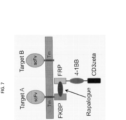
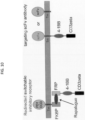
- the antigen binding member does not comprise an intracellular signaling domain and does not comprise a switch domain that forms a dimerization switch with a switch domain on the inhibitory extracellular domain member or the switch domain on the intracellular signaling member. See, e.g., Fig. 10 , far right panel.
- the antigen binding member comprises
- the inhibitory extracellular domain is selected from Table 4.
- the first switch domain is linked to the intracellular signaling domain and second switch domain is linked to the transmembrane domain.
- the inhibitory extracellular domain binds to its ligand on the target cell and redirects signal activation in the presence of a heterodimerization molecule.
- the intracellular signaling domain is a primary intracellular signaling domain, selected, e.g., from Table 1.
- the primary intracellular signaling domain comprises a CD3zeta domain.
- the intracellular signaling domain is a costimulatory signaling domain, e.g., selected from the list in Table 2.
- the costimulatory signaling domain comprises a 4-1BB domain.
- the RCAR comprises a second intracellular signaling domain.
- the second intracellular signaling domain is a primary intracellular signaling domain, e.g., selected from the list in Table 1.
- the second intracellular signaling domain is a costimulatory signaling domain, e.g., selected from the list in Table 2.
- the first and second intracellular signaling domains comprise:
- the RCAR comprises a third intracellular signaling domain.
- the third intracellular signaling domain is a primary intracellular signaling domain, e.g., selected from the list in Table 1.
- the third intracellular signaling domain is a costimulatory signaling domain, e.g., selected from the list in Table 2.
- one of the first, second and third intracellular signaling domain is a primary intracellular signaling domain, e.g., selected from the list in Table 1, and the other two are costimulatory signaling domains, e.g., selected from, Table 2.
- two of the first, second and third intracellular signaling domains are primary intracellular signaling domains, e.g., selected from the list in Table 1, and the other is a costimulatory signaling domain, e.g., selected from, Table 2.
- each of the first, second and third intracellular signaling domains is a primary intracellular signaling domain, e.g., selected from the list in Table 1.
- each of the first, second, and third intracellular signaling domains is a costimulatory signaling domain, e.g., selected from the list in Table 2.
- the first, second, and third intracellular signaling domains comprise: A CD28 domain; a 4-1BB domain, and a CD3zeta domain.
- the RCAR comprises a fourth intracellular signaling domain.
- the fourth intracellular signaling domain is a primary intracellular signaling domain, e.g., selected from the list in Table 1.
- the fourth intracellular signaling domain is a costimulatory signaling domain, e.g., selected from the list in Table 2.
- one of the first, second, third and fourth intracellular signaling domain is a primary intracellular signaling domain, e.g., selected from the list in Table 1 and the other three are costimulatory signaling domains, e.g., selected from the list in Table 2.
- two of the first, second, third, and fourth intracellular signaling domains are primary intracellular signaling domains, e.g., selected from the list in Table 1, and the other two are costimulatory signaling domains, e.g., selected from the list in Table 2.
- three of the first, second, third, and fourth intracellular signaling domains are primary intracellular signaling domains, e.g., selected from the list in Table 1, and the other is a costimulatory signaling domain, e.g., selected from the list in Table 2.
- each of the first, second, third, and fourth intracellular signaling domains is a primary intracellular signaling domain, e.g., selected from the list in Table 1.
- each of the first, second, third, and fourth intracellular signaling domains is a costimulatory signaling domain, e.g., selected from the list in Table 2.
- the order of switch domain and the intracellular signaling domain (isd) or domains is as follows, beginning with amino terminus:
- the order of switch domain and the intracellular signaling domain (isd) or domains is as follows, beginning with carboxy terminus:
- the switch domains are components of a heterodimerization switch.
- the switch domains are components of a homodimerization switch.
- the dimerization switch is intracellular.
- the dimerization switch is extracellular.
- the transmembrane domain disposed on the antigen binding member and the dimerization switch e.g., a heterodimerization switch or homodimerization switch, is intracellular.
- transmembrane domain disposed on the intracellular signaling member and the dimerization switch e.g., heterodimerization or homodimerization switch, is extracellular.
- the dimerization switch comprises a FKBP-FRB based switch.
- the dimerization switch comprises: a switch domain comprising a rapamycin analog binding sequence having at least 80, 85, 90, 95, 98, or 99 % identity with FKBP, and a switch domain comprising a rapamycin analog binding sequence binding sequence having at least 80, 85, 90, 95, 98, or 99 % identity with FRB.
- the FKBP-FRB based switch comprises a switch domain comprising a FRB binding fragment or analog of FKBP and a switch domain comprising an FKBP binding fragment or analog of FRB
- the FKBP binding fragment or analog of FRB comprises one or more mutations which enhances the formation of a complex between an FKBP switch domain, an FRB switch domain, and the dimerization molecule, or a mutation described in the section herein entitled MODIFIED FKBP/FRB-BASED DIMERIZATION SWITCHES.
- the FKBP binding fragment or analog of FRB comprises: an E2032 mutation, e.g., an E2032I mutation or E2032L mutation; a T2098 mutation, e.g., a T2098L mutation, or an E2032 and a T2098 mutation, e.g., an E2032I and a T2098L or an E2032L and a T2098L mutation.
- the dimerization switch comprises: a switch domain comprising a rapamycin analog binding sequence that differs by no more than 10, 9, 8, 7, 6, 5, 4, 3, 2, or 1 amino acid residues from the corresponding sequence of FKBP, and a switch domain comprising a rapamycin analog binding sequence that differs by no more than 10, 9, 8, 7, 6, 5, 4, 3, 2, or 1 amino acid residues from the corresponding sequence of FRB.
- the dimerization molecule is an mTOR inhibitor, e.g., an allosteric mTOR inhibitor, e.g., rapamycin or a rapalog, e.g., RAD001.
- an mTOR inhibitor e.g., an allosteric mTOR inhibitor, e.g., rapamycin or a rapalog, e.g., RAD001.
- any of the dosing regimes or formulations of an allosteric mTOR inhibitor, e.g., RAD001, described in the section here for a low, immune enhancing, dose of an allosteric mTOR inhibitor, e.g., RAD001, can be administered to dimerize an FKBP-FRB based switch.
- the switch is an FKBP-FRB based switch and the dimerization molecule is RAD001.
- the dimerization switch comprises: a switch domain comprising a rapamycin, or rapamycin analog, binding sequence from FKBP, and a switch domain comprising a rapamycin, or rapamycin analog, binding sequence from FRB, e.g., a sequence comprising a lysine at residue 2098.
- the dimerization switch comprises: a switch domain comprising a rapamycin analog binding sequence from FKBP, and a switch domain comprising a rapamycin analog binding sequence from FRB, e.g., a sequence comprising a lysine at residue 2098.
- the dimerization switch comprises: a switch domain comprising a AP21967 binding sequence from FKBP, and a switch domain comprising a AP21967 binding sequence from FRB, e.g., a sequence comprising a lysine at residue 2098.
- the first switch domain comprises an AP21967 binding sequence from FRB, e.g., a sequence comprising a lysine at residue 2098; and, the second switch domain comprises an AP21967 binding sequence from FKBP.
- the dimerization molecule is a rapamycin analogue, e.g., AP21967.
- the dimerization switch comprises a GyrB-GyrB based switch.
- the dimerization switch comprises: a switch domain comprising a coumermycin binding sequence having at least 80, 85, 90, 95, 98, or 99 % identity with the 24 K Da amino terminal sub-domain of GyrB.
- the dimerization switch comprises: a switch domain comprising a coumermycin binding sequence that differs by no more than 10, 9, 8, 7, 6, 5, 4, 3, 2, or 1 amino acid residues from the corresponding sequence of 24 K Da amino terminal sub-domain of GyrB.
- the dimerization switch comprises: a switch domain comprising a coumermycin binding sequence from the 24 K Da amino terminal sub-domain of GyrB.
- the dimerization switch comprises: the 24 K Da amino terminal sub-domain of GyrB.
- the dimerization molecule is a coumermycin.
- the dimerization switch comprises a GAI-GID1 based switch.
- the dimerization switch comprises: a GID1 switch domain comprising a gibberellin, or gibberellin analog, e.g., GA 3 , binding sequence having at least 80, 85, 90, 95, 98, or 99 % identity with GID1, and a switch domain comprising a GAI switch domain having at least 80, 85, 90, 95, 98, or 99 % identity with GAI.
- GID1 switch domain comprising a gibberellin, or gibberellin analog, e.g., GA 3 , binding sequence having at least 80, 85, 90, 95, 98, or 99 % identity with GID1
- a switch domain comprising a GAI switch domain having at least 80, 85, 90, 95, 98, or 99 % identity with GAI.
- the dimerization switch comprises: a GID1 switch domain comprising a gibberellin, or gibberellin analog, e.g., GA 3 , binding sequence that differs by no more than 10, 9, 8, 7, 6, 5, 4, 3, 2, or 1 amino acid residues from the corresponding sequence of GID1, and a GAI switch domain that differs by no more than 10, 9, 8, 7, 6, 5, 4, 3, 2, or 1 amino acid residues from the corresponding sequence of GAI.
- a GID1 switch domain comprising a gibberellin, or gibberellin analog, e.g., GA 3 , binding sequence that differs by no more than 10, 9, 8, 7, 6, 5, 4, 3, 2, or 1 amino acid residues from the corresponding sequence of GID1
- GAI switch domain that differs by no more than 10, 9, 8, 7, 6, 5, 4, 3, 2, or 1 amino acid residues from the corresponding sequence of GAI.
- the dimerization molecule is GA 3 -AM.
- the dimerization molecule is GA 3 .
- the dimerization molecule is a small molecule, e.g., is other than a polypeptide.
- the dimerization molecule is a polypeptide, e.g., a polypeptide, e.g., an antibody molecule, or a non-antibody scaffold, e.g., a fribronectin or adnectin, having specific affinity for one or both of the first and second switch domains.
- the dimerization molecule e.g. a polypeptide
- the dimerization molecule is an antibody molecule.
- the dimerization switch comprises a Halotag/SNAP-tag based switch.
- the dimerization switch comprises: a Halotag switch domain comprising having at least 80, 85, 90, 95, 98, or 99 % identity with SEQ ID NO 14, and a SNAP-tag switch domain having at least 80, 85, 90, 95, 98, or 99 % identity with SEQ ID NO 15.
- the dimerization switch comprises: a Halotag switch domain comprising that differs by no more than 10, 9, 8, 7, 6, 5, 4, 3, 2, or 1 amino acid residues from SEQ ID NO 14, and a SNAP-tag switch domain that differs by no more than 10, 9, 8, 7, 6, 5, 4, 3, 2, or 1 amino acid residues from SEQ ID NO: 15.
- the dimerization molecule comprises structure 5.
- the dimerization molecule comprises three or more domains, e.g., protein tags, that bind a switch domain, e.g., a polypeptide, e.g., an antibody molecule or non-antibody scaffold, having affinity for the domain.
- a switch domain e.g., a polypeptide, e.g., an antibody molecule or non-antibody scaffold, having affinity for the domain.
- the dimerization molecule is a non-covalent dimerization molecule.
- the dimerization molecule is covalent dimerization molecule.
- the dimerization switch e.g., a homodimerization switch, e.g., an extracellular homodimerization switch
- the dimerization switch comprises switch domains that comprise tag molecules, e.g., a c-myc peptide tag, flag peptide tag, HA peptide tag or V5 peptide tag
- the dimerization switch comprises polypeptides with affinity for the switch domains, e.g., antibody molecules and non-antibody scaffold.
- the RCAR further comprises a second order dimerization switch.
- the dimerization molecule has a valency of greater than two, e.g., it is multi-valent, and binds, and thus clusters or dimerizes, more than two switch domains.
- an RCAR can include a member, e.g., an inhibitory extracellular domain member, comprising an intracellular signaling domain, e.g., a costimulatory signaling domain. While not wishing to be bound by theory, it is believed that the presence of such a domain promotes persistence of the member in a cell without significant activation in the absence of dimerization switch mediated association of members of the RCAR. Embodiments of such members are described in the section following immediately hereafter.
- the RCAR comprises:
- the order of elements on the inhibitory extracellular domain member is as follows, with beginning with the amino terminus:
- the order of elements on the intracellular signaling member is as follows, beginning with the amino terminus:
- the order of elements on the inhibitory extracellular domain member is as follows, beginning with the carboxy terminus:
- the order of elements on the intracellular signaling member is as follows, beginning with the carboxy terminus:
- the first and second switch domains form a FKBP-FRB based switch.
- the one of the first and second dimerization switches comprises: a switch domain comprising rapamycin or a rapamycin analog binding sequence having at least 80, 85, 90, 95, 98, or 99 % identity with FKBP, and the other comprises a switch domain comprising a rapamycin or rapamycin analog binding sequence binding sequence having at least 80, 85, 90, 95, 98, or 99 % identity with FRB.
- the FKBP-FRB based switch comprises a switch domain comprising a FRB binding fragment or analog of FKBP and a switch domain comprising an FKBP binding fragment or analog of FRB
- the FKBP binding fragment or analog of FRB comprises one or more mutations which enhances the formation of a complex between an FKBP switch domain, an FRB switch domain, and the dimerization molecule, or a mutation described in the section herein entitled MODIFIED FKBP/FRB-BASED DIMERIZATION SWITCHES.
- the FKBP binding fragment or analog of FRB comprises: an E2032 mutation, e.g., an E2032I mutation or E2032L mutation; a T2098 mutation, e.g., a T2098L mutation; or an E2032 and a T2098 mutation, e.g., an E2032I and a T2098L or an E2032L and a T2098L mutation.
- the dimerization molecule is an mTOR inhibitor, e.g., an allosteric mTOR inhibitor, e.g., rapamycin or a rapalog, e.g., RAD001.
- an mTOR inhibitor e.g., an allosteric mTOR inhibitor, e.g., rapamycin or a rapalog, e.g., RAD001.
- any of the dosing regimes or formulations of an allosteric mTOR inhibitor, e.g., RAD001, described in the section here for a low, immune enhancing, dose of an allosteric mTOR inhibitor, e.g., RAD001, can be administered to dimerize an FKBP-FRB based switch.
- the switch is an FKBP-FRB based switch and the dimerization molecule is RAD001.
- the dimerization switch comprises a GyrB-GyrB based switch, e.g., an GyrB-GyrB based switch described herein, e.g., an GyrB-GyrB based switch as described herein, e.g., in the Dimerization Switch Module.
- the dimerization switch comprises a GAI-GID1 based switch, e.g., an GAI-GID1 based switch described herein, e.g., an GAI-GID1 based switch as described herein, e.g., in the Dimerization Switch Module.
- the dimerization switch comprises a Halotag/SNAP-tag based switch, e.g., a Halotag/SNAP-tag based switch described herein, e.g., a Halotag/SNAP-tag based switch as described herein, e.g., in the Dimerization Switch Module.
- the RCAR comprises:
- the RCAR is associated with, e.g., is provided in the same cell with: an inhibitor of an inhibitory molecule, e.g., an inhibitor of a inhibitory molecule of Table 3.
- the RCAR is associated with, e.g., is provided in the same cell with, an shRNA that targets a inhibitory molecule, e.g. a coinhibitory molecule from Table 3.
- a inhibitory molecule e.g. a coinhibitory molecule from Table 3.
- the RCAR comprises a shRNA that targets PD1.
- the antigen binding domain binds to a target antigen on a cancer cell but does not activate the RCARX cell, e.g., a RCART cell, until a dimerization molecule is administered.
- the antigen binding domain binds to a target antigen on a target cell, e.g., a cancer cell, but does not promote an immune effector response, e.g., a T cell activation, until the dimerization molecule, e.g., a heterodimerization molecule or homodimerization molecule, is administered.
- a target cell e.g., a cancer cell
- an immune effector response e.g., a T cell activation
- the antigen binding member comprises
- the antigen binding member does not comprise a switch domain that forms a dimerization switch with the switch on the inhibitory counter ligand binding member or the switch on the intracellular signaling member.
- inhibitory counter ligand binding domain is selected from Table 4.
- the antigen binding member comprises an intracellular signaling domain, further embodiments of which are discussed immediately below.
- the intracellular signaling domain of antigen binding member is a primary intracellular signaling domain, selected, e.g., from Table 1.
- the primary intracellular signaling domain of antigen binding member comprises a CD3zeta domain.
- the intracellular signaling domain of antigen binding member is a costimulatory signaling domain, e.g., selected from the list in Table 2.
- the costimulatory signaling domain comprises a 4-1BB domain.
- the antigen binding member comprises a second intracellular signaling domain.
- the second intracellular signaling domain of antigen binding member is a primary intracellular signaling domain, e.g., selected from the list in Table 1.
- the second intracellular signaling domain of antigen binding member is a costimulatory signaling domain, e.g., selected from the list in Table 2.
- the first and second intracellular signaling domains of antigen binding member comprise:
- the antigen binding member comprises a third intracellular signaling domain.
- the third intracellular signaling domain of antigen binding member is a primary intracellular signaling domain, e.g., selected from the list in Table 1.
- the third intracellular signaling domain of antigen binding member is a costimulatory signaling domain, e.g., selected from the list in Table 2.
- one of the first, second and third intracellular signaling domain of antigen binding member is a primary intracellular signaling domain, e.g., selected from the list in Table 1, and the other two are costimulatory signaling domains, e.g., selected from the list in Table 2.
- two of the first, second and third intracellular signaling domains of antigen binding member are primary intracellular signaling domains, e.g., selected from the list in Table 1, and the other is a costimulatory signaling domain, e.g., selected from the list in Table 2.
- each of the first, second and third intracellular signaling domains of antigen binding member is a primary intracellular signaling domain, e.g., selected from the list in Table 1.
- each of the first, second and third intracellular signaling domains of antigen binding member is a costimulatory signaling domain, e.g., selected from the list in Table 2.
- the first, second, and third intracellular signaling domains of antigen binding member comprise: a CD28 domain; a 4-1BB domain, and a CD3zeta domain.
- antigen binding member comprises a fourth intracellular signaling domain.
- the fourth intracellular signaling domain of antigen binding member is a primary intracellular signaling domain, e.g., selected from the list in Table 1.
- the fourth intracellular signaling domain of antigen binding member is a costimulatory signaling domain, e.g., selected from the list in Table 2.
- one of the first, second third and fourth intracellular signaling domain of antigen binding member is a primary intracellular signaling domain, e.g., selected from the list in Table 1 and the other three are costimulatory signaling domains, e.g., selected from the list in Table 2.
- two of the first, second, third, and fourth intracellular signaling domains of antigen binding member are primary intracellular signaling domains, e.g., selected from the list in Table 1, and the other two are costimulatory signaling domain, e.g., selected from the list in Table 2.
- three of the first, second, third, and fourth intracellular signaling domains of antigen binding members are selected from the list in Table 1, and the other is a costimulatory signaling domain, e.g., selected from the list in Table 2.
- each of the first, second, third, and fourth intracellular signaling domains of antigen binding member is a primary intracellular signaling domain, e.g., selected from the list in Table 1.
- each of the first, second, third, and fourth intracellular signaling domains of antigen binding member is a costimulatory signaling domain, e.g., selected from the list in Table 2.
- the two or more costimulatory domains can be the same costimulatory signaling domain, e.g., selected from the list in Table 2, or different costimulatory signaling domains, e.g., selected from the list in Table 2.
- the order of switch domain and the intracellular signaling domain (isd) or domains of antigen binding member is as follows, beginning with amino :
- the order of switch domain and the intracellular signaling domain (isd) or domains of antigen binding member is as follows, beginning with carboxy terminus:
- the antigen binding member comprises
- the intracellular binding member switch domain forms a heterodimerization switch with one or both of:
- the switched antigen binding member comprises an intracellular signaling domain, further embodiments of which are discussed immediately below.
- intracellular signaling domain of switched antigen binding member is a primary intracellular signaling domain, selected, e.g., from the list in Table 1.
- the primary intracellular signaling domain of switched antigen binding member comprises a CD3zeta domain.
- the intracellular signaling domain of switched antigen binding member is a costimulatory signaling domain, e.g., selected from the list in Table 2.
- the costimulatory signaling domain comprises a 4-1BB domain.
- the switched antigen binding member comprises a second intracellular signaling domain.
- the second intracellular signaling domain of switched antigen binding member is a primary intracellular signaling domain, e.g., selected from the list in Table 1.
- the second intracellular signaling domain of switched antigen binding member is a costimulatory signaling domain, e.g., selected from the list in Table 2.
- the first and second intracellular signaling domains of switched antigen binding member comprise:
- the antigen binding member comprises a third intracellular signaling domain.
- the third intracellular signaling domain of switched antigen binding member is a primary intracellular signaling domain, e.g., selected from the list in Table 1.
- the third intracellular signaling domain of switched antigen binding member is a costimulatory signaling domain, e.g., selected from the list in Table 2.
- one of the first, second and third intracellular signaling domain of switched antigen binding member is a primary intracellular signaling domain, e.g., selected from the list in Table 1, and the other two are costimulatory signaling domains, e.g., selected from the list in Table 2.
- two of the first, second and third intracellular signaling domains of switched antigen binding member are primary intracellular signaling domains, e.g., selected from the list in Table 1, and the other is a costimulatory signaling domain, e.g., selected from the list in Table 2.
- each of the first, second and third intracellular signaling domains of switched antigen binding member is a primary intracellular signaling domain, e.g., selected from the list in Table 1.
- each of the first, second and third intracellular signaling domains of switched antigen binding member is a costimulatory signaling domain, e.g., selected from the list in Table 2.
- the first, second, and third intracellular signaling domains of switched antigen binding member comprise: a CD28 domain; a 4-1BB domain, and a CD3zeta domain.
- switched antigen binding member comprises a fourth intracellular signaling domain.
- the fourth intracellular signaling domain of switched antigen binding member is a primary intracellular signaling domain, e.g., selected from the list in Table 1.
- the fourth intracellular signaling domain of switched antigen binding member is a costimulatory signaling domain, e.g., selected from the list in Table 2.
- one of the first, second third and fourth intracellular signaling domain of switched antigen binding member is a primary intracellular signaling domain, e.g., selected from the list in Table 1 and the other three are costimulatory signaling domains, e.g., selected from the list in Table 2.
- two of the first, second, third, and fourth intracellular signaling domains of switched antigen binding member are primary intracellular signaling domains, e.g., selected from the list in Table 1, and the other two are costimulatory signaling domain, e.g., selected from the list in Table 2.
- three of the first, second, third, and fourth intracellular signaling domains of switched antigen binding members are selected from the list in Table 1, and the other is a costimulatory signaling domain, e.g., selected from the list in Table 2.
- each of the first, second, third, and fourth intracellular signaling domains of switched antigen binding member is a primary intracellular signaling domain, e.g., selected from the list in Table 1.
- each of the first, second, third, and fourth intracellular signaling domains of switched antigen binding member is a costimulatory signaling domain, e.g., selected from the list in Table 2.
- the two or more costimulatory domains can be the same costimulatory signaling domain, e.g., selected from the list in Table 2, or different costimulatory signaling domains, e.g., selected from the list in Table 2.
- the order of switch domain and the intracellular signaling domain (isd) or domains of switched antigen binding member is as follows, beginning with amino terminus:
- the order of switch domain and the intracellular signaling domain (isd) or domains of switched antigen binding member is as follows, the beginning with carboxy terminus:
- the RCAR is associated with, e.g., is provided in the same cell with: an inhibitor of an inhibitory molecule, e.g., an inhibitor of a inhibitory molecule of Table 3.
- the RCAR is associated with, e.g., is provided in the same cell with an shRNA that targets a inhibitory molecule, e.g. a coinhibitory molecule from Table 3.
- a inhibitory molecule e.g. a coinhibitory molecule from Table 3.
- the RCAR further comprises a shRNA that targets PD1.
- the antigen binding domain binds to a target antigen on a cancer cell but does not activate the RCARX cell, e.g., a RCART cell, until a dimerization molecule is administered.
- the antigen binding domain binds to a target antigen on a target cell, e.g., a cancer cell, but does not promote an immune effector response, e.g., a T cell activation, until the dimerization molecule, e.g., a heterodimerization molecule or homodimerization molecule, is administered.
- a target cell e.g., a cancer cell
- an immune effector response e.g., a T cell activation
- RCARs disclosed herein can include, e.g., in place of an scFv-based antigen binding domain, an extracelluar domain of an a costimulatory ECD domain. While not wising to be bound by theory, it is believed that engagement of the ECD with its counter ligand activates the immune response via the RCAR. This is discussed immediately below.
- a RCAR e.g., an isolated, RCAR comprising:
- the intracellular binding member switch domain forms a heterodimerization switch with one or both of:
- the costimulatory ECD domain is selected from Table 5.
- the intracellular signaling domain is a primary intracellular signaling domain, selected, e.g., from Table 1.
- the primary intracellular signaling domain comprises a CD3zeta domain.
- the intracellular signaling domain is a costimulatory signaling domain, e.g., selected from the list in Table 2.
- the costimulatory signaling domain comprises a 4-1BB domain.
- the RCAR comprises a second intracellular signaling domain.
- the second intracellular signaling domain is a primary intracellular signaling domain, e.g., selected from the list in Table 1.
- the second intracellular signaling domain is a costimulatory signaling domain, e.g., selected from the list in Table 2.
- the first and second intracellular signaling domains comprise:
- the RCAR comprises a third intracellular signaling domain.
- the third intracellular signaling domain is a primary intracellular signaling domain, e.g., selected from the list in Table 1.
- the third intracellular signaling domain is a costimulatory signaling domain, e.g., selected from the list in Table 2.
- one of the first, second and third intracellular signaling domain is a primary intracellular signaling domain, e.g., selected from the list in Table 1, and the other two are costimulatory signaling domains, e.g., selected from the list in Table 2.
- two of the first, second and third intracellular signaling domains are primary intracellular signaling domains, e.g., selected from the list in Table 1, and the other is a costimulatory signaling domain, e.g., selected from the list in Table 2.
- each of the first, second and third intracellular signaling domains is a primary intracellular signaling domain, e.g., selected from the list in Table 1.
- each of the first, second, and third intracellular signaling domains is a costimulatory signaling domain, e.g., selected from the list in Table 2.
- the first, second, and third intracellular signaling domains comprise: a CD28 domain; a 4-1BB domain, and a CD3zeta domain.
- the RCAR comprises a fourth intracellular signaling domain.
- the fourth intracellular signaling domain is a primary intracellular signaling domain, e.g., selected from the list in Table 1.
- the fourth intracellular signaling domain is a costimulatory signaling domain, e.g., selected from the list in Table 2.
- one of the first, second, third and fourth intracellular signaling domain is a primary intracellular signaling domain, e.g., selected from the list in Table 1 and the other three are costimulatory signaling domains, e.g., selected from the list in Table 2.
- two of the first, second, third, and fourth intracellular signaling domains are primary intracellular signaling domains, e.g., selected from the list in Table 1, and the other two are costimulatory signaling domain, e.g., selected from the list in Table 2.
- three of the first, second, third, and fourth intracellular signaling domains are primary intracellular signaling domains, e.g., selected from the list in Table 1, and the other is a costimulatory signaling domain, e.g., selected from the list in Table 2.
- each of the first, second, third, and fourth intracellular signaling domains is a primary intracellular signaling domain, e.g., selected from the list in Table 1.
- each of the first, second, third, and fourth intracellular signaling domains is a costimulatory signaling domain, e.g., selected from the list in Table 2.
- the two or more costimulatory domains can be the same costimulatory signaling domain, e.g., selected from the list in Table 2, or different costimulatory signaling domains, e.g., selected from the list in Table 2.
- the order of switch domain and the intracellular signaling domain (isd) or domains is as follows, beginning with the amino terminus:
- the order of switch domain and the intracellular signaling domain (isd) or domains is as follows, beginning with the carboxy terminus:
- the switch domains are components of a heterodimerization switch.
- the switch domains are components of a homodimerization switch.
- the dimerization switch is intracellular.
- the dimerization switch is extracellular.
- the transmembrane domain disposed on the antigen binding member and the dimerization switch e.g., a heterodimerization switch or homodimerization switch, is intracellular.
- transmembrane domain disposed on the intracellular signaling member and the dimerization switch e.g., heterodimerization or homodimerization switch, is extracellular.
- the dimerization switch comprises a FKBP-FRB based switch.
- the dimerization switch comprises: a switch domain comprising a rapamycin analog binding sequence having at least 80, 85, 90, 95, 98, or 99 % identity with FKBP, and a switch domain comprising a rapamycin analog binding sequence binding sequence having at least 80, 85, 90, 95, 98, or 99 % identity with FRB.
- the FKBP-FRB based switch comprises a switch domain comprising a FRB binding fragment or analog of FKBP and a switch domain comprising an FKBP binding fragment or analog of FRB
- the FKBP binding fragment or analog of FRB comprises one or more mutations which enhances the formation of a complex between an FKBP switch domain, an FRB switch domain, and the dimerization molecule, or a mutation described in the section herein entitled MODIFIED FKBP/FRB-BASED DIMERIZATION SWITCHES.
- the FKBP binding fragment or analog of FRB comprises: an E2032 mutation, e.g., an E2032I mutation or E2032L mutation; a T2098 mutation, e.g., a T2098L mutation; or an E2032 and a T2098 mutation, e.g., an E2032I and a T2098L or an E2032L and a T2098L mutation.
- the dimerization switch comprises: a switch domain comprising a rapamycin analog binding sequence that differs by no more than 10, 9, 8, 7, 6, 5, 4, 3, 2, or 1 amino acid residues from the corresponding sequence of FKBP, and a switch domain comprising a rapamycin analog binding sequence that differs by no more than 10, 9, 8, 7, 6, 5, 4, 3, 2, or 1 amino acid residues from the corresponding sequence of FRB.
- the dimerization molecule is an mTOR inhibitor, e.g., an allosteric mTOR inhibitor, e.g., rapamycin or a rapalog, e.g., RAD001.
- an mTOR inhibitor e.g., an allosteric mTOR inhibitor, e.g., rapamycin or a rapalog, e.g., RAD001.
- any of the dosing regimes or formulations of an allosteric mTOR inhibitor, e.g., RAD001, described in the section here for a low, immune enhancing, dose of an allosteric mTOR inhibitor, e.g., RAD001, can be administered to dimerize an FKBP-FRB based switch.
- the switch is an FKBP-FRB based switch and the dimerization molecule is RAD001.
- the dimerization switch comprises: a switch domain comprising a rapamycin, or rapamycin analog, binding sequence from FKBP, and a switch domain comprising a rapamycin, or rapamycin analog, binding sequence from FRB, e.g., a sequence comprising a lysine at residue 2098.
- the dimerization switch comprises: a switch domain comprising a rapamycin analog binding sequence from FKBP, and a switch domain comprising a rapamycin analog binding sequence from FRB, e.g., a sequence comprising a lysine at residue 2098.
- the dimerization switch comprises: a switch domain comprising a AP21967 binding sequence from FKBP, and a switch domain comprising a AP21967 binding sequence from FRB, e.g., a sequence comprising a lysine at residue 2098.
- the first switch domain comprises an AP21967 binding sequence from FRB, e.g., a sequence comprising a lysine at residue 2098; and, the second switch domain comprises an AP21967 binding sequence from FKBP.
- the dimerization molecule is a rapamycin analogue, e.g., AP21967.
- the dimerization switch comprises a GyrB-GyrB based switch.
- the dimerization switch comprises: a switch domain comprising a coumermycin binding sequence having at least 80, 85, 90, 95, 98, or 99 % identity with the 24 K Da amino terminal sub-domain of GyrB.
- the dimerization switch comprises: a switch domain comprising a coumermycin binding sequence that differs by no more than 10, 9, 8, 7, 6, 5, 4, 3, 2, or 1 amino acid residues from the corresponding sequence of 24 K Da amino terminal sub-domain of GyrB.
- the dimerization switch comprises: a switch domain comprising a coumermycin binding sequence from the 24 K Da amino terminal sub-domain of GyrB.
- the dimerization switch comprises: the 24 K Da amino terminal sub-domain of GyrB.
- the dimerization molecule is a coumermycin.
- the dimerization switch comprises a GAI-GID1 based switch.
- the dimerization switch comprises: a GID1 switch domain comprising a gibberellin, or gibberellin analog, e.g., GA 3 , binding sequence having at least 80, 85, 90, 95, 98, or 99 % identity with GID1, and a switch domain comprising a GAI switch domain having at least 80, 85, 90, 95, 98, or 99 % identity with GAI.
- GID1 switch domain comprising a gibberellin, or gibberellin analog, e.g., GA 3 , binding sequence having at least 80, 85, 90, 95, 98, or 99 % identity with GID1
- a switch domain comprising a GAI switch domain having at least 80, 85, 90, 95, 98, or 99 % identity with GAI.
- the dimerization switch comprises: a GID1 switch domain comprising a gibberellin, or gibberellin analog, e.g., GA 3 , binding sequence that differs by no more than 10, 9, 8, 7, 6, 5, 4, 3, 2, or 1 amino acid residues from the corresponding sequence of FKBP, and a GAI switch domain that differs by no more than 10, 9, 8, 7, 6, 5, 4, 3, 2, or 1 amino acid residues from the corresponding sequence of FRB.
- a GID1 switch domain comprising a gibberellin, or gibberellin analog, e.g., GA 3 , binding sequence that differs by no more than 10, 9, 8, 7, 6, 5, 4, 3, 2, or 1 amino acid residues from the corresponding sequence of FKBP
- GAI switch domain that differs by no more than 10, 9, 8, 7, 6, 5, 4, 3, 2, or 1 amino acid residues from the corresponding sequence of FRB.
- the dimerization molecule is GA 3 -AM.
- the dimerization molecule is GA 3 .
- the dimerization molecule is a small molecule, e.g., is other than a polypeptide.
- the dimerization molecule is a polypeptide, e.g., a polypeptide, e.g., an antibody molecule, or a non-antibody scaffold, e.g., a fribronectin or adnectin, having specific affinity for one or both of the first and second switch domains.
- the dimerization molecule e.g. a polypeptide
- the dimerization molecule is an antibody molecule.
- the dimerization switch comprises a Halotag/SNAP-tag based switch.
- the dimerization switch comprises: a Halotag switch domain comprising having at least 80, 85, 90, 95, 98, or 99 % identity with SEQ ID NO: 14, and a SNAP-tag switch domain having at least 80, 85, 90, 95, 98, or 99 % identity with SEQ ID NO: 15.
- the dimerization switch comprises: a Halotag switch domain comprising that differs by no more than 10, 9, 8, 7, 6, 5, 4, 3, 2, or 1 amino acid residues from SEQ ID NO: 14, and a SNAP-tag switch domain that differs by no more than 10, 9, 8, 7, 6, 5, 4, 3, 2, or 1 amino acid residues from SEQ ID NO: 15.
- the dimerization molecule comprises structure 5.
- the dimerization molecule comprises three or more domains, e.g., protein tags that bind a switch domain, e.g., a polypeptide, e.g., an antibody molecule or non-antibody scaffold, having affinity for the domain.
- a switch domain e.g., a polypeptide, e.g., an antibody molecule or non-antibody scaffold, having affinity for the domain.
- the dimerization molecule is a non-covalent dimerization molecule.
- the dimerization molecule is covalent dimerization molecule.
- the dimerization switch e.g., a homodimerization switch, e.g., an extracellular homodimerization switch
- the dimerization switch comprises switch domains that comprise tag molecules, e.g., a c-myc peptide tag, flag peptide tag, HA peptide tag or V5 peptide tag
- the dimerization switch comprises polypeptides with affinity for the switch domains, e.g., antibody molecules and non-antibody scaffold.
- the RCAR further comprises a second order dimerization switch.
- the dimerization molecule has a valency of greater than two, e.g., it is multi-valent, and binds, and thus clusters or dimerizes, more than two switch domains.
- the antigen binding member comprises
- the RCAR comprises:
- the order of elements on the costimulatory ECD member is as follows, beginning with the amino terminus:
- the order of elements on the intracellular signaling member is as follows, beginning with the amino terminus :
- the order of elements on the a costimulatory ECD member is as follows, beginning with the carboxy terminus:
- the order of elements on the intracellular signaling member is as follows, beginning with the carboxy terminus:
- the first and second switch domains form a FKBP-FRB based switch.
- the one of the first and second dimerization switches comprises: a switch domain comprising rapamycin or a rapamycin analog binding sequence having at least 80, 85, 90, 95, 98, or 99 % identity with FKBP, and the other comprises a switch domain comprising a rapamycin or rapamycin analog binding sequence binding sequence having at least 80, 85, 90, 95, 98, or 99 % identity with FRB.
- the dimerization molecule is an mTOR inhibitor, e.g., an allosteric mTOR inhibitor, e.g., rapamycin or a rapalog, e.g., RAD001.
- an mTOR inhibitor e.g., an allosteric mTOR inhibitor, e.g., rapamycin or a rapalog, e.g., RAD001.
- any of the dosing regimes or formulations of an allosteric mTOR inhibitor, e.g., RAD001, described in the section here for a low, immune enhancing, dose of an allosteric mTOR inhibitor, e.g., RAD001, can be administered to dimerize an FKBP-FRB based switch.
- the switch is an FKBP-FRB based switch and the dimerization molecule is RAD001.
- the dimerization switch comprises a GyrB-GyrB based switch, e.g., an GyrB-GyrB based switch described herein, e.g., an GyrB-GyrB based switch as described herein, e.g., in the Dimerization Switch Module.
- the dimerization switch comprises a GAI-GID1 based switch, e.g., an GAI-GID1 based switch described herein, e.g., an GAI-GID1 based switch as described herein, e.g., in the Dimerization Switch Module.
- the dimerization switch comprises a Halotag/SNAP-tag based switch, e.g., a Halotag/SNAP-tag based switch described herein, e.g., a Halotag/SNAP-tag based switch as described herein, e.g., in the Dimerization Switch Module.
- the RCAR comprises:
- the RCAR is associated with, e.g., is provided in the same cell with: an inhibitor of an inhibitory molecule, e.g., an inhibitor of a inhibitory molecule of Table 3.
- the RCAR is associated with, e.g., is provided in the same cell withan shRNA that targets a inhibitory molecule, e.g. a coinhibitory molecule from Table 3.
- a inhibitory molecule e.g. a coinhibitory molecule from Table 3.
- the RCAR further comprises: a shRNA that targets PD1.
- the antigen binding domain binds to a target antigen on a cancer cell but does not activate the RCARX cell, e.g., a RCART cell, until a dimerization molecule is administered.
- the antigen binding domain binds to a target antigen on a target cell, e.g., a cancer cell, but does not promote an immune effector response, e.g., a T cell activation, until the dimerization molecule, e.g., a heterodimerization molecule or homodimerization molecule, is administered.
- a target cell e.g., a cancer cell
- an immune effector response e.g., a T cell activation
- the invention also provides RCARs having a configuration that allows switching of proliferation. For example, upon antigen encounter, the RCAR exhibits constitute primary signal, e.g., target cell killing, and allows regulation of a second signal, e.g., proliferation, survival, and cytokine secretion.
- primary signal e.g., target cell killing
- second signal e.g., proliferation, survival, and cytokine secretion.
- the invention features, a regulatable chimeric antigen receptor (RCAR), e.g., an isolated RCAR, wherein the RCAR comprises:
- the antigen binding member does not comprise a costimulatory signaling domain.
- the intracellular signaling member comprises a second costimulatory signaling domain, selected, e.g., from Table 2.
- the two or more costimulatory domains can be the same costimulatory signaling domain, e.g., selected from the list in Table 2, or different costimulatory signaling domains, e.g., selected from the list in Table 2.
- the intracellular signaling member comprises: a plurality, e.g., 2 or 3, co-stimulatory signaling domains selected from 41BB, CD28, CD27, ICOS, and OX40.
- the intracellular signaling member comprises the following co-stimulatory signaling domains, from the extracellular to intracellular direction:
- the intracellular signaling member comprises the following co-stimulatory signaling domains: CD28-41BB.
- intracellular signaling member comprises the following co-stimulatory signaling domains: CD28-OX40.
- the intracellular signaling member in addition to one or a plurality of co-stimulatory signaling domains, the intracellular signaling member comprises a primary intracellular signaling domain, e.g., selected from Table 1, e.g., a CD3zeta domain.
- a primary intracellular signaling domain e.g., selected from Table 1, e.g., a CD3zeta domain.
- the intracellular signaling domain comprises a CD28 co-stimulatory signaling domain, a 4-1BB co-stimulatory signaling domain, and a CD3zeta domain.
- the intracellular signaling domain comprises a CD28 co-stimulatory signaling domain, a OX40 co-stimulatory signaling domain, and a CD3zeta domain.
- the intracellular signaling member does not comprise a transmembrane domain or membrane tethering domain.
- the switch domain is intracellular.
- the intracellular signaling member comprises two costimulatory signaling domains, where the two costimulatory domains are selected from 4-1BB, OX40, CD27, CD28, and ICOS.
- the order of elements on the intracellular signaling member is as follows, from the extracellular to intracellular direction: a first co-stimulatory signaling domain/ a second costimulatory signaling domain and a switch domain disposed between any of the signaling elements, or, from the extracellular to intracellular direction, after all other signaling elements. See, e.g., Fig. 56D .
- the intracellular signaling member comprises a transmembrane domain.
- the switch domain can be intracellular or extracellular.
- the intracellular signaling member comprises two costimulatory signaling domains, where the two costimulatory domains are selected from 4-1BB, OX40, CD27, CD28, and ICOS.
- the order of elements on the intracellular signaling member is as follows, from the extracellular to intracellular direction: a switch domain/ a transmembrane domain/ a first co-stimulatory signaling domain/ a second costimulatory signaling domain. See, e.g., Fig. 56C .
- the order of elements on the intracellular signaling member is as follows, ,rom the extracellular to intracellular direction: transmembrane domain/ a first co-stimulatory signaling domain/ a second costimulatory signaling domain and a switch domain disposed intracellularly between any of the signaling elements, or, from extracellular to intracellular, after all other signaling elements. See, e.g., Fig. 56A .
- the intracellular signaling member comprises a membrane tethering domain.
- the switch domain is intracellular.
- the intracellular signaling member comprises two costimulatory signaling domains, where the two costimulatory domains are selected from 4-1BB, OX40, CD27, CD28, and ICOS.
- the order of elements on the intracellular signaling member is as follows, from the extracellular to intracellular direction: a membrane tethering domain/a first co-stimulatory signaling domain/ a second costimulatory signaling domain and a switch domain disposed extracellularly, between any of the signaling elements, or, from extracellular to intracellular, after all other signaling elements. See, e.g., Fig. 56B .
- the switch domain is: extracellular; disposed between the transmembrane domain or membrane tethering domain and a co-stimulatory signaling domain, e.g., the costimulatory signaling domain closest to the membrane; between a first and second costimulatory signaling domain; between a costimulatory signaling domain and a primary intracellular signaling domain; or, from extracellular to intracellular, after all intracellular signaling domains.
- the order of elements on the intracellular signaling member, from extracellular to intracellular is as follows: transmembrane domain or membrane tethering domain/a first co-stimulatory signaling domain/optionally a second costimulatory signaling domain/and optionally a primary intracellular signaling domain, and a switch domain disposed extracellularly, between any of the elements, or, from extracellular to intracellular, after all other elements.
- the order of elements on the antigen binding member, from extracellular to intracellular is as follows: antigen binding domain/transmembrane domain/primary intracellular signaling domain, e.g., selected from Table 1, e.g., a CD3zeta domain.
- the intracellular signaling member comprises a switch domain from a homodimerization switch.
- the intracellular signaling member comprises a first switch domain of a heterodimerization switch and the RCAR comprises a second intracellular signaling member which comprises a second switch domain of the heterodimerization switch.
- the second intracellular signaling member comprises the same intracellular signaling domains as the intracellular signaling member.
- the antigen binding member comprises a plurality of, e.g., 2, 3, 4, or 5, antigen binding domains, e.g., scFvs, wherein each antigen binding domain binds to a target antigen.
- two or more of the antigen binding domains can bind to different antigens.
- two or more of the antigen binding domains can bind to the same antigen, e.g., the same or different epitopes on the same antigen.
- a linker or hinge region is optionally disposed between two or each of the antigen binding domains.
- the dimerization switch is intracellular.
- the dimerization switch is extracellular.
- the dimerization switch comprises a FKBP-FRB based switch.
- the dimerization switch comprises: a switch domain comprising a rapamycin analog binding sequence having at least 80, 85, 90, 95, 98, or 99 % identity with FKBP, and a switch domain comprising a rapamycin analog binding sequence binding sequence having at least 80, 85, 90, 95, 98, or 99 % identity with FRB.
- the dimerization switch comprises: a switch domain comprising a rapamycin analog binding sequence that differs by no more than 10, 9, 8, 7, 6, 5, 4, 3, 2, or 1 amino acid residues from the corresponding sequence of FKBP, and a switch domain comprising a rapamycin analog binding sequence that differs by no more than 10, 9, 8, 7, 6, 5, 4, 3, 2, or 1 amino acid residues from the corresponding sequence of FRB.
- the dimerization switch comprises a FRB binding fragment or analog of FKBP and an FKBP binding fragment or analog of FRB
- the FKBP binding fragment or analog of FRB comprises one or more mutations which increase the affinity of binding with rapamycin or a rapalog, e.g., RAD001, or a mutation described in the section herein entitled MODIFIED FKBP/FRB-BASED DIMERIZATION SWITCHES.
- the FKBP binding fragment or analog of FRB comprises: an E2032 mutation, e.g., an E2032I mutation or E2032L mutation; a T2098 mutation, e.g., a T2098L mutation; or an E2032 and a T2098 mutation, e.g., an E2032I and a T2098L or an E2032L and a T2098L mutation.
- the dimerization switch is a multi switch comprising a plurality of, e.g., 2, 3, 4, 5, 6, 7, 8, 9, or 10, switch domains, independently, on the intracellular signaling member.
- the intracellular signaling member comprises a plurality of first switch domains of a heterodimerization switch, e.g., FKBP-based switch domains
- the RCAR further comprises a second intracellular signaling member comprising a plurality of second switch domains of a heterodimerization switch, e.g., FRB-based switch domains.
- the RCAR further comprises a second intracellular signaling member comprising a first and a second switch domain, e.g., a FKBP-based switch domain and a FRB-based switch domain.
- the dimerization molecule is an mTOR inhibitor, e.g., an allosteric mTOR inhibitor, e.g., rapamycin or a rapalog, e.g., RAD001.
- an mTOR inhibitor e.g., an allosteric mTOR inhibitor, e.g., rapamycin or a rapalog, e.g., RAD001.
- any of the dosing regimes or formulations of an allosteric mTOR inhibitor, e.g., RAD001, described in the section here for a low, immune enhancing, dose of an allosteric mTOR inhibitor, e.g., RAD001, can be administered to dimerize an FKBP-FRB based switch.
- the switch is an FKBP-FRB based switch and the dimerization molecule is RAD001.
- the dimerization switch comprises: a switch domain comprising a rapamycin, or rapamycin analog, binding sequence from FKBP, and a switch domain comprising a rapamycin, or rapamycin analog, binding sequence from FRB, e.g., a sequence comprising a lysine at residue 2098.
- the dimerization switch comprises: a switch domain comprising a rapamycin analog binding sequence from FKBP, and a switch domain comprising a rapamycin analog binding sequence from FRB, e.g., a sequence comprising a lysine at residue 2098.
- the dimerization switch comprises: a switch domain comprising an AP21967 binding sequence from FKBP, and a switch domain comprising an AP21967 binding sequence from FRB, e.g., a sequence comprising a lysine at residue 2098.
- the first switch domain comprises an AP21967 binding sequence from FRB, e.g., a sequence comprising a lysine at residue 2098; and, the second switch domain comprises an AP21967 binding sequence from FKBP.
- the dimerization molecule is a rapamycin analogue, e.g., AP21967.
- the dimerization switch comprises a GyrB-GyrB based switch.
- the dimerization switch comprises: a switch domain comprising a coumermycin binding sequence having at least 80, 85, 90, 95, 98, or 99 % identity with the 24 K Da amino terminal sub-domain of GyrB.
- the dimerization switch comprises: a switch domain comprising a coumermycin binding sequence that differs by no more than 10, 9, 8, 7, 6, 5, 4, 3, 2, or 1 amino acid residues from the corresponding sequence of 24 K Da amino terminal sub-domain of GyrB.
- the dimerization switch comprises: a switch domain comprising a coumermycin binding sequence from the 24 K Da amino terminal sub-domain of GyrB.
- the dimerization switch comprises: the 24 K Da amino terminal sub-domain of GyrB.
- the dimerization molecule is a coumermycin.
- the dimerization switch comprises a GAI-GID1 based switch.
- the dimerization switch comprises: a GID1 switch domain comprising a gibberellin, or gibberellin analog, e.g., GA 3 , binding sequence having at least 80, 85, 90, 95, 98, or 99 % identity with GID1, and a switch domain comprising a GAI switch domain having at least 80, 85, 90, 95, 98, or 99 % identity with GAI.
- GID1 switch domain comprising a gibberellin, or gibberellin analog, e.g., GA 3 , binding sequence having at least 80, 85, 90, 95, 98, or 99 % identity with GID1
- a switch domain comprising a GAI switch domain having at least 80, 85, 90, 95, 98, or 99 % identity with GAI.
- the dimerization switch comprises: a GID1 switch domain comprising a gibberellin, or gibberellin analog, e.g., GA 3 , binding sequence that differs by no more than 10, 9, 8, 7, 6, 5, 4, 3, 2, or 1 amino acid residues from the corresponding sequence of G1D1, and a GAI switch domain that differs by no more than 10, 9, 8, 7, 6, 5, 4, 3, 2, or 1 amino acid residues from the corresponding sequence of GAI.
- a GID1 switch domain comprising a gibberellin, or gibberellin analog, e.g., GA 3 , binding sequence that differs by no more than 10, 9, 8, 7, 6, 5, 4, 3, 2, or 1 amino acid residues from the corresponding sequence of G1D1
- GAI switch domain that differs by no more than 10, 9, 8, 7, 6, 5, 4, 3, 2, or 1 amino acid residues from the corresponding sequence of GAI.
- the dimerization molecule is GA 3 -AM.
- the dimerization molecule is GA 3 .
- the dimerization molecule is a small molecule, e.g., is other than a polypeptide.
- the dimerization molecule is a polypeptide, e.g., a polypeptide, e.g., an antibody molecule, or a non-antibody scaffold, e.g., a fribronectin or adnectin, having specific affinity for one or both of the first and second switch domains.
- the dimerization molecule e.g. a polypeptide
- the dimerization molecule is an antibody molecule.
- the dimerization switch comprises a Halotag/SNAP-tag based switch.
- the dimerization switch comprises: a Halotag switch domain comprising having at least 80, 85, 90, 95, 98, or 99 % identity with SEQ ID NO: 14, and a SNAP-tag switch domain having at least 80, 85, 90, 95, 98, or 99 % identity with SEQ ID NO: 15.
- the dimerization switch comprises: a Halotag switch domain comprising that differs by no more than 10, 9, 8, 7, 6, 5, 4, 3, 2, or 1 amino acid residues from SEQ ID NO: 14, and a SNAP-tag switch domain that differs by no more than 10, 9, 8, 7, 6, 5, 4, 3, 2, or 1 amino acid residues from SEQ ID NO: 15.
- the dimerization molecule comprises structure 5.
- the dimerization molecule comprises three or more domains, e.g., protein tags that bind a switch domain, e.g., a polypeptide, e.g., an antibody molecule or non-antibody scaffold, having affinity for the domain.
- a switch domain e.g., a polypeptide, e.g., an antibody molecule or non-antibody scaffold, having affinity for the domain.
- the dimerization molecule is a non-covalent dimerization molecule.
- the dimerization molecule is covalent dimerization molecule.
- the dimerization switch e.g., a homodimerization switch, e.g., an extracellular homodimerization switch
- the dimerization switch comprises switch domains that comprise tag molecules, e.g., a c-myc peptide tag, flag peptide tag, HA peptide tag or V5 peptide tag
- the dimerization switch comprises polypeptides with affinity for the switch domains, e.g., antibody molecules and non-antibody scaffold.
- the RCAR further comprises a second order dimerization switch.
- the dimerization molecule has a valency of greater than two, e.g., it is multi-valent, and binds, and thus clusters or dimerizes, more than two switch domains.
- the RCAR is associated with, e.g., is provided in the same cell with: an inhibitor of an inhibitory molecule, e.g., an inhibitor of an inhibitory molecule of Table 3.
- the RCAR is associated with, e.g., is provided in the same cell with, a nucleic acid inhibitor, e.g., an siRNA, an shRNA, or an antisense molecule, that targets a inhibitory molecule, e.g. a coinhibitory molecule from Table 3.
- a nucleic acid inhibitor e.g., an siRNA, an shRNA, or an antisense molecule
- a inhibitory molecule e.g. a coinhibitory molecule from Table 3.
- the shRNA targets PD1.
- dimerization increases the level of proliferation or persistence of the RCARX, e.g., RCART, cell.
- the RCAR further comprises: an inhibitory counter ligand binding member comprising,
- the invention features, a nucleic acid, e.g., an isolated nucleic acid, encoding a RCAR described herein.
- sequence encoding the antigen binding member and the intracellular signaling member are present in a single nucleic acid molecule.
- sequence encoding the antigen binding member is operatively linked to a first control region and sequence encoding the intracellular signaling member is operatively linked to a second control region.
- sequence encoding the antigen binding member is transcribed as a first RNA and sequence encoding intracellular signaling member is translated as a second RNA.
- sequence encoding the antigen binding member is present on a first nucleic acid molecule and sequence encoding intracellular signaling member is present on a second nucleic acid molecule.
- sequence encoding the antigen binding member and the intracellular signaling member are present in a single nucleic acid molecule.
- the nucleic acid further comprises a sequence encoding a shRNA targeting a coinhibitory domain.
- sequence encoding the antigen binding member, the intracellular signaling member, and a sequence encoding a shRNA targeting a coinhibitory domain are present in a single nucleic acid molecule.
- sequence encoding the antigen binding member is present on a first nucleic acid molecule and sequence encoding intracellular signaling member is present on a second nucleic acid molecule and a sequence encoding a shRNA targeting a coinhibitory domain is present on one or both of the first and second nucleic acid molecules.
- sequence encoding the antigen binding member is present on a first nucleic acid molecule
- sequence encoding intracellular signaling member is present on a second nucleic acid molecule
- a sequence encoding a shRNA targeting a coinhibitory domain is present on a third nucleic acid molecule.
- the nucleic acid encodes a RCAR as described in any of Tables 6, 7, 8, 9, 10, or 11.
- the nucleic acid comprises:
- the nucleic acid comprises:
- the nucleic acid comprises:
- the nucleic acid encodes a RCAR comprising:
- the nucleic acid encodes a RCAR comprising:
- the nucleic acid encode a RCAR comprising
- the nucleic acid encode a RCAR in which the antigen binding domain is separated from the intracellular signaling domain by a dimerization switch comprising a first and a second switch domain, wherein the first switch domain is linked to the antigen binding domain and the second switch domain is linked to the intracellular signaling domain, wherein the first and second switch domains interact together to form a complex in the presence of a dimerization molecule.
- the invention features, a vector system, e.g., a vector system comprising one or more vectors, comprising nucleic acid encoding a RCAR described herein.
- all of the elements of a RCAR are encoded on a single vector.
- an element of a RCAR is encoded on a first vector and another element of the RCAR is encoded on a second vector, of the vector system.
- the vector system comprises a DNA, a RNA, a plasmid, a lentivirus vector, adenoviral vector, or a retrovirus vector.
- the vector system comprises a bi-cistronic or tri-cistronic lentivirus vector.
- the vector system comprises a bi-cistronic or tri-cistronic promoter.
- the invention features, a cell comprising a vector system described herein.
- the cell is a human cell.
- the cell is a T cell.
- the cell is a NK cell.
- the invention features, a method of making a RCARX cell described herein comprising introducing a vector system described herein into said cell.
- the invention features, a method of treating a mammal, e.g., a method of providing an anti-tumor immunity in a mammal, comprising administering to the mammal an effective amount of a RCARX cell described herein.
- the RCARX cell is an autologous T cell.
- the RCARX cell is an allogeneic T cell.
- the RCARX cell is an autologous NK cell.
- the RCARX cell is an allogeneic NK cell.
- the mammal is a human.
- the method comprises treating a mammal, e.g., a human, having a disease associated with expression of EGFRvIII.
- the disease associated with EGFRvIII expression is a proliferative disease, cancer, a precancerous condition, or a non-cancer related indication associated with expression of EGFRvIII.
- the proliferative disease is a glioblastoma.
- the proliferative disease is chronic lymphocytic leukemia (CLL).
- CLL chronic lymphocytic leukemia
- the proliferative disease is CLL and the antigen binding domain of the RCAR targets CD19.
- the cancer is selected from glioblastoma multiforme (GBM), anaplastic astrocytoma, giant cell glioblastoma, gliosarcoma, anaplastic oligodendroglioma, anaplastic ependymoma, choroid plexus carcinoma, anaplastic ganglioglioma, pineoblastoma, medulloepithelioma, ependymoblastoma, medulloblastoma, supratentorial primitive neuroectodermal tumor, and atypical teratoid/rhabdoid tumor, non-small cell lung carcinomas, lung, breast, prostate, ovarian, colorectal and bladder carcinoma.
- GBM glioblastoma multiforme
- anaplastic astrocytoma giant cell glioblastoma
- gliosarcoma anaplastic oligodendroglioma
- the side effect comprises acute respiratory distress syndrome, febrile neutropenia, hypotension, encephalopathy, hepatic transaminitis, seizure, or macrophage activation syndrome.
- the method further comprises treating said human, e.g., a human having a side effect, with anti-cytokine agent, e.g., a tumor necrosis factor antagonist, e.g., a TNF-Ig fusion, e.g., etanercept, an IL-6 antagonist, e.g., an IL-6 receptor antagonist, e.g., an anti-IL6 receptor antibody, e.g., tocilizumab, or a corticosteroid.
- anti-cytokine agent e.g., a tumor necrosis factor antagonist, e.g., a TNF-Ig fusion, e.g., etanercept
- an IL-6 antagonist e.g., an IL-6 receptor antagonist, e.g., an anti-IL6 receptor antibody, e.g., tocilizumab, or a corticosteroid.
- the method comprises administering an anti-IL6 receptor antibody to said human.
- the dimerization molecule is an mTOR inhibitor, e.g., an allosteric mTOR inhibitor, e.g., rapamycin or a rapalog, e.g., RAD001.
- an mTOR inhibitor e.g., an allosteric mTOR inhibitor, e.g., rapamycin or a rapalog, e.g., RAD001.
- the FKBP-FRB based switch comprises a switch domain comprising a FRB binding fragment or analog of FKBP and a switch domain comprising an FKBP binding fragment or analog of FRB
- the FKBP binding fragment or analog of FRB comprises one or more mutations which enhances the formation of a complex between an FKBP switch domain, an FRB switch domain, and the dimerization molecule, or a mutation described in the section herein entitled MODIFIED FKBP/FRB-BASED DIMERIZATION SWITCHES.
- the FKBP binding fragment or analog of FRB comprises: an E2032 mutation, e.g., an E2032I mutation or E2032L mutation; a T2098 mutation, e.g., a T2098L mutation; or an E2032 and a T2098 mutation, e.g., an E2032I and a T2098L or an E2032L and a T2098L mutation.
- any of the dosing regimes or formulations of an allosteric mTOR inhibitor, e.g., RAD001, described in the section here for a low, immune enhancing, dose of an allosteric mTOR inhibitor, e.g., RAD001, can be administered to dimerize an FKBP-FRB based switch.
- the switch is an FKBP-FRB based switch and the dimerization molecule is RAD001.
- the switch is an FKBP-FRB based switch and 0.1 to 20, 0.5 to 10, 2.5 to 7.5, 3 to 6, or about 5, mgs of RAD001 per week, e.g., delivered once per week, is administered.
- the switch is an FKBP-FRB based switch and 0.3 to 60, 1.5 to 30, 7.5 to 22.5, 9 to 18, or about 15 mgs of RAD001 in a sustained release formuation, per week, e.g., delivered once per week,is administered.
- the switch is an FKBP-FRB based switch and 0.005 to 1.5, 0.01 to 1.5, 0.1 to 1.5, 0.2 to 1.5, 0.3 to 1.5, 0.4 to 1.5, 0.5 to 1.5, 0.6 to 1.5, 0.7 to 1.5, 0.8 to 1.5, 1.0 to 1.5, 0.3 to 0.6, or about 0.5 mgs of RAD001 per day, e.g., delivered once once per day, is administered.
- the switch is an FKBP-FRB based switch and 0.015 to 4.5, 0.03 to 4.5, 0.3 to 4.5, 0.6 to 4.5, 0.9 to 4.5, 1.2 to 4.5, 1.5 to 4.5, 1.8 to 4.5, 2.1 to 4.5, 2.4 to 4.5, 3.0 to 4.5, 0.9 to 1.8, or about 1.5 mgs of RAD001 in a sustained release formulation, per day, e.g., delivered once once per day, is administered.
- the switch is an FKBP-FRB based switch and 0.1 to 30, 0.2 to 30, 2 to 30, 4 to 30, 6 to 30, 8 to 30, 10 to 30, 1.2 to 30, 14 to 30, 16 to 30, 20 to 30, 6 to 12, or about 10 mgs of RAD001 in a sustained release formulation, per week, e.g., delivered once once per week, is administered.
- an allosteric mTOR inhibitor e.g., RAD001, dosing regime, or formulation, from that section can be used as a dimerization molecule with FKBP/FRB dimerization switches.
- the method comprises administering to the subject a low, immune enhancing, dose of an mTOR inhibitor, e.g., RAD001 or rapamycin, e.g., to optimize the ratio of PD1 negative T cells/PD1 positive T cells.
- an mTOR inhibitor e.g., RAD001 or rapamycin
- the dose comprises an allosteric mTOR inhibitor, a catalytic mTOR inhibitor, or both.
- the mTOR inhibitor is administered for an amount of time sufficient to decrease the proportion of PD-1 positive T cells, increase the proportion of PD-1 negative T cells, or increase the ratio of PD-1 negative T cells/ PD-1 positive T cells, in the peripheral blood of the subject, or in a preparation of T cells isolated from the subject.
- the low, immune enhancing, dose of an mTOR inhibitor is administered prior to administration of immune effector cells, e.g., T cells to be engineered to express an RCAR, (e.g., prior to or after harvest of the immune effector cells) for an amount of time sufficient for one or more of the following to occur:
- immune effector cells e.g., T cells to be engineered to express an RCAR
- the low, immune enhancing, dose of an mTOR inhibitor is administered prior to harvest of immune effector cells, e.g., T cells to be engineered to express an RCAR, for an amount of time sufficient for one or more of the following to occur, e.g., to occur in the harvested cells or in the engineered cells (or in non-harvested cells, or in both):
- immune effector cells e.g., T cells to be engineered to express an RCAR
- the immune effector cell e.g., T cell
- the immune effector cell is harvested at least 5, 10, 15, 20, 25, 30, 35, 40, 45, 50, 55, or 60 days after initiation, or completion, of dosing with the low, immune enhancing, dose of an mTOR inhibitor.
- the low, immune enhancing, dose of an mTOR inhibitor is administered after harvest of immune effector cells, e.g., T cells to be engineered to express an RCAR, for an amount of time sufficient for one or more of the following to occur:
- the low, immune enhancing, dose of an mTOR inhibitor is administered after administration of immune effector cells, e.g., T cells to be engineered to express an RCAR, for an amount of time sufficient for one or more of the following to occur:
- immune effector cells e.g., T cells to be engineered to express an RCAR
- immune effector cells e.g., T cells, which have, or will be engineered to express a RCAR
- T cells which have, or will be engineered to express a RCAR
- an mTOR inhibitor that optimizes performance. While not wishing to be bound by theory, it is believed that in an embodiment, one or more of the following occurs:
- the dose of an mTOR inhibitor is associated with mTOR inhibition of at least 5 but no more than 90%, e.g., as measured by p70 S6K inhibition.
- the dose of an mTOR inhibitor is associated with mTOR inhibition of at least 10% but no more than 40%, e.g., as measured by p70 S6K inhibition.
- administering comprises administering, e.g., once per week, e.g., in an immediate release dosage form, 0.1 to 20, 0.5 to 10, 2.5 to 7.5, 3 to 6, or about 5, mgs of RAD001, or an mTOR inhibitor other than RAD001 that is bioequivalent to a once per week, immediate release dosage form of 0.1 to 20, 0.5 to 10, 2.5 to 7.5, 3 to 6, or about 5, mgs of RAD001.
- administering comprises administering, e.g., once per week, e.g., in a sustained release dosage form, 0.3 to 60, 1.5 to 30, 7.5 to 22.5, 9 to 18, or about 15 mgs of RAD001, or an mTOR inhibitor other than RAD001 that is bioequivalent to a once per week, sustained release dosage form of 0.3 to 60, 1.5 to 30, 7.5 to 22.5, 9 to 18, or about 15 mgs of RAD001.
- administering comprises administering, e.g., once per day, e.g., in an immediate release dosage form, 0.005 to 1.5, 0.01 to 1.5, 0.1 to 1.5, 0.2 to 1.5, 0.3 to 1.5, 0.4 to 1.5, 0.5 to 1.5, 0.6 to 1.5, 0.7 to 1.5, 0.8 to 1.5, 1.0 to 1.5, 0.3 to 0.6, or about 0.5 mgs of RAD001, or an mTOR inhibitor other than RAD001 that is bioequivalent to a once per day, immediate release dosage form of 0.005 to 1.5, 0.01 to 1.5, 0.1 to 1.5, 0.2 to 1.5, 0.3 to 1.5, 0.4 to 1.5, 0.5 to 1.5, 0.6 to 1.5, 0.7 to 1.5, 0.8 to 1.5, 1.0 to 1.5, 0.3 to 0.6, or about 0.5 mgs of RAD001.
- administering comprises administering, e.g., once per day, e.g., in a sustained release dosage form, 0.015 to 4.5, 0.03 to 4.5, 0.3 to 4.5, 0.6 to 4.5, 0.9 to 4.5, 1.2 to 4.5, 1.5 to 4.5, 1.8 to 4.5, 2.1 to 4.5, 2.4 to 4.5, 3.0 to 4.5, 0.9 to 1.8, or about 1.5 mgs of RAD001, or an mTOR inhibitor other than RAD001 that is bioequivalent to a once per day, sustained release dosage form of 0.015 to 4.5, 0.03 to 4.5, 0.3 to 4.5, 0.6 to 4.5, 0.9 to 4.5, 1.2 to 4.5, 1.5 to 4.5, 1.8 to 4.5, 2.1 to 4.5, 2.4 to 4.5, 3.0 to 4.5, 0.9 to 1.8, or about 1.5 mgs of RAD001.
- the invention features, a method of evaluating a human who has been treated with a RCARX cell for a side effect of said treatment.
- said side effect comprises acute respiratory distress syndrome, febrile neutropenia, hypotension, encephalopathy, hepatic transaminitis, seizure, or macrophage activation syndrome.
- the method further compriseins treating said human, e.g., a human having a side effect, with anti-cytokine agent, e.g., a tumor necrosis factor antagonist, e.g., a TNF-Ig fusion, e.g., etanercept, an IL-6 antagonist, e.g., an IL-6 receptor antagonist, e.g., an anti-IL6 receptor antibody, e.g., tocilizumab, or a corticosteroid.
- anti-cytokine agent e.g., a tumor necrosis factor antagonist, e.g., a TNF-Ig fusion, e.g., etanercept
- an IL-6 antagonist e.g., an IL-6 receptor antagonist, e.g., an anti-IL6 receptor antibody, e.g., tocilizumab, or a corticosteroid.
- the method comprises administering an anti-IL6 receptor antibody to said human.
- the invention features, a method of providing an RCARX cell comprising: providing an immune effector cell, e.g., a T cell from a human, to a recipient entity, e.g., a laboratory or hospital; and receiving from said entity, an RCARX cell derived from said immune effector cell, or a daughter cell thereof.
- an immune effector cell e.g., a T cell from a human
- a recipient entity e.g., a laboratory or hospital
- said entity inserted a nucleic acid encoding a RCAR into said immune effector cell or a daughter cell thereof.
- the method further comprises administering said RCARX to said human.
- the invention features, a method of providing an RCARX cell comprising: receiving from an entity, e.g., a health care provider, an immune effector cell, e.g., a T cell, from a human; inserting a nucleic acid encoding an RCAR into said immune effector cell, or a daughter cell thereof, to form an RCARX cell; and, optionally, providing said RCARX cell to said entity.
- an entity e.g., a health care provider
- an immune effector cell e.g., a T cell
- the invention features, a nucleic acid described herein, a RCAR described herein, a vector system described herein, or an RCARX cell described herein for use as a medicament.
- the invention features, a nucleic acid described herein for use as a medicament.
- the invention features, a RCAR described herein for use as a medicament.
- the invention features, a vector system described herein for use as a medicament.
- the invention features, a RCARX cell described herein for use as a medicament.
- the invention features, a nucleic acid described herein, a RCAR described herein, a vector system described herein, or an RCARX cell described herein for use in the treatment of a disease characterized by the need of an enhanced immune response.
- the invention features, a nucleic acid described herein for use in the treatment of a disease characterized by the need of an enhanced immune response.
- the invention features, a nucleic acid described herein for use in the treatment of a disease characterized by unwanted expression of EGFRvIII.
- the invention features, a nucleic acid described herein for use in the treatment of a disease characterized by unwanted expression of EGFRvIII and the disease is a proliferative disease, cancer, a precancerous condition, or a non-cancer related indication associated with expression of EGFRvIII.
- the invention features, a nucleic acid described herein for use in the treatment of a disease characterized by sub-optimal anti-tumor immunity.
- the invention features, a nucleic acid described herein for use in the treatment of a disease wherein said disease is cancer.
- the invention features, a nucleic acid described herein for use in the treatment of a disease wherein said disease glioblastoma.
- the invention features, a nucleic acid described herein for use in the treatment of a disease wherein said disease is glioblastoma multiforme (GBM), anaplastic astrocytoma, giant cell glioblastoma, gliosarcoma, anaplastic oligodendroglioma, anaplastic ependymoma, choroid plexus carcinoma, anaplastic ganglioglioma, pineoblastoma, medulloepithelioma, ependymoblastoma, medulloblastoma, supratentorial primitive neuroectodermal tumor, and atypical teratoid/rhabdoid tumor, non-small cell lung carcinomas, lung, breast, prostate, ovarian, colorectal or bladder carcinoma.
- GBM glioblastoma multiforme
- anaplastic astrocytoma giant cell glioblastoma
- gliosarcoma ana
- the invention features, a RCAR described herein for use in the treatment of a disease, characterized by the need of an enhanced immune response.
- the invention features, a RCAR described herein for use in the treatment of a disease characterized by unwanted expression of EGFRvIII.
- the invention features, a RCAR described herein for use in the treatment of a disease characterized by unwanted expression of EGFRvIII wherein the disease is a proliferative disease, cancer, a precancerous condition, or a non-cancer related indication associated with expression of EGFRvIII.
- the invention features, a RCAR described herein for use in the treatment of a disease characterized by sub-optimal anti-tumor immunity.
- the invention features, a RCAR described herein for use in the treatment of cancer.
- the invention features, a RCAR described herein for use in the treatment of glioblastoma.
- the invention features, a RCAR described herein for use in the treatment of glioblastoma multiforme (GBM), anaplastic astrocytoma, giant cell glioblastoma, gliosarcoma, anaplastic oligodendroglioma, anaplastic ependymoma, choroid plexus carcinoma, anaplastic ganglioglioma, pineoblastoma, medulloepithelioma, ependymoblastoma, medulloblastoma, supratentorial primitive neuroectodermal tumor, and atypical teratoid/rhabdoid tumor, non-small cell lung carcinomas, lung, breast, prostate, ovarian, colorectal or bladder carcinoma.
- GBM glioblastoma multiforme
- anaplastic astrocytoma giant cell glioblastoma
- gliosarcoma anaplastic oligodendrogliom
- the invention features, a vector system described herein for use in the treatment of a disease, characterized by the need of an enhanced immune response.
- the invention features, a vector system described herein for use in the treatment of a disease, characterized by unwanted expression of EGFRvIII.
- the invention features, a vector system described herein for use in the treatment of a disease characterized by unwanted expression of EGFRvIII wherein the disease is a proliferative disease, cancer, a precancerous condition, or a non-cancer related indication associated with expression of EGFRvIII.
- the invention features, a vector system described herein for use in the treatment of a disease, characterized by sub-optimal anti-tumor immunity.
- the invention features, a vector system described herein for use in the treatment of cancer.
- the invention features, a vector system described herein, wherein said disease is glioblastoma.
- the invention features, a vector system described herein, wherein said disease is glioblastoma multiforme (GBM), anaplastic astrocytoma, giant cell glioblastoma, gliosarcoma, anaplastic oligodendroglioma, anaplastic ependymoma, choroid plexus carcinoma, anaplastic ganglioglioma, pineoblastoma, medulloepithelioma, ependymoblastoma, medulloblastoma, supratentorial primitive neuroectodermal tumor, and atypical teratoid/rhabdoid tumor, non-small cell lung carcinomas, lung, breast, prostate, ovarian, colorectal or bladder carcinoma.
- GBM glioblastoma multiforme
- anaplastic astrocytoma giant cell glioblastoma
- gliosarcoma anaplastic oligodendroglioma
- the invention features, a RCARX cell described herein, for use in the treatment of a disease, characterized by the need of an enhanced immune response.
- the invention features, a RCARX cell described herein, for use in the treatment of a disease characterized by unwanted expression of EGFRvIII.
- the invention features, a RCARX cell described herein, for use in the treatment of a disease characterized by unwanted expression of EGFRvIII wherein the disease is a proliferative disease, cancer, a precancerous condition, or a non-cancer related indication associated with expression of EGFRvIII.
- the invention features, a RCARX cell described herein, for use in the treatment of a disease, characterized by sub-optimal anti-tumor immunity.
- the invention features, a RCARX cell described herein, for use in the treatment of cancer.
- the invention features, a RCARX cell described herein, for use in the treatment of glioblastoma.
- the invention features, a RCARX cell described herein, for use in the treatment of glioblastoma multiforme (GBM), anaplastic astrocytoma, giant cell glioblastoma, gliosarcoma, anaplastic oligodendroglioma, anaplastic ependymoma, choroid plexus carcinoma, anaplastic ganglioglioma, pineoblastoma, medulloepithelioma, ependymoblastoma, medulloblastoma, supratentorial primitive neuroectodermal tumor, and atypical teratoid/rhabdoid tumor, non-small cell lung carcinomas, lung, breast, prostate, ovarian, colorectal or bladder carcinoma.
- GBM glioblastoma multiforme
- GBM glioblastoma multiforme
- GBM glioblastoma multiforme
- GBM glioblasto
- the invention features a regulatable chimeric antigen receptor (RCAR), e.g., an isolated RCAR, wherein the RCAR comprises:
- the antigen binding member comprises: a plurality of costimulatory domains chosen, e.g, from Table 2, and no primary intracellular signaling domain.
- the plurality of costimulatory domains are the same costimulatory domains, e.g., chosen from Table 2.
- the plurality comprises the following costimulatory signaling domains: CD28-41BB .
- the plurality comprises the following costimulatory signaling domains: CD28-OX40.
- the antigen binding domain does not comprise a transmembrane domain and the intracellular signaling domain comprises a primary signaling domain and a co-stimulatory signaling domain.
- the dimerization switch can be a homodimerization switch or a heterodimerization switch.
- the intracellular signaling domain on the intracellular signaling member is a primary intracellular signaling domain, e.g., from Table 1.
- the primary intracellular signaling domain comprises a CD3zeta domain.
- the intracellular signaling domain on the intracellular signaling member is a costimulatory signaling domain.
- the intracellular signaling domain is a costimulatory signaling domain selected from Table 2.
- the costimulatory signaling domain comprises a 4-1BB domain.
- the RCAR comprises a second intracellular signaling domain.
- the second intracellular signaling domain is a costimulatory signaling domain, e.g., selected from Table 2.
- one of the first and second switch domains comprises an FKBP-based switch domain and the other comprises an FRB-based switch domain.
- the switch domain is dimerized by RAD001.
- the switch domain comprises an FKBP binding fragment or analog of FRB comprising: an E2032 mutation, e.g., an E2032I mutation or E2032L mutation; a T2098 mutation, e.g., a T2098L mutation; or an E2032 and a T2098 mutation, e.g., an E2032I and a T2098L or an E2032L and a T2098L mutation.
- an E2032 mutation e.g., an E2032I mutation or E2032L mutation
- a T2098 mutation e.g., a T2098L mutation
- E2032 and a T2098 mutation e.g., an E2032I and a T2098L or an E2032L and a T2098L mutation.
- the RCAR comprises an inhibitor of an inhibitory molecule wherein the inhibitor comprises an inhibitory nucleic acid, e.g., a dsRNA, e.g., an siRNA or shRNA.
- an inhibitory nucleic acid e.g., a dsRNA, e.g., an siRNA or shRNA.
- the antigen binding domain binds to a target antigen on a cancer cell, e.g., a tumor antigen described herein, but does not activate the RCARX cell, e.g., a RCART cell, until a dimerization molecule is administered.
- the invention features an RCAR, e.g., an isolated RCAR, comprising:
- the inhibitory extracellular domain binds to its ligand on the target cell and redirects signal activation in the presence of a heterodimerization molecule.
- the invention features an RCAR, e.g., an isolated, RCAR comprising:
- the costimulatory ECD domains is selected from Table 5.
- the invention features an RCAR, e.g., an isolated RCAR, wherein the RCAR comprises:
- the invention features a nucleic acid, e.g., an isolated nucleic acid, encoding a RCAR, or an element of an RCAR described herein.
- the nucleic acid encodes an RCAR described herein, wherein:
- the nucleic acid further comrpises a sequence encoding an inhibitor of an inhibitory molecule from Table 3, e.g., PD1, e.g., wherein the inhibitor comprises an inhibitory nucleic acid, e.g., a dsRNA, e.g., an siRNA or shRNA.
- an inhibitory nucleic acid e.g., a dsRNA, e.g., an siRNA or shRNA.
- the invention features an isolated nucleic acid, encoding an RCAR comprising:
- the invention features a vector system, e.g., one or more vectors, comprising a nucleic acid described herein.
- the vector system comprises a DNA, a RNA, a plasmid, a lentivirus vector, adenoviral vector, or a retrovirus vector.
- the invention features a cell comprising an RCAR described herein, a nucleic acid described herein, or a vector system described herein.
- the disclosure features a method of making a cell described herein, comprising introducing a nucleic acid described herein or a vector system described herein into said cell.
- the cell is a human cell.
- the cell is a T cell.
- the cell is a NK cell.
- the invention features a method of treating a subject, e.g., a mammal, e.g., a method of providing an anti-tumor immunity in a subject, comprising administering to the subject an effective amount of a RCARX cell described herein, e.g., a cell of clauses 30 to 33, or providing a subject comprising the cell.
- a subject e.g., a mammal
- a method of providing an anti-tumor immunity in a subject comprising administering to the subject an effective amount of a RCARX cell described herein, e.g., a cell of clauses 30 to 33, or providing a subject comprising the cell.
- the RCARX cell is an autologous T cell.
- the RCARX cell is an allogeneic T cell.
- the RCARX cell is selected from: an autologous NK cell; and an allogeneic NK cell.
- the subject is a human.
- the method comprises treating the subject for cancer.
- the method further comprises administering a dimerization molecule to the subject.
- the RCAR comprises an FKBP-FRB based switch
- the method further comprises administering a dimerization molecule comprising an mTOR inhibitor, e.g., an allosteric mTOR inhibitor, e.g., rapamycin or a rapalog, e.g., RAD001.
- an mTOR inhibitor e.g., an allosteric mTOR inhibitor, e.g., rapamycin or a rapalog, e.g., RAD001.
- the method further comprises administering a low, immune enhancing, dose of an allosteric mTOR inhibitor, e.g., RAD001.
- an allosteric mTOR inhibitor e.g., RAD001.
- the invention features a method of treating a subject, e.g., a mammal, e.g., a method of providing an anti-tumor immunity in a subject, comprising:
- the cell is an autologous T cell.
- the cell is an allogeneic T cell.
- the cell is selected from: an autologous NK cell; and an allogeneic NK cell.
- the subject is a human.
- the method comprises treating the subject for cancer.
- the method further comprises administering a RAD001 dimerization molecule to the subject.
- the method further comprises administering a low, immune enhancing, dose of an allosteric mTOR inhibitor, e.g., RAD001.
- an allosteric mTOR inhibitor e.g., RAD001.
- the invention features a method of providing an RCARX cell comprising:
- the entity inserted a nucleic acid encoding the RCAR into said immune effector cell or a daughter cell thereof.
- the method further comprises administering said RCARX to said human.
- the invention features providing an RCARX cell comprising: receiving from an entity, e.g., a health care provider, an immune effector cell, e.g., a T cell, from a human; inserting a nucleic acid encoding an RCAR of any of claims 1-23 into said immune effector cell, or a daughter cell thereof, to form an RCARX cell; and, optionally, providing said RCARX cell to said entity.
- an entity e.g., a health care provider
- an immune effector cell e.g., a T cell
- the invention features a nucleic acid described herein for use as a medicament.
- the invention features a RCAR described herein for use as a medicament.
- the invention features a vector system described herein for use as a medicament.
- the invention features an RCARX cell described herein, e.g., the cell described herein, e.g., the cell comprising an RCAR described herein, a nucleic acid described herein, or a vector system described herein, for use as a medicament.
- the invention features a nucleic acid described herein for use in the treatment of a disease, wherein the disease is characterized by the need of an enhanced immune response.
- the invention features an RCAR described herein for use in the treatment of a disease, wherein the disease is characterized by the need of an enhanced immune response.
- the invention features a vector system described herein for use in the treatment of a disease, wherein the disease is characterized by the need of an enhanced immune response.
- the disease is characterized by sub-optimal anti-tumor immunity.
- the disease is cancer.
- an element means one element or more than one element.
- Allogeneic refers to any material derived from a different animal of the same species as the individual to whom the material is introduced. Two or more individuals are said to be allogeneic to one another when the genes at one or more loci are not identical. In some aspects, allogeneic material from individuals of the same species may be sufficiently unlike genetically to interact antigenically.
- An exemplary antigen binding domain comprises a polypeptide, e.g., an antibody molecule (which includes an antibody, and antigen binding fragments thereof, e.g., a immunoglobulin, single domain antibody (sdAb, e.g., a nanobody, and an scFv), or a non-antibody scaffold, e.g., a fibronectin, and the like.
- the antigen binding domain is a single polypeptide.
- the antigen binding domain comprises, one, two, or more, polypeptides.
- the antigen binding domain comprises a fragment of an antibody, that is sufficient to confer recognition and specific binding to the target antigen.
- antibody fragment refers to at least one portion of an antibody, that retains the ability to specifically interact with (e.g., by binding, steric hinderance, stabilizing/destabilizing, spatial distribution) an epitope of an antigen.
- an antibody fragment examples include, but are not limited to, an Fab, Fab', F(ab') 2 , or Fv fragment, an scFv antibody fragment, an disulfide-linked Fv (sdFv), a Fd fragment consisting of the VH and CH1 domains, a linear antibody, single domain antibody such as an sdAb, e.g., a nanobody, (either VL or VH), a camelid VHH domain, multi-specific antibodies formed from antibody fragments such as a bivalent fragment comprising two Fab fragments linked by a disulfide brudge at the hinge region, and an isolated CDR or other epitope binding fragments of an antibody.
- An antigen binding fragment can also be incorporated into single domain antibodies, maxibodies, minibodies, nanobodies, intrabodies, diabodies, triabodies, tetrabodies, v-NAR and bis-scFv (see, e.g., Hollinger and Hudson, Nature Biotechnology 23:1126-1136, 2005 ).
- Antigen binding fragments can also be grafted into scaffolds based on polypeptides such as a fibronectin type III (Fn3)(see U.S. Patent No.: 6,703,199 , which describes fibronectin polypeptide minibodies).
- Fn3 fibronectin type III
- the antigen binding domain is a "scFv," which can comprise a fusion protein comprising a VL chain and a VH chain of an antibody, where the VH and VL are linked via a short flexible polypeptide linker.
- the scFv is capable of being expressed as a single chain polypeptide and retains the specificity of the intact antibody from which it is derived.
- the VL and VH variable chains can be linked in either order, e.g., with respect to the N-terminal and C-terminal ends of the polypeptide, the scFv may comprise VL-linker-VH or may comprise VH-linker-VL.
- the antigen binding domain comprises a non antibody scaffold, e.g., a fibronectin, ankyrin, domain antibody, e.g., a nanobody, lipocalin, small modular immuno-pharmaceutical, maxybody, Protein A, or affilin.
- the non antibody scaffold has the ability to bind to target antigen on a cell.
- the antigen binding domain is a polypeptide or fragment thereof of a naturally occurring protein expressed on a cell.
- the antigen binding domain binds a growth factor or hormone receptor. While not wishing to be bound by theory, the antigen binding domain serves to provide specificity for target cells, and in embodiments, optimize and immune effector function by coupling antigen binding to generation of a signal by an intracellular signaling domain on an intracellular signaling member.
- Antigen binding member comprises an antigen binding domain, and, optionally, a transmembrane domain or a membrane anchor.
- An antigen binding member can also comprise a switch domain.
- the switch domain on the antigen binding member can form a dimerization switch with a switch domain on an intracellular signaling member. The dimerization switch formed by these two switch domains can couple antigen binding to intracellular signal generation, and thereby optimize an immune effector function of the cell.
- the antigen binding member comprises an antigen binding domain which is other than the native extracellular domain of a molecule from which an intracellular signaling domain on the intracellular signaling member is derived.
- the antigen binding member comprises an antigen binding domain which binds an antigen which is not the ligand of the native extracellular domain of a molecule from which an intracellular signaling domain on the intracellular signaling member is derived.
- Anti-cancer effect refers to a biological effect which can be manifested by various means, including but not limited to, e.g., a decrease in tumor volume, a decrease in the number of cancer cells, a decrease in the number of metastases, an increase in life expectancy, decrease in cancer cell proliferation, decrease in cancer cell survival, or amelioration of various physiological symptoms associated with the cancerous condition.
- An "anti-cancer effect” can also be manifested by the ability of the peptides, polynucleotides, cells and antibodies in prevention of the occurrence of cancer in the first place.
- anti-tumor effect refers to a biological effect which can be manifested by various means, including but not limited to, e.g., a decrease in tumor volume, a decrease in the number of cancer cells, a decrease in tumor cell proliferation, or a decrease in tumor cell survival.
- Auxiliary antigen binding member refers to a molecule comprising an antigen binding domain that binds an antigen other than the antigen bound by another antigen binding domain of the RCAR, e.g., other than the antigen binding domain of the antigen binding member. In embodiments it comprises a transmembrane domain or membrane anchoring domain.
- Cancer refers to a disease characterized by the uncontrolled growth of aberrant cells. Cancer cells can spread locally or through the bloodstream and lymphatic system to other parts of the body. Examples of various cancers include but are not limited to, breast cancer, prostate cancer, ovarian cancer, cervical cancer, skin cancer, pancreatic cancer, colorectal cancer, renal cancer, liver cancer, brain cancer, lymphoma, leukemia, lung cancer and the like.
- Costimulatory signaling domain refers to a molecule, e.g., an endogenous molecule, of the RCARX cell that, upon binding to its cognate counter ligand on a target cell, enhance, e.g., increases, an immune effector response.
- “Derived from” indicates a relationship between a first and a second molecule. It generally refers to structural similarity between the first molecule and a second molecule and does not connotate or include a process or source limitation on a first molecule that is derived from a second molecule. For example, in the case of an intracellular signaling domain that is derived from a CD3zeta molecule, the intracellular signaling domain retains sufficient CD3zeta structure such that is has the required function, namely, the ability to generate a signal under the appropriate conditions.
- dimerization molecule refers to a molecule that promotes the association of a first switch domain with a second switch domain.
- the dimerization molecule can cross the plasma membrane.
- the dimerization molecule need not cross the plasma membrane.
- the dimerization molecule does not naturally occur in the subject, or does not occur in concentrations that would result in significant dimerization.
- the dimerization molecule is a small molecule, e.g., rapamycin or a rapalogue.
- the dimerization molecule is a polypeptide.
- the dimerization molecule is an antibody molecule, e.g., antibody or antigen-binding fragment thereof.
- the first and second switch domains of a homodimerization switch or heterodimerization switch associate together in the presence of small molecule dimerization molecule e.g., rapamycin or a rapalogue.
- the first and second switch domains of a homodimerization switch or heterodimerization switch associate together in the presence of polypeptide dimerization molecule.
- the first and second switch domains of a homodimerization switch or heterodimerization switch associate together in the presence of a multimeric peptide dimerization molecule. In embodiments, the first and second switch domains of a homodimerization switch or heterodimerization switch associate together in the presence of an antibody molecule dimerization molecule. In embodiments, the antibody molecule comprises a monospecific antibody molecule. In embodiments, the antibody molecule is a dual specific antibody molecule.
- a dimerization molecule will promote the association of at least two switch molecules (and thereby the association of intracellular domains linked to the switch domains).
- the dimerization molecule has a valency of greater than two, e.g., it is multi-valent, and binds, and thus clusters or dimerizes, more than two switch domains.
- a dimerization molecule can comprise a plurality, e.g., at least 2, 3, 4, 5, 6, 7, 8, 9 or 10, binding domains, each of which can bind a switch domain.
- dsRNA refers to a nucleic acid molecule, having at least a region of duplexed structure, that is capable of mediating sequence specific inhibition of the expression of a target gene.
- dsRNAs comprise short interfering RNA (siRNA) and short hairpin RNA (shRNA).
- shRNA is similar in structure to an siRNA but includes a moiety, typically one or more RNA monomers, that connect a duplex region of sense and an antisense sequence.
- the shRNA after intracellular processing (e.g., by Dicer), results in a 19-23 nucleotide duplex siRNA with 2 nucleotide 3' overhangs.
- Endogenous refers to any material, e.g., a polypeptide, from or produced inside an organism, cell, tissue or system.
- Exogenous refers to any material, e.g., a polypeptide, or dimerization molecule, introduced from or produced outside an organism, cell, tissue or system.
- Immuno effector cell refers to a cell that is involved in an immune response, e.g., in the promotion of an immune effector response.
- immune effector cells include T cells, e.g., alpha/beta T cells and gamma/delta T cells, B cells, natural killer (NK) cells, natural killer T (NKT) cells, mast cells, and myeloic-derived phagocytes.
- Immuno effector function or immune effector response refers to function or response, e.g., of an immune effector cell, that enhances or promotes an immune attack of a target cell.
- an immune effector function or response refers a property of a T or NK cell that promotes killing or the inhibition of growth or proliferation, of a target cell.
- primary stimulation and costimulation are examples of immune effector function or response.
- An immune effector function or response can be promoted by the action of a RCAR, and can, e.g., result in a RCARX cell that is more effective at proliferation, cytokine production, cytotoxicity or upregulation of cell surface markers such asCD25, CD69, CD107a.
- an "inhibitory extracellular domain,” as that term is used herein, refers to polypeptide comprising an extracellular domain of an inhibitory molecule. Normally, binding to its conterligand has an inhibitory effect on the generation of an immune effector response. When linked, e.g., fused, or coupled by a dimerization switch, to an intracellular signaling domain, it redirects an interaction that normally inhibits the generation of an immune effector response into one that promotes an immune effector response.
- Inhibitory binding member refers to a polypeptide that comprises an inhibitory extracellular domain, a transmembrane domain, and a switch domain.
- inhibitory molecule refers to a molecule, e.g., an endogenous molecule, of RCARX cell, e.g., a RCART cell that, upon binding to its cognate counter ligand on a target cell, minimizes, e.g., suppresses or inhibits, an immune effector response.
- inhibitory molecules include PD1, PD-L1, CTLA4, TIM3, LAG3, VISTA, BTLA, TIGIT, LAIR1, and TGFR beta.
- Intracellular signaling domain refers to an intracellular portion of a molecule.
- the intracellular signaling domain generates a signal that promotes an immune effector function of the RCARX cell, e.g., a RCART cell.
- immune effector function e.g., in a RCART cell, include cytolytic activity and helper activity, including the secretion of cytokines.
- the intracellular signaling domain can comprise a primary intracellular signaling domain.
- Exemplary primary intracellular signaling domains include those derived from the molecules responsible for primary stimulation, or antigen dependent simulation.
- the intracellular signaling domain can comprise a costimulatory intracellular domain.
- Exemplary costimulatory intracellular signaling domains include those derived from molecules responsible for costimulatory signals, or antigen independent stimulation.
- a primary intracellular signaling domain can comprise cytoplasmic sequences of the T cell receptor
- a costimulatory intracellular signaling domain can comprise cytoplasmic sequence from co-receptor or costimulatory molecule.
- a primary cytoplasmic signaling sequence (also referred to as a "primary signaling domain") that acts in a stimulatory manner may contain a signaling motif which is known as immunoreceptor tyrosine-based activation motif or ITAM.
- ITAM immunoreceptor tyrosine-based activation motif
- an ITAM containing cytoplasmic signaling sequence that is of particular use in the invention includes, but is not limited to, those derived from CD3 zeta, common FcR gamma (FCER1G), Fc gamma RIIa,, FcR beta (Fc Epsilon R1b), CD3 gamma, CD3 delta , CD3 epsilon, CD79a, CD79b, DAP10, and DAP12.
- the intracellular signaling domain in any one or more RCARS of the invention comprises an intracellular signaling sequence, e.g., a primary signaling sequence of CD3-zeta.
- a costimulatory intracellular signaling domain can be derived from the intracellular portion of a costimulatory molecule.
- a costimulatory molecule can be represented in the following protein families: TNF receptor proteins, Immunoglobulin-like proteins, cytokine receptors, integrins, signaling lymphocytic activation molecules (SLAM proteins), and activating NK cell receptors.
- Examples of such molecules include CD27, CD28, 4-1BB (CD137), OX40, GITR, CD30, CD40, ICOS, BAFFR, HVEM, ICAM-1, lymphocyte function-associated antigen-1 (LFA-1), CD2, CDS, CD7, CD287, LIGHT, NKG2C, SLAMF7, NKp80, CD160, B7-H3, and a ligand that specifically binds with CD83, and the like.
- costimulatory molecules include CDS, ICAM-1, GITR, BAFFR, HVEM (LIGHTR), SLAMF7, NKp80 (KLRF1), CD160, CD19, CD4, CD8alpha, CD8beta, IL2R beta, IL2R gamma, IL7R alpha, ITGA4, VLA1, CD49a, ITGA4, IA4, CD49D, ITGA6, VLA-6, CD49f, ITGAD, CD11d, ITGAE, CD 103, ITGAL, CD11a, LFA-1, ITGAM, CD11b, ITGAX, CD 11c, ITGB1, CD29, ITGB2, CD18, LFA-1, ITGB7, TNFR2, TRANCE/RANKL, DNAM1 (CD226), SLAMF4 (CD244, 2B4), CD84, CD96 (Tactile), CEACAM1, CRTAM, Ly9 (CD229), CD160 (BY55), PSGL1, CD100 (SEMA), IL
- the intracellular signaling domain can comprise the entire intracellular portion, or the entire native intracellular signaling domain, of the molecule from which it is derived, or a functional fragment or derivative thereof.
- Intracellular signaling member refers to a polypeptide comprising an intracellular signaling domain and a switch domain. In embodiments it comprises a primary intracellular signal domain, and, optionally, a costimulatory signaling domain. In embodiments with more than one intracellular signaling domain, such domains may be linked to each other in a random or specified order. Optionally, a short oligo- or polypeptide linker, for example, between 2 and 10 amino acids in length, may be disposed between intracellular signaling domains. A glycine-serine doublet provides a particularly suitable linker. In an embodiment, the intracellular signaling member comprises the signaling domain of CD3-zeta and the signaling domain of CD28.
- the intracellular signaling member comprises the signaling domain of CD3-zeta and the signaling domain of 4-1BB.
- the intracellular signaling domain of 4-1BB is a signaling domain from SEQ ID NO: 138.
- the signaling domain of CD3-zeta is a signaling domain from SEQ ID NO: 139.
- isolated refers to a nucleic acid or polypeptide means separated from at least one contaminating compound.
- a nucleic acid or polypeptide that exists in nature it means free of a compound with which it occurs in nature, wherein in embodiments, the contaminating compound is a polynucleotide or polypeptide.
- a nucleic acid or polypeptide that is made synthetically it means free of a sude reactant or compound used in its preparation, e.g., a solvent or starting reactant.
- nucleic acid or a polypeptide naturally present in a living animal is not “isolated,” but the same nucleic acid or polypeptide partially or completely separated from the coexisting materials of its natural state is “isolated.”
- An isolated nucleic acid or protein can exist in substantially purified form, or can exist in a non-native environment such as, for example, a host cell.
- Membrane anchor refers to a moiety or polypeptide sufficient to anchor an extracellular domain to the plasma membrane.
- non-polypeptide moieties include glycophosphatidylinositol (GPI anchor) or a myristoyl group (myristoylation).
- Nucleic acid-based inhibitor refers to a nucleic acid molecule that can inhibit expression of a target gene, e.g., an inhibitory molecule. It comprises double stranded RNA (dsRNA), including short hairpin RNA (shRNA) and short interfering RNA (siRNA), antisense RNA, and microRNA (miRNA).
- dsRNA double stranded RNA
- shRNA short hairpin RNA
- siRNA short interfering RNA
- antisense RNA antisense RNA
- miRNA microRNA
- the nucleic-acid based inhibitor binds to the target mRNA and inhibits the production of protein therefrom, e.g., by cleavage of the target mRNA.
- RCAR Registered chimeric antigen receptor
- a target cell typically a cancer cell
- regulatable intracellular signal generation which can optimize an immune effector property of the RCARX cell, e.g., cytolytic activity, cytokine secretion, cell survival, or proliferation,.
- An RCARX cell relies at least in part, on an antigen binding domain to provide specificity to a target cell that comprises the antigen bound by the antigen binding domain.
- an RCAR includes a dimerization switch that, upon the presence of a dimerization molecule, can couple an intracellular signaling domain to a extracellular recognition element.
- An extracellular recognition element can be an antigen binding domain, an inhibitory counter ligand binding domain, or costimulatory ECD domain.
- an RCAR includes a dimerization switch that, upon the presence of a dimerization molecule, can couple an intracellular signaling domain to a extracellular recognition element, which is not expressed by the RCARX cell but provided exogenously.
- RCARX cell refers to a cell comprising RCAR. Any cell that is engineered to express a RCAR can be used as a RCARX cell.
- the RCARX cell is a T cell, and is referred to as a RCART cell.
- the RCARX cell is an NK cell, and is referred to as a RCARN cell.
- the RCARX cell is autologous to the patient. In an embodiment the RCARX is allogeneic to the patient. In an embodiment, a patient receives more than one kind of RCARX cell, e.g., the patient receives a RCART cell and a RCARN cell.
- Specifically binds refers to an antibody, or a ligand, which recognizes and binds with a binding partner (e.g., tumor antigen) protein present in a sample, but which antibody or ligand does not substantially recognize or bind other molecules in the sample.
- a binding partner e.g., tumor antigen
- Switch domain refers to an entity, typically a polypeptide-based entity, that, in the presence of a dimerization molecule, associates with another switch domain. The association results in a functional coupling of a first entity linked to, e.g., fused to, a first switch domain, and a second entity linked to, e.g., fused to, a second switch domain.
- a first and second switch domain are collectively referred to as a dimerization switch.
- the first and second switch domains are the same as one another, e.g., they are polypeptides having the same primary amino acid sequence, and are referred to collectively as a homodimerization switch.
- the first and second switch domains are different from one another, e.g., they are polypeptides having different primary amino acid sequence, and are referred to collectively as a heterodimerization switch.
- the switch is intracellular.
- the switch is extracellular.
- the switch domain is a polypeptide-based entity, e.g., FKBP-FRB, and the dimerization molecule is small molecule, e.g., a rapalogue.
- the switch domain is a polypeptide-based entity, e.g., an scFv that binds a myc peptide
- the dimerization molecule is a polypeptide, a fragment thereof, or a multimer of a polypeptide, e.g., a myc ligand or multimers of a myc ligand that bind to one or more myc scFvs.
- the switch domain is a polypeptide-based entity, e.g., myc receptor
- the dimerization molecule is an antibody or fragments thereof, e.g., myc antibody.
- Transmembrane domain refers to a polypeptide that spans the plasma membrane. In an embodiment, it links an extracellular sequence, e.g., a switch domain, an extracellular recognition element, e.g., an antigen binding domain, an inhibitory counter ligand binding domain, or costimulatory ECD domain, to an intracellular sequence, e.g., to a switch domain or an intracellular signaling domain.
- extracellular sequence e.g., a switch domain
- an extracellular recognition element e.g., an antigen binding domain, an inhibitory counter ligand binding domain, or costimulatory ECD domain
- a transmembrane domain of particular use in this invention may include at least the transmembrane region(s) of e.g., the alpha, beta or zeta chain of the T-cell receptor, CD28, CD3 epsilon, CD45, CD4, CD5, CD8 (e.g., CD8 alpha, CD8 beta), CD9, CD16, CD22, CD33, CD37, CD64, CD80, CD86, CD134, CD137, CD154.
- CD8 e.g., CD8 alpha, CD8 beta
- CD9 CD16, CD22, CD33, CD37, CD64, CD80, CD86, CD134, CD137, CD154.
- a transmembrane domain may include at least the transmembrane region(s) of, e.g., KIRDS2, OX40, CD2, CD27, LFA-1 (CD11a, CD18), ICOS (CD278), 4-1BB (CD137), GITR, CD40, BAFFR, HVEM (LIGHTR), SLAMF7, NKp80 (KLRF1), CD160, CD19, IL2R beta, IL2R gamma, IL7R ⁇ , ITGA1, VLA1, CD49a, ITGA4, IA4, CD49D, ITGA6, VLA-6, CD49f, ITGAD, CD11d, ITGAE, CD103, ITGAL, CD11a, LFA-1, ITGAM, CD11b, ITGAX, CD11c, ITGB1, CD29, ITGB2, CD18, LFA-1, ITGB7, TNFR2, DNAM1 (CD226), SLAMF4 (CD244, 2B4), CD
- Treating refers to the reduction or amelioration of the progression, severity and/or duration of a proliferative disorder, or the amelioration of one or more symptoms (preferably, one or more discernible symptoms) of a proliferative disorder resulting from the administration of one or more therapies (e.g., one or more therapeutic agents such as a CAR of the invention).
- therapies e.g., one or more therapeutic agents such as a CAR of the invention.
- the terms “treat”, “treatment” and “treating” refer to the amelioration of at least one measurable physical parameter of a proliferative disorder, such as growth of a tumor, not necessarily discernible by the patient.
- the terms “treat”, “treatment” and “treating” -refer to the inhibition of the progression of a proliferative disorder, either physically by, e.g., stabilization of a discernible symptom, physiologically by, e.g., stabilization of a physical parameter, or both.
- the terms “treat”, “treatment” and “treating” refer to the reduction or stabilization of tumor size or cancerous cell count.
- Tumor antigen or “cancer-associated antigen”, as those terms are interchangeably used herein, refers to a molecule (typically a protein, carbohydrate or lipid) that is expressed on the surface of a cancer cell, either entirely or as a fragment (e.g., MHC/peptide), and which is useful for the preferential targeting of a pharmacological agent to the cancer cell.
- a tumor antigen is a marker expressed by both normal cells and cancer cells, e.g., a lineage marker, e.g., CD19 on B cells.
- a tumor antigen is a cell surface molecule that is overexpressed in a cancer cell in comparison to a normal cell, for instance, 1-fold over expression, 2-fold overexpression, 3-fold overexpression or more in comparison to a normal cell.
- a tumor antigen is a cell surface molecule that is inappropriately synthesized in the cancer cell, for instance, a molecule that contains deletions, additions or mutations in comparison to the molecule expressed on a normal cell.
- a tumor antigen will be expressed exclusively on the cell surface of a cancer cell, entirely or as a fragment (e.g., MHC/peptide), and not synthesized or expressed on the surface of a normal cell.
- the RCARs of the present invention includes RCARs comprising an antigen binding domain (e.g., antibody or antibody fragment) that binds to a MHC presented peptide.
- an antigen binding domain e.g., antibody or antibody fragment
- peptides derived from endogenous proteins fill the pockets of Major histocompatibility complex (MHC) class I molecules, and are recognized by T cell receptors (TCRs) on CD8 + T lymphocytes.
- TCRs T cell receptors
- the MHC class I complexes are constitutively expressed by all nucleated cells.
- virus-specific and/or tumor-specific peptide/MHC complexes represent a unique class of cell surface targets for immunotherapy.
- TCR-like antibodies targeting peptides derived from viral or tumor antigens in the context of human leukocyte antigen (HLA)-A1 or HLA-A2 have been described (see, e.g., Sastry et al., J Virol.
- TCR-like antibody can be identified from screening a library, such as a human scFv phage displayed library.
- Unswitched auxiliary antigen binding member refers to a polypeptide that comprises: an antigen binding domain which binds an antigen other than the antigen bound by another antigen binding domain of the RCAR; a transmembrane domain; and an intracellular signaling domain, e.g., a primary intracellular signaling domain. Typically, it does not comprise a switch domain that can form a dimerization switch with a switch domain on another component of the RCAR.
- Unit dosage form refers to a dosage for suitable one administration.
- a unit dosage form can be a tablet, a capsule, or an amount of therapeutic disposed in a delivery device, e.g., a syringe or intravenous drip bag.
- a unit dosage form is administered in a single administration.
- more than one unit dosage form e.g., two tablets, can be administered simultaneously.
- Xenogeneic refers to a graft derived from an animal of a different species.
- Bioequivalent refers to an amount of an agent other than the reference compound (e.g., RAD001), required to produce an effect equivalent to the effect produced by the reference dose or reference amount of the reference compound (e.g., RAD001).
- the effect is the level of mTOR inhibition, e.g., as measured by P70 S6 kinase inhibition, e.g., as evaluated in an in vivo or in vitro assay, e.g., as measured by an assay described herein, e.g., the Boulay assay, or measurement of phosphorylated S6 levels by western blot.
- the effect is alteration of the ratio of PD-1 positive/PD-1 negative T cells, as measured by cell sorting.
- a bioequivalent amount or dose of an mTOR inhibitor is the amount or dose that achieves the same level of P70 S6 kinase inhibition as does the reference dose or reference amount of a reference compound.
- a bioequivalent amount or dose of an mTOR inhibitor is the amount or dose that achieves the same level of alteration in the ratio of PD-1 positive/PD-1 negative T cells as does the reference dose or reference amount of a reference compound.
- Low, immune enhancing, dose when used herein in conjuction with an mTOR inhibitor, e.g., an allosteric mTOR inhibitor, e.g., RAD001 or rapamycin, or a catalytic mTOR inhibitor, refers to a dose of mTOR inhibitor that partially, but not fully, inhibits mTOR activity, e.g., as measured by the inhibition of P70 S6 kinase activity. Methods for evaluating mTOR activity, e.g., by inhibition of P70 S6 kinase, are discussed herein. The dose is insufficient to result in complete immune suppression but is sufficient to enhance the immune response.
- an mTOR inhibitor e.g., an allosteric mTOR inhibitor, e.g., RAD001 or rapamycin, or a catalytic mTOR inhibitor
- the low, immune enhancing, dose of mTOR inhibitor results in a decrease in the number of PD-1 positive T cells and/or an increase in the number of PD-1 negative T cells, or an increase in the ratio of PD-1 negative T cells/PD-1 positive T cells. In an embodiment, the low, immune enhancing, dose of mTOR inhibitor results in an increase in the number of naive T cells. In an embodiment, the low, immune enhancing, dose of mTOR inhibitor results in one or more of the following:
- the CARs described herein include an antigen binding domain in the extracellular region of the antigen binding member.
- An exemplary antigen binding domain comprises a polypeptide, e.g., an antibody molecule (which includes an antibody, and antigen binding fragments thereof, e.g., a immunoglobulin, single domain antibody (sdAb), and an scFv), or a non-antibody scaffold, e.g., a fibronectin, and the like.
- the antigen binding domain is a single polypeptide.
- the antigen binding domain comprises, one, two, or more, polypeptides.
- an antigen binding domain can depend upon the type and number of ligands or receptors that define the surface of a target cell.
- the antigen binding domain may be chosen to recognize a ligand or receptor that acts as a cell surface marker on target cells associated with a particular disease state.
- cell surface markers that may act as ligands or receptors include a cell surface marker associated with a particular disease state, e.g., cell surface makers for viral diseases, bacterial diseases parasitic infections, autoimmune diseases and disorders associated with unwanted cell proliferation, e.g., a cancer, e.g., a cancer described herein.
- proliferative disorder antigen refers to antigens that are common to specific proliferative disorders.
- the proliferative disorder antigens of the present invention are derived from, cancers including but not limited to primary or metastatic melanoma, thymoma, lymphoma, sarcoma, lung cancer (e.g., NSCLC or SCLC), liver cancer, non-Hodgkin's lymphoma, Hodgkin's lymphoma, leukemias, multiple myeloma, glioblastoma, neuroblastoma, uterine cancer, cervical cancer, renal cancer, thyroid cancer, bladder cancer, kidney cancer, mesothelioma, and adenocarcinomas such as breast cancer, prostate cancer, ovarian cancer, pancreatic cancer, colon cancer and the like.
- cancers including but not limited to primary or metastatic melanoma, thymoma, lymphoma, sarcoma, lung cancer (e.g
- the cancer is B-cell acute lymphoid leukemia ("BALL”), T-cell acute lymphoid leukemia (“TALL”), acute lymphoid leukemia (ALL), acute myelogenous leukemia (AML); one or more chronic leukemias including but not limited to chronic myelogenous leukemia (CML), chronic lymphocytic leukemia (CLL); additional hematologic cancers or hematologic conditions including, but not limited to B cell prolymphocytic leukemia, blastic plasmacytoid dendritic cell neoplasm, Burkitt's lymphoma, diffuse large B cell lymphoma, follicular lymphoma, hairy cell leukemia, small cell- or a large cell-follicular lymphoma, malignant lymphoproliferative conditions, MALT lymphoma, mantle cell lymphoma, Marginal zone lymphoma, multiple myeloma, myelodysplasia and my
- the tumor antigen comprises one or more antigenic cancer epitopes immunologically recognized by tumor infiltrating lymphocytes (TIL) derived from a cancer tumor of a mammal.
- TIL tumor infiltrating lymphocytes
- Tumor antigens are proteins that are produced by tumor cells that elicit an immune response, particularly T-cell mediated immune responses.
- the selection of the antigen binding domain of the invention will depend on the particular type of cancer to be treated.
- Tumor antigens are well known in the art and include, for example, a glioma-associated antigen, carcinoembryonic antigen (CEA), EGFRvIII, IL-IIRa, IL-13Ra, EGFR, FAP, B7H3, Kit, CA-IX, CS-1, MUC1, BCMA, bcr-abl, HER2, ⁇ -human chorionic gonadotropin, alphafetoprotein (AFP), ALK, CD19, CD123, cyclin B1, lectin-reactive AFP, Fos-related antigen 1, ADRB3, thyroglobulin, EphA2, RAGE-1, RU1, RU2, SSX2, AKAP-4, LCK, OY-TES1, PAX5, SART
- the tumor antigen is selected from the group consisting of folate receptor (FRa), mesothelin, EGFRvIII, IL-13Ra, CD123, CD19, CD33, BCMA, GD2, CLL-1, CA-IX, MUC1, HER2, and any combination thereof.
- the tumor antigen comprises one or more antigenic cancer epitopes associated with a malignant tumor.
- Malignant tumors express a number of proteins that can serve as target antigens for an immune attack. These molecules include but are not limited to tissue-specific antigens such as MART-1, tyrosinase and GP 100 in melanoma and prostatic acid phosphatase (PAP) and prostate-specific antigen (PSA) in prostate cancer.
- Other target antigens include transformation-related molecules such as the oncogene HER-2/Neu/ErbB-2.
- Yet another group of target antigens are onco-fetal antigens such as carcinoembryonic antigen (CEA).
- B-cell lymphoma the tumor-specific idiotype immunoglobulin constitutes a truly tumor-specific immunoglobulin antigen that is unique to the individual tumor.
- B-cell differentiation antigens such as CD19, CD20 and CD37 are other candidates for target antigens in B-cell lymphoma.
- tumor antigens include the following: Differentiation antigens such as MART-1/MelanA (MART-I), gp100 (Pmel 17), tyrosinase, TRP-1, TRP-2 and tumor-specific multilineage antigens such as MAGE-1, MAGE-3, BAGE, GAGE-1, GAGE-2, p15; overexpressed embryonic antigens such as CEA; overexpressed oncogenes and mutated tumor-suppressor genes such as p53, Ras, HER-2/neu; unique tumor antigens resulting from chromosomal translocations; such as BCR-ABL, E2A-PRL, H4-RET, IGH-IGK, MYL-RAR; and viral antigens, such as the Epstein Barr virus antigens EBVA and the human papillomavirus (HPV) antigens E6 and E7.
- Differentiation antigens such as MART-1/MelanA (MART-I), g
- the RCAR of the invention can be engineered to include the appropriate antigen bind domain that is specific to the desired antigen target.
- a RCAR as described herein includes a CAR comprising an antigen binding domain (e.g., antibody or antibody fragment) that binds to a MHC presented-peptide.
- an antigen binding domain e.g., antibody or antibody fragment
- peptides derived from endogenous proteins fill the pocket of Major histocompatibility complex (MHC) class I molecules, and are recognized by T cell receptors (TCRs) on CD8 + T lymphocytes.
- TCRs T cell receptors
- the MHC class I complexes are constitutively expressed by all nucleated cells.
- virus-specific and/or tumor-specific peptide/MHC complexes represent a unique class of cell surface targets for immunotherapy.
- TCR-like antibodies targeting peptides derived from viral or tumor antigens in the context of human leukocyte antigen (HLA)-A1 or HLA-A2 have been described (see, e.g., Sastry et al., J Virol.
- TCR-like antibody can be identified from screening a library, such as a human scFv phage displayed library.
- the present invention provides a CAR, e.g., a RCAR described herein, that comprises an antigen binding domain that binds to a MHC presented peptide of a molecule selected from any tumor antigen described above that is expressed intracellularly, e.g., p53, BCR-Abl, Ras, K-ras, NY-ESO-1, and c-met.
- a CAR e.g., a RCAR described herein
- an antigen binding domain that binds to a MHC presented peptide of a molecule selected from any tumor antigen described above that is expressed intracellularly, e.g., p53, BCR-Abl, Ras, K-ras, NY-ESO-1, and c-met.
- RCARs wherein the antigen binding member comprises a plurality of antigen binding domains.
- an antigen binding member comprising two or more antigen binding domains can result in additive or synergistic enhancement of activation and effector functions when the two or more corresponding antigens are encountered.
- an antigen binding member comprising two or more antigen binding domains can increase the specificity of the effector cells for cancer cells versus normal cell, to offset antigen escape or to allow for targeting the cancer cell and the cancer microenvironment.
- the antigen binding member can comprise a plurality of, e.g., 2, 3, 4, or 5, antigen binding domains, e.g., scFvs, wherein each antigen binding domain binds to a target antigen.
- two or more of the antigen binding domains can bind to different antigens.
- two or more of the antigen binding domains can bind to the same antigen, e.g., the same or different epitopes on the same antigen.
- the plurality of antigen binding domains are linked to each other, e.g., the C-terminus of a first antigen binding domain is linked to the N-terminus of a second antigen binding domain.
- the C-terminus of a first antigen binding domain is linked to the N-terminus of a second antigen binding domain by a covalent bond, e.g., a peptide bond.
- the order of the antigen binding domains can be optimized for increased binding of the target antigens simulaneously, e.g., by the relative size of the corresponding target antigens. For example, for the larger of the target antigens, the corresponding antigen binding domain is disposed closer to the transmembrane domain of the antigen binding member; and for the smaller of the target antigens, the corresponding antigen binding domain is disposed farther from the transmembrane domain of the antigen binding member, e.g., more extracellularly. (See, e.g., Grada et al., 2013, Mol Ther, 2:e105 ).
- a linker or hinge region is disposed between each of the antigen binding domains, e.g., a linker or hinge region is disposed between the C-terminus of a first antigen binding domain and the N-terminus of a second antigen binding domain.
- an antigen binding member comprising two antigen binding domains e.g., ABD 1 and ABD 2
- ABD 1 and ABD 2 can be arranged in the following configuration: [ABD 1 ]-[linker/hinge]-[ABD 2 ].
- Additional antigen binding domains can be added in a similar manner, optionally with linker or hinge regions disposed between the C-terminus of an antigen binding domain and the N-terminus of the next antigen binding domain.
- Linkers or hinge regions suitable for use in linking a plurality of antigen binding members are flexible, non-cleavable, and allow near-free motion of each antigen binding domain independent from the other antigen binding domains to encourage binding with multiple target antigens simultaneously.
- Any flexible linker or hinge region known in the art can be used.
- Examples of hinge regions include SEQ ID NO: 136.
- Antigen binding domains derived from an Antibody Molecule
- the antigen binding domain can be derived from an antibody molecule, e.g., one or more of monoclonal antibodies, polyclonal antibodies, recombinant antibodies, human antibodies, humanized antibodies, single-domain antibodies e.g., a heavy chain variable domain (VH), a light chain variable domain (VL) and a variable domain (VHH) from, e.g., human or camelid origin.
- an antibody molecule e.g., one or more of monoclonal antibodies, polyclonal antibodies, recombinant antibodies, human antibodies, humanized antibodies, single-domain antibodies e.g., a heavy chain variable domain (VH), a light chain variable domain (VL) and a variable domain (VHH) from, e.g., human or camelid origin.
- VH heavy chain variable domain
- VL light chain variable domain
- VHH variable domain
- the antigen binding domain it is beneficial for the antigen binding domain to be derived from the same species in which the RCAR will ultimately be used in, e.g., for use in humans, it may be beneficial for the antigen binding domain of the CAR, e.g., the RCAR, e.g., described herein, to comprise a human or a humanized antigen binding domain.
- Antibodies can be obtained using known techniques known in the art.
- antibody refers to an immunoglobulin molecule which specifically binds with a target antigen.
- An antibody can be intact immunoglobulin derived from natural sources or from recombinant sources and can be an immunoreactive portion of intact immunoglobulin.
- Antibodies are typically tetramers of immunoglobulin molecules.
- the antibody molecule described herein may exist in a variety of forms where the antigen binding portion of the antibody is expressed as part of a contiguous polypeptide chain including, for example, a single domain antibody fragment (sdAb), a single chain antibody (scFv) and a humanized or human antibody, e.g., as described herein.
- antibody fragment refers to a portion of an intact antibody and refers to the antigenic determining variable regions of an intact antibody.
- antibody fragments include, but are not limited to, a single chain domain antibody (sdAb), Fab, Fab', F(ab')2, and Fv fragments, linear antibodies, scFv antibodies, a linear antibody, single domain antibody such as an sdAb (either VL or VH), a camelid VHH domain, and multispecific antibodies formed from antibody fragments.
- antibody heavy chain refers to the larger of the two types of polypeptide chains present in all antibody molecules in their naturally occurring conformations.
- antibody light chain refers to the smaller of the two types of polypeptide chains present in all antibody molecules in their naturally occurring conformations.
- ⁇ and ⁇ light chains refer to the two major antibody light chain isotypes.
- synthetic antibody an antibody molecule which is generated using recombinant DNA technology, such as, for example, an antibody molecule expressed by a bacteriophage as described herein.
- the term should also be construed to mean an antibody molecule which has been generated by the synthesis of a DNA molecule encoding the antibody molecule and which DNA molecule expresses an antibody protein, or an amino acid sequence specifying the antibody, wherein the DNA or amino acid sequence has been obtained using synthetic DNA or amino acid sequence technology which is available and well known in the art.
- the antigen binding domain comprises a fragment of an antibody that is sufficient to confer recognition and specific binding to the target antigen.
- an antibody fragment include, but are not limited to, an Fab, Fab', F(ab') 2 , or Fv fragment, an scFv antibody fragment, a linear antibody, single domain antibody such as an sdAb (either VL or VH), a camelid VHH domain, and multi-specific antibodies formed from antibody fragments.
- the antigen binding domain is a "scFv," which can comprise a fusion protein comprising a VL chain and a VH chain of an antibody, where the VH and VL are, e.g., linked via a short flexible polypeptide linker, e.g., a linker described herein.
- the scFv is capable of being expressed as a single chain polypeptide and retains the specificity of the intact antibody from which it is derived.
- the VL and VH variable chains can be linked in either order, e.g., with respect to the N-terminal and C-terminal ends of the polypeptide, the scFv may comprise VL-linker-VH or may comprise VH-linker-VL.
- scFv molecules can be produced by linking VH and VL chians together using flexible polypeptide linkers.
- the scFv molecules comprise flexible polypeptide linker with an optimized length and/or amino acid composition.
- the flexible polypeptide linker length can greatly affect how the variable regions of a scFv fold and interact. In fact, if a short polypeptide linker is employed (e.g., between 5-10 amino acids, intrachain folding is prevented.
- linker orientation and size see, e.g., Hollinger et al. 1993 Proc Natl Acad. Sci. U.S.A. 90:6444-6448 , U.S. Patent Application Publication Nos.
- the peptide linker of the scFv consists of amino acids such as glycine and/or serine residues used alone or in combination, to link variable heavy and variable light chain regions together.
- the flexible polypeptide linkers include, but are not limited to, (Gly4 Ser)4 or (Gly4 Ser)3.
- the linkers include multiple repeats of (Gly2Ser), (GlySer) or (Gly3Ser).
- the antigen binding domain is a single domain antigen binding (SDAB) molecules.
- SDAB molecule includes molecules whose complementary determining regions are part of a single domain polypeptide. Examples include, but are not limited to, heavy chain variable domains, binding molecules naturally devoid of light chains, single domains derived from conventional 4-chain antibodies, engineered domains and single domain scaffolds other than those derived from antibodies (e.g., described in more detail below).
- SDAB molecules may be any of the art, or any future single domain molecules.
- SDAB molecules may be derived from any species including, but not limited to mouse, human, camel, llama, fish, shark, goat, rabbit, and bovine. This term also includes naturally occurring single domain antibody molecules from species other than Camelidae and sharks.
- an SDAB molecule can be derived from a variable region of the immunoglobulin found in fish, such as, for example, that which is derived from the immunoglobulin isotype known as Novel Antigen Receptor (NAR) found in the serum of shark.
- NAR Novel Antigen Receptor
- an SDAB molecule is a naturally occurring single domain antigen binding molecule known as a heavy chain devoid of light chains.
- a heavy chain devoid of light chains Such single domain molecules are disclosed in WO 9404678 and Hamers-Casterman, C. et al. (1993) Nature 363:446-448 , for example.
- this variable domain derived from a heavy chain molecule naturally devoid of light chain is known herein as a VHH or nanobody to distinguish it from the conventional VH of four chain immunoglobulins.
- a VHH molecule can be derived from Camelidae species, for example in camel, llama, dromedary, alpaca and guanaco. Other species besides Camelidae may produce heavy chain molecules naturally devoid of light chain; such VHHs are within the scope of the invention.
- Certain IgG antibodies from this family of mammals as found in nature lack light chains, and are thus structurally distinct from the typical four chain quaternary structure having two heavy and two light chains, for antibodies from other animals. See PCT/EP93/02214 ( WO 94/04678 published 3 March 1994 ).
- a region of the camelid antibody which is the small single variable domain identified as VHH can be obtained by genetic engineering to yield a small protein having high affinity for a target, resulting in a low molecular weight antibody-derived protein known as a "camelid nanobody”. See U.S.
- an amino acid sequence of a camelid antibody can be altered recombinantly to obtain a sequence that more closely resembles a human sequence, i.e., the nanobody can be "humanized".
- the natural low antigenicity of camelid antibodies to humans can be further reduced.
- the camelid nanobody has a molecular weight approximately one-tenth that of a human IgG molecule, and the protein has a physical diameter of only a few nanometers.
- One consequence of the small size is the ability of camelid nanobodies to bind to antigenic sites that are functionally invisible to larger antibody proteins, i.e., camelid nanobodies are useful as reagents detect antigens that are otherwise cryptic using classical immunological techniques, and as possible therapeutic agents.
- a camelid nanobody can inhibit as a result of binding to a specific site in a groove or narrow cleft of a target protein, and hence can serve in a capacity that more closely resembles the function of a classical low molecular weight drug than that of a classical antibody.
- camelid nanobodies being extremely thermostable, stable to extreme pH and to proteolytic digestion, and poorly antigenic. Another consequence is that camelid nanobodies readily move from the circulatory system into tissues, and even cross the blood-brain barrier and can treat disorders that affect nervous tissue. Nanobodies can further facilitated drug transport across the blood brain barrier. See U.S. patent application 20040161738 published August 19, 2004 . These features combined with the low antigenicity to humans indicate great therapeutic potential. Further, these molecules can be fully expressed in prokaryotic cells such as E. coli and are expressed as fusion proteins with bacteriophage and are functional.
- An antigen binding domain can comprise a a camelid antibody or nanobody, or an antigen binding fragment thereof.
- Such antibodies can have high affinity for its cognate antigen.
- the camelid antibody or nanobody is naturally produced in the camelid animal, i.e., is produced by the camelid following immunization with antigen or a peptide fragment thereof.
- the camelid nanobody is engineered, i.e., produced by selection for example from a library of phage displaying appropriately mutagenized camelid nanobody proteins using panning procedures with the target antigen.
- Engineered nanobodies can further be customized by genetic engineering to have a half life in a recipient subject of from 45 minutes to two weeks.
- the camelid antibody or nanobody is obtained by grafting the CDRs sequences of the heavy or light chain of the human antibodies of the invention into nanobody or single domain antibody framework sequences, as described for example in PCT/EP93/02214 .
- An antigen binding domain can comprise a single domain antibody, e.g., which relies only on a heavy chain variable region for binding, e.g., a nanobody.
- Nanobodies suitable for use herein can be made by the methods described in US2010/0028341 , WO2009/030285 , and WO2010/007376 .
- the SDAB molecule is a single chain fusion polypeptide comprising one or more single domain molecules (e.g., nanobodies), devoid of a complementary variable domain or an immunoglobulin constant, e.g., Fc, region, that binds to one or more target antigens.
- single domain molecules e.g., nanobodies
- an immunoglobulin constant e.g., Fc, region
- the SDAB molecules can be recombinant, CDR-grafted, humanized, camelized, de-immunized and/or in vitro generated (e.g., selected by phage display).
- the antigen biding domain portion comprises a human antibody or a fragment thereof.
- a non-human antibody is humanized, where specific sequences or regions of the antibody are modified to increase similarity to an antibody naturally produced in a human.
- the antigen binding domain is humanized.
- Non human antibodies can be humanized using a variety of techniques known in the art, e.g., CDR-grafting (see, e.g., European Patent No. EP 239,400 ; International Publication No. WO 91/09967 ; and U.S. Pat. Nos. 5,225,539 , 5,530,101 , and 5,585,089 , each of which is incorporated herein in its entirety by reference), veneering or resurfacing (see, e.g., European Patent Nos.
- CDR-grafting see, e.g., European Patent No. EP 239,400 ; International Publication No. WO 91/09967 ; and U.S. Pat. Nos. 5,225,539 , 5,530,101 , and 5,585,089 , each of which is incorporated herein in its entirety by reference
- veneering or resurfacing see, e.g., European Patent Nos.
- the humanized antibody molecule comprises a sequence described herein, e.g., a variable light chain and/or a variable heavy chain described herein, e.g., a humanized variable light chain and/or variable heavy chain described in Table X.
- humanized antibody has one or more amino acid residues introduced into it from a source which is nonhuman. These nonhuman amino acid residues are often referred to as "import” residues, which are typically taken from an “import” variable domain.
- humanized antibodies comprise one or more CDRs from nonhuman immunoglobulin molecules and framework regions from human.
- humanized chimeric antibodies substantially less than an intact human variable domain has been substituted by the corresponding sequence from a nonhuman species.
- humanized antibodies are typically human antibodies in which some CDR residues and possibly some framework (FR) residues are substituted by residues from analogous sites in rodent antibodies.
- the antibody of the invention is further prepared using an antibody having one or more of the VH and/or VL sequences disclosed herein can be used as starting material to engineer a modified antibody, which modified antibody may have altered properties as compared to the starting antibody.
- the antibody is engineered by modifying one or more amino acids within one or both variable regions (i.e., VH and/or VL), for example within one or more CDR regions and/or within one or more framework regions.
- the antigen binding domain is a T cell receptor ("TCR"), or a fragment thereof, for example, a single chain TCR (scTCR).
- TCR T cell receptor
- scTCR single chain TCR
- Methods to make such TCRs are known in the art. See, e.g., Willemsen RA et al, Gene Therapy 7: 1369-1377 (2000 ); Zhang T et al, Cancer Gene Ther 11: 487-496 (2004 ); Aggen et al, Gene Ther. 19(4):365-74 (2012 ) (references are incorporated herein by its entirety).
- scTCR can be engineered that contains the V ⁇ and V ⁇ genes from a T cell clone linked by a linker (e.g., a flexible peptide). This approach is very useful to cancer associated target that itself is intracellular, however, a fragment of such antigen (peptide) is presented on the surface of the cancer cells by MHC.
- the TCR sequences
- An antigen binding domain can comprise a sequence from Table 11.
- Table 11 Exemplary Sequences for Antigen Binding Domains Target Antige n Name Amino Acid Sequence SEQ ID NO: CD19 huscFv1 143 CD19 huscFv2 144 CD19 huscFv3 145 CD19 huscFv4 146 CD19 huscFv5 147 CD19 huscFv6 148 CD19 huscFv7 149 CD19 huscFv8 150 CD19 huscFv9 151 CD19 Hu scFv10 152 CD19 Hu scFv11 153 CD19 Hu scFv12 154 CD19 muCTL 019 155 CD123 Mu1172 156 CD123 Mu1176 157 CD123 huscFv1 158 CD123 huscFv2 159 CD123 huscFv3 160 CD123 huscFv4 161 CD123 huscFv5 162 CD123 huscFv6 163 CD123
- the antigen binding domain comprises an anti- 19 antibody, or fragment thereof, e.g., an scFv.
- the antigen binding domain comprises a variable heavy chain and a variable light chain listed inTable 12.
- the linker sequence joining the variable heavy and variable light chains can be any of the linker sequences described herein, or alternatively, can be GSTSGSGKPGSGEGSTKG (SEQ ID NO: 273).
- Table 12 Anti-CD 19 antibody binding domains Antibod y VH Sequence VL Sequence SJ25-C1
- CD19 antigen binding domain from any known CD19 CAR in the art can be used in accordance with the instant invention.
- the antigen binding domain comprises a non antibody scaffold, e.g., a fibronectin, ankyrin, domain antibody, lipocalin, small modular immuno-pharmaceutical, maxybody, Protein A, or affilin.
- the non antibody scaffold has the ability to bind to target antigen on a cell.
- the antigen binding domain is a polypeptide or fragment thereof of a naturally occurring protein expressed on a cell.
- the antigen binding domain comprises a non-antibody scaffold.
- a wide variety of non-antibody scaffolds can be employed so long as the resulting polypeptide includes at least one binding region which specifically binds to the target antigen on a target cell.
- Non-antibody scaffolds include: fibronectin (Novartis, MA), ankyrin (Molecular Partners AG, Zurich, Switzerland), domain antibodies (Domantis, Ltd., Cambridge, MA, and Ablynx nv, Zwijnaarde, Belgium), lipocalin (Pieris Proteolab AG, Freising, Germany), small modular immuno-pharmaceuticals (Trubion Pharmaceuticals Inc., Seattle, WA), maxybodies (Avidia, Inc., Mountain View, CA), Protein A (Affibody AG, Sweden), and affilin (gamma-crystallin or ubiquitin) (Scil Proteins GmbH, Halle, Germany).
- Fibronectin scaffolds can be based on fibronectin type III domain (e.g., the tenth module of the fibronectin type III ( 10 Fn3 domain)).
- the fibronectin type III domain has 7 or 8 beta strands which are distributed between two beta sheets, which themselves pack against each other to form the core of the protein, and further containing loops (analogous to CDRs) which connect the beta strands to each other and are solvent exposed. There are at least three such loops at each edge of the beta sheet sandwich, where the edge is the boundary of the protein perpendicular to the direction of the beta strands (see US 6,818,418 ). Because of this structure, this non-antibody scaffold mimics antigen binding properties that are similar in nature and affinity to those of antibodies. These scaffolds can be used in a loop randomization and shuffling strategy in vitro that is similar to the process of affinity maturation of antibodies in vivo.
- the ankyrin technology is based on using proteins with ankyrin derived repeat modules as scaffolds for bearing variable regions which can be used for binding to different targets.
- the ankyrin repeat module is a 33 amino acid polypeptide consisting of two anti-parallel ⁇ -helices and a ⁇ -turn. Binding of the variable regions is mostly optimized by using ribosome display.
- Avimers are derived from natural A-domain containing protein such as HER3. These domains are used by nature for protein-protein interactions and in human over 250 proteins are structurally based on A-domains. Avimers consist of a number of different "A-domain" monomers (2-10) linked via amino acid linkers. Avimers can be created that can bind to the target antigen using the methodology described in, for example, U.S. Patent Application Publication Nos. 20040175756 ; 20050053973 ; 20050048512 ; and 20060008844 .
- Affibody affinity ligands are small, simple proteins composed of a three-helix bundle based on the scaffold of one of the IgG-binding domains of Protein A.
- Protein A is a surface protein from the bacterium Staphylococcus aureus. This scaffold domain consists of 58 amino acids, 13 of which are randomized to generate affibody libraries with a large number of ligand variants (See e.g., US 5,831,012 ).
- Affibody molecules mimic antibodies, they have a molecular weight of 6 kDa, compared to the molecular weight of antibodies, which is 150 kDa. In spite of its small size, the binding site of affibody molecules is similar to that of an antibody.
- Protein epitope mimetics are medium-sized, cyclic, peptide-like molecules (MW 1-2kDa) mimicking beta-hairpin secondary structures of proteins, the major secondary structure involved in protein-protein interactions.
- Antigen binding domains e.g., those comprising scFv, single domain antibodies, or camelid antibodies, can be directed to any target receptor/ligand described herein, e.g., the the PD1 receptors, PD1-L1 or PD1-L2.
- a plurality of chimeric membrane embedded receptors each comprising an antigen binding domain (CMERs) that interactions between the antigen binding domain of the CMER can be undesirable, e.g., because it inhibits the ability of one or more of the antigen binding domains to bind its cognate antigen.
- a first and a second non-naturally occurring CMER comprising antigen binding domains that minimize such interactions when expressed in the same cell wherein said first CMER is an RCAR.
- a plurality of CMERs comprises two RCARs.
- a plurality of CMERs comprises a CAR and another RCAR.
- the claimed invention comprises a first and second CMER, wherein the antigen binding domain of one of said first CMER said second CMER does not comprise a variable light domain and a variable heavy domain, wherein one of said first and second CMER is a RCAR.
- the antigen binding domain of one of said first CMER said second CMER is an scFv, and the other is not an scFv, wherein one of said first and second CMER is a RCAR.
- the antigen binding domain of one of said first CMER said second CMER comprises a single VH domain, e.g., a camelid, shark, or lamprey single VH domain, or a single VH domain derived from a human or mouse sequence or a non-antibody scaffold, wherein one of said first and second CMER is a RCAR.
- the antigen binding domain of one of said first CMER said second CMER comprises a nanobody, wherein one of said first and second CMER is a RCAR.
- the antigen binding domain of one of said first CMER said second CMER comprises a camelid VHH domain, wherein one of said first and second CMER is a RCAR.
- the antigen binding domain of one of said first CMER said second CMER comprises an scFv, and the other comprises a single VH domain, e.g., a camelid, shark, or lamprey single VH domain, or a single VH domain derived from a human or mouse sequence, wherein one of said first and second CMER is a RCAR.
- the antigen binding domain of one of said first CMER said second CMER comprises an scFv, and the other comprises a nanobody, wherein one of said first and second CMER is a RCAR.
- the antigen binding domain of one of said first CMER said second CMER comprises an scFv, and the other comprises a camelid VHH domain, wherein one of said first and second CMER is a RCAR.
- binding of the antigen binding domain of said first CMER to its cognate antigen is not substantially reduced by the presence of said second CMER, wherein one of said first and second CMER is a RCAR.
- binding of the antigen binding domain of said first CMER to its cognate antigen in the presence of said second CMER is 85%, 90%, 95%, 96%, 97%, 98% or 99% of binding of the antigen binding domain of said first CMER to its cognate antigen in the absence of said second CMER, wherein one of said first and second CMER is a RCAR.
- the antigen binding domains of said first CMER said second CMER when present on the surface of a cell, associate with one another less than if both were scFv antigen binding domains, wherein one of said first and second CMER is a RCAR. In some embodiments, the antigen binding domains of said first CMER said second CMER, associate with one another 85%, 90%, 95%, 96%, 97%, 98% or 99% less than if both were scFv antigen binding domains, wherein one of said first and second CMER is a RCAR.
- Dimerization switches can be non-covalent or covalent, depending on the form of interaction between the switch domians.
- non-covalent dimerization switch the dimerization molecule promotes a non-covalent interaction between the switch domains.
- non-covalent dimerization switches include the FKBP/FRAP-Based Dimerization Switches, GyrB-GyrB Based Dimerization Switches and Gibberelin-Based Dimerization Switches, described herein.
- FKBP12 (FKBP, or FK506 binding protein) is an abundant cytoplasmic protein that serves as the initial intracellular target for the natural product immunosuppressive drug, rapamycin. Rapamycin binds to FKBP and to the large PI3K homolog FRAP (RAFT, mTOR), thereby acting to dimerize these molecules.
- RAFT PI3K homolog FRAP
- an FKBP/FRAP based switch also referred to herein as an FKBP/FRB, based switch can use a heterodimerization molecule, e.g., rapamycin or a rapamycin analog.
- FRB is a 93 amino acid portion of FRAP, that is sufficient for binding the FKBP-rapamycin complex ( Chen, J., Zheng, X. F., Brown, E. J. & Schreiber, S. L. (1995) Identification of an 11-kDa FKBP12-rapamycin-binding domain within the 289-kDa FKBP12-rapamycin-associated protein and characterization of a critical serine residue. Proc Natl Acad Sci U S A 92: 4947-51 ).
- FKBP FKBP
- an FKBP switch domain can comprise a FRB binding fragment of FKBP, e.g., the underlined portion of SEQ ID NO 1, which is:
- FRB The sequence of FRB is as follows:
- one switch domain comprises amino acid residues disclosed in SEQ ID NO: 1, or an FRB binding fragment or analog thereof, e.g., SEQ ID NO: 141, and one switch domain comprises amino acid residues disclosed in SEQ ID NO: 2 or an FKPB binding fragment or analog thereof.
- the FRB binding fragment of FKBP comprises 30, 35, 40, 45, 50, 55, 60, 70, 75, 80, 85 or 90 amino acids of the sequence of FKBP, SEQ ID NO: 1, or SEQ ID NO: 141.
- the FRB binding fragment of FKBP is at least 5, 10, 15, 20, 25, 30, 35, 40 amino acids shorter than the sequence of FKBP, SEQ ID NO:1, or SEQ ID NO: 141.
- the FKBP binding fragment of FRB comprises 30, 35, 40, 45, 50, 55, 60, 70, 75, 80, 85 or 90 amino acids of the sequence of FRB, SEQ ID NO:2. In an embodiment, the FKBP binding fragment of FRB is at least 5, 10, 15, 20, 25, 30, 35, 40 amino acids shorter than the sequence of FRB, SEQ ID NO:2.
- the FKBP binding fragment or analog of FRB comprises one or more mutations which enhances the formation of a complex between an FKBP switch domain, an FRB switch domain, and the dimerization molecule, e.g., rapamycin, or a rapalog, e.g., RAD001, or a mutation described in the section herein entitled MODIFIED FKBP/FRB-BASED DIMERIZATION SWITCHES.
- the FKBP binding fragment or analog of FRB comprises: an E2032 mutation, e.g., an E2032I mutation or E2032L mutation; a T2098 mutation, e.g., a T2098L mutation; or an E2032 and a T2098 mutation, e.g., an E2032I and a T2098L or an E2032L and a T2098L mutation.
- one switch domain comprises amino acid residues disclosed in SEQ ID NO: 1 (or SEQ ID NO:141) and one switch domain comprises amino acid residues disclosed in SEQ ID NO: 2.
- a switch domain, or a rapamycin, or rapalog, e.g., RAD001, binding sequence of thereof will have at least 60, 70, 75, 80, 85, 90, 95, 96, 97, 98, or 99% identity with the FKBP sequence of SEQ ID NO: 1 (or SEQ ID NO: 141).
- a switch domain, or a rapamycin, or rapalog, e.g., RAD001, binding sequence thereof will differ by no more than 35, 30, 25, 20, 15, 10, 5, 4, 3, 2, or 1 amino acid residues from the corresponding the sequence of SEQ ID NO: 1 (or SEQ ID NO: 141).
- one switch domain binds FRB (or FRB and rapamycin, or a rapamycin analog) and has at least 60, 70, 75, 80, 85, 90, 95, 96, 97, 98, or 99% identity with, or differs by no more than 35, 30, 25, 20, 15, 10, 5, 4, 3, 2, or 1 amino acid residues from, the FKBP sequence of SEQ ID NO: 1.
- a switch domain, or a rapamycin, or rapalog, e.g., RAD001, binding sequence of thereof will have at least 60, 70, 75, 80, 85, 90, 95, 96, 97, 98, or 99% identity with the FRB sequence of SEQ ID NO: 2.
- a switch domain, or a rapamycin, or rapalog, e.g., RAD001, binding sequence thereof will differ by no more than 35, 30, 25, 20, 15, 10, 5, 4, 3, 2, or 1 amino acid residues from the corresponding the sequence of SEQ ID NO: 2.
- the other switch domain binds FKBP (or FKBP and rapamycin, or a rapamycin analog) and has at least 60, 70, 75, 80, 85, 90, 95, 96, 97, 98, or 99% identity with, or differs by no more than 35, 30, 25, 20, 15, 10, 5, 4, 3, 2, or 1 amino acid residues from, the FRB sequence of SEQ ID NO: 2. See, e.g., Fig. 2 .
- a switch domain, or a rapamycin, or rapalog, e.g., RAD001, binding sequence of thereof will have at least 60, 70, 75, 80, 85, 90, 95, 96, 97, 98, or 99% identity with a non-human, e.g., mammalian, e.g., rodent, e.g., mouse, rat or hamster, FKBP sequence.
- a non-human e.g., mammalian, e.g., rodent, e.g., mouse, rat or hamster, FKBP sequence.
Landscapes
- Health & Medical Sciences (AREA)
- Life Sciences & Earth Sciences (AREA)
- Chemical & Material Sciences (AREA)
- Organic Chemistry (AREA)
- General Health & Medical Sciences (AREA)
- Immunology (AREA)
- Genetics & Genomics (AREA)
- Zoology (AREA)
- Medicinal Chemistry (AREA)
- Biochemistry (AREA)
- Molecular Biology (AREA)
- Animal Behavior & Ethology (AREA)
- Public Health (AREA)
- Veterinary Medicine (AREA)
- Engineering & Computer Science (AREA)
- Epidemiology (AREA)
- Bioinformatics & Cheminformatics (AREA)
- Wood Science & Technology (AREA)
- Biophysics (AREA)
- Proteomics, Peptides & Aminoacids (AREA)
- Cell Biology (AREA)
- Gastroenterology & Hepatology (AREA)
- Toxicology (AREA)
- General Engineering & Computer Science (AREA)
- Biotechnology (AREA)
- Biomedical Technology (AREA)
- Pharmacology & Pharmacy (AREA)
- Microbiology (AREA)
- Chemical Kinetics & Catalysis (AREA)
- General Chemical & Material Sciences (AREA)
- Nuclear Medicine, Radiotherapy & Molecular Imaging (AREA)
- Medicines Containing Material From Animals Or Micro-Organisms (AREA)
- Peptides Or Proteins (AREA)
- Micro-Organisms Or Cultivation Processes Thereof (AREA)
- Developmental Biology & Embryology (AREA)
- Virology (AREA)
- Hematology (AREA)
- Medicines That Contain Protein Lipid Enzymes And Other Medicines (AREA)
- Pharmaceuticals Containing Other Organic And Inorganic Compounds (AREA)
Applications Claiming Priority (6)
| Application Number | Priority Date | Filing Date | Title |
|---|---|---|---|
| US201361919588P | 2013-12-20 | 2013-12-20 | |
| US201461953818P | 2014-03-15 | 2014-03-15 | |
| CN2014082615 | 2014-07-21 | ||
| CN2014090494 | 2014-11-06 | ||
| EP14872734.0A EP3087101B1 (de) | 2013-12-20 | 2014-12-19 | Regulierbarer chimärer antigenrezeptor |
| PCT/CN2014/094383 WO2015090229A1 (en) | 2013-12-20 | 2014-12-19 | Regulatable chimeric antigen receptor |
Related Parent Applications (2)
| Application Number | Title | Priority Date | Filing Date |
|---|---|---|---|
| EP14872734.0A Division EP3087101B1 (de) | 2013-12-20 | 2014-12-19 | Regulierbarer chimärer antigenrezeptor |
| EP14872734.0A Division-Into EP3087101B1 (de) | 2013-12-20 | 2014-12-19 | Regulierbarer chimärer antigenrezeptor |
Publications (2)
| Publication Number | Publication Date |
|---|---|
| EP4420663A2 true EP4420663A2 (de) | 2024-08-28 |
| EP4420663A3 EP4420663A3 (de) | 2024-10-30 |
Family
ID=53402125
Family Applications (2)
| Application Number | Title | Priority Date | Filing Date |
|---|---|---|---|
| EP14872734.0A Active EP3087101B1 (de) | 2013-12-20 | 2014-12-19 | Regulierbarer chimärer antigenrezeptor |
| EP24173692.5A Withdrawn EP4420663A3 (de) | 2013-12-20 | 2014-12-19 | Regulierbarer chimärer antigenrezeptor |
Family Applications Before (1)
| Application Number | Title | Priority Date | Filing Date |
|---|---|---|---|
| EP14872734.0A Active EP3087101B1 (de) | 2013-12-20 | 2014-12-19 | Regulierbarer chimärer antigenrezeptor |
Country Status (4)
| Country | Link |
|---|---|
| US (3) | US10287354B2 (de) |
| EP (2) | EP3087101B1 (de) |
| JP (3) | JP6793902B2 (de) |
| WO (1) | WO2015090229A1 (de) |
Families Citing this family (182)
| Publication number | Priority date | Publication date | Assignee | Title |
|---|---|---|---|---|
| RU2553225C2 (ru) | 2008-05-23 | 2015-06-10 | Сива Корпорейшн | Способ облегчения регенерации |
| DK2956175T3 (da) * | 2013-02-15 | 2017-11-27 | Univ California | Kimærisk antigenreceptor og fremgangsmåder til anvendelse deraf |
| JP6647868B2 (ja) | 2013-02-20 | 2020-02-14 | ノバルティス アーゲー | ヒト化抗EGFRvIIIキメラ抗原受容体を用いたがんの処置 |
| US9573988B2 (en) | 2013-02-20 | 2017-02-21 | Novartis Ag | Effective targeting of primary human leukemia using anti-CD123 chimeric antigen receptor engineered T cells |
| WO2014145252A2 (en) | 2013-03-15 | 2014-09-18 | Milone Michael C | Targeting cytotoxic cells with chimeric receptors for adoptive immunotherapy |
| UY35468A (es) | 2013-03-16 | 2014-10-31 | Novartis Ag | Tratamiento de cáncer utilizando un receptor quimérico de antígeno anti-cd19 |
| EP3925618A1 (de) | 2013-07-29 | 2021-12-22 | 2seventy bio, Inc. | Multilaterale signalisierungsproteine und verwendungen davon |
| ES2918501T3 (es) | 2013-12-19 | 2022-07-18 | Novartis Ag | Receptores de antígenos quiméricos de mesotelina humana y usos de los mismos |
| EP3087101B1 (de) | 2013-12-20 | 2024-06-05 | Novartis AG | Regulierbarer chimärer antigenrezeptor |
| WO2015112626A1 (en) | 2014-01-21 | 2015-07-30 | June Carl H | Enhanced antigen presenting ability of car t cells by co-introduction of costimulatory molecules |
| GB201405845D0 (en) * | 2014-04-01 | 2014-05-14 | Ucl Business Plc | Signalling system |
| AU2015244039B2 (en) | 2014-04-07 | 2021-10-21 | Novartis Ag | Treatment of cancer using anti-CD19 chimeric antigen receptor |
| TWI719942B (zh) * | 2014-07-21 | 2021-03-01 | 瑞士商諾華公司 | 使用cd33嵌合抗原受體治療癌症 |
| SG10201913782UA (en) | 2014-07-21 | 2020-03-30 | Novartis Ag | Treatment of cancer using a cll-1 chimeric antigen receptor |
| US11542488B2 (en) | 2014-07-21 | 2023-01-03 | Novartis Ag | Sortase synthesized chimeric antigen receptors |
| JP2017528433A (ja) | 2014-07-21 | 2017-09-28 | ノバルティス アーゲー | 低い免疫増強用量のmTOR阻害剤とCARの組み合わせ |
| BR112017001183A2 (pt) | 2014-07-21 | 2017-11-28 | Novartis Ag | tratamento de câncer usando receptor de antígeno quimérico anti-bcma humanizado |
| WO2016016341A1 (en) * | 2014-07-29 | 2016-02-04 | Cellectis | EGFRvIII SPECIFIC CHIMERIC ANTIGEN RECEPTORS FOR CANCER IMMUNOTHERAPY |
| EP4205749A1 (de) | 2014-07-31 | 2023-07-05 | Novartis AG | Subset-optimierte chimäre antigenrezeptorhaltige zellen |
| AU2015301460B2 (en) | 2014-08-14 | 2021-04-08 | Novartis Ag | Treatment of cancer using GFR alpha-4 chimeric antigen receptor |
| MX2017002205A (es) | 2014-08-19 | 2017-08-21 | Novartis Ag | Receptor quimerico de antigeno (car) anti-cd123 para uso en el tratamiento de cancer. |
| GB201415347D0 (en) | 2014-08-29 | 2014-10-15 | Ucl Business Plc | Signalling system |
| JP6839074B2 (ja) | 2014-09-17 | 2021-03-03 | ノバルティス アーゲー | 養子免疫療法のためのキメラ受容体での細胞毒性細胞のターゲティング |
| EP3194439B1 (de) | 2014-09-19 | 2022-01-19 | Siwa Corporation | Anti-age-antikörper zur behandlung von entzündungs- und autoimmunerkrankungen |
| KR20170068504A (ko) | 2014-10-08 | 2017-06-19 | 노파르티스 아게 | 키메라 항원 수용체 요법에 대한 치료 반응성을 예측하는 바이오마커 및 그의 용도 |
| US10201606B2 (en) | 2014-11-26 | 2019-02-12 | Miltenyi Biotec Gmbh | Combination immunotherapy of antigen-recognizing receptors and hematopoietic cells for the treatment of diseases |
| US20180334490A1 (en) | 2014-12-03 | 2018-11-22 | Qilong H. Wu | Methods for b cell preconditioning in car therapy |
| US10358502B2 (en) | 2014-12-18 | 2019-07-23 | Siwa Corporation | Product and method for treating sarcopenia |
| US9993535B2 (en) | 2014-12-18 | 2018-06-12 | Siwa Corporation | Method and composition for treating sarcopenia |
| WO2016098078A2 (en) * | 2014-12-19 | 2016-06-23 | Novartis Ag | Dimerization switches and uses thereof |
| RU2021118125A (ru) | 2014-12-29 | 2022-04-06 | Новартис Аг | Способы получения экспрессирующих химерный антигенный рецептор клеток |
| US11459390B2 (en) | 2015-01-16 | 2022-10-04 | Novartis Ag | Phosphoglycerate kinase 1 (PGK) promoters and methods of use for expressing chimeric antigen receptor |
| WO2016126608A1 (en) | 2015-02-02 | 2016-08-11 | Novartis Ag | Car-expressing cells against multiple tumor antigens and uses thereof |
| GB201501936D0 (en) | 2015-02-05 | 2015-03-25 | Ucl Business Plc | Signalling system |
| AU2016243583B2 (en) * | 2015-03-27 | 2022-03-10 | President And Fellows Of Harvard College | Modified T cells and methods of making and using the same |
| JP6961490B2 (ja) | 2015-04-08 | 2021-11-05 | ノバルティス アーゲー | Cd20療法、cd22療法、およびcd19キメラ抗原受容体(car)発現細胞との併用療法 |
| AU2016249005B2 (en) | 2015-04-17 | 2022-06-16 | Novartis Ag | Methods for improving the efficacy and expansion of chimeric antigen receptor-expressing cells |
| EP3286211A1 (de) | 2015-04-23 | 2018-02-28 | Novartis AG | Behandlung von krebs mit chimärem antigenrezeptor- und proteinkinase-a-blocker |
| CN107921148A (zh) | 2015-05-08 | 2018-04-17 | 哈佛学院校长同事会 | 通用供体干细胞和相关方法 |
| PL3298033T5 (pl) | 2015-05-18 | 2023-10-30 | TCR2 Therapeutics Inc. | Kompozycje i zastosowania medyczne do reprogramowania TCR z zastosowaniem białek fuzyjnych |
| US11173179B2 (en) * | 2015-06-25 | 2021-11-16 | Icell Gene Therapeutics Llc | Chimeric antigen receptor (CAR) targeting multiple antigens, compositions and methods of use thereof |
| JP2018520679A (ja) | 2015-06-29 | 2018-08-02 | ザ・ジョンズ・ホプキンス・ユニバーシティー | 免疫チェックポイントキメラ抗原受容体療法 |
| CA2992551A1 (en) | 2015-07-21 | 2017-01-26 | Novartis Ag | Methods for improving the efficacy and expansion of immune cells |
| GB201513540D0 (en) | 2015-07-31 | 2015-09-16 | King S College London | Therapeutic agents |
| SI3331910T1 (sl) | 2015-08-03 | 2020-07-31 | Engmab Sarl | Monoklonska protitelesa proti humani antigen dozorevanja limfocitov B (BCMA) |
| WO2017024318A1 (en) | 2015-08-06 | 2017-02-09 | Dana-Farber Cancer Institute, Inc. | Targeted protein degradation to attenuate adoptive t-cell therapy associated adverse inflammatory responses |
| US11667691B2 (en) | 2015-08-07 | 2023-06-06 | Novartis Ag | Treatment of cancer using chimeric CD3 receptor proteins |
| EP3341410B1 (de) * | 2015-08-24 | 2021-06-02 | Cellectis | Chimäre antigenrezeptoren mit integrierten steuerbaren funktionen |
| WO2017040930A2 (en) | 2015-09-03 | 2017-03-09 | The Trustees Of The University Of Pennsylvania | Biomarkers predictive of cytokine release syndrome |
| CA2997551A1 (en) * | 2015-09-04 | 2017-03-09 | Memorial Sloan Kettering Cancer Center | Immune cell compositions and methods of use |
| MX389194B (es) * | 2015-10-06 | 2025-03-20 | Univ Minnesota | Compuestos terapéuticos y métodos. |
| AU2016337525B2 (en) * | 2015-10-16 | 2022-01-20 | The Trustees Of Columbia University In The City Of New York | Compositions and methods for inhibition of lineage specific antigens |
| US20210206826A1 (en) * | 2015-11-19 | 2021-07-08 | The Regents Of The University Of California | Conditionally repressible immune cell receptors and methods of use thereof |
| WO2017093969A1 (en) | 2015-12-04 | 2017-06-08 | Novartis Ag | Compositions and methods for immunooncology |
| EP4643874A3 (de) | 2015-12-22 | 2026-02-11 | Novartis AG | Chimärer antigenrezeptor (car) gegen mesothelin und antikörper gegen pd-l1-inhibitor zur kombinierten verwendung in der antikrebstherapie |
| EP3184548A1 (de) | 2015-12-23 | 2017-06-28 | Miltenyi Biotec GmbH | Chimärer antigenrezeptor mit zytokinrezeptoraktivierender oder -blockierender domäne |
| CN109153975A (zh) | 2015-12-28 | 2019-01-04 | 诺华股份有限公司 | 制备嵌合抗原受体表达细胞的方法 |
| IL299616A (en) | 2016-01-08 | 2023-03-01 | Univ California | Conditionally active heterodimeric polypeptides and methods of using them |
| HUE058854T2 (hu) | 2016-02-19 | 2022-09-28 | Siwa Corp | Módszer és készítmény a rák kezelésére, az áttétes rákos sejtek elpusztítására és a rák áttétképzõdésének megelõzésére a fejlett glikációs végtermékek (AGE) elleni antitest alkalmazásával |
| US10871490B2 (en) | 2016-02-29 | 2020-12-22 | Multenyi Biotec, gmbH | Assay for detection of chimeric antigen receptor T cells |
| KR20180118175A (ko) | 2016-03-04 | 2018-10-30 | 노파르티스 아게 | 다중 키메라 항원 수용체 (car) 분자를 발현하는 세포 및 그에 따른 용도 |
| EP3432924A1 (de) | 2016-03-23 | 2019-01-30 | Novartis AG | Zellsekretierte minikörper und verwendungen davon |
| IL262061B2 (en) | 2016-04-01 | 2023-03-01 | Amgen Inc | Chimeric flt-3 receptors and methods of using them |
| ES2891578T3 (es) | 2016-04-01 | 2022-01-28 | Kite Pharma Inc | Antígeno quimérico y receptores de células T y métodos de uso |
| CA3019650C (en) | 2016-04-01 | 2023-07-25 | Kite Pharma, Inc. | Chimeric receptors and methods of use thereof |
| TWI795133B (zh) | 2016-04-01 | 2023-03-01 | 美商凱特製藥公司 | Bcma結合分子類及彼等之用途 |
| KR20180133452A (ko) | 2016-04-15 | 2018-12-14 | 시와 코퍼레이션 | 신경퇴행성 질환을 치료하기 위한 항-노화 항체 |
| WO2017210617A2 (en) | 2016-06-02 | 2017-12-07 | Porter, David, L. | Therapeutic regimens for chimeric antigen receptor (car)- expressing cells |
| SG11201900344YA (en) | 2016-07-15 | 2019-02-27 | Novartis Ag | Treatment and prevention of cytokine release syndrome using a chimeric antigen receptor in combination with a kinase inhibitor |
| BR112019002035A2 (pt) | 2016-08-01 | 2019-05-14 | Novartis Ag | tratamento de câncer usando um receptor de antígeno quimérico em combinação com um inibidor de uma molécula pró-macrófago m2 |
| CA3032498A1 (en) | 2016-08-02 | 2018-02-08 | TCR2 Therapeutics Inc. | Compositions and methods for tcr reprogramming using fusion proteins |
| KR102546839B1 (ko) | 2016-08-03 | 2023-06-23 | 워싱턴 유니버시티 | 키메라 항원 수용체를 이용한 t 세포 악성종양의 치료를 위한 car-t 세포의 유전자 편집 |
| JP6698854B2 (ja) * | 2016-09-16 | 2020-05-27 | キッセイ薬品工業株式会社 | 遺伝子改変細胞及びその作製方法 |
| BR112019006006A2 (pt) * | 2016-09-28 | 2019-06-25 | Gavish-Galilee Bio Applications Ltd. | molécula de ácido nucleico, vetor, métodos para preparação de um receptor de antígeno quimérico inibidor, para preparar uma célula imune efetora segura, para selecionar um biomarcador personalizado e para tratar o câncer em um paciente com um tumor, célula imune efetora segura, e, combinação de duas ou mais moléculas de ácido nucleico. |
| BR112019006781A2 (pt) | 2016-10-07 | 2019-07-30 | Novartis Ag | receptores de antígeno quiméricos para o tratamento de câncer |
| WO2018067993A1 (en) | 2016-10-07 | 2018-04-12 | TCR2 Therapeutics Inc. | Compositions and methods for t-cell receptors reprogramming using fusion proteins |
| CN107988164B (zh) | 2016-10-26 | 2020-07-07 | 阿思科力(苏州)生物科技有限公司 | 一种pd-1 car nk-92细胞及其制备方法与应用 |
| JP7267914B2 (ja) | 2016-11-02 | 2023-05-02 | エンクマフ エスアーエールエル | Bcma及びcd3に対する二重特異性抗体、及び多発性骨髄腫を治療するために併用して使用される免疫療法薬 |
| US11332713B2 (en) | 2016-11-16 | 2022-05-17 | KSQ Therapeutics, Inc. | Gene-regulating compositions and methods for improved immunotherapy |
| JP7291396B2 (ja) | 2016-11-22 | 2023-06-15 | ティーシーアール2 セラピューティクス インク. | 融合タンパク質を用いたtcrの再プログラミングのための組成物及び方法 |
| CN110191955B (zh) | 2016-12-13 | 2024-05-31 | 西雅图儿童医院(Dba西雅图儿童研究所) | 在体外和体内对工程化的细胞中表达的化学物质诱导的信号传导复合物进行外源性药物激活的方法 |
| ES2912408T3 (es) | 2017-01-26 | 2022-05-25 | Novartis Ag | Composiciones de CD28 y métodos para terapia con receptores quiméricos para antígenos |
| JP7227912B2 (ja) | 2017-02-08 | 2023-02-24 | ダナ-ファーバー キャンサー インスティテュート,インコーポレイテッド | キメラ抗原受容体の調節 |
| RU2019130504A (ru) | 2017-02-28 | 2021-03-30 | Вор Байофарма, Инк. | Композиции и способы ингибирования линиеспецифических белков |
| WO2018175636A2 (en) | 2017-03-22 | 2018-09-27 | Novartis Ag | Compositions and methods for immunooncology |
| CA3059803A1 (en) | 2017-04-13 | 2018-10-18 | Siwa Corporation | Humanized monoclonal advanced glycation end-product antibody |
| AU2018257894A1 (en) | 2017-04-24 | 2019-10-31 | Kite Pharma, Inc. | Humanized antigen-binding domains against CD19 and methods of use |
| US11596655B2 (en) | 2017-04-27 | 2023-03-07 | Washington University | Activation of natural cytotoxicity receptor 2 (NCR2) |
| EP3615055A1 (de) | 2017-04-28 | 2020-03-04 | Novartis AG | Zellen, die einen auf bcma abzielenden chimären antigenrezeptor exprimieren, und kombinationsbehandlung mit einem gamma-sekretase-inhibitor |
| CA3287539A1 (en) | 2017-06-21 | 2026-03-02 | Icell Gene Therapeutics Llc | CHIMERIC ANTIGEN RECEPTORS (CARs), COMPOSITIONS AND METHODS THEREOF |
| WO2019067425A1 (en) * | 2017-09-26 | 2019-04-04 | The Trustees Of The University Of Pennsylvania | COMPOSITIONS AND METHODS FOR TREATING CARDIAC DISEASE BY REDIRECTED T-CELL IMMUNOTHERAPIES |
| AU2018351050B2 (en) | 2017-10-18 | 2025-09-18 | Novartis Ag | Compositions and methods for selective protein degradation |
| US11771718B2 (en) * | 2017-10-18 | 2023-10-03 | Precigen, Inc. | Polypeptide compositions comprising spacers |
| RU2020116579A (ru) | 2017-10-25 | 2021-11-25 | Новартис Аг | Способы получения клеток, экспрессирующих химерный антигенный рецептор |
| US12049482B2 (en) | 2017-10-31 | 2024-07-30 | The Brigham And Women's Hospital, Inc. | Molecular switch-mediated control of engineered cells |
| US11851679B2 (en) * | 2017-11-01 | 2023-12-26 | Juno Therapeutics, Inc. | Method of assessing activity of recombinant antigen receptors |
| EP3710471A1 (de) | 2017-11-16 | 2020-09-23 | Kite Pharma, Inc. | Modifizierte chimäre antigenrezeptoren und verfahren zur verwendung |
| TWI795462B (zh) * | 2017-11-17 | 2023-03-11 | 日商鹽野義製藥股份有限公司 | 光安定性及溶出性優異的醫藥製劑 |
| CA3084551A1 (en) * | 2017-12-14 | 2019-06-20 | Bluebird Bio, Inc. | Daric interleukin receptors |
| EP3502130A1 (de) | 2017-12-20 | 2019-06-26 | St. Anna Kinderkrebsforschung | Ligandreguliertes protein-protein-interaktionssystem |
| CN118206634A (zh) | 2017-12-20 | 2024-06-18 | 圣安娜儿童癌症研究中心 | 配体调控的蛋白-蛋白相互作用系统 |
| US11518801B1 (en) | 2017-12-22 | 2022-12-06 | Siwa Corporation | Methods and compositions for treating diabetes and diabetic complications |
| GB201721833D0 (en) * | 2017-12-22 | 2018-02-07 | Cancer Research Tech Ltd | Fusion proteins |
| JP2021508468A (ja) * | 2017-12-29 | 2021-03-11 | シティ・オブ・ホープCity of Hope | メディトープ対応t細胞 |
| US12539308B2 (en) | 2018-01-08 | 2026-02-03 | The Trustees Of The University Of Pennsylvania | Immune-enhancing RNAs for combination with chimeric antigen receptor therapy |
| JP7458318B2 (ja) | 2018-02-12 | 2024-03-29 | ハダシット メディカル リサーチ サービシーズ アンド ディベロップメント リミテッド | 癌治療のためのslamf6スプライスバリアントの調節 |
| CN111819192A (zh) * | 2018-03-02 | 2020-10-23 | 艾洛基治疗公司 | 可诱导的嵌合细胞激素受体 |
| US20190284553A1 (en) | 2018-03-15 | 2019-09-19 | KSQ Therapeutics, Inc. | Gene-regulating compositions and methods for improved immunotherapy |
| CN112040986A (zh) | 2018-03-15 | 2020-12-04 | Ksq治疗公司 | 用于改进的免疫疗法的基因调控组合物和方法 |
| CA3096202A1 (en) | 2018-04-06 | 2019-10-10 | The Regents Of The University Of California | Methods of treating egfrviii expressing glioblastomas |
| CA3095757A1 (en) | 2018-04-06 | 2019-10-10 | The Regents Of The University Of California | Methods of treating glioblastomas |
| JP7479290B2 (ja) | 2018-04-10 | 2024-05-08 | アムジエン・インコーポレーテツド | Dll3に対するキメラ受容体及びその使用方法 |
| CA3096458A1 (en) * | 2018-04-12 | 2019-10-17 | Umoja Biopharma, Inc. | Viral vectors and packaging cell lines |
| EP3774866A1 (de) | 2018-04-13 | 2021-02-17 | Ludwig Institute for Cancer Research Ltd | Heterodimere deaktivierbare chimäre antigenrezeptoren |
| WO2019210057A1 (en) | 2018-04-27 | 2019-10-31 | Seattle Children's Hospital (dba Seattle Children's Research Institute) | Rapamycin resistant cells |
| EP3788369A1 (de) | 2018-05-01 | 2021-03-10 | Novartis Ag | Biomarker zur auswertung von car-t-zellen zur vorhersage des klinischen ergebnisses |
| EP3801769A1 (de) | 2018-05-25 | 2021-04-14 | Novartis AG | Kombinationstherapie mit therapien mit chimärem antigen-rezeptor (car) |
| TWI890660B (zh) | 2018-06-13 | 2025-07-21 | 瑞士商諾華公司 | Bcma 嵌合抗原受體及其用途 |
| EA202190304A1 (ru) | 2018-07-18 | 2022-01-21 | Эмджен Инк. | Химерные рецепторы к steap1 и способы их применения |
| KR20210046006A (ko) * | 2018-08-10 | 2021-04-27 | 상가모 테라퓨틱스 프랑스 | Tnfr2 도메인을 포함하는 신규한 car 작제물 |
| CN119264211A (zh) | 2018-08-27 | 2025-01-07 | 瑞泽恩制药公司 | 拉曼光谱在下游纯化中的应用 |
| CA3110837A1 (en) | 2018-08-28 | 2020-03-05 | Vor Biopharma Inc. | Genetically engineered hematopoietic stem cells and uses thereof |
| EP3844265A2 (de) | 2018-08-31 | 2021-07-07 | Novartis AG | Verfahren zur herstellung von zellen zur expression des chimären antigenrezeptors |
| EP4635978A2 (de) | 2018-08-31 | 2025-10-22 | Novartis AG | Verfahren zur herstellung von chimären antigenrezeptorexprimierenden zellen |
| WO2020069405A1 (en) | 2018-09-28 | 2020-04-02 | Novartis Ag | Cd22 chimeric antigen receptor (car) therapies |
| WO2020069409A1 (en) | 2018-09-28 | 2020-04-02 | Novartis Ag | Cd19 chimeric antigen receptor (car) and cd22 car combination therapies |
| GB201816839D0 (en) * | 2018-10-16 | 2018-11-28 | Glaxosmithkline Ip Dev Ltd | Novel control switch |
| CN112912400B (zh) | 2018-10-19 | 2025-05-30 | 明尼苏达大学董事会 | Nk接合子分子及其使用方法 |
| US20220010281A1 (en) * | 2018-10-29 | 2022-01-13 | Ottawa Hospital Research Institute | Genetically-engineered mesenchymal stem cells overexpressing aoah and uses thereof |
| EP3873937A2 (de) | 2018-11-01 | 2021-09-08 | Juno Therapeutics, Inc. | Chimäre antigenrezeptoren spezifisch für g-protein-gekoppelte rezeptoren klasse c, gruppe 5, element d (gprc5d) |
| AU2019397033B2 (en) | 2018-12-12 | 2023-06-29 | Kite Pharma, Inc. | Chimeric antigen receptors and CAR-T cells and methods of use |
| KR20210104772A (ko) | 2018-12-14 | 2021-08-25 | 블루버드 바이오, 인코포레이티드. | 이량체화제로 조절된 면역수용체 복합체 |
| WO2020123947A1 (en) | 2018-12-14 | 2020-06-18 | Bluebird Bio, Inc. | Dimerizing agent regulated immunoreceptor complexes |
| AU2020232216B2 (en) | 2019-03-01 | 2025-09-25 | Allogene Therapeutics, Inc. | Chimeric cytokine receptors bearing a PD-1 ectodomain |
| PE20211902A1 (es) | 2019-03-01 | 2021-09-27 | Allogene Therapeutics Inc | Receptores de citocinas quimericos constitutivamente activos |
| PH12021551720A1 (en) | 2019-03-01 | 2022-03-28 | Allogene Therapeutics Inc | Dll3 targeting chimeric antigen receptors and binding agents |
| AU2020252001B2 (en) * | 2019-03-29 | 2026-02-26 | Trustees Of Boston University | Chimeric antigen receptor (CAR) modulation |
| EP3953455A1 (de) | 2019-04-12 | 2022-02-16 | Novartis AG | Verfahren zur herstellung von zellen zur expression des chimären antigenrezeptors |
| WO2020219812A1 (en) | 2019-04-26 | 2020-10-29 | Allogene Therapeutics, Inc. | Methods of manufacturing allogeneic car t cells |
| SG11202111031RA (en) | 2019-04-26 | 2021-11-29 | Allogene Therapeutics Inc | Rituximab-resistant chimeric antigen receptors and uses thereof |
| BR112021020999A2 (pt) | 2019-05-04 | 2021-12-14 | Inhibrx Inc | Polipeptídeos de ligação à clec12a e usos dos mesmos |
| KR20220031549A (ko) | 2019-05-08 | 2022-03-11 | 2세븐티 바이오, 인코포레이티드 | Cll-1 표적화 면역요법 |
| IL267614A (en) | 2019-06-24 | 2019-09-26 | Lotem Michal | Nucleic acids to modulate SLAMF6 isoforms |
| WO2021009701A1 (en) * | 2019-07-17 | 2021-01-21 | Curocell Inc. | Enhanced immune cells using dual shrna and composition including the same |
| US12528856B2 (en) | 2019-08-30 | 2026-01-20 | Allogene Therapeutics, Inc. | Chimeric cytokine receptors comprising TGF β binding domains |
| US12116418B2 (en) | 2019-09-23 | 2024-10-15 | The Trustees Of The University Of Pennsylvania | Disrupting tumor tissues by targeting fibroblast activation protein (FAP) |
| MX2022003465A (es) | 2019-09-23 | 2022-06-16 | Univ Pennsylvania | Anticuerpo monoclonal contra proteína de activación de fibroblasto canino de reacción cruzada con proteína de activación de fibroblasto (fap) de ratón y humana. |
| AU2020359530A1 (en) * | 2019-09-30 | 2022-05-19 | 2Seventy Bio, Inc. | Dimerizing agent regulated immunoreceptor complexes |
| CA3154281A1 (en) * | 2019-10-16 | 2021-04-22 | Andrew Scharenberg | Retroviral vector for universal receptor therapy |
| IL293215A (en) | 2019-11-26 | 2022-07-01 | Novartis Ag | Chimeric antigen receptors that bind bcma and cd19 and their uses |
| EP4065157A1 (de) | 2019-11-26 | 2022-10-05 | Novartis AG | Chimäre cd19- und cd22-antigen-rezeptoren und verwendungen davon |
| CN111234033B (zh) * | 2020-01-21 | 2021-05-11 | 南京北恒生物科技有限公司 | 多链嵌合抗原受体及其用途 |
| WO2021150919A1 (en) | 2020-01-23 | 2021-07-29 | The Children's Medical Center Corporation | Stroma-free t cell differentiation from human pluripotent stem cells |
| US12312407B2 (en) * | 2020-01-30 | 2025-05-27 | St Phi Therapeutics Co., Ltd. | Universal T cells and the method of use thereof |
| EP4104187A1 (de) | 2020-02-14 | 2022-12-21 | Novartis AG | Verfahren zur vorhersage des ansprechens auf eine chimäre antigen-rezeptor-therapie |
| MX2022010340A (es) | 2020-02-24 | 2022-09-19 | Allogene Therapeutics Inc | Celulas t con car de bcma con actividades mejoradas. |
| EP4110823A1 (de) | 2020-02-26 | 2023-01-04 | A2 Biotherapeutics, Inc. | Gegen mage-a3-peptid-mhc-komplexe gerichtete polypeptide und verfahren zu deren verwendung |
| EP4110376A2 (de) | 2020-02-27 | 2023-01-04 | Novartis AG | Verfahren zur herstellung von zellen mit expression des chimären antigenrezeptors |
| CN115397460A (zh) | 2020-02-27 | 2022-11-25 | 诺华股份有限公司 | 制备表达嵌合抗原受体的细胞的方法 |
| EP3916388A1 (de) | 2020-05-27 | 2021-12-01 | Miltenyi Biotec B.V. & Co. KG | Reagenzien zum nachweis von chimären antigenrezeptorzellen |
| WO2021247397A2 (en) * | 2020-06-04 | 2021-12-09 | Siwa Corporation | Methods and compositions for enhancing the immune system |
| CN113801238A (zh) * | 2020-06-11 | 2021-12-17 | 南京北恒生物科技有限公司 | 表达nk抑制性分子的工程化免疫细胞及其用途 |
| CA3187944A1 (en) | 2020-06-22 | 2021-12-30 | Ngm Biopharmaceuticals, Inc. | Lair-1-binding agents and methods of use thereof |
| JP2023536285A (ja) * | 2020-07-29 | 2023-08-24 | ザ ボード オブ トラスティーズ オブ ザ レランド スタンフォード ジュニア ユニバーシティー | 細胞工学および療法のための合成オリゴマー化システム |
| CA3198447A1 (en) | 2020-11-13 | 2022-05-19 | Novartis Ag | Combination therapies with chimeric antigen receptor (car)-expressing cells |
| AU2021386370A1 (en) | 2020-11-24 | 2023-06-22 | Lyell Immunopharma, Inc. | Methods for making, compositions comprising, and methods of using rejuvenated t cells |
| TW202237638A (zh) | 2020-12-09 | 2022-10-01 | 日商武田藥品工業股份有限公司 | 烏苷酸環化酶c(gcc)抗原結合劑之組成物及其使用方法 |
| AR124414A1 (es) | 2020-12-18 | 2023-03-22 | Century Therapeutics Inc | Sistema de receptor de antígeno quimérico con especificidad de receptor adaptable |
| KR20230122618A (ko) | 2020-12-21 | 2023-08-22 | 알로젠 테라퓨틱스 인코포레이티드 | 프로테아제 활성화 cd45-게이트 car |
| AU2022212952A1 (en) * | 2021-01-27 | 2023-08-10 | Umoja Biopharma, Inc. | Lentivirus for generating cells expressing anti-cd19 chimeric antigen receptor |
| WO2023009989A1 (en) | 2021-07-26 | 2023-02-02 | Kite Pharma, Inc. | Split chimeric antigen receptors and methods of use |
| JP2024537991A (ja) | 2021-10-14 | 2024-10-18 | アーセナル バイオサイエンシズ インコーポレイテッド | 共発現されるshRNAと論理ゲートシステムとを有する免疫細胞 |
| WO2023161219A2 (en) * | 2022-02-23 | 2023-08-31 | Oslo Universitetssykehus Hf | Tuned car |
| JP2025525937A (ja) | 2022-08-05 | 2025-08-07 | ジュノー セラピューティクス インコーポレイテッド | Gprc5dおよびbcmaに特異的なキメラ抗原受容体 |
| CA3266372A1 (en) | 2022-09-15 | 2024-03-21 | Novartis Ag | TREATMENT OF AUTOIMMUNE DISORDERS USING CHIMERIC ANTIGEN RECEPTOR THERAPY |
| TW202440623A (zh) | 2022-11-28 | 2024-10-16 | 美商艾洛基因醫療公司 | 靶向密連蛋白18﹒2之嵌合抗原受體及結合劑以及其用途 |
| WO2024138181A2 (en) * | 2022-12-23 | 2024-06-27 | Tcrcure Biopharma Corp. | Engineered t cell receptors and engineered immune cells expressing the same |
| WO2024178397A2 (en) | 2023-02-24 | 2024-08-29 | Elevatebio Technologies, Inc. | Modified immune effector cells and methods of use |
| WO2024182539A1 (en) | 2023-02-28 | 2024-09-06 | Lyell Immunopharma, Inc. | Methods of culturing reprogrammed cells |
| WO2024229126A2 (en) * | 2023-05-01 | 2024-11-07 | Seattle Children's Hospital D/B/A Seattle Children's Research Institute | Mutant interleukin 15 expressing immune cells |
| KR20260033032A (ko) | 2023-06-29 | 2026-03-10 | 디스패치 바이오테라퓨틱스, 인크. | 합성 시토카인 수용체 |
| WO2026006767A1 (en) | 2024-06-28 | 2026-01-02 | Dispatch Biotherapeutics, Inc. | Tethered il-9/il-9r and related engineered cells and methods |
Citations (81)
| Publication number | Priority date | Publication date | Assignee | Title |
|---|---|---|---|---|
| US3929992A (en) | 1972-09-29 | 1975-12-30 | Ayerst Mckenna & Harrison | Rapamycin and process of preparation |
| EP0239400A2 (de) | 1986-03-27 | 1987-09-30 | Medical Research Council | Rekombinante Antikörper und Verfahren zu deren Herstellung |
| US4816567A (en) | 1983-04-08 | 1989-03-28 | Genentech, Inc. | Recombinant immunoglobin preparations |
| WO1991009967A1 (en) | 1989-12-21 | 1991-07-11 | Celltech Limited | Humanised antibodies |
| EP0519596A1 (de) | 1991-05-17 | 1992-12-23 | Merck & Co. Inc. | Verfahren zur Verringerung der Immunogenität der variabelen Teile von Antikörpern |
| US5199942A (en) | 1991-06-07 | 1993-04-06 | Immunex Corporation | Method for improving autologous transplantation |
| US5225539A (en) | 1986-03-27 | 1993-07-06 | Medical Research Council | Recombinant altered antibodies and methods of making altered antibodies |
| WO1993017105A1 (en) | 1992-02-19 | 1993-09-02 | Scotgen Limited | Altered antibodies, products and processes relating thereto |
| WO1994004678A1 (en) | 1992-08-21 | 1994-03-03 | Casterman Cecile | Immunoglobulins devoid of light chains |
| EP0592106A1 (de) | 1992-09-09 | 1994-04-13 | Immunogen Inc | Oberflächenumformung von rodenten Antikörpern |
| WO1994009010A1 (en) | 1992-10-09 | 1994-04-28 | Sandoz Ltd. | O-alkylated rapamycin derivatives and their use, particularly as immunosuppressants |
| WO1995014023A1 (en) | 1993-11-19 | 1995-05-26 | Abbott Laboratories | Semisynthetic analogs of rapamycin (macrolides) being immunomodulators |
| WO1995016691A1 (en) | 1993-12-17 | 1995-06-22 | Sandoz Ltd. | Rapamycin derivatives useful as immunosuppressants |
| US5530101A (en) | 1988-12-28 | 1996-06-25 | Protein Design Labs, Inc. | Humanized immunoglobulins |
| US5565332A (en) | 1991-09-23 | 1996-10-15 | Medical Research Council | Production of chimeric antibodies - a combinatorial approach |
| WO1996041807A1 (en) | 1995-06-09 | 1996-12-27 | Novartis Ag | Rapamycin derivatives |
| WO1997003654A2 (en) | 1995-07-14 | 1997-02-06 | Novartis Ag | Pharmaceutical compositions |
| WO1998002441A2 (en) | 1996-07-12 | 1998-01-22 | Ariad Pharmaceuticals, Inc. | Non immunosuppressive antifungal rapalogs |
| US5741677A (en) | 1995-06-07 | 1998-04-21 | Geron Corporation | Methods for measuring telomere length |
| US5766886A (en) | 1991-12-13 | 1998-06-16 | Xoma Corporation | Modified antibody variable domains |
| US5831012A (en) | 1994-01-14 | 1998-11-03 | Pharmacia & Upjohn Aktiebolag | Bacterial receptor structures |
| US5858358A (en) | 1992-04-07 | 1999-01-12 | The United States Of America As Represented By The Secretary Of The Navy | Methods for selectively stimulating proliferation of T cells |
| WO1999015530A1 (en) | 1997-09-26 | 1999-04-01 | Abbott Laboratories | Tetrazole-containing rapamycin analogs with shortened half-lives |
| US6015815A (en) | 1997-09-26 | 2000-01-18 | Abbott Laboratories | Tetrazole-containing rapamycin analogs with shortened half-lives |
| EP1007630A1 (de) | 1997-04-30 | 2000-06-14 | Hans Klingemann | Natürliche killerzelllinien und verfahren zu ihrer verwendung |
| WO2001014387A1 (en) | 1999-08-24 | 2001-03-01 | Ariad Gene Therapeutics, Inc. | 28-epirapalogs |
| WO2001029058A1 (en) | 1999-10-15 | 2001-04-26 | University Of Massachusetts | Rna interference pathway genes as tools for targeted genetic interference |
| US6326193B1 (en) | 1999-11-05 | 2001-12-04 | Cambria Biosciences, Llc | Insect control agent |
| WO2001096584A2 (en) | 2000-06-12 | 2001-12-20 | Akkadix Corporation | Materials and methods for the control of nematodes |
| US6352694B1 (en) | 1994-06-03 | 2002-03-05 | Genetics Institute, Inc. | Methods for inducing a population of T cells to proliferate using agents which recognize TCR/CD3 and ligands which stimulate an accessory molecule on the surface of the T cells |
| US6407213B1 (en) | 1991-06-14 | 2002-06-18 | Genentech, Inc. | Method for making humanized antibodies |
| WO2003014161A2 (en) | 2001-08-10 | 2003-02-20 | Aberdeen University | Antigen binding domains from fish |
| US6534055B1 (en) | 1988-11-23 | 2003-03-18 | Genetics Institute, Inc. | Methods for selectively stimulating proliferation of T cells |
| WO2003028705A1 (en) | 2001-09-28 | 2003-04-10 | Novartis Ag | Pharmaceutical compositions comprising colloidal silicon dioxide |
| US6548640B1 (en) | 1986-03-27 | 2003-04-15 | Btg International Limited | Altered antibodies |
| US6692964B1 (en) | 1995-05-04 | 2004-02-17 | The United States Of America As Represented By The Secretary Of The Navy | Methods for transfecting T cells |
| US6703199B1 (en) | 1997-06-12 | 2004-03-09 | Research Corporation Technologies, Inc. | Artificial antibody polypeptides |
| US20040101519A1 (en) | 2002-01-03 | 2004-05-27 | The Trustees Of The University Of Pennsylvania | Activation and expansion of T-cells using an engineered multivalent signaling platform as a research tool |
| US20040161738A1 (en) | 2000-05-26 | 2004-08-19 | Arumugam Muruganandam | Single-domain brain-targeting antibody fragments derived from llama antibodies |
| US20040175756A1 (en) | 2001-04-26 | 2004-09-09 | Avidia Research Institute | Methods for using combinatorial libraries of monomer domains |
| US6797514B2 (en) | 2000-02-24 | 2004-09-28 | Xcyte Therapies, Inc. | Simultaneous stimulation and concentration of cells |
| US6818418B1 (en) | 1998-12-10 | 2004-11-16 | Compound Therapeutics, Inc. | Protein scaffolds for antibody mimics and other binding proteins |
| US20050042664A1 (en) | 2003-08-22 | 2005-02-24 | Medimmune, Inc. | Humanization of antibodies |
| US20050048512A1 (en) | 2001-04-26 | 2005-03-03 | Avidia Research Institute | Combinatorial libraries of monomer domains |
| US20050048617A1 (en) | 2003-08-18 | 2005-03-03 | Medimmune, Inc. | Humanization of antibodies |
| US20050053973A1 (en) | 2001-04-26 | 2005-03-10 | Avidia Research Institute | Novel proteins with targeted binding |
| US6867041B2 (en) | 2000-02-24 | 2005-03-15 | Xcyte Therapies, Inc. | Simultaneous stimulation and concentration of cells |
| US20050100543A1 (en) | 2003-07-01 | 2005-05-12 | Immunomedics, Inc. | Multivalent carriers of bi-specific antibodies |
| US20050101624A1 (en) | 2003-11-12 | 2005-05-12 | Betts Ronald E. | 42-O-alkoxyalkyl rapamycin derivatives and compositions comprising same |
| US6905680B2 (en) | 1988-11-23 | 2005-06-14 | Genetics Institute, Inc. | Methods of treating HIV infected subjects |
| US6905874B2 (en) | 2000-02-24 | 2005-06-14 | Xcyte Therapies, Inc. | Simultaneous stimulation and concentration of cells |
| US20050175606A1 (en) | 2001-04-11 | 2005-08-11 | Hua-Liang Huang | Cyclic single-chain trispecific antibody |
| US20060008844A1 (en) | 2004-06-17 | 2006-01-12 | Avidia Research Institute | c-Met kinase binding proteins |
| US20060034810A1 (en) | 2004-05-27 | 2006-02-16 | The Trustees Of The University Of Pennsylvania | Novel artificial antigen presenting cells and uses therefor |
| WO2006020258A2 (en) | 2004-07-17 | 2006-02-23 | Imclone Systems Incorporated | Novel tetravalent bispecific antibody |
| US20060115470A1 (en) | 2002-11-08 | 2006-06-01 | Ablynx N. V. | Camelidae antibodies against imminoglobulin e and use thereof for the treatment of allergic disorders |
| US20060121005A1 (en) | 2000-02-24 | 2006-06-08 | Xcyte Therapies, Inc. | Activation and expansion of cells |
| US7067318B2 (en) | 1995-06-07 | 2006-06-27 | The Regents Of The University Of Michigan | Methods for transfecting T cells |
| US7091213B2 (en) | 2002-02-01 | 2006-08-15 | Ariad Gene Therapeutics, Inc. | Phosphorus-containing compounds and uses thereof |
| WO2006122806A2 (en) | 2005-05-20 | 2006-11-23 | Novartis Ag | 1,3-dihydro-imidazo [4,5-c] quinolin-2-ones as lipid kinase inhibitors |
| US20070014794A1 (en) | 1995-03-01 | 2007-01-18 | Genentech, Inc. | Method for making heteromultimeric polypeptides |
| US7175843B2 (en) | 1994-06-03 | 2007-02-13 | Genetics Institute, Llc | Methods for selectively stimulating proliferation of T cells |
| US20070036773A1 (en) | 2005-08-09 | 2007-02-15 | City Of Hope | Generation and application of universal T cells for B-ALL |
| WO2007024715A2 (en) | 2005-08-19 | 2007-03-01 | Abbott Laboratories | Dual variable domain immunoglobin and uses thereof |
| US20070065440A1 (en) | 2003-10-08 | 2007-03-22 | Domantis Limited | Antibody compositions and methods |
| WO2007044729A2 (en) | 2005-10-07 | 2007-04-19 | Exelixis, Inc. | N- (3-amino-quinoxalin-2-yl) -sulfonamide derivatives and their use as phosphatidylinositol 3-kinase inhibitors |
| US7446190B2 (en) | 2002-05-28 | 2008-11-04 | Sloan-Kettering Institute For Cancer Research | Nucleic acids encoding chimeric T cell receptors |
| WO2009030285A1 (en) | 2007-09-07 | 2009-03-12 | Ablynx N.V. | Binding molecules with multiple binding sites, compositions comprising the same and uses thereof |
| WO2010007376A2 (en) | 2008-07-18 | 2010-01-21 | Domantis Limited | Compositions monovalent for cd28 binding and methods of use |
| US20100028341A1 (en) | 2006-12-15 | 2010-02-04 | Ablynx N.V. | Amino acid sequences that modulate the interaction between cells of the immune system |
| US7727950B2 (en) | 2002-04-09 | 2010-06-01 | The University Of Dundee | Methods and reagents for assaying protein kinase activity |
| WO2010114484A1 (en) | 2009-04-03 | 2010-10-07 | S*Bio Pte Ltd | Pyrimidine substituted purine compounds as kinase (s) inhibitors |
| WO2012006552A1 (en) | 2010-07-09 | 2012-01-12 | Exelixis, Inc. | Combinations of kinase inhibitors for the treatment of cancer |
| WO2012007926A1 (en) | 2010-07-16 | 2012-01-19 | Piramal Life Sciences Limited | Substituted imidazoquinoline derivatives as kinase inhibitors |
| US8162901B2 (en) | 2002-10-07 | 2012-04-24 | Valeritas, Inc. | Microneedle array patch |
| US20120321667A1 (en) | 2009-10-29 | 2012-12-20 | Sentman Charles L | T cell receptor-deficient t cell compositions |
| WO2013023184A1 (en) | 2011-08-11 | 2013-02-14 | Intellikine, Llc | Kinase inhibitor polymorphs |
| WO2013033626A2 (en) | 2011-08-31 | 2013-03-07 | Trustees Of Dartmouth College | Nkp30 receptor targeted therapeutics |
| US8399645B2 (en) | 2003-11-05 | 2013-03-19 | St. Jude Children's Research Hospital, Inc. | Chimeric receptors with 4-1BB stimulatory signaling domain |
| USRE44768E1 (en) | 1994-04-18 | 2014-02-18 | Wyeth Llc | Rapamycin hydroxyesters |
| US20140068797A1 (en) | 2012-05-25 | 2014-03-06 | University Of Vienna | Methods and compositions for rna-directed target dna modification and for rna-directed modulation of transcription |
Family Cites Families (157)
| Publication number | Priority date | Publication date | Assignee | Title |
|---|---|---|---|---|
| US5906936A (en) | 1988-05-04 | 1999-05-25 | Yeda Research And Development Co. Ltd. | Endowing lymphocytes with antibody specificity |
| US6303121B1 (en) | 1992-07-30 | 2001-10-16 | Advanced Research And Technology | Method of using human receptor protein 4-1BB |
| WO1992010591A1 (en) | 1990-12-14 | 1992-06-25 | Cell Genesys, Inc. | Chimeric chains for receptor-associated signal transduction pathways |
| US6319494B1 (en) | 1990-12-14 | 2001-11-20 | Cell Genesys, Inc. | Chimeric chains for receptor-associated signal transduction pathways |
| IE920716A1 (en) | 1991-03-07 | 1992-09-09 | Gen Hospital Corp | Redirection of cellular immunity by receptor chimeras |
| US7049136B2 (en) | 1991-03-07 | 2006-05-23 | The General Hospital Corporation | Redirection of cellular immunity by receptor chimeras |
| US6004811A (en) | 1991-03-07 | 1999-12-21 | The Massachussetts General Hospital | Redirection of cellular immunity by protein tyrosine kinase chimeras |
| US8211422B2 (en) | 1992-03-18 | 2012-07-03 | The United States Of America, As Represented By The Secretary, Department Of Health And Human Services | Chimeric receptor genes and cells transformed therewith |
| IL104570A0 (en) | 1992-03-18 | 1993-05-13 | Yeda Res & Dev | Chimeric genes and cells transformed therewith |
| US6972193B1 (en) | 1993-02-12 | 2005-12-06 | Board Of Trustees Of Leland Stanford Junior University | Regulated transcription of targeted genes and other biological events |
| EP0804561B1 (de) | 1993-02-12 | 2009-12-30 | The Board Of Trustees Of The Leland Stanford Junior University | Regulierte transkription von zielgerichteten genen und andere biologische ereignisse |
| US7211259B1 (en) | 1993-05-07 | 2007-05-01 | Immunex Corporation | 4-1BB polypeptides and DNA encoding 4-1BB polypeptides |
| DE69528894T2 (de) | 1994-05-02 | 2003-03-27 | Bernd Groner | Bifunktionelles protein, herstellung und verwendung |
| US5712149A (en) | 1995-02-03 | 1998-01-27 | Cell Genesys, Inc. | Chimeric receptor molecules for delivery of co-stimulatory signals |
| US6103521A (en) | 1995-02-06 | 2000-08-15 | Cell Genesys, Inc. | Multispecific chimeric receptors |
| ATE297986T1 (de) | 1995-02-24 | 2005-07-15 | Gen Hospital Corp | Neuorientierung der zellulären immunität durch rezeptorchimären |
| US5696135A (en) | 1995-06-07 | 1997-12-09 | Gpi Nil Holdings, Inc. | Inhibitors of rotamase enzyme activity effective at stimulating neuronal growth |
| GB9526131D0 (en) | 1995-12-21 | 1996-02-21 | Celltech Therapeutics Ltd | Recombinant chimeric receptors |
| US5874240A (en) | 1996-03-15 | 1999-02-23 | Human Genome Sciences, Inc. | Human 4-1BB receptor splicing variant |
| EP0937095A4 (de) | 1996-10-25 | 1999-12-22 | Cell Genesys Inc | Gezielte zytolyse von krebszellen |
| GB9713473D0 (en) | 1997-06-25 | 1997-09-03 | Celltech Therapeutics Ltd | Biological products |
| US20030060444A1 (en) | 1997-06-25 | 2003-03-27 | Celltech Therapeutics, Ltd. | Cell activation process and reagents therefor |
| GB9725764D0 (en) | 1997-12-04 | 1998-02-04 | Isis Innovation | HLA-E binding |
| JP2002503667A (ja) * | 1998-02-13 | 2002-02-05 | プレジデント・アンド・フェローズ・オブ・ハーバード・カレッジ | 新規な二量体化剤、その製造および使用 |
| GB9809658D0 (en) | 1998-05-06 | 1998-07-01 | Celltech Therapeutics Ltd | Biological products |
| EP1109921A4 (de) | 1998-09-04 | 2002-08-28 | Sloan Kettering Inst Cancer | Für das prostataspezifische membranantigen spezifische fusionsrezeptoren und deren verwendungen |
| US6410319B1 (en) | 1998-10-20 | 2002-06-25 | City Of Hope | CD20-specific redirected T cells and their use in cellular immunotherapy of CD20+ malignancies |
| WO2000063374A1 (en) | 1999-04-16 | 2000-10-26 | Celltech Therapeutics Limited | Synthetic transmembrane components |
| GB9925848D0 (en) | 1999-11-01 | 1999-12-29 | Celltech Therapeutics Ltd | Biological products |
| CA2392299A1 (en) * | 1999-12-10 | 2001-06-14 | Victor Rivera | Methods for expression of genes in primates |
| IL136511A0 (en) | 2000-06-01 | 2001-06-14 | Gavish Galilee Bio Appl Ltd | Genetically engineered mhc molecules |
| GB0025307D0 (en) | 2000-10-16 | 2000-11-29 | Celltech Chiroscience Ltd | Biological products |
| ATE338124T1 (de) | 2000-11-07 | 2006-09-15 | Hope City | Cd19-spezifische umgezielte immunzellen |
| US7070995B2 (en) | 2001-04-11 | 2006-07-04 | City Of Hope | CE7-specific redirected immune cells |
| WO2002088334A1 (en) | 2001-04-30 | 2002-11-07 | City Of Hope | Chimeric immunoreceptor useful in treating human cancers |
| US7514537B2 (en) | 2001-04-30 | 2009-04-07 | City Of Hope | Chimeric immunoreceptor useful in treating human gliomas |
| US20090257994A1 (en) | 2001-04-30 | 2009-10-15 | City Of Hope | Chimeric immunoreceptor useful in treating human cancers |
| US20030148982A1 (en) | 2001-11-13 | 2003-08-07 | Brenner Malcolm K. | Bi-spcific chimeric T cells |
| US7638326B2 (en) | 2002-01-03 | 2009-12-29 | The Trustees Of The University Of Pennsylvania | Activation and expansion of T-cells using an engineered multivalent signaling platform |
| WO2003057171A2 (en) | 2002-01-03 | 2003-07-17 | The Trustees Of The University Of Pennsylvania | Activation and expansion of t-cells using an engineered multivalent signaling platform |
| US20050129671A1 (en) | 2003-03-11 | 2005-06-16 | City Of Hope | Mammalian antigen-presenting T cells and bi-specific T cells |
| WO2005019429A2 (en) | 2003-08-22 | 2005-03-03 | Potentia Pharmaceuticals, Inc. | Compositions and methods for enhancing phagocytosis or phagocyte activity |
| US20050113564A1 (en) | 2003-11-05 | 2005-05-26 | St. Jude Children's Research Hospital | Chimeric receptors with 4-1BB stimulatory signaling domain |
| US7994298B2 (en) | 2004-09-24 | 2011-08-09 | Trustees Of Dartmouth College | Chimeric NK receptor and methods for treating cancer |
| WO2006060878A1 (en) | 2004-12-10 | 2006-06-15 | Peter Maccallum Cancer Institute | Methods and compositions for adoptive immunotherapy |
| WO2007002905A1 (en) | 2005-06-29 | 2007-01-04 | University Of Miami | Antibody-immune cell ligand fusion protein for cancer therapy |
| WO2008045437A2 (en) | 2006-10-09 | 2008-04-17 | The General Hospital Corporation | Chimeric t-cell receptors and t-cells targeting egfrviii on tumors |
| US20080131415A1 (en) | 2006-11-30 | 2008-06-05 | Riddell Stanley R | Adoptive transfer of cd8 + t cell clones derived from central memory cells |
| SI2856876T1 (en) | 2007-03-30 | 2018-04-30 | Memorial Sloan-Kettering Cancer Center | Constitutive expression of costimulatory ligands on adoptively transferred T lymphocytes |
| WO2009097140A1 (en) | 2008-01-30 | 2009-08-06 | Memorial Sloan-Kettering Cancer Center | Methods for off -the -shelf tumor immunotherapy using allogeneic t-cell precursors |
| AU2009215375A1 (en) | 2008-02-21 | 2009-08-27 | Astrazeneca Ab | Combination therapy 238 |
| US8379824B2 (en) | 2008-03-06 | 2013-02-19 | At&T Intellectual Property I, Lp | Methods and apparatus to provide a network-based caller identification service in a voice over internet protocol network |
| EP2331566B1 (de) | 2008-08-26 | 2015-10-07 | City of Hope | Verfahren und zusammensetzungen zur verstärkung der anti-tumor-effektor-funktion von t-zellen |
| US8476431B2 (en) | 2008-11-03 | 2013-07-02 | Itellikine LLC | Benzoxazole kinase inhibitors and methods of use |
| WO2010085660A2 (en) | 2009-01-23 | 2010-07-29 | Roger Williams Hospital | Viral vectors encoding multiple highly homologous non-viral polypeptides and the use of same |
| CA2776143A1 (en) | 2009-10-01 | 2011-04-07 | The United States Of America, As Represented By The Secretary, Departmen T Of Health And Human Services | Anti-vascular endothelial growth factor receptor-2 chimeric antigen receptors and use of same for the treatment of cancer |
| US9273283B2 (en) | 2009-10-29 | 2016-03-01 | The Trustees Of Dartmouth College | Method of producing T cell receptor-deficient T cells expressing a chimeric receptor |
| ES2724451T3 (es) | 2010-02-04 | 2019-09-11 | Univ Pennsylvania | ICOS regula fundamentalmente la expansión y la función de linfocitos Th17 humanos inflamatorios |
| KR20130010121A (ko) | 2010-03-23 | 2013-01-25 | 인트렉손 코포레이션 | 치료적 단백질을 조건부로 발현하는 벡터,상기 벡터를 포함하는 숙주 세포 및 이의 용도 |
| WO2011163029A2 (en) | 2010-06-21 | 2011-12-29 | The Board Of Trustees Of The Leland Stanford Junior University | Alkenyl substituted cycloaliphatic compounds as chemical inducers of proximity |
| ES2602743T3 (es) | 2010-09-08 | 2017-02-22 | Chemotherapeutisches Forschungsinstitut Georg-Speyer-Haus | Receptores de antígenos quiméricos con una región bisagra optimizada |
| MX2013004792A (es) | 2010-10-27 | 2013-08-27 | Baylor College Medicine | Receptor cd27 quimericos para redirigir celulas t a malignidades cd70-positivas. |
| PH12013501201A1 (en) | 2010-12-09 | 2013-07-29 | Univ Pennsylvania | Use of chimeric antigen receptor-modified t cells to treat cancer |
| US9233125B2 (en) | 2010-12-14 | 2016-01-12 | University Of Maryland, Baltimore | Universal anti-tag chimeric antigen receptor-expressing T cells and methods of treating cancer |
| KR20140004174A (ko) | 2011-01-18 | 2014-01-10 | 더 트러스티스 오브 더 유니버시티 오브 펜실바니아 | 암 치료를 위한 조성물 및 방법 |
| WO2012127464A2 (en) | 2011-03-23 | 2012-09-27 | Gavish-Galilee Bio Applications Ltd | Constitutively activated t cells for use in adoptive cell therapy |
| US9987308B2 (en) | 2011-03-23 | 2018-06-05 | Fred Hutchinson Cancer Research Center | Method and compositions for cellular immunotherapy |
| MX2013011363A (es) | 2011-04-01 | 2014-04-25 | Sloan Kettering Inst Cancer | Anticuerpos para peptidos citosolicos. |
| CA2832569A1 (en) | 2011-04-08 | 2012-10-11 | Baylor College Of Medicine | Reversing the effects of the tumor microenvironment using chimeric cytokine receptors |
| US20130071414A1 (en) | 2011-04-27 | 2013-03-21 | Gianpietro Dotti | Engineered cd19-specific t lymphocytes that coexpress il-15 and an inducible caspase-9 based suicide gene for the treatment of b-cell malignancies |
| EP2736539B1 (de) | 2011-07-25 | 2017-08-23 | Nationwide Children's Hospital, Inc. | Rekombinante virusprodukte und verfahren zur expressionshemmung von dux4 |
| MX2014001222A (es) | 2011-07-29 | 2014-09-15 | Univ Pennsylvania | Receptores coestimuladores de cambio. |
| EP3326467B1 (de) | 2011-09-16 | 2020-03-11 | Baylor College of Medicine | Gegen die tumormikroumgebung gerichtete manipulierte nkt-zellen |
| CN103946952A (zh) | 2011-09-16 | 2014-07-23 | 宾夕法尼亚大学董事会 | 用于治疗癌症的rna改造的t细胞 |
| ES2654060T3 (es) | 2011-10-20 | 2018-02-12 | The U.S.A. As Represented By The Secretary, Department Of Health And Human Services | Receptores de antígenos quiméricos anti-CD22 |
| WO2013126729A1 (en) | 2012-02-22 | 2013-08-29 | The Trustees Of The University Of Pennsylvania | Use of the cd2 signaling domain in second-generation chimeric antigen receptors |
| CA3285826A1 (en) | 2012-02-22 | 2026-03-02 | The Trustees Of The University Of Pennsylvania | Compositions and methods for generating a persisting population of t cells useful for the treatment of cancer |
| EP2817330B1 (de) | 2012-02-22 | 2020-07-08 | The Trustees of the University of Pennsylvania | Verwendung von cars auf icos-basis zur verbesserung einer antitumor-wirkung und einer car-persistenz |
| WO2013126726A1 (en) * | 2012-02-22 | 2013-08-29 | The Trustees Of The University Of Pennsylvania | Double transgenic t cells comprising a car and a tcr and their methods of use |
| US20130271355A1 (en) | 2012-04-13 | 2013-10-17 | Nokia Corporation | Multi-segment wearable accessory |
| JP6482461B2 (ja) | 2012-07-13 | 2019-03-13 | ザ トラスティーズ オブ ザ ユニバーシティ オブ ペンシルバニア | 投与に関する形質導入t細胞の適合性の評価方法 |
| US20150290244A1 (en) | 2012-07-13 | 2015-10-15 | The Trustees Of The University Of Pennsylvania | Use of cart19 to deplete normal b cells to induce tolerance |
| HRP20230297T1 (hr) | 2012-07-13 | 2023-05-12 | The Trustees Of The University Of Pennsylvania | UPRAVLJANJE TOKSIČNOŠĆU ZA ANTI-TUMORSKO DJELOVANJE CAR-a |
| JP2015524255A (ja) | 2012-07-13 | 2015-08-24 | ザ トラスティーズ オブ ザ ユニバーシティ オブ ペンシルバニア | 二重特異性抗体を共導入することによってcart細胞の活性を強化する方法 |
| EP2872617A4 (de) | 2012-07-13 | 2015-12-09 | Univ Pennsylvania | Epitopstreuung in zusammenhang mit car-t-zellen |
| US20150140019A1 (en) | 2012-07-13 | 2015-05-21 | The Trustees Of The University Of Pennsylvania | Compositions and Methods for Regulating CAR T Cells |
| BR122020002986A8 (pt) | 2012-08-20 | 2023-04-18 | Seattle Childrens Hospital Dba Seattle Childrens Res Inst | Método e composições para imunoterapia celular |
| WO2014039513A2 (en) | 2012-09-04 | 2014-03-13 | The Trustees Of The University Of Pennsylvania | Inhibition of diacylglycerol kinase to augment adoptive t cell transfer |
| WO2014055442A2 (en) | 2012-10-01 | 2014-04-10 | The Trustees Of The University Of Pennsylvania | Compositions and methods for targeting stromal cells for the treatment of cancer |
| WO2014055657A1 (en) | 2012-10-05 | 2014-04-10 | The Trustees Of The University Of Pennsylvania | Use of a trans-signaling approach in chimeric antigen receptors |
| DK2956175T3 (da) * | 2013-02-15 | 2017-11-27 | Univ California | Kimærisk antigenreceptor og fremgangsmåder til anvendelse deraf |
| JP6647868B2 (ja) | 2013-02-20 | 2020-02-14 | ノバルティス アーゲー | ヒト化抗EGFRvIIIキメラ抗原受容体を用いたがんの処置 |
| US9573988B2 (en) | 2013-02-20 | 2017-02-21 | Novartis Ag | Effective targeting of primary human leukemia using anti-CD123 chimeric antigen receptor engineered T cells |
| WO2014145252A2 (en) | 2013-03-15 | 2014-09-18 | Milone Michael C | Targeting cytotoxic cells with chimeric receptors for adoptive immunotherapy |
| UY35468A (es) | 2013-03-16 | 2014-10-31 | Novartis Ag | Tratamiento de cáncer utilizando un receptor quimérico de antígeno anti-cd19 |
| EP3925618A1 (de) * | 2013-07-29 | 2021-12-22 | 2seventy bio, Inc. | Multilaterale signalisierungsproteine und verwendungen davon |
| ES2918501T3 (es) | 2013-12-19 | 2022-07-18 | Novartis Ag | Receptores de antígenos quiméricos de mesotelina humana y usos de los mismos |
| EP3087101B1 (de) | 2013-12-20 | 2024-06-05 | Novartis AG | Regulierbarer chimärer antigenrezeptor |
| WO2015112626A1 (en) | 2014-01-21 | 2015-07-30 | June Carl H | Enhanced antigen presenting ability of car t cells by co-introduction of costimulatory molecules |
| US20170335281A1 (en) | 2014-03-15 | 2017-11-23 | Novartis Ag | Treatment of cancer using chimeric antigen receptor |
| ES2857226T3 (es) | 2014-03-15 | 2021-09-28 | Novartis Ag | Receptor de antígeno quimérico regulable |
| AU2015244039B2 (en) | 2014-04-07 | 2021-10-21 | Novartis Ag | Treatment of cancer using anti-CD19 chimeric antigen receptor |
| BR112017001183A2 (pt) | 2014-07-21 | 2017-11-28 | Novartis Ag | tratamento de câncer usando receptor de antígeno quimérico anti-bcma humanizado |
| TWI719942B (zh) | 2014-07-21 | 2021-03-01 | 瑞士商諾華公司 | 使用cd33嵌合抗原受體治療癌症 |
| US11542488B2 (en) | 2014-07-21 | 2023-01-03 | Novartis Ag | Sortase synthesized chimeric antigen receptors |
| US20170274014A1 (en) | 2014-07-21 | 2017-09-28 | Jennifer Brogdon | Combinations of low, immune enhancing, doses of mtor inhibitors and cars |
| SG10201913782UA (en) | 2014-07-21 | 2020-03-30 | Novartis Ag | Treatment of cancer using a cll-1 chimeric antigen receptor |
| US20170226495A1 (en) | 2014-07-21 | 2017-08-10 | Novartis Ag | Sortase molecules and uses thereof |
| JP2017528433A (ja) | 2014-07-21 | 2017-09-28 | ノバルティス アーゲー | 低い免疫増強用量のmTOR阻害剤とCARの組み合わせ |
| EP4205749A1 (de) | 2014-07-31 | 2023-07-05 | Novartis AG | Subset-optimierte chimäre antigenrezeptorhaltige zellen |
| AU2015301460B2 (en) | 2014-08-14 | 2021-04-08 | Novartis Ag | Treatment of cancer using GFR alpha-4 chimeric antigen receptor |
| MX2017002205A (es) | 2014-08-19 | 2017-08-21 | Novartis Ag | Receptor quimerico de antigeno (car) anti-cd123 para uso en el tratamiento de cancer. |
| JP6839074B2 (ja) | 2014-09-17 | 2021-03-03 | ノバルティス アーゲー | 養子免疫療法のためのキメラ受容体での細胞毒性細胞のターゲティング |
| KR20170068504A (ko) | 2014-10-08 | 2017-06-19 | 노파르티스 아게 | 키메라 항원 수용체 요법에 대한 치료 반응성을 예측하는 바이오마커 및 그의 용도 |
| WO2016061368A1 (en) | 2014-10-15 | 2016-04-21 | The Children's Hospital Of Philadelphia | Compositions and methods for treating b-lymphoid malignancies |
| RU2021118125A (ru) | 2014-12-29 | 2022-04-06 | Новартис Аг | Способы получения экспрессирующих химерный антигенный рецептор клеток |
| US11459390B2 (en) | 2015-01-16 | 2022-10-04 | Novartis Ag | Phosphoglycerate kinase 1 (PGK) promoters and methods of use for expressing chimeric antigen receptor |
| WO2016126608A1 (en) | 2015-02-02 | 2016-08-11 | Novartis Ag | Car-expressing cells against multiple tumor antigens and uses thereof |
| ES2876974T3 (es) | 2015-04-07 | 2021-11-15 | Novartis Ag | Combinación de terapia con receptor de antígeno quimérico y derivados de amino pirimidina |
| JP6961490B2 (ja) | 2015-04-08 | 2021-11-05 | ノバルティス アーゲー | Cd20療法、cd22療法、およびcd19キメラ抗原受容体(car)発現細胞との併用療法 |
| AU2016249005B2 (en) | 2015-04-17 | 2022-06-16 | Novartis Ag | Methods for improving the efficacy and expansion of chimeric antigen receptor-expressing cells |
| EP3286211A1 (de) | 2015-04-23 | 2018-02-28 | Novartis AG | Behandlung von krebs mit chimärem antigenrezeptor- und proteinkinase-a-blocker |
| CA2992551A1 (en) | 2015-07-21 | 2017-01-26 | Novartis Ag | Methods for improving the efficacy and expansion of immune cells |
| US11667691B2 (en) | 2015-08-07 | 2023-06-06 | Novartis Ag | Treatment of cancer using chimeric CD3 receptor proteins |
| WO2017040930A2 (en) | 2015-09-03 | 2017-03-09 | The Trustees Of The University Of Pennsylvania | Biomarkers predictive of cytokine release syndrome |
| AU2016323985B2 (en) | 2015-09-17 | 2022-12-15 | Novartis Ag | CAR T cell therapies with enhanced efficacy |
| EP4643874A3 (de) | 2015-12-22 | 2026-02-11 | Novartis AG | Chimärer antigenrezeptor (car) gegen mesothelin und antikörper gegen pd-l1-inhibitor zur kombinierten verwendung in der antikrebstherapie |
| RU2018127657A (ru) | 2015-12-30 | 2020-01-31 | Новартис Аг | Виды терапии на основе иммуноэффекторных клеток с улучшенной эффективностью |
| KR20180118175A (ko) | 2016-03-04 | 2018-10-30 | 노파르티스 아게 | 다중 키메라 항원 수용체 (car) 분자를 발현하는 세포 및 그에 따른 용도 |
| EP3432924A1 (de) | 2016-03-23 | 2019-01-30 | Novartis AG | Zellsekretierte minikörper und verwendungen davon |
| WO2017210617A2 (en) | 2016-06-02 | 2017-12-07 | Porter, David, L. | Therapeutic regimens for chimeric antigen receptor (car)- expressing cells |
| SG11201900344YA (en) | 2016-07-15 | 2019-02-27 | Novartis Ag | Treatment and prevention of cytokine release syndrome using a chimeric antigen receptor in combination with a kinase inhibitor |
| AU2017302668B9 (en) | 2016-07-28 | 2023-06-22 | Novartis Ag | Combination therapies of chimeric antigen receptors and PD-1 inhibitors |
| BR112019002035A2 (pt) | 2016-08-01 | 2019-05-14 | Novartis Ag | tratamento de câncer usando um receptor de antígeno quimérico em combinação com um inibidor de uma molécula pró-macrófago m2 |
| JP2019532953A (ja) | 2016-09-30 | 2019-11-14 | ノバルティス アーゲー | 増強された有効性を有する免疫エフェクター細胞治療 |
| BR112019006781A2 (pt) | 2016-10-07 | 2019-07-30 | Novartis Ag | receptores de antígeno quiméricos para o tratamento de câncer |
| ES2912408T3 (es) | 2017-01-26 | 2022-05-25 | Novartis Ag | Composiciones de CD28 y métodos para terapia con receptores quiméricos para antígenos |
| CN110582509A (zh) | 2017-01-31 | 2019-12-17 | 诺华股份有限公司 | 使用具有多特异性的嵌合t细胞受体蛋白治疗癌症 |
| WO2018160731A1 (en) | 2017-02-28 | 2018-09-07 | Novartis Ag | Shp inhibitor compositions and uses for chimeric antigen receptor therapy |
| CN110831619A (zh) | 2017-03-22 | 2020-02-21 | 诺华股份有限公司 | 具有增强功效的生物标志和car t细胞疗法 |
| US20200179511A1 (en) | 2017-04-28 | 2020-06-11 | Novartis Ag | Bcma-targeting agent, and combination therapy with a gamma secretase inhibitor |
| EP3615055A1 (de) | 2017-04-28 | 2020-03-04 | Novartis AG | Zellen, die einen auf bcma abzielenden chimären antigenrezeptor exprimieren, und kombinationsbehandlung mit einem gamma-sekretase-inhibitor |
| AU2018351050B2 (en) | 2017-10-18 | 2025-09-18 | Novartis Ag | Compositions and methods for selective protein degradation |
| RU2020116579A (ru) | 2017-10-25 | 2021-11-25 | Новартис Аг | Способы получения клеток, экспрессирующих химерный антигенный рецептор |
| CN111787938A (zh) | 2017-11-15 | 2020-10-16 | 诺华股份有限公司 | 靶向bcma的嵌合抗原受体、靶向cd19的嵌合抗原受体及组合疗法 |
| US20200371091A1 (en) | 2017-11-30 | 2020-11-26 | Novartis Ag | Bcma-targeting chimeric antigen receptor, and uses thereof |
| US12539308B2 (en) | 2018-01-08 | 2026-02-03 | The Trustees Of The University Of Pennsylvania | Immune-enhancing RNAs for combination with chimeric antigen receptor therapy |
| US20200399383A1 (en) | 2018-02-13 | 2020-12-24 | Novartis Ag | Chimeric antigen receptor therapy in combination with il-15r and il15 |
| US20200061113A1 (en) | 2018-04-12 | 2020-02-27 | Novartis Ag | Chimeric antigen receptor therapy characterization assays and uses thereof |
| WO2019210153A1 (en) | 2018-04-27 | 2019-10-31 | Novartis Ag | Car t cell therapies with enhanced efficacy |
| US20200085869A1 (en) | 2018-05-16 | 2020-03-19 | Novartis Ag | Therapeutic regimens for chimeric antigen receptor therapies |
| EP3801769A1 (de) | 2018-05-25 | 2021-04-14 | Novartis AG | Kombinationstherapie mit therapien mit chimärem antigen-rezeptor (car) |
| TWI890660B (zh) | 2018-06-13 | 2025-07-21 | 瑞士商諾華公司 | Bcma 嵌合抗原受體及其用途 |
| EP3844265A2 (de) | 2018-08-31 | 2021-07-07 | Novartis AG | Verfahren zur herstellung von zellen zur expression des chimären antigenrezeptors |
| WO2020069409A1 (en) | 2018-09-28 | 2020-04-02 | Novartis Ag | Cd19 chimeric antigen receptor (car) and cd22 car combination therapies |
| EP4065157A1 (de) | 2019-11-26 | 2022-10-05 | Novartis AG | Chimäre cd19- und cd22-antigen-rezeptoren und verwendungen davon |
| IL293215A (en) | 2019-11-26 | 2022-07-01 | Novartis Ag | Chimeric antigen receptors that bind bcma and cd19 and their uses |
-
2014
- 2014-12-19 EP EP14872734.0A patent/EP3087101B1/de active Active
- 2014-12-19 US US15/105,074 patent/US10287354B2/en active Active
- 2014-12-19 EP EP24173692.5A patent/EP4420663A3/de not_active Withdrawn
- 2014-12-19 WO PCT/CN2014/094383 patent/WO2015090229A1/en not_active Ceased
- 2014-12-19 JP JP2016559487A patent/JP6793902B2/ja not_active Expired - Fee Related
-
2018
- 2018-12-05 US US16/210,480 patent/US11578130B2/en active Active
-
2020
- 2020-09-04 JP JP2020148844A patent/JP7225174B2/ja active Active
-
2022
- 2022-04-28 US US17/661,207 patent/US20230026049A1/en not_active Abandoned
-
2023
- 2023-02-08 JP JP2023017324A patent/JP2023065409A/ja active Pending
Patent Citations (93)
| Publication number | Priority date | Publication date | Assignee | Title |
|---|---|---|---|---|
| US3929992A (en) | 1972-09-29 | 1975-12-30 | Ayerst Mckenna & Harrison | Rapamycin and process of preparation |
| US4816567A (en) | 1983-04-08 | 1989-03-28 | Genentech, Inc. | Recombinant immunoglobin preparations |
| US6331415B1 (en) | 1983-04-08 | 2001-12-18 | Genentech, Inc. | Methods of producing immunoglobulins, vectors and transformed host cells for use therein |
| EP0239400A2 (de) | 1986-03-27 | 1987-09-30 | Medical Research Council | Rekombinante Antikörper und Verfahren zu deren Herstellung |
| US5225539A (en) | 1986-03-27 | 1993-07-06 | Medical Research Council | Recombinant altered antibodies and methods of making altered antibodies |
| US6548640B1 (en) | 1986-03-27 | 2003-04-15 | Btg International Limited | Altered antibodies |
| US6887466B2 (en) | 1988-11-23 | 2005-05-03 | Genetics Institute, Inc. | Methods for selectively stimulating proliferation of T cells |
| US5883223A (en) | 1988-11-23 | 1999-03-16 | Gray; Gary S. | CD9 antigen peptides and antibodies thereto |
| US7144575B2 (en) | 1988-11-23 | 2006-12-05 | The Regents Of The University Of Michigan | Methods for selectively stimulating proliferation of T cells |
| US7232566B2 (en) | 1988-11-23 | 2007-06-19 | The United States As Represented By The Secretary Of The Navy | Methods for treating HIV infected subjects |
| US6905680B2 (en) | 1988-11-23 | 2005-06-14 | Genetics Institute, Inc. | Methods of treating HIV infected subjects |
| US6534055B1 (en) | 1988-11-23 | 2003-03-18 | Genetics Institute, Inc. | Methods for selectively stimulating proliferation of T cells |
| US5585089A (en) | 1988-12-28 | 1996-12-17 | Protein Design Labs, Inc. | Humanized immunoglobulins |
| US5530101A (en) | 1988-12-28 | 1996-06-25 | Protein Design Labs, Inc. | Humanized immunoglobulins |
| WO1991009967A1 (en) | 1989-12-21 | 1991-07-11 | Celltech Limited | Humanised antibodies |
| EP0519596A1 (de) | 1991-05-17 | 1992-12-23 | Merck & Co. Inc. | Verfahren zur Verringerung der Immunogenität der variabelen Teile von Antikörpern |
| US5199942A (en) | 1991-06-07 | 1993-04-06 | Immunex Corporation | Method for improving autologous transplantation |
| US6407213B1 (en) | 1991-06-14 | 2002-06-18 | Genentech, Inc. | Method for making humanized antibodies |
| US5565332A (en) | 1991-09-23 | 1996-10-15 | Medical Research Council | Production of chimeric antibodies - a combinatorial approach |
| US5766886A (en) | 1991-12-13 | 1998-06-16 | Xoma Corporation | Modified antibody variable domains |
| WO1993017105A1 (en) | 1992-02-19 | 1993-09-02 | Scotgen Limited | Altered antibodies, products and processes relating thereto |
| US5858358A (en) | 1992-04-07 | 1999-01-12 | The United States Of America As Represented By The Secretary Of The Navy | Methods for selectively stimulating proliferation of T cells |
| WO1994004678A1 (en) | 1992-08-21 | 1994-03-03 | Casterman Cecile | Immunoglobulins devoid of light chains |
| US5759808A (en) | 1992-08-21 | 1998-06-02 | Vrije Universiteit Brussel | Immunoglobulins devoid of light chains |
| EP0592106A1 (de) | 1992-09-09 | 1994-04-13 | Immunogen Inc | Oberflächenumformung von rodenten Antikörpern |
| US5665772A (en) | 1992-10-09 | 1997-09-09 | Sandoz Ltd. | O-alkylated rapamycin derivatives and their use, particularly as immunosuppressants |
| WO1994009010A1 (en) | 1992-10-09 | 1994-04-28 | Sandoz Ltd. | O-alkylated rapamycin derivatives and their use, particularly as immunosuppressants |
| WO1995014023A1 (en) | 1993-11-19 | 1995-05-26 | Abbott Laboratories | Semisynthetic analogs of rapamycin (macrolides) being immunomodulators |
| WO1995016691A1 (en) | 1993-12-17 | 1995-06-22 | Sandoz Ltd. | Rapamycin derivatives useful as immunosuppressants |
| US5831012A (en) | 1994-01-14 | 1998-11-03 | Pharmacia & Upjohn Aktiebolag | Bacterial receptor structures |
| USRE44768E1 (en) | 1994-04-18 | 2014-02-18 | Wyeth Llc | Rapamycin hydroxyesters |
| US7175843B2 (en) | 1994-06-03 | 2007-02-13 | Genetics Institute, Llc | Methods for selectively stimulating proliferation of T cells |
| US6905681B1 (en) | 1994-06-03 | 2005-06-14 | Genetics Institute, Inc. | Methods for selectively stimulating proliferation of T cells |
| US6352694B1 (en) | 1994-06-03 | 2002-03-05 | Genetics Institute, Inc. | Methods for inducing a population of T cells to proliferate using agents which recognize TCR/CD3 and ligands which stimulate an accessory molecule on the surface of the T cells |
| US20070014794A1 (en) | 1995-03-01 | 2007-01-18 | Genentech, Inc. | Method for making heteromultimeric polypeptides |
| US6692964B1 (en) | 1995-05-04 | 2004-02-17 | The United States Of America As Represented By The Secretary Of The Navy | Methods for transfecting T cells |
| US7172869B2 (en) | 1995-05-04 | 2007-02-06 | The United States Of America As Represented By The Secretary Of The Navy | Methods for transfecting T cells |
| US5741677A (en) | 1995-06-07 | 1998-04-21 | Geron Corporation | Methods for measuring telomere length |
| US7067318B2 (en) | 1995-06-07 | 2006-06-27 | The Regents Of The University Of Michigan | Methods for transfecting T cells |
| WO1996041807A1 (en) | 1995-06-09 | 1996-12-27 | Novartis Ag | Rapamycin derivatives |
| WO1997003654A2 (en) | 1995-07-14 | 1997-02-06 | Novartis Ag | Pharmaceutical compositions |
| US6004973A (en) | 1995-07-14 | 1999-12-21 | Novartis Ag | Pharmaceutical compositions comprising rafamycin coprecipitates |
| WO1998002441A2 (en) | 1996-07-12 | 1998-01-22 | Ariad Pharmaceuticals, Inc. | Non immunosuppressive antifungal rapalogs |
| EP1007630A1 (de) | 1997-04-30 | 2000-06-14 | Hans Klingemann | Natürliche killerzelllinien und verfahren zu ihrer verwendung |
| US6703199B1 (en) | 1997-06-12 | 2004-03-09 | Research Corporation Technologies, Inc. | Artificial antibody polypeptides |
| WO1999015530A1 (en) | 1997-09-26 | 1999-04-01 | Abbott Laboratories | Tetrazole-containing rapamycin analogs with shortened half-lives |
| US6015815A (en) | 1997-09-26 | 2000-01-18 | Abbott Laboratories | Tetrazole-containing rapamycin analogs with shortened half-lives |
| US6818418B1 (en) | 1998-12-10 | 2004-11-16 | Compound Therapeutics, Inc. | Protein scaffolds for antibody mimics and other binding proteins |
| WO2001014387A1 (en) | 1999-08-24 | 2001-03-01 | Ariad Gene Therapeutics, Inc. | 28-epirapalogs |
| WO2001029058A1 (en) | 1999-10-15 | 2001-04-26 | University Of Massachusetts | Rna interference pathway genes as tools for targeted genetic interference |
| US6326193B1 (en) | 1999-11-05 | 2001-12-04 | Cambria Biosciences, Llc | Insect control agent |
| US6797514B2 (en) | 2000-02-24 | 2004-09-28 | Xcyte Therapies, Inc. | Simultaneous stimulation and concentration of cells |
| US6867041B2 (en) | 2000-02-24 | 2005-03-15 | Xcyte Therapies, Inc. | Simultaneous stimulation and concentration of cells |
| US20060121005A1 (en) | 2000-02-24 | 2006-06-08 | Xcyte Therapies, Inc. | Activation and expansion of cells |
| US6905874B2 (en) | 2000-02-24 | 2005-06-14 | Xcyte Therapies, Inc. | Simultaneous stimulation and concentration of cells |
| US20040161738A1 (en) | 2000-05-26 | 2004-08-19 | Arumugam Muruganandam | Single-domain brain-targeting antibody fragments derived from llama antibodies |
| WO2001096584A2 (en) | 2000-06-12 | 2001-12-20 | Akkadix Corporation | Materials and methods for the control of nematodes |
| US20050175606A1 (en) | 2001-04-11 | 2005-08-11 | Hua-Liang Huang | Cyclic single-chain trispecific antibody |
| US20050053973A1 (en) | 2001-04-26 | 2005-03-10 | Avidia Research Institute | Novel proteins with targeted binding |
| US20050048512A1 (en) | 2001-04-26 | 2005-03-03 | Avidia Research Institute | Combinatorial libraries of monomer domains |
| US20040175756A1 (en) | 2001-04-26 | 2004-09-09 | Avidia Research Institute | Methods for using combinatorial libraries of monomer domains |
| WO2003014161A2 (en) | 2001-08-10 | 2003-02-20 | Aberdeen University | Antigen binding domains from fish |
| WO2003028705A1 (en) | 2001-09-28 | 2003-04-10 | Novartis Ag | Pharmaceutical compositions comprising colloidal silicon dioxide |
| US20040101519A1 (en) | 2002-01-03 | 2004-05-27 | The Trustees Of The University Of Pennsylvania | Activation and expansion of T-cells using an engineered multivalent signaling platform as a research tool |
| US7091213B2 (en) | 2002-02-01 | 2006-08-15 | Ariad Gene Therapeutics, Inc. | Phosphorus-containing compounds and uses thereof |
| US7727950B2 (en) | 2002-04-09 | 2010-06-01 | The University Of Dundee | Methods and reagents for assaying protein kinase activity |
| US7446190B2 (en) | 2002-05-28 | 2008-11-04 | Sloan-Kettering Institute For Cancer Research | Nucleic acids encoding chimeric T cell receptors |
| US8162901B2 (en) | 2002-10-07 | 2012-04-24 | Valeritas, Inc. | Microneedle array patch |
| US20060115470A1 (en) | 2002-11-08 | 2006-06-01 | Ablynx N. V. | Camelidae antibodies against imminoglobulin e and use thereof for the treatment of allergic disorders |
| US20050100543A1 (en) | 2003-07-01 | 2005-05-12 | Immunomedics, Inc. | Multivalent carriers of bi-specific antibodies |
| US20050048617A1 (en) | 2003-08-18 | 2005-03-03 | Medimmune, Inc. | Humanization of antibodies |
| US20050042664A1 (en) | 2003-08-22 | 2005-02-24 | Medimmune, Inc. | Humanization of antibodies |
| US20070065440A1 (en) | 2003-10-08 | 2007-03-22 | Domantis Limited | Antibody compositions and methods |
| US20090148434A1 (en) | 2003-10-08 | 2009-06-11 | Domantis Limted | Antibody Compositions and Methods |
| US8399645B2 (en) | 2003-11-05 | 2013-03-19 | St. Jude Children's Research Hospital, Inc. | Chimeric receptors with 4-1BB stimulatory signaling domain |
| US20050101624A1 (en) | 2003-11-12 | 2005-05-12 | Betts Ronald E. | 42-O-alkoxyalkyl rapamycin derivatives and compositions comprising same |
| US20060034810A1 (en) | 2004-05-27 | 2006-02-16 | The Trustees Of The University Of Pennsylvania | Novel artificial antigen presenting cells and uses therefor |
| US20060008844A1 (en) | 2004-06-17 | 2006-01-12 | Avidia Research Institute | c-Met kinase binding proteins |
| WO2006020258A2 (en) | 2004-07-17 | 2006-02-23 | Imclone Systems Incorporated | Novel tetravalent bispecific antibody |
| WO2006122806A2 (en) | 2005-05-20 | 2006-11-23 | Novartis Ag | 1,3-dihydro-imidazo [4,5-c] quinolin-2-ones as lipid kinase inhibitors |
| US20070036773A1 (en) | 2005-08-09 | 2007-02-15 | City Of Hope | Generation and application of universal T cells for B-ALL |
| WO2007024715A2 (en) | 2005-08-19 | 2007-03-01 | Abbott Laboratories | Dual variable domain immunoglobin and uses thereof |
| WO2007044729A2 (en) | 2005-10-07 | 2007-04-19 | Exelixis, Inc. | N- (3-amino-quinoxalin-2-yl) -sulfonamide derivatives and their use as phosphatidylinositol 3-kinase inhibitors |
| US20100028341A1 (en) | 2006-12-15 | 2010-02-04 | Ablynx N.V. | Amino acid sequences that modulate the interaction between cells of the immune system |
| WO2009030285A1 (en) | 2007-09-07 | 2009-03-12 | Ablynx N.V. | Binding molecules with multiple binding sites, compositions comprising the same and uses thereof |
| WO2010007376A2 (en) | 2008-07-18 | 2010-01-21 | Domantis Limited | Compositions monovalent for cd28 binding and methods of use |
| WO2010114484A1 (en) | 2009-04-03 | 2010-10-07 | S*Bio Pte Ltd | Pyrimidine substituted purine compounds as kinase (s) inhibitors |
| US20120321667A1 (en) | 2009-10-29 | 2012-12-20 | Sentman Charles L | T cell receptor-deficient t cell compositions |
| WO2012006552A1 (en) | 2010-07-09 | 2012-01-12 | Exelixis, Inc. | Combinations of kinase inhibitors for the treatment of cancer |
| WO2012007926A1 (en) | 2010-07-16 | 2012-01-19 | Piramal Life Sciences Limited | Substituted imidazoquinoline derivatives as kinase inhibitors |
| WO2013023184A1 (en) | 2011-08-11 | 2013-02-14 | Intellikine, Llc | Kinase inhibitor polymorphs |
| WO2013033626A2 (en) | 2011-08-31 | 2013-03-07 | Trustees Of Dartmouth College | Nkp30 receptor targeted therapeutics |
| US20140068797A1 (en) | 2012-05-25 | 2014-03-06 | University Of Vienna | Methods and compositions for rna-directed target dna modification and for rna-directed modulation of transcription |
Non-Patent Citations (114)
| Title |
|---|
| "Current and Future Treatment Strategies for Patients with Advanced Hepatocellular Carcinoma: Role of mTOR Inhibition. Finn RS", LIVER CANCER, vol. 1, no. 3-4, November 2012 (2012-11-01), pages 247 - 256 |
| "Dissolution Testing of Immediate Release Solid Oral Dosage Forms", 1997, FDA CDER, article "Guidance for Industry" |
| "Handbook of Pharmaceutical Excipients", pages: 355 - 361 |
| 16TH ANNU MEET AM SOC GEN CELL THER (ASGCT, 2013 |
| ACAD. SCI. USA, vol. 85, pages 2444 |
| ACS MED. CHEM. LETT., vol. 1, 2010, pages 39 - 43 |
| AGGEN ET AL., GENE THER, vol. 19, no. 4, 2012, pages 365 - 74 |
| ALTSCHUL ET AL., J. MOL. BIOL., vol. 215, 1990, pages 403 - 410 |
| ALTSCHUL ET AL., NUC. ACIDS RES, vol. 25, 1977, pages 3389 - 3402 |
| BACA ET AL., J. BIOL. CHEM., vol. 272, 1997, pages 10678 - 84 |
| BERG ET AL., TRANSPLANT PROC, vol. 30, no. 8, 1998, pages 3975 - 3977 |
| BIERER ET AL., CURR. OPIN. IMMUN, vol. 5, 1993, pages 763 - 773 |
| BITINAITE ET AL., PROC. NATL. ACAD. SCI. USA, vol. 95, 1998, pages 10570 - 5 |
| BOLOTIN, MICROBIOL, vol. 151, 2005, pages 2551 - 2561 |
| BOULAY ET AL., CANCER RES, vol. 64, 2004, pages 252 - 61 |
| BRENT ET AL., CURRENT PROTOCOLS IN MOLECULAR BIOLOGY, 2003 |
| BRENTJENS ET AL., BLOOD, vol. 118, no. 18, 2011, pages 4817 - 4828 |
| BRUMMELKAMP TR ET AL., SCIENCE, vol. 315, 2007, pages 1709 - 1712 |
| CALDAS ET AL., PROTEIN ENG., vol. 13, no. 5, 2000, pages 353 - 60 |
| CARROLL ET AL., GENETICS SOCIETY OF AMERICA, vol. 188, 2011, pages 773 - 782 |
| CATHOMEN ET AL., MOL. THER, vol. 16, 2008, pages 1200 - 7 |
| CERMAK ET AL., NUCL. ACIDS RES, vol. 39, 2011, pages e82 |
| CHEN, J.ZHENG, X. F.BROWN, E. JSCHREIBER, S. L: "Identification of an 11-kDa FKBP 12-rapamycin-binding domain within the 289-kDa FKBP 12-rapamycin-associated protein and characterization of a critical serine residue", PROC NATL ACAD SCI U S A, vol. 92, 1995, pages 4947 - 51 |
| CHRESTA, C.M. ET AL., CANCER RES, vol. 70, no. 1, 2010, pages 288 - 298 |
| CORTEZ-RETAMOZO ET AL., INT J CANCER, vol. 89, 2002, pages 456 - 62 |
| COUTO ET AL., CANCER RES., vol. 55, no. 8, 1995, pages 5973s - 5977 |
| DAO ET AL., SCI TRANSL MED, vol. 5, no. 176, 2013, pages 176 - 33 |
| DOYON ET AL., NATURE METHODS, vol. 8, 2010, pages 74 - 79 |
| DUMOULIN ET AL., NATURE, vol. 424, 2003, pages 783 - 788 |
| E. MEYERSW. MILLER, COMPUT. APPL. BIOSCI, vol. 4, 1988, pages 11 - 17 |
| ERHART ET AL., CHEM BIOL, vol. 20, no. 4, 2013, pages 549 - 557 |
| GARCIA-MARTINEZ JM ET AL., BIOCHEM J., vol. 421, no. 1, 2009, pages 29 - 42 |
| GARLAND ET AL., J. IMMUNOL METH, vol. 227, no. 1-2, 1999, pages 53 - 63 |
| GEIBLER ET AL., PLOS ONE, vol. 6, 2011, pages e19509 |
| GHOSH ET AL., GLYCOBIOLOGY, vol. 5, 1991, pages 505 - 10 |
| GILBERT ET AL.: "The 24 kDa N-terminal sub-domain of the DNA gyrase B protein binds coumarin drugs", MOLECULAR MICROBIOLOGY, vol. 12, 1994, pages 365 |
| GONG ET AL.: "Leukemia", vol. 8, April 1994, MACMILLAN PRESS, LTD, pages: 652 - 658 |
| GRADA ET AL., MOL THER, vol. 2, 2013, pages e105 |
| GRAEF, I. A.HOLSINGER, L. J.DIVER, S.SCHREIBER, S. LCRABTREE, G. R: "Proximity and orientation underlie signaling by the non-receptor tyrosine kinase ZAP70", EMBO J, vol. 16, 1997, pages 5618 - 28, XP055263591, DOI: 10.1093/emboj/16.18.5618 |
| GRISSA ET AL., BMC BIOINFORMATICS, vol. 8, 2007, pages 172 |
| GUO ET AL., J. MOL. BIOL., vol. 400, 2010, pages 96 |
| HAANEN ET AL., J. EXP. MED, vol. 190, no. 9, 1999, pages 13191328 |
| HAFT ET AL., PLOS COMPUT. BIOL, vol. 1, 2005, pages e60 |
| HAMERS-CASTERMAN, C ET AL., NATURE, vol. 363, 1993, pages 446 - 448 |
| HENDERSON ET AL., IMMUN, vol. 73, 1991, pages 316 - 321 |
| HOLLINGER ET AL., PROC NATL ACAD. SCI. U.S.A., vol. 90, 1993, pages 6444 - 6448 |
| HOLLINGERHUDSON, NATURE BIOTECHNOLOGY, vol. 23, 2005, pages 1126 - 1136 |
| HORVATH ET AL., SCIENCE, vol. 327, 2010, pages 167 - 170 |
| HUSTON ET AL., PROC. NATL. ACAD. SCI. USA, vol. 85, 1988, pages 5879 - 5883 |
| IWAI ET AL., INT. IMMUNOL, vol. 17, 2005, pages 133 - 144 |
| JONES ET AL., NATURE, vol. 321, 1986, pages 522 - 525 |
| JOO WDVISINTIN IMOR G, MATURITAS, 20 September 2013 (2013-09-20) |
| KIM ET AL., PROC. NATL. ACAD. SCI. USA, vol. 93, 1996, pages 1156 - 1160 |
| KOCHENDERFER ET AL., BLOOD, vol. 116, no. 20, 2010, pages 4099 - 102 |
| KOCHENDERFER ET AL., BLOOD, vol. 122, no. 25, 2013, pages 4129 - 2973 |
| KUNIN, GENOME BIOL, vol. 8, 2007, pages R61 |
| LAUWEREYS ET AL., EMBO J, vol. 17, 1998, pages 3512 - 3520 |
| LIU ET AL., CELL, vol. 66, 1991, pages 807 - 815 |
| MAKAROVA ET AL., BIOLOGY DIRECT, vol. 1, 2006, pages 7 |
| MARRAGINI ET AL., SCIENCE, vol. 321, 2008, pages 1843 - 1845 |
| MCALPINE, J.B. ET AL., J. ANTIBIOTICS, vol. 44, 1991, pages 688 |
| MILLER ET AL., NATURE BIOTECH., vol. 29, 2011, pages 143 - 8 |
| MILONE ET AL., MOL. THER, vol. 17, no. 8, 2009, pages 1453 - 1464 |
| MILONE ET AL., MOLECULAR THERAPY, vol. 17, no. 8, 2009, pages 1453 - 1464 |
| MIYAGISHI M ET AL., NAT. BIOTECHNOL., vol. 19, 2002, pages 497 - 500 |
| MIYAMOTO ET AL.: "Rapid and orthogonal logic gating with a gibberellins-induced dimerization system", NAT. CHEM. BIOL, vol. 8, 2010, pages 465 |
| MOEINI ACORNELLA HVILLANUEVA A, LIVER CANCER, vol. 1, no. 2, September 2012 (2012-09-01), pages 83 - 93 |
| MOJICA ET AL., J. MOL. EVOL, vol. 60, 2005, pages 174 - 182 |
| MOREA ET AL., METHODS, vol. 20, 2000, pages 267 - 79 |
| MOSCOU ET AL., SCIENCE, vol. 326, 2009, pages 3501 - 12 |
| N CHINNASAMY ET AL.: "Production of Multicistronic HIV-1 Based Lentiviral Vectors", METHODS MOL BIOL, vol. 515, 2009, pages 1 - 14 |
| NEEDLEMANWUNSCH, J. MOL. BIOL, vol. 48, 1970, pages 443 |
| NEEDLEMANWUNSCH, J. MOL. BIOL., vol. 48, 1970, pages 444 - 453 |
| PADLAN, MOLECULAR IMMUNOLOGY, vol. 28, no. 4/5, 1991, pages 489 - 498 |
| PEARSONLIPMAN, PROC. NAT'1, 1988 |
| PEDERSEN ET AL., J. MOL. BIOL., vol. 235, no. 3, 1994, pages 959 - 73 |
| PENNISI, SCIENCE, vol. 341, 2013, pages 833 - 836 |
| PLESCHBERGER ET AL., BIOCONJUGATE CHEM, vol. 14, 2003, pages 440 - 448 |
| POURCEL ET AL., MICROBIOL., vol. 151, 2005, pages 653 - 663 |
| RARRAR ET AL.: "Activation of the Raf-1 kinase cascade by coumermycin induced dimerization", NATURE, vol. 383, 1996, pages 178, XP002063560, DOI: 10.1038/383178a0 |
| RIECHMANN ET AL., NATURE, vol. 332, 1988, pages 323 - 327 |
| ROGUSKA ET AL., PNAS, vol. 91, 1994, pages 969 - 973 |
| ROGUSKA ET AL., PROTEIN ENG., vol. 9, no. 10, 1996, pages 895 - 904 |
| ROSENBERG ET AL., NEW ENG. J. OF MED, vol. 319, 1988, pages 1676 |
| SALVADORI M, WORLD J TRANSPLANT, vol. 2, no. 5, 24 October 2012 (2012-10-24), pages 74 - 83 |
| SANDHU, GENE, vol. 150, no. 2, 1994, pages 409 - 10 |
| SANTONI MBERARDI RAMANTINI CBURATTINI LSANTINI DSANTONI GCASCINU S, INT J CANCER, 2 October 2013 (2013-10-02) |
| SASTRY ET AL., J VIROL, vol. 85, no. 5, 2011, pages 1935 - 1942 |
| SCHREIBER, S.L. ET AL., J. AM. CHEM. SOC., vol. 113, 1991, pages 7433 |
| SERGEEVA ET AL., BOOD, vol. 117, no. 16, 2011, pages 4262 - 4272 |
| SMITHWATERMAN, ADV. APPL. MATH, vol. 2, 1970, pages 482 |
| STERN ET AL., TRENDS. GENET, vol. 28, 2010, pages 335 - 340 |
| STIJLEMANS ET AL., J BIOL CHEM, vol. 279, 2004, pages 1256 - 1261 |
| STRELTSOV, PROTEIN SCI, vol. 14, 2005, pages 2901 - 2909 |
| STUDNICKA ET AL., PROTEIN ENGINEERING, vol. 7, no. 6, 1994, pages 805 - 814 |
| SZCZEPEK ET AL., NATURE BIOTECH, vol. 25, 2007, pages 786 - 793 |
| TAN ET AL., J. IMMUNOL., vol. 169, 2002, pages 1119 - 25 |
| TASSEV ET AL., CANCER GENE THE, vol. 19, no. 2, 2012, pages 84 - 100 |
| TASSEV ET AL., CANCER GENE THER, vol. 19, no. 2, 2012, pages 84 - 100 |
| TISCORNIA G.: "Gene Transfer: Delivery and Expression of DNA and RNA", FRIEDMANN AND ROSSI, article "Development of Lentiviral Vectors Expressing siRNA" |
| TONN ET AL.: "Treatment of patients with advanced cancer with the natural killer cell-line NK-92", CYTOTHERAPY, vol. 15, 2013, pages 1563 - 1570, XP002729819, DOI: 10.1016/j.jcyt.2013.06.017 |
| UI-TEI ET AL., FEBS LETTERS, vol. 479, 2000, pages 79 - 82 |
| VENKATESAN, A.M., J. MED.CHEM., vol. 53, 2010, pages 2636 - 2645 |
| VERHOEYEN ET AL., SCIENCE, vol. 239, 1988, pages 1534 - 1536 |
| VERMA ET AL., J IMMUNOL, vol. 184, no. 4, 2010, pages 2156 - 2165 |
| WIEDENHEFT ET AL., NATURE, vol. 1 -4, 2012, pages 331 - 8 |
| WILLEMSEN ET AL., GENE THER, vol. 8, no. 21, 2001, pages 1601 - 1608 |
| WILLEMSEN RA ET AL., GENE THERAPY, vol. 7, 2000, pages 1369 - 1377 |
| WOOD ET AL., SCIENCE, vol. 333, 2011, pages 307 |
| XU ET AL., LEUK LYMPHOMA, vol. 54, no. 2, 2013, pages 255 - 260 |
| YU K ET AL.: "Biochemical, Cellular, and In vivo Activity of Novel ATP-Competitive and Selective Inhibitors of the Mammalian Target of Rapamycin", CANCER RES., vol. 69, no. 15, 2009, pages 6232 - 6240, XP008132305, DOI: 10.1158/0008-5472.CAN-09-0299 |
| ZHANG ET AL., NATURE BIOTECH, vol. 29, 2011, pages 149 - 734 |
| ZHANG ET AL.: "Retargeting NK-92 for anti-melanoma activity by a TCR-like single domain antibody", IMMUNOL CELL BIOL, vol. 91, 2013, pages 615 - 624 |
| ZHANG T ET AL., CANCER GENE THER, vol. 11, 2004, pages 487 - 496 |
Also Published As
| Publication number | Publication date |
|---|---|
| US20160311907A1 (en) | 2016-10-27 |
| US20190263914A1 (en) | 2019-08-29 |
| JP7225174B2 (ja) | 2023-02-20 |
| JP2017502690A (ja) | 2017-01-26 |
| US20230026049A1 (en) | 2023-01-26 |
| JP2021000103A (ja) | 2021-01-07 |
| US10287354B2 (en) | 2019-05-14 |
| JP2023065409A (ja) | 2023-05-12 |
| WO2015090229A1 (en) | 2015-06-25 |
| US11578130B2 (en) | 2023-02-14 |
| EP4420663A3 (de) | 2024-10-30 |
| EP3087101A4 (de) | 2017-12-06 |
| EP3087101B1 (de) | 2024-06-05 |
| EP3087101A1 (de) | 2016-11-02 |
| JP6793902B2 (ja) | 2020-12-02 |
Similar Documents
| Publication | Publication Date | Title |
|---|---|---|
| US20230026049A1 (en) | Regulatable chimeric antigen receptor | |
| JP7797549B2 (ja) | ヒトメソテリンキメラ抗原受容体およびその使用 | |
| JP7597688B2 (ja) | キメラ抗原受容体発現細胞の有効性および増殖を改善するための方法 | |
| TWI890660B (zh) | Bcma 嵌合抗原受體及其用途 | |
| US11542488B2 (en) | Sortase synthesized chimeric antigen receptors | |
| TWI750110B (zh) | 使用人類化抗-bcma嵌合抗原受體治療癌症 | |
| US20170274014A1 (en) | Combinations of low, immune enhancing, doses of mtor inhibitors and cars | |
| EP3174546B1 (de) | Teilmengenoptimierte chimäre antigenrezeptorhaltige t-zellen | |
| KR20220104217A (ko) | Cd19 및 cd22 키메라 항원 수용체 및 이의 용도 | |
| JP2017528433A (ja) | 低い免疫増強用量のmTOR阻害剤とCARの組み合わせ | |
| JP2019206538A (ja) | キメラ抗原受容体を使用する癌の処置 | |
| EP3811970A1 (de) | Regulierbarer chimärer antigenrezeptor | |
| TW201619380A (zh) | 使用cll-1嵌合抗原受體治療癌症 | |
| CN114621969A (zh) | 用于过继免疫疗法的具有嵌合受体的靶向细胞毒性细胞 | |
| TW201619379A (zh) | 使用cd33嵌合抗原受體治療癌症 | |
| HK40069983A (en) | Targeting cytotoxic cells with chimeric receptors for adoptive immunotherapy |
Legal Events
| Date | Code | Title | Description |
|---|---|---|---|
| PUAI | Public reference made under article 153(3) epc to a published international application that has entered the european phase |
Free format text: ORIGINAL CODE: 0009012 |
|
| STAA | Information on the status of an ep patent application or granted ep patent |
Free format text: STATUS: THE APPLICATION HAS BEEN PUBLISHED |
|
| AC | Divisional application: reference to earlier application |
Ref document number: 3087101 Country of ref document: EP Kind code of ref document: P |
|
| AK | Designated contracting states |
Kind code of ref document: A2 Designated state(s): AL AT BE BG CH CY CZ DE DK EE ES FI FR GB GR HR HU IE IS IT LI LT LU LV MC MK MT NL NO PL PT RO RS SE SI SK SM TR |
|
| REG | Reference to a national code |
Ref country code: DE Ref legal event code: R079 Free format text: PREVIOUS MAIN CLASS: A61K0031436000 Ipc: C07K0019000000 |
|
| PUAL | Search report despatched |
Free format text: ORIGINAL CODE: 0009013 |
|
| AK | Designated contracting states |
Kind code of ref document: A3 Designated state(s): AL AT BE BG CH CY CZ DE DK EE ES FI FR GB GR HR HU IE IS IT LI LT LU LV MC MK MT NL NO PL PT RO RS SE SI SK SM TR |
|
| RIC1 | Information provided on ipc code assigned before grant |
Ipc: C07K 16/28 20060101ALI20240926BHEP Ipc: C07K 14/725 20060101ALI20240926BHEP Ipc: A61K 35/17 20150101ALI20240926BHEP Ipc: A61K 31/436 20060101ALI20240926BHEP Ipc: C12N 5/0783 20100101ALI20240926BHEP Ipc: C07K 19/00 20060101AFI20240926BHEP |
|
| STAA | Information on the status of an ep patent application or granted ep patent |
Free format text: STATUS: THE APPLICATION IS DEEMED TO BE WITHDRAWN |
|
| 18D | Application deemed to be withdrawn |
Effective date: 20241105 |