EP4427902A1 - Article moulé par étirage-soufflage et procédé de production d'un article moulé par étirage-soufflage - Google Patents
Article moulé par étirage-soufflage et procédé de production d'un article moulé par étirage-soufflage Download PDFInfo
- Publication number
- EP4427902A1 EP4427902A1 EP24161340.5A EP24161340A EP4427902A1 EP 4427902 A1 EP4427902 A1 EP 4427902A1 EP 24161340 A EP24161340 A EP 24161340A EP 4427902 A1 EP4427902 A1 EP 4427902A1
- Authority
- EP
- European Patent Office
- Prior art keywords
- polyester
- preform
- pet
- stretch blow
- molded article
- Prior art date
- Legal status (The legal status is an assumption and is not a legal conclusion. Google has not performed a legal analysis and makes no representation as to the accuracy of the status listed.)
- Pending
Links
Images



Classifications
-
- C—CHEMISTRY; METALLURGY
- C08—ORGANIC MACROMOLECULAR COMPOUNDS; THEIR PREPARATION OR CHEMICAL WORKING-UP; COMPOSITIONS BASED THEREON
- C08J—WORKING-UP; GENERAL PROCESSES OF COMPOUNDING; AFTER-TREATMENT NOT COVERED BY SUBCLASSES C08B, C08C, C08F, C08G or C08H
- C08J3/00—Processes of treating or compounding macromolecular substances
- C08J3/20—Compounding polymers with additives, e.g. colouring
- C08J3/22—Compounding polymers with additives, e.g. colouring using masterbatch techniques
- C08J3/226—Compounding polymers with additives, e.g. colouring using masterbatch techniques using a polymer as a carrier
-
- B—PERFORMING OPERATIONS; TRANSPORTING
- B29—WORKING OF PLASTICS; WORKING OF SUBSTANCES IN A PLASTIC STATE IN GENERAL
- B29C—SHAPING OR JOINING OF PLASTICS; SHAPING OF MATERIAL IN A PLASTIC STATE, NOT OTHERWISE PROVIDED FOR; AFTER-TREATMENT OF THE SHAPED PRODUCTS, e.g. REPAIRING
- B29C49/00—Blow-moulding, i.e. blowing a preform or parison to a desired shape within a mould; Apparatus therefor
- B29C49/08—Biaxial stretching during blow-moulding
-
- B—PERFORMING OPERATIONS; TRANSPORTING
- B29—WORKING OF PLASTICS; WORKING OF SUBSTANCES IN A PLASTIC STATE IN GENERAL
- B29B—PREPARATION OR PRETREATMENT OF THE MATERIAL TO BE SHAPED; MAKING GRANULES OR PREFORMS; RECOVERY OF PLASTICS OR OTHER CONSTITUENTS OF WASTE MATERIAL CONTAINING PLASTICS
- B29B17/00—Recovery of plastics or other constituents of waste material containing plastics
- B29B17/0026—Recovery of plastics or other constituents of waste material containing plastics by agglomeration or compacting
- B29B17/0042—Recovery of plastics or other constituents of waste material containing plastics by agglomeration or compacting for shaping parts, e.g. multilayered parts with at least one layer containing regenerated plastic
-
- B—PERFORMING OPERATIONS; TRANSPORTING
- B29—WORKING OF PLASTICS; WORKING OF SUBSTANCES IN A PLASTIC STATE IN GENERAL
- B29B—PREPARATION OR PRETREATMENT OF THE MATERIAL TO BE SHAPED; MAKING GRANULES OR PREFORMS; RECOVERY OF PLASTICS OR OTHER CONSTITUENTS OF WASTE MATERIAL CONTAINING PLASTICS
- B29B17/00—Recovery of plastics or other constituents of waste material containing plastics
- B29B17/04—Disintegrating plastics, e.g. by milling
-
- B—PERFORMING OPERATIONS; TRANSPORTING
- B29—WORKING OF PLASTICS; WORKING OF SUBSTANCES IN A PLASTIC STATE IN GENERAL
- B29C—SHAPING OR JOINING OF PLASTICS; SHAPING OF MATERIAL IN A PLASTIC STATE, NOT OTHERWISE PROVIDED FOR; AFTER-TREATMENT OF THE SHAPED PRODUCTS, e.g. REPAIRING
- B29C49/00—Blow-moulding, i.e. blowing a preform or parison to a desired shape within a mould; Apparatus therefor
- B29C49/0005—Blow-moulding, i.e. blowing a preform or parison to a desired shape within a mould; Apparatus therefor characterised by the material
-
- B—PERFORMING OPERATIONS; TRANSPORTING
- B29—WORKING OF PLASTICS; WORKING OF SUBSTANCES IN A PLASTIC STATE IN GENERAL
- B29C—SHAPING OR JOINING OF PLASTICS; SHAPING OF MATERIAL IN A PLASTIC STATE, NOT OTHERWISE PROVIDED FOR; AFTER-TREATMENT OF THE SHAPED PRODUCTS, e.g. REPAIRING
- B29C49/00—Blow-moulding, i.e. blowing a preform or parison to a desired shape within a mould; Apparatus therefor
- B29C49/02—Combined blow-moulding and manufacture of the preform or the parison
- B29C49/06—Injection blow-moulding
-
- B—PERFORMING OPERATIONS; TRANSPORTING
- B29—WORKING OF PLASTICS; WORKING OF SUBSTANCES IN A PLASTIC STATE IN GENERAL
- B29C—SHAPING OR JOINING OF PLASTICS; SHAPING OF MATERIAL IN A PLASTIC STATE, NOT OTHERWISE PROVIDED FOR; AFTER-TREATMENT OF THE SHAPED PRODUCTS, e.g. REPAIRING
- B29C49/00—Blow-moulding, i.e. blowing a preform or parison to a desired shape within a mould; Apparatus therefor
- B29C49/08—Biaxial stretching during blow-moulding
- B29C49/10—Biaxial stretching during blow-moulding using mechanical means for prestretching
- B29C49/12—Stretching rods
-
- C—CHEMISTRY; METALLURGY
- C08—ORGANIC MACROMOLECULAR COMPOUNDS; THEIR PREPARATION OR CHEMICAL WORKING-UP; COMPOSITIONS BASED THEREON
- C08L—COMPOSITIONS OF MACROMOLECULAR COMPOUNDS
- C08L67/00—Compositions of polyesters obtained by reactions forming a carboxylic ester link in the main chain; Compositions of derivatives of such polymers
- C08L67/02—Polyesters derived from dicarboxylic acids and dihydroxy compounds
-
- B—PERFORMING OPERATIONS; TRANSPORTING
- B29—WORKING OF PLASTICS; WORKING OF SUBSTANCES IN A PLASTIC STATE IN GENERAL
- B29B—PREPARATION OR PRETREATMENT OF THE MATERIAL TO BE SHAPED; MAKING GRANULES OR PREFORMS; RECOVERY OF PLASTICS OR OTHER CONSTITUENTS OF WASTE MATERIAL CONTAINING PLASTICS
- B29B17/00—Recovery of plastics or other constituents of waste material containing plastics
- B29B17/04—Disintegrating plastics, e.g. by milling
- B29B2017/0424—Specific disintegrating techniques; devices therefor
- B29B2017/0468—Crushing, i.e. disintegrating into small particles
-
- B—PERFORMING OPERATIONS; TRANSPORTING
- B29—WORKING OF PLASTICS; WORKING OF SUBSTANCES IN A PLASTIC STATE IN GENERAL
- B29C—SHAPING OR JOINING OF PLASTICS; SHAPING OF MATERIAL IN A PLASTIC STATE, NOT OTHERWISE PROVIDED FOR; AFTER-TREATMENT OF THE SHAPED PRODUCTS, e.g. REPAIRING
- B29C49/00—Blow-moulding, i.e. blowing a preform or parison to a desired shape within a mould; Apparatus therefor
- B29C49/02—Combined blow-moulding and manufacture of the preform or the parison
- B29C2049/023—Combined blow-moulding and manufacture of the preform or the parison using inherent heat of the preform, i.e. 1 step blow moulding
-
- B—PERFORMING OPERATIONS; TRANSPORTING
- B29—WORKING OF PLASTICS; WORKING OF SUBSTANCES IN A PLASTIC STATE IN GENERAL
- B29C—SHAPING OR JOINING OF PLASTICS; SHAPING OF MATERIAL IN A PLASTIC STATE, NOT OTHERWISE PROVIDED FOR; AFTER-TREATMENT OF THE SHAPED PRODUCTS, e.g. REPAIRING
- B29C48/00—Extrusion moulding, i.e. expressing the moulding material through a die or nozzle which imparts the desired form; Apparatus therefor
- B29C48/001—Combinations of extrusion moulding with other shaping operations
- B29C48/0017—Combinations of extrusion moulding with other shaping operations combined with blow-moulding or thermoforming
-
- B—PERFORMING OPERATIONS; TRANSPORTING
- B29—WORKING OF PLASTICS; WORKING OF SUBSTANCES IN A PLASTIC STATE IN GENERAL
- B29C—SHAPING OR JOINING OF PLASTICS; SHAPING OF MATERIAL IN A PLASTIC STATE, NOT OTHERWISE PROVIDED FOR; AFTER-TREATMENT OF THE SHAPED PRODUCTS, e.g. REPAIRING
- B29C48/00—Extrusion moulding, i.e. expressing the moulding material through a die or nozzle which imparts the desired form; Apparatus therefor
- B29C48/03—Extrusion moulding, i.e. expressing the moulding material through a die or nozzle which imparts the desired form; Apparatus therefor characterised by the shape of the extruded material at extrusion
- B29C48/04—Particle-shaped
-
- B—PERFORMING OPERATIONS; TRANSPORTING
- B29—WORKING OF PLASTICS; WORKING OF SUBSTANCES IN A PLASTIC STATE IN GENERAL
- B29C—SHAPING OR JOINING OF PLASTICS; SHAPING OF MATERIAL IN A PLASTIC STATE, NOT OTHERWISE PROVIDED FOR; AFTER-TREATMENT OF THE SHAPED PRODUCTS, e.g. REPAIRING
- B29C49/00—Blow-moulding, i.e. blowing a preform or parison to a desired shape within a mould; Apparatus therefor
- B29C49/02—Combined blow-moulding and manufacture of the preform or the parison
- B29C49/06—Injection blow-moulding
- B29C49/061—Injection blow-moulding with parison holding means displaceable between injection and blow stations
-
- B—PERFORMING OPERATIONS; TRANSPORTING
- B29—WORKING OF PLASTICS; WORKING OF SUBSTANCES IN A PLASTIC STATE IN GENERAL
- B29C—SHAPING OR JOINING OF PLASTICS; SHAPING OF MATERIAL IN A PLASTIC STATE, NOT OTHERWISE PROVIDED FOR; AFTER-TREATMENT OF THE SHAPED PRODUCTS, e.g. REPAIRING
- B29C49/00—Blow-moulding, i.e. blowing a preform or parison to a desired shape within a mould; Apparatus therefor
- B29C49/08—Biaxial stretching during blow-moulding
- B29C49/10—Biaxial stretching during blow-moulding using mechanical means for prestretching
-
- B—PERFORMING OPERATIONS; TRANSPORTING
- B29—WORKING OF PLASTICS; WORKING OF SUBSTANCES IN A PLASTIC STATE IN GENERAL
- B29K—INDEXING SCHEME ASSOCIATED WITH SUBCLASSES B29B, B29C OR B29D, RELATING TO MOULDING MATERIALS OR TO MATERIALS FOR MOULDS, REINFORCEMENTS, FILLERS OR PREFORMED PARTS, e.g. INSERTS
- B29K2067/00—Use of polyesters or derivatives thereof, as moulding material
-
- B—PERFORMING OPERATIONS; TRANSPORTING
- B29—WORKING OF PLASTICS; WORKING OF SUBSTANCES IN A PLASTIC STATE IN GENERAL
- B29K—INDEXING SCHEME ASSOCIATED WITH SUBCLASSES B29B, B29C OR B29D, RELATING TO MOULDING MATERIALS OR TO MATERIALS FOR MOULDS, REINFORCEMENTS, FILLERS OR PREFORMED PARTS, e.g. INSERTS
- B29K2067/00—Use of polyesters or derivatives thereof, as moulding material
- B29K2067/003—PET, i.e. poylethylene terephthalate
-
- B—PERFORMING OPERATIONS; TRANSPORTING
- B29—WORKING OF PLASTICS; WORKING OF SUBSTANCES IN A PLASTIC STATE IN GENERAL
- B29K—INDEXING SCHEME ASSOCIATED WITH SUBCLASSES B29B, B29C OR B29D, RELATING TO MOULDING MATERIALS OR TO MATERIALS FOR MOULDS, REINFORCEMENTS, FILLERS OR PREFORMED PARTS, e.g. INSERTS
- B29K2091/00—Use of waxes as moulding material
-
- B—PERFORMING OPERATIONS; TRANSPORTING
- B29—WORKING OF PLASTICS; WORKING OF SUBSTANCES IN A PLASTIC STATE IN GENERAL
- B29K—INDEXING SCHEME ASSOCIATED WITH SUBCLASSES B29B, B29C OR B29D, RELATING TO MOULDING MATERIALS OR TO MATERIALS FOR MOULDS, REINFORCEMENTS, FILLERS OR PREFORMED PARTS, e.g. INSERTS
- B29K2105/00—Condition, form or state of moulded material or of the material to be shaped
- B29K2105/0094—Condition, form or state of moulded material or of the material to be shaped having particular viscosity
-
- B—PERFORMING OPERATIONS; TRANSPORTING
- B29—WORKING OF PLASTICS; WORKING OF SUBSTANCES IN A PLASTIC STATE IN GENERAL
- B29K—INDEXING SCHEME ASSOCIATED WITH SUBCLASSES B29B, B29C OR B29D, RELATING TO MOULDING MATERIALS OR TO MATERIALS FOR MOULDS, REINFORCEMENTS, FILLERS OR PREFORMED PARTS, e.g. INSERTS
- B29K2105/00—Condition, form or state of moulded material or of the material to be shaped
- B29K2105/26—Scrap or recycled material
-
- B—PERFORMING OPERATIONS; TRANSPORTING
- B29—WORKING OF PLASTICS; WORKING OF SUBSTANCES IN A PLASTIC STATE IN GENERAL
- B29K—INDEXING SCHEME ASSOCIATED WITH SUBCLASSES B29B, B29C OR B29D, RELATING TO MOULDING MATERIALS OR TO MATERIALS FOR MOULDS, REINFORCEMENTS, FILLERS OR PREFORMED PARTS, e.g. INSERTS
- B29K2225/00—Use of polymers of vinyl-aromatic compounds or derivatives thereof as reinforcement
- B29K2225/04—Polymers of styrene
- B29K2225/06—PS, i.e. polystyrene
-
- B—PERFORMING OPERATIONS; TRANSPORTING
- B29—WORKING OF PLASTICS; WORKING OF SUBSTANCES IN A PLASTIC STATE IN GENERAL
- B29K—INDEXING SCHEME ASSOCIATED WITH SUBCLASSES B29B, B29C OR B29D, RELATING TO MOULDING MATERIALS OR TO MATERIALS FOR MOULDS, REINFORCEMENTS, FILLERS OR PREFORMED PARTS, e.g. INSERTS
- B29K2267/00—Use of polyesters or derivatives thereof as reinforcement
- B29K2267/003—PET, i.e. poylethylene terephthalate
-
- B—PERFORMING OPERATIONS; TRANSPORTING
- B29—WORKING OF PLASTICS; WORKING OF SUBSTANCES IN A PLASTIC STATE IN GENERAL
- B29K—INDEXING SCHEME ASSOCIATED WITH SUBCLASSES B29B, B29C OR B29D, RELATING TO MOULDING MATERIALS OR TO MATERIALS FOR MOULDS, REINFORCEMENTS, FILLERS OR PREFORMED PARTS, e.g. INSERTS
- B29K2507/00—Use of elements other than metals as filler
- B29K2507/04—Carbon
-
- B—PERFORMING OPERATIONS; TRANSPORTING
- B29—WORKING OF PLASTICS; WORKING OF SUBSTANCES IN A PLASTIC STATE IN GENERAL
- B29L—INDEXING SCHEME ASSOCIATED WITH SUBCLASS B29C, RELATING TO PARTICULAR ARTICLES
- B29L2031/00—Other particular articles
- B29L2031/712—Containers; Packaging elements or accessories, Packages
-
- B—PERFORMING OPERATIONS; TRANSPORTING
- B29—WORKING OF PLASTICS; WORKING OF SUBSTANCES IN A PLASTIC STATE IN GENERAL
- B29L—INDEXING SCHEME ASSOCIATED WITH SUBCLASS B29C, RELATING TO PARTICULAR ARTICLES
- B29L2031/00—Other particular articles
- B29L2031/712—Containers; Packaging elements or accessories, Packages
- B29L2031/7158—Bottles
-
- B—PERFORMING OPERATIONS; TRANSPORTING
- B29—WORKING OF PLASTICS; WORKING OF SUBSTANCES IN A PLASTIC STATE IN GENERAL
- B29L—INDEXING SCHEME ASSOCIATED WITH SUBCLASS B29C, RELATING TO PARTICULAR ARTICLES
- B29L2031/00—Other particular articles
- B29L2031/767—Printing equipment or accessories therefor
- B29L2031/7678—Ink or toner cartridges
-
- C—CHEMISTRY; METALLURGY
- C08—ORGANIC MACROMOLECULAR COMPOUNDS; THEIR PREPARATION OR CHEMICAL WORKING-UP; COMPOSITIONS BASED THEREON
- C08G—MACROMOLECULAR COMPOUNDS OBTAINED OTHERWISE THAN BY REACTIONS ONLY INVOLVING UNSATURATED CARBON-TO-CARBON BONDS
- C08G63/00—Macromolecular compounds obtained by reactions forming a carboxylic ester link in the main chain of the macromolecule
- C08G63/02—Polyesters derived from hydroxycarboxylic acids or from polycarboxylic acids and polyhydroxy compounds
- C08G63/12—Polyesters derived from hydroxycarboxylic acids or from polycarboxylic acids and polyhydroxy compounds derived from polycarboxylic acids and polyhydroxy compounds
- C08G63/16—Dicarboxylic acids and dihydroxy compounds
- C08G63/18—Dicarboxylic acids and dihydroxy compounds the acids or hydroxy compounds containing carbocyclic rings
- C08G63/181—Acids containing aromatic rings
- C08G63/183—Terephthalic acids
-
- C—CHEMISTRY; METALLURGY
- C08—ORGANIC MACROMOLECULAR COMPOUNDS; THEIR PREPARATION OR CHEMICAL WORKING-UP; COMPOSITIONS BASED THEREON
- C08G—MACROMOLECULAR COMPOUNDS OBTAINED OTHERWISE THAN BY REACTIONS ONLY INVOLVING UNSATURATED CARBON-TO-CARBON BONDS
- C08G63/00—Macromolecular compounds obtained by reactions forming a carboxylic ester link in the main chain of the macromolecule
- C08G63/66—Polyesters containing oxygen in the form of ether groups
- C08G63/668—Polyesters containing oxygen in the form of ether groups derived from polycarboxylic acids and polyhydroxy compounds
- C08G63/672—Dicarboxylic acids and dihydroxy compounds
-
- C—CHEMISTRY; METALLURGY
- C08—ORGANIC MACROMOLECULAR COMPOUNDS; THEIR PREPARATION OR CHEMICAL WORKING-UP; COMPOSITIONS BASED THEREON
- C08J—WORKING-UP; GENERAL PROCESSES OF COMPOUNDING; AFTER-TREATMENT NOT COVERED BY SUBCLASSES C08B, C08C, C08F, C08G or C08H
- C08J2300/00—Characterised by the use of unspecified polymers
- C08J2300/30—Polymeric waste or recycled polymer
-
- C—CHEMISTRY; METALLURGY
- C08—ORGANIC MACROMOLECULAR COMPOUNDS; THEIR PREPARATION OR CHEMICAL WORKING-UP; COMPOSITIONS BASED THEREON
- C08J—WORKING-UP; GENERAL PROCESSES OF COMPOUNDING; AFTER-TREATMENT NOT COVERED BY SUBCLASSES C08B, C08C, C08F, C08G or C08H
- C08J2367/00—Characterised by the use of polyesters obtained by reactions forming a carboxylic ester link in the main chain; Derivatives of such polymers
- C08J2367/02—Polyesters derived from dicarboxylic acids and dihydroxy compounds
-
- C—CHEMISTRY; METALLURGY
- C08—ORGANIC MACROMOLECULAR COMPOUNDS; THEIR PREPARATION OR CHEMICAL WORKING-UP; COMPOSITIONS BASED THEREON
- C08J—WORKING-UP; GENERAL PROCESSES OF COMPOUNDING; AFTER-TREATMENT NOT COVERED BY SUBCLASSES C08B, C08C, C08F, C08G or C08H
- C08J2467/00—Characterised by the use of polyesters obtained by reactions forming a carboxylic ester link in the main chain; Derivatives of such polymers
- C08J2467/02—Polyesters derived from dicarboxylic acids and dihydroxy compounds
-
- C—CHEMISTRY; METALLURGY
- C08—ORGANIC MACROMOLECULAR COMPOUNDS; THEIR PREPARATION OR CHEMICAL WORKING-UP; COMPOSITIONS BASED THEREON
- C08L—COMPOSITIONS OF MACROMOLECULAR COMPOUNDS
- C08L2203/00—Applications
- C08L2203/10—Applications used for bottles
-
- C—CHEMISTRY; METALLURGY
- C08—ORGANIC MACROMOLECULAR COMPOUNDS; THEIR PREPARATION OR CHEMICAL WORKING-UP; COMPOSITIONS BASED THEREON
- C08L—COMPOSITIONS OF MACROMOLECULAR COMPOUNDS
- C08L2205/00—Polymer mixtures characterised by other features
- C08L2205/02—Polymer mixtures characterised by other features containing two or more polymers of the same C08L -group
- C08L2205/025—Polymer mixtures characterised by other features containing two or more polymers of the same C08L -group containing two or more polymers of the same hierarchy C08L, and differing only in parameters such as density, comonomer content, molecular weight, structure
Definitions
- the present disclosure relates to a stretch blow-molded article and to a method for producing a stretch blow-molded article.
- toner bottles that supply, for instance, toner have to be strong enough so as not to break even when dropped; accordingly, molded articles resulting from injection stretch blow molding of polyethylene terephthalate (hereafter also referred to as "PET"), which is a polyester resin, are often used in such toner bottles.
- PET polyethylene terephthalate
- Japanese Patent Application Publication No. 2001-042626 discloses a toner bottle obtained through stretch blow molding.
- solid phase polymerization which is known as a PET repolymerization method still incurs significant energy requirements, while imposing a large environmental load.
- bottle-to-bottle recycling is accomplished through solid phase polymerization, but the original molecular weight of PET used for yarn and sheets is considerably lower than that used for bottle molding. Therefore, recycled PET materials used for yarn and sheets are not used at all for bottle molding, and thus recycled PET that is amenable for use in stretch blowing is limited.
- PET as a material resulting from recycling of recovered blow bottles
- MR-PET material-recycled PET
- Such PET resins with shorter molecular chains tend to exhibit a folded structure, which is one of crystalline states, and form spherulites easily.
- spherulites may rapidly grow in the MR-PET, over the course of the process from preform molding up to blow molding. It is deemed that, as a result, the hardness of the preform increases rapidly in parts, giving rise to sites that cannot keep up with the stretching, whereupon the preform ruptures at those sites.
- At least one aspect of the present disclosure aims at providing a stretch blow-molded article that can be molded stably even when using polyester of reduced molecular weight. At least one aspect of the present disclosure aims at providing a method for producing a high-quality stretch blow-molded article.
- At least one aspect of the present disclosure provides a stretch blow-molded article specified in claims 1 to 6.
- At least one aspect of the present disclosure provides a method for producing the above stretch blow-molded article specified in claims 7 to 9.
- the stretch blow-molded article comprises a first polyester and a second polyester having a structure different from a structure of the first polyester.
- the first polyester and the second polyester satisfy the two provisions a) and b) below.
- an intrinsic viscosity value of the first polyester is 0.60 to 0.74 dL/g.
- the second polyester has a structure different from a structure of the first polyester, and has a structure corresponding to terephthalic acid and a structure corresponding to bisphenol A.
- the first polyester preferably comprises at least one selected from the group consisting of polyethylene terephthalate and polyethylene naphthalate. More preferably, the first polyester comprises polyethylene terephthalate (PET).
- PET is obtained in a condensation reaction or transesterification reaction between terephthalic acid or an ester-forming derivative thereof, and 1,2-ethanediol or an ester-forming derivative thereof.
- the first polyester may be either copolymerized PET or a homopolymer.
- the first polyester may be a mixture with other resins.
- the first polyester preferably contains 60 to 100 mass% of PET, more preferably 80 to 100 mass%, and yet more preferably 90 to 100 mass%.
- the molecular weight of recycled polyesters such as MR-PET may decrease on account of hydrolysis.
- An intrinsic viscosity value in the range of 0.60 to 0.74 dL/g denotes that the first polyester has short molecular chains, and low molecular weight, to some extent. For instance the above range, with values ordinarily found in MR-PET, is lower than that of PET for bottles, which is a so-called virgin material not having undergone ordinary recycling. Polyester exhibiting such an intrinsic viscosity value has a low molecular weight, and accordingly tends to form spherulites.
- the first polyester may have an intrinsic viscosity value of 0.60 to 0.72 dL/g. A crystallization suppression effect is brought out more readily within this range.
- Japanese Patent Application Publication No. 2013-159681 describes reducing the crystallization rate by copolymerizing isophthalic acid, besides terephthalic acid, during PET synthesis.
- the only method for polymerizing isophthalic acid during recycling of PET involves chemical recycling, which is undesirable in terms of CO 2 reduction.
- the inventors endeavored therefore to modify the first polyester that is to be recycled, by mixing therewith a second polyester having a structure different from that of the first polyester.
- the inventors found that just by mixing the first polyester and the second polyester, which have different structures, crystals that may eventually yield spherulites do not arise readily, i.e. the phenomenon of increased density derived from molecular folding is less prone to occur, and thus stable blow molding can be accomplished.
- the inventors speculate the following as underlying reasons for the above.
- the first polyester and the second polyester are both polyesters, and are therefore deemed to be well compatible with each other, and to become readily mixed uniformly with each other.
- the second polyester has a structure different from that of the first polyester, and accordingly constitutes a foreign substance to the first polyester.
- resins that form spherulites the higher the purity of the resin, the higher is ordinarily the likelihood of occurrence of spherulite formation; hence, formation of spherulites is arguably suppressed through mixing in of foreign matter.
- the first polyester comprises at least one selected from the group consisting of polyethylene terephthalate and polyethylene naphthalate (PEN).
- PEN polyethylene naphthalate
- PET and PEN have a structure (terephthalic acid structure, naphthalene dicarboxylic acid structure) that is more readily compatible with the terephthalic acid of the second polyester.
- the explanation that follows will be based on PET as an example.
- PET has a structure corresponding to terephthalic acid, such that when the second polyester is mixed with PET, the terephthalic acid of the second polyester and the PET exhibit good compatibility and become readily mixed with each other uniformly.
- bisphenol A which is another component of the second polyester, is a substance exhibiting a structure different from that of PET, and therefore has a structure that is foreign to the first polyester.
- the first polyester is for instance recycled polyester.
- the first polyester may be recycled PET such as MR-PET, or may be virgin PET having undergone no reduction in molecular weight.
- the effects of the present disclosure are more pronounced, however, in a case where MR-PET, which is problematic in that it readily forms spherulites, is used as unmodified PET. Therefore, the first polyester is preferably a recycled material, and is more preferably material-recycled PET.
- the presence of the second polyester in the modified PET, and quantification of that second polyester can be accomplished for instance by measurements based on FT-IR.
- the structure corresponding to terephthalic acid is a structure resulting from condensation polymerization of terephthalic acid (including derivatives capable of forming a structure similar to that of condensation polymerization of terephthalic acid) in a polyester, and is specifically a structure represented by Formula (t) below.
- the structure corresponding to bisphenol A is specifically represented by Formula (b) below.
- the structure corresponding to bisphenol A is introduced into the polyester through the use of for instance an alkylene oxide adduct of bisphenol A, such as a propylene oxide adduct of bisphenol A, in the production of the polyester.
- the content ratio of the structure corresponding to terephthalic acid in the second polyester is not particularly limited, but is preferably 15 to 50 mass% and more preferably 25 to 40 mass%.
- the content ratio of the structure corresponding to bisphenol A in the second polyester is not particularly limited, but is preferably 20 to 70 mass%, more preferably 40 to 60 mass%. Formation spherulites can be more readily suppressed within the above ranges.
- the second polyester according to the present disclosure has a structure corresponding to terephthalic acid and a structure corresponding to bisphenol A.
- the second polyester is for instance a condensation polymer of a monomer mixture that comprises terephthalic acid and an alkylene oxide adduct of bisphenol A.
- the above polyester monomer mixture was charged into a 5-liter autoclave together with 0.2 mass% of dibutyltin oxide relative to the total amount of monomers, and the autoclave was fitted with a reflux condenser, a water separating device, an N 2 gas inlet tube, a thermometer and a stirring device, whereupon a polycondensation reaction was conducted at 230°C while under introduction of N 2 gas into the autoclave.
- the reaction time was adjusted so as to reach a desired softening point, and once the reaction was over, the resulting product was retrieved from the vessel, and was cooled and crushed, to yield a second polyester.
- the second polyester had a Tg of 58.5°C and a softening point of 90°C. In the examples of the present disclosure this second polyester will be referred to as Polyester (1).
- the second polyester is preferably a polyester made up of an alkylene oxide adduct of bisphenol A and terephthalic acid. Such a polyester is however not limited to the above formulations and production method.
- the content (compounding amount) of the second polyester is preferably 0.005 to 1.00 mass%, more preferably 0.05 to 1.00 mass%, relative to the total of the first polyester and second polyester. Crystallization of PET of reduced molecular weight can be more readily suppressed by prescribing the content to lie the above range. The effect of inhibiting crystallization is more readily brought out, and the effect of improving blow molding is likewise elicited more readily, when the content is 0.005 mass% or higher. When the content is 1.00 mass% or lower, by contrast, the influence of the second polyester is small, and the strength of the molded article is preserved satisfactorily even with PET of low molecular weight.
- the second polyester is used mainly in toners, and preferably, the weight-average molecular weight of the second polyester is 10000 or lower.
- the weight-average molecular weight is 5000 to 10000. That is because given that the purpose of the second polyester is to control crystallization without detracting from the physical properties of the first polyester, then the lower the molecular weight and the higher the flowability of the second polyester, the more readily the second polyester mixes uniformly with the first polyester, and the easier it becomes to control crystallization.
- Weight-average molecular weights are measured herein by gel permeation chromatography (GPC).
- the content (compounding amount) of the first polyester is preferably 99.00 to 99.995 mass%, more preferably 99.00 to 99.95 mass%, relative to the total of the first polyester and the second polyester.
- the total content ratio of the first polyester and the second polyester in the stretch blow-molded article is for instance 50 mass% or higher, preferably from 80 to 100 mass%, and more preferably 90 to 99.99 mass%.
- composition of the stretch blow-molded article for instance in terms of the content of the first polyester and the second polyester, can be analyzed in accordance with the method below.
- the blow-molded article is dissolved in a solvent, and thereafter a soluble fraction alone is extracted by filtration and is subjected to qualitative and quantitative analyses by GC-MS and HPLC.
- the second polyester is mainly formulated into electrophotographic toners, and accordingly a similar effect can be achieved by blending an electrophotographic toner in. That is, the second polyester may be a polyester that is contained in electrophotographic toners.
- toner bottle recycling only the resin in the bottle is ordinarily recycled, and hence a process is required, such as washing with water, in which a large amount of CO 2 is released.
- studies by the inventors have revealed that even in the absence of sufficient cleaning, crystallization of the first polyester can be suppressed in recycling using toner bottles with toner remaining therein. In consequence, this allows contributing to significantly reducing CO 2 , which is the purpose of recycling.
- the stretch blow-molded article may comprise carbon black. Carbon black is in some instances mixed into a stretch blow-molded article for reasons of appearance; however, carbon black can also serve as crystal nuclei of the first polyester.
- the first polyester has the specific intrinsic viscosity value, has a small molecular weight, and crystallizes readily. Spherulites may thus be likelier to occur when using carbon black in the first polyester which crystallizes readily. In the present disclosure, however, a good stretch blow-molded article can be obtained, even when carbon black is used, thanks to the spherulite suppressing effect elicited by the first polyester and the second polyester.
- the content (compounding amount) of carbon black in the stretch blow-molded article is for instance 0.01 to 0.20 mass%, or 0.02 to 0.10 mass%.
- the method for producing a stretch blow-molded article comprises a step of preparing a preform comprising at least a first polyester and a second polyester, and a molding step of obtaining the stretch blow-molded article through stretch blow molding of the preform.
- pellets that constitute a material for a preform used for the purpose of biaxial stretch blow molding of a stretch blow-molded article.
- pellets are molded through melt-kneading of the first polyester and the second polyester.
- the first polyester and the second polyester may be mixed for instance in the contents (compounding amounts) described above.
- the toner that comprises the second polyester, and the first polyester are melt-kneaded, to thereby mold pellets.
- the pellets may comprise herein carbon black.
- the first polyester may comprise carbon black.
- pellets can be formed through crushing and melt-kneading of a toner bottle, comprising a first polyester, and having adhered thereto electrophotographic toner comprising a second polyester. Through pelletization, the material formulation is thereby rendered uniform and easier to mold.
- the step of preparing a preform preferably has a step of forming pellets through crushing and melt-kneading of a recycled toner bottle having an electrophotographic toner adhered thereto, and a step of forming the preform out of the pellets.
- the electrophotographic toner comprises the second polyester and the toner bottle comprises the first polyester.
- the melt kneading means is not particularly limited, and a known means such as a twin-screw extruder may be utilized.
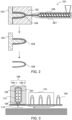
- FIG. 8 is a schematic diagram of a twin-screw extruder.
- a twin-screw extruder 201 uses a twin-screw to melt and knead a first polyester 203 and a second polyester 204 that are charged into a hopper 202. After being melt-kneaded, the resulting material is extruded into a string-like shape, is cooled in a water tank 205, and is then cut into pellets in a pelletizer 206, as a result of which the melt-kneaded product becomes molded into pellets amenable for injection molding.
- the temperature during melt-kneading is not particularly limited, as long as the first polyester and the second polyester can be melt-kneaded.
- the temperature is 200 to 300°C, preferably 240 to 280°C.
- the melt-kneading conditions are likewise not particularly limited, but it is considered that by controlling for instance vent degassing conditions it becomes possible to adjust the amount of residual moisture in the resin, such that the intrinsic viscosity value can be controlled through hydrolysis by that residual moisture.
- a step of crystallizing the pellets after formation of the pellets by melt kneading may also be adopted. Workability during preform production is improved through crystallization of the pellets. Crystallization can be accomplished by keeping the pellets under conditions that preferably include a temperature of about 100 to 180°C, more preferably of about 130 to 170°C, preferably for about 1 to 12 hours, more preferably for about 3 to 7 hours, even when having been crystallized, the pellets can become amorphous on account of heating during production of the preform.
- a test tube-shaped preform 104 is molded next by injection molding, using the obtained pellets.
- a heating cylinder 105 melts, through heating, a material having been charged into an injection molding machine 101, and an extrusion screw 207 injects thereupon the molten material into preform dies 102, 103, to mold the preform 104.
- the preform is obtained from the obtained pellets by injection molding.
- the preform has a test tube shape.
- the preform 104 is subjected to biaxial stretch blowing (biaxial stretch molding).
- the preform 104 is placed in a heating furnace 107 and is heated up to a temperature that allows for stretching.
- the heating time herein is preferably 3 or fewer minutes. By setting the heating time to 3 or fewer minutes, it becomes possible to prevent that crystallization of a crystalline polyester should proceed within the preform during heating.
- the heated preform 104 is retrieved from the heating furnace 107 and is set at the mouth of a blow mold 108 in the interior of which a cavity is formed by combining a left die 108-1 and a right die 108-2.
- the heated preform is placed at the mouth of the blow mold within a short time (for instance within 10 seconds), so that the temperature of the heated preform does not drop before the start of a biaxial stretching step.
- the progress of crystallization of the crystalline polyester within the preform, derived from gradual cooling of the preform, can be arrested thereby.
- the heated preform set in the blow mold 108 is then stretched, in the longitudinal direction, using a stretching rod 109.
- This stretching is referred to as primary stretching.
- a gas is allowed to flow in that case in such a manner that the preform 104 does not come into contact with the stretching rod 109; the pressure of the gas is referred to herein as a primary blow pressure.
- a gas 110 is introduced through a preform opening 106, to inflate the preform in the transversal direction (circumferential direction). This is referred to as secondary stretching.
- the pressure of the gas is referred to herein as a secondary blow pressure.
- Examples of the gas that is blown in include air, nitrogen, carbon dioxide and argon.
- the molding step has a step of stretching the preform in a longitudinal direction of the preform by using a stretching rod, and a step of stretching the preform in the circumferential direction of the preform by causing a gas to flow into the preform having been stretched in the longitudinal direction.
- the blow-molded article 112 is then retrieved, from the blow mold 108, by separating the left die 108-1 and the right die 108-2 of the blow mold 108.
- the blow-molded article 112 is stretched both longitudinally and transversally, and hence is a high-strength molded article.
- the preform in the stretching step by injection stretch blow molding the preform is preferably in an uncrystallized state (non-crystalline state, i.e. amorphous state).
- a high-strength bottle can be formed through stretch crystallization of PET, in the direction of stretching by blowing, i.e. biaxial stretch molding, upon reaching of a blow molding temperature in an amorphous state.
- Injection stretch blow molding methods include a single-stage method and a two-stage method.
- the single-stage method is a method in which residual heat from the preform immediately after retrieval from the mold is exploited to carry out stretch blow molding, as-is or with temperature control.
- the two-stage method is a method in which the preform is cooled down to room temperature, after which the temperature of the preform is adjusted again, whereupon stretch blow molding is carried out.
- the two-stage method is a blow molding method in which the preform after injection molding is cooled down to or below the glass transition temperature of PET, is retrieved, and is thereafter heated at the blow molding temperature (for instance from 90°C to 120°C) in another blow molding apparatus.
- the blow molding temperature for instance from 90°C to 120°C
- an injection molding apparatus and a blow molding apparatus are used in the form of separate equipment. For instance, once the preform has been molded in the step of preparing the preform, the preform is then cooled down to or below the glass transition temperature of the first polyester, and the molding step is carried out thereafter.
- the single-stage method is preferred in that less reheating energy is required herein than in the two-stage method, since the preform is not cooled down to or below the glass transition temperature.
- the lapse of time of holding at the crystallization temperature of PET after injection molding is longer, and as a result crystallization of isothermal crystals of PET progresses more readily than in the two-stage method.
- the crystallization temperature of this PET is from about 130°C to 200°C.
- the production method of the present disclosure elicits the effect of slowing down the progress of isothermal crystallization, both in a single-stage method and in a two-stage method; however, the production method of the present disclosure is particularly effective in a single-stage method.
- the molding step so that the preform does not drop down to or below the glass transition temperature of the first polyester.
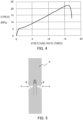
- FIG. 4 illustrates how PET characteristic change as a result of uniaxial stretching.
- PET is molded into a sample shape (Charpy specimen d in FIG. 5 ) pursuant to JIS K7111, using an injection molding apparatus, to yield an unstretched molded article.
- notches are made in the center of the Charpy specimen, by cutting from two directions (e direction and f direction) using a notching machine (not shown).
- the specimen is notched down to a distance g of 2.00 mm between the deepest point of the notch that is cut in the e direction and the deepest point of the notch that is cut in the f direction.
- the angle ⁇ of the notches is set to 45°.
- the shaved Charpy specimen (test piece) is heated using a heat gun until the specimen reaches a blow temperature (100°C in the present disclosure).
- a blow temperature 100°C in the present disclosure.
- non-stretched portions i.e. between the portion notched by the notching machine and the portions chucked by the tensile tester, are protected for instance with a heat insulating sponge so as to preclude rises in temperature.
- the time required to reach 100°C in the heat gun is 90 or fewer seconds.
- a tensile test is carried out at a rate of 500 mm/min using a tensile tester (Instron 5582; by Illinois Tool Works Inc.) in accordance with JIS K7161, to generate a strain-stress curve, i.e. an S-S curve.
- a tensile tester Instron 5582; by Illinois Tool Works Inc.
- JIS K7161 JIS K7161
- stress when a stretching ratio is 5 times is 2.00 to 15.00 MPa as read from the S-S curve.
- Biaxial stretch blow molding of the preform can be carried out more easily by setting thus stress when a stretching ratio is 5 times to lie within the above range.
- a toner bottle can be more easily obtained as a result in which stretch crystallization has proceeded uniformly, and which boasts excellent strength.
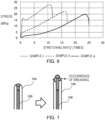
- FIG. 6 illustrates S-S curves of the following PET samples a to c.
- Sample b PET (product name: TN-8550FF; by Teijin Limited) 98.6% Masterbatch of the above PET, containing 5 mass% of carbon black 1.4% Sample having a degree of crystallinity of 4%, and obtained by injecting pellets, in turn obtained by melt-kneading of above PET and masterbatch, into an injection mold set to a mold temperature of 25°C.
- PET product name: TN-8550FF; by Teijin Limited
- TN-8550FF TN-8550FF
- Teijin Limited 98.6%
- Masterbatch of the above PET containing 5 mass% of carbon black 1.4%
- Sample having a degree of crystallinity of 18% and obtained by injecting pellets, in turn obtained by melt-kneading of above PET and masterbatch, into an injection mold set to a mold temperature of 60°C.
- Sample a in an amorphous state exhibits low strain, i.e. a stress of 2.6 MPa at the time where the stretching ratio reaches 5 after the start of stretching.
- the stretch factor at a time where stretching is discontinued is very large, of 20 or higher.
- This state corresponds to stress with easy stretching of the sample by means of a stretching rod at the time of longitudinal stretching using the stretching rod, such that the sample inflates without rupturing, also in blow molding.
- Sample b exhibits a stress of 9.7 MPa at the time where the stretching ratio reaches 5 after the start of stretching, i.e. exhibits higher stress than that of an amorphous sample.
- the stretch factor upon discontinuation of stretching is 16, which is lower than that of sample a. This is because PET spherulites having carbon black nuclei occurred in sample b, and the hardness of the sample increased, as a result of which a stronger force was required in order to stretch the sample.
- FIG. 1 is a schematic configuration explanatory diagram illustrating an electrophotographic four-color image forming apparatus where the reference symbol 80 denotes the main body of the image forming apparatus.
- the image forming apparatus 80 is configured as an image forming apparatus of so-called intermediate transfer tandem type in which four color image forming sections are arranged side by side on an intermediate transfer belt.
- the image forming apparatus 80 carries out image formation as follows.
- respective electrostatic latent images are formed first on photosensitive drums 17 (17y, 17m, 17c, 17bk) by exposure devices 50 (50y, 50m, 50c, 50bk) on the basis of print data.
- the formed electrostatic latent images are developed by respective developing apparatuses 21 (21y, 21m, 21c, 21bk), to form respective toner images.
- the toner images are transferred onto an intermediate transfer body 62 by primary transfer devices 60 (60y, 60m, 60c, 60bk), whereupon a resulting toner image is transferred, in a secondary transfer section 64 (64a, 64b), onto a sheet material S that is supplied from a paper feeding device 63.
- the toner image transferred onto the sheet S is fixed on the sheet material S by a fixing means 68, followed by discharge onto a paper discharge tray 70.
- detachable toner bottles 3 (3Y, 3M, 3C, 3Bk) are used for the purpose of supplying respective toners to the developing apparatuses 21.
- the toner bottle of the present disclosure is used thus in the above manner.
- the "longitudinal stretch factor" of the blow stretching ratio is a value calculated by dividing the "total length after stretching” by the “total length (before stretching) of the portion of the preform (heated portion) that reaches the stretching temperature”.
- the "transversal stretch factor" of the blow stretching ratio is a value calculated by dividing the "diameter of the intermediate portions after stretching” by the "diameter (before stretching) of the intermediate portion of the preform".
- Pellets of the resin mixture dried as described above were charged into an injection molding apparatus of a one-step stretch blow molding machine (product name: ASB-70DPH; by Nissei ASB Machine Co., Ltd.), and biaxial stretch blow molding was carried out, to mold a toner bottle.
- the above one-step stretch blow molding machine sequentially executes a step of obtaining a test tube-shaped preform by injection molding, and a step of subjecting the preform to biaxial stretch blow molding, to yield a bottle-shaped molded article (single-stage method).
- the screw diameter of the injection molding machine in the molding machine was 54 mm.
- a preform molding mold there was prepared first a mold capable of molding a preform having an outer diameter of 30 mm, a wall thickness of 3.7 mm, and a length of 220 mm. A preform was then molded under the following molding conditions.
- the preform was thereafter demolded and was conveyed to a biaxial stretch blow station of the one-step stretch blow molding machine.
- the temperature of the preform during conveyance was controlled as follows.
- the preform adjusted to the above temperature was set in a cylindrical mold having a size corresponding to the size of the toner bottle and having been adjusted to a temperature of 18°C, and biaxial stretch blow molding was carried out thereupon, to produce a blow bottle.
- the preform being transported was heated, whereby the surface temperature of the center of the preform immediately prior to entering the cylindrical mold was 100°C.
- the stretching rod was inserted from a retracted position into the preform, through the opening of the preform, and was driven forward until coming into contact with the apex of the preform.
- the air pressure for driving the stretching rod was set to 1.2 MPa, whereupon the stretching rod was further driven forward.
- primary air was introduced into the preform through the opening thereof 0.5 seconds after the start of this further advancement of the stretching rod.
- the pressure of the primary air was set to 1.0 MPa.
- Secondary air was subsequently introduced 0.15 seconds after the introduction of the primary air.
- the pressure of the secondary air was set to 2.9 MPa.
- Air was introduced into the preform over 7.0 seconds, from the start of introduction of primary air.
- the pressure inside the preform was then reverted to normal pressure over 2.5 seconds.
- a toner bottle produced by blow molding was thus obtained. This bottle is a toner bottle of unrecycled virgin PET.
- Toner was sealed in toner bottles of virgin PET (material formulation given in Table 2), the bottles were then used as electrophotographic toner bottles (NPG-67 by Canon Inc.) in the market, and thereafter the bottles were recovered from the market. Two hundred recovered toner bottles were prepared herein. The toner bottles were cleaned using an air gun, but a small amount of toner remained therein.
- the bottles with such residual toner were crushed using a crusher, to a size of about 5 to 10 mm square, to yield a crushed product (hereafter also referred to as flake product).
- the flakes were washed with water, to thereby yield Flakes (1) having toner removed therefrom.
- the Flakes (1) were mixed with 0.1 mass% of the Polyester (1) described above (with 100 mass% as the total of Flakes (1) plus Polyester (1)), and then the resulting mixture was melt-kneaded using a twin-screw extruder (PC-46 by Ikegai Co., Ltd.) at a temperature of 260°C, a screw rotational speed of 200 rpm, at vent degassing of -0.08 MPa, and at a discharge rate of 50 kg/h, followed by pelletization. The resulting pellets were kept at a temperature of 150°C for 5 hours, to elicit crystallization of pellets for molding.
- a twin-screw extruder PC-46 by Ikegai Co., Ltd.
- Crystallization in this case is not short-time crystallization that sometimes occurs in blow molding, but entails a step of crystallization over a prolonged period of time; even if the mixture contains Polyester (1), in which crystallization is hindered, crystallization nevertheless proceeds over a long period of time.
- the MR-PET containing this crystallized Polyester (1) will be referred to as MR-PET (1).
- the IV value of MR-PET (1) was 0.72 dL/g.
- the IV value of the MR-PET (1) was lower than that of virgin PET (0.77 dL/g), and accordingly it was found that the molecular chains of MR-PET (1) had been shortened on account of recycling.
- the method for measuring the IV value was as follows.
- the molded article is crushed using a crusher, whereupon the IV value can measured in accordance with a method similar to the above method, using the crushed sample.
- Biaxial stretch blow molding was carried out, using MR-PET (1), in the one-step stretch blow molding machine described above, and under the same blow molding conditions as described above.
- a blow bottle could be molded as a result, without rupture of the preform halfway during molding.
- Visual observation of the obtained blow bottle revealed no strain derived from formation of PET spherulites.
- the underlying reason for this is deemed to be the inhibition of crystallization elicited by the Polyester (1), such that the preform did not crystallize even though molecular weight had been reduced with a reduced molecular weight.
- a sample for the above tensile test was prepared using the MR-PET (1) pellets, the tensile test was carried out, an S-S curve was created, and stress when a stretching ratio was 5 times was calculated. The result was 9.87 MPa (15.00 MPa or less).
- toner bottles similar to those in Example 1.
- the toner bottles were cleaned using an air gun, but a small amount of toner remained therein.
- the residual amount of toner which was herein the average value of the 200 bottles, was 0.321 mass% relative to 100% as the mass of the toner bottle body (PET toner bottle having had removed therefrom for instance all supply parts ancillary to the bottle, such that only toner remains in the interior of the bottle).
- This toner contains 30 mass% of Polyester (1) relative to 100 mass% of the toner, and hence the substantial content of Polyester (1) is 0.096 mass%.
- Flakes (2) The bottles having residual toner therein were crushed using a crusher, down to a size of about 5 to 10 mm square, to yield a crushed product.
- This product is referred to as Flakes (2).
- the Flakes (2) were melt-kneaded, without having been washed, using a twin-screw extruder (PC-46 by Ikegai Co., Ltd.) at a temperature of 260°C, a screw rotational speed of 200 rpm, and at a discharge rate of 50 kg/h, followed by pelletization.
- the resulting pellets were kept at a temperature of 150°C for 5 hours, to elicit crystallization of pellets for molding.
- These pellets constituted MR-PET (2) pellets.
- the IV value of MR-PET (2) was 0.72 dL/g.
- the IV value of the MR-PET (2) was lower than the initial IV value (0.77 dL/g), and accordingly it was found that the molecular chains of MR-PET (2) had been shortened on account of recycling.
- a sample for the above tensile test was prepared using the MR-PET (2) pellets, the tensile test was carried out, an S-S curve was created, and stress when a stretching ratio was 5 times was calculated. The result was 11.58 MPa (15.00 MPa or less).
- Pellets of MR-PET (5) were obtained in the same manner as the pellets of MR-PET (1), but modifying herein vent degassing to -0.01 MPa, and modifying the amount of Polyester (1) to 1.0 mass%.
- the IV value of MR-PET (5) was 0.60 dL/g. It is deemed that the IV value of PET was lower herein due to the fact that vent degassing was lower than in MR-PET (1), and due to hydrolysis by residual moisture in the flakes.
- a blow bottle was produced in the same way as in Example 1 but using herein these pellets.
- a blow bottle could be molded as a result without rupturing of the preform halfway during molding.
- Visual observation of the obtained blow bottle revealed no strain derived from formation of PET spherulites.
- Toner masterbatch 2 having a toner concentration of 10 mass%.
- Example 6 The stress when a stretching ratio was 5 times was calculated for the pellets of Example 6 in the same way as in Example 1.
- the result was 15.00 MPa or less, specifically 14.56 MPa.
- MR-PET was produced in the same way as in Example 1 but modifying Polyester (1) in Example 1 to 0.00 mass%. This will be referred to as MR-PET (6).
- a blow bottle was produced using this MR-PET (6).
- the IV value in this case was 0.72 dL/g.
- the preform ruptured while being stretched uniaxially by the stretching rod, and blow molding could not be carried out.
- MR-PET was produced in the same way as in Example 5, but herein the amount of Polyester (1) was modified to 0.00 mass%. This will be referred to as MR-PET (7).
- a blow bottle was produced using this MR-PET (7).
- the IV value in this case was 0.60 dL/g. However, the preform ruptured while being stretched uniaxially by the stretching rod, and blow molding could not be carried out.
- a blow bottle was produced in the same way as in Example 1 but adopting herein the material formulation given in Table 5. As a result, the preform ruptured while being stretched uniaxially by the stretching rod, and blow molding could not be carried out. Visual observation of the obtained blow bottle revealed no strain derived from formation of PET spherulites.
- Table 6 sets out the material formulations of Examples 1 to 5 and Comparative examples 1 and 2.
- Material composition (mass%) Vent degassing conditions Flakes (1)
- Flakes (2) Polyester (1)
- Example 1 99.9% 0.1% -0.08MPa
- Example 2 100% (with toner content of 0.321 %) -0.08MPa
- Example 3 99.0% 1.0% -0.08MPa
- Example 4 99.99% 0.01% -0.08MPa
- Example 5 99.0% 1.0% -0.01 MPa Comparative example 1 100% -0.08MPa Comparative example 2 100% -0.01 MPa
- Table 7 sets out the results of Examples 1 to 5 and Comparative examples 1 and 2.
- MR-PET name IV value (dL/g) Stress when a stretching ratio is 5 times Blow bottle molding
- Example 1 MR-PET(1) 0.72 9.87MPa Possible Example 2 MR-PET(2) 0.72 11.58MPa Possible Example 3 MR-PET(3) 0.72 8.54MPa Possible Example 4
- MR-PET(4) 0.72 14.92MPa Possible Example 5 MR-PET(5) 0.60 13.88MPa Possible Comparative example 1 MR-PET(6) 0.72 19.55MPa Not possible Comparative example 2 MR-PET(7) 0.60 25.68MPa Not possible
- Intrinsic viscosity IV values of the blow bottles of Examples 1 to 6 and Comparative Examples 1 to 3 were measured in accordance with the above-described method; the values were identical to those measured from the pellets.
- a stretch blow-molded article comprising: a first polyester; and a second polyester having a structure different from a structure of the first polyester, wherein an intrinsic viscosity value of the first polyester is 0.60 to 0.74 dL/g, and the second polyester has a structure corresponding to terephthalic acid and a structure corresponding to bisphenol A.
Landscapes
- Engineering & Computer Science (AREA)
- Mechanical Engineering (AREA)
- Chemical & Material Sciences (AREA)
- Manufacturing & Machinery (AREA)
- Medicinal Chemistry (AREA)
- Organic Chemistry (AREA)
- Polymers & Plastics (AREA)
- Health & Medical Sciences (AREA)
- Chemical Kinetics & Catalysis (AREA)
- Environmental & Geological Engineering (AREA)
- Blow-Moulding Or Thermoforming Of Plastics Or The Like (AREA)
- Processing And Handling Of Plastics And Other Materials For Molding In General (AREA)
- Compositions Of Macromolecular Compounds (AREA)
Applications Claiming Priority (1)
| Application Number | Priority Date | Filing Date | Title |
|---|---|---|---|
| JP2023033674A JP2024125689A (ja) | 2023-03-06 | 2023-03-06 | 延伸ブロー成形品及び延伸ブロー成形品の製造方法 |
Publications (1)
| Publication Number | Publication Date |
|---|---|
| EP4427902A1 true EP4427902A1 (fr) | 2024-09-11 |
Family
ID=90361947
Family Applications (1)
| Application Number | Title | Priority Date | Filing Date |
|---|---|---|---|
| EP24161340.5A Pending EP4427902A1 (fr) | 2023-03-06 | 2024-03-05 | Article moulé par étirage-soufflage et procédé de production d'un article moulé par étirage-soufflage |
Country Status (4)
| Country | Link |
|---|---|
| US (1) | US20240300161A1 (fr) |
| EP (1) | EP4427902A1 (fr) |
| JP (1) | JP2024125689A (fr) |
| CN (1) | CN118620354A (fr) |
Citations (12)
| Publication number | Priority date | Publication date | Assignee | Title |
|---|---|---|---|---|
| JPH09272792A (ja) * | 1996-04-04 | 1997-10-21 | Unitika Ltd | ポリエステル樹脂組成物及びその製造法 |
| US5888598A (en) * | 1996-07-23 | 1999-03-30 | The Coca-Cola Company | Preform and bottle using pet/pen blends and copolymers |
| EP0926197A1 (fr) * | 1997-07-04 | 1999-06-30 | Mitsubishi Plastics Inc. | Composition de resines de polyester et bouteille fabriquee a partir d'une telle composition |
| JP2000169623A (ja) | 1998-12-10 | 2000-06-20 | Is:Kk | ポリエチレンテレフタレ―ト廃棄物のケミカルリサイクル方法 |
| JP2001042626A (ja) | 1999-05-25 | 2001-02-16 | Ricoh Co Ltd | トナーボトル及びこれを装着する電子写真装置並びにトナーボトルの成形方法 |
| JP2003136583A (ja) * | 2001-11-02 | 2003-05-14 | Toyo Seikan Kaisha Ltd | プリフォームの成形方法 |
| CN101132910A (zh) * | 2005-03-02 | 2008-02-27 | 伊斯曼化工公司 | 多层的透明制品及其生产方法 |
| JP2010139697A (ja) * | 2008-12-11 | 2010-06-24 | Canon Inc | トナーカートリッジ |
| JP2011256328A (ja) * | 2010-06-11 | 2011-12-22 | Toyo Seikan Kaisha Ltd | リサイクルポリエステル含有ポリエステル構造体及びその製造方法 |
| JP2013159681A (ja) | 2012-02-03 | 2013-08-19 | Fujifilm Corp | 樹脂組成物とその製造方法、ポリエチレンテレフタレートフィルム及び太陽電池モジュール用バックシート |
| JP2014198422A (ja) | 2013-03-29 | 2014-10-23 | 株式会社 資生堂 | 射出延伸ブローボトル及び射出延伸ブローボトルの製造方法 |
| US9890256B2 (en) * | 2013-11-26 | 2018-02-13 | Adeka Corporation | Process for producing masterbatch |
Family Cites Families (5)
| Publication number | Priority date | Publication date | Assignee | Title |
|---|---|---|---|---|
| US5216091A (en) * | 1988-10-11 | 1993-06-01 | Amoco Corporation | High strength polymers and blends of hydroquinone poly(iso-terephthalates) containing residues of p-hydroxybenzoic acid |
| US20080318063A1 (en) * | 2007-06-22 | 2008-12-25 | Anderson Jerrel C | Glass laminates with improved weatherability |
| WO2016027577A1 (fr) * | 2014-08-22 | 2016-02-25 | 三菱瓦斯化学株式会社 | Récipient en matière plastique multicouche |
| JP2022010939A (ja) * | 2020-06-29 | 2022-01-17 | キリンホールディングス株式会社 | プラスチック容器及び飲料製品 |
| TWI836276B (zh) * | 2020-10-07 | 2024-03-21 | 美商朋瑟美國公司 | 聚酯系熱收縮膜 |
-
2023
- 2023-03-06 JP JP2023033674A patent/JP2024125689A/ja active Pending
-
2024
- 2024-02-28 US US18/589,656 patent/US20240300161A1/en active Pending
- 2024-03-05 EP EP24161340.5A patent/EP4427902A1/fr active Pending
- 2024-03-05 CN CN202410249647.1A patent/CN118620354A/zh active Pending
Patent Citations (12)
| Publication number | Priority date | Publication date | Assignee | Title |
|---|---|---|---|---|
| JPH09272792A (ja) * | 1996-04-04 | 1997-10-21 | Unitika Ltd | ポリエステル樹脂組成物及びその製造法 |
| US5888598A (en) * | 1996-07-23 | 1999-03-30 | The Coca-Cola Company | Preform and bottle using pet/pen blends and copolymers |
| EP0926197A1 (fr) * | 1997-07-04 | 1999-06-30 | Mitsubishi Plastics Inc. | Composition de resines de polyester et bouteille fabriquee a partir d'une telle composition |
| JP2000169623A (ja) | 1998-12-10 | 2000-06-20 | Is:Kk | ポリエチレンテレフタレ―ト廃棄物のケミカルリサイクル方法 |
| JP2001042626A (ja) | 1999-05-25 | 2001-02-16 | Ricoh Co Ltd | トナーボトル及びこれを装着する電子写真装置並びにトナーボトルの成形方法 |
| JP2003136583A (ja) * | 2001-11-02 | 2003-05-14 | Toyo Seikan Kaisha Ltd | プリフォームの成形方法 |
| CN101132910A (zh) * | 2005-03-02 | 2008-02-27 | 伊斯曼化工公司 | 多层的透明制品及其生产方法 |
| JP2010139697A (ja) * | 2008-12-11 | 2010-06-24 | Canon Inc | トナーカートリッジ |
| JP2011256328A (ja) * | 2010-06-11 | 2011-12-22 | Toyo Seikan Kaisha Ltd | リサイクルポリエステル含有ポリエステル構造体及びその製造方法 |
| JP2013159681A (ja) | 2012-02-03 | 2013-08-19 | Fujifilm Corp | 樹脂組成物とその製造方法、ポリエチレンテレフタレートフィルム及び太陽電池モジュール用バックシート |
| JP2014198422A (ja) | 2013-03-29 | 2014-10-23 | 株式会社 資生堂 | 射出延伸ブローボトル及び射出延伸ブローボトルの製造方法 |
| US9890256B2 (en) * | 2013-11-26 | 2018-02-13 | Adeka Corporation | Process for producing masterbatch |
Non-Patent Citations (1)
| Title |
|---|
| "Handbook of Saturated Polyester Resins", 22 December 1989, NIKKAN KOGYO SHIMBUN, pages: 224 - 225 |
Also Published As
| Publication number | Publication date |
|---|---|
| JP2024125689A (ja) | 2024-09-19 |
| US20240300161A1 (en) | 2024-09-12 |
| CN118620354A (zh) | 2024-09-10 |
Similar Documents
| Publication | Publication Date | Title |
|---|---|---|
| EP2268737B1 (fr) | Compositions de polyester et procédé de préparation d'articles par moulage par extrusion-soufflage | |
| CN100509355C (zh) | 热收缩性聚酯类薄膜卷筒及其制造方法、使用其的标签 | |
| US8258239B2 (en) | Production method of polyethylene terephthalate graft copolymerized resin and molded product thereof | |
| KR101689417B1 (ko) | 공동 함유 열수축성 폴리에스테르계 필름 및 그의 제조방법 | |
| JP2001509197A (ja) | 変性ポリエステル | |
| EP0601844A1 (fr) | Produits moulés et étirés de mélanges de PET et PBT et procédé de fabrication | |
| US5556926A (en) | Concentrate for use in the melt fabrication of polyester | |
| JP2011510116A (ja) | 押出ブロー成形物品 | |
| MXPA00005067A (es) | Laminas y peliculas celulares de resina de poliester, estiradas mono o biaxialmente. | |
| TW201938634A (zh) | 雙軸延伸膜 | |
| JP6043377B2 (ja) | ポリエステル樹脂組成物及びそれからなるブロー成形品 | |
| JP6456116B2 (ja) | ポリエステル樹脂組成物及びそれからなるブロー成形品 | |
| EP1137696B1 (fr) | Augmentation des viscosites de fusion d'une resine polyester | |
| EP4427902A1 (fr) | Article moulé par étirage-soufflage et procédé de production d'un article moulé par étirage-soufflage | |
| EP4272927B1 (fr) | Mélange de résine, procédé de production d'un mélange de résine, produit moulé par étirage-soufflage et procédé de production d'un produit moulé par étirage-soufflage | |
| CN114525018B (zh) | 一种共聚酯微发泡阻燃材料及其制备方法 | |
| EP4427909B1 (fr) | Procédé de production d'un produit moulé par soufflage, composition de résine et pastilles | |
| EP4717437A2 (fr) | Polymère, préforme, article moulé étiré biaxialement, pastille de résine et procédé de production d'un article moulé étiré biaxialement | |
| AU3371599A (en) | Production of reduced gas-permeable polyalkylene terephthalate films by strain induced crystallization | |
| JP4895451B2 (ja) | 脂肪族熱可塑性ポリエステルを含む組成物、その製法およびその利用 | |
| US7025925B2 (en) | Extrusion blow molded articles | |
| EP4205948A1 (fr) | Film thermorétractable de polyester, étiquette thermorétractable et emballage | |
| JPH08509776A (ja) | ガラス繊維強化ポリエステル樹脂製製品 | |
| JP2007169546A (ja) | 熱収縮性ポリエステル系フィルム及び熱収縮性ラベル | |
| CA2222333C (fr) | Concentres utilisables dans la fabrication par fusion de polyesters |
Legal Events
| Date | Code | Title | Description |
|---|---|---|---|
| PUAI | Public reference made under article 153(3) epc to a published international application that has entered the european phase |
Free format text: ORIGINAL CODE: 0009012 |
|
| STAA | Information on the status of an ep patent application or granted ep patent |
Free format text: STATUS: THE APPLICATION HAS BEEN PUBLISHED |
|
| AK | Designated contracting states |
Kind code of ref document: A1 Designated state(s): AL AT BE BG CH CY CZ DE DK EE ES FI FR GB GR HR HU IE IS IT LI LT LU LV MC ME MK MT NL NO PL PT RO RS SE SI SK SM TR |
|
| STAA | Information on the status of an ep patent application or granted ep patent |
Free format text: STATUS: REQUEST FOR EXAMINATION WAS MADE |
|
| 17P | Request for examination filed |
Effective date: 20250311 |