EP4428099A1 - Procédé et dispositif pour la synthèse d'ammoniac - Google Patents
Procédé et dispositif pour la synthèse d'ammoniac Download PDFInfo
- Publication number
- EP4428099A1 EP4428099A1 EP23020114.7A EP23020114A EP4428099A1 EP 4428099 A1 EP4428099 A1 EP 4428099A1 EP 23020114 A EP23020114 A EP 23020114A EP 4428099 A1 EP4428099 A1 EP 4428099A1
- Authority
- EP
- European Patent Office
- Prior art keywords
- hydrogen
- ammonia
- synthesis
- nitrogen
- electrolysis
- Prior art date
- Legal status (The legal status is an assumption and is not a legal conclusion. Google has not performed a legal analysis and makes no representation as to the accuracy of the status listed.)
- Withdrawn
Links
Images
Classifications
-
- C—CHEMISTRY; METALLURGY
- C01—INORGANIC CHEMISTRY
- C01C—AMMONIA; CYANOGEN; COMPOUNDS THEREOF
- C01C1/00—Ammonia; Compounds thereof
- C01C1/02—Preparation, purification or separation of ammonia
- C01C1/04—Preparation of ammonia by synthesis
- C01C1/0405—Preparation of ammonia by synthesis from N2 and H2 in presence of a catalyst
-
- C—CHEMISTRY; METALLURGY
- C01—INORGANIC CHEMISTRY
- C01C—AMMONIA; CYANOGEN; COMPOUNDS THEREOF
- C01C1/00—Ammonia; Compounds thereof
- C01C1/02—Preparation, purification or separation of ammonia
- C01C1/04—Preparation of ammonia by synthesis
- C01C1/0405—Preparation of ammonia by synthesis from N2 and H2 in presence of a catalyst
- C01C1/0458—Separation of NH3
- C01C1/047—Separation of NH3 by condensation
-
- C—CHEMISTRY; METALLURGY
- C25—ELECTROLYTIC OR ELECTROPHORETIC PROCESSES; APPARATUS THEREFOR
- C25B—ELECTROLYTIC OR ELECTROPHORETIC PROCESSES FOR THE PRODUCTION OF COMPOUNDS OR NON-METALS; APPARATUS THEREFOR
- C25B1/00—Electrolytic production of inorganic compounds or non-metals
-
- C—CHEMISTRY; METALLURGY
- C25—ELECTROLYTIC OR ELECTROPHORETIC PROCESSES; APPARATUS THEREFOR
- C25B—ELECTROLYTIC OR ELECTROPHORETIC PROCESSES FOR THE PRODUCTION OF COMPOUNDS OR NON-METALS; APPARATUS THEREFOR
- C25B1/00—Electrolytic production of inorganic compounds or non-metals
- C25B1/01—Products
- C25B1/02—Hydrogen or oxygen
- C25B1/04—Hydrogen or oxygen by electrolysis of water
-
- C—CHEMISTRY; METALLURGY
- C25—ELECTROLYTIC OR ELECTROPHORETIC PROCESSES; APPARATUS THEREFOR
- C25B—ELECTROLYTIC OR ELECTROPHORETIC PROCESSES FOR THE PRODUCTION OF COMPOUNDS OR NON-METALS; APPARATUS THEREFOR
- C25B15/00—Operating or servicing cells
- C25B15/08—Supplying or removing reactants or electrolytes; Regeneration of electrolytes
Definitions
- the invention relates to a process for the synthesis of ammonia, in which an ammonia synthesis gas comprising hydrogen and nitrogen is formed in a synthesis circuit with the addition of anhydrous make-up hydrogen and is fed to an ammonia reactor in order to convert it with catalytic support into a synthesis product containing ammonia, hydrogen and nitrogen, which is cooled in one or more cooling steps to obtain an ammonia-rich condensate and a gas phase consisting largely of hydrogen and nitrogen, at least a part of which is returned to the ammonia reactor via the synthesis circuit to form the ammonia synthesis gas, wherein a water-containing hydrogen fraction produced by electrochemical decomposition of water (electrolysis hydrogen) is provided to obtain the anhydrous make-up hydrogen.
- an ammonia synthesis gas comprising hydrogen and nitrogen is formed in a synthesis circuit with the addition of anhydrous make-up hydrogen and is fed to an ammonia reactor in order to convert it with catalytic support into a synthesis product containing ammonia,
- the invention relates to a device for carrying out the method according to the invention.
- Ammonia is one of the most widely produced chemicals in the world. It is primarily used as a raw material for the production of fertilizers, but is also becoming increasingly important as an energy source and hydrogen storage medium. On an industrial scale, it is synthesized almost exclusively from nitrogen and hydrogen using the Haber-Bosch process.
- a hydrocarbon-containing feedstock such as natural gas
- a hydrocarbon-containing feedstock such as natural gas
- a hydrocarbon-containing feedstock such as natural gas
- the raw synthesis gas is then subjected to water gas conversion in order to convert the carbon monoxide it contains with water to hydrogen and carbon dioxide.
- Carbon dioxide is separated from the converted gas by acid gas scrubbing, among other things, resulting in a hydrogen fraction known as raw hydrogen, which, in addition to hydrogen, also contains residues of carbon monoxide and carbon dioxide as well as water.
- the raw hydrogen is further treated for this purpose, for example by methanation, nitrogen scrubbing or pressure swing adsorption, whereby carbon monoxide, carbon dioxide and free oxygen are converted or separated together with any water present.
- electrolysis hydrogen gas fraction
- electrolysis hydrogen does not contain carbon monoxide but is usually saturated with water.
- Electrolysis hydrogen also contains up to 1000 ppmv of free oxygen, so it cannot be used directly as make-up hydrogen.
- its free oxygen content may be reduced by separating oxygen and/or converting oxygen to water before it is freed of water, for example by pressure or temperature swing adsorption, which requires a high level of equipment and energy.
- the present invention has for its object to provide a method of the generic type and a device for carrying it out, which allow the effort for the synthesis of ammonia to be reduced compared to the prior art.
- free oxygen is separated from the electrolysis hydrogen and/or converted to water by reaction with hydrogen, so that the hydrogen fraction with an atomic oxygen concentration of less than 5 ppmv is obtained.
- the reduction of free oxygen can be omitted if the electrolysis hydrogen already has a free oxygen content of less than 5 ppmv.
- the process according to the invention can be used advantageously when the electrolysis hydrogen or the hydrogen fraction obtained from electrolysis hydrogen by reducing free oxygen has a high water content.
- the electrolysis hydrogen or the hydrogen fraction obtained from electrolysis hydrogen by reducing free oxygen can be saturated with water.
- a preferred embodiment of the method according to the invention provides that at least part of the nitrogen required as make-up gas is mixed with the electrolysis hydrogen or the hydrogen fraction obtained from electrolysis hydrogen by reducing free oxygen into the synthesis product to be cooled. This is particularly advantageous if water-containing nitrogen is available to form the make-up nitrogen, as is obtained, for example, when a nitrogen fraction separated from air by pressure swing adsorption is subjected to catalytic deoxidation to remove free oxygen, in which free oxygen reacts to form water.
- the invention further relates to a device for the synthesis of ammonia, with an ammonia reactor which is integrated into a synthesis circuit in which an ammonia synthesis gas comprising hydrogen and nitrogen can be formed by supplying make-up hydrogen and fed to the ammonia reactor in order to be converted with catalytic support to a synthesis product containing ammonia, hydrogen and nitrogen, a cooling device with one or more serially arranged cooling stages which is connected to a separating device in such a way that the synthesis product can be separated into an ammonia-rich condensate and a gas phase consisting largely of hydrogen and nitrogen, at least a part of which can be returned in the synthesis circuit upstream of the ammonia reactor, and a hydrogen source connected to the synthesis circuit which comprises an electrolyzer with which a water-containing hydrogen fraction (electrolysis hydrogen) can be provided to obtain the make-up hydrogen by electrochemical decomposition of water.
- an ammonia reactor which is integrated into a synthesis circuit in which an ammonia synthesis gas
- the stated object is achieved according to the invention in that the hydrogen source is connected to the synthesis circuit via a feed device in such a way that the electrolysis hydrogen or a hydrogen fraction obtainable from electrolysis hydrogen by reducing free oxygen can be introduced into the cooling device for separating water in order to be cooled together with the synthesis product and to obtain the anhydrous make-up hydrogen.
- the hydrogen source can comprise, for example, an acidic or PEM electrolyzer or an alkaline electrolyzer or a solid oxide electrolyzer. Since such electrolyzers produce the electrolysis hydrogen with an oxygen concentration that is too high for make-up hydrogen, the hydrogen source in particular in these cases has an oxygen reduction with which the content of free oxygen in the electrolysis hydrogen can be reduced to below 5 ppmv by separating oxygen and/or converting oxygen to water.
- the oxygen reduction is a catalytic Deoxidation, by which free oxygen can be converted into water with hydrogen over a catalyst bed.
- the device according to the invention can have several cooling stages, which are divided into a high-temperature and a condensation group. While in the high-temperature group the synthesis product can be cooled without ammonia condensation, for example against boiler feed water to be evaporated, the cooling in the condensation group can be carried out with ammonia condensation, preferably against cooling water.
- the feed device opens into the synthesis circuit downstream of the high-temperature group and upstream of the condensation group.
- the feed device is expediently connected to a mixing device with which at least part of the make-up nitrogen required in the synthesis cycle can be mixed with the electrolysis hydrogen or the hydrogen fraction obtainable from electrolysis hydrogen by reducing free oxygen.
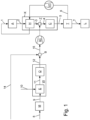
- the Figure 1 shows an ammonia synthesis which is operated according to a preferred variant of the process according to the invention.
- the ammonia synthesis gas 1, in which hydrogen and nitrogen are present in the stoichiometric ratio of 3:1 for the synthesis of ammonia, is fed to the ammonia reactor A in anhydrous form and at a temperature between 150 and 250°C, where it is converted with catalytic support in an exothermic reaction at a pressure between 80 and 300 bar to form ammonia to form the synthesis product 2, which contains not only ammonia but also considerable amounts of hydrogen and nitrogen.
- the synthesis product 2, which leaves the ammonia reactor A at a temperature between 400 and 480°C, is first of all stripped of high-temperature heat in the high-temperature group H of the cooling device K, which is used, for example, to generate process steam.
- the cooled synthesis product is passed on via the feed device Z and line 4 to the condensation group C of the cooling device K in order to reduce its temperature to a value between -20 and 0°C, whereby ammonia condenses out and a two-phase mixture of substances 5 is formed, which is separated in the separation device T into a gas mixture 6 consisting largely of hydrogen and nitrogen and containing residues of uncondensed ammonia, and a liquid phase 7 consisting predominantly of ammonia. While the liquid phase 7 is introduced into the storage tank L as an ammonia product, the gas mixture 6 is returned via the recycling compressor V1 and, after being warmed up against the synthesis product 2 to be cooled, is fed to the ammonia reactor A via line 1.
- water is fed to the water treatment M via line 8 in order to be treated to form demineralized water 9 and passed on to the electrolyzer E arranged in the hydrogen source W.
- the demineralized water 9 is broken down with the aid of electrical current 10, which preferably comes from a renewable power source, to produce electrolysis hydrogen 11, which is typically saturated with water and contains up to 1000 ppmv of free oxygen.
- the oxygen reduction O which is a catalytic deoxidation
- the free oxygen content of the electrolysis hydrogen 11 is reduced to a value below 5 ppmv, producing a water-saturated hydrogen fraction 12, which is withdrawn from the hydrogen source W.
- the hydrogen fraction 12 is mixed with a nitrogen stream 14 in the mixing device B to form the make-up gas 15, the pressure of which is increased in the compressor V2 in order to mix it with the cooled synthesis product 3 via the feed device Z, together with which it is fed via line 4 to the condensation group C for cooling. While the water contained in the make-up gas 15 condenses out with the ammonia of the synthesis product 3 and is introduced into the storage tank L with the ammonia product 7, nitrogen and hydrogen enter the ammonia synthesis gas 1 as anhydrous make-up gases.
Landscapes
- Chemical & Material Sciences (AREA)
- Organic Chemistry (AREA)
- Chemical Kinetics & Catalysis (AREA)
- Inorganic Chemistry (AREA)
- Engineering & Computer Science (AREA)
- Electrochemistry (AREA)
- Materials Engineering (AREA)
- Metallurgy (AREA)
- Analytical Chemistry (AREA)
- Electrolytic Production Of Non-Metals, Compounds, Apparatuses Therefor (AREA)
- Catalysts (AREA)
Priority Applications (2)
| Application Number | Priority Date | Filing Date | Title |
|---|---|---|---|
| EP23020114.7A EP4428099A1 (fr) | 2023-03-09 | 2023-03-09 | Procédé et dispositif pour la synthèse d'ammoniac |
| PCT/EP2024/025094 WO2024183950A1 (fr) | 2023-03-09 | 2024-02-28 | Procédé et appareil de synthese d'ammoniac |
Applications Claiming Priority (1)
| Application Number | Priority Date | Filing Date | Title |
|---|---|---|---|
| EP23020114.7A EP4428099A1 (fr) | 2023-03-09 | 2023-03-09 | Procédé et dispositif pour la synthèse d'ammoniac |
Publications (1)
| Publication Number | Publication Date |
|---|---|
| EP4428099A1 true EP4428099A1 (fr) | 2024-09-11 |
Family
ID=85570302
Family Applications (1)
| Application Number | Title | Priority Date | Filing Date |
|---|---|---|---|
| EP23020114.7A Withdrawn EP4428099A1 (fr) | 2023-03-09 | 2023-03-09 | Procédé et dispositif pour la synthèse d'ammoniac |
Country Status (2)
| Country | Link |
|---|---|
| EP (1) | EP4428099A1 (fr) |
| WO (1) | WO2024183950A1 (fr) |
Citations (4)
| Publication number | Priority date | Publication date | Assignee | Title |
|---|---|---|---|---|
| WO2022173794A1 (fr) * | 2021-02-10 | 2022-08-18 | Icarus Technology Llc | Production d'ammoniac renouvelable |
| US11453950B1 (en) * | 2021-03-15 | 2022-09-27 | Air Products And Chemicals, Inc. | Method and apparatus for dosing hydrogen in a centrifugal compression system |
| US20220388855A1 (en) * | 2021-06-07 | 2022-12-08 | FuelPositive Corporation | Modular, transportable clean hydrogen-ammonia maker |
| US20230034962A1 (en) * | 2020-01-27 | 2023-02-02 | Thyssenkrupp Industrial Solutions Ag | Process for ammonia synthesis and plant for preparation of ammonia |
-
2023
- 2023-03-09 EP EP23020114.7A patent/EP4428099A1/fr not_active Withdrawn
-
2024
- 2024-02-28 WO PCT/EP2024/025094 patent/WO2024183950A1/fr not_active Ceased
Patent Citations (4)
| Publication number | Priority date | Publication date | Assignee | Title |
|---|---|---|---|---|
| US20230034962A1 (en) * | 2020-01-27 | 2023-02-02 | Thyssenkrupp Industrial Solutions Ag | Process for ammonia synthesis and plant for preparation of ammonia |
| WO2022173794A1 (fr) * | 2021-02-10 | 2022-08-18 | Icarus Technology Llc | Production d'ammoniac renouvelable |
| US11453950B1 (en) * | 2021-03-15 | 2022-09-27 | Air Products And Chemicals, Inc. | Method and apparatus for dosing hydrogen in a centrifugal compression system |
| US20220388855A1 (en) * | 2021-06-07 | 2022-12-08 | FuelPositive Corporation | Modular, transportable clean hydrogen-ammonia maker |
Also Published As
| Publication number | Publication date |
|---|---|
| WO2024183950A1 (fr) | 2024-09-12 |
Similar Documents
| Publication | Publication Date | Title |
|---|---|---|
| EP4112540A1 (fr) | Procédé et dispositif de production d'hydrogène à partir d'ammoniac | |
| EP3307675B1 (fr) | Procédé multipression pour la production d'ammoniac | |
| DE102016213360A1 (de) | Verfahren zur elektrochemischen Herstellung von Ammoniak | |
| EP3954650A1 (fr) | Procédé et installation de fabrication d'hydrogène et de séparation du dioxyde de carbone | |
| DE19625093A1 (de) | Verfahren zur Gewinnung von Kohlenmonoxid und Wasserstoff | |
| DE102019214812A1 (de) | Verfahren und Anlage zur Erzeugung von Synthesegas | |
| DE102019008016A1 (de) | Verfahren und Vorrichtung zur Erzeugung von Kohlenmonoxid durch reverse Wassergas-Shift | |
| WO2018166865A1 (fr) | Procédé et installation pour la production et le traitement d'un mélange de gaz de synthèse | |
| EP4008760A1 (fr) | Installation et procédé de fabrication de combustibles synthétiques sans eau douce | |
| DE102015015310A1 (de) | Verfahren und Vorrichtung zur Kohlendioxidabtrennung aus Synthesegas | |
| DE69809159T2 (de) | Hydroraffinierungsverfahren und -anlage für Erdöleinsätze mit Ammoniakspaltung und Wasserstoffrückführung | |
| DE102019007672A1 (de) | Verfahren und Anlage zur Herstellung von Monoethylenglycol | |
| EP3466869B1 (fr) | Procédé de fabrication combinée de méthanol et d'ammoniac | |
| EP4197967A1 (fr) | Procédé et installation de production de méthanol et de monoxyde de carbone | |
| EP4066921A1 (fr) | Procédé et installation de production de méthanol et d'ammoniaque | |
| EP4428099A1 (fr) | Procédé et dispositif pour la synthèse d'ammoniac | |
| DE102024122674A1 (de) | Verfahren zur Herstellung von Kohlenstoffmonoxid und Verfahren zur Herstellung von Syngas | |
| EP4428100A1 (fr) | Procédé et dispositif pour la synthèse d'ammoniac | |
| WO2023156444A1 (fr) | Synthèse électrochimique et chimique d'ammoniac | |
| WO2015106952A1 (fr) | Procédé et dispositif de production de diméthyle éther | |
| LU103279B1 (de) | Anlage und Verfahren zur gemeinsamen Verdichtung von Wasserstoff und Erdgas | |
| DE3501459A1 (de) | Verfahren zur erzeugung von h(pfeil abwaerts)2(pfeil abwaerts)/co-synthesegas und co | |
| DE102017009503A1 (de) | Erzeugung von Oxogas unter Verwendung eines Druckwechseladsorbers | |
| DE102016204331A1 (de) | Verfahren zur Herstellung von Ammoniak aus Rohgas | |
| DE4334257A1 (de) | Verfahren zum Gewinnen von Ammoniak |
Legal Events
| Date | Code | Title | Description |
|---|---|---|---|
| PUAI | Public reference made under article 153(3) epc to a published international application that has entered the european phase |
Free format text: ORIGINAL CODE: 0009012 |
|
| STAA | Information on the status of an ep patent application or granted ep patent |
Free format text: STATUS: THE APPLICATION HAS BEEN PUBLISHED |
|
| AK | Designated contracting states |
Kind code of ref document: A1 Designated state(s): AL AT BE BG CH CY CZ DE DK EE ES FI FR GB GR HR HU IE IS IT LI LT LU LV MC ME MK MT NL NO PL PT RO RS SE SI SK SM TR |
|
| STAA | Information on the status of an ep patent application or granted ep patent |
Free format text: STATUS: THE APPLICATION IS DEEMED TO BE WITHDRAWN |
|
| 18D | Application deemed to be withdrawn |
Effective date: 20250312 |