EP4428893A1 - Betätigungsmechanismus für null-volt-spule-feder in einem schutzschalter - Google Patents
Betätigungsmechanismus für null-volt-spule-feder in einem schutzschalter Download PDFInfo
- Publication number
- EP4428893A1 EP4428893A1 EP23160189.9A EP23160189A EP4428893A1 EP 4428893 A1 EP4428893 A1 EP 4428893A1 EP 23160189 A EP23160189 A EP 23160189A EP 4428893 A1 EP4428893 A1 EP 4428893A1
- Authority
- EP
- European Patent Office
- Prior art keywords
- zvc
- charging
- plunger
- spring
- lever
- Prior art date
- Legal status (The legal status is an assumption and is not a legal conclusion. Google has not performed a legal analysis and makes no representation as to the accuracy of the status listed.)
- Pending
Links
Images






Classifications
-
- H—ELECTRICITY
- H01—ELECTRIC ELEMENTS
- H01H—ELECTRIC SWITCHES; RELAYS; SELECTORS; EMERGENCY PROTECTIVE DEVICES
- H01H83/00—Protective switches, e.g. circuit-breaking switches, or protective relays operated by abnormal electrical conditions otherwise than solely by excess current
- H01H83/12—Protective switches, e.g. circuit-breaking switches, or protective relays operated by abnormal electrical conditions otherwise than solely by excess current operated by voltage falling below a predetermined value, e.g. for no-volt protection
-
- H—ELECTRICITY
- H01—ELECTRIC ELEMENTS
- H01H—ELECTRIC SWITCHES; RELAYS; SELECTORS; EMERGENCY PROTECTIVE DEVICES
- H01H3/00—Mechanisms for operating contacts
- H01H3/22—Power arrangements internal to the switch for operating the driving mechanism
- H01H3/30—Power arrangements internal to the switch for operating the driving mechanism using spring motor
- H01H3/3005—Charging means
- H01H3/3015—Charging means using cam devices
-
- H—ELECTRICITY
- H01—ELECTRIC ELEMENTS
- H01H—ELECTRIC SWITCHES; RELAYS; SELECTORS; EMERGENCY PROTECTIVE DEVICES
- H01H3/00—Mechanisms for operating contacts
- H01H3/32—Driving mechanisms, i.e. for transmitting driving force to the contacts
- H01H3/42—Driving mechanisms, i.e. for transmitting driving force to the contacts using cam or eccentric
-
- H—ELECTRICITY
- H01—ELECTRIC ELEMENTS
- H01H—ELECTRIC SWITCHES; RELAYS; SELECTORS; EMERGENCY PROTECTIVE DEVICES
- H01H33/00—High-tension or heavy-current switches with arc-extinguishing or arc-preventing means
- H01H33/02—Details
- H01H33/28—Power arrangements internal to the switch for operating the driving mechanism
- H01H33/40—Power arrangements internal to the switch for operating the driving mechanism using spring motor
Definitions
- the present disclosure generally relates to circuit breaker drive mechanisms. More particularly, it relates to providing multiple charging and discharging mechanisms for a zero volt coil, ZVC, spring in a circuit breaker.
- Protection systems that include logic circuits, sensors, relays, circuit breakers, fuses, isolators, instrument transformers, and other protection devices, are provided in electrical power systems to control, protect and isolate electrical equipment of the electrical power systems during any electrical fault.
- the electrical fault may correspond to an abnormal condition in the electrical power system, which may damage the electrical equipment and disturb normal flow of electric current in the electrical power system.
- the electrical fault may occur in one or more of three phases or a power line of the electrical power system.
- the potential energy required for opening and closing operations of the circuit breaker may be provided by an operating mechanism, such as a spring operating mechanism/circuit breaking mechanism.
- the spring operating mechanism may have potential energy mechanically stored in springs.
- different spring operating mechanisms such as BLK, BLG, MSD, and FSA, may be used based on a rating of the power line to be isolated or a rating of the circuit breaker.
- the circuit breaker comprises a ZVC, a ZVC plunger connected to the ZVC, and a ZVC spring connected to the ZVC plunger.
- Available FSA-ZVC based spring operating mechanism of the circuit breaker requires additional components/devices such as resistor, timer, contactor, under voltage relay, and so on, to satisfy International Organization for Standardization/International Electro technical Commission, IEC, requirements of tripping the circuit breaker below specified percentage of rated voltage.
- a device for an electrical circuit comprises a zero-volt coil, ZVC.
- the device comprises a ZVC plunger, which is arranged to be displaced between a charged position in which it is held by a magnetic field generated by the ZVC and a discharged position in which it is released by the ZVC.
- the device comprises a ZVC spring connected to the ZVC plunger.
- the ZVC spring is operable between a charged position corresponding to the charged position of the ZVC plunger and a discharged position corresponding to the discharged position of the ZVC plunger.
- the device comprises a circuit breaking mechanism.
- the device comprises a charging mechanism for displacing the ZVC spring to its charged position.
- the device comprises a discharging mechanism configured to be connected to the ZVC plunger and to be displaced by the ZVC spring and the ZVC plunger upon discharging of the ZVC spring and the ZVC plunger into a position in which it triggers the circuit breaking mechanism to break the electrical circuit.
- the charging mechanism comprises a plural linkage mechanism configured to be connected in one end to the ZVC plunger for enabling charging of the ZVC plunger and of the ZVC spring through a pivotation of at least one of the links of the plural linkage mechanism.
- the discharging mechanism comprises a plural linkage mechanism connected in one end to the ZVC plunger and in an opposite end with the circuit breaking mechanism.
- the ZVC spring When in its charged position, the ZVC spring exerts a force on the ZVC plunger in a direction in which it strives at forcing the ZVC plunger in a direction away from its charged position, in which the ZVC plunger is held by the ZVC upon application of a voltage onto the ZVC towards the discharged position of the ZVC plunger, such that, upon application of the predetermined reduced voltage on the ZVC.
- the ZVC plunger is moved in said direction by the action of the ZVC spring to adapt its discharged position, for the purpose of initiating circuit breaking by the device.
- the charging mechanism comprises a rotary retention lever, wherein a rotation of the retention lever causes a displacement of the links of the plural linkage mechanism to a position in which the ZVC plunger and the ZVC spring are in their respective charged position and in which said spacing between at least two links of the plural linkage mechanism is present.
- the device disclosed herein implements charging and discharging mechanisms for charging the ZVC spring and for disengaging the plural linkage mechanism of the charging mechanism, thereby breaking the electrical circuit.
- the ZVC spring may be charged during opening or closing operation of the device.
- the charging and discharging mechanisms implemented by the device may be designed by considering one or more of: no dependency on open orientation of a charging lever of the charging mechanism, a minimum number of links in the charging mechanism, minimum horizontal force on the ZVC plunger, and high margin for force available to trip/break the device.
- the plural linkage mechanism of the charging mechanism comprises a charging lever configured to be connected to the ZVC plunger and to be releasably connected to the retention lever and a cam element configured to be connected to the charging lever by means of a coupler.
- the discharging mechanism comprises an L-bracket connected in one end to the ZVC plunger, a connection strip connected to the L-bracket, and a bend bracket connected to the connection strip.
- the retention lever is configured to rotate by exceeding a first pre-defined threshold for causing rotation of the charging lever and for further causing rotation of the cam element to displace the ZVC plunger and the ZVC spring to their respective charged position.
- the charging lever comprises a spring configured to rotate the charging lever, when the charging lever crosses a first toggle positon during charging of the ZVC spring and the ZVC plunger to their respective charged position by the action of the charging mechanism and a stopper pin configured to stop rotation of the charging lever, when the charging lever crosses a second toggle position during charging of the ZVC spring and the ZVC plunger to their respective charged position by the action of the charging mechanism.
- a pin mounted on the cam element is configured to slide inside a slot of a slotted lever pivotally connected to the L-bracket, and the retention lever is configured to rotate further to a position in which said spacing exists between the retention lever and the charging lever.
- the discharging mechanism upon discharging of the ZVC spring, is configured to disturb an equilibrium state of the circuit breaking mechanism and the slotted lever is configured to cause rotation of the cam element and the charging lever.
- the charging mechanism comprises a retention lever and a charging lever configured to be connected to the ZVC plunger and to be releasably connected to the retention lever.
- the discharging mechanism comprises a connection link connected in one end to the ZVC plunger, a connection strip connected to the connection link, and a bend bracket connected to the connection strip and to the circuit breaking mechanism, and wherein the charging lever is connected to the ZVC plunger via the connecting link.
- the retention lever is configured to rotate by exceeding a first pre-defined threshold for causing rotation of the charging lever to displace the ZVC plunger and the ZVC spring via the connection link to their respective charged position.
- the retention lever is configured to rotate back in an opposite direction such that, when the ZVC spring is in the charged position, the retention lever and the charging lever are spaced apart by said spacing.
- the ZVC spring is configured to displace the plunger and the connection link, to which the charging lever is connected, and thereby causing rotation of the charging lever back to a position in which it will be releasably connected by the retention lever upon rotation of the retention lever to said first threshold during a subsequent charging operation, and to further cause the bend bracket to disturb an equilibrium state of the circuit breaking mechanism and thereby trigger the circuit breaking mechanism to break an electric circuit.
- the charging mechanism comprises a retention lever, a coupler connected to the retention lever, and an oscillator connected to the coupler.
- the discharging mechanism comprises a connecting link connected in one end to the ZVC plunger, a charging link connected to the connecting link, and a connection strip connected in one end to the charging link, and a bend bracket connected in one end to the connection strip and in an opposite end to the circuit breaking mechanism.
- the oscillator has a charging pin, which is connectable to the charging link and configured to push the charging link upon a predetermined rotation of the retention lever and thereby induce charging motion of the ZVC plunger and the ZVC spring and wherein, after rotation of the retention lever such that charging of the ZVC plunger and ZVC spring is achieved, the retention lever is configured to be rotated in an opposite direction such that said spacing is formed between said charging pin and the charging link.
- the retention lever is configured to displace the oscillator, which is configured to push the charging link at an end of an opening stroke for enabling the charging link, the connecting link, and the ZVC plunger to displace the ZVC spring and the ZVC plunger to their respective charged position.
- the charging link, the connection strip, and the bend bracket are configured to move for bringing the circuit breaking mechanism to a latched condition.
- the charging mechanism comprises a charging lever, which is spring-loaded such that it exerts a charging force on the ZVC plunger and wherein the charging mechanism comprises a retention lever, which is configured to be rotated such that it counteracts the spring load on the charging lever, and wherein, after charging of the ZVC plunger and the ZVC spring by the action of the charging lever, the retention lever is configured to be rotated to a predetermined angular position such that it pivots the charging lever to a position in which said spacing is present between the charging lever and the ZVC plunger.
- the charging mechanism comprises a charging lever which is spring-loaded such that it exerts a charging force on the ZVC plunger
- the charging mechanism comprises a retention lever which is configured to be rotated such that it counteracts the spring load on the charging lever, and wherein, after charging of the ZVC plunger and the ZVC spring by the action of the charging lever the retention lever is configured to be rotated to a predetermined angular position such that it pivots the charging lever to a position in which said spacing is present between the charging lever and the ZVC plunger.
- the retention lever is configured to engage and close the circuit breaker mechanism upon being rotated to said predetermined angular position, and wherein, upon discharging of the ZVC plunger, the discharging mechanism will trigger an opening of the circuit breaker mechanism, which opening will trigger a rotation of the retention lever to an angular position in which the retention lever does not engage the charging lever, thereby enabling the charging lever to apply its spring force on the ZVC plunger for the charging thereof.
- the charging mechanism comprises the retention lever and the charging lever, and a stop pin, wherein the stop pin is configured to prevent the charging lever from pivoting beyond a point at which remaining motion of the ZVC plunger to its charged position is enabled by application of a predetermined voltage on the ZVC.
- the discharging mechanism comprises an L-bracket, a connection strip connected to the L-bracket and a bend bracket connected to the connection strip and to the circuit breaking mechanism.
- the device further comprises a torsion spring configured to apply said spring load on the charging lever, and a spring stopper pin configured to support a fixed leg of the torsion spring.
- the charging lever is configured to displace the ZVC plunger by means of the torsion spring for displacing the ZVC spring and the ZVC plunger to their respective charged position.
- the retention lever is configured to rotate and interact with the charging lever for causing the charging lever to rotate and disengage from the ZVC plunger, wherein when the ZVC spring is in the charged position, the retention lever is configured to lock on the circuit breaker mechanism.
- the ZVC spring when the ZVC spring moves to its discharged position during the closing operation of the circuit breaker, the ZVC spring is configured to transfer energy to a latch catch of the circuit breaking mechanism by means of the discharging mechanism and the charging mechanism for disturbing an equilibrium of the circuit breaking mechanism and to further release the retention lever from the circuit breaking mechanism.
- the ZVC spring when the circuit breaker is being operated from the closing operation to the opening operation, is configured to displace the plunger for discharging mechanism to disturb an equilibrium of the circuit breaker mechanism for tripping of the circuit breaker.
- the retention lever when the circuit breaker is being tripped, is configured to rotate for causing rotation of the charging lever to displace the plunger for enabling the ZVC spring to move towards the charged position.
- the circuit breaker further comprises a blockage assembly comprising a threaded bush and is configured to lock the plunger in a locked condition using a bolt for mechanically blocking the ZVC spring and a microswitch configured to provide an alert indicating that the ZVC spring is being blocked.
- the circuit breaker further comprises: a holder configured to be mounted on the latch shaft, a latch link configured to be assembled on the holder using a pin, a latch torsion spring configured to be arranged between the holder and the latch link and over the pin.
- the latch link is operated against a torque of the latch torsion spring for manually tripping the circuit breaker.
- any of the above aspects may additionally have features identical with or corresponding to any of the various features as explained above for any of the other aspects.
- Embodiments herein disclose a device for an electrical circuit.
- the device referred herein may be a circuit breaker or a switching device, configured to be operated manually and/or automatically for controlling and protecting the electrical circuit (also be referred to as electrical equipment) of an electrical power system.
- the device may operate to, for example, control opening and/or closing of the electrical circuit (specifically, a power line) to control flow of current through the circuit.
- the device may be provided at terminals of the power line for de-energization of a fault circuit or a faulty power line.
- the device referred herein may be a high voltage circuit breaker.
- an Intelligent Electronic Device On detecting high fault current, an Intelligent Electronic Device, IED, may send an opening signal to the device. On receiving the opening signal, the device may interrupt current flow in the power line. Once the fault is cleared, the device may be reset or closed to resume normal operation of the power line and the electrical power system, either manually or automatically. A sufficient mechanical power/potential energy is required for the opening and closing operation of the device.
- the required potential energy for the opening and closing operation of the device may be provided by a spring operating mechanism.
- the spring operating mechanism may be BLK.
- the device being operated in accordance with BLK comprises a zero volt coil, ZVC, spring coupled to a ZVC through a ZVC plunger.
- BLK-ZVC based spring operating mechanism of the device satisfy International Organization for Standardization/International Electro technical Commission, IEC, requirements of tripping the device below specified percentage of rated voltage without additional components such as resistor, timer, contactor, under voltage relay, and so on.
- IEC International Organization for Standardization/International Electro technical Commission
- BLK-ZVC charges the ZVC spring through an external force.
- the device implements or triggers one of multiple (for example, first, second, third, fourth) charging and discharging mechanisms for efficient charging of the ZVC spring and for disengaging a charging mechanism configured for displacing the ZVC spring to its charged position.
- first and second charging and discharging mechanisms the ZVC spring is charged during a closing operation of the device.
- third and fourth charging and discharging mechanisms the ZVC spring is charged during an opening operation of the device.
- the device configured for implementing multiple charging and discharging mechanisms comprises a ZVC, a ZVC plunger, a ZVC spring, a circuit breaking mechanism, a charging mechanism, and a discharging mechanism.
- the ZVC plunger is arranged to be displaced between a charged position and a discharged position. In the charged position, the ZVC plunger is held by a magnetic field generated by the ZVC. In the discharged position, the ZVC plunger is released by the ZVC as a result of a predetermined voltage reduction in the ZVC and displaced relative to the charged position.
- the ZVC spring is connected to the ZVC plunger.
- the ZVC spring is operable between a charged position corresponding to the charged position of the ZVC plunger and a discharged position corresponding to the discharged position of the ZVC plunger. In its charged position, the ZVC spring exerts a force on the ZVC plunger in a direction in which it strives at forcing the ZVC plunger in a direction away from its charged position in which the ZVC plunger is held by the ZVC upon application of a voltage onto the ZVC.
- the charging mechanism is configured for displacing the ZVC spring to its charged position.
- the discharging mechanism is configured to be connected to the ZVC plunger and to be displaced by the ZVC spring and the ZVC plunger upon discharging of the ZVC spring and the ZVC plunger into a position in which it triggers the circuit breaking mechanism to break the electrical circuit.
- the charging mechanism comprises a plural linkage mechanism configured to be connected in one end to the ZVC plunger for enabling charging of the ZVC plunger and of the ZVC spring through a pivotation of at least one of links of the plural linkage mechanism.
- the discharging mechanism comprises a plural linkage mechanism connected in one end to the ZVC plunger and in an opposite end with the discharging mechanism.
- the ZVC plunger and the ZVC spring When the ZVC plunger and the ZVC spring are in their respective charged position, there is a spacing between at least two links of the plural linkage mechanism of the charging mechanism or between the charging mechanism and the ZVC plunger or between the charging mechanism and any part of the discharging mechanism via which the charging mechanism is connected to the ZVC plunger.
- the spacing enables the ZVC plunger to move from its charged position to its discharged position without being hindered by the charging mechanism, and thereby to displace the discharging mechanism to the position in which it triggers the circuit breaking mechanism to break the electrical circuit.
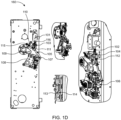
- Figs. 1A , 1B , 1C , and 1D disclose the device implementing the first charging and discharging mechanism for the ZVC spring.
- the device implementing the first charging and discharging mechanism may be referred hereinafter as a device 160.
- the device 106 comprises a ZVC 101, a ZVC plunger 103, a ZVC spring 102, a circuit breaking mechanism 108, a charging mechanism 130, and a discharging mechanism 140.
- the ZVC plunger 103 is arranged to be displaced between the charged position in which its held by a magnetic field generated by the ZVC 101, and a discharged position in which it is released by the ZVC 101.
- the ZVC spring 102 is connected to the ZVC plunger 103.
- the ZVC spring 102 is operable between a charged position corresponding to the charged position of the ZVC plunger and a discharged position corresponding to the discharged position of the ZVC plunger 103.
- the charging mechanism 130 is configured for displacing the ZVC spring 102 to its charged position.
- the charging mechanism 130 comprises a plural linkage mechanism configured to be connected in one end of the ZVC plunger 103 for enabling charging of the ZVC plunger 103 and of the ZVC spring 102 through a pivotation of at least one of links of the plural linkage mechanism.
- the charging mechanism 130 may comprise a rotary retention lever 109.
- the end referred herein may be an end of the plural linkage mechanism that is distant from the ZVC plunger 103.
- the rotation of the rotary retention lever 109 may cause a displacement of links of the plural linkage mechanism to a position in which the ZVC plunger 103 and the ZVC spring 102 are in their respective charged position and in which a spacing between at least two links of the plural linkage mechanism is present.
- the plural linkage mechanism of the charging mechanism 130 comprises a charging lever 110 and a cam element 112.
- the charging lever 110 un-releasably connected to cam via coupler 111.
- Cam releasably connected to plunger and to be releasably connected to the retention lever 109.
- the cam element 112 may be configured to be connected to the charging lever 110 by means of a coupler 111.
- the discharging mechanism 140 is configured to be connected to the ZVC plunger 103 and to be displaced by the ZVC spring 102 and the ZVC plunger 102 upon discharging of the ZVC spring 102, and the ZVC plunger 103 into a position in which it triggers the circuit breaking mechanism 108 to break the electrical circuit.
- the discharging mechanism comprises a plural linkage mechanism connected in one end to the ZVC plunger and in an opposite end with the circuit breaking mechanism 108.
- the discharging mechanism 140 comprises an L-bracket 102, a connection strip 105, and a bend bracket 106.
- the L-bracket 104 may be connected in one end to the ZVC plunger 103.
- the connection strip 105 may be connected to the L-bracket 104.
- the bend bracket 106 may be connected to the connection strip 105.
- the ZVC plunger 103 and the ZVC spring 102 When the ZVC plunger 103 and the ZVC spring 102 are in their respective charged position, there is a spacing between at least two links of the plural linkage mechanism of the charging mechanism 130, or between the charging mechanism 130 and the ZVC plunger 103 or between the charging mechanism 130 and any part of the discharging mechanism 140 via which the charging mechanism 130 is connected to the ZVC plunger 103.
- the spacing enables the ZVC plunger 103 to move from its charged position to its discharged position without being hindered by the charging mechanism 130. Thereby, to displace the discharging mechanism 140 to the position in which it triggers the circuit breaking mechanism 108 to break the electrical circuit.
- the ZVC spring 102 is in the discharged position.
- the ZVC spring 102 and the ZVC plunger 103 may be charged by the action of the charging mechanism 130.
- the retention lever 109 may be configured to rotate by exceeding a first pre-defined threshold for causing rotation of the charging lever 110 and for further causing rotation of the cam element 112 to displace the ZVC plunger 103 and the ZVC spring 102 to their respective charged position.
- the rotation of the retention lever 109 exceeding the first pre-defined threshold may be referred as an overtravel of the retention lever 109.
- the overtravel may be a variable parameter, which normally reduces with consecutive operations of the device 160.
- the overtravel may be dependent on a closing speed of the device 160. Higher the closing speed, higher will be the overtravel of the retention lever 109.
- the overtravel may also be a function of excess amount of energy available in a closing spring over an opening spring.
- the charging lever 110 comprises a spring 115 and a stopper pin 116.
- the spring 115 may be configured to rotate the charging lever 110, when the charging lever 110 crosses a first toggle position during charging of the ZVC spring 102 and the ZVC plunger 103 to their respective charged position by the action of the charging mechanism 130.
- the stopper pin 116 may be configured to stop rotation of the charging lever 110, when the charging lever 110 crosses a second toggle position during charging of the ZVC spring 102 and the ZVC plunger 103 to their respective charged position by the action of the charging mechanism 130.
- a profile of the cam element 112 may be designed in such a way that the cam element 112 would be able to charge the ZVC spring 102 at a minimum overtravel. Additionally, dwell may be provided on the cam element 112, so that it does not damage the ZVC 101 by causing dead-stop inside the ZVC 101 during a maximum overtravel.
- the cam element 112 comprises a pin 113 mounted on it.
- the pin 112 may be configured to slide inside a slot of a slotted lever 114 pivotally connected to the L-bracket 104, and the retention lever 109 may be configured to rotate further to a position in which said spacing exists between the retention lever 109 and the charging lever 110.
- disengagement of charging and discharging mechanism after charging of the ZVC spring 102 and the ZVC plunger 103 to their respective charged position may be advantageous, as it eliminates a need to test robustness of entire plural linkage mechanism of the charging mechanism 130 connected to the ZVC 101.
- the spring 115 on the charging lever 110 may show a tendency to rotate the charging lever 110 in a clockwise direction when the ZVC 101 is in a discharged condition.
- the spring 115 may show a tendency to rotate the charging lever 110 in an anticlockwise direction when and the charging lever 110 cross the first toggle position.
- the charging lever 110 may be stopped by the stopper pin 116 after crossing the second toggle position.
- the pin 113 on the cam element 112 may slide freely inside the slot of the slotted lever 114 during charging of the ZVC spring 102 and the ZVC plunger 103 to their respective charged position.
- the slotted lever 114 may have the slot such that at an end of charging of the ZVC spring 102 and the ZVC plunger 103 to their respective charged position, the pin 113 may touch an end of the slot of the slotted lever 114.
- the spacing/positive gap created between the retention lever 109 and the charging lever 110 ensures that the plural linkage mechanism of the charging mechanism may be operated only if the ZVC spring 102 and the ZVC plunger 103 are operated and as the ZVC 101 is operated for fewer operations compared to the device 106. Thus, eliminating a need to perform mechanical endurance test of the plural linkage mechanism of the charging mechanism 130.
- the device 160 in the closed position and the ZVC 101 (i.e., the ZVC spring 102 and the ZVC plunger 103) in the charged position with disengagement of the plural linkage mechanism of the charging mechanism 130 with the retention lever 109 is depicted in Fig. 1C .
- the plural linkage mechanism of the charging mechanism 130 Upon discharging of the ZVC spring 102, the plural linkage mechanism of the charging mechanism 130 has to restore its position as depicted in Fig. 1A .
- energy from the ZVC spring 102 may be utilized for two purposes.
- a first purpose is to disturb an equilibrium state of the circuit breaking mechanism 108 by the discharging mechanism 140, which may result in opening operation of the device 160.
- a second purpose is to reset the position of the charging mechanism 130, which may be achieved by the slotted lever 114, which pushes the pin 113 that causes rotation of the cam element 112 and ultimately the charging lever 110. This may cause the spring 115 to cross a toggle position, which may restore an initial configuration of the charging mechanism 130.
- the ZVC spring 102 in discharged position and the opening condition of the device 160 is depicted in Fig. 1D .
- Figs. 2A , 2B , and 2C disclose the device implementing the second charging and discharging mechanism for the ZVC spring.
- the device implementing the second charging and discharging mechanism may be referred hereinafter as a device 260.
- the device 260 comprises a ZVC 201, a ZVC plunger 203, a ZVC spring 202, a circuit breaking mechanism 208, a charging mechanism 230, and a discharging mechanism 240.
- the ZVC plunger 203 is arranged to be displaced between the charged position in which its held by a magnetic field generated by the ZVC 201, and a discharged position in which it is released by the ZVC 201.
- the ZVC spring 202 is connected to the ZVC plunger 203.
- the ZVC spring 202 is operable between a charged position corresponding to the charged position of the ZVC plunger 203 and a discharged position corresponding to the discharged position of the ZVC plunger 203.
- the charging mechanism 230 is configured to displace the ZVC spring 202 to its charged position.
- the charging mechanism 230 comprises a plural linkage mechanism configured to be connected in one end of the ZVC plunger 203 for enabling charging of the ZVC plunger 203 and of the ZVC spring 202 through a pivotation of at least one of links of the plural linkage mechanism.
- the charging mechanism 230 comprises the retention lever 209 and charging lever 210.
- the charging lever 210 may be configured to be connected to the plunger 203 with connection link 222 by lower pair and to retention lever 209 by higher pair.
- the discharging mechanism 240 is configured to be connected to the ZVC plunger 203 and to be displaced by the ZVC spring 202 and the ZVC plunger 203 upon discharging of the ZVC spring 202, and the ZVC plunger 203 into a position in which it triggers the circuit breaking mechanism 208 to break the electrical circuit.
- the discharging mechanism 240 comprises a plural linage mechanism connected in one end to the ZVC plunger 203 and in an opposite end with the circuit breaking mechanism 208.
- the plural linkage mechanism of the discharging mechanism 240 comprises a connection link 222, a connection strip 205, and a bend bracket 206.
- the connection link 222 may be connected in one end to the ZVC plunger 203.
- the connection strip 205 may be connected to the connection link 222.
- the bend bracket 206 may be connected to the connection strip 205 and to the circuit breaking mechanism 208.
- the charging lever 210 is connected to the ZVC plunger 203 via the connecting link 222.
- the ZVC plunger 203 and the ZVC spring 202 When the ZVC plunger 203 and the ZVC spring 202 are in their respective charged position, there is a spacing between at least two links of the plural linkage mechanism of the charging mechanism 230, or between the charging mechanism 230 and the ZVC plunger 203 or between the charging mechanism 230 and any part of the discharging mechanism 240 via which the charging mechanism 230 is connected to the ZVC plunger 203.
- the spacing enables the ZVC plunger 203 to move from its charged position to its discharged position without being hindered by the charging mechanism 230. Thereby, to displace the discharging mechanism 240 to the position in which it triggers the circuit breaking mechanism 208 to break the electrical circuit.
- the charging mechanism 230 may comprise the rotary retention lever 209.
- the end referred herein may be an end of the plural linkage mechanism that is distant from the ZVC plunger 203.
- the rotation of the rotary retention lever 209 may cause a displacement of the links of the plural linkage mechanism to a position in which the ZVC plunger 203 and the ZVC spring 202 are in their respective charged position and in which the spacing between at least two links of the plural linkage mechanism is present.
- the device 260 may be in the open position.
- a supply may be provided to the ZVC 201.
- an additional mechanism may be used to push the ZVC plunger 203 against the ZVC spring 202.
- the ZVC spring 202 and the ZVC plunger 203 may be charged to their respective charged position by the action of the charging mechanism 230.
- the retention lever 209 may be configured to rotate (in a counter clockwise direction) by exceeding the first pre-defined threshold. Rotation of the retention lever 209 exceeding the first pre-defined threshold may be referred as overtravel of the retention lever 209 or rotation of the retention lever 209 in an overtravel zone.
- Rotation of the retention lever 209 in the overtravel zone may cause rotation of the charging lever 210 to displace the ZVC plunger 203 and the ZVC spring 202 via the connection link 222 to their respective charged position.
- rotation of the charging lever 210 may cause the ZVC plunger 203 to start moving in an upward direction.
- the ZVC plunger 203 may be pulled and hold by the magnetic force generated by the ZVC 201.
- a profile on the retention lever 209 is such that even if the retention lever 209 rotates excess in the overtravel, it may not rotate the charging lever 210 after certain rotation, as depicted in Fig. 2C (i.e., the charging lever 210 may be in dwell condition).
- the retention lever 209 may start rotating back in an opposite direction and may be locked on the circuit breaking mechanism 208, as depicted in Fig. 2D .
- the retention lever 209 and the charging lever 210 may be spaced apart by the spacing. The said spacing may be required for discharging of the ZVC spring 202 and ultimately tripping the device 260.
- the ZVC 201 may lose its magnetic force and the ZVC spring 202 may be configured to displace the ZVC plunger 203 (in a downward direction) and the connection link 222 to which the charging lever 210 is connected. Thereby, causing rotation of the charging lever 210 back to a position in which it will be releasably connected by the retention lever 209 upon rotation of the retention lever 209 to the first pre-defined threshold during the subsequent charging operation.
- the charging lever 210 may be further configured to transfer motion to the bend bracket 206 through the connection link 205.
- the bend bracket 206 may rotate and hit a latch catch connected to the circuit breaking mechanism 208 to rotate it. Rotation of the latch catch disturbs an equilibrium state of the circuit breaking mechanism 209. Thereby, triggering the circuit breaking mechanism 208 to break the electrical circuit, as depicted in Fig. 2E .
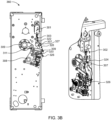
- Figs. 3A , 3B , and 3C disclose the device implementing the third charging and discharging mechanism for the ZVC spring.
- the device implementing the third breaking mechanism may be referred hereinafter as a device 360.
- the device 360 comprises a ZVC 301, a ZVC plunger 303, a ZVC spring 302, a circuit breaking mechanism 308, a charging mechanism 330, and a discharging mechanism 340.
- the ZVC plunger 303 is arranged to be displaced between the charged position in which its held by a magnetic field generated by the ZVC 301, and a discharged position in which it is released by the ZVC 301.
- the ZVC spring 302 is connected to the ZVC plunger 303.
- the ZVC spring 302 is operable between a charged position corresponding to the charged position of the ZVC plunger 303 and a discharged position corresponding to the discharged position of the ZVC plunger 303.
- the charging mechanism 330 is configured to displace the ZVC spring 302 to its charged position.
- the charging mechanism 330 comprises a plural linkage mechanism configured to be connected in one end of the ZVC plunger 303 for enabling charging of the ZVC plunger 303 and of the ZVC spring 302 through a pivotation of at least one of links of the plural linkage mechanism.
- the discharging mechanism 340 is configured to be connected to the ZVC plunger 303 and to be displaced by the ZVC spring 302 and the ZVC plunger 303 upon discharging of the ZVC spring 302, and the ZVC plunger 303 into a position in which it triggers the circuit breaking mechanism 308 to break the electrical circuit.
- the discharging mechanism 340 comprises a plural linage mechanism connected in one end to the ZVC plunger 303 and in an opposite end with the circuit breaking mechanism 308.
- the ZVC plunger 303 and the ZVC spring 302 When the ZVC plunger 303 and the ZVC spring 302 are in their respective charged position, there is a spacing between at least two links of the plural linkage mechanism of the charging mechanism 330, or between the charging mechanism 330 and the ZVC plunger 303 or between the charging mechanism 330 and any part of the discharging mechanism 340 via which the charging mechanism 330 is connected to the ZVC plunger 303.
- the spacing enables the ZVC plunger 303 to move from its charged position to its discharged position without being hindered by the charging mechanism 330. Thereby, to displace the discharging mechanism 340 to the position in which it triggers the circuit breaking mechanism 308 to break the electrical circuit.
- the charging mechanism 330 may comprise a rotary retention lever 309.
- the end referred herein may be an end of the plural linkage mechanism that is distant from the ZVC plunger 303.
- the rotation of the rotary retention lever 309 may cause a displacement of the links of the plural linkage mechanism to a position in which the ZVC plunger 303 and the ZVC spring 302 are in their respective charged position and in which the spacing between at least two links of the plural linkage mechanism is present.
- the charging mechanism 330 comprises the retention lever 309, a coupler 311, and an oscillator 328.
- the coupler 311 may be connected to the retention lever 309.
- the oscillator 328 may be connected to the coupler 311.
- the discharging mechanism 340 comprises a connecting link 322, a charging link 324, a connection strip 305, and a bend bracket 326.
- the connecting link 322 may be connected in one end to the ZVC plunger 303.
- the charging link 324 may be connected to the connecting link 322.
- the connection strip 305 may be connected in one end to the charging link 324.
- the bend bracket 326 may be connected in one end to the connection strip 305 and in opposite end to the circuit breaking mechanism 308.
- the oscillator 328 may have a charging pin 327, which may be connectable to the charging link 324 and configured to push the charging link 324 upon a pre-determined rotation of the retention lever 309. Thereby inducing charging motion of the ZVC plunger 303 and the ZVC spring 302. After rotation of the retention lever 309 such that charging of the ZVC plunger 303 and the ZVC spring 302 is achieved, the retention lever 309 is configured to be rotated in an opposite direction such that said spacing is formed between the charging pin 327 and the charging link 324.
- the ZVC spring 302 and the ZVC plunger 303 may be charged to their respective charged position by the action of the charging mechanism 330.
- the retention lever 309 may be configured to displace the oscillator 328.
- the oscillator 328 may be configured to push the charging link 324 at an end of an opening stroke for enabling the charging link 324, the connection link 322, and the plunger 303 to displace the ZVC spring 302 and the ZVC plunger 303 to their respective charged position.
- the charging link 324, the connection strip 305, and the bend bracket 326 may be configured to move for bringing the circuit breaking mechanism 308 to a latched condition.
- the retention lever 309 may cause the oscillator 328 to rotate by a desired angle, which may create the spacing between the charging pin 327 and the charging link 324.
- the said spacing may be necessary for discharging of the ZVC spring 302/ZVC 301 without encountering the dead-stop.
- the ZVC spring 302 when the ZVC spring 302 moves to its discharged position during the tripping operation of the device 360, the ZVC spring 302 may be configured to transfer energy to a latch catch of the circuit breaking mechanism 308 by means of the discharging mechanism 340 for disturbing an equilibrium of the circuit breaking mechanism 308 and to further release the retention lever 309 from the circuit breaking mechanism 308.
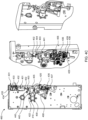
- Figs. 4A , 4B , and 4C disclose the device implementing the fourth charging and discharging mechanism for the ZVC spring.
- the device implementing the fourth breaking mechanism may be referred hereinafter as a device 460.
- the device 460 comprises a ZVC 401, a ZVC plunger 403, a ZVC spring 402, a circuit breaking mechanism 408, a charging mechanism 430, and a discharging mechanism 440.
- the ZVC plunger 403 is arranged to be displaced between the charged position in which its held by a magnetic field generated by the ZVC 401, and a discharged position in which it is released by the ZVC 401.
- the ZVC spring 402 is connected to the ZVC plunger 403.
- the ZVC spring 402 is operable between a charged position corresponding to the charged position of the ZVC plunger 403 and a discharged position corresponding to the discharged position of the ZVC plunger 403.
- the charging mechanism 430 is configured to displace the ZVC spring 402 to its charged position.
- the charging mechanism 430 comprises a plural linkage mechanism configured to be connected in one end of the ZVC plunger 403 for enabling charging of the ZVC plunger 403 and of the ZVC spring 402 through a pivotation of at least one of links of the plural linkage mechanism.
- the discharging mechanism 440 is configured to be connected to the ZVC plunger 403 and to be displaced by the ZVC spring 402 and the ZVC plunger 402 upon discharging of the ZVC spring 402, and the ZVC plunger 403 into a position in which it triggers the circuit breaking mechanism 408 to break the electrical circuit.
- the discharging mechanism 440 comprises a plural linage mechanism connected in one end to the ZVC plunger 403 and in an opposite end with the circuit breaking mechanism 408.
- the ZVC plunger 403 and the ZVC spring 402 When the ZVC plunger 403 and the ZVC spring 402 are in their respective charged position, there is a spacing between at least two links of the plural linkage mechanism of the charging mechanism 430, or between the charging mechanism 430 and the ZVC plunger 403 or between the charging mechanism 430 and any part of the discharging mechanism 440 via which the charging mechanism 430 is connected to the ZVC plunger 403.
- the spacing enables the ZVC plunger 403 to move from its charged position to its discharged position without being hindered by the charging mechanism 430. Thereby, to displace the discharging mechanism 440 to the position in which it triggers the circuit breaking mechanism 408 to break the electrical circuit.
- the charging mechanism 430 may comprise a rotary retention lever 409.
- the end referred herein may be an end of the plural linkage mechanism that is distant from the ZVC plunger 403.
- the rotation of the rotary retention lever 409 may cause a displacement of the links of the plural linkage mechanism to a position in which the ZVC plunger 403 and the ZVC spring 402 are in their respective charged position and in which the spacing between at least two links of the plural linkage mechanism is present.
- the charging mechanism 430 comprises the retention lever 409 and a charging lever 410.
- the charging lever 410 may be spring-loaded such that it exerts a charging force on the ZVC plunger 403.
- the retention lever 409 may be configured to be rotated such that it counteracts the spring load on the charging lever 410. After charging of the ZVC plunger 403 and the ZVC spring 402 by the action of the charging lever 410, the retention lever 409 is configured to be rotated to a pre-determined angular position such that it pivots the charging lever 410 to a position in which the spacing is present between the charging lever 410 and the ZVC plunger 403. The retention lever 409 may be further configured to engage and close the circuit breaker mechanism 408 upon being rotated to the pre-determined angular position. Upon discharging of the ZVC spring 403/ZVC plunger 403, the discharging mechanism 440 may trigger an opening of the circuit breaker mechanism 408. Such an opening may trigger a rotation of the retention lever 409 to an angular position in which the retention lever does not engage the charging lever 410. Thereby, enabling the charging lever 410 to apply its spring force on the ZVC plunger 403 for the charging thereof.
- the charging mechanism 430 may also comprise a stop pin 443 (also be referred to as eccentric pin) along with the retention lever 409 and the charging lever 410.
- the charging lever 410 may be rotatably mounted on the stop pin 443. By rotating the stop pin 443 during the opening operation of the device 460, angular position of the charging lever 410 may be set.
- the stop pin 443 may be configured to prevent the charging lever 410 from pivoting beyond a point at which remaining motion of the ZVC plunger 403 to its charged position is enabled by application of a pre-determined voltage on the ZVC 401.
- the discharging mechanism 440 comprises an L-bracket 404, a connection strip 405, and a bend bracket 406.
- the connection strip 405 may be connected to the L-bracket 404.
- the bend bracket 406 may be connected to the connection strip 405 and to the circuit breaking mechanism 408.
- the device 460 further comprises a torsion spring 441 and a spring stopper pin 442.
- the torsion spring 441 may be configured to apply the spring load on the charging lever 410. Also, a position of the charging lever 410 may be secured by the torsion spring 441.
- the spring stopper pin 442 may be configured to support a fixed leg of the torsion spring 441.
- the charging lever 410 is configured to displace the ZVC plunger 403 by means of the torsion spring 441 for displacing the ZVC spring 402 and the ZVC plunger 403 to the respective charged position.
- the ZVC spring 402 may be charged by eliminating issues related to dependency on overtravel of the retention lever 409. Further, using the fourth charging and discharging mechanism, the device 460 may be tripped at increased friction and relaxed spring conditions.
- the retention lever 409 is configured to rotate and interact with the charging lever 410 for causing the charging lever 410 to rotate and disengage from the ZVC plunger 403.
- the retention lever 409 may lock on the circuit breaking mechanism 408, as depicted in Fig. 4B .
- the ZVC plunger 403 may maintain its position due to magnetic pulling force of the ZVC 401, which may result in the spacing between the ZVC plunger 403 and the charging lever 410. The said spacing may be essential during tripping operation of the device 460 using the ZVC 401.
- the ZVC spring 402 starts discharging.
- the ZVC spring 402 may be configured to displace the ZVC plunger 403 in a downward direction.
- the downward motion of the ZVC plunger 403 may be transferred to a latch catch of the circuit breaking mechanism 408 using the discharging mechanism 440. Due to the movement of the latch catch, the equilibrium of the circuit breaking mechanism 408 may be disturbed and may result in tripping of the device 460.
- the retention lever 409 may rotate in a clockwise direction and the charging lever 410 may rotate in a counter clockwise direction to push the ZVC plunger 403 in the upward direction for enabling the ZVC spring 402 to move towards the charged position, as depicted in Fig. 4C .
- the device 460 further comprises a blockage assembly 432, and a micro switch 435.
- the blockage assembly 432 comprises a threaded bush 433, which may be configured to lock the ZVC plunger 403 in a lock condition using a bolt 431 for mechanically blocking the ZVC spring 402.
- the micro switch 435 may be configured to provide an alert indicating that the ZVC spring 402 is being blocked manually.
- the device 460 further comprises a holder 436, a latch link 437, and a latch torsion spring 438.
- the holder 436 may be configured to be mounted on the circuit breaking mechanism 408.
- the latch link 437 may be configured to be assembled on the holder 436 using a pin 439.
- the latch torsion spring 438 may be configured to be arranged between the holder 436 and the latch link 437 and over the pin 439.
- the latch link 437 may be operated against a torque of the latch torsion spring 438 for manually tripping of the device 460.
- all the charging and discharging mechanisms implemented by the device may be designed by considering one or more of: no dependency on open orientation of a retention lever of the charging mechanism, a minimum number of links in the charging mechanism, minimum horizontal force on the ZVC plunger, and high margin for force available to trip/break the device.
- the ZVC spring may be charged without any failure.
Landscapes
- Mechanisms For Operating Contacts (AREA)
Priority Applications (1)
| Application Number | Priority Date | Filing Date | Title |
|---|---|---|---|
| EP23160189.9A EP4428893A1 (de) | 2023-03-06 | 2023-03-06 | Betätigungsmechanismus für null-volt-spule-feder in einem schutzschalter |
Applications Claiming Priority (1)
| Application Number | Priority Date | Filing Date | Title |
|---|---|---|---|
| EP23160189.9A EP4428893A1 (de) | 2023-03-06 | 2023-03-06 | Betätigungsmechanismus für null-volt-spule-feder in einem schutzschalter |
Publications (1)
| Publication Number | Publication Date |
|---|---|
| EP4428893A1 true EP4428893A1 (de) | 2024-09-11 |
Family
ID=85505744
Family Applications (1)
| Application Number | Title | Priority Date | Filing Date |
|---|---|---|---|
| EP23160189.9A Pending EP4428893A1 (de) | 2023-03-06 | 2023-03-06 | Betätigungsmechanismus für null-volt-spule-feder in einem schutzschalter |
Country Status (1)
| Country | Link |
|---|---|
| EP (1) | EP4428893A1 (de) |
Citations (3)
| Publication number | Priority date | Publication date | Assignee | Title |
|---|---|---|---|---|
| US5093643A (en) * | 1990-10-22 | 1992-03-03 | Westinghouse Electric Corp. | Undervoltage release device assembly for circuit breaker |
| EP0813219A1 (de) * | 1996-06-10 | 1997-12-17 | Siemens Aktiengesellschaft | Unterspannungsauslöser |
| WO2022180074A1 (en) * | 2021-02-24 | 2022-09-01 | Hitachi Energy Switzerland Ag | Operating mechanism for circuit breakers |
-
2023
- 2023-03-06 EP EP23160189.9A patent/EP4428893A1/de active Pending
Patent Citations (3)
| Publication number | Priority date | Publication date | Assignee | Title |
|---|---|---|---|---|
| US5093643A (en) * | 1990-10-22 | 1992-03-03 | Westinghouse Electric Corp. | Undervoltage release device assembly for circuit breaker |
| EP0813219A1 (de) * | 1996-06-10 | 1997-12-17 | Siemens Aktiengesellschaft | Unterspannungsauslöser |
| WO2022180074A1 (en) * | 2021-02-24 | 2022-09-01 | Hitachi Energy Switzerland Ag | Operating mechanism for circuit breakers |
Similar Documents
| Publication | Publication Date | Title |
|---|---|---|
| AU2006320816B2 (en) | Fault interrupting and reclosing device | |
| US4025883A (en) | Modular integral motor controller | |
| AU2009307039B2 (en) | Electrical switching apparatus | |
| CN105609386B (zh) | 控制与保护开关电器 | |
| EP3314628B1 (de) | Leistungsschalter mit strombegrenzender und hochgeschwindigkeitsfehlerkapazität | |
| KR20150006058A (ko) | 드롭아웃 재폐로 차단기 | |
| WO2017011370A1 (en) | Component for electric power system, and contact assembly and open air arcing elimination method therefor | |
| EP2788998B1 (de) | Auslösemechanismus sowie elektrische schaltung mit einem durch den druck aus einem lichtbogen in einer lichtbogenkammer gedrückten auslöseelement | |
| JP2011091042A (ja) | 瞬時トリップメカニズムを有する配線用遮断器 | |
| CN104040674B (zh) | 布线用断路器 | |
| US8542083B2 (en) | Collapsible mechanism for circuit breakers | |
| CA2633874C (en) | Fault interrupter and operating method | |
| CN107818891B (zh) | 具有在触点熔焊时可靠显示开关位置的装置的开关设备 | |
| EP3104385B1 (de) | Haltevorrichtung für ein schutzschalterkontaktsystem | |
| EP4428893A1 (de) | Betätigungsmechanismus für null-volt-spule-feder in einem schutzschalter | |
| EP3080830B1 (de) | Flussshuntauslöserschnittstelle und schutzschalterrückstellmechanismus für schutzschalter | |
| EP3319102B1 (de) | Anzeigevorrichtung eines elektrischen schalters | |
| EP3107112B1 (de) | Kontaktsystem eines schutzschalters, sowie schutzschalter | |
| CN113745019A (zh) | 一种带双重脱扣机构的后备保护器 | |
| EP4425517A1 (de) | Federantriebsanordnung für federantrieb eines leistungsschalters | |
| EP3275005B1 (de) | Elektrische schaltvorrichtung und auslösungsanordnung dafür | |
| RU2832649C1 (ru) | Интеллектуальный выключатель-разъединитель | |
| CN105489451B (zh) | 具有用于显示开关位置的闭锁装置的开关设备 | |
| CN111463079B (zh) | 断路器 | |
| GB2040573A (en) | Improvements in electric circuit breakers |
Legal Events
| Date | Code | Title | Description |
|---|---|---|---|
| PUAI | Public reference made under article 153(3) epc to a published international application that has entered the european phase |
Free format text: ORIGINAL CODE: 0009012 |
|
| STAA | Information on the status of an ep patent application or granted ep patent |
Free format text: STATUS: THE APPLICATION HAS BEEN PUBLISHED |
|
| AK | Designated contracting states |
Kind code of ref document: A1 Designated state(s): AL AT BE BG CH CY CZ DE DK EE ES FI FR GB GR HR HU IE IS IT LI LT LU LV MC ME MK MT NL NO PL PT RO RS SE SI SK SM TR |
|
| STAA | Information on the status of an ep patent application or granted ep patent |
Free format text: STATUS: REQUEST FOR EXAMINATION WAS MADE |
|
| 17P | Request for examination filed |
Effective date: 20250311 |
|
| STAA | Information on the status of an ep patent application or granted ep patent |
Free format text: STATUS: EXAMINATION IS IN PROGRESS |
|
| 17Q | First examination report despatched |
Effective date: 20260225 |