EP4431181A1 - Catalyseur pour la purification de gaz d'échappement et procédé de purification de gaz d'échappement l'utilisant - Google Patents
Catalyseur pour la purification de gaz d'échappement et procédé de purification de gaz d'échappement l'utilisant Download PDFInfo
- Publication number
- EP4431181A1 EP4431181A1 EP22892589.7A EP22892589A EP4431181A1 EP 4431181 A1 EP4431181 A1 EP 4431181A1 EP 22892589 A EP22892589 A EP 22892589A EP 4431181 A1 EP4431181 A1 EP 4431181A1
- Authority
- EP
- European Patent Office
- Prior art keywords
- catalyst
- alumina
- catalyst layer
- exhaust gas
- pore
- Prior art date
- Legal status (The legal status is an assumption and is not a legal conclusion. Google has not performed a legal analysis and makes no representation as to the accuracy of the status listed.)
- Pending
Links
Images
Classifications
-
- B—PERFORMING OPERATIONS; TRANSPORTING
- B01—PHYSICAL OR CHEMICAL PROCESSES OR APPARATUS IN GENERAL
- B01J—CHEMICAL OR PHYSICAL PROCESSES, e.g. CATALYSIS OR COLLOID CHEMISTRY; THEIR RELEVANT APPARATUS
- B01J35/00—Catalysts, in general, characterised by their form or physical properties
- B01J35/19—Catalysts containing parts with different compositions
-
- B—PERFORMING OPERATIONS; TRANSPORTING
- B01—PHYSICAL OR CHEMICAL PROCESSES OR APPARATUS IN GENERAL
- B01D—SEPARATION
- B01D53/00—Separation of gases or vapours; Recovering vapours of volatile solvents from gases; Chemical or biological purification of waste gases, e.g. engine exhaust gases, smoke, fumes, flue gases, aerosols
- B01D53/34—Chemical or biological purification of waste gases
- B01D53/92—Chemical or biological purification of waste gases of engine exhaust gases
- B01D53/94—Chemical or biological purification of waste gases of engine exhaust gases by catalytic processes
-
- B—PERFORMING OPERATIONS; TRANSPORTING
- B01—PHYSICAL OR CHEMICAL PROCESSES OR APPARATUS IN GENERAL
- B01D—SEPARATION
- B01D53/00—Separation of gases or vapours; Recovering vapours of volatile solvents from gases; Chemical or biological purification of waste gases, e.g. engine exhaust gases, smoke, fumes, flue gases, aerosols
- B01D53/34—Chemical or biological purification of waste gases
- B01D53/92—Chemical or biological purification of waste gases of engine exhaust gases
- B01D53/94—Chemical or biological purification of waste gases of engine exhaust gases by catalytic processes
- B01D53/9445—Simultaneously removing carbon monoxide, hydrocarbons or nitrogen oxides making use of three-way catalysts [TWC] or four-way-catalysts [FWC]
- B01D53/945—Simultaneously removing carbon monoxide, hydrocarbons or nitrogen oxides making use of three-way catalysts [TWC] or four-way-catalysts [FWC] characterised by a specific catalyst
-
- B—PERFORMING OPERATIONS; TRANSPORTING
- B01—PHYSICAL OR CHEMICAL PROCESSES OR APPARATUS IN GENERAL
- B01D—SEPARATION
- B01D53/00—Separation of gases or vapours; Recovering vapours of volatile solvents from gases; Chemical or biological purification of waste gases, e.g. engine exhaust gases, smoke, fumes, flue gases, aerosols
- B01D53/34—Chemical or biological purification of waste gases
- B01D53/92—Chemical or biological purification of waste gases of engine exhaust gases
- B01D53/94—Chemical or biological purification of waste gases of engine exhaust gases by catalytic processes
- B01D53/9459—Removing one or more of nitrogen oxides, carbon monoxide, or hydrocarbons by multiple successive catalytic functions; systems with more than one different function, e.g. zone coated catalysts
- B01D53/9463—Removing one or more of nitrogen oxides, carbon monoxide, or hydrocarbons by multiple successive catalytic functions; systems with more than one different function, e.g. zone coated catalysts with catalysts positioned on one brick
- B01D53/9468—Removing one or more of nitrogen oxides, carbon monoxide, or hydrocarbons by multiple successive catalytic functions; systems with more than one different function, e.g. zone coated catalysts with catalysts positioned on one brick in different layers
-
- B—PERFORMING OPERATIONS; TRANSPORTING
- B01—PHYSICAL OR CHEMICAL PROCESSES OR APPARATUS IN GENERAL
- B01J—CHEMICAL OR PHYSICAL PROCESSES, e.g. CATALYSIS OR COLLOID CHEMISTRY; THEIR RELEVANT APPARATUS
- B01J23/00—Catalysts comprising metals or metal oxides or hydroxides, not provided for in group B01J21/00
- B01J23/38—Catalysts comprising metals or metal oxides or hydroxides, not provided for in group B01J21/00 of noble metals
- B01J23/40—Catalysts comprising metals or metal oxides or hydroxides, not provided for in group B01J21/00 of noble metals of the platinum group metals
- B01J23/46—Ruthenium, rhodium, osmium or iridium
- B01J23/464—Rhodium
-
- B—PERFORMING OPERATIONS; TRANSPORTING
- B01—PHYSICAL OR CHEMICAL PROCESSES OR APPARATUS IN GENERAL
- B01J—CHEMICAL OR PHYSICAL PROCESSES, e.g. CATALYSIS OR COLLOID CHEMISTRY; THEIR RELEVANT APPARATUS
- B01J23/00—Catalysts comprising metals or metal oxides or hydroxides, not provided for in group B01J21/00
- B01J23/38—Catalysts comprising metals or metal oxides or hydroxides, not provided for in group B01J21/00 of noble metals
- B01J23/54—Catalysts comprising metals or metal oxides or hydroxides, not provided for in group B01J21/00 of noble metals combined with metals, oxides or hydroxides provided for in groups B01J23/02 - B01J23/36
- B01J23/56—Platinum group metals
- B01J23/63—Platinum group metals with rare earths or actinides
-
- B—PERFORMING OPERATIONS; TRANSPORTING
- B01—PHYSICAL OR CHEMICAL PROCESSES OR APPARATUS IN GENERAL
- B01J—CHEMICAL OR PHYSICAL PROCESSES, e.g. CATALYSIS OR COLLOID CHEMISTRY; THEIR RELEVANT APPARATUS
- B01J35/00—Catalysts, in general, characterised by their form or physical properties
- B01J35/50—Catalysts, in general, characterised by their form or physical properties characterised by their shape or configuration
- B01J35/56—Foraminous structures having flow-through passages or channels, e.g. grids or three-dimensional [3D] monoliths
-
- B—PERFORMING OPERATIONS; TRANSPORTING
- B01—PHYSICAL OR CHEMICAL PROCESSES OR APPARATUS IN GENERAL
- B01J—CHEMICAL OR PHYSICAL PROCESSES, e.g. CATALYSIS OR COLLOID CHEMISTRY; THEIR RELEVANT APPARATUS
- B01J35/00—Catalysts, in general, characterised by their form or physical properties
- B01J35/60—Catalysts, in general, characterised by their form or physical properties characterised by their surface properties or porosity
- B01J35/61—Surface area
- B01J35/613—10-100 m2/g
-
- B—PERFORMING OPERATIONS; TRANSPORTING
- B01—PHYSICAL OR CHEMICAL PROCESSES OR APPARATUS IN GENERAL
- B01J—CHEMICAL OR PHYSICAL PROCESSES, e.g. CATALYSIS OR COLLOID CHEMISTRY; THEIR RELEVANT APPARATUS
- B01J35/00—Catalysts, in general, characterised by their form or physical properties
- B01J35/60—Catalysts, in general, characterised by their form or physical properties characterised by their surface properties or porosity
- B01J35/63—Pore volume
- B01J35/633—Pore volume less than 0.5 ml/g
-
- B—PERFORMING OPERATIONS; TRANSPORTING
- B01—PHYSICAL OR CHEMICAL PROCESSES OR APPARATUS IN GENERAL
- B01J—CHEMICAL OR PHYSICAL PROCESSES, e.g. CATALYSIS OR COLLOID CHEMISTRY; THEIR RELEVANT APPARATUS
- B01J37/00—Processes, in general, for preparing catalysts; Processes, in general, for activation of catalysts
- B01J37/02—Impregnation, coating or precipitation
- B01J37/0236—Drying, e.g. preparing a suspension, adding a soluble salt and drying
-
- B—PERFORMING OPERATIONS; TRANSPORTING
- B01—PHYSICAL OR CHEMICAL PROCESSES OR APPARATUS IN GENERAL
- B01J—CHEMICAL OR PHYSICAL PROCESSES, e.g. CATALYSIS OR COLLOID CHEMISTRY; THEIR RELEVANT APPARATUS
- B01J37/00—Processes, in general, for preparing catalysts; Processes, in general, for activation of catalysts
- B01J37/02—Impregnation, coating or precipitation
- B01J37/024—Multiple impregnation or coating
- B01J37/0244—Coatings comprising several layers
-
- B—PERFORMING OPERATIONS; TRANSPORTING
- B01—PHYSICAL OR CHEMICAL PROCESSES OR APPARATUS IN GENERAL
- B01J—CHEMICAL OR PHYSICAL PROCESSES, e.g. CATALYSIS OR COLLOID CHEMISTRY; THEIR RELEVANT APPARATUS
- B01J37/00—Processes, in general, for preparing catalysts; Processes, in general, for activation of catalysts
- B01J37/02—Impregnation, coating or precipitation
- B01J37/024—Multiple impregnation or coating
- B01J37/0248—Coatings comprising impregnated particles
-
- B—PERFORMING OPERATIONS; TRANSPORTING
- B01—PHYSICAL OR CHEMICAL PROCESSES OR APPARATUS IN GENERAL
- B01J—CHEMICAL OR PHYSICAL PROCESSES, e.g. CATALYSIS OR COLLOID CHEMISTRY; THEIR RELEVANT APPARATUS
- B01J37/00—Processes, in general, for preparing catalysts; Processes, in general, for activation of catalysts
- B01J37/08—Heat treatment
- B01J37/082—Decomposition and pyrolysis
- B01J37/088—Decomposition of a metal salt
-
- F—MECHANICAL ENGINEERING; LIGHTING; HEATING; WEAPONS; BLASTING
- F01—MACHINES OR ENGINES IN GENERAL; ENGINE PLANTS IN GENERAL; STEAM ENGINES
- F01N—GAS-FLOW SILENCERS OR EXHAUST APPARATUS FOR MACHINES OR ENGINES IN GENERAL; GAS-FLOW SILENCERS OR EXHAUST APPARATUS FOR INTERNAL-COMBUSTION ENGINES
- F01N3/00—Exhaust or silencing apparatus having means for purifying, rendering innocuous, or otherwise treating exhaust
- F01N3/08—Exhaust or silencing apparatus having means for purifying, rendering innocuous, or otherwise treating exhaust for rendering innocuous
- F01N3/10—Exhaust or silencing apparatus having means for purifying, rendering innocuous, or otherwise treating exhaust for rendering innocuous by thermal or catalytic conversion of noxious components of exhaust
-
- F—MECHANICAL ENGINEERING; LIGHTING; HEATING; WEAPONS; BLASTING
- F01—MACHINES OR ENGINES IN GENERAL; ENGINE PLANTS IN GENERAL; STEAM ENGINES
- F01N—GAS-FLOW SILENCERS OR EXHAUST APPARATUS FOR MACHINES OR ENGINES IN GENERAL; GAS-FLOW SILENCERS OR EXHAUST APPARATUS FOR INTERNAL-COMBUSTION ENGINES
- F01N3/00—Exhaust or silencing apparatus having means for purifying, rendering innocuous, or otherwise treating exhaust
- F01N3/08—Exhaust or silencing apparatus having means for purifying, rendering innocuous, or otherwise treating exhaust for rendering innocuous
- F01N3/10—Exhaust or silencing apparatus having means for purifying, rendering innocuous, or otherwise treating exhaust for rendering innocuous by thermal or catalytic conversion of noxious components of exhaust
- F01N3/101—Three-way catalysts
-
- F—MECHANICAL ENGINEERING; LIGHTING; HEATING; WEAPONS; BLASTING
- F01—MACHINES OR ENGINES IN GENERAL; ENGINE PLANTS IN GENERAL; STEAM ENGINES
- F01N—GAS-FLOW SILENCERS OR EXHAUST APPARATUS FOR MACHINES OR ENGINES IN GENERAL; GAS-FLOW SILENCERS OR EXHAUST APPARATUS FOR INTERNAL-COMBUSTION ENGINES
- F01N3/00—Exhaust or silencing apparatus having means for purifying, rendering innocuous, or otherwise treating exhaust
- F01N3/08—Exhaust or silencing apparatus having means for purifying, rendering innocuous, or otherwise treating exhaust for rendering innocuous
- F01N3/10—Exhaust or silencing apparatus having means for purifying, rendering innocuous, or otherwise treating exhaust for rendering innocuous by thermal or catalytic conversion of noxious components of exhaust
- F01N3/24—Exhaust or silencing apparatus having means for purifying, rendering innocuous, or otherwise treating exhaust for rendering innocuous by thermal or catalytic conversion of noxious components of exhaust characterised by constructional aspects of converting apparatus
- F01N3/28—Construction of catalytic reactors
-
- B—PERFORMING OPERATIONS; TRANSPORTING
- B01—PHYSICAL OR CHEMICAL PROCESSES OR APPARATUS IN GENERAL
- B01D—SEPARATION
- B01D2255/00—Catalysts
- B01D2255/10—Noble metals or compounds thereof
- B01D2255/102—Platinum group metals
- B01D2255/1023—Palladium
-
- B—PERFORMING OPERATIONS; TRANSPORTING
- B01—PHYSICAL OR CHEMICAL PROCESSES OR APPARATUS IN GENERAL
- B01D—SEPARATION
- B01D2255/00—Catalysts
- B01D2255/10—Noble metals or compounds thereof
- B01D2255/102—Platinum group metals
- B01D2255/1025—Rhodium
-
- B—PERFORMING OPERATIONS; TRANSPORTING
- B01—PHYSICAL OR CHEMICAL PROCESSES OR APPARATUS IN GENERAL
- B01D—SEPARATION
- B01D2255/00—Catalysts
- B01D2255/20—Metals or compounds thereof
- B01D2255/204—Alkaline earth metals
-
- B—PERFORMING OPERATIONS; TRANSPORTING
- B01—PHYSICAL OR CHEMICAL PROCESSES OR APPARATUS IN GENERAL
- B01D—SEPARATION
- B01D2255/00—Catalysts
- B01D2255/20—Metals or compounds thereof
- B01D2255/209—Other metals
- B01D2255/2092—Aluminium
-
- B—PERFORMING OPERATIONS; TRANSPORTING
- B01—PHYSICAL OR CHEMICAL PROCESSES OR APPARATUS IN GENERAL
- B01D—SEPARATION
- B01D2255/00—Catalysts
- B01D2255/40—Mixed oxides
- B01D2255/407—Zr-Ce mixed oxides
-
- B—PERFORMING OPERATIONS; TRANSPORTING
- B01—PHYSICAL OR CHEMICAL PROCESSES OR APPARATUS IN GENERAL
- B01D—SEPARATION
- B01D2255/00—Catalysts
- B01D2255/90—Physical characteristics of catalysts
- B01D2255/902—Multilayered catalyst
- B01D2255/9022—Two layers
-
- B—PERFORMING OPERATIONS; TRANSPORTING
- B01—PHYSICAL OR CHEMICAL PROCESSES OR APPARATUS IN GENERAL
- B01D—SEPARATION
- B01D2255/00—Catalysts
- B01D2255/90—Physical characteristics of catalysts
- B01D2255/908—O2-storage component incorporated in the catalyst
-
- B—PERFORMING OPERATIONS; TRANSPORTING
- B01—PHYSICAL OR CHEMICAL PROCESSES OR APPARATUS IN GENERAL
- B01D—SEPARATION
- B01D2255/00—Catalysts
- B01D2255/90—Physical characteristics of catalysts
- B01D2255/92—Dimensions
- B01D2255/9205—Porosity
-
- B—PERFORMING OPERATIONS; TRANSPORTING
- B01—PHYSICAL OR CHEMICAL PROCESSES OR APPARATUS IN GENERAL
- B01D—SEPARATION
- B01D2257/00—Components to be removed
- B01D2257/40—Nitrogen compounds
- B01D2257/404—Nitrogen oxides other than dinitrogen oxide
-
- B—PERFORMING OPERATIONS; TRANSPORTING
- B01—PHYSICAL OR CHEMICAL PROCESSES OR APPARATUS IN GENERAL
- B01D—SEPARATION
- B01D2257/00—Components to be removed
- B01D2257/50—Carbon oxides
- B01D2257/502—Carbon monoxide
-
- B—PERFORMING OPERATIONS; TRANSPORTING
- B01—PHYSICAL OR CHEMICAL PROCESSES OR APPARATUS IN GENERAL
- B01D—SEPARATION
- B01D2257/00—Components to be removed
- B01D2257/70—Organic compounds not provided for in groups B01D2257/00 - B01D2257/602
- B01D2257/702—Hydrocarbons
-
- B—PERFORMING OPERATIONS; TRANSPORTING
- B01—PHYSICAL OR CHEMICAL PROCESSES OR APPARATUS IN GENERAL
- B01D—SEPARATION
- B01D2258/00—Sources of waste gases
- B01D2258/01—Engine exhaust gases
- B01D2258/012—Diesel engines and lean burn gasoline engines
Definitions
- the present invention relates to a catalyst for exhaust gas purification and an exhaust gas purification method using the same.
- a large number of techniques have been conventionally proposed.
- various techniques have been proposed for the purpose of removal of hydrocarbons (HC), carbon monoxide (CO), and nitrogen oxides (NOx) contained in the exhaust gas.
- HC hydrocarbons
- CO carbon monoxide
- NOx nitrogen oxides
- a three-way catalyst containing a first layer containing palladium, alumina, and a ceria-zirconia composite oxide and a second layer containing rhodium, alumina, and a ceria-zirconia composite oxide, sequentially laminated on a three-dimensional structure have been proposed ( JP2009-541041A (corresponding to US2010/0263357 )).
- the present invention has been made in view of the aforementioned situation, and an object thereof is to provide a means for improving catalytic performance of a catalyst for exhaust gas purification.
- the present inventors made intensive studies in order to solve the above-described problems. As a result, they found that the problems can be solved by sequentially forming a catalyst layer containing rhodium and a catalyst layer containing palladium and a specific amount of strontium onto a three-dimensional structure, and increasing the volume of pores having a specific pore size, whereby the invention was completed.
- a first aspect of the invention relates to a catalyst for exhaust gas purification, containing a first catalyst layer and a second catalyst layer sequentially laminated onto a three-dimensional structure, in which the first catalyst layer contains rhodium, the second catalyst layer contains palladium, strontium and an alumina, the strontium content in the second catalyst layer (in terms of strontium oxide) per 1 liter of the three-dimensional structure is more than 0 g/L and less than 15 g/L, and the catalyst for exhaust gas purification has a pore volume of pores having a pore size of 2 nm or more and 40 nm or less of more than 0.26 mL/g in a pore volume distribution measured by nitrogen adsorption method.
- a second aspect of the invention relates to a method for purifying exhaust gas of a gasoline engine, including treating exhaust gas emitted from a gasoline engine using the catalyst for exhaust gas purification of the invention.
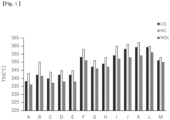
- Fig. 1 is a bar graph showing T50 (°C) for carbon monoxide (CO), hydrocarbons (HC), and nitrogen oxides (NOx) of catalysts A to M.
- a first aspect of the invention relates to a catalyst for exhaust gas purification, containing a first catalyst layer and a second catalyst layer sequentially laminated onto a three-dimensional structure, in which the first catalyst layer contains rhodium, the second catalyst layer contains palladium, strontium and an alumina, the strontium content in the second catalyst layer (in terms of strontium oxide) per 1 liter of the three-dimensional structure is more than 0 g/L and less than 15 g/L, and the catalyst for exhaust gas purification has a pore volume of pores having a pore size of 2 nm or more and 40 nm or less of more than 0.26 mL/g in a pore volume distribution measured by nitrogen adsorption method.
- a second aspect of the invention relates to a method for purifying exhaust gas of a gasoline engine, including treating exhaust gas emitted from a gasoline engine using the catalyst for exhaust gas purification of the invention.
- catalytic performance can be improved in a catalyst for exhaust gas purification.
- the pore volume distribution measured by nitrogen adsorption method will also be referred to simply as "pore volume distribution”.
- the pore volume of pores having a pore size of 2 nm or more and 40 nm or less in a pore volume distribution measured by nitrogen adsorption method will also be referred to simply as "pore volume of pores having a pore size of 2 nm or more and 40 nm or less” or “V 2-40nm ".
- the strontium content (in terms of strontium oxide) per 1 liter of the three-dimensional structure will also be referred to simply as a "content of strontium", “Sr content”, “content of strontium according to the invention”, or “Sr content according to the invention”.
- X to Y indicating a range includes X and Y and means “X or more and Y or less”.
- a and/or B means at least one of A and B, and includes both A and B, or either one of A or B. Unless otherwise specified, operations and measurement of physical properties or the like are performed under the condition of room temperature (20 to 25°C).
- a catalyst according to the invention is characterized in that it includes two catalyst layers, in which a first catalyst layer (a lower layer on the three-dimensional structure side) contains rhodium; a second catalyst layer (an upper layer on the side to be brought into contact with exhaust gas) contains palladium, per 1 liter of the three-dimensional structure more than 0 g/L and less than 15 g/L of strontium (in terms of SrO), and an alumina; and a pore volume (V 2-40nm ) of pores having a pore size of 2 nm or more and 40 nm or less is more than 0.26 mL/g.
- a catalyst described in JP2009-541041A (corresponding to US2010/0263357 ) has the inverse order of lamination to that in the catalyst of the invention (namely, the first catalyst layer contains palladium, strontium, and an alumina; and the second catalyst layer contains rhodium).
- the layer containing rhodium is arranged on the side to be brought into contact with exhaust gas, the NO-CO reaction (reduction reaction of NOx) and the CO-O 2 reaction (oxidation reaction of CO) proceed in the surface layer, and thereby NOx and CO can be efficiently purified.
- the first catalyst layer (a lower layer on the three-dimensional structure side) contains rhodium
- the second catalyst layer (an upper layer on the side to be brought into contact with exhaust gas) contains palladium, strontium, and an alumina.
- the second catalyst layer containing palladium is arranged on the side to be brought into contact with exhaust gas as describedabove, the HC-O 2 reaction and the like (oxidation reaction of HC) proceeds in a surface layer, and thereby hydrocarbons (HC) can be efficiently purified.
- the catalyst according to the invention has a large pore volume of pores having a pore size of 2 to 40 nm (has a large number of pores having a pore size of 2 to 40 nm). Since exhaust gas molecules pass through the inside of the pores while making contact with the inner wall of the pores, the exhaust gas is moderately retained inside the pores. Therefore, the exhaust gas efficiently contacts with the precious metal
- the catalyst of the invention can be a three-way catalyst that exhibits a high catalytic performance (it can efficiently purify hydrocarbons (HC), carbon monoxide (CO), and nitrogen oxides (NOx) contained in exhaust gas emitted from a gasoline engine, especially after a high-temperature thermal aging).
- the effect described above is particularly notably exhibited when the second catalyst layer contains a large pore-volume alumina in which a pore volume (V 2-40nm ) of pores having a pore size of 2 nm or more and 40 nm or less is 0.60 mL/g or more.
- a pore volume (V 2-40nm ) of pores having a pore size of 2 nm or more and 40 nm or less is more than 0.26 mL/g, preferably more than 0.31 mL/g, and more preferably 0.36 mL/g or more in a pore volume distribution measured by nitrogen adsorption method.
- V 2-40nm is 0.26 mL/g or less, exhaust gas cannot be sufficiently retained in the catalyst layers. Therefore, a sufficient catalytic performance cannot be exhibited (see catalyst F below).
- exhaust gas can be more efficiently retained inside the pores, and thus it can more efficiently contact with precious metals (rhodium and palladium) to further improve catalytic performance.
- the "pore volume (V 2-40nm ) of pores having a pore size of 2 nm or more and 40 nm or less in a pore volume distribution measured by nitrogen adsorption method" is a value for the catalyst before use (before the contact with exhaust gas).
- the total pore volume of the catalyst according to the invention is, for example, more than 0.41 mL/g, preferably 0.45 mL/g or more, more preferably more than 0.48 mL/g, further preferably 0.51 mL/g or more, and particularly preferably more than 0.51 mL/g. With such a total pore volume, both the dispersion of exhaust gas into the catalyst layers and the retention of the catalyst layers on the refractory three-dimensional structure can be attained.
- the upper limit of the total pore volume according to the invention is not particularly restricted, and is normally less than 0.96 mL/g and preferably 0.78 mL/g or less.
- the "total pore volume" is a value for the catalyst before use (before the contact with exhaust gas).
- the "proportion (%) of the pore volume" is a value for the catalyst before use (before the contact with exhaust gas).
- the pore volume of pores having a pore size of 2 nm or more and 40 nm or less in a pore volume distribution measured by nitrogen adsorption method and the total pore volume is obtained based on the pore volume distribution (pore size distribution) in accordance with the following method.
- the pore volume distribution (pore size distribution), the pore size (pore diameter), and the pore volume can be measured by known methods, and are preferably measured by nitrogen adsorption method. In a measurement by nitrogen adsorption method, the measurement is performed referring to ISO 15901-3:2007.
- the catalyst components which have been applied are peeled off, and the peeled off powder is measured in a fresh state (before thermal aging).
- the catalyst components which have been applied are peeled off from the catalyst after thermal aging, and the peeled off powder is measured in a state after thermal aging (after thermal aging).
- the pore size of the three-dimensional structure is normally 500 nm or more, and therefore presence or absence of the three-dimensional structure has no effect on the pore volume distribution of pores sized 40 nm or less. More specifically, the pore size distribution, the pore volume, and the total pore volume are measured by the following method.
- the catalyst is subjected to a decompression treatment at 250°C for 2 hours to prepare a sample.
- a decompression treatment at 250°C for 2 hours to prepare a sample.
- an automatic specific surface area/pore distribution measuring apparatus TriStar II Plus 3020 manufactured by Shimadzu Corporation
- liquid nitrogen is introduced into the sample, and an adsorption/desorption isotherm of nitrogen at -196°C at a relative pressure (P/saturated vapor pressure) of 0 to 1 is measured. From the adsorption/desorption isotherm obtained and the adsorption amount of nitrogen, the pore size distribution and the total pore volume of each of the catalysts are obtained by Barrett-Joyner-Halenda method (BJH method).
- BJH method Barrett-Joyner-Halenda method
- the catalyst for exhaust gas purification according to the invention can maintain the pore volume (V 2-40nm ) of pores having a pore size of 2 nm or more and 40 nm or less even after being exposed to exhaust gas from an internal combustion engine having a high temperature for a long period. Accordingly, since exhaust gas can be retained for a longer period inside the pores, the contact between the exhaust gas and precious metals can be improved, and the exhaust gas can be more efficiently purified.
- the pore maintenance rate of the catalyst after thermal aging is preferably 42.0% or more and less than 80.0%, more preferably more than 46.0% and 75.0% or less, further preferably 55.0% or more and less than 75.0%, further more preferably more than 60.0% and less than 72.0%, and particularly preferably more than 60.0% and less than 69.0%.
- the total pore volume and the pore volume of pores having a pore size of 2 nm or more and 40 nm or less are measured by the above-described method after treating the catalyst in nitrogen gas flow containing 5 vol% of hydrogen at 1000°C for 10 hours (hereinafter, referred to as a thermal aging).
- the exhaust gas purification catalyst may be exposed to exhaust gas having a high temperature of more than 1000°C. It is necessary to maintain the exhaust gas purification performance even after exposure to such an exhaust gas having a high temperature.
- exhaust gas purification performance of a catalyst after thermal aging in which the catalyst is treated in nitrogen gas flow containing 5 vol% of hydrogen at 1000°C for 10 hours can be evaluated.
- the pore size, the pore volume, and the pore size distribution of the catalyst after thermal aging can be measured.
- the catalyst for exhaust gas purification according to the invention can be used for the purpose of purifying exhaust gas emitted from a diesel engine or a gasoline engine, and is particularly preferably used for the purpose of purifying exhaust gas emitted from a gasoline engine.
- Exhaust gas emitted from a gasoline engine is greatly different from exhaust gas emitted from a diesel engine in many aspects such as the substantial absence of particulate matters (PM), the composition of exhaust gas (e.g., CO, NOx, and HC), and HC having a shorter chain than that emitted from a diesel engine. Therefore, even a catalyst with an excellent ability to purify exhaust gas emitted from a diesel engine does not always have an excellent ability to purify exhaust gas emitted from a gasoline engine.
- PM particulate matters
- a first catalyst layer (a lower layer on a three-dimensional structure side) and a second catalyst layer (an upper layer on the side to be brought into contact with exhaust gas) are sequentially laminated onto a three-dimensional structure.
- the first catalyst layer may be directly arranged on the three-dimensional structure or may be arranged above the three-dimensional structure via another layer.
- the first catalyst layer is arranged directly on the three-dimensional structure.
- the first catalyst layer contains rhodium (Rh), and may contain other components.
- the other components include an alumina, a ceria-zirconia composite oxide, a refractory inorganic oxide, and a co-catalyst.
- the first catalyst layer preferably further contains a ceria-zirconia composite oxide and more preferably further contains an alumina and a ceria-zirconia composite oxide.
- the first catalyst layer substantially does not contain a combustion promoter Icontaining a Group 2 element such as magnesium (Mg), calcium (Ca), and barium (Ba) (e.g., barium sulfate (BaSO 4 ) and barium oxide (BaO)) (e.g., a content of the Group 2 element in the first catalyst layer is less than 0.1 g and preferably 0 g per 1 liter of the three-dimensional structure).
- a combustion promoter Icontaining a Group 2 element such as magnesium (Mg), calcium (Ca), and barium (Ba) (e.g., barium sulfate (BaSO 4 ) and barium oxide (BaO)) (e.g., a content of the Group 2 element in the first catalyst layer is less than 0.1 g and preferably 0 g per 1 liter of the three-dimensional structure).
- the first catalyst layer contains rhodium (Rh).
- the first catalyst layer may contain platinum (Pt) as a precious metal in addition to rhodium, but it is preferred that a precious metal contained in the first catalyst layer is only rhodium.
- the used amount (supported amount) of rhodium (Rh) is not particularly restricted, and considering purification performance of exhaust gas (especially NOx), it is preferably 0.001 to 20 g, more preferably 0.01 to 5 g, and most preferably 0.05 to 3 g in terms of the precious metal per 1 liter of the three-dimensional structure.
- the used amount (supported amount) of platinum (Pt) when the first catalyst layer further contains platinum is not particularly restricted, and considering purification performance of exhaust gas, it is preferably 0.01 to 20 g, more preferably 0.05 to 10 g, and most preferably more than 0.5 g and less than 5 g in terms of the precious metal per 1 liter of the three-dimensional structure.
- the mixing ratio of rhodium and platinum is, for example, preferably 1:30 to 1:1.1, more preferably 1:20 to 1:1.3, and particularly preferably 1:5 to 1:1.5.
- the exhaust gas purification efficiency can be improved.
- a nitrate, an acetate, an amine salt, an ammonium salt, or the like can be used, and a nitrate is more preferred.
- the amount of the precious metal source is not particularly restricted, and is preferably an amount that meets the above-described content (supported amount) of each of the precious metals.
- the total amount of the precious metal sources is preferably an amount that meets the above-described content (supported amount) of the precious metal.
- the first catalyst layer preferably contains a ceria-zirconia composite oxide.
- the ceria-zirconia composite oxide acts as an oxygen storage material and has an advantage of an especially large oxygen storage/release rate.
- the oxygen storage material also referred to as an "oxygen storage/release material” has a function of allowing oxidation/reduction reactions to proceed stably by storing oxygen in an oxidizing atmosphere (lean) and releasing oxygen in a reducing atmosphere (rich) in accordance with fluctuations in an air-fuel ratio (A/F) which changes depending on the operating conditions.
- the ceria-zirconia composite oxide may contain at least one kind of metal selected from a group consisting of lanthanum (La), yttrium (Y), neodymium (Nd), and praseodymium (Pr). Specific examples thereof include a ceria-zirconia-lanthana composite oxide and a ceria-zirconia-lanthana-yttria composite oxide.
- the BET specific surface area of the ceria-zirconia composite oxide is not particularly restricted, and is preferably 20 to 150 m 2 /g and more preferably 50 to 90 m 2 /g.
- the average secondary particle size of the ceria-zirconia composite oxide is preferably 1 to 50 ⁇ m and more preferably 5 to 20 ⁇ m.
- the average secondary particle size of the ceria-zirconia composite oxide means an average particle size (D50) measured with a laser diffraction/scattering particle size analyzer.
- the content (supported amount; in terms of oxide) of the ceria-zirconia composite oxide in the first catalyst layer is not particularly restricted and is preferably 5 to 200 g, more preferably 5 to 100 g, and further preferably 10 to 90 g per 1 liter of the three-dimensional structure.
- the amount of cerium (Ce) contained in the ceria-zirconia composite oxide (oxygen storage material) is, in terms of oxide (CeO 2 ), preferably 1 to 60 mass%, more preferably 10 to 50 mass%, and further preferably 20 mass% or more and less than 50 mass%.
- the content of zirconium (Zr) contained in the ceria-zirconia composite oxide is, in terms of oxide (ZrOz), preferably 30 to 90 mass%, more preferably 40 to 80 mass%, and further preferably more than 40 mass% and 70 mass% or less.
- the content of the ceria-zirconia composite oxide means the total amount.
- the ceria-zirconia composite oxide may further contain at least one selected from a group consisting of lanthanum (La), yttrium (Y), neodymium (Nd), and praseodymium (Pr), in addition to cerium and zirconium.
- the amount of lanthanum (La), yttrium (Y), neodymium (Nd), and praseodymium (Pr) can be properly selected from a viewpoint of stability of oxidation/reduction reaction and the like.
- Crystal structures of the ceria-zirconia composite oxide include a cubic crystal, a tetragonal crystal, a monoclinic crystal, and an orthorhombic crystal, and preferred is a cubic crystal, a tetragonal crystal, or a monoclinic crystal and more preferred is a cubic crystal or a tetragonal crystal.
- the first catalyst layer preferably contains an alumina instead of the ceria-zirconia composite oxide or in addition to the ceria-zirconia composite oxide, and more preferably contains an alumina in addition to the ceria-zirconia composite oxide. Accordingly, rhodium (a catalyst component) can be supported on the alumina, and the contact area between rhodium and exhaust gas can be increased and a reactant can be adsorbed. As a result, the reactivity of the catalyst as a whole can be further increased.
- the first catalyst layer contains rhodium, and at least one of a ceria-zirconia composite oxide and an alumina. In one embodiment of the invention, the first catalyst layer contains rhodium, a ceria-zirconia composite oxide, and an alumina. In one embodiment of the invention, the first catalyst layer is composed of rhodium, a ceria-zirconia composite oxide, and an alumina.
- the alumina used is not particularly restricted as long as it contains an oxide of aluminum, and examples thereof include an active alumina such as ⁇ , ⁇ , ⁇ , and ⁇ -alumina, a lanthana-containing alumina, a silica-containing alumina, a silica-titania-containing alumina, and a silica-titania-zirconia-containing alumina.
- active alumina such as ⁇ , ⁇ , ⁇ , and ⁇ -alumina, a lanthana-containing alumina, a silica-containing alumina, a silica-titania-containing alumina, and a silica-titania-zirconia-containing alumina.
- aluminas only one type may be used alone, or two or more types may be used in combination.
- ⁇ , ⁇ , or ⁇ -alumina, or a lanthana-containing alumina is preferable from a viewpoint of high dispersion of precious
- the content of lanthana in the lanthana-containing alumina is preferably 0.5 to 8 mass% and more preferably 1 to 5 mass%.
- X-containing alumina means that it contains aluminum at a rate (molar rate in terms of metal) of more than a half of the whole and contains X component at a rate of the rest.
- a rate of molar of aluminum (Al) relative to the total molar of lanthanum (La) and aluminum (Al) constituting the lanthana-containing alumina exceeds 0.5.
- the pore volume distribution of the alumina used in the first catalyst layer is not particularly restricted, and an alumina having a pore structure different from a large pore-volume alumina described later is preferred.
- the pore volume of pores having a pore size of 2 nm or more and 40 nm or less is preferably less than 0.98 mL/g, more preferably 0.70 mL/g or less, and particularly preferably less than 0.60 mL/g in a pore volume distribution measured by nitrogen adsorption method.
- the lower limit of the pore volume of pores having a pore size of 2 nm or more and 40 nm or less is not particularly restricted, and is, for example, 0.01 mL/g or more and preferably more than 0.1 mL/g.
- the total pore volume of the alumina is, for example, 0.2 to 1.0 mL/g and preferably 0.4 to 0.8 mL/g.
- the BET specific surface area of the alumina is also not particularly restricted, and from a viewpoint of supporting a catalyst component, it is preferably 50 to 350 m 2 /g, more preferably 80 to 200 m 2 /g, and particularly preferably 100 to 180 m 2 /g. With such a specific surface area, a sufficient amount of precious metal (a catalyst component) can be supported on the alumina, and the contact area between the catalyst component and exhaust gas can be increased and a reactant can be adsorbed. As a result, the reactivity of the catalyst as a whole can be further increased.
- the shape of the alumina is not particularly restricted, and may be any shape such as a particle shape, a fine particle shape, a powder shape, a cylindrical shape, a conical shape, a prismatic shape, a cubic shape, a pyramidal shape, or an amorphous shape, and is preferably a particle shape, a fine particle shape, or a powder shape and more preferably a powder shape.
- the average primary particle size of the alumina (in the first catalyst layer) is preferably 5 to 20 nm and more preferably 5 to 10 nm. Within those ranges, a catalyst component can be efficiently supported on the surface of the alumina.
- the average primary particle sizes of the alumina can be measured with a transmission electron microscope (TEM).
- the "primary particle size” means the largest distance among distances between any two points on an outline of the sample having a particle shape, a fine particle shape, or a powder shape.
- the average secondary particle size of the alumina (before milling) is preferably 20 to 150 ⁇ m and more preferably 30 to 90 ⁇ m. Within those ranges, a catalyst component can be efficiently supported on the surface of the alumina.
- the average secondary particle sizes of the alumina (including a large pore-volume alumina described below), the ceria-zirconia composite oxide, and the refractory inorganic oxide can be measured with a laser diffraction/scattering particle size analyzer.
- the content (supported amount) of the alumina in the first catalyst layer is not particularly restricted and is preferably 10 to 300 g and more preferably 50 to 200 g per 1 L of the three-dimensional structure.
- the content of the alumina per 1 L of the three-dimensional structure is 10 g or more, rhodium can be sufficiently dispersed in the alumina and a catalyst having a more sufficient durability can be obtained.
- the content of the alumina is 300 g or less, a contact state between rhodium and exhaust gas becomes favorable, and exhaust gas purification performance can be more sufficiently exhibited.
- the first catalyst layer contains two or more kinds of alumina, the content of the alumina means the total content.
- the mixing ratio (mass ratio) of the alumina and the ceria-zirconia composite oxide is preferably 10:1 to 1:10, more preferably 10:2 to 5:10, and most preferably 10:3 to 10:10.
- a sufficient amount of rhodium (a catalyst component) can be supported on the alumina, and the contact area between the catalyst component and exhaust gas can be increased and the ceria-zirconia composite oxide can sufficiently adsorb hydrocarbons (HC), carbon monoxide (CO), and nitrogen oxides (NOx) in the exhaust gas.
- HC hydrocarbons
- CO carbon monoxide
- NOx nitrogen oxides
- the first catalyst layer may further contain a refractory inorganic oxide (other refractory inorganic oxide) other than the alumina and the ceria-zirconia composite oxide.
- the refractory inorganic oxide has a large specific surface area, and by having it support the catalyst component, the contact area between the catalyst component and exhaust gas can be increased and a reactant can be adsorbed. As a result, the reactivity of the catalyst as a whole can be further increased.
- refractory inorganic oxide examples include zeolite, titania, zirconia, and silica. Among these refractory inorganic oxides, only one type may be used alone, or two or more types may be used in combination.
- the second catalyst layer (an upper layer on the side to be brought into contact with exhaust gas) is formed onto the first catalyst layer formed onto the three-dimensional structure.
- the second catalyst layer may be directly arranged on the first catalyst layer or may be arranged above the first catalyst layer via another layer.
- the second catalyst layer is directly arranged on the first catalyst layer.
- Another layer may be arranged on the second catalyst layer, but the second catalyst layer is preferably the outermost layer (to contact with the exhaust gas).
- the second catalyst layer contains palladium (Pd).
- the second catalyst layer may contain platinum (Pt) as a precious metal in addition to palladium, but it is preferred that the precious metal contained in the second catalyst layer is only palladium.
- the used amount (supported amount) of palladium (Pd) is not particularly restricted, and considering purification performance of exhaust gas (especially HC), it is preferably 0.01 to 20 g, more preferably 0.1 to 15 g, and most preferably 1 to 7 g in terms of the precious metal per 1 liter of the three-dimensional structure.
- the used amount (supported amount) of platinum (Pt) when the second catalyst layer further contains platinum is not particularly restricted, and considering purification performance of exhaust gas, is, for example, 0.1 to 15 g and preferably 1 to 6 g in terms of the precious metal per 1 liter of the three-dimensional structure.
- the mixing ratio of palladium and platinum is, for example, 0.1:1 to 10:1 and preferably 0.5:1 to 5:1.
- the exhaust gas purification efficiency can be improved.
- a nitrate, an acetate, an amine salt, or an ammonium salt can be used, and a nitrate is more preferred.
- the amount of the precious metal source (palladium source and platinum source) is not particularly restricted, and is preferably an amount that meets the above-described content (supported amount) of each of the precious metals.
- the total amount of the precious metal sources is preferably an amount that meets the above-described content (supported amount) of the precious metal.
- the second catalyst layer contains an alumina. Accordingly, palladium (a catalyst component) can be supported on the alumina, and the contact area between palladium and exhaust gas can be increased and a reactant can be adsorbed. As a result, the reactivity of the catalyst as a whole can be further increased.
- the alumina usable in the second catalyst layer is not particularly restricted as long as it contains an oxide of aluminum, and examples thereof include an active alumina such as ⁇ , ⁇ , ⁇ , and ⁇ -alumina, a lanthana-containing alumina, a silica-containing alumina, a silica-titania-containing alumina, and a silica-titania-zirconia-containing alumina.
- active alumina such as ⁇ , ⁇ , ⁇ , and ⁇ -alumina, a lanthana-containing alumina, a silica-containing alumina, a silica-titania-containing alumina, and a silica-titania-zirconia-containing alumina.
- aluminas only one type may be used alone, or two or more types may be used in combination.
- ⁇ , ⁇ , or ⁇ -alumina, or a lanthana-containing alumina is preferable from viewpoints of high
- the content of lanthana in the lanthana-containing alumina is preferably 0.5 to 8 mass% and more preferably 1 to 5 mass%.
- X-containing alumina means that it contains aluminum at a rate (molar rate in terms of metal) of more than a half of the whole and contains X component at a rate of the rest.
- a rate of molar of aluminum (Al) relative to the total molar of lanthanum (La) and aluminum (Al) constituting the lanthana-containing alumina exceeds 0.5.
- the pore volume distribution of the alumina is not particularly restricted and the alumina preferably contains a large pore-volume alumina in which the pore volume of pores having a pore size of 2 nm or more and 40 nm or less is 0.60 mL/g or more in a pore volume distribution measured by nitrogen adsorption method, more preferably contains a large pore-volume alumina in which it is more than 0.70 mL/g, further preferably contains a large pore-volume alumina in which it is more than 0.8 mL/g, and particularly preferably contains a large pore-volume alumina in which it is 0.98 mL/g or more.
- the upper limit of the pore volume of pores having a pore size of 2 nm or more and 40 nm or less is, for example, 5 mL/g or less, preferably less than 2.1 mL/g, and more preferably less than 1.5 mL/g.
- the catalyst according to the embodiment efficiently purifies hydrocarbons (HC), carbon monoxide (CO), and nitrogen oxides (NOx) in exhaust gas and is especially suitable as a three-way catalyst.
- the pore volume (V 2-40nm ) of pores having a pore size of 2 nm or more and 40 nm or less may be measured in a commercially available alumina and one having a desired pore volume may be selected.
- the large pore-volume alumina may be produced by an alkoxide hydrolysis method.
- the total pore volume of the large pore-volume alumina is, for example, 0.6 to 2.1 mL/g and preferably 0.8 to 1.6 mL/g.
- alumina in which the pore volume of pores having a pore size of 2 nm or more and 40 nm or less is 0.60 mL/g or more in a pore volume distribution measured by nitrogen adsorption method will also be referred to simply as a "large pore-volume alumina".
- the proportion of the large pore-volume alumina in the whole alumina in the second catalyst layer is preferably 50 mass% or more, more preferably more than 50 mass%, further preferably more than 80 mass% (upper limit: 100 mass%), and particularly preferably 100 mass%.
- the large pore-volume alumina is contained in the second catalyst layer in a proportion of 50 mass% or more relative to the total mass of the alumina.
- the large pore-volume alumina is contained in the second catalyst layer in a proportion of more than 50 mass% relative to the total mass of the alumina.
- the large pore-volume alumina is contained in the second catalyst layer in a proportion of more than 80 mass% relative to the total mass of the alumina. In a particularly preferred embodiment of the invention, the large pore-volume alumina is contained in the second catalyst layer in a proportion of 100 mass% relative to the total mass of the alumina (namely, the second catalyst layer contains as alumina only the large pore-volume alumina).
- the first catalyst layer may contain the large pore-volume alumina, but the proportion of the large pore-volume alumina in the whole alumina in the first catalyst layer is less than 50 mass%, preferably less than 10 mass%, more preferably less than 5 mass% (lower limit: 0 mass%), and particularly preferably 0 mass% (namely, the first catalyst layer contains no large pore-volume alumina).
- alumina specified in the item (Alumina) for the first catalyst layer can be used.
- the proportion of the large pore-volume alumina in the second catalyst layer is, relative to the total mass of the second catalyst layer, preferably more than 20 mass%, more preferably more than 40 mass% and 70 mass% or less, further preferably 45 mass% or more and less than 60 mass%, and particularly preferably more than 48.0 mass% and less than 55.0 mass%.
- V 2-40nm of the catalyst can be increased.
- the large pore-volume alumina is contained in a proportion of more than 20 mass% relative to the total mass of the second catalyst layer.
- the large pore-volume alumina is contained in a proportion of more than 40 mass% and 70 mass% or less relative to the total mass of the second catalyst layer. In a further preferred embodiment of the invention, the large pore-volume alumina is contained in a proportion of 45 mass% or more and less than 60 mass% relative to the total mass of the second catalyst layer. In a particularly preferred embodiment of the invention, the large pore-volume alumina is contained in a proportion of more than 48.0 mass% and less than 55.0 mass% relative to the total mass of the second catalyst layer.
- the BET specific surface area of the large pore-volume alumina is also not particularly restricted, and from a viewpoint of supporting catalyst components, it is preferably 80 to 450 m 2 /g, more preferably 100 to 250 m 2 /g, and particularly preferably 120 to 200 m 2 /g. With such a specific surface area, a sufficient amount of precious metal (a catalyst component) can be supported on the large pore-volume alumina, and the contact area between the catalyst component and exhaust gas can be increased and a reactant can be adsorbed. As a result, the reactivity of the catalyst as a whole can be further increased.
- the shape of the large pore-volume alumina is not particularly restricted, and may be any shape such as a particle shape, a fine particle shape, a powder shape, a cylindrical shape, a conical shape, a prismatic shape, a cubic shape, a pyramidal shape, or an amorphous shape, and is preferably a particle shape, a fine particle shape, or a powder shape and more preferably a powder shape.
- the average primary particle size of the large pore-volume alumina is preferably 5 to 20 nm and more preferably 5 to 10 nm.
- the catalyst component can be efficiently supported on the surface of the large pore-volume alumina.
- the average secondary particle size of the large pore-volume alumina (before milling) is preferably 10 to 90 ⁇ m and more preferably 20 to 50 ⁇ m. Within those ranges, a catalyst component can be efficiently supported on the surface of the alumina.
- a content (supported amount) of the large pore-volume alumina is not particularly restricted and is preferably 10 to 300 g, more preferably 20 to 200 g, and particularly preferably 30 to 100 g per 1 L of the three-dimensional structure.
- the content of the large pore-volume alumina per 1 L of the three-dimensional structure is 10 g or more, palladium can be sufficiently dispersed in the large pore-volume alumina and a catalyst having a more sufficient durability can be obtained.
- the content of the large pore-volume alumina is 300 g or less, a contact state between palladium and exhaust gas becomes favorable, and exhaust gas purification performance can be more sufficiently exhibited.
- the second catalyst layer contains two or more kinds of large pore-volume alumina, the content of the large pore-volume alumina means the total content.
- the second catalyst layer contains strontium in addition to palladium and the alumina. Since the second catalyst layer is arranged on the side to be brought into contact with exhaust gas, it is exposed to a higher temperature than the first catalyst layer. Meanwhile, the alumina, especially the large pore-volume alumina, easily contracts due to heat, and the pore volume (V 2-40nm ) of pores having a pore size of 2 nm or more and 40 nm or less of the catalyst decreases during the exposure to exhaust gas.
- the second catalyst layer according to the present invention contains strontium. Strontium gets into the structure of the alumina and suppresses an aggregation of alumina with each other. Thus, both the alumina, especially the large pore-volume alumina and strontium are contained, and thereby the thermal contraction of the alumina can be suppressed and V 2-40nm can be maintained.
- Strontium present in the second catalyst layer exists in the form of an oxide, a sulfate, or a carbonate.
- strontium exists in a form of an oxide or a carbonate.
- the second catalyst layer contains palladium, an oxide, a sulfate, or a carbonate of strontium, and the alumina.
- the second catalyst layer contains palladium, an oxide or a carbonate of strontium, and the alumina (especially the large pore-volume alumina).
- the used amount (supported amount) of strontium per 1 liter of the three-dimensional structure is more than 0 g/L and less than 15 g/L, preferably 2.5 g/L or more and 10.0 g/L or less, and most preferably 4.0 g/L or more and 7.5 g/L or less in terms of the oxide (SrO).
- the used amount of Sr 0 g/L
- the thermal contraction of the alumina especially the large pore-volume alumina
- the used amount of strontium is 15 g/L or more, strontium closes the pores or decreases the pore size, and thus the catalytic performance may be poor.
- the mixing ratio of strontium (Sr) and palladium in the second catalyst layer is a ratio such that strontium (Sr) (in terms of strontium oxide) is preferably 0.1 to 5.0, more preferably 0.5 to 3.5, and particularly preferably more than 0.7 and less than 2.5 per 1 mol of palladium (Pd).
- strontium (Sr) and palladium in the second catalyst layer a value obtained by dividing the used amount (mol) of strontium (in terms of strontium oxide) in the second catalyst layer by the used amount (mol) of palladium in the second catalyst layer to the second decimal place and rounding off to the first decimal place is used.
- the molar ratio of strontium (in terms of strontium oxide) relative to the large pore-volume alumina (mol of strontium (in terms of strontium oxide) / 1 mol of large pore-volume alumina) is preferably 0.01 or more and less than 0.8, more preferably 0.03 or more and less than 0.50, and particularly preferably 0.05 or more and 0.35 or less.
- a value obtained by dividing the used amount (mol) of strontium (in terms of strontium oxide) in the second catalyst layer by the used amount (mol) of the large pore-volume alumina in the second catalyst layer to the third decimal place and rounding off to the second decimal place is used.
- alumina 2 value in Examples below
- the thermal contraction of the large pore-volume alumina can be more effectively suppressed and prevented.
- strontium hydroxide Sr(OH) 2
- strontium sulfate SrSO 4
- strontium carbonate SrCO 3
- strontium acetate Sr(CH 3 COO) 2
- strontium hydroxide is more preferred.
- the amount of the strontium source is not particularly restricted, and is preferably an amount that meets the above-described content (supported amount) of strontium.
- the total amount of the strontium sources is preferably an amount that meets the above-described content (supported amount) of strontium.
- the second catalyst layer preferably contains no Group 2 element other than strontium (namely, beryllium (Be), magnesium (Mg), calcium (Ca), barium (Ba), and radium (Ra)). It is considered that since strontium has a lower basicity than barium, it does not damage the structure of the alumina and it can easily stabilize the structure. Specifically, the content of Group 2 elements per 1 liter of the three-dimensional structure other than strontium in the second catalyst layer is less than 0.1 g/L.
- the content of Group 2 elements per 1 liter of the three-dimensional structure other than strontium in the second catalyst layer is less than 0.05 g/L (lower limit: 0 g/L).
- the content of Group 2 elements per 1 liter of the three-dimensional structure other than strontium in the second catalyst layer is 0 g/L (the second catalyst layer contains only strontium as a Group 2 element).
- the presence of Group 2 elements other than strontium in the second catalyst layer can be confirmed by a known method such as an X-ray fluorescence analysis.
- the second catalyst layer contains a ceria-zirconia composite oxide and it is more preferred that both the first and the second catalyst layers contain a ceria-zirconia composite oxide.
- the first catalyst layer and the second catalyst layer contain a ceria-zirconia composite oxide.
- the second catalyst layer contains palladium, strontium, and an alumina, and the alumina contains a large pore-volume alumina.
- the second catalyst layer contains palladium, strontium, an alumina, and a ceria-zirconia composite oxide, and the alumina contains a large pore-volume alumina.
- the second catalyst layer is composed of palladium, strontium, a large pore-volume alumina, and a ceria-zirconia composite oxide.
- the first catalyst layer contains rhodium, and at least one of a ceria-zirconia composite oxide and an alumina; and the second catalyst layer contains palladium, strontium, and an alumina, and the alumina in the second catalyst layer contains a large pore-volume alumina in a proportion of 50 mass% or more relative to the total mass of the alumina in the second catalyst layer.
- the first catalyst layer contains rhodium, a ceria-zirconia composite oxide, and an alumina; and the second catalyst layer contains palladium, strontium, an alumina, and a ceria-zirconia composite oxide, and the alumina in the second catalyst layer contains a large pore-volume alumina in a proportion of more than 80 mass% relative to the total mass of the alumina in the second catalyst layer.
- the first catalyst layer is composed of rhodium, a ceria-zirconia composite oxide, and an alumina; and the second catalyst layer is composed of palladium, strontium, a large pore-volume alumina, and a ceria-zirconia composite oxide.
- the ceria-zirconia composite oxide acts as an oxygen storage material.
- the oxygen storage material also referred to as an "oxygen storage/release material" has a function of allowing oxidation/reduction reactions to proceed stably by storing oxygen in an oxidizing atmosphere (lean) and releasing oxygen in a reducing atmosphere (rich) in accordance with fluctuations in an air-fuel ratio (A/F) which changes depending on the operating conditions.
- the ceria-zirconia composite oxide used in the second catalyst layer has the same features as that in the first catalyst layer unless otherwise specified, and thus the description is omitted here.
- the content (supported amount; in terms of oxide) of the ceria-zirconia composite oxide in the second catalyst layer is not particularly restricted and is preferably 5 to 200 g, more preferably 5 to 100 g, and further preferably 10 to 90 g per 1 liter of the three-dimensional structure.
- the content of the ceria-zirconia composite oxide means the total content.
- the same ceria-zirconia composite oxide, as in the first catalyst layer can be used.
- the mixing ratio (mass ratio) of the alumina and the ceria-zirconia composite oxide is preferably 10:1 to 1:10, more preferably 10:2 to 5:10, and most preferably 10:3 to 10:10.
- a sufficient amount of palladium (a catalyst component) can be supported on the alumina, and the contact area between the catalyst component and exhaust gas can be increased and the ceria-zirconia composite oxide can sufficiently adsorb hydrocarbons (HC), carbon monoxide (CO), and nitrogen oxides (NOx) in the exhaust gas.
- HC hydrocarbons
- CO carbon monoxide
- NOx nitrogen oxides
- the second catalyst layer may further contain a refractory inorganic oxide (other refractory inorganic oxide) other than the alumina (especially a large pore-volume alumina) and the ceria-zirconia composite oxide.
- the refractory inorganic oxide has a large specific surface area, and by having it support the catalyst component, the contact area between the catalyst component and exhaust gas can be increased and a reactant can be adsorbed. As a result, the reactivity of the catalyst as a whole can be further increased.
- the second catalyst layer contains another refractory inorganic oxide, the same refractory inorganic oxide as in the first catalyst layer can be used.
- the first and the second catalyst layers are laminated (supported) onto a three-dimensional structure.
- the three-dimensional structure is not particularly restricted and a refractory three-dimensional structure normally used in the field can be used in the same manner.
- a heat-resistant carrier such as a honeycomb carrier having through holes (gas passage holes, cell shape) with a triangular shape, a quadrangular shape, or a hexagonal shape can be used.
- an integrally molded one is preferred and, for example, a monolith carrier, a metal honeycomb carrier, a punching metal, or the like is preferably used.
- the monolith carrier may be generally referred to as ceramic honeycomb carrier, preferably one containing in particular cordierite, mullite, silicon carbide, silicon nitride, or the like as a material, and among them, particularly preferably one made of cordierite (cordierite carrier).
- ceramic honeycomb carrier preferably one containing in particular cordierite, mullite, silicon carbide, silicon nitride, or the like as a material, and among them, particularly preferably one made of cordierite (cordierite carrier).
- cordierite carrier cordierite carrier
- heat-resistant metals with oxidization resistance such as stainless steel and Fe-Cr-Al alloy are also used.
- the shape of the through holes may be any of a hexagonal shape (honeycomb), a quadrangular shape, a triangular shape, and a corrugate (corrugation shape).
- the catalyst for exhaust gas purification of the invention can be produced with reference to known methods appropriately, and as described above, the pore volume (V 2-40nm ) of pores having a pore size of 2 nm or more and 40 nm or less can be achieved by forming the first catalyst layer using rhodium and forming the second catalyst layer using palladium, strontium, and the alumina (especially the large pore-volume alumina).
- a preferred form of the invention includes a forming step (A) of the first catalyst layer including (a-1) a slurry preparing step, (a-2) a slurry applying step, (a-3) a drying step, and (a-4) a calcination step; and a forming step (B) of the second catalyst layer including (b-1) a slurry preparing step, (b-2) a slurry applying step, (b-3) a drying step, and (b-4) a calcination step.
- the rhodium raw material and , if necessary, each of the raw materials described in the above [First Catalyst Layer], are dispersed in an aqueous medium (for example, water), followed by wet milling to prepare slurry.
- the wet milling can be performed by a known method using, for example, a ball mill.
- the wet milling conditions are not particularly restricted and a normal condition can be appropriately selected. For example, it is preferred to perform the wet milling with a ball mill, for example, at a rotation speed of 50 to 5000 rotations/min for 5 minutes to 5 hours.
- the slurry obtained in the (a-1) slurry preparing step is applied on the three-dimensional structure.
- a known method such as washcoating can be appropriately adopted.
- the application amount of the slurry can be appropriately set by those skilled in the art according to the amount of solid matter in the slurry and the thickness of the catalyst layer to be formed.
- the application amount of the slurry is preferably an amount that meets the above-described contents (supported amounts) of rhodium, alumina, and ceria-zirconia composite oxide, and other optional additives (if contained).
- the drying step is a step of drying the slurry that has been applied onto the three-dimensional structure in the slurry applying step to form a film.
- a film (slurry film) applied to the three-dimensional structure is dried in air at a temperature of preferably 50 to 170°C and more preferably 70 to 150°C for 5 minutes to 10 hours and preferably 15 minutes to 3 hours.
- the film is calcined after (a-3).
- the catalyst components such as rhodium, the alumina, and the ceria-zirconia composite oxide
- the catalyst components attach to the three-dimensional structure.
- nitrogen-containing components, hydrogen-containing components, and carbon-containing components remaining in the catalyst layer are removed.
- the calcination conditions are not particularly restricted.
- calcination is performed in air at a temperature of 440°C to 800°C, preferably 480°C to 700°C, and more preferably 500°C to 600°C for 10 minutes to 3 hours and preferably 15 minutes to 1 hour.
- the catalyst components such as rhodium, alumina, and ceria-zirconia composite oxide
- the catalyst components can efficiently adhere to the three-dimensional structure.
- the calcination may be performed while flowing gas such as air.
- a speed of gas flow (gas flow rate) is not particularly restricted, and is preferably 0.1 m/second or more and more preferably 0.2 to 1.2 m/second.
- the first catalyst layer is formed on the three-dimensional structure as described above.
- the palladium raw material, a strontium raw material, and the alumina, and each of the raw materials described in the above [Second Catalyst Layer] if necessary, are dispersed in an aqueous medium (for example, water), followed by wet milling to prepare slurry.
- an aqueous medium for example, water
- the wet milling can be performed by a known method using, for example, a ball mill.
- a wet milling condition is not particularly restricted and in a case of a slurry containing the large pore-volume alumina, a solid content particle size in the slurry after milling is preferably 2 ⁇ m to 10 ⁇ m and more preferably 3 ⁇ m to 8 ⁇ m.
- the solid content particle size in the slurry after milling can be measured with a laser diffraction/scattering particle size analyzer. In order to prepare slurry having such the solid content particle size, it is preferred to perform a wet milling with a ball mill, for example, at a rotation speed of 50 to 5000 rotations/min for 5 minutes to 5 hours.
- the slurry obtained in the (b-1) slurry preparing step is applied on the first catalyst layer on the three-dimensional structure.
- Specific method is the same as the (a-2) slurry applying step.
- the drying step is a step of drying the slurry that has been applied in the slurry applying step on the first catalyst layer on the three-dimensional structure to form a film.
- Specific method is the same as the (a-3) drying step.
- the film is calcined after the (b-3).
- the catalyst components such as palladium, strontium, the alumina, and the ceria-zirconia composite oxide
- attach to the three-dimensional structure a nitrogen-containing component, a hydrogen-containing component, and a carbon-containing component remaining in the catalyst layer are removed.
- Specific method is the same as the (a-4) calcination step.
- the second catalyst layer is formed on the first catalyst layer on the three-dimensional structure to produce the catalyst according to the invention.
- the catalyst of the invention can exhibit a high purification performance for exhaust gas (hydrocarbons (HC), carbon monoxide (CO), and nitrogen oxides (NOx)) emitted from a gasoline engine. Therefore, the invention also provides a method for purifying exhaust gas of a gasoline engine, including treating exhaust gas emitted from a gasoline engine (especially purifying hydrocarbons (HC), carbon monoxide (CO), and nitrogen oxides (NOx) in exhaust gas) using the catalyst for exhaust gas purification of the invention (the second aspect of the invention).
- HC hydrocarbons
- CO carbon monoxide
- NOx nitrogen oxides
- the purification rate (purification performance) of exhaust gas using a gasoline engine can be evaluated, for example, by the temperature (T50 (°C)) at which the purification rates of CO, HC, and NOx each reach 50% in the light-off (LO) test below. It is indicated that the lower T50 is, the higher the exhaust gas purification performance (catalytic performance) exhibited by the catalyst.
- Exhaust gas normally contains HC, CO, and NOx, and contains, for example, nitrogen oxides (e.g., NO, NO 2 , and N 2 O), carbon monoxide (CO), carbon dioxide (CO 2 ), oxygen (O 2 ), hydrogen (H 2 ), ammonia (NH 3 ), water (H 2 O), sulfur dioxide (SO 2 ), hydrocarbons (HC), and the like in any proportion.
- nitrogen oxides e.g., NO, NO 2 , and N 2 O
- CO carbon dioxide
- CO 2 oxygen
- O 2 oxygen
- hydrogen H 2
- ammonia NH 3
- water H 2 O
- SO 2 sulfur dioxide
- hydrocarbons hydrocarbons
- the gasoline engine to which the exhaust gas purification method of the present form is applied is intended to exclude diesel engines, and includes, in addition to normal gasoline engines, for example, gasoline hybrid engines, engines that use natural gas, ethanol, or dimethyl ether as fuel, and the like. Among these, it is preferred to be a gasoline engine or a gasoline hybrid engine.
- Examples of a method for bringing exhaust gas into contact with the catalyst of the invention include a method of placing the catalyst for exhaust gas purification in the exhaust flow path of an exhaust port of a gasoline engine and having exhaust gas flow into the exhaust flow path.
- the temperature of the exhaust gas is preferably 0°C to 800°C, namely, within the temperature range of exhaust gas during normal gasoline engine operation.
- the air-fuel ratio (A/F) in the exhaust gas of a gasoline engine, having a temperature of 0°C to 800°C, is 10 to 30 and preferably 11 to 14.7.
- the temperature of exhaust gas may be in a high temperature range of 800 to 1200°C.
- the air-fuel ratio of the exhaust gas of an internal combustion engine, having a temperature of 800 to 1200°C is preferably 10 to 18.6.
- the catalyst according to the invention can exhibit an excellent exhaust gas treatment effect also for exhaust gas (especially containing HC, CO, NOx, water vapor, and the like) having a low temperature of 50 to 600°C, or also for exhaust gas having a low temperature of 50 to 600°C after being exposed for a long period to exhaust gas (especially containing HC, CO, NOx, water vapor, and the like) having a high temperature of 650 to 900°C at the catalyst bed part.
- exhaust gas especially containing HC, CO, NOx, water vapor, and the like
- the catalyst of the invention described above or the catalyst produced by the method described above may be exposed to exhaust gas having a temperature of 650 to 900°C and preferably 700°C to 850°C.
- the period for which the catalyst of the invention is exposed to high temperature exhaust gas is also not particularly restricted, and is, for example, 10 to 800 hours, preferably 16 to 500 hours, and more preferably 40 to 100 hours.
- the catalyst of the invention has a high performance even after having been exposed to such a high temperature exhaust gas.
- exhaust gas temperature means the temperature of the exhaust gas at a catalyst inlet part.
- catalyst inlet part indicates the part of a catalyst end face on the exhaust gas inlet side to 10 cm toward the internal combustion engine side in an exhaust pipe in which the catalyst for exhaust gas purification is placed, and indicates the part at the center portion in the longitudinal direction (axial direction) of the exhaust pipe.
- the "catalyst bed part” indicates a central portion between the catalyst end face on the exhaust gas inlet side and the catalyst end face on an exhaust gas outlet side in the exhaust pipe, and the part at the center portion in a cross-section of the exhaust pipe (when the cross-section of the exhaust pipe is not a round shape, the part at the center of gravity portion in the cross-section of the exhaust pipe).
- the invention includes the following embodiments and forms.
- Aluminum isopropoxide was used as a raw material for alumina carrier preparation, and a liquid obtained by adding 200 ml of pure water to 100 ml of isopropyl alcohol and a liquid obtained by adding 100 ml of pure water to 200 ml of isopropyl alcohol were prepared as a decomposition solution. 100 g of powdered aluminum isopropoxide was placed in a 500 ml beaker, followed by performing hydrolysis using each of the two kinds of alcohol solutions having different concentrations.
- Vigorous stirring was performed at 43°C for 15 minutes, and the obtained hydrogel was vacuum dried at a normal temperature (25°C) and formed, followed by drying at 120°C for 2 hours and calcining at 550°C for 2 hours to obtain a precursor of alumina 2.
- the precursor of alumina 2 was added to a solution obtained by adding lanthanum nitrate to 500 ml of pure water, , followed by stirring with a mixer to obtain a suspended slurry.
- the obtained slurry was subjected to evaporation until dryness, and the obtained product was calcined at 600°C for 3 hours to obtain a large pore-volume alumina containing lanthanum (alumina 2).
- the alumina 2 obtained as described above contained 1 mass% of lanthanum as La 2 O 3 , and had V 2-40nm of 0.98 mL/g, total pore volume of 1.1 mL/g, BET specific surface area of 165 m 2 /g, and average secondary particle size of 37 ⁇ m.
- the precursor A1 was washcoated with the slurry a2 so that the supported amount after calcination met the value of the second catalyst layer of the catalyst A in Table 1. Subsequently, drying was performed at 150°C for 15 minutes and then calcination was performed in air at 550°C for 30 minutes to form the second catalyst layer (upper catalyst layer) on the first catalyst layer (lower catalyst layer) of the precursor A1 (catalyst A).
- Catalyst B was prepared in the same manner as in Example 1 except that the mass ratio of alumina 1 and alumina 2 in the second catalyst layer was changed to the values of catalyst B in Table 1 after calcining the second catalyst layer.
- Catalyst C was prepared in the same manner as in Example 1 except that the content (supported amount) of SrO in the second catalyst layer was changed to the value of catalyst C in Table 1 after calcining the second catalyst layer.
- Catalyst D was prepared in the same manner as in Example 1 except that the content (supported amount) of SrO in the second catalyst layer was changed to the value of catalyst D in Table 1 after calcining the second catalyst layer.
- Catalyst E was prepared in the same manner as in Example 1 except that strontium sulfate (SrSO 4 ) was used as the strontium source in the second catalyst layer instead of strontium hydroxide and the content (supported amount) of SrSO 4 was changed to the value of catalyst E in Table 1 after calcining the second catalyst layer.
- strontium sulfate SrSO 4
- Catalyst F was prepared in the same manner as in Example 1 except for using alumina 1 instead of alumina 2 in the second catalyst layer.
- Catalyst G was prepared in the same manner as in Example 1 except that the content (supported amount) of SrO in the second catalyst layer was changed to the value of catalyst G in Table 1 after calcining the second catalyst layer (that is, the second catalyst layer was formed without adding strontium hydroxide octahydrate).
- Catalyst H was prepared in the same manner as in Example 1 except that the content (supported amount) of SrO in the second catalyst layer was changed to the value of catalyst H in Table 1 after calcining the second catalyst layer.
- Catalyst I was prepared in the same manner as catalyst A except that barium sulfate (BaSO 4 ) was used instead of strontium hydroxide in the second catalyst layer and the content (supported amount) of BaSO 4 was changed to the value of catalyst I in Table 1 after calcining the second catalyst layer.
- barium sulfate BaSO 4
- slurry a1 was prepared in the same manner as in Example 1. Subsequently, the precursor A1 was obtained in the same manner as in Example 1.
- each of the raw materials was weighed so that the mass ratio of Pd:CZ2:BaSO 4 :alumina 2 met the value in Table 1 after calcining the second catalyst layer.
- the precursor A1 was washcoated with slurry I2 so that the supported amount after calcination met the value of the second catalyst layer of the catalyst I in Table 1. Subsequently, drying was performed at 150°C for 15 minutes and then calcination was performed in air at 550°C for 30 minutes to form the second catalyst layer (upper catalyst layer) on the first catalyst layer (lower catalyst layer) of the precursor I1 (catalyst I).
- Catalyst J was prepared in the same manner as in Comparative Example 4 except that the mass ratio of alumina 1 and alumina 2 in the second catalyst layer was changed to the values of catalyst J in Table 1 after calcining the second catalyst layer.
- Catalyst K was prepared in the same manner as in Comparative Example 4 except for using alumina 1 instead of alumina 2 in the second catalyst layer.
- Slurry a1 and slurry a2 were prepared in the same manner as in Example 1.
- Catalyst L has a structure where the first catalyst layer and the second catalyst layer reversed to those in catalyst A (namely, a structure in which the first catalyst layer of catalyst L is the second catalyst layer of catalyst A and the second catalyst layer of catalyst L is the first catalyst layer of catalyst A).
- Slurry a1 was prepared in the same manner as in Example 1.
- slurry I2 was prepared in the same manner as in Comparative Example 4.
- Catalyst M has a structure where the first catalyst layer and the second catalyst layer reversed to those in catalyst I (namely, a structure in which the first catalyst layer of catalyst M is the second catalyst layer of catalyst I and the second catalyst layer of catalyst M is the first catalyst layer of catalyst I).
- Catalyst compositions of catalysts A to E of Examples 1 to 5 and catalysts F to M of Comparative Examples 1 to 8 are shown in Table 1 below.
- the content of Group 2 elements (including strontium) per 1 liter of the three-dimensional structure in the first catalyst layer of catalysts A to E of Examples 1 to 5 was 0 g/L
- the content of Group 2 elements per 1 liter of the three-dimensional structure other than strontium in the second catalyst layer was 0 g/L.
- "alumina 2 content (%)” indicates the proportion (%) of the mass of alumina 2 relative to the total mass of alumina (total mass of alumina 1 and alumina 2) in each of the catalysts.
- AEM/Pd (molar rate) indicates a molar rate of an alkaline earth metal (Sr or Ba) relative to Pd in each of the catalysts.
- AEM/alumina 2 (molar rate) indicates a molar rate of an alkaline earth metal (Sr or Ba) relative to alumina 2 in each of the catalysts.
- catalysts A to E of Examples 1 to 5 have a significantly lower T50 regarding each of the gases (CO, HC, and NOx) than catalysts F to M of Comparative Examples 1 to 8, namely, they have a significantly higher catalytic performance.
Landscapes
- Chemical & Material Sciences (AREA)
- Engineering & Computer Science (AREA)
- Chemical Kinetics & Catalysis (AREA)
- Materials Engineering (AREA)
- Organic Chemistry (AREA)
- Health & Medical Sciences (AREA)
- Combustion & Propulsion (AREA)
- Toxicology (AREA)
- Mechanical Engineering (AREA)
- General Engineering & Computer Science (AREA)
- General Chemical & Material Sciences (AREA)
- Biomedical Technology (AREA)
- Environmental & Geological Engineering (AREA)
- Analytical Chemistry (AREA)
- Oil, Petroleum & Natural Gas (AREA)
- Thermal Sciences (AREA)
- Physics & Mathematics (AREA)
- Catalysts (AREA)
- Exhaust Gas After Treatment (AREA)
- Exhaust Gas Treatment By Means Of Catalyst (AREA)
Applications Claiming Priority (2)
| Application Number | Priority Date | Filing Date | Title |
|---|---|---|---|
| JP2021184009 | 2021-11-11 | ||
| PCT/JP2022/039863 WO2023085089A1 (fr) | 2021-11-11 | 2022-10-26 | Catalyseur pour la purification de gaz d'échappement et procédé de purification de gaz d'échappement l'utilisant |
Publications (2)
| Publication Number | Publication Date |
|---|---|
| EP4431181A1 true EP4431181A1 (fr) | 2024-09-18 |
| EP4431181A4 EP4431181A4 (fr) | 2025-09-24 |
Family
ID=86335652
Family Applications (1)
| Application Number | Title | Priority Date | Filing Date |
|---|---|---|---|
| EP22892589.7A Pending EP4431181A4 (fr) | 2021-11-11 | 2022-10-26 | Catalyseur pour la purification de gaz d'échappement et procédé de purification de gaz d'échappement l'utilisant |
Country Status (5)
| Country | Link |
|---|---|
| US (1) | US20250001405A1 (fr) |
| EP (1) | EP4431181A4 (fr) |
| JP (1) | JP7299443B1 (fr) |
| CN (1) | CN118119451A (fr) |
| WO (1) | WO2023085089A1 (fr) |
Family Cites Families (6)
| Publication number | Priority date | Publication date | Assignee | Title |
|---|---|---|---|---|
| TW442324B (en) * | 1996-12-06 | 2001-06-23 | Engelhard Corp | Catalytic metal plate |
| DE202007019615U1 (de) | 2006-06-29 | 2014-05-20 | Umicore Ag & Co. Kg | Dreiweg-Katalysator |
| EP3202495B1 (fr) * | 2014-10-02 | 2025-11-26 | Cataler Corporation | Catalyseur de purification de gaz d'échappement |
| US11446639B2 (en) * | 2018-09-28 | 2022-09-20 | Umicore Shokubai Japan Co., Ltd. | Exhaust gas purification catalyst, exhaust gas purification method, and production method for exhaust gas purification catalyst |
| EP3733266B1 (fr) * | 2019-05-03 | 2024-04-24 | Johnson Matthey Public Limited Company | Article de catalyseur, procédé et utilisation |
| JP2021184009A (ja) | 2020-05-21 | 2021-12-02 | 株式会社東海理化電機製作所 | 画像投影装置 |
-
2022
- 2022-10-26 CN CN202280069336.6A patent/CN118119451A/zh active Pending
- 2022-10-26 US US18/700,331 patent/US20250001405A1/en active Pending
- 2022-10-26 WO PCT/JP2022/039863 patent/WO2023085089A1/fr not_active Ceased
- 2022-10-26 JP JP2023525043A patent/JP7299443B1/ja active Active
- 2022-10-26 EP EP22892589.7A patent/EP4431181A4/fr active Pending
Also Published As
| Publication number | Publication date |
|---|---|
| JPWO2023085089A1 (fr) | 2023-05-19 |
| EP4431181A4 (fr) | 2025-09-24 |
| CN118119451A (zh) | 2024-05-31 |
| US20250001405A1 (en) | 2025-01-02 |
| WO2023085089A1 (fr) | 2023-05-19 |
| JP7299443B1 (ja) | 2023-06-27 |
Similar Documents
| Publication | Publication Date | Title |
|---|---|---|
| RU2549402C1 (ru) | Каталитический нейтрализатор выхлопных газов | |
| US9339793B2 (en) | Catalyst composition for exhaust gas cleaning and catalyst for automobile exhaust gas cleaning | |
| BRPI0808980A2 (pt) | Catalisador de paládio-ródio de camada única | |
| JP7002812B2 (ja) | 排ガス用浄化触媒組成物の製造方法 | |
| EP3885030A1 (fr) | Catalyseur de purification de gaz d'échappement | |
| US11813590B2 (en) | Gasoline engine exhaust gas purification catalyst, production method therefor, and exhaust gas purification method using the same | |
| JP4656188B2 (ja) | 排気ガス浄化用触媒 | |
| EP3733287B1 (fr) | Catalyseur pour fabrication d'hydrogène, et catalyseur pour purification de gaz d'échappement mettant en oeuvre celui-ci | |
| EP4431181A1 (fr) | Catalyseur pour la purification de gaz d'échappement et procédé de purification de gaz d'échappement l'utilisant | |
| EP3530351B1 (fr) | Catalyseur de purification de gaz d'échappement et procédé de purification de gaz d'échappement | |
| EP3903929A1 (fr) | Catalyseur pour la purification de gaz d'échappement, procédé pour sa production et procédé de purification de gaz d'échappement l'utilisant | |
| EP4046711A1 (fr) | Catalyseur de purification des gaz d'échappement, méthode de purification des gaz d'échappement et procédé de production d'un catalyseur de purification des gaz d'échappement | |
| US12515201B2 (en) | Ce—Zr composite oxide and exhaust gas purification catalyst using same | |
| EP4434623A1 (fr) | Catalyseur de purification de gaz d'échappement, procédé de purification de gaz d'échappement, et procédé de production d'un catalyseur de purification de gaz d'échappement | |
| EP4406645A1 (fr) | Catalyseur d'épuration des gaz d'échappement et dispositif de catalyseur d'épuration des gaz d'échappement pour véhicules | |
| WO2026014237A1 (fr) | Catalyseur de purification de gaz d'échappement, procédé de production de celui-ci, et procédé de purification de gaz d'échappement au moyen dudit catalyseur de purification de gaz d'échappement |
Legal Events
| Date | Code | Title | Description |
|---|---|---|---|
| STAA | Information on the status of an ep patent application or granted ep patent |
Free format text: STATUS: THE INTERNATIONAL PUBLICATION HAS BEEN MADE |
|
| PUAI | Public reference made under article 153(3) epc to a published international application that has entered the european phase |
Free format text: ORIGINAL CODE: 0009012 |
|
| STAA | Information on the status of an ep patent application or granted ep patent |
Free format text: STATUS: REQUEST FOR EXAMINATION WAS MADE |
|
| 17P | Request for examination filed |
Effective date: 20240423 |
|
| AK | Designated contracting states |
Kind code of ref document: A1 Designated state(s): AL AT BE BG CH CY CZ DE DK EE ES FI FR GB GR HR HU IE IS IT LI LT LU LV MC ME MK MT NL NO PL PT RO RS SE SI SK SM TR |
|
| DAV | Request for validation of the european patent (deleted) | ||
| DAX | Request for extension of the european patent (deleted) | ||
| REG | Reference to a national code |
Ref country code: DE Ref legal event code: R079 Free format text: PREVIOUS MAIN CLASS: B01J0035040000 Ipc: B01D0053940000 |
|
| A4 | Supplementary search report drawn up and despatched |
Effective date: 20250826 |
|
| RIC1 | Information provided on ipc code assigned before grant |
Ipc: B01D 53/94 20060101AFI20250820BHEP Ipc: B01J 23/63 20060101ALI20250820BHEP Ipc: F01N 3/10 20060101ALI20250820BHEP Ipc: F01N 3/28 20060101ALI20250820BHEP |