EP4435155A1 - Procédé et dispositif de post-traitement thermique d'au moins un cristal volumique en sic - Google Patents
Procédé et dispositif de post-traitement thermique d'au moins un cristal volumique en sic Download PDFInfo
- Publication number
- EP4435155A1 EP4435155A1 EP23163761.2A EP23163761A EP4435155A1 EP 4435155 A1 EP4435155 A1 EP 4435155A1 EP 23163761 A EP23163761 A EP 23163761A EP 4435155 A1 EP4435155 A1 EP 4435155A1
- Authority
- EP
- European Patent Office
- Prior art keywords
- crystal
- single crystal
- bulk single
- sic bulk
- post
- Prior art date
- Legal status (The legal status is an assumption and is not a legal conclusion. Google has not performed a legal analysis and makes no representation as to the accuracy of the status listed.)
- Pending
Links
Images

Classifications
-
- C—CHEMISTRY; METALLURGY
- C30—CRYSTAL GROWTH
- C30B—SINGLE-CRYSTAL GROWTH; UNIDIRECTIONAL SOLIDIFICATION OF EUTECTIC MATERIAL OR UNIDIRECTIONAL DEMIXING OF EUTECTOID MATERIAL; REFINING BY ZONE-MELTING OF MATERIAL; PRODUCTION OF A HOMOGENEOUS POLYCRYSTALLINE MATERIAL WITH DEFINED STRUCTURE; SINGLE CRYSTALS OR HOMOGENEOUS POLYCRYSTALLINE MATERIAL WITH DEFINED STRUCTURE; AFTER-TREATMENT OF SINGLE CRYSTALS OR A HOMOGENEOUS POLYCRYSTALLINE MATERIAL WITH DEFINED STRUCTURE; APPARATUS THEREFOR
- C30B33/00—After-treatment of single crystals or homogeneous polycrystalline material with defined structure
- C30B33/02—Heat treatment
-
- C—CHEMISTRY; METALLURGY
- C30—CRYSTAL GROWTH
- C30B—SINGLE-CRYSTAL GROWTH; UNIDIRECTIONAL SOLIDIFICATION OF EUTECTIC MATERIAL OR UNIDIRECTIONAL DEMIXING OF EUTECTOID MATERIAL; REFINING BY ZONE-MELTING OF MATERIAL; PRODUCTION OF A HOMOGENEOUS POLYCRYSTALLINE MATERIAL WITH DEFINED STRUCTURE; SINGLE CRYSTALS OR HOMOGENEOUS POLYCRYSTALLINE MATERIAL WITH DEFINED STRUCTURE; AFTER-TREATMENT OF SINGLE CRYSTALS OR A HOMOGENEOUS POLYCRYSTALLINE MATERIAL WITH DEFINED STRUCTURE; APPARATUS THEREFOR
- C30B29/00—Single crystals or homogeneous polycrystalline material with defined structure characterised by the material or by their shape
- C30B29/10—Inorganic compounds or compositions
- C30B29/36—Carbides
-
- F—MECHANICAL ENGINEERING; LIGHTING; HEATING; WEAPONS; BLASTING
- F27—FURNACES; KILNS; OVENS; RETORTS
- F27B—FURNACES, KILNS, OVENS OR RETORTS IN GENERAL; OPEN SINTERING OR LIKE APPARATUS
- F27B17/00—Furnaces of a kind not covered by any of groups F27B1/00 - F27B15/00
- F27B17/0016—Chamber type furnaces
-
- F—MECHANICAL ENGINEERING; LIGHTING; HEATING; WEAPONS; BLASTING
- F27—FURNACES; KILNS; OVENS; RETORTS
- F27D—DETAILS OR ACCESSORIES OF FURNACES, KILNS, OVENS OR RETORTS, IN SO FAR AS THEY ARE OF KINDS OCCURRING IN MORE THAN ONE KIND OF FURNACE
- F27D5/00—Supports, screens or the like for the charge within the furnace
- F27D5/0037—Supports specially adapted for semi-conductors
Definitions
- the invention relates to a method for thermally post-treating at least one SiC bulk single crystal, which has a substantially cylindrical basic shape with a crystal length measured in an axial direction, with a crystal diameter measured in a radial direction, with a crystal center longitudinal axis running in the axial direction and with three boundary surfaces, namely a base surface, a top surface and a peripheral edge surface.
- the invention also relates to a device for thermally post-treating at least one such SiC bulk single crystal.
- SiC silicon carbide
- Such SiC bulk single crystals are usually deposited by physical vapor deposition (PVT), e.g. using a US8,865,324 B2 described sublimation process.
- PVD physical vapor deposition
- a single-crystal SiC disk is placed in a growth crucible as a SiC seed crystal together with suitable source material.
- the disc-shaped single-crystal SiC substrates are cut out of these SiC bulk single crystals, which are then provided with at least one epitaxial layer, particularly made of SiC, after a multi-stage polishing treatment of their surfaces as part of the component production.
- defects from the SiC substrate are inherited into the applied epitaxial layer and thus lead to a deterioration in the component properties.
- the quality of the components therefore depends largely on that of the SiC bulk single crystal grown and the SiC substrates obtained from it.
- the geometry of the SiC substrate used is of great importance for the production of the epitaxial layers of the components.
- good thermal coupling which is very important for homogeneous and high-quality epitaxial layer growth, is essentially only achieved with SiC substrates that do not exhibit any significant bending.
- the SiC bulk single crystal is annealed in a crucible during an additional process step, where it is completely embedded in SiC powder.
- the temperature field in the SiC bulk single crystal is as isothermal or homogeneous as possible.
- such an isothermal temperature field can only have a global effect on stress fields in the SiC bulk single crystal, so that the mechanical stresses present in the crystal structure are only partially reduced.
- US7,767,022 B1 describes another method for thermal post-treatment of a bulk SiC single crystal, in which it is either directly or indirectly completely embedded in a powdered polycrystalline SiC source material.
- the bulk SiC single crystal to be tempered is located in a thin-walled container made of porous graphite of low density, which in turn is then placed within the polycrystalline SiC source material.
- the tempering should take place at as uniform a temperature as possible. Preferably, both axial and radial temperature gradients are minimized.
- the object of the invention is therefore to provide a further improved method and a further improved device for the thermal post-treatment of a SiC bulk single crystal.
- the SiC bulk single crystal is brought to a post-treatment temperature in order to reduce mechanical stresses present in the SiC bulk single crystal after completion of the previous growth, wherein an inhomogeneous temperature profile with a radial thermal gradient that increases continuously from the crystal center longitudinal axis to the peripheral edge surface is set in the SiC bulk single crystal, and a heat exchange of the SiC bulk single crystal with a free space surrounding it takes place by means of free thermal radiation on at least two of the three boundary surfaces.
- the bottom surface of the SiC bulk single crystal is in particular essentially circular and preferably essentially flat.
- the bottom surface is formed by the underside of the SiC seed crystal used to grow the SiC bulk single crystal.
- the SiC seed crystal can also be separated from the part of the SiC bulk single crystal grown during the previous growth before the thermal post-treatment.
- the top surface of the SiC bulk single crystal is opposite the bottom surface. It is in particular uneven, preferably cap- or dome-shaped.
- the peripheral edge surface in particular has the shape of a cylindrical shell surface.
- the SiC bulk single crystal grew in the axial direction.
- axial here is meant a Direction parallel to or along the central crystal center longitudinal axis, "radial” refers to a direction perpendicular to this and “tangential” refers to a circumferential direction around the crystal center longitudinal axis.
- the growth interface is defined by isothermal lines of the temperature field.
- a curved growth interface is an important prerequisite for producing high-quality SiC bulk single crystals.
- the SiC bulk single crystal therefore grows in a curved temperature field during growth. Different temperatures prevail at the curved growth interface. This is particularly true for a temperature comparison between the center and the edge region of the growth interface. These temperature differences generate dislocations and mechanical stresses in the growing SiC bulk single crystal.
- a SiC substrate later cut out of the SiC bulk single crystal also has subregions that grew at different temperatures during crystal growth. The mechanical stresses this causes in the SiC substrate are one cause of the disruptive bows and/or warps already mentioned.
- the curvature of the thermal fields established during growth also runs to a significant extent in the radial direction.
- a thermal gradient that continuously increases in the radial direction starting from the crystal center longitudinal axis is a particularly effective thermal post-treatment measure for achieving the desired stress reduction in the SiC bulk single crystal and the resulting positive influence on the geometry of the SiC substrates obtained from the SiC bulk single crystal.
- Such a continuously increasing radial thermal gradient advantageously leads to a reduction or preferably even to a minimization of the stress balance in the crystal structure of the SiC bulk single crystal. Stresses here are to be understood in particular as frozen dislocations and/or other defects in the crystal lattice.
- the SiC bulk single crystal is brought to a post-treatment temperature at which these dislocations are preferably mobilized.
- a temperature gradient that continuously increases in the radial direction also specifies a direction in which the mobilized dislocations preferentially move. The dislocations then move radially outwards or dissolve. This advantageously also reduces the entropy in the SiC bulk single crystal.
- this advantageous inhomogeneous temperature profile with a thermal gradient that continuously increases in the radial direction can be set particularly well by surrounding the SiC bulk single crystal during the thermal post-treatment with free space on more than 50% of its entire crystal surface, or by having more than 50% of its entire crystal surface border free space.
- the SiC bulk single crystal is surrounded by free space on these Places in particular are contact-free, i.e. they have no mechanical contact with other objects, such as an inner wall of the post-treatment crucible or a holding surface of the crystal holder, or with other materials, such as SiC powder material.
- the heat exchange at the non-contact, i.e. contacted places or regions of the SiC bulk single crystal takes place mainly by means of thermal conduction, with the proportion of the total crystal surface with free thermal radiation preferably dominating over the proportion of the total crystal surface with thermal conduction.
- Both mechanisms transfer heat to varying degrees at the post-treatment temperature, the thermal radiation mechanism in particular better than the thermal conduction mechanism.
- the ratio of the area portion with heat conduction to the area portion with free heat radiation is a particularly preferred parameter for adjusting the inhomogeneous temperature profile with a thermal gradient that continuously increases in the radial direction.
- thermal post-treatment processes known to date set a temperature field that is designed in the opposite way.
- This embedding is carried out in particular to prevent non-stoichiometric dissolution of the SiC bulk single crystal that may occur at high post-treatment temperatures.
- complete embedding in SiC powder reduces Heat transport by thermal radiation. Instead, heat exchange with the environment occurs almost exclusively by means of thermal conduction. This post-treatment process therefore results in a high level of temperature homogeneity in the SiC bulk single crystal to be tempered.
- the process according to the invention has a further advantage over the known post-treatment process with the embedding of the SiC bulk single crystal in SiC powder. Without such embedding, SiC can evaporate from the surface of the SiC bulk single crystal. However, this effect can be counteracted by an adjustment, in particular by increasing the process pressure in the post-treatment crucible.
- omitting the embedding in SiC powder offers the advantage that no parasitic SiC grows uncontrollably on the SiC bulk single crystal to be tempered during the thermal post-treatment according to the invention.
- Such growths of parasitic SiC can cause renewed and/or additional mechanical stresses in the edge region of the SiC bulk single crystal when a SiC bulk single crystal embedded in SiC powder cools after the thermal post-treatment has been completed, which can have a negative effect on the geometry of the SiC substrates produced from the SiC bulk single crystal, particularly due to the bending and/or curvature caused by them.
- a favorable design is one in which the heat exchange between the SiC bulk single crystal and the free space surrounding it takes place by means of free heat radiation on all three of its boundary surfaces.
- contact-free points or areas of the SiC bulk single crystal can be located on all three of its boundary surfaces, whereby the respective boundary surface can preferably be completely or only partially contact-free.
- the heat exchange by means of heat radiation is then particularly efficient.
- the heat exchange takes place mainly by means of heat conduction.
- the heat exchange between the SiC bulk single crystal and the free space surrounding it takes place by means of free thermal radiation on a radiation surface portion of a total surface of the SiC bulk single crystal, whereby the total surface is made up of the sum of the three boundary surfaces and the radiation surface portion is in the range of 63% to 83%, in particular 63% to 78% of the total surface.
- the radiation surface portion is in particular the portion of the total surface that has no contact with other objects or materials. It is therefore preferably contact-free.
- the radial thermal gradient is set such that in a central region of the SiC bulk single crystal, which extends in the radial direction from the crystal center longitudinal axis to half the crystal diameter, it has values between 0.1 K/cm and 0.3 K/cm, in particular between 0.1 K/cm and 0.25 K/cm. This results in particularly good stress relief in the crystal structure of the SiC bulk single crystal.
- the radial thermal gradient is set such that it assumes values between 0.25 K/cm and 0.8 K/cm, in particular between 0.25 K/cm and 0.7 K/cm, in an edge region of the SiC bulk single crystal, which extends in the radial direction from half the crystal diameter to the peripheral edge surface. This measure also promotes the stress reduction in the crystal structure of the SiC bulk single crystal.
- a temperature value is set for the post-treatment temperature which is higher, in particular up to 500 °C higher, preferably up to 200 °C higher than a growth temperature at which the SiC bulk single crystal was previously grown.
- a post-treatment temperature of greater than 1950 °C, preferably greater than 2000 °C, preferably greater than 2200 °C is set, with an upper limit of this temperature being in particular 2500 °C, preferably 2450 °C.
- a gas atmosphere is set around the SiC bulk single crystal, for which purpose at least one silicon-free process gas is supplied.
- a gas from the group of argon, helium, another noble gas and nitrogen or a gas mixture from this group is supplied as the at least one silicon-free process gas.
- the thermal post-treatment of the SiC bulk single crystal takes place in particular without actively supplying silicon-containing components, such as gases or solids.
- silicon-containing components, such as gases or solids are introduced into the post-treatment crucible.
- the SiC bulk single crystal to be tempered preferably does not come into direct contact with such silicon-containing components. Indirect contact, such as could occur by interposing a barrier, e.g.
- any silicon-containing gas components that are nevertheless present in the atmosphere in small quantities essentially only come from the SiC bulk single crystal to be tempered itself, for example due to evaporation of SiC from the surface of the SiC bulk single crystal.
- a process gas pressure is set in the range between 800 mbar and 1200 mbar, in particular in the range between 800 mbar and 1000 mbar.
- the crystal length is at most 50 mm, in particular at most 45 mm. Preferably, it is between 25 mm and 30 mm. A lower limit for the crystal length is in particular 15 mm, preferably 25 mm and most preferably 30 mm.
- the crystal diameter is at least 150 mm, in particular at least 200 mm.
- An upper limit for the crystal diameter is in particular 450 mm, preferably 300 mm.
- an aspect ratio which is formed by dividing the crystal length by the crystal diameter, is in the range between 0.05 and 0.35, in particular in the range between 0.1 and 0.3.
- the crystal length of the SiC bulk single crystals which can be produced by means of physical vapor deposition (PVT), is limited in particular to a few centimeters and is largely independent of the crystal diameter.
- PVT physical vapor deposition
- the aspect ratio of the SiC bulk single crystals changes. It becomes smaller and smaller.
- the radial thermal gradient increasingly dominates the properties of the growing SiC bulk single crystal compared to the axial thermal gradient as the crystal diameter increases.
- the stresses in the growing SiC bulk single crystal and the influence on the geometry of the SiC substrates subsequently produced from it are increasingly determined by the radial thermal gradient prevailing during growth.
- the axial thermal gradient is of minor importance below a certain upper limit of the aspect ratio, which is important for both growth and thermal Post-treatment of the SiC bulk single crystal applies.
- This upper limit of the aspect ratio is in particular in the range between 0.3 and 0.35.
- the focus on the radial thermal gradient provided for in the post-treatment process according to the invention is then decisive in order to achieve the desired positive influence on the geometry of the SiC substrates produced from the SiC bulk single crystal to be tempered.
- the at least one SiC bulk single crystal to be thermally post-treated is placed on a crystal holder arranged in a post-treatment crucible with a holding surface for contacting and holding the at least one SiC bulk single crystal, wherein the holding surface contacts the at least one SiC bulk single crystal to be post-treated only in a radial edge region of the SiC bulk single crystal.
- an inner diameter of the post-treatment crucible is provided which is larger than the crystal diameter, so that when a SiC bulk single crystal is used in the post-treatment crucible, a tangentially completely circumferential free annular gap is present between the peripheral edge surface of the SiC bulk single crystal and an inner wall of the post-treatment crucible.
- the crystal holder is designed as a ring-shaped crystal support.
- a thickness measured in the axial direction in the range between 1 mm and 5 mm, in particular in the range between 1 mm and 3 mm, is provided for the crystal layer.
- a lower thermal conductivity is provided for a holding material from which the crystal holder consists or which it contains than that of a crucible material from which the post-treatment crucible consists or which it contains.
- a holding material from which the crystal holder consists or which it contains is provided with a higher porosity than that of a crucible material from which the post-treatment crucible consists or which it contains.
- the device according to the invention has a thermal post-treatment crucible with a receiving space for the at least one SiC bulk single crystal to be thermally post-treated, a heating device for heating the post-treatment crucible and the SiC bulk single crystal to be placed therein to reduce mechanical stresses present in the SiC bulk single crystal after completion of the previous growth to a post-treatment temperature and a crystal holder arranged in the post-treatment crucible with a holding surface for contacting and holding the at least one SiC bulk single crystal to be thermally post-treated.
- the holding surface contacts the at least one SiC bulk single crystal to be post-treated only in a radial edge region of the SiC bulk single crystal, so that an inhomogeneous temperature profile with a radial thermal gradient, which increases continuously from the crystal center longitudinal axis to the peripheral edge surface, is established in the at least one SiC bulk single crystal to be post-treated, and a heat exchange of the SiC bulk single crystal to be post-treated at least one SiC bulk single crystal with a free space surrounding it by means of free thermal radiation on at least two of the three boundary surfaces, wherein the free space is a component of the receiving space.
- the radial edge region of the SiC bulk single crystal contacted by the holding surface of the crystal holder has in particular the peripheral edge surface as well as partial regions of the bottom surface and the top surface adjacent to the peripheral edge surface.
- the device according to the invention and its embodiments offer essentially the same advantages that have already been described in connection with the method according to the invention and its embodiments.
- a favorable design is one in which the crystal holder is designed in such a way that the heat exchange of the SiC bulk single crystal with the free space surrounding it takes place by means of free heat radiation on all three boundary surfaces.
- the crystal holder is designed in such a way that the heat exchange of the SiC bulk single crystal with the free space surrounding it takes place by means of free thermal radiation on a radiation surface portion of a total surface of the SiC bulk single crystal, wherein the total surface is the sum of the three boundary surfaces and the radiation surface proportion is in the range of 63% to 83%, in particular from 63% to 78% of the total surface.
- the contacting of the at least one SiC bulk single crystal by the holding surface is designed such that the radial thermal gradient in a central region of the SiC bulk single crystal assumes values between 0.1 K/cm and 0.3 K/cm, in particular between 0.1 K/cm and 0.25 K/cm, wherein the central region of the SiC bulk single crystal extends in the radial direction from the crystal center longitudinal axis to half the crystal diameter.
- the contacting of the at least one SiC bulk single crystal by the holding surface is designed such that the radial thermal gradient in an edge region of the SiC bulk single crystal assumes values between 0.25 K/cm and 0.8 K/cm, in particular between 0.25 K/cm and 0.7 K/cm, wherein the edge region of the SiC bulk single crystal extends in the radial direction from half the crystal diameter to the peripheral edge surface.
- the post-treatment temperature is a temperature value that is higher, in particular up to 500 °C higher, preferably up to 200 °C higher than a growth temperature at which the SiC bulk single crystal was previously grown.
- the post-treatment temperature is greater than 1950 °C, preferably greater than 2000 °C, preferably greater than 2200 °C, with an upper limit of this temperature being in particular 2500 °C, preferably 2450 °C.
- an inner diameter of the post-treatment crucible is larger than the crystal diameter, so that when a SiC bulk single crystal is used in the post-treatment crucible, a tangentially completely circumferential free annular gap is present between the peripheral edge surface of the SiC bulk single crystal and an inner wall of the post-treatment crucible.
- the annular gap has a gap width in particular in the range between 5 mm and 20 mm, preferably in the range between 5 mm and 15 mm.
- the crystal holder is designed as a ring-shaped crystal support.
- it can therefore very well support the SiC bulk single crystal, which is essentially cylindrical, particularly in the area of the peripheral edge and the base surface.
- the ring-shaped crystal support only contacts a small part of the boundary surfaces of the SiC bulk single crystal, so that a large part of the boundary surfaces is available for heat exchange by means of free thermal radiation.
- the crystal layer has a thickness measured in the axial direction in the range between 1 mm and 5 mm, in particular in the range between 1 mm and 3 mm.
- the thickness of the crystal layer used can also be used to control the heat conduction via the crystal layer, whereby the radial thermal gradient in the SiC bulk single crystal to be tempered can then be further adjusted and/or set.
- the thickness of the crystal layer is in particular one of the means for adjusting or fine-tuning the ratio between heat conduction and heat radiation, i.e. between the two heat exchange mechanisms by which the SiC bulk single crystal placed on the crystal support exchanges heat with its environment, in particular with other objects in its vicinity or with the free space surrounding it, during the thermal post-treatment.
- a holding material from which the crystal holder is made or which it contains has a lower thermal conductivity than a crucible material from which the post-treatment crucible is made or which it contains.
- the thermal conductivity of the holding material can also preferably be used to control the heat conduction via the crystal support, whereby the radial thermal gradient in the SiC bulk single crystal to be tempered can then also be further adapted and/or adjusted.
- the thermal conductivity of the holding material is in particular also one of the means for adjusting or finely adjusting the ratio between heat conduction and heat radiation from or to the SiC bulk single crystal to be tempered.
- the holding material can in particular be a graphite.
- the crucible material can also in particular be a graphite.
- a support material from which the crystal support consists or which it contains has a higher porosity than a crucible material from which the post-treatment crucible consists or which it contains.
- the higher porosity reduces the proportion of heat conduction in particular, since there are fewer direct thermal bridges, i.e. fewer direct contact points.
- the porosity of the support material can also be used to preferably control the heat conduction via the crystal support, which then also reduces the radial thermal gradient. in the SiC bulk single crystal to be tempered can be further adapted and/or adjusted.
- the porosity of the holding material is in particular also one of the means for adjusting or finely adjusting the ratio between heat conduction and heat radiation from or to the SiC bulk single crystal to be tempered.
- the holding material can in particular be a porous graphite.
- the crucible material can in particular also be a graphite.
- Graphite is available in different designs.
- a graphite of the holding material is preferably more porous than a graphite of the crucible material.
- the crystal holder can in particular also be realized as a two- or multi-layer structure which contains, for example, a base body made of a dense first holding material, e.g. made of dense graphite, and a layer covering the base body made of a second holding material that is more porous than the first holding material, e.g. made of porous graphite.
- the receiving space is designed to receive the at least one SiC bulk single crystal to be thermally post-treated, the crystal length being at most 50 mm, in particular at most 45 mm.
- the crystal length is preferably between 25 mm and 30 mm.
- a lower limit for the crystal length is in particular 15 mm, preferably 25 mm and most preferably 30 mm.
- the receiving space is designed to receive the at least one SiC bulk single crystal to be thermally post-treated, wherein the crystal diameter is at least 150 mm, in particular at least 200 mm.
- An upper limit for the crystal diameter is in particular 450 mm, preferably 300 mm.
- the receiving space is designed to receive the at least one SiC bulk single crystal to be thermally post-treated, wherein an aspect ratio, which is formed by dividing the crystal length by the crystal diameter, is in the range between 0.05 and 0.35, in particular in the range between 0.1 and 0.3.
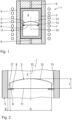
- a device 1 for the thermal post-treatment of a SiC bulk single crystal 2 is shown.
- the device 1 can also be referred to as a tempering device.
- the post-treatment crucible 3 consists of a crucible material which in the exemplary embodiment is a dense graphite.
- the crucible material can also be a high-melting metal such as tantalum (Ta), tungsten (W) or other refractory metals or carbidized metals, for example tantalum carbide (TaC) or tungsten carbide (WC).
- the post-treatment crucible 3 is surrounded by thermal insulation 5 which in the exemplary embodiment shown consists of graphite felt.
- thermal insulation 5 there are two openings on the top and bottom, each in the form of a pyrometer channel 6, in order to be able to measure the temperature at the post-treatment crucible 3 using a pyrometer (not shown).
- the thermal insulation 5 is surrounded by an inductive heating device in the form of a heating coil 7.
- a crystal holder 8 is arranged in the receiving space 4 of the post-treatment crucible 3, which has a holding surface 9 on which the SiC bulk single crystal 2 rests during the thermal post-treatment.
- the crystal holder 8 is designed as a ring-shaped crystal support and in the embodiment shown consists of a holding material which has a higher porosity and a lower thermal conductivity compared to the crucible material.
- the holding material is In this embodiment, a porous graphite is used.
- the holder material has the same or at least a similar porosity and thermal conductivity as the crucible material, whereby these two material properties are then not, or at most only to a very small extent, considered as parameters for the (fine) adjustment of the ratio of heat conduction to heat radiation. This adjustment is then made practically exclusively by determining the proportion of the contact-free areas of the total surface of the total surface of the SiC bulk single crystal 2 (see below).
- the device 1 shown is designed for the thermal post-treatment of only one SiC bulk single crystal 2. However, this is not a fundamental limitation. There are also other devices in which two or more SiC bulk single crystals can be tempered together.
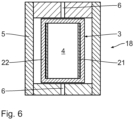
- the SiC bulk single crystal 2 to be tempered has an essentially cylindrical basic shape with a crystal center longitudinal axis 10 and with three boundary surfaces, namely a flat circular base surface 11, a cap-shaped top surface 12 and a cylindrical peripheral edge surface 13.
- the crystal center longitudinal axis 10 runs in the axial direction, along which the SiC bulk single crystal 2 grew during its growth and along which a crystal length L of the SiC bulk single crystal 2 is also measured. In a direction perpendicular to this, namely in the radial direction, a crystal diameter D of the SiC bulk single crystal 2 is measured.
- the larger the crystal diameter D of the SiC bulk single crystal 2, the more the radial temperature gradient ( thermal gradient) influences the properties of the growing SiC bulk single crystal 2 during growth. At the same time, the influence of the axial temperature gradient becomes smaller.
- the physical vapor deposition process used for crystal growth enables the production of SiC bulk single crystals with ever larger crystal diameters D, but the achievable crystal length L in the axial direction is limited to a few centimeters. Therefore, the ratio of crystal length L to crystal diameter D, which is referred to here as the aspect ratio, changes with increasing crystal diameter D. It becomes smaller.
- the representations of the Figures 3 to 5 illustrate this effect. Shown are three SiC bulk single crystals 14, 15 and 16, each with the same crystal length L of 25 mm, but different crystal diameters D.
- the SiC bulk single crystal 14 has Fig.3 a crystal diameter D of 76.2 mm and thus an aspect ratio L/D of 0.33.
- the SiC bulk single crystal 15 according to Fig.4 has a crystal diameter D of 150 mm and thus an aspect ratio L/D of 0.17.
- the SiC bulk single crystal 16 according to Fig.5 has a crystal diameter D of 200 mm and thus an aspect ratio L/D of 0.13.
- This special inhomogeneous temperature profile within the SiC bulk single crystal 2 to be tempered is not generated solely by the external heating device of the device 1.
- the external heating device in the form of the heating coil 7 essentially only directly influences the temperature in the crucible wall of the post-treatment crucible 3.
- the post-treatment crucible 3 represents a type of heater. It transports the heat fed into it into the receiving space 4 in its interior.
- further measures for influencing the temperature are provided in the device 1.
- the heat transport mechanism which transfers the heat from the crucible wall into the interior of the post-treatment crucible 3 to the SiC bulk single crystal 2, also has an influence on the temperature distribution in the SiC bulk single crystal 2.
- a similar effect to complete embedding in SiC powder occurs when the SiC bulk single crystal 2 rests with its entire base surface 11 on a support surface, e.g. made of graphite or SiC powder. In the contact area between the base surface 11 and the support surface, heat is transported from and to the SiC bulk single crystal 2 again by means of heat conduction.
- the inhomogeneous temperature profile can be advantageously determined by the ratio of the proportion of thermal conduction in the heat transfer to the proportion of thermal radiation in the heat transfer. with the temperature gradient rising radially from the inside to the outside during the thermal post-treatment. Accordingly, the SiC bulk single crystal 2 is stored or held in the receiving space 4 by the crystal holder 8 in such a way that a significant or predominant portion of the heat transfer from and to the SiC bulk single crystal 2 takes place by means of free thermal radiation.
- the crystal holder 8 is preferably designed in such a way that the held SiC bulk single crystal 2 has no contact with another object, such as the inner wall of the post-treatment crucible 3 or the holding surface 9 of the crystal holder 8, on the largest part of its total surface, which is made up of the three boundary surfaces, i.e. the base surface 11, the top surface 12 and the peripheral edge surface 13.
- the heat exchange or heat transfer between the SiC bulk single crystal 2 to be tempered and the free space of the receiving space 4 adjacent to it then takes place by means of free thermal radiation.
- These contact-free areas form a radiation surface portion which, in relation to the total surface of the SiC bulk single crystal 2, is in particular in the range between 63% and 83%.
- the other areas of the total surface of the SiC bulk single crystal 2 whose portion of the total surface accordingly is in particular in the range between 17% and 37%, there is contact with other objects or components of the device 1, in particular with the crystal holder 8, so that the heat transfer there takes place mainly by means of thermal conduction.
- the heat exchange of the SiC bulk single crystal 2 with the free space surrounding it by means of free heat radiation preferably takes place at at least two of the three boundary surfaces, in Fig. 1 and 2 In the embodiment shown, this is even the case on all three boundary surfaces.
- a central part of the base surface 11 is not contacted by the crystal holder 8, which is designed as a ring-shaped crystal support.
- the base surface 11 remains contact-free in the area of the ring opening of the crystal holder, so that heat is exchanged there with the adjacent free space by means of free heat radiation.
- the cover surface 12 and the peripheral edge surface 13 are completely contact-free and are therefore completely available for heat exchange by means of free heat radiation.
- the peripheral edge surface 13 is contact-free, since an inner diameter of the post-treatment crucible 3 is larger than the crystal diameter D of the SiC bulk single crystal 2, so that a tangentially completely circumferential free annular gap 17 is present between the peripheral edge surface 2 of the inserted SiC bulk single crystal 2 and the inner wall of the post-treatment crucible 3.
- This annular gap 17 has a gap width B of preferably 5 mm to 20 mm (see Fig. 2 ).
- the thickness of the crystal holder 8 designed as an annular crystal support can be varied and/or a holder material with a correspondingly adapted thermal conductivity or porosity can be used for the crystal holder 8.
- a support material with a low thermal conductivity and/or with high porosity can be selected.
- the device 1 has further components which, for reasons of clarity, are shown in Fig. 1 and 2 are not shown.
- Argon (Ar), helium (He) or nitrogen (N) or a mixture of these gases is supplied as the process gas.
- the thermal post-treatment process is described in more detail below.
- a process gas pressure in the range of 800 mbar to 1200 mbar, preferably 800 mbar to 1000 mbar, is then set in order to keep the surface evaporation of SiC material from the SiC bulk single crystal 2 to be tempered as low as possible.
- the post-treatment crucible 3 is then heated with the SiC bulk single crystal 2 placed therein to the desired process temperature, whereby after reaching a temperature range of 900 °C to 1500 °C, preferably from 1000 °C to 1200 °C, the further temperature increase up to the actual post-treatment temperature with a temperature ramp of 1 °C/h to 5 °C/h in order to avoid the formation of additional stresses.
- the actual post-treatment temperatures are up to 500 °C, preferably up to 200 °C, above the growth temperature at which the SiC bulk single crystal 2 was grown.
- the post-treatment temperature is therefore in a range from 1950 °C to 2450 °C.
- the process conditions of pressure, atmospheric composition and temperature are kept as constant as possible for a process period that lasts between 5 h and 72 h, preferably between 15 h and 50 h. Minor temperature fluctuations are less than 10 °C, preferably less than 2 °C. This provides sufficient time for the reduction of mechanical stresses in the crystal structure of the SiC bulk single crystal. On the other hand, the stress reduction is not hindered by fluctuations in the process parameters.
- the SiC bulk single crystal 2 is slowly cooled with a temperature ramp of 0.5 °C/h to 3 °C/h, preferably from 0.5 °C/h to 2 °C/h, to a temperature range of 900 °C to 1500 °C, preferably from 1000 °C to 1200 °C, in order to avoid the formation of new mechanical stresses due to temperature inhomogeneities that can be caused by heat transport mechanisms.
- the post-treatment crucible 3 is flooded with ambient atmosphere and the SiC bulk single crystal 2 is removed for further processing.
- the device 1 according to Fig. 1 and 2 has an inductive heating device, by means of which the global temperature distribution within the post-treatment crucible 3 can be adjusted.
- the heating device does not necessarily have to be inductive.
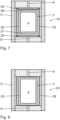
- in the Figures 6 to 8 are alternative tempering devices 18, 19 and 20 for the thermal post-treatment of the SiC bulk single crystal 2, which are equipped with resistance heaters instead of the heating coil 7. Using these resistance heaters, the global temperature distribution within the post-treatment crucible 3 can be adjusted in the same way as with the induction heating of the device 1. However, with both heating concepts, only the temperature of the post-treatment crucible 3 itself can be adjusted.
- the additional temperature influencing measures described above with reference to device 1 are also advantageously used in the tempering devices 18, 19, 20, although like some other components of the tempering devices 18, 19, 20, they are not included in Fig. 6 to 8 are shown.
- a cylinder jacket-shaped resistance heating element 21 is arranged within the post-treatment crucible 3 adjacent to or adjacent to the tangentially circumferential cylindrical crucible side wall 22.
- a cylindrical jacket-shaped resistance heating element 23 and two circular resistance heating elements 24 and 25 are arranged outside the post-treatment crucible 3, but inside the insulation 5.
- the resistance heating element 23 surrounds the cylindrical crucible side wall 22.
- Each of the resistance heating elements 24 and 25 covers the respective axial crucible end wall 26 and 27 on the top and bottom of the post-treatment crucible 3.
- a resistance heating element 28 in the form of a cylinder jacket surrounds the cylindrical crucible side wall 22 outside the post-treatment crucible 3 and inside the insulation 5.
- the resistance heating element 28 is comparable to the resistance heating element 23 of the tempering device 19.
- the tempering device 20 does not have any resistance heating elements on the two axial end faces of the post-treatment crucible 3.
- the devices 1, 18, 19 and 20 each have rotationally symmetrical heating devices. These are exemplary embodiments. Other, in particular non-rotationally symmetrical structures and alternative arrangements of the heating devices or combinations of different heating devices are also possible.
- all devices 1, 18, 19 and 20 enable a very advantageous thermal post-treatment, in which an inhomogeneous temperature profile with a radially increasing temperature gradient is set within the SiC bulk single crystal 2 to be tempered, corresponding to the stress balance inside the SiC bulk single crystal 2. This leads to a very good reduction of the existing mechanical stresses. High-quality SiC substrates with very little bending and curvature can be produced from a SiC bulk single crystal 2 thermally post-treated in this way.
Landscapes
- Chemical & Material Sciences (AREA)
- Engineering & Computer Science (AREA)
- Crystallography & Structural Chemistry (AREA)
- Materials Engineering (AREA)
- Metallurgy (AREA)
- Organic Chemistry (AREA)
- Inorganic Chemistry (AREA)
- Physics & Mathematics (AREA)
- Thermal Sciences (AREA)
- Mechanical Engineering (AREA)
- General Engineering & Computer Science (AREA)
- Crystals, And After-Treatments Of Crystals (AREA)
Priority Applications (5)
| Application Number | Priority Date | Filing Date | Title |
|---|---|---|---|
| EP23163761.2A EP4435155A1 (fr) | 2023-03-23 | 2023-03-23 | Procédé et dispositif de post-traitement thermique d'au moins un cristal volumique en sic |
| JP2024027533A JP2024137753A (ja) | 2023-03-23 | 2024-02-27 | 少なくとも1つのSiCバルク単結晶の熱的後処理のための方法及び装置 |
| US18/598,090 US20240318352A1 (en) | 2023-03-23 | 2024-03-07 | Method and apparatus for the thermal post-treatment of at least one sic volume monocrystal |
| KR1020240035012A KR20240143868A (ko) | 2023-03-23 | 2024-03-13 | 적어도 하나의 SiC 부피 단결정의 열적 후처리를 위한 방법 및 장치 |
| CN202410335704.8A CN118685864A (zh) | 2023-03-23 | 2024-03-22 | 用于至少一个SiC体积单晶的热后处理的方法和设备 |
Applications Claiming Priority (1)
| Application Number | Priority Date | Filing Date | Title |
|---|---|---|---|
| EP23163761.2A EP4435155A1 (fr) | 2023-03-23 | 2023-03-23 | Procédé et dispositif de post-traitement thermique d'au moins un cristal volumique en sic |
Publications (1)
| Publication Number | Publication Date |
|---|---|
| EP4435155A1 true EP4435155A1 (fr) | 2024-09-25 |
Family
ID=85726405
Family Applications (1)
| Application Number | Title | Priority Date | Filing Date |
|---|---|---|---|
| EP23163761.2A Pending EP4435155A1 (fr) | 2023-03-23 | 2023-03-23 | Procédé et dispositif de post-traitement thermique d'au moins un cristal volumique en sic |
Country Status (5)
| Country | Link |
|---|---|
| US (1) | US20240318352A1 (fr) |
| EP (1) | EP4435155A1 (fr) |
| JP (1) | JP2024137753A (fr) |
| KR (1) | KR20240143868A (fr) |
| CN (1) | CN118685864A (fr) |
Citations (8)
| Publication number | Priority date | Publication date | Assignee | Title |
|---|---|---|---|---|
| US7767022B1 (en) | 2006-04-19 | 2010-08-03 | Ii-Vi Incorporated | Method of annealing a sublimation grown crystal |
| DE102009048868B4 (de) | 2009-10-09 | 2013-01-03 | Sicrystal Ag | Herstellungsverfahren für einen SiC-Volumeneinkristall mittels einer thermischen Behandlung und niederohmiges einkristallines SiC-Substrat |
| US8449671B2 (en) | 2007-06-27 | 2013-05-28 | Ii-Vi Incorporated | Fabrication of SiC substrates with low warp and bow |
| US8865324B2 (en) | 2010-06-07 | 2014-10-21 | Sicrystal Ag | Production method for a bulk SiC single crystal with a large facet and monocrystalline SiC substrate with homogeneous resistance distribution |
| CN104357913A (zh) * | 2014-12-07 | 2015-02-18 | 中国电子科技集团公司第四十六研究所 | 一种碳化硅晶体高温退火处理方法 |
| CN111074348A (zh) * | 2019-12-17 | 2020-04-28 | 山东天岳先进材料科技有限公司 | 一种降低晶体内部应力的退火处理方法及装置 |
| CN112553694A (zh) * | 2021-01-13 | 2021-03-26 | 山西烁科晶体有限公司 | 一种碳化硅单晶高温退火的方法及装置 |
| CN113564719A (zh) * | 2021-07-26 | 2021-10-29 | 河北天达晶阳半导体技术股份有限公司 | 一种碳化硅晶体的二次退火方法 |
-
2023
- 2023-03-23 EP EP23163761.2A patent/EP4435155A1/fr active Pending
-
2024
- 2024-02-27 JP JP2024027533A patent/JP2024137753A/ja active Pending
- 2024-03-07 US US18/598,090 patent/US20240318352A1/en active Pending
- 2024-03-13 KR KR1020240035012A patent/KR20240143868A/ko active Pending
- 2024-03-22 CN CN202410335704.8A patent/CN118685864A/zh active Pending
Patent Citations (8)
| Publication number | Priority date | Publication date | Assignee | Title |
|---|---|---|---|---|
| US7767022B1 (en) | 2006-04-19 | 2010-08-03 | Ii-Vi Incorporated | Method of annealing a sublimation grown crystal |
| US8449671B2 (en) | 2007-06-27 | 2013-05-28 | Ii-Vi Incorporated | Fabrication of SiC substrates with low warp and bow |
| DE102009048868B4 (de) | 2009-10-09 | 2013-01-03 | Sicrystal Ag | Herstellungsverfahren für einen SiC-Volumeneinkristall mittels einer thermischen Behandlung und niederohmiges einkristallines SiC-Substrat |
| US8865324B2 (en) | 2010-06-07 | 2014-10-21 | Sicrystal Ag | Production method for a bulk SiC single crystal with a large facet and monocrystalline SiC substrate with homogeneous resistance distribution |
| CN104357913A (zh) * | 2014-12-07 | 2015-02-18 | 中国电子科技集团公司第四十六研究所 | 一种碳化硅晶体高温退火处理方法 |
| CN111074348A (zh) * | 2019-12-17 | 2020-04-28 | 山东天岳先进材料科技有限公司 | 一种降低晶体内部应力的退火处理方法及装置 |
| CN112553694A (zh) * | 2021-01-13 | 2021-03-26 | 山西烁科晶体有限公司 | 一种碳化硅单晶高温退火的方法及装置 |
| CN113564719A (zh) * | 2021-07-26 | 2021-10-29 | 河北天达晶阳半导体技术股份有限公司 | 一种碳化硅晶体的二次退火方法 |
Also Published As
| Publication number | Publication date |
|---|---|
| US20240318352A1 (en) | 2024-09-26 |
| CN118685864A (zh) | 2024-09-24 |
| JP2024137753A (ja) | 2024-10-07 |
| KR20240143868A (ko) | 2024-10-02 |
Similar Documents
| Publication | Publication Date | Title |
|---|---|---|
| DE112009003667B4 (de) | Verbessertes axial-gradient-transport- (agt-) züchtungsverfahren und -apparat unter anwendung von resistivem erhitzen | |
| DE60125689T2 (de) | Verfahren und Vorrichtung zur Herstellung von Siliziumkarbidkristallen unter Verwendung von Quellegasen | |
| DE602004001802T2 (de) | Vorrichtung und Verfahren zur Herstellung von Einkristallen durch Dampfphasenabscheidung | |
| DE102012222841B4 (de) | Herstellungsverfahren für einen SiC-Volumeneinkristall mit homogenem Netzebenenverlauf | |
| DE102010029756B4 (de) | Herstellungsverfahren für einen SiC-Volumeneinkristall mit großer Facette und einkristallines SiC-Substrat mit homogener Widerstandsverteilung | |
| DE3686570T2 (de) | Verfahren und vorrichtung zum herstellen von einkristallen nach dem czochralski-verfahren. | |
| DE102019109544B4 (de) | SiC-Einkristall-Züchtungsvorrichtung und Verfahren zur Züchtung eines SiC-Einkristalls | |
| DE112013002107B4 (de) | SiC-Einkristall-Herstellungsverfahren | |
| DE112014003132B4 (de) | Siliziumkarbid-Einkristallsubstrat | |
| DE1956055A1 (de) | Halterungsvorrichtung aus Graphit zur Erzeugung isothermer Temperaturverteilungen auf mittels Hochfrequenzenergie erhitzten,epitaktischen Prozessen zu unterwerfenden Halbleiterplaettchen | |
| DE112018002163B4 (de) | Verfahren zur Herstellung eines Silicium-Einkristalls, Verfahren zur Herstellung eines epitaktischen Silicium-Wafers, Silicium-Einkristall, und epitaktischer Silicium-Wafer | |
| EP1739213A1 (fr) | Appareil et procédé de récuit des plaquettes III-V ainsi que des plaquettes monocristallines récuites du semiconducteur type III-V | |
| EP1051535B1 (fr) | SUPPORT DE SUBSTRAT DESTINE A L'EPITAXIE DU SiC ET PROCEDE PERMETTANT DE FABRIQUER UN INSERT DESTINE A UN SUSCEPTEUR | |
| DE69705545T2 (de) | Vorrichtung zur züchtung von grossen siliziumkarbideinkristallen | |
| DE102019132933A1 (de) | Suszeptor und vorrichtung zur chemischen gasphasenabscheidung | |
| EP3699328A1 (fr) | Procédé de fabrication pour un monocristal volumique de sic et dispositif de croissance correspondant | |
| DE102009048868B4 (de) | Herstellungsverfahren für einen SiC-Volumeneinkristall mittels einer thermischen Behandlung und niederohmiges einkristallines SiC-Substrat | |
| DE102022119343B4 (de) | Kristallzüchtungsvorrichtung, Verfahren zum Züchten eines Halbleiters, Halbleiter und dessen Verwendung und Halbleiter-Substrat | |
| DE202015009519U1 (de) | Siliziumkarbid-Substrat | |
| EP1127176B1 (fr) | Dispositif pour produire et traiter des substrats semiconducteurs | |
| EP4435155A1 (fr) | Procédé et dispositif de post-traitement thermique d'au moins un cristal volumique en sic | |
| DE102009016131B4 (de) | Herstellungsverfahren für einen SiC-Volumeneinkristall mittels einer Gasbarriere und versetzungsarmes einkristallines SiC-Substrat | |
| DE102004024207B4 (de) | Verfahren und Vorrichtung zur Niedertemperaturepitaxie auf einer Vielzahl von Halbleitersubstraten | |
| EP3868925A1 (fr) | Procédé de fabrication d'un cristal unique dans un creuset de croissance | |
| EP4060099A1 (fr) | Procédé de fabrication pour un monocristal volumique de sic à distribution non homogène de dislocation en vis et substrat sic |
Legal Events
| Date | Code | Title | Description |
|---|---|---|---|
| PUAI | Public reference made under article 153(3) epc to a published international application that has entered the european phase |
Free format text: ORIGINAL CODE: 0009012 |
|
| STAA | Information on the status of an ep patent application or granted ep patent |
Free format text: STATUS: THE APPLICATION HAS BEEN PUBLISHED |
|
| AK | Designated contracting states |
Kind code of ref document: A1 Designated state(s): AL AT BE BG CH CY CZ DE DK EE ES FI FR GB GR HR HU IE IS IT LI LT LU LV MC ME MK MT NL NO PL PT RO RS SE SI SK SM TR |
|
| P01 | Opt-out of the competence of the unified patent court (upc) registered |
Free format text: CASE NUMBER: APP_53445/2024 Effective date: 20240926 |
|
| STAA | Information on the status of an ep patent application or granted ep patent |
Free format text: STATUS: REQUEST FOR EXAMINATION WAS MADE |
|
| 17P | Request for examination filed |
Effective date: 20250114 |