EP4435661A1 - Simulation de flux de personnes au moyen de techniques de simulation macroscopiques et microscopiques - Google Patents
Simulation de flux de personnes au moyen de techniques de simulation macroscopiques et microscopiques Download PDFInfo
- Publication number
- EP4435661A1 EP4435661A1 EP23163168.0A EP23163168A EP4435661A1 EP 4435661 A1 EP4435661 A1 EP 4435661A1 EP 23163168 A EP23163168 A EP 23163168A EP 4435661 A1 EP4435661 A1 EP 4435661A1
- Authority
- EP
- European Patent Office
- Prior art keywords
- sub
- area
- people
- simulation
- macroscopic
- Prior art date
- Legal status (The legal status is an assumption and is not a legal conclusion. Google has not performed a legal analysis and makes no representation as to the accuracy of the status listed.)
- Withdrawn
Links
Images


Classifications
-
- G—PHYSICS
- G06—COMPUTING OR CALCULATING; COUNTING
- G06F—ELECTRIC DIGITAL DATA PROCESSING
- G06F30/00—Computer-aided design [CAD]
- G06F30/20—Design optimisation, verification or simulation
- G06F30/27—Design optimisation, verification or simulation using machine learning, e.g. artificial intelligence, neural networks, support vector machines [SVM] or training a model
Definitions
- the invention relates to a method for simulating flows of people in an area comprising several sub-areas.
- a people flow simulation is a computer simulation in which the movements of people are simulated on the basis of a mathematical model. Put simply, people flow simulations imitate the behavior of a large number of people in a spatial area. To do this, the simulation calculates the closest position of a person in time and space based on certain rules or machine-learned procedures, which is intended to imitate a human behavior pattern. Various models from the field of micro- or macro-modeling can be used for this. The purpose of these simulations is diverse; a prominent example is the calculation of evacuation situations.
- a particularly interesting use of pedestrian flow simulations is real-time applications.
- the result of the simulation should make it possible to control the flow of people in the area under consideration, which can, for example, prevent or mitigate unfavourable scenarios predicted by the simulation.
- Real-time implies that, during a real event, the simulation predicts future conditions from the current point in time, so that these future conditions can be influenced by suitable interventions.
- the invention is based on the object of demonstrating a method for simulating flows of people in an area, which is particularly suitable for real-time applications.
- the invention further relates to a corresponding device or a system for data processing, a corresponding computer program, a corresponding computer-readable, preferably non-volatile, storage medium, and a corresponding transmission signal.
- Advantageous embodiments and further developments are the subject of subclaims.
- the method for simulating flows of people relates to an area comprising several sub-areas.
- a macroscopic flow of people simulation is calculated for a first of these sub-areas.
- For the macroscopic simulation at least one number of people at at least one input interface of the first sub-area is used as input data.
- At least one number of people at at least one output interface of the first sub-area is calculated.
- a microscopic flow of people simulation is calculated.
- the at least one calculated number of people at the at least one output interface of the first sub-area is used as input data.
- a distribution of people within the second sub-area is calculated for several points in time.
- the area under consideration may consist of the first and the second sub-area. Alternatively, it may include further sub-areas for which a macroscopic or microscopic simulation takes place.
- the first and the second sub-area are preferably adjacent so that a person can move directly from the first to the second sub-area.
- At least one input interface and at least one output interface are considered for the first sub-area. People can enter or leave the first sub-area via these interfaces, i.e. they correspond to entrances and exits of the first sub-area.
- the specific design of these interfaces can vary, e.g. they can be doors, gates, turnstiles or certain parts of paths.
- a plurality of input interfaces and/or a plurality of output interfaces can be used.
- the number of people plays a role here, namely at the input interface(s) and at the output interface(s). At least one number of people at at least one input interface is therefore used as the basis for the calculation of the macroscopic simulation, and at least one number of people at at least one output interface is the result of the macroscopic simulation.
- the microscopic simulation which is carried out for the second sub-area, is of interest to the situation within this sub-area.
- the microscopic simulation is intended to The time course of a distribution of people in the second sub-area can be determined. These are the forecast values that can be used as the basis for a real-time application in order to intervene in the second sub-area to control the flow of people.
- the microscopic simulation is based on the result of the macroscopic simulation, ie the number of people calculated by the macroscopic simulation at at least one output interface is used as the input data for the microscopic simulation.
- the at least one number of people at the at least one input interface and the at least one number of people at the at least one output interface of the first sub-area can be a time series of person flows, or a time series of accumulated numbers of people.
- a time series of person flows or a time series of accumulated numbers of people.
- not a single value of a number of people is used as input and result data of the macroscopic simulation, but rather a series of values that relate to different points in time.
- These can be used as person flows, i.e. as the number of people per unit of time, or as accumulated numbers, i.e. as the number of people summed up to a certain point in time.
- the macroscopic pedestrian flow simulation is calculated using artificial intelligence.
- Known AI systems can be used for this.
- the use of artificial intelligence is advantageous on the one hand because it enables rapid calculation of the result, which the microscopic simulation can then build on, and on the other hand because it can usually learn complex relationships between input and output data.
- the artificial intelligence is trained using training data before calculating the macroscopic people flow simulation.
- the training data can include at least a number of people at the at least one input interface of the first sub-area and at least a number of people at the at least one output interface of the first sub-area.
- the training data therefore contains relationships between data of the type that will later be processed by the artificial intelligence as input data and the type that will later be output by the artificial intelligence as a result.
- the training data is generated by means of a microscopic person flow simulation of the first sub-area.
- a model of the topology of the first sub-area is used, among other things.
- the microscopic simulation is given at least one number of people at the at least one input interface of the first sub-area, from which at least one number of people at the at least one output interface of the first sub-area can be calculated.
- To generate the training data a large number of microscopic person flow simulations of the first sub-area with different numbers of people at the at least one input interface of the first sub-area can be calculated.
- the more training data is calculated by means of microscopic person flow simulation and made available to the artificial intelligence, the better the result of the macroscopic simulation of the same sub-area by the artificial intelligence will be on average.
- these can also be determined by measuring the number of people in the first sub-area.
- the number of people at the at least one input interface and the at least one output interface are recorded using suitable sensors.
- the input data for the macroscopic pedestrian flow simulation of the first sub-area can be determined by measuring the number of people in the first sub-area.
- a measurement is first carried out at at least one input interface, then a macroscopic simulation using the measurement results, then a microscopic simulation using the results of the macroscopic simulation.
- the artificial intelligence can be an LSTM network, which is provided with the input data as a time course of variable length in order to calculate the macroscopic people flow simulation.
- LSTM network which is provided with the input data as a time course of variable length in order to calculate the macroscopic people flow simulation.
- the artificial intelligence can be a neural network, which is provided with the input data as a vector of constant length in order to calculate the macroscopic people flow simulation. This can take advantage of the fact that in many scenarios relevant to the simulation there is only a limited period of time within which the number of people changes, such as after the end of a major event. A vector of a certain length can be created from this data from the limited period of time.
- the method according to the invention and/or one or more functions, features and/or steps of the method according to the invention and/or one of its embodiments can be carried out with the aid of a computer. It can be carried out or implemented, for example, by means of one or more computers, processors, application-specific integrated circuits (ASIC), digital signal processors (DSP) and/or so-called "field programmable gate arrays" (FPGA). It can also be carried out at least partially in a cloud and/or in an edge computing environment.
- One or more computer programs that interact with one another are used for the computer-assisted process. If several programs are used, they can be stored together on a computer and executed by it, or on different computers in different locations. Since this is functionally equivalent, "the computer program” and "the computer” are formulated in the singular here.
- a people flow simulation model models the movements of people in spatial environments. Typical areas considered here are, for example, train stations, airports, sports stadiums. By running the simulation, different scenarios can be considered, such as evacuations of office buildings or hotels in the event of a fire, the simultaneous arrival of a large number of people in a limited area such as at the start or end of a sporting event in a stadium, or the effects of design changes within buildings or public spaces on aspects such as safety or efficiency of people transport.
- a microscopic simulation is particularly interesting. Such simulations depict the movement of individual people.
- the simulation starts in a state in which a certain number of people are located at certain starting points within the area under consideration and begin their movement from there, or there is a certain distribution of people within the area.
- the starting points can be one or more areas within the area, such as entrances or exits.
- the person flow simulation model is given personal parameters that determine the movement of individual people. These parameters can be the desired speed, as well as preferred and minimum distances to other people.
- one or more destinations are given that the people want to reach.
- the result of the microscopic person flow simulation is the temporal progression of the distribution of people in the area under consideration; i.e. for the points in time in the future after the start of the simulation.
- the person flow simulation model predicts where a person is located within the area.
- a disadvantage of this microscopic simulation technology is the high amount of time involved in calculating the simulation results. For example, simulating an evacuation of a football stadium with 60,000 people currently takes one to several hours on an average notebook. Advances in computer and cloud technology will improve performance in the future; the above-mentioned problems can currently be partially compensated for by using faster computers or by using computing power in the cloud, e.g. by calculating numerous statistical runs in parallel.
- the performance of a microscopic people flow simulation i.e. how quickly the simulation result is available, depends essentially on the size of the area and the complexity of the obstacles in it, as well as on the number of people in the area under consideration.
- performance plays a role when many simulation runs of large scenarios are to be carried out for the purposes of statistical significance. But especially with real-time requirements for Simulation@Operation applications, it is increasingly important to be able to react in a timely manner to results delivered by the simulation. The acceptance of such applications is better the shorter the waiting time for the simulation result.
- the hard upper limit is of course that the simulation must be faster than the actual time that has passed, otherwise the point in time delivered as a result by the simulation has already occurred or has even passed, so that it is no longer possible to react appropriately, e.g. within the framework of an operations control system.
- a significant factor in terms of the resource requirements of a pedestrian flow simulation is the microscopic simulation, i.e. simulating the movement of individual people with detailed obstacles. Passenger flow simulations can be carried out much more quickly using macroscopic approaches. With such a flow-based approach, only a specific flow of people, i.e. a number of people per unit of time, is considered, which is present at transitions between different sub-areas. The distribution of people within a sub-area is - in contrast to the microscopic simulation - not relevant. The disadvantage of a macroscopic simulation is therefore that certain effects cannot be represented, such as how far a traffic jam extends back into a corridor or braking behavior due to opposing flows of people.
- a sub-area is first selected that can only be entered via certain interfaces such as doors and can only be exited via locally limited outlets.
- An example of this would be the reception hall in a hotel, which is connected to the entrance door for the incoming flow of people from the outside, and to the inside via lifts, corridors and stairs for the outgoing flow of people.
- This part of the reception hall can be simulated macroscopically, while other parts of the hall adjacent to the entrances and exits are simulated microscopically.
- the opposite approach can also be used, ie the reception hall can be simulated microscopically, while the parts of the hall adjacent to the entrances and exits are viewed macroscopically.
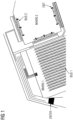
- Figure 1 shows an area considered for a passenger flow simulation.
- the specific example shown here is a bus station at a football stadium.
- This area is relevant for a passenger flow simulation because the scenario at the end of a football match is that a large number of people leave the stadium and try to get to the buses quickly.
- the aim is to simulate the departure of the people after the match or their movement to the buses.
- it can be decided, for example, how many buses need to be made available at which stops.
- People coming from the stadium reach the queues in the bus station via the black ENTER entrance area.
- the sub-areas in which the buses are located can be reached via twelve EXIT entrances marked with arrows.
- Figure 1 only one of the entrances is labeled EXIT.
- the details in the queues i.e. the movement behavior of the people between the ENTER entrance area and the EXIT entrances, are not relevant to the goal of providing buses as needed and can therefore be simulated macroscopically in a simplified manner.
- the ENTER entrance area is the interface for the sub-area of the macroscopic simulation for the entry of people
- the EXIT entrances are the interfaces for the sub-area of the macroscopic simulation for the exit of people.
- a microscopic simulation is carried out for the other two sub-areas MICRO 1 and MICRO 2. Since the sub-areas for the macroscopic and microscopic simulation are adjacent to one another, the interfaces for the sub-area of the macroscopic simulation for the exit of people correspond to the interfaces for the sub-areas of the microscopic simulation for the entry of people.
- MICRO 1 In the first of these sub-areas MICRO 1, a large number of BUS 1 buses are ready for boarding, although only one of the buses is labeled to improve clarity. In the second of these sub-areas, MICRO 2, there are only a few on-demand BUS 2 buses available, with new BUS 2 buses being provided as needed. Also to improve clarity, only one of the BUS 2 buses is labeled.
- the two sub-areas, MICRO 1 and MICRO 2 are simulated microscopically, because the specific distribution of people should be able to be responded to here. For example, the queuing behavior, the formation of crowds of people, and traffic jams near the EXIT entrances should be observed so that security personnel can intervene if necessary and so that buses can be made available as needed.
- the entire passenger flow simulation is thus a combination of a macroscopic simulation, which only calculates passenger flows, and a microscopic simulation, which as a result shows in the affected sub-areas MICRO 1 and MICRO 2 over time at which locations within of these sub-areas there are people at the respective times.
- the input variable for the macroscopic simulation is the flow of people via the entrance area ENTER
- the result of the macroscopic simulation is the flow of people via each of the twelve entrances EXIT to the sub-areas MICRO 1 and MICRO 2.
- the sub-area between the entrance area ENTER and the twelve entrances EXIT which has labyrinth-like paths and would therefore be very time-consuming to simulate microscopically, can be viewed as a black box.
- the input variables for the microscopic simulation are the flow of people via the twelve entrances EXIT
- the result of the microscopic simulation is a time series of person distributions in the sub-areas MICRO 1 and MICRO 2. This result allows the use of the flow of people simulation in a real-time application.
- the sub-areas MIKRO 1 and MIKRO 2 have a less complicated topology, so that a microscopic pedestrian flow simulation can be calculated in a short time.
- AI Artificial Intelligence
- An AI process is used as a macroscopic simulation, which maps the input data, i.e. the flow of people via the ENTER entrance area, to the output data, i.e. the flow of people via the twelve EXIT entrances.
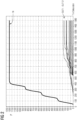
- a set of training data can be used, for example, as in Figure 2
- the accumulated number P of people is shown at the top, who entered the considered part of the area via the entrance area ENTER by the time T plotted on the abscissa.
- sensors for detecting people which monitor both the ENTER entrance area and the twelve EXIT entrances, provide measurement results from which the input curve IN and the OUTPUT curves OUT1 - OUT12 can be derived.
- Cameras for example, are suitable sensors.
- Simpler technologies for detecting people are, for example, turnstiles or similar, or a tripwire, which detects when people cross a line.
- a microscopic simulation of the sub-area between the ENTER entrance area and the twelve EXIT entrances can be used to generate the training data. There is no time restriction for generating training data, so a large amount of time spent calculating the simulation is not a hindrance. Virtual tripwires can be inserted into the simulation so that the microscopic simulation calculates the flow of people via virtual lines both in the ENTER entrance area and in the twelve EXIT entrances.
- the twelve OUTPUT curves OUT1 - OUT12 show that this is not a simple shift or linear mapping of the input signal, i.e. the input curve IN. Rather, the OUTPUT curves OUT1 - OUT12 look different from one another because they are determined by the complex processes and the topology inside the sub-area. At some outputs, the step function of the input signal is still recognizable, while at other outputs it is heavily distorted or completely replaced by a continuous increase. This makes it clear that no simple functional relationship can be found between input and output, e.g. via statistical correlation. Conversely, however, there is also a non-random relationship between input and output that can at least be approximated using learning methods.
- the AI is provided with a variety of sets of training data for the purpose of learning.
- this training data is generated through a people flow simulation, parameters such as the number of people and their speed distribution are varied in order to have a wide range of different sets of training data available.
- AI there are various options for the specific design of the AI.
- artificial neural networks recurrent neural networks, convolutional neural networks, perceptrons, Bayesian neural networks, autoencoders, variational autoencoders, Gaussian processes, deep learning architectures, support vector machines, data-driven regression models, k-nearest neighbor classifiers, physical models and/or decision trees can be trained.
- Methods from the field of reinforcement learning for example policy gradient methods, are particularly suitable as training methods.
- LSTM Long Short-Term Memory
- neural networks can be used, such as convolutional neural networks.
- Simpler neural networks can be used to map graphics to each other than for any time series.
- FIG. 3 illustrates where the learning of a neural network with training data according to Figure 2
- the curve P on the left corresponds to the accumulated number of people in the entrance area ENTER
- the curve P on the right corresponds to the accumulated number of people P from one of the twelve entrances EXIT, whereby the scaling of the two ordinates is different.
- the curve P is only from one of the twelve entrances EXIT in the Figure 3
- a set of training data contains for each course P the accumulated number of people in the entry area ENTER (left side of the Figure 3 ) twelve curves P for the twelve accesses EXIT.
- the procedure corresponds to conventional image learning: the value of the curve P at a certain time T is considered as a data point, with each of the values available to the AI provided vector V contains a majority of such data points.
- training using vectors V leads to a significantly reduced need for training data, in contrast to training using time series.
- the functions are monotonically increasing, which also simplifies training.
- the AI learns to map the accumulated number of people in the ENTER entrance area to the accumulated number of people in the twelve EXIT entrances.
- the AI is given measured flows of people in the ENTER entrance area as input data. From this, the AI then determines the corresponding flows of people at the twelve EXIT entrances.
- the trained AI can now be used as a representative model for a more detailed person simulation model in the sub-area between the ENTER entrance area and the twelve EXIT entrances.
- tripwires or other types of counters are installed at the entrance, i.e. in the ENTER entrance area, which provide input data for the AI that corresponds to the training data.
- the results of the AI i.e. the predicted flows of people at the twelve EXIT entrances, are then used as input data for the microscopic simulation of the other sub-areas.
- the result of this microscopic simulation is therefore available much more quickly than if the entire area had to be simulated microscopically.
- the speed of the calculation can therefore be increased significantly, while the accuracy in the sub-areas that are still calculated microscopically does not suffer.
- a difference to known methods of microscopic simulation is therefore the masking out of a large part of the simulation area using a representative Model that carries out a macroscopic simulation.
- the flow of people is measured at one or more suitable interfaces to the part excluded from the microscopic simulation and the resulting functions serve as input for the macroscopic simulation.
- This representative model can be an AI, in particular a neural network, as described above.
- a statistical method can be used, e.g. a conventional mathematical analysis such as using Fourier series. This is easier the less complicated the relationship between input and output curves is.
- the procedure described can be used in the case that the entrances/exits to the macroscopically simulated sub-area are used exclusively, i.e. people can only enter or leave the sub-area via a certain interface.
- this is not a harmful restriction, because many of the scenarios underlying a people flow simulation involve people moving in a specific direction, e.g. during evacuations or when leaving large event venues.
- Figure 4 a flow chart for the procedure described.
- the area to be considered by the people flow simulation is divided into at least two sub-areas MICRO and MACRO in the DIVIDE step, whereby a microscopic people flow simulation is to be carried out for the MICRO sub-area and a macroscopic people flow simulation for the MACRO sub-area.
- a plurality of MICRO sub-areas and/or MACRO sub-areas can be used.
- People flow simulation models are created for the MICRO and MACRO sub-areas in the MODEL step.
- MICRO-MODEL is created for the microscopic people flow simulation and MACRO-MODEL for the macroscopic people flow simulation.
- Training data T-DATA is generated for the people flow simulation model MAKRO-MODEL for the macroscopic people flow simulation in the GENERATE step. This can be done using measurements or microscopic simulation of the MACRO sub-area, alternatively existing training data T-DATA can be accessed.
- the people flow simulation model MAKRO-MODEL for the macroscopic people flow simulation is trained with the training data T-DATA, after which the trained model TRAINED MODEL is available.
- the number of people is recorded in the COUNT step, which can be used as input data INPUT for the macroscopic people flow simulation.
- the people flow simulation is calculated, whereby the macroscopic people flow simulation is carried out by the trained model TRAINED MODEL based on the input data INPUT, and the microscopic people flow simulation is based on the results of the macroscopic people flow simulation.
- the result RESULT of the microscopic people flow simulation is used in the following MEASURE step to implement ADAPT measures in the real environment corresponding to the MICRO sub-area.
- Figure 5 shows how a system SYS suitable for this purpose can be constructed. While the components explained in more detail below are present in a single version in the figure, it is also possible that they are present in multiple versions, e.g. as a distributed system. In this way, the functionality of the system SYS can be divided up into several systems, possibly linked hierarchically.
- the system SYS comprises a computing unit or a processor PRO. This is connected to a memory MEM in which a computer program PROGRAM is stored.
- the memory MEM is preferably a non-volatile computer-readable data storage medium. Storage can be carried out in any way that is suitable for ensuring readability by a computing unit, such as magnetic storage, e.g. using a floppy disk, optical storage, e.g. using a CD, magneto-optical storage, ROM (Read Only Memory) storage, RAM (Random Access Memory) storage, EPROM (Erasable Programmable Read-Only Memory), EEPROM (Electrically Erasable Programmable Read-Only Memory), flash memory.
- the PRO processor By executing the instructions of the PROGRAM program in the PRO processor, the steps of the procedure explained above are carried out. This applies in particular to the SIMULATE step, which involves calculating the simulation result. The other steps can be carried out by the same or a different computer system.
- the PRO processor is connected to an input and output unit IN/OUT, via which information can be exchanged between the SYS system and other components and/or a user. For example, the measured number of people can be made available to the people flow simulation model and the simulation result can be output.
- This interface can be designed in a suitable manner, e.g. via radio or cable, and communication can take place via suitable standards.
- Figure 6 shows an example of how the system of Figure 5 can be designed: this can be a generic computer SYS or a mobile generic computer SYS-MOBILE.
- the generic computer SYS represents various types of digital computing devices, such as desktop computers, workstations, servers, blade servers, mainframes, or other suitable devices.
- the mobile generic computer SYS-MOBILE represents various types of mobile digital computing devices, such as laptops, PDAs, mobile phones or smart phones, or other suitable devices.
- the computer SYS comprises a processor PRO, a memory MEM, and a high-speed interface HS-INTER between them. Furthermore, high-speed expansion ports EXP and a low-speed interface LS-INTER are connected to the high-speed interface HS-INTER.
- the storage device STORAGE and the low-speed bus LS-BUS are connected to the low-speed interface LS-INTER.
- the components PRO, MEM, STORAGE, HS-INTER, EXP, LS-INTER are connected via suitable connections/buses and can be mounted on a common motherboard.
- the computer SYS can also comprise several interconnected computers, which may be located at different locations.
- the processor PRO can process instructions to be executed in the computer SYS, where the instructions can be stored in particular in the memory MEM or in the storage device STORAGE. Information, in particular results The data processed in the PRO processor can be graphically displayed using a GUI on a display connected to the high-speed HS-INTER interface, such as the DISPLAY screen.
- the memory MEM is used to store information within the computer SYS. This can be a volatile memory or a non-volatile memory. It can include several memory cells.
- the storage device STORAGE is preferably a mass storage device for a computer-readable medium. This can include, for example, a floppy disk drive, a hard disk, an optical disk drive, a tape device, a flash memory storage device, or a series of devices, e.g. in a storage area network configuration.
- the high-speed interface HS-INTER is responsible for bandwidth-intensive processes within the computer SYS, while the low-speed interface LS-INTER is used for those with lower bandwidth requirements.
- the high-speed interface HS-INTER is connected to the memory MEM, the screen DISPLAY, possibly via a graphics processor, the high-speed expansion ports EXP, which can accommodate various expansion cards.
- the storage device STORAGE and the low-speed bus LS-BUS, on which low-speed expansion ports can be located, are connected to the low-speed interface LS-INTER.
- the latter can have various communication ports, e.g. USB, Bluetooth, Ethernet, wireless Ethernet.
- Various input and/or output devices can be connected to these, e.g.
- a keyboard KEYPAD a mouse MOUSE
- a scanner SCAN a network device NETWORK DEVICE such as a switch or a router.
- a network device NETWORK DEVICE such as a switch or a router.
- the computer SYS can be implemented in different ways, as can be seen on the right edge of the figure.
- it can be implemented as a personal computer PC, as a standard server SERV, or as a group of such servers such as a server farm, or as a rack server system R-SERV or part of such a system.
- the mobile computer SYS-MOBILE comprises a processor PRO, a memory MEM, an input and output device DISPLAY, a communication interface COM-INTER, a transceiver TX/RX.
- the components PRO, MEM, COM-INTER, TX/RX are connected via suitable connections/buses and can be mounted on a common motherboard or in another suitable manner.
- a further storage device such as a microdrive or similar, can be provided in order to create further storage options.
- the processor PRO can execute instructions within the mobile computer SYS-MOBILE, in particular those that are stored in the memory MEM. It can be implemented as a chip or chipset that contains one or more analog or digital processing units.
- the processor PRO can be responsible, among other things, for coordinating the other components of the mobile computer SYS-MOBILE, for example for controlling the user interface(s), for applications that run on the mobile computer SYS-MOBILE, and for the wireless communication of the mobile computer SYS-MOBILE.
- Information is transferred between the user of the mobile computer SYS-MOBILE and the processor PRO via the user interface USER-INTER, for example via voice input/output, and via the display interface DISPLAY-INTER. for example via text input/output.
- the input and output device DISPLAY can be based on TFT LCD (Thin-Film-Transistor Liquid Crystal Display) or OLED (Organic Light Emitting Diode) technology.
- an external interface EXT-INT is provided which is connected to the PRO processor and enables near-field communication between the SYS-MOBILE mobile computer and other devices. Communication can be carried out via wired and/or wireless communication via the external interface EXT-INT.
- the MEM memory is used to store information within the SYS-MOBILE mobile computer and can be implemented, for example, as a volatile or non-volatile memory comprising one or more memory units.
- an extension memory EXT-MEM can be provided, which is connected to the SYS-MOBILE mobile computer via the MEM-INTER extension interface, e.g. an interface for a SIMM (Single In Line Memory Module) or a SIM (Subscriber Identity Module).
- SIMM Single In Line Memory Module
- SIM Subscriber Identity Module
- the EXT-MEM extension memory offers additional storage capacity for the SYS-MOBILE mobile computer and can also store various applications.
- the EXT-MEM extension memory can serve as a security module for the SYS-MOBILE mobile computer by storing identification information there.
- the mobile computer SYS-MOBILE can communicate wirelessly via the transceiver TX/RX, which has means for digital signal processing.
- the communication interface COM-INTER enables communication via suitable protocols, such as GSM, SMS, MMS, CDMA, TDMA, PDC, WCDMA, CDMA2000, GPRS, EDGE, UMTS, LTE, as well as communication protocols of the 5th or higher generations.
- suitable protocols such as GSM, SMS, MMS, CDMA, TDMA, PDC, WCDMA, CDMA2000, GPRS, EDGE, UMTS, LTE, as well as communication protocols of the 5th or higher generations.
- a not shown Transceivers for near-field communication such as Bluetooth, WiFi or similar can be provided.
- a GPS module GPS can also be provided in order to be able to use location-based services.
- received audio information which can in particular include instructions from a user, can be converted into digital information that can be processed by the mobile computer SYS-MOBILE; accordingly, sound information that can be perceived by the user can be generated using the audio codec AUDIO.
- the mobile computer SYS-MOBILE is preferably implemented as a smartphone PHONE or laptop LAPTOP.
- the interaction between the user and the computer SYS or the mobile computer SYS-MOBILE can take place in a variety of ways and is not limited to the specific representation of the Figure 6 limited. Any sensory information transmission (visible, audible, tactile) is possible.
- the Figure 5 The computer program PROGRAM shown can be stored in any of the memories MEM, STORAGE, EXT-MEM of the Figure 6 stored, even distributed across multiple storage devices. Alternatively or additionally, storage can also be cloud-based.
Landscapes
- Engineering & Computer Science (AREA)
- Physics & Mathematics (AREA)
- Evolutionary Computation (AREA)
- Theoretical Computer Science (AREA)
- Computer Vision & Pattern Recognition (AREA)
- Medical Informatics (AREA)
- Software Systems (AREA)
- Artificial Intelligence (AREA)
- Computer Hardware Design (AREA)
- Geometry (AREA)
- General Engineering & Computer Science (AREA)
- General Physics & Mathematics (AREA)
- Management, Administration, Business Operations System, And Electronic Commerce (AREA)
Priority Applications (1)
| Application Number | Priority Date | Filing Date | Title |
|---|---|---|---|
| EP23163168.0A EP4435661A1 (fr) | 2023-03-21 | 2023-03-21 | Simulation de flux de personnes au moyen de techniques de simulation macroscopiques et microscopiques |
Applications Claiming Priority (1)
| Application Number | Priority Date | Filing Date | Title |
|---|---|---|---|
| EP23163168.0A EP4435661A1 (fr) | 2023-03-21 | 2023-03-21 | Simulation de flux de personnes au moyen de techniques de simulation macroscopiques et microscopiques |
Publications (1)
| Publication Number | Publication Date |
|---|---|
| EP4435661A1 true EP4435661A1 (fr) | 2024-09-25 |
Family
ID=85724668
Family Applications (1)
| Application Number | Title | Priority Date | Filing Date |
|---|---|---|---|
| EP23163168.0A Withdrawn EP4435661A1 (fr) | 2023-03-21 | 2023-03-21 | Simulation de flux de personnes au moyen de techniques de simulation macroscopiques et microscopiques |
Country Status (1)
| Country | Link |
|---|---|
| EP (1) | EP4435661A1 (fr) |
Citations (2)
| Publication number | Priority date | Publication date | Assignee | Title |
|---|---|---|---|---|
| WO2011098337A2 (fr) * | 2010-02-12 | 2011-08-18 | Siemens Aktiengesellschaft | Procédé et dispositif destinés à la simulation de flux d'objets dans des zones partielles |
| EP2592586A1 (fr) * | 2011-11-14 | 2013-05-15 | Siemens Aktiengesellschaft | Simulation de flux de personnes avec des zones d'attente |
-
2023
- 2023-03-21 EP EP23163168.0A patent/EP4435661A1/fr not_active Withdrawn
Patent Citations (2)
| Publication number | Priority date | Publication date | Assignee | Title |
|---|---|---|---|---|
| WO2011098337A2 (fr) * | 2010-02-12 | 2011-08-18 | Siemens Aktiengesellschaft | Procédé et dispositif destinés à la simulation de flux d'objets dans des zones partielles |
| EP2592586A1 (fr) * | 2011-11-14 | 2013-05-15 | Siemens Aktiengesellschaft | Simulation de flux de personnes avec des zones d'attente |
Non-Patent Citations (1)
| Title |
|---|
| EDGAR F ESTEVES ET AL: "A software environment for microscopic pedestrian simulation", PROCEEDINGS OF THE 7TH INDUSTRIAL SIMULATION CONFERENCE (ISC'09): 1-3 JUNE 2009, 1 June 2009 (2009-06-01), XP055013392, Retrieved from the Internet <URL:http://hdl.handle.net/10216/15123> [retrieved on 20111129] * |
Similar Documents
| Publication | Publication Date | Title |
|---|---|---|
| DE112016003245T5 (de) | Resistive Verarbeitungseinheit | |
| DE3854935T2 (de) | Verfahren und Gerät zur Simulation von begrenzten verteilten diskreten Ereignissen | |
| DE112019004076T5 (de) | Dezentralisiertes verteiltes deep learning | |
| DE112018005227T5 (de) | Merkmalsextraktion mithilfe von multi-task-lernen | |
| DE112018006189T5 (de) | Robuste gradienten-gewichtskomprimierungsschemata für deep-learning-anwendungen | |
| DE19917592A1 (de) | Situationsabhängig operierendes semantisches Netz n-ter Ordnung | |
| DE112019000340T5 (de) | Epistemische und aleatorische tiefe plastizität auf grundlage vontonrückmeldungen | |
| DE112021002453T5 (de) | Iteratives trainieren eines modells für maschinelles lernen | |
| DE102010055708A1 (de) | Verfahren zum Berechnen einer kollisionsfreien Geschwindigkeit für einen Agenten in einer Menschenmassensimulationsumgebung | |
| EP2961644A1 (fr) | Estimation basée sur une grille de la position d'un objet | |
| DE202016107031U1 (de) | Parallelisierte Simulation der Verfügbarkeit von Datenfluss mithilfe stochastischer Prozess- und Datenflusstechnikalgorithmen | |
| DE112017000855T5 (de) | Energiesparender zeitlich gemultiplexter neurosynaptischer Kern zum Implementieren neuronaler Netze | |
| DE102018008685A1 (de) | Verfahren zum Trainieren eines künstlichen neuronalen Netzes, künstliches neuronales Netz, Verwendung eines künstlichen neuronalen Netzes sowie entsprechendes Computerprogramm maschinenlesbares Speichermedium und entsprechende Vorrichtung | |
| DE112019003764B4 (de) | Von der lage der zellen unabhängiges, in bezug auf die gewichtung linear aktualisierbares synaptisches cmos-array | |
| DE112023004745T5 (de) | Maschinelles lernmodell für die mehrkamera-mehrpersonen-verfolgung | |
| EP2592586A1 (fr) | Simulation de flux de personnes avec des zones d'attente | |
| WO2022079193A1 (fr) | Procédé de modélisation de système de rail d'ascenseur | |
| DE112018007536T5 (de) | Konvolutionales neuronales Netz | |
| EP4435661A1 (fr) | Simulation de flux de personnes au moyen de techniques de simulation macroscopiques et microscopiques | |
| EP3937151A1 (fr) | Dispositif et procédé de commande d'un flux de la circulation dans un réseau de circulation au moyen d'un plan de phase de signal optimal | |
| DE102024117455A1 (de) | Verfahren und System zur automatisierten Generierung einer Präsentation | |
| Wang et al. | Modelling the unidirectional and bidirectional flow of pedestrians based on convolutional neural networks | |
| EP3716058A1 (fr) | Procédé de commande d'un appareil au moyen d'un nouveau code de programme | |
| EP4428778A1 (fr) | Simulation de flux de personnes au moyen de données réelles pour une application en temps réel | |
| DE102018216719A1 (de) | Schlüsselbildbasierter autonomer Fahrzeugbetrieb |
Legal Events
| Date | Code | Title | Description |
|---|---|---|---|
| PUAI | Public reference made under article 153(3) epc to a published international application that has entered the european phase |
Free format text: ORIGINAL CODE: 0009012 |
|
| STAA | Information on the status of an ep patent application or granted ep patent |
Free format text: STATUS: THE APPLICATION HAS BEEN PUBLISHED |
|
| AK | Designated contracting states |
Kind code of ref document: A1 Designated state(s): AL AT BE BG CH CY CZ DE DK EE ES FI FR GB GR HR HU IE IS IT LI LT LU LV MC ME MK MT NL NO PL PT RO RS SE SI SK SM TR |
|
| STAA | Information on the status of an ep patent application or granted ep patent |
Free format text: STATUS: THE APPLICATION IS DEEMED TO BE WITHDRAWN |
|
| 18D | Application deemed to be withdrawn |
Effective date: 20250326 |