EP4438596A1 - Diaminopyrimidinderivate als hdac- und dhfr-inhibitoren mit doppelter zielrichtung und verwendung davon bei der vorbeugung und behandlung von malaria - Google Patents
Diaminopyrimidinderivate als hdac- und dhfr-inhibitoren mit doppelter zielrichtung und verwendung davon bei der vorbeugung und behandlung von malaria Download PDFInfo
- Publication number
- EP4438596A1 EP4438596A1 EP23305430.3A EP23305430A EP4438596A1 EP 4438596 A1 EP4438596 A1 EP 4438596A1 EP 23305430 A EP23305430 A EP 23305430A EP 4438596 A1 EP4438596 A1 EP 4438596A1
- Authority
- EP
- European Patent Office
- Prior art keywords
- sub
- diamino
- ethylpyrimidin
- compound
- propoxy
- Prior art date
- Legal status (The legal status is an assumption and is not a legal conclusion. Google has not performed a legal analysis and makes no representation as to the accuracy of the status listed.)
- Withdrawn
Links
Images

Classifications
-
- C—CHEMISTRY; METALLURGY
- C07—ORGANIC CHEMISTRY
- C07D—HETEROCYCLIC COMPOUNDS
- C07D239/00—Heterocyclic compounds containing 1,3-diazine or hydrogenated 1,3-diazine rings
- C07D239/02—Heterocyclic compounds containing 1,3-diazine or hydrogenated 1,3-diazine rings not condensed with other rings
- C07D239/24—Heterocyclic compounds containing 1,3-diazine or hydrogenated 1,3-diazine rings not condensed with other rings having three or more double bonds between ring members or between ring members and non-ring members
- C07D239/28—Heterocyclic compounds containing 1,3-diazine or hydrogenated 1,3-diazine rings not condensed with other rings having three or more double bonds between ring members or between ring members and non-ring members with hetero atoms or with carbon atoms having three bonds to hetero atoms with at the most one bond to halogen, directly attached to ring carbon atoms
- C07D239/46—Two or more oxygen, sulphur or nitrogen atoms
- C07D239/48—Two nitrogen atoms
Definitions
- the present invention relates to dual targeting inhibitors of histone deacetylase (HDAC) and dihydrofolate reductase (DHFR), useful in the prevention and treatment of malaria.
- HDAC histone deacetylase
- DHFR dihydrofolate reductase
- ACTs artemisinin-based combination therapies
- PYR dihydrofolate reductase
- DHFR dihydrofolate reductase
- hybrid molecules derived from artemisinin and isoquinolines have recently been reported and shown to have the potential to enhance efficacy, improve safety, be cost-effective and reduce the propensity to elicit resistance relative to the parent drugs ( Kouznetsov et al. Eur J Med Chem, 2009. 44(8): p. 3091-3113 ; Meunier Accounts of Chemical Research, 2008. 41(1): p. 69-77 ; Muregi et al. Drug Dev Res, 2010. 71(1): p. 20-32 ; Vandekerckhove et al. Bioorganic & Medicinal Chemistry, 2015. 23(16): p. 5098-5119 ;). However, these molecules were not further investigated.
- Histone modifying enzymes have been shown to be key in achieving spatio-temporal regulation of gene expression, and to play vital roles in the growth and survival of parasites.
- HDACs histone deacetylases
- HATs histone acetyltransferases
- HMTs methyltransferases
- HDACi HDAC inhibitors
- DHFR a key enzyme involved in the regeneration of folic acid. Its inhibition blocks the biosynthesis of purines and pyrimidines, which are essential for DNA synthesis and cell multiplication. This leads to failure of nuclear division at the time of schizont formation in erythrocytes and liver.
- compound P65 is also a potent DHFR inhibitor.
- the invention concerns a compound of formula (I) below: wherein
- the present invention relates to a pharmaceutical or veterinary composition
- a pharmaceutical or veterinary composition comprising a compound of formula (I) as described above or below, and a pharmaceutically or veterinary acceptable carrier.
- the invention relates to a compound of formula (I) as defined above and below for use as a drug, in particular for preventing or treating a parasitic disease such as malaria.
- the present invention relates to a kit comprising:
- the present invention encompasses methods for preparing the compounds of formula (I) as defined above.
- An exemplary method comprises the following steps:
- halogen refers to a fluorine, bromine, chlorine or iodine atom, preferably a chlorine or fluorine atom.
- ( C 1 -C 6 )alkyl refers to a linear or branched saturated hydrocarbon chain containing from 1 to 6 carbon atoms including, but not limited to, methyl, ethyl, n-propyl, iso-propyl, n-butyl, iso-butyl, sec-butyl, t-butyl, n-pentyl, n-hexyl, and the like.
- ( C 2 -C 6 )alkenyl refers to a linear or branched unsaturated hydrocarbon chain containing from 2 to 6 carbon atoms and comprising at least one double bond including, but not limited to, ethenyl, propenyl, butenyl, pentenyl, hexenyl and the like.
- ( C 3 -C 10 )cycloalkyl refers to a hydrocarbon monocyclic or bicyclic (fused) ring having 3 to 10 carbon atoms including, but not limited to, cyclopropyl, cyclopentyl, cyclohexyl and the like.
- ( C 1 -C 6 )haloalkyl refers to a (C 1 -C 6 )alkyl group as defined herein substituted by at least one halogen atom, and preferably by at least one fluorine atom.
- the (C 1 -C 6 )haloalkyl is preferably a (C 1 -C 6 )fluoroalkyl. It is in particular a trifluoromethyl group (CF 3 ).
- ( C 1 -C 6 )alkoxy refers to a (C 1 -C 6 )alkyl group as defined above bound to the molecule via an oxygen atom, including, but not limited to, methoxy, ethoxy, n-propoxy, iso-propoxy, n-butoxy, iso-butoxy, sec-butoxy, t-butoxy, n-pentoxy, n-hexoxy, and the like.
- aryl group as used herein alone or as part of another group denotes homocyclic aromatic groups, preferably monocyclic or bicyclic (fused) groups, containing from 6 to 12 carbons in the ring portion, such as phenyl, naphthyl and indenyl. Phenyl is the most preferred aromatic group.
- alkylaryl refers to an aryl group as defined above bound to the molecule via an alkyl group as defined above; in other words, it is a (C 1 -C 6 )alkyl-aryl group.
- the alkylaryl group is a benzyl group.
- C 1 -C 12 alkylene refers to a linear or branched divalent saturated hydrocarbon chain containing from 1 to 12 carbon atoms - preferably from 1 to 6 carbon atoms - including, but not limited to, C 1 -alkylene, i.e. a methylene of formula -CH 2 -, a C 2 alkylene, a C 3 alkylene, a C 4 alkylene, a C 5 alkylene and a C 6 alkylene.
- C 2 -C 12 alkenylene refers to a linear or branched divalent unsaturated hydrocarbon chain containing from 2 to 12 carbon atoms - preferably from 2 to 6 carbon atoms - and comprising at least one double bond including, but not limited to, ethenylene, propenylene, butenylene, pentenylene, hexenylene and the like.
- An alkenylene preferably contains non triple bond, and advantageously only one double bond.
- C 1 -C 12 arylene refers to a divalent homocyclic aromatic group, preferably monocyclic or bicyclic (fused) group, containing from 6 to 12 carbons in the ring portion, such as phenylene, naphthylene and indenylene. Phenylene, especially -1,3-phenylene-, is the most preferred arylene group.
- the term "leaving group” as used in the present invention refers to a chemical group which can be easily replaced with a nucleophile during a nucleophile substitution reaction, the nucleophile being in the present case an alcohol, generally a compound of formula (II) as defined herein.
- a leaving group can be in particular a halogen atom or a sulfonate, preferably a bromine atom.
- the sulfonate is in particular a group -OSO 2 -R' with R' representing a (C 1 -C 6 ) alkyl, aryl, aryl-(C 1 -C 6 )-alkyl or (C 1 -C 6 )-alkyl-aryl group.
- the sulfonate can be in particular a mesylate (CH 3 -S(O 2 )O-), a triflate (CF 3 -S(O) 2 O-) or a tosylate (p-Me-C 6 H 4 -S(O) 2 O-).
- a "THP protecting group” is a tetrahydropyranyl group of formula
- Me stands for methyl
- Ph stands for phenyl
- Bn stands for benzyl
- Bz stands for benzoyl
- Ac stands for acetyl
- L 1 is a linear (C 2 -C 6 ) alkylene.
- L 1 is a (C 2 -C 4 ) alkylene, such as -CH 2 -CH 2 - or -CH 2 -CH 2 -CH 2 -, more preferably -CH 2 -CH 2 -CH 2 -.
- R 1 is H, methyl, ethyl, n-propyl, cyclopropyl, n-butyl or isobutyl. In some embodiments, R 1 is H or a C 1 -C 3 alkyl or a cyclopropryl group, preferably ethyl.
- R 2 is H, a (C 1 -C 4 )alkyl group, or a (C 1 -C 4 )alkylphenyl group (preferably benzyl), said phenyl being optionally substituted by -OMe, -OEt, -OAc, advantageously at the para-position.
- R 2 is H, benzyl or p -AcO-Ph-CH 2 -.
- R 3 is H, a (C 1 -C 4 )alkyl group, a halogen, a (C 1 -C 3 )alkoxy group, -OH, - NH 2 , a (C 1 -C 3 )fluoroalkyl group (preferably a -CF 3 ), -CONH 2 , -NHCOCH 3 .
- R 3 is H, halogen or a methoxy group, more preferably H.
- L 2 is in the ortho position, so that the compound of formula (I) is best represented by the general formula (I'): with L 1 , L 2 , R 1 , R 2 and R 3 as defined herein.
- L 2 is a bond, a (C 1 -C 6 )alkylene, a (C 2 -C 6 )alkenylene, -NH-(C 1 -C 6 ) alkylene, -NH-(C 2 -C 6 )alkenylene, -CO-NH-(C 1 -C 6 )alkylene, -CO-NH-(C 2 -C 6 )alkenylene, -O-(C 1 -C 6 ) alkylene, -NH-CO-(C 1 -C 6 ) alkylene or (C 1 -C 6 )alkylene-O-arylene-(C 2 -C 6 ) alkenylene.
- L 2 is a bond, a (C 1 -C 12 ) alkylene or a (C 2 -C 12 ) alkenylene, -CO-NH- (C 1 -C 12 ) alkylene, -CO-NH- (C 2 -C 12 ) alkenylene, or (C 1 -C 12 ) alkylene-O-arylene-(C 2 -C 12 ) alkenylene, preferably a bond, a (C 1 -C 6 ) alkylene or a (C 2 -C 6 ) alkenylene, -CO-NH- (C 1 -C 6 ) alkylene, -CO-NH- (C 2 -C 6 ) alkenylene, or (C 1 -C 6 ) alkylene-O-arylene-(C 2 -C 6 ) alkenylene.
- the term "pharmaceutically acceptable” is intended to mean what is useful to the preparation of a pharmaceutical composition, and what is generally safe and non-toxic, for a pharmaceutical use.
- the compounds of the present invention may be in the form of free bases or pharmaceutically acceptable acid addition salts thereof.
- pharmaceutically acceptable salts are salts commonly used to form alkali metal salts and to form addition salts of free acids or free bases. The nature of the salt may vary, provided that it is pharmaceutically acceptable.
- Suitable pharmaceutically acceptable acid addition salts of compounds for use in the present methods may be prepared from an inorganic acid or from an organic acid. Examples of such inorganic acids are hydrochloric, hydrobromic, hydroiodic, nitric, carbonic, sulfuric and phosphoric acid.
- Appropriate organic acids may be selected from formic, acetic, propionic, succinic, glycolic, gluconic, lactic, malic, tartaric, citric, ascorbic, glucuronic, maleic, fumaric, pyruvic, aspartic, glutamic, benzoic, anthranilic, mesylic, 4-hydroxybenzoic, phenylacetic, mandelic, embonic (pamoic), methanesulfonic, ethanesulfonic, benzenesulfonic, pantothenic, 2-hydroxyethanesulfonic, toluenesulfonic, sulfanilic, cyclohexylaminosulfonic, stearic, algenic, hydroxybutyric, salicylic, galactaric and galacturonic acid. All of these salts may be prepared by conventional means from the corresponding compound by reacting, for example, the appropriate acid with any of the compounds of the invention.
- the compounds of formula (I) are in the form of an HCl addition salt.
- the compound of formula (I) is selected from the group consisting of: 1 3- ⁇ 2-[3-(2,4-Diamino-6-ethylpyrimidin-5-yloxy)propoxy]phenyl ⁇ -N-hydroxypropanamide, 2 3- ⁇ 2-[2-(2,4-Diamino-6-ethylpyrimidin-5-yloxy)ethoxy]phenyl ⁇ -N-hydroxypropanamide, 3 3- ⁇ 2-[4-(2,4-Diamino-6-ethylpyrimidin-5-yloxy)butoxy]phenyl ⁇ -N-hydroxypropanamide, 4 3- ⁇ 2-[3-(2,4-Diamino-6-ethylpyrimidin-5-yloxy)propoxy]-4-methoxyphenyl ⁇ -N-hydroxypropanamide 5 3- ⁇ 4-Chloro-2-[3-(2,4-diamino-6-ethylpyrimidin-5-yloxy)propoxy]phenyl ⁇ - N- hydroxypropanamide 6 N -
- the compound is selected from the group consisting of: 1 3- ⁇ 2-[3-(2,4-Diamino-6-ethylpyrimidin-5-yloxy)propoxy]phenyl ⁇ - N -hydroxypropanamide 2 3- ⁇ 2-[2-(2,4-Diamino-6-ethylpyrimidin-5-yloxy)ethoxy]phenyl ⁇ - N -hydroxypropanamide 3 3- ⁇ 2-[4-(2,4-Diamino-6-ethylpyrimidin-5-yloxy)butoxy]phenyl ⁇ - N -hydroxypropanamide 4 3- ⁇ 2-[3-(2,4-Diamino-6-ethylpyrimidin-5-yloxy)propoxy]-4-methoxyphenyl ⁇ - N- hydroxypropanamide 5 3- ⁇ 4-Chloro-2-[3-(2,4-diamino-6-ethylpyrimidin-5-yloxy)propoxy]phenyl ⁇ - N- hydroxypropanamide 6 N -(4-Chloro
- the compound of formula (I) is: or a pharmaceutically acceptable solvate or a salt thereof, in particular a hydrochloride salt thereof.
- the compounds of formula (I) as described above may exist in tautomeric, diastereomeric or enantiomeric forms.
- the present invention contemplates all such compounds, including cis- and trans-diastereomers, E- and Z-stereomers, R- and S-enantiomers, diastereomers, d-isomers, I-isomers, the racemic mixtures thereof and other mixtures thereof.
- Pharmaceutically acceptable salts of such tautomeric, diastereomeric or enantiomeric forms are also included within the invention.
- cis and trans denote a form of geometric isomerism in which two carbon atoms connected by a double bond will each have a hydrogen atom on the same side of the double bond ("cis”) or on opposite sides of the double bond ("trans").
- the compounds of formula (I) may be prepared by a process comprising the following steps:
- LG is preferably a halogen, even more preferably a bromine.
- the process further comprises a step c) of deprotecting the THP protecting group, typically under acidic conditions such as by contacting the compound of formula (IV) with aqueous HCl in a polar organic solvent, such as tetrahydrofuran (THF).
- a polar organic solvent such as tetrahydrofuran (THF).
- PG in the compound of formula (V) is a THP protecting group.
- the process then further comprises a step c) of deprotecting the THP protecting group (typically under acidic conditions), thereby yielding the compound of formula (I).
- PG in the compound of formula (V) is typically a benzyl group
- the process further comprises a step c) of deprotecting the PG group by hydrogenation, typically using Pd/C under a H 2 atmosphere, thereby yielding the compound of formula (I).
- the Williamson ether synthesis a) is typically carried out using a base in a protic solvent.
- the base is preferably a mineral base, such as a hydroxide salt, advantageously NaOH or LiOH.
- the solvent is preferably dimethylformamide (DMF).
- the Williamson ether synthesis a) is usually performed at room temperature.
- step a) comprises a concomitant saponification step.
- the peptidic coupling of step b) is typically carried out using an acid activating agent such as Benzotriazole-1-yl-oxytripyrrolidinophosphonium hexafluorophosphate (PyBOP) or 2-(7-Aza-1H-benzotriazole-1-yl)-1,1,3,3-tetramethyluronium hexafluorophosphate (HATU).
- the peptidic coupling of step b) is further typically carried out in the presence a base, preferably an organic base, such as an amine of formula (VI) NR f R g R h , with R f , R g and R h independently representing a (C 1 -C 6 )alkyl group.
- R f , R g and R h are independently representing a (C 1 -C 3 )alkyl group.
- the preferred base is diisopropylethylamine (DIPEA).
- the compound of formula (III) may be prepared through a Mitsunobu reaction of a compound for formula (VII) below:
- the Mitsunobu reaction is typically carried out in the presence of a triarylphosphine of formula PAr 1 Ar 2 Ar 3 , with Ar 1 , Ar 2 and Ar 3 independently representing an aryl group, preferably a phenyl group.
- the preferred triarylphosphine is triphenylphosphine.
- the preferred dialkyl azodicarboxylate is diisopropyl azodicarboxylate (DIAD).
- the Mitsunobu reaction is preferably carried out at room temperature.
- the compound of formula (III) may be represented by formula (IX) below:
- the compound of formula (IX) may be prepared by a process comprising the steps of:
- the Mitsunobu reaction step a) may be performed as described above in connection with the compounds of formula (VII) and (VIII).
- the Wittig reaction is preferably performed in an aprotic solvent such as toluene, typically at room temperature.
- the compound of formula (I) may be represented by formula (XIII) below: wherein L 1 , R 1 R 2 and R 3 are as defined above in connection with the compound of formula (I), and L 3 is a (C 1 -C 10 ) alkylene or a (C 2 -C 10 ) alkenylene.
- the compound of formula (XIII) may be prepared by a process comprising the steps of:
- the process further comprises a step c) of deprotecting the THP protecting group, typically under acidic conditions such as by contacting the compound obtained in step b) with aqueous HCl in a polar organic solvent, such as tetrahydrofuran (THF).
- a polar organic solvent such as tetrahydrofuran (THF).
- PG in the compound of formula (XVI) is a THP protecting group.
- the process then further comprises a step c) of deprotecting the THP protecting group (typically under acidic conditions), thereby yielding the compound of formula (I).
- PG in the compound of formula (XVI) is typically a benzyl group, and the process further comprises a step c) of deprotecting the PG group by hydrogenation, typically using Pd/C under a H 2 atmosphere, thereby yielding the compound of formula (I).
- the Williamson ether synthesis step a) and the peptidic coupling step b) may be carried out as described above.
- the present invention relates to a pharmaceutical or veterinary composition
- a pharmaceutical or veterinary composition comprising a compound of formula (I) as described herein, and a pharmaceutically or veterinary acceptable carrier.
- the composition is a pharmaceutical composition.
- Said pharmaceutically or veterinary acceptable carrier is selected, according to the dosage form and mode of administration desired, from the typical excipients known to persons skilled in the art.
- compositions according to the invention can be administered parenterally (such as intravenously or intradermally), topically, orally or rectally.
- parenteral includes subcutaneous, intravenous or intramuscular techniques.
- injectable preparations for example, sterile injectable aqueous or oleaginous suspensions, may be formulated according to the known art using suitable dispersing or wetting agents and suspending agents.
- formulations for parenteral administration may be in the form of aqueous or non-aqueous isotonic sterile injection solutions or suspensions.
- compositions of the invention are administered via oral route.
- Solid dosage forms for oral administration may include capsules, tablets, pills, powders, and granules.
- the compound is ordinarily combined with one or more adjuvants appropriate to the indicated route of administration.
- Such capsules or tablets can contain a controlled-release formulation as can be provided in a dispersion of active compound in hydroxypropylmethyl cellulose.
- the dosage forms can also comprise buffering agents such as sodium citrate, or magnesium or calcium carbonate or bicarbonate. Tablets and pills can additionally be prepared with enteric coatings.
- Liquid dosage forms for oral administration may include pharmaceutically acceptable emulsions, solutions, suspensions, syrups, and elixirs containing inert diluents commonly used in the art, such as water. Such compositions may also comprise adjuvants, such as wetting agents, emulsifying and suspending agents, and sweetening, flavoring, and perfuming agents. In a particular embodiment, the pharmaceutical or veterinary composition of the invention further comprises another one or more therapeutic compounds.
- Another aspect of the present invention encompasses a combination of a compound of formula (I) as described above, with one or more other therapeutic compounds.
- the present invention also relates to a kit comprising:
- the other compound known to date as a combined therapy to treat malaria is suitable as the other therapeutic compound.
- the other therapeutic compound is preferably an antiplasmodial/antimalarial agent and/or an antibiotic compound.
- the antibiotic compound is preferably selected from the group consisting of sulfadoxine, azithromycin, clindamycin and doxycycline.
- the therapeutic compound is an antiplasmodial/antimalarial compound, typically selected from the group consisting of pyrimethamine (PYR), chloroquine, mefloquine, quinine, proguanil, atovaquone, artemether, lumefantrine, artenimol, piperaquine, artesunate.
- PYR pyrimethamine
- the invention relates to a compound of formula (I) as defined above and below, the composition or the kit as defined above, for use as a drug.
- the drug is in particular for preventing or treating parasitic diseases, such as malaria.
- the invention further relates to the use of the compound or composition or a kit of the invention for manufacturing a medicament for preventing or treating parasitic diseases, such as malaria.
- the invention in another aspect, relates to a method for preventing or treating a parasitic disease such as malaria, comprising administering to a patient in need thereof an effective dose of a compound of formula (I) or of the composition as defined above.
- said parasitic diseases are malaria, toxoplasmosis, and cryptosporidiosis, preferably malaria and toxoplasmosis.
- the parasitic disease is malaria, notably a form resistant to ACTs or PYR, or a multidrug resistant form of malaria.
- the "effective dose" of a compound of the invention varies as a function of numerous parameters such as, for example, the route of administration and the weight, the age, the sex, the advancement of the pathology to be treated and the sensitivity of the subject or patient to be treated.
- patient or “subject” includes any mammal, and is preferably a human being.
- the analytical HPLC consists of an XTerra RP18 column (3.5 ⁇ m, 3.9 mm ⁇ 100 mm) from the manufacturer Waters (Milford, MA, USA) and two LC-10AD pumps, a SPD-M10A VP PDA detector, and a SIL-HT autosampler, all from the manufacturer Shimadzu (Kyoto, Japan).
- an XTerra RP18 column (7 ⁇ m, 19 mm ⁇ 150 mm) from the manufacturer Waters (Milford, MA, USA) and two LC-20AD pumps were used.
- the mobile phase was in all cases a gradient of methanol/ water (starting at 95% water going to 5% water).
- Mass spectrometry analyses were performed with a Finnigan MAT710C (Thermo Separation Products, San Jose, CA, USA) for the ESI-MS spectra and with a LTQ (linear ion trap) Orbitrap XL hybrid mass spectrometer (Thermo Fisher Scientific, Bremen, Germany) for the HRMS-ESI (high resolution mass spectrometry) spectra.
- HRMS analyses the signal for the isotopes with the highest prevalence was given and calculated ( 35 Cl, 79 Br).
- Method F synthesis of the carboxylic acids intermediates through Williamson ether synthesis followed by alkaline hydrolysis
- the obtained product was dissolved in THF followed by the addition of a catalytic amount of diluted HCl, and the mixture was stirred at room temperature overnight.
- the reaction was controlled by TLC. After that the solvent was evaporated under vacuum and the hydroxamic acid product was purified by reverse phase column chromatography (water: acetonitrile).
- O-Benzylhydroxylamine hydrochloride was commercially available, while 4-(aminooxymethyl)phenyl acetate was prepared as previously described ( Ghazy, E. European Journal of Medicinal Chemistry, 2020. 200: p. 112338 ).
- the obtained product was dissolved in methanol (10 mL) and stirred at RT with Pd/C (10% w/w) under hydrogen atmosphere. The progress of reaction was monitored by TLC which indicated the disappearance of the starting material.
- the catalyst was filtered off through celite and washed with methanol, and the filtrate was collected and concentrated under vacuum to give the corresponding product.
- This compound was synthesized starting from 3-(2-hydroxyphenyl)propanoic acid which was converted to its methyl ester using method B. This ester was then reacted with 3-brom-1-propanol using method E to afford methyl 3-[2-(3-bromopropoxy)phenyl]propanoate, which was reacted then with 2,4-diamino-6-ethyl-5-hydroxypyrimidine hydrochloride using method F to yield the carboxylic acid intermediate 3- ⁇ 2-[3-(2,4-diamino-6-ethylpyrimidin-5-yloxy)propoxy]phenyl ⁇ propanoic acid. This acid was finally converted to the hydroxamic acid using method G.
- This compound was synthesized starting from 3-(2-hydroxyphenyl)propanoic acid which was converted to its methyl ester using method B. This ester was then reacted with 2-bromethanol using method E to afford methyl 3-[2-(2-bromoethoxy)phenyl]propanoate, which was reacted then with 2,4-diamino-6-ethyl-5-hydroxypyrimidine hydrochloride using method F to yield the carboxylic acid intermediate 3- ⁇ 2-[2-(2,4-diamino-6-ethylpyrimidin-5-yloxy)ethoxy]phenyl ⁇ propanoic acid. This acid was finally converted to the hydroxamic acid using method G.
- This compound was synthesized starting from 3-(2-hydroxyphenyl)propanoic acid which was converted to its methyl ester using method B. This ester was then reacted with 4-brom-1-butanol using method E to afford methyl 3-[2-(4-bromobutoxy)phenyl]propanoate, which was reacted then with 2,4-diamino-6-ethyl-5-hydroxypyrimidine hydrochloride using method F to yield the carboxylic acid intermediate 3- ⁇ 2-[4-(2,4-diamino-6-ethylpyrimidin-5-yloxy)butoxy]phenyl ⁇ propanoic acid. This acid was finally converted to the hydroxamic acid using method G.
- This compound was synthesized starting from 2-hydroxy-4-methoxybenzaldehyde which was converted to 3-(2-hydroxy-4-methoxyphenyl)propanoic acid using method C. This acid was then converted to its methyl ester using method B. This ester was then reacted with 3-brom-1-propanol using method E to afford methyl 3-[2-(3-bromopropoxy)-4-methoxyphenyl]propanoate, which was reacted then with 2,4-diamino-6-ethyl-5-hydroxypyrimidine hydrochloride using method F to yield the carboxylic acid intermediate 3- ⁇ 2-[3-(2,4-diamino-6-ethylpyrimidin-5-yloxy)propoxy]-4-methoxyphenyl ⁇ propanoic acid. This acid was finally converted to the hydroxamic acid using method G.
- This compound was synthesized starting from 3-(2-hydroxyphenyl)propanoic acid which was converted to its methyl ester using method B. This ester was then reacted with 3-brom-1-propanol using method E to afford methyl 3-[2-(3-bromopropoxy)phenyl]propanoate, which was reacted then with 2,4-diamino-6-ethyl-5-hydroxypyrimidine hydrochloride using method F to yield the carboxylic acid intermediate 3- ⁇ 2-[3-(2,4-diamino-6-ethylpyrimidin-5-yloxy)propoxy]phenyl ⁇ propanoic acid. This acid was finally converted to the final compound using method H.
- This compound was synthesized starting from 3-(2-hydroxyphenyl)propanoic acid which was converted to its methyl ester using method B. This ester was then reacted with 3-brom-1-propanol using method E to afford methyl 3-[2-(3-bromopropoxy)phenyl]propanoate, which was reacted then with 2,4-diamino-6-ethyl-5-hydroxypyrimidine hydrochloride using method F to yield the carboxylic acid intermediate 3- ⁇ 2-[3-(2,4-diamino-6-ethylpyrimidin-5-yloxy)propoxy]phenyl ⁇ propanoic acid. This acid was finally converted to the final compound using method H.
- This compound was synthesized starting from methyl 3-hydroxybenzoate which was then reacted with 3-brom-1-propanol using method E to afford methyl 3-(3-bromopropoxy)benzoate, which was reacted then with 2,4-diamino-6-ethyl-5-hydroxypyrimidine hydrochloride using method F to yield the carboxylic acid intermediate 3-[3-(2,4-diamino-6-ethylpyrimidin-5-yloxy)propoxy]benzoic acid. This acid was finally converted to the hydroxamic acid using method G.
- This compound was synthesized starting from 4-chloro-3-hydroxybenzoic acid which was converted to its methyl ester using method B. This ester was then reacted with 3-brom-1-propanol using method E to afford methyl 3-(3-bromopropoxy)-4-chlorobenzoate, which was reacted then with 2,4-diamino-6-ethyl-5-hydroxypyrimidine hydrochloride using method F to yield the carboxylic acid intermediate 2-chloro-5-[3-(2,4-diamino-6-ethylpyrimidin-5-yloxy)propoxy]benzoic acid. This acid was finally converted to the hydroxamic acid using method G.
- This compound was synthesized starting from 4- fluoro-3-hydroxybenzoic acid which was converted to its methyl ester using method B. This ester was then reacted with 3-brom-1-propanol using method E to afford methyl 3-(3-bromopropoxy)-4-fluorobenzoate, which was reacted then with 2,4-diamino-6-ethyl-5-hydroxypyrimidine hydrochloride using method F to yield the carboxylic acid intermediate 5-[3-(2,4-diamino-6-ethylpyrimidin-5-yloxy)propoxy]-2-fluorobenzoic acid. This acid was finally converted to the hydroxamic acid using method G.
- This compound was synthesized starting from methyl 3-hydroxybenzoate which was then reacted with 3-brom-1-propanol using method E to afford methyl 3-(3-bromopropoxy)benzoate, which was reacted then with 2,4-diamino-6-ethyl-5-hydroxypyrimidine hydrochloride using method F to yield the carboxylic acid intermediate 3-[3-(2,4-diamino-6-ethylpyrimidin-5-yloxy)propoxy]benzoic acid. This acid was finally converted to the final compound using method H.
- This compound was synthesized starting from methyl 3-hydroxybenzoate which was then reacted with 3-brom-1-propanol using method E to afford methyl 3-(3-bromopropoxy)benzoate, which was reacted then with 2,4-diamino-6-ethyl-5-hydroxypyrimidine hydrochloride using method F to yield the carboxylic acid intermediate 3-[3-(2,4-diamino-6-ethylpyrimidin-5-yloxy)propoxy]benzoic acid. This acid was finally converted to the final compound using method H.
- This compound was synthesized starting from 2-hydroxycinnamic acid which was converted to its methyl ester using method B. This ester was then reacted with 3-brom-1-propanol using method E to afford (E)-methyl 3-[2-(3-bromopropoxy)phenyl]acrylate, which was reacted then with 2,4-diamino-6-ethyl-5-hydroxypyrimidine hydrochloride using method F to yield the carboxylic acid intermediate (E)-3- ⁇ 2-[3-(2,4-diamino-6-ethylpyrimidin-5-yloxy)propoxy]phenyl ⁇ acrylic acid. This acid was finally converted to the hydroxamic acid using method G.
- This compound was synthesized starting from 2-hydroxy-4-methoxybenzaldehyde which was converted to (E)-methyl 3-(2-hydroxy-4-methoxyphenyl)acrylate using method D.
- This ester was then reacted with 3-brom-1-propanol using method E to afford (E)-methyl 3-[2-(3-bromopropoxy)-4-methoxyphenyl]acrylate, which was reacted then with 2,4-diamino-6-ethyl-5-hydroxypyrimidine hydrochloride using method F to yield the carboxylic acid intermediate (E)-3- ⁇ 2-[3-(2,4-diamino-6-ethylpyrimidin-5-yloxy)propoxy]-4-methoxyphenyl ⁇ acrylic acid.
- This acid was finally converted to the hydroxamic acid using method G.
- This compound was synthesized starting from 4-chloro-2-hydroxybenzaldehyde which was converted to (E)-methyl 3-(4-chloro-2-hydroxyphenyl)acrylate using method D.
- This ester was then reacted with 3-brom-1-propanol using method E to afford (E)-methyl 3-[2-(3-bromopropoxy)-4-chlorophenyl]acrylate, which was reacted then with 2,4-diamino-6-ethyl-5-hydroxypyrimidine hydrochloride using method F to yield the carboxylic acid intermediate (E)-3- ⁇ 4-chloro-2-[3-(2,4-diamino-6-ethylpyrimidin-5-yloxy)propoxy]phenyl ⁇ acrylic acid.
- This acid was finally converted to the hydroxamic acid using method G.
- This compound was synthesized starting from 2-hydroxycinnamic acid which was converted to its methyl ester using method B. This ester was then reacted with 3-brom-1-propanol using method E to afford (E)-methyl 3-[2-(3-bromopropoxy)phenyl]acrylate, which was reacted then with 2,4-diamino-6-ethyl-5-hydroxypyrimidine hydrochloride using method F to yield the carboxylic acid intermediate (E)-3- ⁇ 2-[3-(2,4-diamino-6-ethylpyrimidin-5-yloxy)propoxy]phenyl ⁇ acrylic acid. This acid was finally converted to the final compound using method H.
- This compound was synthesized starting from 2-hydroxycinnamic acid which was converted to its methyl ester using method B. This ester was then reacted with 3-brom-1-propanol using method E to afford (E)-methyl 3-[2-(3-bromopropoxy)phenyl]acrylate, which was reacted then with 2,4-diamino-6-ethyl-5-hydroxypyrimidine hydrochloride using method F to yield the carboxylic acid intermediate (E)-3- ⁇ 2-[3-(2,4-diamino-6-ethylpyrimidin-5-yloxy)propoxy]phenyl ⁇ acrylic acid. This acid was finally converted to the final compound using method H.
- This compound was synthesized starting from 3-hydroxybenzaldehyde, which was converted to (E)-methyl 3-(3-hydroxyphenyl)acrylate using method D.
- This ester was then reacted with 2-bromethanol using method E to afford (E)-methyl 3-[3-(2-bromoethoxy)phenyl]acrylate, which was reacted then with 2,4-diamino-6-ethyl-5-hydroxypyrimidine hydrochloride using method F to yield the carboxylic acid intermediate (E)-3- ⁇ 3-[2-(2,4-Diamino-6-ethylpyrimidin-5-yloxy)ethoxy]phenyl ⁇ acrylic acid.
- This acid was finally converted to the hydroxamic acid using method G.
- This compound was synthesized starting from 3-hydroxybenzaldehyde, which was converted to (E)-methyl 3-(3-hydroxyphenyl)acrylate using method D. This ester was then reacted with 3-brom-1-propanol using method E to afford (E)-methyl 3-[3-(3-bromopropoxy)phenyl]acrylate, which was reacted then with 2,4-diamino-6-ethyl-5-hydroxypyrimidine hydrochloride using method F to yield the carboxylic acid intermediate (E)-3- ⁇ 3-[3-(2,4-diamino-6-ethylpyrimidin-5-yloxy)propoxy]phenyl ⁇ acrylic acid. This acid was finally converted to the hydroxamic acid using method G.
- This compound was synthesized starting from 4-hydroxybenzaldehyde, which was converted to (E)-methyl 3-(4-hydroxyphenyl)acrylate using method D. This ester was then reacted with 3-brom-1-propanol using method E to afford (E)-methyl 3-[4-(3-bromopropoxy)phenyl]acrylate, which was reacted then with 2,4-diamino-6-ethyl-5-hydroxypyrimidine hydrochloride using method F to yield the carboxylic acid intermediate (E)-3- ⁇ 4-[3-(2,4-diamino-6-ethylpyrimidin-5-yloxy)propoxy]phenyl ⁇ acrylic acid. This acid was finally converted to the hydroxamic acid using method G.
- This compound was synthesized from (E)-methyl 3-(3-hydroxyphenyl)acrylate and [3-(3-bromopropoxy)phenyl]methanol using method E to afford (E)-methyl 3- ⁇ 4-[3-(3-bromopropoxy)benzyloxy]phenyl ⁇ acrylate, which was reacted then with 2,4-diamino-6-ethyl-5-hydroxypyrimidine hydrochloride using method F to yield the carboxylic acid intermediate (E)-3- ⁇ 3-[3-(2,4-diamino-6-ethylpyrimidin-5-yloxy)propoxy]phenyl ⁇ acrylic acid. This acid was finally converted to the hydroxamic acid using method G.
- This compound was synthesized starting from the previously reported methyl 5-(2-hydroxyphenyl)pentanoate which was reacted with 3-brom-1-propanol using method E to afford 1-(3-bromopropoxy)-2-(5-methoxypentyl)benzene, which was then reacted with 2,4-diamino-6-ethyl-5-hydroxypyrimidine hydrochloride using method F to yield the carboxylic acid intermediate 5-(2- ⁇ 3-[(2,4-diamino-6-ethylpyrimidin-5-yl)oxy]propoxy ⁇ phenyl)pentanoic acid.
- This compound was synthesized starting from 3-(2-hydroxyphenyl)propanoic acid which was converted to its methyl ester using method B. This ester was then reacted with 3-brom-1-propanol using method E to afford methyl 3-[2-(3-bromopropoxy)phenyl]propanoate, which was then reacted with 6-cyclopropyl-2,4-diamino-5-hydroxypyrimidine hydrochloride using method F to yield the carboxylic acid intermediate 3-(2- ⁇ 3-[(2,4-diamino-6-cyclopropylpyrimidin-5-yl)oxy]propoxy ⁇ phenyl)propanoic acid. This acid was finally converted to the corresponding hydroxamic acid through the reaction with O -benzylhydroxylamine hydrochloride using method I.
- This compound was synthesized starting from 3-(3-hydroxyphenyl)propanoic acid which was converted to its methyl ester using method B. This ester was then reacted with 3-brom-1-propanol using method E to afford methyl 3-[3-(3-bromopropoxy)phenyl]propanoate, which was then reacted with 2,4-diamino-6-ethyl-5-hydroxypyrimidine hydrochloride using method F to yield the carboxylic acid intermediate 3-(3- ⁇ 3-[(2,4-diamino-6-ethylpyrimidin-5-yl)oxy]propoxy ⁇ phenyl)propanoic acid. This acid was finally converted to the corresponding hydroxamic acid through the reaction with O-benzylhydroxylamine hydrochloride using method I.
- This compound was synthesized starting from 3-(4-hydroxyphenyl)propanoic acid which was converted to its methyl ester using method B. This ester was then reacted with 3-brom-1-propanol using method E to afford methyl 3-[4-(3-bromopropoxy)phenyl]propanoate, which was then reacted with 2,4-diamino-6-ethyl-5-hydroxypyrimidine hydrochloride using method F to yield the carboxylic acid intermediate 3-(4- ⁇ 3-[(2,4-diamino-6-ethylpyrimidin-5-yl)oxy]propoxy ⁇ phenyl)propanoic acid. This acid was finally converted to the corresponding hydroxamic acid through the reaction with O-benzylhydroxylamine hydrochloride using method I.
- This compound was synthesized starting from methyl 4-hydroxybenzoate which was then reacted with 3-brom-1-propanol using method E to afford methyl 4-(3-bromopropoxy)benzoate, which was then reacted with 2,4-diamino-6-ethyl-5-hydroxypyrimidine hydrochloride using method F to yield the carboxylic acid intermediate 4-[3-(2,4-diamino-6-ethylpyrimidin-5-yloxy)propoxy]benzoic acid. This acid was finally converted to the corresponding hydroxamic acid through the reaction with O-benzylhydroxylamine hydrochloride using method I.
- This compound was synthesized through an amide coupling reaction between 2-(benzyloxy)aniline and mono-methyl adipate followed by removal of the benzyl group using method I to afford methyl 6-[(2-hydroxyphenyl)amino]-6-oxohexanoate which was then converted to methyl 6- ⁇ [2-(3-bromopropoxy)phenyl]amino ⁇ -6-oxohexanoate using method J.
- This compound was then reacted with 2,4-diamino-6-ethyl-5-hydroxypyrimidine hydrochloride using method F to yield the carboxylic acid intermediate 6-[(2- ⁇ 3-[(2,4-diamino-6-ethylpyrimidin-5-yl)oxy]propoxy ⁇ phenyl)amino]-6-oxohexanoic acid.
- This acid was finally converted to the corresponding hydroxamic acid through the reaction with O- benzylhydroxylamine hydrochloride using method I.
- This compound was synthesized through an amide coupling reaction between 2-(benzyloxy)aniline and mono-methyl suberate followed by removal of the benzyl group using method I to afford methyl 8-[(2-hydroxyphenyl)amino]-8-oxoctanoate which was then converted to methyl 8- ⁇ [2-(3-bromopropoxy)phenyl]amino ⁇ -8-oxoctanoate using method J.
- IC 50 50% growth inhibition
- All IC 50 values were calculated using log-linear interpolation (www.antimalarial-icestimator.net), with mean values ( ⁇ SD) determined over at least two independent experiments.
- HEK293 Human embryonic kidney 293 (HEK293) cells (DSMZ Braunschweig, ACC305) were incubated at 37 °C in a humidified incubator with 5% CO2 in Dulbecco's modified Eagle medium (DMEM) supplemented with 10% FCS and 5 mM glutamine. Cells were seeded out at 1.5 ⁇ 103 cells per well in a 96-well cell culture plate (TPP, Switzerland). The compounds were added immediately to the medium at 50 ⁇ M or increasing concentrations to determine IC 50 values.
- DMEM Dulbecco's modified Eagle medium
- Alamar Blue reagent (Invitrogen, CA) was added according to the manufacturer's instructions and incubated again for 21 h before samples were analyzed. Detection of viable cells which convert the resazurine compound of reagent into the high fluorescent resorufin was performed by using a FLUOstar OPTIMA microplate reader (BMG Labtec) with the following filter set: Ex 560 nm/Em 590 nm.
- IC50 values are presented as mean ⁇ SD with n ⁇ 2.
- Compound n° MW (g/mol) Pf3D7 IC 50 (nM) 1 ⁇ HCl 411.17 0.170 ⁇ 0.018 2 ⁇ HCl 397.85 11.4 ⁇ 7.9 3 ⁇ HCl 425.9 0.451 ⁇ 0.088 4 ⁇ HCl 441.9 0.173 ⁇ 0.122 5 ⁇ HCl 445.12 0.279 ⁇ 0.154 6 523.24 0.169 ⁇ 0.041 7 465.23 0.497 ⁇ 0.055 8 ⁇ HCl 383.83 0.845 ⁇ 0.108 9 381.12 0.172 ⁇ 0.027 10 401.13 0.390 ⁇ 0.012 11 495.21 1.02 ⁇ 0.68 12 437.2 4.836 ⁇ 1.053 13 ⁇ HCl 409.87 0.081 ⁇ 0.043 14 ⁇ HCl 439.16 0.088 ⁇ 0.02 15 407.13 0.082
- IC 50 values are presented as mean ⁇ SD with n ⁇ 2.
- Compound n° Pf3D7 IC50 (nM) PfDd2 IC50 (nM) 1 0.170 ⁇ 0.018 19.8 ⁇ 0.9 4 0.173 ⁇ 0.122 6.2 ⁇ 0.5 8 0.845 ⁇ 0.108 137.9 ⁇ 25.4 9 0.172 ⁇ 0.027 16.9 ⁇ 3.2 13 0.081 ⁇ 0.043 11.1 ⁇ 7.2 15 0.082 ⁇ 0.007 4.0 ⁇ 0.4 19 0.173 ⁇ 0.021 41.5 ⁇ 11.9 31 0.404 ⁇ 0.136 22.8 ⁇ 2.6
- Dual-targeting compounds were formulated in 7% DMSO and 25% HP ⁇ CD in DPBS, pH 5.5 - 7 (Experiments 1 and 2) or in 6% DMSO and 25% HP ⁇ CD in DPBS, pH 5.5 - 7 (Experiment 3). Briefly, a 50% w/v solution of (2-hydroxypropyl)- ⁇ -cyclodextrin (Sigma-Aldrich cat # 332607) (HP ⁇ CD) was first prepared in distilled water on a slow-moving shaking table. Compounds powder was dissolved in DMSO and sonicated for 10 min. Appropriate volume of 50%W/v HP ⁇ CD was added dropwise under gentle swirling.
- P. berghei ANKA parasites stabilates conserved in liquid nitrogen were thawed and injected intraperitoneally (ip) into 2-3 mice (10 6 infected red blood cells (RBC) / mouse).
- ip intraperitoneally
- p.o. CQ 10 mg/kg, as a positive control once a day, for four days.
- mice received 7% DMSO 25% HP ⁇ CD in DPBS (Experiments 1 and 2) or 6% DMSO 25% HP ⁇ CD in DPBS.
- day 4 post infection p.i.
- the peripheral blood parasitemia of all mice was evaluated via microscopic examination of Giemsa-stained thin blood smears. Parasitemia was then followed for two weeks.
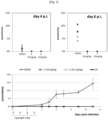
- Results show that following treatment at 10mg/kg, parasites were undetectable at day 4 p.i. in the compound 1-, compound 8- or compound 13 -treated mice whereas the vehicle control group showed a parasitemia of -1.2% and -2.5% in experiment 1 and 2, respectively ( Fig. 1 ; Fig. 2 ).
- the follow-up of parasitemia showed that while parasitemia continue increasing in the vehicle control group (7.7% and 10.8% at day 6 p.i. in Experiment 1 and 2, respectively), parasites remained undetectable in compound 1-, compound 8- or compound 13 -treated mice until the end of the experiments.
- Table IV The table above shows the follow-up of parasitemia (mean ⁇ sd) as well as the number of mice showing blood parasites on days 4, 5, 6, 7, 8 and 10 post infection (p.i.). day 4 p.i. day 5 p.i. day 6 p.i. day 7 p.i. day 8 p.i. day 10 p.i.
- the compounds of the invention are highly potent against P. falciparum in vitro sensitive and multi-resistant strains and they exhibit very high selectivity indexes to HEK293 cells.
- the DHFR inhibitor moiety still retained its capacity to inhibit in vitro the enzymatic activity of mutated DHFR.
- 12 compounds have been tested in cytotoxicity assays against HEK293 cells and showed very high Selectivity Indexes. Importantly, 8 compounds were also very potent against P . falciparum multidrug resistant Dd2 strain in vitro.
- three compounds ( 1, 8, 13 ) administered by oral route (at 10 mg/kg) achieved parasite clearance after oral administration. Moreover, two of them are extremely potent as they are still active according to the Peters test when administered at 1mg/kg.
Landscapes
- Chemical & Material Sciences (AREA)
- Organic Chemistry (AREA)
- Pharmaceuticals Containing Other Organic And Inorganic Compounds (AREA)
Priority Applications (1)
| Application Number | Priority Date | Filing Date | Title |
|---|---|---|---|
| EP23305430.3A EP4438596A1 (de) | 2023-03-28 | 2023-03-28 | Diaminopyrimidinderivate als hdac- und dhfr-inhibitoren mit doppelter zielrichtung und verwendung davon bei der vorbeugung und behandlung von malaria |
Applications Claiming Priority (1)
| Application Number | Priority Date | Filing Date | Title |
|---|---|---|---|
| EP23305430.3A EP4438596A1 (de) | 2023-03-28 | 2023-03-28 | Diaminopyrimidinderivate als hdac- und dhfr-inhibitoren mit doppelter zielrichtung und verwendung davon bei der vorbeugung und behandlung von malaria |
Publications (1)
| Publication Number | Publication Date |
|---|---|
| EP4438596A1 true EP4438596A1 (de) | 2024-10-02 |
Family
ID=86051938
Family Applications (1)
| Application Number | Title | Priority Date | Filing Date |
|---|---|---|---|
| EP23305430.3A Withdrawn EP4438596A1 (de) | 2023-03-28 | 2023-03-28 | Diaminopyrimidinderivate als hdac- und dhfr-inhibitoren mit doppelter zielrichtung und verwendung davon bei der vorbeugung und behandlung von malaria |
Country Status (1)
| Country | Link |
|---|---|
| EP (1) | EP4438596A1 (de) |
Citations (2)
| Publication number | Priority date | Publication date | Assignee | Title |
|---|---|---|---|---|
| WO2009048957A1 (en) * | 2007-10-08 | 2009-04-16 | Medicines For Malaria Venture | Antimalarial compounds with flexible side-chains |
| WO2015179427A1 (en) | 2014-05-20 | 2015-11-26 | Lung Biotechnology Pbc | Methods for producing beraprost and its derivatives |
-
2023
- 2023-03-28 EP EP23305430.3A patent/EP4438596A1/de not_active Withdrawn
Patent Citations (2)
| Publication number | Priority date | Publication date | Assignee | Title |
|---|---|---|---|---|
| WO2009048957A1 (en) * | 2007-10-08 | 2009-04-16 | Medicines For Malaria Venture | Antimalarial compounds with flexible side-chains |
| WO2015179427A1 (en) | 2014-05-20 | 2015-11-26 | Lung Biotechnology Pbc | Methods for producing beraprost and its derivatives |
Non-Patent Citations (8)
| Title |
|---|
| BOWDEN KEITH ET AL: "Structure-activity relations. Part 8. Some novel designed 2,4-diaminopyridine inhibitors of diydrofolic acid reductase", JOURNAL OF CHEMICAL RESEARCH - SYNOPSES, SCIENCE REVIEWS LTD, GB, no. 7, 1 January 1991 (1991-01-01), pages 184 - 185, XP008146434, ISSN: 0308-2342 * |
| EUR J MED CHEM, vol. 161, 2019, pages 277 - 291 |
| GHAZY ET AL., EUROPEAN JOURNAL OF MEDICINAL CHEMISTRY, vol. 200, 2020, pages 112338 |
| IZUMIYAMA ET AL., EXP PARASITOL, vol. 121, no. 2, 2009, pages 144 - 50 |
| KOUZNETSOV ET AL., EUR J MED CHEM, vol. 44, no. 8, 2009, pages 3091 - 3113 |
| MEUNIER ACCOUNTS OF CHEMICAL RESEARCH, vol. 41, no. 1, 2008, pages 69 - 77 |
| MUREGI ET AL., DRUG DEV RES, vol. 71, no. 1, 2010, pages 20 - 32 |
| VANDEKERCKHOVE ET AL., BIOORGANIC & MEDICINAL CHEMISTRY, vol. 23, no. 16, 2015, pages 5098 - 5119 |
Similar Documents
| Publication | Publication Date | Title |
|---|---|---|
| KR0131202B1 (ko) | 치환 4-(퀴놀린-2-일-메톡시)페닐-아세트산 유도체 | |
| JP4405602B2 (ja) | ヒストン脱アセチル化酵素阻害剤 | |
| US8765820B2 (en) | Tranylcypromine derivatives as inhibitors of histone demethylases LSD1 and/or LSD2 | |
| US20080269282A1 (en) | Compounds for Inhibiting Copper-Containing Amine Oxidases and Uses Thereof | |
| US20070219239A1 (en) | Nitrogen-containing heterocycle derivatives, pharmaceutical compositions, and methods of use thereof as antiviral agents | |
| SK283201B6 (sk) | Amidínové zlúčeniny, spôsob ich prípravy, farmaceutický prostriedok s ich obsahom, ich použitie a medziprodukt | |
| KR20040066866A (ko) | 벤즈옥사진 및 벤조티아진 유도체 및 이들을 포함하는약제학적 조성물 | |
| ES2605727T9 (es) | Inhibidores de MAP cinasa p38 | |
| EP3301085A1 (de) | Retinoidderivate mit antitumorwirkung | |
| US20170304283A1 (en) | Compounds and compounds for use in methods for treating diseases or conditions mediated by protein disulfide isomerase | |
| EP4438596A1 (de) | Diaminopyrimidinderivate als hdac- und dhfr-inhibitoren mit doppelter zielrichtung und verwendung davon bei der vorbeugung und behandlung von malaria | |
| JP7734361B2 (ja) | 化合物又はその塩及びその製造方法、化合物又はその塩を含む医薬品組成物及びその製造方法 | |
| EP0505467A1 (de) | Pharmakologisch aktive dicarbonsäure-monoamidderivate | |
| US9422233B2 (en) | Vanilloid fatty hydroxamates as therapeutic anti-inflammatory pharmaceuticals | |
| EP3889132A1 (de) | Inhibitoren der monoacylglycerol lipase(magl) | |
| US11358930B2 (en) | Selective potassium channel agonists | |
| US6620848B2 (en) | Nitric oxide synthase inhibitors | |
| EP0562796A1 (de) | Phenoxyessigsäureverbindungen und diese enthaltende medizinische Zubereitungen | |
| WO2021090194A1 (en) | Treatment of malaria using histone deacetylase (hdac) inhibitors | |
| US6436973B1 (en) | LTA4 hydrolase inhibitors | |
| US20080114005A1 (en) | Fibrate Compounds Having Ppar Agonist Activity | |
| CA2956464A1 (en) | Bisamidinium-based inhibitors for the treatment of myotonic dystrophy | |
| US20050059608A1 (en) | Pharmaceutical compounds | |
| WO2014018913A2 (en) | Santacruzamate a compositions and analogs and methods of use | |
| KR101096427B1 (ko) | 신규한 4-아릴-4-옥소부탄산 아미드 유도체 또는 이의 약학적으로 허용가능한 염, 이의 제조방법 및 이를 유효성분으로 함유하는 약학적 조성물 |
Legal Events
| Date | Code | Title | Description |
|---|---|---|---|
| PUAI | Public reference made under article 153(3) epc to a published international application that has entered the european phase |
Free format text: ORIGINAL CODE: 0009012 |
|
| STAA | Information on the status of an ep patent application or granted ep patent |
Free format text: STATUS: THE APPLICATION HAS BEEN PUBLISHED |
|
| AK | Designated contracting states |
Kind code of ref document: A1 Designated state(s): AL AT BE BG CH CY CZ DE DK EE ES FI FR GB GR HR HU IE IS IT LI LT LU LV MC ME MK MT NL NO PL PT RO RS SE SI SK SM TR |
|
| STAA | Information on the status of an ep patent application or granted ep patent |
Free format text: STATUS: THE APPLICATION IS DEEMED TO BE WITHDRAWN |
|
| 18D | Application deemed to be withdrawn |
Effective date: 20250403 |