EP4445749A1 - Coagulant destiné à la préparation d'une pâte de haricot, et pâte de haricot préparée à l'aide d?un tel coagulant - Google Patents
Coagulant destiné à la préparation d'une pâte de haricot, et pâte de haricot préparée à l'aide d?un tel coagulant Download PDFInfo
- Publication number
- EP4445749A1 EP4445749A1 EP22911860.9A EP22911860A EP4445749A1 EP 4445749 A1 EP4445749 A1 EP 4445749A1 EP 22911860 A EP22911860 A EP 22911860A EP 4445749 A1 EP4445749 A1 EP 4445749A1
- Authority
- EP
- European Patent Office
- Prior art keywords
- coagulant
- bean curd
- weight
- oil
- producing
- Prior art date
- Legal status (The legal status is an assumption and is not a legal conclusion. Google has not performed a legal analysis and makes no representation as to the accuracy of the status listed.)
- Pending
Links
- 235000013527 bean curd Nutrition 0.000 title claims abstract description 147
- 239000000701 coagulant Substances 0.000 title claims abstract description 141
- 238000002360 preparation method Methods 0.000 title description 3
- 238000000034 method Methods 0.000 claims abstract description 28
- TWRXJAOTZQYOKJ-UHFFFAOYSA-L Magnesium chloride Chemical compound [Mg+2].[Cl-].[Cl-] TWRXJAOTZQYOKJ-UHFFFAOYSA-L 0.000 claims description 51
- 235000010469 Glycine max Nutrition 0.000 claims description 45
- 244000068988 Glycine max Species 0.000 claims description 44
- 239000003921 oil Substances 0.000 claims description 41
- 235000019198 oils Nutrition 0.000 claims description 41
- 235000004347 Perilla Nutrition 0.000 claims description 26
- 244000124853 Perilla frutescens Species 0.000 claims description 25
- 229910001629 magnesium chloride Inorganic materials 0.000 claims description 25
- 239000010466 nut oil Substances 0.000 claims description 25
- 235000018330 Macadamia integrifolia Nutrition 0.000 claims description 24
- 240000000912 Macadamia tetraphylla Species 0.000 claims description 24
- 235000003800 Macadamia tetraphylla Nutrition 0.000 claims description 24
- 235000019640 taste Nutrition 0.000 claims description 22
- 235000005135 Micromeria juliana Nutrition 0.000 claims description 19
- 235000007315 Satureja hortensis Nutrition 0.000 claims description 19
- 235000013322 soy milk Nutrition 0.000 claims description 18
- 239000013535 sea water Substances 0.000 claims description 17
- 239000008157 edible vegetable oil Substances 0.000 claims description 13
- 239000002245 particle Substances 0.000 claims description 9
- 238000002791 soaking Methods 0.000 claims description 9
- 238000010438 heat treatment Methods 0.000 claims description 8
- 235000019750 Crude protein Nutrition 0.000 claims description 7
- 230000001112 coagulating effect Effects 0.000 claims description 5
- 238000000227 grinding Methods 0.000 claims description 5
- 238000003756 stirring Methods 0.000 claims description 5
- 241001131796 Botaurus stellaris Species 0.000 claims description 4
- 238000001914 filtration Methods 0.000 claims description 4
- JVTAAEKCZFNVCJ-UHFFFAOYSA-N lactic acid Chemical compound CC(O)C(O)=O JVTAAEKCZFNVCJ-UHFFFAOYSA-N 0.000 claims description 4
- 240000002114 Satureja hortensis Species 0.000 claims description 3
- 230000008961 swelling Effects 0.000 claims description 3
- UXVMQQNJUSDDNG-UHFFFAOYSA-L Calcium chloride Chemical compound [Cl-].[Cl-].[Ca+2] UXVMQQNJUSDDNG-UHFFFAOYSA-L 0.000 claims description 2
- 239000001110 calcium chloride Substances 0.000 claims description 2
- 229910001628 calcium chloride Inorganic materials 0.000 claims description 2
- 239000004310 lactic acid Substances 0.000 claims description 2
- 235000014655 lactic acid Nutrition 0.000 claims description 2
- 238000002156 mixing Methods 0.000 description 25
- 241000246354 Satureja Species 0.000 description 16
- 238000004519 manufacturing process Methods 0.000 description 16
- 239000000796 flavoring agent Substances 0.000 description 12
- 235000019774 Rice Bran oil Nutrition 0.000 description 11
- 239000008165 rice bran oil Substances 0.000 description 11
- 239000000839 emulsion Substances 0.000 description 10
- XLYOFNOQVPJJNP-UHFFFAOYSA-N water Substances O XLYOFNOQVPJJNP-UHFFFAOYSA-N 0.000 description 10
- 235000019634 flavors Nutrition 0.000 description 9
- VZSRBBMJRBPUNF-UHFFFAOYSA-N 2-(2,3-dihydro-1H-inden-2-ylamino)-N-[3-oxo-3-(2,4,6,7-tetrahydrotriazolo[4,5-c]pyridin-5-yl)propyl]pyrimidine-5-carboxamide Chemical compound C1C(CC2=CC=CC=C12)NC1=NC=C(C=N1)C(=O)NCCC(N1CC2=C(CC1)NN=N2)=O VZSRBBMJRBPUNF-UHFFFAOYSA-N 0.000 description 8
- AFCARXCZXQIEQB-UHFFFAOYSA-N N-[3-oxo-3-(2,4,6,7-tetrahydrotriazolo[4,5-c]pyridin-5-yl)propyl]-2-[[3-(trifluoromethoxy)phenyl]methylamino]pyrimidine-5-carboxamide Chemical compound O=C(CCNC(=O)C=1C=NC(=NC=1)NCC1=CC(=CC=C1)OC(F)(F)F)N1CC2=C(CC1)NN=N2 AFCARXCZXQIEQB-UHFFFAOYSA-N 0.000 description 7
- 235000013339 cereals Nutrition 0.000 description 7
- OSGAYBCDTDRGGQ-UHFFFAOYSA-L calcium sulfate Chemical compound [Ca+2].[O-]S([O-])(=O)=O OSGAYBCDTDRGGQ-UHFFFAOYSA-L 0.000 description 6
- 102000004169 proteins and genes Human genes 0.000 description 6
- 108090000623 proteins and genes Proteins 0.000 description 6
- 230000000052 comparative effect Effects 0.000 description 5
- 230000001953 sensory effect Effects 0.000 description 5
- JAWMENYCRQKKJY-UHFFFAOYSA-N [3-(2,4,6,7-tetrahydrotriazolo[4,5-c]pyridin-5-ylmethyl)-1-oxa-2,8-diazaspiro[4.5]dec-2-en-8-yl]-[2-[[3-(trifluoromethoxy)phenyl]methylamino]pyrimidin-5-yl]methanone Chemical compound N1N=NC=2CN(CCC=21)CC1=NOC2(C1)CCN(CC2)C(=O)C=1C=NC(=NC=1)NCC1=CC(=CC=C1)OC(F)(F)F JAWMENYCRQKKJY-UHFFFAOYSA-N 0.000 description 4
- 238000005345 coagulation Methods 0.000 description 4
- 230000015271 coagulation Effects 0.000 description 4
- 239000003995 emulsifying agent Substances 0.000 description 4
- 230000002708 enhancing effect Effects 0.000 description 4
- 238000011156 evaluation Methods 0.000 description 4
- 235000019645 odor Nutrition 0.000 description 4
- 230000000704 physical effect Effects 0.000 description 4
- HMUNWXXNJPVALC-UHFFFAOYSA-N 1-[4-[2-(2,3-dihydro-1H-inden-2-ylamino)pyrimidin-5-yl]piperazin-1-yl]-2-(2,4,6,7-tetrahydrotriazolo[4,5-c]pyridin-5-yl)ethanone Chemical compound C1C(CC2=CC=CC=C12)NC1=NC=C(C=N1)N1CCN(CC1)C(CN1CC2=C(CC1)NN=N2)=O HMUNWXXNJPVALC-UHFFFAOYSA-N 0.000 description 3
- MKYBYDHXWVHEJW-UHFFFAOYSA-N N-[1-oxo-1-(2,4,6,7-tetrahydrotriazolo[4,5-c]pyridin-5-yl)propan-2-yl]-2-[[3-(trifluoromethoxy)phenyl]methylamino]pyrimidine-5-carboxamide Chemical compound O=C(C(C)NC(=O)C=1C=NC(=NC=1)NCC1=CC(=CC=C1)OC(F)(F)F)N1CC2=C(CC1)NN=N2 MKYBYDHXWVHEJW-UHFFFAOYSA-N 0.000 description 3
- NIPNSKYNPDTRPC-UHFFFAOYSA-N N-[2-oxo-2-(2,4,6,7-tetrahydrotriazolo[4,5-c]pyridin-5-yl)ethyl]-2-[[3-(trifluoromethoxy)phenyl]methylamino]pyrimidine-5-carboxamide Chemical compound O=C(CNC(=O)C=1C=NC(=NC=1)NCC1=CC(=CC=C1)OC(F)(F)F)N1CC2=C(CC1)NN=N2 NIPNSKYNPDTRPC-UHFFFAOYSA-N 0.000 description 3
- KRKNYBCHXYNGOX-UHFFFAOYSA-N citric acid Chemical compound OC(=O)CC(O)(C(O)=O)CC(O)=O KRKNYBCHXYNGOX-UHFFFAOYSA-N 0.000 description 3
- 230000000694 effects Effects 0.000 description 3
- 238000004945 emulsification Methods 0.000 description 3
- 230000001965 increasing effect Effects 0.000 description 3
- 239000000047 product Substances 0.000 description 3
- 150000003839 salts Chemical class 0.000 description 3
- 238000003860 storage Methods 0.000 description 3
- 235000004977 Brassica sinapistrum Nutrition 0.000 description 2
- 241000196324 Embryophyta Species 0.000 description 2
- 235000010627 Phaseolus vulgaris Nutrition 0.000 description 2
- 244000046052 Phaseolus vulgaris Species 0.000 description 2
- 235000019658 bitter taste Nutrition 0.000 description 2
- 238000009835 boiling Methods 0.000 description 2
- 235000021329 brown rice Nutrition 0.000 description 2
- -1 citric acid Chemical class 0.000 description 2
- 235000005687 corn oil Nutrition 0.000 description 2
- 239000002285 corn oil Substances 0.000 description 2
- 238000005516 engineering process Methods 0.000 description 2
- 239000007788 liquid Substances 0.000 description 2
- 239000000203 mixture Substances 0.000 description 2
- 238000000465 moulding Methods 0.000 description 2
- 239000002994 raw material Substances 0.000 description 2
- LDXJRKWFNNFDSA-UHFFFAOYSA-N 2-(2,4,6,7-tetrahydrotriazolo[4,5-c]pyridin-5-yl)-1-[4-[2-[[3-(trifluoromethoxy)phenyl]methylamino]pyrimidin-5-yl]piperazin-1-yl]ethanone Chemical compound C1CN(CC2=NNN=C21)CC(=O)N3CCN(CC3)C4=CN=C(N=C4)NCC5=CC(=CC=C5)OC(F)(F)F LDXJRKWFNNFDSA-UHFFFAOYSA-N 0.000 description 1
- 235000019489 Almond oil Nutrition 0.000 description 1
- 244000226021 Anacardium occidentale Species 0.000 description 1
- 235000019737 Animal fat Nutrition 0.000 description 1
- 235000014698 Brassica juncea var multisecta Nutrition 0.000 description 1
- 240000002791 Brassica napus Species 0.000 description 1
- 235000006008 Brassica napus var napus Nutrition 0.000 description 1
- 235000006618 Brassica rapa subsp oleifera Nutrition 0.000 description 1
- 244000188595 Brassica sinapistrum Species 0.000 description 1
- 229920000742 Cotton Polymers 0.000 description 1
- PHOQVHQSTUBQQK-SQOUGZDYSA-N D-glucono-1,5-lactone Chemical compound OC[C@H]1OC(=O)[C@H](O)[C@@H](O)[C@@H]1O PHOQVHQSTUBQQK-SQOUGZDYSA-N 0.000 description 1
- 235000019487 Hazelnut oil Nutrition 0.000 description 1
- 235000019493 Macadamia oil Nutrition 0.000 description 1
- 241001465754 Metazoa Species 0.000 description 1
- 235000019482 Palm oil Nutrition 0.000 description 1
- 235000019483 Peanut oil Nutrition 0.000 description 1
- 241000229722 Perilla <angiosperm> Species 0.000 description 1
- 241000221037 Pyrularia pubera Species 0.000 description 1
- 235000019485 Safflower oil Nutrition 0.000 description 1
- 235000019486 Sunflower oil Nutrition 0.000 description 1
- 235000019498 Walnut oil Nutrition 0.000 description 1
- 239000000654 additive Substances 0.000 description 1
- 239000008168 almond oil Substances 0.000 description 1
- 235000021302 avocado oil Nutrition 0.000 description 1
- 239000008163 avocado oil Substances 0.000 description 1
- 235000019636 bitter flavor Nutrition 0.000 description 1
- 235000021324 borage oil Nutrition 0.000 description 1
- 239000006227 byproduct Substances 0.000 description 1
- 235000020226 cashew nut Nutrition 0.000 description 1
- 239000011248 coating agent Substances 0.000 description 1
- 238000000576 coating method Methods 0.000 description 1
- 238000010835 comparative analysis Methods 0.000 description 1
- 235000012343 cottonseed oil Nutrition 0.000 description 1
- 239000002385 cottonseed oil Substances 0.000 description 1
- 239000010779 crude oil Substances 0.000 description 1
- 238000001514 detection method Methods 0.000 description 1
- 230000006866 deterioration Effects 0.000 description 1
- 238000007598 dipping method Methods 0.000 description 1
- 230000005611 electricity Effects 0.000 description 1
- 238000010828 elution Methods 0.000 description 1
- 230000001804 emulsifying effect Effects 0.000 description 1
- 239000004744 fabric Substances 0.000 description 1
- 235000019197 fats Nutrition 0.000 description 1
- 235000021323 fish oil Nutrition 0.000 description 1
- 235000013305 food Nutrition 0.000 description 1
- 235000011194 food seasoning agent Nutrition 0.000 description 1
- 235000012209 glucono delta-lactone Nutrition 0.000 description 1
- 239000000182 glucono-delta-lactone Substances 0.000 description 1
- 229960003681 gluconolactone Drugs 0.000 description 1
- 239000008169 grapeseed oil Substances 0.000 description 1
- 239000010468 hazelnut oil Substances 0.000 description 1
- 238000003505 heat denaturation Methods 0.000 description 1
- 235000008216 herbs Nutrition 0.000 description 1
- 239000004615 ingredient Substances 0.000 description 1
- 235000021388 linseed oil Nutrition 0.000 description 1
- 239000000944 linseed oil Substances 0.000 description 1
- 239000010469 macadamia oil Substances 0.000 description 1
- 235000011147 magnesium chloride Nutrition 0.000 description 1
- 239000002075 main ingredient Substances 0.000 description 1
- 238000005259 measurement Methods 0.000 description 1
- 238000000691 measurement method Methods 0.000 description 1
- 235000013336 milk Nutrition 0.000 description 1
- 239000008267 milk Substances 0.000 description 1
- 210000004080 milk Anatomy 0.000 description 1
- 238000012986 modification Methods 0.000 description 1
- 230000004048 modification Effects 0.000 description 1
- 235000008390 olive oil Nutrition 0.000 description 1
- 239000004006 olive oil Substances 0.000 description 1
- 150000007524 organic acids Chemical class 0.000 description 1
- 235000005985 organic acids Nutrition 0.000 description 1
- 239000003346 palm kernel oil Substances 0.000 description 1
- 235000019865 palm kernel oil Nutrition 0.000 description 1
- 239000002540 palm oil Substances 0.000 description 1
- 239000000312 peanut oil Substances 0.000 description 1
- 239000010773 plant oil Substances 0.000 description 1
- 239000008171 pumpkin seed oil Substances 0.000 description 1
- 239000008213 purified water Substances 0.000 description 1
- 230000009257 reactivity Effects 0.000 description 1
- IOVGROKTTNBUGK-SJCJKPOMSA-N ritodrine Chemical compound N([C@@H](C)[C@H](O)C=1C=CC(O)=CC=1)CCC1=CC=C(O)C=C1 IOVGROKTTNBUGK-SJCJKPOMSA-N 0.000 description 1
- 235000005713 safflower oil Nutrition 0.000 description 1
- 239000003813 safflower oil Substances 0.000 description 1
- 235000015067 sauces Nutrition 0.000 description 1
- 238000000926 separation method Methods 0.000 description 1
- 235000011803 sesame oil Nutrition 0.000 description 1
- 239000008159 sesame oil Substances 0.000 description 1
- 235000002639 sodium chloride Nutrition 0.000 description 1
- 235000012424 soybean oil Nutrition 0.000 description 1
- 239000003549 soybean oil Substances 0.000 description 1
- 235000013599 spices Nutrition 0.000 description 1
- 239000002600 sunflower oil Substances 0.000 description 1
- 239000008170 walnut oil Substances 0.000 description 1
- 239000002699 waste material Substances 0.000 description 1
Images
Classifications
-
- A—HUMAN NECESSITIES
- A23—FOODS OR FOODSTUFFS; TREATMENT THEREOF, NOT COVERED BY OTHER CLASSES
- A23L—FOODS, FOODSTUFFS OR NON-ALCOHOLIC BEVERAGES, NOT OTHERWISE PROVIDED FOR; PREPARATION OR TREATMENT THEREOF
- A23L29/00—Foods or foodstuffs containing additives; Preparation or treatment thereof
-
- A—HUMAN NECESSITIES
- A23—FOODS OR FOODSTUFFS; TREATMENT THEREOF, NOT COVERED BY OTHER CLASSES
- A23L—FOODS, FOODSTUFFS OR NON-ALCOHOLIC BEVERAGES, NOT OTHERWISE PROVIDED FOR; PREPARATION OR TREATMENT THEREOF
- A23L11/00—Pulses, i.e. fruits of leguminous plants, for production of food; Products from legumes; Preparation or treatment thereof
- A23L11/40—Pulse curds
- A23L11/45—Soy bean curds, e.g. tofu
-
- A—HUMAN NECESSITIES
- A23—FOODS OR FOODSTUFFS; TREATMENT THEREOF, NOT COVERED BY OTHER CLASSES
- A23D—EDIBLE OILS OR FATS, e.g. MARGARINES, SHORTENINGS OR COOKING OILS
- A23D7/00—Edible oil or fat compositions containing an aqueous phase, e.g. margarines
- A23D7/005—Edible oil or fat compositions containing an aqueous phase, e.g. margarines characterised by ingredients other than fatty acid triglycerides
- A23D7/0053—Compositions other than spreads
-
- A—HUMAN NECESSITIES
- A23—FOODS OR FOODSTUFFS; TREATMENT THEREOF, NOT COVERED BY OTHER CLASSES
- A23L—FOODS, FOODSTUFFS OR NON-ALCOHOLIC BEVERAGES, NOT OTHERWISE PROVIDED FOR; PREPARATION OR TREATMENT THEREOF
- A23L11/00—Pulses, i.e. fruits of leguminous plants, for production of food; Products from legumes; Preparation or treatment thereof
- A23L11/30—Removing undesirable substances, e.g. bitter substances
-
- A—HUMAN NECESSITIES
- A23—FOODS OR FOODSTUFFS; TREATMENT THEREOF, NOT COVERED BY OTHER CLASSES
- A23L—FOODS, FOODSTUFFS OR NON-ALCOHOLIC BEVERAGES, NOT OTHERWISE PROVIDED FOR; PREPARATION OR TREATMENT THEREOF
- A23L29/00—Foods or foodstuffs containing additives; Preparation or treatment thereof
- A23L29/015—Inorganic compounds
-
- A—HUMAN NECESSITIES
- A23—FOODS OR FOODSTUFFS; TREATMENT THEREOF, NOT COVERED BY OTHER CLASSES
- A23L—FOODS, FOODSTUFFS OR NON-ALCOHOLIC BEVERAGES, NOT OTHERWISE PROVIDED FOR; PREPARATION OR TREATMENT THEREOF
- A23L29/00—Foods or foodstuffs containing additives; Preparation or treatment thereof
- A23L29/03—Organic compounds
- A23L29/035—Organic compounds containing oxygen as heteroatom
- A23L29/04—Fatty acids or derivatives
-
- A—HUMAN NECESSITIES
- A23—FOODS OR FOODSTUFFS; TREATMENT THEREOF, NOT COVERED BY OTHER CLASSES
- A23V—INDEXING SCHEME RELATING TO FOODS, FOODSTUFFS OR NON-ALCOHOLIC BEVERAGES AND LACTIC OR PROPIONIC ACID BACTERIA USED IN FOODSTUFFS OR FOOD PREPARATION
- A23V2002/00—Food compositions, function of food ingredients or processes for food or foodstuffs
-
- A—HUMAN NECESSITIES
- A23—FOODS OR FOODSTUFFS; TREATMENT THEREOF, NOT COVERED BY OTHER CLASSES
- A23V—INDEXING SCHEME RELATING TO FOODS, FOODSTUFFS OR NON-ALCOHOLIC BEVERAGES AND LACTIC OR PROPIONIC ACID BACTERIA USED IN FOODSTUFFS OR FOOD PREPARATION
- A23V2200/00—Function of food ingredients
- A23V2200/20—Ingredients acting on or related to the structure
- A23V2200/218—Coagulant
Definitions
- the present disclosure relates to a coagulant for producing a bean curd, a bean curd produced using the coagulant, and a method of producing a bean curd using the coagulant.
- Bean curd has been used as a high-protein food for a long time. According to a bean curd production method traditionally used, bean curds have been produced by dipping and soaking soybeans in water, grinding the soybeans on a millstone and boiling, and then filtering while boiling, and adding magnesium chloride (bittern) as a coagulant to the obtained soymilk at about 60°C to 90°C, which is then stirred and coagulated.
- bean curds have been produced by dipping and soaking soybeans in water, grinding the soybeans on a millstone and boiling, and then filtering while boiling, and adding magnesium chloride (bittern) as a coagulant to the obtained soymilk at about 60°C to 90°C, which is then stirred and coagulated.
- bittern magnesium chloride
- Magnesium chloride is the main ingredient in bittern, which is a by-product after collecting salt from seawater. Unlike calcium sulfate or glucono delta lactone (G.D.L.), magnesium chloride is a fast-acting coagulant that immediately reacts when mixed with soymilk. In general, fast-acting coagulants have an advantage in that they are fast to work and easy to coagulate when producing a bean curd with low water retention, such as a fried bean curd, but have a disadvantage of requiring skilled technology when producing a bean curd with high water retention.
- the soymilk is cooled to create an environment where coagulation by the coagulant is difficult to occur, and then the fast-acting coagulant is added and mixed, and then the soymilk is gradually heated to solidify while controlling the temperature rise by hot water, steam, or electricity.
- the method of using the emulsified coagulant as described above has problems in that more oil and emulsifier, which are auxiliary ingredients used to emulsify the fast-acting coagulant, are included than the fast-acting coagulant, and large amounts of oil and emulsifier are used, which is not only a waste of resources, but also requires a separate device to destroy the emulsified layer when added to soymilk.
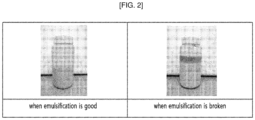
- the high content of oil causes oil odor and deterioration of emulsification during storage, resulting in separation of oil.
- the emulsified coagulant without the emulsifier has a problem with being easily separated at room temperature.
- Patent Document 0001 Korean Patent No. 0229010
- the present inventors have developed a coagulant for producing a high-quality bean curd with enhanced savory taste, a bean curd produced using the coagulant, and a method of producing a bean curd using the coagulant, thereby completing the present disclosure.
- An object of the present disclosure is to provide a coagulant for producing a bean curd, the coagulant including 20% by weight to 50% by weight of macadamia nut oil, 1% by weight to 10% by weight of perilla oil, and 15% by weight to 79% by weight of a fast-acting coagulant.
- Another object of the present disclosure is to provide a bean curd which is produced using the coagulant for producing a bean curd.
- Still another object of the present disclosure is to provide a method of producing a bean curd, the method including the steps of selecting soybeans, soaking and swelling the selected soybeans, producing soymilk by grinding and heating the swollen soybeans and then filtering the same, and coagulating the produced soymilk under stirring while adding the coagulant for producing a bean curd to the produced soymilk.
- An aspect of the present disclosure provides a coagulant for producing a bean curd, the coagulant including 20% by weight to 50% by weight of macadamia nut oil, 1% by weight to 10% by weight of perilla oil, and 15% by weight to 79% by weight of a fast-acting coagulant.
- the coagulant for producing a bean curd of the present disclosure is an emulsified coagulant which is used to coagulate soybean milk in the production of bean curds, and may be usefully applied in producing a high-quality bean curd by dispersing the fast-acting coagulant in macadamia nut oil and perilla oil and coating the same so that the fast-acting coagulant is gradually released during the production of bean curds.
- the coagulant for producing a bean curd of the present disclosure includes the macadamia nut oil and the perilla oil, thereby removing the beany flavor unique to soybeans, preventing the bitter taste, off-flavor, and odor unique to the coagulant for producing a bean curd, and enhancing the original savory flavor of bean curd.
- the coagulant for producing a bean curd of the present disclosure may include 20% by weight to 50% by weight, specifically, 30% by weight to 50% by weight, and more specifically, 35% by weight to 45% by weight of macadamia nut oil, but is not limited thereto.
- the macadamia nut oil When the macadamia nut oil is included in an amount of less than 20% by weight, the unique beany flavor of beans may not be removed and the effect of increasing the savory taste of bean curd is not sufficient. When the macadamia nut oil is included in an amount of more than 50% by weight, there is a problem in that the emulsion stability of the coagulant is reduced, which is not suitable for mass production of bean curd.
- the coagulant for producing a bean curd of the present disclosure may include 1% by weight to 10% by weight, specifically, 2.5% by weight to 7.5% by weight, and more specifically, 4% by weight to 6% by weight of perilla oil, but is not limited thereto.
- the perilla oil When the perilla oil is included in an amount of less than 1% by weight, the unique beany flavor of beans may not be removed and the effect of increasing the savory taste of bean curd is not sufficient.
- the perilla oil When the perilla oil is included in an amount of more than 10% by weight, there is a problem in that the distinct aroma and greasy taste of perilla oil are strengthened, which reduces the preference for bean curd, and the emulsion stability of the coagulant is reduced, which is not suitable for mass production of bean curd.
- the coagulant for producing a bean curd of the present disclosure may include 15% by weight to 79% by weight, specifically, 25% by weight to 70% by weight, and more specifically, 50% by weight to 60% by weight of the fast-acting coagulant, but is not limited thereto.
- the fast-acting coagulant When the fast-acting coagulant is included in an amount of less than 15% by weight, the coagulation reaction occurs too slowly, and thus industrial efficiency is very low. When the fast-acting coagulant is included in an amount of more than 79% by weight, there is a problem in that emulsification does not occur, which makes it impossible to prepare the emulsified coagulant.
- the coagulant for producing a bean curd of the present disclosure may include the macadamia nut oil, the perilla oil, and the fast-acting coagulant in the above contents, thereby removing the beany flavor unique to soybeans, preventing the bitter taste, off-flavor and odor unique to the coagulant for producing a bean curd, and enhancing the original savory flavor of bean curd.
- the coagulant may further include 0.001 % by weight to 20% by weight of edible oil, but is not limited thereto.
- edible oil refers to oil which is manufactured and processed to be edible from crude oil as a raw material, which is obtained from oil-containing plants (including crushed form) or animals.
- specific examples of the edible oil may include plant oils such as perilla oil, macadamia nut oil, rice bran oil (brown rice oil, bran oil etc.), corn oil, soybean oil, rapeseed (canola, etc.) oil, sunflower oil, sesame oil, palm oil, palm kernel oil, olive oil, grape seed oil, hazelnut oil, cottonseed oil, peanut oil, almond oil, avocado oil, flaxseed oil, pumpkin seed oil, walnut oil, perilla oil, cashew nut oil, borage oil, etc., fish oil, animal fat, flavored oils/seasoning oils such as rayu, etc., but are not limited thereto.
- the edible oil is an oil that is optionally mixed to increase the price competitiveness of new coagulants, and known edible oils commonly used may be used.
- rice bran oil brown rice oil, bran oil etc.
- rice bran oil may be used, but is not limited to thereto.
- the coagulant for producing a bean curd of the present disclosure may include 0% by weight to 20% by weight, more specifically, 0% by weight to 10% by weight of edible oil, but is not limited thereto.
- the coagulant for producing a bean curd of the present disclosure may include no edible oil, or may further include 0.001% by weight to 20% by weight, more specifically, 0.001% by weight to 10% by weight of edible oil, but is not limited thereto.
- the edible oil may be optionally included to increase price competitiveness, but when the edible oil is included in an amount of more than 20% by weight, specifically, more than 10% by weight, it affects the taste of the bean curd, causing a problem in that the acceptance and preference of bean curd is reduced.
- the fast-acting coagulant may be selected from the group consisting of magnesium chloride, bittern containing magnesium chloride, seawater, concentrated seawater, prepared seawater magnesium chloride, calcium chloride, and lactic acid, but is not limited thereto.
- the fast-acting coagulant of the present disclosure may be magnesium chloride, but is not limited thereto.
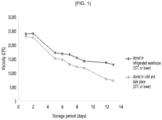
- the coagulant for producing a bean curd of the present disclosure may have a viscosity of 12,000 cP to 26,000 cP.
- the viscosity may be 12,000 cP to 26,000 cP.
- the measurement may be performed after storage at 0°C to 20°C, for example, 5°C to 20°C.
- Another aspect of the present disclosure provides a method of producing the coagulant for producing a bean curd of the present disclosure, the method including the step of mixing 20% by weight to 50% by weight of the macadamia nut oil, 1% by weight to 10% by weight of the perilla oil, and 15% by weight to 79% by weight of the fast-acting coagulant.
- the macadamia nut oil, perilla oil, fast-acting coagulant, bean curd, and coagulant are as described above.
- the mixing step may be performed at a temperature of 55°C to 85°C, specifically at 60°C to 80°C, more specifically at 65°C to 75°C, and more specifically at about 70°C, but is not limited thereto.
- the emulsion stability of the coagulant may be excellent.
- the production method may further include the step of adding and mixing with 0.001% by weight to 20% by weight of the edible oil, but is not limited thereto.
- Still another aspect of the present disclosure provides a bean curd which is produced using the coagulant.
- the bean curd and coagulant are as described above.
- the bean curd produced using the coagulant may have an increased savory taste of bean curd, as compared to a bean curd produced using a coagulant without macadamia nut oil and perilla oil, but is not limited thereto.
- Still another aspect of the present disclosure provides a method of producing a bean curd, the method including the steps of selecting soybeans, soaking and swelling the selected soybeans, producing soymilk by grinding and heating the swollen soybeans and then filtering the same, and coagulating the produced soymilk under stirring while adding the coagulant for producing a bean curd to the produced soymilk.
- the bean curd and coagulant are as described above.
- the step of selecting soybeans is important in order to produce a high-quality bean curd with high efficiency.
- the selected soybeans in the present disclosure may have a 100-grain weight (a weight of 100 grains of soybeans) of 10 g to 35 g, specifically 15 g to 30 g, and more specifically 18 g to 26 g, but is not limited thereto.
- the "100-grain weight” refers to the weight (g) of 100 grains of soybeans.
- the selected soybeans of the present disclosure may have a particle size of 4.5 mm to 9.0 mm, specifically 5.0 mm to 8.5 mm, and more specifically 5.6 mm to 8.0 mm, but are not limited thereto.
- the particle size may be measured by a known method, for example, by passing 100 grains of soybeans through a mesh net of 5.6 mm and 8.0 mm.
- the selected soybeans of the present disclosure may have a crude protein content of 15% to 45%, specifically 20% to 40%, and more specifically 21% to 37%, but are not limited thereto.
- the crude protein content has a major impact on the yield and physical properties of bean curd, and a bean curd produced from soybeans with a high protein content has a high protein/fat ratio.
- the selected soybeans may have a 100-grain weight (a weight of 100 grains of soybeans) of 18 g to 26 g, a particle size of 5.6 mm to 8.0 mm, and a crude protein content of 21% to 37%, but are not limited thereto.
- soybeans having the 100-grain weight, the particle size, and/or the crude protein content in the above ranges are used to produce a bean curd, it is possible to produce a high-quality bean curd with a smooth bean curd surface due to less water loss and uniform curd properties, with high efficiency.
- the coagulant in the coagulating step may be added in an amount of 0.1% by weight to 5.0% by weight, specifically 0.3% by weight to 3.0% by weight, and more specifically 0.5% by weight to 2.5% by weight, but is not limited thereto.
- the coagulant When the coagulant is included in an amount of less than 0.1% by weight, there is a problem in that the bean curd does not coagulate, and when the coagulant is included in an amount of more than 5.0% by weight, excessive coagulation occurs, causing severe water loss during bean curd molding, and a hard bean curd with low preference may be produced, and the production cost of bean curd becomes expensive, which may reduce yieldability.
- the soaking time may be 12 hours to 22 hours, specifically 18 hours to 20 hours, but is not limited thereto.
- the heating temperature may be 95°C to 105°C, specifically about 100°C, but is not limited thereto.
- a bean curd with desirable properties may be produced.
- the heating temperature is outside the above range, there are problems in that a too low temperature results in insufficient heat denaturation of proteins, which makes it difficult to produce a bean curd with desirable properties, and a too high temperature results in protein insolubilization, which makes it difficult to produce a bean curd with desirable properties.
- additives such as salt, sauce, spices, plants such as herbs, etc. may be added to give additional taste to the bean curd.
- a coagulant according to the present disclosure When a coagulant according to the present disclosure is used, a high-quality bean curd with an enhanced savory taste may be produced. Accordingly, it is economical because it does not require separate equipment, and the process is simple and less time-consuming, thereby being usefully applied to mass production of high-quality bean curds.
- a prepared seawater magnesium chloride solution as a fast-acting coagulant 40 g of macadamia nut oil, and 5 g of perilla oil were placed in a mixing container, and stirred and mixed while maintaining the temperature of the mixing container at 70°C to prepare a coagulant for producing a bean curd.
- a prepared seawater magnesium chloride solution as a fast-acting coagulant 5 g of macadamia nut oil, 5 g of perilla oil, and 35 g of rice bran oil were placed in a mixing container, and stirred and mixed while maintaining the temperature of the mixing container at 70°C to prepare a coagulant for producing a bean curd.
- a prepared seawater magnesium chloride solution as a fast-acting coagulant 10 g of macadamia nut oil, 5 g of perilla oil, and 30 g of rice bran oil were placed in a mixing container, and stirred and mixed while maintaining the temperature of the mixing container at 70°C to prepare a coagulant for producing a bean curd.
- a prepared seawater magnesium chloride solution as a fast-acting coagulant 21.25 g of macadamia nut oil, 2.5 g of perilla oil, and 21.25 g of rice bran oil were placed in a mixing container, and stirred and mixed while maintaining the temperature of the mixing container at 70°C to prepare a coagulant for producing a bean curd.
- a prepared seawater magnesium chloride solution as a fast-acting coagulant 31.25 g of macadamia nut oil, 2.5 g of perilla oil, and 11.25 g of rice bran oil were placed in a mixing container, and stirred and mixed while maintaining the temperature of the mixing container at 70°C to prepare a coagulant for producing a bean curd.
- a 1 L sample was sampled and measured at room temperature (15°C to 25°C) under conditions of 63 spindle and 2.0 rpm using a DV-E viscometer (rotational viscometer, Brookfield).
- Bean curds were produced using the coagulants for producing a bean curd, which were prepared in Example 1.
- soybeans suitable for bean curd production 100-grain weight, particle size, and protein content were measured using the measurement methods below.
- soybeans with a 100-grain weight of 18 g to 26 g soybeans with 90% of the weight of 100 grains with a particle size of 5.6 mm or more and 8.0 mm or less, and soybeans with a crude protein content of 21% to 37% are used, it is possible to produce a soft bean curd due to the smooth bean curd surface and minimal water loss, and to produce a uniformly coagulated bean curd.
- Bean curds were produced using the soybeans selected in Example 3-1 and the coagulants for producing a bean curd, which were prepared in Example 1.
- Example 3 a comparative evaluation of the sensory quality was performed on the bean curd produced with the coagulant of Example 1-2, which was produced in Example 3, and a commercially available bean curd (coagulant: prepared seawater magnesium chloride, safflower oil, macadamia oil).
- Example 3 As a result, as shown in Table 3, it was found that the bean curd produced with the coagulant of Example 1-2, which was prepared in Example 3, showed the high overall taste preference, physical property preference, and product preference, and its savory taste intensity was lower than that of commercially available bean curd, but its preference was slightly better. Therefore, it was confirmed that the coagulant composition of the above mixing ratio had relatively excellent sensory preference in enhancing the savory taste of bean curds.
Landscapes
- Life Sciences & Earth Sciences (AREA)
- Chemical & Material Sciences (AREA)
- Engineering & Computer Science (AREA)
- Food Science & Technology (AREA)
- Polymers & Plastics (AREA)
- Health & Medical Sciences (AREA)
- Nutrition Science (AREA)
- Agronomy & Crop Science (AREA)
- Botany (AREA)
- Inorganic Chemistry (AREA)
- Oil, Petroleum & Natural Gas (AREA)
- Beans For Foods Or Fodder (AREA)
Applications Claiming Priority (2)
| Application Number | Priority Date | Filing Date | Title |
|---|---|---|---|
| KR1020210182887A KR102863438B1 (ko) | 2021-12-20 | 2021-12-20 | 두부 제조용 응고제 및 이를 사용하여 제조된 두부 |
| PCT/KR2022/020846 WO2023121227A1 (fr) | 2021-12-20 | 2022-12-20 | Coagulant destiné à la préparation d'une pâte de haricot, et pâte de haricot préparée à l'aide d'un tel coagulant |
Publications (2)
| Publication Number | Publication Date |
|---|---|
| EP4445749A1 true EP4445749A1 (fr) | 2024-10-16 |
| EP4445749A4 EP4445749A4 (fr) | 2025-03-26 |
Family
ID=86903433
Family Applications (1)
| Application Number | Title | Priority Date | Filing Date |
|---|---|---|---|
| EP22911860.9A Pending EP4445749A4 (fr) | 2021-12-20 | 2022-12-20 | Coagulant destiné à la préparation d'une pâte de haricot, et pâte de haricot préparée à l'aide d?un tel coagulant |
Country Status (6)
| Country | Link |
|---|---|
| US (1) | US20250040577A1 (fr) |
| EP (1) | EP4445749A4 (fr) |
| JP (1) | JP7801456B2 (fr) |
| KR (1) | KR102863438B1 (fr) |
| CN (1) | CN118613175A (fr) |
| WO (1) | WO2023121227A1 (fr) |
Family Cites Families (8)
| Publication number | Priority date | Publication date | Assignee | Title |
|---|---|---|---|---|
| KR100229010B1 (ko) | 1997-03-17 | 1999-11-01 | 박승림 | 천연 두부 응고제 및 이를 이용하는 두부의 제조방법 |
| JP3781177B2 (ja) * | 2001-03-12 | 2006-05-31 | 朝日食品工業株式会社 | 豆乳及び豆腐の製造方法 |
| KR100395431B1 (ko) * | 2002-10-30 | 2003-08-21 | 충청북도 | 무간수 두부 및 그 제조 방법 |
| KR100774912B1 (ko) * | 2005-05-03 | 2007-11-09 | 씨제이 주식회사 | 속효성 응고제의 응고 지연 방법 및 그 방법을 이용한두부의 제조방법 |
| US20200170271A1 (en) * | 2009-07-27 | 2020-06-04 | Takai Tofu & Soymilk Equipment Co. | Process for producing tofu coagulant |
| US20110020524A1 (en) | 2009-07-27 | 2011-01-27 | Takai Tofu & Soymilk Equipment Co. | Tofu coagulant and process for producing the same |
| JP5867997B2 (ja) * | 2009-12-28 | 2016-02-24 | 株式会社高井製作所 | 豆腐製造用の乳化凝固剤の製造方法及び豆腐製造用の乳化凝固剤の製造装置 |
| KR20110127439A (ko) * | 2010-05-19 | 2011-11-25 | 김순희 | 천연재료를 이용한 토종콩 두부의 제조방법 |
-
2021
- 2021-12-20 KR KR1020210182887A patent/KR102863438B1/ko active Active
-
2022
- 2022-12-20 WO PCT/KR2022/020846 patent/WO2023121227A1/fr not_active Ceased
- 2022-12-20 US US18/722,527 patent/US20250040577A1/en active Pending
- 2022-12-20 CN CN202280090213.0A patent/CN118613175A/zh active Pending
- 2022-12-20 EP EP22911860.9A patent/EP4445749A4/fr active Pending
- 2022-12-20 JP JP2024537811A patent/JP7801456B2/ja active Active
Also Published As
| Publication number | Publication date |
|---|---|
| JP2024544733A (ja) | 2024-12-03 |
| KR102863438B1 (ko) | 2025-09-23 |
| JP7801456B2 (ja) | 2026-01-16 |
| US20250040577A1 (en) | 2025-02-06 |
| KR20230093893A (ko) | 2023-06-27 |
| WO2023121227A1 (fr) | 2023-06-29 |
| EP4445749A4 (fr) | 2025-03-26 |
| CN118613175A (zh) | 2024-09-06 |
Similar Documents
| Publication | Publication Date | Title |
|---|---|---|
| CA3194597A1 (fr) | Base de soupe a base de plantes et procede de production de base de soupe a base de plantes | |
| US4983414A (en) | Method of producing tofu-like food | |
| US20080026126A1 (en) | Whipping cream comprising tofu puree | |
| US4144358A (en) | Preparation of a cheese food | |
| US20250040577A1 (en) | Coagulant for producing bean curd and bean curd produced using the same | |
| JP2004283031A (ja) | 米飯改質用油脂組成物 | |
| JP3229838B2 (ja) | ルウの製造方法 | |
| EP3273792B1 (fr) | Produit de type tofu à base de canola et procédé | |
| JP2016123286A (ja) | 不溶性食物繊維含有物の製造方法 | |
| JP2001352911A (ja) | 植物性ソーセージ代替品の製造方法 | |
| JPS6210144B2 (fr) | ||
| JP2521468B2 (ja) | 玄米乳入りアイスクリ−ムの製造方法 | |
| JP7620544B2 (ja) | ハードチーズ様組成物及びその製造方法 | |
| JPH08131112A (ja) | 全粒豆腐及びその製造方法 | |
| KR102166852B1 (ko) | 대두 이외의 원물을 포함하는 가공두부 및 이의 제조방법 | |
| JPS62259561A (ja) | 大豆蛋白ペ−ストの製造方法 | |
| Yadav et al. | Low fat channa spread from filled milk | |
| JP2506676B2 (ja) | 可塑性油脂組成物とその製造法 | |
| DE69304272T2 (de) | Nahrungsmittelersatz von Sojabohnen und Verfahren zur dessen Herstellung | |
| JP2011135785A (ja) | 大豆加工食品の製造方法 | |
| JP2022163977A (ja) | 油揚げ製造方法 | |
| JPH0646792A (ja) | 乳化調味料 | |
| KR20260048549A (ko) | 대두 함유 가공 식품 제조 방법, 대두 함유 가공 식품 제조 시스템, 및 대두 함유 가공 식품 | |
| DE102024112744A1 (de) | Herstellung schnittfester pflanzlicher Käsealternative auf Sojabasis unter der Weiterentwicklung konventioneller Molkereitechnologie | |
| JP2022152992A (ja) | 全脂大豆粉末を使用した固形状大豆加工品 |
Legal Events
| Date | Code | Title | Description |
|---|---|---|---|
| STAA | Information on the status of an ep patent application or granted ep patent |
Free format text: STATUS: THE INTERNATIONAL PUBLICATION HAS BEEN MADE |
|
| PUAI | Public reference made under article 153(3) epc to a published international application that has entered the european phase |
Free format text: ORIGINAL CODE: 0009012 |
|
| STAA | Information on the status of an ep patent application or granted ep patent |
Free format text: STATUS: REQUEST FOR EXAMINATION WAS MADE |
|
| 17P | Request for examination filed |
Effective date: 20240711 |
|
| AK | Designated contracting states |
Kind code of ref document: A1 Designated state(s): AL AT BE BG CH CY CZ DE DK EE ES FI FR GB GR HR HU IE IS IT LI LT LU LV MC ME MK MT NL NO PL PT RO RS SE SI SK SM TR |
|
| REG | Reference to a national code |
Ref country code: DE Ref legal event code: R079 Free format text: PREVIOUS MAIN CLASS: A23L0029000000 Ipc: A23L0011450000 |
|
| A4 | Supplementary search report drawn up and despatched |
Effective date: 20250224 |
|
| DAV | Request for validation of the european patent (deleted) | ||
| DAX | Request for extension of the european patent (deleted) | ||
| RIC1 | Information provided on ipc code assigned before grant |
Ipc: A23L 29/00 20160101ALI20250218BHEP Ipc: A23L 11/30 20160101ALI20250218BHEP Ipc: A23L 11/45 20210101AFI20250218BHEP |