EP4445919A1 - Antikörper-wirkstoff-konjugat mit verbesserter affinität sowie herstellungsverfahren dafür und anwendung davon - Google Patents
Antikörper-wirkstoff-konjugat mit verbesserter affinität sowie herstellungsverfahren dafür und anwendung davon Download PDFInfo
- Publication number
- EP4445919A1 EP4445919A1 EP22903276.8A EP22903276A EP4445919A1 EP 4445919 A1 EP4445919 A1 EP 4445919A1 EP 22903276 A EP22903276 A EP 22903276A EP 4445919 A1 EP4445919 A1 EP 4445919A1
- Authority
- EP
- European Patent Office
- Prior art keywords
- cancer
- antibody
- group
- stereoisomer
- solvate
- Prior art date
- Legal status (The legal status is an assumption and is not a legal conclusion. Google has not performed a legal analysis and makes no representation as to the accuracy of the status listed.)
- Withdrawn
Links
Images



Classifications
-
- A—HUMAN NECESSITIES
- A61—MEDICAL OR VETERINARY SCIENCE; HYGIENE
- A61K—PREPARATIONS FOR MEDICAL, DENTAL OR TOILETRY PURPOSES
- A61K47/00—Medicinal preparations characterised by the non-active ingredients used, e.g. carriers or inert additives; Targeting or modifying agents chemically bound to the active ingredient
- A61K47/50—Medicinal preparations characterised by the non-active ingredients used, e.g. carriers or inert additives; Targeting or modifying agents chemically bound to the active ingredient the non-active ingredient being chemically bound to the active ingredient, e.g. polymer-drug conjugates
- A61K47/51—Medicinal preparations characterised by the non-active ingredients used, e.g. carriers or inert additives; Targeting or modifying agents chemically bound to the active ingredient the non-active ingredient being chemically bound to the active ingredient, e.g. polymer-drug conjugates the non-active ingredient being a modifying agent
- A61K47/68—Medicinal preparations characterised by the non-active ingredients used, e.g. carriers or inert additives; Targeting or modifying agents chemically bound to the active ingredient the non-active ingredient being chemically bound to the active ingredient, e.g. polymer-drug conjugates the non-active ingredient being a modifying agent the modifying agent being an antibody, an immunoglobulin or a fragment thereof, e.g. an Fc-fragment
- A61K47/6835—Medicinal preparations characterised by the non-active ingredients used, e.g. carriers or inert additives; Targeting or modifying agents chemically bound to the active ingredient the non-active ingredient being chemically bound to the active ingredient, e.g. polymer-drug conjugates the non-active ingredient being a modifying agent the modifying agent being an antibody, an immunoglobulin or a fragment thereof, e.g. an Fc-fragment the modifying agent being an antibody or an immunoglobulin bearing at least one antigen-binding site
- A61K47/6851—Medicinal preparations characterised by the non-active ingredients used, e.g. carriers or inert additives; Targeting or modifying agents chemically bound to the active ingredient the non-active ingredient being chemically bound to the active ingredient, e.g. polymer-drug conjugates the non-active ingredient being a modifying agent the modifying agent being an antibody, an immunoglobulin or a fragment thereof, e.g. an Fc-fragment the modifying agent being an antibody or an immunoglobulin bearing at least one antigen-binding site the antibody targeting a determinant of a tumour cell
-
- A—HUMAN NECESSITIES
- A61—MEDICAL OR VETERINARY SCIENCE; HYGIENE
- A61K—PREPARATIONS FOR MEDICAL, DENTAL OR TOILETRY PURPOSES
- A61K47/00—Medicinal preparations characterised by the non-active ingredients used, e.g. carriers or inert additives; Targeting or modifying agents chemically bound to the active ingredient
- A61K47/50—Medicinal preparations characterised by the non-active ingredients used, e.g. carriers or inert additives; Targeting or modifying agents chemically bound to the active ingredient the non-active ingredient being chemically bound to the active ingredient, e.g. polymer-drug conjugates
- A61K47/51—Medicinal preparations characterised by the non-active ingredients used, e.g. carriers or inert additives; Targeting or modifying agents chemically bound to the active ingredient the non-active ingredient being chemically bound to the active ingredient, e.g. polymer-drug conjugates the non-active ingredient being a modifying agent
- A61K47/68—Medicinal preparations characterised by the non-active ingredients used, e.g. carriers or inert additives; Targeting or modifying agents chemically bound to the active ingredient the non-active ingredient being chemically bound to the active ingredient, e.g. polymer-drug conjugates the non-active ingredient being a modifying agent the modifying agent being an antibody, an immunoglobulin or a fragment thereof, e.g. an Fc-fragment
- A61K47/6801—Drug-antibody or immunoglobulin conjugates defined by the pharmacologically or therapeutically active agent
- A61K47/6803—Drugs conjugated to an antibody or immunoglobulin, e.g. cisplatin-antibody conjugates
-
- A—HUMAN NECESSITIES
- A61—MEDICAL OR VETERINARY SCIENCE; HYGIENE
- A61K—PREPARATIONS FOR MEDICAL, DENTAL OR TOILETRY PURPOSES
- A61K47/00—Medicinal preparations characterised by the non-active ingredients used, e.g. carriers or inert additives; Targeting or modifying agents chemically bound to the active ingredient
- A61K47/50—Medicinal preparations characterised by the non-active ingredients used, e.g. carriers or inert additives; Targeting or modifying agents chemically bound to the active ingredient the non-active ingredient being chemically bound to the active ingredient, e.g. polymer-drug conjugates
- A61K47/51—Medicinal preparations characterised by the non-active ingredients used, e.g. carriers or inert additives; Targeting or modifying agents chemically bound to the active ingredient the non-active ingredient being chemically bound to the active ingredient, e.g. polymer-drug conjugates the non-active ingredient being a modifying agent
- A61K47/68—Medicinal preparations characterised by the non-active ingredients used, e.g. carriers or inert additives; Targeting or modifying agents chemically bound to the active ingredient the non-active ingredient being chemically bound to the active ingredient, e.g. polymer-drug conjugates the non-active ingredient being a modifying agent the modifying agent being an antibody, an immunoglobulin or a fragment thereof, e.g. an Fc-fragment
- A61K47/6835—Medicinal preparations characterised by the non-active ingredients used, e.g. carriers or inert additives; Targeting or modifying agents chemically bound to the active ingredient the non-active ingredient being chemically bound to the active ingredient, e.g. polymer-drug conjugates the non-active ingredient being a modifying agent the modifying agent being an antibody, an immunoglobulin or a fragment thereof, e.g. an Fc-fragment the modifying agent being an antibody or an immunoglobulin bearing at least one antigen-binding site
- A61K47/6849—Medicinal preparations characterised by the non-active ingredients used, e.g. carriers or inert additives; Targeting or modifying agents chemically bound to the active ingredient the non-active ingredient being chemically bound to the active ingredient, e.g. polymer-drug conjugates the non-active ingredient being a modifying agent the modifying agent being an antibody, an immunoglobulin or a fragment thereof, e.g. an Fc-fragment the modifying agent being an antibody or an immunoglobulin bearing at least one antigen-binding site the antibody targeting a receptor, a cell surface antigen or a cell surface determinant
-
- A—HUMAN NECESSITIES
- A61—MEDICAL OR VETERINARY SCIENCE; HYGIENE
- A61K—PREPARATIONS FOR MEDICAL, DENTAL OR TOILETRY PURPOSES
- A61K47/00—Medicinal preparations characterised by the non-active ingredients used, e.g. carriers or inert additives; Targeting or modifying agents chemically bound to the active ingredient
- A61K47/50—Medicinal preparations characterised by the non-active ingredients used, e.g. carriers or inert additives; Targeting or modifying agents chemically bound to the active ingredient the non-active ingredient being chemically bound to the active ingredient, e.g. polymer-drug conjugates
- A61K47/51—Medicinal preparations characterised by the non-active ingredients used, e.g. carriers or inert additives; Targeting or modifying agents chemically bound to the active ingredient the non-active ingredient being chemically bound to the active ingredient, e.g. polymer-drug conjugates the non-active ingredient being a modifying agent
- A61K47/68—Medicinal preparations characterised by the non-active ingredients used, e.g. carriers or inert additives; Targeting or modifying agents chemically bound to the active ingredient the non-active ingredient being chemically bound to the active ingredient, e.g. polymer-drug conjugates the non-active ingredient being a modifying agent the modifying agent being an antibody, an immunoglobulin or a fragment thereof, e.g. an Fc-fragment
- A61K47/6889—Conjugates wherein the antibody being the modifying agent and wherein the linker, binder or spacer confers particular properties to the conjugates, e.g. peptidic enzyme-labile linkers or acid-labile linkers, providing for an acid-labile immuno conjugate wherein the drug may be released from its antibody conjugated part in an acidic, e.g. tumoural or environment
-
- A—HUMAN NECESSITIES
- A61—MEDICAL OR VETERINARY SCIENCE; HYGIENE
- A61P—SPECIFIC THERAPEUTIC ACTIVITY OF CHEMICAL COMPOUNDS OR MEDICINAL PREPARATIONS
- A61P35/00—Antineoplastic agents
-
- C—CHEMISTRY; METALLURGY
- C07—ORGANIC CHEMISTRY
- C07D—HETEROCYCLIC COMPOUNDS
- C07D493/00—Heterocyclic compounds containing oxygen atoms as the only ring hetero atoms in the condensed system
- C07D493/22—Heterocyclic compounds containing oxygen atoms as the only ring hetero atoms in the condensed system in which the condensed system contains four or more hetero rings
-
- C—CHEMISTRY; METALLURGY
- C07—ORGANIC CHEMISTRY
- C07K—PEPTIDES
- C07K16/00—Immunoglobulins [IG], e.g. monoclonal or polyclonal antibodies
- C07K16/18—Immunoglobulins [IG], e.g. monoclonal or polyclonal antibodies against material from animals or humans
- C07K16/28—Immunoglobulins [IG], e.g. monoclonal or polyclonal antibodies against material from animals or humans against receptors, cell surface antigens or cell surface determinants
- C07K16/30—Immunoglobulins [IG], e.g. monoclonal or polyclonal antibodies against material from animals or humans against receptors, cell surface antigens or cell surface determinants from tumour cells
-
- A—HUMAN NECESSITIES
- A61—MEDICAL OR VETERINARY SCIENCE; HYGIENE
- A61K—PREPARATIONS FOR MEDICAL, DENTAL OR TOILETRY PURPOSES
- A61K39/00—Medicinal preparations containing antigens or antibodies
- A61K2039/505—Medicinal preparations containing antigens or antibodies comprising antibodies
Definitions
- the present disclosure relates to the field of medicine, and specifically to an antibody-drug conjugate (ADC) capable of binding to a human oncology antigen target and/or providing an anti-tubulin drug activity.
- ADC antibody-drug conjugate
- the present disclosure further relates to a method and composition useful in the treatment and diagnosis of a cancer that expresses a tumor antigen target and/or is treatable by disrupting tubulin.
- MORAb-202 is the first ADC of Eisai, which is the first ADC that the in-house developed anti-cancer agent eribulin of Eisai is conjugated with the humanized IgG1 monoclonal antibody targeting to folate receptor ⁇ (FR ⁇ ), and has the structure as shown below, in which the antibody and the toxin are linked using an enzyme-cleavable linker, and the drug-to-antibody ratio (DAR) is 4.0.
- eribulin is the first halichondrin-type tubulin dynamics inhibitor, which has a novel mechanism of action.
- eribulin is a simplified and synthetic version of halichondrin B.
- Halichondrin B is a natural product isolated from the sponge Halichondria okadai. Eribulin is thought to prevent cell division by inhibiting tubulin dynamics during the growth phase. In cancer cells, this mechanism can lead to prolonged irreversible mitotic arrest, ultimately leading to cell death.
- Eribulin was approved for marketing in China in January 2020 for the treatment of patients with topically recurrent or metastatic breast cancer who have previously received at least 2 chemotherapy regimens (including anthracyclines and taxanes). Therefore, Eribulin can effectively solve the problem of drug resistance caused by treatment with tubulin inhibitors such as anthracyclines and taxanes.
- the linker of MORAb-202 adopts the structure of PEG2-val-cit-PAB.
- the addition of p-aminobenzyloxycarbonyl (PAB) group is to provide sufficient enzyme cleavage space so that ADC can be self-cleaved in the cell to release eribulin small molecule.
- the PEG2 structure provides better hydrophilicity for ADC molecule.
- the linker As a bridge of ADC drug, the linker is linked to the antibody through a cleavable or non-cleavable linker.
- the linker needs to be reasonably designed, requiring both stability and specific cleavability in tumor cells, as well as pharmaceutical convenience, such as good hydrophilicity, suitable DAR value, and maintaining good affinity of the antibody. Therefore, there is still room and demand for optimizing the linker of ADC.
- the inventors of the present disclosure creatively discovered that the molecular structure of eribulin carries a primary amine structure, and the primary amine structure is far away from the main structure of eribulin, so that there is a sufficient space. Based on this, the inventors designed a PAB-free linker to directly connect the primary amine structure of eribulin with an amino acid or short peptide (e.g., Vc or Va structure) to form an amide bond; in addition, the inventors of the present disclosure also creatively discovered that the hydrophilicity of the ADC can be improved by using a short chain instead of a long chain after the maleimide group to connect to the amino acid or short peptide (e.g., Vc or Va).
- an amino acid or short peptide e.g., Vc or Va structure
- the inventors obtained the linker, linker-eribulin small molecule compound, and ADC of the present disclosure.
- the inventors of the present disclosure unexpectedly discovered that the ADC constructed by the truncated linker of the present disclosure can not only significantly improve the hydrophilicity of the ADC molecule, but also improve the affinity between the antibody and the target protein, and can also improve the anti-tumor efficacy.
- the present disclosure provides a compound represented by Formula (I), a pharmaceutically acceptable salt thereof, a stereoisomer thereof, or a solvate thereof, L 1 -L 2 -D (I) wherein:
- Y is
- X 1 , X 2 , X 3 and X 4 are all CH 2 .
- n 1 is 0, n 2 , n 3 , and n 4 are each independently selected from the group consisting of 0 and 1, and at least one of n 2 , n 3 , and n 4 is 1.
- n 1 and n 2 are 1, and n 3 and n 4 are 0.
- n is selected from the group consisting of 1, 2, 3 and 4.
- n is selected from the group consisting of 1, 2 and 3.
- n is 2.
- L 2 is a short peptide consisting of 2 to 4 amino acid residues, and preferably, the amino acid is selected from the group consisting of glycine, phenylalanine, valine, citrulline, and alanine, more preferably, the amino acid is selected from the group consisting of valine, citrulline, and alanine.
- the amino end of L 2 is linked to L 1
- the carbonyl end of L 2 is linked to D.
- L 2 is selected from the group consisting of glycine-glycine-phenylalanine-glycine (GGFG), valine-citrulline (VC), valine-alanine (VA), preferably selected from the group consisting of valine-citrulline (VC), and valine-alanine (VA).
- GGFG glycine-glycine-phenylalanine-glycine
- VC valine-citrulline
- VA valine-alanine
- VA valine-alanine
- the amino end of L 2 is linked to L 1
- the carbonyl end of L 2 is linked to D.
- L 2 is selected from the group consisting of preferably selected from the group consisting of In some embodiments, the amino end of L 2 is linked to L 1 , and the carbonyl end of L 2 is linked to D.
- D is N-(2-aminoethyl)-2-aminoethyl-N-(2-aminoethyl)-2-aminoethyl-N-(2-aminoethyl)-2-aminoethyl-N-(2-aminoethyl)-2-aminoethyl-N-(2-aminoethyl)-2-aminoethyl-N-phenyl
- the linker is stable extracellularly such that the ADC remains intact when present in the extracellular environment but is capable of being cleaved when internalized in a cell, such as a cancer cell.
- the linker comprises a cleavable moiety that enables the linker or the antibody moiety to remain bound to eribulin after cleavage.
- the cleavable moiety in the linker is a cleavable peptide moiety.
- an ADC comprising a cleavable peptide moiety exhibits a lower aggregation level, an improved antibody: drug ratio, increased target killing of cancer cells, reduced off-target killing of non-cancer cells, and/or a higher drug loading (p).
- the addition of a cleavable moiety increases the cytotoxicity and/or potency.
- the increased potency and/or cytotoxicity is shown in cancers that express moderate levels of the antigen targeted by the antibody moiety of the ADC (e.g., moderate FRA expression).
- the cleavable peptide moiety is enzyme-cleavable and the linker is an enzyme-cleavable linker.
- the enzyme is a cathepsin, and the linker is a cathepsin-cleavable linker.
- the enzyme-cleavable linker e.g., cathepsin-cleavable linker
- the cleavable peptide moiety of the linker comprises an amino acid unit.
- the amino acid unit comprises valine-citrulline (Val-Cit) or valine-alanine (Val-Ala).
- an ADC comprising Val-Cit or Val-Ala exhibits increased stability, reduced off-target cell killing, increased on-target cell killing, lower aggregation level, and/or higher drug loading.
- the linker comprises at least one spacer unit that joins the antibody moiety to the cleavable moiety.
- the spacer unit in the linker may comprise at least one maleimidocaproyl (MC) moiety or a truncated fragment thereof, preferably a truncated fragment of MC.
- MC maleimidocaproyl
- an ADC comprising a shorter spacer unit shows lower aggregation level and better stability and/or efficacy as compared to an ADC comprising a longer spacer unit (e.g., MC or (PEG) 2-8 ).
- the spacer unit of the linker in the antibody conjugate of the present disclosure does not comprise the spacer unit p-aminobenzyloxycarbonyl (PAB) attached to D.
- PAB p-aminobenzyloxycarbonyl
- the spacer unit in the linker is attached to the antibody moiety of the ADC via a maleimide moiety (Mal).
- the compound represented by L 1 -L 2 -D is selected from the group consisting of:
- Control Compound 1 and Control Compound 2 are only used as control structures of the compound represented by Formula (I) of the present disclosure, and are not the compounds sought to be protected by the present disclosure.
- the present disclosure provides an antibody-drug conjugate represented by Formula (II), a pharmaceutically acceptable salt thereof, a stereoisomer thereof, or a solvate thereof, Ab-(L 1 -L 2 -D) p (II) wherein:
- Y is
- X 1 , X 2 , X 3 and X 4 are all CH 2 .
- n 1 is 0, n 2 , n 3 , and n 4 are each independently selected from the group consisting of 0 and 1, and at least one of n 2 , n 3 , and n 4 is 1.
- n 1 and n 2 are 1, and n 3 and n 4 are 0.
- n is selected from the group consisting of 1, 2, 3 and 4.
- n is selected from the group consisting of 1, 2 and 3.
- n is 2.
- L 2 is a short peptide consisting of 2-4 amino acid residues.
- the amino acid is selected from the group consisting of glycine, phenylalanine, valine, citrulline, and alanine, more preferably, the amino acid is selected from the group consisting of valine, citrulline, and alanine.
- the amino end of L 2 is linked to L 1 and the carbonyl end of L 2 is linked to D.
- L 2 is selected from the group consisting of glycine-glycine-phenylalanine-glycine (GGFG), valine-citrulline (VC), valine-alanine (VA), preferably selected from the group consisting of valine-citrulline (VC), and valine-alanine (VA).
- GGFG glycine-glycine-phenylalanine-glycine
- VC valine-citrulline
- VA valine-alanine
- VA valine-alanine
- the amino end of L 2 is linked to L 1 and the carbonyl end of L 2 is linked to D.
- L 2 is selected from the group consisting of preferably selected from the group consisting of In some embodiments, the amino end of L 2 is linked to L 1 , and the carbonyl end of L 2 is linked to D.
- D is N-(2-aminoethyl)-2-aminoethyl-N-(2-aminoethyl)-2-aminoethyl-N-(2-aminoethyl)-2-aminoethyl-N-(2-aminoethyl)-2-aminoethyl-N-(2-aminoethyl)-2-aminoethyl-N-phenyl
- antibody-drug conjugate represented by the above Formula (II) refers to a composition of ADC molecules with the same or different numbers of conjugated drug molecules.
- each ADC in the composition described herein comprises the same number of one or more drug molecules. In other cases, each ADC in the composition described herein comprises a different number of one or more drug molecules.
- each antibody can be conjugated with 1, 2, 3, 4, 5, 6, 7, 8 or more drug molecules, for example, 1 to 5 (e.g., 1, 2, 3, 4, or 5) drug molecules, 5 to 8 (e.g., 5, 6, 7, or 8) drug molecules, or 8 to 12 (e.g., 8, 9, 10, 11 or 12) drug molecules.
- 1 to 5 e.g., 1, 2, 3, 4, or 5
- 5 to 8 e.g., 5, 6, 7, or 8
- 8 to 12 e.g., 8, 9, 10, 11 or 12
- the drug-to-antibody ratio refers to the number of drug molecules conjugated to the antibody (e.g., p in Formula II).
- the number of drug molecules contained in the ADC described herein is usually an integer.
- the fraction refers to the average number of drug molecules conjugated to each antibody in a composition comprising multiple ADC molecules.
- p is any value between 1 and 10.
- p is any value between 3 and 5.
- p is any value between 3.5 and 4.5, for example, p is 3.5, 3.9, or 4.1.
- the antibody-drug conjugate is selected from the group consisting of the following: and
- -S- is not another external sulfur atom, but the -S formed by linking to the sulfhydryl in Ab itself after opening the disulfide bond.
- the antibody in the antibody-drug conjugate (ADC) of the present disclosure is selected from the group consisting of murine antibody, chimeric antibody, humanized antibody, and fully human antibody.
- Suitable antibodies may bind to any disease-associated antigens known in the art.
- diseases when the disease state is a cancer, for example, many antigens expressed by or otherwise associated with tumor cells are known in the art, which include but are not limited to carbonic anhydrase IX, ⁇ -fetoprotein (AFP), ⁇ -actinin-4, A3, antigen specific for A33 antibody, ART-4, B7, Ba 733, BAGE, BrE3 antigen, CA125, CAMEL, CAP -1, CASP-8/m, CCL19, CCL21, CD1, CD1a, CD2, CD3, CD4, CD5, CD8.
- AFP ⁇ -fetoprotein
- Exemplary antibodies that may be used include, but are not limited to, hR1 (anti-IGF-1R, U.S. Patent No. 13/688,812 ), hPAM4 (anti-mucin, U.S. Patent No. 7,282,567 ), hA20 (anti-CD20, U.S. Patent No. 7,151,164 ), hA19 (anti-CD19, U.S. Patent No. 7,109,304 ), hIMMU31 (anti-AFP, U.S. Patent No. 7,300,655 ), hLL1 (anti-CD74, U.S. Patent No. 7,312,318 ), hLL2 (anti-CD22, U.S. Patent No.
- the antibody is IMMU-31 (anti-AFP), hRS7 (anti-Trop-2), hMN-14 (anti-CEACAM5), hMN-3 (anti-CEACAM6), hMN-15 (anti-CEACAM6), hLL1 (anti-CD74), hLL2 (anti-CD22), hL243 or IMMU-114 (anti-HLA-DR), hA19 (anti-CD19) or hA20 (anti-CD20).
- the terms epratuzumab and hLL2 are interchangeable, as are the terms veltuzumab and hA20, hL243g4P, hL243 ⁇ 4P, and IMMU-114.
- the antibody is an anti-Trop-2 antibody such as hRS7; an anti-ROR1 antibody such as 99961 ( Chinese Patent No. 104662044 ); an anti-HER-3 antibody such as patritumab ( Chinese Patent No. 102174105 ); an anti-HER2 antibody Herceptin (Trastuzumab), pertuzumab.
- Applicable alternative antibodies include, but are not limited to, abciximab (anti-glycoprotein IIb/IIIa), alemtuzumab (anti-CD52), bevacizumab (anti-VEGF), cetuximab (anti-EGFR), gemtuzumab (anti-CD33), ibritumomab (anti-CD20), panitumumab (anti-EGFR), rituximab (anti-CD20), tositumomab (anti-CD20), trastuzumab (anti-ErbB2), lambrolizumab (anti-PD1 receptor), atezolizumab (anti-PD-L1), MEDI4736 (anti-PD-L1), nivolumab (anti-PD-1 receptor), ipilimumab (anti-CTLA-4), abagovomab (anti-CA-125), adecatumumab (anti-EpCAM), atlizumab (anti-
- Patent 8,333,971 Ab75, Ab76, Ab77 ( Paulik et al., 1999, Biochem Pharmacol 58:1781-90 ), and anti-HIV antibody described and marketed by Polymun (Vienna, Austria), which also described in U.S. Patent 5,831,034 , U.S. Patent 5,911,989 , and Vcelar et al., AIDS 2007; 21(16):2161-2170 , and Joos et al., Antimicrob. Agents Chemother. 2006; 50(5): 1773-9 , all these documents are incorporated herein by reference.
- the drug moiety conjugated to the subject antibody is selected from the group consisting of eribulin or a derivative thereof, such as eribulin mesylate.
- eribulin refers to a synthetic analog of halichondrin B (a macrocyclic compound originally isolated from the sponge Halichondria okadais ). Eribulin is a tubulin inhibitor and is believed to bind tubulin and cause cell cycle arrest in the G2/M phase by inhibiting mitotic spindle components.
- eribulin mesylate refers to the mesylate salt of eribulin, which is sold under the trade name Halaven TM .
- the present disclosure provides a method for preparing the compound, a pharmaceutically acceptable salt, a stereoisomer or a solvate thereof as described in the first aspect.
- the method comprises: performing an amidation reaction of L 1 -L 2 -OH and eribulin to obtain the compound represented by Formula (I), a pharmaceutically acceptable salt thereof, a stereoisomer thereof, or a solvate thereof, wherein L 1 and L 2 are as defined in the first aspect of the present disclosure.
- the method comprises:
- the present disclosure provides a method for preparing the antibody-drug conjugate, a pharmaceutically acceptable salt, a stereoisomer or a solvate thereof as described in the second aspect.
- the method comprises: reacting the compound, a pharmaceutically acceptable salt thereof, a stereoisomer thereof, or a solvate thereof as described in the first aspect with the aforementioned Ab to obtain the antibody-drug conjugate represented by Formula (II), a pharmaceutically acceptable salt thereof, a stereoisomer thereof, or a solvate thereof.
- the compound, a pharmaceutically acceptable salt thereof, a stereoisomer thereof, or a solvate thereof as described in the first aspect is prepared by the method as described in the third aspect.
- the produced antibody-drug conjugate (II) may be subjected to operations such as concentration, buffer exchange, purification by using the following Common Operations.
- the antibody or antibody-drug conjugate solution was placed into a container, and subjected to centrifugation (e.g., centrifugation at 2000G to 3800G for 5 to 20 minutes) by using a centrifuge to concentrate the antibody or antibody-drug conjugate solution.
- centrifugation e.g., centrifugation at 2000G to 3800G for 5 to 20 minutes
- a UV meter is used to determine the antibody concentration according to the manufacturer's method.
- phosphate buffer e.g., PBS
- sodium chloride e.g., 137mM
- EDTA ethylenediaminetetraacetic acid
- PBS/EDTA phosphate buffer/EDTA
- PBS/EDTA ethylenediaminetetraacetic acid
- phosphate buffer e.g., 50mM, pH6.5, also called PBS6.5/EDTA in the present disclosure
- sodium chloride e.g., 50mM
- EDTA e.g., 2mM
- phosphate buffer e.g., 50mM, pH6.5, also called PBS6.5/EDTA in the present disclosure
- sodium chloride e.g., 50mM
- EDTA e.g., 2mM
- PD-10 column is equilibrated using any one of buffers selected from the group consisting of commercially available phosphate buffer (e.g., PBS7.4), sodium phosphate buffer (e.g., 10mM, pH6.5; also referred to as PBS6.5 in the present disclosure) containing sodium chloride (e.g., 137mM), or acetate buffer (e.g., 10mM, pH 5.5; also referred to as ABS in the present disclosure) containing sorbitol (e.g., 5%), or MES 25mM pH 6.5, or His 10mM pH 5.5.
- PBS7.4 commercially available phosphate buffer
- sodium phosphate buffer e.g., 10mM, pH6.5; also referred to as PBS6.5 in the present disclosure
- sodium chloride e.g., 137mM
- acetate buffer e.g., 10mM, pH 5.5; also referred to as ABS in the present disclosure
- sorbitol e
- the column is filled with an antibody-drug conjugate reaction aqueous solution (e.g., about 1 mL), and eluted with an amount of buffer specified by the manufacturer to separate and obtain an antibody fraction, thereby obtaining an antibody-drug conjugate from which unlinked drug linker, low molecular compounds (e.g., tris(2-carboxyethyl)phosphine hydrochloride (TCEP), cysteine, dimethyl sulfoxide, etc.) are removed.
- an antibody-drug conjugate reaction aqueous solution e.g., about 1 mL
- buffer specified by the manufacturer
- TCEP tris(2-carboxyethyl)phosphine hydrochloride
- cysteine dimethyl sulfoxide, etc.
- AKTA column (packing: sephadex G 25) is equilibrated using any one of buffers selected from the group consisting of phosphate buffer (e.g., PBS7.4), sodium phosphate buffer (e.g., 10mM, pH6.5; also referred to as PBS6.5 in the present disclosure) containing sodium chloride (e.g., 137mM), or acetate buffer (e.g., 10mM, pH 5.5; also referred to as ABS in the present disclosure) containing sorbitol (e.g., 5%), or MES 25mM pH 6.5, or His 10mM pH 5.5.
- phosphate buffer e.g., PBS7.4
- sodium phosphate buffer e.g., 10mM, pH6.5; also referred to as PBS6.5 in the present disclosure
- sodium chloride e.g., 137mM
- acetate buffer e.g., 10mM, pH 5.5; also referred to as ABS in the
- An antibody-drug conjugate reaction aqueous solution (e.g., about 2 mL) is loaded by using a sample injector, and eluted with an amount of buffer specified by the manufacturer to separate and obtain an antibody fraction.
- an antibody-drug conjugate is obtained from which unlinked drug linker, low molecular compounds (e.g., tris(2-carboxyethyl)phosphine hydrochloride (TCEP), cysteine, dimethyl sulfoxide, etc.) are removed.
- TCEP tris(2-carboxyethyl)phosphine hydrochloride
- the present disclosure provides a pharmaceutical composition, which comprises the compound, a pharmaceutically acceptable salt, a stereoisomer, or a solvate thereof as described in the first aspect, or the antibody-drug conjugate, a pharmaceutically acceptable salt, a stereoisomer, or a solvate thereof as described in the second aspect, and one or more pharmaceutical adjuvants, such as carriers and/or excipients.
- the pharmaceutical composition can be formulated into any pharmaceutically acceptable dosage form.
- the pharmaceutical composition may also be administered to an individual in need of such treatment in any suitable mode of administration, such as oral, parenteral, rectal or pulmonary administration.
- the pharmaceutical composition can be made into conventional solid preparations, such as tablets, capsules, pills, granules, etc.; or can also be made into oral liquid preparations, such as oral solutions, oral suspensions, syrup, etc.
- appropriate fillers, binders, disintegrants, lubricants, etc. can be added.
- parenteral administration the pharmaceutical composition can be made into injections, including injection liquid, sterile powder for injection and concentrated solution for injection. When making injections, conventional methods in the existing pharmaceutical field can be used.
- the pharmaceutical composition When preparing injections, no additives may be added, or appropriate additives may be added according to the properties of drugs.
- the pharmaceutical composition When used for rectal administration, the pharmaceutical composition can be made into suppositories and the like. When used for pulmonary administration, the pharmaceutical composition can be made into inhalants or sprays.
- the present disclosure provides use of the compound, a pharmaceutically acceptable salt, a stereoisomer, or a solvate thereof as described in the first aspect, or the antibody-drug conjugate, a pharmaceutically acceptable salt, a stereoisomer, or a solvate thereof as described in the second aspect, or the pharmaceutical composition as described in the fifth aspect in the manufacture of a medicament for treating and/or preventing of a disease (e.g., cancer disease) associated with abnormal cell activity.
- a disease e.g., cancer disease
- the present disclosure provides the compound, a pharmaceutically acceptable salt, a stereoisomer, or a solvate thereof as described in the first aspect, or the antibody-drug conjugate, a pharmaceutically acceptable salt, a stereoisomer, or a solvate thereof as described in the second aspect, or the pharmaceutical composition as described in the fifth aspect, for use in treating and/or preventing of a disease (e.g., cancer disease) associated with abnormal cell activity.
- a disease e.g., cancer disease
- the present disclosure provides a method of treating or preventing a disease (e.g., a cancer disease) associated with abnormal cell activity, comprising administering to an individual in need thereof an effective dose of the compound, a pharmaceutically acceptable salt, a stereoisomer, or a solvate thereof as described in the first aspect, or the antibody-drug conjugate, a pharmaceutically acceptable salt, a stereoisomer, or a solvate thereof as described in the second aspect, or the pharmaceutical composition as described in the fifth aspect.
- Dosage regimens can be adjusted to provide the best desired response. For example, a single bolus may be administered, several divided doses may be administered over time, or the dosage may be proportionally reduced or increased as the exigencies of therapeutic situation indicate.
- Dosage values may vary depending on the type and severity of the condition to be alleviated, and may include single or multiple doses. It is further understood that for any particular individual, specific dosage regimens may be adjusted over time according to the individual needs and the professional judgment of the person administering the composition or supervising the administration of the composition.
- Various embodiments may involve the use of the subject method and composition to treat cancer, including in-situ cancer or metastatic cancer. Therefore, with regard to the above-mentioned sixth aspect, seventh aspect, and eighth aspect, in some embodiments, the cancer in-situ cancer or metastatic cancer.
- the cancer includes, but is not limited to, metastatic breast cancer, non-small cell lung cancer, Burkitt lymphoma, Hodgkin's lymphoma, acute myeloid leukemia, chronic myeloid leukemia, acute lymphoblastic leukemia, chronic lymphoblastic leukemia, skin cancer, oral cancer, esophageal cancer, gastrointestinal cancer, lung tract cancer, lung cancer, gastric cancer, colon cancer, rectal cancer, triple negative breast cancer (TNBC), ovarian cancer, prostate cancer, uterine cancer, endometrial cancer, cervical cancer, bladder cancer, pancreatic cancer, bone cancer, brain cancer, connective tissue cancer, thyroid cancer, liver cancer, gallbladder cancer, bladder (urothelial) cancer, kidney cancer, skin cancer, central nervous system cancer, testicular cancer, epithelial cancer, head and neck cancer.
- TNBC triple negative breast cancer
- the cancer is selected from the group consisting of metastatic breast cancer, TNBC, non-TNBC, cervical cancer, endometrial cancer, lung cancer, ovarian cancer, bladder (urothelial) cancer, colon cancer, and pancreatic cancer.
- the cancer is TNBC, ovarian cancer, cervical cancer, bladder (urothelial) cancer, or pancreatic cancer (e.g., in-situ pancreatic cancer).
- the antibody or immunoconjugate can be used in combination with surgery, radiation therapy, chemotherapy, immunotherapy performed using naked antibody including checkpoint inhibitory antibody, radioimmunotherapy, immunomodulator, vaccine, etc.
- the antibody or immunoconjugate is used in combination with PARP inhibitor, tubulin inhibitor, Bruton's kinase inhibitor and/or PI3K inhibitor.
- combination therapies may allow lower doses of therapeutic agents to be administered in the context of the combination, thereby reducing some severe side effects and potentially reducing the duration of treatment required.
- the respective full dose may also be administered when there is no or minimal overlapping toxicity.
- the antibody or immunoconjugate may be administered as a periodic bolus injection, in alternative embodiments, the antibody or immunoconjugate may be administered by continuous infusion.
- continuous infusion can be administered, for example, through an indwelling catheter.
- indwelling catheter Such devices are known in the art, such as HICKMAN ® , BROVIAC ® or Port-A-Cath ® catheters (see, for example, Skolnik et al., Ther DrugMonit 32:741-48, 2010 ), and any of the known indwelling catheters can be used.
- continuous infusion pumps are also known in the art, and any such known infusion pump may be used.
- the dose range for continuous infusion may be between 0.1 and 3.0 mg/kg per day. More preferably, these immunoconjugates are administered by intravenous infusion over a relatively brief period of 2 to 5 hours, more preferably 2 to 3 hours.
- the antibody or immunoconjugate and dosing schedule may be effective in patients who are resistant to standard therapies.
- an hRS7-eribulin immunoconjugate can be administered to a patient who has not responded to prior therapy with eribulin. Strikingly, irinotecan-resistant patients may show partial or even complete responses to hRS7-eribulin.
- the ability of immunoconjugate to specifically target tumor tissue may overcome tumor resistance due to improved targeting and enhanced delivery of therapeutic agent.
- a particularly preferred subject may be one who has Trop-2 positive breast cancer, ovarian cancer, cervical cancer, endometrial cancer, lung cancer, prostate cancer, colon cancer, rectal cancer, gastric cancer, esophageal cancer, bladder (urothelial) cancer, kidney cancer, pancreatic cancer, brain cancer, thyroid cancer, epithelial cancer, or head and neck cancer.
- the cancer is metastatic cancer. More preferably, the patient has previously failed treatment with at least one standard anti-cancer therapy.
- the cancer is metastatic breast cancer, TNBC, non-TNBC, endometrial cancer, lung cancer, ovarian cancer, or colon cancer.
- the present disclosure provides a pharmaceutical preparation, which comprises the compound, a pharmaceutically acceptable salt, a stereoisomer, or a solvate thereof as described in the first aspect, or the conjugate, a pharmaceutically acceptable salt, a stereoisomer, or a solvate thereof as described in the second aspect, or the pharmaceutical composition as described in the fifth aspect.
- the present disclosure provides use of the compound, a pharmaceutically acceptable salt, a stereoisomer, or a solvate thereof as described in the first aspect, or the conjugate, a pharmaceutically acceptable salt, a stereoisomer, or a solvate thereof as described in the second aspect, or the pharmaceutical composition as described in the fifth aspect in the manufacture of a pharmaceutical preparation.
- the present disclosure provides a kit, which comprises the compound, a pharmaceutically acceptable salt, a stereoisomer, or a solvate thereof as described in the first aspect, or the conjugate, a pharmaceutically acceptable salt, a stereoisomer, or a solvate thereof as described in the second aspect, or the pharmaceutical composition as described in the fifth aspect, or the pharmaceutical preparation as described in the ninth aspect.
- the aforementioned compound, antibody-drug conjugate, pharmaceutically acceptable salt, stereoisomer, or solvate, pharmaceutical preparation or kit provided by the present disclosure can be used to inhibit the growth, proliferation or migration of cancer cells.
- the compound, antibody-drug conjugate, pharmaceutically acceptable salt, stereoisomer, or solvate, pharmaceutical preparation or kit is used for in vivo or in vitro administration; for example, it is administered to a subject, or is administered to cells in vitro (e.g., cell lines, or cells from an individual, such as cancer cells).
- the aforementioned compound, antibody-drug conjugate, pharmaceutically acceptable salt, stereoisomer, or solvate, pharmaceutical preparation or kit is used for non-therapeutic purposes (e.g., in vitro scientific research, etc.), used for inhibiting the growth, proliferation or migration of cancer cells.
- the present disclosure provides use of the compound, a pharmaceutically acceptable salt, a stereoisomer, or a solvate thereof as described in the first aspect, or the antibody-drug conjugate, a pharmaceutically acceptable salt, a stereoisomer, or a solvate thereof as described in the second aspect, or the pharmaceutical composition as described in the fifth aspect, or the pharmaceutical preparation as described in the ninth aspect in the manufacture of a reagent for inhibiting the growth, proliferation or migration of a cancer cell, especially in the manufacture of a reagent for inhibiting the growth, proliferation or migration of a cancer cell in vitro.
- the carcinoma in the cancer cell is cancer, and in some embodiments, the cancer is as described above. In some embodiments, the use is for non-therapeutic purposes.
- the present disclosure provides the compound, a pharmaceutically acceptable salt, a stereoisomer, or a solvate thereof as described in the first aspect, or the antibody-drug conjugate, a pharmaceutically acceptable salt, a stereoisomer, or a solvate thereof as described in the second aspect, or the pharmaceutical composition as described in the fifth aspect, or the pharmaceutical preparation as described in the ninth aspect, for use in inhibiting the growth, proliferation or migration of a cancer cell, especially for use in inhibiting the growth, proliferation or migration of a cancer cell in vitro.
- the carcinoma in the cancer cell is cancer, and in some embodiments, the cancer is as described above. In some embodiments, the use is for non-therapeutic purposes.
- the present disclosure provides a method for inhibiting the growth, proliferation or migration of a cancer cell (especially for inhibiting the growth, proliferation or migration of a cancer cell in vitro), which comprises administering to the cancer cell an effective amount of the compound, a pharmaceutically acceptable salt, a stereoisomer, or a solvate thereof as described in the first aspect, or the antibody-drug conjugate, a pharmaceutically acceptable salt, a stereoisomer, or a solvate thereof as described in the second aspect, or the pharmaceutical composition as described in the fifth aspect, or the pharmaceutical preparation as described in the ninth aspect.
- the carcinoma in the cancer cell is cancer, and in some embodiments, the cancer is as described above. In some embodiments, the method is used for non-therapeutic purposes.
- the cancer cell is an in-situ cancer cell or metastatic cancer cell.
- the cancer cell a cancer cell of the cancer selected from the group consisting of metastatic breast cancer, non-small cell lung cancer, Burkitt lymphoma, Hodgkin's lymphoma, acute myeloid leukemia, chronic myeloid leukemia, acute lymphoblastic leukemia, chronic lymphoblastic leukemia, skin cancer, oral cancer, esophageal cancer, gastrointestinal cancer, lung tract cancer, lung cancer, gastric cancer, colon cancer, rectal cancer, triple negative breast cancer (TNBC), ovarian cancer, prostate cancer, uterine cancer, endometrial cancer, cervical cancer, bladder cancer, pancreatic cancer, bone cancer, brain cancer, connective tissue cancer, thyroid cancer, liver cancer, gallbladder cancer, bladder (urothelial) cancer, kidney cancer, skin cancer, central nervous system
- TNBC triple negative breast cancer
- the cancer cells are cancer cells of the cancer selected from the group consisting of metastatic breast cancer, TNBC, non-TNBC, cervical cancer, endometrial cancer, lung cancer, ovarian cancer, bladder (urothelial) cancer, colon cancer, and pancreatic cancer.
- the cancer cell is a cancer cell of the cancer selected from the group consisting of TNBC, ovarian cancer, cervical cancer, bladder (urothelial) cancer, and pancreatic cancer (e.g., in-situ pancreatic cancer cell).
- Y is n 1 , n 2 , n 3 and n 4 are each independently selected from the group consisting of 0 and 1, and at least one of n 1 , n 2 , n 3 and n 4 is 1.
- Y is
- Y is
- Y is
- Y is
- n 1 and n 2 are 1 and n 3 and n 4 are 0, Y is
- Other similar definitions can be understood with reference to the foregoing contents.
- amino acid residue refers to a remaining incomplete amino acid structure that is formed after the amino group of an amino acid loses a hydrogen and the carboxyl group of the amino acid loses a hydroxyl group, and has an amino end and a carbonyl end.
- L 2 is an amino acid residue or a short peptide composed of 2 to 10 (preferably 2 to 4) amino acid residues, wherein the types of 2 to 10 (preferably 2 to 4) amino acids can be the same or different from each other.
- L 2 is a short peptide consisting of 4 amino acid residues, and the amino acids are selected from the group consisting of glycine and phenylalanine
- L 2 can be the following short peptide or peptide residue: glycine-glycine-phenylalanine-glycine (Gly-Gly-Phe-Gly), specifically, it can be
- linker refers to a chemical structural fragment or bond that is linked to an antibody at one end and linked to a drug (drug compound) at the other end, and can also be linked to other linkers before being linked to the drug compound.
- the linker structure of the present invention can be synthesized by methods known in the art, or can be synthesized using the method described in the present invention.
- the "antibody-drug conjugate" of the present invention refers to that a targeting moiety such as an antibody or antigen-binding fragment being linked to a biologically active drug through a stable linker unit.
- pharmaceutically acceptable salt refers to a relatively non-toxic acid addition salt or base addition salt of the compound or conjugate of the present invention.
- the acid addition salt is a salt formed by the compound or conjugate of the present invention and a suitable inorganic acid or organic acid, and these salts can be prepared by reacting the compound or conjugate of the present invention with a suitable organic acid or inorganic acid in an appropriate solvent.
- Representative acid addition salts include hydrobromide, hydrochloride, sulfate, bisulfate, sulfite, acetate, oxalate, valerate, oleate, palmitate, stearate, laurate, borate, benzoate, lactate, nitrate, phosphate, hydrogen phosphate, carbonate, bicarbonate, toluate, citrate, maleate, fumarate, succinate, malate, ascorbate, tannate, pamoate, alginate, naphthalenesulfonate, tartrate, benzoate, methanesulfonate, p-toluenesulfonate, gluconate, lactobionate and laurylsulfonate, etc.
- the base addition salt is a salt formed by the compound or conjugate of the present invention and a suitable inorganic base or organic base, and these salts can be prepared by reacting the compound or conjugate of the present invention with a suitable inorganic base or organic base in an appropriate solvent.
- Representative base addition salts include, for example, salts formed with alkali metal, alkaline earth metal, quaternary ammonium cation, such as sodium salt, lithium salt, potassium salt, calcium salt, magnesium salt, tetramethyl quaternary ammonium salt, tetraethyl quaternary ammonium salt, etc.; amine salts include salts formed with ammonia (NH 3 ), primary amine, secondary amine or tertiary amine, such as methylamine salt, dimethylamine salt, trimethylamine salt, triethylamine salt, ethylamine salt, etc.
- quaternary ammonium cation such as sodium salt, lithium salt, potassium salt, calcium salt, magnesium salt, tetramethyl quaternary ammonium salt, tetraethyl quaternary ammonium salt, etc.
- amine salts include salts formed with ammonia (NH 3 ), primary amine, secondary amine or tertiary amine, such as
- the compound or conjugate of the present invention may exist in a specific geometric or stereoisomer form.
- a chiral center may exist in the drug, in the linker structure, or in the antibody or derivative thereof.
- all such compounds include cis and trans isomers, (-)- and (+)-enantiomers, (R)- and (S)-enantiomers, diastereomer, (D)-isomer, (L)-isomer, as well as racemic mixture and other mixture thereof, such as enantiomer- or diastereomer-enriched mixture, all fall into the scope of the present invention.
- optically active (R)- and (S)-isomers as well as the D and L isomers can be prepared by chiral synthesis or chiral reagents or other conventional techniques. If it is desired to obtain an enantiomer of the compound or conjugate of the present invention, it can be prepared by asymmetric synthesis or derivatization with chiral auxiliary, in which the resulting diastereomeric mixture is separated and the auxiliary group is cleaved to provide the pure enantiomer as desired.
- a diastereomeric salt is formed with a suitable optically active acid or base, and then diastereomeric resolution is performed by conventional methods known in the art, and pure enantiomers can be recovered and obtained.
- the separation of enantiomers and diastereomers is usually accomplished by chromatography using chiral stationary phases, optionally in combination with chemical derivatization methods (e.g., generation of carbamate from amine).
- the solvates e.g., hydrates
- suitable solvates include solvates of the compound or conjugate of the present invention that are formed with acetone, 2-butanol, 2-propanol, ethanol, ethyl acetate, tetrahydrofuran, diethyl ether, and the like. Hydrates and ethanolates may also be listed.
- treatment of an individual suffering from a disease or disease condition means that the individual's symptoms are partially or completely alleviated, or remain unchanged following treatment. Treatment therefore includes prevention, treatment and/or cure. "Prevention” means preventing an underlying disease and/or preventing the worsening of symptoms or progression of a disease. Treatment or prevention also comprises any pharmaceutical use of the ADC, pharmaceutical composition, and pharmaceutical preparation provided herein.
- the term “effective dose” refers to an amount of a compound that, when administered, alleviates to a certain extent one or more symptoms of the condition being treated.
- the term “effective amount” refers to an amount of a compound that, when administered, inhibits the growth, proliferation, or migration of cancer cells to a certain extent.
- therapeutic effect refers to an effect resulting from treatment of an individual that alters, generally improves or ameliorates the symptoms of a disease or disease condition, or cures a disease or disease condition.
- “individual” comprises a human or non-human animal.
- exemplary human individual comprises human subject (referred to as patient) suffering from a disease (e.g., the disease described herein), or normal subject.
- non-human animal comprises all vertebrates, such as non-mammals (e.g., birds, amphibians, reptiles) and mammals, such as non-human primates, domestic animals and/or domesticated animals (e.g., sheep, dogs, cats, cows, pigs, etc.).
- compositions and methods are not limited to the specific compositions and methods described and/or illustrated herein, and that the terminology used herein is for the purpose of describing particular embodiments by way of example only and is not intended to limit the claimed compositions and methods.
- compositions and methods of using the compositions are described. Where the present disclosure describes or claims features or embodiments in connection with a composition, such features or embodiments apply equally to methods of using the composition. Likewise, where the present disclosure describes or claims features or embodiments in connection with methods of using a composition, such features or embodiments apply equally to the composition.
- references to values within a range comprise every value within that range. All ranges include their endpoints and can be combined. When values are expressed as approximations, by use of the preceding "about,” it is understood that the particular value forms another embodiment. Unless the context clearly dictates otherwise, references to a specific numerical value comprise at least the stated specific value. The use of “or” will mean “and/or” unless the specific context in which it is used dictates otherwise. All references cited herein are incorporated by reference for any purpose. In the event of a conflict between a reference and the present disclosure, the present disclosure will prevail.
- hRS7 antibody was produced in CHO cells.
- Expression vectors containing hRS7 antibody genes were constructed using conventional molecular biology methods.
- the amino acid sequences of the hRS7 antibody light chain and heavy chain were shown in SEQ ID NO: 1 and SEQ ID NO: 2, respectively, and their corresponding nucleotide sequences were shown in SEQ ID NO:3 and SEQ ID NO:4, respectively.
- the above two sequences were inserted into the same expression vector, a large amount of transfection plasmid was extracted and prepared. It was then transfected into CHO-K1 cells (ATCC CCL-61).
- the specific transfection and antibody preparation processes were as follows:
- the fluid of high expression cells cultured in the shake flask was collected, and subjected to protein A affinity purification (GE, Mab Select SuRe) and ion exchange purification (GE, Capto S).
- the purified antibodies were analyzed using SDS-PAGE and SEC-HPLC for molecular weight and purity.
- SDS-PAGE measurement results showed that the molecular weight of the prepared hRS7 was in line with expectation, and the antibody purity measured by SEC-HPLC was 99.1%.
- Trifluoroacetic acid (1 mL) was added to a solution of A1 (60 mg, 0.16 mmol) in DCM (2 mL). The reaction solution was reacted at room temperature for 3 hours. After spin-drying the reaction solution to dryness and removing the solvent, about 42 mg of the crude target product A2 was obtained with a yield of 98.8%.
- Example 1 The antibody prepared in Example 1 was added to a pH 7.4 PBS solution at 10 mg/mL, stirred and mixed using a 25°C water bath, and simultaneously added with an equal volume of TCEP solution in 2.4 times molar amount, and the solution was placed in a 25°C water bath and reacted for 1.5 hours.
- a 25°C water bath was used for the sample, then the antibody solution was stirred and mixed, and simultaneously added with Compound A in 8 times molar amount in DMSO solution (the final concentration of DMSO was 10%), and the reaction was carried out under shaking with a shaker at 25°C for 90 minutes; finally, the sample was stirred and mixed, and simultaneously added with cysteine in 8 times molar amount, and allowed to stand and react in a 25°C water bath for 10 minutes to obtain the coupling product ADC-1.1.
- Example 1 The antibody prepared in Example 1 was added to a pH 7.3 PBS solution at 10 mg/mL, stirred and mixed well using a 22°C water bath, and simultaneously added with an equal volume of TCEP solution in 2.15 times molar amount; the solution was allowed to stand and react for 2 hours in a 22°C water bath.
- a 22°C water bath was used for the sample, then the antibody solution was stirred and mixed, and simultaneously added with Compound A in 5.5 times molar amount in DMSO solution (the final concentration of DMSO was 10%), the reaction was carried out by shaking in a shaker at 22°C for 60 minutes; finally, the sample was stirred and mixed, and simultaneously added with cysteine in 8 times molar amount, and allowed to stand and react in a 22°C water bath for 10 minutes to obtain the coupling product ADC-1.2.
- Example 1 The antibody prepared in Example 1 was added to a pH 7.4 PBS solution at 10 mg/mL, stirred and mixed by using a 25°C water bath, and simultaneously added with an equal volume of TCEP solution in 2.4 times molar amount, and the solution was allowed to stand and react in a 25°C water bath for 1.5 hours.
- a 25°C water bath was used for the sample, then the antibody solution was stirred and mixed, and simultaneously added with Compound B in 8 times molar amount in DMSO solution (the final concentration of DMSO was 10%), the reaction was carried out under shaking in a shaker at 25°C for 90 minutes; finally, the sample was stirred and mixed, and simultaneously added with cysteine in 8 times molar amount, and allowed to stand and react in a 25°C water bath for 10 minutes to obtain the coupling product ADC-2.1.
- Example 1 The antibody prepared in Example 1 was added to a pH 7.3 PBS solution at 10 mg/mL, stirred and mixed by using a 22°C water bath, and simultaneously added with an equal volume of TCEP solution in 2.15 times molar amount, and the solution was allowed to stand and react in a 22°C water bath for 2 hours.
- a 22°C water bath was used for the sample, then the antibody solution was stirred and mixed, and simultaneously added with Compound B in 5.5 times molar amount in DMSO solution (the final concentration of DMSO was 10%), the reaction was carried out under shaking in a shaker at 22°C for 60 minutes; finally, the sample was stirred and mixed, simultaneously added with cysteine in 8 times molar amount, and allowed to stand and react in a 22°C water bath for 10 minutes to obtain the coupling product ADC-2.2.
- the antibody prepared in Example 1 was added in a pH 7.4 PBS solution at 10 mg/mL, and placed in an ice water bath.
- an equal volume of TCEP solution in 3.5 times molar amount was added while stirring and mixing.
- the solution was allowed to stand and react in a water bath at 25°C for 1 hour.
- a 25°C water bath was used for the reaction solution.
- the antibody solution was added with 40% DMSO solution of compound C in 7 times molar amount while stirring and mixing.
- the reaction was carried out under shaking on a shaker at 25°C for 90 minutes.
- the reaction solution was added with cysteine in 8 times molar amount while stirring and mixing, and allowed to stand and react in a water bath at 25°C for 10 minutes to obtain the coupling product ADC-4.
- the detection, purification and DAR value determination methods of the coupling product were the same as those of ADC-1.1, and the DAR value of ADC-4 obtained was 3.8.
- the antibody prepared in Example 1 was added to a pH 7.4 PBS solution at 5 mg/mL, and added with TCEP solution in 7 times molar amount while stirring and mixing, and the solution was allowed to stand and react in a 37°C water bath for 1.5 hours. A 25°C water bath was used for the reaction solution.
- the antibody solution was added with 40% DMSO solution of Compound C in 16 times molar amount while stirring and mixing. The reaction was carried out under shaking on a shaker at 25°C for 90 minutes. Finally, the reaction solution was added with cysteine in 16 times molar amount while stirring and mixing, and allowed to stand and react in a water bath at 25°C for 10 minutes to obtain the coupling product ADC-5.
- DTT dithiothreitol
- TROP-2 antibody (20mM acetic acid-sodium acetate, pH6.1) prepared in Example 1 was adjusted to pH7.5 and diluted with a buffer of 50mM EPPS with 5mM EDTA at pH7.5.
- the product prepared in Section 5.3 was dissolved in DMSO.
- Protein solution (concentration 10mg/ml) (pH 7.5) was placed in a 25°C water bath. When the temperature of the protein solution reached 25°C, 1/10 volume of TCEP (dissolved in water) (2.2989eq) was added while stirring and mixing. The solution was reacted under shaking at 30 rpm on a shaker at 25°C for 90 minutes.
- a 25°C water bath was used for the sample, 5% DMSO was added while vortexing and mixing, then 5% Compound A' (7.5eq) was added, making the total DMSO 10%, and the reaction was carried out under shaking at 30 rpm on a shaker at 25°C for 90 minutes.
- the sample was added with Cys (dissolved in water) (8eq) while vortexing and mixing, and the reaction was carried out under shaking at 30 rpm on a shaker at 25°C for 10 minutes.
- the sample was centrifuged at 5000 rpm/min for 5 min, desalted with AKTA and exchanged into a solution of 25 mM MES, pH 5.5. SEC detection showed that small molecules had been completely removed.
- the detection result of purified ADC-217 was shown in Figure 4 .
- the drug-to-antibody ratio DAR was estimated to be 3.80 by RP-HPLC, and the detection method was the same as that of ADC-1.1.
- a protein hydrophobic interaction chromatography column (HIC) was used to detect the hydrophilicity and hydrophobicity of various ADCs prepared in Example 2.
- the specific experimental conditions were as follows:
- Example 2 30 ul of each ADC sample prepared in Example 2 was taken and injected into HIC (TSKgel Butyl-NPR 4.6 mm I.D. ⁇ 10cm,2.5um), the sample tray temperature was 4°C, the column temperature was 40°C.
- Mobile phase A 1.5M Na 2 SO 4 &0.025M PB pH7.4&2%IPA (isopropyl alcohol), and mobile phase B: 0.025M PB pH7.4&11%IPA (isopropyl alcohol).
- the elution gradient was as follows: Elution gradient Time (min) A% B% Flow rate (ml/min) 0.00 100 0.0 0.600 15.00 100 0.0 0.600 90.00 7.4 92.6 0.600 95.00 7.3 92.7 0.600 95.10 100 0.0 0.600 100.00 100 0.0 0.600
- Trop2 protein (Beijing Yiqiao Shenzhou Biotechnology Co., Ltd.) was diluted with coating solution (0.15M Na 2 CO 3 and 0.35 M NaHCO 3 ) to 0.5 ⁇ g/mL, mixed well and added to an ELISA plate, 100 ⁇ L/well, covered with sealing film, and placed in a 4°C refrigerator overnight.
- Washing plate The ELISA plate was taken out and washed 3 times with 1* PBST.
- Blocking solution 1% BSA was taken and added to the plate, 200 ⁇ L/well of blocking solution, covered with sealing film, mixed at 250 rpm and incubated at 25°C for 1 hour.
- Washing plate The plate was washed 3 times with 1* PBST.
- Example 2 The ADC samples 1, 2, 4, and 5 prepared in Example 2 and the TROP-2 antibody prepared in Example 1 were diluted to 2000ng/mL with 1% BSA, then they were subjected 3-fold dilution to 12 concentrations, and added to the ELISA plate, 100 ⁇ L/well, covered with sealing film, mixed at 250 rpm and incubated at 25°C for 1 hour.
- Washing plate The ELISA plate was washed 3 times with 1* PBST.
- Anti-Human HRP (Boster) was diluted with 1% BSA to 1: 10000, added at 100 ⁇ L/well to the ELISA plate, covered with sealing film, mixed at 250 rpm and incubated at 25°C for 1 hour.
- Washing plate The ELISA plate was washed 3 times with 1* PBST.
- Color development substrate TMB Huzhou Yingchuang
- Stopping and reading Stop solution (1M H 2 SO 4 ) was added, 100ul/well, and a microplate reader was used for reading at OD450nm.
- the detection results were shown in Figure 6 .
- the ratio of the EC50 of the ADC prepared in Example 2 to the EC50 of the TROP-2 naked antibody is used as the ordinate. The larger the ratio, the smaller the affinity. Comparing the affinities of ADC products with different structures, the results showed that ADC-1.1 and ADC-2.1 had the best affinity, while the ADCs with a similar structure to MORAb-202 had the worst affinity with TROP-2. That was, the ADCs obtained by coupling the L-D structures of the present disclosure could better maintain the affinity of the antibody.
- BxPC-3 cells human orthotopic pancreatic adenocarcinoma cells, ATCC CRL-1687
- ATCC CRL-1687 human orthotopic pancreatic adenocarcinoma cells
- BxPC-3 tumor cells were suspended in a mixture of 0.1 ml PBS and Matrigel (1:1) and inoculated into the right scapula of 5 nude mice (P1 generation).
- P1 generation 5.0 ⁇ 10 6 BxPC-3 tumor cells were suspended in a mixture of 0.1 ml PBS and Matrigel (1:1) and inoculated into the right scapula of 5 nude mice (P1 generation).
- the tumor-bearing mice were killed by CO 2 anesthesia.
- the tumor masses were taken out, the surrounding necrotic tissues were removed, and the tumor masses were cut into small tumor masses of 20 to 30 mm 3 , and inoculated into a batch of new nude mice (P2 generation).
- P6 generation tumor tissues were used to evaluate the anti-tumor activity of the samples to be tested.
- the tumor-bearing mice were killed by CO 2 anesthesia, the tumor masses were taken out, the surrounding necrotic tissues were removed, and the tumor masses were cut into small tumor masses of 20 to 30 mm 3 , and inoculated into the right scapula of the formal experiment mice, and a total of 40 mice were inoculated.
- the average tumor volume reached about 135 mm 3 18 days after the tumor inoculation, mice with tumors that were too small or too large were eliminated, and the remaining 25 mice were randomly divided into groups according to tumor volume, and administered with drugs.
- tumor volume (mm 3 ) 1/2 ⁇ (a ⁇ b 2 ) (wherein, a represented the long diameter, and b represented the short diameter).
- T/C % Relative tumor proliferation rate, was a relative tumor volume or tumor weight percentage between the treatment group and the control group at a certain time point.
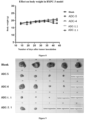
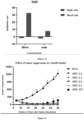
- Figure 7 showed the statistical curve of tumor inhibitory activity
- Figure 8 showed the body weight change curve
- Figure 9 showed the photography of removed tumors.
- ADC-1.1 and ADC-2.1 had better anti-tumor effects than ADC-4 and ADC-5, wherein ADC-1.1 and ADC-2.1 could completely regress tumors with just a single administration and showed good safety.
- the eribulin small molecule toxin could be released by lysing BxPC-3 cells in the mixed cell culture group, thereby killing A549 cells, so that the fluorescence in the cells was quenched, and the absorbance value at 490nm read from a ELISA reader could be used to calculate the cell inhibition rate of the bystander effect.
- Colo205 cells human colon cancer cells, ATCC CCL-222 were cultured in monolayer in vitro in an incubator at 37°C with air containing 5% CO 2 under culture conditions of 1640 medium + 10% heat-inactivated fetal bovine serum + agar. Digestion with 0.25% trypsin was performed twice a week for passage. When the cells were in the exponential growth phase, the cells were collected, counted, and inoculated.
- P6 generation tumor tissues were used to evaluate the anti-tumor activity of the samples to be tested.
- the tumor-bearing mice were killed by CO 2 anesthesia, the tumor masses were taken out, the surrounding necrotic tissues were removed, and the tumor masses were cut into small tumor masses of 20 to 30 mm 3 , and inoculated into the right scapula of the formal experimental mice, and a total of 50 mice were inoculated.
- 30 mice with moderate tumor size were selected and randomly divided into groups according to tumor volume, and administered with drugs.
- the dosage regimen was as follows: Group Number of mice Control/sample to be tested Dose (mg/kg) Route of administration Schedule of administration 1 5 Bland (PBS) -- IV Only once 2 5 ADC-1.1 0.05 IV Only once 3 5 ADC-1.2 0.05 IV Only once 4 5 ADC-2.1 0.05 IV Only once 5 5 ADC-2.2 0.05 IV Only once 6 5 ADC-217 0.05 IV Only once Note: "Only once” means no more administration after one administration on the day of grouping.
- tumors were removed from all mice, weighed, and photographed.
Landscapes
- Health & Medical Sciences (AREA)
- Chemical & Material Sciences (AREA)
- Life Sciences & Earth Sciences (AREA)
- Bioinformatics & Cheminformatics (AREA)
- Engineering & Computer Science (AREA)
- Medicinal Chemistry (AREA)
- General Health & Medical Sciences (AREA)
- Pharmacology & Pharmacy (AREA)
- Animal Behavior & Ethology (AREA)
- Public Health (AREA)
- Veterinary Medicine (AREA)
- Immunology (AREA)
- Organic Chemistry (AREA)
- Epidemiology (AREA)
- Cell Biology (AREA)
- Nuclear Medicine, Radiotherapy & Molecular Imaging (AREA)
- General Chemical & Material Sciences (AREA)
- Chemical Kinetics & Catalysis (AREA)
- Biochemistry (AREA)
- Biophysics (AREA)
- Genetics & Genomics (AREA)
- Molecular Biology (AREA)
- Proteomics, Peptides & Aminoacids (AREA)
- Peptides Or Proteins (AREA)
- Medicines Containing Antibodies Or Antigens For Use As Internal Diagnostic Agents (AREA)
- Medicinal Preparation (AREA)
- Medicines That Contain Protein Lipid Enzymes And Other Medicines (AREA)
- Pharmaceuticals Containing Other Organic And Inorganic Compounds (AREA)
Applications Claiming Priority (2)
| Application Number | Priority Date | Filing Date | Title |
|---|---|---|---|
| CN202111496135 | 2021-12-09 | ||
| PCT/CN2022/135429 WO2023103854A1 (zh) | 2021-12-09 | 2022-11-30 | 一种亲和力改善的抗体-药物偶联物、其制备方法及应用 |
Publications (1)
| Publication Number | Publication Date |
|---|---|
| EP4445919A1 true EP4445919A1 (de) | 2024-10-16 |
Family
ID=86729627
Family Applications (1)
| Application Number | Title | Priority Date | Filing Date |
|---|---|---|---|
| EP22903276.8A Withdrawn EP4445919A1 (de) | 2021-12-09 | 2022-11-30 | Antikörper-wirkstoff-konjugat mit verbesserter affinität sowie herstellungsverfahren dafür und anwendung davon |
Country Status (5)
| Country | Link |
|---|---|
| US (1) | US20250064965A1 (de) |
| EP (1) | EP4445919A1 (de) |
| JP (1) | JP2024545138A (de) |
| CN (1) | CN118401258A (de) |
| WO (1) | WO2023103854A1 (de) |
Families Citing this family (1)
| Publication number | Priority date | Publication date | Assignee | Title |
|---|---|---|---|---|
| WO2025228172A1 (zh) * | 2024-04-28 | 2025-11-06 | 上海拓济医药有限责任公司 | 艾日布林衍生物及其抗体药物偶联物和医药用途 |
Family Cites Families (24)
| Publication number | Priority date | Publication date | Assignee | Title |
|---|---|---|---|---|
| US5831034A (en) | 1987-11-13 | 1998-11-03 | Hermann Katinger | Human monoclonal anti-HIV-I-antibodies |
| DE69534530T2 (de) | 1994-08-12 | 2006-07-06 | Immunomedics, Inc. | Für b-zell-lymphom und leukämiezellen spezifische immunkonjugate und humane antikörper |
| US5874540A (en) | 1994-10-05 | 1999-02-23 | Immunomedics, Inc. | CDR-grafted type III anti-CEA humanized mouse monoclonal antibodies |
| AU2308595A (en) | 1995-04-19 | 1996-11-07 | Polymun Scientific Immunobiologische Forschung Gmbh | Monoclonal antibodies against hiv-1 and vaccines made thereo f |
| US7387772B1 (en) | 1999-06-22 | 2008-06-17 | Immunimedics, Inc. | Chimeric, human and humanized anti-CSAP monoclonal antibodies |
| US7312318B2 (en) | 2002-03-01 | 2007-12-25 | Immunomedics, Inc. | Internalizing anti-CD74 antibodies and methods of use |
| US7138496B2 (en) | 2002-02-08 | 2006-11-21 | Genetastix Corporation | Human monoclonal antibodies against human CXCR4 |
| WO2003068821A2 (en) | 2002-02-14 | 2003-08-21 | Immunomedics, Inc. | Anti-cd20 antibodies and fusion proteins thereof and methods of use |
| US9745380B2 (en) * | 2002-03-01 | 2017-08-29 | Immunomedics, Inc. | RS7 antibodies |
| CA2478047C (en) | 2002-03-01 | 2014-01-21 | Immunomedics, Inc. | Rs7 antibodies |
| ES2524767T3 (es) | 2002-06-14 | 2014-12-12 | Immunomedics, Inc. | Anticuerpo monoclonal humanizado HPAM4 |
| JP5138867B2 (ja) | 2002-08-01 | 2013-02-06 | イミューノメディクス、インコーポレイテッド | α−フェトタンパク質Immu31抗体および融合タンパク質ならびにその使用方法 |
| US7541440B2 (en) | 2002-09-30 | 2009-06-02 | Immunomedics, Inc. | Chimeric, human and humanized anti-granulocyte antibodies and methods of use |
| CA2534639C (en) | 2003-07-31 | 2013-07-30 | Immunomedics, Inc. | Anti-cd19 antibodies |
| ES2665422T3 (es) | 2005-03-03 | 2018-04-25 | Immunomedics Inc. | Anticuerpos L243 humanizados |
| AR056857A1 (es) | 2005-12-30 | 2007-10-24 | U3 Pharma Ag | Anticuerpos dirigidos hacia her-3 (receptor del factor de crecimiento epidérmico humano-3) y sus usos |
| WO2007134037A2 (en) | 2006-05-15 | 2007-11-22 | Immunomedics, Inc. | Methods and compositions for treatment of human immunodeficiency virus infection with conjugated antibodies or antibody fragments |
| ITTO20080313A1 (it) | 2008-04-22 | 2009-10-23 | Marco Colombatti | Anticorpo monoclonale isolato o suo frammento legante l'antigene specifico di membrana della prostata, suoi coniugati e suoi usi |
| EP2478110B1 (de) | 2009-09-16 | 2016-01-06 | Immunomedics, Inc. | Klasse-i-anti-cea-antikörper und verwendungen davon |
| ES2702315T3 (es) | 2012-08-24 | 2019-02-28 | Univ California | Anticuerpos y vacunas para su uso en tratar cánceres ROR1 e inhibir metástasis |
| PE20231050A1 (es) * | 2016-03-02 | 2023-07-11 | Eisai Randd Man Co Ltd | Conjugados de anticuerpo y farmaco basados en eribulina y metodos para su uso |
| CN113766933B (zh) * | 2019-06-28 | 2024-09-06 | 上海复旦张江生物医药股份有限公司 | 一种抗体偶联药物、其中间体、制备方法及应用 |
| EP4088739A4 (de) * | 2019-12-23 | 2024-11-13 | Eisai R&D Management Co., Ltd. | Verfahren zum produzieren eines eribulinbasierten antikörper-wirkstoffkonjugats |
| JP7821733B2 (ja) * | 2020-01-22 | 2026-02-27 | 上海森輝医薬有限公司 | エリブリン誘導体の薬物複合体、その調製方法及びその医薬的応用 |
-
2022
- 2022-11-30 CN CN202280081091.9A patent/CN118401258A/zh active Pending
- 2022-11-30 EP EP22903276.8A patent/EP4445919A1/de not_active Withdrawn
- 2022-11-30 JP JP2024534317A patent/JP2024545138A/ja active Pending
- 2022-11-30 WO PCT/CN2022/135429 patent/WO2023103854A1/zh not_active Ceased
- 2022-11-30 US US18/717,482 patent/US20250064965A1/en active Pending
Also Published As
| Publication number | Publication date |
|---|---|
| US20250064965A1 (en) | 2025-02-27 |
| JP2024545138A (ja) | 2024-12-05 |
| WO2023103854A1 (zh) | 2023-06-15 |
| CN118401258A (zh) | 2024-07-26 |
Similar Documents
| Publication | Publication Date | Title |
|---|---|---|
| US20230357417A1 (en) | Antibodies and antibody-drug conjugates specific for cd123 and uses thereof | |
| EP4385522A1 (de) | Antikörper-wirkstoff-konjugat auf basis eines mikrotubuli-inhibitors | |
| CN110300601B (zh) | 吡咯并苯并二氮杂䓬-抗体缀合物 | |
| AU2017257254B2 (en) | Efficacy of anti-Trop-2-SN-38 antibody drug conjugates for therapy of tumors relapsed/refractory to checkpoint inhibitors | |
| JP6980980B2 (ja) | 抗hla‐drまたは抗trop‐2抗体と微小管阻害剤、parp阻害剤、ブルトンキナーゼ阻害剤またはホスホイノシチド3‐キナーゼ阻害剤との併用は癌の治療効果を有意に改善する | |
| JP6427789B2 (ja) | Cl2aリンカーを有する抗体−sn−38免疫複合体 | |
| US20170224837A1 (en) | Combination of abcg2 inhibitors with sacituzumab govitecan (immu-132) overcomes resistance to sn-38 in trop-2 expressing cancers | |
| US10137196B2 (en) | Dosages of immunoconjugates of antibodies and SN-38 for improved efficacy and decreased toxicity | |
| BR112020005212A2 (pt) | conjugado de anticorpo, kit, composição farmacêutica, e, métodos de tratamento ou prevenção e de diagnóstico de uma doença ou condição. | |
| EP4393514A1 (de) | Über einen brechbaren linker konjugiertes antikörper-wirkstoff-konjugat | |
| CN116284054B (zh) | 一种海鞘素类化合物、其抗体药物偶联物及其应用 | |
| TW202216207A (zh) | 抗體-藥物結合物及cdk9抑制劑之組合 | |
| EP4445919A1 (de) | Antikörper-wirkstoff-konjugat mit verbesserter affinität sowie herstellungsverfahren dafür und anwendung davon | |
| US20240139324A1 (en) | Dosages of immunoconjugates of antibodies and sn-38 for improved efficacy and decreased toxicity | |
| US11497787B2 (en) | Functionalized poly-ADP-ribose polymers for drug delivery | |
| RU2789150C2 (ru) | Антитела и конъюгаты антитела-лекарственного средства, специфичные к cd123, и их применения | |
| HK40010186A (en) | Treatment of trop-2 expressing triple negative breast cancer with sacituzumab govitecan and a rad51 inhibitor | |
| HK40008217A (en) | Therapy for metastatic urothelial cancer with the antibody-drug conjugate, sacituzumab govitecan (immu-132) | |
| HK40009429A (en) | Subcutaneous administration of antibody-drug conjugates for cancer therapy |
Legal Events
| Date | Code | Title | Description |
|---|---|---|---|
| STAA | Information on the status of an ep patent application or granted ep patent |
Free format text: STATUS: THE INTERNATIONAL PUBLICATION HAS BEEN MADE |
|
| PUAI | Public reference made under article 153(3) epc to a published international application that has entered the european phase |
Free format text: ORIGINAL CODE: 0009012 |
|
| STAA | Information on the status of an ep patent application or granted ep patent |
Free format text: STATUS: REQUEST FOR EXAMINATION WAS MADE |
|
| 17P | Request for examination filed |
Effective date: 20240613 |
|
| AK | Designated contracting states |
Kind code of ref document: A1 Designated state(s): AL AT BE BG CH CY CZ DE DK EE ES FI FR GB GR HR HU IE IS IT LI LT LU LV MC ME MK MT NL NO PL PT RO RS SE SI SK SM TR |
|
| STAA | Information on the status of an ep patent application or granted ep patent |
Free format text: STATUS: THE APPLICATION HAS BEEN WITHDRAWN |
|
| 18W | Application withdrawn |
Effective date: 20241029 |