EP4445975A1 - Spielvorrichtung, spielumgebungseinstellungsverfahren und programm - Google Patents
Spielvorrichtung, spielumgebungseinstellungsverfahren und programm Download PDFInfo
- Publication number
- EP4445975A1 EP4445975A1 EP22920599.2A EP22920599A EP4445975A1 EP 4445975 A1 EP4445975 A1 EP 4445975A1 EP 22920599 A EP22920599 A EP 22920599A EP 4445975 A1 EP4445975 A1 EP 4445975A1
- Authority
- EP
- European Patent Office
- Prior art keywords
- feature data
- voice
- game device
- game
- data
- Prior art date
- Legal status (The legal status is an assumption and is not a legal conclusion. Google has not performed a legal analysis and makes no representation as to the accuracy of the status listed.)
- Pending
Links
Images



Classifications
-
- A—HUMAN NECESSITIES
- A63—SPORTS; GAMES; AMUSEMENTS
- A63F—CARD, BOARD, OR ROULETTE GAMES; INDOOR GAMES USING SMALL MOVING PLAYING BODIES; VIDEO GAMES; GAMES NOT OTHERWISE PROVIDED FOR
- A63F13/00—Video games, i.e. games using an electronically generated display having two or more dimensions
- A63F13/60—Generating or modifying game content before or while executing the game program, e.g. authoring tools specially adapted for game development or game-integrated level editor
- A63F13/63—Generating or modifying game content before or while executing the game program, e.g. authoring tools specially adapted for game development or game-integrated level editor by the player, e.g. authoring using a level editor
-
- A—HUMAN NECESSITIES
- A63—SPORTS; GAMES; AMUSEMENTS
- A63F—CARD, BOARD, OR ROULETTE GAMES; INDOOR GAMES USING SMALL MOVING PLAYING BODIES; VIDEO GAMES; GAMES NOT OTHERWISE PROVIDED FOR
- A63F13/00—Video games, i.e. games using an electronically generated display having two or more dimensions
- A63F13/20—Input arrangements for video game devices
- A63F13/21—Input arrangements for video game devices characterised by their sensors, purposes or types
- A63F13/215—Input arrangements for video game devices characterised by their sensors, purposes or types comprising means for detecting acoustic signals, e.g. using a microphone
-
- A—HUMAN NECESSITIES
- A63—SPORTS; GAMES; AMUSEMENTS
- A63F—CARD, BOARD, OR ROULETTE GAMES; INDOOR GAMES USING SMALL MOVING PLAYING BODIES; VIDEO GAMES; GAMES NOT OTHERWISE PROVIDED FOR
- A63F13/00—Video games, i.e. games using an electronically generated display having two or more dimensions
- A63F13/40—Processing input control signals of video game devices, e.g. signals generated by the player or derived from the environment
- A63F13/42—Processing input control signals of video game devices, e.g. signals generated by the player or derived from the environment by mapping the input signals into game commands, e.g. mapping the displacement of a stylus on a touch screen to the steering angle of a virtual vehicle
- A63F13/424—Processing input control signals of video game devices, e.g. signals generated by the player or derived from the environment by mapping the input signals into game commands, e.g. mapping the displacement of a stylus on a touch screen to the steering angle of a virtual vehicle involving acoustic input signals, e.g. by using the results of pitch or rhythm extraction or voice recognition
-
- A—HUMAN NECESSITIES
- A63—SPORTS; GAMES; AMUSEMENTS
- A63F—CARD, BOARD, OR ROULETTE GAMES; INDOOR GAMES USING SMALL MOVING PLAYING BODIES; VIDEO GAMES; GAMES NOT OTHERWISE PROVIDED FOR
- A63F13/00—Video games, i.e. games using an electronically generated display having two or more dimensions
- A63F13/50—Controlling the output signals based on the game progress
- A63F13/53—Controlling the output signals based on the game progress involving additional visual information provided to the game scene, e.g. by overlay to simulate a head-up display [HUD] or displaying a laser sight in a shooting game
- A63F13/537—Controlling the output signals based on the game progress involving additional visual information provided to the game scene, e.g. by overlay to simulate a head-up display [HUD] or displaying a laser sight in a shooting game using indicators, e.g. showing the condition of a game character on screen
-
- A—HUMAN NECESSITIES
- A63—SPORTS; GAMES; AMUSEMENTS
- A63F—CARD, BOARD, OR ROULETTE GAMES; INDOOR GAMES USING SMALL MOVING PLAYING BODIES; VIDEO GAMES; GAMES NOT OTHERWISE PROVIDED FOR
- A63F13/00—Video games, i.e. games using an electronically generated display having two or more dimensions
- A63F13/55—Controlling game characters or game objects based on the game progress
- A63F13/58—Controlling game characters or game objects based on the game progress by computing conditions of game characters, e.g. stamina, strength, motivation or energy level
-
- A—HUMAN NECESSITIES
- A63—SPORTS; GAMES; AMUSEMENTS
- A63F—CARD, BOARD, OR ROULETTE GAMES; INDOOR GAMES USING SMALL MOVING PLAYING BODIES; VIDEO GAMES; GAMES NOT OTHERWISE PROVIDED FOR
- A63F2300/00—Features of games using an electronically generated display having two or more dimensions, e.g. on a television screen, showing representations related to the game
- A63F2300/10—Features of games using an electronically generated display having two or more dimensions, e.g. on a television screen, showing representations related to the game characterized by input arrangements for converting player-generated signals into game device control signals
- A63F2300/1081—Input via voice recognition
Definitions
- the present disclosure relates to a game device, a game environment setting method and a program.
- Patent Document 1 disclosed is a game device that makes a specific character corresponding to an inputted sound or voice appear on a display screen according to the sound or voice inputted by a player.
- Patent Document 2 disclosed is a game system that compares the voice inputted by the player with voices associated with game operations and stored in advance, and activates operations with different effects within the game depending on the comparison result.
- the abovementioned character, etc. is made to appear using so-called pattern matching in which features of the voice inputted by the player are compared with voice feature information stored in a database in advance, so if the conditions when the player inputs the voice are the same (e.g. the same dialogue), it is likely that a character, etc., with the same parameters will appear, which has the problem of being uninteresting. There is also the problem that when the inputted voice does not match the voice feature information stored in the database, the abovementioned character, etc., cannot be made to appear.
- the purpose of the present disclosure is to provide a game device, a game environment setting method and a program capable of setting a wide variety of game environments when setting a game environment, and of reliably setting those environments.
- a game device of claim 1 is a game device comprising
- Claim 2 is the game device according to claim 1, comprising
- Claim 3 is the game device according to claim 2, wherein the digitization means digitizes into a plurality of numerical values based on the feature data.
- Claim 4 is the game device according to claim 2 or 3, wherein the extraction means divides a frequency spectrum obtained from waveform data of the voice acquired by the acquisition means into a plurality of frequency domains, and extracts the area under the spectrum in each divided frequency domain as the feature data.
- Claim 5 is the game device according to claim 4, wherein the digitization means digitizes the feature data by converting the area of each of the frequency domains into a prescribed integer corresponding to an applicable predetermined range corresponding to each of the area.
- Claim 6 is the game device according to claim 5, comprising
- Claim 7 is the game device according to claim 6, comprising a display control means for displaying on a display unit the plurality of characteristics of the character set by the setting means.
- Claim 8 is the game device according to claim 6 or 7, comprising
- Claim 9 is the game device according to claim 8, wherein
- a game environment setting method is a game environment setting method comprising
- a program according to claim 11 is a program that
- FIG. 1 is a drawing showing an example of the external appearance of a game device 10.
- the game device 10 is a tablet type terminal device that comprises a display unit 14 and a voice input unit 15, etc., and based on voice data inputted from the voice input unit 15, sets characteristics (offensive power, defensive power, speed) of a prescribed character (e.g. the main character of the game performed on the game device 10), and controls the display of the character characteristics that have been set on the display unit 14.
- characteristics offensive power, defensive power, speed
- a player of this game device 10 uses the character for which the abovementioned characteristics have been set to enjoy a battle game on a computer with another player.
- FIG. 2 is a block diagram showing an example of the functional constitution of the game device 10.
- the game device 10 comprises a CPU (Central Processing Unit) 11, a storage unit 12, an operating unit 13, a display unit 14, a voice input unit 15, a speaker unit 16, and a bus 17. Each part of the game device 10 is connected via the bus 17.
- CPU Central Processing Unit
- the CPU 11 is a processor for controlling each part of the game device 10.
- the CPU 11 reads a specified program among a system program and application programs stored in the ROM (Read Only Memory) of the storage unit 12 and executes various processes according to the program on the ROM.
- the CPU 11 may also expand the specified program in the RAM (Random Access Memory) of the storage unit 12.
- the storage unit 12 comprises a storage device used as a temporary storage region for RAM (Random Access Memory), etc., and at least one memory (e.g. ROM or storage memory) for storing programs and data.
- RAM Random Access Memory
- ROM Read Only Memory
- Examples include a system program for having the CPU 11 comprehensively control the game device 10, or a game program needed for executing a game.
- the operating unit 13 is configured having a power button 131 and a home button 132 provided around the display unit 14 of the game device 10 body, and a touch sensor, etc., (not illustrated) provided on the display unit 14, receives an input operation from the player, and outputs that operation information to the CPU 11.
- the display unit 14 is constituted by an LCD (Liquid Crystal Display), an EL (Electro Luminescence) display, etc., and performs various displays according to display information instructed from the CPU 11.
- the display unit 14 may be integrated with the game device 10 or may also be realized by a television or other display device separate from the game device 10.
- the voice input unit 15 is configured having a microphone, an AD converter, etc., receives voice input of the player, etc. from the microphone during voice input, converts the inputted voice to digital voice data, and outputs that to the CPU 11.
- the speaker unit 16 is configured having a DA converter, an amplifier, a speaker, etc., converts digital audio signals to analog audio signals during sound output, and outputs that from the speaker.
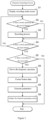
- FIG. 3 is a flow chart showing the flow of the character generating process.
- the character generating process explained here is a process that is started when a prescribed operation is done to display a recording mode screen 31 (described later) on the display unit 14 via the operating unit 13.
- the CPU 11 of the game device 10 displays the recording mode screen 31 on the display unit 14 (step S1).
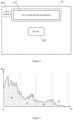
- FIG. 4 is a drawing showing an example of the recording mode screen 31.
- the message information 311 "Let's record into the microphone!” is displayed.
- a record button 312 and a back button 313 are also displayed on the recording mode screen 31.
- the record button 312 is a button for starting the recording process (described later).
- the back button 313 is a button for displaying on the display unit 14 a prescribed screen (not illustrated) before transitioning to the recording mode screen 31.
- the CPU 11 determines whether a touch operation has been done on the record button 312 via the operating unit 13 (step S2).
- step S2 when it is determined that the touch operation has not been done on the record button 312 via the operating unit 13 (step S2, No), the CPU 11 skips step S3, and the process advances to step S4.
- step S2 when it is determined that the touch operation has been done on the record button 312 via the operation unit 13 (step S2, Yes), the CPU 11 performs the recording process via the voice input unit 15 for a prescribed time (e.g. 2 seconds) (step S3).
- a prescribed time e.g. 2 seconds
- voice data of the player, etc. is acquired and is temporarily stored in the RAM of the storage unit 12.
- the CPU 11 advances the process to step S4.
- the player is allowed to say any word (e.g. "Summon,” "Monster name,” etc.).
- the CPU 11 determines whether the touch operation has been done on the back button 313 via the operating unit 13 (step S4).
- step S4 when it is determined that the touch operation has not been done on the back button 313 via the operating unit 13 (step S4, No), the CPU 11 returns the process to step S2, and repeats the process thereafter.
- step S4 when it is determined that the touch operation was done on the back button 313 via the operating unit 13 (step S4, Yes), the CPU 11 determines whether there is a recording of the voice data (recording data) in the RAM of the storage unit 12 (step S5).
- step S5 when it is determined that there is a recording of the voice data (recording data) in the RAM of the storage unit 12 (step S5, Yes), the CPU 11 performs fast Fourier transform (FFT) on the voice data, and derives a frequency spectrum (step S6).
- the fast Fourier transform is executed on the voice data while shifting a half frame (256 samples) at a time with 512 samples per frame.
- the voice data is divided into a front half and a latter half of approximately 21,000 samples each, and the frequency spectrum is derived for each of the front half and the latter half of the voice data.
- the CPU 11 extracts feature data (voiceprint data) from the frequency spectrum derived in step S6 (step S7).
- the CPU 11 divides into four equal parts each frequency spectrum derived with the front half and the latter half of the voice data as the object, and derives the areas S 0 , S 1 , S 2 , S 3 of each section (see FIG. 5 ) as feature data (voiceprint data).
- the CPU 11 derives the frequency number (0 to 255) that gives the maximum gain in each of the abovementioned frequency spectrums.
- the CPU 11 generates parameters conforming to a prescribed standard based on the feature data extracted in step S7 (step S8).
- the CPU 11 first converts the area of each section in each frequency spectrum of the front half and latter half of the abovementioned voice data derived in step S7 to any one of integers I0, I1, I2, I3.
- the CPU 11 converts the area to I0.
- the abovementioned area is the first threshold TH1 or greater and less than a second threshold TH2
- the area is converted to I1.
- the abovementioned area is the second threshold TH2 or greater and less than a third threshold TH3
- the area is converted to I2.
- the abovementioned area is the third threshold TH3 or greater, that area is converted to I3.
- T1 represents data after conversion of the area of each section of the frequency spectrum of the front half to the abovementioned integers
- T1' represents the data after the data after conversion is rearranged using the rearrangement method according to the frequency number F1.
- T2 represents the data after conversion of the areas of each section of the frequency spectrum of the latter half to the abovementioned integers
- T2' represents the data after the data after conversion is rearranged using the rearrangement method according to frequency number F2.
- F1 represents the number of the frequency that gives the maximum gain in the frequency spectrum of the front half
- F2 represents the number of the frequency that gives the maximum gain in the frequency spectrum of the latter half.
- the CPU 11 allocates each binary data BD1, BD0, BD2 corresponding to each of U1 [3] , U2 [0] , U2 [1] to a group relating to defensive power, for example.
- the CPU 11 allocates each binary data BD3, BD3 corresponding to each of U2 [2] , U2 [3] to a group relating to speed, for example.
- the CPU 11 generates binary data BD11 constituted by combining each binary data BD0, BD3, BD2 allocated to the group relating to offensive power.
- the CPU 11 converts the generated binary data BD11 to decimal data Dn1, and generates offensive power parameters based on this data Dn1.
- the CPU11 generates binary data BD12 constituted by combining each binary data BD1, BD0, BD2 allocated to the group related to defensive power. Then, the CPU 11 converts the generated binary data BD12 to decimal data Dn2, and generates defensive power parameters based on this data Dn2.
- the CPU 11 generates binary data BD13 constituted by combining each binary data BD3, BD3 allocated to the group related to speed. Then, the CPU 11 converts the generated binary data BD13 to decimal data DN3, and generates defensive power parameters based on this data DN3.
- the CPU 11 displays a character generating screen 32 on the display unit 13 (step S9). Then, the CPU 11 ends the character generating process.
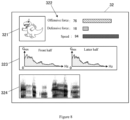
- FIG. 8 is a drawing showing an example of the character generating screen 32.
- the character generating screen 32 is a prescribed screen before transitioning to the recording mode screen 31, and is a screen in which the characteristics, etc., of the character based on the parameters generated in step S8 are displayed.
- an image 321 of the character described above is displayed, and parameter data 322 is displayed.
- the parameter data 322 is data representing each of the three parameters of offensive power, defensive power, and speed as numerical values and bar graphs.
- each frequency spectrum 323 of the first half and the latter half obtained from the voice data (waveform data) recorded in the recording process of step S3 is displayed, and a voiceprint 324 that represents the result of frequency analysis of the voice data as a sonagram is displayed.
- step S5 when it is determined that there is no recording of the voice data (recording data) in the RAM of the storage unit 12 (step S5, No), the CPU 11 skips the processes of step S6 to step S9 and ends the character generating process.
- the normal prescribed screen (not illustrated) before transitioning to the recording mode screen 31 is displayed.
- the CPU 11 of the game device 10 of the present embodiment acquires voice via the voice input unit 15, extracts feature data relating to the voice based on the acquired voice, digitizes the extracted feature data, and sets prescribed character characteristics (offensive power, defensive power, speed) as the game environment based on the digitized feature data.
- prescribed character characteristics are set based on featured data relating to the voice that has been digitized, without performing so-called pattern matching, so it is possible to create a character with various characteristics even when the conditions when the voice is input are the same (e.g. same dialogue).
- so-called pattern matching is not performed, as long as it is possible to acquire the voice, it is possible to reliably set the prescribed character characteristics whatever the type of voice.
- the CPU 11 of the game device 10 of the present embodiment divides the frequency spectrum obtained from the waveform data of the voice acquired via the voice input unit 15 into a plurality of frequency domains, and the area under the spectrum in each divided frequency domain is extracted as feature data.
- the area under the spectrum of each frequency domain is extracted as feature data, so it is possible to highlight that feature data.
- different feature data is extracted according to the words (e.g. "Summon,” or "Monster name”) said by a certain player, so it is possible to create a unique character according to the words said even by the same player.
- the same word said by a certain player e.g. "Summon”
- different feature data is extracted, so it is possible to create unique characters for each player.
- feature data of the same contents is extracted, so it is possible to give reproducibility to character creation.
- the CPU 11 of the game device 10 of the present embodiment digitizes feature data by converting the areas under the spectrum of each frequency domain to a prescribed integer corresponding to an applicable predetermined range.
- the game device 10 of the present embodiment since feature data is digitized by converting the areas under the spectrum of each frequency domain to a prescribed integer corresponding to an applicable predetermined range. it is possible to digitize feature data within a range conforming to a predetermined standard. As a result, according to the game device 10, it is possible to appropriately set prescribed character characteristics.
- the CPU 11 of the game device 10 of the present embodiment converts each of the integers of digitized feature data to binary data, allocates each of the converted binary data to a prescribed group among a plurality of groups, generates a plurality of parameters corresponding to each group based on the binary data configured by being allocated to each group, and sets a plurality of characteristics (offensive power, defensive power, speed) of a prescribed character based on the generated plurality of parameters.
- a plurality of characteristics of a prescribed character are set based on the plurality of parameters generated from the digitized feature data, so it is possible to create a more unique character.
- the CPU 11 of the game device 10 of the present embodiment displays the set plurality of characteristics (offensive power, defensive power, speed) of the prescribed character on the display unit 14.
- the set plurality of characteristics of the prescribed character are displayed on the display unit 14, so it is possible to have the player understand the plurality of characteristics of that character.
- the CPU 11 of the game device 10 of the present embodiment is capable of changing the lineup of the integers of the digitized feature data, and when the lineup of the integers is changed, converts each of the integers of the feature data to binary data based on the feature data after the lineup of the integers has been changed.
- the game device 10 of the present embodiment by changing the lineup of the integers of the digitized feature data, it is possible to increase the variation of that feature data, so it is possible to create an even more unique character by setting a plurality of characteristics of a prescribed character based on the plurality of parameters generated from this kind of feature data.
- the CPU 11 of the game device 10 of the present embodiment further extracts the frequency that gives the maximum gain in the abovementioned frequency spectrum as the feature data, and changes the lineup of the integers of the feature data based on the array corresponding to the extracted frequency.
- the lineup of the integers of the feature data is changed based on the same array to each other, so by setting the plurality of characteristics of a prescribed character based on the plurality of parameters generated by this kind of feature data, it is possible to ensure the reproducibility of the character creation.
- offensive power, defensive power, and speed which are three characteristics of a prescribed character are set as the game environment, but the characteristics are not limited to three, and may also be more than that.
- the abovementioned characteristics are not limited to being related to attribute values, and may also include the external appearance, etc., of the character. In this case, parameters are generated according to the number of characteristics.
- the game device 10 was configured to acquire voice via the voice input unit 15, but, for example, it is also possible to provide a communication unit that is connected in communication to a communication network and that performs communication with devices on the communication network, and that acquires voice from an external device via the communication unit.
- each frequency spectrum derived with the front half and latter half of the voice data as the object is divided into four equal parts, and the areas S 0 , S 1 , S 2 , S 3 of each section are derived as feature data, but it is also possible to divide equally into four predetermined frequency domains, and to divide each frequency spectrum in a region from minimum frequency to maximum frequency of each derived frequency spectrum into four equal parts.
- the feature data for example, it is also possible to not divide the voice data into the front half and latter half, and rather to divide the frequency spectrum derived through the overall voice data into eight equal parts, and to derive areas S 0 , S 1 , ..., S 8 of each section as the feature data.
- the lineup of the digitized feature data T ⁇ T 0 , T 1 , T 2 , T 3 ⁇ was changed, but it is also possible to generate the three parameters of offensive power, defensive power, and speed which are attributes of the character from the feature data T without changing the lineup.
- the feature data extracted at step S7 was digitized, and the parameters were generated conforming to a prescribed standard based on the digitized feature data, but, for example, it is also possible to generate the parameters directly from the feature data extracted at step S7 according to a prescribed conversion method without digitizing the feature data.
- the present disclosure can be used in a game device, a game environment setting method and a program.
Landscapes
- Engineering & Computer Science (AREA)
- Multimedia (AREA)
- Human Computer Interaction (AREA)
- Theoretical Computer Science (AREA)
- Physics & Mathematics (AREA)
- Optics & Photonics (AREA)
- Acoustics & Sound (AREA)
- Processing Or Creating Images (AREA)
- Management, Administration, Business Operations System, And Electronic Commerce (AREA)
- Auxiliary Devices For Music (AREA)
Applications Claiming Priority (2)
| Application Number | Priority Date | Filing Date | Title |
|---|---|---|---|
| JP2022003574A JP7461391B2 (ja) | 2022-01-13 | 2022-01-13 | ゲーム装置、ゲーム環境設定方法及びプログラム |
| PCT/JP2022/047382 WO2023136082A1 (ja) | 2022-01-13 | 2022-12-22 | ゲーム装置、ゲーム環境設定方法及びプログラム |
Publications (2)
| Publication Number | Publication Date |
|---|---|
| EP4445975A1 true EP4445975A1 (de) | 2024-10-16 |
| EP4445975A4 EP4445975A4 (de) | 2025-11-26 |
Family
ID=87278968
Family Applications (1)
| Application Number | Title | Priority Date | Filing Date |
|---|---|---|---|
| EP22920599.2A Pending EP4445975A4 (de) | 2022-01-13 | 2022-12-22 | Spielvorrichtung, spielumgebungseinstellungsverfahren und programm |
Country Status (6)
| Country | Link |
|---|---|
| US (1) | US20250099856A1 (de) |
| EP (1) | EP4445975A4 (de) |
| JP (1) | JP7461391B2 (de) |
| CN (1) | CN118434481A (de) |
| AU (1) | AU2022432757A1 (de) |
| WO (1) | WO2023136082A1 (de) |
Families Citing this family (1)
| Publication number | Priority date | Publication date | Assignee | Title |
|---|---|---|---|---|
| JP7606645B1 (ja) | 2024-09-04 | 2024-12-25 | NHN PlayArt株式会社 | ゲームプログラム及びゲームサーバ |
Family Cites Families (13)
| Publication number | Priority date | Publication date | Assignee | Title |
|---|---|---|---|---|
| JP2860097B1 (ja) * | 1998-01-08 | 1999-02-24 | テクモ株式会社 | ゲームプログラムを記録した媒体およびゲーム装置 |
| JP3066528B1 (ja) * | 1999-02-26 | 2000-07-17 | コナミ株式会社 | 楽曲再生システム、リズム解析方法及び記録媒体 |
| JP2002351489A (ja) * | 2001-05-29 | 2002-12-06 | Namco Ltd | ゲーム情報、情報記憶媒体、及びゲーム装置 |
| JP2003181136A (ja) * | 2001-12-14 | 2003-07-02 | Sega Corp | 音声制御方法 |
| JP2006109966A (ja) * | 2004-10-13 | 2006-04-27 | Ishisaki:Kk | 音ゲーム機および携帯電話機 |
| JP4722652B2 (ja) * | 2005-09-29 | 2011-07-13 | 株式会社コナミデジタルエンタテインメント | 音声情報処理装置、音声情報処理方法、ならびに、プログラム |
| US9694282B2 (en) * | 2011-04-08 | 2017-07-04 | Disney Enterprises, Inc. | Importing audio to affect gameplay experience |
| JP2015032128A (ja) * | 2013-08-02 | 2015-02-16 | 任天堂株式会社 | 情報処理装置、情報処理プログラム、情報処理システム、および情報処理方法 |
| JP2016202436A (ja) * | 2015-04-20 | 2016-12-08 | 株式会社コロプラ | 周囲音を記録しゲームに反映させるためのシステム、方法、及びプログラム |
| US11068233B2 (en) * | 2017-10-13 | 2021-07-20 | Sonova Ag | Selecting a microphone based on estimated proximity to sound source |
| JP7292639B2 (ja) | 2018-11-19 | 2023-06-19 | 青島海爾洗衣机有限公司 | 洗濯乾燥機 |
| US20220122328A1 (en) * | 2019-01-31 | 2022-04-21 | Treasured Inc. | System and method for updating objects in a simulated environment |
| JP7510155B2 (ja) * | 2020-06-19 | 2024-07-03 | 国立大学法人電気通信大学 | 指示入力装置および指示入力プログラム |
-
2022
- 2022-01-13 JP JP2022003574A patent/JP7461391B2/ja active Active
- 2022-12-22 WO PCT/JP2022/047382 patent/WO2023136082A1/ja not_active Ceased
- 2022-12-22 EP EP22920599.2A patent/EP4445975A4/de active Pending
- 2022-12-22 AU AU2022432757A patent/AU2022432757A1/en not_active Abandoned
- 2022-12-22 CN CN202280084456.3A patent/CN118434481A/zh active Pending
- 2022-12-22 US US18/727,668 patent/US20250099856A1/en active Pending
Also Published As
| Publication number | Publication date |
|---|---|
| CN118434481A (zh) | 2024-08-02 |
| JP7461391B2 (ja) | 2024-04-03 |
| EP4445975A4 (de) | 2025-11-26 |
| AU2022432757A1 (en) | 2024-07-25 |
| WO2023136082A1 (ja) | 2023-07-20 |
| JP2023102860A (ja) | 2023-07-26 |
| US20250099856A1 (en) | 2025-03-27 |
Similar Documents
| Publication | Publication Date | Title |
|---|---|---|
| CN107393569B (zh) | 音视频剪辑方法及装置 | |
| US20250099856A1 (en) | Game device, game environment setting method and program | |
| JP4792703B2 (ja) | 音声解析装置、音声解析方法及び音声解析プログラム | |
| CN114495871B (zh) | 基于多线条特征信息生成音乐旋律的方法、系统与装置 | |
| CN107204027A (zh) | 图像处理装置、显示装置、动画生成方法以及动画显示方法 | |
| CN110134235B (zh) | 一种引导式互动的方法 | |
| AU2023205562B2 (en) | Video processing method and apparatus, and nonvolatile computer readable storage medium | |
| JP6746775B2 (ja) | 情報提供装置、端末装置、表示システム、プログラム及び情報提供方法 | |
| CN108847243A (zh) | 声纹特征更新方法、装置、存储介质及电子设备 | |
| JP6428774B2 (ja) | 音声制御装置、音声制御方法およびプログラム | |
| JP7129769B2 (ja) | リップシンク処理プログラム、記録媒体、リップシンク処理方法 | |
| US8373056B2 (en) | Waveform generation apparatus and waveform generation program | |
| JPH0239268A (ja) | 自動問診装置 | |
| US20240013798A1 (en) | Conversion device, conversion method, and conversion program | |
| CN108704310B (zh) | 一种双vr设备参与虚拟游戏时的虚拟场景同步切换方法 | |
| CN111326162B (zh) | 一种声纹特征的采集方法和装置以及设备 | |
| JP2000055938A (ja) | 波形表示方法及び波形表示装置 | |
| CN107864398B (zh) | 音频与视频的合并方法及装置 | |
| JP6583931B2 (ja) | ゲームプログラムおよびゲーム装置 | |
| US20240244161A1 (en) | Dialogue replay method, dialogue replay apparatus and program | |
| JP2017090921A (ja) | データ処理装置、データ構造、データ処理方法、およびプログラム | |
| JP3578947B2 (ja) | 均等色領域抽出方法、装置及び記録媒体 | |
| CN117392998A (zh) | 音频处理方法、装置、计算机设备、介质及程序产品 | |
| CN112799575A (zh) | 一种基于智能音箱的语音交互方法、智能音箱及智能终端 | |
| CN117831534A (zh) | 数字人口型视频的生成方法、装置、终端设备和存储介质 |
Legal Events
| Date | Code | Title | Description |
|---|---|---|---|
| STAA | Information on the status of an ep patent application or granted ep patent |
Free format text: STATUS: THE INTERNATIONAL PUBLICATION HAS BEEN MADE |
|
| PUAI | Public reference made under article 153(3) epc to a published international application that has entered the european phase |
Free format text: ORIGINAL CODE: 0009012 |
|
| STAA | Information on the status of an ep patent application or granted ep patent |
Free format text: STATUS: REQUEST FOR EXAMINATION WAS MADE |
|
| 17P | Request for examination filed |
Effective date: 20240712 |
|
| AK | Designated contracting states |
Kind code of ref document: A1 Designated state(s): AL AT BE BG CH CY CZ DE DK EE ES FI FR GB GR HR HU IE IS IT LI LT LU LV MC ME MK MT NL NO PL PT RO RS SE SI SK SM TR |
|
| DAV | Request for validation of the european patent (deleted) | ||
| DAX | Request for extension of the european patent (deleted) | ||
| REG | Reference to a national code |
Ref country code: DE Ref legal event code: R079 Free format text: PREVIOUS MAIN CLASS: A63F0013580000 Ipc: A63F0013424000 |
|
| A4 | Supplementary search report drawn up and despatched |
Effective date: 20251023 |
|
| RIC1 | Information provided on ipc code assigned before grant |
Ipc: A63F 13/424 20140101AFI20251017BHEP Ipc: A63F 13/215 20140101ALI20251017BHEP Ipc: A63F 13/58 20140101ALI20251017BHEP Ipc: A63F 13/63 20140101ALI20251017BHEP |