EP4451665B1 - Procédé de lecture et de préparation d'images vidéo en temps réel - Google Patents
Procédé de lecture et de préparation d'images vidéo en temps réel Download PDFInfo
- Publication number
- EP4451665B1 EP4451665B1 EP24165302.1A EP24165302A EP4451665B1 EP 4451665 B1 EP4451665 B1 EP 4451665B1 EP 24165302 A EP24165302 A EP 24165302A EP 4451665 B1 EP4451665 B1 EP 4451665B1
- Authority
- EP
- European Patent Office
- Prior art keywords
- images
- image
- video
- monitor
- time
- Prior art date
- Legal status (The legal status is an assumption and is not a legal conclusion. Google has not performed a legal analysis and makes no representation as to the accuracy of the status listed.)
- Active
Links
Images

Classifications
-
- H—ELECTRICITY
- H04—ELECTRIC COMMUNICATION TECHNIQUE
- H04N—PICTORIAL COMMUNICATION, e.g. TELEVISION
- H04N7/00—Television systems
- H04N7/18—Closed-circuit television [CCTV] systems, i.e. systems in which the video signal is not broadcast
- H04N7/181—Closed-circuit television [CCTV] systems, i.e. systems in which the video signal is not broadcast for receiving images from a plurality of remote sources
-
- G—PHYSICS
- G08—SIGNALLING
- G08B—SIGNALLING SYSTEMS, e.g. PERSONAL CALLING SYSTEMS; ORDER TELEGRAPHS; ALARM SYSTEMS
- G08B13/00—Burglar, theft or intruder alarms
- G08B13/18—Actuation by interference with heat, light, or radiation of shorter wavelength; Actuation by intruding sources of heat, light, or radiation of shorter wavelength
- G08B13/189—Actuation by interference with heat, light, or radiation of shorter wavelength; Actuation by intruding sources of heat, light, or radiation of shorter wavelength using passive radiation detection systems
- G08B13/194—Actuation by interference with heat, light, or radiation of shorter wavelength; Actuation by intruding sources of heat, light, or radiation of shorter wavelength using passive radiation detection systems using image scanning and comparing systems
- G08B13/196—Actuation by interference with heat, light, or radiation of shorter wavelength; Actuation by intruding sources of heat, light, or radiation of shorter wavelength using passive radiation detection systems using image scanning and comparing systems using television cameras
- G08B13/19665—Details related to the storage of video surveillance data
- G08B13/19671—Addition of non-video data, i.e. metadata, to video stream
- G08B13/19673—Addition of time stamp, i.e. time metadata, to video stream
-
- G—PHYSICS
- G08—SIGNALLING
- G08B—SIGNALLING SYSTEMS, e.g. PERSONAL CALLING SYSTEMS; ORDER TELEGRAPHS; ALARM SYSTEMS
- G08B13/00—Burglar, theft or intruder alarms
- G08B13/18—Actuation by interference with heat, light, or radiation of shorter wavelength; Actuation by intruding sources of heat, light, or radiation of shorter wavelength
- G08B13/189—Actuation by interference with heat, light, or radiation of shorter wavelength; Actuation by intruding sources of heat, light, or radiation of shorter wavelength using passive radiation detection systems
- G08B13/194—Actuation by interference with heat, light, or radiation of shorter wavelength; Actuation by intruding sources of heat, light, or radiation of shorter wavelength using passive radiation detection systems using image scanning and comparing systems
- G08B13/196—Actuation by interference with heat, light, or radiation of shorter wavelength; Actuation by intruding sources of heat, light, or radiation of shorter wavelength using passive radiation detection systems using image scanning and comparing systems using television cameras
- G08B13/19678—User interface
- G08B13/19691—Signalling events for better perception by user, e.g. indicating alarms by making display brighter, adding text, creating a sound
- G08B13/19693—Signalling events for better perception by user, e.g. indicating alarms by making display brighter, adding text, creating a sound using multiple video sources viewed on a single or compound screen
-
- H—ELECTRICITY
- H04—ELECTRIC COMMUNICATION TECHNIQUE
- H04N—PICTORIAL COMMUNICATION, e.g. TELEVISION
- H04N21/00—Selective content distribution, e.g. interactive television or video on demand [VOD]
- H04N21/80—Generation or processing of content or additional data by content creator independently of the distribution process; Content per se
- H04N21/85—Assembly of content; Generation of multimedia applications
- H04N21/854—Content authoring
- H04N21/8547—Content authoring involving timestamps for synchronizing content
-
- H—ELECTRICITY
- H04—ELECTRIC COMMUNICATION TECHNIQUE
- H04N—PICTORIAL COMMUNICATION, e.g. TELEVISION
- H04N7/00—Television systems
- H04N7/025—Systems for the transmission of digital non-picture data, e.g. of text during the active part of a television frame
Definitions
- the present invention relates to a method for reading in and processing video images in real time, in which one or more video cameras provide images, the images being digitized and stored in a memory, after which the images are fed to at least one monitor.
- Modern solutions for image transmission are designed to produce the highest possible quality image and to suppress interference. This includes the automatic adjustment processes in the video camera, the Transmission path and the processing of the image or images on the screen. Based on the requirements of entertainment television, no errors should be visible; it is better if a saved image is shown on the screen during the error state. For this reason, all modern transmission systems have rather complex electronic circuits with image storage, starting in the video camera, possibly in the transmission path and finally in the image processing. However, as soon as digital image processing and image storage are involved, a time delay between the camera and the monitor cannot be ruled out; in fact, this is very common in television broadcasts, as can be seen when the same live event is broadcast by different television stations. Delays of a few seconds are the norm here.
- the joint display of several video images on one monitor has been known for decades. Typical examples are surveillance monitors in supermarkets, where, for example, the images from four cameras are displayed on one monitor. The person monitoring the images can display the image from one camera in full screen at any time or switch other cameras to the monitor if they see anything suspicious.
- the surveillance monitors in the Vienna subway are also well known, allowing the driver to see when all passengers have boarded and alighted, so that he can dispatch the train and close the doors.
- the images from two cameras are displayed on one monitor. In these two applications, the partial images are simply displayed next to each other and/or on top of each other without any transitions.
- the current state of the art is therefore to digitize the four incoming individual images, save them and then create the new, composite image from the digitally available, saved images and transmit it to the screen. If the transmission to the screen is analog, the necessary synchronization signals must be generated anew.
- EP2341710 discloses a method in which the latency of a camera signal only influences the display of the image on the monitor assigned to the camera and has no influence on the display of the other images in the other cameras.
- images are often stored in a memory and read from there and sent to a monitor.
- image processing such as "stitching"
- images are often stored in a memory and read from there and sent to a monitor.
- One example is the display of four camera images on a monitor mentioned above.
- the video signals from all cameras are stored digitally and then only every second pixel of each line and every second line from each camera is sent to the monitor, so that the image only takes up one quadrant. This can also lead to annoying time delays, because it is always possible that a camera will fail and no longer provide a signal.
- the last image then remains in the memory and is constantly displayed as a still image.
- This object is achieved by a method of the type mentioned at the outset in that all video images are provided with a time stamp which is stored in the memory together with the video images, that the time stamp of the video image or - when several video images are played back simultaneously - the time stamp of all played back video images is then read out and compared with the current time and the signal is only fed to the at least one monitor if the time stamp is at most a predetermined time period ago or if all time stamps are at most a specified period of time.
- the invention is based on the realization that it is better to show no image at all than an outdated image, because this immediately shows that there is no useful information. If, for example, the specified time period is set to 100 ms, then the maximum time delay is well below the typical human reaction time and therefore does not cause any disruption; if the time delay is higher, then no meaningful image (e.g. just black, just white, a pattern) is shown, so the disruption is immediately apparent.
- time stamp is to be understood in general terms. It does not matter which point in time is considered “zero”, for example it could be when the system is switched on or a "reset signal”. It also does not matter in which units the measurement is used.
- the unit could be the frame rate (usually 40 ms), i.e. the digitized images are simply numbered. The number of the image and the time of switching on then give the "real" time when the image was taken. However, this time does not have to be calculated. It is sufficient to simply run a counter for checking purposes, which is set to zero when the system is switched on or when a reset signal is received and which counts up by 1 every 40 ms. If this counter is compared with the number of the image, an image can be recognized as out of date if there is a certain deviation of, for example, 3 or 5 images (corresponding to 120 ms or 200 ms).
- the stored images should be processed after they have been given the time stamp, and the time stamp should be read out after processing and then the processed images which must be connected to at least one monitor. In this way, the time required for processing is also recorded.
- the one or more video cameras deliver the images as an analog signal and the processed images are converted into an analog signal before they are fed to the at least one monitor.
- the incoming video images are provided with the time stamp and the time stamp of the video image or - when several video images are played back simultaneously - the time stamp of all the video images played back is read out and compared when the processed images are converted into an analog signal.
- the video camera delivers analog signals (without prior digital processing), so that no delay can occur.
- the monitor also works analog, so it immediately displays the incoming video signal. So no delay can occur here either.
- the invention takes the approach that each image is given a time stamp during digitization, and that stored images are only used if the time stamp is not too long ago. If an unexpected delay occurs (e.g. because an image "remains" in the memory and is not overwritten by new images - e.g. due to a defect in the analog-digital converter), this is recognized and the image is not displayed at all.
- the one or more video cameras deliver the images as a digital signal.
- the video images are already provided with the time stamp in the one or more video cameras.
- the one or more video cameras deliver the images as SDI signals, a time offset is practically impossible even in the case of digital signals: the CCD sensor uses an A/D converter to digitize the pixels one after the other, and these digital values are output in the SDI protocol, either via a coaxial cable or via a two-wire line, and independently of the receiving devices, so that in this case too it is possible to only provide the incoming video images with the time stamp without any security risk. (There is therefore hardly any difference to analog signals here, only the serial processing of the pixels creates a small but constant time offset of the order of 20 ms.)
- the advantage of the second solution is that conventional SDI video cameras can be used.
- IP cameras deliver data via network cables and take into account all the data traffic on the network; and since networks can be overloaded and/or disrupted, unpredictable delays can occur.
- IP cameras it is therefore essential that the time stamp is already generated in the camera.
- At least two memories should be used, with the video signals being written alternately to these two memories, switching after each image is erased.
- the video signals are always written to the memory that was last erased. If memory 1 is erased at time x, then at time x + 40 ms there will be complete images in memory 1 and reading and conversion to an analog signal can begin. At this time, memory 2 is erased and the other video signals are written to memory 2. Since transmission to the monitor also takes 40 ms, memory 1 can be erased at time x + 80 ms. In the next 40 ms, memory 2 is then converted to an analog signal and transmitted to the monitor, and the video signals are stored again in memory 1.
Landscapes
- Engineering & Computer Science (AREA)
- Multimedia (AREA)
- Signal Processing (AREA)
- Physics & Mathematics (AREA)
- General Physics & Mathematics (AREA)
- Library & Information Science (AREA)
- Human Computer Interaction (AREA)
- Computer Security & Cryptography (AREA)
- Closed-Circuit Television Systems (AREA)
Claims (3)
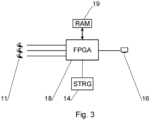
- Procédé d'importation et de traitement d'images en temps réel pour un rétroviseur électronique,dans lequel rétroviseur au moins trois caméras vidéo (11) fournissent des images en tant que signal numérique sériel sous la forme d'un signal SDI,lesquelles caméras vidéo correspondent à un rétroviseur extérieur gauche, un rétroviseur extérieur droit et un rétroviseur intérieur,les images étant stockées dans une mémoire (19),les images étant assemblées et transmises à au moins un écran (16),toutes les images étant pourvues d'un horodatage dans le bit le moins significatif du signal numérique dans les caméras vidéo (11) ,les horodatages étant désérialisés conjointement avec les images par une unité de traitement d'images réalisée par un FPGA (18) etles horodatages étant enregistrés dans la mémoire (19) avec les images,une commande avec laquelle le FPGA (18) peut être commandé pouvant être prévue,les images étant égalisées et assemblées de manière transparente et puis l'image assemblée étant sérialisée, l'horodatage de toutes les images représentées étant ensuite lu et comparé à l'heure actuelle, etun signal pour la transmission des images à l'au moins un écran n'étant transmis audit au moins un écran (16) que si tous les horodateurs ne remontent pas à plus d'une période prédéterminée.
- Procédé selon la revendication 1, caractérisé en ce que les images stockées sont traitées après avoir été horodatées, en ce que l'horodatage est lu après le traitement et en ce que les images traitées sont transmises à l'au moins un écran (16) .
- Procédé selon l'une des revendications 1 à 2, caractérisé en ce que les signaux sont munis d'un code d'identification (26) et en ce que ce code d'identification (26) est vérifié pour garantir que la bonne image est représentée en cas d'affichage plein écran ou que les différentes images sont affichées à la bonne place si les images sont représentées conjointement sur un écran.
Applications Claiming Priority (3)
| Application Number | Priority Date | Filing Date | Title |
|---|---|---|---|
| ATA51013/2016A AT519108B1 (de) | 2016-11-07 | 2016-11-07 | Verfahren zum Einlesen und Aufbereiten von Videobildern in Echtzeit |
| EP17181318.1A EP3319315A1 (fr) | 2016-11-07 | 2017-07-13 | Procédé de lecture et de préparation d'images vidéo en temps réel |
| EP24161162.3 | 2024-03-04 |
Related Parent Applications (2)
| Application Number | Title | Priority Date | Filing Date |
|---|---|---|---|
| EP17181318.1A Division EP3319315A1 (fr) | 2016-11-07 | 2017-07-13 | Procédé de lecture et de préparation d'images vidéo en temps réel |
| EP24161162.3 Division | 2016-11-07 | 2024-03-04 |
Publications (3)
| Publication Number | Publication Date |
|---|---|
| EP4451665A1 EP4451665A1 (fr) | 2024-10-23 |
| EP4451665C0 EP4451665C0 (fr) | 2025-01-22 |
| EP4451665B1 true EP4451665B1 (fr) | 2025-01-22 |
Family
ID=59337588
Family Applications (2)
| Application Number | Title | Priority Date | Filing Date |
|---|---|---|---|
| EP24165302.1A Active EP4451665B1 (fr) | 2016-11-07 | 2017-07-13 | Procédé de lecture et de préparation d'images vidéo en temps réel |
| EP17181318.1A Ceased EP3319315A1 (fr) | 2016-11-07 | 2017-07-13 | Procédé de lecture et de préparation d'images vidéo en temps réel |
Family Applications After (1)
| Application Number | Title | Priority Date | Filing Date |
|---|---|---|---|
| EP17181318.1A Ceased EP3319315A1 (fr) | 2016-11-07 | 2017-07-13 | Procédé de lecture et de préparation d'images vidéo en temps réel |
Country Status (3)
| Country | Link |
|---|---|
| EP (2) | EP4451665B1 (fr) |
| AT (1) | AT519108B1 (fr) |
| ES (1) | ES3017789T3 (fr) |
Families Citing this family (3)
| Publication number | Priority date | Publication date | Assignee | Title |
|---|---|---|---|---|
| DE102018125790A1 (de) * | 2018-10-17 | 2020-04-23 | Rheinmetall Electronics Gmbh | Vorrichtung zur validierbaren Ausgabe von Bildern |
| DE102019111178A1 (de) * | 2019-04-30 | 2020-11-05 | Rheinmetall Electronics Gmbh | Vorrichtung zur validierbaren Ausgabe von Bildern |
| DE102022125621A1 (de) | 2022-10-05 | 2024-04-11 | Ibak Helmut Hunger Gmbh & Co Kg | Verfahren zum Streamen von von einer Rohrinspektionseinheit aufgenommenen Videodaten von der Rohrinspektionseinheit zu einer Auswerteeinheit |
Family Cites Families (7)
| Publication number | Priority date | Publication date | Assignee | Title |
|---|---|---|---|---|
| US8570373B2 (en) * | 2007-06-08 | 2013-10-29 | Cisco Technology, Inc. | Tracking an object utilizing location information associated with a wireless device |
| DE102008034160A1 (de) * | 2008-07-22 | 2010-03-18 | Siemens Aktiengesellschaft | Vorrichtung zur Überwachung eines räumlichen Bereichs, insbesondere in der Umgebung oder innerhalb eines Fahrzeugs |
| US8294772B2 (en) * | 2009-01-29 | 2012-10-23 | Pelco, Inc. | System and method for monitoring connections within an analog video system |
| DE102009060845A1 (de) * | 2009-12-29 | 2011-06-30 | Funkwerk plettac electronic GmbH, 90766 | Verfahren zur sicheren Übertragung von Videosignalen von mehreren Videoquellen über ein Netzwerk an mehrere Monitore |
| US10518701B2 (en) * | 2012-07-26 | 2019-12-31 | Kyocera Corporation | Image monitoring apparatus, movable object, program and failure determining method |
| DE102014008808A1 (de) * | 2014-06-11 | 2014-11-27 | Daimler Ag | Verfahren zur Absicherung der Übertragung von sicherheitsrelevanten Kamerabildern |
| DE102015014190A1 (de) * | 2015-11-03 | 2016-05-25 | Daimler Ag | Verfahren zur Absicherung einer Übertragung von sicherheitsrelevanten Kamerabildern |
-
2016
- 2016-11-07 AT ATA51013/2016A patent/AT519108B1/de active
-
2017
- 2017-07-13 EP EP24165302.1A patent/EP4451665B1/fr active Active
- 2017-07-13 EP EP17181318.1A patent/EP3319315A1/fr not_active Ceased
- 2017-07-13 ES ES24165302T patent/ES3017789T3/es active Active
Also Published As
| Publication number | Publication date |
|---|---|
| AT519108B1 (de) | 2018-04-15 |
| ES3017789T3 (en) | 2025-05-13 |
| EP4451665C0 (fr) | 2025-01-22 |
| EP3319315A1 (fr) | 2018-05-09 |
| AT519108A4 (de) | 2018-04-15 |
| EP4451665A1 (fr) | 2024-10-23 |
Similar Documents
| Publication | Publication Date | Title |
|---|---|---|
| EP2147844B1 (fr) | Dispositif de surveillance d'une zone d'espace, notamment dans l'environnement ou à l'intérieur d'un véhicule | |
| DE102011077143B4 (de) | Fahrzeugkamerasystem und Verfahren zur Bereitstellung eines lückenlosen Bildes der Fahrzeugumgebung | |
| EP4451665B1 (fr) | Procédé de lecture et de préparation d'images vidéo en temps réel | |
| DE102015107293B4 (de) | Videoanzeigevorrichtung, videoumschaltvorrichtung, und videoanzeigeverfahren | |
| EP1991924A2 (fr) | Dispositif et procédé d'émission d'images différentes à au moins deux écrans | |
| DE3623576A1 (de) | Verfahren und vorrichtung zur elektronischen uebertragung und/oder aufzeichnung sowie anschliessenden wiedergabe von stereoskopischen fernsehbildern | |
| DE19545356C2 (de) | Vorrichtung zur Darstellung von Stereo-Videobildern | |
| DE2435794A1 (de) | Fernsehempfaengereinrichtung | |
| DE112015001285T5 (de) | Kamerakopf mit integrierten Eichtabellen | |
| DE102016013502A1 (de) | Verfahren zum Überwachen einer Datenübertragung auf Übertragungsfehler und Datenübertragungssystem | |
| DE2920303C2 (de) | Vorrichtung zum Übertragen von Videosignalen | |
| DE102022208956B3 (de) | Computerimplementiertes Verfahren zur Visualisierung einer Verzögerungszeit in einem übertragenen Bild und Vorrichtung zur Ausgabe eines Bildes | |
| DE19962730A1 (de) | Videosignalverarbeitungssystem bzw. Videosignalverarbeitungsverfahren | |
| EP0701366A2 (fr) | Appareil de télévision | |
| EP1610554B1 (fr) | Véhicule avec une identification de sources de données d'image | |
| DE102011117659B4 (de) | Verfahren zum Betreiben einer Bildverarbeitungeinrichtung sowie entsprechende Bildverarbeitungeinrichtung | |
| DE102006020511A1 (de) | Einrichtung und Verfahren zum Übertragen von Videosignalen bei Kraftfahrzeugen | |
| DE10006091A1 (de) | Verfahren und Vorrichtung zur Erkennung von Fehlern in Signalverarbeitungsanlagen der Sicherheitstechnik | |
| DE102007001843B4 (de) | Verfahren zum Verarbeiten von Bilddaten | |
| EP1922871B1 (fr) | Transmission d'informations dans le signal video d'un systeme de camera | |
| WO2025056397A1 (fr) | Procédé de commande à distance d'un véhicule automobile de transport de passagers au sol | |
| DE102020114845B4 (de) | Verfahren zur Ermittlung wenigstens einer eine Videolatenz beschreibenden Latenzinformation in einer Bildaufnahme- und Anzeigeanordnung und Messvorrichtung | |
| EP1576673B1 (fr) | Procede de telecommande visuelle a partir d'une image conforme | |
| DE3437338A1 (de) | Verfahren zum uebermitteln von nur von einem beschraenkten benutzerkreis benutzbaren fernsehsignalen | |
| DE69901660T2 (de) | Verfahren und Vorrichtung zur Übertragung von Bildinformationen |
Legal Events
| Date | Code | Title | Description |
|---|---|---|---|
| PUAI | Public reference made under article 153(3) epc to a published international application that has entered the european phase |
Free format text: ORIGINAL CODE: 0009012 |
|
| STAA | Information on the status of an ep patent application or granted ep patent |
Free format text: STATUS: REQUEST FOR EXAMINATION WAS MADE |
|
| STAA | Information on the status of an ep patent application or granted ep patent |
Free format text: STATUS: EXAMINATION IS IN PROGRESS |
|
| 17P | Request for examination filed |
Effective date: 20240913 |
|
| AC | Divisional application: reference to earlier application |
Ref document number: 3319315 Country of ref document: EP Kind code of ref document: P |
|
| AK | Designated contracting states |
Kind code of ref document: A1 Designated state(s): AL AT BE BG CH CY CZ DE DK EE ES FI FR GB GR HR HU IE IS IT LI LT LU LV MC MK MT NL NO PL PT RO RS SE SI SK SM TR |
|
| GRAP | Despatch of communication of intention to grant a patent |
Free format text: ORIGINAL CODE: EPIDOSNIGR1 |
|
| STAA | Information on the status of an ep patent application or granted ep patent |
Free format text: STATUS: GRANT OF PATENT IS INTENDED |
|
| 17Q | First examination report despatched |
Effective date: 20241008 |
|
| INTG | Intention to grant announced |
Effective date: 20241031 |
|
| GRAS | Grant fee paid |
Free format text: ORIGINAL CODE: EPIDOSNIGR3 |
|
| GRAA | (expected) grant |
Free format text: ORIGINAL CODE: 0009210 |
|
| STAA | Information on the status of an ep patent application or granted ep patent |
Free format text: STATUS: THE PATENT HAS BEEN GRANTED |
|
| AC | Divisional application: reference to earlier application |
Ref document number: 3319315 Country of ref document: EP Kind code of ref document: P |
|
| AK | Designated contracting states |
Kind code of ref document: B1 Designated state(s): AL AT BE BG CH CY CZ DE DK EE ES FI FR GB GR HR HU IE IS IT LI LT LU LV MC MK MT NL NO PL PT RO RS SE SI SK SM TR |
|
| REG | Reference to a national code |
Ref country code: GB Ref legal event code: FG4D Free format text: NOT ENGLISH |
|
| REG | Reference to a national code |
Ref country code: CH Ref legal event code: EP |
|
| REG | Reference to a national code |
Ref country code: IE Ref legal event code: FG4D Free format text: LANGUAGE OF EP DOCUMENT: GERMAN |
|
| REG | Reference to a national code |
Ref country code: DE Ref legal event code: R096 Ref document number: 502017016669 Country of ref document: DE |
|
| U01 | Request for unitary effect filed |
Effective date: 20250212 |
|
| U07 | Unitary effect registered |
Designated state(s): AT BE BG DE DK EE FI FR IT LT LU LV MT NL PT RO SE SI Effective date: 20250218 |
|
| REG | Reference to a national code |
Ref country code: ES Ref legal event code: FG2A Ref document number: 3017789 Country of ref document: ES Kind code of ref document: T3 Effective date: 20250513 |
|
| PG25 | Lapsed in a contracting state [announced via postgrant information from national office to epo] |
Ref country code: RS Free format text: LAPSE BECAUSE OF FAILURE TO SUBMIT A TRANSLATION OF THE DESCRIPTION OR TO PAY THE FEE WITHIN THE PRESCRIBED TIME-LIMIT Effective date: 20250422 |
|
| PG25 | Lapsed in a contracting state [announced via postgrant information from national office to epo] |
Ref country code: PL Free format text: LAPSE BECAUSE OF FAILURE TO SUBMIT A TRANSLATION OF THE DESCRIPTION OR TO PAY THE FEE WITHIN THE PRESCRIBED TIME-LIMIT Effective date: 20250122 |
|
| PG25 | Lapsed in a contracting state [announced via postgrant information from national office to epo] |
Ref country code: IS Free format text: LAPSE BECAUSE OF FAILURE TO SUBMIT A TRANSLATION OF THE DESCRIPTION OR TO PAY THE FEE WITHIN THE PRESCRIBED TIME-LIMIT Effective date: 20250522 Ref country code: NO Free format text: LAPSE BECAUSE OF FAILURE TO SUBMIT A TRANSLATION OF THE DESCRIPTION OR TO PAY THE FEE WITHIN THE PRESCRIBED TIME-LIMIT Effective date: 20250422 |
|
| PG25 | Lapsed in a contracting state [announced via postgrant information from national office to epo] |
Ref country code: HR Free format text: LAPSE BECAUSE OF FAILURE TO SUBMIT A TRANSLATION OF THE DESCRIPTION OR TO PAY THE FEE WITHIN THE PRESCRIBED TIME-LIMIT Effective date: 20250122 |
|
| PG25 | Lapsed in a contracting state [announced via postgrant information from national office to epo] |
Ref country code: GR Free format text: LAPSE BECAUSE OF FAILURE TO SUBMIT A TRANSLATION OF THE DESCRIPTION OR TO PAY THE FEE WITHIN THE PRESCRIBED TIME-LIMIT Effective date: 20250423 |
|
| U20 | Renewal fee for the european patent with unitary effect paid |
Year of fee payment: 9 Effective date: 20250624 |
|
| PG25 | Lapsed in a contracting state [announced via postgrant information from national office to epo] |
Ref country code: SM Free format text: LAPSE BECAUSE OF FAILURE TO SUBMIT A TRANSLATION OF THE DESCRIPTION OR TO PAY THE FEE WITHIN THE PRESCRIBED TIME-LIMIT Effective date: 20250122 |
|
| PGFP | Annual fee paid to national office [announced via postgrant information from national office to epo] |
Ref country code: ES Payment date: 20250828 Year of fee payment: 9 |
|
| PGFP | Annual fee paid to national office [announced via postgrant information from national office to epo] |
Ref country code: GB Payment date: 20250724 Year of fee payment: 9 |
|
| PGFP | Annual fee paid to national office [announced via postgrant information from national office to epo] |
Ref country code: CH Payment date: 20250801 Year of fee payment: 9 |
|
| PG25 | Lapsed in a contracting state [announced via postgrant information from national office to epo] |
Ref country code: CZ Free format text: LAPSE BECAUSE OF FAILURE TO SUBMIT A TRANSLATION OF THE DESCRIPTION OR TO PAY THE FEE WITHIN THE PRESCRIBED TIME-LIMIT Effective date: 20250122 |
|
| PG25 | Lapsed in a contracting state [announced via postgrant information from national office to epo] |
Ref country code: SK Free format text: LAPSE BECAUSE OF FAILURE TO SUBMIT A TRANSLATION OF THE DESCRIPTION OR TO PAY THE FEE WITHIN THE PRESCRIBED TIME-LIMIT Effective date: 20250122 |
|
| PLBE | No opposition filed within time limit |
Free format text: ORIGINAL CODE: 0009261 |
|
| STAA | Information on the status of an ep patent application or granted ep patent |
Free format text: STATUS: NO OPPOSITION FILED WITHIN TIME LIMIT |
|
| 26N | No opposition filed |
Effective date: 20251023 |