EP4455227A1 - Emulsionssystem mit anionischer latexzusammensetzung für verbesserte beschichtung - Google Patents
Emulsionssystem mit anionischer latexzusammensetzung für verbesserte beschichtung Download PDFInfo
- Publication number
- EP4455227A1 EP4455227A1 EP23170591.4A EP23170591A EP4455227A1 EP 4455227 A1 EP4455227 A1 EP 4455227A1 EP 23170591 A EP23170591 A EP 23170591A EP 4455227 A1 EP4455227 A1 EP 4455227A1
- Authority
- EP
- European Patent Office
- Prior art keywords
- emulsion system
- anionic
- acrylate
- sodium lauryl
- emulsion
- Prior art date
- Legal status (The legal status is an assumption and is not a legal conclusion. Google has not performed a legal analysis and makes no representation as to the accuracy of the status listed.)
- Withdrawn
Links
Images
Classifications
-
- C—CHEMISTRY; METALLURGY
- C09—DYES; PAINTS; POLISHES; NATURAL RESINS; ADHESIVES; COMPOSITIONS NOT OTHERWISE PROVIDED FOR; APPLICATIONS OF MATERIALS NOT OTHERWISE PROVIDED FOR
- C09D—COATING COMPOSITIONS, e.g. PAINTS, VARNISHES OR LACQUERS; FILLING PASTES; CHEMICAL PAINT OR INK REMOVERS; INKS; CORRECTING FLUIDS; WOODSTAINS; PASTES OR SOLIDS FOR COLOURING OR PRINTING; USE OF MATERIALS THEREFOR
- C09D5/00—Coating compositions, e.g. paints, varnishes or lacquers, characterised by their physical nature or the effects produced; Filling pastes
Definitions
- the present invention relates to an emulsion system containing anionic latex composition.
- the present invention also relates to a process for the preparation of the emulsion system.
- Latexes form a class of compounds that are polymers that can be made up of different monomers. What they have in common is they are formed in an emulsion polymerization process. The monomers are fed into a reaction tank, and with the aid of anionic surfactants, emulsified and then polymerized with an initiator. The resulting latex has certain inherent properties and can be further modified with other added products such as surfactants, polymers etc. The products added after the reaction are known as "post-adds" in the industry.
- Cationic surfactants are ionic surfactants with a positive charge on the hydrophilic group. When added to a mixture containing anionic surfactants, the two can be attracted to each other due to the opposite charges.
- the resulting paired surfactant can be called as a "catanionic" surfactant and can have different properties than either cationic or anionic surfactant on their own.
- An object of the present invention is to provide an emulsion system having improved stability.
- Another object of the present invention to provide the emulsion system having improved water resistance when used as a coating paint.
- Still another object of the present invention is to provide an emulsion system having improved stain resistance and solvent resistance when used as a coating paint.
- Yet another object of the present invention is to provide a simple process of making an emulsion system.
- the present invention provides an emulsion system obtainable by a process comprising mixing of a) an anionic latex composition comprising at least one acrylate polymer and at least one anionic surfactant; and b) at least one cationic surfactant, wherein the molar ratio of the at least one anionic surfactant to the at least one cationic surfactant is in the range of 0.4:1 to 9: 1, wherein the cationic surfactant or anionic surfactant or both contains 2 to 30 ethylene oxide (EO) units per molecule.
- EO ethylene oxide
- the present invention also provides a process for the preparation of the emulsion system according to the present invention, wherein the process comprises preparing the anionic latex composition comprising at least one acrylate polymer and at least one anionic surfactant, combining the at least one cationic surfactant with the anionic latex composition to form a mixture, and mixing the mixture, wherein the cationic surfactant or anionic surfactant or both contains 2 to 30 ethylene oxide (EO) units per molecule.
- EO ethylene oxide
- the present invention further provides a coating composition comprising the emulsion system according to present invention.
- the present invention still further provides use of the emulsion system according to the present invention as a coating, especially as a coating paint.
- an “emulsion”, “emulsion solution”, “emulsion formulation”, “emulsion composition” or emulsion system herein interchangeably means a polymer or a copolymer in the form of small particles (e.g., usually ⁇ 500 nm) emulsified by a surfactant composition and dispersed in an aqueous system.
- Anionic surfactant means surfactants that carry a negatively charged head group.
- Cationic surfactant means surfactants that carry a positively charged head group.
- Molar ratio is the ratio between two coefficients in a balanced chemical equation.
- the molar ratio is also known as the mole ratio or mole-to-mole ratio.
- surface is used for the interface between matter and air, or matter and vacuum.
- 'interface' is a boundary between two special regions occupied by different matter or by matter in different physical state.
- surface tension is defined as the work (energy) that is needed to increase the surface by a defined area.
- Surface tension can be best explained by the behaviour of molecules at the surface of a liquid. Cohesive forces between the molecules in the surface layer are not evenly distributed to all sides compared to molecules in the inner phase. The result of these unbalanced attraction forces is the so-called surface tension.
- surface energy is commonly used. The surface energy of solid surfaces can be indirectly determined by contact angle measurements with liquids with a known surface tension. Consequently, the surface tension is typically given in units of mJ/m 2 , dyn/cm or mN/m.
- water absorption is the capacity of a plastic or a polymer or any composition to absorb moisture from its environment. Water absorption is used to determine the amount of water absorbed under specified conditions. Factors affecting water absorption include type of polymer, additives used, temperature and length of exposure.
- stain resistant is the ability of material to withstand discoloration. In other words, it's a material/coat/paint that doesn't absorb dirt and stains.
- ethylene oxide (EO) units per molecule means EO units present in a molecule in their polymerized form (“-CH2-CH2-O-").
- the presently claimed invention provides an emulsion system obtainable by a process comprising mixing of an anionic latex composition comprising at least one acrylate polymer and at least one anionic surfactant; and at least one cationic surfactant, wherein the molar ratio of the at least one anionic surfactant to the at least one cationic surfactant is in the range of 0.4:1 to 9: 1, wherein the cationic surfactant or anionic surfactant or both contains 2 to 30 ethylene oxide (EO) units per molecule.
- the cationic surfactant is post-added to the anionic latex composition while maintaining the molar ratio of the anionic surfactant to the cationic surfactant in the range of 0.4:1 to 9:1.
- the anionic latex composition used is essentially free of cationic surfactant.
- the term "essentially free” refers to no cationic surfactant present in the latex composition. It may be present as an impurity in an amount of less than 0.0001 wt.%.
- emulsion stability can be defined as the system's ability to resist changes in its physicochemical properties over time.
- the anionic surfactant is preferably selected from sodium lauryl ethoxylate sulphate, sodium lauryl ethoxylate phosphate, or a combination thereof, each containing ethylene oxide (EO) units per molecule.
- the anionic surfactant is preferably selected from sodium dodecyl sulphate, sodium dioctyl sulfosuccinate, or combinations thereof.
- the anionic surfactant such as sodium dodecyl sulphate, sodium dioctyl sulfosuccinate, or combinations thereof
- the cationic surfactant added to make the emulsion system contains 2 to 6 ethylene oxide (EO) units per molecule.
- the anionic surfactant is more preferably selected from sodium lauryl ethoxylate sulphate, and sodium lauryl ethoxylate phosphate, each containing 2 to 30 ethylene oxide (EO) units per molecule, or combinations thereof. Even more preferably, the anionic surfactant is sodium lauryl ethoxylate sulphate, or sodium lauryl ethoxylate phosphate, each containing 2 to 30 ethylene oxide (EO) units per molecule. Most preferably, the anionic surfactant is sodium lauryl ethoxylate sulphate, or sodium lauryl ethoxylate phosphate, each containing 2 to 12 ethylene oxide (EO) units per molecule. Even most preferably, the anionic surfactant is sodium lauryl ethoxylate sulphate, or sodium lauryl ethoxylate phosphate, each containing 2 to 7 ethylene oxide (EO) units per molecule.
- the amount of anionic surfactant is ranging from 0.001 to 10 % by weight. More preferably, the amount of anionic surfactant is ranging from 0.01 to 5.0 % by weight. Even more preferably, the amount of anionic surfactant is ranging from 0.01 to 3.0 % by weight.
- the cationic surfactant is preferably selected from cetyltrimethylammonium chloride, or 2[(2-hydroxydodecoxy) ethoxy]ethyl-trimethyl ammonium chloride containing 0 to 6 ethylene oxide (EO) units per molecule, or combinations thereof.
- the cationic surfactant is more preferably selected from cetyltrimethylammonium chloride, or 2[(2-hydroxydodecoxy) ethoxy]ethyl-trimethyl ammonium chloride containing 2 to 6 ethylene oxide (EO) units per molecule, or combinations thereof. Even more preferably, the cationic surfactant is 2[(2-hydroxydodecoxy) ethoxy]ethyl-trimethyl ammonium chloride containing 2 to 6 ethylene oxide (EO) units per molecule.
- the amount of cationic surfactant is ranging from 0.001 to 10 % by weight. More preferably, the amount of cationic surfactant is ranging from 0.01 to 5.0 % by weight. Even more preferably, the amount of cationic surfactant is ranging from 0.01 to 3.0 % by weight.
- the molar ratio of the at least one anionic surfactant to the at least one cationic surfactant is in the range of 0.4:1 to 9: 1.
- the molar ratio of the at least one anionic surfactant to the at least one cationic surfactant is 3: 1 to 1:1. More preferably, the molar ratio of the at least one anionic surfactant to the at least one cationic surfactant is 1:1.
- the amount of cationic surfactant is not higher than the amount of at least one anionic surfactant therein.
- the emulsion system comprises:
- the emulsion system comprises:
- the emulsion system comprises:
- the anionic latex composition comprises at least one acrylate polymer.
- the acrylate polymer comprises one or more monomers in polymerized form selected from methyl methacrylate, 2-ethylhexyl acrylate, ethyl acrylate, (meth)acrylic acid, ethyl imidazolidone methacrylate, n-butyl acrylate, n-dodecyl methacrylate, methyl methacrylate, 2-ethylbutyl acrylate, hexyl acrylate, 2-ethylhexyl acrylate, nonyl acrylate, octyl acrylate, sec-butyl acrylate, dodecyl acrylate, isobutyl acrylate, isopropyl acrylate, styrene, vinyl acetate or combinations thereof.
- the acrylate polymer comprises one or more monomers in polymerized form selected from methyl methacrylate, 2-ethy
- the amount of acrylate polymer is in the range of 5.0 to 70 % by weight. More preferably, the amount of acrylate polymer is in the range of 10 to 60 % by weight. Even more preferably, the amount of acrylate polymer is in the range of 15 to 50 % by weight.
- the molecular weight of the acrylate polymer is in the range of 500-1000000 Daltons. More preferably, the molecular weight of the acrylate polymer is in the range of 1000-100000 Daltons.
- the molecular weight (Mn) of the acrylate polymer was determined by means of gel permeation chromatography (GPC) using a refractometer as the detector. The mobile phase used was tetrahydrofuran (THF, 1mL/min, 35° C), the standard employed for determining the molecular weight being polystyrene (PS).
- the acrylate polymer further comprises one or more monomers in polymerized form selected from butadiene, styrene, vinyl acetate, or combinations thereof.
- the anionic latex composition further comprises polystyrene seeds and at least one additive.
- the additive is selected from the group of initiators, pH adjusting agents or any combinations thereof.
- initiator also known as polymer initiator
- monomer single molecule that can form chemical bonds
- intermediate compound capable of linking successively with a large number of other monomers into a polymeric compound.
- Persulfates are suited for polymer initiation and are used to prepare latex polymers for paints, coatings etc.
- the initiator is selected from potassium persulfate, ammonium persulfate, sodium persulfate, or any combination thereof. More preferably, the initiator is potassium persulfate.
- the pH adjusting agent is selected from sodium bicarbonate, diethanolamine, triethanolamine, ammonia, sodium hydroxide, sodium carbonate, potassium hydroxide, ammonium carbonate, sodium phosphate, or any combination thereof.
- the pH adjusting agent is sodium bicarbonate.
- the amount of initiator and pH adjusting agent is added as per the requirement which is known to a person skilled in the art.
- EO ethylene oxide
- the molar ratio of the at least one anionic surfactant to the at least one cationic surfactant is in the range of 0.4:1 to 9:1.
- the molar ratio of the at least one anionic surfactant to the at least one cationic surfactant is in the range of 3:1 to 1:1.
- the step of preparing the anionic latex composition comprises the following steps: In the first step (Step (a)), at least one first initiator, water and polystyrene seeds are mixed in a reactor to obtain a mixture. The pH of the mixture is adjusted using at least one pH adjusting agent.
- the first initiator is selected from potassium persulfate, ammonium persulfate, sodium persulfate, or any combination thereof. More preferably, the first initiator is potassium persulfate.
- the pH adjusting agent is selected from sodium bicarbonate, diethanolamine, triethanolamine, ammonia, sodium hydroxide, sodium carbonate, potassium hydroxide, ammonium carbonate, sodium phosphate, or any combination thereof.
- the pH adjusting agent is sodium bicarbonate.
- the step (a) is carried out at a temperature ranging from 30 to 95 0 C. More preferably, the step (a) is carried out at a temperature ranging from 50 to 90 0 C. Most preferably, the step (a) is carried out at a temperature ranging from 70 to 90 0 C.
- the step (a) is carried out using an agitator rotating at a speed of 80 to 120 rpm. More preferably, the step (a) is carried out using an agitator rotating at a speed of 90 to 110 rpm.
- Step (b) at least one acrylate and the at least one anionic surfactant are mixed in a pre-emulsion flask to obtain an emulsion.
- Step (c) at least one second initiator is dissolved in water in an initiator flask to obtain a solution.
- the second initiator is selected from potassium persulfate, ammonium persulfate, sodium persulfate, or any combination thereof. More preferably, the second initiator is potassium persulfate.
- step (d) the emulsion obtained in step (b) and the solution of step (c) are transferred to the reactor containing the mixture of step (a).
- the step (d) i.e. transferring of the emulsion (b) and the solution (c) in portion is carried out for a period ranging from 60 to 100 minutes. More preferably, the step (d) i.e. transferring of the emulsion (b) and the solution (c) in portion is carried out for a period ranging from 75 to 95 minutes.
- step (e) the so obtained mixture from step (d) is reacted.
- the step (e) is carried out at a temperature in the range from 70 to 95 0 C. More preferably, the step (e) is carried out at a temperature in the range from 80 to 90 0 C.
- step (e) the pH value of the reaction mixture obtained in step (e) is adjusted. followed by mixing, cooling, and adjusting pH to obtain the anionic latex composition.
- the pH adjusting agent is selected from sodium bicarbonate, diethanolamine, triethanolamine, ammonia, sodium hydroxide, sodium carbonate, potassium hydroxide, ammonium carbonate, sodium phosphate, or any combination thereof.
- the pH adjusting agent is sodium bicarbonate.
- step (f) the pH value of the reaction mixture is adjusted to pH 6.5 to 8.5. More preferably, in step (f), the pH value of the reaction mixture is adjusted to pH 6.8 to 7.2.
- the process further comprises a step of cooling the reaction mixture obtained from step (e) before adjusting the pH value.
- a coating composition comprising the emulsion system according to the present invention.
- the "reactor charge” components (0.07 g of potassium persulfate, 0.15 g of sodium bicarbonate, and 78.2 g of water) were added, warmed to 85 0 C and mixed at 100 rpm using an agitator. Polystyrene seeds (0.8 g) were also added to control particle size.
- pre-emulsion components (74.5 g of methyl methacrylate, 65.5 g of 2-ethylhexyl acrylate, 2.78 g of anionic surfactant and 50.9 g of water) were added and mixed at 100 rpm to emulsify.
- the pre-emulsion and initiator flasks were fed to the reactor over 80 and 90 minutes respectively to obtain a mixture.
- the obtained mixture in the reactor was mixed for 1 additional hour at 85 0 C and then cooled to room temperature.
- the anionic latex composition was obtained by adding and mixing neutralization components (6.2 g of 8% sodium bicarbonate) to adjust a pH of 7.
- Example 1A Sodium dodecyl sulphate (SDS), C 12 H 25 -SO 4 Na
- Example 1B Sodium dioctyl sulfosuccinate (SDOS), C 20 H 37 NaO 7 S. The process of example 1 was repeated using SDOS as an anionic surfactant.
- SDOS Sodium dioctyl sulfosuccinate
- Example 2 Preparation of emulsion system (Comparative examples: 2C-2E)
- the emulsion system was prepared by adding and mixing the cationic surfactant into the anionic latex composition containing anionic surfactant as prepared in example 1 at a predetermined molar ratio of anionic to cationic surfactant. The mixing is carried out using a paddle mixer at 100 to 200 rpm.
- Example 2C Sodium dodecyl sulphate (SDS) with cetyltrimethylammonium chloride, C 19 H 42 N.Cl (CTAC).
- the anionic latex composition was prepared as per example 1 using SDS as an anionic surfactant.
- SDS an anionic surfactant.
- cetyltrimethylammonium chloride (CTAC) as a cationic surfactant was added in a molar ratio of 8:2 followed by mixing to obtain the emulsion system.
- Example 2D Sodium dioctyl sulfosuccinate (SDOS) with cetyltrimethylammonium chloride, CTAC.
- Example 2E Sodium dodecyl benzyl sulfonate, C 18 H 30 NaO 3 S (SDBS, LAS) with cetyltrimethylammonium chloride, CTAC.
- Example 3 Sodium dodecyl sulphate (SDS), with 2[2-(2-hydroxydodecoxy)ethoxy]ethyl-trimethylammonium chloride (C[EO]TAC).
- Example 4 Sodium dioctyl sulfosuccinate (SDOS) with 2[2-(2-hydroxydodecoxy)ethoxy]ethyl-trimethylammonium chloride (C[EO]TAC).
- Example 5 Sodium lauryl ethoxylate sulphate (SLES, FES 32), C 12-4 O[EO]-SO4Na with Cetyltrimethylammonium chloride, CTAC.
- Various emulsion systems were prepared by varying the molar ratio of SLES to CTAC such as 9:1, 7:3, 5:5, and 3:7.
- Example 6 Sodium lauryl ethoxylate sulphate (SLES, FES 32), C 12-4 O[EO]-SO 4 Na with 2[2-(2-hydroxydodecoxy)ethoxy]ethyl-trimethylammonium chloride (C[EO]TAC).
- Example 7 Sodium lauryl ethoxylate sulphate (SLES, FES 993), C 12-30 O[EO]-SO 4 Na with cetyltrimethylammonium chloride, CTAC.
- Example 8 Sodium lauryl ethoxylate sulphate (SLES, FES 993), C 12-30 O [EO]-SO 4 Na with 2[2-(2-hydroxydodecoxy) ethoxy]ethyl-trimethylammonium chloride (C[EO]TAC).
- Example 9 Sodium dodecyl benzyl sulfonate (SDBS) with 2[2-(2-hydroxydodecoxy)ethoxy]ethyl-trimethyl ammonium chloride (C[EO]TAC).
- SDBS Sodium dodecyl benzyl sulfonate
- C[EO]TAC 2[2-(2-hydroxydodecoxy)ethoxy]ethyl-trimethyl ammonium chloride
- Disponil ® FES sodium salts of fatty alcohol ethersulfates with differing ethoxylation degrees and the hydrophobe is based on a native C 12 -C 14 fatty alcohol.
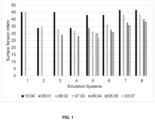
- FIG. 1 A comparative chart is provided in Figure 1 , wherein vertical axis represents surface tension value and horizontal axis represents various emulsion systems prepared, in which 1 denotes example 2C, 2 denotes example 2D, 3 denotes example 3, 4 denotes example 4, 5 denotes example 5, 6 denotes example 6, 7 denotes example 7 and 8 denotes example 8.
- the emulsion systems of examples 3-8 also showed found to be stable when checked for phase separation and precipitation. These emulsion systems were then used to prepare plaques. The obtained plaques were stable with absence of any precipitation due to soluble ion pair. The clarity and opacity were found to be optimum. The coating of these emulsion systems created smooth and glossy appearance when coated on the surface.
- the ion pair formulations as described in examples 2-9 were prepared by adding cationic surfactant to the anionic latex composition. 2 grams of prepared formulations were then poured into 1-inch by 1-inch square silicone trays and placed in an oven at 50 °C overnight to cure for 48 hours. The plaque was then removed from the tray and an initial weight was taken. The plaques were prepared in triplicate and placed in a jar full of water, set on an orbital shaker at 50 rpm, and submerged for 24 hrs. Each plaque was then removed, patted dry with paper towel and allowed to sit open to air for 10 minutes. The plaque surface was dried again with a Kim wipe and weighed. The reported water absorption measurements were taken as the difference between the final weight and the initial weight and reported as a percentage of the original weight.
- Table 1 Water absorption (% by wt.) The observations w. r. t. the water absorption (% by wt.) are provided herein below: The observations with respect to water absorption are provided herein below: - Example 2A (10:0, only SDS, in absence of cationic surfactant) shows water absorption of 14.7 % by wt. - Example 2B (10:0, only SDOS, in absence of cationic surfactant) shows water absorption of 5.99 % by wt. - Example 3 (SDS+C[EO]TAC) at 10:0 molar ratio shows water absorption of 14.7 % by wt.
- Example 4 SDOS+C[EO]TAC
- SLES (FES32)+CTAC) at 10:0 molar ratio shows water absorption of 6.22 % by wt., which is lowered to 2.91 % by wt., and 5.15 % by wt. at 8:2 molar ratio and 6:4 molar ratio respectively.
- Example 6(SLES (FES 32)+C[EO]TAC) at 10:0 molar ratio shows water absorption of 5.10 % by wt., which is lowered to 4.42 % by wt., and 4.97 % by wt. at 8:2 molar ratio and 6:4 molar ratio respectively.
- the reduction in water absorption improves the durability of coating or paint as well as the dirt resistance.
- a coating of the given ion pair emulsion polymer formulation (emulsion system of the present invention) was drawn down with a #6 bar on a clean stainless sheet. The coating was cured in open air for 2 hours. A drop of French's yellow mustard was then placed on the surface in triplicate, covered and cured for 5 minutes, 1 hour and up to 24 hrs to stain. At the given time points, the mustard droplet was removed with a paper towel, and the stain was scored on a scale of 1 to 5, 1 being hardly visible and 5 being very visible. Scoring was conducted visually.
- the present invention provides emulsion system obtainable by a process comprising mixing of an anionic latex composition comprising at least one acrylate polymer and at least one anionic surfactant; and at least one cationic surfactant, wherein the molar ratio of the at least one anionic surfactant to the at least one cationic surfactant is in the range of 0.4:1 to 9: 1, wherein the cationic surfactant or anionic surfactant or both contains 2 to 30 ethylene oxide (EO) units per molecule.
- EO ethylene oxide
- the at least one anionic surfactant is sodium lauryl ethoxylate sulphate, or sodium lauryl ethoxylate phosphate, each containing 2 to 30 ethylene oxide (EO) units per molecule.
- the at least one anionic surfactant is sodium lauryl ethoxylate sulphate, or sodium lauryl ethoxylate phosphate, each containing 2 to 12 ethylene oxide (EO) units per molecule.
- the at least one anionic surfactant is sodium lauryl ethoxylate sulphate, or sodium lauryl ethoxylate phosphate, each containing 2 to 7 ethylene oxide (EO) units per molecule.
- emulsion system according to any of embodiments 1 to 5, wherein the at least one cationic surfactant is selected from the group of cetyltrimethylammonium chloride, 2[(2-hydroxydodecoxy) ethoxy]ethyl-trimethyl ammonium chloride containing 2 to 6 ethylene oxide (EO) units per molecule, and combinations thereof.
- the at least one cationic surfactant is selected from the group of cetyltrimethylammonium chloride, 2[(2-hydroxydodecoxy) ethoxy]ethyl-trimethyl ammonium chloride containing 2 to 6 ethylene oxide (EO) units per molecule, and combinations thereof.
- acrylate polymer comprising one or more monomers in polymerized form selected from the group of methyl methacrylate, 2-ethylhexyl acrylate, ethyl acrylate, (meth)acrylic acid, ethyl imidazolidone methacrylate, n-butyl acrylate, n-dodecyl methacrylate, methyl methacrylate, 2-ethylbutyl acrylate, hexyl acrylate, 2-ethylhexyl acrylate, nonyl acrylate, octyl acrylate, sec-butyl acrylate, dodecyl acrylate, isobutyl acrylate, isopropyl acrylate, and combinations thereof.
- acrylate polymer further comprises one or more monomers in polymerized form selected from butadiene, styrene, vinyl acetate, or combinations thereof.
- anionic latex composition further comprises polystyrene seeds.
- anionic latex composition further comprises at least one additive selected from the group of potassium persulfate, sodium bicarbonate, and combinations thereof.
- EO ethylene oxide
- step of preparing the anionic latex composition comprises:
- step (a) is carried out at a temperature ranging from 30 to 95 0 C.
- step (a) is carried out using an agitator rotating at a speed of 80 to 120 rpm.
- step (e) is carried out at a temperature in the range from 70 to 95 0 C.
- step (f) the pH value of the reaction mixture is adjusted to pH 6.5 to 8.5.
- a coating composition comprising the emulsion system according to any of the embodiments 1 to 16.
Landscapes
- Chemical & Material Sciences (AREA)
- Life Sciences & Earth Sciences (AREA)
- Engineering & Computer Science (AREA)
- Materials Engineering (AREA)
- Wood Science & Technology (AREA)
- Organic Chemistry (AREA)
- Polymerisation Methods In General (AREA)
Priority Applications (1)
| Application Number | Priority Date | Filing Date | Title |
|---|---|---|---|
| EP23170591.4A EP4455227A1 (de) | 2023-04-28 | 2023-04-28 | Emulsionssystem mit anionischer latexzusammensetzung für verbesserte beschichtung |
Applications Claiming Priority (1)
| Application Number | Priority Date | Filing Date | Title |
|---|---|---|---|
| EP23170591.4A EP4455227A1 (de) | 2023-04-28 | 2023-04-28 | Emulsionssystem mit anionischer latexzusammensetzung für verbesserte beschichtung |
Publications (1)
| Publication Number | Publication Date |
|---|---|
| EP4455227A1 true EP4455227A1 (de) | 2024-10-30 |
Family
ID=86330337
Family Applications (1)
| Application Number | Title | Priority Date | Filing Date |
|---|---|---|---|
| EP23170591.4A Withdrawn EP4455227A1 (de) | 2023-04-28 | 2023-04-28 | Emulsionssystem mit anionischer latexzusammensetzung für verbesserte beschichtung |
Country Status (1)
| Country | Link |
|---|---|
| EP (1) | EP4455227A1 (de) |
Citations (4)
| Publication number | Priority date | Publication date | Assignee | Title |
|---|---|---|---|---|
| US2912349A (en) * | 1956-08-28 | 1959-11-10 | Wood Conversion Co | Latices and fabrics therefrom |
| GB1363278A (en) * | 1971-08-20 | 1974-08-14 | Dow Chemical Co | Latex compositions |
| US5977210A (en) * | 1995-01-30 | 1999-11-02 | Xerox Corporation | Modified emulsion aggregation processes |
| WO2018067859A1 (en) * | 2016-10-06 | 2018-04-12 | Cal-West Specialty Coatings, Inc. | Protective coating systems for paint booths that resist discoloration |
-
2023
- 2023-04-28 EP EP23170591.4A patent/EP4455227A1/de not_active Withdrawn
Patent Citations (4)
| Publication number | Priority date | Publication date | Assignee | Title |
|---|---|---|---|---|
| US2912349A (en) * | 1956-08-28 | 1959-11-10 | Wood Conversion Co | Latices and fabrics therefrom |
| GB1363278A (en) * | 1971-08-20 | 1974-08-14 | Dow Chemical Co | Latex compositions |
| US5977210A (en) * | 1995-01-30 | 1999-11-02 | Xerox Corporation | Modified emulsion aggregation processes |
| WO2018067859A1 (en) * | 2016-10-06 | 2018-04-12 | Cal-West Specialty Coatings, Inc. | Protective coating systems for paint booths that resist discoloration |
Similar Documents
| Publication | Publication Date | Title |
|---|---|---|
| JP6104923B2 (ja) | 凍結融解安定性(freeze−thawstability)エマルジョンポリマーおよびそのコーティングのための新規な反応性界面活性剤 | |
| EP3502196B1 (de) | Wässrige dispersion von polymerpartikeln, mikrokugeln und polyethylenwachs | |
| EP2703434B1 (de) | Latexbinder, wässrige Beschichtungen und Lacke mit Einfrier-Auftau-Stabilität und Verwendungsverfahren dafür | |
| EP2001987B1 (de) | Reaktive tenside und ihre verwendung für emulsionen und dispersonen | |
| EP3498785B1 (de) | Wässrige dispersion von mikrosphären-p-säure-funktionalisierten polymerpartikeln | |
| EP2432819B1 (de) | Aus oxetan-basierten makromonomeren erhältliche polymere, verfahren zu deren herstellung und deren verwendung als additive in beschichtungsmitteln und kunststoffen | |
| EP2443170B1 (de) | Terminal ungesättigte, glycidol-basierte makromonomere, daraus erhältliche polymere, herstellung und verwendung | |
| JP2025023931A (ja) | 水白化耐性を有する重合性界面活性剤及び使用方法 | |
| EP2432820B1 (de) | Terminal ungesättigte, oxetan-basierte makromonomere und verfahren zu deren herstellung | |
| EP4455227A1 (de) | Emulsionssystem mit anionischer latexzusammensetzung für verbesserte beschichtung | |
| CN116675815A (zh) | 一种poss复合聚丙烯酸酯水分散体及其制备方法 | |
| EP3105285B1 (de) | Tristyrylphenolalkoxylatsulfosuccinate | |
| EP3177673B1 (de) | Polymerisierbare allylethersulfattenside und verfahren zur verwendung | |
| CN112239518A (zh) | 改善涂层早期耐水性和光泽度的丙烯酸共聚乳液及其应用 | |
| EP2794695B1 (de) | Verfahren für die herstellung eines vinyliden-chlorid-polymers | |
| Sun et al. | Synthesis of a novel series of polymerizable surfactants and application in emulsion polymerization | |
| EP0269187B1 (de) | Amphipathische polymerisierbare Vinylmonomere, davon abgeleitete Vinylharzteilchen und deren Herstellung | |
| JP2018095752A (ja) | 耐水塗膜用ポリマーエマルションの製造方法 | |
| BR102020008912B1 (pt) | Tensoativo não-iônico reativo isento de alquilfenol etoxilado, processo para obtenção do tensoativo não-iônico reativo isento de alquilfenol etoxilado, látices polimerizados em emulsão, composição de revestimento à base de água com elevada resistência à água, e, uso da composição de revestimento à base de água | |
| JP2025537109A (ja) | 重合性界面活性剤から形成されるポリマーを含む、改善された特性を有するコーティング組成物 | |
| BR112021021905B1 (pt) | Composição polimerizável de tensoativos, adesivo sensível à pressão com aperfeiçoadas propriedades de clareamento e resistência à água, e tinta com aperfeiçoada resistência à marca de água e propriedades de resistência à lixiviação do tensoativo | |
| BR102020008912A2 (pt) | Tensoativo não-iônico reativo isento de alquilfenol etoxilado, processo para obtenção do tensoativo não-iônico reativo isento de alquilfenol etoxilado, látices polimerizados em emulsão, composição de revestimento à base de água com elevada resistência à água, e, uso da composição de revestimento à base de água |
Legal Events
| Date | Code | Title | Description |
|---|---|---|---|
| PUAI | Public reference made under article 153(3) epc to a published international application that has entered the european phase |
Free format text: ORIGINAL CODE: 0009012 |
|
| STAA | Information on the status of an ep patent application or granted ep patent |
Free format text: STATUS: THE APPLICATION HAS BEEN PUBLISHED |
|
| AK | Designated contracting states |
Kind code of ref document: A1 Designated state(s): AL AT BE BG CH CY CZ DE DK EE ES FI FR GB GR HR HU IE IS IT LI LT LU LV MC ME MK MT NL NO PL PT RO RS SE SI SK SM TR |
|
| STAA | Information on the status of an ep patent application or granted ep patent |
Free format text: STATUS: THE APPLICATION IS DEEMED TO BE WITHDRAWN |
|
| 18D | Application deemed to be withdrawn |
Effective date: 20250501 |