EP4455234A1 - Ruban adhésif, composite collé et procédé de libération électrique du composite collé - Google Patents
Ruban adhésif, composite collé et procédé de libération électrique du composite collé Download PDFInfo
- Publication number
- EP4455234A1 EP4455234A1 EP23169916.6A EP23169916A EP4455234A1 EP 4455234 A1 EP4455234 A1 EP 4455234A1 EP 23169916 A EP23169916 A EP 23169916A EP 4455234 A1 EP4455234 A1 EP 4455234A1
- Authority
- EP
- European Patent Office
- Prior art keywords
- adhesive
- layer
- adhesive tape
- electrically conductive
- adhesive layer
- Prior art date
- Legal status (The legal status is an assumption and is not a legal conclusion. Google has not performed a legal analysis and makes no representation as to the accuracy of the status listed.)
- Withdrawn
Links
Images


Classifications
-
- C—CHEMISTRY; METALLURGY
- C09—DYES; PAINTS; POLISHES; NATURAL RESINS; ADHESIVES; COMPOSITIONS NOT OTHERWISE PROVIDED FOR; APPLICATIONS OF MATERIALS NOT OTHERWISE PROVIDED FOR
- C09J—ADHESIVES; NON-MECHANICAL ASPECTS OF ADHESIVE PROCESSES IN GENERAL; ADHESIVE PROCESSES NOT PROVIDED FOR ELSEWHERE; USE OF MATERIALS AS ADHESIVES
- C09J7/00—Adhesives in the form of films or foils
- C09J7/20—Adhesives in the form of films or foils characterised by their carriers
- C09J7/22—Plastics; Metallised plastics
- C09J7/25—Plastics; Metallised plastics based on macromolecular compounds obtained otherwise than by reactions involving only carbon-to-carbon unsaturated bonds
- C09J7/255—Polyesters
-
- C—CHEMISTRY; METALLURGY
- C09—DYES; PAINTS; POLISHES; NATURAL RESINS; ADHESIVES; COMPOSITIONS NOT OTHERWISE PROVIDED FOR; APPLICATIONS OF MATERIALS NOT OTHERWISE PROVIDED FOR
- C09J—ADHESIVES; NON-MECHANICAL ASPECTS OF ADHESIVE PROCESSES IN GENERAL; ADHESIVE PROCESSES NOT PROVIDED FOR ELSEWHERE; USE OF MATERIALS AS ADHESIVES
- C09J5/00—Adhesive processes in general; Adhesive processes not provided for elsewhere, e.g. relating to primers
- C09J5/08—Adhesive processes in general; Adhesive processes not provided for elsewhere, e.g. relating to primers using foamed adhesives
-
- C—CHEMISTRY; METALLURGY
- C09—DYES; PAINTS; POLISHES; NATURAL RESINS; ADHESIVES; COMPOSITIONS NOT OTHERWISE PROVIDED FOR; APPLICATIONS OF MATERIALS NOT OTHERWISE PROVIDED FOR
- C09J—ADHESIVES; NON-MECHANICAL ASPECTS OF ADHESIVE PROCESSES IN GENERAL; ADHESIVE PROCESSES NOT PROVIDED FOR ELSEWHERE; USE OF MATERIALS AS ADHESIVES
- C09J7/00—Adhesives in the form of films or foils
- C09J7/30—Adhesives in the form of films or foils characterised by the adhesive composition
-
- B—PERFORMING OPERATIONS; TRANSPORTING
- B32—LAYERED PRODUCTS
- B32B—LAYERED PRODUCTS, i.e. PRODUCTS BUILT-UP OF STRATA OF FLAT OR NON-FLAT, e.g. CELLULAR OR HONEYCOMB, FORM
- B32B43/00—Operations specially adapted for layered products and not otherwise provided for, e.g. repairing; Apparatus therefor
- B32B43/006—Delaminating
-
- B—PERFORMING OPERATIONS; TRANSPORTING
- B32—LAYERED PRODUCTS
- B32B—LAYERED PRODUCTS, i.e. PRODUCTS BUILT-UP OF STRATA OF FLAT OR NON-FLAT, e.g. CELLULAR OR HONEYCOMB, FORM
- B32B7/00—Layered products characterised by the relation between layers; Layered products characterised by the relative orientation of features between layers, or by the relative values of a measurable parameter between layers, i.e. products comprising layers having different physical, chemical or physicochemical properties; Layered products characterised by the interconnection of layers
- B32B7/04—Interconnection of layers
- B32B7/12—Interconnection of layers using interposed adhesives or interposed materials with bonding properties
-
- C—CHEMISTRY; METALLURGY
- C08—ORGANIC MACROMOLECULAR COMPOUNDS; THEIR PREPARATION OR CHEMICAL WORKING-UP; COMPOSITIONS BASED THEREON
- C08K—Use of inorganic or non-macromolecular organic substances as compounding ingredients
- C08K3/00—Use of inorganic substances as compounding ingredients
- C08K3/34—Silicon-containing compounds
-
- C—CHEMISTRY; METALLURGY
- C08—ORGANIC MACROMOLECULAR COMPOUNDS; THEIR PREPARATION OR CHEMICAL WORKING-UP; COMPOSITIONS BASED THEREON
- C08K—Use of inorganic or non-macromolecular organic substances as compounding ingredients
- C08K5/00—Use of organic ingredients
- C08K5/16—Nitrogen-containing compounds
- C08K5/34—Heterocyclic compounds having nitrogen in the ring
- C08K5/3442—Heterocyclic compounds having nitrogen in the ring having two nitrogen atoms in the ring
- C08K5/3445—Five-membered rings
-
- C—CHEMISTRY; METALLURGY
- C09—DYES; PAINTS; POLISHES; NATURAL RESINS; ADHESIVES; COMPOSITIONS NOT OTHERWISE PROVIDED FOR; APPLICATIONS OF MATERIALS NOT OTHERWISE PROVIDED FOR
- C09J—ADHESIVES; NON-MECHANICAL ASPECTS OF ADHESIVE PROCESSES IN GENERAL; ADHESIVE PROCESSES NOT PROVIDED FOR ELSEWHERE; USE OF MATERIALS AS ADHESIVES
- C09J11/00—Features of adhesives not provided for in group C09J9/00, e.g. additives
- C09J11/02—Non-macromolecular additives
- C09J11/04—Non-macromolecular additives inorganic
-
- C—CHEMISTRY; METALLURGY
- C09—DYES; PAINTS; POLISHES; NATURAL RESINS; ADHESIVES; COMPOSITIONS NOT OTHERWISE PROVIDED FOR; APPLICATIONS OF MATERIALS NOT OTHERWISE PROVIDED FOR
- C09J—ADHESIVES; NON-MECHANICAL ASPECTS OF ADHESIVE PROCESSES IN GENERAL; ADHESIVE PROCESSES NOT PROVIDED FOR ELSEWHERE; USE OF MATERIALS AS ADHESIVES
- C09J11/00—Features of adhesives not provided for in group C09J9/00, e.g. additives
- C09J11/02—Non-macromolecular additives
- C09J11/06—Non-macromolecular additives organic
-
- C—CHEMISTRY; METALLURGY
- C09—DYES; PAINTS; POLISHES; NATURAL RESINS; ADHESIVES; COMPOSITIONS NOT OTHERWISE PROVIDED FOR; APPLICATIONS OF MATERIALS NOT OTHERWISE PROVIDED FOR
- C09J—ADHESIVES; NON-MECHANICAL ASPECTS OF ADHESIVE PROCESSES IN GENERAL; ADHESIVE PROCESSES NOT PROVIDED FOR ELSEWHERE; USE OF MATERIALS AS ADHESIVES
- C09J133/00—Adhesives based on homopolymers or copolymers of compounds having one or more unsaturated aliphatic radicals, each having only one carbon-to-carbon double bond, and at least one being terminated by only one carboxyl radical, or of salts, anhydrides, esters, amides, imides, or nitriles thereof; Adhesives based on derivatives of such polymers
- C09J133/04—Homopolymers or copolymers of esters
-
- C—CHEMISTRY; METALLURGY
- C09—DYES; PAINTS; POLISHES; NATURAL RESINS; ADHESIVES; COMPOSITIONS NOT OTHERWISE PROVIDED FOR; APPLICATIONS OF MATERIALS NOT OTHERWISE PROVIDED FOR
- C09J—ADHESIVES; NON-MECHANICAL ASPECTS OF ADHESIVE PROCESSES IN GENERAL; ADHESIVE PROCESSES NOT PROVIDED FOR ELSEWHERE; USE OF MATERIALS AS ADHESIVES
- C09J133/00—Adhesives based on homopolymers or copolymers of compounds having one or more unsaturated aliphatic radicals, each having only one carbon-to-carbon double bond, and at least one being terminated by only one carboxyl radical, or of salts, anhydrides, esters, amides, imides, or nitriles thereof; Adhesives based on derivatives of such polymers
- C09J133/04—Homopolymers or copolymers of esters
- C09J133/06—Homopolymers or copolymers of esters of esters containing only carbon, hydrogen and oxygen, the oxygen atom being present only as part of the carboxyl radical
- C09J133/062—Copolymers with monomers not covered by C09J133/06
- C09J133/064—Copolymers with monomers not covered by C09J133/06 containing anhydride, COOH or COOM groups, with M being metal or onium-cation
-
- C—CHEMISTRY; METALLURGY
- C09—DYES; PAINTS; POLISHES; NATURAL RESINS; ADHESIVES; COMPOSITIONS NOT OTHERWISE PROVIDED FOR; APPLICATIONS OF MATERIALS NOT OTHERWISE PROVIDED FOR
- C09J—ADHESIVES; NON-MECHANICAL ASPECTS OF ADHESIVE PROCESSES IN GENERAL; ADHESIVE PROCESSES NOT PROVIDED FOR ELSEWHERE; USE OF MATERIALS AS ADHESIVES
- C09J145/00—Adhesives based on homopolymers or copolymers of compounds having no unsaturated aliphatic radicals in a side chain, and having one or more carbon-to-carbon double bonds in a carbocyclic or in a heterocyclic system; Adhesives based on derivatives of such polymers
-
- C—CHEMISTRY; METALLURGY
- C09—DYES; PAINTS; POLISHES; NATURAL RESINS; ADHESIVES; COMPOSITIONS NOT OTHERWISE PROVIDED FOR; APPLICATIONS OF MATERIALS NOT OTHERWISE PROVIDED FOR
- C09J—ADHESIVES; NON-MECHANICAL ASPECTS OF ADHESIVE PROCESSES IN GENERAL; ADHESIVE PROCESSES NOT PROVIDED FOR ELSEWHERE; USE OF MATERIALS AS ADHESIVES
- C09J153/00—Adhesives based on block copolymers containing at least one sequence of a polymer obtained by reactions only involving carbon-to-carbon unsaturated bonds; Adhesives based on derivatives of such polymers
- C09J153/02—Vinyl aromatic monomers and conjugated dienes
-
- C—CHEMISTRY; METALLURGY
- C09—DYES; PAINTS; POLISHES; NATURAL RESINS; ADHESIVES; COMPOSITIONS NOT OTHERWISE PROVIDED FOR; APPLICATIONS OF MATERIALS NOT OTHERWISE PROVIDED FOR
- C09J—ADHESIVES; NON-MECHANICAL ASPECTS OF ADHESIVE PROCESSES IN GENERAL; ADHESIVE PROCESSES NOT PROVIDED FOR ELSEWHERE; USE OF MATERIALS AS ADHESIVES
- C09J5/00—Adhesive processes in general; Adhesive processes not provided for elsewhere, e.g. relating to primers
-
- C—CHEMISTRY; METALLURGY
- C09—DYES; PAINTS; POLISHES; NATURAL RESINS; ADHESIVES; COMPOSITIONS NOT OTHERWISE PROVIDED FOR; APPLICATIONS OF MATERIALS NOT OTHERWISE PROVIDED FOR
- C09J—ADHESIVES; NON-MECHANICAL ASPECTS OF ADHESIVE PROCESSES IN GENERAL; ADHESIVE PROCESSES NOT PROVIDED FOR ELSEWHERE; USE OF MATERIALS AS ADHESIVES
- C09J7/00—Adhesives in the form of films or foils
- C09J7/10—Adhesives in the form of films or foils without carriers
-
- C—CHEMISTRY; METALLURGY
- C09—DYES; PAINTS; POLISHES; NATURAL RESINS; ADHESIVES; COMPOSITIONS NOT OTHERWISE PROVIDED FOR; APPLICATIONS OF MATERIALS NOT OTHERWISE PROVIDED FOR
- C09J—ADHESIVES; NON-MECHANICAL ASPECTS OF ADHESIVE PROCESSES IN GENERAL; ADHESIVE PROCESSES NOT PROVIDED FOR ELSEWHERE; USE OF MATERIALS AS ADHESIVES
- C09J7/00—Adhesives in the form of films or foils
- C09J7/20—Adhesives in the form of films or foils characterised by their carriers
- C09J7/28—Metal sheet
-
- C—CHEMISTRY; METALLURGY
- C09—DYES; PAINTS; POLISHES; NATURAL RESINS; ADHESIVES; COMPOSITIONS NOT OTHERWISE PROVIDED FOR; APPLICATIONS OF MATERIALS NOT OTHERWISE PROVIDED FOR
- C09J—ADHESIVES; NON-MECHANICAL ASPECTS OF ADHESIVE PROCESSES IN GENERAL; ADHESIVE PROCESSES NOT PROVIDED FOR ELSEWHERE; USE OF MATERIALS AS ADHESIVES
- C09J7/00—Adhesives in the form of films or foils
- C09J7/30—Adhesives in the form of films or foils characterised by the adhesive composition
- C09J7/38—Pressure-sensitive adhesives [PSA]
-
- C—CHEMISTRY; METALLURGY
- C09—DYES; PAINTS; POLISHES; NATURAL RESINS; ADHESIVES; COMPOSITIONS NOT OTHERWISE PROVIDED FOR; APPLICATIONS OF MATERIALS NOT OTHERWISE PROVIDED FOR
- C09J—ADHESIVES; NON-MECHANICAL ASPECTS OF ADHESIVE PROCESSES IN GENERAL; ADHESIVE PROCESSES NOT PROVIDED FOR ELSEWHERE; USE OF MATERIALS AS ADHESIVES
- C09J7/00—Adhesives in the form of films or foils
- C09J7/30—Adhesives in the form of films or foils characterised by the adhesive composition
- C09J7/38—Pressure-sensitive adhesives [PSA]
- C09J7/381—Pressure-sensitive adhesives [PSA] based on macromolecular compounds obtained by reactions involving only carbon-to-carbon unsaturated bonds
- C09J7/385—Acrylic polymers
-
- C—CHEMISTRY; METALLURGY
- C09—DYES; PAINTS; POLISHES; NATURAL RESINS; ADHESIVES; COMPOSITIONS NOT OTHERWISE PROVIDED FOR; APPLICATIONS OF MATERIALS NOT OTHERWISE PROVIDED FOR
- C09J—ADHESIVES; NON-MECHANICAL ASPECTS OF ADHESIVE PROCESSES IN GENERAL; ADHESIVE PROCESSES NOT PROVIDED FOR ELSEWHERE; USE OF MATERIALS AS ADHESIVES
- C09J7/00—Adhesives in the form of films or foils
- C09J7/30—Adhesives in the form of films or foils characterised by the adhesive composition
- C09J7/38—Pressure-sensitive adhesives [PSA]
- C09J7/381—Pressure-sensitive adhesives [PSA] based on macromolecular compounds obtained by reactions involving only carbon-to-carbon unsaturated bonds
- C09J7/387—Block-copolymers
-
- C—CHEMISTRY; METALLURGY
- C09—DYES; PAINTS; POLISHES; NATURAL RESINS; ADHESIVES; COMPOSITIONS NOT OTHERWISE PROVIDED FOR; APPLICATIONS OF MATERIALS NOT OTHERWISE PROVIDED FOR
- C09J—ADHESIVES; NON-MECHANICAL ASPECTS OF ADHESIVE PROCESSES IN GENERAL; ADHESIVE PROCESSES NOT PROVIDED FOR ELSEWHERE; USE OF MATERIALS AS ADHESIVES
- C09J9/00—Adhesives characterised by their physical nature or the effects produced, e.g. glue sticks
- C09J9/02—Electrically-conducting adhesives
-
- C—CHEMISTRY; METALLURGY
- C08—ORGANIC MACROMOLECULAR COMPOUNDS; THEIR PREPARATION OR CHEMICAL WORKING-UP; COMPOSITIONS BASED THEREON
- C08K—Use of inorganic or non-macromolecular organic substances as compounding ingredients
- C08K3/00—Use of inorganic substances as compounding ingredients
- C08K3/18—Oxygen-containing compounds, e.g. metal carbonyls
- C08K3/24—Acids; Salts thereof
-
- C—CHEMISTRY; METALLURGY
- C08—ORGANIC MACROMOLECULAR COMPOUNDS; THEIR PREPARATION OR CHEMICAL WORKING-UP; COMPOSITIONS BASED THEREON
- C08K—Use of inorganic or non-macromolecular organic substances as compounding ingredients
- C08K5/00—Use of organic ingredients
- C08K5/04—Oxygen-containing compounds
- C08K5/09—Carboxylic acids; Metal salts thereof; Anhydrides thereof
- C08K5/098—Metal salts of carboxylic acids
-
- C—CHEMISTRY; METALLURGY
- C08—ORGANIC MACROMOLECULAR COMPOUNDS; THEIR PREPARATION OR CHEMICAL WORKING-UP; COMPOSITIONS BASED THEREON
- C08K—Use of inorganic or non-macromolecular organic substances as compounding ingredients
- C08K5/00—Use of organic ingredients
- C08K5/36—Sulfur-, selenium-, or tellurium-containing compounds
- C08K5/41—Compounds containing sulfur bound to oxygen
- C08K5/42—Sulfonic acids; Derivatives thereof
-
- C—CHEMISTRY; METALLURGY
- C08—ORGANIC MACROMOLECULAR COMPOUNDS; THEIR PREPARATION OR CHEMICAL WORKING-UP; COMPOSITIONS BASED THEREON
- C08K—Use of inorganic or non-macromolecular organic substances as compounding ingredients
- C08K5/00—Use of organic ingredients
- C08K5/36—Sulfur-, selenium-, or tellurium-containing compounds
- C08K5/43—Compounds containing sulfur bound to nitrogen
-
- C—CHEMISTRY; METALLURGY
- C09—DYES; PAINTS; POLISHES; NATURAL RESINS; ADHESIVES; COMPOSITIONS NOT OTHERWISE PROVIDED FOR; APPLICATIONS OF MATERIALS NOT OTHERWISE PROVIDED FOR
- C09J—ADHESIVES; NON-MECHANICAL ASPECTS OF ADHESIVE PROCESSES IN GENERAL; ADHESIVE PROCESSES NOT PROVIDED FOR ELSEWHERE; USE OF MATERIALS AS ADHESIVES
- C09J2301/00—Additional features of adhesives in the form of films or foils
- C09J2301/10—Additional features of adhesives in the form of films or foils characterized by the structural features of the adhesive tape or sheet
- C09J2301/12—Additional features of adhesives in the form of films or foils characterized by the structural features of the adhesive tape or sheet by the arrangement of layers
- C09J2301/124—Additional features of adhesives in the form of films or foils characterized by the structural features of the adhesive tape or sheet by the arrangement of layers the adhesive layer being present on both sides of the carrier, e.g. double-sided adhesive tape
- C09J2301/1242—Additional features of adhesives in the form of films or foils characterized by the structural features of the adhesive tape or sheet by the arrangement of layers the adhesive layer being present on both sides of the carrier, e.g. double-sided adhesive tape the opposite adhesive layers being different
-
- C—CHEMISTRY; METALLURGY
- C09—DYES; PAINTS; POLISHES; NATURAL RESINS; ADHESIVES; COMPOSITIONS NOT OTHERWISE PROVIDED FOR; APPLICATIONS OF MATERIALS NOT OTHERWISE PROVIDED FOR
- C09J—ADHESIVES; NON-MECHANICAL ASPECTS OF ADHESIVE PROCESSES IN GENERAL; ADHESIVE PROCESSES NOT PROVIDED FOR ELSEWHERE; USE OF MATERIALS AS ADHESIVES
- C09J2301/00—Additional features of adhesives in the form of films or foils
- C09J2301/30—Additional features of adhesives in the form of films or foils characterized by the chemical, physicochemical or physical properties of the adhesive or the carrier
- C09J2301/302—Additional features of adhesives in the form of films or foils characterized by the chemical, physicochemical or physical properties of the adhesive or the carrier the adhesive being pressure-sensitive, i.e. tacky at temperatures inferior to 30°C
-
- C—CHEMISTRY; METALLURGY
- C09—DYES; PAINTS; POLISHES; NATURAL RESINS; ADHESIVES; COMPOSITIONS NOT OTHERWISE PROVIDED FOR; APPLICATIONS OF MATERIALS NOT OTHERWISE PROVIDED FOR
- C09J—ADHESIVES; NON-MECHANICAL ASPECTS OF ADHESIVE PROCESSES IN GENERAL; ADHESIVE PROCESSES NOT PROVIDED FOR ELSEWHERE; USE OF MATERIALS AS ADHESIVES
- C09J2301/00—Additional features of adhesives in the form of films or foils
- C09J2301/30—Additional features of adhesives in the form of films or foils characterized by the chemical, physicochemical or physical properties of the adhesive or the carrier
- C09J2301/314—Additional features of adhesives in the form of films or foils characterized by the chemical, physicochemical or physical properties of the adhesive or the carrier the adhesive layer and/or the carrier being conductive
-
- C—CHEMISTRY; METALLURGY
- C09—DYES; PAINTS; POLISHES; NATURAL RESINS; ADHESIVES; COMPOSITIONS NOT OTHERWISE PROVIDED FOR; APPLICATIONS OF MATERIALS NOT OTHERWISE PROVIDED FOR
- C09J—ADHESIVES; NON-MECHANICAL ASPECTS OF ADHESIVE PROCESSES IN GENERAL; ADHESIVE PROCESSES NOT PROVIDED FOR ELSEWHERE; USE OF MATERIALS AS ADHESIVES
- C09J2301/00—Additional features of adhesives in the form of films or foils
- C09J2301/40—Additional features of adhesives in the form of films or foils characterized by the presence of essential components
- C09J2301/408—Additional features of adhesives in the form of films or foils characterized by the presence of essential components additives as essential feature of the adhesive layer
-
- C—CHEMISTRY; METALLURGY
- C09—DYES; PAINTS; POLISHES; NATURAL RESINS; ADHESIVES; COMPOSITIONS NOT OTHERWISE PROVIDED FOR; APPLICATIONS OF MATERIALS NOT OTHERWISE PROVIDED FOR
- C09J—ADHESIVES; NON-MECHANICAL ASPECTS OF ADHESIVE PROCESSES IN GENERAL; ADHESIVE PROCESSES NOT PROVIDED FOR ELSEWHERE; USE OF MATERIALS AS ADHESIVES
- C09J2301/00—Additional features of adhesives in the form of films or foils
- C09J2301/40—Additional features of adhesives in the form of films or foils characterized by the presence of essential components
- C09J2301/412—Additional features of adhesives in the form of films or foils characterized by the presence of essential components presence of microspheres
-
- C—CHEMISTRY; METALLURGY
- C09—DYES; PAINTS; POLISHES; NATURAL RESINS; ADHESIVES; COMPOSITIONS NOT OTHERWISE PROVIDED FOR; APPLICATIONS OF MATERIALS NOT OTHERWISE PROVIDED FOR
- C09J—ADHESIVES; NON-MECHANICAL ASPECTS OF ADHESIVE PROCESSES IN GENERAL; ADHESIVE PROCESSES NOT PROVIDED FOR ELSEWHERE; USE OF MATERIALS AS ADHESIVES
- C09J2301/00—Additional features of adhesives in the form of films or foils
- C09J2301/50—Additional features of adhesives in the form of films or foils characterized by process specific features
- C09J2301/502—Additional features of adhesives in the form of films or foils characterized by process specific features process for debonding adherents
-
- C—CHEMISTRY; METALLURGY
- C09—DYES; PAINTS; POLISHES; NATURAL RESINS; ADHESIVES; COMPOSITIONS NOT OTHERWISE PROVIDED FOR; APPLICATIONS OF MATERIALS NOT OTHERWISE PROVIDED FOR
- C09J—ADHESIVES; NON-MECHANICAL ASPECTS OF ADHESIVE PROCESSES IN GENERAL; ADHESIVE PROCESSES NOT PROVIDED FOR ELSEWHERE; USE OF MATERIALS AS ADHESIVES
- C09J2400/00—Presence of inorganic and organic materials
- C09J2400/10—Presence of inorganic materials
- C09J2400/16—Metal
- C09J2400/163—Metal in the substrate
-
- C—CHEMISTRY; METALLURGY
- C09—DYES; PAINTS; POLISHES; NATURAL RESINS; ADHESIVES; COMPOSITIONS NOT OTHERWISE PROVIDED FOR; APPLICATIONS OF MATERIALS NOT OTHERWISE PROVIDED FOR
- C09J—ADHESIVES; NON-MECHANICAL ASPECTS OF ADHESIVE PROCESSES IN GENERAL; ADHESIVE PROCESSES NOT PROVIDED FOR ELSEWHERE; USE OF MATERIALS AS ADHESIVES
- C09J2400/00—Presence of inorganic and organic materials
- C09J2400/20—Presence of organic materials
- C09J2400/24—Presence of a foam
-
- C—CHEMISTRY; METALLURGY
- C09—DYES; PAINTS; POLISHES; NATURAL RESINS; ADHESIVES; COMPOSITIONS NOT OTHERWISE PROVIDED FOR; APPLICATIONS OF MATERIALS NOT OTHERWISE PROVIDED FOR
- C09J—ADHESIVES; NON-MECHANICAL ASPECTS OF ADHESIVE PROCESSES IN GENERAL; ADHESIVE PROCESSES NOT PROVIDED FOR ELSEWHERE; USE OF MATERIALS AS ADHESIVES
- C09J2433/00—Presence of (meth)acrylic polymer
-
- C—CHEMISTRY; METALLURGY
- C09—DYES; PAINTS; POLISHES; NATURAL RESINS; ADHESIVES; COMPOSITIONS NOT OTHERWISE PROVIDED FOR; APPLICATIONS OF MATERIALS NOT OTHERWISE PROVIDED FOR
- C09J—ADHESIVES; NON-MECHANICAL ASPECTS OF ADHESIVE PROCESSES IN GENERAL; ADHESIVE PROCESSES NOT PROVIDED FOR ELSEWHERE; USE OF MATERIALS AS ADHESIVES
- C09J2467/00—Presence of polyester
- C09J2467/006—Presence of polyester in the substrate
Definitions
- the invention relates to an adhesive tape, a bonded composite, a method for electrically releasing the bonded composite and the use of the adhesive tape for bonding components in electronic devices, automobiles, medical devices and dental devices.
- Debonding technologies aim to achieve a cohesive splitting of the adhesive layer or an adhesive detachment of the adhesive layer from the substrate. While the former requires cleaning of the substrate before rebonding, the latter does not require this.
- the EP 3363873 B1 Such an electrical separation process or a corresponding double-sided adhesive tape, which enables an electrical separation of substrates bonded together. This is intended to enable the separation of rigid substrates in particular.
- the EP 3363873 B1 For this purpose, the proposed adhesive tape has a centrally arranged electrically conductive layer surrounded by two adhesive layers, of which one adhesive layer contains an electrolyte and can thus be electrically separated from the conductive layer or an electrically conductive substrate.
- Shock resistance is often important for the use of adhesive tapes, especially in electronic devices, since the bonded components must not come loose even if the mobile device is dropped.
- the adhesives are often foamed, in particular by adding expandable microballoons.
- the addition of such additives influences the properties of the adhesive, particularly the adhesive strength.
- the foaming itself also produces a property profile that is different from that of the unfoamed mass. This particularly affects the density, strength and the movement possibilities of smaller molecules in the adhesive, with the latter aspect in particular influencing the electrical removability of the adhesive.
- the present invention is therefore based on the object of providing an adhesive tape, wherein the adhesive tape can be removed from at least one substrate without leaving residue and has excellent shock resistance (impact strength). At the same time, the adhesive strength of the adhesive tape to the substrates to be bonded should not be negatively affected before removal.
- the adhesive layer D can be electrically removed using the electrolyte it contains. Surprisingly, it has been found that the adhesive layer D can also be electrically removed when it is foamed using microballoons and thus contains microballoons. It is important for this that the microballoons have a layer of silicate or aluminosilicate on their surface. This results in a high shock resistance of the adhesive tape and of a bonded composite comprising the adhesive tape and substrates bonded together using it. At the same time, the adhesive tape has a high adhesive strength despite the microballoons it contains.
- the present invention succeeds in providing an adhesive tape which can be removed easily and quickly and thus contributes to sustainability, while the articles containing the adhesive tape have an increased longevity, even in the event of an undesirable force being applied, for example due to a fall.
- the adhesive tape according to the invention is preferably a double-sided adhesive tape.
- the adhesive tape according to the invention is also referred to as "adhesive tape" in the double-sided embodiments within the scope of the present invention.
- the present invention relates to an adhesive tape which can be in any form, with adhesive tape rolls being preferred.
- the adhesive tape in particular in web form, can be produced either in the form of a roll, i.e. rolled up on itself in the form of an Archimedean spiral, or as an adhesive strip, such as is obtained in the form of die-cut pieces, for example.
- the adhesive tape according to the invention is in particular in web form.
- a web is understood to mean an object whose length (extension in the x direction) is many times greater than its width (extension in the y direction) and the width is approximately preferably exactly the same along the entire length.
- adheresive tape also synonymously called “adhesive strip” includes in the sense of this invention all flat structures, such as films or film sections extended in two dimensions, tapes with extended length and limited width, tape sections and the like, and ultimately also die-cuts or labels.
- the adhesive tape In addition to the longitudinal dimension (x-direction) and width dimension (y-direction), the adhesive tape also has a thickness (z-direction) that runs perpendicular to both dimensions, with the width dimension and longitudinal dimension being many times greater than the thickness.
- the thickness is as uniform as possible, preferably exactly the same, across the entire surface area of the adhesive tape, determined by the length and width.
- the invention also encompasses all features that are the subject matter of any dependent patent claims.
- the invention also encompasses combinations of individual features with one another, including different levels of preference.
- the invention encompasses the combination of a first feature marked as "preferred” with a second feature marked as “particularly preferred”.
- This also encompasses objects referred to as "embodiments” that also have different levels of preference.
- the adhesive layer D contains at least one electrolyte.
- an “electrolyte” is understood here as a chemical compound "which is dissociated into ions in the solid, liquid or dissolved state and which, under the influence of a electric field", as described in the Wikipedia entry "Electrolyte” dated 04.01.2023 or accordingly in Carl H. Hamann, Wolf Dahlstich: Electrochemistry I: Electrolytic conductivity, potentials, phase boundaries. 2nd edition. VCH Verlagsgesellschaft mbH, Oldenburg/ Bonn 1985, ISBN 3-527-21100-4, p. 4 ., listed.
- the electrolyte of the adhesive layer D is selected from the group consisting of ionic liquids and metal salts, with ionic liquids being particularly preferred.
- Ionic liquids as an electrolyte makes it easy to remove the adhesive tape without negatively affecting the adhesive properties of the tape.
- Ionic liquids have the advantage that they can be distributed well and homogeneously in the polymer matrix of adhesives and that they can be removed more quickly than with other electrolytes.
- ionic liquids are not volatile, especially at room temperature. Ionic liquids are also relatively heat-stable and non-flammable, as well as relatively chemically stable.
- ionic liquids are salts that are liquid at room temperature, i.e. 23 °C. Ionic liquids therefore contain anions and cations.
- Ionic liquids are therefore particularly suitable as electrolytes in the separation process or process for electrical dissolution according to the invention.
- the anions migrate to the anodic side and the cations to the cathodic side. This leads to a reduction in the adhesive strength of the adhesive layer containing the ionic liquid, here layer D, to at least one of the adjacent layers, thereby achieving an adhesive split between the adhesive layer D and at least one adjacent layer.
- the ionic liquids used in the context of the present invention contain at least one anion and at least one cation. It is also conceivable that the ionic liquid comprises two or more types of anions and/or two or more types of cations. It is also conceivable that two or more different ionic liquids are added to the adhesive layer D or that the adhesive layer D then contains two or more different ionic liquids.
- the anion of the ionic liquid is selected from the group consisting of Br-, AlCl 4 -, Al 2 Cl 7 - , NO 3 - , BF 4 - , PF 6 - , CH 3 COO - , CF 3 COO - , CF 3 CO 3 - , CF 3 SO 3 - , (CF 3 SO 2 ) 2 N - , (CF 3 SO 2 ) 3 C - , AsF 6 - , SbF 6 - , CF 3 (CF 2 ) 3 SO 3 - (CF 3 CF 2 SO 2 ) 2 N - , CF 3 CF 2 CF 2 COO - , (FSO 2 ) 2 N - .
- anions are particularly soluble in polymers used in adhesives, such as (meth)acrylates, and can diffuse through the matrix quickly enough to enable a comparatively fast separation process. At the same time, no residues remain.
- the anion is selected from the group consisting of (CF 3 SO 2 ) 2 N - and (FSO 2 ) 2 N - .
- the cation of the ionic liquid is selected from the group consisting of imidazolium-based cations, pyridinium-based cations, pyrrolidine-based cations and ammonium-based cations.
- the cation is selected from the group consisting of imidazolium-based cations.
- the cation is selected from the group consisting of 1-ethyl-3-methylimidazolium and 1-butyl-3-methylimidazolium.
- the cation is again preferred to be 1-ethyl-3-methylimidazolium.
- the electrolyte of the adhesive layer D is particularly preferably selected from the group consisting of the ionic liquids 1-ethyl-3-methylimidazolium bis(trifluoromethylsulfonyl)imide (EMIM-TFSI) and 1-ethyl-3-methylimidazolium bis(fluorosulfonyl)imide (EMIM-FSI).
- EMIM-TFSI 1-ethyl-3-methylimidazolium bis(trifluoromethylsulfonyl)imide
- EMIM-FSI 1-ethyl-3-methylimidazolium bis(fluorosulfonyl)imide
- the mass of the adhesive layer D preferably contains at least one polymer.
- the adhesive layer D is poly(meth)acrylate-based.
- (meth)acrylate-based in the context of the present invention means that poly(meth)acrylates are the main polymers of the adhesive and are accordingly contained in the adhesive layer D at 90 to 100% by weight, based on 100% by weight, i.e. based on the total amount of polymers contained in the adhesive layer D. Any The adhesive resins contained in adhesive layer D are not counted towards the 100 wt.% of polymers contained.
- the adhesive layer contains less than 100% by weight (based on the total amount of polymers contained) of poly(meth)acrylates, it contains at least one type of other polymer.
- the polymers contained in the adhesive layer D are 100% by weight poly(meth)acrylates.
- the poly(meth)acrylates of all embodiments can in principle be any poly(meth)acrylates that are suitable for use in adhesives.
- a "poly(meth)acrylate” is understood to mean a polymer which is obtainable in particular by radical or anionic polymerization of acrylic and/or methacrylic monomers and optionally other copolymerizable monomers.
- a "poly(meth)acrylate” is understood to mean a polymer whose monomer base consists of at least 50% by weight of acrylic acid, methacrylic acid, acrylic esters and/or methacrylic esters, with acrylic esters and/or methacrylic esters being present at least in proportion, preferably at least 30% by weight, based on the total monomer base of the polymer in question.
- the poly(meth)acrylate preferably contains at least a portion of polymerized functional monomers, particularly preferably monomers of at least one type with at least one functional group selected from the group consisting of carboxylic acid groups, sulfonic acid groups, phosphonic acid groups, hydroxyl groups, acid anhydride groups, epoxy groups and amino groups.
- the groups mentioned exhibit reactivity with epoxy groups, whereby the poly(meth)acrylate is advantageously accessible to thermal crosslinking with introduced epoxides.
- the poly(meth)acrylate most preferably contains at least a portion of polymerized functional monomers, particularly preferably monomers of at least one type with at least one functional group selected from the group consisting of carboxylic acid groups and epoxy groups; in particular, it contains at least one carboxylic acid group.
- the poly(meth)acrylate contains a proportion of polymerized acrylic acid and/or methacrylic acid.
- the poly(meth)acrylate has a reactivity with epoxy groups due to the carboxylic acid groups, whereby the poly(meth)acrylate is advantageously accessible to thermal crosslinking with introduced epoxides.
- the poly(meth)acrylate is based on a monomer composition which contains monomers of group a) in a proportion of 93 to 99 wt.% and monomers of group b) in a proportion of 1 to 7 wt.%.
- the monomers of component a) are generally plasticizing, rather non-polar monomers.
- R II in the monomers a) is particularly preferably an alkyl radical having 4 to 10 C atoms.
- the monomers of the formula (1) are in particular selected from the group consisting of n-butyl acrylate, n-butyl methacrylate, n-pentyl acrylate, n-pentyl methacrylate, n-amyl acrylate, n-hexyl acrylate, n-hexyl methacrylate, n-heptyl acrylate, n-octyl acrylate, n-octyl methacrylate, n-nonyl acrylate, isobutyl acrylate, isooctyl acrylate, isooctyl methacrylate, 2-ethylhexyl acrylate, 2-ethylhexyl methacrylate, 2-propy
- the monomers of formula (1) or group a) are selected from the group consisting of n-butyl acrylate, n-hexyl acrylate, n-octyl acrylate, isooctyl acrylate, 2-ethylhexyl acrylate and 2-propylheptyl acrylate.
- the monomers mentioned can be polymerized particularly well and the glass transition temperature of the poly(meth)acrylate produced can be adjusted particularly well. This in turn makes it possible to achieve optimized properties in terms of flowability and stickiness, which are also adapted to the respective substrate or component to be bonded.
- the monomers of formula (1) or group a) are again preferably selected from the group consisting of n-butyl acrylate, isooctyl acrylate and 2-ethylhexyl acrylate.
- n-butyl acrylate and 2-ethylhexyl acrylate are used as monomers of formula (1) or group a).
- the monomers of group b) are particularly preferably selected from the group consisting of acrylic acid, methacrylic acid, itaconic acid, maleic acid, fumaric acid, crotonic acid, aconitic acid, dimethylacrylic acid, ⁇ -acryloyloxypropionic acid, trichloroacrylic acid, vinylacetic acid, Vinylphosphonic acid, maleic anhydride, hydroxyethyl acrylate, 2-hydroxyethyl acrylate, hydroxypropyl acrylate, 3-hydroxypropyl acrylate, hydroxybutyl acrylate, 4-hydroxybutyl acrylate, hydroxyhexyl acrylate, 6-hydroxyhexyl acrylate, hydroxyethyl methacrylate, 2-hydroxyethyl methacrylate, hydroxypropyl methacrylate, 3-Hydroxypropyl Methacrylate, Hydroxybutyl Methacrylate, 4-Hydroxybutyl Methacrylate, Hydroxyhexyl Meth
- the monomers of group b) are selected from acrylic acid, methacrylic acid and hydroxyethyl acrylate.
- Acrylic acid is particularly preferably used as monomer of group b).
- Examples of monomers of component c) are: Methylacrylat, Ethylacrylat, Propylacrylat, Methylmethacrylat, Ethylmethacrylat, Benzylacrylat, Benzylmethacrylat, sec-Butylacrylat, tert-Butylacrylat, Phenylacrylat, Phenylmethacrylat, Isobornylacrylat, Isobornylmethacrylat, tert-Butylphenylacrylat, tert-Butylaphenylmethacrylat, Dodecylmethacrylat, Isodecylacrylat, Laurylacrylat, n-Undecylacrylat, Stearylacrylat, Tridecylacrylat, Behenylacrylat, Cyclohexylmethacrylat, Cyclopentylmethacrylat, Phenoxyethylacrlylat, Phenoxyethylmethacrylat, 2-Butoxye
- Monomers of component c) can also advantageously be chosen such that they contain functional groups that support subsequent radiation-chemical crosslinking (for example by electron beams or UV radiation).
- Suitable copolymerizable photoinitiators are, for example, benzoin acrylate and acrylate-functionalized benzophenone derivatives.
- Monomers that support crosslinking by electron irradiation are, for example, tetrahydrofurfuryl acrylate, N-tert-butylacrylamide and allyl acrylate.
- the poly(meth)acrylate is preferably a polyacrylate which is produced by polymerization of n-butyl acrylate and/or n-hexyl acrylate and/or n-octyl acrylate and/or isooctyl acrylate and/or 2-ethylhexyl acrylate and/or 2-propylheptyl acrylate and acrylic acid.
- the poly(meth)acrylate is particularly preferably a polyacrylate which is produced by polymerization of n-butyl acrylate, 2-ethylhexyl acrylate and acrylic acid.
- the adhesive tape according to the invention also has a particularly high adhesive strength, in particular when the adhesive tape is bonded over at least one surface of the adhesive layer D.
- the poly(meth)acrylates are preferably produced by conventional radical polymerizations or controlled radical polymerizations.
- the poly(meth)acrylates can be produced by copolymerization of the monomers using conventional polymerization initiators and, if appropriate, regulators, with polymerization taking place at the usual temperatures in bulk, in emulsion, for example in water or liquid hydrocarbons, or in solution.
- the poly(meth)acrylates are preferably prepared by copolymerizing the monomers in solvents, particularly preferably in solvents having a boiling range of 50 to 150 °C, in particular 60 to 120 °C, using 0.01 to 5% by weight, in particular 0.1 to 2% by weight, in each case based on the total weight of the monomers, of polymerization initiators.
- radical sources are peroxides, hydroperoxides and azo compounds, for example bis-(4-tert-butylcyclohexyl)peroxydicarbonate, dibenzoyl peroxide, cumene hydroperoxide, cyclohexanone peroxide, di-t-butyl peroxide, cyclohexylsulfonylacetyl peroxide, diisopropyl percarbonate, t-butyl peroctoate and benzpinacol.
- radical sources are peroxides, hydroperoxides and azo compounds, for example bis-(4-tert-butylcyclohexyl)peroxydicarbonate, dibenzoyl peroxide, cumene hydroperoxide, cyclohexanone peroxide, di-t-butyl peroxide, cyclohexylsulfonylacetyl peroxide, diisopropyl percarbonate, t-butyl pe
- Preferred radical initiators are 2,2'-azobis(2-methylbutyronitrile) (Vazo ® 67 TM from DuPont) or 2,2'-azobis(2-methylpropionitrile) (2,2'-azobisisobutyronitrile;AIBN; Vazo ® 64 TM from DuPont).
- bis(4-tert-butylcyclohexyl)peroxydicarbonate is used.
- Preferred solvents for the production of the poly(meth)acrylates are alcohols such as methanol, ethanol, n- and iso-propanol, n- and iso-butanol, in particular isopropanol and/or isobutanol; hydrocarbons such as toluene and in particular petroleum spirits with a boiling range of 60 to 120°C; ketones, in particular acetone, methyl ethyl ketone, methyl isobutyl ketone; esters such as ethyl acetate and mixtures of the abovementioned solvents.
- Particularly preferred solvents are mixtures which contain isopropanol in amounts of 2 to 15% by weight, in particular 3 to 10% by weight, in each case based on the solvent mixture used.
- the poly(meth)acrylates After the poly(meth)acrylates have been produced, they can be further processed from solution or they can be concentrated and the further processing of the poly(meth)acrylates can be carried out essentially without solvents.
- concentration of the polymer can take place in the absence of crosslinking and accelerator substances. However, it is also possible to add one of these classes of compounds to the polymer before concentration, so that the concentration then takes place in the presence of this substance(s).
- the polymers can be transferred to a compounder. If necessary, the concentration and compounding can also take place in the same reactor.
- the weight-average molecular weights (weight average of the molecular weight distribution) Mw of the poly(meth)acrylate(s) are preferably in a range from 20,000 to 2,000,000 g/mol, particularly preferably in a range from 100,000 to 1,500,000 g/mol, very particularly preferably in a range from 150,000 to 1,000,000 g/mol.
- suitable polymerization regulators such as thiols, halogen compounds and/or alcohols
- the Mw is determined according to GPC as described under the test methods.
- the poly(meth)acrylates preferably have a K value of 30 to 90, particularly preferably 40 to 70, measured in toluene (1% solution, 21 °C).
- the K value according to Fikentscher is a measure of the molecular weight and viscosity of polymers.
- the principle of the method is based on the capillary viscometric determination of the relative solution viscosity.
- the test substance is dissolved in toluene by shaking for 30 minutes to obtain a 1% solution.
- the flow time is measured in a Vogel-Ossag viscometer at 25 °C and the relative viscosity of the sample solution is determined from this in relation to the viscosity of the pure solvent.
- the poly(meth)acrylate preferably has a polydispersity PD ⁇ 4 and thus a relatively narrow molecular weight distribution. Masses based on this have a particularly good shear strength after crosslinking despite a relatively low molecular weight.
- the lower polydispersity enables easier processing from the melt, since the flow viscosity is lower than that of a more broadly distributed poly(meth)acrylate with largely the same application properties.
- Narrowly distributed poly(meth)acrylates can advantageously be produced by anionic polymerization or by controlled radical polymerization methods, the latter being particularly suitable. Corresponding poly(meth)acrylates can also be produced using N-oxyls.
- atom transfer radical polymerization can be used advantageously for the synthesis of narrowly distributed poly(meth)acrylates, whereby monofunctional or difunctional secondary or tertiary halides are preferably used as initiators and Cu, Ni, Fe, Pd, Pt, Ru, Os, Rh, Co, Ir, Ag or Au complexes are used to abstract the halides.
- RAFT polymerization is also suitable.
- the poly(meth)acrylates are preferably crosslinked by linking reactions - particularly in the sense of addition or substitution reactions - of functional groups contained in them, such as carboxylic acid groups in particular, with thermal crosslinkers.
- This has the advantage that the adhesive is not too soft and does not have too high a cold flow. This has a beneficial effect on the cohesion of the adhesive as well as the storage and processability of the adhesive.
- a combination of polymers containing carboxy (carboxylic acid), amino and/or hydroxy groups and isocyanates, in particular aliphatic or blocked isocyanates, for example trimerized isocyanates deactivated with amines, as crosslinkers is possible.
- Suitable isocyanates are in particular trimerized derivatives of MDI [4,4-methylenedi(phenyl isocyanate)], HDI [hexamethylene diisocyanate, 1,6-hexylene diisocyanate] and IPDI [isophorone diisocyanate, 5-isocyanato-1-isocyanatomethyl-1,3,3-trimethylcyclohexane].
- Thermal crosslinkers are preferably used at 0.1 to 5 wt.%, in particular at 0.2 to 1 wt.%, based on the total amount of the polymer to be crosslinked.
- Cross-linking via complexing agents also known as chelates, is also possible.
- a preferred complexing agent is, for example, aluminum acetylacetonate.
- the poly(meth)acrylates are preferably cross-linked using epoxy(s) or one or more substances containing epoxy groups. This ensures permanent, non-reversible cross-linking.
- the substances containing epoxy groups are in particular multifunctional epoxides, i.e. those with at least two epoxy groups; accordingly, there is an indirect link between the building blocks of the poly(meth)acrylates that carry the functional groups.
- the substances containing epoxy groups can be both aromatic and aliphatic compounds.
- Excellently suitable multifunctional epoxides are oligomers of epichlorohydrin, epoxy ethers of polyhydric alcohols, in particular ethylene, propylene and butylene glycols, polyglycols, thiodiglycols, glycerin, pentaerythritol, sorbitol, polyvinyl alcohol, polyallyl alcohol and the like; Epoxy ethers of polyhydric phenols, in particular resorcinol, hydroquinone, bis-(4-hydroxyphenyl)-methane, bis-(4-hydroxy-3-methylphenyl)-methane, bis-(4-hydroxy-3,5-dibromophenyl)-methane, bis-(4-hydroxy-3,5-difluorophenyl)-methane, 1,1-bis-(4-hydroxyphenyl)ethane, 2,2-bis-(4-hydroxyphenyl)propane, 2,2-bis-(4-hydroxyphenyl)
- Very suitable ethers are, for example, 1,4-butanediol diglycidyl ether, polyglycerol-3-glycidyl ether, cyclohexanedimethanol diglycidyl ether, glycerol triglycidyl ether, neopentyl glycol diglycidyl ether, pentaerythritol tetraglycidyl ether, 1,6-hexanediol diglycidyl ether, polypropylene glycol diglycidyl ether, trimethylolpropane triglycidyl ether, pentaerythritol tetraglycidyl ether, bisphenol A diglycidyl ether and bisphenol F diglycidyl ether.
- epoxides are cycloaliphatic epoxides such as 3,4-epoxycyclohexylmethyl-3,4-epoxycyclohexanecarboxylate (UVACure1500).
- tetraglycidyl-meta-xylenediamine is used as crosslinker.
- the poly(meth)acrylates are crosslinked by means of a crosslinker-accelerator system ("crosslinking system") in order to obtain better control over the processing time, the crosslinking kinetics and the degree of crosslinking.
- the crosslinker-accelerator system preferably comprises at least one substance containing epoxy groups as a crosslinker and at least one substance that accelerates crosslinking reactions by means of compounds containing epoxy groups at a temperature below the melting temperature of the polymer to be crosslinked as an accelerator.
- amines are particularly preferably used as accelerators. These are formally to be understood as substitution products of ammonia; the substituents include in particular alkyl and/or aryl radicals. Particularly preferred are those amines which react little or not at all with the polymers to be crosslinked.
- primary (NRH 2 ), secondary (NR 2 H) and tertiary amines (NR 3 ) can be selected as accelerators, including, of course, those which have several primary and/or secondary and/or tertiary amino groups.
- Particularly preferred accelerators are tertiary amines such as triethylamine, triethylenediamine, benzyldimethylamine, dimethylaminomethylphenol, 2,4,6-tris-(N,N-dimethylaminomethyl)phenol, N,N'-bis(3-(dimethylamino)propyl)urea.
- Other preferred accelerators are multifunctional amines such as diamines, triamines and/or tetramines, for example diethylenetriamine, triethylenetetramine, trimethylhexamethylenediamine.
- Further preferred accelerators are amino alcohols, in particular secondary and/or tertiary amino alcohols, wherein in the case of several amino functionalities per molecule preferably at least one, particularly preferably all amino functionalities are secondary and/or tertiary.
- accelerators are pyridine, imidazoles such as 2-methylimidazole and 1,8-diazabicyclo[5.4.0]undec-7-ene. Cycloaliphatic polyamines can also be used as accelerators. Phosphorus-based accelerators such as phosphines and/or phosphonium compounds, for example triphenylphosphine or tetraphenylphosphonium tetraphenylborate, are also suitable.
- Quaternary ammonium compounds can also be used as accelerators; examples are tetrabutylammonium hydroxide, cetyltrimethylammonium bromide and benzalkonium chloride.
- the first adhesive layer D contains 2 to 10% by weight, particularly preferably 4 to 6% by weight, of electrolytes, preferably ionic liquids, based on 100% by weight of polymers contained, wherein the polymers are preferably 100% by weight poly(meth)acrylates.
- the adhesive layer D is foamed according to the invention, wherein the foaming is produced by means of microballoons, wherein the microballoons have a layer of silicate or aluminosilicate on their surface.
- Microballoons are understood to be elastic hollow microspheres that are expandable in their basic state and have a thermoplastic polymer shell. These spheres are filled with low-boiling liquids or liquefied gas. Polyacrylonitrile, PVDC, PVC or polyacrylates are used in particular as shell material. Hydrocarbons of the lower alkanes, for example isobutane or isopentane, are particularly suitable as low-boiling liquids or as gases, which are enclosed in the polymer shell as liquefied gas under pressure, with isopentane being particularly preferred.
- the outer polymer shell softens.
- the liquid propellant gas in the shell changes into its gaseous state.
- the microballoons expand irreversibly and three-dimensionally. The expansion ends when the internal and external pressures equalize. Since the polymer shell remains intact, a closed-cell foam is created.
- microballoon types are commercially available, which differ essentially in their size (6 to 45 ⁇ m diameter in the unexpanded state) and the starting temperatures required for expansion (75 to 220 °C).
- microballoons often have an inorganic layer on their surface for stabilization.
- This can be a silicate or an aluminosilicate, for example.
- carbonates such as calcium carbonate or various oxides can also be used.
- microballoons having a layer of silicate or aluminosilicate on their surface can be used to achieve a An electrically removable adhesive layer D containing electrolytes and simultaneously foamed can be produced.
- Silicates are the salts of orthosilicic acid (Si(OH) 4 ) and their condensates. All salts are compounds made up of SiO 4 tetrahedra, whose tetrahedra can, however, be linked together in various ways. Unlinked parts of the tetrahedra contribute metal cations to charge balancing or may be present as hydroxide ions (OH-).
- Aluminosilicates are the collective name for chemical compounds from the group of silicates, which are made up of the basic building blocks SiO 4 tetrahedra and AlO 4 tetrahedra.
- unexpanded and pre-expanded microballoons Furthermore, a distinction can be made between unexpanded and pre-expanded microballoons. In the context of the present invention, the use of unexpanded and/or pre-expanded microballoons is conceivable in principle.
- Unexpanded microballoons are usually added to a mass in the unexpanded state and only then is expansion carried out, in particular by heating.
- Unexpanded microballoon types are also available as an aqueous dispersion with a solids or microballoon content of approx. 40 to 45% by weight, and also as polymer-bound microballoons (masterbatches), for example in ethyl vinyl acetate with a microballoon concentration of approx. 65% by weight. Both the microballoon dispersions and the masterbatches, like the DU types, are suitable for producing a foamed adhesive mass.
- Foamed adhesive layers can also be produced using so-called pre-expanded microballoons.
- pre-expanded microballoons With pre-expanded microballoons, expansion takes place before they are mixed into the polymer matrix.
- Pre-expanded microballoons are commercially available, for example, under the name Dualite ® .
- the microballoons may tend to float due to their low density in the polymer matrix into which they are to be incorporated, i.e. they may float "upwards" in the polymer matrix during processing. This leads to an uneven distribution of the microballoons in the layer. There are more microballoons in the upper area of the layer (z-direction) than in the lower area of the layer, so that a density gradient is established across the layer thickness.
- non- or only slightly pre-expanded and thus expandable microballoons are incorporated into the polymer matrix of the adhesive layers.
- the microballoons are only expanded after they have been incorporated into the layer. This results in a more even distribution of the microballoons in the polymer matrix.
- the expandable microballoons expand, thereby producing foaming.
- the microballoons are preferably expanded only after incorporation, coating and drying (solvent evaporation).
- the adhesive layer D is thus foamed, wherein the foaming is produced by expanding expandable microballoons, wherein the expandable microballoons have a layer of silicate or aluminosilicate on their surface.
- the average diameter of the cavities formed by the microballoons in the foamed adhesive layer(s) is preferably 10 to 200 ⁇ m, particularly preferably 15 to 200 ⁇ m, very particularly preferably 15 to 150 ⁇ m, again preferably 20 to 100 ⁇ m, again particularly preferably 25 to 70 ⁇ m.
- Particularly good shock resistance is achieved with the preferred and particularly preferred size ranges mentioned.
- the sizes are adapted with regard to the layer thicknesses of the adhesive layer(s).
- the diameters of the cavities formed by the microballoons in the foamed adhesive layer are measured here, the diameters are the diameters of the cavities formed by the expanded microballoons.
- the mean diameter is the arithmetic mean of the diameters of the cavities formed by the microballoons in the adhesive layer.
- the mean diameter of the cavities formed by the microballoons in an adhesive layer is determined using 5 different cryo-fracture edges of the adhesive tape in a scanning electron microscope (SEM) at 500x magnification.
- SEM scanning electron microscope
- the diameters of the microballoons visible in the images are determined graphically in such a way that the maximum extension in any (two-dimensional) direction is taken from the SEM images for each individual microballoon of the adhesive layer to be examined and is regarded as its diameter.
- microballoons can be added to the formulation as a batch, paste or as an undiluted or diluted powder. They can also be suspended in solvent.
- the proportion of microballoons in the adhesive layer is between greater than 0% by weight and 12% by weight, particularly preferably between 0.25% by weight and 5% by weight, very particularly preferably between 0.5% and 3% by weight, in each case based on the total composition (including mixed-in microballoons) of the corresponding layer.
- the adhesive of the adhesive layer D may also contain other conventional additives, such as adhesive resins, plasticizers, compatibilizers and fillers.
- Low molecular weight polyethers, polyamines, polyvinylpyrrolidones or aliphatic polyesters, which are homogeneously miscible with the adhesive, are preferably used as compatibilizers.
- the adhesive of the adhesive layer D contains at least one polyether, preferably at least one substance selected from the group consisting of polyethylene glycol (PEG), polypropylene glycol (PPG), polytetrahydrofuran, with PEG and PPG being particularly preferred. This particularly supports the removability. Without wishing to be bound to a specific theory, it is conceivable that the ion flow of the electrolyte(s) through the adhesive layer is accelerated by the substances mentioned, in particular PEG.
- the molecular weight (according to GPC) of the substances mentioned is preferably between 100 and 5000 g/mol, particularly preferably between 200 and 2000 g/mol.
- PEG and PPG are available with different molecular weights Mw, such as PEG 400 or PPG 600, where the number indicates the Mw.
- the voltage is applied according to step i.) of the method according to the invention for electrically releasing the bond.
- the voltage is in particular a direct current.
- the duration of the application of the voltage in step i.) can range from a few seconds, in particular 2 seconds, up to 300 seconds, preferably up to 120 seconds.
- the substrates A and B can be separated from one another in a quick and simple manner without the need for excessive force.
- the method according to the invention comprises at least the further method step: ii.) Applying a force to the adhesive layer D and/or the substrate A and/or the substrate B so as to increase the distance between the substrates A and B.
- the force that may still be required according to step ii.) is significantly lower than the adhesive force before applying the voltage according to step i.)
- the voltage is applied in accordance with step i.) at two different points on the bonded composite according to the invention.
- the points at which the voltage is appropriately applied depend on the structure of the adhesive tape and the bonded composite and thus on the nature of the individual layers and the substrates A and B bonded together.
- the adhesive tape is a transfer adhesive tape and consists of the adhesive layer D.
- Such an adhesive tape can advantageously be electrically released again in a bonded composite with two substrates A and B in that both substrates A and B are electrically conductive.
- a voltage is then applied to the substrates A and B, so that anions migrate to the anode and cations to the cathode in the adhesive.
- the inventors assume the following mechanism: By applying the voltage, the electrolyte migrates, in particular the anions and cations of an ionic liquid separate, in the adhesive layer D. This greatly reduces the adhesion of the adhesive layer D to the substrate A and the substrate B and these layers separate from one another.
- Such an adhesive tape can be adapted as a double-sided adhesive tape to a variety of different substrates via the second adhesive layer C. In principle, these can be the same substrates as in the previous embodiments in which the adhesive tape is a transfer adhesive tape.
- Such an adhesive tape can also be used in particular and advantageously to later separate substrates A and B from each other, of which only one is electrically conductive, for example substrate A.
- either xi.) only the carrier layer T or xii.) the carrier layer T and the second adhesive layer C are designed to be electrically conductive.
- a voltage can be applied to xi.) the electrically conductive carrier layer or xii.) to the second adhesive layer C as well as to the conductive substrate A.
- the adhesive tape is advantageously bonded beforehand as a double-sided adhesive tape in such a way that the electrically detachable adhesive layer D is bonded to the conductive substrate A and the second adhesive layer is bonded to the substrate B, which may or may not be conductive.
- the inventors assume the following mechanism: By applying the voltage, a migration of the electrolyte occurs, in particular a separation of the anions and cations of an ionic liquid, in the adhesive layer D. As a result, the adhesion of the adhesive layer D to the substrate A is greatly reduced and these layers separate from one another.
- xi.) only the carrier layer is electrically conductive.
- a voltage can be applied to this particularly well, in particular and preferably when the carrier layer projects laterally beyond at least one of the adhesive layers.
- the carrier layer and the second adhesive layer C are electrically conductive.
- Such a structure has the advantage that the voltage can be applied to the adhesive layer C.
- a lateral projection of the carrier layer is not necessary.
- the adhesive tape can therefore be produced in a simple manner, in particular since the layers D, T and C can be punched together.
- the adhesive tape according to the embodiments described above consists of the three layers D, T and C.
- the term three-layer composite D-T-C is also used in the context of the present application.
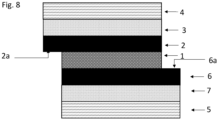
- Such an adhesive tape has at least the layer structure C-T-D-T ⁇ -C ⁇ and can be adapted as a double-sided adhesive tape to a variety of different substrates via the adhesive layers C and C'.
- these can be the same substrates as in the previous embodiments, in which the adhesive tape is a transfer adhesive tape or has the three-layer structure D-T-C.
- Such an adhesive tape can, in particular and advantageously, also be used to later separate substrates A and B from each other, neither of which is electrically conductive.
- either xi.) only the carrier layers T and T' or xii.) the carrier layers T and T' and the second adhesive layer C and/or the third adhesive layer C ⁇ are designed to be electrically conductive.
- a voltage can be applied to xi.) the two electrically conductive carrier layers or xii.) to at least one of the adhesive layers C and C' and to one of the carrier layers or the other adhesive layer.
- xi.) only the carrier layers T and T' are electrically conductive.
- a voltage can be applied to these particularly well, in particular and It is preferred if the carrier layers T and T' extend laterally beyond at least one of the adjacent adhesive layers.
- the carrier layers T and T' and the second and third adhesive layers C and C ⁇ are electrically conductive.
- Such a structure has the advantage that the voltage can be applied to the adhesive layers C and C ⁇ .
- a lateral projection of the carrier layers T and T' is not necessary.
- the adhesive tape can therefore be produced in a simple manner, in particular since the layers C, T, D, T' and C' can be punched together.
- the adhesive tape according to the embodiments described above consists of the five layers C, T, D, T' and C'.
- the term five-layer composite C-T-D-T ⁇ -C ⁇ is also used in the context of the present application.
- the electrically conductive substrate of all embodiments can be, for example, a metal housing from a mobile phone.
- the electrically non-conductive substrate of all embodiments can in particular be a housing made of a non-conductive material, such as plastic, or a battery or other non-electrically conductive components, such as loudspeakers.
- a further object of the present invention is the use of the adhesive tape according to the invention for bonding components in electronic devices, automobiles, medical devices and dental devices.
- the carrier layers T as well as T and T' of all the above-mentioned embodiments are electrically conductive.
- the term “electrically conductive carrier layer” or just “carrier layer” is used. Depending on the above embodiments, this refers to the carrier layer T or the carrier layers T and T'.
- the carrier layers T and T' are independent of each other and can be identical or different.
- the electrically conductive carrier layer comprises at least one metal.
- the metal is selected from the group consisting of copper, nickel, zinc, tin, silver, gold, aluminum, iron, chromium and alloys of these metals.
- the metal is selected from the group consisting of aluminium, copper and nickel.
- the electrically conductive carrier layer has a layer thickness, measured in the z-direction, i.e. parallel to the stacking direction of the layer arrangement, of 10 nm (nanometers) to 50 ⁇ m (micrometers).
- the electrically conductive carrier layer comprises a) at least one metal foil, preferably an aluminum foil, and/or b) at least one electrically conductive textile comprising at least one metal, preferably selected from the group consisting of copper and nickel, and/or c) one or more layers of at least one vapor-deposited metal, preferably selected from the group consisting of copper and aluminum, and/or d) at least one grid made of metal and/or e) a metal-vapor-deposited foil.
- layer T contains a combination of two or more of the above-mentioned possibilities.
- Metal foils such as, for example and preferably, aluminum foils, are known to those skilled in the art.
- the metal foil for example and preferably the aluminum foil, preferably has a layer thickness, measured in the z-direction, i.e. parallel to the stacking direction of the layer arrangement, of 5 to 50 ⁇ m, particularly preferably of 10 to 30 ⁇ m.
- Electrically conductive textiles are known to those skilled in the art, particularly under the English term “conductive mesh”.
- This is a textile fabric, for example made of PET (polyethylene terephthalate), which is coated with a metal, for example copper and/or nickel, which makes the fabric electrically conductive.
- metals can be vapor-deposited directly as a monolayer or multiple layers onto surfaces, such as the surface of an adhesive layer here.
- the electrically conductive carrier layer can be provided by vapor deposition of metal onto the adhesive layer D or the adhesive layer C or the adhesive layer C ⁇ .
- Metal grids of different dimensions are known to the person skilled in the art.
- Metal grids with suitable layer thicknesses can be produced, for example, by a layer of appropriately thin metal threads or by punching at least one film of appropriate layer thickness.
- a non-conductive film is vaporized with metal in order to make it electrically conductive.
- the material of the film can in principle be selected from all materials that are suitable for being vaporized with metal and used as a carrier film in adhesive tapes.
- the material is selected in particular from polyesters and polyolefins, although a mixture of several materials is also conceivable.
- Polyethylene terephthalate (PET) and polyethylene naphthalate (PEN) are particularly preferred as polyesters.
- Polyolefins are particularly preferred, such as polypropylene (PP) and polyethylene (PE).
- the material of the film is selected from the group consisting of PET, PEN, PE, PP.
- the film is made of PET (polyethylene terephthalate).
- PET polyethylene terephthalate
- Such a film is dimensionally stable and therefore easy to process without significantly stretching or tearing. This makes it possible to permanently apply a homogeneous and gapless metal layer so that electrical conductivity, particularly in the z-direction, is permanently guaranteed across the entire film.
- At least one electrically conductive carrier layer T or at least two electrically conductive carrier layers T and T' are present, it is preferred that these extend laterally beyond at least one adjacent adhesive layer in at least one direction of extension of the layer plane and thus have a lateral projection. A voltage can then be applied to this lateral projection in a simple manner.
- the lateral projections of the electrically conductive carrier layers T and T ⁇ are arranged spatially separated from one another according to advantageous embodiments. This makes it easier to apply a voltage to these two projections.
- this carrier layer only projects laterally beyond an adjacent adhesive layer in at least one direction of extension of the layer plane and that the other adhesive layer serves as a mechanical support for this metal layer.
- the metal layer has no actual carrier function. Instead, the other adhesive layer acts as a carrier for the metal layer.
- the term carrier layer for the metal layer is retained in these embodiments.
- the layer thickness of the layer T in this case is preferably greater than or equal to 10 nm (nanometers), preferably 50 to 200 nm.
- the electrically conductive carrier layer T or T and/or T' has a) at least one metal foil, preferably an aluminum foil, and/or b) at least one electrically conductive textile comprising at least one metal, preferably selected from the group consisting of copper and nickel, and/or d) at least one grid made of metal and/or e) a metal-vaporized film, and projects beyond the first adhesive layer D and the second adhesive layer C or the first adhesive layer D and the second adhesive layer C and/or the first adhesive layer D and the third adhesive layer C ⁇ in at least one direction of extension.
- This allows tension to be applied to the carrier layer in a simple and safe manner.
- the adhesive tape can be produced in a comparatively simple manner.
- the electrically conductive carrier layer T or T and/or T' has one or more layers, preferably one layer, of at least one vapor-deposited metal, preferably selected from the group consisting of copper and aluminum.
- the electrically conductive carrier layer T or T and/or T' e) has a metal-vaporized film and projects beyond the first adhesive layer D in at least one direction of extension.
- the film is metal-vaporized on one surface in particular and the respective carrier layer is bonded to the first adhesive layer D, and thus to the electrically detachable layer, via the metallized surface. This allows a voltage to be applied to the carrier layer in a simple and safe manner.
- lateral projection refers to any type of lateral projection of the layer or layers in question and means that the layer in question extends further than the reference layer, particularly in the "xy” plane and thus laterally - perpendicular to the stacking direction.
- lateral extension or “lateral extension section” are also used in the context of the present invention.
- lateral here refers to any extension direction of the layer plane "xy" perpendicular to the stacking direction of the layers "z".
- the term is therefore particularly independent of the geometric shape of the adhesive tape in the "xy" plane, which can be, for example, a rectangle, as is usual for adhesive tapes (see above), but also a square or a circle.
- the adhesive layers C or C and C' can in principle be based on the same materials as the adhesive layer D, whereby the adhesives of the layers C or C and C' do not have to contain any electrolytes, but can. Preferably, the layers C or C and C' do not contain any electrolytes.
- the adhesive layer C is electrically conductive.
- the adhesive layer C and/or the adhesive layer C' of the five-layer composite C-T-D-T'-C' can also be designed to be electrically conductive.
- the term “electrically conductive adhesive layer” is used at appropriate points. Depending on the above embodiments, this refers to the adhesive layer C or the adhesive layers C and/or C'. Furthermore, for the sake of simplicity, the expression “the adhesive layers C or C and/or C'” is used, which means the respective layers in the described embodiments of the adhesive tape comprising at least the three-layer composite or at least the five-layer composite.
- the adhesive layers C and C' are independent of one another and can be the same or different from one another.
- the electrically conductive adhesive layer preferably contains at least one metal, such as in particular nickel, copper, silver, preferably in the form of electrically conductive metal particles and/or metallized particles, particularly preferably metal particles.
- Metallized particles are in particular and preferably glass or polymer particles which are metallized with at least one metal, so that the previously electrically non-conductive particles are made electrically conductive by the metallization.
- the electrically conductive adhesive layer contains electrically conductive particles selected from the group consisting of nickel particles, copper particles and silver-plated copper particles.
- the electrically conductive adhesive layer contains nickel particles.
- the electrically conductive adhesive layer preferably contains 5 to 40% by weight, particularly preferably 20 to 40% by weight, very particularly preferably 25 to 35% by weight, of electrically conductive particles, in particular metal particles and/or metallized particles, based on 100% by weight, based on 100% by weight of polymers and adhesive resins contained.
- the electrically conductive particles should preferably not be, or not significantly larger, than the respective thickness of the electrically conductive adhesive layer in the z direction, measured using a light microscope.
- the electrically conductive particles preferably have an average particle size of 1 to 10 ⁇ m, particularly preferably 1 to 6 ⁇ m, again preferably 3 to 5 ⁇ m, such as in particular 4 ⁇ m.
- the electrically conductive adhesive layer is in particular electrically conductive at least in the z-direction.
- the electrically conductive adhesive layer can also be electrically conductive in the xy plane. If the electrically conductive adhesive layer is designed to be electrically conductive only in the z direction, but not necessarily in the xy direction, a smaller amount of these materials is required according to preferred embodiments in which a metal, in particular metal particles, are added to achieve electrical conductivity. This optimizes the adhesive in terms of the required conductivity, adhesive strength, flow behavior and costs.
- a layer is considered to be "electrically conductive” in particular if the resistance is less than 1 ohm, measured in the respective direction, here in particular in the z-direction, according to the standard MIL-DTL-83528C.
- the adhesive layers C or C and/or C ⁇ are poly(meth)acrylate-based, like the adhesive layer D. All of the above Details on the definition and type and quantity of poly(meth)acrylate-based or poly(meth)acrylates.
- the same poly(meth)acrylate is used in the adhesive layers C or C and/or C' as in the adhesive layer D.
- a polymer is used in the adhesive layers C or C and/or C ⁇ which is different from the poly(meth)acrylate used in the adhesive layer D.
- the properties of the conductive layer to be particularly well adapted to the substrate(s) that are bonded via the adhesive layer C or C and/or C ⁇ . Since the adhesive layer C or C and/or C ⁇ preferably does not contain or need not contain an electrolyte such as an ionic liquid, the components do not have to be adapted to this.
- a poly(meth)acrylate which is different from the poly(meth)acrylate used in the adhesive layer D is used in the adhesive layers C or C and/or C ⁇ .
- the adhesive layers C or C and/or C ⁇ contain at least one vinylaromatic block copolymer.
- the adhesive layers C or C and/or C' are based on vinylaromatic block copolymer(s), i.e., according to these embodiments, vinylaromatic block copolymers are the main polymers in the adhesive layer and are present here at 70 to 100% by weight, based on 100% by weight of polymers present in layer C.
- Any adhesive resins contained in the adhesive layer are not counted towards the 100% by weight of polymers contained in this calculation.
- the vinylaromatic block copolymer(s) may in principle be any type known to the person skilled in the art.
- the vinylaromatic block copolymers preferably have the structure AB, ABA and/or (AB) n X, where X is a residue of a coupling reagent or initiator and n is greater than or equal to 2.
- the vinylaromatic block copolymer(s) have the structure A-B-A, optionally in admixture with portions of A-B, the latter representing the diblock portion.
- the vinylaromatic block copolymer(s) are present as a mixture of polymers of structure A-B-A with polymers of structure A-B.
- the A blocks represent the blocks made from vinyl aromatic monomers.
- the blocks A are produced from a polymerization mixture containing at least styrene and ⁇ -methylstyrene, preferably produced from a polymerization mixture containing at least styrene.
- the blocks A are blocks produced from styrene and thus polystyrene blocks.
- the blocks B represent the remaining blocks of the block copolymer.
- the blocks B are preferably produced from a polymerization mixture containing monomers of 1,3-dienes and isobutylene, more preferably produced from a polymerization mixture containing butadiene and/or isoprene.
- the blocks B are very particularly preferably blocks produced from butadiene and thus polybutadiene blocks.
- the vinylaromatic block copolymer(s) are particularly preferably styrene block copolymer(s), in turn preferably styrene-butadiene block copolymers of the structure A-B-A and optional proportions of A-B.
- the pressure-sensitive adhesive layer comprises a mixture of at least two styrene-butadiene block copolymers as vinylaromatic block copolymer, wherein a first block copolymer has a diblock proportion A-B of 50 to 85% and a second block copolymer has a diblock proportion A-B of 5 to 35%.
- the diblock content is determined by GPC and, as is known to those skilled in the art, can be specifically adjusted by choosing suitable manufacturing processes.
- the weight average molecular weight distribution Mw (according to GPC) of the A-B-A polymer strands of the vinylaromatic block copolymer(s) present is from 50,000 g/mol to 300,000 g/mol, particularly preferably from 80,000 to 180,000 g/mol.
- the adhesive layers C and C' can be the same or different from each other.
- one of the adhesive layers, for example C can be composed of an acrylate-based adhesive, while the other layer, in the same example C ⁇ , is composed of an adhesive based on vinyl aromatic block copolymer(s).
- the adhesive layers C or C and/or C ⁇ comprise at least one adhesive resin, in particular if they are based on vinylaromatic block copolymers as main polymers.
- an “adhesive resin” is understood to mean an oligomeric or polymeric resin which increases the adhesion (the tack, the inherent stickiness) of the adhesive layer in comparison to the adhesive layer which does not contain any adhesive resin but is otherwise identical.
- the at least one adhesive resin preferably has a weight-average molecular weight M w of 400 to 15,000 g/mol, particularly preferably 400 to 5,000 g/mol, very particularly preferably 500 to 2,000 g/mol.
- the at least one adhesive resin is selected from the group consisting of non-hydrogenated, partially or fully hydrogenated resins based on rosin or rosin derivatives, hydrogenated polymers of dicyclopentadiene, non-hydrogenated, partially, selectively or fully hydrogenated hydrocarbon resins based on C-5, C-5/C-9 or C-9 monomer mixtures and polyterpene resins based on ⁇ -pinene and/or ⁇ -pinene and/or ⁇ -limonene.
- the adhesive of the adhesive layers C or C and/or C ⁇ may further contain other conventional additives, such as plasticizers and fillers.
- the adhesive of the adhesive layers C or C and/or C' is also foamed.
- the foaming of the adhesive of the adhesive layers C or C and/or C' is also produced by expanding expandable microballoons.
- the adhesive of the adhesive layers C or C and/or C' is also foamed, the foaming being produced by means of microballoons, the microballoons having a layer of silicate or aluminosilicate on their surface and preferably being mixed into the adhesive as expandable microballoons.
- the adhesive of the adhesive layer D is a pressure-sensitive adhesive and the adhesive layer D is therefore preferably a pressure-sensitive adhesive layer D.
- the adhesive of the adhesive layers C or C and/or C ⁇ is not a pressure-sensitive adhesive.
- the adhesive of the adhesive layers C or C and C' is a pressure-sensitive adhesive and the adhesive layer C or C and C' is thus a pressure-sensitive adhesive layer.
- the adhesive tape according to the invention is a pressure-sensitive adhesive tape.
- a pressure-sensitive adhesive is understood, as is generally the case, to be a substance that is permanently tacky and adhesive, particularly at room temperature.
- a characteristic of a pressure-sensitive adhesive is that it can be applied to a substrate by pressure and remains adhered to there, whereby the pressure to be applied and the duration of this pressure are not defined in more detail.
- the application of a short-term, minimal pressure which does not go beyond a light touch for a brief moment, is sufficient to achieve the adhesive effect; in other cases, a longer-term exposure to high pressure may also be necessary.
- Pressure-sensitive adhesives have special, characteristic viscoelastic properties that lead to their permanent stickiness and adhesive ability. They are characterized by the fact that when they are mechanically deformed, both viscous flow processes and the build-up of elastic restoring forces occur. The proportions of both processes are in a certain relationship to one another, depending on the precise composition, structure and degree of cross-linking of the pressure-sensitive adhesive, as well as on the speed and duration of the deformation and on the temperature.
- the proportion of viscous flow is necessary to achieve adhesion. Only the viscous components, caused by macromolecules with relatively high mobility, enable good wetting and good flow onto the substrate to be bonded. A high proportion of viscous flow leads to high adhesive strength (also known as tack or surface stickiness) and thus often to high adhesive strength. Strongly cross-linked systems, crystalline or glass-like solidified polymers are generally not adhesive or at least only slightly adhesive due to the lack of flowable components.
- the proportional elastic restoring forces are necessary to achieve cohesion. They are caused, for example, by very long-chained and strongly entangled macromolecules as well as by physically or chemically cross-linked macromolecules and enable the transfer of the forces acting on an adhesive bond. They lead to an adhesive bond resisting a force acting on it. can withstand continuous loading, for example in the form of permanent shear loading, to a sufficient extent over a longer period of time.
- the storage modulus (G') and loss modulus (G") which can be determined using Dynamic Mechanical Analysis (DMA, according to DIN EN ISO 6721), can be used.
- G' is a measure of the elastic component
- G" a measure of the viscous component of a material. Both quantities depend on the deformation frequency and the temperature.
- the values can be determined using a rheometer.
- the material to be tested is subjected to a sinusoidal oscillating shear stress in a plate-plate arrangement, for example.
- the deformation is measured as a function of time and the temporal offset of this deformation compared to the introduction of the shear stress. This temporal offset is referred to as the phase angle ⁇ .
- a substance is generally considered to be pressure-sensitively adhesive and is defined as pressure-sensitively adhesive in the sense of the invention if, at room temperature, here by definition at 23°C, in the deformation frequency range from 10° to 10 1 rad/sec, G' is at least partly in the range from 10 3 to 10 7 Pa and if G" is also at least partly in this range.
- Partly means that at least one section of the G' curve is within the window spanned by the deformation frequency range from 10° to 10 1 rad/sec (abscissa) and the range of G' values from 10 3 to 10 7 Pa (ordinate). This applies accordingly to G".
- the pressure-sensitive adhesive has a storage modulus G' and a loss modulus G" in the range from 10 3 to 10 7 Pa, determined in accordance with DIN EN ISO 6721, in the deformation frequency range from 10 0 to 10 1 rad/sec at 23 °C.
- the monomers on which the polymers underlying the PSA are based, as well as any other components of the PSA that may be present, are selected in such a way that the PSA has a glass transition temperature (according to DIN 53765) below the application temperature (i.e. usually below room temperature (23 °C)).
- the temperature range in which a polymer mass can form pressure-sensitive adhesives can be extended. properties, can be enlarged and/or shifted.
- the application area of the pressure-sensitive adhesives can thus be optimized by adjusting the flowability and cohesion of the mass.
- the pressure-sensitive adhesive preferably has a glass transition temperature of ⁇ 23 °C, determined according to DIN 53765.
- hot melt adhesives e.g. based on polyamides, polyurethanes or modified polyethylenes, do not exhibit any tack at room temperature (23 °C), even in hot melt adhesive compositions.
- the provision of the first adhesive according to step A1) is carried out in particular by providing at least one polymer, which can optionally contain further components.
- the list of steps A2) to A5) does not necessarily represent a chronological order.
- the electrolyte such as in particular at least one ionic liquid, can be added to the adhesive first and only then the expandable microballoons can be added.
- adhesive layer D applies to the adhesive, the electrolyte and the pre-expanded microballoons.
- the list of steps X2) to X5) does not necessarily represent a chronological order.
- the electrolyte such as in particular at least one ionic liquid, can be added to the adhesive first and only then can the pre-expanded microballoons be added.
- the adhesive is formed into a layer by known methods, in particular by spreading.
- one or more drying steps may be carried out if necessary.
- the provision of the second adhesive layer C according to step B) is carried out in particular by providing at least one further adhesive.
- the adhesive is formed into a layer by known methods, in particular by spreading.
- one or more drying steps may be carried out if necessary.
- step D) is carried out in a manner known to those skilled in the art, wherein the layers are placed on top of one another in such a way that a layer composite DTC is obtained as a double-sided adhesive tape, wherein T is arranged between D and C.
- step C The provision of the carrier layer T according to step C) can be carried out in various ways, as already explained above.
- a metal foil in particular an aluminum foil, and/or b) an electrically conductive net and/or d) at least one grid made of metal and/or e) a metal-coated PET film is placed between layers D and C.
- metal particles can be vapor-deposited directly onto the surface of the adhesive layer D or C.
- the foaming of the adhesive layer D according to process step E) can take place before the lamination according to step D) or after it.
- expandable microballoons are also added to the adhesive of the adhesive layer C when it is provided according to step B).
- the expansion is particularly and preferably achieved by heating the layer or layers to be foamed to the appropriate temperature necessary for the expansion of the microballoons used.
- step E) takes place after the lamination according to step D), since layers D and C can thus be heated and thus foamed at the same time, saving time and energy.
- the process for producing the adhesive tape in the embodiment of the five-layer composite comprises analogous steps, wherein additionally the layers T' and C' are provided and also laminated into the composite.
- the adhesive tape according to the invention is in particular a double-sided adhesive tape in which, depending on the embodiment, two surfaces of the adhesive layer D (transfer adhesive tape) or one surface the first adhesive layer D and a surface of the second adhesive layer C (three-layer composite DTC) or a surface each of the adhesive layers C and C ⁇ (five-layer composite CTDT ⁇ -C ⁇ ) are each available for bonding substrates.
- the outer, exposed surfaces of the adhesive layers of the adhesive tape according to the invention can advantageously be equipped with anti-adhesive materials such as a release paper or a release film, also called a liner.
- a liner can also be a material with an anti-adhesive coating on at least one side, preferably on both sides, such as material siliconized on both sides.
- a liner, or more generally, a temporary carrier is not a component of an adhesive tape, but only an aid for its production, storage and/or for further processing by punching.
- a liner is not firmly connected to an adhesive layer, but rather functions as a temporary carrier, i.e. as a carrier that can be removed from the adhesive layer.
- “Permanent carriers” are synonymously referred to in the present application as simply "carriers”.
- the thickness of the individual adhesive layer(s) is preferably from 15 to 150 ⁇ m, particularly preferably from 20 to 100 ⁇ m, very particularly preferably from 25 to 70 ⁇ m.
- the adhesive layers D and C or D and C as well as D and C' have different layer thicknesses according to preferred embodiments, the thickness of the adhesive layer D being, for example, less than that of the adhesive layers C or C and C'.
- the layers D and C or D, C and C ⁇ have the same layer thickness.
- the adhesive layer D 1 is connected to the carrier layer T 2 via one of its surfaces.
- the second adhesive layer C 3 is arranged on the surface of the carrier layer T opposite the layer D.
- the layer composite representing a double-sided adhesive tape, in which one surface of the adhesive layer D and one surface of the second adhesive layer C are each available for bonding.
- Fig. 2 a preferred embodiment of the invention is shown.
- the electrically conductive carrier layer T 2 projects laterally beyond the adhesive layer D 1 and the second adhesive layer C 3 in at least one direction of extension of the layer plane, so that the electrically conductive carrier layer T 2 has a projection with at least one free surface 2 a.
- Fig. 3 A further preferred embodiment of the invention is shown.
- the electrically conductive carrier layer T 2 projects laterally beyond the adhesive layer D 1 in at least one direction of extension of the layer plane, so that the electrically conductive carrier layer T 2 has a projection with a free surface 2 a.
- the adhesive layer C 3 is designed such that it also has a projection relative to the layer D 1.
- the carrier layer T 2 is in particular a PET film coated on one side with aluminum, the aluminized side being bonded to the layer D 1.
- Fig. 4 is a schematic representation of the bonded composite according to the invention in a preferred embodiment.
- the adhesive tape is arranged via the adhesive layer D 1 on a surface of the first substrate A 4, wherein the first substrate is electrically conductive.
- the adhesive tape is arranged via the second adhesive layer C 3 on a surface of a second substrate B 5.
- Fig. 4 It is also shown by way of example that the electrically conductive carrier layer T 2 projects laterally beyond the adhesive layer D 1 in at least one direction of extension of the layer plane, so that the electrically conductive carrier layer T has a projection with a free surface 2 a. A voltage can now be applied across this free surface 2 a, as in the schematic representation according to Fig. 5 shown.
- Fig. 7 is a further schematic representation of the bonded composite according to the invention in a preferred embodiment.
- the adhesive tape is arranged over the adhesive layer C 3 on a surface of the first substrate A 4.
- the adhesive tape is arranged via the third adhesive layer C ⁇ 7 on a surface of a second substrate B 5.
- the electrically removable adhesive layer D 1 and two electrically conductive carrier layers T 2 and T' 6, with the layer D 1 being arranged between the carrier layers.
- Fig. 7 It is also shown by way of example that the electrically conductive carrier layer T 2 and the electrically conductive carrier layer T' 6 each project laterally beyond the adhesive layer D 1 in at least one direction of extension of the layer plane, so that the electrically conductive carrier layer T has a projection with a free surface 2a and the electrically conductive carrier layer T' has a projection with a free surface 6a.
- Fig. 8 is a further schematic representation of the bonded composite according to the invention in a preferred embodiment, which corresponds to the representation according to Fig. 7 is similar. Unlike Fig. 7 However, the projections of the electrically conductive carrier layer T 2 and the electrically conductive carrier layer T' 6 point in different directions, so that the resulting free surfaces of these layers 2a and 6a are spatially separated.
- a voltage can now be applied across these free surfaces 2a and 6a, analogous to Figure 5
- the voltage can be applied to surfaces 2a and 6a, so that none of the substrates A and B needs to be electrically conductive.
- Applying the voltage causes the electrolyte to migrate, in particular the anions and cations of an ionic liquid to separate, in the adhesive layer D 1. This greatly reduces the adhesion of the adhesive layer D 1 to the carrier layers T 2 and/or T' 6 and causes these layers to separate from one another. In particular, detachment occurs at the layer to which the negative pole is applied.
- Fig. 1 to 8 are, as stated, schematic representations.
- the layer thicknesses of the individual layers D, T and C can differ from one another.
- the substrates A and B are only shown schematically as additional layers. These can of course have any other spatial geometry.
- a combination of columns of the type PSS-SDV, 5 ⁇ m, 10 3 ⁇ as well as 10 5 ⁇ and 10 6 ⁇ , each with 8.0 mm * 300 mm, is used for separation (columns from Polymer Standards Service; detection using a Shodex RI71 differential refractometer). The flow rate is 1.0 ml per minute. Calibration is carried out for polar molecules such as the starting materials of polyurethane against PMMA standards (polymethyl methacrylate calibration) and otherwise against PS standards (polystyrene calibration).
- the adhesive resin softening temperature is carried out according to the relevant methodology known as Ring & Ball and standardized according to ASTM E28.
- the thickness of an adhesive layer can be determined by determining the thickness of a section of such an adhesive layer applied to a liner, defined in terms of its length and width, minus the (known or separately ascertainable) thickness of a section of the same dimensions of the liner used.
- the thickness of the adhesive layer can be determined using commercially available thickness measuring devices (probe testers) with an accuracy of less than 1 ⁇ m deviation. If thickness fluctuations are determined, the average value of measurements at at least three representative locations is given, i.e. in particular not measured at creases, folds, spots and the like.
- the thickness of an adhesive tape can be determined analogously using commercially available thickness measuring devices (probe testers) with an accuracy of less than 1 ⁇ m deviation. If thickness fluctuations are detected, the average value of measurements at at least three representative locations is given, i.e. in particular not measured at creases, folds, spots and the like.
- the measurement results are given in N/cm and are averaged from three measurements.
- the adhesive layer D is provided as follows:
- a base polymer based on acrylates is produced as follows: A conventional reactor for radical polymerization is filled with 48 kg of 2-ethylhexyl acrylate, 48 kg of n-butyl acrylate, 4 kg of acrylic acid and 66 kg of petrol/acetone (70/30). After passing nitrogen gas through the reactor for 45 minutes while stirring, the reactor is heated to 58 °C and 50 g of AIBN are added. The external heating bath is then heated to 75 °C and the reaction is carried out at a constant external temperature. After 1 h, another 50 g of AIBN are added and after 4 h, the mixture is diluted with 20 kg of petrol/acetone mixture.
- the reaction is reinitiated with 150 g of bis-(4-tert-butylcyclohexyl)peroxydicarbonate. After 22 h of reaction time, the polymerization is stopped and cooled to room temperature.
- ionic liquid 1-ethyl-3-methylimidazolium bis(trifluoromethylsulfonyl)imide EMIM-TFSI
- 4 wt.% polyethylene glycol 400 Sigma Aldrich
- 0.1 wt.% of the crosslinker Erysis GA 240 is added based on the amount of acrylate polymer without solvent.
- Matsumoto FN100SSD microballoons 1% by weight is added to layer D, based on the total amount of adhesive. These have a silicate coating and have a size of approximately 20 ⁇ m after expansion.
- the resulting mixture is then spread with a spreader bar onto a PET liner equipped with a separating silicone, so that after drying at 110°C a layer thickness of 45 ⁇ m is obtained.
- the adhesive layer C is provided as follows: The acrylate base polymer is prepared as described above for the adhesive layer D. 0.1 wt.% of the crosslinker Erysis GA 240 is added, based on the amount of acrylate polymer without solvent.
- An aluminized PET film with a layer thickness of 25 ⁇ m is provided as electrically conductive carrier layer T.
- An "aluminized PET film” is a PET film that has aluminum vapor-deposited on one surface.
- the resulting layer thickness of the aluminum layer in the z-direction is approximately 40 nm.
- the second adhesive layer C is then spread onto the non-metallized side of the PET film using a spreader bar.
- the resulting layer thickness of this adhesive layer C is then again 45 ⁇ m.
- the back is covered with a liner based on a siliconized PET film.
- the electrically removable adhesive layer D is then laminated onto the aluminum side of the composite consisting of carrier layer T and adhesive layer C, resulting in an adhesive tape with the layer arrangement DTC.
- the adhesive layer C together with the electrically conductive carrier layer T protrudes beyond the adhesive layer D in at least one direction, ideally by approx. 1 cm.
- the total thickness of the adhesive tape is 115 ⁇ m.
- the adhesive tape which still has a siliconized liner on both sides, is then heated for 1 minute at 180°C, which causes the microballoons to expand and the adhesive layers D and C to foam.
- the total thickness of the adhesive tape without the siliconized liner is then 145 ⁇ m.
- the adhesive strength of the composite to steel is 4.0 N/cm on the electrically removable side, i.e. on the free surface of adhesive layer D, and 6.5 N/cm on adhesive layer C.
- the adhesive tape is bonded as follows.
- the removable side of the adhesive tape is bonded to a conductive surface, in this case a steel plate as a representative for the conductive substrate A.
- a plastic part made of polystyrene is bonded to the opposite side as a representative for the substrate B.
- a voltage is applied and in such a way that the cathode is placed on the steel plate and the anode on the protrusion of the carrier foil T.
- the voltage is 12 V and is applied for 1 minute.
- the sample is then immediately clamped into the measuring apparatus and the adhesive strength of the adhesive layer D of the adhesive tape on the steel plate is measured again.
- the adhesive strength is now only 0.5 N/cm.
- the electrically removable adhesive of the adhesive layer D is modified by shifting the ratio of the acrylates used.
- EMIM-FSI 1-ethyl-3-methylimidazolium bis(fluorosulfonyl)imide
- 0.1 wt.% of the crosslinker Erysis GA 240 is added based on the amount of acrylate polymer without solvent.
- This mass is spread onto a siliconized liner with a layer thickness of 45 ⁇ m.
- the adhesive layer C consists of a mass based on styrene block copolymers, namely a mass consisting of 33% Kraton D1118, 17% Kraton D1102 and 50% Piccolyte A115.
- the mass is spread with a resulting layer thickness of 45 ⁇ m onto an aluminized PET film with a thickness of 25 ⁇ m as carrier layer T, as in Example 1.
- a siliconized PET film is laminated as a liner onto the free adhesive side.
- the electrically removable layer D is laminated again onto the still free, metallized side of the carrier layer T, whereby the carrier layer T together with the adhesive layer C projects beyond the removable adhesive layer D in at least one direction.
- the resulting adhesive tape is heated again at 180°C for 1 min to expand the microballoons in the adhesive layers D and C.
- the total thickness of the adhesive tape without the two liners is 145 ⁇ m.
- the resulting adhesive tape has an adhesive strength on steel of 3.8 N/cm on the electrically removable side, i.e. on the free surface of the adhesive layer D, and of 8.4 N/cm on the other side, i.e. on the free surface of the adhesive layer C.
- Bonding to test removability is carried out as described above. After applying a voltage of 12 V for 1 minute, the adhesive strength of the removable side, i.e. the adhesive layer D, of the adhesive tape on the steel is measured again: the adhesive strength drops to 0.3 N/cm.
- Example 1 For the electrically removable layer D, the same adhesive as in Example 1 according to the invention is used, except that the microballoons are replaced by Expancel 920 DU20 microballoons from Nouryon, which have a calcium carbonate coating.
- the layer T and the adhesive layer C also remain unchanged from Example 1 according to the invention.
- the individual layers are laminated together as described above and then heated to 160°C for 1 minute. This shows that uniform foaming of the microballoons is not possible; the foaming is significantly lower. Under the microscope, it can be seen that the microballoons are already largely destroyed. There appears to be an incompatibility of the microballoons with a calcium carbonate coating with the ionic liquid.
- the adhesive strength of the adhesive layer D to substrates such as steel is high before the voltage is applied and is only reduced to such a low value when the voltage is applied that the substrates can be separated from one another quickly and without great effort.
Landscapes
- Chemical & Material Sciences (AREA)
- Organic Chemistry (AREA)
- Chemical Kinetics & Catalysis (AREA)
- Health & Medical Sciences (AREA)
- Medicinal Chemistry (AREA)
- Polymers & Plastics (AREA)
- Inorganic Chemistry (AREA)
- Adhesives Or Adhesive Processes (AREA)
- Adhesive Tapes (AREA)
Priority Applications (5)
| Application Number | Priority Date | Filing Date | Title |
|---|---|---|---|
| EP23169916.6A EP4455234A1 (fr) | 2023-04-25 | 2023-04-25 | Ruban adhésif, composite collé et procédé de libération électrique du composite collé |
| JP2024042074A JP7789110B2 (ja) | 2023-04-25 | 2024-03-18 | 接着テープ、接着された接合体、及び接着された接合体を電気的に剥離するための方法 |
| EP24168624.5A EP4455237A1 (fr) | 2023-04-25 | 2024-04-05 | Ruban adhésif, composite collé et procédé de libération électrique du composite collé |
| KR1020240053988A KR20240157565A (ko) | 2023-04-25 | 2024-04-23 | 점착 테이프, 점착된 복합재 및 상기 점착된 복합재를 전기적으로 분리하는 방법 |
| CN202410496107.3A CN118834608A (zh) | 2023-04-25 | 2024-04-24 | 胶带、经粘合的复合物和用于经粘合的复合物的电分离方法 |
Applications Claiming Priority (1)
| Application Number | Priority Date | Filing Date | Title |
|---|---|---|---|
| EP23169916.6A EP4455234A1 (fr) | 2023-04-25 | 2023-04-25 | Ruban adhésif, composite collé et procédé de libération électrique du composite collé |
Publications (1)
| Publication Number | Publication Date |
|---|---|
| EP4455234A1 true EP4455234A1 (fr) | 2024-10-30 |
Family
ID=86226720
Family Applications (2)
| Application Number | Title | Priority Date | Filing Date |
|---|---|---|---|
| EP23169916.6A Withdrawn EP4455234A1 (fr) | 2023-04-25 | 2023-04-25 | Ruban adhésif, composite collé et procédé de libération électrique du composite collé |
| EP24168624.5A Pending EP4455237A1 (fr) | 2023-04-25 | 2024-04-05 | Ruban adhésif, composite collé et procédé de libération électrique du composite collé |
Family Applications After (1)
| Application Number | Title | Priority Date | Filing Date |
|---|---|---|---|
| EP24168624.5A Pending EP4455237A1 (fr) | 2023-04-25 | 2024-04-05 | Ruban adhésif, composite collé et procédé de libération électrique du composite collé |
Country Status (4)
| Country | Link |
|---|---|
| EP (2) | EP4455234A1 (fr) |
| JP (1) | JP7789110B2 (fr) |
| KR (1) | KR20240157565A (fr) |
| CN (1) | CN118834608A (fr) |
Cited By (1)
| Publication number | Priority date | Publication date | Assignee | Title |
|---|---|---|---|---|
| DE102024121139A1 (de) * | 2024-06-11 | 2025-12-11 | Tesa Se | Klebemasse, Klebeband, verklebter Verbund und Verfahren zum elektrischen Lösen des verklebten Verbundes |
Citations (4)
| Publication number | Priority date | Publication date | Assignee | Title |
|---|---|---|---|---|
| EP2500390A1 (fr) * | 2011-03-17 | 2012-09-19 | Nitto Denko Corporation | Ruban adhésif sensible à la pression pour la fixation temporaire d'une pièce électronique |
| JP2020007568A (ja) * | 2014-09-25 | 2020-01-16 | 日東電工株式会社 | 熱剥離型粘着シート |
| EP3363873B1 (fr) | 2015-10-16 | 2021-12-29 | Nitto Denko Corporation | Feuille adhésive double face, corps lié de feuille adhésive double face, et procédé de liaison/séparation vis-à-vis d'adhérés |
| EP4050040A1 (fr) * | 2021-02-26 | 2022-08-31 | Henkel AG & Co. KGaA | Composition adhésive durcissable monocomposant (1k) |
Family Cites Families (2)
| Publication number | Priority date | Publication date | Assignee | Title |
|---|---|---|---|---|
| JP7427235B2 (ja) * | 2020-02-18 | 2024-02-05 | ビッグテクノス株式会社 | 電気剥離性粘着剤組成物、電気剥離性粘着製品及びその剥離方法 |
| EP4194200B1 (fr) * | 2021-03-26 | 2025-08-20 | Lintec Corporation | Feuille adhésive électriquement pelable, et procédé de pelage de celle-ci |
-
2023
- 2023-04-25 EP EP23169916.6A patent/EP4455234A1/fr not_active Withdrawn
-
2024
- 2024-03-18 JP JP2024042074A patent/JP7789110B2/ja active Active
- 2024-04-05 EP EP24168624.5A patent/EP4455237A1/fr active Pending
- 2024-04-23 KR KR1020240053988A patent/KR20240157565A/ko active Pending
- 2024-04-24 CN CN202410496107.3A patent/CN118834608A/zh active Pending
Patent Citations (4)
| Publication number | Priority date | Publication date | Assignee | Title |
|---|---|---|---|---|
| EP2500390A1 (fr) * | 2011-03-17 | 2012-09-19 | Nitto Denko Corporation | Ruban adhésif sensible à la pression pour la fixation temporaire d'une pièce électronique |
| JP2020007568A (ja) * | 2014-09-25 | 2020-01-16 | 日東電工株式会社 | 熱剥離型粘着シート |
| EP3363873B1 (fr) | 2015-10-16 | 2021-12-29 | Nitto Denko Corporation | Feuille adhésive double face, corps lié de feuille adhésive double face, et procédé de liaison/séparation vis-à-vis d'adhérés |
| EP4050040A1 (fr) * | 2021-02-26 | 2022-08-31 | Henkel AG & Co. KGaA | Composition adhésive durcissable monocomposant (1k) |
Non-Patent Citations (1)
| Title |
|---|
| P. E. HINKAMP, POLYMER, vol. 8, 1967, pages 381 |
Cited By (1)
| Publication number | Priority date | Publication date | Assignee | Title |
|---|---|---|---|---|
| DE102024121139A1 (de) * | 2024-06-11 | 2025-12-11 | Tesa Se | Klebemasse, Klebeband, verklebter Verbund und Verfahren zum elektrischen Lösen des verklebten Verbundes |
Also Published As
| Publication number | Publication date |
|---|---|
| EP4455237A1 (fr) | 2024-10-30 |
| KR20240157565A (ko) | 2024-11-01 |
| CN118834608A (zh) | 2024-10-25 |
| JP7789110B2 (ja) | 2025-12-19 |
| JP2024157520A (ja) | 2024-11-07 |
Similar Documents
| Publication | Publication Date | Title |
|---|---|---|
| EP3464497B1 (fr) | Bande autoadhésive | |
| EP3417029B1 (fr) | Bande autoadhésive | |
| DE102013215297A1 (de) | Haftklebemasse | |
| DE102013215296A1 (de) | Haftklebemasse | |
| DE102018200957A1 (de) | Haftklebestreifen mit teilgeschäumter Selbstklebemasse | |
| EP3633002A2 (fr) | Procédé d'application de pièces estampées sur des surfaces ainsi que procédé d'essai correspondant | |
| EP4455237A1 (fr) | Ruban adhésif, composite collé et procédé de libération électrique du composite collé | |
| EP3568446A1 (fr) | Procédé pour coller des profilés sur des surfaces de substrat | |
| DE102020200452A1 (de) | Einseitig schwach oder nicht klebendes Abdichtungsband | |
| DE102022131231B4 (de) | Wiederablösbares Haftklebeband und Verwendung | |
| DE102016223550A1 (de) | Verbundsystem mit schwach klebendem Abdeckmaterial | |
| DE102022100562A1 (de) | Poly(meth)acrylat-basierte Haftklebemassen enthaltend mindestens einen Acrylnitril-Butadien-Kautschuk | |
| WO2019020363A1 (fr) | Masse autoadhésive en forme de ruban, moussée avec des microballons | |
| EP4455236A1 (fr) | Ruban adhésif, composite collé et procédé de libération électrique du composite collé | |
| EP4455238A1 (fr) | Ruban adhésif, procédé de fabrication du ruban adhésif, composite collé et procédé de détachement électrique du composite collé | |
| DE102020215673A1 (de) | Klebeband mit geschäumter Haftklebemasseschicht und Strukturierung auf der Oberfläche | |
| EP4592370A1 (fr) | Ruban adhésif, composite collé et procédé de libération électrique du composite collé | |
| EP4663714A1 (fr) | Matière adhésive, bande adhésive, composite collé et procédé de libération électrique de la matière composite collée | |
| DE102024121139A1 (de) | Klebemasse, Klebeband, verklebter Verbund und Verfahren zum elektrischen Lösen des verklebten Verbundes | |
| WO2026021803A1 (fr) | Substance adhésive, ruban adhésif, composé lié, et procédé de dissolution électrique du composé lié | |
| DE102020215674B4 (de) | Verfahren zur Herstellung eines wiederablösbaren Klebebands mit geschäumter Haftklebemasseschicht und Strukturierung auf der Oberfläche | |
| DE102020205793B4 (de) | Harzseife-modifizierte Haftklebmasse | |
| DE102024121360A1 (de) | Haftklebmasse | |
| EP4506430A1 (fr) | Ruban adhésif, composite collé et procédé de libération électrique du composite collé | |
| WO2025153229A1 (fr) | Ruban adhésif réactif, système de ruban adhésif réactif, assemblage collé et procédé de décollement électrique de l'assemblage collé |
Legal Events
| Date | Code | Title | Description |
|---|---|---|---|
| PUAI | Public reference made under article 153(3) epc to a published international application that has entered the european phase |
Free format text: ORIGINAL CODE: 0009012 |
|
| STAA | Information on the status of an ep patent application or granted ep patent |
Free format text: STATUS: THE APPLICATION HAS BEEN PUBLISHED |
|
| AK | Designated contracting states |
Kind code of ref document: A1 Designated state(s): AL AT BE BG CH CY CZ DE DK EE ES FI FR GB GR HR HU IE IS IT LI LT LU LV MC ME MK MT NL NO PL PT RO RS SE SI SK SM TR |
|
| STAA | Information on the status of an ep patent application or granted ep patent |
Free format text: STATUS: THE APPLICATION HAS BEEN WITHDRAWN |
|
| 18W | Application withdrawn |
Effective date: 20250319 |